❌

Normal view

Scientists Have Made a Sweet Discovery in Interstellar Space, Offering Clues to Mystery of Life’s Origins

15 July 2026 at 12:59

Scientists have discovered an abundance of molecules in the cosmos, but for the first time ever, they were able to detect one in interstellar space very familiar to us here on Earth: sugar. 

The discovery, made in the vast clouds of gas and dust between stars, could help scientists better understand how some of the chemical ingredients necessary for life formed long before Earth existed.

Researchers at the Centro de Astrobiología, part of the Spanish National Research Council (CSIC), identified the sugar molecule erythrulose within the interstellar medium.

Sugars are considered fundamental building blocks of life. On Earth, they play vital biological roles, including forming the backbone of RNA and contributing to the chemistry that ultimately supports DNA, while also serving as an important source of energy. Scientists studying the origins of life have long sought to understand how the first sugars formed, since they are essential ingredients in the molecules associated with life’s earliest development.

“The detection of erythrulose is very exciting because it opens up the possibility of discovering in space other sugars such as ribose, which is part of RNA, and other important molecules for the origin of life,” says Carlos Briones, co-author of the study, in a statement. 

Even so, one major question remains: where did the first biologically important sugars originate?

Previous studies have identified sugars such as ribose and glucose in meteorites and asteroid samples, suggesting that some organic compounds may have been delivered to the early Earth from space. Until now, however, no sugar had been directly detected in the cold molecular clouds where stars and planets form.

The newly identified molecule, erythrulose, was found in the molecular cloud G+0.693−0.027 near the center of the Milky Way. On Earth, erythrulose is a naturally occurring four-carbon ketose sugar.

The discovery was made using highly sensitive radio astronomy observations from the Yebes Observatory’s 40-meter radio telescope and the 30-meter telescope operated by the Institute for Radio Astronomy in the Millimeter Range. Researchers analyzed the unique radio signatures, or spectral fingerprints, emitted by molecules in space.

The team identified 12 spectral lines matching laboratory measurements of erythrulose, confirming the molecule’s presence.

The findings also challenge some existing ideas about how complex molecules form in space. Scientists have generally proposed that interstellar chemistry builds larger molecules by gradually adding carbon atoms. Yet erythrulose proved to be more abundant than related three-carbon sugars that researchers expected would appear first.

“This finding was unexpected, as the prevailing view in astrochemistry is that interstellar molecules grow in size through the sequential addition of carbon atoms,” said Izaskun Jimenez Serra (CAB), the lead author of the recent study. 

Instead, the researchers found that erythrulose could form inside icy dust grains from simpler two-carbon alcohols and aldehydes. These frozen environments may function as natural chemical laboratories, allowing increasingly complex organic molecules to develop over time.

The team estimates that during the Late Heavy Bombardment—roughly 4.1 to 3.8 billion years ago, when Earth experienced intense asteroid and comet impacts—between 500,000 and 50 million tonnes of erythrulose may have been delivered to the planet’s surface.

The discovery adds another piece to the puzzle of life’s origins, suggesting that some of its essential ingredients may have arrived with something surprisingly sweet.

This paper was published in the journal Nature Astronomy.

Chrissy Newton is a PR professional and the founder of VOCAB Communications. She currently appears on The Discovery Channel and Max and hosts the Rebelliously Curious podcast, which can be found on YouTube and on all audio podcast streaming platforms. Follow her on X: @ChrissyNewton, Instagram: @BeingChrissyNewton, and chrissynewton.com. To contact Chrissy with a story, please email chrissy @ thedebrief.org.

Wisdom of the Wise is Foolishness with God

13 July 2026 at 01:26
The mystery of life's origin on Earth remains unsolved. With modern biochemistry tools scientists are no closer to synthesizing life from non-living chemicals despite advanced knowledge and technology, let alone understanding how it could have arisen abiogenetically. The rejection of the Creator has led to foolishness in the wise.

White House appoints Harvard astronomer Avi Loeb to lead new UFO study group

11 July 2026 at 11:00

Harvard astrophysicist Avi Loeb has been appointed as the head of a new White House group to study unidentified anomalous phenomena or UAP, a new catch-all term for UFOs that might appear not just in the air but also in space or underwater. Loeb says the group is focused on evidence, instrumentation, data analysis and collection standards.

The move follows recent Trump administration initiatives to bring more transparency to the topic of UFOs, or UAP. The UAP Science Advisory Council, Loeb explains, was established by the White House, the Pentagon's All-Domain Anomaly Resolution Office (AARO), the Office of the Director of National Intelligence (ODNI), the Federal Bureau of Investigation, and other members of the Intelligence Community.

Loeb co-founded and leads the Galileo Project, designed to bring the search for extraterrestrial technological signatures of extraterrestrial technological civilizations "from accidental or anecdotal observations and legends to the mainstream of transparent, validated and systematic scientific research."

As chair of the just-formed UAP Science Advisory Council, Loeb has built a team of researchers that he describes as "an amazing A-team of exceptional scientists and experts."

Members of the group come from a wide range of disciplines from data science and instrumentation to biology, oceanography, anthropology and psychology.

The council's stated purpose is to help government agencies study the nature of UAP through rigorous scientific methods, with an emphasis on collecting and analyzing higher-quality data rather than relitigating older material that cannot be independently verified.

Meet the team

But first things first.

What is the current membership makeup of Loeb's Council? It's quite a mix of talent to undertake a new look at UAP:

  • Liberty Capito is a professor of practice in data science at the Olin Business School at the Washington University in St. Louis.
  • Carol Cleland is a professor in the Department of Philosophy at the University of Colorado Boulder.
  • Richard Cloete is a computer scientist at Harvard University and a member of Loeb's Galileo Project.
  • Omer Eldadi is in the department of psychology at Reichman University, Herzliya, Israel.
  • Tim Gallaudet is a retired Navy admiral and oceanographer.
  • Robin Hanson is an associate professor of economics at George Mason University statistics and economics.
  • Ross Howard is producer of John Michael Godier's Event Horizon podcast that explores the technosignatures of alien technology. He is also with the Sol Foundation aimed at addressing the UAP issue and preparing society for its social implications.
  • Kevin Knuth is a professor of physics at the University at Albany.
  • Ravi Kopparapu is a NASA Goddard Space Flight Center expert having research interests in extrasolar planet habitability, atmosphere modeling and characterization.
  • Ben Lamm is the co-founder and CEO Of Colossal Biosciences, the world's first de-extinction company.
  • Jacob Haqq Misra, of Blue Marble Space, is a meteorology and astrobiology specialist.
  • Devesh Nandal is a Swiss National Science Foundation postdoctoral fellow at the Center for Astrophysics at Harvard and Smithsonian.
  • Garry Nolan is professor in the Department of Pathology at Stanford University School of Medicine and is executive director of the board of the Sol Foundation.
  • Michael Shermer is the founding publisher of Skeptic magazine and an educator on critical thinking.
  • Peter Skafish is a sociocultural anthropologist and secretary of the Sol Foundation.
  • Matthew Szydagis is an associate professor in the Department of Physics at the University at Albany.
  • Jennice Vilhauer is a clinical psychologist with expertise in quantitative psychology and the psychological dimensions of potential disclosure.

Data-driven, physics-based

Space.com reached out to several of the UAP Council members to get their personal views on this new study approach.

"I expect the council and myself to follow methods and techniques deeply rooted in the scientific principles," said Devesh Nandal.

"The UAP Science council in particular is focused on a data-driven and physics-based approach on the topic of UAP," said Nandal. "We approach this topic with the same rigor we apply in our respective scientific fields and we hope to provide an unbiased analysis on this topic."

Nandal said his role is to help with quantitative data analysis and apply his expertise in astrophysics to help the council decipher the origin of UAPs.

a cross-shaped targeting reticule surrounds a grainy black blur on a grey, grainy background

A "football-shaped" UAP (unidentified anomalous phenomenon) observed by an infrared sensor on a U.S. military platform in 2024. The Pentagon released this observation on May 8, 2026. (Image credit: U.S. Deparment of War)

"My first and foremost passion is in stellar astrophysics where I study the life and death of massive and supermassive stars," Nandal said. "I also find the anomalous nature of UAP sightings to be quite intriguing, and whether these events are of terrestrial or extraterrestrial origin, I am excited to apply my understanding of physics to decipher their true nature," he said.

If such events can be explained using known principles, "that's excellent," Nandal advised, as this gives him a chance to test the laws of physics to explain a phenomenon that is captivating fellow humans.

"If such events are beyond our current understanding, I see this as a brilliant opportunity to learn all that I can about the Universe and share my findings with everyone," Nandal concluded.

Public trust in science

Council member Liberty Capito said she's honored to be a part of the study group.

"Avi is one of the most brilliant scientists of our time and what he has put together, is what I believe to be a blueprint for re-establishing the public's trust in science by having people with vastly different views, beliefs and science on it," Capito said.

From Council member, Robin Hanson: "It's an honor to be invited, and it's a great cause. I worried at first if we could find much useful to do, but it seems that we do have some promising ideas."

Another member of the UAP Council is Carol Cleland, a professor in the Department of Philosophy at the University of Colorado Boulder. She is a Search for Extraterrestrial Intelligence Institute Affiliate and a member of CU Boulder's Center for Astrobiology.

"I anticipate having a council of outside experts will pressure the government to be more open about releasing information and allowing members of the council to interview UAP witnesses," Cleland told Space.com.

Potential positive

Identifying the unidentified deserves a high priority within the U.S. government and the scientific community, explains Loeb.

Nevertheless, for organizations that also continue to diligently sort out what's behind unidentified flying objects (UFOs) in the past and the current UAP tag line, they are taking a cautiously optimistic attitude.

"The involvement of serious, independent scientists is a potential positive development, and the government requires that for any thorough and credible investigation of UAP," said Mark Rodeghier, president and scientific director of the J. Allen Hynek Center for UFO Studies since 1986.

The key issue is not the credentials of the people involved, Rodeghier said, but the structure they are working within.

"If the Council lacks a clear mandate, access to relevant data, a collaborative relationship with those actually grappling with the UAP problem in the government, and then a path for public reporting, its practical value may be quite limited," Rodeghier told Space.com.

a slide showing various different shapes of UFOs reported by US government personnel

A slide released by the Pentagon's All-Domain Anomaly Resolution Office (AARO) in 2023 detailing trends in UAP reports. (Image credit: U.S. Dept. of Defense/AARO)

Wait and see

Robert Powell, an executive board member of the Scientific Coalition for UAP Studies, said he's adopting a "wait and see" attitude regarding the UAP Council at this point in time.

"Since the UAP Council seems to have the ear of some in Congress," Powell told Space.com, "I hope that they will spend some of their time advocating that Congress appropriate funding specific to the study of UAP through the National Science Foundation."

In SCU board meetings, Powell added, they are a strong proponent of making funding available to the scientific community and academia.

"We never know from where a breakthrough may occur in the study of UAP," Powell said, "and the more scientists involved from all areas of research, the better."

“We’ve Replicated in Chemistry What Only Used to be Possible in Biology”: Scientists Have Created the First Fully Synthetic Cell

3 July 2026 at 14:41

Researchers have developed the first entirely artificial cell, made completely from non-living chemical components, which they say is even capable of replicating.

A team of researchers at the University of Minnesota, Twin Cities, College of Biological Sciences, has described their synthetic cell, which they call SpudCell, in a recent preprint. SpudCell marks the first time scientists have replicated elements of life, such as energy use, reproduction, growth, and development, in a synthetic biological organism.

The Secrets of Life

While many mysteries of life and death remain for science, the team’s achievement represents a significant breakthrough, moving a concept once relegated only to science fiction into science fact. The team is hopeful that new solutions to medical and engineering problems will also arise from their achievement.

“This is likely the most exciting project I’ve ever worked on,” said co-author Kate Adamala. “We’ve replicated in chemistry what only used to be possible in biology: the complete set of behaviors of a cell. It proves that the most fundamental functions of life, like growth and replication, do not need a mysterious magical spark.”

synthetic cell SpudCell
Fluorescent microscopy of SpudCell undergoing division (Image Credit: Kate Adamala, Adamala LabCredit: Kate Adamala, Adamala Lab).

The artificial SpudCell performs some of the most complex activities of its biological counterparts, including selection, genome replication, genetically encoded division, resource acquisition via feeding, and growth. 

Like a Cell, Yet Different

Although the synthetic cell copies many biological functions, there are some differences. It lacks the internal scaffolding, called a cytoskeleton, which natural cells use to divide. Instead, SpudCell crowds proteins together on its membrane surface until enough mechanical stress builds up to cause the membrane to split. 

In addition to being slightly different from a biological cell, the team refined SpudCell throughout their research, at one point altering the cell’s genetics to increase fusion protein production. With this change, the cells grew faster and produced more offspring, outcompeting the original variant in five generations. In a demonstration of the system’s selection and competition, the genetically modified advantage further increased when the team changed conditions to make nutrients scarcer.

The cell’s genetic code is relatively simple. There are about three million kilobase pairs in the human genome, and likely around 113 pairs in a single cell. SpudCell contains a mere 90, encoded on seven DNA plasmids, instead of a single chromosome. This encoding solution offers benefits, allowing researchers to program cellular functions more easily by simply touching a single piece of the modular system. They say this will enable them to continue increasing SpudCell’s complexity.

Moving Forward on Synthetic Cells

“This work is just the beginning,” said Adamala, who, along with several partners, is founding a research and engineering institution called Biotic, which will focus on further advancements in synthetic cell research, keeping its findings open source.

“We are showing it’s possible to engineer the basic functions of the cell,” Adamala added. “To fully realize the promise of this technology – to make it robust and practical – we need combined international effort.”

“The role of Biotic is to focus engineering efforts and make them compatible with a shared chassis. SpudCell is that chassis, and with Biotic setting the protocols for collaboration, we are eager to start applying this technology to serious challenges.”

The next steps for Biotic will be to combine SpudCell’s seven DNA plasmids into a single genome and build more molecular machinery. One of the greatest challenges they are preparing to confront is standardization, as many labs use different standards. To achieve true growth in this sector, Biotic aims to develop modular standards that will apply across the entire field.

SpudCell could provide a revolutionary new basis for manufacturing, allowing cells to naturally develop properties that typically require difficult and expensive molecular transformations, and even open up possibilities beyond what those transformations can offer. This could enable major improvements in medicine by using amino acids that are never used in nature.

The paper, “A Chemically Defined Synthetic Cell Capable Of Growth And Replication,” is available in preprint form on bioRxiv.

Ryan Whalen covers science and technology for The Debrief. He holds an MA in History and a Master of Library and Information Science with a certificate in Data Science. He can be contacted at ryan@thedebrief.org, and follow him on Twitter @mdntwvlf.

Why Did the US Government Brief Groups of Christian Pastors About UFOs and Aliens?

26 June 2026 at 03:43
In February 2026, President Trump directed the U.S. government to release documents on UFOs, UAPs, and alien life. Questions arise about the nature of these phenomena, ranging from interdimensional entities to possible deceptions involving spiritual beings, echoing long-standing debates on extraterrestrial existence and their implications for faith.

NASA’s Perseverance Rover Finds Complex Carbon at Ancient Martian Site Rich in Potential Biosignatures

25 June 2026 at 13:54

Evidence for possible life on Mars in the ancient past continues to build, thanks to a recent discovery by NASA’s Perseverance rover that identified complex carbon in two mudstones.

As detailed in a recent paper published in Science Advances, Perseverance collected samples in the Jezero crater, a location that has continued to yield possible biosignatures of life on Mars in the ancient past.

In the same region, scientists reported potential evidence of microbial activity on ancient Mars, adding to a growing list of circumstantial evidence for one of the most intriguing possibilities in modern space exploration: the prospect that Earth may not have been the only planet in our Solar System that has held the potential to host life.

A Prime Location for Life on Mars

Among the study’s most significant findings is that complex macromolecular carbon was discovered alongside other potential biosignatures. Jezero Crater, a 28-mile-wide impact basin on the Martian surface, once contained flowing water roughly 3.5 billion years ago, making it one of the most promising locations in the search for ancient life. Water is essential to all known life on Earth, serving as a universal solvent and playing a critical role in biological processes.

“Jezero Crater was selected as a landing site due, in part, to its past evidence of aqueous activity and potential to preserve organic material,” co-lead author Kyle Uckert, a research scientist at NASA’s Jet Propulsion Laboratory, told The Debrief. “The Perseverance Rover’s exploration of Jezero Crater helps us understand the past habitability of Mars.”

Perseverance targeted a distinctive geological feature known as the Bright Angel outcrop, where the samples were collected. The outcrop consists of mudstones deposited in the dry bed of an ancient river that once flowed into Jezero Crater. Comparable sedimentary deposits on Earth are often associated with environments capable of preserving evidence of microbial life.

Analyzing Samples

Determining the origin of the organic carbon preserved within these Martian rocks is key to understanding whether the Red Planet ever supported life.

Using its onboard Raman spectrometer, Perseverance mapped the distribution of the rocks’ organic matter. One sample contained organic carbon within a primary silicate-dominated matrix, while another preserved carbon within secondary carbonate and sulfate minerals.

Notably, the carbon appears to have remained remarkably well preserved despite billions of years of exposure to the harsh Martian environment. Researchers suggest its limited weathering may indicate that the material is resistant to radiation and oxidation—possibly because it is mixed with iron-rich regolith or protected by clay minerals—or that it was only recently exposed at the surface through erosion.

The researchers are quick to point out that their findings do not determine whether the carbon originated through biological or non-biological processes. Nevertheless, the discovery adds another intriguing piece of evidence to the ongoing search for ancient life on Mars.

“Macromolecular carbon may be delivered to Mars via meteorites, or may have formed through hydrothermal geologic processes,” Uckert said.

Continuing to Explore Life on Mars

According to the researchers, determining the true origin of the carbon will ultimately require returning Martian samples to Earth, where they can be examined using far more sophisticated laboratory instruments than those carried aboard Perseverance.

“Further constraining the origin, distribution, and alteration history of the MMC observed in the Neretva Vallis mudstones requires high-resolution and high-sensitivity analyses in terrestrial laboratories, which can be facilitated by the return of the Cheyava Falls rock core, ‘Sapphire Canyon’ to Earth,” explained co-lead author Ashley Murphy, a postdoctoral research scientist at the Planetary Science Institute.

“The Perseverance Rover science payload is not designed to determine whether martian organic molecules were created by biologic or geologic processes, and our study is unable to make this distinction,” Uckert added.

The researchers say that future sample-return missions, combined with advanced laboratory analyses on Earth, may finally help resolve one of planetary science’s most enduring questions.

“The Perseverance Rover collects samples of scientifically compelling martian rocks for potential return to Earth,” Uckert concludes.“Using high-resolution terrestrial instruments to analyze these rock samples, particularly the Sapphire Canyon core collected on the Cheyava Falls rock, may provide more compelling evidence for a biologic or abiotic origin of this organic matter.”

The paper, “Spatially Distributed Complex Organic Matter Detected in an Ancient River Valley in Jezero Crater, Mars,” appeared in Science Advances on June 24, 2026.

Ryan Whalen covers science and technology for The Debrief. He holds an MA in History and a Master of Library and Information Science with a certificate in Data Science. He can be contacted at ryan@thedebrief.org, and follow him on Twitter @mdntwvlf.

Smoke, soot and toxic fumes: Nigerian families living in shadow of burning oil well six years after blowout

Villagers in Awoye in the Niger Delta say the ongoing pollution is causing sickness and environmental destruction, while pleas for help go unanswered

Perched on a narrow hospital cot across from her son, Bodunwa Orugbemi can hear the distant Atlantic Ocean and smell the stench of crude oil on the air drifting in from the shore. For days, her 21-year-old son has been lying in this hospital in the Niger Delta, swallowing small spoonfuls of food without being able to speak.

Seventy‑year‑old Orugbemi says Ijadopin started coughing one evening in May, inside their small wooden home in Awoye on Nigeria’s Atlantic coastline. After a few days his cough intensified, then he developed a skin irritation, followed by difficulty breathing.

Continue reading...

© Photograph: NurPhoto/Getty Images

© Photograph: NurPhoto/Getty Images

© Photograph: NurPhoto/Getty Images

Something in space may be changing alien signals before they can reach Earth. Scientists have a solution.

23 June 2026 at 17:00

Humans have been searching the stars for alien radio signals for decades — and so far, E.T. has not phoned home. But that doesn’t mean intelligent life isn’t out there, a new study hints. Rather, something else could be interfering: according to the research, space weather surrounding alien planets could be preventing us from detecting technological signals from extraterrestrial civilizations.

The findings, published March 5 in The Astrophysical Journal, offer a potential answer to the Fermi paradox: Given the size of the universe, there are many potentially habitable planets that could support life, and yet we have not detected technosignatures from any of them ‪— so, "Where is everyone?" physicist Enrico Fermi famously posited in 1950.

In the new study, researchers found that space weather caused by a planet's star could broaden hypothetical technosignals, dissipating their power over a larger range of frequencies and making them more difficult to detect.

"If a signal gets broadened by its own star's environment, it can slip below our detection thresholds, even if it's there, potentially helping explain some of the radio silence we've seen in technosignature searches," Vishal Gajjar, an astronomer at the SETI Institute and first author of the paper, said in a statement.

One way astronomers search for alien life is by looking for very narrowband signals, which are sharp spikes in the power of a radio emission. This spike usually only covers a few hertz.

"These don't occur naturally," Evan Keane, an astronomer at Trinity College Dublin who was not involved in the research, told Live Science. "So, if you see something very narrowband, you know that it is from something of interest." Astronomers would, for example, be able to easily detect some narrowband technosignatures on Mars, coming from the Mars rovers. But they have not observed any such signals from a clearly non-human origin.

Distorting signals

The new research argues that astronomers may have been looking for the wrong signal shape. In the new study, the researchers found that alien signals could be distorted by stellar space weather surrounding their home stars, which could explain why they have not been detected.

Space weather refers to changes in the space environment caused by charged particles, radiation and giant lumps of plasma called coronal mass ejections emitted by the sun. Other stars also generate space weather in their vicinity.

Gajjar and SETI colleague Grayce Brown investigated how space weather has historically impacted communications between Earth and spacecraft such as Mariner IV, which flew by Mars in the 1960s, and the Viking probes, which launched in 1977 for a voyage through the solar system and beyond. They created one of the largest collections of signal broadening examples and used that information to determine how other sunlike stars would affect the environment around their exoplanets. From this, the team calculated what would happen to a hypothetical alien narrowband signal that originated on one of them.

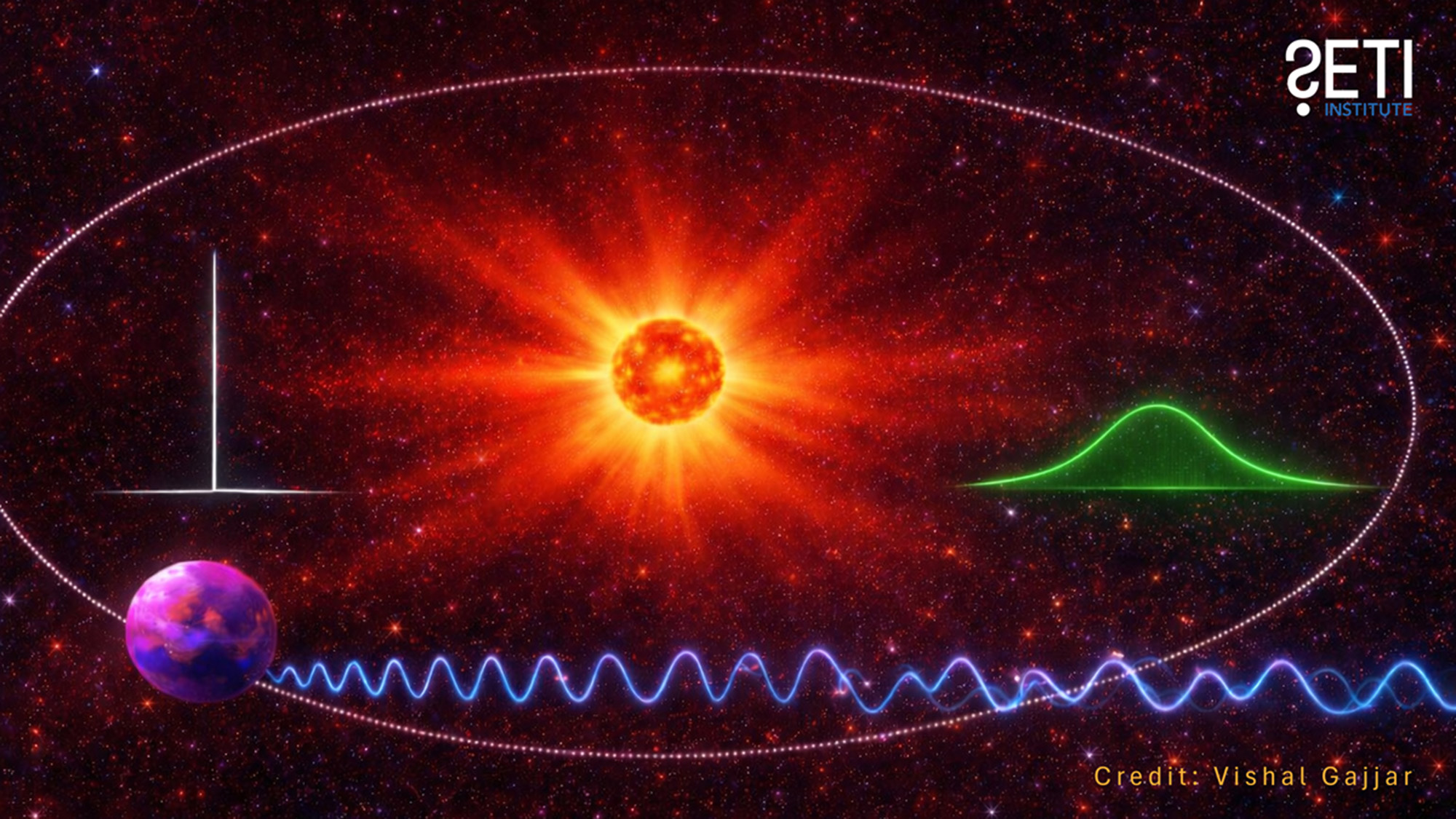
A graph showing various wavy lines next to an exoplanet with a glowing sun in the middle of the image

A planet’s radio signal may begin as a sharp tone (left, white) but can be spread out by the star’s plasma winds into a wider, fainter signal (right, green). The new study suggests radio astronomers may be missing signals by mostly looking for the sharp white shape instead of the broader green one. (Image credit: Vishal Gajjar)

Then, they turned their attention to M dwarf stars, the most common type in the Milky Way. These stars account for three out of four stars in our galaxy, and some have been around since the early universe. That gives them a lot of time to have developed technologically advanced life, according to the paper.

There are no actual measurements of space weather around these stars, so Gajjar and Brown modeled what might happen to a narrowband technosignal that emerged from exoplanets and had to travel through interplanetary plasma. They found that hypothetical narrowband signals from these exoplanets were more likely to be smeared by space weather, making them even harder to detect.

In the paper, the authors propose a framework to estimate how much broadening would happen to a signal, given its frequency and the type of star its exoplanet was orbiting.

This new framework doesn’t totally answer Fermi’s infamous question, but it does give us a potential reason for the silence. The Fermi paradox "is not solely evidence for the absence of transmitters, but also a reflection of our detection limitations arising from a mismatch between the assumed signal morphology" and shape, the researchers wrote.

A step forward for SETI

Michael Garrett, an astrophysicist at the University of Manchester in the U.K. who was not involved in the study, welcomed the research.

"It is a solid contribution that SETI researchers and signal-processing teams should pay attention to," he told Live Science. "One of the strengths of the paper is that it's grounded in real measurements too, drawing on decades of spacecraft observations."

However, he emphasized that the paper focused on narrowband radio signals, which was only one way of potentially detecting an alien civilization. By contrast, Garrett's work explores the possible combined radio leakage from a technological civilization across a large range of frequencies.

Andrew Siemion, director of Breakthrough Listen Oxford Hub in the U.K. who was not involved in the research but collaborates with the SETI Institute, said this is the first paper to explore the space around exoplanets and its impact on detectability.

"The work offers a very concrete mechanism through which a candidate signal might ultimately be validated as having a likely origin with a distant planetary system," he told Live Science.

The authors recommended that future searches, especially with sensitive next-generation telescopes such as SKA-Low, take note of signal broadening when searching for civilizations beyond Earth.

Are you a UFO fanatic? Find out with our extraterrestrials quiz!

Searching for alien life: New model could help scientists home in on habitable exoplanets

23 June 2026 at 14:00

A new planetary habitability model could make the search for aliens more efficient by quickly identifying rocky worlds unlikely to sustain the atmospheres needed for life as we know it.

The software, called the Smaller Than Earth Habitability Model (STEHM), allows astronomers to screen exoplanets before committing valuable telescope time to detailed observations. Developed by researchers at Stanford University, the model assesses whether a rocky planet can build and retain an atmosphere over billions of years — a prerequisite for life as we know it, according to a statement from the university.

Astronomers searching for life beyond Earth face a daunting challenge: thousands of exoplanets have already been discovered, and billions more are thought to exist throughout the Milky Way — roughly one for every star in the galaxy. As powerful new telescopes come online, researchers increasingly need ways to identify which worlds are worth closer study.

"The only way that we're going to ever find out if there are signatures of life out there is by observing the atmosphere of these planets," Michelle Hill, lead author of the study who developed STEHM, said in the statement.

Traditionally, scientists have focused on whether a planet lies within its star's habitable zone, the region where temperatures may allow liquid water to exist on the surface. But location alone does not guarantee habitability. A planet without a substantial atmosphere may be unable to maintain stable temperatures, shield itself from radiation or support surface water, the researchers said.

STEHM adds a second layer to this assessment by estimating whether small rocky planets can generate and retain atmospheres over geologic timescales. The model links a planet's size to its ability to hold onto atmospheric gases, helping identify a lower size threshold for potentially habitable worlds.

To build STEHM, Hill used the ExoPlex planetary simulation code to model six rocky worlds ranging from half Earth's size to Earth-size, testing how planetary structure, volcanic activity, internal heat and stellar radiation affect atmospheric survival. The model was validated using Venus and Mars, correctly reproducing Venus's thick carbon dioxide atmosphere and Mars's long-term atmospheric loss.

The results suggest that rocky planets at least 80% the size of Earth can retain atmospheres for 10 billion years or more when orbiting within habitable zones around sun-like stars. Smaller planets generally lose their atmospheres more quickly, though worlds around 70% of Earth's size may still be habitable under favorable conditions. Atmospheric longevity also depends strongly on initial carbon content and heat-producing elements that drive volcanic activity, allowing STEHM to serve as a size-based filter for identifying the most promising habitable worlds.

"Maybe there's life on other planets under the ground, but we are never going to be able to see it because we can't send something to those exoplanets," Hill said in the statement. "The best chance we've got is looking for signs of life by analyzing atmospheres from afar."

By narrowing the field of candidates, STEHM could help astronomers focus on the most promising planets for life while avoiding wasting resources on unlikely targets. The approach may be especially useful as next-generation missions, such as the European Space Agency's PLATO space telescope, expand the catalog of rocky exoplanets around nearby stars. Researchers hope the model will help prioritize which of these planets merit follow-up observations.

STEHM not only addresses where life beyond Earth could occur, but when it might, by modeling whether exoplanets can actually hold onto atmospheres over geologic timescales — a key prerequisite for life to take hold in the first place.

"Maybe the answer to why we haven't found any life yet is that we're so early in the grand scheme of what has been created through the lives and deaths of stars," Hill said in the statement. "Maybe we're one of the first."

Their findings were published June 4 in the Planetary Science Journal.

The Amazon’s Mysterious “Ghost Dog” Has Been Hiding a Big Secret

23 June 2026 at 03:26
Camera Trap Captures Rare Short Eared DogCamera traps are revealing that the Amazon’s “ghost dog” is less rare than feared but still depends on protected forests. For decades, the short-eared dog (Atelocynus microtis) has ranked among the least understood carnivores in Latin America, and perhaps among the least understood canids anywhere. Its secretive behavior, sharp hearing, and powerful sense of smell [...]

Scientists Warn Extraterrestrial Encounters Could Endanger Earth—a Quarantine Facility on the Moon May Be Our Last Line of Defense

22 June 2026 at 14:28

During future space missions, humans may finally encounter extraterrestrial life forms, settling the age-old question of whether we are alone in the cosmos. But what if alien biology is so different from that of Earthlings that its presence could become a potential global hazard?

This is the concern raised by researchers Frederick I. Moxley and Anthony Ricciardi in a new study, which argues that in an era of sample return missions and space missions that are carrying humans and our robotic probes farther into the cosmos than ever before, we need to be prepared to enact measures to protect our planet against the unforeseen consequences of any potential alien encounters the future may hold.

“The advancement of space exploration into an era of sample return missions from Mars, asteroids, and icy moons raises the potential for biological contamination either to or from Earth,” the authors write in their recent study, published in the journal Ambio. Given the potential for such contamination, Moxley and Ricciardi approach the question of alien contact from the perspective of past examples where invasive species on Earth have caused major disturbances to the environments they encounter.

“We consider the possibility that extraterrestrial organisms introduced to Earth could behave analogously to invasive species by destabilizing ecosystems or interacting unpredictably with their new environment,” the authors write, pointing to the multitude of examples known to science, many of which involve the introduction of microbial organisms into new environments—often with devastating consequences.

In many cases, such organisms not only can survive in new environments, but can often adapt with remarkable speed, even in some of the most extreme environments.

This, the authors say, challenges the idea that extraterrestrial life might not even be capable of surviving on Earth, as expressed by some past research.

“The plausibility of encountering extraterrestrial life warrants stringent planetary protection measures grounded in biosafety and biosecurity principles,” the authors warn.

So how do they suggest protecting Earth against such potentially catastrophic events involving future encounters with extraterrestrials?

According to Moxley and Ricciardi, building a quarantine facility on the Moon could serve as Earth’s last line of defense against any unintended alien invasions that could radically disrupt Earth’s fragile ecosystems.

“Due to its proximity, natural isolation, and apparent lack of a biosphere, the Moon can serve as a secure site for biocontainment of extraterrestrial samples,” the authors write. In their study, they examine historical instances where biological invasions have led to catastrophic environmental changes and argue that constructing a biocontainment facility on the Moon “should form the cornerstone of modern astrobiological risk mitigation strategies.”

Moon base extraterrestrial
Artist’s concept of a future lunar base (Image Credit: NASA/SAIC/Pat Rawlings)

What the researchers propose falls in line with current plans NASA has for a permanent lunar base, which is one of the many ambitious efforts under its Artemis Mission. Such a lunar outpost, which will serve as the official Artemis Base Camp, is planned for construction near the Moon’s South Pole.

At a cost of close to $30 billion, the effort will help to facilitate an ongoing human presence on the Moon by as soon as 2028, according to current mission timelines, and will serve as a science hub in support of future lunar exploration.

For Moxley and Ricciardi, incorporating a quarantine facility within our future lunar infrastructure that can house any extraterrestrial life forms we may encounter could prove to be vital. Ultimately, having such a facility may play the important role of shielding Earth against unintentional contamination by a potentially invasive alien species.

The team’s recent paper, “Protecting earth from extraterrestrial contamination: The case for a lunar biocontainment facility,” was published in Ambio.

Micah Hanks is the Editor-in-Chief and Co-Founder of The Debrief. A longtime reporter on science, defense, and technology with a focus on space and astronomy, he can be reached at micah@thedebrief.org. Follow him on X @MicahHanks, and at micahhanks.com.

Earthlings on Europa? Provocative Study Explores ‘Reverse Panspermia’ Scenario Where Earth Life May Have Invaded an Alien Moon

21 June 2026 at 14:51

Astronomers have long wondered whether life on Earth might have had origins somewhere else in the cosmos. The idea that the key ingredients for life, or even simple organisms, might be carried through space by non-animate objects—a concept known as panspermia—has been proposed as one way such “seeding” of life on Earth might have occurred.

But what if it could also happen in reverse? In other words, what if life were one day found on an alien moon, which could later be traced back to Earth?

This is the very idea presented in a new study that explores the provocative idea that Jupiter’s frozen moon Europa may not only be hospitable, but that life from Earth could be thriving there.

In the new study, published in the International Journal of Astrobiology, astrophysicist Zaza Osmanov of the Free University of Tbilisi explored whether Earthly bacteria might have been able to escape our planet by traveling on microscopic dust particles, which, after escaping Earth’s gravity, could have drifted through space until they reached Europa.

There, a vast subsurface ocean is believed to exist beneath the moon’s icy crust, meaning that any simple organisms capable of escaping from Earth on tiny spacefaring rafts of dust might have found their way to a new home, and one that could support life.

Panspermia, but in Reverse

The long-debated idea of panspermia already presents the general idea for how this might work. However, Osmanov’s study investigates this idea in reverse order: not only might life on Earth have originated from elsewhere, but our planet could also hypothetically be the source of similar “seeding” events that might occur on alien worlds.

Based on mathematical models, Osmanov calculated how bacteria-rich dust grains could be launched into space, resulting from collisions with incoming dust in Earth’s upper atmosphere. Upon escaping the planet’s gravity, some of these bacteria might be able to sail along toward distant locales like Europa with the help of pressure generated by solar radiation—essentially the same concept as a solar light sail spacecraft, albeit much smaller.

With the help of solar radiation and occasional gravitational interactions, Osmanov theorizes that some particles might eventually be “steered” by such natural processes over time, eventually making their way to Jupiter.

Tiny Earthling Alien Invaders

Based on Osmanov’s estimates, there could potentially be as many as hundreds of millions of Earth-originating dust particles that might make their way to Europa every second. That’s a significant number, and although he estimates that the majority would be destroyed on impact, a small fraction could arrive at extremely shallow angles, which he believes may be able to survive landing on Europa’s surface.

However, even if a few bacterial invaders managed to survive, the next challenge they would face would be to reach the moon’s ocean that astronomers believe to be concealed beneath its icy exterior. Based on past studies, tidal forces generated by the massive host planet Jupiter offer a solution: such events are believed to likely cause fractures in Europa’s icy shell, which lead to the creation of entry points where surface materials might be capable of migrating downward.

Adding to this, Osmanov also points to instances where ice melting may also provide a means for the movement of material from the surface down into the moon’s hidden ocean. Over periods of thousands of years, some of these tiny bacterial invaders might make their way past the harsh surface environment and down into the moon’s far more hospitable subsurface ocean.

Osmanov estimates that there may be considerable numbers of Earth-derived particles that could reach Europa’s ocean over geological timescales. This could mean that terrestrial particles, Earthly microbes that have made the journey, may have had time to establish themselves as microbial colonists—if, of course, current presumptions about the moon’s conditions for supporting life are correct.

While the theory remains speculative, and Osmanov concedes that it cannot be tested directly at present, it suggests something fascinating: that the eventual discovery of life on an alien world could have ancestral links to our own planetary home.

Osmanov’s recent study, “Earth as a potential source of life for Europa’s subsurface ocean,” appeared in the journal International Journal of Astrobiology.

Micah Hanks is the Editor-in-Chief and Co-Founder of The Debrief. A longtime reporter on science, defense, and technology with a focus on space and astronomy, he can be reached at micah@thedebrief.org. Follow him on X @MicahHanks, and at micahhanks.com.

Inbreeding Hits Small Males in Threatened Songbird

21 June 2026 at 11:49

Inbreeding depression, a genetic phenomenon where offspring result from the mating of related individuals, has long been understood to compromise individual fitness and elevate the risks of population decline or extinction. However, the depth and nuances of these effects remain largely unexplored in many non-model species, especially those facing dire conservation challenges. A groundbreaking new study investigates this complex relationship in a threatened songbird species, the aquatic warbler (Acrocephalus paludicola), unveiling how inbreeding depression manifests in a phenotype-dependent manner, particularly emphasizing body size as a critical factor in male fitness outcomes.

The aquatic warbler, a habitat specialist bird known for its recent precipitous population decline, poses a unique opportunity to study the genetic intricacies and their ecological consequences. Unlike widely studied model species, this bird’s depleted genetic diversity coupled with habitat specificity creates an ideal system to understand how inbreeding depression impacts survival and reproduction under real-world environmental pressures. Employing cutting-edge genomic tools such as single nucleotide polymorphisms (SNPs), researchers could quantify inbreeding at an unprecedented resolution, offering new insights into the genetic health and viability of this endangered population.

One of the pivotal breakthroughs of this research lies in demonstrating that inbreeding depression is not a uniform or straightforward process but is intricately moderated by the physical and ecological context of the individual. For male aquatic warblers, the genomic markers revealed a pronounced negative effect of inbreeding on breeding success—but only among males characterized by smaller body size, denoted by tarsus length, an established morphological proxy. This finding highlights how phenotypic traits can mediate the severity of inbreeding effects, suggesting that smaller-bodied males experience disproportionately harsh fitness reductions as a consequence of their genetic relatedness.

Equally compelling is the study’s exploration of wing length as another morphological trait potentially influencing inbreeding depression. While the results here were more subtle, a notable weak interaction was found between the degree of inbreeding and shorter wing length in males, correlating with decreased survival probabilities. This interaction suggests that even relatively minor morphological differences may buffer or exacerbate the impacts of genetic relatedness on survival outcomes, adding another layer of complexity to how we understand inbreeding depression in natural populations.

Importantly, the research also reveals a stark contrast between sexes. Female aquatic warblers showed scant evidence of inbreeding depression affecting key fitness components such as clutch size, hatching success, nestling survival, or the number of fledged fledglings. Moreover, no interactions emerged between female fitness measures and phenotypic or environmental variables examined. This asymmetry in inbreeding effects underscores sex-specific pathways in evolutionary and ecological responses to genetic challenges, warranting further inquiry into the mechanistic underpinnings driving such differences.

Prior studies investigating inbreeding depression often relied on relatively simplistic models that did not incorporate potential interactions with individual phenotype or environmental heterogeneity. This omission might explain why many previous estimates of inbreeding load—reflecting the cumulative fitness consequences of deleterious recessive alleles—have been inconsistent or highly uncertain. By integrating detailed phenotypic data with high-resolution genomic analyses, this study advances the field by showing that accounting for individual variation unveils clearer, biologically meaningful patterns of inbreeding depression.

The implications for conservation biology are profound. Small-bodied males, disproportionately burdened by inbreeding loads, might represent a critical demographic subgroup whose reproductive success most strongly influences population trajectories. This insight challenges conventional approaches that treat all individuals as homogenous units within populations, advocating instead for conservation strategies that are finely tuned to the nuanced genetic and phenotypic architectures of endangered species.

The environmental factors considered—timing of breeding and brood size—proved less influential in mediating inbreeding depression compared to phenotypic variables, at least in this particular system. While breeding timing and brood size have been previously hypothesized to influence fitness by affecting resource allocation or offspring survival probabilities, their interaction with genomic inbreeding proved minimal. This result refines our understanding of the complex ecological determinants of fitness and suggests that underlying genetic and phenotypic factors can overshadow the modifying effects of certain environmental variables.

Methodologically, the use of SNP-based genomic inbreeding coefficients represents a significant step forward from traditional pedigree-based measures. Genetic markers enable more precise estimates of genome-wide relatedness and inbreeding, which is especially crucial for populations like the aquatic warbler, where pedigree data are incomplete or unavailable due to logistical challenges in tracking individuals across generations. This technological advance paves the way for more accurate assessments of inbreeding consequences in conservation genetics.

Another noteworthy contribution is the nuanced interpretation of inbreeding load estimates. The study found that models omitting phenotypic interactions yielded highly uncertain inbreeding load figures for both survival and breeding success in males, whereas incorporating body size interactions produced more robust and meaningful estimates. This methodological insight calls for revisiting traditional models that treat inbreeding load as a fixed entity, promoting dynamic frameworks that integrate individual heterogeneity.

The study also contributes to evolutionary theory by demonstrating how inbreeding depression may exert selective pressure that maintains or increases body size in male aquatic warblers. Since smaller males suffer more pronounced fitness detriments due to inbreeding, natural selection may favor larger males, which effectively buffer against the genetic disadvantages. This dynamic adds a rich dimension to sexual selection and life-history evolution, where morphology and genetic fitness interplay to shape population structure.

In broader ecological contexts, understanding conditional inbreeding depression helps elucidate population resilience amid environmental change. As habitats degrade or fragment, and populations become increasingly isolated, the compounding effects of genetic bottlenecks and reduced phenotypic diversity could spell catastrophic declines if certain phenotypic groups disproportionately suffer. This research underscores the urgent need to consider phenotype-genotype-environment interactions in any assessment of vulnerable species.

Moreover, the findings raise compelling questions about the management of breeding programs aiming to mitigate inbreeding effects. Conservation initiatives often emphasize genetic diversity restoration in general terms, yet this study advocates for precision strategies that recognize differential vulnerabilities among phenotypic classes. For the aquatic warbler and similar threatened species, such targeted approaches could optimize reproductive success and survival rates, substantially enhancing recovery prospects.

Overall, this study reshapes scientific paradigms surrounding inbreeding depression by foregrounding the conditionality of its effects. It insists that blanket statements about the genetic risks of inbreeding are oversimplifications. Instead, fitness consequences emerge as a complex tapestry woven from genomic architecture, individual morphology, and ecological context, challenging researchers and conservationists alike to embrace multidimensional models.

Future research inspired by these findings will likely delve deeper into the mechanistic bases for the observed interactions, exploring, for instance, how developmental pathways link body size and genetic load expressions. Additionally, cross-species comparisons incorporating habitat specialists versus generalists may reveal whether this pattern of phenotype-dependent inbreeding depression is widely applicable or highly species-specific.

In conclusion, this landmark study presents a compelling case that it is indeed “hard to be small” for male aquatic warblers facing the genetic drawbacks of inbreeding. Such a phenotype-dependent dimension to inbreeding depression not only enhances scientific understanding but also provides invaluable practical guidance for conserving one of Europe’s most threatened songbirds. As the world grapples with biodiversity loss and climate challenges, integrating genomic, phenotypic, and ecological data remains paramount in crafting effective conservation blueprints.


Subject of Research: Inbreeding depression and its phenotypic and environmental conditionality in a threatened songbird species, the aquatic warbler (Acrocephalus paludicola).

Article Title: It is hard to be small: Inbreeding depression on male breeding success depends on body size in a threatened songbird.

Article References:
Kubacka, J., Arantes, L.S., Herdegen-Radwan, M. et al. It is hard to be small: Inbreeding depression on male breeding success depends on body size in a threatened songbird. Heredity (2026). https://doi.org/10.1038/s41437-026-00859-0

Image Credits: AI Generated

DOI: 21 June 2026

Scientists find a new way to search for ancient life on Mars using ‘mirror’ molecules

20 June 2026 at 16:00

Billions of years ago, Mars looked very different from the cold, dry world we see today. Scientists believe the Red Planet once had a warmer climate, liquid water and a thicker atmosphere. These conditions may have been suitable for simple forms of life. But did life ever actually exist on Mars? That remains one of […]

The post Scientists find a new way to search for ancient life on Mars using ‘mirror’ molecules appeared first on Knowridge Science Report.

Late-Season Ice-Edge Productivity Revealed in Barents Sea

20 June 2026 at 02:58

In a groundbreaking study that promises to reshape our understanding of Arctic marine ecosystems, researchers have uncovered evidence of unexpected biological productivity along the Barents Sea ice edge during the late Holocene. The investigation, led by A.J. Pieńkowski and colleagues, utilized advanced biomarker analysis to trace diatom enrichment—a key indicator of primary production—in sediment cores, revealing complex ecological dynamics that continue to defy conventional seasonal models of polar phytoplankton activity. This discovery has broad implications for climate science, marine biology, and our conceptual frameworks regarding ice-edge ecosystems in a warming Arctic.

The Barents Sea, located north of Norway and Russia, is a key region for studying the effects of climate change on Arctic environments due to its unique position between Atlantic and Arctic waters. Historically, sea ice has been understood to exert a controlling influence over the timing and intensity of phytoplankton blooms, with primary productivity peaking during the spring and early summer months as ice melts. However, the extreme late-Holocene interval analyzed in this study suggests that productivity along the ice edge may extend much later into the seasonal cycle than previously thought, indicating a previously underappreciated ecological niche.

Central to this research is the application of organic geochemical proxies, notably diatom-specific biomarkers such as highly branched isoprenoids (HBIs). These molecular fossils are derived from diatoms—microscopic photosynthetic algae—and provide a window into past productivity and environmental conditions. By examining sediment layers deposited over the last several thousand years, the team identified striking elevations in diatom biomarker concentrations during late-season periods, suggesting not only prolonged but intensified ice-edge productivity.

The implications of these findings are profound, signaling that the timing of phytoplankton blooms may have been more flexible and responsive to environmental variables over millennial timescales than contemporary observations suggest. This shifts paradigms about marine food web dynamics in polar regions, as late-season blooms could support secondary consumers such as zooplankton—and by extension, fish and marine mammals—during periods traditionally seen as low productivity. Such dynamics have likely played a crucial role in shaping Arctic biodiversity through time.

Moreover, the study highlights the interplay between sea ice extent, melt timing, and nutrient availability. While earlier models posited that retreating ice reduces habitat for ice-associated algae and thus limits productivity, these new data reveal a more nuanced picture where late-season melting creates persistent ice edges that serve as hotspots for diatom proliferation. Nutrient enrichment via upwelling and Atlantic water inflow likely contributed to sustaining this productivity, challenging assumptions about the oligotrophic nature of the late melt season.

In terms of methodology, the research exemplifies the cutting-edge integration of paleoceanography and organic geochemistry. Sediment cores were meticulously sampled and subjected to high-resolution biomarker profiling, allowing for temporal reconstructions at seasonal to decadal scales. The use of isotopic analyses further corroborated the timing of these bio-events, lending robustness to interpretations about late-season environmental conditions in the Barents Sea. This methodological sophistication underscores the potential for biomarker proxies to unlock hidden chapters of ecological history.

Notably, the timing of the extreme biomarker enrichments correlates with known climatic variability during the late Holocene, including phases of relative warming and cooling. This temporal correspondence suggests that even subtle shifts in temperature and sea ice dynamics may have orchestrated significant ecological reorganization in polar marine systems. Understanding these past responses is critical as anthropogenic warming accelerates, potentially recreating or amplifying such conditions in the near future.

From a broader perspective, the recognition of late-season ice-edge productivity has ramifications for global biogeochemical cycles. Phytoplankton are pivotal in sequestering atmospheric CO2, and extending the productive season could mean that polar oceans play a more dynamic role in the carbon cycle than appreciated. This discovery invites a reassessment of climate models that currently may underestimate the biological feedback potential of Arctic marine ecosystems during the waning ice season.

The study’s revelations also emphasize the resilience and adaptability of polar marine life. Despite harsh and fluctuating conditions, diatoms and associated microbial communities have exploited ephemeral niches, adjusting phenology and productivity patterns to optimize survival and growth. Such adaptive strategies may become increasingly important as climate perturbations continue to reshape polar habitats, with unknown consequences for ecosystem stability and services.

In practical terms, these findings could inform conservation and management strategies. As the Barents Sea and broader Arctic region become more accessible due to ice retreat, understanding seasonal productivity pulses is crucial for fisheries, indigenous communities, and environmental stewardship. Recognizing late-season productivity hotspots could guide sustainable use and protection of biologically rich zones that emerge under shifting climatic regimes.

Furthermore, this research opens new avenues for interdisciplinary collaboration, bridging paleoclimatology, marine ecology, and environmental chemistry. Future studies may leverage the biomarkers identified here to monitor contemporary changes in Arctic productivity and validate predictive models. Additionally, analogous approaches could elucidate productivity dynamics in other polar and subpolar regions, deepening our global perspective on climate-ecosystem interactions.

Given the rapidity of ongoing climatic change, the temporal insights provided by this late-Holocene study serve as a crucial baseline, contextualizing contemporary observations within a longer-term framework. This historical depth equips scientists and policymakers with a richer understanding of variability and resilience in polar systems, enhancing our capacity to anticipate and mitigate the impacts of a warming world.

In sum, the work by Pieńkowski, Belt, Husum, and their team has decisively expanded our comprehension of ice-edge ecosystems, revealing a vibrant and late-blooming diatom community thriving in conditions once thought marginal or unproductive. Their integration of molecular biomarkers and paleoenvironmental techniques creates a compelling narrative of Arctic productivity that challenges prevailing assumptions and invigorates future research paths. As the Arctic ice retreats, these insights become not only academically fascinating but vitally important for forecasting and managing the biological pulse of the planet’s coldest seas.

This landmark study stands as a testament to the power of interdisciplinary science to uncover hidden complexities within Earth’s most extreme environments, shining a light on the subtle yet dynamic rhythms of life beneath the ice. It invites a reconsideration of the Arctic not as a static frozen desert, but as a place of seasonal vibrancy and ecological innovation sustained by the delicate interplay of ice, ocean, and life.

Subject of Research: Arctic ice-edge diatom productivity and late-season ecosystem dynamics during the late Holocene.

Article Title: Extreme late-Holocene diatom biomarker enrichment reveals late-season ice-edge productivity in the Barents Sea.

Article References:
Pieńkowski, A.J., Belt, S.T., Husum, K. et al. Extreme late-Holocene diatom biomarker enrichment reveals late-season ice-edge productivity in the Barents Sea. Commun Earth Environ (2026). https://doi.org/10.1038/s43247-026-03717-3

Image Credits: AI Generated

DOI: 10.1038/s43247-026-03717-3

Keywords: Arctic marine ecosystems, Barents Sea, diatom biomarkers, highly branched isoprenoids, late Holocene, ice-edge productivity, paleoclimate, sediment cores, phytoplankton phenology, Arctic sea ice dynamics, biogeochemical cycles, climate change, biomarker proxies.

A Fatal Deer Disease May Be Spreading in Ways No One Expected

18 June 2026 at 16:52
White Tailed Deer (Odocoileus virginianus) Buck AntlersScientists found that chronic wasting disease may spread silently between species, revealing a hidden challenge in the fight against the fatal wildlife disease. Chronic wasting disease (CWD) is best known as a disease affecting deer, elk, and other cervid (hooved, plant-eating) animals. Now, researchers at the University of Calgary and their international collaborators have taken [...]

‘Mega-consumers’ of food and energy cost environment $5.7tn a year, study finds

Top 10% generate climate and biodiversity damage bill that exceeds economies of most countries, say researchers

The environmental damage bill racked up by the highest-consuming 10% of the world’s population has reached up to $5.7tn a year – larger than the economy of every country except the US and China, a study has found.

Mega-consumers in this group are concentrated in the global north, accounting for more than half the population of the US and 40-45% of people in the EU.

Continue reading...

© Photograph: Francis R Malasig/EPA

© Photograph: Francis R Malasig/EPA

© Photograph: Francis R Malasig/EPA

❌