Why Did the US Government Brief Groups of Christian Pastors About UFOs and Aliens?


Evidence for possible life on Mars in the ancient past continues to build, thanks to a recent discovery by NASA’s Perseverance rover that identified complex carbon in two mudstones.
As detailed in a recent paper published in Science Advances, Perseverance collected samples in the Jezero crater, a location that has continued to yield possible biosignatures of life on Mars in the ancient past.
In the same region, scientists reported potential evidence of microbial activity on ancient Mars, adding to a growing list of circumstantial evidence for one of the most intriguing possibilities in modern space exploration: the prospect that Earth may not have been the only planet in our Solar System that has held the potential to host life.
Among the study’s most significant findings is that complex macromolecular carbon was discovered alongside other potential biosignatures. Jezero Crater, a 28-mile-wide impact basin on the Martian surface, once contained flowing water roughly 3.5 billion years ago, making it one of the most promising locations in the search for ancient life. Water is essential to all known life on Earth, serving as a universal solvent and playing a critical role in biological processes.
“Jezero Crater was selected as a landing site due, in part, to its past evidence of aqueous activity and potential to preserve organic material,” co-lead author Kyle Uckert, a research scientist at NASA’s Jet Propulsion Laboratory, told The Debrief. “The Perseverance Rover’s exploration of Jezero Crater helps us understand the past habitability of Mars.”
Perseverance targeted a distinctive geological feature known as the Bright Angel outcrop, where the samples were collected. The outcrop consists of mudstones deposited in the dry bed of an ancient river that once flowed into Jezero Crater. Comparable sedimentary deposits on Earth are often associated with environments capable of preserving evidence of microbial life.
Determining the origin of the organic carbon preserved within these Martian rocks is key to understanding whether the Red Planet ever supported life.
Using its onboard Raman spectrometer, Perseverance mapped the distribution of the rocks’ organic matter. One sample contained organic carbon within a primary silicate-dominated matrix, while another preserved carbon within secondary carbonate and sulfate minerals.
Notably, the carbon appears to have remained remarkably well preserved despite billions of years of exposure to the harsh Martian environment. Researchers suggest its limited weathering may indicate that the material is resistant to radiation and oxidation—possibly because it is mixed with iron-rich regolith or protected by clay minerals—or that it was only recently exposed at the surface through erosion.
The researchers are quick to point out that their findings do not determine whether the carbon originated through biological or non-biological processes. Nevertheless, the discovery adds another intriguing piece of evidence to the ongoing search for ancient life on Mars.
“Macromolecular carbon may be delivered to Mars via meteorites, or may have formed through hydrothermal geologic processes,” Uckert said.
According to the researchers, determining the true origin of the carbon will ultimately require returning Martian samples to Earth, where they can be examined using far more sophisticated laboratory instruments than those carried aboard Perseverance.
“Further constraining the origin, distribution, and alteration history of the MMC observed in the Neretva Vallis mudstones requires high-resolution and high-sensitivity analyses in terrestrial laboratories, which can be facilitated by the return of the Cheyava Falls rock core, ‘Sapphire Canyon’ to Earth,” explained co-lead author Ashley Murphy, a postdoctoral research scientist at the Planetary Science Institute.
“The Perseverance Rover science payload is not designed to determine whether martian organic molecules were created by biologic or geologic processes, and our study is unable to make this distinction,” Uckert added.
The researchers say that future sample-return missions, combined with advanced laboratory analyses on Earth, may finally help resolve one of planetary science’s most enduring questions.
“The Perseverance Rover collects samples of scientifically compelling martian rocks for potential return to Earth,” Uckert concludes.“Using high-resolution terrestrial instruments to analyze these rock samples, particularly the Sapphire Canyon core collected on the Cheyava Falls rock, may provide more compelling evidence for a biologic or abiotic origin of this organic matter.”
The paper, “Spatially Distributed Complex Organic Matter Detected in an Ancient River Valley in Jezero Crater, Mars,” appeared in Science Advances on June 24, 2026.
Ryan Whalen covers science and technology for The Debrief. He holds an MA in History and a Master of Library and Information Science with a certificate in Data Science. He can be contacted at ryan@thedebrief.org, and follow him on Twitter @mdntwvlf.

Humans have been searching the stars for alien radio signals for decades — and so far, E.T. has not phoned home. But that doesn’t mean intelligent life isn’t out there, a new study hints. Rather, something else could be interfering: according to the research, space weather surrounding alien planets could be preventing us from detecting technological signals from extraterrestrial civilizations.
The findings, published March 5 in The Astrophysical Journal, offer a potential answer to the Fermi paradox: Given the size of the universe, there are many potentially habitable planets that could support life, and yet we have not detected technosignatures from any of them — so, "Where is everyone?" physicist Enrico Fermi famously posited in 1950.
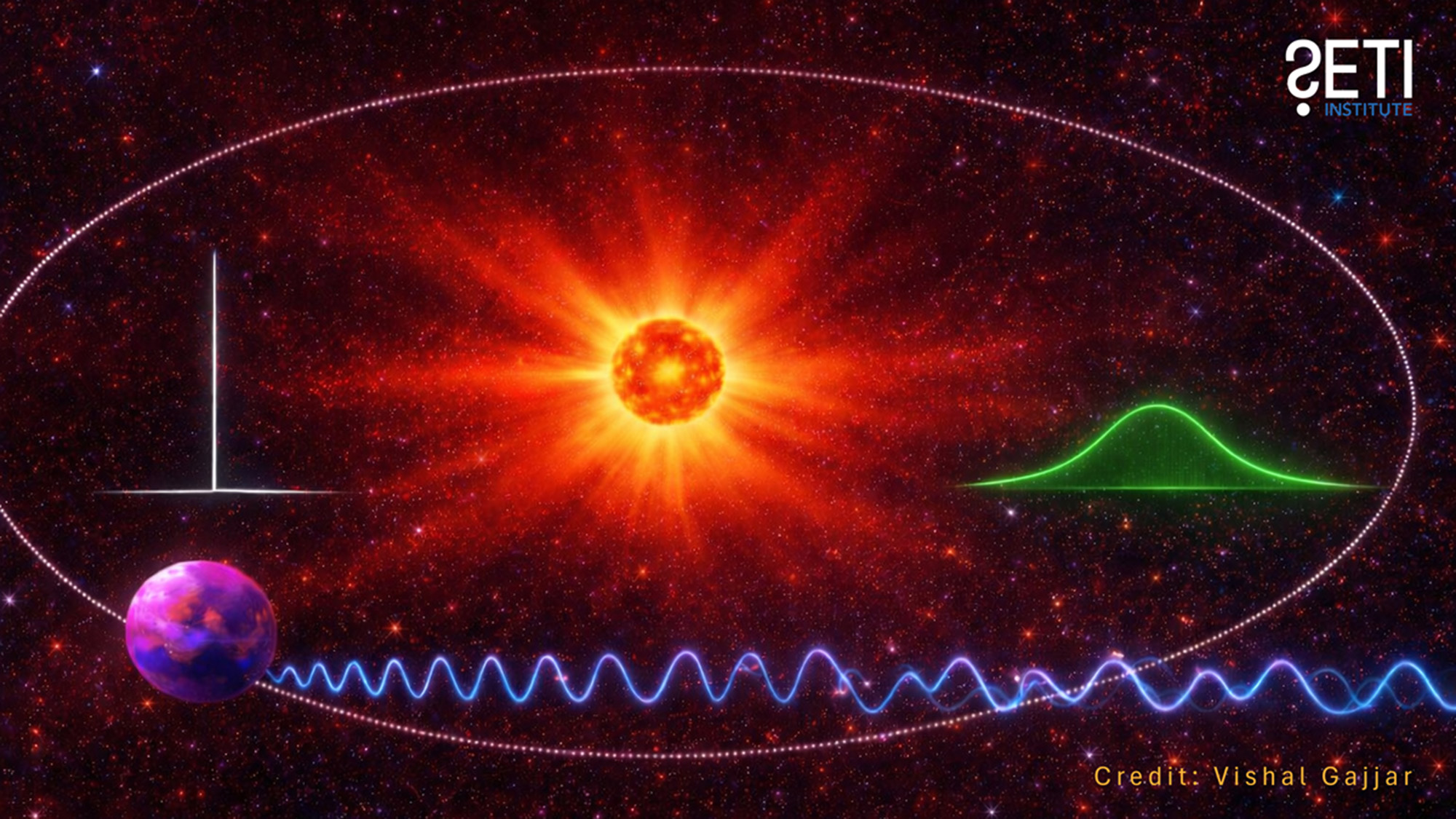
In the new study, researchers found that space weather caused by a planet's star could broaden hypothetical technosignals, dissipating their power over a larger range of frequencies and making them more difficult to detect.
"If a signal gets broadened by its own star's environment, it can slip below our detection thresholds, even if it's there, potentially helping explain some of the radio silence we've seen in technosignature searches," Vishal Gajjar, an astronomer at the SETI Institute and first author of the paper, said in a statement.
One way astronomers search for alien life is by looking for very narrowband signals, which are sharp spikes in the power of a radio emission. This spike usually only covers a few hertz.
"These don't occur naturally," Evan Keane, an astronomer at Trinity College Dublin who was not involved in the research, told Live Science. "So, if you see something very narrowband, you know that it is from something of interest." Astronomers would, for example, be able to easily detect some narrowband technosignatures on Mars, coming from the Mars rovers. But they have not observed any such signals from a clearly non-human origin.
The new research argues that astronomers may have been looking for the wrong signal shape. In the new study, the researchers found that alien signals could be distorted by stellar space weather surrounding their home stars, which could explain why they have not been detected.
Space weather refers to changes in the space environment caused by charged particles, radiation and giant lumps of plasma called coronal mass ejections emitted by the sun. Other stars also generate space weather in their vicinity.
Gajjar and SETI colleague Grayce Brown investigated how space weather has historically impacted communications between Earth and spacecraft such as Mariner IV, which flew by Mars in the 1960s, and the Viking probes, which launched in 1977 for a voyage through the solar system and beyond. They created one of the largest collections of signal broadening examples and used that information to determine how other sunlike stars would affect the environment around their exoplanets. From this, the team calculated what would happen to a hypothetical alien narrowband signal that originated on one of them.
Then, they turned their attention to M dwarf stars, the most common type in the Milky Way. These stars account for three out of four stars in our galaxy, and some have been around since the early universe. That gives them a lot of time to have developed technologically advanced life, according to the paper.
There are no actual measurements of space weather around these stars, so Gajjar and Brown modeled what might happen to a narrowband technosignal that emerged from exoplanets and had to travel through interplanetary plasma. They found that hypothetical narrowband signals from these exoplanets were more likely to be smeared by space weather, making them even harder to detect.
In the paper, the authors propose a framework to estimate how much broadening would happen to a signal, given its frequency and the type of star its exoplanet was orbiting.
This new framework doesn’t totally answer Fermi’s infamous question, but it does give us a potential reason for the silence. The Fermi paradox "is not solely evidence for the absence of transmitters, but also a reflection of our detection limitations arising from a mismatch between the assumed signal morphology" and shape, the researchers wrote.
Michael Garrett, an astrophysicist at the University of Manchester in the U.K. who was not involved in the study, welcomed the research.
"It is a solid contribution that SETI researchers and signal-processing teams should pay attention to," he told Live Science. "One of the strengths of the paper is that it's grounded in real measurements too, drawing on decades of spacecraft observations."
However, he emphasized that the paper focused on narrowband radio signals, which was only one way of potentially detecting an alien civilization. By contrast, Garrett's work explores the possible combined radio leakage from a technological civilization across a large range of frequencies.
Andrew Siemion, director of Breakthrough Listen Oxford Hub in the U.K. who was not involved in the research but collaborates with the SETI Institute, said this is the first paper to explore the space around exoplanets and its impact on detectability.
"The work offers a very concrete mechanism through which a candidate signal might ultimately be validated as having a likely origin with a distant planetary system," he told Live Science.
The authors recommended that future searches, especially with sensitive next-generation telescopes such as SKA-Low, take note of signal broadening when searching for civilizations beyond Earth.
Are you a UFO fanatic? Find out with our extraterrestrials quiz!
During future space missions, humans may finally encounter extraterrestrial life forms, settling the age-old question of whether we are alone in the cosmos. But what if alien biology is so different from that of Earthlings that its presence could become a potential global hazard?
This is the concern raised by researchers Frederick I. Moxley and Anthony Ricciardi in a new study, which argues that in an era of sample return missions and space missions that are carrying humans and our robotic probes farther into the cosmos than ever before, we need to be prepared to enact measures to protect our planet against the unforeseen consequences of any potential alien encounters the future may hold.
“The advancement of space exploration into an era of sample return missions from Mars, asteroids, and icy moons raises the potential for biological contamination either to or from Earth,” the authors write in their recent study, published in the journal Ambio. Given the potential for such contamination, Moxley and Ricciardi approach the question of alien contact from the perspective of past examples where invasive species on Earth have caused major disturbances to the environments they encounter.
“We consider the possibility that extraterrestrial organisms introduced to Earth could behave analogously to invasive species by destabilizing ecosystems or interacting unpredictably with their new environment,” the authors write, pointing to the multitude of examples known to science, many of which involve the introduction of microbial organisms into new environments—often with devastating consequences.
In many cases, such organisms not only can survive in new environments, but can often adapt with remarkable speed, even in some of the most extreme environments.
This, the authors say, challenges the idea that extraterrestrial life might not even be capable of surviving on Earth, as expressed by some past research.
“The plausibility of encountering extraterrestrial life warrants stringent planetary protection measures grounded in biosafety and biosecurity principles,” the authors warn.
So how do they suggest protecting Earth against such potentially catastrophic events involving future encounters with extraterrestrials?
According to Moxley and Ricciardi, building a quarantine facility on the Moon could serve as Earth’s last line of defense against any unintended alien invasions that could radically disrupt Earth’s fragile ecosystems.
“Due to its proximity, natural isolation, and apparent lack of a biosphere, the Moon can serve as a secure site for biocontainment of extraterrestrial samples,” the authors write. In their study, they examine historical instances where biological invasions have led to catastrophic environmental changes and argue that constructing a biocontainment facility on the Moon “should form the cornerstone of modern astrobiological risk mitigation strategies.”

What the researchers propose falls in line with current plans NASA has for a permanent lunar base, which is one of the many ambitious efforts under its Artemis Mission. Such a lunar outpost, which will serve as the official Artemis Base Camp, is planned for construction near the Moon’s South Pole.
At a cost of close to $30 billion, the effort will help to facilitate an ongoing human presence on the Moon by as soon as 2028, according to current mission timelines, and will serve as a science hub in support of future lunar exploration.
For Moxley and Ricciardi, incorporating a quarantine facility within our future lunar infrastructure that can house any extraterrestrial life forms we may encounter could prove to be vital. Ultimately, having such a facility may play the important role of shielding Earth against unintentional contamination by a potentially invasive alien species.
The team’s recent paper, “Protecting earth from extraterrestrial contamination: The case for a lunar biocontainment facility,” was published in Ambio.
Micah Hanks is the Editor-in-Chief and Co-Founder of The Debrief. A longtime reporter on science, defense, and technology with a focus on space and astronomy, he can be reached at micah@thedebrief.org. Follow him on X @MicahHanks, and at micahhanks.com.
University of California, Riverside’s Professor Eric Schwitzgebel and University of Lisbon postdoctoral researcher Jeremy Pober argue that consciousness is substrate flexible, meaning it can arise not just in the biological tissue we find on Earth, but potentially in radically different physical materials found elsewhere in the cosmos.
The post Consciousness is Not Exclusive to Earth’s Biology, Philosophers Argue appeared first on Sci.News: Breaking Science News.
Consciousness may arise in systems far different than the biology on Earth we are used to, according to University of California, Riverside (UCR) researchers, who argue that many forms of conscious experience may be possible in alien lifeforms.
Eric Schwitzgebel of UCR worked with Jeremy Pober, a former graduate student, not to understand what consciousness is, but rather, to explore whether it could arise in beings that differ radically from Earth’s biological standards.
At a time when questions about the possibility of alien life visiting Earth are on many minds, their work examines what unexpected forms might achieve consciousness—the first step toward intelligence.
Central to the pair’s work is the idea of “substrates,” from the Latin for “the level below,” referring to the underlying material base from which something is made. Although the term may be most familiar from geology, it can be applied conceptually across many disciplines, from biology to linguistics, to describe an underlying structure or form.
The researchers framed their core question around what they call “substrate flexibility”: can a specific property be achieved across many substrates, or is it more limited? One example they use is computer data storage. Information can be stored in many ways, including optical, magnetic, and solid-state media, indicating that storage exhibits a high degree of substrate flexibility.
But what about consciousness? Can it also be achieved flexibly? Perhaps the answer depends on the specificity of the question and whether we are considering human consciousness or a broader concept of consciousness itself.
The researchers began by considering the scale and nature of our universe as it is presently understood. That includes roughly a trillion galaxies containing countless planets unlike our own, which they estimate may have given rise to more than a thousand alien civilizations during the 13.8 billion years since the Big Bang. Notably, they do not focus solely on Earth-like planets that might theoretically harbor biological life recognizable to us.
“With that many draws from the lottery, some of these life forms will be strange indeed,” the pair writes in their paper.
This idea is not far-fetched, as astrobiologists have long hypothesized that life in the cosmos may take forms radically different from those on Earth, composed of available local materials, possibly including entirely different chemical structures.
The pair does not argue that such exotic lifeforms definitely exist in some corner of the universe, only that, in such a large and diverse universe, it is relatively unlikely that the same building blocks would commonly arrange themselves in precisely the same way as on Earth.
Taking inspiration from the idea of Nicholas Copernicus, the researchers argue that since the Earth, and thereby humanity, are not the center of the universe, it is likely that consciousness is also not a unique feature of our planet, or even recognizable biology.
However, the authors are quick to note that simply because consciousness may exist in multiple substrates does not mean it must exist in every substrate. AI systems, for example, may represent a form of silicon-based life, but they are not necessarily conscious at present. Additionally, perhaps how they are conscious should be considered more broadly, taking into account the variety of possible substrates, rather than simply assessing how well AI models the human brain.
That broader perspective is a crucial element of the pair’s conclusions. Consciousness should be considered in terms wider than simply assessing how well something replicates the human mind. While the authors concede that a similar substrate may be required to perfectly reproduce human consciousness, a broader view of the phenomenon may be necessary to recognize forms of consciousness that are fundamentally alien to our own.
The paper, “Substrate Flexibility and the Copernican Principle of Consciousness,” appeared in draft form on the University of California, Riverside website on May 28, 2026.
Ryan Whalen covers science and technology for The Debrief. He holds an MA in History and a Master of Library and Information Science with a certificate in Data Science. He can be contacted at ryan@thedebrief.org, and follow him on Twitter @mdntwvlf.
Using the SETI Institute’s Allen Telescope Array, a 42-element radio interferometer at Hat Creek Radio Observatory in Hat Creek, California, astronomers probed 3I/ATLAS for artificial radio transmissions but found only human-made interference.
The post Astronomers Scan Interstellar Object 3I/ATLAS for Alien Radio Signals appeared first on Sci.News: Breaking Science News.