❌

Normal view

'Found you!' Astronomers spot faintest exoplanet ever seen from Earth after a decade of hide-and-seek

15 July 2026 at 14:00

It has taken over ten years, but astronomers have finally won a prolonged game of cosmic hide-and-seek with a planet hiding around the star Beta Pictoris. The extrasolar planet, or exoplanet, is known as Beta Pictoris d. It is found 63 light-years away and has two planetary siblings, which were caught some time ago.

This new exoplanet is 100 times fainter than its sibling Beta Pictoris b, which was the first planet discovered in the system. That makes Beta Pictoris d the faintest exoplanet ever seen from Earth.

Like its previously discovered sibling, Beta Pictoris d is a gas giant. However, unlike Beta Pictoris b and Beta Pictoris c, it is much further away from its parent star and is thus much cooler than its siblings. The newly discovered world is also smaller than the previously seen world around Beta Pictoris. While both Beta Pictoris b and Beta Pictoris c have around 10 times the mass of Jupiter each, Beta Pictoris d has only around 2.4 times the mass of the solar system's most massive world. That makes it one of the lightest exoplanets ever directly imaged by a ground-based telescope.

"Planet d, it seems, has been playing a game of hide-and-seek with us for over a decade, and only now can we say ‘found you!’" team member Jayne Birkby an astronomer at the University of Oxford in the UK, said in a statement.

The discovery of Beta Pictoris d helps clear up a puzzle regarding a disk of dust and debris in this planetary system, which is theorized to be made of the leftovers of planet formation. That is because this newly found world has exactly the right mass and location needed to explain both the odd shape of this debris disk and its location.

11 years of hide-and-seek

The team behind this discovery wasn't initially looking for a third planet around Beta Pictoris. Instead, they were simply attempting to learn more about the system's first planet.

"This was a serendipitous discovery," team co-leader Ben Sutlieff, an astronomer at the University of Edinburgh said. "We initially wanted to look more at a known planet in the system, Beta Pictoris b, to see how it changed over time."

That was until they spotted telltale signs of another planet around the same star. Delving back into 11 years of archival data, the team found the third planet lurking in various images.

six circles showing a bright dot on a blurry, grainy red background

Marked with an arrow is Beta Pictoris d, the third planet discovered around the star Beta Pictoris. (Image credit: ESO/B. Sutlieff, M. Bonse et al.)

To consider how impressive it is to directly image a planet outside the solar system, consider that of the over 6,000 worlds in NASA's exoplanet catalog, less than 100 were discovered using direct imaging. Such detections are so tricky because they require picking out the thermal glow of a planet from the glare of its parent star.

Catching a direct image of an exoplanet as faint as Beta Pictoris d is a major step forward for this technique.

"The new planet is 100 times fainter than Beta Pictoris b, the famous planet in the same system, making it the faintest exoplanet ever imaged directly from Earth," team co-leader and European Southern Observatory researcher Markus Bonse said.

three striped planets next to a bright star, on a black starry background

An illustration of the three planets of Beta Pictoris. (Image credit: Robert Lea (created with Canva))

The discovery of Beta Pictoris d makes the Beta Pictoris system just the second in which more than two worlds have been directly imaged. The first was HR 8799, which is located around 133 light-years away.

"Systems with multiple directly imaged exoplanets are the 'holy grails' of discoveries, because they can teach us a lot about what different exoplanets are like in the same formation environment," Sutlieff said

Thus, the discovery of Beta Pictoris d via direct imaging should encourage further direct imaging of planetary systems which may also harbor faint planets. This is an investigation that could be picked up by the Extremely Large Telescope (ELT), currently under construction in the Atacama Desert of northern Chile.

"Planets seem to have friends," team member Beth Biller, of the University of Edinburgh in the UK, said. "Many of the famous directly imaged exoplanet systems seem to have multiple giant planets in the same system, and likely there are even more lower-mass planets hiding in these systems that might be revealed with instruments on the ELT."

The team's research was published on Wednesday (July 15) in The Astrophysical Journal Letters.

Can Arid Planets Keep Their Cool?

14 July 2026 at 17:00

side-by-side images of Venus's surface today and an imagining of what its surface might have looked like in the past

Editor’s Note: Astrobites is a graduate-student-run organization that digests astrophysical literature for undergraduate students. As part of the partnership between the AAS and astrobites, we occasionally repost astrobites content here at AAS Nova. We hope you enjoy this post from astrobites; the original can be viewed at astrobites.org.

Title: Carbon Cycle Imbalances on Arid Terrestrial Planets with Implications for Venus
Authors: Haskelle T. White-Gianella and Joshua Krissansen-Totton
Authors’ Institution: University of Washington
Status: Published in PSJ

The Carbon-Cycle Thermostat

When discussing the habitability of planets, we usually focus on the habitable zone, the region around a star where a planet can host a temperature suitable for supporting liquid water on its surface. Yet, being in the right place doesn’t necessarily guarantee that a planet will be habitable.

A planet also needs the right atmospheric composition to sustain the necessary temperatures for hosting liquid water. A key mechanism found on Earth for maintaining this composition is the geologic carbon cycle, which acts as a built-in climate control system. This cycle begins with volcanic eruptions releasing carbon dioxide (CO2), which then dissolves in rainwater and forms a weak acid that weathers rocks on continents. The weathering products wash into oceans, where they form carbonate rocks, locking carbon away. Eventually, plate tectonics recycles some of that carbon back to volcanoes. The weathering process works faster when the planet is warmer, thus regulating the amount of CO2 and stabilizing the climate over long periods of time (but it should be noted that it can take up to a few hundred thousand years to rebalance this slow carbon cycle through the weathering process).

An important caveat is that the weathering process requires sufficient liquid water on the planet’s surface, so what happens in the case for planets with shallower oceans? Low-mass M dwarfs, the most common type of star found in the galaxy, are expected to host less-massive disks and therefore lower water inventories for forming planets. If more “dry” planets are indeed a more likely outcome of planet formation, we’d want to know how their arid conditions influence their long-term evolution and habitability.

Creating Carbon-Tracking Models

The authors built a model that tracks how water and CO2 move between a planet’s interior, oceans, and atmosphere over 4.5 billion years. The model notably includes the following:

  • A sophisticated weathering model that accounts for how runoff can limit rock weathering, improving upon previous models that only included a temperature dependence on weathering
  • Wind-driven evaporation limits that influence the amount of water evaporation in addition to sunlight-driven evaporation
  • Multiple deep water cycle parameterizations that explore how water moves between the interior and the surface

The model tests for four initial surface water inventories (0.1%, 1%, 10%, and 100% of Earth’s oceans) and then simulates how the surface water, atmosphere, and climate evolve over time.

A Critical Water Threshold

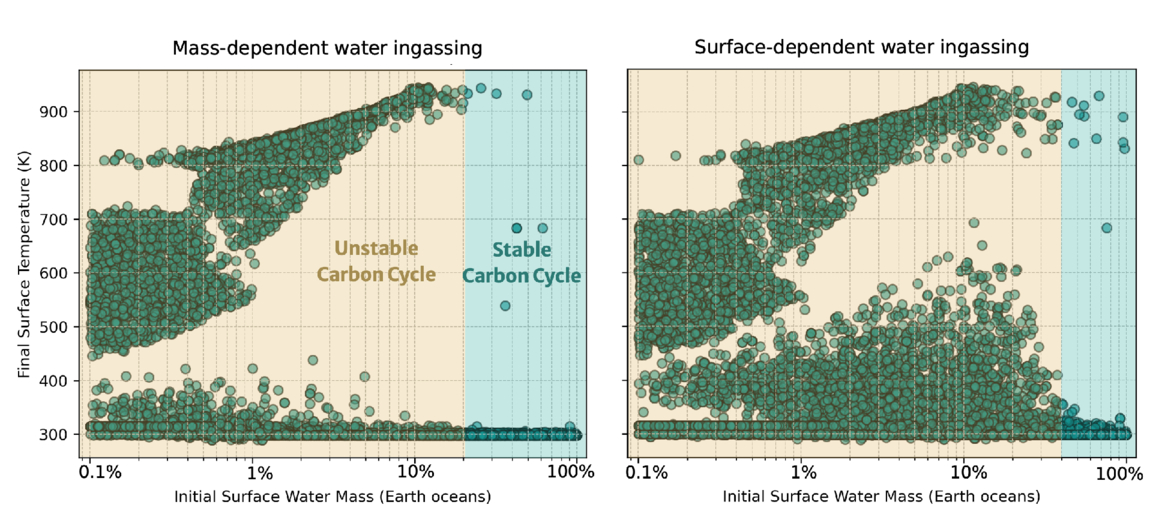
The models reveal that planets require at least 20–50% of Earth’s ocean mass to maintain a balanced carbon cycle. Below this threshold, the carbon cycle becomes unbalanced, leading to devastating consequences for habitability (Figure 1).

two plots of final surface temperature as a function of initial surface water mass

Figure 1: Final surface temperature after simulating 4.5 billion years of evolution as a function of initial water inventory for Earth-like planets. Each dot represents a model run with different assumptions (total carbon inventory, temperature dependence of weathering, soil age, etc.). The yellow region shows where most simulations result in uninhabitable surface temperatures from an unbalanced carbon cycle, and the cyan region shows where most simulations result in habitable surface temperatures and a balanced carbon cycle. The left and right plots show the results for two different parameterizations of the deep water cycle implemented in the model. [White-Gianella & Krissansen-Totton 2026]

For the more arid planets, models reveal a concerning runaway process. Limited surface water reduces precipitation and slows rock weathering. Weathering cannot keep up with volcanic CO2 release, causing CO2 buildup and warming of the atmosphere. The cycle repeats, driving runaway warming until all water evaporates.

Important Implications (Within and Outside Our Solar System)

Looking within the solar system, the results offer an explanation for how a potentially habitable Venus could have transitioned into its current inhospitable state. If Venus had formed with an initial water inventory below this critical threshold of 20–50% of Earth’s ocean mass, then its carbon cycle would have become unbalanced, creating the CO2 inferno seen on Venus today.

In future exoplanet studies, telescopes like the Habitable Worlds Observatory might detect ocean glint (specular reflection from liquid water) or measure land fraction from light curves. Finding a planet in the habitable zone but with limited ocean coverage would likely be bad news, as the planet could be quietly losing its grip on habitability. Astronomers may want to be more careful when looking at seemingly promising planets within their habitable zones.

Original astrobite edited by Natalie Price.

About the author, Jared Bull:

I am a 2nd-year PhD student at Johns Hopkins University. I study brown-dwarf variability and am interested in using time-series observations to uncover dynamic processes within their atmospheres. In my free time I like to read, cook, and do astrophotography.

The post Can Arid Planets Keep Their Cool? appeared first on AAS Nova.

These mysterious exoplanets may have clouds of vaporized rock and grounds of scorching magma oceans

13 July 2026 at 22:00

Clouds formed from vaporized rock could create the ultimate thermal insulation on one of the most common types of exoplanets discovered so far — the sub-Neptunes — raising temperatures so high that these worlds' solid surfaces melt and turn into oceans of magma.

"This work takes us one step closer to answering the question of what these mysterious worlds are made from," said astronomer Luis Welbanks, of Arizona State University, in a statement.

Sub-Neptunes are planets larger than Earth but smaller than Neptune. They are especially mysterious since we do not have a world of this type in our solar system. They are thought to contain a rocky core surrounded by a deep atmosphere, but not much else is known about their composition and structure. Their atmosphere could be hydrogen-rich like Jupiter's, or it could be abundant with water vapor and carbon-based organic molecules. In some cases, they might even be habitable under the hycean world paradigm, wherein a thick hydrogen atmosphere encases a global ocean of liquid water.

The James Webb Space Telescope (JWST) is busy probing the atmosphere of several sub-Neptunes to try and learn more about their bulk composition because their atmosphere should be representative of what such planets are made from, but results so far have been inconclusive.

Atmospheres of sub-Neptunes are deep and dense, meaning crushing pressures close to the boundary between the atmosphere and the solid body of the world can turn minerals into vapor that forms clouds. These minerals include aluminium oxide, iron, magnesium silicate, manganese sulfide, potassium chloride, sodium sulfide and zinc sulfide.

Using detailed computer simulations, a team led by Sagnick Mukherjee of Arizona State University explored what effect these clouds could have on both the surface and atmosphere of a sub-Neptune.

They showed that when these mineral clouds form deep down, they act as efficient insulating blankets that trap heat (and lots of it) leaking out from the core of the planet.

"Among the sub-Neptunes currently being studied with JWST, we were amazed to find that cloud-driven heating can raise the temperature at the planet's atmosphere–interior boundary by roughly over 1,400 to 2,600 degrees Celsius [2,550–4,712 degrees Fahrenheit]," said Mukherjee.

At the same time, because heat is being prevented from escaping, the upper atmosphere cools noticeably.

With all that heat retained close to the surface, the rock begins to melt.

"For some of the planets we modeled, that extra heat is enough to melt the planet's surface, creating a magma ocean," said team-member Matthew Nixon of Arizona State University.

These potential magma planets include GJ 1214b, which orbits a red dwarf star 48 light-years away. At one time it was thought to be a cool water-world, but JWST's discovery in 2025 of metallic vapors and carbon-dioxide haze in GJ 1214b's atmosphere rule this out, and now it seems that its surface, undetectable beneath the thick atmosphere, could be completely molten.

However, the presence of magma oceans opens up possibilities for more complex atmospheric chemistry. Gas seeps out of the magma and diffuses into the atmosphere, in theory enriching it in oxygen, silicon hydride and silicon monoxide, while going the other way the magma absorbs ammonia, methane and water vapor from the atmosphere. In other words, the atmosphere becomes enriched by material from underground, while also becoming depleted in some gases that astronomers would expect to see in greater abundance.

This means that JWST's attempts to learn about the bulk composition of a sub-Neptune exoplanet from the spectrum of its atmosphere could be skewed by this exchange of gases between a magma ocean and the atmosphere. The extra heating deep down will also impact the future of these sub-Neptune planets, since the extra heat will keep their lower atmosphere bloated and prevent the planet from contracting over billions of years.

If the findings are correct, they could place a huge obstacle on sub-Neptunes being habitable. Even if the boundary between the atmosphere and solid body of the planet isn't hot enough to form magma, it would still render the surface too hot to support liquid water or life.

The findings were published on July 8 in Astrophysical Journal Letters.

A Jupiter-size planet that escaped its star's death

11 July 2026 at 13:00

WD 1856 b is the only confirmed case of a planet that survived the death of a Sun-like star. It’s a Jupiter-size world orbiting a white dwarf—the burned-out remnant of a Sun-like star. Now, a team of astronomers has used the James Webb Space Telescope to take a closer look at this planet for the first time, and what they found makes an already strange system even stranger.

A feeding frenzy

WD 1856 b was an accidental discovery. Astronomers pointed the TESS observatory at a sample of roughly 2,000 white dwarfs in 2020. These stars are the remains of a Sun-like star that have already gone through a red-giant phase, leaving behind an Earth-size body that’s primarily composed of elements like carbon and oxygen. The TESS team was searching for small objects like comets or asteroids that might transit across the face of these dead stars.

What they found in the WD 1856 system was a gas giant. “As soon as they looked at it, they said, okay, that’s weird,” said Christopher O’Connor, a theoretical astrophysicist at Cornell University and co-author of the recent Nature study on WD 1856 b.

Read full article

Comments

© NASA, ESA, CSA, R. Crawford

Scientists Say They’ve Identified an Earth-Like Planet Right Next Door

11 July 2026 at 13:00

A recently discovered exoplanet only 25 light years away resembles our own planet a lot more than once thought.

The distant world, dubbed GJ 3378b, orbits inside the habitable zone of a red dwarf star — a type of star that is much smaller and cooler than our Sun — where temperatures are just right for liquid water to form on the surface.

But initially, its case for potentially supporting life beyond that looked grim. Astronomers suspected it was a rocky world, but its mass was at least five times more than Earth — or what astronomers called a “super-Earth.” Along with its incredible surface gravity, such a heavy world would possess a crushing atmosphere that would smother any chance of hosting life.

That no longer appears to be the case, however. In a new study published in The Astrophysical Journal, researchers from the University of California, Irvine, took a second look at the exoplanet, finding that it’s a much more manageable twice the mass of Earth. Combined with its proximity to our solar system, it’s one of the most tantalizing nearby candidates for potentially supporting life yet.

“This one’s exciting,” lead author Paul Robertson, a UC Irvine associate professor of astronomy, said in a statement about the work. “It’s one of our closest cosmic neighbors. 25 light-years sounds like a long way, but the Milky Way is about 100,000 light-years across, so in that respect it’s our next-door neighbor.”

There’s more detective work that needs to be done before we know how hospitable to life GJ 3378b is. The biggest question mark is its atmosphere. Does it have one, and is it robust enough to protect against the radiation of its star? And how much pressure does it exert?

It’s a delicate balance. “If you scale the Earth down to the size of an apple,” Robertson explained, “its atmosphere would be about as thick as the skin of the apple.” This is just the right amount to support liquid water and have breathable air, while still providing protection against space radiation, he added.

There’s also a raging debate in astronomy over whether red dwarf systems are habitable at all. These stars are believed to be highly volatile, regularly unleashing powerful solar flares. Because their habitable zones are smaller, that puts a potential life-supporting realm much closer to these outbursts, which could strip them of their atmosphere and sterilize any burgeoning life. Being so close to the star also means that any such planets are likely to be tidally locked, in which the star’s gravity prevents them from rotating so that one side is facing the star at all times.

More on space: Saturn’s Icy Moon Is the Perfect Place to Settle, NASA Scientist Argues

The post Scientists Say They’ve Identified an Earth-Like Planet Right Next Door appeared first on Futurism.

Detached but Not Alone

26 June 2026 at 17:00

A rendering of a Jupiter-like planet floating in front of a galaxy.

Microlensing surveys have discovered plenty of regular exoplanets, but more surprisingly, they’ve also turned up many solo Neptunes with no star nearby. New research suggests that first impressions might be deceiving, however, and that at least some of these planets might not be so alone: they just have a complicated family history.

An Abundance of Exo-Neptunes

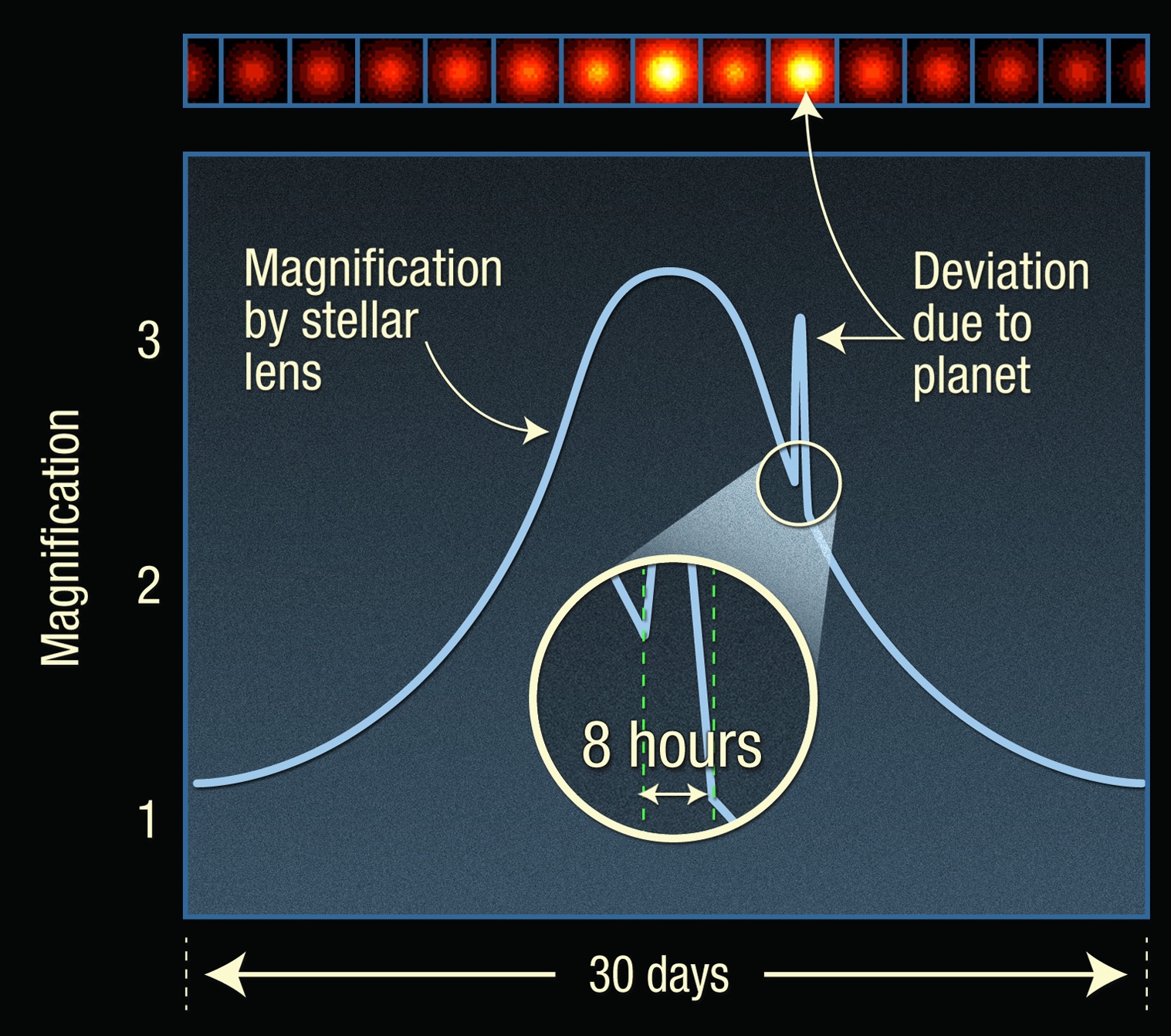
There are simply too many Neptune-like exoplanets in our galaxy. Or at least that’s the current feeling astronomers get from gravitational microlensing surveys, which look for exoplanets during short-lived magnification events caused by chance alignments between stars. These surveys have now found about a dozen so-called “free-floating” planets, and while this doesn’t sound like that many, running the numbers reveals that this tiny sample implies that there are about two free-floating Neptune-size planets for every star in the galaxy.

A schematic graph of a large pulse and a smaller narrower pulse superimposed on top.

An illustration of how exoplanets are found via microlensing. The broad first bump is caused by the host star magnifying the light from a background star; the narrow second bump is caused by the planet acting as a lens as well. “Free-floating” planets create only one bump. [Adapted from NASA, ESA, and A. Feild (STScI)]

The idea that there are more free-ranging Neptunes than stars is unsettling, and astronomers aren’t yet sure how this many planets ended up so isolated. It’s possible that these objects simply formed disconnected from any planetary system, but it’s unclear how something so small could collapse from the interstellar clouds that usually produce stellar-mass objects. It’s also possible that the planets formed around stars in the usual way, only to be later kicked out by some violent dynamical process — but this would either require too much time or too many giant planets capable of ejecting the lower-mass ones.

However, new research by Sam Hadden (Canadian Institute for Theoretical Astrophysics) and Yanqin Wu (University of Toronto) presents an alternative idea: what if at least some of these free-floating planets aren’t fully on their own, but instead remain estranged but weakly bound to their parent stars?

Simulated Scattering

Two celestial objects need to align nearly perfectly in order to create a microlensing pulse that we can detect. For an exoplanet orbiting a star, we should observe two of these pulses: one when the host star drifts in and out of alignment with a background star, and one when the nearby bound planet does the same. In the case of a free-floating planet, there’s only one pulse, and we therefore assume that there is no host star. Hadden and Wu noticed that since the alignment has to be so precise for microlensing to occur, it’s possible that a seemingly free-floating planet is simply widely separated from its host star, and the star managed to dodge the magnification effect. In other words, these planets might not be free floating at all, just on wide and eccentric orbits.

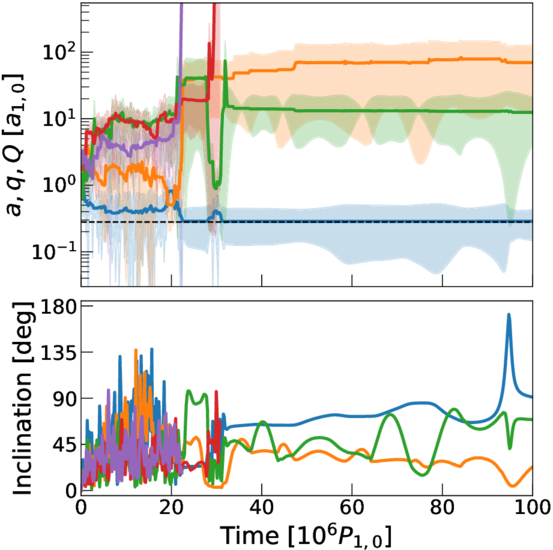
A two-panel plot showing how the semimajor axis and inclination of 5 planets evolve over time.

The orbital evolution of a five-planet system that undergoes planet–planet scattering. Each line represents one planet; note that in the end two are ejected, two end up on wide detached orbits, and the fifth ends up on a tightly bound inner orbit. Click to enlarge. [Hadden & Yu 2026]

The researchers decided to test whether it’s possible to create these kinds of orbits via a known dynamical process called planet–planet scattering. As the name implies, during this process, planets that begin on orderly orbits around their parent star undergo a dramatic rearrangement as they jostle each other around through gravitational interactions. The researchers created two types of simulations: one with a collection of equal-mass planets, and another in which one planet dominates over a brood of smaller ones. After setting up the systems, they let the “dynamical havoc” proceed for a few hundred million years, then surveyed the aftermath.

They found that both types of simulations readily created the “detached” objects needed to mimic free-floating planets. In fact, the most common outcome was for two or three planets to be bullied into far-out orbits by a planet that then plunges onto a tight inner orbit extremely close to the star.

Though the authors caution that this process likely doesn’t explain all of the free-floating planets observed to date, this is an exciting model that would dramatically lower our estimates of the number of Neptunes roaming alone between the stars.

Citation

“Free Floating or Merely Detached?,” Sam Hadden and Yanqin Wu 2026 ApJ 1000 70. doi:10.3847/1538-4357/ae6508

The post Detached but Not Alone appeared first on AAS Nova.

Alien life on nearby 'super Earth' much likelier than we thought, study claims

4 July 2026 at 12:00

A hefty "super Earth" lurking in one of the closest star systems to our planet may be much better suited to supporting extraterrestrial life than scientists initially thought, a new study suggests. The alien world's relative proximity to Earth, and the nature of its home star, make it a prime candidate for follow-up observations, researchers say.

The exoplanet, dubbed GJ 3378b, was discovered in 2024 and orbits a red dwarf star around 25 light-years from our planet. The alien world circles its star every 21.5 days at a distance around 10 times closer than Earth orbits the sun, which would make it completely inhospitable in our solar system. But because the red dwarf emits around 90% less radiation than the sun does, GJ 3378b is slap bang in the middle of this star system’s "habitable zone," where liquid water could exist on the exoplanet's surface.

Researchers initially thought that GJ 3378b was around five times more massive than Earth. If the planet is rocky like ours, it would qualify as a "super Earth" — often considered the best candidates for sustaining extraterrestrial life. However, it was hard to tell if this world had a solid surface or was actually a mini gas giant. And even if it was rocky, its immense size would probably mean that its atmospheric pressure would be crushing, making it less likely to harbor life.

But in a new study, published June 30 in The Astrophysical Journal, researchers recalculated the exoplanet's size, using the Habitable-zone Planet Finder instrument attached to the Hobby-Eberly Telescope at the McDonald Observatory in Texas. This device measures subtle wobbles in the host star, caused by the gravitational tug of orbiting planets, and can be used to calculate the planet’s mass and trajectory.

This revealed that GJ 3378b is actually only 2.3 times more massive than Earth, which almost guarantees it is a rocky world and means it could have an atmosphere with a similar pressure to our own, raising the chances that extraterrestrial lifeforms could thrive there.

An artist's illustration of an exoplanet in space

The newly constrained size of GJ 3378b makes it much more likely that the exoplanet has an atmosphere similar to Earth's. But more research is needed to confirm if it even has an atmosphere. (Image credit: NASA/Eyes on Exoplanets viewer)

While researchers have found several other exoplanets that could harbor life, the fact that GJ 3378b is so close to us makes it particularly intriguing, as it will be easier to confirm whether it is truly habitable.

"This one’s exciting," study first author Paul Robertson, an astronomer at the University of California, Irvine, said in a statement. "25 light-years sounds like a long way, but the Milky Way is about 100,000 light-years across, so in that respect it’s our next-door neighbor."

Before we get too carried away, there is still no evidence that GJ 3378b has an atmosphere or liquid water. Its proximity to its home star may mean that any atmosphere it once had was stripped away by stellar winds, similar to how solar radiation likely stripped Mars of its atmosphere and ancient oceans.

Therefore, more observations are needed. But if an atmosphere is detected, GJ 3378b would likely jump to near the front of the queue of exoplanets that researchers want to study further.

"If a planet in the habitable zone has a proper atmosphere, we can justify further research looking for biosignatures, liquid water or other signs of life," study co-author Gogod James, an undergraduate student at UC Irvine, said in the statement.

The fact that GJ 3378b orbits a red dwarf also makes it more appealing for future study because this is the most common star type in the Milky Way, so experts are keen to learn more about these stars' planetary systems and potential to nurture life.

"About 70% of stars in our galaxy are red dwarfs, so they represent the standard," study co-author Michael Endl, an astronomer at the McDonald Observatory and the University of Texas at Austin, said in another statement. "It’s really important that we understand the planet population around these stars."

Cotton-Candy Exoplanets: Two for the Price of One!

2 July 2026 at 13:00

NASA’s Transiting Exoplanet Survey Satellite has found two “super-puff” planets in the same system, each one as light as cotton candy.

The post Cotton-Candy Exoplanets: Two for the Price of One! appeared first on Sky & Telescope.

This 'improbable' exoplanet system is so wonky because of a weird object within

23 June 2026 at 11:00

Using NASA's exoplanet-hunting spacecraft TESS (Transiting Exoplanet Survey Satellite), scientists have discovered a planetary system that scientists are calling "improbable." It could change how we think about the mechanisms behind planet formation.

The reason for the unusual arrangement of this planetary system is a failed star or brown dwarf designated TOI-201 c. Objects like this get the slightly unfair nickname of "failed stars" because, despite forming from a collapsing cloud of gas and dust like other stars, they fail to gather enough mass to trigger nuclear fusion of hydrogen to helium in their cores. Brown dwarfs have masses between 13 and 80 times that of Jupiter, or 0.013 to 0.08 the mass of the sun. That puts them right between the most massive planets and the smallest stars.

TOI-201 c is on a highly elliptical orbit, taking 2,881 days to orbit its star, which has resulted in planets including a super-Earth named TOI-201 d and a warm Jupiter named TOI-201 b, forming in a narrow zone within its orbit, something that isn't just new to astronomers; it is completely unexpected based on planetary formation models.

The 5.8-day orbit of TOI-201 d and the 53-day orbit of TOI-201 b are both perfectly aligned with the orbit of the brown dwarf. The brown dwarf creates gravitational instability at distances equivalent to the distance between Mars and the sun, but this didn't prevent planets from forming in the system.

"This discovery provides a crucial insight into how planets form even around massive, eccentric objects," team member and INAF researcher Aldo Bonomo said in an emailed statement.

The system challenges the idea that gas giant planets form at distances equivalent to 2 to 3 times the distance between Earth and the sun in the disks of gas and dust that surround stars during their infancy.

"The presence of the brown dwarf on such an elliptical orbit forced the planets to form and survive by occupying the innermost and hottest edges of the primordial disk," team member Luca Naponiello of the National Institute for Astrophysics (INAF) said in the statement. "Furthermore, the data show that during the close approach of the brown dwarf, the warm Jupiter undergoes strong and sudden variations in its transit timing, bearing witness to an intense and vigorous dynamic interaction currently underway between the two giants."

The system was discovered by TESS using a rare mono-transit event, which describes a planetary body making one crossing of the face of its star, causing a dip in starlight. This was followed by an observing campaign conducted from the ground.

It is extremely rare to discover objects like TOI-201 c with such long and eccentric orbital periods using transits they make of their parent star. This brown dwarf is the first one of these objects to have its mass confirmed, making it an important step forward in astronomy.

"It [TOI-201c] is the transiting object with the longest orbital period for which the mass is known," Naponiello said.

The team's results were published on Wednesday (June 17) in the journal Nature.

James Webb Space Telescope finds a salty surprise on famous 'Pink Planet'

18 June 2026 at 21:00

Using the James Webb Space Telescope, astronomers have discovered that the well-known "Pink Planet" harbors a salty surprise and an exotic atmospheric chemistry. The discovery marks an advancement in the study of cold objects beyond the solar system.

Initially discovered in 2013, GJ504b orbits a sun-like star located around 57 light-years from Earth. With a mass around 25 times that of Jupiter, this Pink Planet may not be a planet at all despite its moniker. It may instead be a brown dwarf, a failed star that formed like a star but was unable to gather enough mass to achieve the nuclear fusion of hydrogen to helium in its core. Thus, astronomers refer to it as a "planetary-mass companion," which means a planet-size object orbiting a parent star.

GJ504b remains one of the coldest planetary-mass companions discovered using ground-based telescopes, with a temperature of around 550 degrees Fahrenheit (290 degrees Celsius). Although, that still makes it hot enough to bake bread. Now, James Webb Space Telescope (JWST) data reveals it has a key ingredient for bread making too: salt located in its atmospheric clouds, unlike anything astronomers have seen before.

"The Pink Planet is the coldest companion ever discovered using ground-based instruments," team leader Aneesh Baburaj of Northwestern University said in a statement. "Many teams all around the world performed follow-up observations to study its light, but it was too faint for ground-based instruments. That made it a perfect target for JWST.

"When we finally obtained its spectrum, it immediately looked interesting. But once we started digging deeper into the data, we realized it was not like anything we have analyzed before."

The Pink Planet is cold and old

The team studied this planetary companion by measuring its faint electromagnetic radiation emissions and filtering out the bright glare of its parent star.

They found the relative coolness of the Pink Planet is a result of the planet's age. Both gas giant planets and brown dwarfs are born blisteringly hot but cool off as they get older. This new research estimated that GJ504b is between 2.5 billion and 4 billion years old.

Breaking down light from the Pink Planet into individual wavelengths, the team was also able to determine its chemical composition. This is possible because elements absorb and emit light at characteristic wavelengths, meaning they leave "fingerprints" on light passing through their atmospheres.

"In the past, other astronomers observed the companion for an entire night with some of the biggest telescopes in the world to obtain a spectrum," Baburaj said. "And they could not see the object. With JWST, our entire observation took around two hours, and we were successful."

The JWST data revealed a rich cocktail of chemicals in the atmosphere of the Pink Planet that included water, carbon dioxide, methane, and ammonia. However, these observations didn't match modeling of the planetary companion's atmosphere until the team factored in something completely unexpected: clouds of salt deep in the atmosphere.

A depiction of a yellow-hexagon mirror attached to a long silver shield-shape object. This is the JWST. In the background, lots of stars across space. Toward the right in the background, glare from one star that is likely the sun.

An illustration of the JWST which has become a vital tool in the investigation of exoplanets and brown dwarfs. (Image credit: ESA)

"We ran simulations with clouds, and the results aligned with what we know about cold planets," Baburaj said. "We tried three different types of clouds, and salt clouds fit best. When we accounted for salt clouds, it subdued the signature of molecules hidden deeper in the companion’s atmosphere. Then, the results became physically possible.

"This is the first time we've found that salt clouds are critical to explaining the spectrum of an object. It's a good reminder to account for clouds in our models."

Though this mystery may be solved, there are still questions surrounding GJ504b that will only be solved with further investigation. The Pink Planet seems to be unusually rich in elements heavier than hydrogen and helium, which astronomers call metals. This means the team still can't pin down the origin of the Pink Planet; did it form like a planet, or like a star?

That means they aren't quite ready to determine if GJ504b is a gas giant planet or a brown dwarf... or should that be Pink Dwarf?

The team's research was published on Thursday (June 18) in The Astronomical Journal.

Unusual Exoplanet Redefines the Concept of a Hot Jupiter

17 June 2026 at 01:04

For nearly a decade, the hot Jupiter CoRoT-2 b has presented a profound mystery to astronomers: its atmospheric hot spot is inexplicably located opposite the position observed on all other exoplanets of its kind. This peculiar phenomenon challenges conventional wisdom about the nature of hot Jupiters and their atmospheric dynamics. Recent research led by Aurora Kesseli, a staff scientist at the NASA Exoplanet Science Institute (NExScI) housed within Caltech’s IPAC center, has shed new light on this enigma by leveraging advanced spectroscopic data obtained from the Very Large Telescope (VLT) at the European Southern Observatory. This breakthrough offers compelling evidence that CoRoT-2 b defies a fundamental assumption about hot Jupiters: it is not tidally locked to its host star.

Hot Jupiters are a fascinating class of exoplanets typified by their colossal size—often comparable to or exceeding that of Jupiter—and their blisteringly close orbits around host stars, sometimes completing a single revolution in mere days. Because of these properties, hot Jupiters serve as prime candidates for detailed atmospheric studies. Their proximity to the parent star means they receive intense irradiation, significantly influencing their atmospheric dynamics, radiative properties, and chemical compositions. This environment makes them critical laboratories for testing and refining planetary formation, evolution, and climate models.

The accepted paradigm for hot Jupiter atmospheres is predicated on tidal locking, whereby the planet’s rotation period synchronizes with its orbit, causing one hemisphere to perpetually face the star, exposed to relentless stellar radiation, while the opposite side remains cloaked in darkness. This lock is thought to occur rapidly due to strong gravitational interactions between the planet and its star. The perpetual dayside is expected to feature a dominant hot spot slightly offset towards the direction of planetary rotation and orbital motion, driven by atmospheric super-rotation. This consistent pattern is observed across many studied hot Jupiters, reinforcing tidal locking as a foundational concept within exoplanetary atmospheric science.

However, CoRoT-2 b stands out starkly against this backdrop. Discovered in 2007 and studied extensively since, this hot Jupiter’s hottest atmospheric region is displaced not ahead of but behind the substellar point—the point on the planet directly facing its star—opposite to the behavior seen in counterparts. Initial hypotheses proposed to explain this anomaly included obscuring cloud layers, magnetic field-driven atmospheric dynamics complicating wind patterns, or a rotation period differing from the orbital period. Previous work by Lisa Dang, a collaborator and professor at the University of Waterloo, outlined these potential explanations based on early observational data.

Aurora Kesseli and her team recently applied phase-resolved emission spectroscopy using the CRIRES+ instrument on the VLT, capturing the planet’s atmosphere in unprecedented detail across different orbital phases. This method enables tracing variations in emitted light corresponding to temperature and wind structures dynamically as the planet orbits. The data conclusively pointed toward the third hypothesis: CoRoT-2 b exhibits a rotation rate slower than its orbital period, meaning it is not synchronized tidally. Specifically, one full rotation of CoRoT-2 b lasts approximately three Earth days, while its orbital period is about 1.5 days. This differential implies that by the time the planet completes a single axial spin, it has circumnavigated its host star twice.

This non-synchronous rotation leads to a decoupling of the traditional tidally locked pattern of day-night heating contrasts, fundamentally altering how atmospheric circulation redistributes energy. Without tidal locking, the expected eastward-shifted hot spot is replaced by a distinct thermal signature resulting from slower planetary spin interacting with intense stellar irradiation. The discovery challenges standard assumptions embedded in many exoplanet climate models that universally prescribe tidal locking for hot Jupiters, suggesting a more nuanced picture with rotational diversity.

Understanding the rotational state of exoplanets like CoRoT-2 b carries broader implications, especially in the context of habitability studies. Many terrestrial exoplanets orbit M dwarfs, cool stars constituting roughly 70% of the stellar population in the Milky Way. These stars have habitable zones—regions where liquid water can persist on planetary surfaces—so close that tidal locking is highly probable within relatively short stellar lifetimes. Since rotation influences temperature gradients, weather systems, and atmospheric retention, a tidally locked terrestrial exoplanet’s climate could differ drastically from one with asynchronous rotation. Hence, unraveling CoRoT-2 b’s rotation contributes to refining the models employed for predicting environments on potentially habitable worlds in tight orbits.

While the revelation of CoRoT-2 b’s slow rotation solves a significant piece of the puzzle, it simultaneously opens further questions. The mechanisms driving this atypical rotational state in a planet where tidal forces should dominate remain elusive. Possible contributors might include magnetic torques, differential interior structures, or recent dynamical interactions within its planetary system that disturbed its spin. Future observations, especially with upcoming flagship observatories like the James Webb Space Telescope, the Habitable Worlds Observatory, and the ground-based Extremely Large Telescope, promise to provide deeper insight into these processes by offering higher precision data across broader wavelength ranges.

Hot Jupiters continue to act as vanguards in exoplanetary science. They are currently the best-understood and most accessible class of exoplanets for atmospheric characterization, enabling astronomers to test and recalibrate models of atmospheric physics, chemistry, and dynamics. The case of CoRoT-2 b exemplifies how nature’s variability often defies simplified expectations, compelling constant refinement of theories and models. These advances do not merely enhance comprehension of gas giants but ripple outward to shape understanding of all planetary atmospheres, including those bearing life.

Kesseli underscores the excitement of probing “weird” exceptions within the exoplanet census, emphasizing that such outliers drive scientific progress. As instrumentation improves and more extensive surveys unfold, the taxonomy of exoplanetary rotation states, atmospheric dynamics, and climate regimes will grow richer. This improved framework will essentialize our broader quest to understand planet formation, stellar influences, and potential biosignatures on distant worlds. CoRoT-2 b’s defiance of tidal locking invites the scientific community to remain alert to unexpected phenomena lurking in exoplanet atmospheres.

In summation, the unraveling of CoRoT-2 b’s anomalous atmospheric hot spot through rigorous spectroscopic measurements marks a milestone in exoplanet research. It dispels the notion of universal tidal locking among hot Jupiters and reveals a more intricate rotational behavior impacting atmospheric properties. The ongoing inquiry into the cause of this slowed rotation will propel future efforts to decipher planetary spins, magnetic interactions, and orbital dynamics across a diverse planetary population. These insights will deepen our grasp of planetary physics and help guide the search for habitable environments beyond our solar system.

Subject of Research: Atmospheric dynamics and rotational state of the hot Jupiter CoRoT-2 b
Article Title: Unraveling the Mystery of the Peculiar and Young Hot Jupiter CoRoT-2b II: Phase Resolved Emission Spectroscopy with VLT/CRIRES+ and Gemini-S/IGRINS
News Publication Date: June 16, 2026
Web References: IPAC News, NExScI at Caltech, University of Waterloo Newsroom
References: Kesseli et al., submitted to The Astronomical Journal
Image Credits: Keith Miller (Caltech/IPAC – SELab)

Keywords: hot Jupiter, CoRoT-2 b, tidal locking, exoplanet atmospheres, phase-resolved spectroscopy, planetary rotation, atmospheric dynamics, VLT/CRIRES+, exoplanet climate models, M dwarf habitability, rotational decoupling, spectroscopic observations

NASA’s Webb Catches Exoplanet Getting Roasted

16 June 2026 at 22:15
 
4 Min Read

NASA’s Webb Catches Exoplanet Getting Roasted

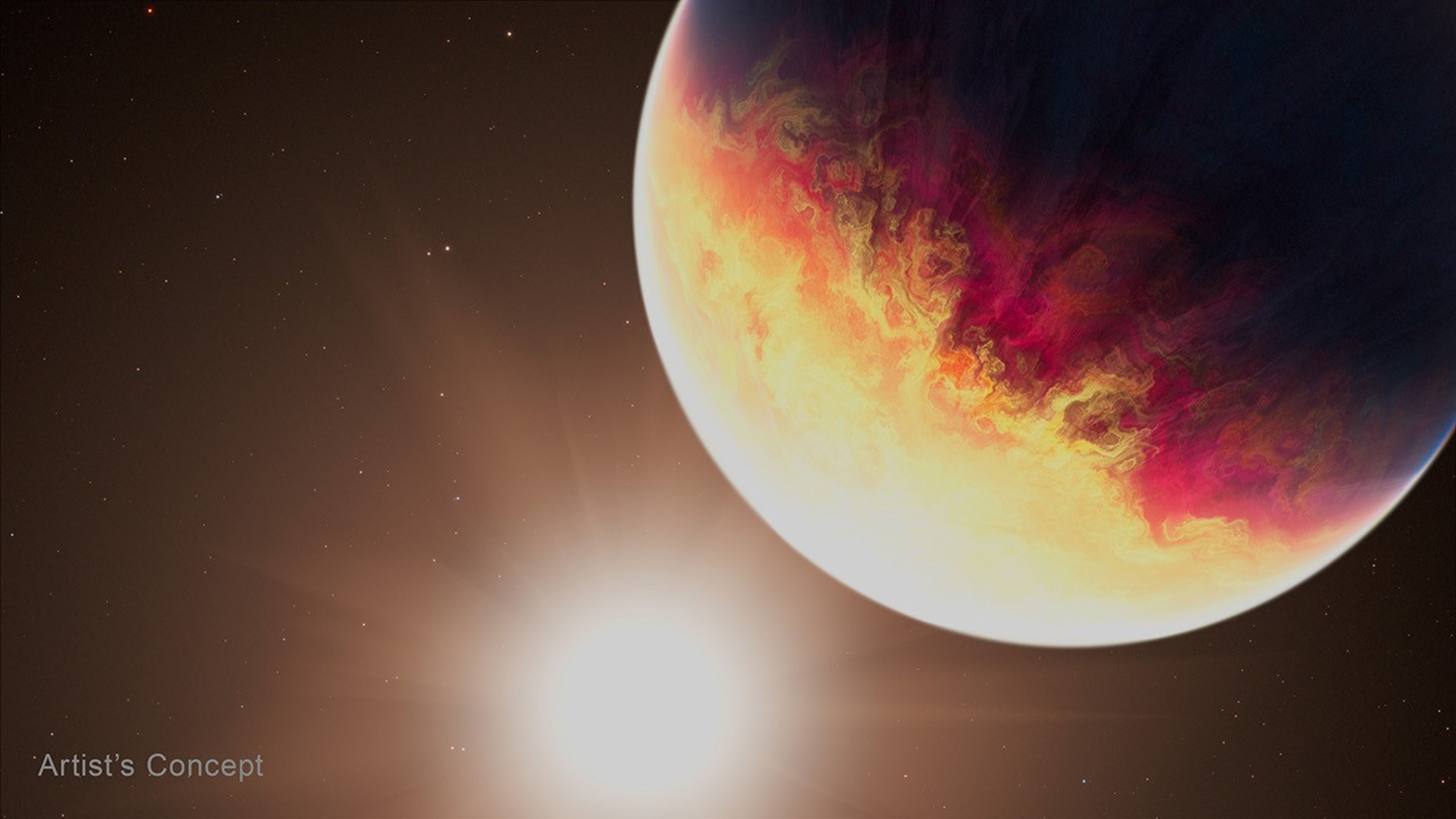
Illustration of a planet and a star, labeled artist’s concept at the bottom left. The planet fills more than a quarter of the image to the upper right, with the bright star to its lower left. The planet is white hot on the star side, fading to yellow that mixes with swirls of bright red across its middle, and eventually fading to black on the side most distant from the star. Distant stars dot the background of space, which is black near the edges of the frame.
This artist’s concept shows exoplanet HD 80606 b being “roasted” as its orbit approaches periastron, the point at which it is closest to its host star, which is similar to our Sun.
Credits:
Artwork: NASA, ESA, CSA, Joseph Olmsted (STScI)

4 min read

NASA’s Webb Catches Exoplanet Getting Roasted

One well-done gas giant, coming right up! That’s the latest from researchers analyzing NASA’s James Webb Space Telescope’s observations of HD 80606 b, an exoplanet four times the mass of Jupiter with an extremely elliptical orbit that sweeps close by its Sun-like star. The research team is presenting their study and preliminary findings Tuesday at the 248th meeting of the American Astronomical Society in Pasadena, California.

“Hot Jupiters are already considered some of the most extreme exoplanets we know of, but even among that population, HD 80606 b is one of the most extreme,” said Tiffany Kataria, the study’s principal investigator at NASA’s Jet Propulsion Laboratory in Southern California. “We typically think of hot Jupiters as hot gas giants sitting right next to their stars, but this planet’s highly eccentric orbit creates a completely different beast.”

As the planet plunges close to its star, Webb shows its temperature skyrockets by 1,100 degrees Fahrenheit. Previous studies have shown that radical temperature swings can cause an exoplanet’s chemistry and clouds to change in real time. According to the research team, the dynamic conditions of HD 80606 b make the planet an ideal target to observe these changes with Webb’s powerful instruments.

Image: Artist’s concept exoplanet HD 80606 b

Illustration of a planet and a star, labeled artistu2019s concept at the bottom left. The planet fills more than a quarter of the image to the upper right, with the bright star to its lower left. The planet is white hot on the star side, fading to yellow that mixes with swirls of bright red across its middle, and eventually fading to black on the side most distant from the star. Distant stars dot the background of space, which is black near the edges of the frame.
This artist’s concept shows exoplanet HD 80606 b being “roasted” as its orbit approaches periastron, the point at which it is closest to its host star, which is similar to our Sun.
Artwork: NASA, ESA, CSA, Joseph Olmsted (STScI)

“Observing a planet like HD 80606 b is actually very efficient because its unusual orbit, with the corresponding swings in temperature and chemical composition, allow us to gather data under varying conditions in just hours and apply those findings to other hot Jupiters or more conventional exoplanets,” said Laura C. Mayorga, co-investigator on the study and an exoplanet astronomer at the Johns Hopkins Applied Physics Laboratory in Laurel, Maryland.

Measurements of temperature and chemical composition were done with spectroscopy, a technique scientists use to break light into its component colors to reveal information about the composition, temperature, motion, and physical properties of objects in space. The team used Webb’s MIRI (Mid-Infrared Instrument) for an extended observation of HD 80606 b before, during, and after its periastron, or closest pass by its star. During periastron, the planet also passed behind the star from Webb’s perspective in what’s known as a secondary eclipse. The observation was years in the planning, as scheduling the time to catch the planet at this point was complex given its extremely elliptical 111-day orbit, and Webb’s own restrictions on where it can look during specific times of the year, based on Earth’s position in orbit around the Sun.

Researchers say they have only begun to peel back the layers of an incredibly rich dataset, but they can clearly see a dramatic shift in the exoplanet’s temperature. “Webb has shown that the planet’s increase in temperature was even more extreme than we anticipated based on Spitzer data,” said Kataria.

In fact, the planet had already been dubbed the “roasted exoplanet” and even got its own poster in NASA’s popular series. NASA’s now-retired Spitzer Space Telescope laid the groundwork of infrared observations of HD 80606 b, showing that more detailed spectroscopic data from Webb would be especially compelling.

“Spitzer did amazing work on this exoplanet, and now Webb is building on that legacy by enabling us to drill down to distinguish specific chemical signatures like methane and carbon dioxide, which is just amazing progress,” said Ryan Challener, co-author and research associate at the Cornell Center for Astrophysics and Planetary Science. “There’s so much to learn from this one dataset here — we really are just getting started deciphering what Webb has to tell us.”

The James Webb Space Telescope is the world’s premier space science observatory. Webb is solving mysteries in our solar system, looking beyond to distant worlds around other stars, and probing the mysterious structures and origins of our universe and our place in it. Webb is an international program led by NASA with its partners, ESA (European Space Agency) and CSA (Canadian Space Agency).

For more information on Webb, visit:

science.nasa.gov/webb

Downloads & Related Information

The following sections contain links to download this article’s images and videos in all available resolutions followed by related information links, media contacts, and if available, research paper and Spanish translation links.

Related Images & Videos

Illustration of a planet and a star, labeled artistu2019s concept at the bottom left. The planet fills more than a quarter of the image to the upper right, with the bright star to its lower left. The planet is white hot on the star side, fading to yellow that mixes with swirls of bright red across its middle, and eventually fading to black on the side most distant from the star. Distant stars dot the background of space, which is black near the edges of the frame.

HD 80606 b (Artist’s Concept)

This artist’s concept shows exoplanet HD 80606 b being “roasted” as its orbit approaches periastron, the point at which it is closest to its host star, which is similar to our Sun.

Related Links

Este Artículo en Español – “Telescopio Webb de la NASA Detecta un Exoplaneto Asandose”

Read:  Webb’s Impact on Exoplanet Research

Watch:  How to Study Exoplanets: Webb and Challenges

Explore:  Eyes on Exoplanets

Print: The Roasted Exoplanet Poster

More Webb: News | Images | Science | Home Page


Share

Details

Last Updated
Jun 17, 2026
Contact
Media

Laura Betz
NASA’s Goddard Space Flight Center
Greenbelt, Maryland
laura.e.betz@nasa.gov

Leah Ramsay
Space Telescope Science Institute
Baltimore, Maryland

Hannah Braun
Space Telescope Science Institute
Baltimore, Maryland

NASA’s Webb Catches Exoplanet Getting Roasted

16 June 2026 at 22:15
 
4 Min Read

NASA’s Webb Catches Exoplanet Getting Roasted

Illustration of a planet and a star, labeled artist’s concept at the bottom left. The planet fills more than a quarter of the image to the upper right, with the bright star to its lower left. The planet is white hot on the star side, fading to yellow that mixes with swirls of bright red across its middle, and eventually fading to black on the side most distant from the star. Distant stars dot the background of space, which is black near the edges of the frame.
This artist’s concept shows exoplanet HD 80606 b being “roasted” as its orbit approaches periastron, the point at which it is closest to its host star, which is similar to our Sun.
Credits: Artwork: NASA, ESA, CSA, Joseph Olmsted (STScI)

4 min read

NASA’s Webb Catches Exoplanet Getting Roasted

One well-done gas giant, coming right up! That’s the latest from researchers analyzing NASA’s James Webb Space Telescope’s observations of HD 80606 b, an exoplanet four times the mass of Jupiter with an extremely elliptical orbit that sweeps close by its Sun-like star. The research team is presenting their study and preliminary findings Tuesday at the 248th meeting of the American Astronomical Society in Pasadena, California.

“Hot Jupiters are already considered some of the most extreme exoplanets we know of, but even among that population, HD 80606 b is one of the most extreme,” said Tiffany Kataria, the study’s principal investigator at NASA’s Jet Propulsion Laboratory in Southern California. “We typically think of hot Jupiters as hot gas giants sitting right next to their stars, but this planet’s highly eccentric orbit creates a completely different beast.”

As the planet plunges close to its star, Webb shows its temperature skyrockets by 1,100 degrees Fahrenheit. Previous studies have shown that radical temperature swings can cause an exoplanet’s chemistry and clouds to change in real time. According to the research team, the dynamic conditions of HD 80606 b make the planet an ideal target to observe these changes with Webb’s powerful instruments.

Image: Artist’s concept exoplanet HD 80606 b

Illustration of a planet and a star, labeled artistu2019s concept at the bottom left. The planet fills more than a quarter of the image to the upper right, with the bright star to its lower left. The planet is white hot on the star side, fading to yellow that mixes with swirls of bright red across its middle, and eventually fading to black on the side most distant from the star. Distant stars dot the background of space, which is black near the edges of the frame.
This artist’s concept shows exoplanet HD 80606 b being “roasted” as its orbit approaches periastron, the point at which it is closest to its host star, which is similar to our Sun.
Artwork: NASA, ESA, CSA, Joseph Olmsted (STScI)

“Observing a planet like HD 80606 b is actually very efficient because its unusual orbit, with the corresponding swings in temperature and chemical composition, allow us to gather data under varying conditions in just hours and apply those findings to other hot Jupiters or more conventional exoplanets,” said Laura C. Mayorga, co-investigator on the study and an exoplanet astronomer at the Johns Hopkins Applied Physics Laboratory in Laurel, Maryland.

Measurements of temperature and chemical composition were done with spectroscopy, a technique scientists use to break light into its component colors to reveal information about the composition, temperature, motion, and physical properties of objects in space. The team used Webb’s MIRI (Mid-Infrared Instrument) for an extended observation of HD 80606 b before, during, and after its periastron, or closest pass by its star. During periastron, the planet also passed behind the star from Webb’s perspective in what’s known as a secondary eclipse. The observation was years in the planning, as scheduling the time to catch the planet at this point was complex given its extremely elliptical 111-day orbit, and Webb’s own restrictions on where it can look during specific times of the year, based on Earth’s position in orbit around the Sun.

Researchers say they have only begun to peel back the layers of an incredibly rich dataset, but they can clearly see a dramatic shift in the exoplanet’s temperature. “Webb has shown that the planet’s increase in temperature was even more extreme than we anticipated based on Spitzer data,” said Kataria.

In fact, the planet had already been dubbed the “roasted exoplanet” and even got its own poster in NASA’s popular series. NASA’s now-retired Spitzer Space Telescope laid the groundwork of infrared observations of HD 80606 b, showing that more detailed spectroscopic data from Webb would be especially compelling.

“Spitzer did amazing work on this exoplanet, and now Webb is building on that legacy by enabling us to drill down to distinguish specific chemical signatures like methane and carbon dioxide, which is just amazing progress,” said Ryan Challener, co-author and research associate at the Cornell Center for Astrophysics and Planetary Science. “There’s so much to learn from this one dataset here — we really are just getting started deciphering what Webb has to tell us.”

The James Webb Space Telescope is the world’s premier space science observatory. Webb is solving mysteries in our solar system, looking beyond to distant worlds around other stars, and probing the mysterious structures and origins of our universe and our place in it. Webb is an international program led by NASA with its partners, ESA (European Space Agency) and CSA (Canadian Space Agency).

For more information on Webb, visit:

science.nasa.gov/webb

Downloads & Related Information

The following sections contain links to download this article’s images and videos in all available resolutions followed by related information links, media contacts, and if available, research paper and Spanish translation links.

Related Images & Videos

Illustration of a planet and a star, labeled artistu2019s concept at the bottom left. The planet fills more than a quarter of the image to the upper right, with the bright star to its lower left. The planet is white hot on the star side, fading to yellow that mixes with swirls of bright red across its middle, and eventually fading to black on the side most distant from the star. Distant stars dot the background of space, which is black near the edges of the frame.

HD 80606 b (Artist’s Concept)

This artist’s concept shows exoplanet HD 80606 b being “roasted” as its orbit approaches periastron, the point at which it is closest to its host star, which is similar to our Sun.

Related Links

Este Artículo en Español – “Telescopio Webb de la NASA Detecta un Exoplaneto Asandose”

Read:  Webb’s Impact on Exoplanet Research

Watch:  How to Study Exoplanets: Webb and Challenges

Explore:  Eyes on Exoplanets

Print: The Roasted Exoplanet Poster

More Webb: News | Images | Science | Home Page

Share

Details

Last Updated
Jun 16, 2026
Contact
Media

Laura Betz
NASA’s Goddard Space Flight Center
Greenbelt, Maryland
laura.e.betz@nasa.gov

Leah Ramsay
Space Telescope Science Institute
Baltimore, Maryland

Hannah Braun
Space Telescope Science Institute
Baltimore, Maryland

The post NASA’s Webb Catches Exoplanet Getting Roasted appeared first on NASA Science.

❌