Japan’s Hayabusa 2 mission has revealed another "snowman" asteroid — a pair of asteroids attached with a narrow neck. The contact binary could help shed light on planet formation.
An asteroid now bears the name of beloved musician Elliott Smith, thanks to one ambitious filmmaker.
Elliott Smith passed away at the age of 34 in 2003, but his impact and his music continue to connect with people around the world. And his influence has now extended to space, thanks to independent filmmaker Orlando Campopiano, who worked to get an asteroid named "Elliottsmith."
"I hope this introduces at least one new person to Elliott's brilliant discography, and I'm happy to see a permanent legacy in the stars! To have this tribute to him blessed by the estate and discoverers is also a great honor," Campopiano told Stereogum.
While listening to the song "Shooting Star," from Smith's album "From a Basement on the Hill," which was released in 2004 following his death, Campopiano had the idea to try and get an asteroid named after Smith, he told Stereogum.
He took this inspiration and ran with it, connecting with Smith's estate and working together to submit a proposal to the International Astronomical Union (IAU), which gives official names to cosmic objects, including asteroids. Maybe there are some Elliott Smith fans at the IAU, because the organization actually said yes.
With this positive response, Asteroid (861969) 2014 OS439 is now officially "Elliottsmith."
The asteroid Elliotsmith (861969) visualized in our solar system. (Image credit: NASA)
The asteroid was discovered back in 2014 by the Pan-STARRS 1 (Panoramic Survey Telescope and Rapid Response System) project in Hawai'i.
The IAU's announcement of the renaming reads: "Steven Paul 'Elliott' Smith (1969–2003) was an influential, Oscar-nominated American songwriter. His intricate music left a lasting impact on many musicians. Asteroid 861969 honors his birth date, August 6, 1969. Smith often used celestial motifs in his work, notably in the song 'Shooting Star,' which, in hindsight, symbolizes his brief but brilliant light."
As this classification states, this asteroid is more than just a random rock in the sky. Its previous, numerical name 861969 happens to perfectly mirror Smith's birthday. This cosmic alignment makes it feel like this naming was truly meant to be.
On June 19, 2004, at the Kitt Peak National Observatory in Tucson, Arizona, astronomers Roy Tucker, David Tholen, and Fabrizio Bernardi discovered Asteroid Apophis. This Near-Earth Object (NEO), approximately 1,099 to 1,230 feet (335 to 375 meters) wide, reached the highest ever rating of level 4 out of 10 on the Torino Impact Hazard Scale,Continue reading "June 19, 2004: Astroid Apophis is discovered"
Last year, NASA's Lucy spacecraft encountered a bi-lobed asteroid that is a chunk of an even larger rocky body that was smashed apart in an almighty collision 155 million years ago. This little pitstop happened on Lucy's way to a rendezvous with the Trojan asteroids that shadow Jupiter around the sun.
The asteroid 52246 Donaldjohanson, better known as "DJ" to Lucy's mission scientists and named after the paleoanthropologist who discovered the Lucy hominin fossil in Ethiopia in 1974, orbits the sun in the inner part of the main asteroid belt between Mars and Jupiter.
The true Lucy fossil dates back in time 3.2 million years and is an important link in the evolutionary chain that led to homo sapiens. Likewise, primitive asteroidal bodies are somewhat like fossilized remnants of the building blocks of the solar system's planets, including Earth. Understanding the make-up of these asteroids and where they formed versus where they are now can provide crucial insights into how Earth was assembled and where its organic materials and water may have come from.
Lucy flew past DJ in April of 2025. It is a pretty primitive asteroid, meaning that it has, or once upon a time had, certain volatile materials such as water-ice, as well as plenty of carbon — all things that can be removed thermally over time. Most objects that contain volatiles originate in the outer solar system, where it is cold enough that the volatiles do not sublimate away.
Within DJ's composition, Lucy detected iron-bearing phyllosilicates, which are a mineral formed in the presence of liquid water.
"Phyllosilicates are an indication that water was present and there was some degree of aqueous alteration," Simone Marchi, a planetary scientist from the South-west Research Institute and lead of the study into DJ, told Space.com.
However, for DJ to have had water, it must have formed further out from the sun, possibly in the outer asteroid belt.
"But DJ belongs to the inner asteroid belt so that's already intriguing," said Marchi.
The spectral evidence also indicates DJ was only partially altered by water, which Marchi says tells us something about its history.
"The aqueous alteration terminated early, and though we don't know why, we can speculate. In order to have aqueous alteration there needs to be some internal heating [usually via radioactive elements] and if something forms later than everything else then there will be less heat [since many of the radioactive elements will have already decayed]. Or perhaps there was just less water to start with where it formed."
The main belt carbonaceous asteroid (52246) Donaldjohanson as observed by the NASA Lucy Spacecraft on April 20, 2025. Here the grey-scale optical image, acquired with the L'LORRI instrument, is overlain by a false-color map indicating the gravitational slopes on the asteroid’s surface. (Image credit: NASA/GSFC/SwRI/JHU-APL/DLR)
What we do know is that DJ was once part of a much larger asteroid that suffered a giant impact 155 million years ago, causing the parent body to break apart into a number of chunks, the largest being the 45-mile-wide (73-kilometer-wide) asteroid 163 Erigone. Consequently, the remains of this parent asteroid, including DJ, are collectively referred to as the Erigone family.
DJ's violent origin may also explain its shape, which features two lobes joined together by a narrower and relatively smooth neck.
"We have now seen many small bodies in the solar system that appear to have this bi-lobed shape, and that's across a wide range of sizes," said Marchi.
For example the near-Earth asteroids 25142 Itokawa, which was visited by the first Japanese Hayabusa mission in 2005, and 4149 Toutatis that was encountered by China's Chang'e 2 in 2012, are both bi-lobed. So too is the tiny asteroid Selam, which is a satellite of the asteroid 152830 Dinkinesh visited by Lucy in 2023. Then there are cometary bodies including 67P Churyumov–Gerasimenko visited by the Rosetta mission and comet 19P/Borrelly, imaged by NASA's Deep Space 1 spacecraft in 1999.
These objects are all different sizes, different types and in different locations, but they all share the same structure. However, Marchi cautions that they might not all form the same way. For example, the neck between the lobes of comets such as 67P might form through erosion via sublimation and outgassing as the comet gets closer to the Sun, whereas for asteroids it might indicate a history of being involved in a giant impact, the resulting fragments coming together to be bound by gravity – a so-called contact binary.
Lucy now continues onwards, scheduled to encounter its first trojan asteroid, known as 3548 Eurybates, in August 2027. Trojans are asteroids that have been captured by Jupiter's gravity at the L3 and L4 Lagrange points, 60 degrees in front and 60 degrees behind Jupiter itself.
"We think that the Trojans, based on our understanding of the solar system, formed further out and then were captured where they are today following the early shuffling of the planets," said Marchi. "This shuffling could also have been the origin of DJ, so there could be a connection there between DJ and the Trojans."
The asteroid Donaldjohanson is seen in detail in this Lucy image. (Image credit: The asteroid Donaldjohanson as seen by the Lucy Long-Range Reconnaissance Imager (L’LORRI). This is one of the most detailed images returned by NASA’s Lucy spacecraft during its flyby. )
Compositionally, the majority of trojans are expected to be even more primitive than DJ, containing more carbon, water and other volatile materials that would sublimate if they got too close to the sun.
That is all except one: Eurybates.
"It is the only one of our targets that from spectroscopy appears to be relatively similar to DJ. It's not identical, but it is closer in composition to DJ than the other Trojans, so it will be intriguing to compare them," said Marchi.
Indeed, any similarities will help tell us how asteroids were herded around during the first few hundred million years of solar system history following the formation of the planets. Jupiter and Saturn, especially, began migrating inwards and then out again. In doing so, their gravity pushed and pulled minor bodies all over the place, as did the gravity of Uranus and particularly Neptune as they edged outwards. These migrations led to the formation of the asteroid belt and the Kuiper belt, and ejected trillions of bodies into the wide orbits of the Oort Cloud.
"The key question is, if DJ has been relocated in the inner asteroid belt, then how many other asteroids came along with it and ended up being closer to the Earth, where they could have delivered some water, some organics and other things to our planet?" asked Marchi.
Lucy will visit six of Jupiter's trojans, which in total number over 15,300 discovered so far. Far from lumps of rock, the trojans, along with DJ and Dinkinesh (which is the Ethiopian name for the Lucy fossil), are windows into the past, and the storytellers of the Earth's most ancient history.
Lucy's findings from Donaldjohanson were published on Thursday (June 18) in the journal Science.
Even small asteroids lead complex lives. During its flyby of the asteroid Donaldjohanson last year, NASA’s Lucy spacecraft revealed the asteroid to be a wobbly, peanut-shaped body that has undergone a lot of activity in its relatively short history. Formed as fragments coalesced after a violent collision 155 million years ago, the asteroid was transformed by the small but inexorable force of the Sun’s radiation, all while retaining signs of the brief presence of liquid water in its distant past.
Zooming through the main asteroid belt toward one of the Jupiter Trojan asteroid groups, the Lucy spacecraft collected the first close-up images and other data at Donaldjohanson on April 20, 2025, as it passed 650 miles away from the asteroid. The data revealed that, instead of spinning simply around one axis like most other asteroids and planets, Donaldjohanson has a more complicated two-axis rotation. Scientists also saw Donaldjohanson’s peanut shape and the craters and ridges on its surface.
A timelapse video made from images taken by NASA’s Lucy spacecraft as it approached the asteroid Donaldjohanson on April 20, 2025. The L’LORRI (Lucy Long Range Reconnaissance Imager) instrument, the spacecraft’s high-resolution black-and-white imager, collected these images over two hours as the spacecraft rapidly closed in on the asteroid from an initial separation of more than 58,000 miles (93,000 km), until the spacecraft passed a mere 650 miles (1000 km) from the 5-mile- (8 km-) wide asteroid.
NASA/Goddard/SwRI/JHU-APL
Lucy’s encounter with the asteroid was planned as a dress rehearsal for the spacecraft and mission team before its primary asteroid encounters, which begin with Lucy’s flyby of the Trojan asteroid Eurybates on Aug. 12, 2027. The instruments performed as expected, and, as a bonus, scientists got a rare opportunity to study a previously unexplored asteroid up close and to compare it to two asteroids with similar compositions but different histories: Bennu, the target of NASA’s OSIRIS-REx sample-return mission, and Ryugu, the site of JAXA’s (Japan Aerospace Exploration Agency) Hayabusa2 sample-return mission.
With Earth-based telescopes, observers saw fluctuations in the light Donaldjohanson reflects, regular patterns of peaks and valleys, typical of an elongated object rotating once every 10.5 Earth days. But Lucy’s data revealed another pattern: Donaldjohanson appears to be rotating like a wobbly top. Paper authors reported that the asteroid rotates end-over-end once every 10.5 Earth days, and wobbles back and forth around its long axis once every 26.5 days.
The asteroid Donaldjohanson is shown slowly rotating in a tumbling, non-principal axis motion, with its angular momentum vector and rotation axes indicated. The surface is colored by gravity slope, which measures the angle between the local surface and the direction of gravity. Higher values (warmer colors) indicate steeper terrain relative to the local gravitational pull. Regions with limited stereo image coverage have been masked out where the shape model is less well constrained.
Kel Elkins/NASA’s Science Visualization Studio/DLR
Peanut shape
While the Earth-based observations hinted at Donaldjohanson’s elongated shape, the Lucy flyby revealed a “bilobate” structure: two lobes connected by a neck, like a peanut. These lobes are likely two fragments from an asteroid collision that gently came together afterward by their mutual gravity.
Donaldjohanson likely rotated at least 10 times faster when it formed, having slowed to its current rate in the last 20 to 60 million years, the team estimates. As it slowed, the balance between the centrifugal force pushing things apart and gravity pulling things together changed and loose rocky material slid down slopes creating the worn-down appearance of many craters, as the flyby images showed.
The paper’s authors say that the asteroid’s slowing rotation is likely caused by a subtle consequence of solar heating known as the YORP effect. Each part of the asteroid’s Sun-warmed surface radiates heat away as infrared light, and that radiation imparts a tiny recoil force to the surface. Because the asteroid’s shape isn’t symmetric, this results in a net torque, or twist, that can change the asteroid’s rotation. Thus, YORP can slow asteroid spins down or speed them up, as in the case of Bennu (once every four hours) and Ryugu (once about every seven hours), which both likely used to rotate much slower than they do today.
Fleeting water
As it passed by Donaldjohanson at 30,000 mph, Lucy recorded the signatures of iron-rich clay minerals on the surface. These clays must have formed in the distant past with the help of liquid water. However, the exposure must have been brief, Lucy scientists concluded, because iron in clays tends to be replaced with other elements, such as magnesium, as water lingers.
Indeed, scientists saw magnesium-rich clays at Bennu and Ryugu, which suggested prolonged water exposure, perhaps lasting millions of years, when they were still part of larger asteroids.
This difference in water exposure history, and other characteristics, may mean that the parent bodies of these asteroids formed at different times or in different regions of the solar system before relocating to the main belt.
Compare, contrast
Donaldjohanson is thought to be made from rocky remnants of a larger, carbon- and water-rich asteroid that collided with another object in the main asteroid belt. Bennu and Ryugu are thought to have formed in the same way and in the same region.
But Donaldjohanson is different. At 155 million years old, it is much younger than Bennu and Ryugu, which formed 1 to 2 billion years ago. Donaldjohanson also has remained in the asteroid belt since birth, while its wandering cousins migrated into orbits around the Sun that bring them close to Earth’s orbit about once a year (which made them perfect close targets for sample return missions).
During its April 20, 2025, encounter with the main-belt asteroid Donaldjohanson, NASA’s Lucy spacecraft discovered evidence for iron-rich clays on the surface using its infrared spectrometer. These clays, which are similar to those found in carbon-rich meteorites such as QUE 97990, indicate that water was briefly present in the asteroid during the distant past.
NASA/Goddard/SwRI/Dan Gallagher
“It’s helpful for scientists to compare Donaldjohanson with asteroids like Bennu and Ryugu, which are seemingly similar asteroids, because every subtle difference is another clue to our origin story,” said Simone Marchi, Lucy deputy principal investigator and lead author of the study at the Boulder, Colorado, office of the Southwest Research Institute.
“Once we start learning more about the Trojans, a completely different population of space rocks with very different histories, our understanding of solar system formation is destined to be challenged,” said Marchi.
Named after a fossilized skeleton of a human ancestor discovered in Ethiopia in 1974, NASA’s Lucy will be the first mission to explore Jupiter’s Trojan asteroids, a population of well-preserved space rocks that formed early in our solar system’s history and could help scientists understand how the planets formed and moved around before settling in their current configuration.
Lucy’s principal investigator is based out of the Boulder, Colorado, branch of Southwest Research Institute, headquartered in San Antonio. NASA’s Goddard Space Flight Center in Greenbelt, Maryland, provides overall mission management, systems engineering, and safety and mission assurance. Lockheed Martin Space in Littleton, Colorado, built the spacecraft. Lucy is the 13th mission in NASA’s Discovery Program. NASA’s Marshall Space Flight Center in Huntsville, Alabama, manages the Discovery Program for the agency’s Science Mission Directorate in Washington.
For more information on NASA’s Lucy mission, visit:
Zooming through the main asteroid belt toward one of the Jupiter Trojan asteroid groups, the Lucy spacecraft collected the first close-up images and other data at Donaldjohanson on April 20, 2025, as it passed 650 miles away from the asteroid. The data revealed that, instead of spinning simply around one axis like most other asteroids and planets, Donaldjohanson has a more complicated two-axis rotation. Scientists also saw Donaldjohanson’s peanut shape and the craters and ridges on its surface.
Discovered in December 2024, the roughly 60-meter-wide asteroid 2024 YR4 was initially thought to have a slim chance of striking Earth in 2032. Further observations ruled out an Earth impact but left open the possibility of a Moon impact. New JWST observations show that 2024 YR4 will speed past both Earth and the Moon without a collision.
Another Update on 2024 YR4
In April 2025, we featured a Research Note that described March 2025 JWST observations of 2024 YR4 and characterized the asteroid’s size and albedo. At the close of that article, the authors suggested that further JWST observations in early 2026 could help to refine our understanding of the asteroid’s trajectory and determine whether it would strike the Moon.
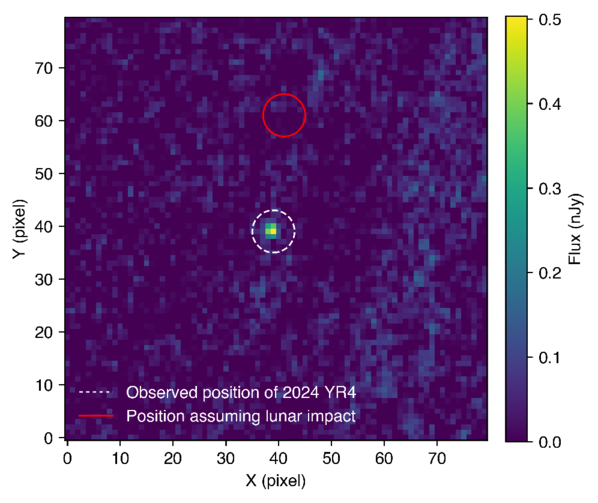
On 18 and 26 February 2026, JWST carried out those critical observations. In this dataset, the asteroid is bright enough to be detected confidently, and the background is peppered with a sufficient number of reference stars — two factors necessary to determine the precise track of the asteroid as it zipped through space.
Trajectory Refinement
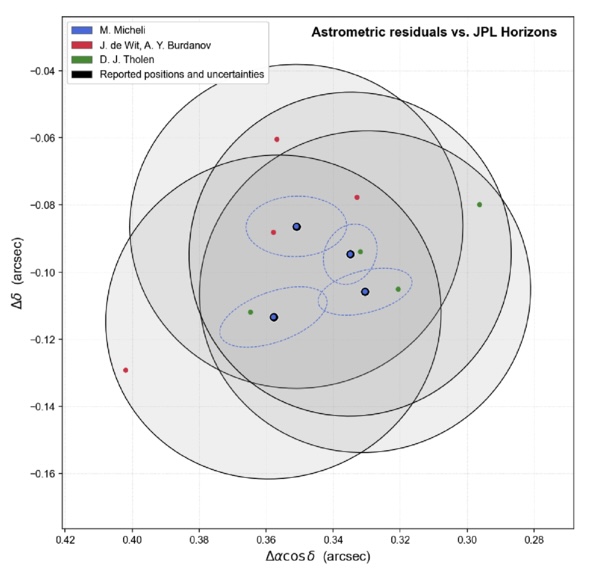
Difference between the position of 2024 YR4 determined in this work using three different reduction methods (red, blue, and green circles) and the position drawn from the existing orbit from the JPL Horizons database. The different analysis methods yielded consistent results. [Adapted from De Wit et al. 2026]
Julien de Wit (Massachusetts Institute of Technology) and collaborators analyzed the new JWST data and determined the asteroid’s position. The team used multiple methods to reduce the data and showed that their results were consistent regardless of the reduction method, ultimately yielding a measurement with an uncertainty of just 50 milliarcseconds. This is a huge improvement over the previous trajectory estimate, which had an uncertainty of 700 milliarcseconds.
Combining the latest JWST observations with existing data stretching back to the asteroid’s discovery, de Wit and coauthors determined a new, highly precise orbit for the object — one that definitively shows that the asteroid will safely pass by the Moon at a distance of 22,900 ± 800 km in 2032. In addition to ruling out the upcoming lunar impact, the team also ruled out any collisions with Earth in the next 100 years. Phew!
Position of 2024 YR4 as seen by JWST in February 2026 (white dashed circle) compared to the asteroid’s location estimated from existing data (red circle). [De Wit et al. 2026]
High-Impact Science
This work highlights JWST’s potential as a tool for planetary defense. The February 2026 observations detailed here represent the faintest-ever detection of a near-Earth object, and JWST can detect objects far fainter than ground-based telescopes can. This ability allows JWST to observe potentially hazardous asteroids over a larger swath of their orbits, which translates to earlier trajectory estimation — JWST pinned down 2024 YR4’s orbit two years before the asteroid would have become bright enough for ground-based telescopes to do so.
JWST’s role may be even more important for smaller objects that rapidly become undetectable after discovery. De Wit’s team demonstrated this for a 10-meter-diameter 2024 YR4 clone on the same trajectory; for an object of this size, JWST would be able to rule out an Earth impact before the asteroid became undetectable, but ground-based telescopes could not. With surveys from facilities like Vera C. Rubin Observatory and Near-Earth Object Surveyor set to discover hundreds of thousands of new near-Earth objects, JWST’s role as a hazard assessor will likely be in high demand.
Citation
“JWST Observations of Asteroid 2024 YR4 Rule Out a 2032 Lunar Impact and Demonstrate a New Regime for Planetary Defense Follow-Up,” Julien de Wit et al 2026 ApJL1003 L21. doi:10.3847/2041-8213/ae6a95
The Lucy spacecraft, en route to its primary mission targets, zipped past the main-belt asteroid Dinkinesh and revealed its tiny satellite, Selam. New research examines the surfaces and histories of these small rocky worlds.
A Stop Along the Way
In 2021, the Lucy spacecraft embarked on a 12-year mission to study several Jupiter trojan asteroids, which share Jupiter’s orbit. The spacecraft won’t have its first encounter with a Jupiter trojan until 2027, but it hasn’t been idle during its long journey. In November 2023, Lucy performed a dress rehearsal of its trojan-encounter maneuvers during a flyby of a 738-meter-wide main-belt asteroid called (152830) Dinkinesh.
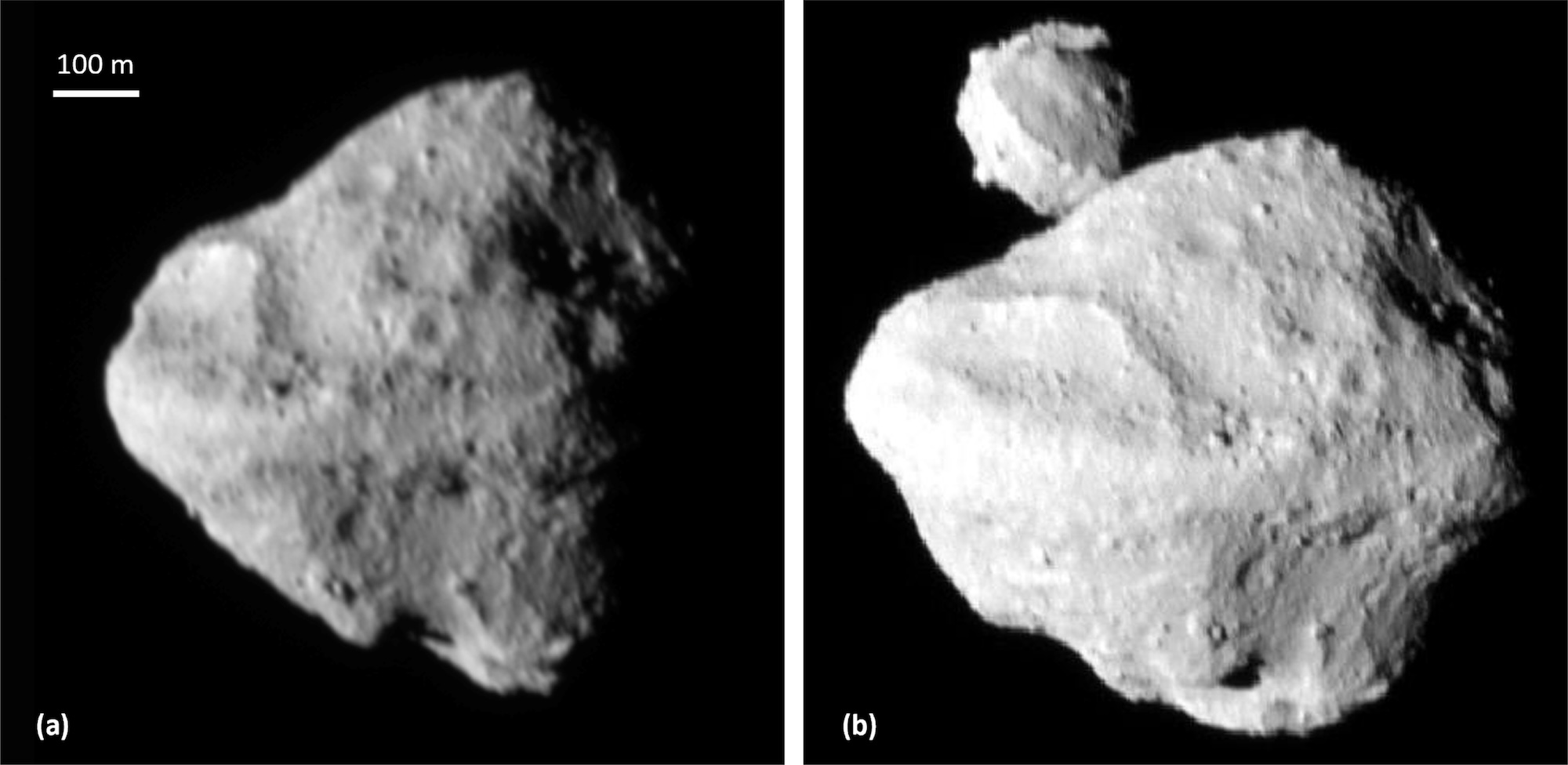
Two images of Dinkinesh from the Lucy mission. The second image features its satellite, Selam. [Bierhaus et al. 2025]
During this flyby, Lucy flew within 430 km (267 mi) of the asteroid and made a surprise discovery: Dinkinesh has a tiny companion, which has been named Selam. (The name Dinkinesh comes from the Amharic name for the Lucy fossil discovered in 1974; Selam is similarly named after a hominid fossil that is sometimes called “Lucy’s baby.”) Remarkably, Selam is the first known asteroid satellite that is a contact binary, made up of two separate bodies that have gently merged into one.
Craters and Boulders
In a recent research article, Edward Bierhaus (Lockheed Martin Space) and collaborators analyzed Lucy flyby images to study the surfaces of Dinkinesh and Selam. The team analyzed global features like troughs and ridges and measured visible craters and boulders.
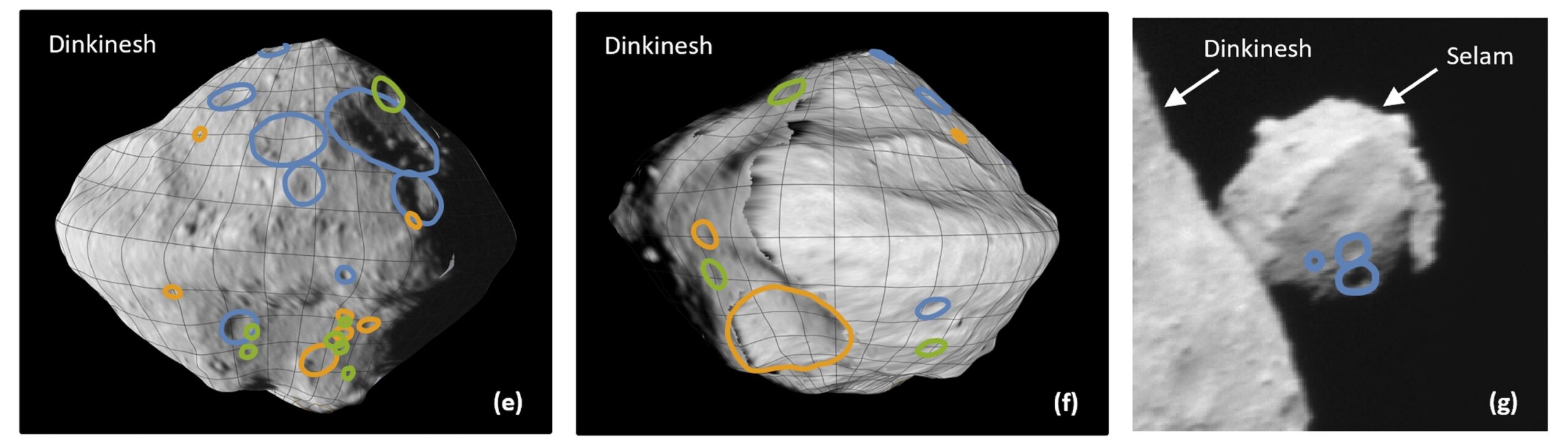
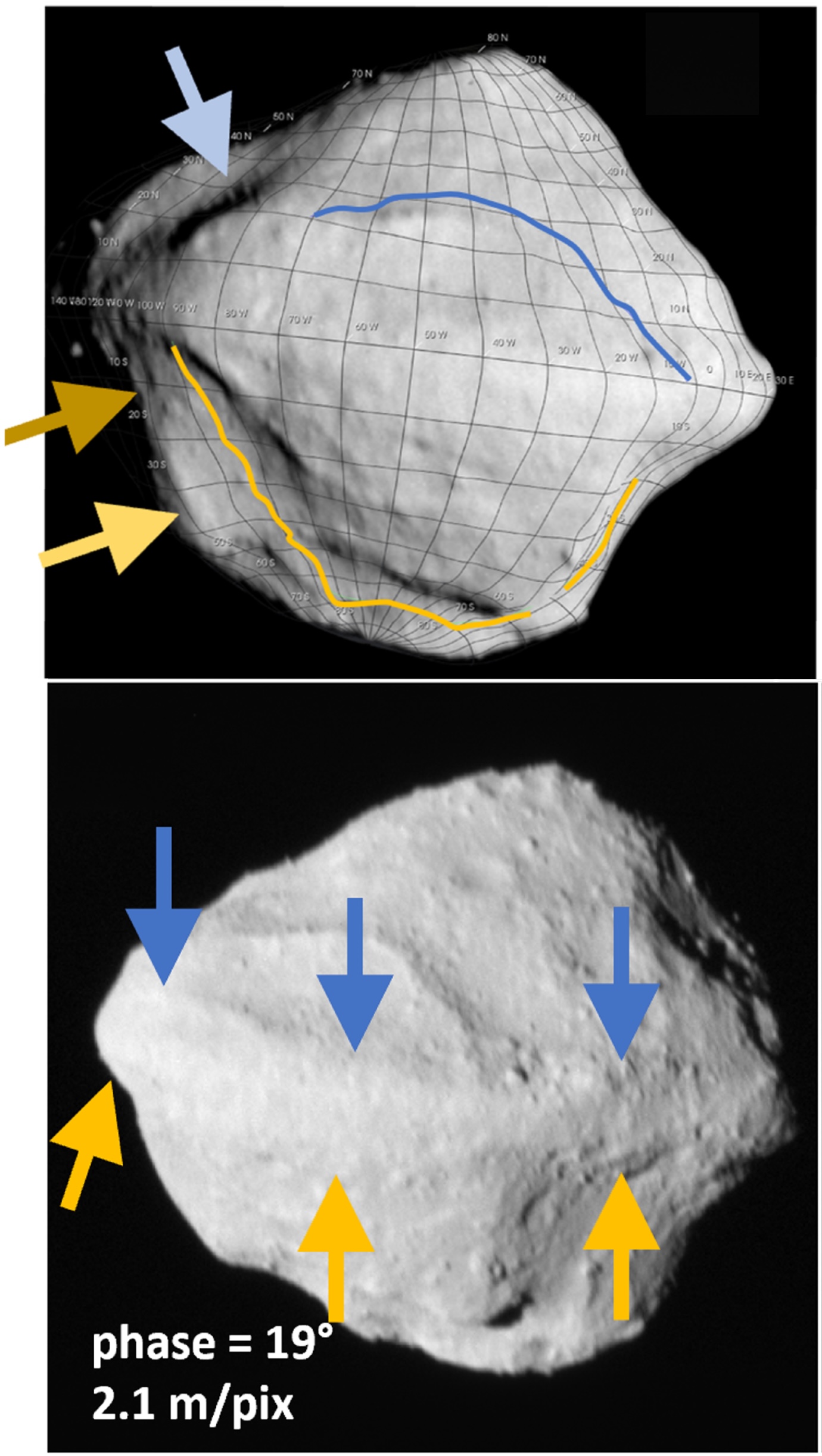
Locations of craters on Dinkinesh and Selam. The blue lines indicate the most confidently identified craters; orange and green lines mark craters identified less confidently. Click to enlarge. [Bierhaus et al. 2025]
While the small numbers of craters detected — 29 for Dinkinesh and 3 for Selam — makes further analysis difficult, the team determined that Dinkinesh’s crater size–frequency distribution is shallower than expected, though similar to that of small near-Earth asteroids (e.g., Ryugu). The seemingly shallow distribution may be an effect of the phase angle and resolution of the observations, or it could be a sign of impact armoring or other surface processes.
The size–frequency distribution of Dinkinesh’s boulders, on the other hand, is somewhat steeper. This discovery may mean that S-type (stony) asteroids like Dinkinesh have different boulder size distributions than C-type (carbonaceous) asteroids.
Possible Histories
An analysis of the collisional timescales in the main asteroid belt suggests that Dinkinesh is a fragment of a larger asteroid that was split apart at least once, though it’s not yet possible to say which parent body it might have come from. After splitting off from its parent asteroid, Dinkinesh appears to have been subjected to the Yarkovsky–O’Keefe–Radzievskii–Paddack (YORP) effect. This effect arises when sunlight falls on a small asymmetric asteroid, creating a torque that can alter its spin rate. In extreme cases, the YORP effect can crank up an asteroid’s spin rate so much that it sheds some of its surface material or flies apart altogether.
Locations of Sumak Fossa (top) and Fab Dorsum (bottom) indicated with arrows. [Adapted from Bierhaus et al. 2025]
Dinkinesh seems to show clear signs of YORP-driven structural failure. Sumak Fossa (a large trough) and Fab Dorsum (a ridge running along the asteroid’s equator) may have formed through this process. If Sumak Fossa was excavated by a YORP-induced mass-shedding event, both Fab Dorsum and Selam could have formed out of the cast-off material.
With Lucy en route to its primary objective, there’s still much for us to learn from this mission about the small bodies of our solar system. In the meantime, be sure to check out the full article linked below, as there are far more details about Dinkinesh and Selam than could be included in this short summary!
Citation
“The Geology of a Small Main-Belt S-Class Binary Asteroid System: Dinkinesh and Its Contact Binary Satellite Selam as Observed by the Lucy Mission,” E. B. Bierhaus et al 2025 Planet. Sci. J.6 299. doi:10.3847/PSJ/ae1968
In September 2022, the Double Asteroid Redirection Test (DART) mission served as the first attempt at redirecting a near-Earth asteroid — an experiment testing humanity’s ability to fend off any threatening Earth-bound asteroids. A recent study presents the first 3D reconstruction of the impact ejecta, suggesting that the blown-out material is more complex than previous models considered.
DART-ing into Dimorphos
The DART spacecraft intentionally smashed into Dimorphos, the small and unassuming moon of the larger asteroid Didymos. This space-based crash test aimed to determine if kinetic impactors like DART could successfully change an asteroid’s course through the solar system. Dimorphos’s orbit was indeed shortened by roughly 30 minutes, confirming that ramming an asteroid with a spacecraft could be a viable method of planetary defense. However, determining exactly how much an asteroid’s path will be altered is not necessarily straightforward. When a spacecraft collides with an asteroid, the impactor imparts momentum to the target, and any material excavated from the impact site can also alter the asteroid’s course.
DART’s impact launched a significant spray of rubble, or what researchers call an ejecta curtain. The ejecta curtain is typically modeled as a cone, using a simple geometry to determine its contribution to momentum transfer. However, when looking closely at imaging taken soon after the collision, the real physical structure of the ejecta appears to be more complex. Untangling the true 3D distribution of the ejecta is necessary to understand how momentum was actually distributed among escaping ejecta, better estimate the total mass ejected from Dimorphos, and improve modeling of the Didymos system’s orbit after impact.
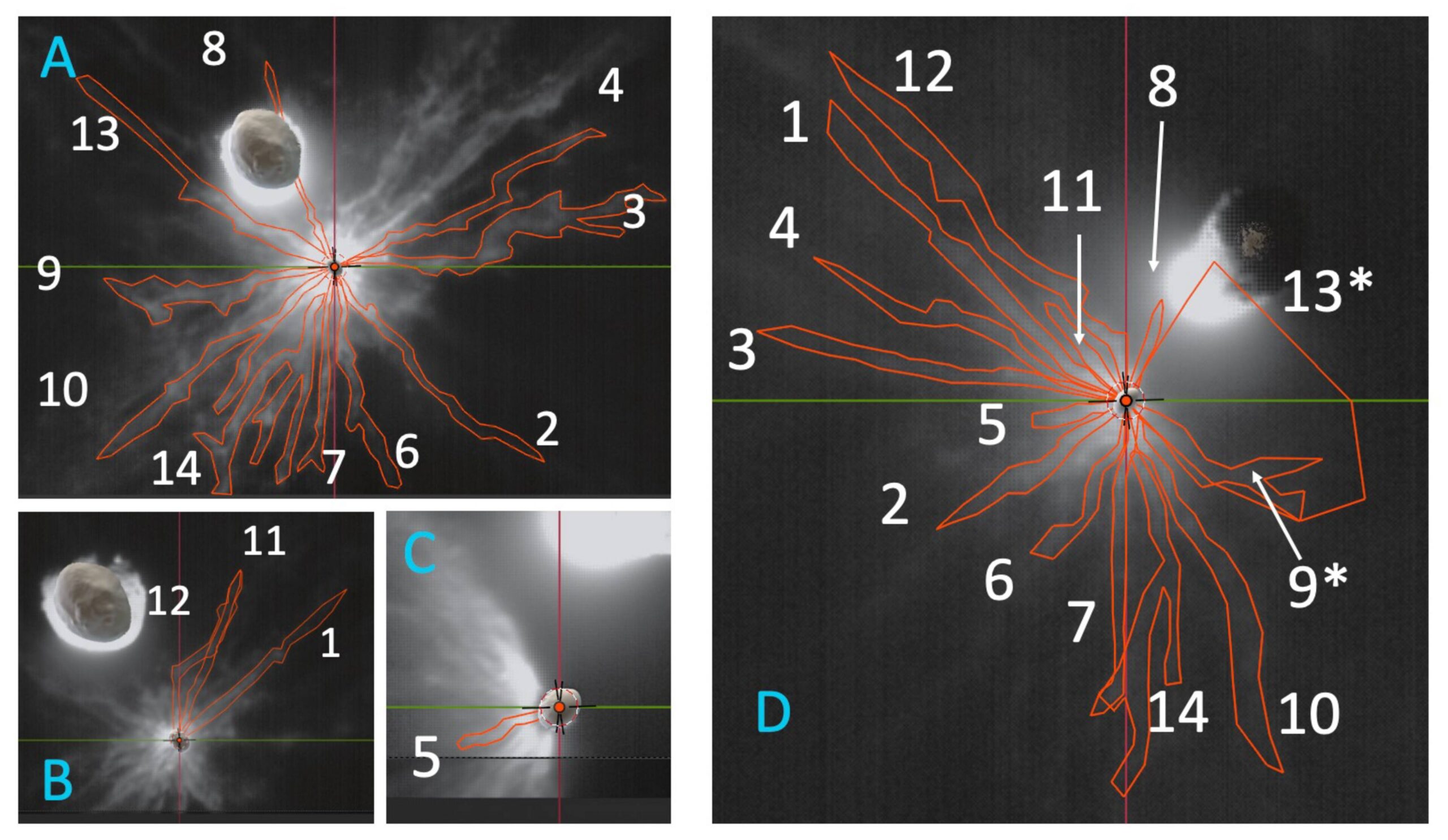
LICIACube images of the DART ejecta curtain with the 14 distinct features identified in this study outlined in red. Click to enlarge. [Deshapriya et al 2026]
Determining Debris Distribution
Seeking to better characterize the ejecta curtain, a team led by J. D. P. Deshapriya from Italy’s National Institute for Astrophysics used data from the Light Italian CubeSat for Imaging of Asteroids (LICIACube) that flew behind the DART spacecraft to capture images of the system shortly after the impact. After careful image handling to bring out diffuse and faint material, the researchers identified 14 distinct ejecta features across the flyby imaging. LICIACube viewed the aftermath both side on and face on, providing valuable 3D information about the distribution and motion of the ejecta.
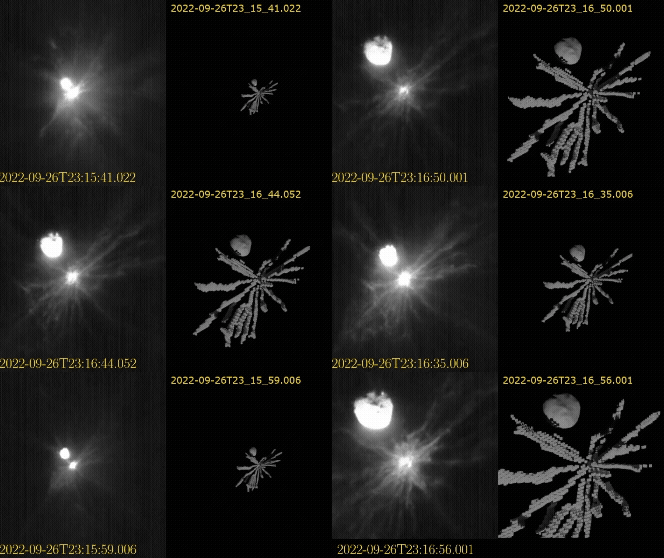
Animation of the DART ejecta as the LICIACube spacecraft approached the impact. The left shows the images taken by the spacecraft, and the right shows the 3D model produced for the ejecta. Click to play animation. [Deshapriya et al 2026]
Using 3D modeling software, the researchers traced each of the 14 distinct features across the images and reconstructed a 3D representation of the ejecta morphology. While earlier models assumed symmetric cone-like geometries, this 3D modeling revealed clear asymmetric and non-uniform structures within the ejecta curtain. These variations point to underlying heterogeneities in the impact site on Dimorphos — surface and subsurface composition naturally link to the resulting ejecta distribution according to previous laboratory experiments. The spatial and directional features uncovered in this study highlight the limitations of models that attempt to characterize ejecta curtains with symmetric and uniform distributions. Refining these model parameters will better match observations and better predict momentum transfer in future missions.
Planetary Defense
What does this mean for planetary defense? While simplified symmetric cone models provide helpful approximations for kinetic impactor missions, they do not fully capture the true complexity of the impact. This study shows that local variations in an asteroid’s surface and interior properties can directly influence the resulting ejecta distribution and motion. The true momentum imparted to the target asteroid depends heavily on the specific ejecta material, and these details inform how effective planetary defense missions can be in redirecting asteroids. Incorporating realistic, observation-driven ejecta distributions into modeling frameworks is essential to achieve reliable predictions for future planetary defense missions.
Citation
“3D Reconstruction of DART Ejecta at Dimorphos Reveals an Anisotropic, Filamentary Structure,” J. D. P Deshapriya et al 2026 Planet. Sci. J. 7 4. doi:10.3847/PSJ/ae2c64
Editor’s Note:Astrobites is a graduate-student-run organization that digests astrophysical literature for undergraduate students. As part of the partnership between the AAS and astrobites, we occasionally repost astrobites content here at AAS Nova. We hope you enjoy this post from astrobites; the original can be viewed at astrobites.org.
Luckily, neither Dimorphos nor Didymos was ever on any sort of collision course with anything (and they’re still not). But by impacting an object orbiting another, the effect of the collision could more easily be measured and so Dimorphos was chosen as the target. You see, the goal wasn’t destruction, but deflection. The scientists wanted to see if a spacecraft could alter an asteroid’s orbit by striking it — and if so, by how much. When DART slammed into Dimorphos at over 22,500 kilometers per hour, it successfully shortened the asteroid’s roughly 12-hour orbit by about 33 minutes. This confirmed that hitting an asteroid with a spacecraft — in this case scientifically called a kinetic impactor — could be a viable method to redirect a potentially hazardous object in space.
But the change in momentum didn’t just come from the spacecraft itself. Much of the momentum transfer came from the plume of debris — called ejecta — that blasted out from the impact site. This debris, spreading out in multiple directions, added to the total push on the asteroid. Understanding how this ejecta moved exactly is key to calculating the full effect of the impact and was one of the primary goals for the DART mission.
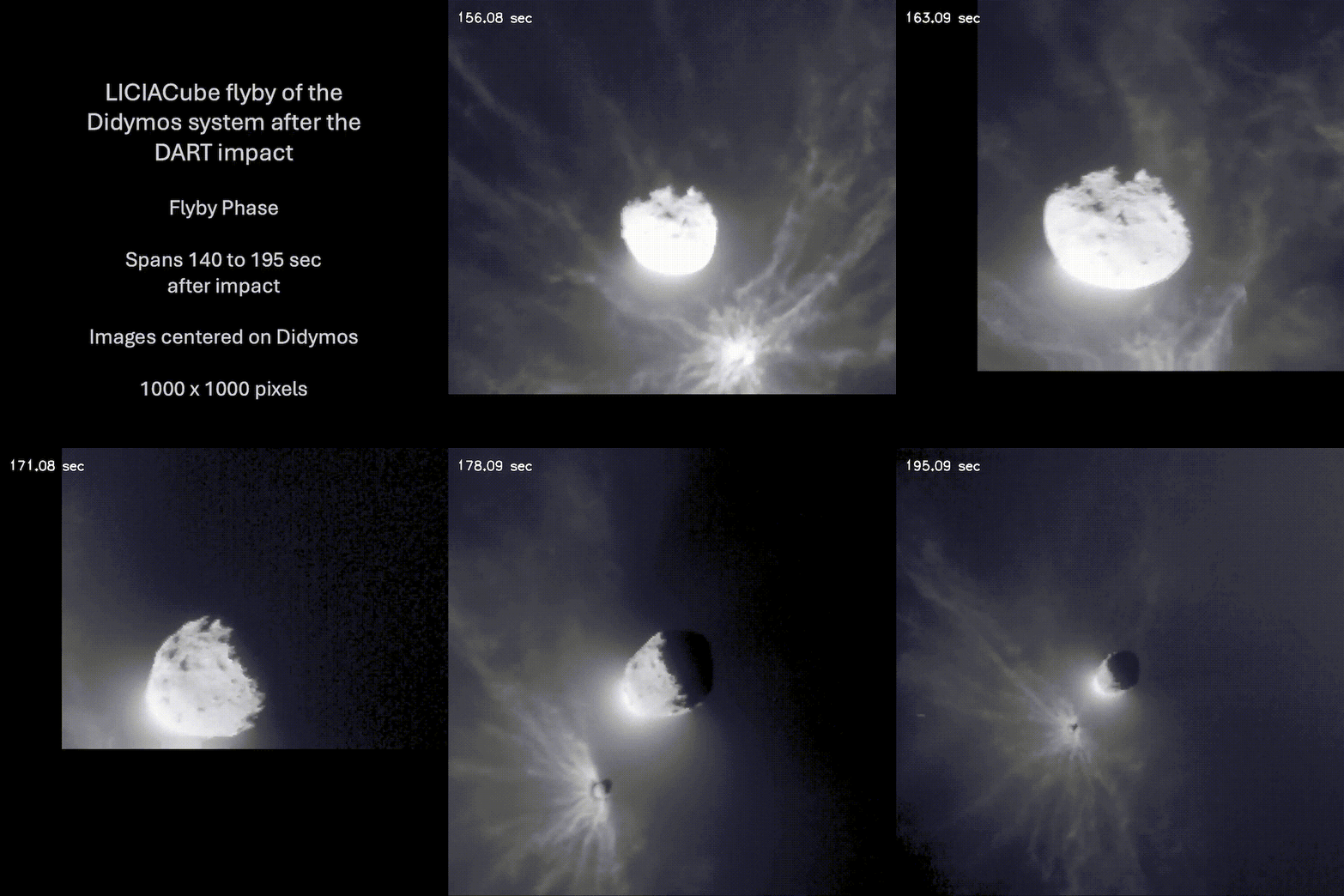
With this exact purpose in mind, a small companion spacecraft called LICIACube (Light Italian Cubesat for Imaging of Asteroids), released by DART two weeks before the crash, flew past moments after the collision. It snapped several images of the debris cloud, as seen in Figure 1, as it raced past. It is with a reanalysis of these images that today’s authors have managed to track a number of boulders in the ejected material.
Figure 1: Animated sequence of images taken by LICIACube as it flew past Didymos and Dimorphos a few minutes after impact by the DART spacecraft. The image is centered on Didymos with the smaller Dimorphos visible for most of the flyby. Large plumes of ejected material are visible, radiating out from the impact site where a very deep crater likely formed. Video provided by the author and subsequently converted to GIF and slowed for use in this bite. [Farnham et al. 2025]
Boulders, Boulders Everywhere!
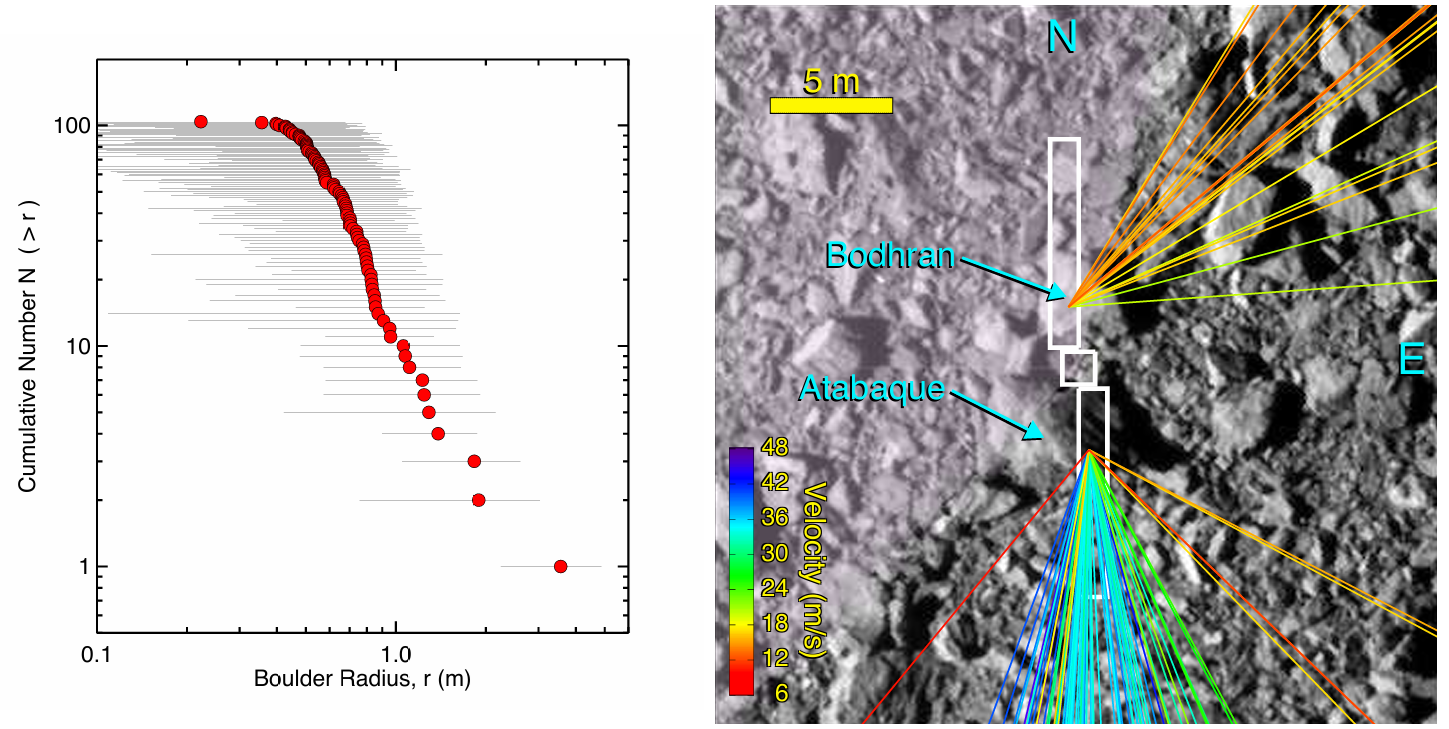
You can say that DART really made an impact — pun intended. It kicked up a lot of material as it struck Dimorphos. In some parts the ejecta plumes are dense enough to block sunlight and even cast shadows on Dimorphos. In the images, like the one seen in Figure 2, the authors were able to make out more than 100 boulders, some as big as 3.6 meters in radius. Tracking the boulders allowed them to calculate velocities and their contribution to the momentum budget. Some of the boulders were ejected at speeds up to nearly 200 kilometers per hour and carried almost as much momentum as the DART craft itself.
Figure 2: The image shows part of the ejected material from the DART impact on Dimorphos at 2 minutes and 40 seconds after impact. A number of boulders are highlighted as they are tracked through the sequence of images from the LICIACube. The boulders are not uniformly distributed but mostly clustered in two distinct populations, with the South Cluster containing around 70% of the measured objects. [Farnham et al. 2025]
Using the assumption that the objects are somewhat spherical, the authors calculate that the total volume of all 104 boulders that they managed to identify and track amounts to 403 cubic meters of material, which is equivalent to a sphere 4.6 meters in radius. If you use the bulk density of Dimorphos, this suggests that the mass ejected in these objects is around 0.02% of Dimorphos’s total mass. And this is only for the boulders tracked — the study identified more boulder, but LICIACube was not able to track all of them and could only detect sizes down to 0.2 meter!
The authors also found that the boulders are clustered, suggesting that they were ejected in preferred directions. They conclude that this non-uniform distribution likely changed Dimorphos’s orbital plane. Additionally, the momentum imparted by boulder ejection also likely altered the rotational state of the asteroid, making it tumble around in its orbit.
So what happened? Although there are no constraints on their actual points of origin, the authors suggest that a likely scenario might be that the ejected rocks are the shattered pieces of two large boulders that were seen in some of the last images from the DART spacecraft itself. The two boulders on the surface — named Bodhran and Atabaque after their drum-like shapes — were likely struck by the solar panels as seen in Figure 3.
Figure 3: The right side of the figure shows the impact site for the DART spacecraft just before it hit the surface. The outline of the craft is superimposed on top with the main bus of the craft and with two extended solar panels. Also shown are the authors’ estimated paths for the 104 boulders tracked. They may be the remains of two surface rocks that were shattered upon impact. To the left is the radius distribution for the boulders that were tracked in the study. [Farnham et al. 2025]
The shallow angles and high ejection speeds are consistent with this scenario. Regardless of how they were ejected, though, it is clear that a significant amount of momentum can be found in the debris and that this process plays an important part in understanding how a kinetic impactor can deflect asteroids.
The European Space Agency’s Hera mission, now en route and arriving in 2026, aims to carry out an in-depth post-impact analysis. It could determine if Dimorphos is tumbling in its slightly modified orbit and help assess the momentum transfer from the impact debris. All this will contribute to a better understanding of just how much the impact changed the asteroid’s orbit and how much more momentum came from the ejected material than was contributed by the DART spacecraft to Dimorphos. These data will be key to refining asteroid deflection strategies in the case that we might need them in the future. After all, the dinosaurs didn’t have any, and look where it got them!
Original astrobite edited by Chloe Klare.
About the author, Kasper Zoellner:
I have a Master of Science in astronomy and I am currently working towards a PhD in physics and educational science. My greatest passion is the search for exoplanets and how stellar variability may influence the possibility of life. I am also interested in science outreach, education and discussing what sci-fi novel to read next!
There are more than 37,000 asteroids known to come within 1.3 au of the Sun. Of this near-Earth asteroid population, roughly 2,500 are classified as potentially hazardous — being more than about 140 meters across and coming within 0.05 au of Earth’s orbit (about 20 times the distance between Earth and the Moon). In the image above, Luisa Fernanda Zambrano-Marin (University of Granada and University of Central Florida) and collaborators present observations of 2020 BX12, a potentially hazardous binary asteroid. The larger of the two asteroids in the system was discovered in January 2020 by the Asteroid Terrestrial-impact Last Alert System. About a week after the initial discovery, the 1,000-foot-wide Arecibo Telescope aimed its powerful planetary radar at 2020 BX12 and revealed the asteroid’s small companion. 2020 BX12 was the last of nearly 60 binary or triple near-Earth asteroids discovered with Arecibo before the telescope collapsed in December 2020. As Zambrano-Marin‘s team notes, the loss of Arecibo hampers scientists’ ability to find companions to near-Earth asteroids, which can be critical for determining the properties of these asteroids and guiding our planetary defense strategies. To learn more about this discovery, as well as what the team learned from follow-up spectroscopy, be sure to check out the full research article linked below.
Citation
“2020 BX12—The Last Binary Asteroid Discovered at Arecibo,” Luisa Fernanda Zambrano-Marin et al 2025 Planet. Sci. J.6 91. doi:10.3847/PSJ/adbe39
“Extraterrestrial Cause for the Cretaceous-Tertiary Extinction,” by physicist Luis Alvarez, geologist Walter Alvarez, Frank Asaro, and Helen Michel, was published in Science June 6, 1980. In it, the authors propose that an asteroid crashing to Earth was responsible for the death of the dinosaurs 65 million years ago. (The timeline was later amended to 66Continue reading "June 6, 1980: The asteroid impact theory"
Not quite halfway through a six-year sojourn through the Solar System, a NASA spacecraft used a close encounter with Mars last week as a dress rehearsal for its arrival at the Solar System's largest metal asteroid in 2029.
The Psyche mission launched more than two-and-a-half years ago, in October 2023, from Kennedy Space Center, Florida, to kick off a journey of some 2.2 billion miles (3.6 billion km) to reach its unexplored namesake, the asteroid Psyche. The robotic research mission got an initial lift from a powerful SpaceX Falcon Heavy rocket. It uses plasma engines to gradually build up the impulse needed to reach its destination in the asteroid belt, between the orbits of Mars and Jupiter.
A flyby of Mars last Friday gave the spacecraft its most significant boost since launch. Navigators at NASA's Jet Propulsion Laboratory in California set up the spacecraft for a course taking it 2,864 miles (4,609 km) from the Martian surface, well above the planet's tenuous atmosphere. Psyche used Martian gravity like a slingshot to gain enough speed to reshape its orbit around the Sun, putting the probe on a path to intercept its asteroid target.

 Login