Researchers using JWST are finding clues about comet 3I/ATLAS' origins. (Image credit: NASA, ESA, CSA, STScI, Martin Cordiner (CUA, NASA-GSFC); Image Processing: Alyssa Pagan (STScI))
NASA's James Webb Space Telescope is finding clues that are leading scientists closer to understanding the origins of the interstellar comet 3I/ATLAS.
What is it?
Comet 3I/ATLAS captured the world's attention when it was discovered nearly a year ago on July 1, 2025. The comet was first spotted by the Asteroid Terrestrial-impact Last Alert System (ATLAS), and is only the third interstellar object every discovered.
The comet swooped through our solar system, passing by Earth at a far (and safe) distance on its tour of our cosmic neighborhood. It is on a long trajectory that will take it out of our solar system, never to return.
In observations from the James Webb Space Telescope, scientists were able to look in the direction the comet as it began moving away from the sun in December of last year. While in close proximity to our star, the sun's heat warmed the comet, making it extra bright and easy to observe.
With this view, astronomers were able to calculate some of the ratios of the chemicals present in the comet. This further highlighted that the object is from out of our solar system, as they found ratios of carbon and heavy hydrogen not found in comets in our solar system.
Researchers described their results in a new paper published June 22 in the journal Nature.
This graph shows some of the differences between 3I/ATLAS and comets found in our own solar system. (Image credit: NASA, ESA, CSA, Martin Cordiner (CUA, NASA-GSFC), Leah Hustak (STScI))
Why is it incredible?
Being only the third interstellar object ever found, people were excited about 3I/ATLAS. They were so excited, in fact, that conspiracies about the object sprouted up quickly. Due to it being from outside of our solar system, some claimed that the comet could be some sort of alien spaceship, similar to the initial suspicions about the interstellar object 'Oumuamua found years earlier.
But with new information coming in from space telescopes, and astronomers eager to understand this object better, these clues are leading us closer and closer to the true origins of this strange comet.
On the evening of June 24, 1881, Sir William Huggins directed his reflector, equipped with spectroscopic and photographic tools and located in his private observatory in London, to the head of Comet 1881 III. He captured the first photographic spectrum of a comet, and later analysis of the imagery revealed cyanogen emissions at certain wavelengths.Continue reading "June 24, 1881: First photographic spectrum of a comet"
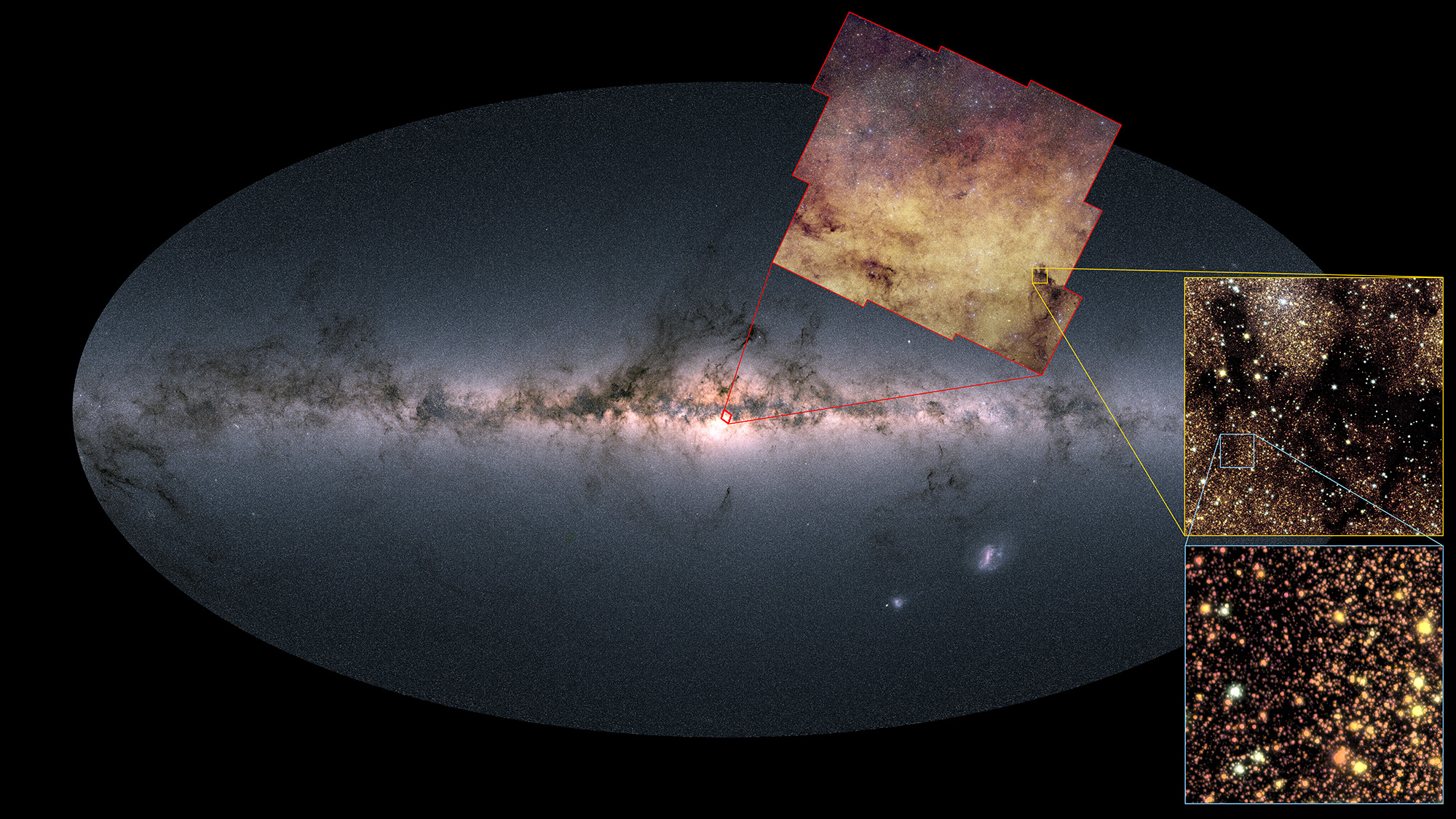
A deep-space telescope on a grand mission to make the largest-ever 3D map of the universe just peered into the star-filled heart of the Milky Way. In the new observations, shared Wednesday (June 24), the Euclid space telescope imaged the center of the Milky Way in extraordinary detail, showing off more than 60 million stars crowded in the galaxy's center.
The shiny new image from the European Space Agency (ESA) spacecraft will help astronomers confirm newfound exoplanets and use changes in starlight to measure those planets' masses as they orbit their parent stars, according to ESA scientists.
The image was taken in 26 cumulative hours in March 2025, across nine pointings of the telescope's visible-light camera toward the galaxy's center, also called the galactic bulge. Each viewpoint captured a slice of sky larger than the full moon. In a statement, ESA praised the performance of Euclid under challenging conditions.
"Designed to observe billions of faraway galaxies, the space telescope's visible-light camera is sensitive enough to tell apart individual stars in our super-crowded galactic bulge, without being blinded," agency officials wrote.
The mosaic image will help NASA's Nancy Grace Roman Telescope with its upcoming planet-hunting mission, after that observatory launches aboard a SpaceX Falcon Heavy rocket from NASA's Kennedy Space Center in Florida no earlier than Aug. 30.
One way the Roman telescope will search for new worlds is through microlensing, the same technique that can be used to examine exoplanets in the new Euclid image. Microlensing happens when one star passes in front of another from the perspective of an observer. The gravity of the closer-up star briefly bends and magnifies the light of the star behind it, allowing possibly unseen planets to pop up near that star.
An image of the Milky Way as seen from Earth, showing two zooms of Euclid's target area. (Image credit: ESA/Euclid/Euclid Consortium/NASA, CFHT, ESA/Gaia/DPAC,image processing by J.-C. Cuillandre and E. Bertin (CEA Paris-Saclay))
"During the last 20 years, almost 300 exoplanets have been discovered using this technique, all with ground-based telescopes and all towards the centre of our galaxy," Jean-Philippe Beaulieu, who initiated the Euclid galactic bulge survey and co-led the Euclid Consortium's exoplanet working group, said in the ESA statement.
"This image from Euclid includes 51 known planetary systems — and it will assist in studying many more that will be found," added Beaulieu, who holds positions at the Paris Institute of Astrophysics and the University of Tasmania in Australia.
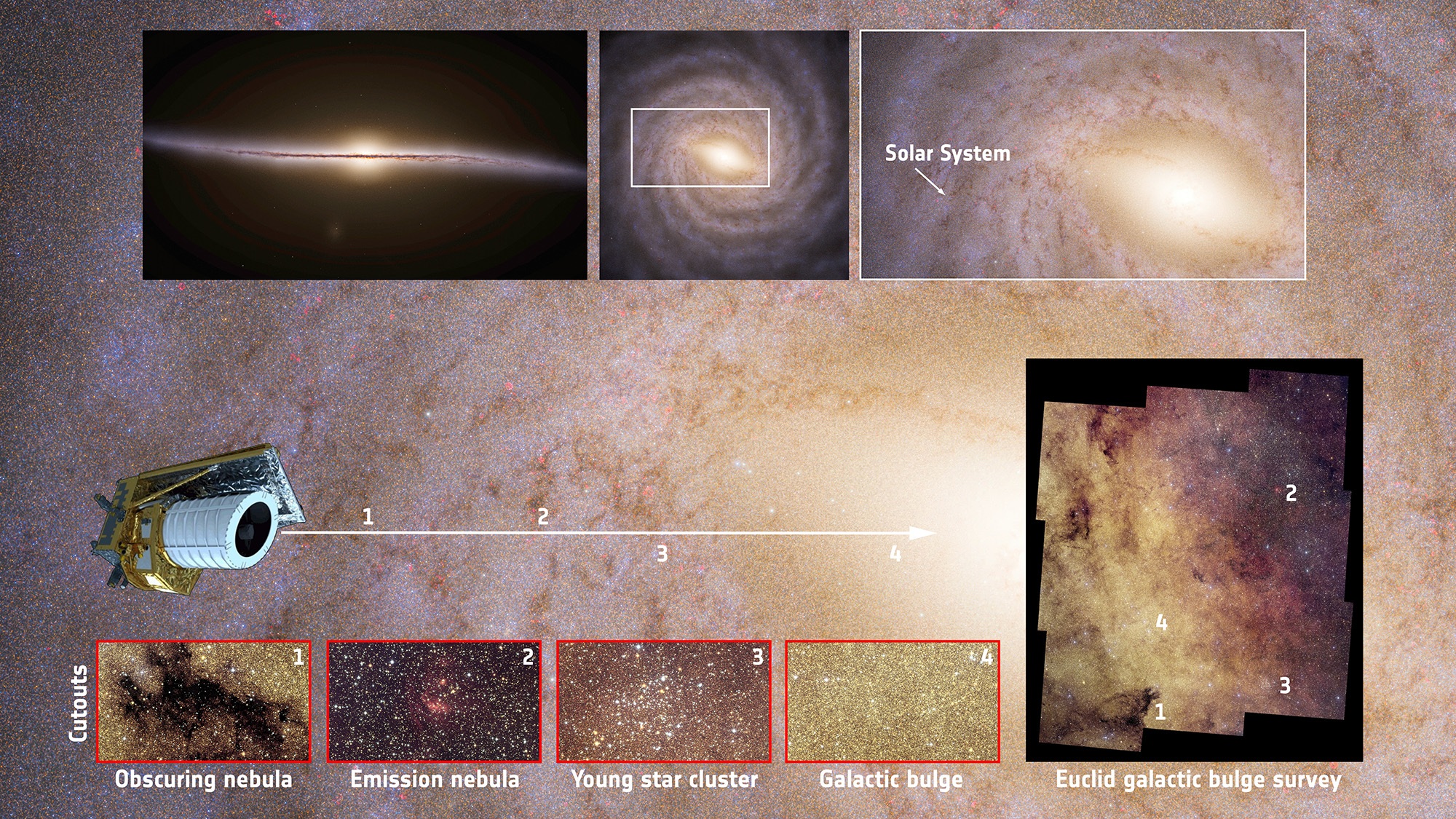
An infographic showing how Euclid sees across the Milky Way, into the galaxy's central bulge. The bottom panels illustrate the diversity of structures in Euclid's field of view. (Image credit: ESA/Euclid/Euclid Consortium/NASA, CFHT, image processing by J.-C. Cuillandre and E. Bertin (CEA Paris-Saclay); Milky Way artist impressions: ESA/Gaia/DPAC, Stefan Payne-Wardenaar))
A cosmic time capsule
Euclid's observing window was too short to find a microlensing event, which requires more than 20 days of examining one star to watch for a planet's orbit and associated changes in the star's light. But Euclid's work did allow astronomers to measure already-known planets. And once newer planets are confirmed by other telescopes, the image will let astronomers look back to confirm those newfound worlds' masses.
"In 24 hours, Euclid has already captured the stars involved in all the future microlensing events that the Roman space telescope will detect, but before the stars and planets involved have aligned," Natalia Rektsini, a postdoctoral fellow at the Paris Institute of Astrophysics who led the release of Euclid's galactic bulge survey data, explained in the statement.
"Anyone who detects a microlensing event in the same region, for example with Roman, will be able from now on to use Euclid data as a time reference in the past and see how the stars looked before they overlapped," she added. "Since Euclid can clearly separate individual stars, one can then measure how fast they move over time, and use that information to confirm the existence of a planet and determine its mass. This would not be possible with data from one point in time."
How well do you know our home galaxy? Find out with our Milky Way quiz!
A bright, dense cluster of hot, massive stars in a galaxy that existed 1.4 billion years after the big bang has been found helping to end the early universe's foggy days during which neutral hydrogen gas was draped across the cosmos, obscuring ultraviolet light from luminous objects.
The cluster was found emitting ultraviolet light in a small but quickly growing galaxy by the Hubble Space Telescope. The presence of this ultraviolet light, and the star-forming history of the cluster producing it, suggests that bursts of star formation contributed to waves of ionizing radiation that gradually cleared out the opaque neutral hydrogen.
In the aftermath of the big bang, the universe was filled with neutral hydrogen gas that is opaque at short wavelengths of light, such as ultraviolet. However, this ultraviolet light was the neutral hydrogen's worst enemy, gradually ionizing the gas across the universe. Once ionized, hydrogen gas cannot absorb ultraviolet light — and so, the cosmos became transparent at those wavelengths.
Because of this, the first billion or so years are called the Epoch of Reionization. It is referred to as "reionization" rather than ionization because, technically, the gas had already been ionized once before during the first 379,000 years after the Big Bang.
While investigating what brought about this epoch, astronomers had identified two chief suspects that could have produced sufficient amounts of ultraviolet light to ionize the neutral hydrogen. One is active supermassive black holes and the other is the first generations of hot, massive stars. The problem is, given that neutral hydrogen is adept at absorbing the ultraviolet light, astronomers have had difficulty tracing that ultraviolet back to its source and identifying which of the two suspects are the main culprit.
In 2023 the James Webb Space Telescope (JWST) made a major breakthrough, finding a galaxy that existed just 900 million years after the Big Bang that was producing enough energy to ionize the neutral gas surrounding it.
Now the Hubble Space Telescope has gone further, detecting ultraviolet light from a galaxy called MXDFz4.4. This ultraviolet light should only be visible if the surrounding gas had already been ionized.
"Observing a galaxy like this was thought to be impossible," said Ilias Goovaerts of the Space Telescope Science Institute (STScI) in Baltimore, who led the discovery, in a statement. "Researchers expected the 'fog' of neutral hydrogen that filled the early universe would be too thick and obscure our view of its ionizing light. Hubble not only spotted that light, but it also helped reveal incredible details about the galaxy's characteristics."
The full Hubble Space Telescope's view of MXDFz4.4 and its surroundings from our vantage point. (Image credit: NASA/ESA/CSA/STScI/Ilias Goovaerts and Anton Koekemoer (STScI)/Marc Rafelski (STScI, JHU)/ Image Processing: Alyssa Pagan (STScI))
MXDFz4.4 was first identified in the MUSE eXtremely Deep Field (MXDF), with MUSE being the Multi Unit Spectroscopic Explorer on the European Southern Observatory's Very Large Telescope in Chile. The "z4.4" part of its name tells us that the galaxy exists at a redshift of 4.4, meaning that it existed 12.37 billion years ago. As the universe has expanded in the time since then, the ultraviolet light has been redshifted into visible wavelengths that were detected by Hubble.
"Astronomers have found many galaxies that existed at this point in the history of the universe, but we haven't detected ionizing photons from any of them, making MXDFz4.4 one of a kind," said Marc Rafelski, who is the Hubble Deputy Mission Head at STScI.
MXDFz4.4 is 100 times smaller than our Milky Way galaxy but is forming stars ten times faster than our galaxy is. Many of those stars are being born in the tight, luminous cluster producing the ionizing ultraviolet.
An artist's impression of the young, distant galaxy MXDFz4.4 and its dense cluster of luminous stars. (Image credit: NASA/ESA/Leah Hustak (STScI))
The cluster contains "A lot of young, hot, massive stars in a small space [that] do a better job of blasting through opaque gas," said Goovaerts.
Furthermore, by comparing Hubble's observations of MXDFz.4.4 with those of the JWST, which probed for cooler, older stars in the galaxy, Goovaerts and Rafelski's team discovered that the stars in the cluster had formed in bursts, each burst producing fresh quantities of ionizing ultraviolet radiation that helped to clear out more and more of the neutral gas over time. We now see the galaxy about 250 million years after it finished reionizing the surrounding gas. These hot, massive stars in the cluster end their lives after a few million years as supernova explosions, the blast waves and radiation from which can create bubbles in the gas light years across, creating further pathways for ultraviolet light to escape and be detected by Hubble.
The observations seem to nail down the theory that clusters of hot, massive, luminous stars in young galaxies in the early universe played a dominant role in ionizing the universe's neutral gas.
"Hubble's observations of MXDFz4.4 let us test our hypotheses much closer to the Era of Reionization than ever before," said Rafelski. "Finding more galaxies, especially at slightly later cosmic times where larger samples are within reach, would let us refine these measurements and figure out what cleared our view as that era was ending."
NASA’s Mars Odyssey spacecraft completed its 60,000th orbit of the Red Planet on June 23, 2015. When Odyssey launched in April 2001 with a goal of better understanding Mars’ environment, the Red Planet was generally thought to be dry, barren world; the mission transformed our understanding, discovering widespread subsurface water ice. Its continuous observations haveContinue reading "June 23, 2015: 60,000 orbits for Mars Odyssey"
Using NASA's exoplanet-hunting spacecraft TESS (Transiting Exoplanet Survey Satellite), scientists have discovered a planetary system that scientists are calling "improbable." It could change how we think about the mechanisms behind planet formation.
The reason for the unusual arrangement of this planetary system is a failed star or brown dwarf designated TOI-201 c. Objects like this get the slightly unfair nickname of "failed stars" because, despite forming from a collapsing cloud of gas and dust like other stars, they fail to gather enough mass to trigger nuclear fusion of hydrogen to helium in their cores. Brown dwarfs have masses between 13 and 80 times that of Jupiter, or 0.013 to 0.08 the mass of the sun. That puts them right between the most massive planets and the smallest stars.
TOI-201 c is on a highly elliptical orbit, taking 2,881 days to orbit its star, which has resulted in planets including a super-Earth named TOI-201 d and a warm Jupiter named TOI-201 b, forming in a narrow zone within its orbit, something that isn't just new to astronomers; it is completely unexpected based on planetary formation models.
The 5.8-day orbit of TOI-201 d and the 53-day orbit of TOI-201 b are both perfectly aligned with the orbit of the brown dwarf. The brown dwarf creates gravitational instability at distances equivalent to the distance between Mars and the sun, but this didn't prevent planets from forming in the system.
"This discovery provides a crucial insight into how planets form even around massive, eccentric objects," team member and INAF researcher Aldo Bonomo said in an emailed statement.
The system challenges the idea that gas giant planets form at distances equivalent to 2 to 3 times the distance between Earth and the sun in the disks of gas and dust that surround stars during their infancy.
"The presence of the brown dwarf on such an elliptical orbit forced the planets to form and survive by occupying the innermost and hottest edges of the primordial disk," team member Luca Naponiello of the National Institute for Astrophysics (INAF) said in the statement. "Furthermore, the data show that during the close approach of the brown dwarf, the warm Jupiter undergoes strong and sudden variations in its transit timing, bearing witness to an intense and vigorous dynamic interaction currently underway between the two giants."
The system was discovered by TESS using a rare mono-transit event, which describes a planetary body making one crossing of the face of its star, causing a dip in starlight. This was followed by an observing campaign conducted from the ground.
It is extremely rare to discover objects like TOI-201 c with such long and eccentric orbital periods using transits they make of their parent star. This brown dwarf is the first one of these objects to have its mass confirmed, making it an important step forward in astronomy.
"It [TOI-201c] is the transiting object with the longest orbital period for which the mass is known," Naponiello said.
The team's results were published on Wednesday (June 17) in the journal Nature.
The interstellar comet 3I/ATLAS carries a chemical fingerprint unlike anything in our Solar System, and it may have formed 10 to 12 billion years ago, before our Sun even existed, according to two papers published in the journal Nature.
A huge, shining bauble of stars called Terzan 5 could be a clump of our galaxy's central bulge that hasn't been smoothed out into the mix, and has instead survived as a fossil relic leftover from the birth of the Milky Way galaxy.
"Terzan 5 may provide direct evidence that can help explain how bulges formed in galaxies throughout the universe," said Barbara Lanzoni of the University of Bologna in a statement. Lanzoni is a member of a team of astronomers, led by Bologna colleagues Giorgia Zullo and Francesco Ferraro, who tackled Terzan 5 with the James Webb Space Telescope (JWST).
Terzan 5 is a globular cluster — a huge sphere of stars with a total mass two million times greater than our sun's and a total luminosity 800,000 times greater. The problem is, Terzan 5 lies about 18,800 light-years away in the bulge of the Milky Way galaxy. This means dense lanes of intervening galactic dust block our view, significantly dimming Terzan 5's apparent brightness. That's why it wasn't discovered until 1968 by the Turkish–French–Armenian astronomer Agop Terzan.
Globular clusters tend to be ancient. They also tend to have formed all their stars in one giant burst. As such, all their stars should be the same age, 12 to 13 billion years old. Yet, a select few globular clusters show evidence of having more than one generation of stars. These include Omega Centauri, NGC 2808 and NGC 1783 in the Milky Way galaxy, as well as NGC 411 in the Small Magellanic Cloud and NGC 1696 in the Large Magellanic Cloud. Several explanations have been put forward, including the possibility that they are the core remnants of dwarf galaxies that have been stripped of most of their stars by gravitational tidal forces emanating from the Milky Way. Or perhaps these clusters were simply massive enough to retain some molecular gas for future stellar generations.
When the Hubble Space Telescope took a look at Terzan 5 in 2009 and then again in 2016, it found that it too was among the ranks of weird globular clusters with two generations of stars, dating back 12.5 and 4.7 billion years. However, because it is behind so much galactic dust, not even Hubble has the clearest of views.
The JWST, however, does. Its near-infrared vision can see through the dust.
"Webb's new near-infrared observations, cross-referenced with Hubble's archival observations, have given us a much clearer picture of the history of Terzan 5," said study leader Giorgia Zullo, who is a Ph.D. student at Bologna.
The JWST detected two further generations of stars, one generation born 3.8 billion years ago and another 2.5 billion years ago. Four generations of stars is hard to explain for any globular cluster, which is why the team think that Terzan 5 could be something more primordial: a leftover building block of the Milky Way's bulge that was never quite assimilated by our galaxy.
"For some reason, this peculiar clump of stars formed separately from the bulge and was not destroyed as the bulge itself formed," said Ferraro. "Terzan 5 is what we now call a bulge fossil fragment because it resembles the primordial clumps that contributed to the formation of the bulge."
Disk galaxies sport two main components: a relatively narrow disk formed from spiral arms, and a bulbous core called the bulge. Galactic bulges tend to be the oldest parts of galaxies, forming billions of years before the disks, at least in the Milky Way's case. The JWST is seeing this process occurring in the early universe, revealing clumpy, young galaxies, but given the great expanse of space and time that JWST is looking across, the observations of the building blocks that go into making these galaxies are still not totally clear. With Terzan 5, we could be looking at one of the building blocks of the Milky Way's bulge relatively close-up, and it could provide new insights into the birth of our galaxy.
An artist's impression of the James Webb Space Telescope. (Image credit: NASA, ESA, CSA, Northrop Grumman)
Terzan 5 is probably not the only bulge fossil fragment either. As well as those other aforementioned globular clusters, some of which might be fossil fragments and others might be the cores of dwarf galaxies, the globular cluster Liller 1 close to the center of our galaxy shares many of Terzan 5's properties, including its high abundance of heavy elements produced by multiple generations of stars that have died either in supernova explosions.
The team are now looking to chase up another 40 or 50 globular clusters in the bulge to see if they could also be bulge fossil fragments, or whether they are just regular globular clusters.
The findings were presented at the 248th meeting of the American Astronomical Society in Pasadena, California which took place between June 14 and June 18. A paper describing the JWST observations has also been published in the journal Astronomy & Astrophysics.
The expansion of the universe is still accelerating under the influence of dark energy, despite recent claims to the contrary, according to new research. This means that dark energy, the mysterious force that dominates the universe, is not weakening but continues to get stronger, considered something of a "cosmological crisis" as it was so against expectations.
In 1998, via the study of cosmic explosions called Type Ia supernovas, astronomers discovered that not only is the universe expanding, but that the speed of that expansion is increasing. "Dark energy" was the name given to the mysterious force driving this accelerating expansion. Since then, scientists have discovered that dark energy accounts for around 70% of the universe's matter and energy.
In November 2025, research was published that suggested the expansion of the universe was slowing, meaning dark energy would be weakening. But this new research suggests that these findings from last year might not be a cosmic hand grenade thrown into the cosmological apple cart, but instead may have actually emerged from a scientific misunderstanding.
"Thankfully, we have averted this crisis, but the mystery about why the rate of expansion of the universe is still accelerating remains," lead author of the new refuting research, Phil Wiseman, from the University of Southampton in the UK, said in a statement. "The previous and well-accepted measurements were, in fact, fine, and our current understanding of the fate of the universe remains robust. By proving our measurements are correct, we can get back to trying to understand what this dark energy actually is, rather than wondering if it exists at all."
The research from 2025 that suggested dark energy was weakening was based upon a reassessment of the brightness of Type Ia supernovas, which occur when a dead star called a white dwarf overfeeds on a companion star. This causes a runaway nuclear explosion of such uniform brightness that it can be used to measure cosmic distances. In fact, these explosions are so uniform that astronomers refer to them as "standard candles."
This prior research determined, incorrectly it now seems, that as the universe has aged, the brightness of Type Ia supernovas had changed, leading to incorrect measurements of distances based on them as well as incorrect estimates of the speed of the universe's expansion. Both of these led to the suggestion that dark energy is weakening.
An illustration of a white dwarf star feeding on a stellar companion prior to a type Ia supernova (Image credit: Robert Lea (created with Canva))
But Wiseman and colleagues found this previous team had made an error in how they calculated the ages of exploding white dwarfs, finding they had assumed the ages of these stars would be the same as the ages of the galaxies in which they exploded.
They also found the 2025 research hadn't accounted for a common correction used in cosmology that factors in the masses of galaxies in which Type Ia supernovas occur.
"Extraordinary claims require especially careful testing," team member Adam Riess, who in 2011 shared the Nobel Prize for the discovery of dark energy, said. "What we find is that when we calibrate these supernovae, accounting for different host environments and populations, the evidence for cosmic acceleration remains remarkably consistent."
While the challenge to dark energy's growing dominance over the universe seems now to have been refuted, the back and forth on this topic shows how ideas in science aren't dogma and remain open for revision.
"This is how progress is made," team member Mark Sullivan, also from the University of Southampton, said. "Although this idea did not turn out to be correct, it has opened up new ways of thinking about how supernovae explode and how we can measure dark energy more accurately."
The first direct measurements of exoplanet magnetic fields reveal that ultra-hot Jupiters possess strong magnetism that shapes their atmospheres and may provide new insights into planetary habitability. Astronomers have achieved a major advance in the study of worlds beyond our Solar System by estimating the strength of the magnetic fields surrounding seven ultra-hot Jupiters. The [...]
Researchers have identified the most distant dormant black hole known, dating back to the universe’s early history. Astronomers have long relied on brilliant quasars, supermassive black holes actively feeding on surrounding matter, to study the early universe. Yet these luminous objects reveal only part of the story. Now, researchers have detected the most distant dormant [...]
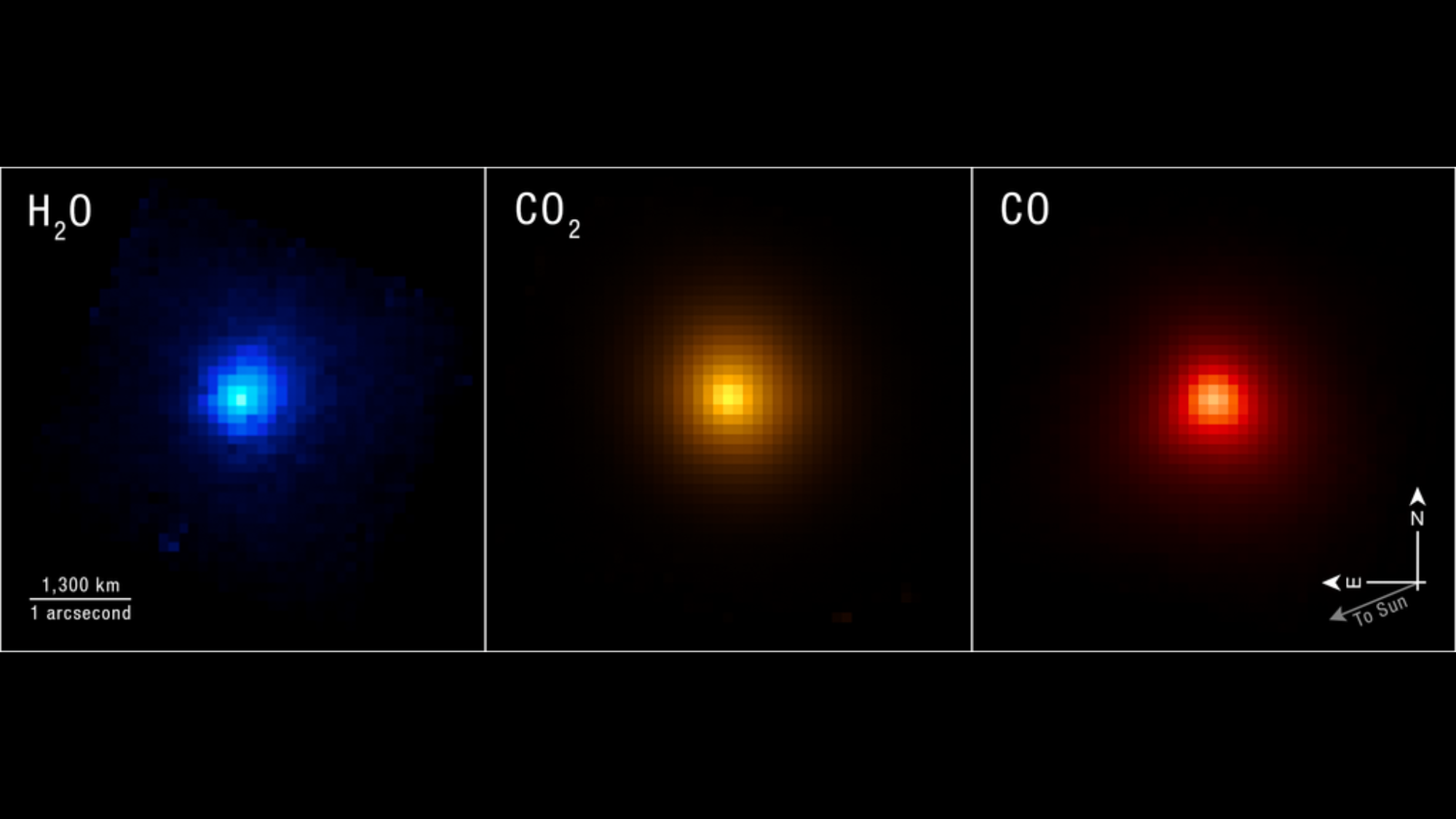
Following its trip around the Sun late last year, 3I/ATLAS had been significantly warmed, causing a large amount of its icy exterior to be converted into a cloudy coma. This not only made the comet more visible but also provided Webb an ideal opportunity to collect spectrographic data that could offer important information about its chemical composition.
The Webb data, which was detailed in a recent study, indicates chemical ratios of carbon and deuterium emanating from the object that are very unlike those of comets found within our solar system.
The compelling new findings, according to NASA officials, “surprised researchers.” Here’s why.
A Rare Look at an Ancient Space Object
Fundamentally, the recent Webb observations provided astronomers with one of their best opportunities to observe information about the comet’s possible origins throughout the duration of its visit to our Solar System last year.
Martin Cordiner, an astro-chemist at NASA’s Goddard Space Flight Center in Greenbelt, Maryland, called the observations “a unique opportunity to study an ancient object from the distant galaxy, probably pre-dating our Sun and solar system.”
Above: Researchers used Webb’s NIRSpec instrument to map specific chemical contents of comet 3I/ATLAS as it exited our Solar System (Image Credit: NASA, ESA, CSA, STScI, Martin Cordiner (CUA, NASA-GSFC); Image Processing: Alyssa Pagan (STScI).
Cordiner, who was also the lead author of the recent Nature study, said that the data he and his co-authors were able to obtain helped to provide “direct insight into that distant time and place” from which 3I/ATLAS originates, while also providing new insights into “how unusual our own solar system may be.”
Understandably, the Webb telescope is in high demand, and Cordiner and his team had to interrupt the space observatory’s planned schedule to turn its powerful eye toward 3I/ATLAS as it made its exit.
A Deuterium-Rich Space Object
Cordiner and the research team joined astronomers from many sub-disciplines in taking the opportunity to get a look at 3I/ATLAS on its journey through the solar system, which relied primarily on Webb’s NIRSpec (Near-Infrared Spectrograph) instrument.
As previously reported by The Debrief, the telescope’s NIRSpec instrument revealed “exceptionally high” levels of deuterium—also known as “heavy hydrogen”—amounting to nearly 30 times the amount normally seen in comets within our solar system.
One thing this probably indicates is that early in its lifetime, 3I/ATLAS was likely exposed to large amounts of radiation, which gave rise to the deuterium-rich ice in its composition. However, after drifting through space for eons without coming into proximity to a star like our Sun, there were no opportunities for this “heavy water” to be converted back into the typical kind of H20 water common on our planet.
Clues from Carbon Traces
Another primary finding Cordiner and the team made is that NIRSpec data revealed only small amounts of carbon-13, as opposed to its lighter counterpart, carbon-12. Since carbon-13 enrichment is known to occur within stellar systems over time, the team interprets this as evidence for the extreme age of 3I/ATLAS, which could have origins going as far back as an astonishing 12 billion years ago.
This would place the interstellar object’s birth within the period astronomers identify as “cosmic noon,” during which our universe was undergoing its peak period in star formation. Additionally, separate observations involving the European Southern Observatory’s Very Large Telescope help to affirm the recent Webb findings, along with complementary insights into the ancient comet’s carbon content, as well as nitrogen present in the form of cyanide, revealed from recent spectrographic analysis.
“For us as scientists, finding these rare isotopes is fascinating, but the bigger picture here is looking at the possibilities of prebiotic chemistry elsewhere in the galaxy,” said Stefanie Milam, one of the recent study’s co-authors, and also a researcher at NASA Goddard, in a recent statement.
Fundamentally, what the latest data on 3I/ATLAS conveys is more than just a rare look at a cosmic voyager who briefly entered our Solar System—it is a potential glimpse at how the very building blocks of life could have made their way into our planetary neighborhood long ago, eventually arriving here on Earth.
“So far, we know of only one place in the vast cosmos where chemical ingredients led to life – our solar system, our Earth,” Milam recently said.
“Analysis of these interstellar objects is a major step towards learning how common, or uncommon, the conditions for the evolution of life are in the universe,” Milam added.
The team’s recent study, “Isotopic evidence for a cold and distant origin of 3I/ATLAS,” appeared in the journal Nature on June 22, 2026.
Micah Hanks is the Editor-in-Chief and Co-Founder of The Debrief. A longtime reporter on science, defense, and technology with a focus on space and astronomy, he can be reached atmicah@thedebrief.org. Follow him on X @MicahHanks, and at micahhanks.com.
HD 80606b has one of the most extreme orbits of any known exoplanet and the NASA/ESA/CSA James Webb Space Telescope just caught it getting flash-fried as it whipped past its star.
GOLDEN, Colorado — The moon is in need of good and accurate artists!
As NASA's Artemis program hits its stride, and in a few years "reboots" our moon with a human presence, there's an urgent need to guard against artistic misrepresentations of the lunar landscape, experts say.
We've all seen those alluring lunar renderings of vehicles and astronauts bounding about while setting up equipment and putting in place a moon base.
What's wrong with this picture? Missing in this artwork are small craters, dust, dirty equipment and dirty astronauts. (Image credit: NASA)
Reality versus depictions
"We are telling the public the moon is easy — it is not!"
That's the matter-of-fact warning from Daniel Britt, the Pegasus Professor of Astronomy and Planetary Sciences in the Department of Physics at the University of Central Florida. He's also the director of the Center for Lunar and Asteroid Surface Science.
Britt spoke about and showcased artists' misconceptions during a "reality versus depictions of the lunar surface" talk here at a Space Resources Roundtable, held from June 2 to June 5 on the campus of the Colorado School of Mines.
"I wish I could say that engineers and managers know better, but they don't. We are training a generation of engineers to not worry about terrain. If the artists are getting it wrong, it is our fault. Let's stop fooling ourselves," Britt said.
Well versed in what the lunar surface truly offers, Britt scolded a number of arty accounts of lunar territory promulgated by both NASA and commercial space ventures. He spotlighted what's wrong with those pictures — for starters, small craters and ever-present lunar dust, along with dirty astronauts, dirty equipment and dirty habitats.
Dusting off past moonwalker experiences reveals a dusty future on the moon. (Image credit: NASA/Daniel Britt)
Facts of life
A flat, dustless moon is not the one we are sending Artemis astronauts to, said Britt. Crews will experience coarse terrain, pervasive dust, and a surface unlike anything here on Earth. These are the facts of life on the moon, he said.
The Apollo moon-landing missions learned this first hand. But those astronauts explored equatorial areas. The Artemis program is targeting the lunar south polar region, which will be tough to deal with thanks to the low angle of the sun.
"When you look into the sun, it will be blasting into your face. But at least you'll see the shadow of that crater you are about to trip into," said Britt. "But looking down-sun, you won't see diddly squat."
"There's need to stop deluding ourselves," Britt told Space.com, advocating the creation of a 1-to-10 scoring system for lunar art, with prizes for the worst and best visualizations
"What I want to do is land on the moon way safer and easier," he added, "so you need to ask yourself what's missing from these depictions. We are training the public to think this is easy."
No dust, almost no small craters, no tipping problems. (Image credit: SpaceX)
False impression
To support his concern, Britt spotlighted both Apollo moonwalker-taken imagery and the scenery as projected by artists, be it using paint brush or artificial intelligence-guided computer work.
"The sun angle washes out the rough terrain. Almost all the pictures taken from the surface give the very false impression of a flat, gentle terrain," Britt said. "The reality is that the lunar surface is heavily cratered, rough, very dusty and covered in regolith."
Most Apollo surface images were taken "down-sun" because looking "up-sun" was hard. "This leaves a very false impression of a flat moon with gentle terrain," Britt said.
Why should we care about artist's misconceptions? Because they create false impressions that lunar landings are easier than they actually are. (Image credit: Blue Origin)
Tilt problems
Apollo was pretty lucky, Britt said, observing that several of the six human moon landings experienced tilt problems. For instance, Apollo 14 experienced a 7-degree tilt on landing, and Apollo 15 had an 11-degree tilt on touchdown.
Apollo 11 had to dodge a boulder field. Apollo 12 and Apollo 16 landed on the edge of big craters. "Even small craters can be meters deep," said Britt, recalling problems encountered by astronauts on their descent to the moon.
"The dust went as far as I could see in any direction and completely obliterated craters and anything else … I couldn't tell what was underneath me," astronaut Pete Conrad said during an Apollo 12 debriefing. "I knew I was in a generally good area, and I was just going to have to bite the bullet and land, because I couldn't tell whether there was a crater down there or not."
Similarly, Apollo 16 commander John Young said: "I couldn't judge slope out the window worth a hoot, and that's the truth. Even down low. The ground looks flat, but I'm sure it would look flat if it had been a 6-8 degree slope, too. I don't see any way around that."
Landing on "flat" places on the moon is a dicey situation. This Apollo 15 image shows the 11-degree tilt experienced by that mission during touchdown. (Image credit: NASA)
Getting it wrong
A flat, crater-free, dustless moon is a staple of imagery issued by NASA, the European Space Agency, other space agencies, and even private space firms, said Britt.
"Yes, these are artists' impressions," Britt said, "but somebody is telling the artists what to draw. I love the idea of landing and operating on a moon without dust, small craters, and rough terrain. However, we see the misconception of a flat, gentle moon everywhere."
"Commercial providers are just as bad. No dust, almost no small craters, no tipping problems. Yes, these are artists' impressions, and they are getting it wrong," said Britt. "NASA knows better. All these people should know better, but don't. Let's not fool the public. We owe them better data."
Scientists have discovered that dying stars don't go down without a fight. New research suggests that when stars like the sun enter their red giant phase, they spit out blobs of plasma and receive a corresponding "kick" in the opposite direction.
Stars become red giants when the hydrogen in their cores is exhausted, and that core collapses. This results in the outer layers of the star where nuclear fusion is still occurring, puffing out and expanding the star's radius to as much as 100 times its original size. Those outer layers are eventually lost altogether, leaving behind a dense stellar remnant known as a white dwarf.The sun itself will undergo this transformation in around 5 billion years, swelling out to around the orbit of Mars and engulfing the inner rocky planets, including Earth.
California Institute of Technology researcher Jim Fuller calculated that before a star becomes a white dwarf, it will receive around 10,000 little kicks over the course of hundreds of thousands of years. The cause of these kicks is the ejection of blobs of plasma from the red giant stars.
"In this model, blobs of matter are chaotically being ejected from the surface of the bloated stars in an asymmetric fashion," Fuller said in a statement. "And every time that happens, the star gets a little kick in the opposite direction. Like Newton said, for every action there is an equal and opposite reaction."
The blobs of plasma will be chaotically ejected in random directions, but this will still result in an overall net push on the red giant, a phenomenon mathematicians call a "random walk." This is akin to randomly flipping a coin to decide whether to move north or south and still eventually finding yourself moved from your starting position.
Fuller determined that for a red giant, this random walk would see a movement in a random direction at a speed of around 2,200 mph (3,540 km/h). This may seem like a lot, but it pales in comparison to the kicks received by massive stars that explode as supernovas.
An illustration shows a red giant ejecting plasma and receiving a kick in the opposite direction (Image credit: Jim Fuller/Caltech)
The lack of an explosion in the transformation of an average-sized star into a white dwarf makes these events less dramatic, but we have still seen evidence of this happening.
Caltech researcher Kareem El-Badry has previously discovered that widely separated binaries are less common in cases when one star has undergone the transformation into a white dwarf. One possible explanation is that repeated kicks during the red giant phase eventually break apart these loosely bound stellar pairs.
"If the orbital speed of the binaries is less than the kick speed, the wide binaries will become gravitationally unbound," Fuller said. Fuller's model also suggests something that astronomers are yet to see. He predicts that in some cases the kicks received by a red giant could send it pinballing toward a stellar companion, causing a massive explosion when the two collide.
Astronomers could now search the cosmos for such events, the discovery of which would help verify Fuller's model.
Fuller's results were presented at the 248th meeting of the American Astronomical Society in Pasadena. The study has been submitted to the Proceedings of the Astronomical Society of the Pacific.
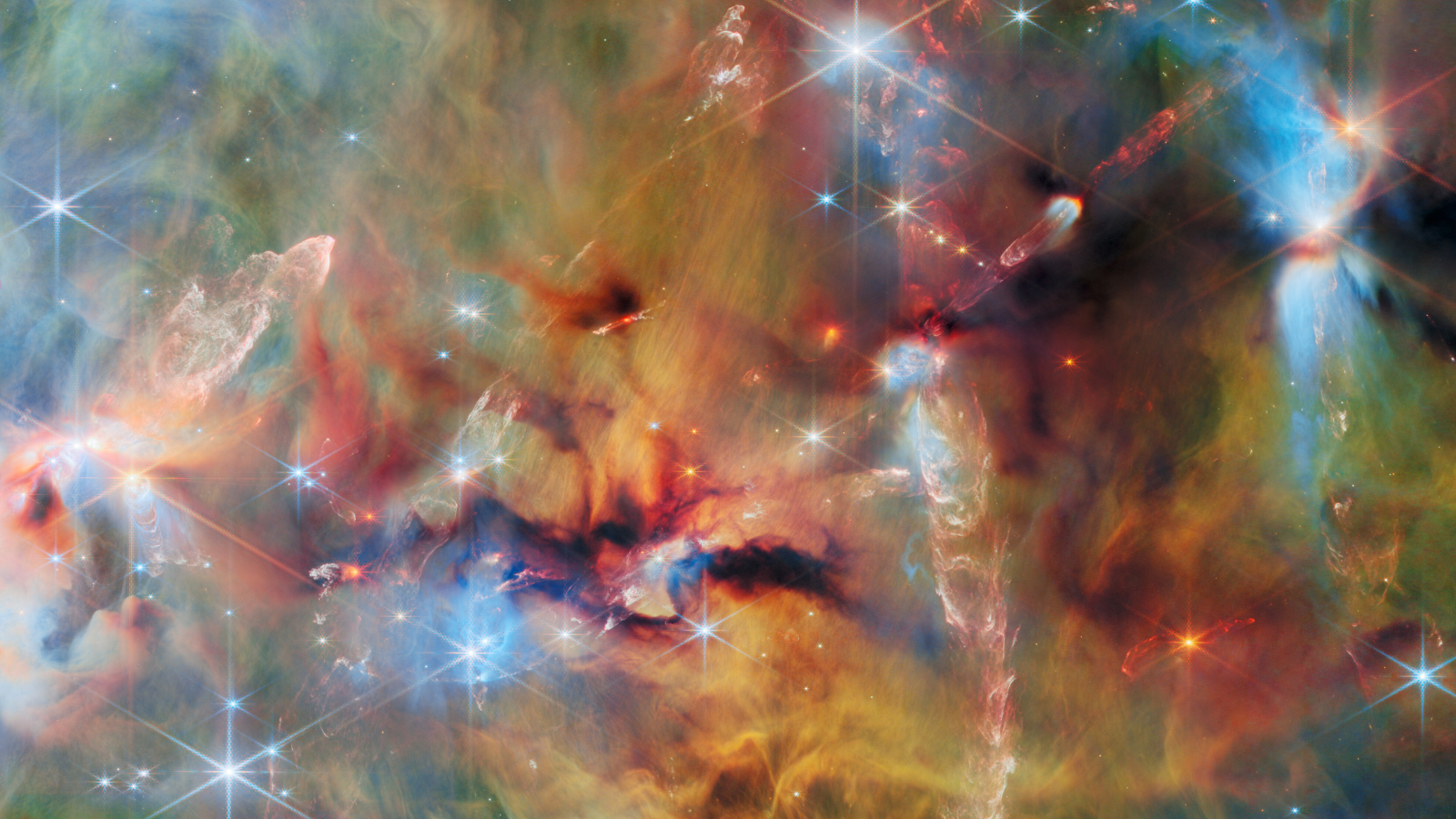
The James Webb Space Telescope Picture of the Month shows the giant molecular cloud Orion A, an area of the sky replete with star-forming clouds. (Image credit: ESA/Webb, NASA & CSA, T. Megeath, M. Zamani (ESA/Webb) Acknowledgement: M. H. Özsaraç)
The image of the day for Monday (June 22) shows the star-forming clouds of Orion A in stunning detail.
Released as the James Webb Space Telescope (JWST) Picture of the Month, the image further demonstrates the impact the $10 billion space telescope has had on our view of the cosmos since it began operations in July 2022.
What is Orion A?
Located around 1,300 light-years from Earth and situated to the south of Orion's Beltin the night sky,Orion A is one of the largest and closest molecular clouds to our planet. Shaped like a filament, this structure of gas and dust is around 290 light-years long.
Part of the Orion molecular cloud complex, Orion A is a packed stellar nursery. Over the last few million years alone, it is estimated that Orion A has given birth to around 3,000 stellar objects.
The molecular cloud is also host to many young protostars surrounded by platters of gas and dust called protoplanetary disks, which, as the name suggests, will form planets. Thus, studying regions like Orion A could be key to understanding how the solar system came to be around 4.6 billion years ago.
The Royal Observatory Greenwich celebrates its 351st anniversary today. Founded by King Charles II on June 22, 1675, the observatory was tasked with solving “the longitude problem,” the lack of accurate east-west positioning at sea because of the difficulty of precise timekeeping during long voyages. John Flamsteed, the first astronomer royal, led meticulous observations ofContinue reading "June 22, 1675: The Royal Observatory Greenwich is founded"
Scientists have released a series of previously unseen images of the asteroid Donaldjohanson captured by NASA’s Lucy spacecraft during an April 2025 flyby.
The team behind the photos’ release said the Lucy spacecraft, which was named for the infamous hominin fossil discovered by anthropologist Donald Johanson, captured critical details about the small main-belt asteroid’s surface features and motion that could help clarify the space rock’s origin and evolution.
The data could also inform studies of the Solar System’s formation, including how asteroids move and evolve over extended timescales.
Craters on Asteroid Donaldjohanson Confirm Its Age
According to a statement from team leader Simone Marchi and colleagues, images captured during the deep-space rendezvous revealed that the oddly shaped rock consists of two cratered ‘lobes’ connected by a comparatively smooth central “neck” section. The researchers noted that Donaldjohanson measured over 8.8 kilometers by 4.4 km by 3.1 km.
An analysis of the surface features helped the team pinpoint the asteroid’s likeliest age to a set of asteroids belonging to the Erigone family, a group that broke apart a larger “parent” body into smaller fragments. The team notes that this ancient age “implies that DJ is a fragment of a larger parent body that was destroyed in a collision about 155 million years ago.”
A grey-scale optical image, acquired with the L’LORRI instrument, of the main belt carbonaceous asteroid (52246) Donaldjohanson as observed by the NASA Lucy Spacecraft on April 20, 2025. Distance: 1272.5 km Phase: 34.4 deg. Image Width: 6.5 km. Image Credit: NASA/GSFC/SwRI/JHU-APL.
Although an examination of the craters helped place the asteroid’s likely age, they noted that craters less than 0.4 kilometers “have been preferentially erased.” The researchers suggest that this preferential erasure of smaller craters might have been caused by “seismic shaking” following a more recent impact event.
“DJ Rotates Slowly in a Tumbling State”
Along with surface features, the newly released images revealed the asteroid’s motion. Specifically, the team determined that Donaldjohanson has a slow, tumbling movement rather than a simple rotation.” Instead of an impact, the team suspects that the asteroid’s motion could have been produced gradually by “torques” resulting from thermal radiation.
“DJ rotates slowly in a tumbling state, likely owing to spin-down by radiative forces,” the team writes.
The main belt carbonaceous asteroid (52246) Donaldjohanson as observed by the NASA Lucy Spacecraft on April 20, 2025. Here, the grey-scale optical image, acquired with the L’LORRI instrument, is overlaid with a false-color map indicating the gravitational slopes on the asteroid’s surface. Distance: 1059 km. Phase: 50.5 deg. Image Width: 5.4 km. Image Credit: NASA/GSFC/SwRI/JHU-APL/DLR.
A spectral analysis of the rock’s cratered surface also revealed a similar composition to other Erigone family asteroids, particularly the presence of iron-bearing phyllosilicates. The team notes these phyllosilicates indicate an “aqueous evolution” on the parent body. However, they also note that the water-induced mineral alteration was likely halted “at an early stage” due to insufficient water or heat.
Next Mission Encounter Planned for 2027
Although the newly released Lucy images were captured in 2025, the team notes that the Donaldjohanson flyby mission was one leg of a larger set of 8 planned Lucy asteroid flybys, with the entire set expected to take 12 years to complete.
“Over its 12-year mission, Lucy will explore a record-breaking number of asteroids: it will fly by three in the belt of asteroids that circle the Sun between the orbits of Mars and Jupiter, and then eight Trojans, which includes five asteroid targets and the satellites of three of those,” a NASA statement explained. “Lucy also will fly by Earth three times to get a push from its gravity, making it the first spacecraft to return to the vicinity of Earth from the outer solar system.”
Christopher Plain is a Science Fiction and Fantasy novelist and Head Science Writer at The Debrief. Follow and connect with him on X, learn about his books at plainfiction.com, or email him directly at christopher@thedebrief.org.

 Login