
❌

Normal view

Scientists Release New Images Captured by the Lucy Spacecraft Flyby of Asteroid Donaldjohanson

22 June 2026 at 12:50


Scientists have released a series of previously unseen images of the asteroid Donaldjohanson captured by NASA’s Lucy spacecraft during an April 2025 flyby.

The team behind the photos’ release said the Lucy spacecraft, which was named for the infamous hominin fossil discovered by anthropologist Donald Johanson, captured critical details about the small main-belt asteroid’s surface features and motion that could help clarify the space rock’s origin and evolution.

The data could also inform studies of the Solar System’s formation, including how asteroids move and evolve over extended timescales.

Craters on Asteroid Donaldjohanson Confirm Its Age

According to a statement from team leader Simone Marchi and colleagues, images captured during the deep-space rendezvous revealed that the oddly shaped rock consists of two cratered ‘lobes’ connected by a comparatively smooth central “neck” section. The researchers noted that Donaldjohanson measured over 8.8 kilometers by 4.4 km by 3.1 km.

An analysis of the surface features helped the team pinpoint the asteroid’s likeliest age to a set of asteroids belonging to the Erigone family, a group that broke apart a larger “parent” body into smaller fragments. The team notes that this ancient age “implies that DJ is a fragment of a larger parent body that was destroyed in a collision about 155 million years ago.”

asteroid Donaldjohanson, Lucy spacecraft
A grey-scale optical image, acquired with the L’LORRI instrument, of the main belt carbonaceous asteroid (52246) Donaldjohanson as observed by the NASA Lucy Spacecraft on April 20, 2025. Distance: 1272.5 km
Phase: 34.4 deg. Image Width: 6.5 km. Image Credit: NASA/GSFC/SwRI/JHU-APL.

Although an examination of the craters helped place the asteroid’s likely age, they noted that craters less than 0.4 kilometers “have been preferentially erased.” The researchers suggest that this preferential erasure of smaller craters might have been caused by “seismic shaking” following a more recent impact event.

“DJ Rotates Slowly in a Tumbling State”

Along with surface features, the newly released images revealed the asteroid’s motion. Specifically, the team determined that Donaldjohanson has a slow, tumbling movement rather than a simple rotation.” Instead of an impact, the team suspects that the asteroid’s motion could have been produced gradually by “torques” resulting from thermal radiation.

“DJ rotates slowly in a tumbling state, likely owing to spin-down by radiative forces,” the team writes.

Lucy spacecraft, asteroid Donaldjohanson
The main belt carbonaceous asteroid (52246) Donaldjohanson as observed by the NASA Lucy Spacecraft on April 20, 2025. Here, the grey-scale optical image, acquired with the L’LORRI instrument, is overlaid with a false-color map indicating the gravitational slopes on the asteroid’s surface. Distance: 1059 km. Phase: 50.5 deg. Image Width: 5.4 km. Image Credit: NASA/GSFC/SwRI/JHU-APL/DLR.

A spectral analysis of the rock’s cratered surface also revealed a similar composition to other Erigone family asteroids, particularly the presence of iron-bearing phyllosilicates. The team notes these phyllosilicates indicate an “aqueous evolution” on the parent body. However, they also note that the water-induced mineral alteration was likely halted “at an early stage” due to insufficient water or heat.

Next Mission Encounter Planned for 2027

Although the newly released Lucy images were captured in 2025, the team notes that the Donaldjohanson flyby mission was one leg of a larger set of 8 planned Lucy asteroid flybys, with the entire set expected to take 12 years to complete.

“Over its 12-year mission, Lucy will explore a record-breaking number of asteroids: it will fly by three in the belt of asteroids that circle the Sun between the orbits of Mars and Jupiter, and then eight Trojans, which includes five asteroid targets and the satellites of three of those,” a NASA statement explained. “Lucy also will fly by Earth three times to get a push from its gravity, making it the first spacecraft to return to the vicinity of Earth from the outer solar system.”

The study “​The Lucy flyby of asteroid (52246) Donaldjohanson:​ ​A bilobed object with a tumbling rotation” was published in Science.

Christopher Plain is a Science Fiction and Fantasy novelist and Head Science Writer at The Debrief. Follow and connect with him on X, learn about his books at plainfiction.com, or email him directly at christopher@thedebrief.org.
The Sun Left Home in a Hurry

14 November 2025 at 17:00

A photograph of a dense knot of stars against a collection of more spread-out stars.

By simulating how the orbits of distant solar system objects were altered by close encounters with other stars early in the Sun’s life, astronomers have placed tight constraints on how long our home star stuck around its siblings after birth.

Born in Batches

Though our Sun currently travels on a solitary trajectory through the galaxy, its earliest childhood was not spent so lonely. Instead, the Sun was likely born as part of a litter of many other stars all collapsing out of the same cloud of precursor gas and dust. As a consequence, its early adolescence was spent in the company of dozens of other young stars, all zipping along on their own paths, destined to drift apart but initially packed close together.

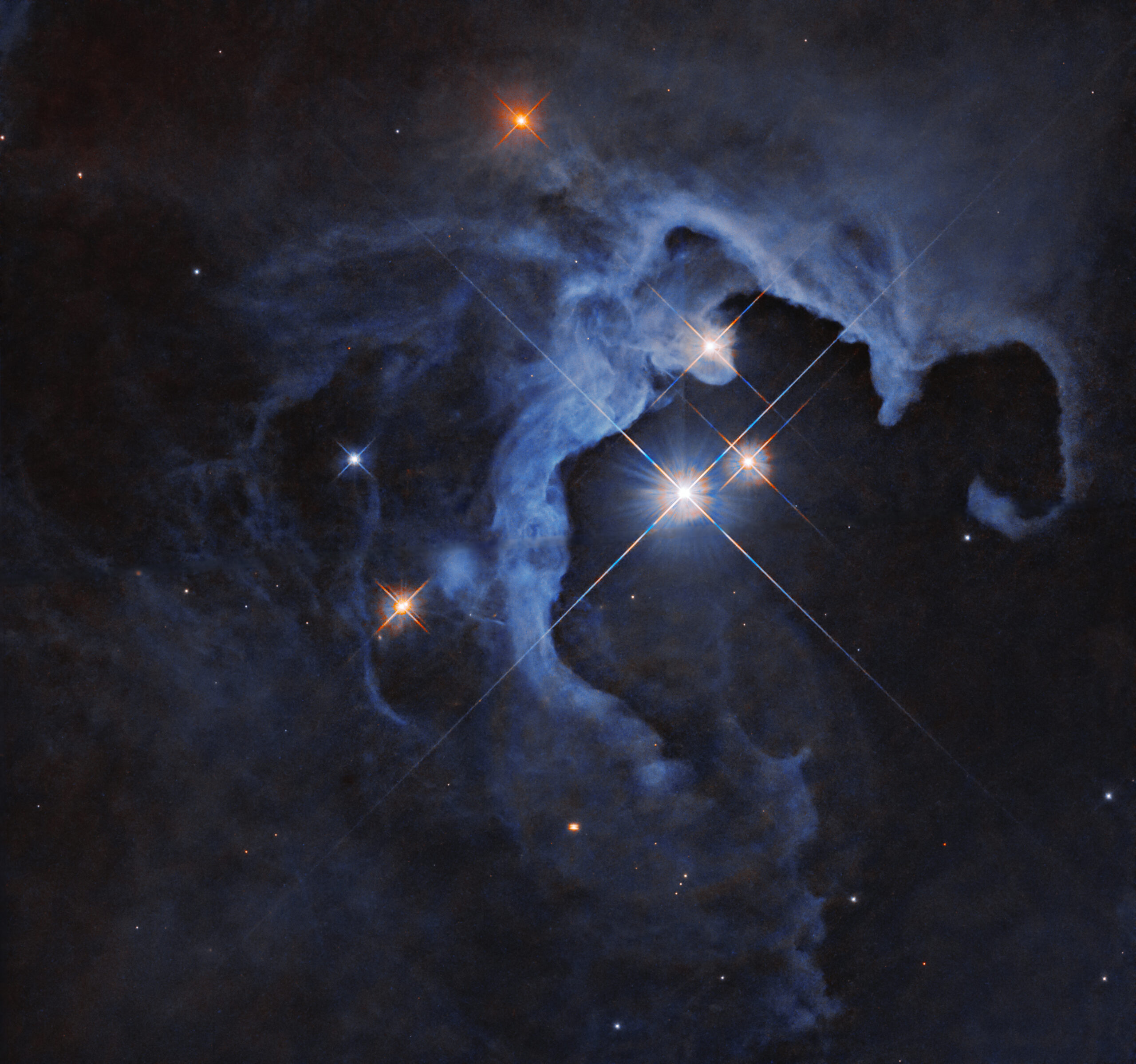
A photograph of three bright stars within a circular cavity of gas.

The Hubble Space Telescope’s view of a collection of young stars still embedded within their natal nebula. [NASA, ESA, G. Duchene (Universite de Grenoble I); Image Processing: Gladys Kober (NASA/Catholic University of America)]

Despite their kinship, these young stars were not kind to one another when they passed nearby. When two stars grow close, the intense gravity of the encounter can severely disrupt their proto-planetary systems, scattering the objects orbiting farthest from their stars and potentially even ejecting some objects altogether. These early years likely left scars on the edges of our solar system that persist even today, billions of years after the early tussles.

Recent research led by Amir Siraj, Princeton University, leverages these scars or their apparent absence to ask the question: given the structure we observe in the outer solar system today, what limits can we place on the number of stars born near the Sun and the amount of time the Sun spent in its birth cluster?

Distance is Power

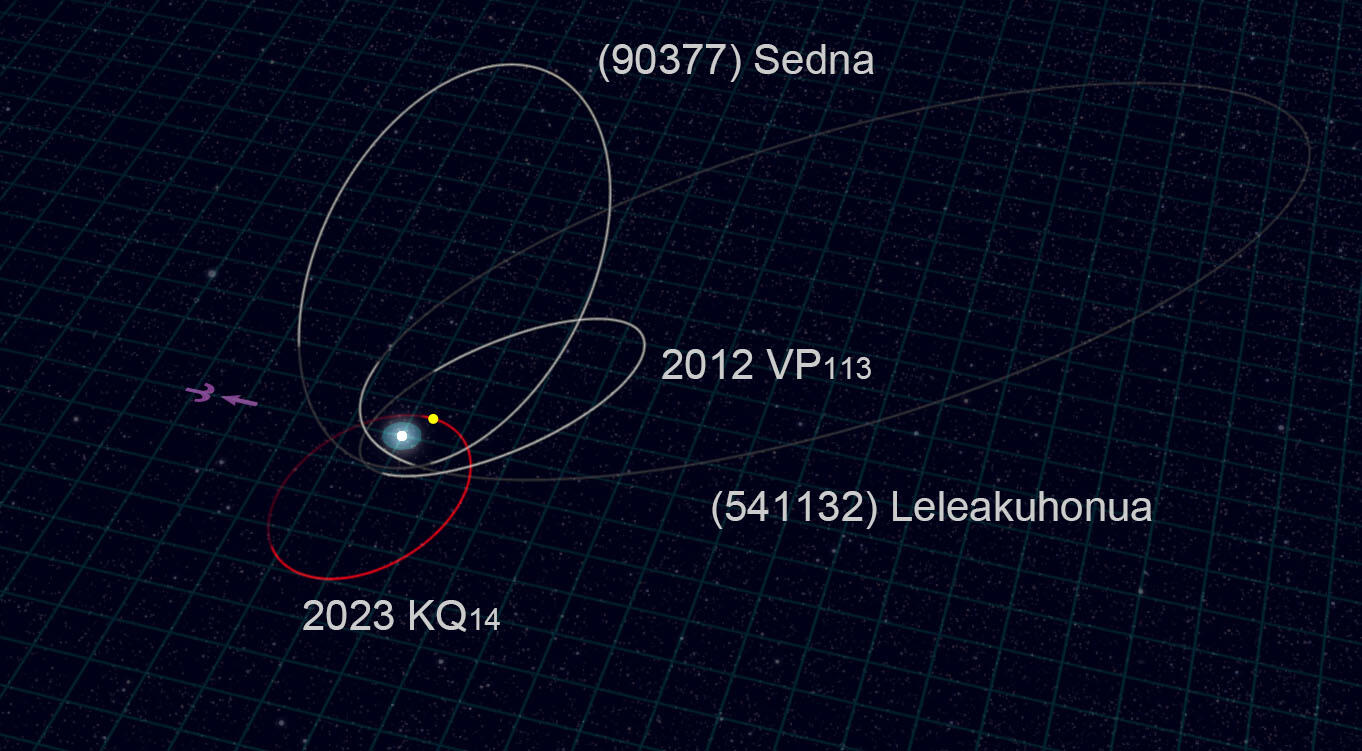
Several authors have asked this question over the past several decades, but Siraj and collaborators added a new twist: instead of studying either the giant planets or the cold classical Kuiper Belt, they instead focused exclusively on the “distant sednoids.” This rarefied collection of only nine known objects includes only the most distant minor planets in our solar system: the sednoids never come within 40 au of the Sun, and they spend much of their orbits beyond 400 au. Interestingly, however, all of them orbit on planes that are fairly aligned with that of the planets, and none ever strays farther than 20° from the ecliptic.

A black background with the sun at center surrounded by several large ovals, each labeled with the name of a minor planet.

An illustration of the orbits for some of the distant sednoids considered in this study. Click to enlarge. [NAOJ]

Through a suite of numerical simulations, Siraj and collaborators demonstrate that this relatively tight distribution of inclinations implies that the Sun couldn’t have been too roughed up on its way out of the cluster. By simulating many different close flybys and their influence on the distant sednoids, the researchers constrained the product of the number of stars in the Sun’s birth cluster and the time the Sun spent there to be less than or equal to 5 billion years per cubic parsec. Assuming a typical cluster density of 100 stars per cubic parsec, this suggests that the Sun cleared out of the densest and most dangerous part of the cluster within just 50 million years.

The authors stress that this conclusion leans on the assumption that the distant sednoids arrived on their extreme orbits essentially immediately, though in fact astronomers aren’t sure exactly how and when these objects ended up on the outskirts of the solar system. If the sednoids were in fact implanted onto their orbits early on, this limit on how long it took the Sun to leave its siblings is by far the strongest to date. With the Vera C. Rubin Observatory poised to discover thousands of new distant solar system objects, it’s likely that the bound will grow even more stringent in the next few years.

Citation

“Limits on Stellar Flybys in the Solar Birth Cluster,” Amir Siraj et al 2025 ApJL 993 L4. doi:10.3847/2041-8213/ae1025

The post The Sun Left Home in a Hurry appeared first on AAS Nova.

❌