 Login

CETA System: Google Cloud India Outage
15 June 2026 at 09:13
A Delhi facility fire has disrupted regional cloud connectivity, exposing how third-party data-centre dependencies, thermal stress and routing


Catastrophic encounters between stars and massive black holes usually take place in the nuclei of galaxies, but not always. Researchers recently reported on the brightest-ever radio emission from an off-nuclear tidal disruption event caused by a wandering or recoiling black hole.
Tidal disruption events occur when a star ventures too close to a massive black hole. The tidal forces of the black hole stretch the star until it’s partially or entirely disrupted, sometimes causing jets or outflows to spray from the shredded star. One thing that often distinguishes a tidal disruption event from the sea of other possible transients is the location, close to the nucleus of a galaxy.
But not all tidal disruption events happen in the center of a galaxy. In rare cases, a massive black hole roaming elsewhere in a galaxy may encounter a star, sending out a tell-tale signal in an unexpected location.
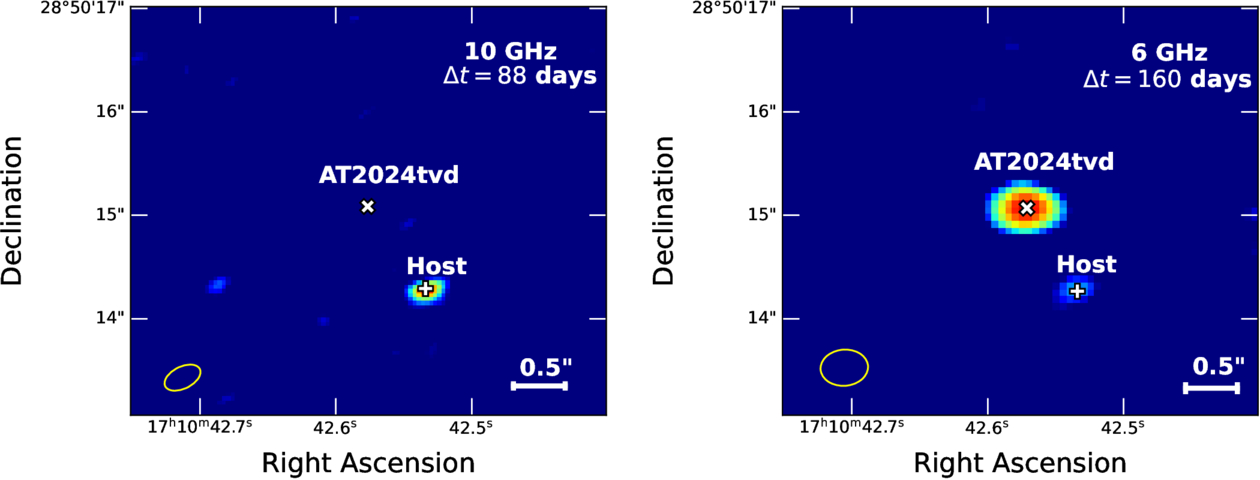
Radio observations of AT 2024tvd on two dates after its optical discovery. The tidal disruption event was not detected at 88 days post-discovery (left) and outshone the center of its host galaxy on 160 days post-discovery (right). Click to enlarge. [Sfaradi et al. 2025]
Less than three months after AT 2024tvd was discovered, Itai Sfaradi (University of California, Berkeley) and collaborators launched a months-long radio-wavelength observing campaign using the Very Large Array, the Atacama Large Millimeter/submillimeter Array, the Arcminute Microkelvin Imager Large Array, the Allen Telescope Array, and the Submillimeter Array. Radio observations are critical for investigating jets and outflows from tidal disruption events.
The observations, which spanned centimeter and millimeter wavelengths, revealed two emission peaks from the tidal disruption event. The first peak occurred roughly 131 days after the event was discovered, and the second followed at day 194.
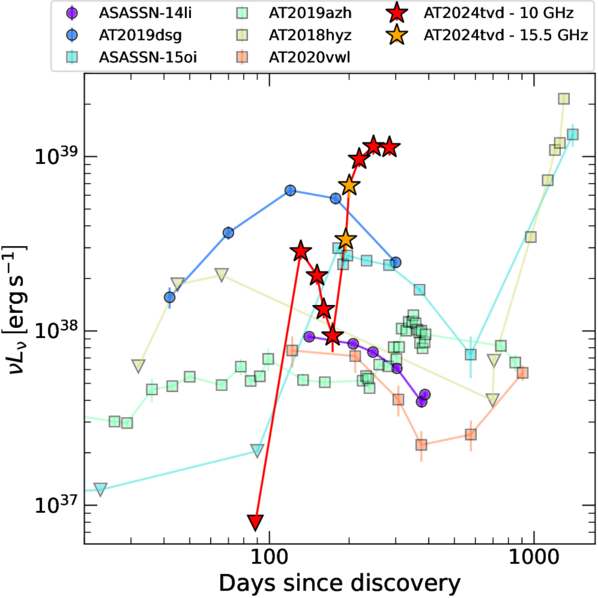
Demonstration of the fast evolution of AT 2024tvd’s radio emission (red and orange stars) compared to other radio-bright tidal disruption events (other symbols). [Sfaradi et al. 2025]
To understand the origin of the fast-evolving, extremely bright radio emission from AT 2024tvd, Sfaradi’s team modeled the emission that would arise from outflows and jets. For both wide-angle outflows and narrow jets, the team considered both prompt — arising simultaneously with the event’s optical detection — and delayed sources.
The team’s modeling highlighted several possible scenarios. In the first, both bright radio peaks arose from a single outflow that was launched about 84 days after the star met its doom. The double-peaked behavior is due to the outflow interacting with a complex distribution of material surrounding the black hole. It’s also possible for the two peaks to arise from separate outflows or jets, one launched around 84 days and the other around either 170 or 190 days, depending on whether the second source is a mildly relativistic outflow or a relativistic jet.
Sfaradi and collaborators posited that AT 2024tvd’s unusual radio behavior could be due to its off-nuclear location, but they acknowledged that this event might simply occupy a region of tidal disruption event parameter space that had yet to be explored. Sensitive interferometric or polarimetric observations may reveal more about how AT 2024tvd interacts with its environment, helping to illuminate the nature of this rare event.
“The First Radio-Bright Off-Nuclear TDE 2024tvd Reveals the Fastest-Evolving Double-Peaked Radio Emission,” Itai Sfaradi et al 2025 ApJL 992 L18. doi:10.3847/2041-8213/ae0a26
The post Investigation of the First Radio-Bright Off-Nuclear Tidal Disruption Event appeared first on AAS Nova.
Simulations suggest that there should be a million stars in our galaxy that once wandered so close to a supermassive black hole that they were nearly destroyed. What are the long-term effects of this encounter, and could astronomers observe the scars of these near-death experiences?
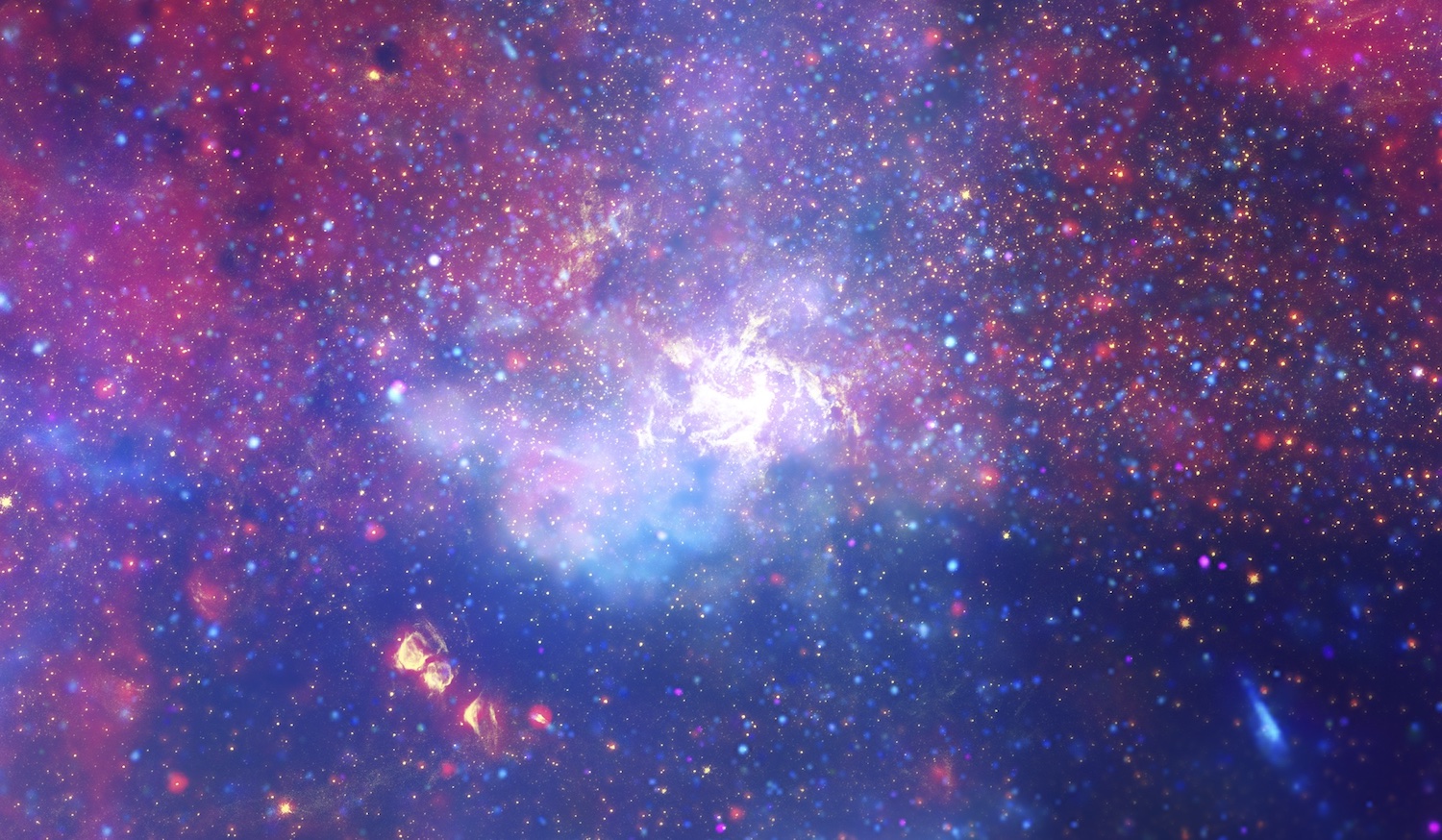
This infrared and X-ray image of the Milky Way’s center shows a swirl of hot gas surrounding Sagittarius A*, our galaxy’s central supermassive black hole. [NASA, ESA, SSC, CXC, STScI]
Simulations suggest that most of the time, these hapless stars are not completely destroyed by their close encounters with the black hole. In principle, then, there should be about a million “survivor” stars wandering near the center of our galaxy. But, what would these survivors look like? And with careful measurements, could we tell them apart from their regular, unscathed counterparts?
Recently, a team of astronomers led by Rewa Clark Bush (University of California Santa Cruz, Cabrillo College, Wesleyan University) tackled this question. First, the team needed to simulate a terrible day for a hypothetical star: the day it passes closest to the black hole. To compute what happens to the star in those intense couple of hours, they used an open-source hydrodynamic code called FLASH to track the state of the star in granular detail.
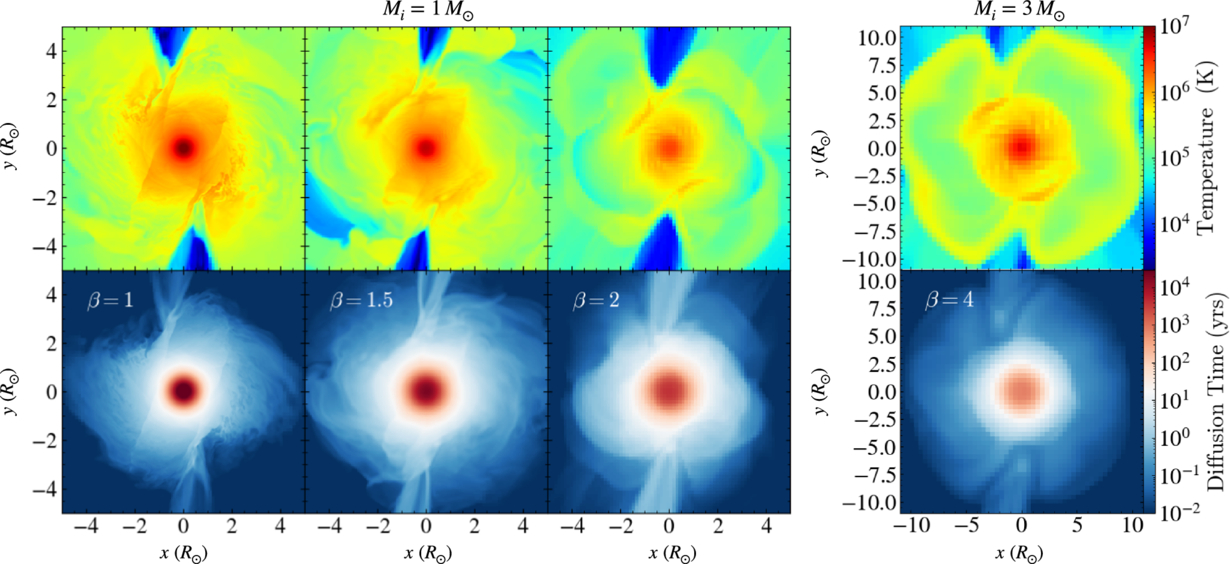
Temperatures (top row) and diffusion timescales (bottom row) of four stars soon after their closest approach to the black hole. Click to enlarge. [Bush et al. 2025]
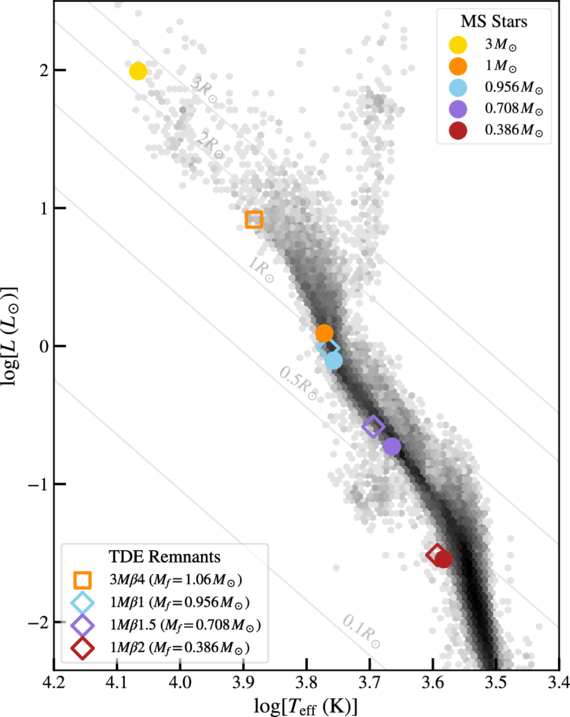
Comparison of the original undisturbed stars (filled circles), the stars after a black hole encounter (open symbols), and other stars with different initial masses (black points). Click to enlarge. [Bush et al. 2025].
Eventually, though, these stars pretty much return to a new normal. Though these stars would have had slightly different colors and luminosities had they not encountered the black hole, they end up looking similar to undisturbed stars with the same final mass.
Although detailed spectroscopic measurements of these remnants might reveal a strange composition thanks to all the stirring that happened during the flyby, it’d be hard to tell anything happened to these stars otherwise. Ultimately, life goes on, even for stars that were nearly destroyed by the most massive creature in the galaxy.
“Black Hole Survival Guide: Searching for Stars in the Galactic Center that Endure Partial Tidal Disruption,” Rewa Clark Bush et al 2025 ApJL 990 L7. doi:10.3847/2041-8213/adefde
The post Scars from a Black Hole appeared first on AAS Nova.
Falling into a supermassive black hole will leave a star mangled and destroyed but not without a fiery end. A recent study explores an intriguing case, uncovering new possibilities for stars lost to black hole bites.
Invisible in light but strong in gravitational influence, some supermassive black holes reveal themselves when a star comes close enough to be ripped apart by the black hole’s tidal forces. This violent encounter produces a flare of radiation known as a tidal disruption event, allowing astronomers to explore the otherwise hidden properties of supermassive black holes and their influence on the material around them.
Tidal disruption events vary depending on the properties of the host galaxy, the supermassive black hole, and the star itself. These events often appear as X-ray flares, but over the past decade, researchers have discovered a new class of optical-ultraviolet tidal disruption events. Emitting primarily in ultraviolet and optical wavelengths, these flares are significantly less energetic than predicted, leaving researchers wondering — what drives these disruptions?
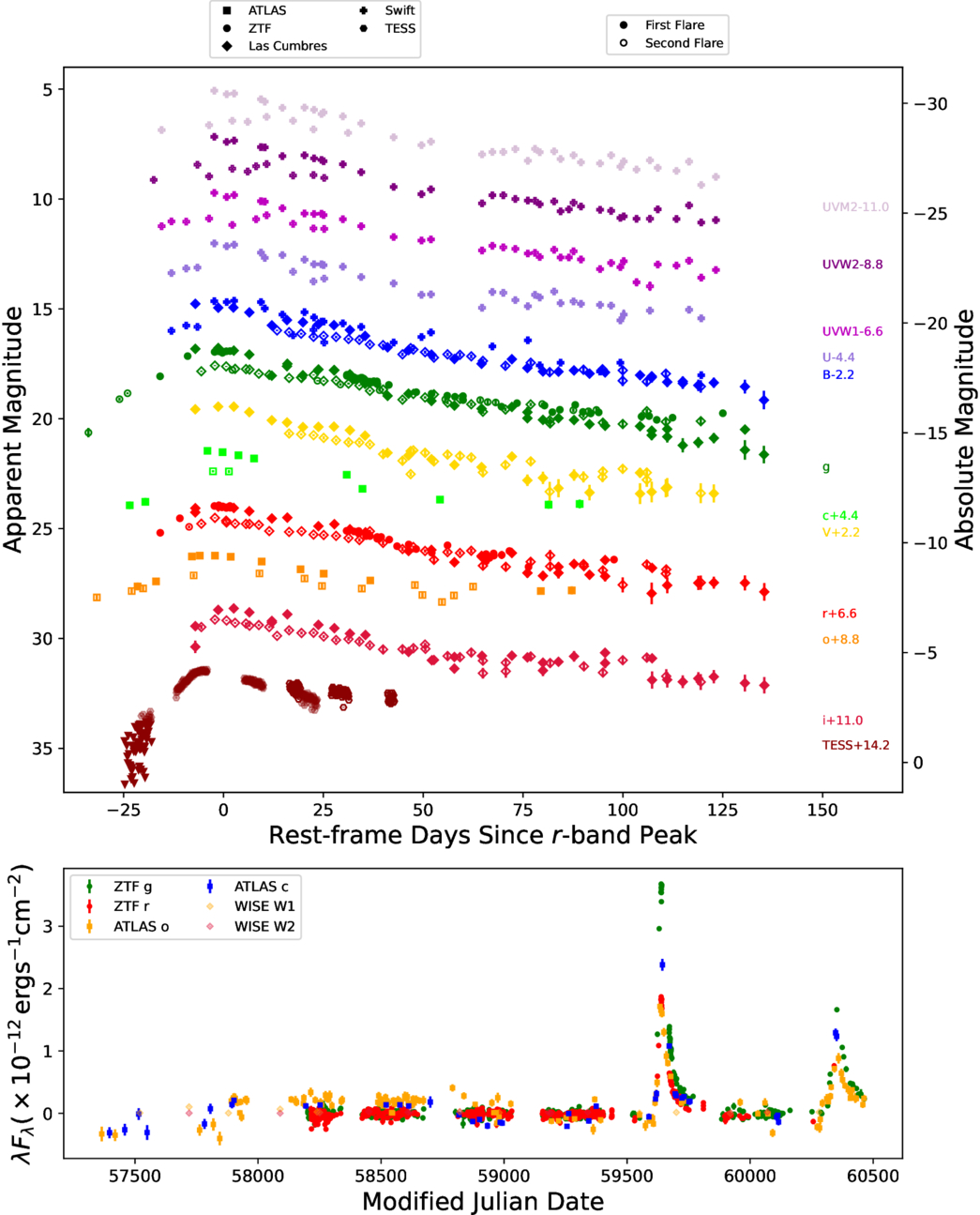
Optical and ultraviolet light curves for the two observed flares of AT 2022dbl. The flares have very similar light curves across wavelengths. Click to enlarge. [Makrygianni et al 2025]
New detections of optical-ultraviolet tidal disruption events can provide insights into their origins, and one such discovery is particularly intriguing. AT 2022dbl first flared in 2022 and emitted a second, nearly identical flare 700 days later in 2024 — behavior uncommon among this class of tidal disruption events — raising many questions about AT 2022dbl’s origins. Did this supermassive black hole perhaps capture two unrelated stars? Is this actually the same flare seen twice due to gravitational lensing? Could a single star have survived the first flare only to be disrupted again?
Lydia Makrygianni (Lancaster University) and collaborators performed follow-up imaging and spectroscopy of AT 2022dbl to probe how the two flares compare to each other and to other observations of optical-ultraviolet tidal disruption events. With these observations and detailed analysis, the team determined that gravitational lensing, the tidal disruption of two separate stars, and even the possibility of a hidden binary companion to the supermassive black hole slurping up some stellar crumbs each cannot account for the two flares of AT 2022dbl.
Ultimately, the authors concluded that the two flares of AT 2022dbl are related to the same star, leaving two possibilities. First, loose debris from the initial flare bound to a tidal tail around the black hole could have ignited the second flare; however, the authors found that there would not be enough loose material bound to the black hole to produce the bright second flare. Rather, the second and likeliest explanation is two repeated disruptions of the same star.
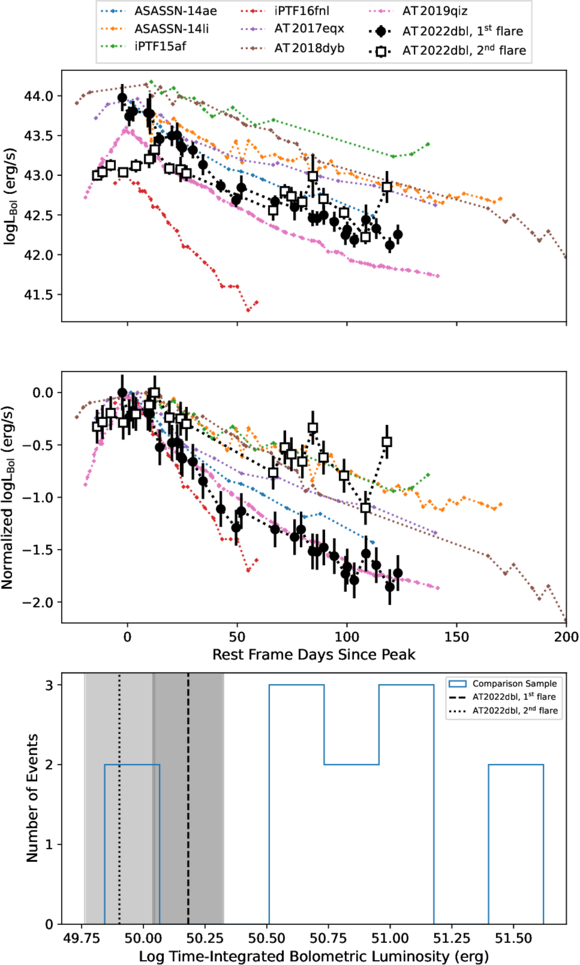
Light curves of AT 2022dbl flares compared to other optical-ultraviolet tidal disruption events. Both flares show similar peak luminosities and decline rates to other events. Click to enlarge. [Makrygianni et al 2025]
Other optical-ultraviolet tidal disruption events appear similar to the flares of AT 2022dbl, and these have generally been assumed to be complete disruptions. With the discovery and classification of AT 2022dbl, the similar optical-ultraviolet tidal disruption events could also be partial disruptions, with their second flares on longer timescales yet to be observed. Future observations of optical-ultraviolet tidal disruption events are required to further understand the mechanisms driving them, and this study opens up new possibilities to consider.
“The Double Tidal Disruption Event AT 2022dbl Implies that at Least Some ‘Standard’ Optical Tidal Disruption Events Are Partial Disruptions,” Lydia Makrygianni et al 2025 ApJL 987 L20. doi:10.3847/2041-8213/ade155
The post Double Disruption Dilemma: Exploring the Tidal Disruption Events of AT 2022dbl appeared first on AAS Nova.
When JWST peered back into the early universe, its keen eyes revealed an unexpected population of galaxies nicknamed “little red dots” for their compact size and bright red hue. A new research article proposes that tidal disruption events could be responsible for the surprising appearance of these galaxies.

Six “little red dot” galaxies seen by JWST. [NASA, ESA, CSA, STScI, Dale Kocevski (Colby College)]
A successful theory of little red dot identity must account for several observed properties: “V”-shaped spectra, broad H-alpha lines, and little or no emission at X-ray wavelengths. In a recent research article, Jillian Bellovary (Queensborough Community College; CUNY Graduate Center; American Museum of Natural History) has theorized that little red dots get their curious characteristics from stars being torn apart by a young and growing black hole.
In this scenario, little red dots arise in the extremely dense star clusters created in the early universe. Because of their extraordinary density, these star clusters are vulnerable to gravitational collapse, causing the packed-together stars to crash into one another. The colliding stars combine to form a supermassive star that collapses, leaving behind an intermediate-mass black hole — a seed that could someday grow into a supermassive black hole.
Situated at the center of a dense star cluster, an intermediate-mass black hole would be poised to ensnare stars in its gravitational web, pulling the stars apart with its powerful tidal forces and stealing their mass. These star-shredding events are known as tidal disruption events.

Predicted number density of intermediate-mass black holes (blue and orange lines). The symbols show the observed number densities of little red dots as a function of redshift. [Bellovary 2025]
Because tidal disruption events tend to remain bright for about a year, this implies that a tidal disruption event rate of one per 10,000 years is necessary for tidal disruption events to explain little red dots.

Modeled tidal disruption event (TDE) rates for two different models and various values of velocity dispersion, σ, and stellar density, nstar. [Adapted from Bellovary 2025]
As Bellovary notes, little red dots could have multiple causes. Some might be due to tidal disruption events, while others could contain active black holes, ancient populations of red stars, or dusty starburst galaxies, as others have suggested.
To verify the tidal disruption event hypothesis, astronomers would need to find evidence for time variability at rest-frame ultraviolet wavelengths, as well as a characteristic decrease in brightness over time. These changes are expected to unfold over the course of years or decades, meaning that while observations may settle this question in due time, there will be plenty of time to ponder the mysteries of little red dots while we wait.
“Little Red Dots Are Tidal Disruption Events in Runaway-Collapsing Clusters,” Jillian Bellovary 2025 ApJL 984 L55. doi:10.3847/2041-8213/adce6c
The post A New Theory for Little Red Dots: Shredded Stars Feeding Growing Black Holes appeared first on AAS Nova.
Editor’s Note: Astrobites is a graduate-student-run organization that digests astrophysical literature for undergraduate students. As part of the partnership between the AAS and astrobites, we occasionally repost astrobites content here at AAS Nova. We hope you enjoy this post from astrobites; the original can be viewed at astrobites.org.
Title: An Untargeted Search for Radio-Emitting Tidal Disruption Events in the VAST Pilot Survey
Authors: Hannah Dykaar et al.
First Author’s Institution: University of Toronto
Status: Published in ApJ
The supermassive black holes in the centers of most galaxies are notoriously, and predictably, violent actors in the universe. While some, classified as active galactic nuclei, act like a drain on their host galaxies, swallowing anything and everything that falls into them, even dormant black holes will react destructively when provoked. Orbit too closely, and any galactic nucleus will break you apart like a first-year chemistry student bumping an unsuspecting beaker off the lab bench.
If an ill-fated star falls into a black hole, the system will briefly glow across the electromagnetic spectrum. When and where these mishaps, known as tidal disruption events (TDEs, shown in Figure 1), occur, as well as the exact physical processes causing the brief glow, are not well understood. TDEs have been detected overwhelmingly in galaxies that do not have active galactic nuclei and are calming down after an era of intense star formation, and current models of the TDE occurrence rate disagree with observations. We expect to see more types of galaxies, such as those with active galactic nuclei, that host TDEs at similar rates, but we don’t — however, we might just be looking in the wrong places, or rather, with the wrong set of eyes.
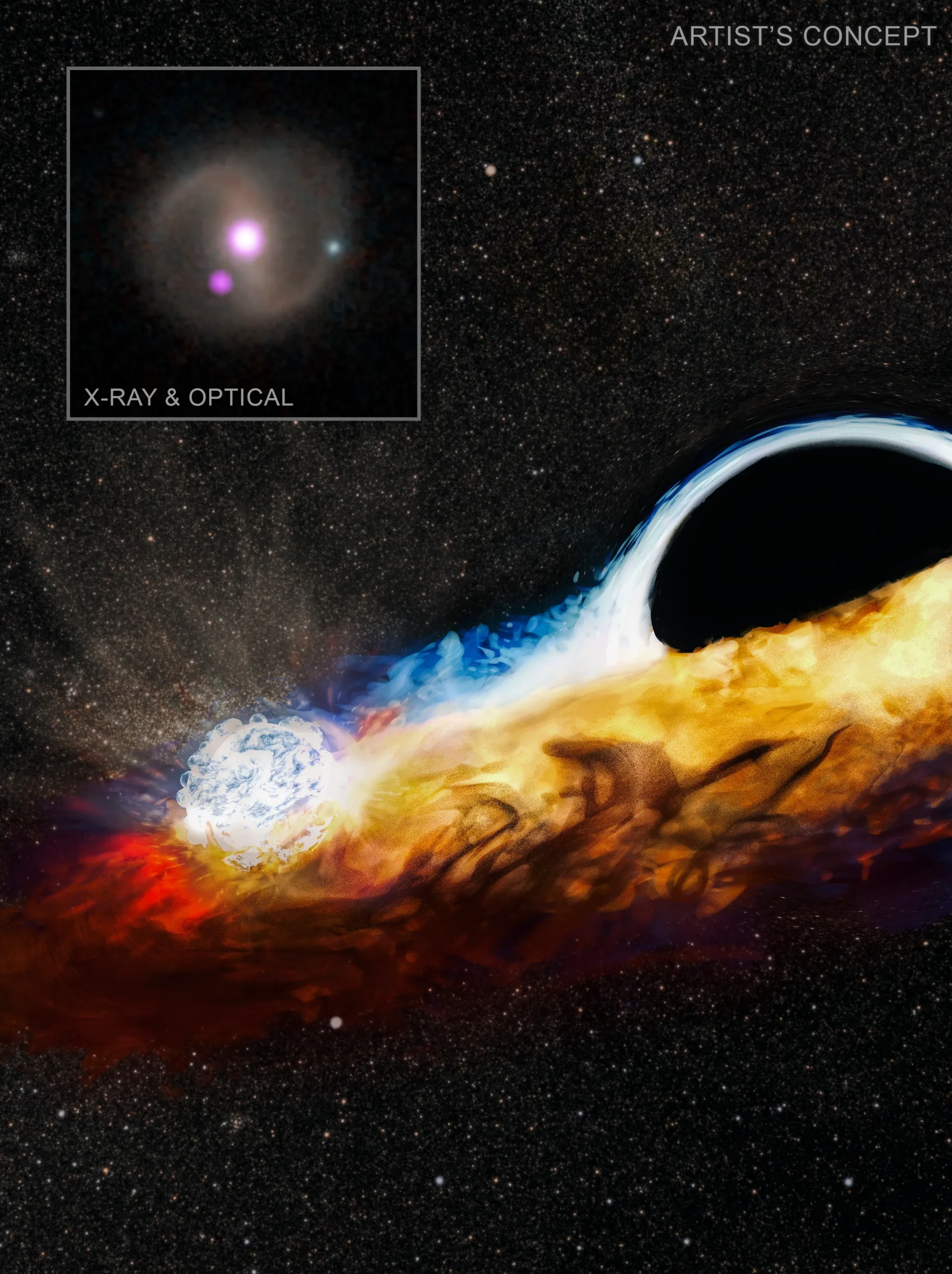
Figure 1: An artist’s impression of a tidal disruption event observed with X-ray and optical telescopes. [X-ray: NASA/CXC/Queen’s Univ. Belfast/M. Nicholl et al.; Optical/IR: PanSTARRS, NSF/Legacy Survey/SDSS; Illustration: Soheb Mandhai / The Astro Phoenix; Image Processing: NASA/CXC/SAO/N. Wolk]
Today’s authors decide to take on this challenge, armed with data from the Variable and Slow Transients (VAST) pilot survey, which observes large swaths of the sky at regular intervals to track variability on the order of days to months. VAST is optimized for observing TDEs, but unfortunately, it is also excellent at finding active galactic nuclei. How do we know what to look for, and how can we distinguish a TDE from an active galactic nucleus? Easy, we can just identify characteristics common to all the known radio-emitting TDEs in the VAST field of view — all one of them, that is. Surely, that won’t do. Instead, our authors simulate the evolution of TDEs as seen by VAST, which can only catch discrete snapshots of light at a specific radio wavelength. Their models of TDE radio emission assume one of three cases: either the TDE produces a relativistic jet directed at us (on-axis), directed away from us (off-axis), or none at all. The presence or absence of a jet, and its direction, determine the shape of the light curve, as shown in Figure 2.
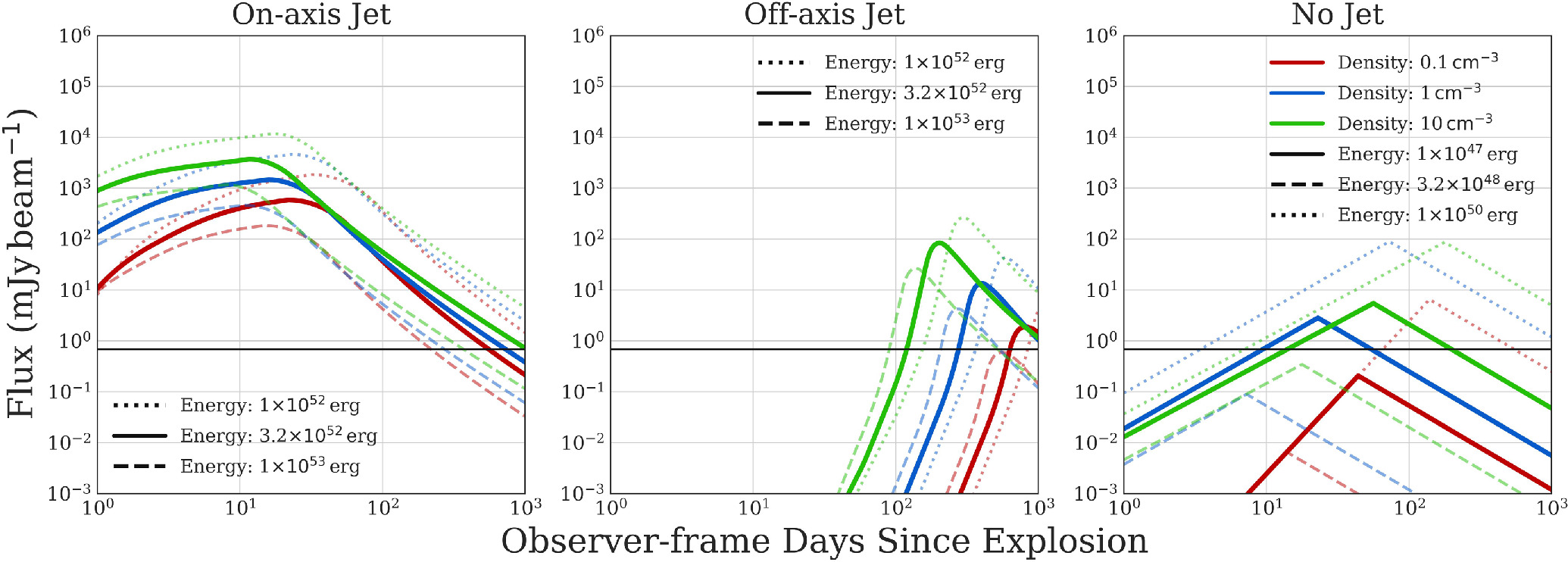
Figure 2: This figure shows the change in radio brightness over time we expect to see from a galaxy during a TDE given different models. The shape of the radio flare depends strongly on whether the TDE results in a relativistic jet, and if so, whether the jet points toward us (on-axis) or not (off-axis). These simulated light curves were used to establish criteria for TDE candidacy, and compared with observations from the final sample to constrain the incidence rate of TDEs and likelihood of different jet geometries. [Dykaar et al. 2024]
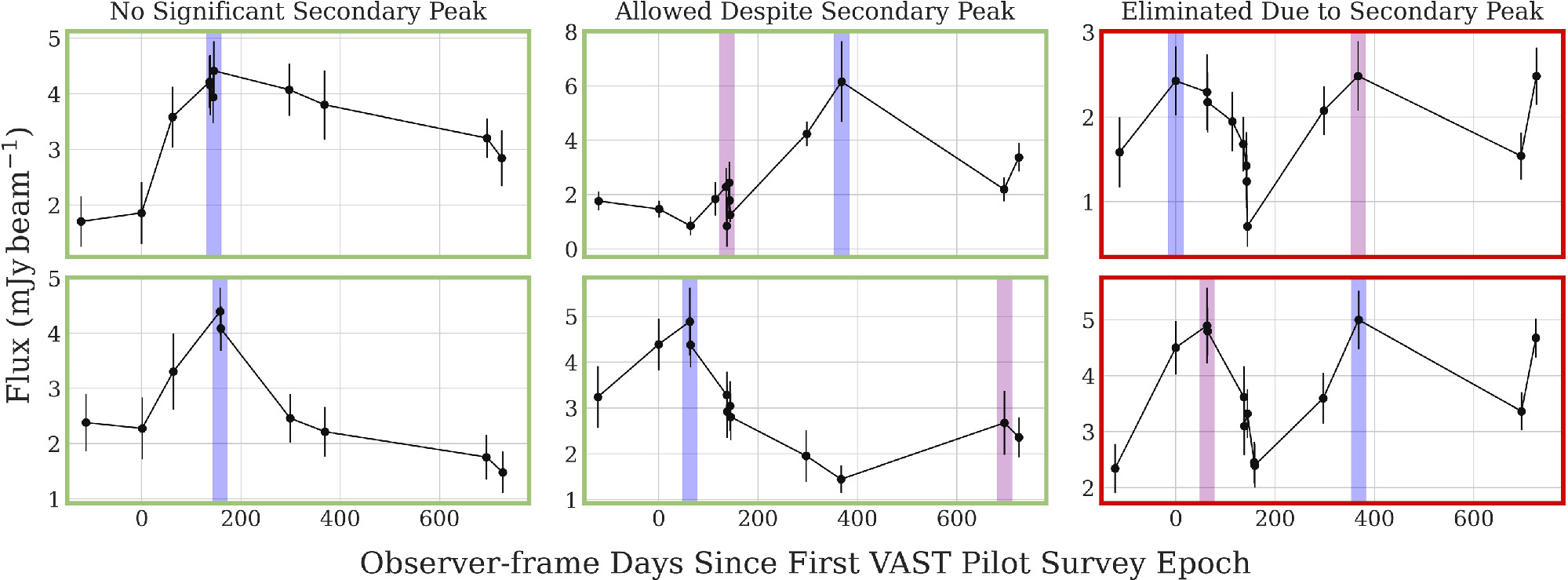
Figure 3: To distinguish TDEs from active galactic nucleus imposters, the authors kept only sources that exhibited one dominant peak in their radio flux, shown by the blue windows. Sources with secondary peaks (shown by the purple windows) that were much smaller than the primary peak were allowed, as the secondary peak could reasonably be due to ambient active galactic nucleus activity. However, multiple comparable peaks are indicative of only intrinsic active galactic nucleus fluctuations, not a TDE. [Dykaar et al. 2024]
The authors next subject these TDE candidates to thorough multi-wavelength scrutiny using archival survey data. First, they investigated whether the candidates are associated with gamma-ray bursts, which are extremely luminous and energetic events that may accompany TDEs. Unfortunately, gamma rays are easily absorbed, making them notoriously difficult to trace back to their sources. (After all, the journey of a gamma ray through light-years of dust and gas to Earth is not unlike Odysseus’s return to Ithaca, and we all know how many made that journey unscathed.)
The authors found that all 12 sources were coincident with a gamma-ray burst, but all 12 sources were also coincident with multiple gamma-ray bursts (which is unlikely to be physical), as were randomized, TDE-free regions of the VAST sky. In other words, the gamma-ray burst association is inconclusive. Contemporary optical and infrared observations of the candidates revealed no corresponding flares, which leads to more questions. Are the sources simply too far away for their optical and infrared flares to be discernible, or could dust absorption be at play? Additionally, nearly all candidates maintained an increased radio flux after the TDE flare. This may indicate that the TDE occurred within an active galactic nucleus as it was transitioning to a higher radio flux state, that the TDE was followed by intense star formation, or both.
By comparing their candidates to the expected observational manifestations of their TDE models, the authors conclude that the candidate sources are consistent with TDEs that have relativistic jets. They also independently constrain the TDE incidence rate, which agrees with current theory. As our window into the variable radio universe expands with future observations, such as with the ongoing VAST survey, we will have a growing population of such radio-detected TDEs to study, and the ability to distinguish them from regular active galactic nuclei will be ever more valuable in our quest to understand them.
About the author, Chloe Klare:
I’m a PhD student in Astronomy and Astrophysics at Penn State, with a physics doctoral minor. In my research, I’m looking for newly evolving synchrotron jets in active galactic nuclei (in the radio!).
The post Did That Supermassive Black Hole Rip Apart a Star, or Is It Eating Lunch Like Normal? appeared first on AAS Nova.
