Physicists recently wondered what would happen if you tried to split a photon — and they found some unexpected behavior that may transform the way we think about particles.
The experiment, in which researchers simulated a photon being sliced by a shutter under various conditions, showed that a severed photon can lead to a complex mixture of zero to infinitely-many photons — raising some big questions about the nature of particle interactions.
Photons are elementary packets of light, which means they are not made up of anything else. So what does it even mean to try splitting a photon? It may be possible thanks to wave-particle duality — a core principle of quantum mechanics, the bizarre physics of the very small.
According to wave-particle duality, a photon is not only a particle but also a wave. Using theoretical calculations, the researchers investigated what would happen if you sent this photon through a shutter and closed it while the photon was passing through, effectively cutting off the tail end of the photon wave.
"I think that most physicists would expect there to be a certain probability that you have zero photons and a certain probability that you have a single photon left after you have done this," Johannes Skaar, co-author of the new study and a professor of theoretical physics at the University of Oslo, told Live Science. "And that is approximately true, but it is not exactly true."
What are the chances?
This brings up another strange aspect of quantum mechanics: its probabilistic nature. Particles exist as a cloud of probabilities stretching to infinity. Until a particle is observed, its properties, such as its position or energy, are in a superposition of possible values; all we can know are the chances of finding it in a certain state.
Through their calculations, Skaar and his colleagues determined how cutting a photon affects these probabilities. In their study, recently accepted in the journal Physical Review Letters, they found that it would create a complex mixture of photon states, including one with an infinite number of photons.
Each of these states has a probability that depends on how quickly the shutter cuts the photon. The expected number of photons becomes infinite only if the shutter is closed infinitely quickly. For realistic shutter speeds, even a thousand photons would be extremely unlikely.
This may sound very strange, but the quantum physicists were unfazed. In fact, what surprised Skaar and his colleagues was what happens if you make measurements of the cut photon from different perspectives.
A photo of an optical table with laser and beam-splitting cube, often used in photonics research. (Image credit: EschCollection via Getty Images)
"When you measure from one side of the shutter, then it will look like a single photon state," Skaar said. "Then, on the other side, it will look like a vacuum state — that means no photons. And that is very strange because the actual state globally is this mixture from zero to infinity."
Changing how we think about particles
The fact that these complex mixtures can be treated locally as very simple states raises fundamental questions about the nature of particles. Skaar said they are still reckoning with the full extent of these implications and they are now considering how this process could play out for other quantum particles, such as electrons.
They hope that by following this theoretical thread through, they may be able to develop a neater way of describing particle interactions. Currently, particles' infinite stretching means they have been interacting for an infinite amount of time. This then poses a problem for causality — the order of cause and effect — in particle interactions, the team said.
These new theoretical photons with a cutoff tail would not have this problem, meaning the causal link in an interaction would be clear, Skaar said. He admitted that there is much more work to be done to develop the theoretical description of this interaction. However, the new result is an important step toward describing particle interactions with a clear causal relationship, which Skaar described as the team's "ultimate goal."
NASA’s Fermi Mission Uncovers Possible Sibling Supernova Remnants
A new study of two supernova remnants, the debris left behind after stars explode, suggests the explosions came from stellar siblings that once orbited each other. The first star’s detonation sent its binary companion hurtling through space, and then, after traveling for thousands of years, the surviving star blew up too.
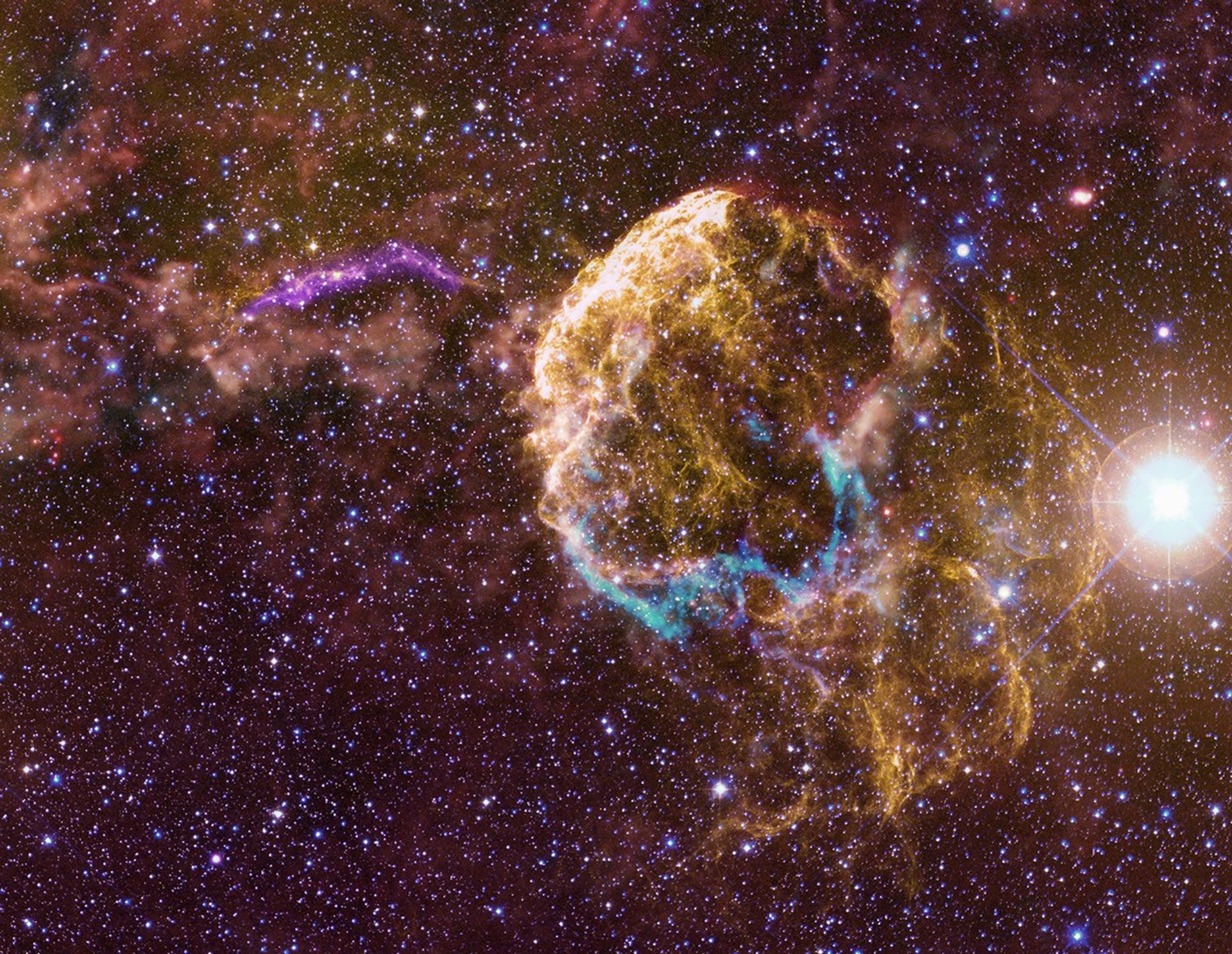
This multiwavelength scene shows the Jellyfish Nebula supernova remnant (right), the interstellar cloud it’s interacting with, and a distinctive curving filament to its upper left. The filament, which is shown here both in optical and ultraviolet (UV) light, is the visible part of an overlapping supernova remnant, G189.6+3.3, that is more prominent in radio and X-rays. Visible light is shown in yellow, UV from NASA’s Neil Gehrels Swift Observatory is shown in violet, and infrared light from NASA’s retired WISE (Wide-field Infrared Survey Explorer) mission appears in cyan, red, and orange. Both remnants are located about 6,000 light-years away in the constellation Gemini. The brilliant star at far right is Propus, also known as Eta Geminorum.
NASA Goddard Space Flight Center and M. Michailidis et al. 2026; optical: DSS; infrared: NASA/WISE/JPL-Caltech/UCLA; ultraviolet: NASA/Swift
“Using 16 years of data from NASA’s Fermi Gamma-ray Space Telescope, our analysis uncovered gamma rays associated with a supernova remnant that was hidden in the glare of its neighbor, the Jellyfish Nebula, one of the brightest gamma-ray-emitting supernova remnants known,” said Miltiadis Michailidis, a postdoctoral fellow in the physics department at Stanford University in California. “There are so many striking connections between the two remnants that we conclude they’re likely related, giving us the first known example of a binary system where both stars have undergone supernova explosions.”
Michailidis presented the findings Wednesday at the 248th meeting of the American Astronomical Society in Pasadena, California. A paper describing the results will appear in a future edition of Nature Communications.
The study focused on a faint supernova remnant called G189.6+3.3, which is mainly visible in X-rays. It is upstaged by its brighter and better-known neighbor, the Jellyfish Nebula (IC 443). The two star wrecks, both located in the constellation Gemini, appear to partially overlap as seen in X-rays. Recent X-ray evidence suggests that hot plasma likely associated with G189.6+3.3 may extend across the entire region, a hint that the overlap may be nearly total.
A massive star explodes when its energy-producing core runs out of fuel and collapses under its own weight, triggering an explosion that blows the star apart. The explosion’s shock wave encloses a hot cloud of debris that rapidly expands into space. So far, astronomers have cataloged about 300 supernova remnants in our galaxy.
The Fermi mission is part of NASA’s fleet of observatories monitoring the changing cosmos to help humanity better understand how the universe works. More than a decade ago, observations from Fermi’s LAT (Large Area Telescope) showed that the shock waves of supernova remnants accelerated particles to within a fraction of the speed of light, a process first proposed by physicist Enrico Fermi — the mission’s namesake — in 1949.
These high-speed particles, called cosmic rays, interact with interstellar gas to produce gamma rays, the highest-energy form of light. Protons make up 99% of cosmic ray particles. To prove that accelerated protons are responsible for the glow, astronomers search for a specific gamma-ray feature. When cosmic-ray protons smash into interstellar gas, they produce a short-lived particle called a neutral pion, which almost immediately decays into a pair of gamma rays. This emission occurs within a specific band of energies associated with the neutral pion’s mass and lies within the range detected by Fermi’s LAT instrument.
In 2013, Fermi observations proved that the Jellyfish Nebula, which is interacting with part of a glowing cloud of hydrogen gas known as Sharpless 249, produced gamma rays through this mechanism. Its neighbor, G189.6+3.3, was discovered in 1994 as part of an X-ray survey by the German-led ROSAT (Roentgen Satellite) mission.
A bright filament of gas lies between the overlapping remnants. New observations of this feature reveal that the shock wave from G189.6+3.3 slammed into dense interstellar gas there and dramatically slowed, key evidence that both remnants are interacting with the same cloud system.
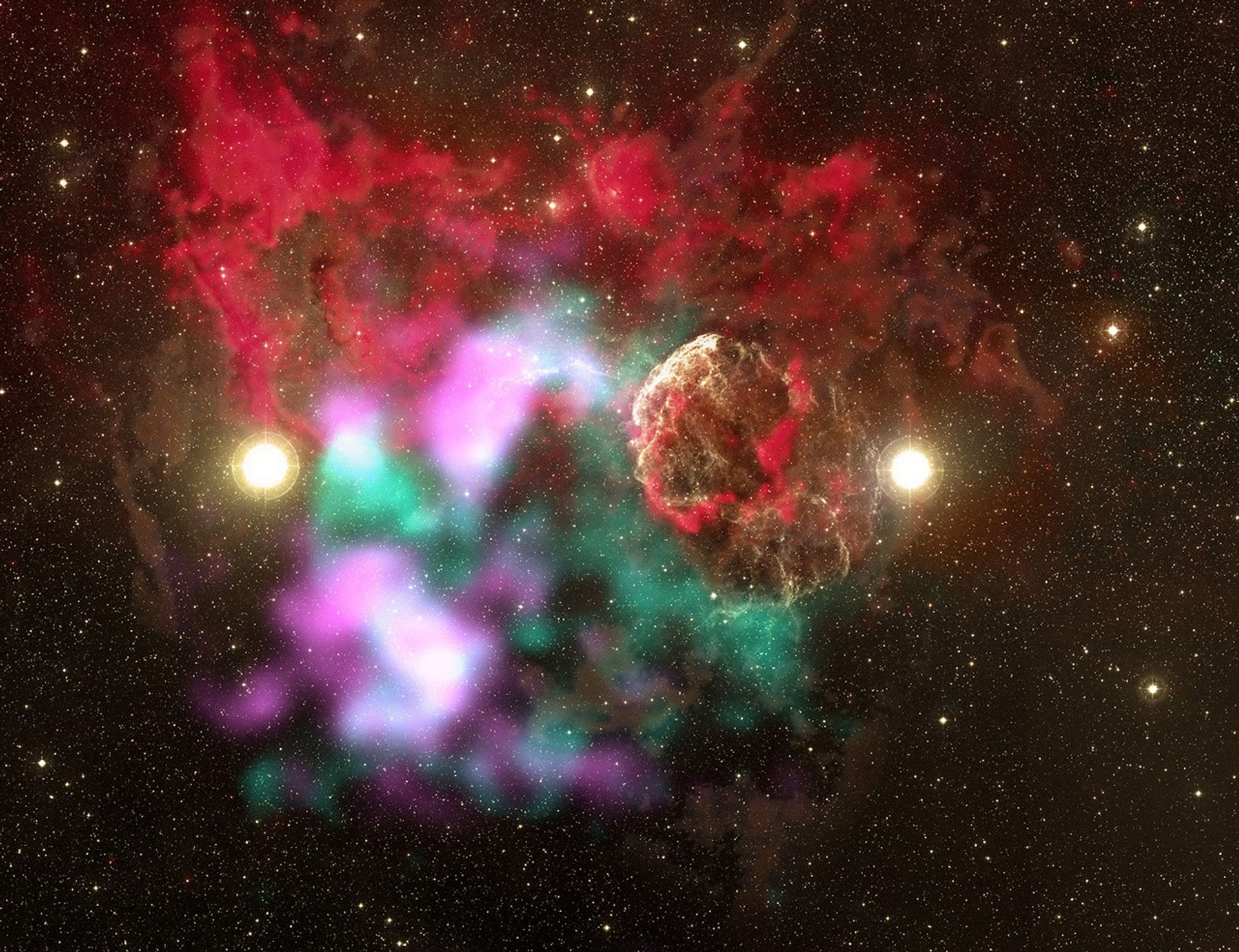
The well-known supernova remnant IC 443 (right) has an older, fainter neighbor (shown here in blue-green and magenta) called G189.6+3.3. A filament of gas between them, glowing in visible and ultraviolet light (violet arc at center), traces the neighbor’s shock wave and shows that both remnants are interacting with the same molecular cloud, shown in red, orange, brown for infrared and radio data and yellow for visible light. Blue-green shows X-rays from the fainter remnant, while magenta shows gamma rays with energies greater than 10 billion electron volts; for comparison, visible light has energies between about 2 and 3 electron volts. In this view, high-energy light from the much brighter IC 443 has been removed for clarity. Gamma-ray emission near the filament stems from protons accelerated in the supernova’s shock wave as it expands into the cloud.
NASA Goddard Space Flight Center and M. Michailidis et al. 2026; radio, MWISP and ESA/Planck; infrared: NASA/WISE/JPL-Caltech/UCLA; optical: DSS; ultraviolet: NASA/Swift; X-ray: SRG/eROSITA; gamma ray: NASA/DOE/Fermi LAT Collaboration
Astronomers think the Jellyfish Nebula is also a candidate PeVatron, a cosmic particle accelerator capable of boosting protons to energies so high they could nearly escape our galaxy. Such particles can produce gamma rays with trillions of times more energy than visible light. Finding a second particle accelerator near the Jellyfish Nebula could offer scientists new clues for how supernova remnants develop into PeVatrons.
“The overlapping remnants, a connecting gas filament, and the availability of data from Fermi and other facilities motivated us to delve into this complex but little-studied region,” said co-author Marianne Lemoine-Goumard, an astrophysicist at the French National Centre for Scientific Research (CNRS) based at the University of Bordeaux. “With Fermi’s LAT instrument, we found gamma-ray emission associated with accelerated protons in the northern part of the fainter remnant. If both remnants are interacting with the same structure, then they must share a common distance from us.”
The team concludes the remnants lie about 6,000 light-years away, their explosion centers are separated by roughly 40 light-years projected onto the plane of the sky, and the original stars may have been 20 or more times the Sun’s mass.
Estimates of the remnants’ ages vary widely, but the team concludes that the age of the Jellyfish Nebula is 8,000 to 9,000 years, while G189.6+3.3 is between 20,000 to 110,000 years old. This means the delay between the explosions could have extended for up to 100,000 years.
In addition, the team conducted computer simulations of a million massive binary systems. They show that systems where the stars orbit close enough to exchange matter and interact during their lives can readily produce dual supernova explosions with similar separations and time delays as those found for the remnants. The team also estimated that the chance of randomly encountering this combination of observed spatial alignment and compatible distances to be less than 1%, strongly supporting a physical association.
“The evidence we’ve compiled — including observations across the spectrum, the chemical and physical properties of the remnants, simulations, and more — paints a compelling picture of a dual supernova event,” said Michailidis.
This study identifies a unique possible example of a binary system where both stars exploded as supernovae and left behind separate, detectable supernova remnants. Astronomers think that most massive stars form in binary or multiple-star systems. The Jellyfish Nebula/G189.6+3.3 complex offers astronomers a rare opportunity to study how massive binary stars evolve, exchange matter, explode, and experience velocity changes — called kicks — induced by the supernova blast. It also provides a powerful new laboratory for understanding how coupled supernova remnants behave, including how they accelerate particles, generate gamma rays, and shape their surrounding environments.
“Fermi’s gamma-ray observations of supernova remnants continue to reveal the dynamic lives of stars,” said Elizabeth Hays, the Fermi project scientist at NASA’s Goddard Space Flight Center in Greenbelt, Maryland. “We can now connect the glowing remains of two massive stars to a powerful pair that evolved together over thousands of years.”
Among the range of proposed alternatives, one potential candidate involves what are called solar light sails, a theoretical propulsion system that relies on pressure generated from solar radiation against a large surface to move a spacecraft.
Such concepts have been proposed since the 1980s, some of which combine the idea of using sunlight as a power source with the implementation of lasers, which could propel such futuristic starships to speeds our best current technologies cannot attain.
However, not all spacecraft propulsion experts are necessarily sold on the idea of solar light sails just yet. According to new findings detailed in a paper by researchers Jiaze Li and Chao Shen of the Harbin Institute of Technology in China, this novel form of propulsion may have a few hurdles to cross before it can attain the near-light-speeds many experts had hoped for.
A Tale of Three Forces
According to Shen and Li’s recent research, a key problem arises once a solar light sail spacecraft begins nearing the speed of light: drag forces resulting from the very source of energy used to propel the devices could place significant limitations on their maximum attainable speeds.
A combination of different forces can be expected to occur as sunlight strikes a light sail, the authors say, which includes incident light, specular reflection, and diffuse scattering.
Incident light describes the physical momentum generated by light energy in the form of photons as they strike the sail, whereas specular reflection describes the momentum produced as photons reflect off the sail. Finally, diffuse scattering is a separate form of momentum generated by photons, which, rather than bouncing away upon impact, is actually absorbed by the sail, the energy from which is thereafter released in random directions.
New Limitations on Solar Light Sails
Based on these primary forces, the authors identify that once a light sail begins reaching relativistic speeds, it also becomes subjected to intense Doppler effect—the phenomenon that occurs as changes in the frequency of waves result as their source and an object or observer’s distance changes in relation to it.
In the case of solar light sails, the more the frequency of light waves striking the sail decreases, the less the amount of thrust generated by the three forces the paper identifies. In simpler terms, the faster a solar light sail spacecraft attempts to travel, the harder it becomes for it to accelerate.
Relativistic Light Aberration
At approximately 75% of the speed of light, the researchers say that an additional hindrance emerges, as what physicists call relativistic light aberration takes over. This phenomenon, first described by Einstein more than a century ago, involves relativistic corrections of light sources for observers who move at velocities approaching light speed.
In the case of our prospective future solar light sailors, this would mean that the weakest of the three forces impacting the sail (diffuse scattering) would begin to impose an active drag once the sail reaches approximately three-quarters of light speed. While the overall force of lasers helping to propel the light sail would remain positive at this stage in the system’s acceleration, the authors note an inevitable decline in efficiency.
The authors do concede that while their paper examines the radiative dynamics of solar light sail propulsion, it does not account for other factors that may include drag resulting from encounters with materials like gases, dust, or other physical sources (i.e., non-radiative sources), which could also impact overall speeds.
Additional factors worthy of consideration, but which the authors do not directly address in their paper, include the melting point of any materials used for solar light sail propulsion, which could be heated to extreme temperatures due to combined exposure to solar radiation, laser energy, and friction from movement.
Fundamentally, the team reports that their paper “provides a rigorous and in-depth theoretical foundation for lightsail dynamics,” which illustrates that while this future propulsion concept has its merits, we may still be far from seeing its realization for practical space travel.
By outlining the factors that contribute to constraints on light sail propulsion, Li and Shen aim to improve our overall understanding of this prospective future technology, thereby helping engineers to realize its potential for use in space exploration at some point in the future.
Micah Hanks is the Editor-in-Chief and Co-Founder of The Debrief. A longtime reporter on science, defense, and technology with a focus on space and astronomy, he can be reached atmicah@thedebrief.org. Follow him on X @MicahHanks, and at micahhanks.com.
It’s 2158, and you’re chugging away on your PhD in Planetary Volcanology from the University of Utopia Planitia on Mars. Graduate students still get paid a sub-living wage, so you’ve been stuck eating freeze-dried ramen for the past three years. You’ve completed studying Jupiter’s moon, Io, but now you have to leave the solar system […]
In an ambitious collaboration bridging continents and disciplines, researchers from the University of Vienna and the Lawrence Berkeley National Laboratory have revisited one of astrophysics’ most enigmatic phenomena—the Galactic Center Excess (GCE). For over a decade, the GCE, a subtle yet pervasive gamma-ray glow enveloping the Milky Way’s core, has stimulated intense debate and exploration within the scientific community. This new study, leveraging cutting-edge machine learning methodologies, offers fresh perspectives that reinvigorate the dark matter hypothesis as a viable explanation for the GCE, a prospect previously challenged by conventional analyses.
The Galactic Center Excess presents itself as a roughly spherical halo of gamma-ray emission, extending over thousands of light years around our galaxy’s nucleus. This faint glow eludes straightforward interpretation, primarily due to the complexities of the astronomical environment it inhabits. The region is not only densely packed with astrophysical sources but also exhibits extraordinarily bright and intricately structured gamma-ray emissions, complicating efforts to disentangle the origins of the GCE signal.
Before this study, two primary interpretations vied for dominance in explaining the GCE. One posited that the excess emanates from annihilations of dark matter particles, hypothetical constituents of the universe that interact weakly with ordinary matter and light. Dark matter, while composing approximately 85% of the universe’s matter content, remains elusive, and detecting its indirect signatures through gamma-ray emissions has been a tantalizing goal. The second hypothesis attributes the gamma-ray glow to a population of millisecond pulsars—rapidly rotating neutron stars known for their intense electromagnetic emissions. These pulsars, if sufficiently numerous and faint, could collectively mimic the characteristics of the observed GCE.
However, the astrophysical scenario faced a significant analytical hurdle. Earlier statistical approaches, while sophisticated, did not fully incorporate a vital dimension of the observed data: the energy spectrum of individual gamma-ray photons. Prior analyses predominantly focused on spatial distribution patterns, searching for point sources that could represent pulsars or diffuse emissions consistent with dark matter annihilation. Without the spectral dimension, conclusions remained inconclusive, often biased toward interpretations favoring bright unresolved sources.
The breakthrough in this new research is the implementation of an advanced machine-learning framework that simultaneously evaluates the spatial location and energy distribution of gamma-ray photons captured by telescopes. Training this model required generating over a million simulated gamma-ray skies, replicating a diverse range of scenarios that include both dark matter and pulsar contributions. By synthesizing these rich datasets, the model attains unprecedented sensitivity and discrimination power, uniquely capable of parsing subtle differences in the gamma-ray energy patterns correlated with different source populations.
The enriched analysis dramatically alters the interpretation landscape. The findings demonstrate that the putative point sources—if responsible for the GCE—would need to be extraordinarily faint, to the point where their individual characteristics blur into a diffuse glow nearly indistinguishable from what dark matter annihilation models predict. This faintness requirement for pulsars implies an astronomical population count exceeding 35,000 millisecond pulsars in the central Milky Way region. Such a number challenges existing astrophysical models and contrasts with previous studies that suggested only a few hundred to a few thousand such sources would suffice to explain the gamma-ray excess.
This new quantitative insight reopens the door for dark matter as a plausible explanation. While previous evidence tended to discount dark matter in favor of point sources, the subtlety revealed by including photon energy analysis counters these assertions. It underscores the present limitations in conclusively resolving the GCE’s origin, emphasizing that the dark matter scenario remains firmly on the table alongside pulsar hypotheses.
The difficulty in resolving the GCE nature also reflects broader challenges in high-energy astrophysics—particularly in crowded celestial environments like our galaxy’s core, where overlapping emissions from stars, supernova remnants, and other celestial objects confound the interpretation of indirect dark matter signals. Machine learning, as applied here, represents a transformative tool, capable of synthesizing immense, multidimensional datasets to disentangle complex astrophysical phenomena.
Scientists caution that these findings do not constitute direct evidence for dark matter annihilation; instead, they highlight the incomplete nature of current data interpretations. The inability to definitively favor pulsars over dark matter annihilation underscores the need for next-generation gamma-ray observatories and continued advances in modeling techniques that can incorporate even more nuanced data features, such as temporal variability and polarization signatures.
This research embodies the synergy between theoretical physics, computational innovation, and observational astrophysics, demonstrating how modern data-driven approaches can revitalize longstanding scientific debates. As gamma-ray detection technologies evolve and more data become available, the methodology pioneered here promises further refinement, potentially leading to breakthroughs in identifying signals from the elusive dark sector of the universe.
The Galactic Center Excess remains one of the most compelling mysteries in contemporary astrophysics, symbolizing the frontier where known astrophysical processes intersect with profound questions about the fundamental composition of the universe. Whether future research will tilt the scales decisively in favor of dark matter or pulsars, this study exemplifies the power of interdisciplinary collaboration and sophisticated computational methods to deepen our cosmic understanding.
Moreover, the implications extend beyond academic curiosity. Deciphering the GCE carries the promise of shedding light on the nature of dark matter, a cornerstone of cosmological structure formation and evolution. Success in this endeavor could unveil new physics beyond the Standard Model, revolutionizing our conception of the universe’s fabric and the forces that govern it at the most fundamental level.
As researchers continue to probe the galactic center’s gamma-ray glow, the intellectual journey itself enriches science, reflecting a profound human drive to illuminate the obscure workings of the cosmos. This study marks a significant stride in that journey, blending technology, theory, and observation to navigate a complex astrophysical puzzle whose solution may redefine our place in the universe.
Subject of Research: The Galactic Center Excess in gamma-ray observations and its implications for dark matter and millisecond pulsar populations.
Article Title: Energy Distribution of the Galactic Center Excess’s Sources
Ultrasonic espresso’ made with cold water and high-frequency sound waves uses less energy than the traditional version – and taste tests show it’s just as good.
Researchers in Sweden have developed a machine-learning approach that embeds the laws of physics directly into neural networks. A new study from Chalmers University of Technology in Sweden shows that machine learning can become far more efficient when it starts with a built-in understanding of the laws of physics. Researchers found that giving an AI [...]
Bird flocks, bacterial swarms, and even crowds move according to interaction rules that appear to break one of physics’ most fundamental principles: Newton’s law of action and reaction. Birds can see much of what is happening around them, but when flying in a flock, they respond only to birds beside them or ahead of them. [...]
In a groundbreaking advancement poised to redefine core principles in theoretical physics, researchers from Kyushu University and esteemed international collaborators have unveiled insights into the nature of continuous parameters within quantum gravity. This study challenges the long-standing assumption that such parameters are freely adjustable external inputs by demonstrating—under particular theoretical conditions—that they inherently originate from operators embedded within the physical theory itself. This resolution not only revitalizes Albert Einstein’s century-old assertion regarding the intrinsic completeness of physical laws but also propels forward our comprehensive understanding of the quantum structure of spacetime.
Central to this revelation is the concept of exactly marginal operators within the framework of conformal field theory (CFT), a pivotal branch of modern physics that explores systems invariant under scale transformations. CFT serves as a formidable bridge between quantum theory and gravitational physics, especially through the lens of the anti-de Sitter/conformal field theory (AdS/CFT) correspondence. This correspondence posits a deep equivalence between gravitational theories in a curved AdS spacetime and lower-dimensional CFTs residing at its boundary, rendering CFT an indispensable tool to probe quantum gravity’s elusive traits.
At the heart of the research lies the structure known as the conformal manifold—an abstract space parameterizing a continuous family of CFTs interconnected via exactly marginal deformations. These deformations represent operators that tweak a theory’s parameters without sacrificing its conformal symmetry. The pressing theoretical puzzle was whether the existence of such a manifold necessarily implies that continuous variations in the theory’s parameters emerge from operators already encoded within the theory, rather than arbitrary, external parameters appended to the formalism.
To rigorously examine this, the interdisciplinary team led by Associate Professor Yuya Kusuki embraced an innovative approach involving conformal interfaces, mathematical constructs that serve as boundary layers interpolating between two related CFTs situated on a conformal manifold. The researchers posited that as two nearby CFTs approach equivalence, the conformal interface connecting them should become trivial. Under the plausible assumption that certain correlation functions transition smoothly as this interface dissolves, they utilized the interface’s displacement operator—which quantifies the response of the interface to infinitesimal positional shifts—to reconstruct an exactly marginal operator governing motions on the manifold.
This reconstruction represents a monumental stride because it conclusively ties continuous parameters characterizing a family of theories not to arbitrary external dials but to concrete operators intrinsic to the theory’s internal dynamics. By examining the perturbative behavior of the conformal interface, the team effectively identified the fundamental origin of parameters that might otherwise have seemed freely tunable.
What does this imply for the broader quest of quantum gravity? Through the prism of AdS/CFT duality, the intimate relationship between conformal manifolds in CFT and the moduli space of vacua in quantum gravity theories becomes transparent. This newly established principle supports the profound conjecture that quantum gravity forbids arbitrary external parameters, with all continuous couplings traceable to internal degrees of freedom—a concept resonant with a widespread expectation but hitherto unproven with such clarity.
Importantly, the present findings apply specifically to two-dimensional CFTs, a fertile domain where theoretical control is well established. Nevertheless, the researchers have expressed optimism that their methods and conceptual revelations will motivate extensions to higher-dimensional CFTs and more general quantum gravity landscapes. Extending these results could illuminate the landscape of string theories and the parameters governing candidate quantum gravity models.
Moreover, these results have significant implications for the so-called “Swampland program,” a burgeoning field striving to delineate which consistent-looking effective field theories can be embedded into quantum gravity. By constraining continuous deformations to those generated by internal operators, this study offers fresh constraints on the space of viable theories and sharpens the boundaries between the “landscape” of consistent theories and the “swampland” of inconsistent ones.
The research underscores an increasingly vital notion: the parameters defining fundamental physics are not arbitrary selections but emergent phenomena anchored within the theory’s operator framework. This insight advances a vision in which the fabric of physical law is self-contained, avoiding unexplained fundamental constants, and aligning with Einstein’s aspiration for a theory without ad hoc inputs.
Led by Kusuki alongside collaborators Shota Komatsu of CERN, Marco Meineri from the University of Turin, and Hirosi Ooguri of the California Institute of Technology, the project utilized sophisticated computational simulations combined with analytic operator algebra techniques to bring these abstract mathematical objects into clearer physical focus.
Published in the prestigious journal Physical Review Letters on June 16, 2026, the paper titled “Continuous Family of Conformal Field Theories and Exactly Marginal Operators” delineates these technical breakthroughs and their broader theoretical implications, offering a compelling blueprint for future explorations in the intersection of quantum theory and gravity.
As the physics community absorbs the ramifications of this breakthrough, it heralds a renewed momentum for using conformal field theory and holographic dualities as guiding principles to unravel the enigmatic quantum nature of gravitation, spacetime, and the universe’s foundational constants.
—
Subject of Research: Not applicable
Article Title: Continuous Family of Conformal Field Theories and Exactly Marginal Operators
Oxford physicists have created an unconventional class of quantum superpositions from highly nonclassical states. Researchers at the University of Oxford have created a new class of quantum superpositions, including Schrödinger’s cat-like states, using building blocks that are themselves strongly nonclassical. The advance could support future quantum computing architectures based on more complex systems than conventional [...]
This artist’s concept shows exoplanet HD 80606 b being “roasted” as its orbit approaches periastron, the point at which it is closest to its host star, which is similar to our Sun.
Credits: Artwork: NASA, ESA, CSA, Joseph Olmsted (STScI)
4 min read
NASA’s Webb Catches Exoplanet Getting Roasted
One well-done gas giant, coming right up! That’s the latest from researchers analyzing NASA’s James Webb Space Telescope’s observations of HD 80606 b, an exoplanet four times the mass of Jupiter with an extremely elliptical orbit that sweeps close by its Sun-like star. The research team is presenting their study and preliminary findings Tuesday at the 248th meeting of the American Astronomical Society in Pasadena, California.
“Hot Jupiters are already considered some of the most extreme exoplanets we know of, but even among that population, HD 80606 b is one of the most extreme,” said Tiffany Kataria, the study’s principal investigator at NASA’s Jet Propulsion Laboratory in Southern California. “We typically think of hot Jupiters as hot gas giants sitting right next to their stars, but this planet’s highly eccentric orbit creates a completely different beast.”
As the planet plunges close to its star, Webb shows its temperature skyrockets by 1,100 degrees Fahrenheit. Previous studies have shown that radical temperature swings can cause an exoplanet’s chemistry and clouds to change in real time. According to the research team, the dynamic conditions of HD 80606 b make the planet an ideal target to observe these changes with Webb’s powerful instruments.
Image: Artist’s concept exoplanet HD 80606 b
This artist’s concept shows exoplanet HD 80606 b being “roasted” as its orbit approaches periastron, the point at which it is closest to its host star, which is similar to our Sun.
Artwork: NASA, ESA, CSA, Joseph Olmsted (STScI)
“Observing a planet like HD 80606 b is actually very efficient because its unusual orbit, with the corresponding swings in temperature and chemical composition, allow us to gather data under varying conditions in just hours and apply those findings to other hot Jupiters or more conventional exoplanets,” said Laura C. Mayorga, co-investigator on the study and an exoplanet astronomer at the Johns Hopkins Applied Physics Laboratory in Laurel, Maryland.
Measurements of temperature and chemical composition were done with spectroscopy, a technique scientists use to break light into its component colors to reveal information about the composition, temperature, motion, and physical properties of objects in space. The team used Webb’s MIRI (Mid-Infrared Instrument) for an extended observation of HD 80606 b before, during, and after its periastron, or closest pass by its star. During periastron, the planet also passed behind the star from Webb’s perspective in what’s known as a secondary eclipse. The observation was years in the planning, as scheduling the time to catch the planet at this point was complex given its extremely elliptical 111-day orbit, and Webb’s own restrictions on where it can look during specific times of the year, based on Earth’s position in orbit around the Sun.
Researchers say they have only begun to peel back the layers of an incredibly rich dataset, but they can clearly see a dramatic shift in the exoplanet’s temperature. “Webb has shown that the planet’s increase in temperature was even more extreme than we anticipated based on Spitzer data,” said Kataria.
In fact, the planet had already been dubbed the “roasted exoplanet” and even got its own poster in NASA’s popular series. NASA’s now-retired Spitzer Space Telescope laid the groundwork of infrared observations of HD 80606 b, showing that more detailed spectroscopic data from Webb would be especially compelling.
“Spitzer did amazing work on this exoplanet, and now Webb is building on that legacy by enabling us to drill down to distinguish specific chemical signatures like methane and carbon dioxide, which is just amazing progress,” said Ryan Challener, co-author and research associate at the Cornell Center for Astrophysics and Planetary Science. “There’s so much to learn from this one dataset here — we really are just getting started deciphering what Webb has to tell us.”
The James Webb Space Telescope is the world’s premier space science observatory. Webb is solving mysteries in our solar system, looking beyond to distant worlds around other stars, and probing the mysterious structures and origins of our universe and our place in it. Webb is an international program led by NASA with its partners, ESA (European Space Agency) and CSA (Canadian Space Agency).
The following sections contain links to download this article’s images and videos in all available resolutions followed by related information links, media contacts, and if available, research paper and Spanish translation links.
Related Images & Videos
HD 80606 b (Artist’s Concept)
This artist’s concept shows exoplanet HD 80606 b being “roasted” as its orbit approaches periastron, the point at which it is closest to its host star, which is similar to our Sun.
This artist’s concept shows exoplanet HD 80606 b being “roasted” as its orbit approaches periastron, the point at which it is closest to its host star, which is similar to our Sun.
Credits: Artwork: NASA, ESA, CSA, Joseph Olmsted (STScI)
4 min read
NASA’s Webb Catches Exoplanet Getting Roasted
One well-done gas giant, coming right up! That’s the latest from researchers analyzing NASA’s James Webb Space Telescope’s observations of HD 80606 b, an exoplanet four times the mass of Jupiter with an extremely elliptical orbit that sweeps close by its Sun-like star. The research team is presenting their study and preliminary findings Tuesday at the 248th meeting of the American Astronomical Society in Pasadena, California.
“Hot Jupiters are already considered some of the most extreme exoplanets we know of, but even among that population, HD 80606 b is one of the most extreme,” said Tiffany Kataria, the study’s principal investigator at NASA’s Jet Propulsion Laboratory in Southern California. “We typically think of hot Jupiters as hot gas giants sitting right next to their stars, but this planet’s highly eccentric orbit creates a completely different beast.”
As the planet plunges close to its star, Webb shows its temperature skyrockets by 1,100 degrees Fahrenheit. Previous studies have shown that radical temperature swings can cause an exoplanet’s chemistry and clouds to change in real time. According to the research team, the dynamic conditions of HD 80606 b make the planet an ideal target to observe these changes with Webb’s powerful instruments.
Image: Artist’s concept exoplanet HD 80606 b
This artist’s concept shows exoplanet HD 80606 b being “roasted” as its orbit approaches periastron, the point at which it is closest to its host star, which is similar to our Sun.
Artwork: NASA, ESA, CSA, Joseph Olmsted (STScI)
“Observing a planet like HD 80606 b is actually very efficient because its unusual orbit, with the corresponding swings in temperature and chemical composition, allow us to gather data under varying conditions in just hours and apply those findings to other hot Jupiters or more conventional exoplanets,” said Laura C. Mayorga, co-investigator on the study and an exoplanet astronomer at the Johns Hopkins Applied Physics Laboratory in Laurel, Maryland.
Measurements of temperature and chemical composition were done with spectroscopy, a technique scientists use to break light into its component colors to reveal information about the composition, temperature, motion, and physical properties of objects in space. The team used Webb’s MIRI (Mid-Infrared Instrument) for an extended observation of HD 80606 b before, during, and after its periastron, or closest pass by its star. During periastron, the planet also passed behind the star from Webb’s perspective in what’s known as a secondary eclipse. The observation was years in the planning, as scheduling the time to catch the planet at this point was complex given its extremely elliptical 111-day orbit, and Webb’s own restrictions on where it can look during specific times of the year, based on Earth’s position in orbit around the Sun.
Researchers say they have only begun to peel back the layers of an incredibly rich dataset, but they can clearly see a dramatic shift in the exoplanet’s temperature. “Webb has shown that the planet’s increase in temperature was even more extreme than we anticipated based on Spitzer data,” said Kataria.
In fact, the planet had already been dubbed the “roasted exoplanet” and even got its own poster in NASA’s popular series. NASA’s now-retired Spitzer Space Telescope laid the groundwork of infrared observations of HD 80606 b, showing that more detailed spectroscopic data from Webb would be especially compelling.
“Spitzer did amazing work on this exoplanet, and now Webb is building on that legacy by enabling us to drill down to distinguish specific chemical signatures like methane and carbon dioxide, which is just amazing progress,” said Ryan Challener, co-author and research associate at the Cornell Center for Astrophysics and Planetary Science. “There’s so much to learn from this one dataset here — we really are just getting started deciphering what Webb has to tell us.”
The James Webb Space Telescope is the world’s premier space science observatory. Webb is solving mysteries in our solar system, looking beyond to distant worlds around other stars, and probing the mysterious structures and origins of our universe and our place in it. Webb is an international program led by NASA with its partners, ESA (European Space Agency) and CSA (Canadian Space Agency).
The following sections contain links to download this article’s images and videos in all available resolutions followed by related information links, media contacts, and if available, research paper and Spanish translation links.
Related Images & Videos
HD 80606 b (Artist’s Concept)
This artist’s concept shows exoplanet HD 80606 b being “roasted” as its orbit approaches periastron, the point at which it is closest to its host star, which is similar to our Sun.
NASA Webb, Hubble Reveal History of Relic of Milky Way’s Formation
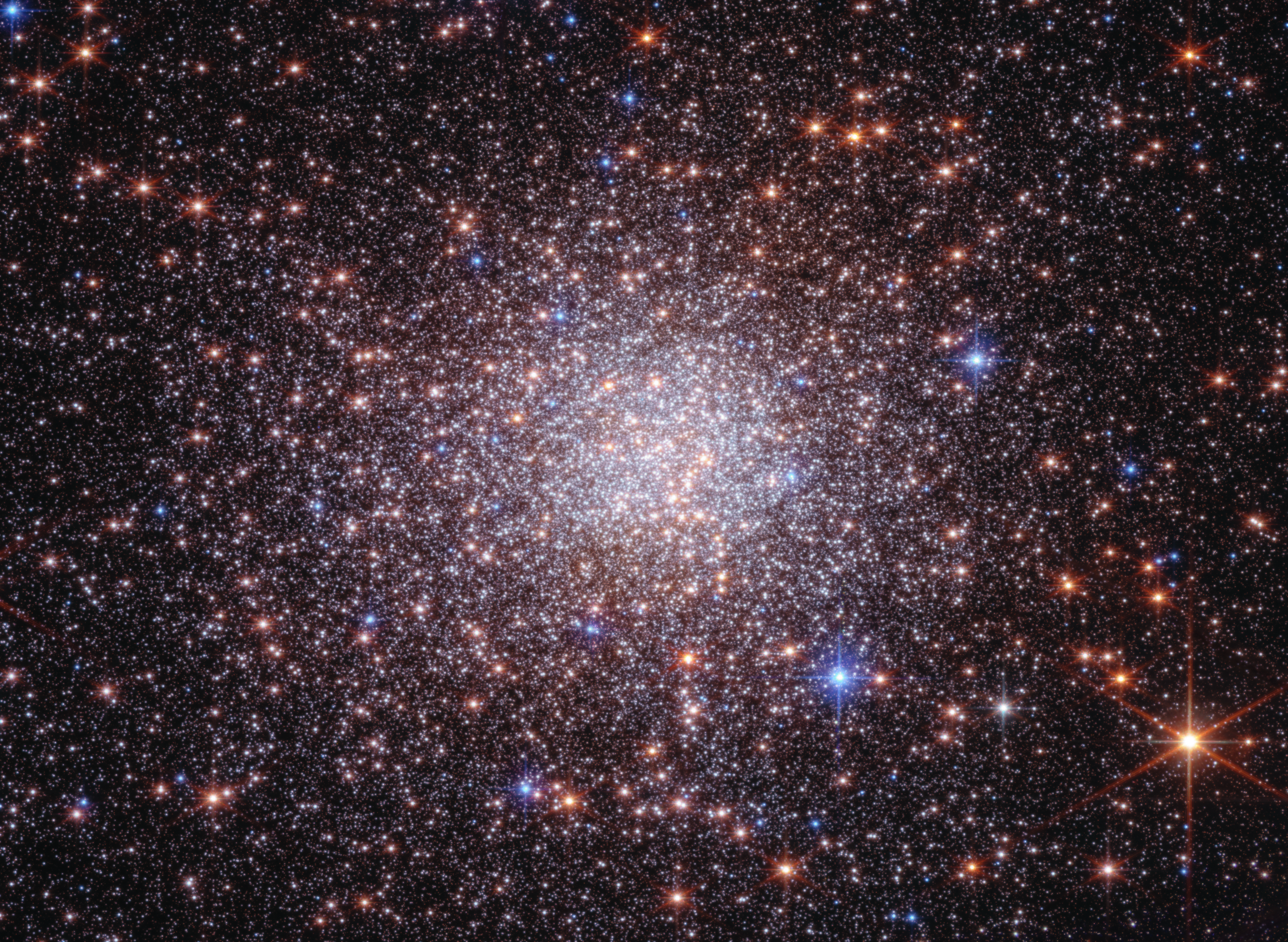
New observations from Webb combined with multiple observations from Hubble prove that Terzan 5 is a self-contained, self-enriching stellar system that contains up to four distinct star populations. It orbits within our Milky Way galaxy’s central bulge.
Credits: Image: NASA, ESA, CSA, STScI, Giorgia Zullo (University of Bologna), Francesco Ferraro (University of Bologna); Image Processing: Alyssa Pagan (STScI)
Researchers using two of humanity’s most powerful observatories — NASA’s James Webb and Hubble Space Telescopes — have definitively shown that Terzan 5 is not a globular star cluster as it was once classified, offering new insight into how galaxies like our own form and evolve over time. A globular star cluster typically has only one ancient star population. New data not only confirms the existence of two distinct populations of stars in Terzan 5, but also provides evidence for two more recent rounds of star formation. Although located within the crowded bulge of our Milky Way, our galaxy’s central, spherical region of older stars, Terzan 5 was massive enough to maintain its separate identity while lighter weight systems spread out and mixed to form the bulge billions of years ago. It’s like a lump in an otherwise well-mixed cake batter.
“Webb’s new near-infrared observations, cross-referenced with Hubble’s archival observations, have given us a much clearer picture of the history of Terzan 5,” said Giorgia Zullo, who led the research and is a PhD student at the University of Bologna in Italy.
These results were presented at a press conference Tuesday at the 248th meeting of the American Astronomical Society in Pasadena, and were published in Astronomy & Astrophysics.
Image: Bulge Fossil Fragment Terzan 5 (Webb and Hubble Image)
New observations from Webb combined with multiple observations from Hubble prove that Terzan 5 is a self-contained, self-enriching stellar system that contains up to four distinct star populations. It orbits within our Milky Way galaxy’s central bulge.
Image: NASA, ESA, CSA, STScI, Giorgia Zullo (University of Bologna), Francesco Ferraro (University of Bologna); Image Processing: Alyssa Pagan (STScI)
Four generations of stars
Discovered in 1968 by astronomer Azop Terzan, Terzan 5 resembles a globular cluster in many ways. However, in 2009 this system was discovered to harbor two distinct populations of stars. In 2016 Hubble provided the first estimate of their ages, showing that one formed roughly 12 billion years ago — as the Milky Way itself was assembling — and the other about 5 billion years ago, just before Earth started forming. This pointed to a more complex history than a typical globular cluster.
Studying Terzan 5 is complicated by its location in a region of our galaxy crowded with stars and heavily obscured by dust. This is where Webb stepped in. Its infrared view allowed the research team to peer through the dust and catalog many more stars, and fainter stars, than previous work. By measuring star colors and brightnesses, astronomers can classify them into populations of different ages and chemistries.
Webb was able to measure these key properties for every star within the field of view in the sky — both stars within Terzan 5 and unrelated foreground stars. To isolate the stars of Terzan 5, the team relied on the power and longevity of Hubble. The 12-year separation allowed the team to measure very small movements of individual stars, known as proper motions, to determine which stars belong to Terzan 5 and which are part of the Milky Way bulge.
By combining data from both Webb and Hubble, the researchers found strong evidence for two more stellar populations, one that formed 3.8 billion years ago and another only 2.5 billion years ago. They also were able to determine the ages of the previously known stellar populations with unprecedented precision, finding that they formed 12.5 billion and 4.7 billion years ago.
With the previously known two generations of stars, astronomers could not rule out the possibility that Terzan 5 interacted with another object, like a globular cluster or a giant molecular cloud, becoming enriched with new gas and dust that set off a second round of star formation. With four stellar generations, those explanations are ruled out.
Measurements of the stellar composition of Terzan 5 populations made at the W. M. Keck Observatory and European Southern Observatory’s Very Large Telescope also point toward very distinct populations. “Along with the ages of these populations, the cluster preserves a fossil record of progressive enrichment of heavy elements by supernovae,” said co-author R. Michael Rich, a research astronomer at the University of California, Los Angeles.
Terzan 5 formed multiple generations of stars because it was able to retain the necessary raw materials. There is evidence of powerful supernova explosions in Terzan 5 that forged heavier elements that were swept up by subsequent generations of stars. In lighter weight systems, the force of the explosions themselves could have ejected the resulting elements as well as sweeping out leftover gas and dust. The progenitor of Terzan 5 had enough mass to retain those stars’ ejections, allowing new generations of stars to form over billions of years.
‘Bulge fossil fragment’
The results show that Terzan 5 is most likely the remnant of a much more massive stellar system that initially formed 12.5 billion years ago. Terzan 5 is extraordinary because it survived — and never merged or fully “mixed in” with the Milky Way’s bulge. “For some reason, this peculiar clump of stars formed separately from the bulge and was not destroyed as the bulge itself formed,” said Francesco R. Ferraro, a professor at the University of Bologna and principal investigator of the Webb observations. “Terzan 5 is what we now call a bulge fossil fragment because it resembles the primordial clumps that contributed to the formation of the bulge.”
To date, there’s one other known cosmic object like Terzan 5. Liller 1 was the second to be reclassified from a globular star cluster to a bulge fossil fragment. It also contains multiple generations of stars. There may be more objects like it. Between 40 to 50 additional globular clusters that orbit within the bulge will be examined by Ferraro’s team to determine if their stellar populations are all the same, like globular clusters, or have several generations, like bulge fossil fragments.
Video: Zoom to See Terzan 5 Near Our Milky Way Galaxy’s Bulge
Zoom in to Terzan 5, a star cluster that lies within the crowded central region of our Milky Way galaxy known as the bulge. The scene starts with a ground-based image of our Milky Way bulge and zooms in on and circles Terzan 5, ending with the composite image of the star system from the James Webb and Hubble Space Telescopes.
Potential parallels for galaxy formation near, far
Ultimately, this research may improve what we know about how the central bulges of galaxies form over hundreds of millions of years. “Based on observations and in-depth simulations, we think that galaxies in the early universe had huge disks of gas that fragmented into clumps and formed stars. These clumps migrated to the center of the galaxies, and many merged to form their bulges,” said Barbara Lanzoni, a co-author and associate professor at the University of Bologna. For example, Webb has turned up several examples of “clumpy” galaxies that were actively forming when the universe was only a few hundred million years old, like the clumps in the Firefly Sparkle galaxy. “Terzan 5 may provide direct evidence that can help explain how bulges formed in galaxies throughout the universe,” Lanzoni said.
The James Webb Space Telescope is the world’s premier space science observatory. Webb is solving mysteries in our solar system, looking beyond to distant worlds around other stars, and probing the mysterious structures and origins of our universe and our place in it. Webb is an international program led by NASA with its partners, ESA (European Space Agency) and CSA (Canadian Space Agency).
The Hubble Space Telescope has been operating for over three decades and continues to make ground-breaking discoveries that shape our fundamental understanding of the universe. Hubble is a project of international cooperation between NASA and ESA (European Space Agency). NASA’s Goddard Space Flight Center in Greenbelt, Maryland, manages the telescope and mission operations. Lockheed Martin Space, based in Denver, also supports mission operations at Goddard. The Space Telescope Science Institute in Baltimore, which is operated by the Association of Universities for Research in Astronomy, conducts Hubble science operations for NASA.
The following sections contain links to download this article’s images and videos in all available resolutions followed by related information links, media contacts, and if available, research paper and Spanish translation links.
Related Images & Videos
Bulge Fossil Fragment Terzan 5 (Webb and Hubble Image)
New observations from Webb combined with multiple observations from Hubble prove that Terzan 5 is a self-contained, self-enriching stellar system that contains up to four distinct star populations. It orbits within our Milky Way galaxy’s central bulge.
Terzan 5 (Webb and Hubble Compass Image)
This image of bulge fossil fragment Terzan 5 was captured by the James Webb and Hubble space telescopes. Webb’s data are from its NIRCam (Near-Infrared Camera) and Hubble’s from its Advanced Camera for Surveys (ACS). The image shows a scale bar, compass arrows, and co…
Zoom to See Terzan 5 Near Our Milky Way Galaxy’s Bulge
Zoom in to Terzan 5, a star cluster that lies within the crowded central region of our Milky Way galaxy known as the bulge. The scene starts with a ground-based image of our Milky Way bulge and zooms in on and circles Terzan 5, ending with the composite image of the star system f…
Astronaut Jessica Meir inspects optical fibers while installing hardware updates to NASA’s Cold Atom Lab, or CAL, aboard the International Space Station on May 8, 2026. About the size of a minifridge, CAL enables researchers to explore quantum physics.
NASA
Astronauts aboard the International Space Station have switched on NASA’s newly upgraded Cold Atom Lab, a one-of-a-kind facility designed to improve how scientists explore the fundamental workings of matter and develop new quantum technologies. By leveraging the unique environment of microgravity in space, the lab can accomplish cutting-edge science impossible to do anywhere else.
Quantum science is the study of matter at the smallest scales, like atoms, electrons, and single particles of light. While it’s easy to imagine atoms as billiard balls bouncing off one another, they also exhibit wave-like behavior, can exist simultaneously in two places at once, and may even pass through one another.
About the size of a minifridge and operated from Earth, the Cold Atom Lab chills atoms to temperatures below minus 459 degrees Fahrenheit (minus 237 degrees Celsius). At this extreme cold, just above absolute zero, atoms form a large quantum object called a Bose‑Einstein condensate, or BEC, a collection of matter waves that is a fifth state of matter beyond solids, liquids, gases, and plasma. This object follows the rules of quantum mechanics despite being much larger than subatomic particles, and the microgravity of low Earth orbit helps make the waves even larger.
“At the coldest temperatures, matter behaves drastically different from anything we have experienced,” said Jason Williams, project scientist for Cold Atom Lab at NASA’s Jet Propulsion Laboratory in Southern California, which built the facility. “The wavelike nature of matter dominates, and ultracold matter can behave in ways that are not only unexpected, but that also enable extremely precise measurements of time, gravity, and motion. The lab has lots of tools — especially with this latest upgrade — to let us probe the nature of the universe.”
The project supports five international teams studying fundamental physics. It also tests the space-readiness of quantum tools that could support future Earth science and space exploration missions.
How it works
The heart of the Cold Atom Lab is a complex set of instruments called its science module. An upgraded module launched on April 11 as part of a Commercial Resupply Services mission to the space station, enabling new kinds of experiments.
For each experiment, a strip of rubidium or potassium metal is heated to as high as 750 F (400 C) — hot enough to form a gas within the facility’s vacuum chamber. Lasers tuned to specific frequencies are then fired at the gas, draining the energy from these atoms, and cooling them by slowing them down. Once this gas has completed the laser-cooling stage, a magnetic trap captures and holds the gas in place. Through a series of complex techniques, the laboratory reduces an atom cloud’s energy further, bringing it close to a standstill and maximizing its time in microgravity.
While facilities for studying ultracold gases exist on Earth, the Cold Atom Lab can study quantum gases in microgravity for longer periods of time and at even lower temperatures. Conducting these experiments in low gravity allows scientists to study larger quantum waves that also interact for longer times with gravity. To harness these benefits, the Cold Atom Lab essentially shrinks an atom physics lab, typically the size of an entire room filled with lasers and tabletop mirrors, to fit within an experiment rack aboard the space station.
“As the first project to create Bose-Einstein condensates in orbit, we’re demonstrating that we can make quantum technology work reliably in space,” said Ethan Elliott, deputy project scientist for Cold Atom Lab at JPL. “In the previous century, there was a quantum revolution that led to lasers, cellphones, and MRIs for medical imaging. We’re performing quantum 2.0 — direct manipulation of large quantum states — and we hope for similar gains in quantum tech by advancing this science in orbit.”
The latest upgrade is the fourth since the Cold Atom Lab arrived at the space station in 2018. Key improvements include a newly designed magnetic trap that changes the shape of the quantum gas clouds, allowing scientists to test different properties related to their atoms. The upgrade also features redesigned metal strips that act as sources for those gas clouds.
“It’s the closest thing we have to controlling the boundary of the quantum world,” said Kamal Oudrhiri, project manager of Cold Atom Lab at JPL, referring to those low temperatures. “This new upgrade pushes that boundary even further.”
The upgrade, Oudrhiri added, “demonstrates NASA’s ability to maintain U.S. leadership in space-based quantum technologies while maturing future quantum instruments, such as matter-wave interferometers for fundamental physics missions, positioning, navigation, timing, and gravity sensing of Earth, the Moon, and beyond.”
More about Cold Atom Lab
Managed by Caltech in Pasadena, JPL designed, built, and operates the Cold Atom Lab, which is sponsored by the Biological and Physical Sciences division of NASA’s Science Mission Directorate at the agency’s headquarters in Washington. The division pioneers scientific discovery and enables exploration by using space environments to conduct investigations that are not possible on Earth. Studying biological and physical phenomena under extreme conditions allows researchers to advance the fundamental scientific knowledge required to go farther and stay longer in space, while also benefiting life on Earth.
Physicists report the discovery of new evidence for a mysterious quantum state in an unusual class of materials, in findings that could illuminate a long-running debate over how these systems transition into superconductivity.
In physics, symmetry breaking refers to processes in which a symmetric state collapses from its initial state of disorder into a more ordered one, albeit now possessing less symmetry.
The new research findings reveal evidence that time-reversal symmetry, a fundamental kind of symmetry in nature, appears to be broken at temperatures significantly higher than previously recognized.
The research was detailed in a recent study published in Nature Physics.
Mysterious Kagome Metals
In their study, an international team of researchers led by a team at the Korea Advanced Institute of Science and Technology focused on what are known as kagome metals—a variety of ferromagnetic quantum materials possessing unique qualities.
For their study, the researchers used a specific kagome metal called Cesium Vanadium Antimonide (CsV₃Sb₅), a novel material first discovered in 2021 by researchers at UC Santa Barbara’s NSF Quantum Foundry.
The researchers found that during experiments with the material, which is recognized as a candidate superconductor, CsV₃Sb₅ showed indications that time-reversal symmetry was broken at temperatures significantly higher than previously recognized.
This is significant because it is suggestive of an elusive phenomenon physicists call loop-current order, which describes a state in which the circulation of electrons throughout a material occurs in persistent microscopic loops.
A Signal Emerges
Using an advanced photoemission technique, the team was able to uncover subtle differences in the way electrons respond to circularly polarized light, which is light that is produced using an electric field vector that rotates in a circle as the light wave propagates, equaling one complete rotation for each wavelength.
Based on the team’s measurements, a distinctive signal emerged, which they say is consistent with a time-reversal symmetry-breaking state, meaning that their observations provide what may be the best experimental evidence to-date for an exotic quantum state of matter known as loop-current order, wherein electrons spontaneously assume microscopic wave-like formations.
Exotic States and High-Temperature Superconductivity
One reason the team’s findings are so significant is that their results offer some clarity for the otherwise complex sequence of phase transitions that are known to occur within CsV₃Sb₅.
Based on their research, the team now believes loop-current order manifests as the temperature begins to decrease, which is then followed by a periodic rearrangement of electrons known as a charge density wave. Finally, superconductivity then follows, accompanied by the absence of electrical resistance altogether.
Fundamentally, the team’s work could offer new insights into the behavior and characteristics of strongly correlated quantum materials, which could hold promise for future studies involving the mechanisms that produce exotic states of matter.
“These insights deepen our understanding of the phase landscape in kagome metals and highlight connections with a correlated system exhibiting analogous transition hierarchy,” the team reports.
In the future, such studies may also help scientists finally attain the long-sought goal of high-temperature superconductivity, whereby materials capable of conducting electricity with zero resistance, and at temperatures above 30 K (-243°C), helping to reduce the current expenses associated with cooling systems required for superconducting, and ultimately helping to bring these high-power engineering technologies into commercial viability.
The team’s recent study, “Evidence of time-reversal symmetry breaking above the charge density wave order in a kagome metal,” was published in Nature Physics.
Micah Hanks is the Editor-in-Chief and Co-Founder of The Debrief. A longtime reporter on science, defense, and technology with a focus on space and astronomy, he can be reached at micah@thedebrief.org. Follow him on X @MicahHanks, and at micahhanks.com.
For decades, physicists have pursued a goal that sounds nearly impossible: to build a clock that keeps time using an atom's nucleus rather than the electrons orbiting it.
Now, researchers have demonstrated the first functioning nuclear clock — an advancement that could eventually lead to more robust timekeeping devices and new ways to search for dark matter and physics beyond the Standard Model.
"Having worked in this field for more than 15 years, it is just beautiful, how a very 'wild' idea such as manipulating an atomic nucleus with a laser has turned into reality," Thorsten Schumm, a professor of quantum metrology at the Vienna University of Technology and a member of the research team, told Live Science via email.
How is a nuclear clock different from an atomic clock?
Today's most accurate clocks are optical atomic clocks, which measure the frequency of electrons jumping between different energy levels inside atoms. These clocks are so precise that they would lose less than a second over a 100 million years.
A nuclear clock works similarly, but it uses a transition within the nucleus itself, where the nucleus jumps between energy levels. Because the nucleus sits deep inside the atom, it's far less affected by external disturbances from things like electric or magnetic fields. According to Schumm, the nuclear transition can be 1,000 to 10,000 times less sensitive to environmental noise than atomic transitions are.
A diagram showing how a nuclear clock works. (Image credit: N. Hanacek/NIST)
"This means that it would be easier to stabilize a nuclear clock over long periods of time," Jacob Higgins, a postdoctoral researcher at Northwestern University who previously worked on thorium clock experiments at JILA in Colorado but was not affiliated with the study, told Live Science in an email. "The transition used for the nuclear clock experiment has a higher quality factor than optical atomic clock transitions, which means that in principle, it can be measured more precisely given the same amount of measurement time."
Together, those advantages could allow nuclear clocks to outperform even today's best atomic clocks according to Higgins.
Why thorium-229 is special
The nuclear clock relies on a rare isotope called thorium-229, whose nucleus contains an unusually low-energy excited state that can be manipulated with ultraviolet laser light.
For decades, scientists had suspected thorium had a low transition, but identifying and controlling it proved extremely challenging. Researchers spent years testing different thorium-containing materials, laser systems and detection methods before finally pinning down the transition.
"It was a long road," Higgins said.
One key advancement was the development of continuous-wave lasers that operate at the precise wavelength needed to excite the thorium nucleus. Before those lasers existed, researchers had to excite the nucleus and then wait several minutes for it to decay and emit a detectable signal. That process was too slow to build a practical clock.
"With the continuous lasers, we can measure the nucleus in absorption and get an immediate response, whether the laser is still at the right frequency (and if not, correct it back)," Schumm said. "Once we had that, it was 'just' implementing some electronics and atomization to have the clock stabilize itself to the nucleus."
Thanks to this set-up, the researchers kept the nuclear clock running continuously for 24 hours.
Unlike many optical atomic clocks, which require ultracold atoms to be suspended in a vacuum chamber, the thorium nuclei are embedded inside a crystal at room temperature.
Because the thorium transition remains stable inside a solid material, researchers may eventually be able to build compact clocks that are useful for navigation systems, telecommunication networks and data synchronization.
NASA's Deep Space Atomic Clock, seen here in an artist's illustration, was launched in June 2019 to use atomic clocks in space. (Image credit: NASA)
A tool for studying the universe
Some physicists are more excited about what nuclear clocks could reveal about fundamental physics, rather than the clocks' timekeeping abilities.
Atomic clocks primarily probe electromagnetic interactions involving electrons. Nuclear clocks, by contrast, are sensitive to the strong nuclear force, weak nuclear force and electromagnetism — three of the four fundamental forces of the universe, along with gravity. This can make them useful detectors of new physics, in a way.
"The nuclear clock is foremost a different clock, ticking on different fundamental physics mechanisms," Schumm said. "Essentially all modern theories beyond the standard model predict additional particles or 5th forces … which can be probed with the nuclear clock in some parameter regime."
Thorium-229 is particularly intriguing because the energy difference between its two nuclear states results from a delicate balance between electromagnetic and nuclear forces. Because those large contributions nearly cancel each other out, even tiny changes in the underlying forces could shift the clock's frequency.
Researchers, including Higgins, have already used early versions of the clock to place constraints on some dark matter models, and they expect its sensitivity to improve as the technology itself gets better.
Although the first functioning nuclear clock is a major achievement, these timekeepers remain in their infancy. Scientists still need to gain a better understanding of how the thorium transition responds to factors like temperature and magnetic fields while developing more powerful and stable laser systems.
"I think it will be many years before the thorium clock can compete with today's best optical atomic clocks," Higgins said, "but we will learn a lot of new science on the pathway to getting there."
Fortunately, a team of physicists at Virginia Tech has a plan for preventing that before it happens, which utilizes an existing variety of particle detection to spot and track down such illicit nuclear development before it becomes a major concern.
The team, led by Virginia Tech researcher Patrick Huber, says that antineutrino detectors could hold the key to preventing misuse of nuclear fusion, as described in new research published in Physical Review Applied.
Antineutrino Detection
Fusion reactors generate large quantities of energy by fusing hydrogen nuclei, which results in powerful neutron emissions. This makes such systems ideal for energy production, since they aren’t reliant on the same kinds of materials used in weapons production.
Still, there are potential concerns, since the neutrons produced by fusion reactors could potentially be used to convert uranium-238—the most common isotope of uranium found in nature—into plutonium-239. The latter isotope is the primary fissile component used in the production of nuclear weapons (along with another variety of uranium isotope: uranium-235).
Given the abundance of uranium-238, scientists warn of the potential for seemingly innocuous fusion reactors being used for the generation of plutonium-239. The only way to prevent this from happening is the use of monitoring systems that could detect such activity.
Fortunately, such detection systems already exist.
The Hunt for Illicit Plutonium Production
According to Huber and his team, antineutrino detectors could hold the key to overcoming this problem.
As one of the byproducts of nuclear reactions, antineutrinos—the very low-mass, chargeless neutrino variants (essentially the antimatter counterparts of neutrinos) can neither be blocked using shielding, nor can they be produced by any known non-nuclear processes.
Because of this, they offer a perfect source for detecting nuclear power generation, including those being operated covertly by any potential bad actors.
The Footprints of Antineutrinos
Given the antineutrino “footprint” produced by the fusion process, Huber and his colleagues used simulations to determine if the signal produced by uranium-238’s absorption of neutrons, which releases antineutrinos as they become split into smaller nuclei, compared with normal nuclear reactor operation. They also used their simulations to make comparisons to another known source of antineutrinos: emanations coming from space.
“We find that even a relatively small detector should be able to confirm production rates of a few kilograms of plutonium over 30 days, despite the cosmogenic background and the antineutrino emissions associated with neutron activation of reactor components,” Huber and the team write in their new paper.
Any such detector could also be operated at a considerable distance from the source reactor, which would make such detection systems practical for use at various facilities.
Fundamentally, the team believes the method their work describes could greatly promote efforts to curb the proliferation of illicit nuclear systems for use in making weapons.
Micah Hanks is the Editor-in-Chief and Co-Founder of The Debrief. A longtime reporter on science, defense, and technology with a focus on space and astronomy, he can be reached atmicah@thedebrief.org. Follow him on X @MicahHanks, and at micahhanks.com.
JUNO’s first results have launched a new era of precision neutrino physics and brought scientists closer to solving the neutrino mass mystery. The Jiangmen Underground Neutrino Observatory (JUNO) has achieved its first major scientific milestone. On June 10, its debut physics result was featured as a cover article in Nature. Using 59 days of high-quality [...]

 Login