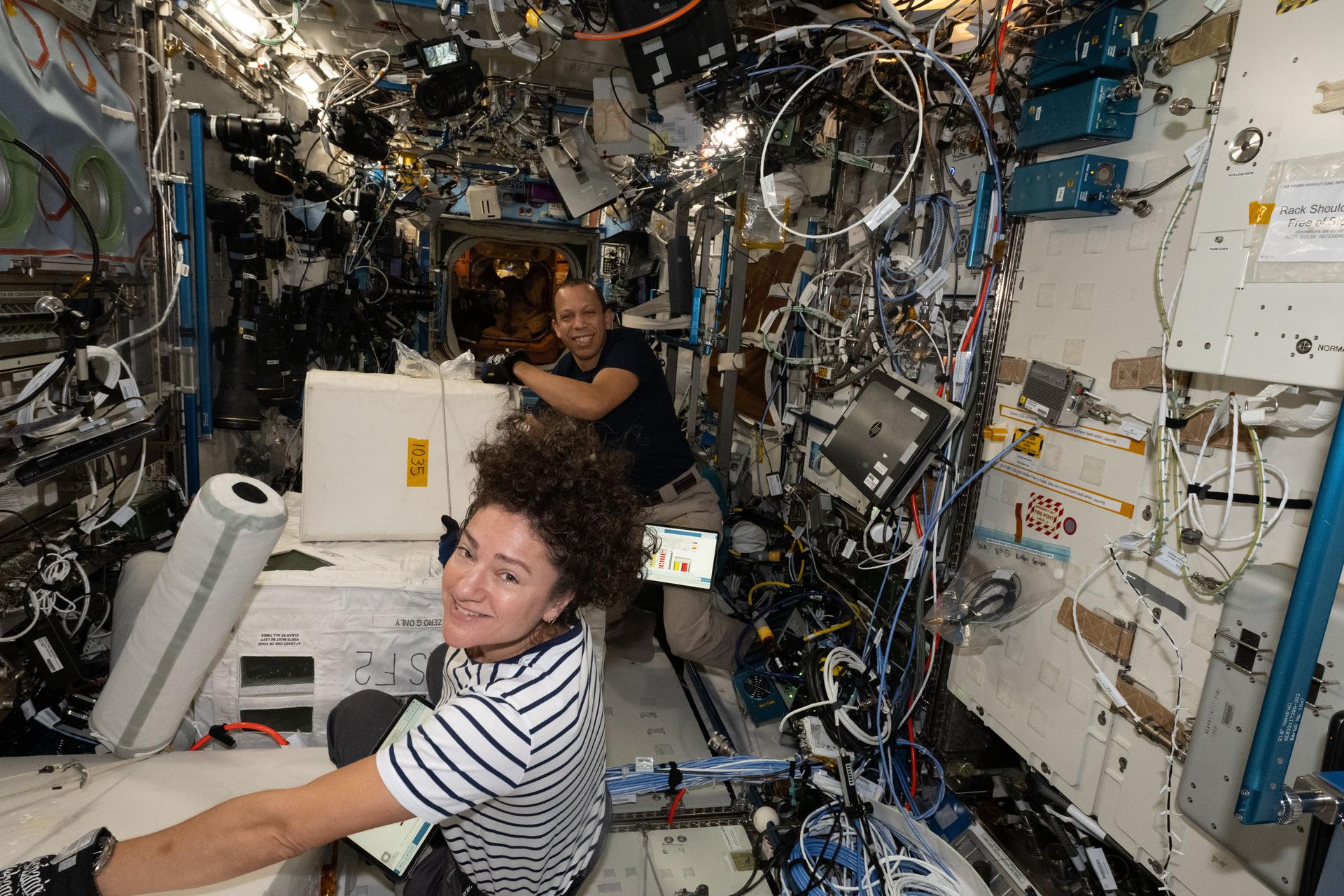
NASA astronauts Jessica Meir and Chris Williams collect frozen research samples while living and working aboard the International Space Station.
Credit: ESA/Sophie Adenot
Students in New Jersey will hear from NASA astronauts Chris Williams and Jessica Meir as they answer prerecorded STEM questions while aboard the International Space Station.
The Earth-to-space call will begin at 12:05 p.m. EDT, Thursday, June 18, and will stream live on the agency’s Learn With NASA YouTube channel.
This event is hosted by Newton Public Schools in Newton, New Jersey, for students in grades K-12 and members of the community. This unique opportunity aims to deepen understanding of space exploration and enhance awareness of STEM careers.
Media interested in covering the event must RSVP no later than 5 p.m. EDT, Wednesday, June 17, to Dr. Joseph Piccirillo at: 973-383-7392, x4229 or jpiccirillo@newtonnj.org.
For more than 25 years, astronauts have continuously lived and worked aboard the space station, testing technologies, performing science, and developing skills needed to explore farther from Earth. Astronauts communicate with NASA’s Mission Control Center in Houston 24 hours a day through SCaN’s (Space Communications and Navigation) Near Space Network.
Research and technology investigations taking place aboard the space station benefit people on Earth and lay the groundwork for other agency deep space missions. As part of NASA’s Artemis program, the agency will send astronauts to the Moon to prepare for future human exploration of Mars, inspiring the world through discovery in a new Golden Age of innovation and exploration.
For more information on NASA in-flight calls, visit:
The upper stage from a commercial Chinese rocket that launched last week has broken apart in space, spreading debris in a heavily trafficked part of low-Earth orbit home to the International Space Station and a significant portion of SpaceX's Starlink broadband network.
The breakup occurred shortly after the Zhuque-2E rocket reached orbit on June 9 with two satellites providing direct-to-cell communications, perhaps around the time the upper stage was expected to perform a disposal burn. The US Space Force confirmed the breakup event in a post on space-track.org, a website used by the military to distribute orbit data to the public.
"The tracked pieces are being incorporated into routine conjunction assessment to support spaceflight safety," the Space Force wrote in an advisory. "There are currently no threats to human spaceflight. Analysis is ongoing."
NASA astronauts Jessica Meir and Chris Williams collect frozen research samples while living and working aboard the International Space Station.
Credit: ESA/Sophie Adenot
Students in New Jersey will hear from NASA astronauts Chris Williams and Jessica Meir as they answer prerecorded STEM questions while aboard the International Space Station.
The Earth-to-space call will begin at 12:05 p.m. EDT, Thursday, June 18, and will stream live on the agency’s Learn With NASA YouTube channel.
This event is hosted by Newton Public Schools in Newton, New Jersey, for students in grades K-12 and members of the community. This unique opportunity aims to deepen understanding of space exploration and enhance awareness of STEM careers.
Media interested in covering the event must RSVP no later than 5 p.m. EDT, Wednesday, June 17, to Dr. Joseph Piccirillo at: 973-383-7392, x4229 or jpiccirillo@newtonnj.org.
For more than 25 years, astronauts have continuously lived and worked aboard the space station, testing technologies, performing science, and developing skills needed to explore farther from Earth. Astronauts communicate with NASA’s Mission Control Center in Houston 24 hours a day through SCaN’s (Space Communications and Navigation) Near Space Network.
Research and technology investigations taking place aboard the space station benefit people on Earth and lay the groundwork for other agency deep space missions. As part of NASA’s Artemis program, the agency will send astronauts to the Moon to prepare for future human exploration of Mars, inspiring the world through discovery in a new Golden Age of innovation and exploration.
For more information on NASA in-flight calls, visit:
Time seems like one of the most basic parts of everyday life. We use clocks to measure it, plan our days around it, and experience it as a steady flow from the past into the future. But according to some of the deepest theories in physics, time may not actually exist in the way we […]
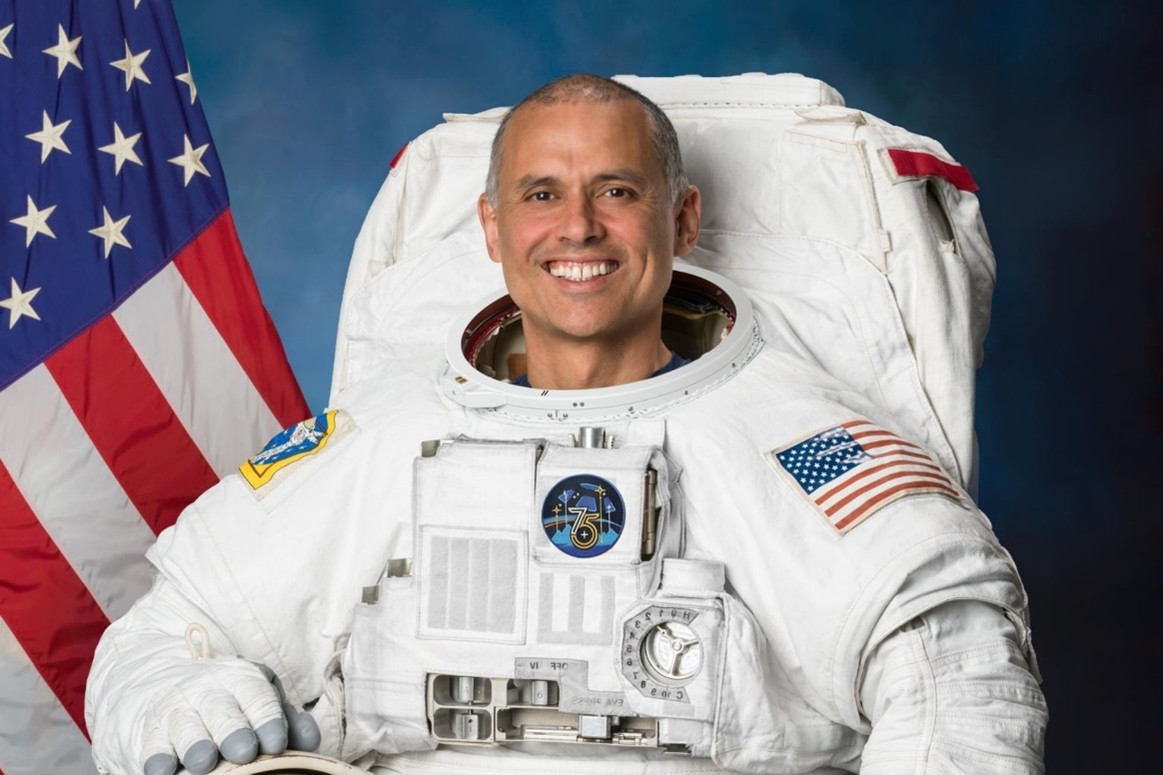
NASA astronaut and International Space Station Expedition 74/75 flight engineer Anil Menon poses for a portrait at NASA’s Johnson Space Center in Houston.
NASA/James Blair
NASA astronaut Anil Menon will be available for limited media interviews beginning at 9 a.m. EDT Monday, June 22, to discuss his upcoming mission to the International Space Station as part of Expeditions 74/75.
The virtual interviews will take place from the Gagarin Cosmonaut Training Center in Star City, Russia, and will stream live on the agency’s YouTube channel.
Media interested in participating must submit a request to the newsroom at NASA’s Johnson Space Center in Houston no later than 5 p.m. Wednesday, June 17, by emailing jsccommu@mail.nasa.gov. A copy of NASA’s media accreditation policy is online.
Menon is scheduled to launch to the space station Tuesday, July 14, from the Baikonur Cosmodrome in Kazakhstan aboard the Roscosmos Soyuz MS-29 spacecraft with Roscosmos cosmonauts Pyotr Dubrov and Anna Kikina. The trio will spend about eight months aboard the orbiting laboratory before returning to Earth in spring 2027.
During his expedition, Menon will conduct scientific investigations and technology demonstrations to help humans prepare for future exploration missions to the Moon and Mars, and to provide benefits on Earth. Among the hundreds of experiments planned during his mission, he will participate in studies to better understand astronaut vein structure, blood flow, and blood composition in microgravity. He also will test producing intravenous fluids using the space station’s potable water.
The Soyuz MS-29 mission will be his first spaceflight after he was selected as part of NASA’s 2021 astronaut class. A native of Minneapolis, Menon is an emergency medicine physician, mechanical engineer, and colonel in the United States Space Force. He also has served as an expedition flight surgeon supporting the agency’s crew members aboard the space station.
For more than 25 years, people have lived and worked continuously aboard the International Space Station, advancing scientific knowledge and making research breakthroughs not possible on Earth. The space station helps NASA understand and overcome the challenges of human spaceflight, expand commercial opportunities in low Earth orbit, and build on the foundation for long-duration missions to the Moon, as part of the Artemis program, and to Mars.
To learn more about International Space Station research, operations, and its crews, visit:
Ten days ago, in a moment of very high drama in orbit, NASA directed its astronauts living on the International Space Station to briefly seek emergency refuge in a Crew Dragon spacecraft.
Since then, neither the US space agency nor Roscosmos has provided additional public information about the situation in orbit. But according to sources who spoke to Ars, following the spectacle in space, the problem has been successfully fixed.
At issue were persistent cracks in a small area of the International Space Station attached to the Russian Zvezda service module, known as the PrK module. The problem has been ongoing since 2019, and Russian astronauts have been attempting various fixes, often using a sealant called Germetall-1.
When Butch Wilmore and Suni Williams finally splashed down off the Florida panhandle in late March 2025 after more than nine months on the International Space Station, they came home inside a SpaceX Crew Dragon. The Boeing Starliner that had carried them up the previous June was already gone — its service module burned up in the atmosphere months earlier, taking with it the thrusters NASA investigators most wanted to examine. An eight-day test flight had become the longest unplanned stay in American spaceflight history, and the rescue had come from the only US company with a working crew capsule.
That moment crystallized something NASA officials had been quietly acknowledging for years. SpaceX has held a monopoly on US crewed access to the ISS since Doug Hurley and Bob Behnken splashed down aboard Endeavour in early August 2020, ending a nine-year gap in domestic human spaceflight. More than five years later, with Starliner still grounded, that monopoly has not loosened. It has hardened.
The official plan was never supposed to look like this. When NASA awarded its Commercial Crew contracts in September 2014, the agency split the work deliberately between two providers: Boeing for the CST-100 Starliner, SpaceX for Crew Dragon. Two vehicles, two rockets, two launch pads. Redundancy was the entire point.
The gap that was supposed to close in 2017
Both capsules were supposed to be carrying astronauts by 2017. Crew Dragon’s first operational flight, Crew-1, finally launched in November 2020 — three years late. Starliner’s first crewed flight didn’t lift off until early June 2024, seven years behind schedule, and it ended with NASA deciding the spacecraft was too risky to bring its own crew home.
Since the Wilmore-Williams rescue, every American who has reached the ISS has done it inside a Dragon. Crew-9, Crew-10, Crew-11. Private missions flown by Axiom Space. Even European Space Agency astronauts like Denmark’s Andreas Mogensen and Sweden’s Marcus Wandt have ridden up on Falcon 9. SpaceX now operates a fleet of five reusable capsules — Endeavour, Resilience, Endurance, Freedom, and the newest, Grace, which debuted on Axiom’s Ax-4 mission in 2025. Endeavour, the capsule that flew Hurley and Behnken in 2020, has now made five trips to orbit. The Falcon 9 boosters beneath them are themselves reused, scorched first stages returning to droneships off the Florida coast within minutes of liftoff.
Why the Russian backup quietly disappeared
For decades, the Soyuz was the safety net. From the Space Shuttle’s retirement in July 2011 until 2020, NASA bought seats on Soyuz at prices that climbed significantly over the years. Even after Dragon began flying, NASA and Roscosmos kept a barter arrangement going — a seat-swap so that at least one American and one Russian were always on station, on different vehicles, in case one was grounded.
That arrangement still technically exists. A NASA astronaut launched on a Soyuz in 2025 as part of the seat-swap program. But the political ground beneath it has thinned since February 2022, and the seat-swap is no longer the redundancy NASA can plan a decade around. The only American-built vehicle in the loop is Dragon.
What Starliner still has to prove
Boeing’s capsule isn’t dead, but its path back to flight has slipped repeatedly. Through the first half of 2025 NASA said it had not yet decided whether Starliner’s next mission would carry a crew, and in November 2025 the agency and Boeing settled the question: the next flight, designated Starliner-1, will be an uncrewed cargo run targeted for no earlier than April 2026, retesting the propulsion system that overheated and leaked helium on its way to the station in June 2024. In the same decision NASA trimmed the number of operational crew flights it is obligated to buy from Boeing. The thrusters that failed during docking — five of 28 reaction control jets in the service module — were destroyed when that module burned up during the empty return in early September 2024, which is partly why the investigation has taken so long. The hardware that misbehaved no longer exists.
Even on an optimistic schedule, Starliner’s return to crewed flight has not occurred as of mid-2026, and the regular crew rotations that would let it genuinely share the workload with Dragon sit further out still. The per-seat cost to NASA, under the fixed-price Commercial Crew contract, has been lower than what NASA paid for Soyuz seats in the final years of that arrangement. Boeing has taken significant financial charges against its Starliner program since 2016.
What the lack of alternatives actually means in 2026
It does not mean NASA has no rockets. The agency’s Space Launch System flew Artemis I around the Moon in late 2022, and Orion is built for deep space. But Orion cannot reach the ISS in any operational sense — it’s the wrong vehicle for a low-Earth-orbit rendezvous, and SLS launches cost in the multi-billions per flight. Sierra Space’s Dream Chaser, a winged cargo vehicle, is being prepared for uncrewed resupply runs but is years from a crewed variant.
Blue Origin’s New Glenn flew its first mission in January 2025 and has not been certified for crew. Vulcan, the rocket from United Launch Alliance that Boeing partly owns, is human-rated on paper but has no capsule attached to it now that Starliner uses Atlas V — and Atlas V’s remaining flights are spoken for.
So when NASA says it has no American alternative to Dragon, the agency means it in the narrow, literal sense: there is exactly one US-built, US-launched system today that can take a human being to the International Space Station and bring them home. That system has a single supplier.
The other quiet shift
While Dragon has become essential to crewed access, NASA has also leaned harder on commercial partners across the rest of its portfolio. The Roman Space Telescope built at Goddard is government-built but launches on a commercial rocket. The agency’s experimental aircraft program has begun accepting transferred military F-15Ds rather than buying new chase planes outright. The X-59 quiet supersonic demonstrator is being built by Lockheed Martin under a Skunk Works contract. The shape of NASA in 2026 is an agency that designs, contracts, and certifies more than it builds.
Within that shape, Dragon is not unusual. It is just the most consequential example, the one that touches every astronaut on every mission to the ISS — and the one that exposes the central tension in NASA’s commercial strategy. The agency made a bet that competitive procurement would deliver lower costs and more resilient supply than the old cost-plus model. On cost, that bet has clearly paid off. On resilience, it has not. A two-provider hedge only hedges if both providers actually fly.
What happens after 2030
The International Space Station is scheduled to be deorbited in 2030 or 2031 using a SpaceX-built US Deorbit Vehicle that NASA awarded in June 2024. The capsule that takes the last astronauts off the station will, on current plans, be a Dragon. The vehicle that pushes the station into the Pacific will, on current plans, also be made by SpaceX.
By then, NASA hopes commercial space stations from Axiom, Vast, Voyager Space, and Blue Origin will be in orbit, and the agency expects to buy crew transport to them the same way it buys crew transport to the ISS now — as a service. The architecture that replaces the ISS, in other words, will deepen the commercial-services model that produced the current Dragon dependency rather than retreat from it. Whether more than one provider will be flying crews by 2030 is the question the next four years will answer, and the answer will shape whether American human spaceflight in the 2030s rests on a competitive marketplace or on a single contractor whose business decisions become, by default, national space policy.
That is the deeper stake behind the Wilmore-Williams rescue and behind every Dragon launch since. For now, every American who looks up at the ISS as it crosses the evening sky — a moving point of light brighter than most stars, visible to the naked eye for about five minutes at a time — is looking at a station their country can only reach in one kind of spacecraft, built by one company, launched from one stretch of Florida coast. The redundancy that Congress demanded in 2014 has not been built. The dependency that resulted is now the plan.
Inside a 140,000-square-foot building in Long Beach that the local aerospace crowd calls Space Beach, circuit boards for spacecraft and defense systems are now coming off the line in a matter of weeks — the same boards that used to take years. The people who run the plant are not claiming the engineers suddenly got faster. They are saying something stranger: there are no longer enough engineers to build the hardware the United States has ordered, and a software agent is now doing the parts a person used to do.
The facility belongs to Voyager Technologies, a Denver-based aerospace and defense company that opened the site on March 12, 2026. Its purpose is narrow and blunt — compress the timeline between a defense-electronics design and a working board, using agentic artificial intelligence to do it.
That single fact cuts against the loudest story being told about AI everywhere else. In most industries the technology arrives as a way to trim headcount. In aerospace and defense it is arriving because the headcount cannot be filled.
The boards that used to take years
Voyager’s Long Beach center runs research, development, and manufacturing across advanced electronics, mission hardware, propulsion, and autonomy systems, SpaceNews reported from the March opening. It is the company’s second major buildout in three months, following the 150,000-square-foot Voyager American Defense Complex that opened in Pueblo, Colorado, in January with a focus on missile defense and tactical munitions.
The man running the defense side is Matt Magaña, Voyager’s president for space, defense, and national security. He grew up in Long Beach and spent close to two decades as a Raytheon executive before joining Voyager in 2024. He describes the old way of building mission electronics in plain terms: it takes years and years, and that is the bottleneck.
The plant’s pitch is that agentic AI can collapse that. Magaña has described printing circuit boards within weeks and months rather than years, using AI to compress the journey from a design to a board headed for orbit. “We’ve got to cut that down to have the speed of relevance,” he told Aviation Week.
Speed of relevance is a military phrase, and it is doing real work here. Voyager is building alongside other Space Beach companies, including Anduril Industries and True Anomaly, in a stretch of Southern California where firms have clustered to stay near the engineering talent and suppliers left over from the region’s older aerospace era.
The robots-on-the-factory-floor story is decades old. What is new at Space Beach is the robot in the engineering office — the one drafting the design, not bolting the part.
Why there aren’t enough people
The shortage is not anecdotal. Clay Mowry, chief executive of the American Institute of Aeronautics and Astronautics, told an audience at the ASCEND conference in Washington that some companies are trying to lift production “by a factor of four,” according to SpaceNews. Firms in the missile-interceptor business, he said, have to scale fast, and there are not enough trained people to put in the jobs — so they are scrambling.
The demand is real and specific. The companies cannot bring in enough trained engineers, software developers, and specialized manufacturing staff to meet the contracts already signed, let alone the expansion the Pentagon now wants. They are all chasing the same small pool of workers fluent in autonomy, machine learning, and systems integration, and that pool is not growing fast enough to match the order books.
The workforce is also aging out. About one-third of aerospace and defense manufacturing and engineering roles are held by workers 55 or older, the AIAA’s Aerospace America reported, citing Deloitte and McKinsey analyses, and the sector’s retirement and attrition rate runs nearly 10 percent above the national industry average. One McKinsey estimate put the cost of that talent drain at up to $330 million for a single mid-sized company.
So the experienced people are leaving faster than they can be replaced, the work is harder to learn than almost any other engineering discipline, and the orders keep climbing. The arithmetic does not close.
A shrinking pipeline
The squeeze sits inside a broader contraction of the technical labor supply. The federal workforce shrank by roughly 220,000 people through November 2025, about a 10 percent cut, according to data analyzed by The New York Times from the Office of Personnel Management — the steepest reduction in decades. Many of those losses landed at civilian agencies that historically fed engineers into defense and aerospace through internships, fellowships, and research partnerships.
Money has been thrown at the gap. Congress added nearly $34 billion above the president’s fiscal 2026 defense request for more than 1,000 research and procurement programs, Roll Call reported, drawing on a database from Taxpayers for Common Sense. The watchdog group has counted more than $134 billion in such program increases since fiscal 2022.
But an appropriation does not produce a qualified engineer, and it does not shorten a test cycle. That is the wall the industry keeps hitting, and it is why a Denver company is standing up a building in Long Beach to let software do the work that hiring cannot fill.
What agentic AI actually does in the engineering office
Agentic AI is not the rule-based automation aerospace plants have used for forty years. Traditional automation handles one narrow, repeating task: a robotic arm welding a seam, a machine running a tolerance check. The agentic version is built to work across the whole production cycle — design iteration, compliance paperwork, supply-chain coordination, production planning — treating them as one connected job rather than a chain of handoffs.
On the floor, that changes who the engineer is. A systems engineer who once shepherded a single program can now oversee several, with the agent drafting the documentation, running the early trade studies, and grinding through the routine compliance work that used to eat hours a day. The engineer becomes a reviewer and a decision-maker instead of a producer of paperwork.
The people selling it are careful to say the humans do not disappear. Magaña has framed the goal as accelerating the cycle time, not removing the engineer from it. The agent is the junior staff that cannot be hired.
The space hardware itself is what makes this hard. A board bound for orbit has to survive launch loads, thermal swings of hundreds of degrees, and a radiation environment that corrupts ordinary electronics. Qualifying that hardware still routinely takes years — a timeline that turns into a problem when commercial operators want a satellite constellation fielded in months and defense customers want resilient systems in place before an adversary closes a gap.
This is where the agent is pointed. It can run thousands of simulation variations in parallel, assemble the qualification documentation, and flag design choices that historically surfaced only after an expensive physical test had already failed. The compression is not in the welding. It is in the thinking that used to happen one engineer at a time.
The accountability problem nobody has solved
The story the plant tells is coherent, and it is also unfinished. When a human engineer signs off on a missile-guidance design, there is a chain of accountability running back through years of training, licensure, and named responsibility. When an agent drafts the compliance package or proposes a design change, that chain gets harder to trace.
The qualification regimes that govern space and defense hardware were built around human reviewers checking human work. Adapting them to artifacts an AI generated — without losing the rigor that keeps an interceptor intercepting and a satellite operating — is a problem the sector has not solved. It is regulatory rather than technical, and it sits in the space between agentic AI accelerating a cycle and quietly defining it.
For now, the shortage is making the decision. The contracts are signed, the deadlines are fixed, and the engineers cannot be hired at the rate the order books demand, so the experiment is running whether or not the verification questions have answers.
Back in Long Beach, the boards keep coming off the line in weeks. The building is new, the talent it was meant to draw on is thinner than it has been in a generation, and the agent in the engineering office is doing the trade studies that a younger engineer, in another decade, would have done by hand. Whether those boards hold up the way years of human review once guaranteed will not be settled in a conference hall. It will be settled in orbit, and on the ranges, on the first programs fast enough to get there.
Scientists from Goethe University, Frankfurt, studying alternatives to black holes have suggested a mathematically viable formation mechanism for one proposed alternative called a ‘Gravastar.’
Although the team behind the newly proposed gravastar formation mechanism conceded that black holes still represent the simplest and most natural solution to gravitational collapse, they also suggest that the physics behind the alternative, which doesn’t require a single point where spacetime curves infinitely, called a “singularity,” can make them “easier to accept” than black holes.
If correct, and some or all black holes are, in fact, gravastars that mimic their expected properties, the work would establish a valid formation mechanism that could rewrite decades of accepted science and open a new field of research dedicated to understanding this previously misunderstood phenomenon.
Meet Gravastar: The Black Hole Mimicker without a Singularity
According to standard cosmology theories, black holes form when extremely massive stars stop generating energy, allowing the force of gravity to take over and collapse the remaining matter into a single point, or singularity. Unfortunately, the research team behind the new study notes that “the laws of physics break down” within the singularity, making the formation of the resulting black hole a difficult phenomenon to predict.
“How can spacetime be curved infinitely at that point, the singularity?” asks the team’s statement announcing the new approach. They also note that no information escapes a black hole, including light, making studying its inner workings effectively impossible, and opening up the possibility that “black holes are in fact entirely different objects.”
Some options have been proposed, including ‘horizonless’ black hole mimickers. The team notes that these proposed options are “mathematically consistent alternatives” that also address the physics challenges posed by traditional black holes.
Still, how these alternative objects form has remained largely unclear. The research team said this lack of a formation mechanism constitutes “a significant open problem” since understanding how they form is the “first step” to determining if they truly exist.
New Model Creates a ‘Big Bang’ Inside a ‘Mini-Universe’
In the new formation model, theoretical physicists Daniel Jampolski and Theoretical Astrophysics Professor Luciano Rezzolla from Goethe University showed that the collapse of a dying star may not go far enough that it reaches the point of no return, where “the collapse to a black hole is inevitable.”
Instead, the collapse slows down near a point scientists call the Schwarzschild radius, then stops. The result is what the team termed a “miniature universe” within the collapsing matter, which they compared to the dynamics of the Big Bang, which most theorists agree formed the entire universe.
Since the universe’s expansion was driven by dark energy, the new model proposes that the dark energy within the mini-universe establishes an “equilibrium” with the counteracting force of gravity, therefore halting the collapse of the star “before a black hole can form.”
“The Big Bang of the emerging universe can unfold once the star has already collapsed almost to the point of becoming a black hole,” explained Jampolski, who discovered the black hole alternative gravastar solution in his master’s thesis while under the supervision of Professor Rezzolla.
Maintaining an Unbiased Approach Toward “What We Do Not Know”
When discussing the impact of their proposed black hole alternative formation model, Jampolski said that from a mathematical and physics standpoint, it is “easier to imagine that the Big Bang occurs only at a very late stage, when matter has already been compressed to an extreme degree, thereby giving rise to new effects.” The team also notes that the unresolved behavior of matter in this environment “leaves room for new physics.”
Although the team’s model offers a mathematically sound formation for an alternative to black holes, Rezzolla notes that the search for gravastars or other alternatives “should not suggest a skepticism towards black holes,” which, he adds, “still represent the most natural and simplest solution to the fate of gravitational collapse.”
Instead, the Goethe professor explained, his general role as a scientist and his specific discipline as a theoretical physicist make it essential that he and his colleagues “maintain an unbiased approach towards what we do not know and hence explore both the accepted wisdom and the more exotic interpretations.”
“History teaches us that it is not unusual for the latter to become the former,” the professor added.
Christopher Plain is a Science Fiction and Fantasy novelist and Head Science Writer at The Debrief. Follow and connect with him on X, learn about his books at plainfiction.com, or email him directly at christopher@thedebrief.org.
In 2021, scientists detected a cosmic ray entering Earth’s atmosphere with as much kineticenergy as a fast-moving tennis ball, all contained in a single subatomic particle. Named the “Amaterasu particle” after the Japanese sun goddess, the event left researchers questioning its origin because its arrival direction pointed to a region of space with no known source capable of producing such energy.
Researchers at Penn State now suggest that the puzzle may stem more from assumptions about the particle’s composition rather than its missing source.
A recent study in Physical Review Letters suggests that the Amaterasu particle, along with other extremely energetic cosmic rays, may actually be atomic nuclei heavier than iron. If correct, the idea could change how researchers search for the sources of cosmic rays.
A Particle of Unknown Origins
Ultrahigh-energy cosmic rays are some of the rarest and most violent phenomena in nature. These particles slam into Earth’s atmosphere with more than 100 exa-electron volts of energy, which is about 10 million times more than what the Large Hadron Collider can produce. The Amaterasu particle, found by the Telescope Array in Utah in May 2021 and reported in Science in 2023, had about 244 exa-electron volts of energy. This makes it one of the most energetic natural events ever recorded.
The mystery extended not only to the particle’s energy, but also to its origin. It came from the direction of the Local Void, which is an almost empty area of space next to the Milky Way, where there is no known source that could create such a powerful particle.
“The origins and acceleration mechanisms of ultrahigh-energy cosmic rays have been among the biggest mysteries in the field for more than 60 years, since the first example was reported,” said Kohta Murase, professor of physics and astronomy at Penn State’s Eberly College of Science and the study’s lead researcher.
The Heavy Nucleus Hypothesis
The Penn State team ran computational simulations to study how particles of different masses travel through intergalactic space. They found that atomic nuclei heavier than iron, known as ultraheavy nuclei, lose energy much more slowly than protons or lighter nuclei as they move through the radiation fields of deep space.
Most research on cosmic rays has assumed that the most extreme events involve protons, which are the simplest and lightest atomic nuclei. Ultraheavy nuclei lose energy much more slowly during their journey, allowing them to reach Earth carrying far more energy than lighter particles traveling similar distances. That makes them strong candidates for the most powerful cosmic ray events we’ve seen, including the Amaterasu particle.
“When we detect individual cosmic-ray particles such as the Amaterasu particle here on Earth, we can often use their energies, arrival directions and expected magnetic deflections to infer their possible cosmic sources,” Murase said.
New Theoretical Limits
The hypothesis that these particles are ultraheavy nuclei also changes the range of possible sources. If the particles are indeed heavier nuclei rather than protons, their production would require some of the most extreme environments in the universe. The researchers identify collapsars, which are massive stars collapsing directly into black holes, and binary neutron-star mergers as likely candidates. Both phenomena are also associated with gamma-ray bursts, which are among the most energetic explosions known to science.
The team’s calculations set new theoretical limits on how much ultraheavy nuclei may contribute to the overall population of ultrahigh-energy cosmic rays. Murase also noted that these sources could help explain a possible asymmetry in the ultrahigh-energy cosmic-ray spectrum between the northern and southern hemispheres.
“The most promising sites for producing and accelerating such ultraheavy nuclei are massive star deaths involving explosive collapse into black holes or strongly magnetized neutron stars, as well as binary neutron-star mergers known to be powerful gravitational-wave emitters,” Murase said.
Testing the Idea
The researchers stress that they are not saying all ultrahigh-energy cosmic rays are ultraheavy nuclei, but some of the most extreme ones might be. This could change what scientists look for in future studies. New observatories and upgrades, like AugerPrime in Argentina and the planned Global Cosmic Ray Observatory, could test these ideas. If ultraheavy nuclei are important, future observations should find evidence that protons alone cannot explain.
More than six decades after scientists first detected ultrahigh-energy cosmic rays, researchers may finally have a new clue about what the most extreme particles in the universe are made of.
Austin Burgess is a writer and researcher with a background in sales, marketing, and data analytics. He holds an MBA, a Bachelor of Science in Business Administration, and a data analytics certification. His work focuses on breaking scientific developments, with an emphasis on emerging biology, cognitive neuroscience, and archaeological discoveries.
The main focus of this argument is the idea of the “block universe.” In this view, also known as eternalism, space-time is a fixed, four-dimensional structure. All past, present, and future events are equally real within this block, according to this interpretation. Time does not flow, and there is no single present moment. The block contains everything that has ever occurred.
Janzen does not object to the geometry itself. His concern lies with the way the word “exists” is used in this context.
Janzen distinguishes between existence and occurrence. Objects exist because they endure through time. Events occur at a specific place and moment, and then they are over. For example, an elephant standing in a room exists. A cross-sectional snapshot of that elephant, representing a single instant removed from its timeline and frozen in place, does not exist in the same way; it only occurs.
In the block universe model, space-time holds every moment of the elephant’s existence as a four-dimensional world line. This world line shows the animal’s full path through space and time. A single cross-section, or one slice of that path, is not the elephant itself; it is only a record of what the elephant was doing at a certain moment. Janzen says the block is better understood as a representational framework rather than a physical object in the usual sense.
A Problem of When
This confusion leads to a fundamental problem. The entire block universe is said to exist, but it is unclear when it exists. A timeless structure that never unfolds cannot endure as the elephant endures from moment to moment. Meanwhile, if the whole block occurs at once, like a single flash, there is no internal experience of time that could be considered an illusion.
To keep the sense of time passing in a block universe, the four-dimensional structure would need to endure in some sense. This would mean adding a fifth dimension, a second time axis outside the block, for the block itself to exist within; however, this extra axis is not part of Einstein’s original theory.
Janzen uses a simpler analogy. He compares the situation to describing a song that exists all at once, complete but unperformed. A song only becomes a song when it unfolds over time.
Austrian-British philosopher Ludwig Wittgenstein warned that philosophical problems arise when “language goes on holiday.” Janzen argues that physics has been in this situation for decades, reusing words such as “timeless,” “exist,” and “become” in technical senses without considering their everyday connotations.
Implications for Physics and Philosophy
One of the biggest unsolved problems in physics is how to bring together general relativity, which explains gravity and the large-scale universe, with quantum mechanics, which describes matter at the smallest scales. These two frameworks do not fit together, and every real attempt to unify them demands a clear definition of what space-time actually is.
If the language physicists use to describe space-time has been internally inconsistent for more than a century, Janzen suggests the resulting confusion may extend beyond philosophy. Clarifying what physicists mean when they talk about space-time could influence how researchers think about attempts to reconcile general relativity and quantum mechanics.
Janzen does not propose a replacement for the current framework but instead suggests that the fundamental question is not how space-time curves, but how to properly define them in the first place.
Austin Burgess is a writer and researcher with a background in sales, marketing, and data analytics. He holds an MBA, a Bachelor of Science in Business Administration, and a data analytics certification. His work focuses on breaking scientific developments, with an emphasis on emerging biology, cognitive neuroscience, and archaeological discoveries.
A small member of our solar system out beyond Pluto may be shrouded in a thin layer of gas. If so, it would be the first object of its size — and the most remote rock in our solar system — known to host even a wispy atmosphere.
“This discovery suggests that small icy worlds beyond Neptune may not be as inactive or unchanging as we often assumed,” says Ko Arimatsu. “Until now, Pluto was the only [object beyond Neptune] with a confirmed atmosphere.”
Arimatsu is an astronomer at the National Astronomical Observatory of Japan. It’s in Mitaka. His group shared the new finding May 4 in Nature Astronomy.
Arimatsu’s group tracked the object — known as 2002 XV93 — with a network of telescopes in Japan. On January 10, 2024, those telescopes saw it move in front of a distant star. Such tiny eclipses are called occultations (Ah-kul-TAY-shuns). They can reveal whether some object in our solar system hosts an atmosphere.
If 2002 XV93 were bare, the star behind it would have seemed to blink out and reappear sharply. But Arimatsu and his teammates saw the star’s light gradually fade and reappear over about 1.5 seconds. That smooth dimming is best explained by starlight passing through a layer of gas. Those data suggest this thin atmosphere has a pressure about one ten-millionth that of Earth’s.
“I was genuinely surprised,” Arimatsu says. The object is about 470 kilometers (290 miles) wide. The Grand Canyon is about that long. At such a small size, 2002 XV93’s gravity should be too weak to hold on to a gas for long. So its atmosphere should have vanished long ago, unless something has added new gas to it.
Perhaps an icy body like a comet recently smashed into 2002 XV93. That could have released a plume of gas around the object. Or maybe 2002 XV93 releases gas regularly from icy volcanoes on its surface.
The astronomers can’t be certain what’s going on just from viewing 2002 XV93 pass in front of one star. The data couldn’t show what the atmosphere is made of. So the small body might even be swaddled in dust, not gas, Arimatsu notes. Nor could they show how high above the body’s surface any atmosphere extends.
“Future observations will be important,” he says. Say its atmosphere fades over the next few years. That could mean he had detected a plume kicked up by an impact. If it sticks around or varies over time, that might make a case for surface volcanoes.
Every photograph of Earth ever taken from space, from Apollo 8’s Earthrise to Apollo 17’s Blue Marble to Voyager 1’s Pale Blue Dot, descends from a strip of 35-millimetre film pulled from the wreckage of a captured German V-2 rocket in the New Mexico desert in October 1946.
The camera that exposed it was a DeVry motion-picture camera modified by Clyde Holliday at the Johns Hopkins Applied Physics Laboratory. It was not launched on a spacecraft, because no spacecraft existed. It was bolted into a weapon.
On October 24, 1946, V-2 No. 13 rose from White Sands Proving Ground carrying Holliday’s camera above the line now commonly treated as the edge of space. At about 105 kilometres up, it photographed Earth as a curved surface against black sky, one frame every second and a half.
The rocket did not land gently. It came back down on the desert range and was destroyed on impact, but the film cassette survived. When the frames were recovered and developed, the result was the first successful photograph of Earth taken from space.
The date matters because it is often blurred with the better-known V-2 camera flights that followed in 1947 and 1948. The first successful sequence came on October 24, 1946, more than a decade before Sputnik, and long before any human being had seen Earth from orbit.
A weapon repurposed as a camera platform
The V-2 was designed to kill. Wernher von Braun’s team at Peenemünde built it as a long-range ballistic missile, and the Smithsonian National Air and Space Museum describes the weapon as having a range of about 320 kilometres and a one-ton warhead.
More than 3,000 V-2s were fired at Allied targets during the war. The program also consumed forced labour on a horrific scale, with the Smithsonian’s Air and Space Museum noting that at least 10,000 people died in the Mittelwerk production system, more than were killed by the weapon’s deployment.
After Germany’s defeat, American forces shipped captured V-2 parts to New Mexico. White Sands became one of the places where the United States learned how high-altitude rockets behaved, how instruments survived launch, and how useful the upper atmosphere could be as a laboratory.
The U.S. Army’s own history of White Sands places the range at the centre of early American rocket testing, beginning with captured German V-2 technology in 1946. That same test culture opened the nose cones to scientists from the Naval Research Laboratory, the Applied Physics Laboratory, the University of Michigan and other institutions.
Most instruments were there to measure radiation, cosmic rays, solar ultraviolet light or the upper atmosphere. Holliday’s camera did something simpler and stranger. It turned the rocket around, in effect, and made Earth itself the subject.
The camera rode above the Kármán line
The October 24 flight carried a 35-millimetre DeVry cine camera, set to expose one frame every 1.5 seconds. Contemporary accounts identify the launch as V-2 No. 13, fired from White Sands and reaching about 104.6 to 105 kilometres above the desert.
That altitude put the camera just above the 100-kilometre Kármán line, the conventional boundary often used to mark the start of space. Balloons had photographed curvature from high altitude before. Holliday’s camera crossed into a different category.
The flight itself was rough. After engine cutoff, the rocket tumbled, and its spent body eventually struck the range downrange from the launch site. One detailed reconstruction places the impact speed at about 150 metres per second, far below the 500 to 800 metres per second sometimes repeated in loose retellings.
The camera was not simply vaporised. Accounts of the recovery describe Holliday’s camera as found in usable condition except for damage such as the missing lens, while the film cassette preserved the exposed frames. The rocket was gone; the pictures remained.
What the first frames showed
The images were grainy and severe. They showed a bright, curved horizon, black sky above it, and the American Southwest flattened into pale geometry below.
Nothing in the frame looks like the blue planet photographs that later became famous. There are no oceans shining blue, no cloud swirls at global scale, no Moon in the foreground. The power of the image is that it is barely an image at all, just enough evidence to prove that Earth could be photographed from outside itself.
Smithsonian’s account of the flight notes that Holliday stitched the movie frames together into broader views, and that the V-2 photographs revealed the planet against the darkness of space. The Johns Hopkins Applied Physics Laboratory also credits its researchers in 1946 with bolting a 35-millimetre motion-picture camera onto a captured German V-2 and taking the first pictures of Earth’s curvature from space.
Holliday understood the shift almost immediately. In a 1950 National Geographic article, he wrote that the V-2 photographs showed “how our Earth would look to visitors from another planet coming in on a space ship.”
The view before Sputnik
That sentence was written seven years before Sputnik, twelve years before John Glenn orbited Earth, and eighteen years before Apollo 8 carried human eyes around the Moon. The idea of Earth as a planet among planets was already present in a strip of film recovered from military wreckage.
The camera program did not stop with one rocket. Holliday and other teams refined the mounts, lenses and recovery systems, and later V-2 flights produced clearer panoramic images from still higher altitudes, including views that covered enormous stretches of the southwestern United States and northern Mexico.
Those flights helped teach engineers how to design instruments for violent ascent, cold upper air, vibration, spin and impact. The information flowed into the wider American sounding-rocket program, including Aerobee, a smaller and cheaper research rocket that APL developed when V-2s became scarce.
The line from V-2 photography to later space images is not only emotional. It is technical. The recovery procedures, camera housings, telemetry habits and high-altitude test culture belonged to the same early chain that eventually led from sounding rockets to satellites, crewed capsules and planetary probes.
The photographs that followed
A little more than two decades later, Apollo 8 astronaut Bill Anders photographed Earthrise from lunar orbit. In 1972, the Apollo 17 crew took The Blue Marble while travelling toward the Moon.
Every one of those later images is more beautiful than Holliday’s first frames. They are richer, cleaner, more legible and more famous. But none of them came first.
The first view was black and white, scratched by motion, recovered after impact, and born from a rocket designed for war. Somewhere in that damaged sequence, the desert falls away and Earth curves into darkness for the first time a camera ever proved it could.
Apollo 17 was the last time human beings walked on the Moon, but the mission did not behave like an ending. It behaved like a field season. In December 1972, Gene Cernan and Harrison “Jack” Schmitt landed in the Taurus-Littrow valley, drove a battery-powered rover across black lunar dust, and packed 741 rock and soil samples into boxes for the trip home.
The total came to 110.5 kilograms, the largest lunar sample return of the Apollo program.
One of the most arresting pieces of that haul was not a boulder or a glittering crystal. It was orange soil, found near Shorty Crater, made of tiny volcanic glass beads from an eruption roughly 3.64 billion years old.
The mission had gone to Taurus-Littrow partly because planners wanted old highland material and possible signs of younger volcanism on the valley floor. What Cernan and Schmitt found was stranger. The orange glass really was volcanic, but the crater beside it was not the vent that made it.
The last Apollo landing was built for science
Apollo 17 launched from Kennedy Space Center at 12:33 a.m. Eastern time on December 7, 1972. It was the only night launch of the Apollo lunar program, a Saturn V rising in white flame while the last Moon crew rode toward a landing site chosen for rocks, not symbolism.
The crew had three men. Eugene Cernan commanded the mission. Ronald Evans remained in lunar orbit aboard the command module America. Harrison Schmitt, the lunar module pilot, was a professional geologist and became the only scientist to walk on the Moon.
That mattered before the crew ever reached the surface. Earlier Apollo landings had proved that humans could land, work, and return. Apollo 17 was meant to stretch what a lunar expedition could do when the field crew included someone trained to read rocks as a landscape.
NASA’s mission plan sent Cernan and Schmitt to Taurus-Littrow, a valley on the southeastern edge of Mare Serenitatis. The site offered two temptations at once: old material from the lunar highlands and possible evidence of volcanic activity on the valley floor.
They landed the lunar module Challenger on December 11, 1972. Cernan reported that Challenger had landed, then the crew and Mission Control checked the spacecraft carefully in case an emergency liftoff was needed. Only after that did the valley become a workplace.
Taurus-Littrow was a valley full of targets
To the astronauts, Taurus-Littrow was not just scenery. It was a map of objectives. The South Massif, North Massif, Sculptured Hills, nearby craters, rolling boulders, and dark valley floor each held a different possible piece of lunar history.
The mission was one of Apollo’s J-type flights, which meant longer surface stays, expanded science equipment, and a Lunar Roving Vehicle. The rover let Cernan and Schmitt reach stations no walking crew could have covered efficiently in bulky suits.
Across three moonwalks, they spent more than 22 hours outside the lunar module. They drove about 35.7 kilometres in the rover, stopping at geology stations, sampling boulders, scraping trenches, shooting photographs, reading checklists, and loading sample bags.
The rover also made the Moon messier. During the first excursion, Cernan accidentally knocked off the rover’s right rear fender with a hammer handle sticking out from his suit pocket. Without the fender, abrasive dust sprayed over the astronauts, the vehicle, and their equipment.
Mission Control and the crew improvised a repair using onboard maps, clamps, and tape. It was not elegant, but it worked well enough to keep the dust under control during later drives.
The orange soil was real, but the first explanation was wrong
The most famous discovery came during the second moonwalk near Shorty Crater. Schmitt saw orange material in the soil and called attention to it immediately. On a grey world, colour was not a small detail.
Cernan and Schmitt sampled the orange material and nearby black soil. The discovery seemed, at first glance, to fit one of the mission’s big hopes: finding evidence of relatively young volcanic activity in the Taurus-Littrow region.
The truth was more complicated. Later study showed that the orange and black material consisted of volcanic glass beads, formed in a fire-fountain eruption about 3.64 billion years ago. The melt came from deep inside the Moon, roughly 400 kilometres below the surface.
Shorty Crater, however, was not the volcanic vent. It was an ordinary impact crater that happened to expose older volcanic glass. The bright colour was real. The easy story was not.
That is why Apollo 17 still matters to lunar science. The mission did not just collect souvenirs from the last human visit. It returned samples that forced geologists to separate what the Moon looked like from what had actually happened there.
The samples kept speaking after the astronauts left
The Apollo 17 collection included basalts, breccias, highland crustal rocks, rare deep-crust materials, rake samples, core samples, and soil from multiple stations. The 741 individual samples gave laboratories on Earth a physical archive of Taurus-Littrow.
Some rocks helped scientists study ancient basin-forming impacts. Others recorded mare volcanism, when lava once filled low areas of the Moon. The orange glass preserved a more explosive story, with droplets frozen from molten material thrown out billions of years ago.
The crew also drilled a deep core reaching material from about three metres below the lunar surface. That core let researchers examine layers that had been shielded from the most recent surface exposure.
Half a century later, Apollo samples are still being reanalysed with instruments the original mission teams did not have. The rocks Cernan and Schmitt packed into boxes in 1972 remain active scientific material, not relics.
That is why new work on Apollo material keeps appearing. A sample can sit quietly in storage for decades, then meet a better microscope, a more precise mass spectrometer, or a new question about the Moon’s interior.
Scientists are still pulling new chemistry out of Apollo 17 material today, including from samples returned in 1972 and preserved for later generations of instruments. Recent analysis of Apollo samples has continued to reveal hidden details about the Moon’s mantle.
The suits made fieldwork feel mechanical
For all the grandeur of the photographs, Apollo 17 geology was hard physical labour. Cernan and Schmitt worked in pressurized suits, sealed helmets, stiff gloves, and portable life-support backpacks. Every sample bag, rake stroke, core tube, and camera frame had to pass through machinery wrapped around the body.
Cernan’s flown A7-LB suit is now preserved by the Smithsonian. It was the last spacesuit worn on the lunar surface, with the red commander stripes visible in the images that still define Apollo 17.
Inside that suit, a geologic field stop became a sequence of constrained movements. Bend carefully. Grip through gloves. Balance in one-sixth gravity. Keep track of the sample number. Keep dust out of the wrong places. Describe the rock clearly enough for scientists on Earth to follow the work.
Schmitt’s presence changed the texture of the mission. He could look at a rock, a slope, or a patch of soil and narrate what made it geologically interesting. Cernan handled the rover, equipment, drilling, navigation, and command decisions while Schmitt kept reading the valley.
That partnership is the centre of Apollo 17. One astronaut brought the instincts of a Navy pilot and mission commander. The other brought the eye of a field geologist. Taurus-Littrow needed both.
There is a thoughtful video by Justin Brown that examines why difficult, quiet work can feel so different from work that brings constant feedback, which gives the Apollo 17 surface record a useful modern echo without changing what the mission actually was.
The final footprints were not the final experiment
Before leaving the surface, Cernan and Schmitt parked the rover so its television camera could watch Challenger lift off from the Moon. The rover stayed behind, along with the descent stage, tools, experiment hardware, footprints, wheel tracks, and the disturbed grey dust around the work sites.
Cernan was the last person to climb the ladder from the lunar surface. That fact gives Apollo 17 its emotional weight, but it can also flatten the mission into a farewell scene. The better way to understand it is as a scientific expedition that happened to be the last one.
The final Apollo astronauts also left objects that still connect the Moon to Earth. Earlier Apollo crews and Apollo 17 left retroreflectors that scientists have used to bounce laser pulses off the lunar surface, a continuing measurement of the Earth-Moon distance and the Moon’s slow movement away from us.
Cernan also left a private mark for his daughter Tracy in the lunar dust, a small human gesture beside the official science and hardware. The initials he traced into the regolith are likely still there, not because they were protected, but because the Moon has no wind or rain to erase them.
The rover is still in Taurus-Littrow. The orange glass is on Earth. The footprints and wheel tracks remain in dust that has not felt weather since the astronauts lifted away. Apollo 17 ended as a flight, but as a field record it is still open, waiting in rock boxes, transcripts, photographs, and a valley no human has crossed since.

 Login