Everything but Exoplanets: The Transformative General Astrophysics of the Habitable Worlds Observatory
Monday, June 15th, 10:00am -11:30am PT
This is your reminder to join the Cosmic Origins community members as they present their science and talk about relevant topics of interest across the astrophysics landscape!
For Cosmic Origins at AAS, please visit the link below.
Experience the Launch of NASA’s Roman Space Telescope
Are you ready for a new view of the universe? The Nancy Grace Roman Space Telescope will reveal distant worlds, dark energy, and the structure of the cosmos, and we want you to be a part of it!
Digital creators and social media users are invited to register to our NASA Social for the Nancy Grace Roman Space Telescope launch. Roman is NASA’s next flagship astrophysics mission, designed to explore everything from our outer solar system to the edge of the observable universe. This mission is scheduled to launch on Aug. 30, 2026, aboard a SpaceX Falcon Heavy rocket from Launch Complex 39A at NASA’s Kennedy Space Center in Florida.
Are you passionate about social media and communications? Do you love to create content for an audience? Are you a fan of new, unique experiences? If you said yes, this NASA Social event is for you! This is your opportunity to be on the front lines of this historic mission.
The NASA Social event will take place over two days, including the day of launch. A maximum of 50 digital creators will be selected to attend this two-day event and will be given access similar to news media.
NASA Social participants will have the opportunity to:
Tour NASA’s Kennedy Space Center
Learn directly from astrophysics subject matter experts
Meet fellow digital creators and social media users
Spend time with members of NASA’s social media team
View the launch of the Nancy Grace Roman Space Telescope
NASA Social events are intended for members of the public. Current or former NASA civil servants, NASA contractors, NASA interns, and individuals or organizations currently under contract to provide products or services to NASA are not eligible to apply or participate in NASA Social events.
NASA Social registration for the Roman launch opens on this page on Monday, June 15 and the deadline to apply is at 11:59 p.m. EDT on Sunday, June 28. All applications will be considered on a case-by-case basis.
Do I need to have a social media account to register?
Yes. This event is designed for people who:
Actively use multiple social networking platforms and tools to disseminate information to a unique audience.
Regularly produce new content that features multimedia elements.
Have the potential to reach a large number of people using digital platforms.
Reach a unique audience, separate and distinctive from traditional news media and/or NASA audiences.
Must have an established history of posting content on social media platforms.
Have previous postings that are highly visible, respected, and widely recognized.
Users are encouraged to follow @NASARoman for Roman updates on X, Facebook, and @NASAGoddard and @NASAUniverse on Instagram. Updates and information about the event will be shared on X via @NASA_Events
How do I register?
Registration for this event opens Monday, June 15 and closes at 5 p.m. EDT on Sunday, June 28. Registration is for one person only (you) and is non-transferable. Each individual wishing to attend must register separately. Each application will be considered on a case-by-case basis.
Can I register if I am not a U.S. citizen?
Yes, this event is open for all to apply.
When will I know if I am selected?
After registrations have been received and processed, an email with confirmation information and additional instructions will be sent to those selected. We expect to send the first notifications on XX and waitlist notifications on XX.
What are NASA Social credentials?
All NASA social applications will be considered on a case-by-case basis. Those chosen must prove through the registration process they meet specific engagement criteria.
If you do not make the registration list for this NASA Social, you still can attend the launch off site and participate in the conversation online. Find out about ways to experience a launch at https://www.nasa.gov/kennedy/see-a-launch-up-close/.
What are the registration requirements?
Registration indicates your intent to travel to NASA Kennedy and attend the two-day event in person. You are responsible for your own expenses for travel, accommodation, food, and other amenities.
The schedule of events and special guest appearances are subject to change without notice. NASA is not responsible for loss or damage incurred as a result of attending. NASA, moreover, is not responsible for loss or damage incurred if the event is canceled with limited or no notice. Please plan accordingly.
Kennedy is a government facility. Those who are selected may need to complete additional steps to receive clearance to enter the secure areas.
IMPORTANT: Those without proper identification cannot be admitted.
For United States Citizens:
You will be required to present a REAL ID compliant identification or valid U.S. passport PLUS one of the following:
Acceptable documents to accompany federal or state identification:
Unexpired Employment Authorization Document issued by DHS that contains a photograph (Form I-688B)
Driver’s license or ID card issued by a state or outlying possession of the United States provided it contains a photograph or information such as name, date of birth, gender, height, eye color, and address
ID card issued by federal, state, or local government agencies or entities, provided it contains a photograph or information such as name, date of birth, gender, height, eye color, and address
School ID card with a photograph
Voter’s Registration Card
Military Dependent’s ID Card
U.S. Military card or draft record
U.S. Coast Guard Merchant Mariner Card
Native American Tribal Document
U.S. Social Security Card issued by the Social Security Administration (other than a card stating it is not valid for employment)
Original or Certified copy of birth certificate issued by a state, county, municipal authority, or outlying possessions of the United States bearing an official seal
U.S. Citizen ID Card (Form I-197)
ID Card for use of Resident Citizens of the United States (Form I-179)
Unexpired employment authorization document issued by DHS (other than those listed previously)
For Foreign Nationals:
Same items required of U.S. Citizens (SSN only when applicable)
Unexpired foreign passport, with I-551 stamp or attached Form I-94 indicating unexpired employment authorization
Passport number and registration date
Citizenship
Driver’s license issued by a Canadian Government authority
For Legal Resident Aliens:
Same items required of U.S. Citizens, and:
Permanent Resident Card or Alien Registration Receipt Card with photograph (Form I-551)
Unexpired Temporary Resident Card (Form I-688)
Certification of Birth Abroad issued by the Department of State (Form FS-545 or Form DS-1350)
The REAL ID Act was passed by Congress in 2005 to establish minimum security standards for state-issued driver’s licenses and identification cards.
All registrants must be at least 18 years old.
What if the launch date changes?
Hundreds of different factors can cause a scheduled launch date to change multiple times. The launch date will not be official until after the Flight Readiness Review. If the launch date changes prior to the review, NASA may adjust the date of the NASA Social accordingly to coincide with the new target launch date, and will notify registrants of any changes via email.
If the launch is postponed, attendees will be invited to attend a later launch date. If the launch is postponed beyond 72 hours, the NASA Social event may be canceled.
NASA Social attendees are responsible for any additional costs they incur related to any launch delay. We strongly encourage participants to make travel arrangements that are refundable and/or flexible.
What if I cannot come to the Kennedy Space Center?
If you cannot come to NASA Kennedy and attend in person, you should not register for the NASA Social. Join the conversation by following @NASARoman on X and Facebook, and @NASAGoddard and @NASAUniverse on Instagram. You can watch the launch at nasa.gov/live. NASA will provide regular launch and mission updates on @NASA.
If you cannot make this NASA Social, don’t worry; NASA is planning many other NASA Social events in the near future at various locations! Check for updates on NASA Socials.
Experience the Launch of NASA’s Roman Space Telescope
Are you ready for a new view of the universe? The Nancy Grace Roman Space Telescope will reveal distant worlds, dark energy, and the structure of the cosmos, and we want you to be a part of it!
Digital creators and social media users are invited to register to our NASA Social for the Nancy Grace Roman Space Telescope launch. Roman is NASA’s next flagship astrophysics mission, designed to explore everything from our outer solar system to the edge of the observable universe. This mission is scheduled to launch on Aug. 30, 2026, aboard a SpaceX Falcon Heavy rocket from Launch Complex 39A at NASA’s Kennedy Space Center in Florida.
Are you passionate about social media and communications? Do you love to create content for an audience? Are you a fan of new, unique experiences? If you said yes, this NASA Social event is for you! This is your opportunity to be on the front lines of this historic mission.
The NASA Social event will take place over two days, including the day of launch. A maximum of 50 digital creators will be selected to attend this two-day event and will be given access similar to news media.
NASA Social participants will have the opportunity to:
Tour NASA’s Kennedy Space Center
Learn directly from astrophysics subject matter experts
Meet fellow digital creators and social media users
Spend time with members of NASA’s social media team
View the launch of the Nancy Grace Roman Space Telescope
NASA Social events are intended for members of the public. Current or former NASA civil servants, NASA contractors, NASA interns, and individuals or organizations currently under contract to provide products or services to NASA are not eligible to apply or participate in NASA Social events.
NASA Social registration for the Roman launch opens on this page on Monday, June 15 and the deadline to apply is at 11:59 p.m. EDT on Sunday, June 28. All applications will be considered on a case-by-case basis.
Do I need to have a social media account to register?
Yes. This event is designed for people who:
Actively use multiple social networking platforms and tools to disseminate information to a unique audience.
Regularly produce new content that features multimedia elements.
Have the potential to reach a large number of people using digital platforms.
Reach a unique audience, separate and distinctive from traditional news media and/or NASA audiences.
Must have an established history of posting content on social media platforms.
Have previous postings that are highly visible, respected, and widely recognized.
Users are encouraged to follow @NASARoman for Roman updates on X, Facebook, and @NASAGoddard and @NASAUniverse on Instagram. Updates and information about the event will be shared on X via @NASA_Events
How do I register?
Registration for this event opens Monday, June 15 and closes at 11:59 p.m. EDT on Sunday, June 28. Registration is for one person only (you) and is non-transferable. Each individual wishing to attend must register separately. Each application will be considered on a case-by-case basis.
Can I register if I am not a U.S. citizen?
Yes, this event is open for all to apply.
When will I know if I am selected?
After registrations have been received and processed, an email with confirmation information and additional instructions will be sent to those selected. We expect to send the first notifications on July 17 and waitlist notifications on July 22.
What are NASA Social credentials?
All NASA social applications will be considered on a case-by-case basis. Those chosen must prove through the registration process they meet specific engagement criteria.
If you do not make the registration list for this NASA Social, you still can attend the launch off site and participate in the conversation online. Find out about ways to experience a launch at https://www.nasa.gov/kennedy/see-a-launch-up-close/.
What are the registration requirements?
Registration indicates your intent to travel to NASA Kennedy and attend the two-day event in person. You are responsible for your own expenses for travel, accommodation, food, and other amenities.
The schedule of events and special guest appearances are subject to change without notice. NASA is not responsible for loss or damage incurred as a result of attending. NASA, moreover, is not responsible for loss or damage incurred if the event is canceled with limited or no notice. Please plan accordingly.
Kennedy is a government facility. Those who are selected may need to complete additional steps to receive clearance to enter the secure areas.
IMPORTANT: Those without proper identification cannot be admitted.
For United States Citizens:
You will be required to present a REAL ID compliant identification or valid U.S. passport PLUS one of the following:
Acceptable documents to accompany federal or state identification:
Unexpired Employment Authorization Document issued by DHS that contains a photograph (Form I-688B)
Driver’s license or ID card issued by a state or outlying possession of the United States provided it contains a photograph or information such as name, date of birth, gender, height, eye color, and address
ID card issued by federal, state, or local government agencies or entities, provided it contains a photograph or information such as name, date of birth, gender, height, eye color, and address
School ID card with a photograph
Voter’s Registration Card
Military Dependent’s ID Card
U.S. Military card or draft record
U.S. Coast Guard Merchant Mariner Card
Native American Tribal Document
U.S. Social Security Card issued by the Social Security Administration (other than a card stating it is not valid for employment)
Original or Certified copy of birth certificate issued by a state, county, municipal authority, or outlying possessions of the United States bearing an official seal
U.S. Citizen ID Card (Form I-197)
ID Card for use of Resident Citizens of the United States (Form I-179)
Unexpired employment authorization document issued by DHS (other than those listed previously)
For Foreign Nationals:
Same items required of U.S. Citizens (SSN only when applicable)
Unexpired foreign passport, with I-551 stamp or attached Form I-94 indicating unexpired employment authorization
Passport number and registration date
Citizenship
Driver’s license issued by a Canadian Government authority
For Legal Resident Aliens:
Same items required of U.S. Citizens, and:
Permanent Resident Card or Alien Registration Receipt Card with photograph (Form I-551)
Unexpired Temporary Resident Card (Form I-688)
Certification of Birth Abroad issued by the Department of State (Form FS-545 or Form DS-1350)
The REAL ID Act was passed by Congress in 2005 to establish minimum security standards for state-issued driver’s licenses and identification cards.
All registrants must be at least 18 years old.
What if the launch date changes?
Hundreds of different factors can cause a scheduled launch date to change multiple times. The launch date will not be official until after the Flight Readiness Review. If the launch date changes prior to the review, NASA may adjust the date of the NASA Social accordingly to coincide with the new target launch date, and will notify registrants of any changes via email.
If the launch is postponed, attendees will be invited to attend a later launch date. If the launch is postponed beyond 72 hours, the NASA Social event may be canceled.
NASA Social attendees are responsible for any additional costs they incur related to any launch delay. We strongly encourage participants to make travel arrangements that are refundable and/or flexible.
What if I cannot come to the Kennedy Space Center?
If you cannot come to NASA Kennedy and attend in person, you should not register for the NASA Social. Join the conversation by following @NASARoman on X and Facebook, and @NASAGoddard and @NASAUniverse on Instagram. You can watch the launch at nasa.gov/live. NASA will provide regular launch and mission updates on @NASA.
If you cannot make this NASA Social, don’t worry; NASA is planning many other NASA Social events in the near future at various locations! Check for updates on NASA Socials.
NASA has chosen four astronauts for the Artemis III mission, but there has been a major setback: the destruction of a Blue Origin rocket and its only launchpad. Our science reporter Katrina Miller describes what this event might mean for the U.S. goal of landing on the moon by 2028.
NASA’s missions these days rarely feature all-male crews. Jared Isaacman, its administrator, said women play prominent roles throughout the space agency.
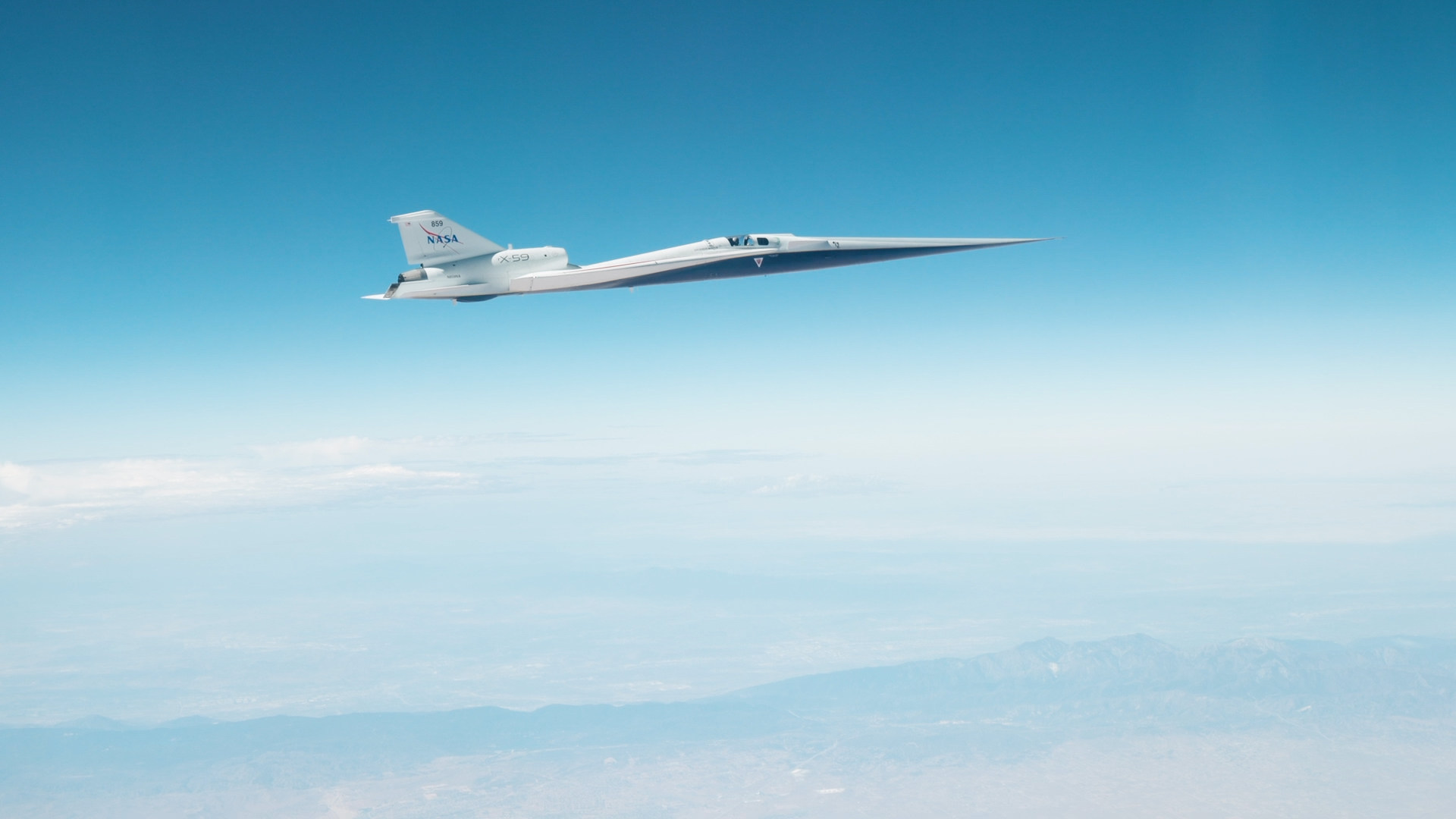
NASA’s X-59 quiet supersonic research aircraft reached its target speed and altitude for future community overflights for the first time during a flight on Friday, June 12, 2026. The milestone marked the first time the aircraft flew at Mach 1.4 and 55,000 feet — conditions it will fly when gathering community response data to its quiet sonic thump.
NASA/Lori Losey
NASA’s X-59 experimental aircraft reached a major milestone Friday, June 12, flying Mach 1.4 (about 924 mph) and an altitude of 55,000 feet, the conditions required for the aircraft to make future flights critical to its mission.
The X-59 still has months of performance testing ahead, but after those are complete, NASA’s Quesst mission will fly the aircraft over several U.S. communities to collect data on public perception of the quiet sonic thump it will make at supersonic speeds. Those community overflights will include flights at Mach 1.4 and 55,000 feet.
The milestone comes just days after the X-59’s first supersonic flight. That flight showed the aircraft performed as expected at Mach 1.1, but Friday’s mission conditions flight was an even more critical step for NASA.
NASA’s X‑59 eXternal Vision System (XVS) shows Mach 1.4 at 55,030 feet on Friday, June 12, 2026 during the aircraft’s first mission conditions flight, the approximate conditions it will fly when gathering community response data to its quiet “sonic thump.” The milestone marks the first time the aircraft flew at its designed speed and altitude.
NASA/Lori Losey
The X-59 was designed to fly supersonic without causing a loud sonic boom. However, for these early supersonic flights it has been accompanied by a NASA F-15 research aircraft, a traditional supersonic jet that causes booms obscuring any noise the X-59 makes. During upcoming flights, a shock-sensing probe mounted to the F-15 will gather measurements of the X-59’s shock wave signature, an early measure of its supersonic performance.
After the team conducts more tests at a variety of altitudes and conditions to complete envelope expansion, the X-59 will enter the acoustic validation phase of Quesst. During this phase, researchers will thoroughly measure the aircraft’s supersonic acoustic signature — the quiet thump it’s designed to make — to confirm it is performing as intended.
Each flight brings NASA one step closer to flying the X-59 over communities and gathering feedback that could help shape the future of commercial supersonic flight over land.
Special Session: Everything but Exoplanets: The Transformative General Astrophysics of the Habitable Worlds Observatory
Monday, June 15th, 1:00pm – 2:30pm ET, 10:00am -11:30am PT
Highlights from Cosmic Origins Science Interest Groups (SIGs) and Science Analysis Groups (SAGs).
Time
Topic
Speaker
10:20am ‑ 10:30am
Spatially Resolved UV Spectroscopy Science Analysis Group in Support of HWO
Emily Witt (JHU)
10:30am ‑ 10:40am
Investigating the NIR Discovery Space of the Habitable Worlds Observatory: Updates from the Red Limit Science Analysis Group
Kyle Cooke (University of Louisville)
10:40am ‑ 10:50am
Opening the OVI Window to Reveal the Diffuse Cosmic Ecosystem with HWO
Sanchayeeta Borthakur (Arizona State University)
11:00am ‑ 11:10am
HWO Science Interest Group: Keeping the Community Connected to HWO
Jessie Christiansen (Caltech/IPAC)
Splinter Session: NASA’s Big Science, Small Missions
Tuesday, June 16th, 1:00pm – 2:30pm ET, 10:00am -11:30am PT (Hybrid Session)
For remote participation, please look for the “Join the Session” link above the agenda on the Cosmic Origins at AAS website.
High-impact science. Smarter, faster, together.
Agenda
Organizers: Swara Ravindranath (NASA/GSFC), Emily Witt (JHU)
Time
Topic
Speaker
10:00am ‑ 10:05am
Welcome
Swara Ravindranath (NASA/GSFC)
10:05am ‑ 10:15am
FORTIS Sounding Rocket
Emily Witt (JHU)
10:15am ‑ 10:25am
BlackCAT CubeSat
Abe Falcone (Pennsylvania State University)
10:25am ‑ 10:35am
SunRISE CubeSat Constellation
Joseph Lazio (University of Michigan)
10:35am ‑ 10:45am
SPHEREx Medium Explorer Mission
Roberta Paladini (IPAC/Caltech)
10:45am ‑ 10:55am
Landolt Pioneer Mission
Peter Kurczynski (NASA/GSFC)
10:55am ‑ 11:05am
Non-Traditional Path to Missions
Sanchayeeta Borthakur (Arizona State University)
11:05am ‑ 11:10am
BREAK
11:10am ‑ 11:30am
Panel Discussion
Swara Ravindranath (NASA/GSFC, moderator) Panelists: Drew Miles (Caltech), Pablo Saz Parkinson (NASA HQ), Joseph Lazio (University of Michigan), Abe Falcone (Pennsylvania State University), David Ardila (JPL)
Special Session: Planning for the Future of Astrophysics and the ASTRA Initiative
Thursday, June 18th, 1:00pm – 2:30pm ET, 10:00am -11:30am PT
No remote participation is available for this special session.
Agenda
Time
Topic
Speaker
10:00am ‑ 10:10am
Introduction from the NASA Astrophysics Division Director
Shawn Domagal‑Goldman (NASA HQ)
10:10am ‑ 10:25am
The ASTRA Initiative: Overview& Path Forward
Jessica Gaskin (NASA HQ)
10:25am ‑ 10:40am
Innovation for Astrophysics Workshop: Initial Findings
Kendra Short (JPL)
10:40am ‑ 10:55am
Ad ASTRA Community Science Workshop
Peter Kurczynski (NASA/GSFC)
10:55am ‑ 11:30am
Panel Discussion
Francesca Civano (NASA/GSFC)
ASTRA Office Hours at Cosmic Origins Exhibit Booth
(June 15 – 17, 2026) at 9am PT
Stop by the AAS / Cosmic Origins Exhibit booth during these times to ask questions about the ASTRA initiative, the September Ad ASTRA workshop, and developing new strategic mission concepts for astrophysics. Monday, Tuesday, Wednesday 9 am PT (Peter Kurczynski)
Best regards, Swara Ravindranath
American Astronomical Society
The 248th Meeting of the AAS
The 248th AAS meeting (joint with the High Energy Astrophysics and the Laboratory Astrophysics Divisions) will be held 14-18 June 2026 in Pasadena, California.
Enabling landers to autonomously identify the safest sites to touch down
Moon craters and their surrounding areas are high-value destinations for lunar missions since they may contain important resources and valuable science targets. However, these sites are also home to dangers such as steep slopes that are difficult to see in the challenging lighting conditions. As a result, selecting landing sites on lunar surfaces is a critical component for NASA’s CLPS (Commercial Lunar Payload Services) missions. A new technology tested through NASA’s Flight Opportunities program is set to go to the Moon and help provide a safe and precise landing.
Astrobotic Technology’s Hazard Detection (HD) Lidar system scans and analyzes the terrain in real-time, enabling landers to autonomously map and select the safest landing sites. Lidar stands for light detection and ranging. The Pittsburgh-headquartered company will use its HD Lidar system when its Griffin lunar lander delivers science and technology payloads to the Moon during its CLPS delivery to the lunar south pole.
With Flight Opportunities support, Astrobotic first tested an engineering model of its advanced HD Lidar sensor in November 2024, confirming its ability to select a safe landing site by detecting and avoiding slopes, rough areas, and potential hazards. This flight test provided the Astrobotic team valuable data on the system’s performance, which was later leveraged by a second flight test in March 2026 with an integrated hazard detection and guidance, navigation, and control (GNC) system to further validate the system ahead of its first lunar mission scheduled for later this year. These flight tests helped the company advance the technology for use on its CLPS mission.
The Astrobotic Griffin Mission One will launch aboard a SpaceX Falcon Heavy rocket from Launch Complex 39A at NASA’s Kennedy Space Center in Florida to deliver NASA payloads to the lunar south pole.
Astrobotic’s HD Lidar system is designed to detect hazards as small as 5.9 inches (15 cm) and slopes greater than 10° to identify potential hazards, such as craters or large rocks. During the lander’s final descent phase, the spacecraft performs a stationary hover at an altitude of 100 meters — about the height of a 30-story building — while pointing its lidar toward the intended landing site. During the hover, the lidar scans the terrain, applies motion correction to account for changes in the spacecraft’s position and attitude, and processes the results into a hazard map used to identify the safest available landing location. The spacecraft then maneuvers to the selected landing site and proceeds with touchdown.
Astrobotic’s HD Lidar system works in tandem with its terrain relative navigation (TRN) sensor system, which takes live photos of the surface and compares them to an onboard map derived from orbital images to determine the spacecraft’s location above the lunar surface. In preparation for the CLPS mission, Astrobotic fully integrated its HD Lidar and TRN camera into its Griffin lander and demonstrated a successful soft landing simulation using Astrobotic’s Griffin Mission One production flatsat — a platform built with engineering models of the actual flight avionics.
Astrobotic’s Griffin lunar lander inside the company’s integration facility. The lander uses Hazard Detection Lidar technology tested with support of NASA’s Flight Opportunities program.
Astrobotic
Advancing Hazard Detection Lidar Through Flight Testing
NASA’s Flight Opportunities program supported testing of Astrobotic’s HD Lidar as part of its mission to demonstrate promising technologies for space exploration, scientific discovery, and the expansion of space commerce. During the flight test on Nov. 11, 2024, an engineering model of the HD Lidar sensor successfully collected data over Astrobotic’s Lunar Surface Proving Ground while mounted on the company’s Xodiac reusable vertical takeoff vertical landing rocket. During the flight, the HD Lidar system processed the 3D lidar point cloud data into a terrain hazard map and helped verify lidar communications, settings, and controls under relevant conditions.
This flight test enabled Astrobotic to make a significant advancement in demonstrating space exploration technology capabilities, and the company applied lessons from this test directly to its lunar lander missions.
Flight test planning using simulated scans from Xodiac historical flight data and Lidar Hazard Detection scan settings in simulation.
Astrobotic
The Hazard Detection Lidar payload, as integrated on the top of Xodiac. The lidar is the box on the left pointed down towards the ground; This pointing angle enables it to view the surface of the Lunar Surface Proving Ground during the flight test.
Astrobotic
Astrobotic’s Griffin lunar lander is seen inside the company’s integration facility.
Astrobotic
Learn More About Flight Opportunities
More Technology Transitions
Learn about other technologies that have advanced their readiness through testing with Flight Opportunities.
Access Flight Testing
Learn more about how to flight test your technology, instrument, or experiment with the Flight Opportunities program.
Flight Providers
Learn about the commercial flight providers that engage with the Flight Opportunities program.
Além do Facebook e Instagram, os problemas estão a afetar outras plataformas da Meta, incluindo o Messenger. A empresa está a trabalhar para resolver as falhas, embora ainda sem avançar com uma explicação para o sucedido.
Habitable Worlds Observatory Detector System Development Study Request for Proposals
12 June 2026
Due by July 7th, 2026
Dear Colleagues,
The Habitable Worlds Observatory Technology Maturation Project Office and Columbus Technologies are excited to invite you to participate in a Detector System Development Study focused on developing critical detector technologies for the Habitable Worlds Observatory. This request for proposals seeks information from qualified organizations capable of supporting detector technology maturation studies to advance candidate technologies toward Technology Readiness Level 5. Specifically, we are seeking responses to address one or more of the following detectors categories: photon-counting detectors for visible and near-infrared coronagraph applications, far-ultraviolet detectors, and large-format detectors for near-ultraviolet and visible applications. Details regarding the call for proposals, eligibility, required deliverables, and study phases are available at the Columbus Technologies website here: https://columbususa.com/opportunities/hwo-detector-rfp/
Respondents located at Government agencies including the Jet Propulsion Laboratory or NASA Centers (e.g., Goddard Space Flight Center, Ames Research Center, etc.) should submit their responses directly to Daniel Kelly (daniel.p.kelly@nasa.gov).
Dear Astrophysics Strategic Technology & Research Accelerator (ASTRA) community members-
As we prepare for our Ad ASTRA Community Science workshop, we are writing to share important updates regarding the agenda structure and instructions for abstract submissions.
The Community Science (Ad ASTRA) Workshop is organized by the NASA Astrophysics Division to engage the community in identifying future large, strategic astrophysics missions. Structured over three thematic days—Science, Capabilities and Implementation, and Community Discussion—the workshop provides a comprehensive framework to connect scientific priorities with technological readiness and mission implementation. Across all three days, plenaries, panels, breakout sessions, and poster contributions are designed to maximize community interactions and discussion. The outcomes of the workshop will help NASA prioritize mission concepts and shape a balanced, forward-looking astrophysics portfolio that is consistent with the Astro2020 recommendations and existing and future science gaps.
To best serve the community and facilitate meaningful collaboration, we are splitting the mission concept presentations into two distinct focuses: Science on Day 1, and Capabilities and Implementation on Day 2. We are relying on you—the concept teams and the broader community—to submit abstracts for both days. We are also offering the option to present mission concepts as posters, and will offer the opportunity to present as posters any abstracts for which there is insufficient room in the parallel sessions.
Please review the detailed agenda structure and submission guidelines below:
Day 1: Science Focus
Science Questions: Day 1 will focus on open science priorities and questions from strategic documents (Astro 2020 Decadal Survey, Enduring Quests – Daring Visions from 2014) and more recent science questions that the mission concepts submitted to ASTRA will address.
Abstract Submission: Presentations for Day 1 are not restricted to mission concept team members. We strongly encourage other scientists in the community to submit abstracts presenting important science questions and to use this opportunity to connect with concept teams.
Breakout Sessions: These sessions will be organized by science themes (Compact Objects and Energetic Phenomena, Cosmology, Galaxies, Exoplanets & Astrobiology, Stars and Stellar Populations). Moderators will present a summary of the panel discussions at the end of Day 1.
Day 2: Mission Concepts – Capabilities and Implementation
Focus: Day 2 is focused on implementation, capabilities, and technologies (software and hardware) relevant to the ASTRA submitted mission concepts. A summary of the Innovation for Astrophysics Missions Workshop (May 2026) will inform discussions regarding industry and other capabilities and opportunities that may be leveraged.
Breakout Sessions: These sessions will be organized by capability groups, which will be determined once the submitted mission concept documents are reviewed.
Format & Goals: Breakout sessions will feature a mix of presentations and flexible discussion. The goal is for teams with concepts at varying maturity levels to collaborate, find commonalities, and strengthen their respective capability groups.
Abstract Submission Note: Teams may submit multiple abstracts for these sessions if their concept spans different capabilities (e.g., requiring both UV and X-ray technologies).
Day 3 & Workshop Outcome
A primary goal of this workshop is to refine a draft “science-to-capabilities” matrix, which will be built using inputs from your submitted ASTRA mission concept documents. During the Day 1 and 2 breakout sessions, moderators will capture key discussion points to present during end-of-day summary panels. On Day 3 of the workshop, we will hold a plenary discussion to recap the week and collaboratively revise the “science-to-capabilities” matrix. Together as a community, we will add, refine, and prioritize science questions, mapping them to mission concepts.
Key Upcoming Dates:
24 June 2026: Abstract submission deadline (link). If you have already submitted an abstract and would like to modify it based on the guidelines above, please delete your previous contribution and send another submission.
Announcement of Opportunity Astrophysics Explorers Program 2026 Small Explorer (SMEX) Final Text Released
12 June 2026
The National Aeronautics and Space Administration (NASA) Science Mission Directorate (SMD) announces the release of an Announcement of Opportunity (AO) to solicit Principal Investigator (PI)-led space science investigations for the Small Explorer (SMEX) opportunity under the Astrophysics Explorers Program. The SMD strategic goal of expanding human knowledge through new scientific discoveries in astrophysics includes the broad objective: “to understand the Sun, Earth, Solar System, and Universe.” SMD addresses this objective through astrophysics investigations that address one or more of these science goals:
How does the Universe work? Probe the origin and destiny of our universe, including the nature of black holes, dark energy, dark matter and gravity.
How did we get here? Explore the origin and evolution of the galaxies, stars, and planets that make up our universe.
Are we alone? Discover and study planets around other stars and explore whether they could harbor life.
The 2026 Astrophysics SMEX (APSMEX26) Schedule:
AO Release Date: June 9, 2026
Preproposal Conference Date: June 30, 2026
Mandatory Notice of Intent Due Date: July 21, 2026
Proposal Due Date: September 9, 2026
The NASA Solicitation and Proposal Integrated Review and Evaluation System (NSPIRES) is the official source for the full text of the Astrophysics Explorers Program 2026 SMEX AO. To find the full, final text visit https://go.nasa.gov/APSMEX26. Alternatively, visit: http://nspires.nasaprs.com/, select ‘Solicitations’ at the top of the page, and on the next page enter solicitation number NNH26ZDA011O in the search field.
Prospective investigators from any category of organizations or institutions, U.S. or non-U.S. with some restrictions as specified in Section 4.2.1 of the AO, are welcome. Specific categories of organizations and institutions include, but are not limited to, educational, industrial, and not-for-profit organizations, Federally Funded Research and Development Centers (FFRDCs), University Affiliated Research Centers (UARCs), NASA Centers, and other Government agencies. Both U.S. and non-U.S. participation is subject to China restrictions described in Sections 4.2.2 and 5.8.1 of the AO.
All interested parties must read the final APSMEX26 AO carefully for significant changes from the draft AO (NNH25ZDA008J) and prior years’ SMD Explorers Program AOs. Of particular importance is the change in evaluation and selection to a single-step competitive process. NASA intends to select one investigation proposal from the APSMEX26 responses to proceed into a combined Phase A&B. All proposals must comply with the requirements, constraints, and guidelines contained within the AO.
The Science Office for Mission Assessments (SOMA) will post the virtual Preproposal Conference agenda, connection information, and related information at: https://explorers.larc.nasa.gov/APSMEX26/SMEX. SOMA hosts the official “2026 Astrophysics Small Explorer (SMEX)” website that provides further information, including the SMEX Program Library and SMEX Question & Answer (Q&A) page. Anonymity of persons/institutions who submit questions will be preserved. Proposers are encouraged to send comments and questions early so that they may be fully addressed. Questions posed at least one week before the Pre-Proposal Conference may be addressed in the Pre-Proposal Conference presentation or on the SMEXQ&A page. The deadline for other questions is two (2) weeks before the proposal due date.
All questions or comments about the Astrophysics SMEX 2026 AO shall be addressed via email to Daniel Moses, APSMEX26 Lead Program Scientist, dan.moses@nasa.gov; Hannah JangCondell, APSMEX26 Deputy Program Scientist, hannah.jang-condell@nasa.gov; and Omar Torres, Lead Acquisition Manager for the 2026 Astrophysics SMEX AO, SOMA omar.torres@nasa.gov using subject line “APSMEX26” to be properly routed.
Any costs incurred in preparing a submission in response to this notice or the full APSMEX26 AO are solely the responsibility of the submitter.
By integrating an AI assistant directly into Edits, Meta is aiming to keep creators engaged on Instagram as it continues to compete with TikTok and YouTube for creators' attention.
Instagram is going to let you tweak what its algorithm shows you on your main feed. With the Your Algorithm feature, "you can now see the topics we think you're interested in, and change them, across all the major parts of Instagram," according to Instagram boss Adam Mosseri. Right now, the feature will only surface topics, but Instagram is working on "supporting requests for people, different moods or vibes, content types, and more."
The company has been slowly giving users more agency over some algorithms on Instagram, having already launched the Your Algorithm feature for your Reels feed and the Explore page. With Wednesday's announcemen …
Dear Astrophysics Strategic Technology & Research Accelerator (ASTRA) community members-
As we prepare for our Ad ASTRA Community Science workshop, we are writing to share important updates regarding the agenda structure and instructions for abstract submissions.
The Community Science (Ad ASTRA) Workshop is organized by the NASA Astrophysics Division to engage the community in identifying future large, strategic astrophysics missions. Structured over three thematic days—Science, Capabilities and Implementation, and Community Discussion—the workshop provides a comprehensive framework to connect scientific priorities with technological readiness and mission implementation. Across all three days, plenaries, panels, breakout sessions, and poster contributions are designed to maximize community interactions and discussion. The outcomes of the workshop will help NASA prioritize mission concepts and shape a balanced, forward-looking astrophysics portfolio that is consistent with the Astro2020 recommendations and existing and future science gaps.
To best serve the community and facilitate meaningful collaboration, we are splitting the mission concept presentations into two distinct focuses: Science on Day 1, and Capabilities and Implementation on Day 2. We are relying on you—the concept teams and the broader community—to submit abstracts for both days. We are also offering the option to present mission concepts as posters, and will offer the opportunity to present as posters any abstracts for which there is insufficient room in the parallel sessions.
Please review the detailed agenda structure and submission guidelines below:
Day 1: Science Focus
Science Questions: Day 1 will focus on open science priorities and questions from strategic documents (Astro 2020 Decadal Survey, Enduring Quests – Daring Visions from 2014) and more recent science questions that the mission concepts submitted to ASTRA will address.
Abstract Submission: Presentations for Day 1 are not restricted to mission concept team members. We strongly encourage other scientists in the community to submit abstracts presenting important science questions and to use this opportunity to connect with concept teams.
Breakout Sessions: These sessions will be organized by science themes (Compact Objects and Energetic Phenomena, Cosmology, Galaxies, Exoplanets & Astrobiology, Stars and Stellar Populations). Moderators will present a summary of the panel discussions at the end of Day 1.
Day 2: Mission Concepts – Capabilities and Implementation
Focus: Day 2 is focused on implementation, capabilities, and technologies (software and hardware) relevant to the ASTRA submitted mission concepts. A summary of the Innovation for Astrophysics Missions Workshop (May 2026) will inform discussions regarding industry and other capabilities and opportunities that may be leveraged.
Breakout Sessions: These sessions will be organized by capability groups, which will be determined once the submitted mission concept documents are reviewed.
Format & Goals: Breakout sessions will feature a mix of presentations and flexible discussion. The goal is for teams with concepts at varying maturity levels to collaborate, find commonalities, and strengthen their respective capability groups.
Abstract Submission Note: Teams may submit multiple abstracts for these sessions if their concept spans different capabilities (e.g., requiring both UV and X-ray technologies).
Day 3 & Workshop Outcome
A primary goal of this workshop is to refine a draft “science-to-capabilities” matrix, which will be built using inputs from your submitted ASTRA mission concept documents. During the Day 1 and 2 breakout sessions, moderators will capture key discussion points to present during end-of-day summary panels. On Day 3 of the workshop, we will hold a plenary discussion to recap the week and collaboratively revise the “science-to-capabilities” matrix. Together as a community, we will add, refine, and prioritize science questions, mapping them to mission concepts.
Key Upcoming Dates:
24 June 2026: Abstract submission deadline (link). If you have already submitted an abstract and would like to modify it based on the guidelines above, please delete your previous contribution and send another submission.
The ASTRA initiative (linked below) will promote new strategic mission concepts for astrophysics. We would like to encourage you to think about new strategic mission concepts for the coming decades of astrophysics. Please join us for a community webinar next Wednesday, June 10, 12:00 – 1:00 pm ET ( 9:00 – 10:00 am PT) where we will discuss ASTRA.
As part of ASTRA, the Community Science (Ad ASTRA) Workshop will take place 1-3 September 2026 in Pasadena. New concept ideas will be discussed at this event.
To join the ASTRA initiative, mission concept template is now available (linked below). There are also instructions for submission. Submitted concept ideas will be discussed at the September workshop.

 Login