❌

Normal view

Schrödinger’s Cat Gets Stranger: Physicists Demonstrate Quantum States No One Has Seen Before

10 June 2026 at 21:54
Quantum mechanics defies classical intuition, most famously through Schrödinger’s cat, where systems exist in superpositions of opposing states. Such superpositions are central to quantum technologies. Quantum ‘cat’ states have been realized in harmonic oscillators, but implementations were largely limited to Fock, displaced, or Gottesman-Kitaev-Preskill states. A different class of macroscopic superpositions, where an oscillator is squeezed along orthogonal axes so that its positional variance is simultaneously larger and smaller than the Heisenberg limit, was proposed previously but remained unrealized. Saner et al. introduce a trapped-ion hybrid spin-oscillator system enabling an experimental realization of these ‘siblings’ of Schrödinger’s cat. Image credit: Saner et al., doi: 10.1103/k1xk-yt42.

Physicists at the University of Oxford have engineered a new class of ‘cat states’ -- quantum superpositions constructed not from ordinary wave packets, but from deeply exotic, nonclassical components -- opening unexpected paths toward more resilient quantum computers.

The post Schrödinger’s Cat Gets Stranger: Physicists Demonstrate Quantum States No One Has Seen Before appeared first on Sci.News: Breaking Science News.

NASA Webb Finds Strongest Evidence Yet for ‘Black Hole Stars’

10 June 2026 at 15:00
 
7 Min Read

NASA Webb Finds Strongest Evidence Yet for ‘Black Hole Stars’

A field of galaxies against the black background of space. In the center is a bright-white elliptical galaxy that is the core of the Abell S1063 galaxy cluster. Around the core are short, curved red lines, which are distant background galaxies magnified and warped by gravitational lensing. A couple of foreground stars appear large and bright with Webb’s signature eight-point diffraction spike pattern. Toward the very bottom, slightly off center toward the right, is a small red dot that is highlighted by an orange square outline. A larger orange square in the top right corner shows the object in more detail. The object, labeled “GLIMPSE-17775” looks like a fuzzy red dot with a yellow core.
While the primary purpose of NASA’s James Webb Space Telescope’s observations of galaxy cluster Abell S1063 was to look for a certain population of stars, scientists obtained a detailed spectrum of GLIMPSE-17775 from the dataset. This little red dot is located behind Abell S1063.
Credits:
Image: NASA, ESA, CSA, Vasily Kokorev (UT Austin); Image Processing: Alyssa Pagan (STScI)

The complex puzzle known as little red dots has become more complete since their initial discovery by NASA’s James Webb Space Telescope in 2022. Now a particular little red dot’s spectrum is helping connect many of the pieces.

A team of astronomers led by Vasily Kokorev at the University of Texas at Austin identified the lucky dot in question: GLIMPSE-17775. By carefully analyzing the dot’s spectrum captured by Webb — the deepest spectrum to date of a little red dot — the research team has identified multiple lines of evidence, all of which support the interpretation that GLIMPSE-17775 is a supermassive black hole enveloped in a dense cocoon of partially ionized gas, a model referred to as the BH* (black hole star) scenario. A paper describing the results was published today in The Astrophysical Journal.

“I think part of the scientific community is converging on a singular picture — that little red dots can be explained by black hole star models. But none of the previous little red dots have all of the pieces of evidence in the same place,” said Kokorev, lead author of the study. “With GLIMPSE-17775 we can test these models because of how deep and amazing this source’s spectrum is.”

Image: Abell S1063 with Pullout of GLIMPSE-17775 (NIRCam Image)

A field of galaxies against the black background of space. In the center is a bright-white elliptical galaxy that is the core of the Abell S1063 galaxy cluster. Around the core are short, curved red lines, which are distant background galaxies magnified and warped by gravitational lensing. A couple of foreground stars appear large and bright with Webbu2019s signature eight-point diffraction spike pattern. Toward the very bottom, slightly off center toward the right, is a small red dot that is highlighted by an orange square outline. A larger orange square in the top right corner shows the object in more detail. The object, labeled u201cGLIMPSE-17775u201d looks like a fuzzy red dot with a yellow core.
While the primary purpose of NASA’s James Webb Space Telescope’s observations of galaxy cluster Abell S1063 was to look for a certain population of stars, scientists obtained a detailed spectrum of GLIMPSE-17775 from the dataset. This little red dot is located behind Abell S1063.
Image: NASA, ESA, CSA, Vasily Kokorev (UT Austin); Image Processing: Alyssa Pagan (STScI)

Connecting puzzle pieces

Soon after Webb first began science operations, it discovered a new, mysterious type of object in the very early universe – abundant red objects that emerged about 600 million years after the big bang. Scientists have explored multiple explanations for these little red dots, including the black hole star scenario.

A set of fortunate circumstances brought about this new, elaborate spectrum of a little red dot. The little red dot that would come to be known as GLIMPSE-17775 was fortunately included in Webb’s imaging and spectroscopy efforts for a project that sought to look for Population III stars and faint galaxies in galaxy cluster Abell S1063. This little red dot is more distant than the galaxy cluster and magnified by gravitational lensing. (GLIMPSE-17775 has a cosmological redshift of 3.5, meaning it existed about 1.8 billion years after the big bang.)

While Webb provided a 30-hour spectrum of the little red dot, the effect of gravitational lensing made it equivalent to 80 hours of telescope time. This combination of Webb’s infrared sensitivity and nature’s own “magnifying glass” amplified the amount of detail that could be gleaned from GLIMPSE-17775. The result was more than 40 spectral lines from this small, red source, which is the most detailed little red dot spectrum to date.

“When we saw the spectrum for the first time, it was like having all the pieces of a puzzle scattered on the floor,” said Kokorev. “We picked up each piece of the puzzle, measured the lines, and started combining the different pieces into a mosaic. Maybe a few pieces looked like nothing at first, but then a couple of them came together, and we realized that there was something there.”

The spectroscopic data collected by Webb contains multiple lines of evidence that support the interpretation that little red dot GLIMPSE-17775 is a black hole star: a rapidly accreting, or growing, black hole enveloped in a dense gas cocoon, which is reprocessing the light emitted from near the black hole and producing the features seen in the spectrum.

Image: Evidence of a ‘Black Hole Star’

Graphic titled “GLIMPSE-17775, Evidence of a ‘Black Hole Star, NIRSpec, Multi-Object Spectroscopy’” shows a graph of amount of light blocked on the y-axis versus wavelength of light, microns. The bottom of the y-axis is labeled “fainter,” and the top is labeled “brighter.” The x-axis starts with 2.80 microns at left and continues in increments of five, ending with 3.05 microns at right. A key at top left has a white line labeled “Data” and a small blue square labeled “Model of light scattered through hot dense gas.” The white data line is stepped with a large bell-like curve that peaks at 2.95 microns. It is labeled “hydrogen” and highlighted by a semi-transparent purple. The data also forms small peaks highlighted with different colors: around 2.84 microns, oxygen, green; 3.0 microns, helium, red; and 3.02 microns, sulfur, orange. The blue filling, representing the model, approximately fills the bell-like curve that marks hydrogen. A smaller peak of blue also approximately fills the data’s peak of helium.
NASA’s James Webb Space Telescope captured the deepest spectrum to date of a little red dot. More than 40 spectral lines have been discerned from the data, many of which independently support the theory that GLIMPSE-17775 is a black hole enshrouded by a hot, dense gas cocoon.
Illustration: NASA, ESA, CSA, Vasily Kokorev (UT Austin); Designer: Leah Hustak (STScI)

Lines of evidence

Among the 40-plus lines that the team detected in GLIMPSE-17775’s spectrum were various independent indicators that all align with the BH* scenario. For example, the team found that many of the spectral lines, such as hydrogen, oxygen, and helium, do not fit a simple model of a rotating gas cloud. Instead, the best fit model includes a broadening effect known as electron scattering, a telltale sign that a dense, layered gas cocoon is enshrouding this source. 

The strength and ratios of certain lines to each other, most notably the 16 iron lines that compose what the team has dubbed an “iron forest” and certain oxygen lines, require a high-energy source to produce them, like a rapidly accreting black hole. Additionally, astronomers noted the fluorescence and absorption of helium in the spectrum, both of which individually suggest that there is a dense medium enveloping a powerful source.

The BH* scenario not only fits GLIMPSE-17775; it also accounts for why most little red dots are faint in X-rays, since any such emission is likely absorbed by the dense gas cocoon.

One missing element of the GLIMPSE-17775 puzzle piece is the part of the spectrum that would reveal what’s known as a Balmer break, or a strong dip in the emitted light that’s a signature characteristic of little red dots. To build a more comprehensive understanding of this little red dot, the team incorporated ancillary data from two observing programs that used NASA’s Hubble Space Telescope: the Frontier Fields and BUFFALO (Beyond Ultra-deep Frontier Fields And Legacy Observations) programs.

The Webb and Hubble data together help explain why the Balmer break is weaker than what typically is found in other little red dots: A giant host galaxy is surrounding GLIMPSE-17775. Although a little red dot’s host galaxy is not something that has been usually seen at such scale before, it isn’t inconsistent with the dense gas cocoon model. The black hole star model of little red dots attributes excess blue light to stars in the host galaxy.

When Webb first discovered little red dots, some researchers thought these objects had “broken cosmology,” unsure how galaxies could have grown so big so quickly in the early universe to account for all this light coming from their stars. However, the team believes the GLIMPSE-17775 puzzle piece fits nicely in the existing framework of the universe’s evolutionary history, because black hole masses don’t need to be as high in order to explain the broad emission lines.

“Everything fits, nothing is broken, and I think that makes the puzzle that is our universe even better,” said Kokorev. “Looking ahead, I’m eager to dive deeper and learn about what is powering the central engines of little red dots. While we think it’s a black hole, there are some other interesting theories being proposed, which is exciting. Maybe in a year or two, we’ll have the final answer to what powers these sources.” 

The James Webb Space Telescope is the world’s premier space science observatory. Webb is solving mysteries in our solar system, looking beyond to distant worlds around other stars, and probing the mysterious structures and origins of our universe and our place in it. Webb is an international program led by NASA with its partners, ESA (European Space Agency) and CSA (Canadian Space Agency).

To learn more about Webb, visit:

https://science.nasa.gov/webb

Downloads & Related Information

The following sections contain links to download this article’s images and videos in all available resolutions followed by related information links, media contacts, and if available, research paper and Spanish translation links.

Related Images & Videos

A field of galaxies against the black background of space. In the center is a bright-white elliptical galaxy that is the core of the Abell S1063 galaxy cluster. Around the core are short, curved red lines, which are distant background galaxies magnified and warped by gravitational lensing. A couple of foreground stars appear large and bright with Webbu2019s signature eight-point diffraction spike pattern. Toward the very bottom, slightly off center toward the right, is a small red dot that is highlighted by an orange square outline. A larger orange square in the top right corner shows the object in more detail. The object, labeled u201cGLIMPSE-17775u201d looks like a fuzzy red dot with a yellow core.

Abell S1063 with Pullout of GLIMPSE-17775 (NIRCam Image)

While the primary purpose of NASA’s James Webb Space Telescope’s observations of galaxy cluster Abell S1063 was to look for a certain population of stars, scientists obtained a detailed spectrum of GLIMPSE-17775 from the dataset. This little red dot is located behind Abell S1063.

Graphic titled u201cGLIMPSE-17775, Evidence of a u2018Black Hole Star, NIRSpec, Multi-Object Spectroscopyu2019u201d shows a graph of amount of light blocked on the y-axis versus wavelength of light, microns. The bottom of the y-axis is labeled u201cfainter,u201d and the top is labeled u201cbrighter.u201d The x-axis starts with 2.80 microns at left and continues in increments of five, ending with 3.05 microns at right. A key at top left has a white line labeled u201cDatau201d and a small blue square labeled u201cModel of light scattered through hot dense gas.u201d The white data line is stepped with a large bell-like curve that peaks at 2.95 microns. It is labeled u201chydrogenu201d and highlighted by a semi-transparent purple. The data also forms small peaks highlighted with different colors: around 2.84 microns, oxygen, green; 3.0 microns, helium, red; and 3.02 microns, sulfur, orange. The blue filling, representing the model, approximately fills the bell-like curve that marks hydrogen. A smaller peak of blue also approximately fills the datau2019s peak of helium.

Evidence of a ‘Black Hole Star’

NASA’s James Webb Space Telescope captured the deepest spectrum to date of a little red dot. More than 40 spectral lines have been discerned from the data, many of which independently support the theory that GLIMPSE-17775 is a black hole enshrouded by a hot, dense gas cocoon.

Related Links

Read more: Black Hole Basics

Explore more: ViewSpace | Black Holes: Searching for the unseen

Watch: NASA Black Hole Visualization Takes Viewers Beyond the Brink

Watch: What Webb Learns from Light

Explore more: NASA’s Universe of Learning: Black Hole Resources

Read more: NASA Connects Little Red Dots with Chandra, Webb

More Webb News

More Webb Images

Webb Science Themes

Webb Mission Page


Share

Details

Last Updated
Jun 11, 2026

Contact
Media

Laura Betz
NASA’s Goddard Space Flight Center
Greenbelt, Maryland
laura.e.betz@nasa.gov

Abigail Major
Space Telescope Science Institute
Baltimore, Maryland

Christine Pulliam
Space Telescope Science Institute
Baltimore, Maryland

NASA Webb Finds Strongest Evidence Yet for ‘Black Hole Stars’

10 June 2026 at 15:00
 
7 Min Read

NASA Webb Finds Strongest Evidence Yet for ‘Black Hole Stars’

A field of galaxies against the black background of space. In the center is a bright-white elliptical galaxy that is the core of the Abell S1063 galaxy cluster. Around the core are short, curved red lines, which are distant background galaxies magnified and warped by gravitational lensing. A couple of foreground stars appear large and bright with Webb’s signature eight-point diffraction spike pattern. Toward the very bottom, slightly off center toward the right, is a small red dot that is highlighted by an orange square outline. A larger orange square in the top right corner shows the object in more detail. The object, labeled “GLIMPSE-17775” looks like a fuzzy red dot with a yellow core.
While the primary purpose of NASA’s James Webb Space Telescope’s observations of galaxy cluster Abell S1063 was to look for a certain population of stars, scientists obtained a detailed spectrum of GLIMPSE-17775 from the dataset. This little red dot is located behind Abell S1063.
Credits: Image: NASA, ESA, CSA, Vasily Kokorev (UT Austin); Image Processing: Alyssa Pagan (STScI)

The complex puzzle known as little red dots has become more complete since their initial discovery by NASA’s James Webb Space Telescope in 2022. Now a particular little red dot’s spectrum is helping connect many of the pieces.

A team of astronomers led by Vasily Kokorev at the University of Texas at Austin identified the lucky dot in question: GLIMPSE-17775. By carefully analyzing the dot’s spectrum captured by Webb — the deepest spectrum to date of a little red dot — the research team has identified multiple lines of evidence, all of which support the interpretation that GLIMPSE-17775 is a supermassive black hole enveloped in a dense cocoon of partially ionized gas, a model referred to as the BH* (black hole star) scenario. A paper describing the results was published today in The Astrophysical Journal.

“I think part of the scientific community is converging on a singular picture — that little red dots can be explained by black hole star models. But none of the previous little red dots have all of the pieces of evidence in the same place,” said Kokorev, lead author of the study. “With GLIMPSE-17775 we can test these models because of how deep and amazing this source’s spectrum is.”

Image: Abell S1063 with Pullout of GLIMPSE-17775 (NIRCam Image)

A field of galaxies against the black background of space. In the center is a bright-white elliptical galaxy that is the core of the Abell S1063 galaxy cluster. Around the core are short, curved red lines, which are distant background galaxies magnified and warped by gravitational lensing. A couple of foreground stars appear large and bright with Webbu2019s signature eight-point diffraction spike pattern. Toward the very bottom, slightly off center toward the right, is a small red dot that is highlighted by an orange square outline. A larger orange square in the top right corner shows the object in more detail. The object, labeled u201cGLIMPSE-17775u201d looks like a fuzzy red dot with a yellow core.
While the primary purpose of NASA’s James Webb Space Telescope’s observations of galaxy cluster Abell S1063 was to look for a certain population of stars, scientists obtained a detailed spectrum of GLIMPSE-17775 from the dataset. This little red dot is located behind Abell S1063.
Image: NASA, ESA, CSA, Vasily Kokorev (UT Austin); Image Processing: Alyssa Pagan (STScI)

Connecting puzzle pieces

Soon after Webb first began science operations, it discovered a new, mysterious type of object in the very early universe – abundant red objects that emerged about 600 million years after the big bang. Scientists have explored multiple explanations for these little red dots, including the black hole star scenario.

A set of fortunate circumstances brought about this new, elaborate spectrum of a little red dot. The little red dot that would come to be known as GLIMPSE-17775 was fortunately included in Webb’s imaging and spectroscopy efforts for a project that sought to look for Population III stars and faint galaxies in galaxy cluster Abell S1063. This little red dot is more distant than the galaxy cluster and magnified by gravitational lensing. (GLIMPSE-17775 has a cosmological redshift of 3.5, meaning it existed about 1.8 billion years after the big bang.)

While Webb provided a 30-hour spectrum of the little red dot, the effect of gravitational lensing made it equivalent to 80 hours of telescope time. This combination of Webb’s infrared sensitivity and nature’s own “magnifying glass” amplified the amount of detail that could be gleaned from GLIMPSE-17775. The result was more than 40 spectral lines from this small, red source, which is the most detailed little red dot spectrum to date.

“When we saw the spectrum for the first time, it was like having all the pieces of a puzzle scattered on the floor,” said Kokorev. “We picked up each piece of the puzzle, measured the lines, and started combining the different pieces into a mosaic. Maybe a few pieces looked like nothing at first, but then a couple of them came together, and we realized that there was something there.”

The spectroscopic data collected by Webb contains multiple lines of evidence that support the interpretation that little red dot GLIMPSE-17775 is a black hole star: a rapidly accreting, or growing, black hole enveloped in a dense gas cocoon, which is reprocessing the light emitted from near the black hole and producing the features seen in the spectrum.

Image: Evidence of a ‘Black Hole Star’

Graphic titled “GLIMPSE-17775, Evidence of a ‘Black Hole Star, NIRSpec, Multi-Object Spectroscopy’” shows a graph of amount of light blocked on the y-axis versus wavelength of light, microns. The bottom of the y-axis is labeled “fainter,” and the top is labeled “brighter.” The x-axis starts with 2.80 microns at left and continues in increments of five, ending with 3.05 microns at right. A key at top left has a white line labeled “Data” and a small blue square labeled “Model of light scattered through hot dense gas.” The white data line is stepped with a large bell-like curve that peaks at 2.95 microns. It is labeled “hydrogen” and highlighted by a semi-transparent purple. The data also forms small peaks highlighted with different colors: around 2.84 microns, oxygen, green; 3.0 microns, helium, red; and 3.02 microns, sulfur, orange. The blue filling, representing the model, approximately fills the bell-like curve that marks hydrogen. A smaller peak of blue also approximately fills the data’s peak of helium.
NASA’s James Webb Space Telescope captured the deepest spectrum to date of a little red dot. More than 40 spectral lines have been discerned from the data, many of which independently support the theory that GLIMPSE-17775 is a black hole enshrouded by a hot, dense gas cocoon.
Illustration: NASA, ESA, CSA, Vasily Kokorev (UT Austin); Designer: Leah Hustak (STScI)

Lines of evidence

Among the 40-plus lines that the team detected in GLIMPSE-17775’s spectrum were various independent indicators that all align with the BH* scenario. For example, the team found that many of the spectral lines, such as hydrogen, oxygen, and helium, do not fit a simple model of a rotating gas cloud. Instead, the best fit model includes a broadening effect known as electron scattering, a telltale sign that a dense, layered gas cocoon is enshrouding this source. 

The strength and ratios of certain lines to each other, most notably the 16 iron lines that compose what the team has dubbed an “iron forest” and certain oxygen lines, require a high-energy source to produce them, like a rapidly accreting black hole. Additionally, astronomers noted the fluorescence and absorption of helium in the spectrum, both of which individually suggest that there is a dense medium enveloping a powerful source.

The BH* scenario not only fits GLIMPSE-17775; it also accounts for why most little red dots are faint in X-rays, since any such emission is likely absorbed by the dense gas cocoon.

One missing element of the GLIMPSE-17775 puzzle piece is the part of the spectrum that would reveal what’s known as a Balmer break, or a strong dip in the emitted light that’s a signature characteristic of little red dots. To build a more comprehensive understanding of this little red dot, the team incorporated ancillary data from two observing programs that used NASA’s Hubble Space Telescope: the Frontier Fields and BUFFALO (Beyond Ultra-deep Frontier Fields And Legacy Observations) programs.

The Webb and Hubble data together help explain why the Balmer break is weaker than what typically is found in other little red dots: A giant host galaxy is surrounding GLIMPSE-17775. Although a little red dot’s host galaxy is not something that has been usually seen at such scale before, it isn’t inconsistent with the dense gas cocoon model. The black hole star model of little red dots attributes excess blue light to stars in the host galaxy.

When Webb first discovered little red dots, some researchers thought these objects had “broken cosmology,” unsure how galaxies could have grown so big so quickly in the early universe to account for all this light coming from their stars. However, the team believes the GLIMPSE-17775 puzzle piece fits nicely in the existing framework of the universe’s evolutionary history, because black hole masses don’t need to be as high in order to explain the broad emission lines.

“Everything fits, nothing is broken, and I think that makes the puzzle that is our universe even better,” said Kokorev. “Looking ahead, I’m eager to dive deeper and learn about what is powering the central engines of little red dots. While we think it’s a black hole, there are some other interesting theories being proposed, which is exciting. Maybe in a year or two, we’ll have the final answer to what powers these sources.” 

The James Webb Space Telescope is the world’s premier space science observatory. Webb is solving mysteries in our solar system, looking beyond to distant worlds around other stars, and probing the mysterious structures and origins of our universe and our place in it. Webb is an international program led by NASA with its partners, ESA (European Space Agency) and CSA (Canadian Space Agency).

To learn more about Webb, visit:

https://science.nasa.gov/webb

Downloads & Related Information

The following sections contain links to download this article’s images and videos in all available resolutions followed by related information links, media contacts, and if available, research paper and Spanish translation links.

Related Images & Videos

A field of galaxies against the black background of space. In the center is a bright-white elliptical galaxy that is the core of the Abell S1063 galaxy cluster. Around the core are short, curved red lines, which are distant background galaxies magnified and warped by gravitational lensing. A couple of foreground stars appear large and bright with Webbu2019s signature eight-point diffraction spike pattern. Toward the very bottom, slightly off center toward the right, is a small red dot that is highlighted by an orange square outline. A larger orange square in the top right corner shows the object in more detail. The object, labeled u201cGLIMPSE-17775u201d looks like a fuzzy red dot with a yellow core.

Abell S1063 with Pullout of GLIMPSE-17775 (NIRCam Image)

While the primary purpose of NASA’s James Webb Space Telescope’s observations of galaxy cluster Abell S1063 was to look for a certain population of stars, scientists obtained a detailed spectrum of GLIMPSE-17775 from the dataset. This little red dot is located behind Abell S1063.

Graphic titled u201cGLIMPSE-17775, Evidence of a u2018Black Hole Star, NIRSpec, Multi-Object Spectroscopyu2019u201d shows a graph of amount of light blocked on the y-axis versus wavelength of light, microns. The bottom of the y-axis is labeled u201cfainter,u201d and the top is labeled u201cbrighter.u201d The x-axis starts with 2.80 microns at left and continues in increments of five, ending with 3.05 microns at right. A key at top left has a white line labeled u201cDatau201d and a small blue square labeled u201cModel of light scattered through hot dense gas.u201d The white data line is stepped with a large bell-like curve that peaks at 2.95 microns. It is labeled u201chydrogenu201d and highlighted by a semi-transparent purple. The data also forms small peaks highlighted with different colors: around 2.84 microns, oxygen, green; 3.0 microns, helium, red; and 3.02 microns, sulfur, orange. The blue filling, representing the model, approximately fills the bell-like curve that marks hydrogen. A smaller peak of blue also approximately fills the datau2019s peak of helium.

Evidence of a ‘Black Hole Star’

NASA’s James Webb Space Telescope captured the deepest spectrum to date of a little red dot. More than 40 spectral lines have been discerned from the data, many of which independently support the theory that GLIMPSE-17775 is a black hole enshrouded by a hot, dense gas cocoon.

Related Links

Read more: Black Hole Basics

Explore more: ViewSpace | Black Holes: Searching for the unseen

Watch: NASA Black Hole Visualization Takes Viewers Beyond the Brink

Watch: What Webb Learns from Light

Explore more: NASA’s Universe of Learning: Black Hole Resources

More Webb News

More Webb Images

Webb Science Themes

Webb Mission Page

Share

Details

Last Updated
Jun 10, 2026
Contact
Media

Laura Betz
NASA’s Goddard Space Flight Center
Greenbelt, Maryland
laura.e.betz@nasa.gov

Abigail Major
Space Telescope Science Institute
Baltimore, Maryland

Christine Pulliam
Space Telescope Science Institute
Baltimore, Maryland

The post NASA Webb Finds Strongest Evidence Yet for ‘Black Hole Stars’ appeared first on NASA Science.

June 9, 1988: First image of an Einstein ring

9 June 2026 at 14:00

In early 1987, a team led by MIT’s Jacqueline Hewitt was imaging radio-emitting objects with the Very Large Array radio telescope as part of a gravitational lens survey. The unusual appearance of object MG1131+0456 – an oval with elongated bright spots at the ends – led to further investigation, and the researchers eventually concluded itContinue reading "June 9, 1988: First image of an Einstein ring"

The post June 9, 1988: First image of an Einstein ring appeared first on Astronomy Magazine.

Spiritual Physics | Bridging the Gap Between Real and Imaginary

8 June 2026 at 22:50
I explore the concept of spiritual physics, suggesting an analogy between mathematical dimensions and spiritual realms. I posit that while the physical and spiritual worlds are categorically distinct, entities can exist in both, illustrated through the framework of complex numbers representing physical and spiritual entities.

Scientists Recreate a Nuclear Fireball and Uncover Fallout’s Hidden Chemistry

LLNL Plasma Flow ReactorBy recreating a nuclear fireball, scientists uncovered unexpected chemistry that could change how radioactive fallout is understood. In the first fraction of a second after a nuclear explosion or a major reactor accident, an immense surge of energy superheats the surrounding environment. Nearby materials and air are instantly vaporized, creating a rapidly expanding fireball made [...]

Magnetic Fields May Solve a Longstanding Binary Star Mystery

Gas Flows Around Binary Protostar System VisualizationMagnetic fields may be the hidden force bringing both newborn stars and giant black holes together. New computer simulations suggest that magnetic fields play a crucial role in helping pairs of young stars form. The findings could explain why binary star systems are so common throughout the Milky Way and may even offer clues about [...]

How Solar Flares Hint That They’re About to Happen

1 December 2025 at 17:00

Images of a solar flare at different wavelengths

Forecasting solar flares is one of the major challenges facing solar physicists today. New research finds that non-thermal emission can precede a solar flare by more than an hour, and this early emission may signal whether the flare will be accompanied by an explosion of plasma.

Flare Flavors

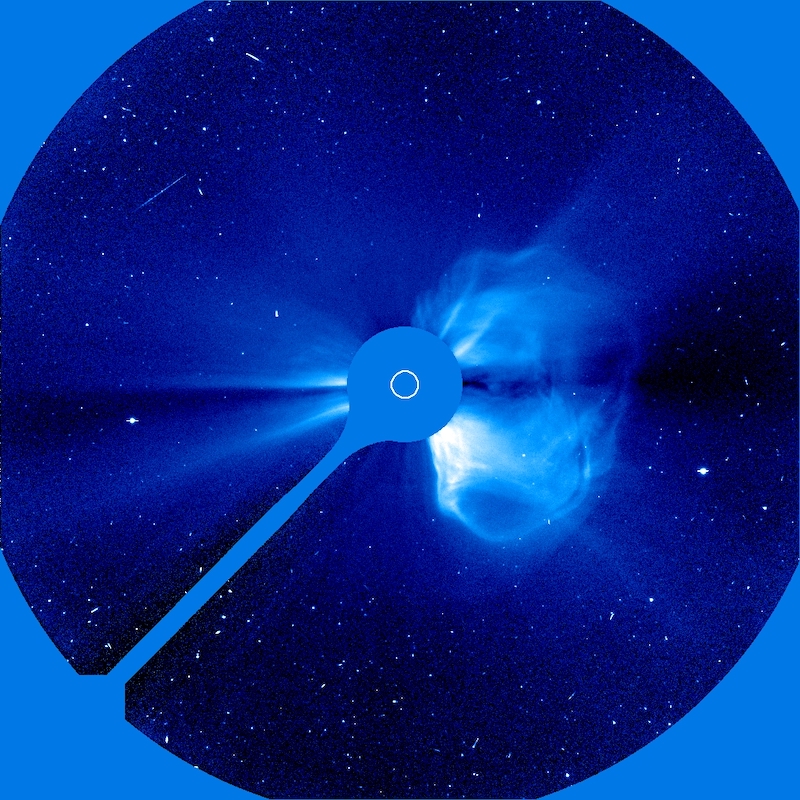
photograph of a coronal mass ejection

The Solar & Heliospheric Observatory (SOHO) took this coronagraphic image of a coronal mass ejection on 20 April 1998. [SOHO (ESA & NASA)]

Solar flares come in two basic flavors: eruptive and confined. Eruptive flares are accompanied by the launch of tangled clouds of plasma and magnetic fields called coronal mass ejections. Confined flares, so called because the solar plasma remains confined to the Sun, feature only a brief blast of high-energy radiation.

Both solar flares and coronal mass ejections can disrupt everyday life on Earth, with flares knocking out radio communications and coronal mass ejections threatening spacecraft electronics and power grids. Given these real-life risks, as well as the potential for probing the physics behind the activity on the Sun and other stars, it’s critical to be able to identify signs of upcoming flares.

Looking at the Lead-Up

Luckily, there’s growing evidence that the Sun sends out subtle signals that a flare is soon to happen. One early sign of an impending flare is an increase in the non-thermal velocity of the plasma at the flare’s location. This phenomenon has been spotted in individual flares, but it hasn’t been studied and characterized for a large sample of flares — until now.

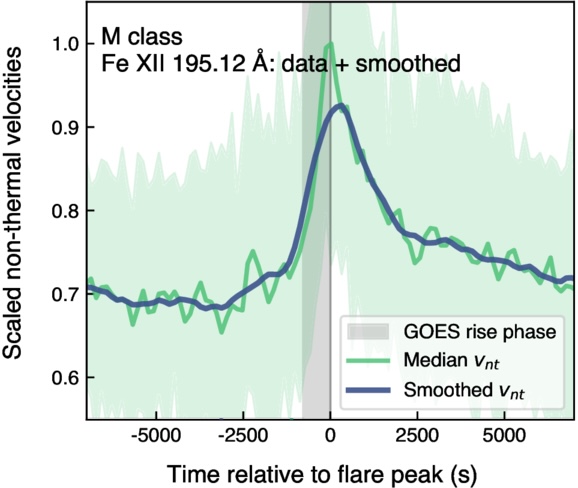
example of increasing non-thermal velocity before a solar flare

Demonstration of the increase in non-thermal velocity seen in an M-class flare compared to the onset and rise time of the soft X-ray flux (gray shaded area). [Adapted from To et al. 2025]

A recent research article led by Andy S. H. To (European Space Agency) takes the first systematic, large-scale approach to studying the non-thermal velocity changes that precede solar flares. The team amassed a sample of 1,449 solar flares that were seen by the Hinode spacecraft, the Geostationary Operational Environmental Satellite (GOES), and the Solar Dynamics Observatory (SDO). Hinode provided the spectral information needed to identify increases in the non-thermal velocity, GOES provided the flare start times, and SDO provided detailed information on the location and appearance of each flare.

Of the flares in the sample, 83% were moderately powerful C-class flares, 18% were stronger M-class flares, and 1% were the most powerful X-class flares. To’s team identified a clear trend across all types of flares: the non-thermal velocity increases 4–25 minutes before the flare’s X-ray emission begins to rise, peaks when the X-ray emission peaks, and decays as the flare decays. The team found some evidence that for smaller flares, the velocity increase begins in spectral lines that trace cooler plasma before spreading to lines probing hotter plasma, but more work is needed to confirm this trend.

More Details

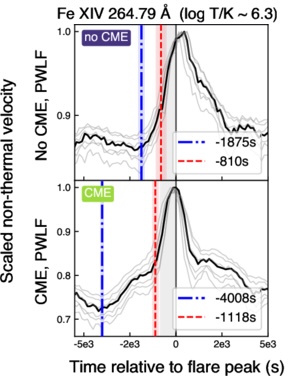
Examples of flares with and without coronal mass ejections

Examples of flares with and without coronal mass ejections. [Adapted from To et al. 2025]

Certain flares give even earlier hints of upcoming activity. M-class flares and some C-class flares exhibit what To’s team calls “precursor emission,” which emerges roughly 30–60 minutes before the flare’s X-ray emission peaks. The team also identified differences in precursor emission between confined and eruptive flares: eruptive flares display precursor emission over a broad range of spectral lines starting 45–74 minutes before the flare peaks, while confined flares show precursor emission later (31–54 minutes before peak) and in only a few spectral lines.

These results suggest that changes in the non-thermal velocity of solar plasma can not only signal when and where a flare is likely to arise, but also whether the flare will be accompanied by a potentially destructive coronal mass ejection. Upcoming missions like the Multi-slit Solar Explorer and SOLAR-C will give an even better view of the early stages of solar flares, helping to illuminate the physics behind them and enhancing our ability to forecast them.

Citation

“Systematic Nonthermal Velocity Increase Preceding Soft X-Ray Flare Onset: A Large-Scale Hinode/EIS Study,” Andy S. H. To et al 2025 ApJ 993 102. doi:10.3847/1538-4357/ae07de

The post How Solar Flares Hint That They’re About to Happen appeared first on AAS Nova.

Record-Breaking Black Hole Wind Blasts Through Space at 30% the Speed of Light

6 June 2026 at 14:18
Quasar Black HoleA distant quasar has revealed one of the most extreme ultraviolet outflows ever observed, providing new clues about the powerful interactions between supermassive black holes and their host galaxies. A supermassive black hole more than a billion times the mass of the Sun is blasting gas through space at such extraordinary speeds that astronomers are [...]

Room-Temperature Quantum Computing? A Superlattice Breakthrough Could Be Poised to Help Supercharge Information Science

5 June 2026 at 16:34


A novel phase of matter has been achieved by a team of American researchers, finally realizing a theoretical quantum prediction using nanoscale building blocks, a breakthrough that could pave the way for room-temperature quantum computing.

Researchers at Brown University and the University of Michigan College of Engineering revealed how they briefly stabilized the novel state of matter in a nanoparticle superlattice in a recent paper published in the journal Science. They say their work provides a new method for engineering classes of materials with custom-shaped nanoparticles, which could be applied to quantum computers and other quantum applications.

Quantum Blocks

“Our work is a little bit like kids playing with LEGO blocks,” said co-author Ou Chen, an associate professor of chemistry at Brown. “We synthesize unique nanoscale building blocks and stack them into interesting structures. In this case, we were able to stabilize these theorized transitional structures and demonstrate important quantum optical properties.”

Most metals form in one of two primary groups of crystal structures. The first is face-centered cubic (FCC), the tightest packing arrangement for spherical particles, typically forming a cube with a single particle at each corner and at the center of each face. The other type is body-centered cubic (BCC), a more loosely packed structure in which single particles are still present at the corners, but instead of each face being centered on a particle, one sits at the center of the entire arrangement.

For the most part, atoms form one of these structures as they arrange into a metal, yet at high temperatures, some metals can switch from one structure to another. When it reaches 912° Celsius, Iron will transition from BCC to FCC. One explanation proposed for the transition is the Nishiyama-Wassermann pathway, which suggests that, due to the lower symmetry of the transition phases between FCC and BCC, these phases are fleeting.

Testing the In-Between States

The American team behind the recent research decided to test this idea, fabricating one of those low symmetries in between phases with silver nanoparticles 

“Materials scientists have cared about how to control the amount of FCC and BCC in their metals for a long time, but the transitions between these phases have been hard to study because they are so unstable,” said co-author Tim Moore, an assistant research scientist at the University of Michigan. “Being able to observe these structures is a fundamental breakthrough in materials science, and it gives us greater control over nanomaterial engineering.”

At the heart of the team’s work was the truncated octahedron, or “mecon,” a 14-sided polyhedron formed by cutting off the vertices of a diamond, producing an intermediate shape between a cube and sphere.

As the team synthesized silver nanoparticles, they varied the heat level during production, resulting in a spectrum of shapes ranging from cubic to spherical, which were coated with long, sticky molecules that bound the particles. They found that the sticky molecules were required for the particles to assemble themselves into the intermediate shapes predicted by the Nishiyama-Wassermann pathway.

Near Quantum Behavior 

Once the particles self-assembled into variously shaped nanoparticle superlattices, the team tested their behavior with computer simulations and physical observations.

The superlattices show evidence of a process known as deep-strong light-matter coupling, in which silver electrons vibrate in unison with light waves, becoming so hybridized they could no longer be treated independently. The similarity of this state to quantum entanglement leaves the team hopeful that their superlattice can be applied to quantum work in the future. 

Crucially, this action occurs at room temperature, whereas in previous instances it occurred only at very cold temperatures. This means the work could be useful for developing quantum technologies, which have been limited by the extreme cold required.

“One of the major challenges in quantum computing is maintaining coherent quantum states without requiring extremely low temperatures,” Chen told The Debrief in an email. “Our work suggests that carefully engineered nanoparticle superlattices may provide a scalable materials platform where strong and coherent light–matter interactions can persist at room temperature.”

Quantum Applications

“In the long term, such systems could potentially be used to create or manipulate quantum states for applications in quantum information science, including quantum communication, sensing, or photonic quantum technologies,” Chen said. “However, it is important to emphasize that this research is still at the fundamental physics and materials discovery stage. We are not yet building a room-temperature quantum computer, but rather exploring new material platforms that may help enable future quantum technologies.”

As research continues, the team is focused on more precisely controlling the superlattices’ quantum optical properties.

“Specifically, we are interested in: Engineering nanoparticle architectures that produce even stronger and more controllable light–matter coupling; Exploring how structural order, particle shape, and lattice symmetry influence quantum optical behavior,” Chen explained, “and Integrating these materials with photonic and optoelectronic platforms for potential quantum-device applications.

“More broadly,” Chen concluded, “we see this work as opening a new direction where nanoscale self-assembly can be used to engineer emergent quantum optical properties that do not exist in the individual nanoparticles alone.”

The paper, “Stabilizing In-Transition Phases of Superlattices Through Shape Control of Silver Nanocrystals,” appeared in Science on May 28, 2026.

Ryan Whalen covers science and technology for The Debrief. He holds an MA in History and a Master of Library and Information Science with a certificate in Data Science. He can be contacted at ryan@thedebrief.org, and follow him on Twitter @mdntwvlf.

Researchers Measured Alien Planet Spins and Discovered a Surprising Pattern

4 June 2026 at 21:19
Relationship Between Mass and Spin for Giant Planets and Brown DwarfsA new Keck Observatory study indicates that giant planets can spin faster than more massive brown dwarfs, revealing important clues about how planetary systems form and evolve. Astronomers have long suspected that a planet’s mass may be linked to how quickly it spins. In our solar system, Jupiter and Saturn rotate especially fast, each completing [...]

NASA’s Roman Telescope Will Search 100 Million Stars for New Worlds

Milky Way Galaxy Envrionments InfographicNASA’s Roman Telescope could reveal 100,000 hidden worlds and rewrite what we know about planets across the Milky Way. NASA’s Nancy Grace Roman Space Telescope is expected to dramatically expand humanity’s catalog of worlds beyond our solar system. Known as exoplanets, these distant planets number nearly 6,300 discoveries so far through NASA missions and other [...]

A Cannibal Star Finally Solves One of Astronomy’s Biggest Mysteries

By: CSIRO
4 June 2026 at 20:09
Cannibal Star White Dwarf Red BinaryA star caught feeding on its companion has finally revealed the source of some of the galaxy’s most mysterious repeating signals. An international research team led by scientists at the University of Sydney has uncovered the strongest evidence yet explaining the origin of a puzzling type of cosmic signal. Their work has also revealed a [...]

Microsoft, Atom Computing update their quantum computing progress

3 June 2026 at 23:09

With dozens of companies, from small startups to tech giants, pursuing quantum computing, there's a steady flow of results as they try to find a path to utility. We typically focus on new technologies and major landmarks, which can obscure the fact that any big success will inevitably have been built on a lot of incremental progress.

The past few weeks have seen two companies release progress reports on how they're trying to get the technologies closer to general use. None of these represents a major breakthrough, but all are absolutely necessary for the technology to advance. The idea here is to convey the hard work required to move us closer to something useful.

Microsoft does material science

Microsoft is one of the few companies working on topological qubits, based on the distinct physics that occurs when particles are confined. Microsoft's system relies on a thin superconducting wire placed on top of a semiconductor. In superconductors, groups of two electrons form Cooper pairs. But if the wire contains an odd number of conducting electrons—meaning there's a single unpaired electron—it will end up delocalized to both ends of the wire. (Because quantum mechanics is weird.)

Read full article

Comments

© John Brecher for Microsoft

❌