 Login
Physicists have measured ‘negative time’ in the lab and it’s as weird as it sounds
9 June 2026 at 20:03
 Quantum particles are sometimes truly stunning.
 Quantum particles are sometimes truly stunning.
In early 1987, a team led by MIT’s Jacqueline Hewitt was imaging radio-emitting objects with the Very Large Array radio telescope as part of a gravitational lens survey. The unusual appearance of object MG1131+0456 – an oval with elongated bright spots at the ends – led to further investigation, and the researchers eventually concluded itContinue reading "June 9, 1988: First image of an Einstein ring"
The post June 9, 1988: First image of an Einstein ring appeared first on Astronomy Magazine.
By recreating a nuclear fireball, scientists uncovered unexpected chemistry that could change how radioactive fallout is understood. In the first fraction of a second after a nuclear explosion or a major reactor accident, an immense surge of energy superheats the surrounding environment. Nearby materials and air are instantly vaporized, creating a rapidly expanding fireball made [...]Magnetic fields may be the hidden force bringing both newborn stars and giant black holes together. New computer simulations suggest that magnetic fields play a crucial role in helping pairs of young stars form. The findings could explain why binary star systems are so common throughout the Milky Way and may even offer clues about [...]
Forecasting solar flares is one of the major challenges facing solar physicists today. New research finds that non-thermal emission can precede a solar flare by more than an hour, and this early emission may signal whether the flare will be accompanied by an explosion of plasma.

The Solar & Heliospheric Observatory (SOHO) took this coronagraphic image of a coronal mass ejection on 20 April 1998. [SOHO (ESA & NASA)]
Both solar flares and coronal mass ejections can disrupt everyday life on Earth, with flares knocking out radio communications and coronal mass ejections threatening spacecraft electronics and power grids. Given these real-life risks, as well as the potential for probing the physics behind the activity on the Sun and other stars, it’s critical to be able to identify signs of upcoming flares.
Luckily, there’s growing evidence that the Sun sends out subtle signals that a flare is soon to happen. One early sign of an impending flare is an increase in the non-thermal velocity of the plasma at the flare’s location. This phenomenon has been spotted in individual flares, but it hasn’t been studied and characterized for a large sample of flares — until now.
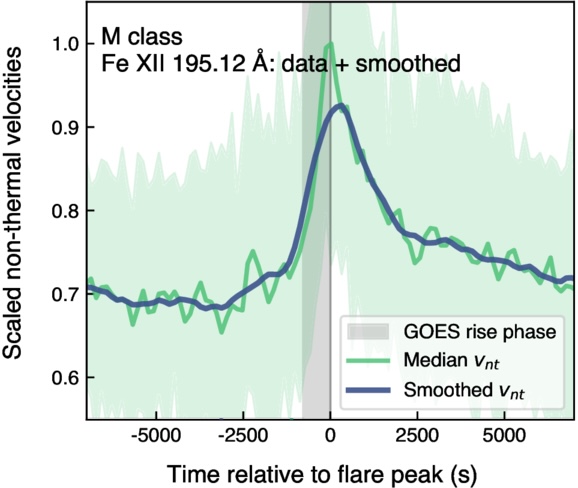
Demonstration of the increase in non-thermal velocity seen in an M-class flare compared to the onset and rise time of the soft X-ray flux (gray shaded area). [Adapted from To et al. 2025]
Of the flares in the sample, 83% were moderately powerful C-class flares, 18% were stronger M-class flares, and 1% were the most powerful X-class flares. To’s team identified a clear trend across all types of flares: the non-thermal velocity increases 4–25 minutes before the flare’s X-ray emission begins to rise, peaks when the X-ray emission peaks, and decays as the flare decays. The team found some evidence that for smaller flares, the velocity increase begins in spectral lines that trace cooler plasma before spreading to lines probing hotter plasma, but more work is needed to confirm this trend.

Examples of flares with and without coronal mass ejections. [Adapted from To et al. 2025]
These results suggest that changes in the non-thermal velocity of solar plasma can not only signal when and where a flare is likely to arise, but also whether the flare will be accompanied by a potentially destructive coronal mass ejection. Upcoming missions like the Multi-slit Solar Explorer and SOLAR-C will give an even better view of the early stages of solar flares, helping to illuminate the physics behind them and enhancing our ability to forecast them.
“Systematic Nonthermal Velocity Increase Preceding Soft X-Ray Flare Onset: A Large-Scale Hinode/EIS Study,” Andy S. H. To et al 2025 ApJ 993 102. doi:10.3847/1538-4357/ae07de
The post How Solar Flares Hint That They’re About to Happen appeared first on AAS Nova.
A distant quasar has revealed one of the most extreme ultraviolet outflows ever observed, providing new clues about the powerful interactions between supermassive black holes and their host galaxies. A supermassive black hole more than a billion times the mass of the Sun is blasting gas through space at such extraordinary speeds that astronomers are [...]A dark void once dismissed as cosmic dust may be a far more fascinating dance of black holes.
A novel phase of matter has been achieved by a team of American researchers, finally realizing a theoretical quantum prediction using nanoscale building blocks, a breakthrough that could pave the way for room-temperature quantum computing.
Researchers at Brown University and the University of Michigan College of Engineering revealed how they briefly stabilized the novel state of matter in a nanoparticle superlattice in a recent paper published in the journal Science. They say their work provides a new method for engineering classes of materials with custom-shaped nanoparticles, which could be applied to quantum computers and other quantum applications.
“Our work is a little bit like kids playing with LEGO blocks,” said co-author Ou Chen, an associate professor of chemistry at Brown. “We synthesize unique nanoscale building blocks and stack them into interesting structures. In this case, we were able to stabilize these theorized transitional structures and demonstrate important quantum optical properties.”
Most metals form in one of two primary groups of crystal structures. The first is face-centered cubic (FCC), the tightest packing arrangement for spherical particles, typically forming a cube with a single particle at each corner and at the center of each face. The other type is body-centered cubic (BCC), a more loosely packed structure in which single particles are still present at the corners, but instead of each face being centered on a particle, one sits at the center of the entire arrangement.
For the most part, atoms form one of these structures as they arrange into a metal, yet at high temperatures, some metals can switch from one structure to another. When it reaches 912° Celsius, Iron will transition from BCC to FCC. One explanation proposed for the transition is the Nishiyama-Wassermann pathway, which suggests that, due to the lower symmetry of the transition phases between FCC and BCC, these phases are fleeting.
The American team behind the recent research decided to test this idea, fabricating one of those low symmetries in between phases with silver nanoparticles
“Materials scientists have cared about how to control the amount of FCC and BCC in their metals for a long time, but the transitions between these phases have been hard to study because they are so unstable,” said co-author Tim Moore, an assistant research scientist at the University of Michigan. “Being able to observe these structures is a fundamental breakthrough in materials science, and it gives us greater control over nanomaterial engineering.”
At the heart of the team’s work was the truncated octahedron, or “mecon,” a 14-sided polyhedron formed by cutting off the vertices of a diamond, producing an intermediate shape between a cube and sphere.
As the team synthesized silver nanoparticles, they varied the heat level during production, resulting in a spectrum of shapes ranging from cubic to spherical, which were coated with long, sticky molecules that bound the particles. They found that the sticky molecules were required for the particles to assemble themselves into the intermediate shapes predicted by the Nishiyama-Wassermann pathway.
Once the particles self-assembled into variously shaped nanoparticle superlattices, the team tested their behavior with computer simulations and physical observations.
The superlattices show evidence of a process known as deep-strong light-matter coupling, in which silver electrons vibrate in unison with light waves, becoming so hybridized they could no longer be treated independently. The similarity of this state to quantum entanglement leaves the team hopeful that their superlattice can be applied to quantum work in the future.
Crucially, this action occurs at room temperature, whereas in previous instances it occurred only at very cold temperatures. This means the work could be useful for developing quantum technologies, which have been limited by the extreme cold required.
“One of the major challenges in quantum computing is maintaining coherent quantum states without requiring extremely low temperatures,” Chen told The Debrief in an email. “Our work suggests that carefully engineered nanoparticle superlattices may provide a scalable materials platform where strong and coherent light–matter interactions can persist at room temperature.”
“In the long term, such systems could potentially be used to create or manipulate quantum states for applications in quantum information science, including quantum communication, sensing, or photonic quantum technologies,” Chen said. “However, it is important to emphasize that this research is still at the fundamental physics and materials discovery stage. We are not yet building a room-temperature quantum computer, but rather exploring new material platforms that may help enable future quantum technologies.”
As research continues, the team is focused on more precisely controlling the superlattices’ quantum optical properties.
“Specifically, we are interested in: Engineering nanoparticle architectures that produce even stronger and more controllable light–matter coupling; Exploring how structural order, particle shape, and lattice symmetry influence quantum optical behavior,” Chen explained, “and Integrating these materials with photonic and optoelectronic platforms for potential quantum-device applications.
“More broadly,” Chen concluded, “we see this work as opening a new direction where nanoscale self-assembly can be used to engineer emergent quantum optical properties that do not exist in the individual nanoparticles alone.”
The paper, “Stabilizing In-Transition Phases of Superlattices Through Shape Control of Silver Nanocrystals,” appeared in Science on May 28, 2026.
Ryan Whalen covers science and technology for The Debrief. He holds an MA in History and a Master of Library and Information Science with a certificate in Data Science. He can be contacted at ryan@thedebrief.org, and follow him on Twitter @mdntwvlf.
It could cause trillions of dollars worth of damage and untold chaos.A new Keck Observatory study indicates that giant planets can spin faster than more massive brown dwarfs, revealing important clues about how planetary systems form and evolve. Astronomers have long suspected that a planet’s mass may be linked to how quickly it spins. In our solar system, Jupiter and Saturn rotate especially fast, each completing [...]NASA’s Roman Telescope could reveal 100,000 hidden worlds and rewrite what we know about planets across the Milky Way. NASA’s Nancy Grace Roman Space Telescope is expected to dramatically expand humanity’s catalog of worlds beyond our solar system. Known as exoplanets, these distant planets number nearly 6,300 discoveries so far through NASA missions and other [...]A star caught feeding on its companion has finally revealed the source of some of the galaxy’s most mysterious repeating signals. An international research team led by scientists at the University of Sydney has uncovered the strongest evidence yet explaining the origin of a puzzling type of cosmic signal. Their work has also revealed a [...]With dozens of companies, from small startups to tech giants, pursuing quantum computing, there's a steady flow of results as they try to find a path to utility. We typically focus on new technologies and major landmarks, which can obscure the fact that any big success will inevitably have been built on a lot of incremental progress.
The past few weeks have seen two companies release progress reports on how they're trying to get the technologies closer to general use. None of these represents a major breakthrough, but all are absolutely necessary for the technology to advance. The idea here is to convey the hard work required to move us closer to something useful.
Microsoft is one of the few companies working on topological qubits, based on the distinct physics that occurs when particles are confined. Microsoft's system relies on a thin superconducting wire placed on top of a semiconductor. In superconductors, groups of two electrons form Cooper pairs. But if the wire contains an odd number of conducting electrons—meaning there's a single unpaired electron—it will end up delocalized to both ends of the wire. (Because quantum mechanics is weird.)
© John Brecher for Microsoft
A new MIT-designed lidar chip uses specially engineered antennas to reduce interference and widen the sensor’s field of view. From self-driving cars navigating busy streets to drones surveying disaster zones, lidar has become one of the most important technologies for helping machines perceive the world in three dimensions. By sending out rapid pulses of infrared [...]
In 1973, John Archibald Wheeler described the relationship between space and matter in two sentences: “Space acts on matter, telling it how to move. In turn, matter reacts back on space, telling it how to curve.” Wheeler’s words serve as a pithy encapsulation of general relativity, Albert Einstein’s theory of gravity. Wheeler’s sentences also lay out a challenge that theorists face today: When…
While searching for new Higgs bosons the CMS experiment at the Large Hadron Collider (LHC) may have just found a surprise. They have observed an excess of events that look to be a new particle, and are reporting high statistical evidence for their claim. The only question is what exactly is this new particle?
The search was initially designed to look for new, heavier, versions of the Higgs boson decaying to a top quark and an anti-top quark. Its well known that the Higgs boson of the Standard Model, discovered jointly by ATLAS and CMS in 2012, underlies the mechanism which gives all fundamental particles their masses. The Higgs boson itself interacts with particles in proportion to their mass, preferring heavier particles over lighter ones. It therefore interacts the most strongly with the heaviest known fundamental particle, the top quark, which has a mass of ~173 GeV. The Higgs boson itself only has a bass of 125 GeV, meaning conservation of energy dictates it can’t decay into a top quark-antiquark pair.
However many theories of physics beyond the the Standard Model predict additional Higgs bosons, heavier cousins of the current one. If these new heavy Higgs bosons had a mass larger than 350 GeV, they would likely decay to a top quark-antiquark pair quite often. CMS therefore was analyzed its data searching for this signature, hoping to find signs of a new Higgs boson. To do so, they had scrutinize very carefully the known production of top quark-antiquark pairs, which are produced copiously at the LHC from other processes. If a new particle was being produced and decaying to top quarks, the mass of the new particle would give the top quarks a characteristic energy. One key sign of a new particle would therefore be an excess of top quark-antiquark events at a particular energy, corresponding to the mass of the new particle.
When CMS scrutinized their data looking for such an excess they found one. But curiously right ~350 GeV, the minimum energy required to produce the top quark-antiquark pair. It would be quite the coincidence for a new particle to show up right at this minimum threshold, which made CMS consider alternative possibilities.

One unorthodox explanation that seems to fit the bill is ‘toponium’, a short lived bound state of the top quark-antiquark pair is being formed. Toponium would be the heaviest version of ‘quarkonia’ we have seen, bound states of quark antiquark pairs that form bound states similar to atoms. We have observed and measured quarkonia states of the other quarks for decades, however it was long thought that the top quark, whose large mass causes it to decay in just 10^(-25) seconds, would decay too quickly to create observable bound state effects at a hadron collider. Toponium production would happen most often if the top quarks were produced just at the energy threshold, such that they don’t any extra energy. These low energy top quarks would spend more time close to each other than normal, rather than immediately flying away, so they could have time to briefly form a toponium state before decaying. However, once small hints of intriguing excesses started appearing in LHC analyses, updated calculations in the last few years suggested that perhaps such an effect could be observable.
These calculations are approximate, and more work is still being done to refine them. But the preliminary predictions they give for the properties of toponium seem to match well with what CMS is seeing, both in terms of the rate of toponium production and the quantum properties of the toponium state (spin and parity).
Still CMS is being cautious before claiming a discovery of toponium. They claim observation of an ‘excess at the top quark pair production threshold’ which is consistent with toponium. However given the limited present data and incomplete theoretical models of toponium, they cannot rule out that the excess they are seeing is coming from a new Higgs-like particle.

Further work will be needed to develop improved theoretical models of toponium, and detailed studies from CMS assessing the properties of their observed excess. The excess will also need confirmation from CMS’s rival LHC experiment, ATLAS, to ensure it has not merely made a mistake in its analysis.
However, the smart money would say this very likely looks like toponium. Which, while not signaling the long sought overthrow of the standard model, would be an unexpected and cool surprise from the LHC. Understanding the properties of this previously-thought-impossible quasiparticle will spawn much fruitful research in the years to come. Physicists love a surprise!
“Observation of a pseudoscalar excess at the top quark pair production threshold” https://arxiv.org/abs/2503.22382
Additional CMS Paper considering Heavy-Higgs interpretation “Search for heavy pseudoscalar and scalar bosons decaying to top quark pairs in proton-proton collisions”
Discloure: The author is a member of the CMS collaboration but did not directly work on this analysis
Erratum 4/15/2025 : The article was updated to clarify that in the theory literature prior to the LHC toponium was thought possible to form, just that it was thought to be too small an effect to be observable. The article previously incorrectly stated it had been previously thought impossible to form
