If matter and antimatter had come out of the Big Bang in equal amounts, there would be no stars today. Every particle has an antimatter twin with the opposite electric charge, and when the two meet, both vanish in a burst of energy. A perfect balance would have left a universe of pure light, with […]
Carbon is the 4th most abundant element in the universe. It’s everywhere, from the air you breathe to the carbohydrates in your food to the petroleum in the Earth’s crust. Like most elements, carbon was not created by the Big Bang, but came from 2 different types of stars that fuse lighter elements together.
Massive stars at least 8 times the Sun’s mass fuse 3 helium atoms into a carbon atom in their cores, through a mechanism called the triple-alpha process. They eventually expel this carbon into space, either through a stream of material called astellar wind or at the end of their lives during a core-collapse supernova.
Meanwhile, low-to-intermediate-sized stars between ½ and 8 times the Sun’s mass also induce the triple-alpha process. But unlike massive stars, they produce carbon not in their cores, but in a dense shell of helium that surrounds them during an advanced stage known as the asymptotic giant branch or AGB. AGB stars undergo cycles of swelling and contraction, during which they shed some of their material into space.
While scientists understand these processes, the contribution of each star type to the carbon supply in the universe remains uncertain. To address this, a team of scientists modeled how the chemical elements in the Milky Way Galaxy change over time with different contributions from the 2 carbon-creating processes. They then verified their findings by comparing them with the actual carbon concentration in the Milky Way.
To obtain the benchmark for the Milky Way Galaxy’s carbon content, the team turned to the catalog of stars observed by the Apache Point Observatory Galactic Evolution Experiment (APOGEE) survey. They selected 14,066 stars that were large and bright enough to yield reliable data but, unlike AGB and massive stars, were still at a stage of life when their newly produced carbon was still confined to their cores. The researchers used the carbon in the outer layers of these stars, known as subgiants, as a compositional record of the gas from which they formed, thereby estimating the Galaxy’s carbon content during their formation.
The scientists started with a computer program developed by another team that models how the Milky Way’s chemistry changes over time. First, the team calculated the potential amount of carbon produced by different types of stars using estimates from earlier studies. Then, they incorporated these results into a model that accounts for how stars form, fuse elements, and release carbon into the Galaxy, using a simulation program called the Versatile Integrator for Chemical Evolution, or VICE. The researchers ran 14 versions of this model, each assuming a different contribution of carbon from AGB stars relative to massive stars.
In their computer model, the Milky Way Galaxy began as a set of 200 concentric rings, each containing its own population of stars, different speeds at which stars form, and varying amounts of gas available to form new stars. The team then stitched these rings together by having stars migrate between them. They allowed these model Galaxies to settle over 10 billion years, then picked a random sample of 14,066 simulated stars to compare their carbon content with carbon in the same number of observed subgiants from APOGEE.
The team’s model most closely reproduced the actual carbon content of the Milky Way’s subgiant stars when AGB stars contribute between 10% and 40% of the Galaxy’s carbon, with the strongest agreement occurring at 15% to 30%. Even though they found that massive stars are the dominant source of carbon, they also found that smaller AGB stars could produce carbon more efficiently than previously thought, though they take longer to become carbon sources than their larger counterparts.
The team concluded that their estimates of how much carbon comes from AGB and massive stars provide a benchmark for future studies, as the connection between the production of elements inside stars and the processes by which those same stars lose mass remains poorly understood. They suggested that future researchers analyze larger sample sizes, examine other galaxies, and use data from future surveys to better understand the chemical history of the universe.
There’s a temperature nothing in the universe has ever touched. It’s called absolute zero, equal to -273.15°C (-459.67°F), the point at which the particles that make up matter would lose all their kinetic energy and simply stop moving. In 1848, the British physicist William Thomson — better known as Lord Kelvin — proposed making that […]
A catalog of almost 3,000 white dwarfs that exploded as type Ia supernovas after overfeeding on companion stars indicates that dark energy, the mysterious force accelerating the expansion of the universe, is changing over time.
The discovery, in conjunction with data from the Dark Energy Survey (DES), backs results revealed from the Dark Energy Spectroscopic Instrument (DESI) published in 2024 that suggested dark energy's influence is weakening.
That means that the team's research doesn't just involve the most comprehensive catalog of type Ia supernovas; it presents the clearest picture yet of the evolution of the universe and the influence of dark energy.
"We've rebuilt 3 decades of astronomical observations into a single, consistent framework," team member Ryan Camilleri of the University of Queensland said in a statement."We combined our data with other cosmic measurements, including relic light from the Big Bang and maps of how galaxies are distributed through space.
"Instead of confirming the standard model of cosmology, which assumes dark energy is fixed and unchanging, we have more evidence that dark energy may change over time."
How do exploding white dwarfs tell us about dark energy?
White dwarfs are the smoldering stellar remnants that are left over when stars with around the mass of the sun exhaust the fuel for nuclear fusion in their cores. This ends the outward pressure that supports a star against its own gravity, meaning the star's core collapses as the outer layers are shed. The core becomes a white dwarf, and for single stars, that is the end. But around 50% of sun-sized stars have a binary companion, and this can lead to renewed activity and a change in the star's fate.
If the white dwarf and its companion are close enough together, the dead star begins stripping away the outer layers of its companion. As this material builds on the white dwarf, it pushes the stellar remnant's mass over the so-called Chandrasekhar limit, allowing it to go supernova.
These cosmic explosions are called type Ia supernovas, and their light output is so uniform that these events are referred to as standard candles. They are of vital importance because measuring how their light has been redshifted as it travels means type Ia supernovas can be used to measure cosmic distances.
"Over the years we've learned a lot more about how supernovae behave so we've been able to go back and apply that improved understanding to older data," Camilleri said. "Extensive work has been done to link observations from different telescopes with different capacities and take into account issues such as cosmic dust and galaxy mass which can affect the light coming from a supernova.
"We also incorporated more subtle effects such as gravitational lensing, which is the bending and magnification of light around large objects as it travels from a supernova to Earth."
Two "fans" representing DESI observations above and below the plane of the Milky Way (Image credit: DESI Collaboration/DOE/KPNO/NOIRLab/NSF/AURA/R. Proctor/ Robert Lea (created with Canva))
Combined with the 2024 results from DESI, this research could change our idea of what dark energy actually is.
"Our supernova data from DES in 2024 first showed hints that dark energy may be time-varying, and this new compilation also sees a deviation from the standard model, although in a slightly different direction," Davis said. "Similarly, results from DESI found hints of variations in dark energy in its surveys of relic sound waves from the early universe.
"So, two completely independent measurements have found hints of time variation in dark energy, challenging the standard model that dark energy doesn't change."
Davis added that, as well as revealing what dark energy actually is, this research may also hold the clue to explaining how gravity and quantum physics fit together. While quantum physics (the best theory we have of how the universe operates at subatomic scales) and Einstein's theory of general relativity (our best picture of gravity) have been highly successful in their own rights, scientists have so far been unable to unite them. In other words, there is no theory of quantum gravity.
“We know these two theories are each immensely successful in their own realms, so if we can figure out how to put them together, that would be a huge step in theoretical physics," Davis continued.
This effort will receive a boost when data is added to the team's already comprehensive type Ia supernova catalog. This will include observations from the Dark Energy Bedrock All-Sky Supernova program (DEBASS), which is detecting hundreds more local supernovas than even the DES survey.
The team's results are available on the repository site arXiv.
Physicists around the world remain deeply divided on key mysteries of the universe, from dark matter to quantum gravity. The standard cosmological model failed to gain majority support, and no leading theory dominated the survey results. The largest survey ever conducted among physicists worldwide reveals surprisingly little agreement on some of the field’s biggest mysteries, [...]
Astronomers have combined 2,884 Type Ia supernovae -- which are used to measure cosmic distances -- with cosmic microwave background and galaxy-mapping data, deepening cracks in the standard ‘cosmological constant’ model.
In the 1970s, astronomer Vera Rubin analyzed a series of observations of how quickly different galaxies rotated around their centers. She found that these galaxies rotated much faster than they should have, given the amount of material visible through starlight. She concluded that a large fraction of these galaxies’ masses must therefore consist of some kind of unseen material.
Scientists have since observed galaxies to more precisely measure this unseen material, which they now call dark matter. They’ve shown that dark matter moves much more slowly than the speed of light. Unlike most celestial objects, it can’t emit or block any light, meaning it doesn’t interact with the electromagnetic force. Even though it doesn’t interact with a fundamental force in the universe, dark matter constitutes over 80% of the mass of an average galaxy.
In the prevailing model of cosmology, known as ΛCDM (pronounced “Lambda-CDM”), dark matter determined where galaxies formed. The theory is that gravity pulled dark matter together more quickly than regular matter in the primordial universe. This redistribution led to regions of space with greater mass density, which collected chaotic, regular matter into pools that eventually formed galaxies, stars, and planets.
In the present universe, dark matter and regular matter coexist in galaxies, though generally separated. Regular matter pools in the very center of galaxies, forming the more familiar galactic disks. Dark matter stays towards the edges of galaxies, enveloping the regular matter disks in what are known as dark matter halos. Because these halos make up so much of the mass of the average galaxy, researchers Guangze Sun, Fangzhou Jiang, and Jing Wang conducted a series of simulations to test how dark matter halos affect regular matter in galaxies. Specifically, they examined what characteristics of dark matter halos determine galaxy sizes.
The force of gravity works such that more massive dark matter halos draw in more regular matter and produce larger galaxies. So these researchers fixed the total mass of the galaxies they simulated at 100 billion times that of the Sun to determine which properties of the dark matter halos would produce the widest galaxies. They selected 4 variables to test: the total density of dark matter in the galactic halo, the density of dark matter in the innermost 1% of the halo, how fast the halo spun, and the ratio of regular matter to dark matter in the entire galaxy. For each variable, they tested 3 to 4 inputs representing low, moderate, and high values against a standard reference value and ran 132 total simulations to generate enough data for statistical analyses.
To simulate the complex physics of dark matter halos, the team used the modeling software GIZMO to model gravity, magnetism, and fluid dynamics. They combined this with a second model, called FIRE-3, which modeled how stars explode at the end of their lives, how much metal these explosions produce, and how gases heat up and cool down over time. The researchers ran the dynamic simulations for 3 billion model years, then used a program they developed based on the existing Pynbody to measure the radii of the simulated galaxies.
The team found that the faster a dark matter halo spun around a simulated galaxy, the larger the galaxy became, as shown in scenario 1 in the figure below. By contrast, in scenario 2, increasing the halo’s total dark matter concentration caused the central galaxy to shrink. Increasing only the innermost dark matter density in the halo had a smaller effect but generally reduced the galaxy’s size, as shown in scenario 3. And lastly, increasing the ratio of regular matter to dark matter in galaxies resulted in smaller galaxies that formed stars closer to their centers, as shown by a greater concentration of stars in scenario 4.
This diagram showcases the team’s results across 4 broad scenarios. The left column depicts a default galaxy under the baseline parameters. The right column depicts how the galaxies changed when the team varied a single experimental factor, including 1) increasing how fast the dark matter halo spun, 2) increasing the total density of the dark matter halo, 3) increasing the density of dark matter in the innermost halo, and 4) increasing the ratio of regular matter to dark matter in the entire galaxy. The dark matter haloes are represented as red rings surrounding the galaxies, not to scale. Illustration by Andrew Bizal.
The team’s results suggest a previously unknown connection between the properties of dark matter halos and galactic disks. However, they cautioned that their simulations were all run on galaxies in isolation, unlike in the actual ΛCDM universe, where their interactions are complicated by galaxies tugging on one another or by material moving from one to another. To further test their results for single galaxies, the researchers plan to run follow-up experiments with halos of different sizes, as well as with galaxies with different shapes and features, such as clumps, gaps, and lopsidedness.
JWST‘s ability to see deep into the cosmos gives astronomers insight into the early universe and challenges prior expectations of what they would find there. Now, an international team led by astronomers from the Netherlands’ Leiden University recently reported the discovery of new stars in a paper published in Nature Astronomy.
With the discovery of these many previously unknown small stars, the researchers say astronomers may need to reconsider the expected mass of these early galaxies, as JWST reveals unexpected levels of development shortly after the Big Bang.
James Webb Space Telescope Observations
For their new work, the astronomers focused on nine massive galaxies in the early universe that had completed their main star-formation period. They combined JWST data with earlier observations from the Very Large Telescope in Chile, operated by the European Southern Observatory.
Spectroscopy is a crucial element of JWST data, breaking light down into separate spectra that allow astronomers to study stars and even planetary atmospheres across extreme distances. However, the smaller, fainter stars revealed in this new research can be much harder to detect than the brighter, more powerful ones.
“If a galaxy were a city, the brightest stars would be the skyscrapers you can immediately see from far away,” said first author Chloe Cheng. “Our models show that behind the brightest stars there is a much larger population of small stars, like houses among the skyscrapers. This means that the galaxy as a whole is much more massive than previous estimates suggested.”
Stellar Birth
Working with data limited by the sensitivity of tools, researchers previously were unable to see as many smaller stellar objects. Researchers then assumed a similar ratio of small to large stars across the universe, which these new findings are now challenging.
Instead, they found ancient massive galaxies filled with many more small stars than previously expected, and far more than in our own Milky Way galaxy today, which is a smaller galaxy. The mass differences produced by this glut of tiny stars increased the expected mass of the galaxy under 1.5 billion years old by fourfold.
“Measurements like these were simply not possible until recently,” explained co-author Martje Slob. “We needed not only a telescope capable of collecting enough light, but also exceptionally high-quality spectra and new analysis techniques. Only then could we reliably distinguish the subtle features of small stars from the light of much brighter stars.”
JWST Discoveries
Launched almost five years ago, JWST has continually defied what astronomers expected to find in the ancient universe. It turns out that the universe shortly after the Big Bang was more massive and had undergone more development than previously considered possible. The new findings add to those ongoing discoveries.
“This result shows that much more mass than we thought is hidden in small stars,” said study lead Professor Mariska Kriek. “It has implications for many areas of astronomy. Small stars often have planets orbiting them, so if there were many more small stars in the early Universe than we thought, there may also have been more planets.”
To follow up on this exciting discovery, the team plans to look even further back into the universe’s past in future observations that will study some of the universe’s very earliest stars.
Ryan Whalen covers science and technology for The Debrief. He holds an MA in History and a Master of Library and Information Science with a certificate in Data Science. He can be contacted at ryan@thedebrief.org.
Editor’s Note:Astrobites is a graduate-student-run organization that digests astrophysical literature for undergraduate students. As part of the partnership between the AAS and astrobites, we occasionally repost astrobites content here at AAS Nova. We hope you enjoy this post from astrobites; the original can be viewed at astrobites.org.
JWST launched in 2021, and one of its key goals was to observe the first galaxies as they formed. Early results from JWST found something surprising: extremely massive galaxies in the early universe that had “quenched,” or stopped making new stars, much faster than was expected. These early results led some to believe that our understanding of how quickly massive galaxies can form and quench was fundamentally wrong.
Before concluding that our understanding of the universe is broken, it’s important to find other reasons why we might see very massive galaxies in the early universe. One theory is that these galaxies are actually less massive than we think. To “weigh” a galaxy, astronomers first measure the amount of light being emitted by that galaxy. If all the light in a galaxy comes from stars (which should be true in the early universe, though active black holes can contribute a lot of light in some galaxies), you can infer the total number of stars by accounting for the average amount of light emitted per star of a certain mass; this is called the “mass-to-light ratio.” Since massive stars emit a lot more light than low-mass stars, and high-mass stars die out faster than low-mass stars, the mass-to-light ratio is higher for older stellar populations. To accurately “weigh” a galaxy, scientists therefore need both a good measurement of the total amount of light in the galaxy and how old its stellar population is. The authors of today’s article suggest that the uncertainty in these measurements might be leading to overestimates of galaxy masses and underestimates of galaxy star formation rates, possibly explaining the existence of the earliest massive quiescent (non-star-forming) galaxies.
The Impact of Color Gradients
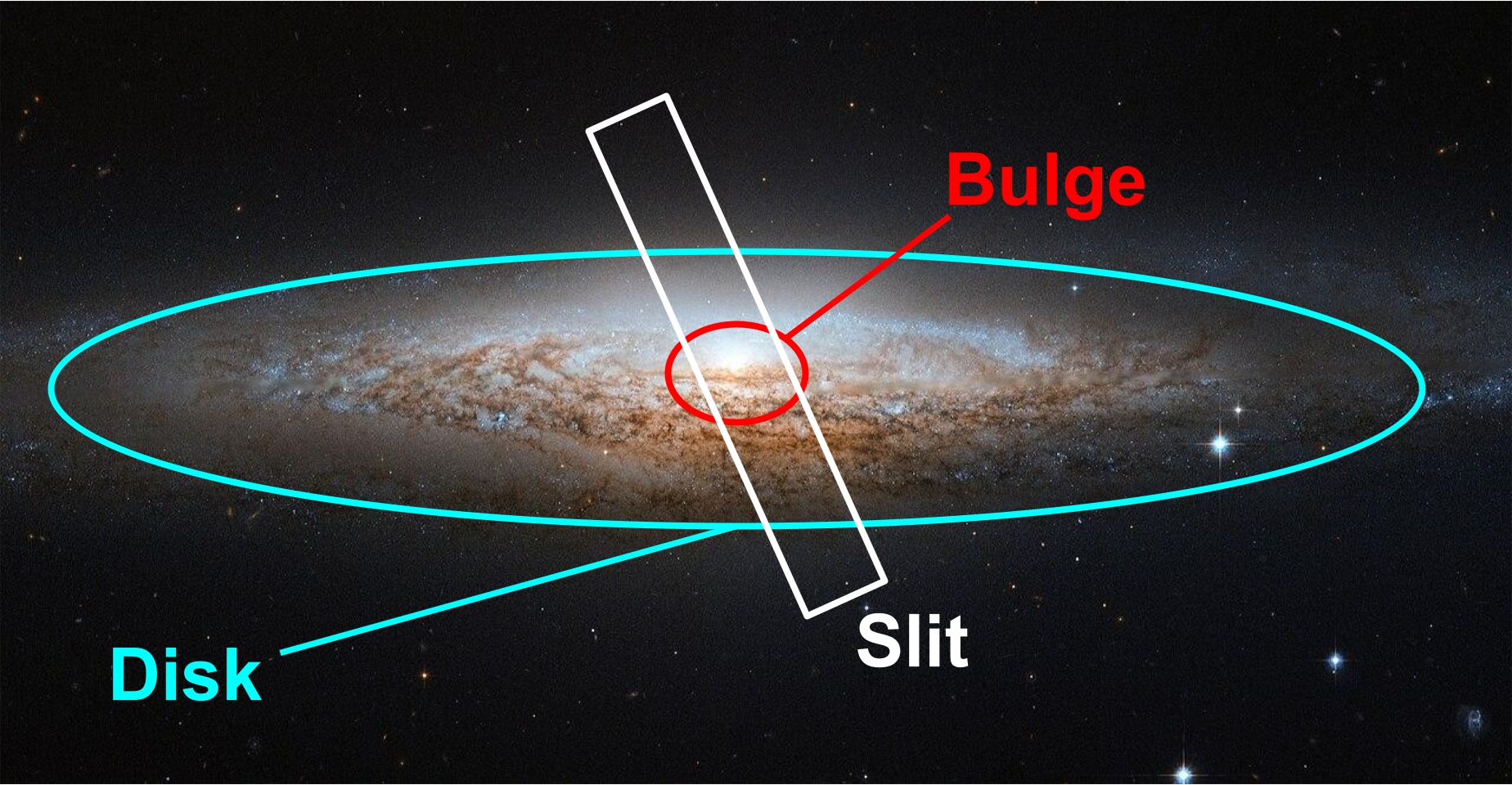
Previousworks about the massive quiescent galaxies in this study used spectroscopy to determine the galaxies’ masses and star formation rates. These spectra were taken with a “slit,” which introduces a source of error: if the slit is smaller than the image of the galaxy, some of the galaxy’s light will be missed in the spectrum. Astronomers usually correct for this by checking how much of the total light of a galaxy image is covered by the slit and scaling up the spectrum to account for the missing light, but this correction assumes that the spectrum is basically the same across the entire galaxy.
However, this assumption is rarely correct. In the local universe, star-forming spiral galaxies like the Milky Way tend to be made of a central “bulge” surrounded by a “disk” (see Figure 1). The bulge is no longer actively forming new stars, leading to a red-to-blue color gradient as you move out from the center of the galaxy. In astronomy, this is considered a “negative” color gradient. A slit that only covers the galaxy center would lead to an overall overestimate of the stellar mass and underestimate of the star formation rate. If the galaxies instead had a positive color gradient, with more star formation in the center of the galaxy, the mass would be underestimated and the star formation rate would be overestimated. Galaxies with both positive and negative color gradients have been found in the distant universe. By measuring the color gradient for each individual galaxy in their sample, the authors can correct the mass and star formation rate calculations from spectra taken with a slit spectrograph.
Figure 1: The spiral galaxy NGC 2683 with its bulge and disk labeled. The inner part of the galaxy (“bulge”) contains older, redder stars; the outer part of the galaxy (“disk”) contains bright blue stars that indicate that star formation is ongoing. Here, the slit spectrograph only covers the galaxy’s bulge, leading to incorrect mass and star formation rate measurements. [ESA/Hubble & NASA (CC BY 4.0) with annotations by Margaret Verrico]
Results
Instead of using spectra, the authors of today’s article use imaging in different filters to measure color gradients for a sample of four galaxies in the early universe that had previously been found to be extremely massive and no longer forming stars. They use medium-band filters, or filters that let in only a small part of a galaxy’s spectrum, to produce a spectral energy distribution at each radius. This spectral energy distribution is less informative than a spectrum (think a handprint versus a fingerprint), but it’s detailed enough to model the likely stellar population at each radius to determine whether the galaxies have positive, negative, or no color gradients, allowing for better corrections to the properties measured from the galaxies’ centers. They also model the stellar population from the central part of the galaxy that would normally be covered by a slit, as well as from the actual spectrum, to test whether any differences in their results come from their choice of modeling techniques.
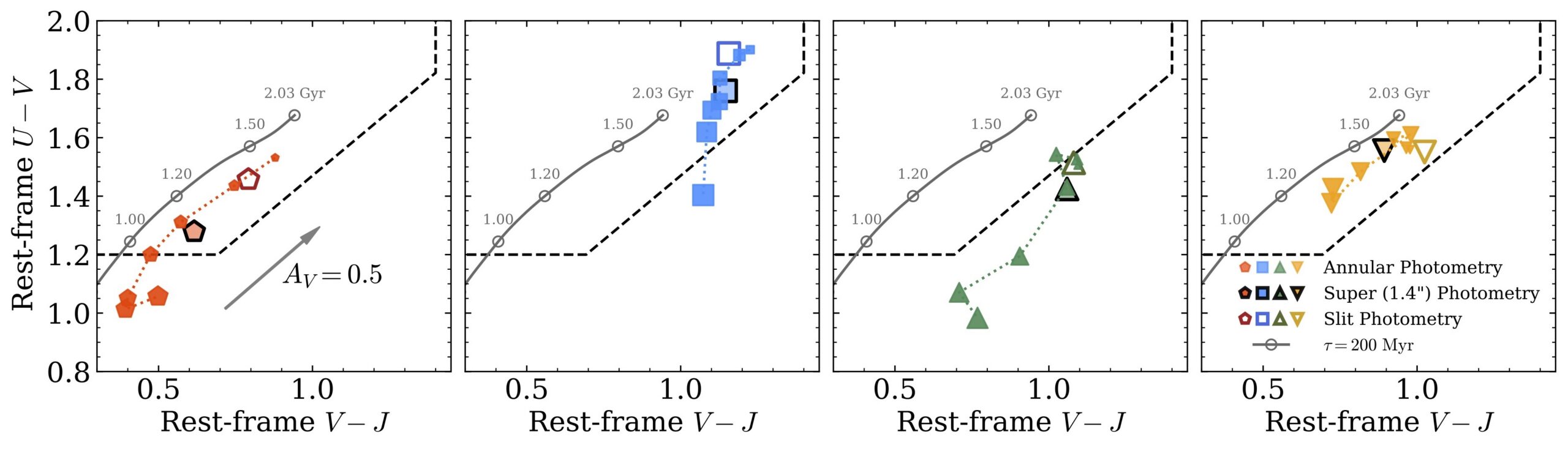
The authors find that three of the four galaxies have a negative color gradient in at least some areas. The fourth galaxy has a relatively flat color gradient, though this measurement is less certain due to the object’s redshift. When the authors plot the galaxies’ colors on a diagnostic diagram that separates red and old galaxies from young and blue galaxies, they find that three of the four galaxies have centers that appear red and old but outskirts that appear young and blue (Figure 2). This means previous measurements of the mass may have been overestimated, and previous measurements of the star formation rate may have been underestimated.
Figure 2: The location of each of the four galaxies on a color–color diagram that separates red galaxies (above/to the left of the dashed lines) from blue galaxies (below/to the right of the dashed lines). The open markers indicate the galaxy color as measured from the center of the galaxy; the filled-in markers show the color at different radii from the galaxy center. For all but one galaxy, the color at several radii is bluer than at the center, indicating that the galaxy might have younger stars at least at some radii. [Adapted from Cutler et al. 2026]
Next, the authors model the stellar ages across the galaxies using spectral energy distribution modeling. This technique compares the measured spectral energy distribution to libraries of stellar spectra, rules about how different dust or chemical composition impact galaxy appearance, and observational effects to predict the actual stellar makeup of a galaxy. In this case, the authors can’t know for sure whether the redder colors at galaxy centers come from an older stellar population, more dust, or changes in the chemical composition (the so-called “dust–age–metallicity degeneracy”). To account for this, the authors try modeling the stellar population two ways: once by assuming all change in color comes from a change in stellar age, and again by allowing the dust and chemical composition of the galaxy to change with radius. They find that if only the stellar age varies across the galaxy, age gradients in the galaxy stellar population can bring the estimated galaxy masses and star formation rates back toward agreement with models of galaxy evolution in the early universe, though not all the way. However, allowing dust and chemical composition to change across the face of the galaxy lead to higher stellar masses and less star formation, meaning the mystery may not yet be solved.
Is the Universe Broken?
To determine whether these galaxies still count as “universe breakers,” the authors use a cosmological model to predict the largest expected galaxy mass in the observed area at different periods in cosmic time. The previous results had less than a 0.3% chance of occurring under current cosmological models; with their updated numbers and stellar population models, the authors find that the observed galaxies sometimes have more than a 5% chance of occurring, though there is still tension. They point out that their analysis ignores processes that could help galaxies grow and quench in the early universe, like galaxy mergers; still, the existence of these massive galaxies with such low star formation rates remains a puzzle.
Original astrobite edited by Ansh Gupta.
About the author, Margaret Verrico:
I am a fourth-year graduate student at the University of Illinois Urbana-Champaign. I study the connection between supermassive black hole transients and their host galaxies. I am also an avid knitter and reader, and I am passionate about opening up STEM opportunities for people of all backgrounds.
NASA Telescopes Create Colorful ‘Craft’ From Nearby Nebula
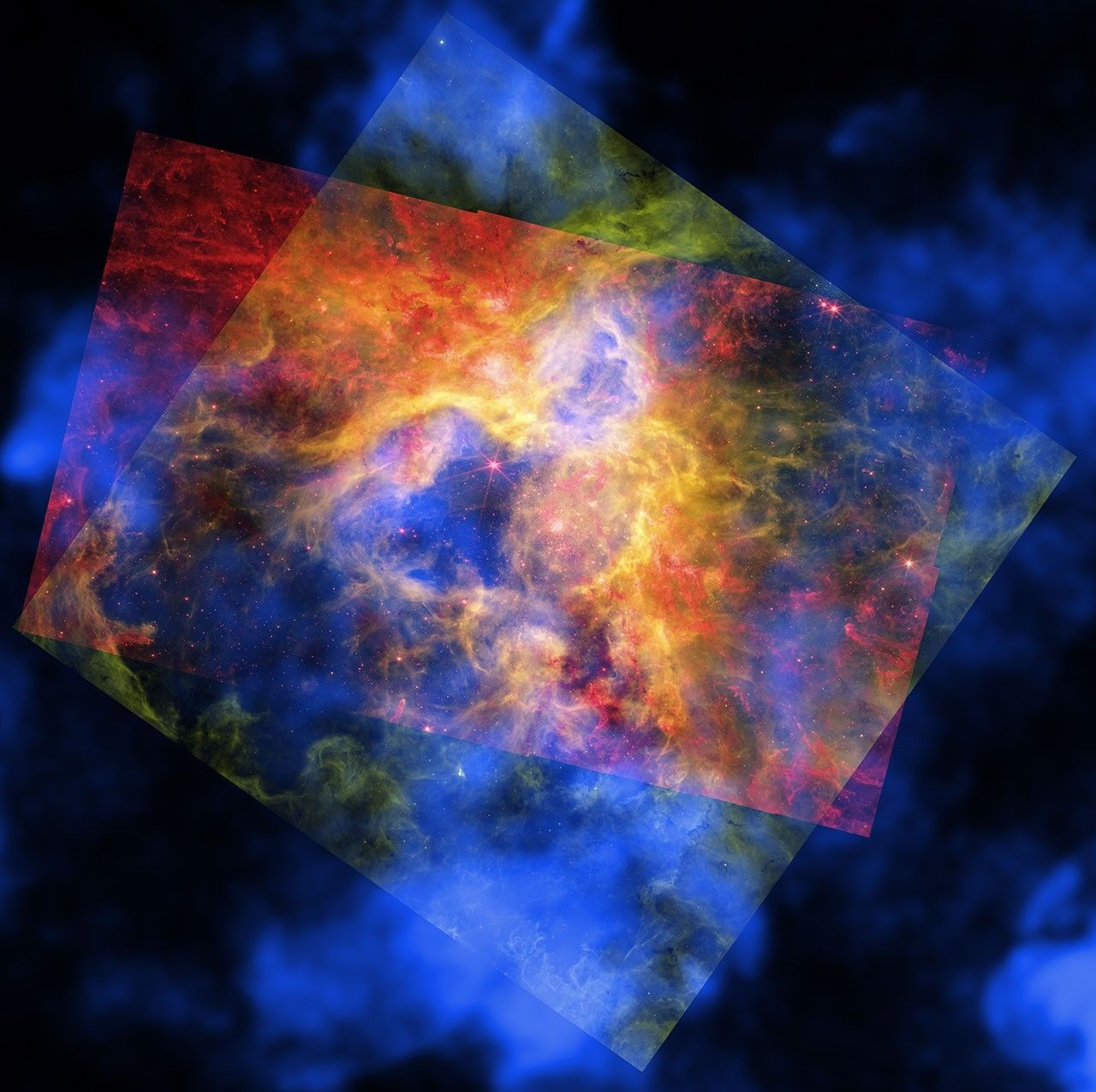
Like a collage made of layered sheets of colored cellophane, a vibrant new image layers observations of a famous star-forming nebula from NASA space telescopes. The resulting cosmic “craft” reveals new details about the star formation region known as 30 Doradus, or the Tarantula Nebula.
Located in the Large Magellanic Cloud, a small neighbor galaxy to the Milky Way about 160,000 light-years from Earth, the Tarantula has thousands of young stars embedded in a vibrant honeycomb-like structure of gas and dust.
X-ray: NASA/CXC/Ohio State Univ./J. Rodriguez et al; Infrared: NASA/ESA/CSA/STScI; Optical: NASA/ESA/STScI; Image Processing: NASA/CXC/SAO/P. Edmonds
Like a collage made of layered sheets of colored cellophane, a vibrant new image layers observations of a famous star-forming nebula from NASA space telescopes. The resulting cosmic “craft” reveals new details about the star formation region known as 30 Doradus, or the Tarantula Nebula.
Located in the Large Magellanic Cloud, a small neighbor galaxy to the Milky Way about 160,000 light-years from Earth, the Tarantula has thousands of young stars embedded in a vibrant honeycomb-like structure of gas and dust.
The new composite image contains X-rays from NASA’s Chandra X-ray Observatory, which has repeatedly observed the Tarantula Nebula over the course of its mission, in the layer that appears in blue. The X-ray data reveals gas blown away by winds from the surfaces of young, massive stars and heated to millions of degrees by shock waves, like sonic booms from supersonic jets.
The red represents infrared data from NASA’s James Webb Space Telescope showing thousands of young stars, plus swaths of cool dust that will provide the ingredients to form new stars and planets. Optical data in the green layer from NASA’s Hubble Space Telescope uncovers hydrogen gas that is warmer than seen with Webb, as well as some individual stars through the nebula.
The composite image shows the full Hubble and Webb images of this region, as well as a large section of the Chandra image, all recently published in a research paper in the Astrophysical Journal. In some regions the blue Chandra layer stands alone, and in others it combines with either the red Webb data or the green Hubble data. In the middle region all three images overlap to provide a holistic view in red, orange, yellow, green, and blue.
Previously, astronomers had studied the amount and the impact of energy produced by winds from young, massive stars in the Tarantula Nebula. Scientists expect that much of this energy should heat gas so that it produces X-rays. However, the research paper shows that there is much less X-ray-emitting gas in the nebula than expected. This led researchers to ask: Where has this energy gone and what tamed the Tarantula Nebula?
By studying the data from Chandra, Hubble, and Webb, combined with data from NASA’s retired Spitzer Space Telescope, the team concluded the Tarantula may be losing energy from several sources.
First, up to half of the hot gas is leaking through the shell walls of the gas and dust structures and escaping the nebula. Next, there is stirring and mixing between the cold gas near the shell walls and some of the hot gas, lowering the overall temperature of the gas. Finally, comparisons with computer simulations suggest the Tarantula may be losing energy through conduction. This involves direct physical contact between hot and cooler material, like with a frying pan on a burner, causing the hot and cooler material to equalize in temperature. In the case of the Tarantula Nebula, the hot gas would be conducting heat by being in direct contact with the cooler gas in the shells, especially in the densest regions. This scenario does not necessarily involve mixing the hot and cooler gas.
The combination of these three channels for losing large amounts of energy leads to this colorful and complex display revealed by NASA’s telescopes working together.
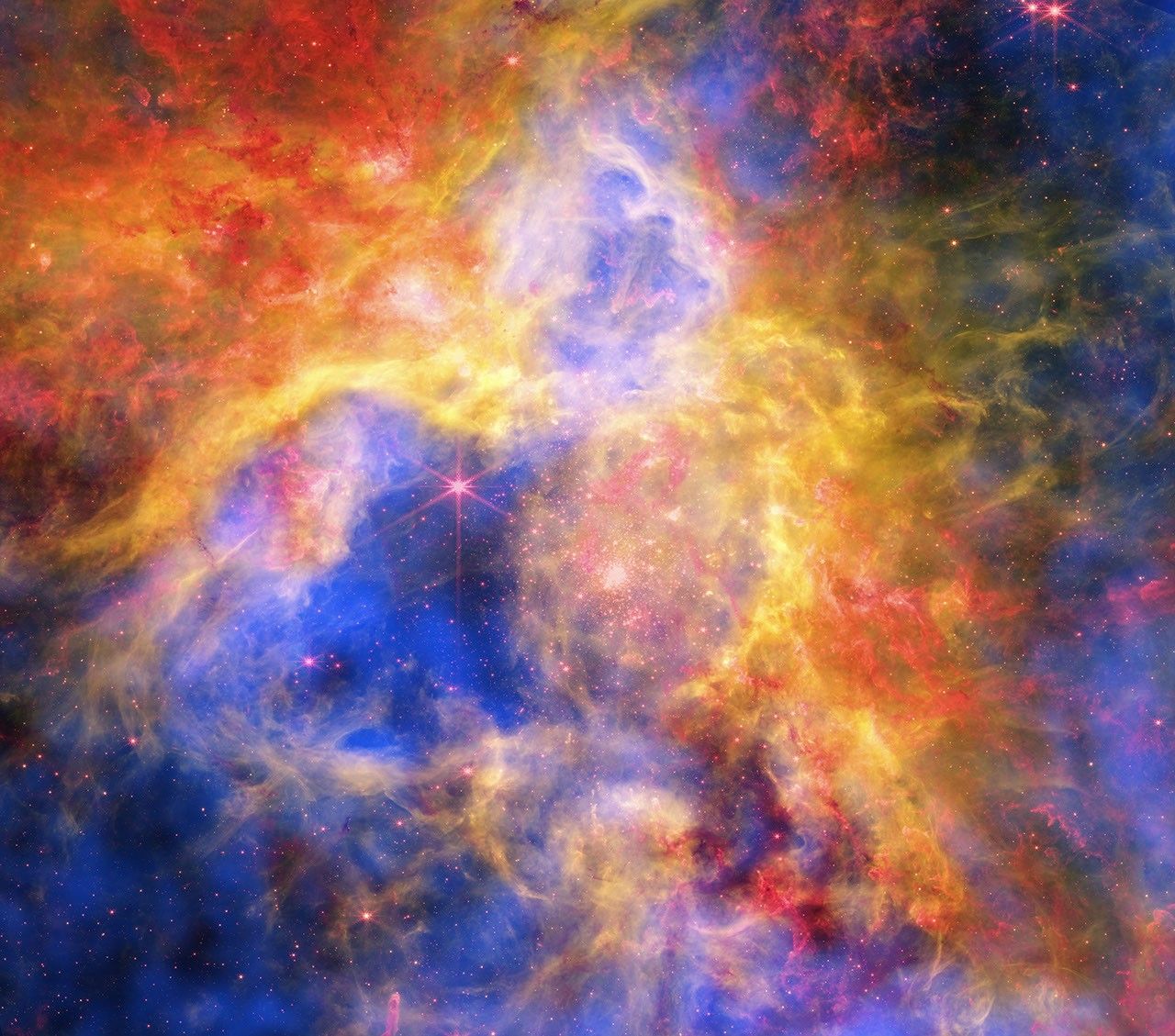
Tarantula Nebula / 30 Doradus, cropped version.
X-ray: NASA/CXC/Ohio State Univ./J. Rodriguez et al; Infrared: NASA/ESA/CSA/STScI; Optical: NASA/ESA/STScI; Image Processing: NASA/CXC/SAO/P. Edmonds
The paper describing these results was led by Jennifer Rodriguez of The Ohio State University in Columbus. Additional authors on the paper include Laura Lopez, Ohio State; Lachlan Lancaster, Columbia University in New York City; Anna Rosen, San Diego State University; Omnaraynai Nayak, Space Telescope Science Institute in Baltimore; Sebastian Lopez, Ohio State; Tyler Holland-Ashford, NASA’s Goddard Space Flight Center in Greenbelt, Maryland; and Trinity Webb, Ohio State.
NASA’s Marshall Space Flight Center in Huntsville, Alabama, manages the Chandra program. The Smithsonian Astrophysical Observatory’s Chandra X-ray Center controls science operations from Cambridge, Massachusetts, and flight operations from Burlington, Massachusetts.
O leaker conhecido como Ice Universe [@UniverseIce] publicou ontem no X imagens do que seriam películas para a tela externa do “iPhone Ultra”, o vindouro primeiro smartphone dobrável da Apple.
Como é possível notar, as imagens trazem duas variações do acessório: uma versão completamente transparente e outra com aquele efeito que limita os ângulos de visualização do display para uma maior privacidade.
This is the screen protector for the iPhone Ultra. You can see, the iPhone Ultra actually has an irregular screen with one side square and the other round. Oh my God, can you even handle that? pic.twitter.com/qpQHZHiqcD
Esta é a película protetora para a tela do “iPhone Ultra”. Como você pode ver, a tela do “iPhone Ultra” tem um formato irregular, com um lado quadrado e o outro redondo. Meu Deus, dá para acreditar?
O detalhe mais importante aqui, no entanto, é o formato das películas, que conta com cantos retos em um lado e arredondados no outro, dando a entender que o foldable da Maçã terá um design assimétrico.
Em uma outra postagem, desta vez com um vídeo da suposta película, no entanto, Ice Universe disse acreditar que isso se trata de um mal-entendido. Para ele, o mais provável é que a tela do “iPhone Ultra” tenha, sim, cantos arredondados em todas as extremidades, já que a película segue o formato do painel de vidro — e ele não precisa ter necessariamente o formato do display em si, já que se trata de componentes diferentes.
I'm sure this is just a misunderstanding – the protective film covers the entire glass panel, not exactly the same as the actual screen display area. The iPhone Ultra screen itself is still a symmetrical rounded rectangle. pic.twitter.com/Iwu52050uw
Tenho certeza de que isso é apenas um mal-entendido: a película protetora cobre todo o painel de vidro, e não exatamente a mesma área da tela. A tela do “iPhone Ultra” continua sendo um retângulo simétrico com cantos arredondados.
O vídeo compartilhado pelo leaker até mostra um mockup do dispositivo com uma tela assimétrica, mas é bem possível que seu criador tenha seguido esse caminho simplesmente por não saber como o smartphone realmente se parecerá.
De qualquer forma, não deverá demorar muito para que essa dúvida seja sanada, uma vez que os rumores são de que a Apple anunciará o “iPhone Ultra” no comecinho de setembro. Ansiosos? 🙂
NASA’s James Webb Space Telescope imaged the planetary nebula NGC 2392, the Lion Nebula, using the observatory’s NIRCam and MIRI instruments. The central star’s remains are responsible for the nebula’s structure, including a lion face-shaped bubble of ionized gas and dust “mane.”
Observing across the starry “plains” of space, NASA’s James Webb Space Telescope has taken new images of NGC 2392, nicknamed the Lion Nebula. NASA’s Hubble Space Telescope previously viewed this planetary nebula in 2000, imaging the lion face-shaped target in visible light and revealing features such as the “mane” of hazy, comet-shaped objects. Now Webb has captured a clearer, more detailed view of the Lion Nebula due to its high-resolution imaging.
Lion Nebula (NIRCam and MIRI Image)
NASA’s James Webb Space Telescope imaged the planetary nebula NGC 2392, the Lion Nebula, using the observatory’s NIRCam and MIRI instruments. The central star’s remains are responsible for the nebula’s structure, including a lion face-shaped bubble of ionized gas and dust “mane.”
Image: NASA, ESA, CSA, STScI; Image Processing: Alyssa Pagan (STScI)
At first glance the nebula’s overall structure in Webb’s infrared images, with both the NIRCam (Near Infrared Camera) and MIRI (Mid Infrared Instrument) instruments, may look quite similar to Hubble’s earlier visible-light view. However, Webb’s infrared vision highlights features like compact clumps of dust and a haze of ionized gas. It’s taken several thousand years for this collection of gas and dust to reach its current shape, and the nebula’s components continue to be altered.
The source of these constant changes and the reason for the Lion Nebula’s distinct appearance is located at the center: the remains of a dying star. Though it looks like the button nose of the lion, its energy and radiation are powering the intricate structures seen here.
Lion Nebula (MIRI Image)
NASA’s James Webb Space Telescope’s mid-infrared image of planetary nebula NGC 2392, nicknamed the Lion Nebula, highlights the varying dust structures. Some dust is being destroyed by the dying central star’s radiation, while some dust filaments manage to survive.
Image: NASA, ESA, CSA, STScI; Image Processing: Alyssa Pagan (STScI)
Massive stars undergo supernova explosions at the end of their lives, but these kinds of events are few and far in between. Most of the universe’s stars have lower masses, like the one belonging to NGC 2392. When a lower-mass star can no longer sustain itself with nuclear reactions in its core, the star becomes unstable and pulsates, losing its mass by shedding its outer layers, which then turn into shells of gas and dust called a planetary nebula. (Stars at this life stage are responsible for producing much of the universe’s observable dust.) The star’s radiation drives the ejected material away, leaving behind the very hot stellar core, also known as a white dwarf.
In the Lion Nebula’s case, the death of the oxygen-rich central star has left behind a white dwarf that is “cooking” everything from the inside and producing a bubble of ionized gas as it does. The gas bubble, which forms the lion’s face, is expanding over time and destroying dust that is in its path. Understanding why the swept-up gas has a complex structure of rings and shells, a common feature in planetary nebulae, is an ongoing endeavor.
The mane of the lion is the interior of a dust shell that is being illuminated by the white dwarf at the center. The tufts of hair, which look like cometary tails of material, are compact clumps of dust that have survived the stellar core’s radiation and protect the material that lies behind them.
Webb’s imagery “freezes” this planetary nebula in time, though the star’s death, and its tumultuous effects, go on. NGC 2392 will continue to undergo changes as its gas and dust migrate away from the stellar core. Astronomers estimate the lion will eventually disperse in approximately 10,000 years — a relatively short period in astronomical terms.
The James Webb Space Telescope is the world’s premier space science observatory. Webb is solving mysteries in our solar system, looking beyond to distant worlds around other stars, and probing the mysterious structures and origins of our universe and our place in it. Webb is an international program led by NASA with its partners, ESA (European Space Agency) and CSA (Canadian Space Agency).
The following sections contain links to download this article’s images and videos in all available resolutions followed by related information links, media contacts, and if available, research paper and Spanish translation links.
Related Images & Videos
Lion Nebula (NIRCam and MIRI Image)
NASA’s James Webb Space Telescope imaged the planetary nebula NGC 2392, the Lion Nebula, using the observatory’s NIRCam and MIRI instruments. The central star’s remains are responsible for the nebula’s structure, including a lion face-shaped bubble of ionized gas and dust “mane.”
Lion Nebula (MIRI Image)
NASA’s James Webb Space Telescope’s mid-infrared image of planetary nebula NGC 2392, nicknamed the Lion Nebula, highlights the varying dust structures. Some dust is being destroyed by the dying central star’s radiation, while some dust filaments manage to survive.
The Scientific Revolution was significantly influenced by Christian philosophers and scientists, particularly Francis Bacon, who emphasized empirical methods and a rational Creator. The integration of faith and reason laid the foundational principles of modern science. The laws of the physical universe never change and are discoverable using the scientific method.
Scientists from the Max-Planck-Institut für Kernphysik (MPIK) in Heidelberg, Germany, have announced the first successful detection of antineutrinos from an inactive nuclear reactor.
The research team behind the historic achievement said that detecting antineutrinos, which they described as “the most elusive particle in the Universe,” could improve monitoring, maintenance, safety, and security of nuclear reactors.
Hunting for ‘Faint Flux’ of Antineutrinos Inside Shutdown Nuclear Reactors
In a statement announcing the detection, the researchers point out that even when nuclear fission reactors are turned off, “the story inside the reactor core still has a great deal to tell.”
For example, the long-lived fission products inside nuclear reactors continue to decay for months, or in some cases, years after a reactor is no longer in use. This ongoing radioactive decay can produce what the team termed a “faint flux” of the most elusive particle in the universe: antineutrinos.
Because antineutrinos interact only extremely weakly with matter, they pass almost unhindered through the reactor vessel and surrounding shielding. In theory, the right equipment could detect this activity, offering insights into the reactor’s radioactive inner core.
Fortunately, for MPIK study leader Anthony Onillon and co-leader Thierry Lassere from the independent research group OMINA, also located at MPIK, there is an underground detector around 400 meters from two reactor cores, which were part of the region’s Chooz reactor in northern France.
Dubbed ‘Double Chooz,’ the detector contains over 30 cubic meters of liquid “scintillator.” According to the study authors, when antineutrinos interact with this material, a detectable flash of light is emitted.
“Antineutrinos interact only extremely rarely with matter,” Lasserre explained. “However, when one interacts within the Double-Chooz detector, a characteristic double-light signal is produced that can be distinguished from background events.”
Observing the ‘Faint Glow’ of Radioactivity
To search for the weak antineutrino signal from the decaying Chooz nuclear reactor material, the research team evaluated recorded data from a 17.2-day period when both reactors were shut down. Because antineutrinos interact so rarely with matter, the researchers searched for the characteristic paired flashes produced when one underwent inverse beta decay inside the detector.
After scanning through the data, the team said they found evidence for roughly 100 “antineutrino candidate events” originating from within the reactors. This included signals from the cores and nearby spent-fuel cooling pools.
MPIK scientists Thierry Lassere and Anthony Onillon discussing the Double Chooz data. Image Credit: R. Lackner/MPIK.
The researchers said the measured signal “agrees remarkably well” with simulations of the remaining fuel inventory and the decay of long-lived fission products.The team said this detection marks the first direct experimental validation of the antineutrino emissions predicted by the shutdown reactor models.
“With this new work, the experiment has achieved another first: observing the faint neutrino glow that remains after a reactor goes dark,” the research team explained.
New Perspectives for Reactor Monitoring, Nuclear Safety, and Safeguards
When discussing the significance of the achievement, Dr. Onillon noted that previous efforts have primarily focused on operational nuclear reactors, where the antineutrino flux is much larger. Conversely, their detection was made under challenging conditions using methods perfected by the team.
“Detecting the tiny residual signal after shutdown required exceptionally low backgrounds and careful analysis techniques developed by the Double Chooz collaboration over many years,” the researcher explained.
When discussing the experiment’s practical applications, the team noted that the work provides researchers and regulators with “the first published benchmark” of the antineutrino glow coming from shutdown reactors and spent fuel pools. In theory, such detection could provide information on a reactor during both operational and maintenance phases.
“The results demonstrate that antineutrino detectors can probe nuclear reactors even during shutdown periods, opening new perspectives for reactor monitoring, nuclear safety, and safeguards,” they conclude, adding that such detections “may become relevant for independent verification of reactor status and spent-fuel inventories.”
Christopher Plain is a Science Fiction and Fantasy novelist and has spent the last six years as Associate News Editor and Head Science Writer at The Debrief. Follow and connect with him on X, learn about his books at plainfiction.com, or email him at christopher@thedebrief.org
Released as eROSITA Data Release 2 (DR2), the new high-energy universe catalog includes nearly two million X-ray sources, essentially doubling the number cataloged in DR1. The team behind the achievement said the new catalog, which has been made available to the wider scientific community, marks a “major step forward” in mapping the entire high-energy universe.
“DR2 is the best inventory of the X-ray sky we have to date and opens the door to robust statistical studies of cosmic populations,” explained Miriam E. Ramos-Ceja, Ground Segment Manager of the eROSITA instrument and lead author of the DR2 publication.
DR2 was built from the first three scans captured by the eROSITA telescope during the Spectrum-Roentgen-Gamma (SRG) mission. According to a statement emailed to The Debrief, the new high-energy map combined data from multiple passes over the sky, significantly increasing the instrument’s survey depth.
After beginning its mission in December 2019, the observatory surveyed the entire sky every six months. This mission length increased the scans’ depth and sensitivity. The new DR2 includes data captured during the mission’s first 556 days. MPE scientists said the final catalog comprises three “full sky surveys.”
“By stacking these observations, the survey reaches significantly fainter fluxes than the first release, enabling the large increase in detected sources,” they explained.
The color image shows X-ray sources in the western galactic hemisphere of the X-ray sky. The Galactic plane lies horizontally through the center of the image. Sources in the eROSITA catalog are plotted with their red, green, and blue brightness showing their count rate in soft (0.5-1.0 keV), medium (0.5-1.0 keV), and hard (1.0-2.0 keV), respectively. The sky is plotted using an azimuthal equal-area projection (Image Credit: Jeremy Sanders / MPE).
The approach also revealed a large population of previously uncatalogued systems.
For example, the DR2 catalog includes nearly two million X-ray sources detected in the 0.2–2.3 keV band. The survey also revealed over 1.9 million “point-like sources.” The team said these detections are “primarily stars and actively accreting supermassive black holes.” The survey also added around 64,000 extended sources, including newly cataloged galaxy clusters, nearby galaxies, and supernova remnants.
The Full Diversity of the X-ray Sky
Along with the primary catalog, the new release includes a complementary “hard-band” catalog that includes 15,000 sources detected at higher energies (2.3–5.0 keV). The team said these detections revealed “heavily obscured and intrinsically energetic systems” that scans performed at ‘softer’ X-ray energies typically overlook.
“Together, these catalogues capture the full diversity of the X-ray sky, from nearby stellar coronae to distant supermassive black holes and massive galaxy clusters,” the team explained, adding that many of the cataloged objects are newly identified in X-rays, while others “can now be studied with substantially improved precision.”
Although more analysis is needed to accurately characterize every high-energy source discovered by the new survey, the team said the DR2 includes “multi-wavelength information” that associates the newly cataloged X-ray detections with their most likely optical and infrared counterparts.
“X-ray detection is only the first step,” explains Mara Salvato, eROSITA spokesperson and chair of the follow-up working group. “By linking X-ray sources to their counterparts at other wavelengths, we can work out what these objects are, where they sit on the cosmic distance ladder, and build clean, well-defined samples on an unprecedented scale.”
This data suggests that approximately 88% of the newly discovered sources come from outside the Milky Way Galaxy. The team said the new sources are “dominated by accreting supermassive black holes.”
Data Suggests Unexpected Abundance of Rapidly Growing Black Holes
When discussing the significance of the new DR2 high-energy catalog, the team highlighted its coincidental release with the latest Sloan Digital Sky Survey (SDSS).
“By combining SDSS spectroscopy with eROSITA’s X-ray data, researchers can build three-dimensional maps of active black holes across the sky, revealing how these rapidly growing objects are distributed and evolve across cosmic time,” they explained.
For example, combining eROSITA’s X-ray catalog with the SDSS spectroscopic and photometric redshift data has already resulted in what the team described as “one of the largest and most detailed studies of accreting supermassive black holes to date.” The researchers said these “elusive objects” formed surprisingly early in the history of the Universe, so capturing new data of their growth at high redshift is invaluable.
“The most luminous black holes at high redshift are like needles in a haystack,” explained the corresponding study’s lead author, William Roster. “Thanks to DR2 we found more needles than expected, suggesting that rapidly growing black holes were more abundant in the early Universe than previously thought”
New World Record of X-ray Sources Won’t Be the Last
Due to a pre-existing agreement between the German and Russian eROSITA consortia, the new DR2 covers the western Galactic hemisphere. However, the researchers note, within this region of the sky, the new catalog “represents the largest and most homogeneous public X-ray dataset currently available.”
eROSITA Principal Investigator Andrea Merloni said the new dataset of unprecedented scale and completeness has been made available to the global astronomical community. MPE Director Kirpal Nandra agreed, adding that the MPE team hopes the most complete catalog of high-energy sources ever assembled will provide “a unique foundation for discoveries ranging from rare objects to large-scale population studies.”
“eROSITA just set another world record in terms of X-ray source numbers – and it won’t be the last,” Merloni concluded.
Christopher Plain is a Science Fiction and Fantasy novelist and has spent the last six years as Associate News Editor and Head Science Writer at The Debrief. Follow and connect with him on X, learn about his books at plainfiction.com, or email him at christopher@thedebrief.org
In Nolan's supposal, the mad scientist takes on the mystique of a wizard. Perhaps this is fitting, given that he sees science and wizardry as the same thing.
The nature of the surveys to which Phil Halper appeals is that they measure what physicists believe. They cannot measure what the evidence actually supports.
Teams at Katalyst Space are making progress slowing the spin of their LINK spacecraft, which is designed to boost the orbit of NASA’s Neil Gehrels Swift Observatory. A series of thruster burns this week reduced the rate of spin from approximately 9 degrees per second to less than 4 degrees per second. Katalyst is continuing with this approach to restabilize the spacecraft in the coming days.
Teams also further evaluated LINK’s functionality and determined there are still potential paths forward for a boost. NASA is working closely with Katalyst to consider revised, innovative approaches. The agency will continue to provide updates about stabilization of LINK and next steps for the mission. LINK is now expected to approach Swift around the end of August.
Learn more from Katalyst, and monitor NASA’s Swift blog for continued updates:
Scientists from the Paul Scherrer Institute (PSI), conducting a new series of experiments with millions of ultracold neutrons, have determined that the neutral particles do not switch between our universe and a theoretical “mirror universe” containing oppositely charged, identical counterparts of all elementary particles previously proposed by theoretical physicists.
Although the new experiments do not completely disprove the concept of a mirror universe, the experiments do cast doubt on one of the idea’s fundamental principles, making its existence less likely. The team behind the new study said their findings also aid future experiments by eliminating one potential area of inquiry.
Neutrons Are the Perfect Candidate to Test for a Mirror Universe
Although theoretical physicists sometimes propose radical concepts, one such idea proposes a mirror universe where every elemental particle has a “twin.” For example, the authors of the new study explain, there would be mirror protons, mirror electrons, and mirror neutrons. Still, they note, interaction between the particles in our universe and their mirror universe companions is likely to be minimal.
Geza Zsigmond, a researcher at the PSI Center for Neutron and Muon Sciences, said the theory suggests that the two mirror particles “sense each other’s presence” through gravity. Some physicists have even suggested that gravitational interaction with mirror-universe particles could explain dark matter. Unfortunately, experiments designed to hunt for the mirror universe have returned zero positive results.
Bernhard Lauss, leader of the research group for ultracold neutron physics at the PSI Center for Neutron and Muon Sciences, said, “There is no way of proving the existence of mirror particles using gravitational interaction alone.” Fortunately, the theory also offers a second testing possibility.
According to Zsigmond and colleagues, mirror universe particles would interact with our universe either through gravitation or through what they described as a “rare” oscillation of neutrons. This means that neutral particles like a neutron could occasionally disappear from our universe and reappear in the mirror universe. Even more surprisingly, the same theory says that these particles could magically return to our universe as well.
“Based on this hypothesis, neutral particles might oscillate to and fro between our normal matter world and the mirror world,” Lauss said.
The team said that this possibility, combined with new experiments at the Institut Laue-Langevin in France that “rekindled” speculation about the mirror universe, focused their new efforts on this “other” property of mirror universe particles.
Study Finds No Evidence for Neutral Particle Oscillations
After joining up with researchers from ETH Zurich and the Jagiellonian University in Kraków, the PSI team designed a series of experiments that should show if neutrons are zipping back and forth between universes. Zsigmond said that neutrons are ideal to test the concept for two reasons. First, they are neutral particles, and second, the researcher said they have a “strange property” the team hoped to exploit.
“Neutrons appear to have different lifetimes, depending on how this is measured,” Zsigmond explained.
Although several theories have been proposed to explain this discrepancy, the team acknowledged that the varying neutron lifetimes could be caused by some of these neutral particles disappearing from our universe and entering the mirror universe.
First, the team used the high-intensity proton accelerator at PSI to generate the millions of neutrons needed for their experiments. Next, the team slowed the neutrons down, creating what scientists call “ultracold” neutrons.
Next, the researchers trapped the ultracold neutrons in a specially designed non-magnetic stainless steel vacuum chamber. Because the theory suggests that the probability of neutrons jumping between universes is extremely sensitive to magnetic fields, the vacuum chamber was surrounded by magnetic field coils that the researchers could control with the required precision.
Throughout the experimentation phase, the researchers stored 1.5 million ultracold neutrons in the chamber every five minutes. After about 200 seconds, the team would empty the chamber and count how many neutrons remained. The team repeated this process over several months, resulting in the creation, storage, and measurement of approximately 25 billion neutrons.
Lauss said the researchers gradually varied the strength and direction of the magnetic field throughout the process to “scan all the relevant regions in which one might expect oscillations between neutrons and mirror neutrons to occur.” However, Lauss said, “we saw no evidence at all of such oscillations.”
Experiments “Set the Standard” For the Foreseeable Future
When discussing the significance of their findings, the PSI-led team said the lack of evidence of mirror universe oscillation by ultracold neutrons suggests a very high probability that such mirror universe neutral particle roundtrips “can be ruled out.” They also note that failing to find evidence of a mirror universe still resulted in benefits for particle physics by eliminating an area of inquiry.
“By restricting the scope for certain speculations, we are showing researchers in theoretical physics that they need to explore new avenues,” Zsigmond explained. “Physics needs that kind of impetus if it is to continue to evolve.”
Moving forward, the team said that “substantial improvements” to their experiments would require a much more elaborate setup. Until then, they said their experiment and its results are “the best of its kind in the world and will set the standard for the foreseeable future.”
Christopher Plain is a Science Fiction and Fantasy novelist and has spent the last six years as Associate News Editor and Head Science Writer at The Debrief. Follow and connect with him on X, learn about his books at plainfiction.com, or email him at christopher@thedebrief.org

 Login