❌

Normal view

‘Little Red Dots’ Remain a Cosmic Mystery—and New Research Reveals They May Be Keeping a Very Big Secret

26 August 2026 at 14:03

Little red dots, an astronomical mystery unveiled by NASA’s James Webb Space Telescope, have perplexed researchers since their discovery—and now, according to new findings, we may be closer than ever to unraveling their mystery.

According to new research that appeared in Nature Astronomy, the enigmatic little red dots could be residents of very small, but also very dense galaxies with masses close to a billion times our Sun’s mass.

If confirmed, the new research may set the pace for unraveling how these cosmic curiosities, first detected in 2023, first came to be in the early stages of the universe’s development. Not only that, it could hint at the possibility that these “little” cosmic curiosities may also be keeping a big secret.

What Are Little Red Dots?

One of the reasons little red dots remained unknown until recent years has to do with their great distances from Earth. With the help of the Webb telescope’s powerful eye, these tiny objects were initially detected three years ago and detailed in a formal scientific paper in 2024.

The nature of these objects remains unknown, and astronomers still aren’t certain about what the exact source of the light they produce might be. In past research, some clues have pointed to the possibility of material around these objects at ultraviolet wavelengths—this would potentially offer a strong hint that these faint, distant objects are galaxies, or are at least related to them in some way.

One of the challenges astronomers have encountered is the lack of optical light measurements indicating the presence of galactic material. Because of this, questions remain about the mass that could be present in stellar bodies associated with the little red dots.

Capturing Optical Emissions from Enigmatic Objects

Now, in new research by Xuheng Ding, Lilan Yang, and colleagues, imagery captured by the James Webb Space Telescope of 217 examples of little red dots has produced new clues about their mysterious origin.

A key component of the new imagery includes the detection of optical emissions, albeit faint ones, observed beyond the primary central objects themselves. The detections are strong enough to be clearly observed, and based on the team’s models, these emission lines are indeed most likely linked to the presence of stellar mass, meaning that the little red dots are good candidates for star-forming galaxies, as many astronomers have suspected.

If correct, this would help confirm a potentially big secret about these objects, since it would also mean the little red dots reside at the centers of these galaxies—as supermassive black holes.

Anatomy of a Little Red Dot

Additional clues about these objects include new estimates for their size, clocking in with a radius of about 210 parsecs—roughly 685 light-years—on average. This means that the little red dots are far more compact than the kinds of star-generating galaxies expected to possess comparable mass, which date to around the same time in our universe’s development that the dots are believed to originate.

Based on the new research, little red dots are more than just unusual light sources in the distant universe, and their likely association with star-forming galaxies offers a significant clue toward revealing their exact nature.

Still, a few questions remain, and the team cautions that their analysis deals with the average properties based on the recent collection of Webb imagery of these cosmic features, since many of the individual characteristics of the little red dots remain too faint to characterize on an individual basis.

Going forward, the team believes additional observations that include spectrographic analysis of the light produced by little red dots will offer more clues about not only their origins, but will also help astronomers determine clearer estimates for their distances.

The recent study, “Extended components of little red dots in the rest-frame optical,” appeared in Nature on August 24, 2026.

Micah Hanks is the Editor-in-Chief and Co-Founder of The Debrief. A longtime reporter on science, defense, and technology with a focus on space and astronomy, he can be reached at micah@thedebrief.org. Follow him on X @MicahHanks, and at micahhanks.com.

Le voile se lève sur les petits points rouges : les astronomes sur la piste d'étoiles 100 000 fois plus massives que le Soleil

7 August 2026 at 08:32
Les étoiles connues dans l'Univers ne dépassent guère la centaine de masses solaires. Toutefois, quelques centaines de millions d'années après le Big Bang, les conditions physiques et chimiques étant différentes, on soupçonne que des étoiles bien plus massives étaient alors possibles, avec 100...

Le télescope James-Webb a vu des centaines de « points rouges » : ce qu’ils pourraient réellement cacher est vertigineux

23 July 2026 at 20:03
Il existe plusieurs objets et phénomènes exotiques en astrophysique qui sont des serpents de mer, comme on dit. Des signes de leur existence apparaissent parfois et à répétition dans les observations, sans que l'on puisse aboutir vraiment à une conclusion. C'est le cas avec une nouvelle...

How Fast Does Information Travel to Earth from the Outer Most Reaches of the Cosmos?

1 July 2026 at 09:54
Astronomers using the James Webb Space Telescope have observed extremely distant LRD galaxies, with redshifts greater than 14 at distances greater than 13.5 billion light-years. The question I raise here is how do we see these galaxies and their spectral features if the universe is less than 10,000 years old?

Two More Thoughts on Little Red Dots

1 July 2026 at 03:54

little red dots seen with JWST

One of the biggest discoveries from JWST’s tenure is a population of compact reddish objects nicknamed “little red dots.” Numerous theories have been proposed to explain the small sizes, high luminosities, and characteristic “V”-shaped spectra of these objects, and today we’ll examine two recent research articles that have explored the identity of the universe’s most mysterious inhabitants.

Red Dot, Blue Dot

You can tell a lot about a person by looking at their friends — and the same might be true for little red dots. A team led by Josephine Baggen (Yale University) examined a sample of 83 little red dots imaged with JWST. They found that 43% of the little red dots in this sample had a little blue companion: an ultraviolet-bright object within a projected separation of 1,630–16,300 light-years. The brightest little red dots were even more likely to have a blue companion; 80% of the brightest objects in the sample were paired up.

Baggen’s team set out to test the hypothesis that these red–blue pairs are fundamentally linked rather than coincidental. Under this hypothesis, the ultraviolet-bright blue companions were assembled first. The ultraviolet radiation from these objects suppressed the cooling of molecular hydrogen in pristine gas clouds in the early universe, causing the gas to skip the usual star-forming process and instead form a massive compact object such as a black hole star, supermassive star, or quasi-star — which we see as a little red dot.

plot of Lyman-Werner radiation versus projected separation

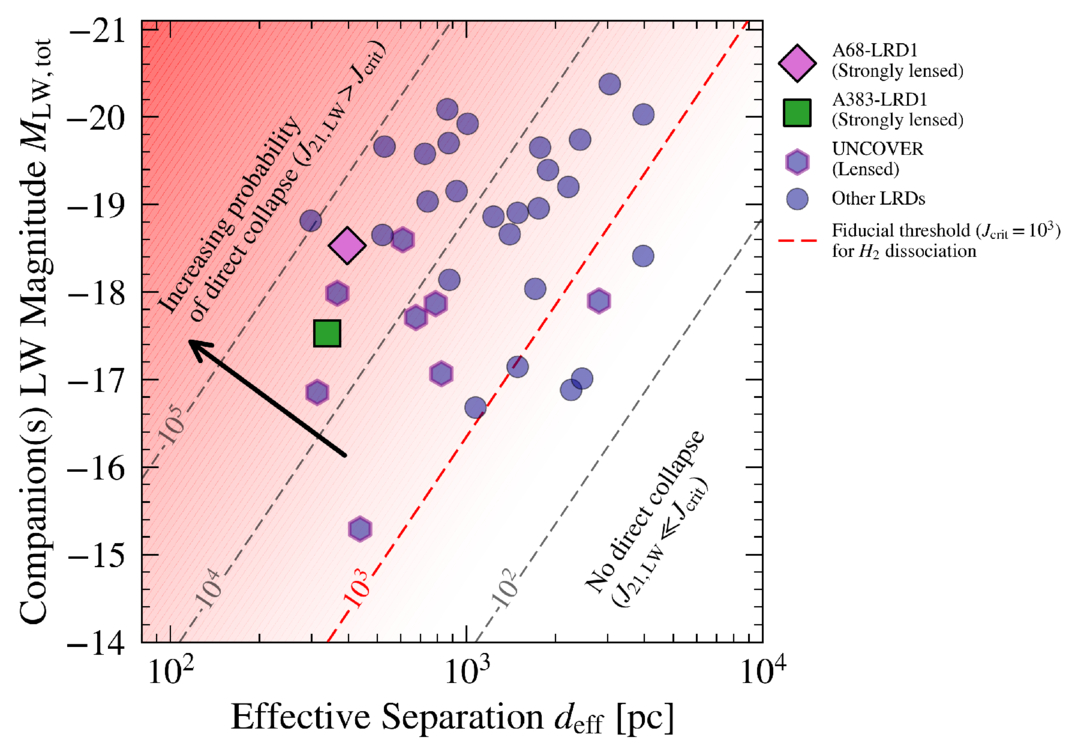
The companion’s mean flux density from 91.2 to 111 nm versus projected separation between the blue companion and the little red dot. The red dashed line shows the estimated values necessary for gas clouds to collapse. Click to enlarge. [Baggen et al. 2026]

Baggen and coauthors investigated whether the ultraviolet radiation from the blue companions is strong enough to have triggered this transformation. The team used spectral energy distribution modeling to determine the luminosities of the blue companions from 91.2 to 111 nanometers. This analysis showed that the radiation from the blue companions is equal to or greater than the threshold necessary to encourage the direct collapse of a gas cloud into a massive compact object.

If little red dots form thanks to their little blue companions, that would imply that every little red dot has or had such a companion. Though little blue companions weren’t so universal in the sample used in this work, the team noted that their analysis techniques, combined with observational limitations and other factors, likely yielded a smaller number of blue companions than are actually present. Further simulations exploring the collapse of pristine gas clouds into massive compact objects and high-resolution spectroscopic observations of little red dots can illuminate the potential link between these objects.

globular cluster NGC 1851

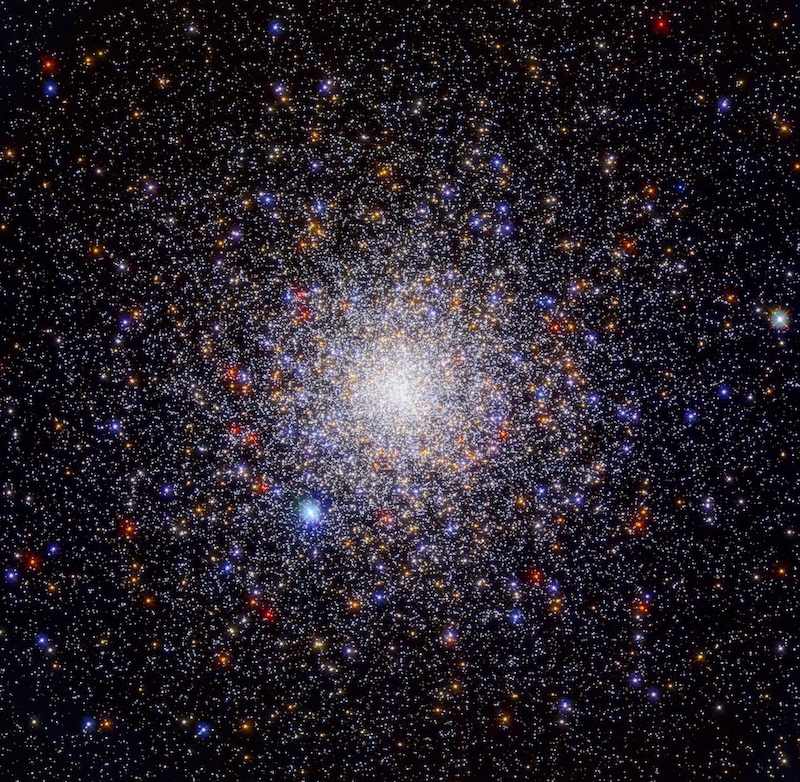
The densely packed globular cluster NGC 1851, as seen by the Hubble Space Telescope. [NASA, ESA, and G. Piotto (Università degli Studi di Padova); Processing: Gladys Kober (NASA/Catholic University of America)]

Little Red Dots as Young Globular Clusters

John Chisholm (The University of Texas at Austin) and collaborators hypothesized that little red dots represent a brief phase in the formation of globular clusters. In this hypothesis, the rest-frame ultraviolet emission of little red dots comes from the hot young stars of the newborn cluster, while the rest-frame optical emission comes from a single supermassive star at the cluster’s heart. Thus, in this framework, the little red dot phase lasts only as long as the fleeting lifespan of the supermassive star.

Chisholm’s team first showed that the spectrum of a young globular cluster with a supermassive star at its center is similar to the observed spectrum of a little red dot. But showing that the emission properties of globular clusters in formation and little red dots are similar is not enough — it’s also necessary to investigate whether the numbers and masses of these objects line up.

mass functions of little red dots and globular clusters

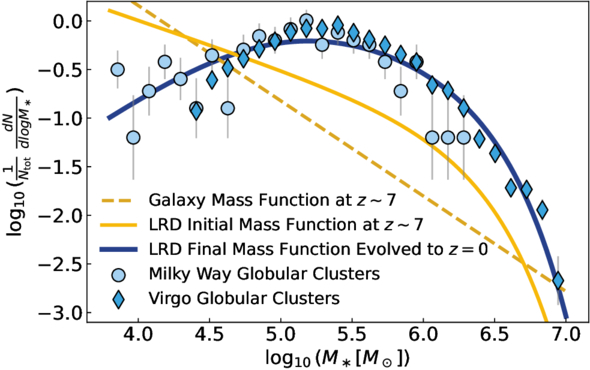
Comparison of the mass functions of little red dots evolved forward to the present day (blue line) and globular clusters in the Milky Way and Virgo (blue symbols). The results for both populations have been normalized to emphasize the shape of the distributions. Click to enlarge. [Chisholm et al. 2026]

To do this, the team propagated the observed mass function of little red dots at a redshift of z = 7 forward in time to z = 0. This process accounted for the rapid evolution of the supermassive star into a black hole, as well as the evolution of and feedback from the massive stars in the cluster. Comparing the resulting mass function to the population of present-day globular clusters, the team found that the mass functions had very similar shapes, and the number densities of little red dots and globular clusters in the present day are estimated to be of the same order of magnitude: 0.1–0.3 Mpc-3 and 0.8 Mpc-3, respectively.

In addition to describing how the properties of globular clusters in formation match those of little red dots, Chisholm’s team outlined some testable predictions for this scenario, including formation timescales and chemical abundance patterns. If this hypothesis withstands further scrutiny, little red dots may provide a valuable look at the early years of some of our universe’s oldest star clusters.

Citation

“Connecting the Dots: UV-Bright Companions of Little Red Dots as Lyman–Werner Sources Enabling Direct-Collapse Black Hole Formation,” Josephine F. W. Baggen et al 2026 ApJL 1002 L4. doi:10.3847/2041-8213/ae58a5

“Little Red Dots as Globular Clusters in Formation,” John Chisholm et al 2026 ApJL 1004 L4. doi:10.3847/2041-8213/ae6dae

The post Two More Thoughts on Little Red Dots appeared first on AAS Nova.

"Little Red Dot" Is a Cocooned Black Hole

16 June 2026 at 13:00

A deep spectrum of a mysterious "little red dot" reveals a supermassive black hole cocooned in gas so dense it's opaque — but glowing in the infrared.

The post "Little Red Dot" Is a Cocooned Black Hole appeared first on Sky & Telescope.

This James Webb Space Telescope Discovery Could Finally Solve the Mystery Behind “Little Red Dots”

12 June 2026 at 15:58


James Webb Space Telescope (JWST) observations of what astronomers call “little red dots” have intrigued researchers since their discovery in 2022.

Now, new data on the spectra of one of these dots, made possible with imagery obtained by Webb, may hold the answers researchers have long sought.

In a recent paper published in The Astrophysical Journal, a team of astronomers led by the University of Texas at Austin’s Vasily Kokorev revealed their intriguing observations of the little red dot GLIMPSE-17775 using the JWST.

Data collected by the JWST support the BH* scenario, the hypothesis that little red dots are supermassive black holes surrounded by a cloud of partially ionized gas.

JWST and the Little Red Dot

The recent JWST observation of GLIMPSE-17775 is the deepest spectral view of a little red dot ever captured, spanning 40 spectral lines and offering a powerful opportunity to compare the data with various theories about the object’s origins. Born only about 1.8 billion years after the Big Bang, or about 12 billion years ago, the object hails from the universe’s early days.

As with many of science’s most interesting discoveries, this observation was a fortunate accident, captured as the JWST was observing the Abell S1063 galaxy cluster, located in front of GLIMPSE-17775 from our point of view.

Gravitational lensing magnifies GIMPSE-17775, allowing JWST a better look at the object despite its extreme distance, and making the 30-spectrum JWST captured equivalent to hours of observations. 

“When we saw the spectrum for the first time, it was like having all the pieces of a puzzle scattered on the floor,” said Kokorev. “We picked up each piece of the puzzle, measured the lines, and started combining the different pieces into a mosaic. Maybe a few pieces looked like nothing at first, but then a couple of them came together, and we realized that there was something there.”

Explaining Little Red Dots

First appearing at around 600 million years after the Big Bang, the mysterious little red dots have puzzled scientists since they first came to light. The black hole scenario is just one of several that researchers have proposed as a possible explanation, although it is currently gaining the most support as more data comes in.

“I think part of the scientific community is converging on a singular picture — that little red dots can be explained by black hole star models. But none of the previous little red dots have all of the pieces of evidence in the same place,” Kokorev said. “With GLIMPSE-17775, we can test these models because of how deep and amazing this source’s spectrum is.”

The researchers interpret the data as showing a rapidly accreting black hole covered by a dense gas cocoon that reprocesses the black hole’s light into the spectrum observed by JWST.

Comparing the spectra to various models revealed some intriguing evidence for the BH* scenario. The helium, oxygen, and hydrogen lines don’t fit a simple rotating gas cloud model, but do correspond to an electron scattering, a broadening effect associated with a dense, layered gas cocoon.

Other lines, such as the 16 iron lines, suggest a powerful energy source, which could indicate a rapidly accreting black hole. Additionally, helium absorption and fluorescence are seen in the spectrum, signs that a powerful energy source is enveloped in a dense medium.

What JWST Didn’t See

Beyond this incredibly deep spectrum, other little red dot observations have been faint in X-rays, a form of emission that the gas cocoon, in the BH* scenario, is likely to absorb.

One strange quirk of GLIMPSE-17775 is that the spectrum was missing the portion that would indicate the little red dots’ signature dip in light emission, known as a Balmer break. However, supplementary data collected by the Hubble Space Telescope resolved this issue, identifying that interference from a giant host galaxy is the root cause.

“Everything fits, nothing is broken, and I think that makes the puzzle that is our universe even better,” Kokorev concluded. “Looking ahead, I’m eager to dive deeper and learn about what is powering the central engines of little red dots. While we think it’s a black hole, there are some other interesting theories being proposed, which is exciting. Maybe in a year or two, we’ll have the final answer to what powers these sources.”

The paper, “The Deepest GLIMPSE of a Dense Gas Cocoon Enshrouding a Little Red Dot,” appeared in The Astrophysical Journal on June 10, 2026.

Ryan Whalen covers science and technology for The Debrief. He holds an MA in History and a Master of Library and Information Science with a certificate in Data Science. He can be contacted at ryan@thedebrief.org, and follow him on Twitter @mdntwvlf.

Little Red Dots | Primordial Black Holes or Big Bang Failures?

9 June 2026 at 23:16
Recent findings from the James Webb Space Telescope (JWST) indicate that Little Red Dots (LRD) could be primordial black holes, challenging the big bang theory. The data suggests these objects formed too soon for typical galaxy evolution, raising questions about cosmological interpretations and the nature of observational evidence.

A Potential New Piece of the “Little Red Dot” Puzzle

7 April 2026 at 17:00

X-ray dot

Editor’s Note: Astrobites is a graduate-student-run organization that digests astrophysical literature for undergraduate students. As part of the partnership between the AAS and astrobites, we occasionally repost astrobites content here at AAS Nova. We hope you enjoy this post from astrobites; the original can be viewed at astrobites.org.

Title: The X-Ray Dot: Exotic Dust or a Late-Stage Little Red Dot?
Authors: Raphael E. Hviding et al.
First Author’s Institution: Max Planck Institute for Astronomy
Status: Published in ApJL

What Are Little Red Dots?

One of the most intriguing results produced by JWST was the serendipitous discovery of a new class of object: “little red dots” (LRDs). These objects started popping up everywhere in our early universe observations. Surprisingly, they look like compact (little) red dots in imaging data (astronomers are an incredibly creative bunch). The number of LRDs we observe drops drastically at redshifts less than about z = 4 (about 12 billion years ago), implying that LRDs are likely evolving into something else entirely. The luminous, compact nature of LRDs, paired with their disappearance from the cosmic stage, has continuously puzzled astronomers in recent years.

At least part of the LRD population has routinely been explained as a new class of active galactic nuclei (AGN). AGN are the central engines of many galaxies — luminous regions powered by actively accreting supermassive black holes. Recent evidence has increasingly pointed towards LRDs being a new class of AGN: black hole stars, or black holes surrounded by dense cocoons of gas. Naturally, this raises questions surrounding the placement of LRDs in our understanding of supermassive black hole and galaxy evolution across cosmic time.

A hallmark of typical AGNs is their X-ray brightness. X-rays are one of the most energetic types of electromagnetic radiation, and they are primarily produced by the most extreme astrophysical situations (think neutron star mergers). One of the key challenges in explaining the nature of LRDs has been their lack of X-ray emission. Their lack of emission in this regime is a piece of evidence pointing towards a black hole star scenario — dense gas can block the X-rays being produced by the black hole. However, the lack of LRDs in the present-day universe implies that they likely shed their cocoons at some point. Catching an LRD in the act of shedding its cocoon would thus provide an important piece of evidence surrounding their nature and evolution. Thankfully, today’s authors may have done exactly that! They report the discovery of what they call the “X-ray dot” (XRD): an LRD-like object that is also X-ray luminous at a redshift of approximately z = 3.28.

New JWST Observations of the XRD

While archival observations of the XRD with the Hubble Space Telescope, the Canada France Hawaii Telescope, the Spitzer Space Telescope, and the Chandra X-ray Observatory existed, new spectral data from JWST were needed to study the system in depth. Spectral data have a huge advantage over photometric observations when it comes to modeling the system. With a good quality spectrum, astronomers can use sophisticated modeling tools to try and pin down the physical nature of the emission we’re observing, and thus understand its intrinsic nature.

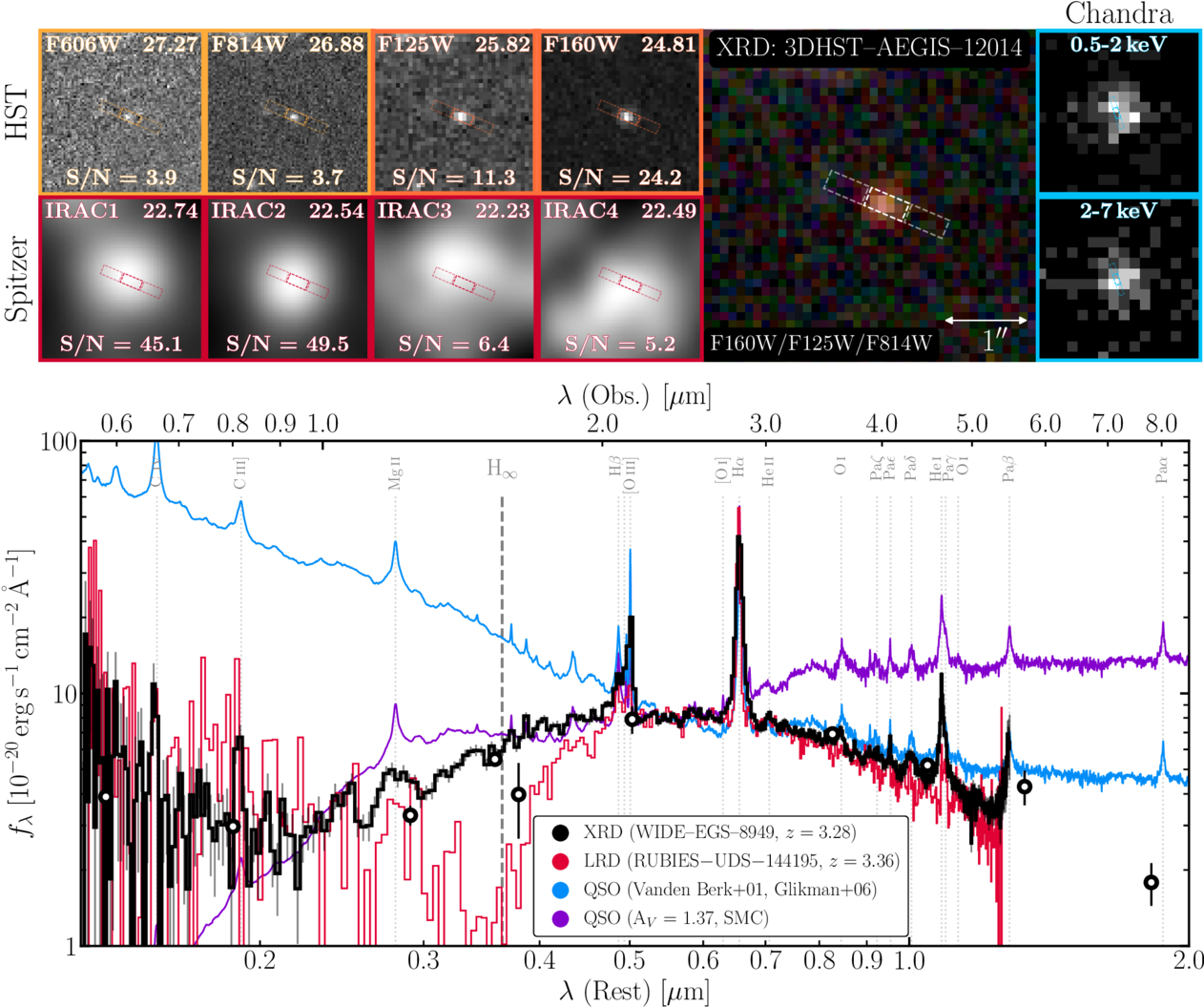
Figure 1 showcases the archival data from Hubble, Spitzer, and Chandra, along with the XRD’s spectrum from JWST (black curve, bottom panel). Photometric observations of the source indicate that it is incredibly compact (radius ≲ 250 pc, about 100 times more compact than the Milky Way) and shows similarities to LRD spectra, but with some key differences. (An example LRD spectrum is shown as the red curve in Figure 1.) The impressive X-ray luminosity of the XRD — typical of standard AGNs — is another key difference between it and standard LRDs.

A figure showing image cutouts from HST, Spitzer, and Chandra, of the XRD. The bottom panels also shows its spectrum alongside a typical LRD spectrum.

Figure 1: Top: Image cutouts from various Hubble, Spitzer, and Chandra observations of the XRD. Bottom: The spectrum of the XRD (black) shown alongside a similar LRD spectrum (red) and two quasar spectra (blue and purple), one of which has been reddened due to the presence of dust (purple). [Hviding et al. 2026]

So…What’s the Deal with the XRD?

To understand the nature of the XRD, the authors fit a variety of models describing a wide range of physical systems to the available data. Surprisingly, their best-fit models indicate that if the XRD is simply a typical AGN heavily obscured by astrophysical dust, its dust properties are drastically different from those of typical galaxies and AGN. Instead, trying to explain the system as an AGN embedded in a cocoon of gas (the black hole star model) provides better results (more aligned with observed LRDs), but it still isn’t perfect.

Notably, the emission in the ultraviolet-to-optical regime of the electromagnetic spectrum differs greatly from that of LRDs. In LRDs, this emission is indicative of a single dense gas component around the supermassive black hole, while in the XRD the authors find evidence suggestive of a patchier, less uniform distribution of gas. However, in order for this explanation to match the data, physical conditions of the model must be finely tuned, suggesting that this model may need to be refined further. These factors seem to suggest that the XRD is poorly understood in the context of our current paradigm of models describing AGNs and LRDs. The potentially patchy nature of the XRD’s gas envelope could suggest that this object is an LRD in the process of shedding its outer envelope, evolving into a typical AGN.

Regardless of its true nature, the XRD opens up new doors in our understanding of AGNs and LRDs. It provides an exciting glimpse at AGN evolution in action — a transitional fossil for early universe black holes. With a new piece of the puzzle slotted into our picture of AGN evolution, it’s only a matter of time before astronomers fully contextualize the stubbornly enigmatic LRDs.

Original astrobite edited by Ansh R. Gupta.

About the author, Drew Lapeer:

Drew is a first-year PhD student at the University of Massachusetts Amherst. They are broadly interested in the evolution of galaxies, with a focus on the impact of cosmic feedback on the galactic ecosystem. In their free time, they enjoy reading, rock climbing, hiking, and baking!

The post A Potential New Piece of the “Little Red Dot” Puzzle appeared first on AAS Nova.

Starring in the Early Universe: Black Hole Stars and Little Red Dots

25 March 2026 at 16:10

NIRCam JADES image

JWST has uncovered a peculiar population of very distant objects known as “little red dots.” The mechanisms powering these objects’ peculiar properties — high luminosities, compact radii, and “V”-shaped spectra — remain uncertain. Could little red dots be the result of supermassive stars, galaxy mergers, or, as a recent study explores, black hole stars?

Direct-Collapse Black Holes and Little Red Dots

Since their discovery, little red dots have been the subject of many studies, but a complete explanation for their unique combination of properties remains elusive. Multiple studies have explored the growing population of peculiar dots, with some postulating that they are the result of stars thousands of times the mass of the Sun, supermassive stars entrenched in gas from a galaxy merger, or black holes embedded in dense accretion disks. 

Even more recently, studies have proposed that little red dots may be the remnants of direct-collapse black holes. In this scenario, a large cloud of gas in the early universe directly collapses into a stellar-mass black hole, and the remaining gas envelops the black hole, forming what is known as a quasi-star (or black hole star). Researchers have suggested that little red dots may be the late stage of this process when the black hole has accreted at least 10% of the total mass of the system. Direct comparisons between quasi-star evolutionary models and JWST observations of little red dots have yet to be explored but are necessary to confirm the potential of quasi-star origins.

Evolutionary Models of Quasi-Stars

Quasi-star HR diagram

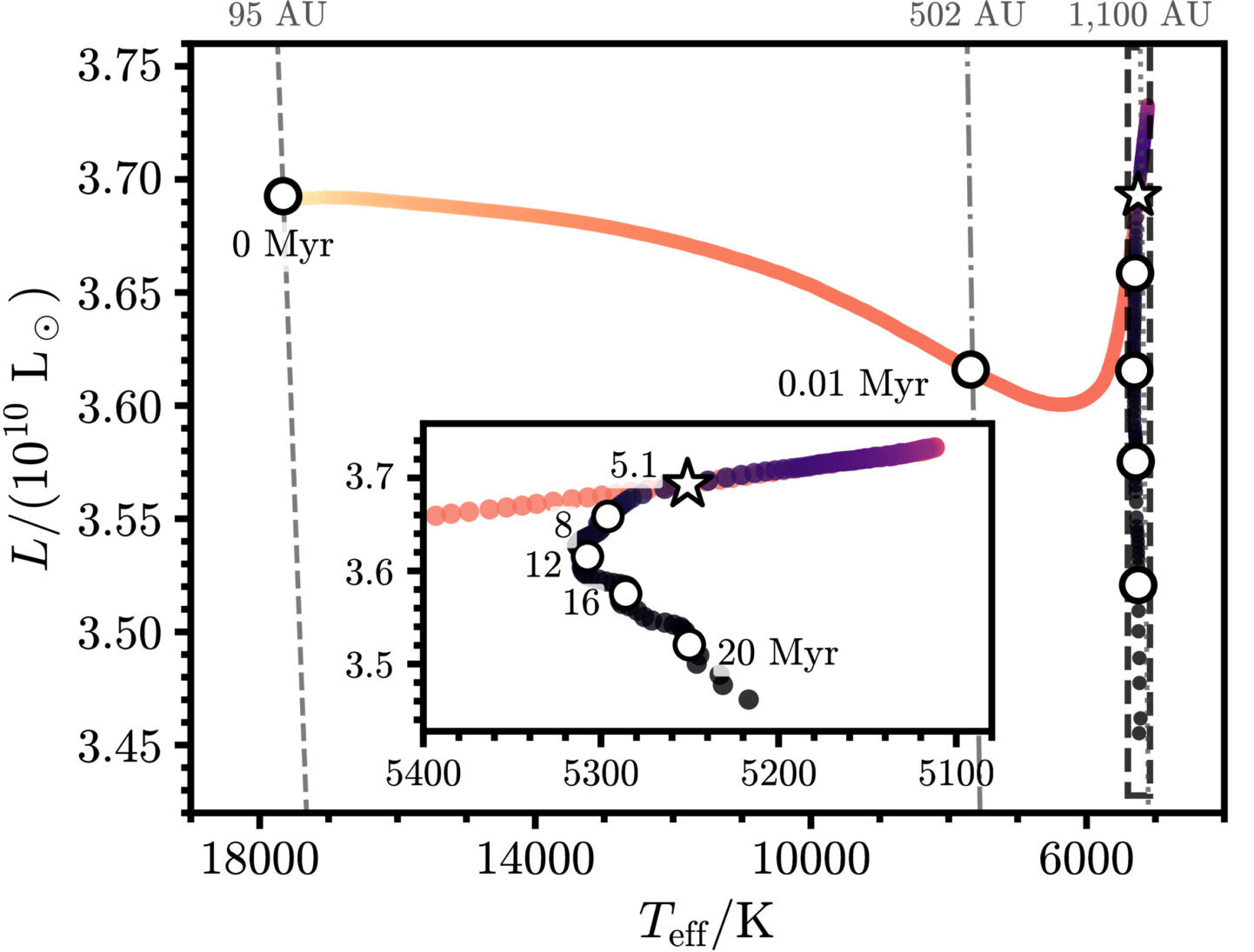
Evolution of a theoretical quasi-star model on a Hertzsprung–Russell diagram. [Modified from Santarelli et al 2026]

Seeking to compare quasi-star evolutionary models to JWST observations of little red dots, Andrew D. Santarelli (Yale University) and collaborators developed a modeling framework to simulate quasi-star evolution. In this framework, a quasi-star is modeled as a black hole at the core of a massive star that accretes material from the stellar envelope over its lifetime. The authors computed models for a range of initial masses and tracked the evolution of the quasi-stars, predicting luminosities, temperatures, surface gravities, and lifetimes of these objects.

After a short initial phase of contraction lasting around 10,000 years, the quasi-star spends the rest of its approximately 20–40-million-year lifetime in the “late stage” as the central black hole continues to eat up the surrounding envelope. In the end, the quasi-star becomes a supermassive black hole a million times the mass of the Sun.

SED comparison of quasi-star + LRDs

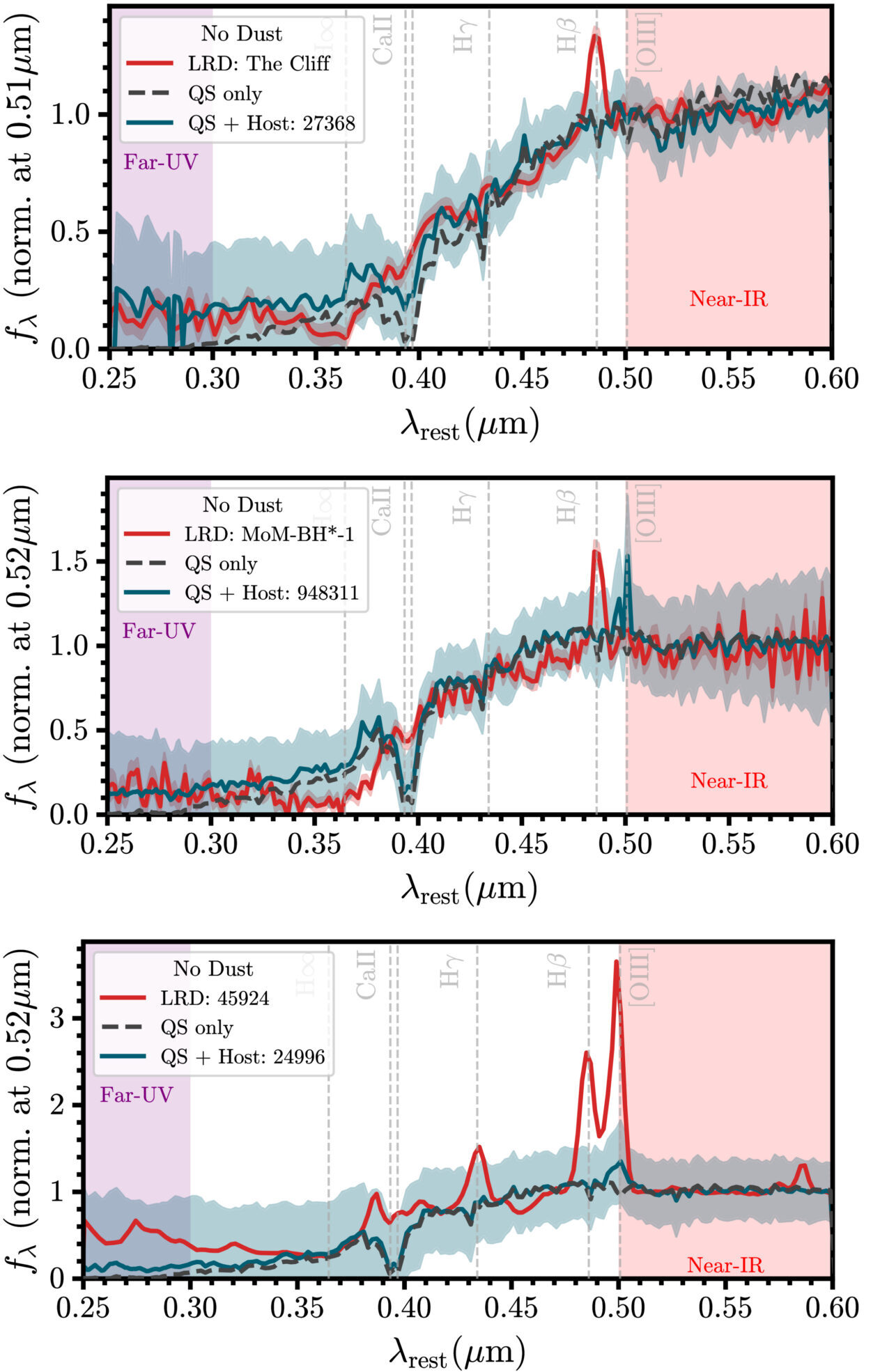
Predicted spectral energy distributions of 1 million solar mass, late-stage quasi-stars both alone (black dashed line) and embedded in a host galaxy (solid blue line). Each panel compares the quasi-star to a little red dot observed by JWST. [Modified from Santarelli 2026]

From these models, the authors extracted synthetic spectral energy distributions for late-stage quasi-stars. In comparing the simulated quasi-star spectra to those of three observed little red dots, the authors found that the synthetic quasi-star spectra generally reproduce the main continuum features seen in all three of the little red dots. While the models do not account for specific emission lines, the continuum slopes of the ultraviolet and near-infrared parts of the spectral energy distributions that form the signature “V” shape generally agree with those seen in the three comparison little red dots.
Plausible Progenitors

The results of this study indicate that late-stage quasi-stars can naturally produce the defining continuum features of little red dot spectra. While further modeling is required to trace specific emission line features, the initial modeling presented in this study establishes quasi-stars as plausible progenitors of not only little red dots but also the universe’s first supermassive black holes. 

As the authors noted, the short lifetimes of quasi-stars shown in their models in conjunction with the observed number density of little red dots implies that a significant fraction of supermassive black holes formed through this mechanism. Continued observations of little red dots and advanced modeling of direct-collapse black holes will aid in determining if these peculiar dots are showing off the birth of supermassive black holes in the universe.

Citation

“Evolutionary Tracks and Spectral Properties of Quasi-stars and Their Correlation with Little Red Dots,” Andrew D. Santarelli et al 2026 ApJL 998 L4. doi:10.3847/2041-8213/ae3713

The post Starring in the Early Universe: Black Hole Stars and Little Red Dots appeared first on AAS Nova.

A Dark Matter Origin for Little Red Dots

2 February 2026 at 17:00

illustration of the Milky Way's dark matter halo

New research suggests that the mysterious “little red dots” spotted in the early universe could be supermassive black holes birthed in the collapse of dark matter halos.

Another Theory for Little Red Dots

little red dots

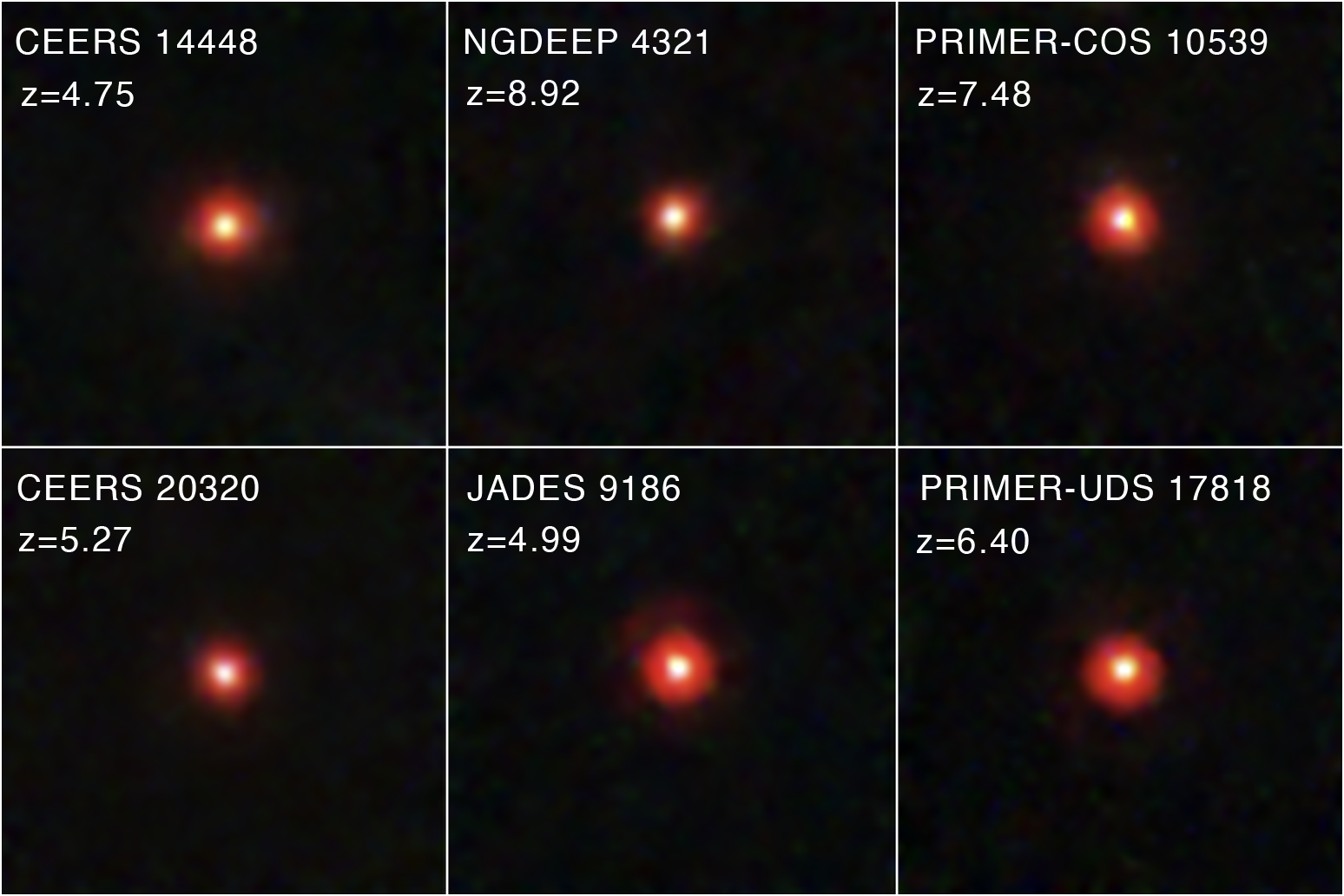
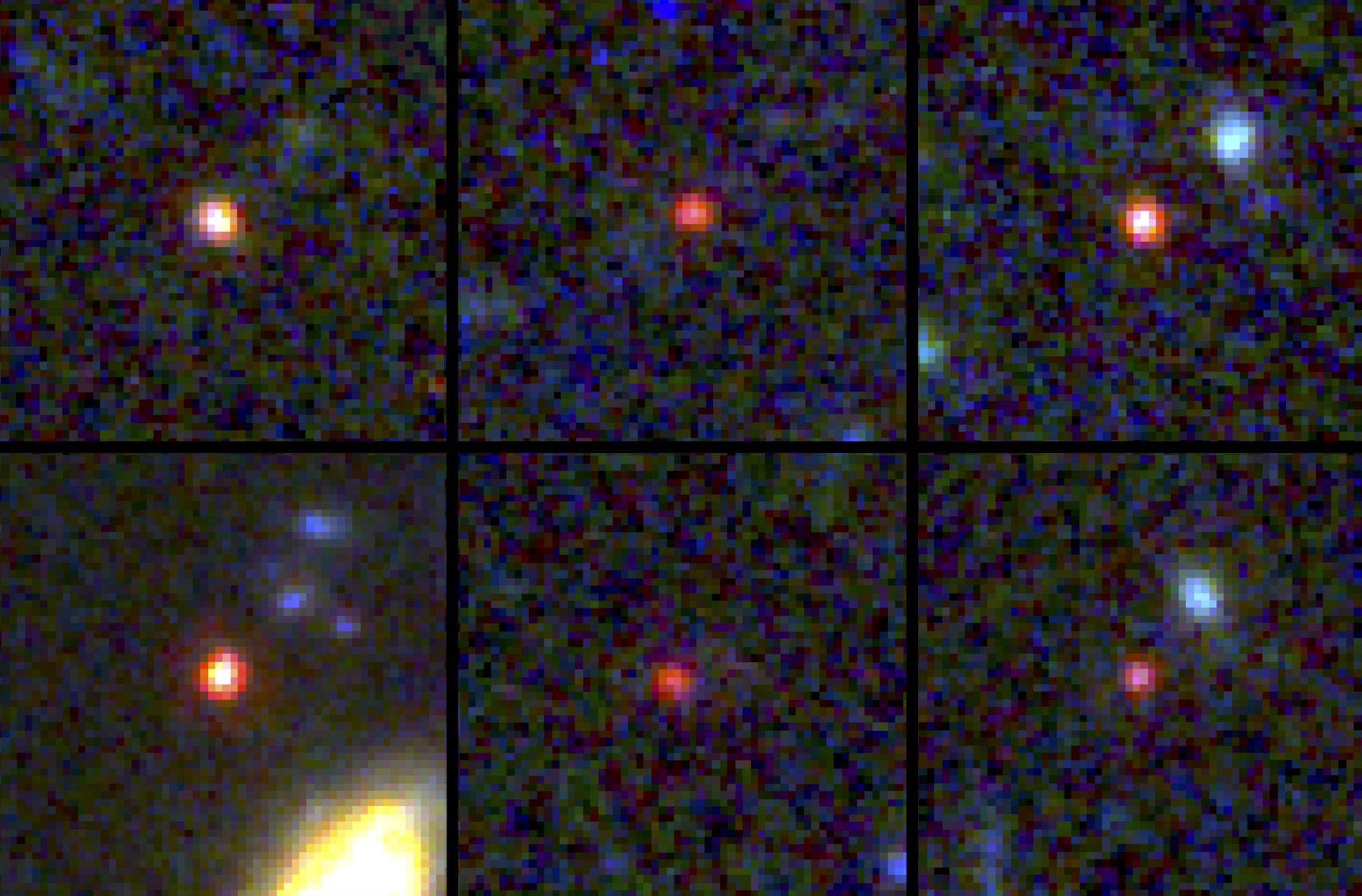
JWST images of six very distant galaxies dubbed “little red dots.” [NASA, ESA, CSA, STScI, Dale Kocevski (Colby College)]

Many theories exist for the origins of little red dots: compact, reddish objects spotted mainly in the first billion years after the Big Bang. The leading theory states that that little red dots are growing black holes encased in dense gas. The black holes at the centers of these little red dots appear to be tens or even hundreds of millions of times the mass of the Sun, raising questions about how they grew so massive so quickly. One possibility is that they started out quite massive, arising from black holes born from the collapse of massive gas clouds in the early universe.

A recent research article explores that theory, with a twist: that the black holes at the heart of little red dots were born not out of regular, baryonic matter, but out of dark matter.

A Dark (Matter) Past

In the early days of the universe, tiny fluctuations in the density of dark matter began to grow, eventually collapsing into vast spheroidal structures called dark matter halos. In the leading theory of cosmology, ΛCDM, dark matter interacts with itself and normal matter only through gravity. This leads to the creation of stable dark matter halos that act as the invisible scaffolding within which the first stars and galaxies grow.

In today’s article, Fangzhou Jiang (Peking University) and collaborators investigated the evolution of halos containing self-interacting dark matter. Particles of self-interacting dark matter, as the name suggests, can interact with one another through collisions and exchange heat. This small adjustment, sometimes invoked in alternatives to ΛCDM to explain the properties of dwarf galaxies, can lead to the collapse of dark matter halos into black holes.

Seeding Black Holes

Jiang and coauthors examined whether this process could explain the observed population of little red dots. First, the team examined whether the timescales are feasible: is it possible for dark matter to assemble itself into massive halos and collapse into black holes, all within the first billion years of the universe?

The answer appears to be yes — in this framework, dark matter halos with masses between 106.5 and 108.5 solar masses were able to form black holes between 104.5 and 106.5 solar masses by a redshift of z = 8.5, when the universe was just 600 million years old.

plot comparing observed and modeled black hole populations

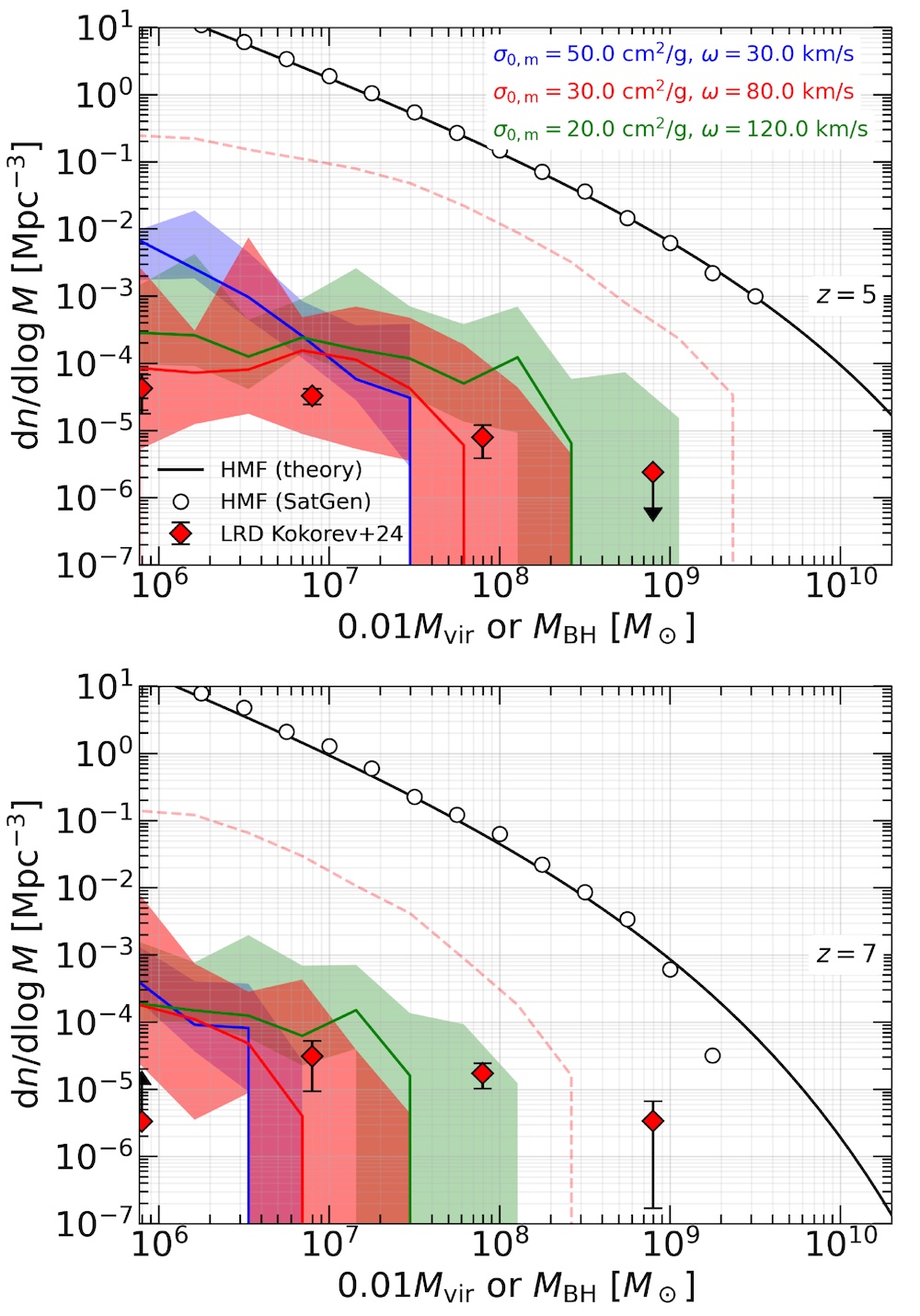
Comparison of the inferred black hole population in little red dots (red diamonds) to models of black holes formed in dark matter halo collapse (shaded areas) at two redshifts. The red area shows the fiducial model, while the blue and green areas show the effects of changing the dark matter self-interaction cross-section. The dashed red lines show an extreme case in which the presence of baryons accelerates halo collapse. Click to enlarge. [Jiang et al. 2026]

Jiang’s team then performed semianalytic modeling to explore how these “seed” black holes grow and evolve through accretion and mergers. This analysis generated a distribution of black hole masses consistent with what has been observed in little red dots. The team cautioned that their results are sensitive to the interaction cross-section of the dark matter particles, as well as various other parameters like the black hole accretion duty cycle. Their modeling also assumes that the halo collapse takes place before any baryonic matter collects within it. Intriguingly, the authors found that the presence of baryons accelerates the collapse of the dark matter halo, speeding the seeding process.

To close, Jiang and collaborators noted that this process is not mutually exclusive with other black hole seeding mechanisms, and as studies of self-interacting dark matter continue, its ability to create black holes in the early universe should be examined further.

Citation

“Formation of the Little Red Dots from the Core Collapse of Self-Interacting Dark Matter Halos,” Fangzhou Jiang et al 2026 ApJL 996 L19. doi:10.3847/2041-8213/ae247a

The post A Dark Matter Origin for Little Red Dots appeared first on AAS Nova.

A Black Hole Egg That Forgot to Hatch

13 January 2026 at 17:00

galaxies known as little red dots

Editor’s Note: Astrobites is a graduate-student-run organization that digests astrophysical literature for undergraduate students. As part of the partnership between the AAS and astrobites, we occasionally repost astrobites content here at AAS Nova. We hope you enjoy this post from astrobites; the original can be viewed at astrobites.org.

Title: The Discovery of Little Red Dots in the Local Universe: Signatures of Cool Gas Envelopes
Authors: Xiaojing Lin et al.
First Author’s Institution: Tsinghua University and University of Arizona
Status: Published in ApJ

Astronomers are using JWST to search the early universe for strange and captivating objects, and the results so far have exceeded all expectations. For every question we definitively answer, several deeper ones seem to emerge. The study of active galactic nuclei (AGNs), black holes that are actively consuming matter at the centers of galaxies across the universe, is no exception. Our pre-JWST understanding of AGNs has been completely shattered by the discovery of an astounding population of objects called little red dots (LRDs).

We know these objects host active black holes for several reasons. For one, they’re incredibly small despite being extremely energetic (that’s the “little” in their name). The smallest LRD we’ve seen appears to be less than 100 light-years across — for reference, the nearest star to the Sun is 4 light-years away — and yet is still as bright as a galaxy. The most plausible explanation for such brightness and compactness is a supermassive black hole that’s actively consuming matter. As further evidence for this hypothesis, we observe broad Balmer emission lines, spectral features that serve as a clear signature of AGN activity, in the vast majority of LRDs.

However, that’s where the similarities between LRDs and more typical AGNs seem to end. First off, astronomers have been unable to detect any significant X-ray emission from LRDs. This is shocking, since X-rays are a telltale signature of previously known AGNs. Another classic way to identify AGNs is by looking for changes in their brightness over time, since they can show drastic variability in their emission on the scale of years or even days. LRDs buck the trend by showing little to no fluctuation. Other classic AGN signatures that LRDs lack include radio emission and an abundance of hot dust. Explaining all of these unusual features has been incredibly challenging; nevertheless, coming up with a solution is crucial because there appear to be orders of magnitude more LRDs than any other kind of AGN in the early universe!

Wishing on a Star

One leading explanation for LRDs has recently gained significant traction. The hypothesis suggests that early black holes may have been cocooned in shrouds of extremely dense gas. This scenario helps explain the absence of many typical AGN signatures in LRDs. For example, this dense gas could absorb the X-rays generated by the central black hole. The gas-enshrouded model also explains a particular feature in the spectra of many LRDs known as a Balmer break. This feature is usually interpreted as coming from old stars with relatively cool atmospheres. The cocooned AGN hypothesis implies that Balmer breaks could actually be made by a black hole embedded in a cloud of gas, which somewhat resembles an enormous star!

This model helps explain the properties of some puzzling LRDs, including the most distant one we currently know of. However, their enormous distance makes them difficult to study in detail. It would be much easier to examine LRDs if they existed in the nearby universe, since they would appear much brighter and we could probe them on small spatial scales. Unfortunately, previous studies with JWST suggest that LRDs started becoming a lot less common around 12 billion years ago (corresponding to a redshift of about z = 4).

Luckily, less common doesn’t mean extinct! The authors of today’s article leverage data from the Sloan Digital Sky Survey (SDSS), which has taken millions of spectra of objects across the night sky over the past few decades. By mining this rich and diverse dataset, they identify a handful of LRDs in the nearby universe. Although they’re still far beyond our own Local Group, they’re practically in our backyard compared to the distant LRDs we’ve seen before. The authors followed up the new sources with some of the most powerful ground-based telescopes, enabling a detailed study of their properties.

A Chick That Forgot to Hatch

The first major result is that these local LRDs really do resemble many of the distant ones identified by JWST. They show a characteristic “V”-shaped spectrum in the ultraviolet and visible, a key feature in the definition of LRDs. They’re also quite compact. Using existing data from the Hubble Space Telescope, the authors measured the size of one source and found a tiny core embedded within a galaxy only a few thousand light-years across. For comparison, the Milky Way spans about 100,000 light-years.

Using spectroscopy from the Large Binocular Telescope, one of the Magellan Telescopes, and the MMT (formerly Multiple Mirror Telescope), the authors of this article find a rich variety of spectral features. This is where the proximity of these objects is extremely important. Taking spectra of the distant LRDs in this astounding level of detail would be at best prohibitively expensive (multiple full days of JWST observations) and at worst be completely impossible. In contrast, the nearby LRDs appear much brighter than their distant cousins. Their spectra are like intricate tapestries, with each thread revealing new details about their properties.

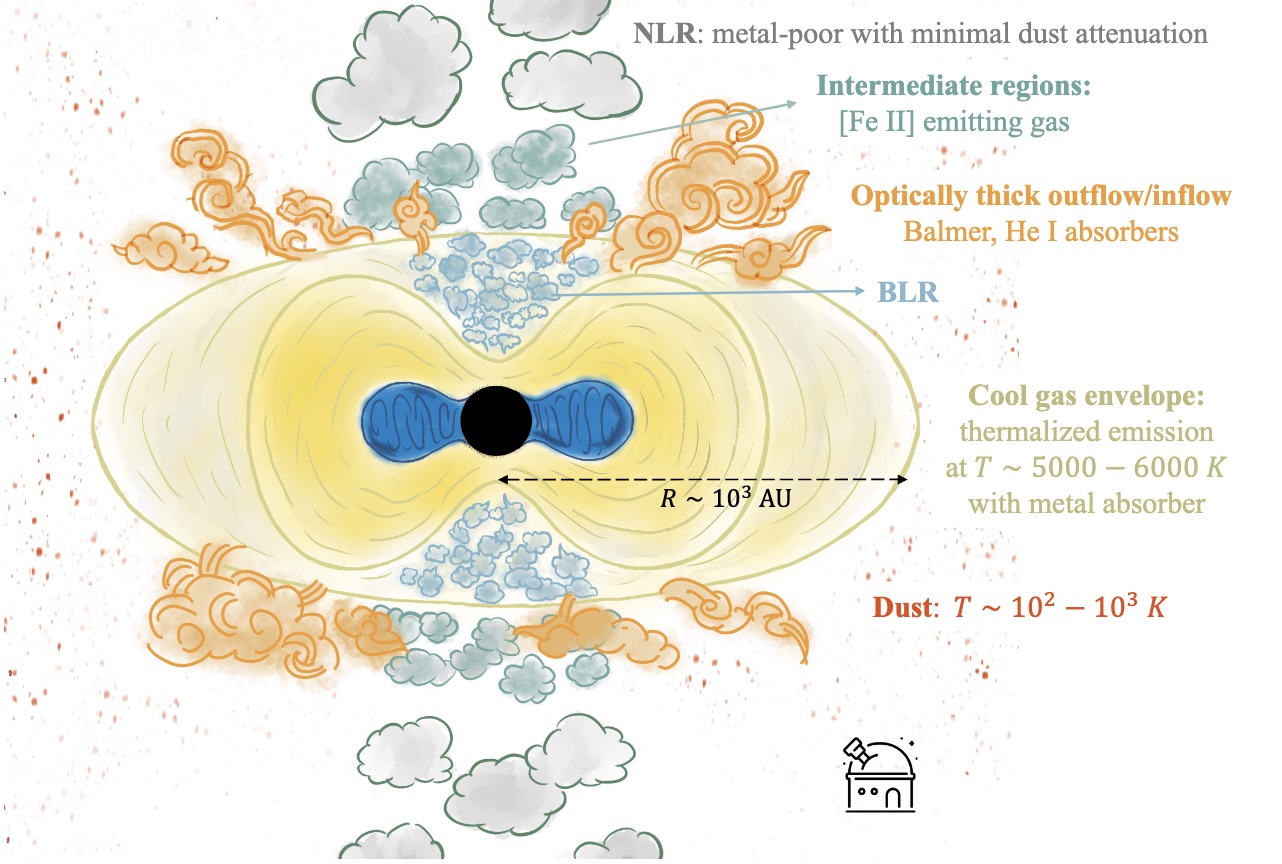
The authors find numerous broadened emission lines, signaling the presence of an active black hole. They also detect several intriguing absorption lines. These are most striking in one source, J1025+1402, nicknamed “The Egg.” In this object, there are clear absorption features from sodium, potassium, iron, and calcium. These elements appear in the observed states only under specific physical conditions. The authors interpret these findings as implying the presence of an envelope of cool gas surrounding the central black hole (see Figure 1). Such a scenario closely resembles the gas-cocooned AGN model proposed to explain distant LRDs!

schematic of a little red dot model

Figure 1: A schematic showing the authors’ interpretation of the nature of LRDs. This scenario is built up based on spectroscopic observations from several ground-based telescopes. Although the local sources differ slightly from the ones in the early universe, this model is strikingly similar to the ones invoked to explain some of the most extreme LRDs. The fact that such objects exist in the nearby universe is intriguing and raises further questions as to how black holes enter such a phase. [Lin et al. 2026]

These observations provide direct evidence for a potentially new kind of AGN. These local objects do differ slightly from their more distant counterparts; for example, they show some emission from hot dust, which is absent in early LRDs. Still, this adds another piece to the puzzle of this cosmic mystery. The authors hope that future observations will further illuminate the inner workings of LRDs across cosmic time. For example, studies may reveal what objects “hatch” from a source like the Egg, offering new insight into the life cycles of these unusual AGNs.

Original astrobite edited by Niloofar Sharei.

About the author, Ansh Gupta:

I’m an astronomy graduate student at the University of Texas at Austin working with Steven Finkelstein. I use data from JWST to study the formation and growth of the first galaxies and black holes in the universe. In my spare time, I enjoy playing piano, reading, and making YouTube videos.

The post A Black Hole Egg That Forgot to Hatch appeared first on AAS Nova.

All Alone With No AGN to Call Home? New Results for Little Red Dots

29 August 2025 at 17:00

little red dots

Among the discoveries JWST has made since its 2021 launch, “little red dots” are one of the most perplexing. Named for their compact size and red color, the origins of these distant galaxies remain unknown. A recent article explores some little red dots’ spectral energy distributions and local environments to better understand what may be lighting up these tiny torches.

Little Red Dot Dilemma

Along with their size and color, little red dots exhibit “V”-shaped spectral energy distributions (how they emit light across wavelengths), broad hydrogen emission lines, and no observed X-ray emission. These properties land them in an untapped parameter space with some similarities to both active galactic nuclei (AGNs) and stellar populations. Some previous investigations have suggested that little red dots contain AGNs, reddened by a dusty accretion disk scattering or blocking AGN light. Other studies have found that models for stellar populations can also fit certain little red dot spectra well. 

Adding to the ambiguity, observations and theory predict AGNs to show broad spectral lines, which are present in little red dots — but if little red dots are AGNs, this implies a much higher density of AGNs in the early universe than previously predicted by ground-based surveys. Furthermore, AGNs are expected to emit in the X-ray and show photometric variability, but neither property has been detected definitively thus far for a little red dot. With a clear dilemma arising for the origins of little red dots, astronomers are still prodding at these curious sources.  

AGN or Not?

AGN vs non-AGN fits

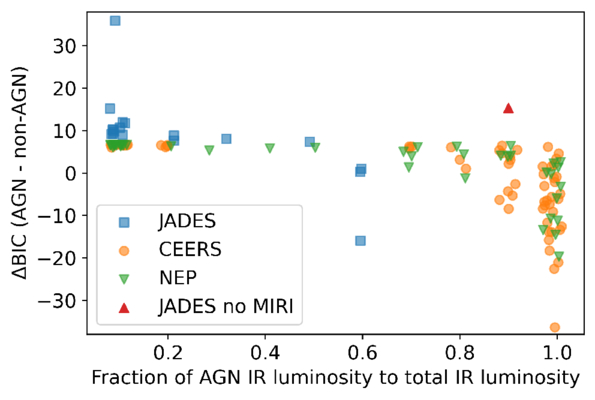
Comparison of AGN versus non-AGN fits using the Bayesian information criterion (BIC). Positive values of ΔBIC favor a non-AGN fit, and ~70% of little red dots have positive ΔBIC. Click to enlarge. [Carranza-Escudero et al 2025]

Leveraging the wealth of data available from recent JWST surveys, María Carranza-Escudero (University of Manchester) and collaborators built a sample of 124 little red dots spanning redshifts of z ~ 3–10. The authors used both AGN and non-AGN models to fit the spectral energy distribution for each galaxy. 

Using a robust statistical analysis, the authors found that AGN models tend to “overfit” the data — with more free parameters, an AGN model can be tweaked in a way that may not actually be physical (e.g., fitting for extremely high dust extinction that would not be possible). Instead, models without AGN components appear to be more appropriate for about 70% of the little red dots in their sample, suggesting that these peculiar objects may have a significant star-forming component powering their emission. 

environments histograms

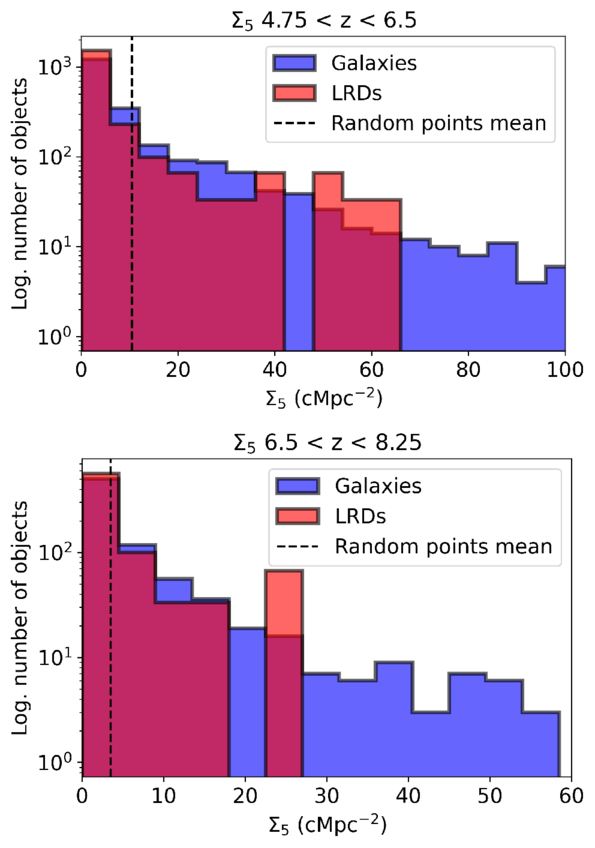
Histograms for two redshift windows showing that little red dots (red) tend to be found in less dense environments than other galaxies (blue) in the same redshift window. Click to enlarge. [Carranza-Escudero et al 2025]

Lonely Neighborhoods

In addition to characterizing little red dots’ emission, the authors analyzed the local environments to compare to other galaxies at similar redshifts. From their analysis, they found that little red dots tend to be found in sparser environments, generally isolated from other galaxies. One explanation for this could be that little red dots in higher-density environments evolve past this peculiar stage faster, which is supported by observations of high-density environments accelerating the evolution of other galaxy types at similar redshifts. However, further investigation is required to better understand the connection between the local environment and little red dot properties. 

More little red dots are yet to be discovered, and continued analysis of their emission and environments will uncover more intriguing characteristics. For now, it seems as though little red dots are still a mystery.

Citation

“Lonely Little Red Dots: Challenges to the Active Galactic Nucleus Nature of Little Red Dots through Their Clustering and Spectral Energy Distributions,” María Carranza-Escudero et al 2025 ApJL 989 L50. doi:10.3847/2041-8213/adf73d

The post All Alone With No AGN to Call Home? New Results for Little Red Dots appeared first on AAS Nova.

Distant Little Red Dot Hosts a Huge (and Growing) Black Hole

6 August 2025 at 20:32

Illustration of an accreting supermassive black hole shrouded by dust

Astronomers have confirmed the discovery of a little red dot galaxy from when the universe was roughly half a billion years old. The galaxy, CAPERS-LRD-z9, is the most distant object to show the tell-tale broad emission lines of gas spiraling around a black hole, opening a new window onto black hole growth in the early universe.

Little Red Dots in the Spotlight

Images of six "little red dot" galaxies from JWST

Images of six “little red dot” galaxies from JWST. [NASA/ESA/CSA/I. Labbe]

Of all the discoveries JWST has enabled since its launch, none seems as enduringly mysterious as the tiny, distant galaxies nicknamed “little red dots.” These early universe objects are characterized by their small sizes, red color in JWST images, and V-shaped spectra.

But what are little red dots? Are they growing supermassive black holes busily amassing gas? Compact collections of old stars? Shredded stars spoon-feeding baby black holes? As reported today in the Astrophysical Journal Letters, new JWST data provide answers for one particularly distant dot.

JWST Takes Another Look

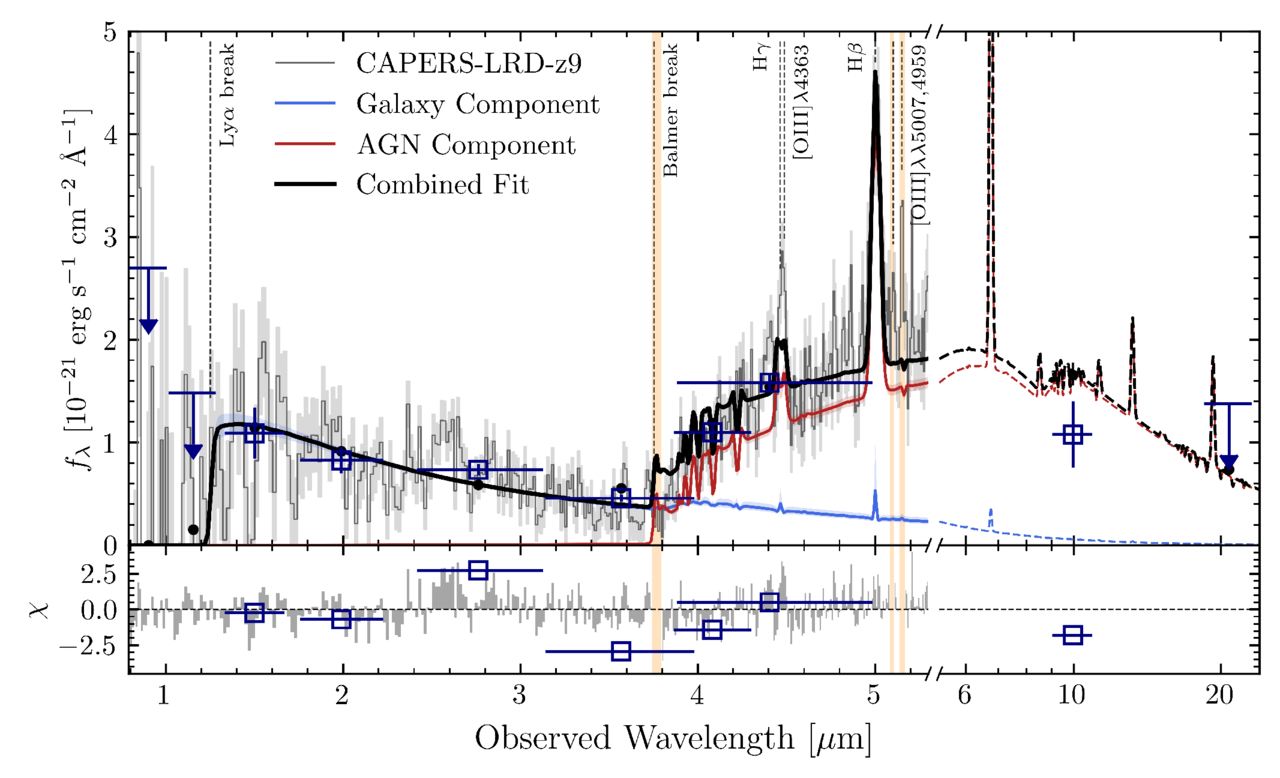
CAPERS-LRD-z9 was first identified as a possible high-redshift little red dot when it was observed by the Public Release IMaging for Extragalactic Research (PRIMER) survey with JWST’s Near-Infrared Camera (NIRCam). Anthony Taylor (The University of Texas at Austin) and collaborators followed up on the discovery with JWST Near-Infrared Spectrograph (NIRSpec) observations from the CANDELS-Area Prism Epoch of Reionization Survey (CAPERS). This spectrum pinned the object’s redshift at z = 9.288, corresponding to when the universe was only about half a billion years old.

With CAPERS-LRD-z9 placed along the cosmic timeline, Taylor and coauthors turned to the question of its identity. The JWST spectra revealed a broad emission line from hydrogen gas moving at thousands of kilometers per second — evidence that CAPERS-LRD-z9 harbors an accreting supermassive black hole (an active galactic nucleus or AGN) that is spinning gas into a frenzy around it. CAPERS-LRD-z9 is the most distant object known to show this characteristic signature of a growing black hole.

JWST spectrum of CAPERS-LRD-z9

JWST NIRSpec spectrum of CAPERS-LRD-z9 with the fit from the AGN (red) plus stars (blue) model. Click to enlarge. [Taylor et al. 2025]

Next, the team examined the little red dot’s spectral energy distribution, using a model that includes an AGN and a stellar population. To reproduce the step-like discontinuity seen in CAPERS-LRD-z9’s spectrum, they used a model in which the supermassive black hole is shrouded in a shell of dusty gas. The model fit well with a black hole mass of 38 million solar masses (though the authors estimate the mass could be anywhere in the range of 4.5–316 million solar masses), an upper limit of 1 billion solar masses on the stellar mass, and a gas density of 1010 per cubic centimeter surrounding the black hole.

Seeding a Black Hole

plot of black hole mass versus redshift for detected AGN and quasars

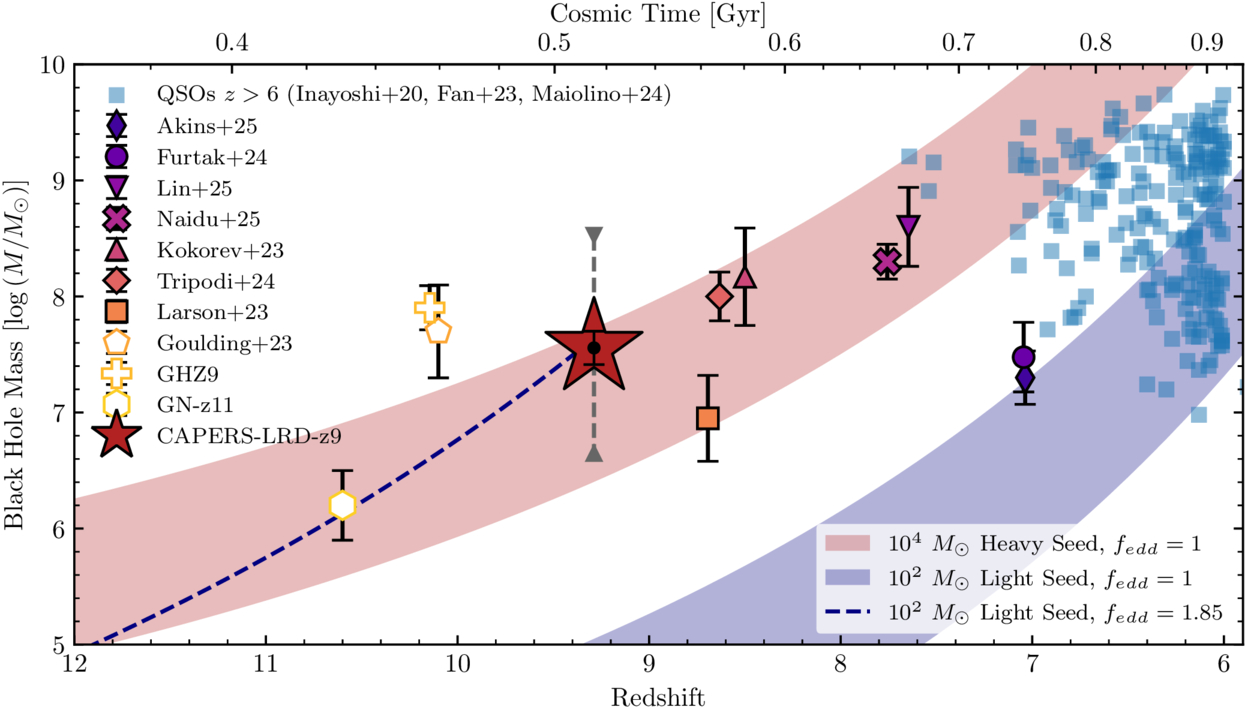
Observed black hole masses and redshifts of several sources, including CAPERS-LRD-z9 (large red star), quasars at redshifts of z > 6 (blue squares), massive spectroscopically confirmed AGN with broad emission lines (filled symbols), and the highest-redshift AGN detected to date via X-ray or ultraviolet emission. The shaded areas show the black hole masses achievable through accretion at the Eddington rate onto a massive (red) or stellar-mass (purple) seed. Click to enlarge. [Taylor et al. 2025]

Since successfully fitting one model doesn’t immediately rule out others, Taylor’s team also applied a stars-only model to the spectrum. This model fit poorly, and combined with the presence of broad hydrogen lines from fast-moving gas, this is strong evidence that CAPERS-LRD-z9 contains an accreting supermassive black hole.

This finding raises the question of how a black hole can grow to millions of solar masses in just 500 million years. The authors showed that this is possible in two scenarios: either the black hole began as a >10,000-solar-mass “seed” that grew at the Eddington rate — the hypothetical limit at which a black hole can accrete matter — or it started out as a smaller, ~100-solar-mass seed that grew at a super-Eddington rate. The observations rule out the possibility that the black hole grew from a ~100-solar-mass seed accreting at or below the Eddington rate.

In addition to setting the record for most distant broad-line AGN known, CAPERS-LRD-z9 gives new intel on the lives of black holes in the early universe. This won’t be the last we hear about this little red dot!

Citation

“CAPERS-LRD-z9: A Gas Enshrouded Little Red Dot Hosting a Broad-Line AGN at z = 9.288,” Anthony J. Taylor et al 2025 ApJL 989 L7. doi:10.3847/2041-8213/ade789

The post Distant Little Red Dot Hosts a Huge (and Growing) Black Hole appeared first on AAS Nova.

A New Theory for Little Red Dots: Shredded Stars Feeding Growing Black Holes

21 May 2025 at 17:00

disk of hot gas swirling around a black hole

When JWST peered back into the early universe, its keen eyes revealed an unexpected population of galaxies nicknamed “little red dots” for their compact size and bright red hue. A new research article proposes that tidal disruption events could be responsible for the surprising appearance of these galaxies.

Galactic Surprises

galaxies known as little red dots

Six “little red dot” galaxies seen by JWST. [NASA, ESA, CSA, STScI, Dale Kocevski (Colby College)]

Using JWST, researchers have discovered more than 300 little red dots. Most of these galaxies are concentrated around when the universe was 600 million years old, though they’ve been spotted out to about 1.6 billion years after the Big Bang. But why do these galaxies look the way they do? Do they host enormous, active black holes, as many researchers suspect? Do they get their characteristic red color from a population of old, evolved stars? Or could rapid, dust-shrouded star formation be the cause?

A successful theory of little red dot identity must account for several observed properties: “V”-shaped spectra, broad H-alpha lines, and little or no emission at X-ray wavelengths. In a recent research article, Jillian Bellovary (Queensborough Community College; CUNY Graduate Center; American Museum of Natural History) has theorized that little red dots get their curious characteristics from stars being torn apart by a young and growing black hole.

A New Hypothesis

In this scenario, little red dots arise in the extremely dense star clusters created in the early universe. Because of their extraordinary density, these star clusters are vulnerable to gravitational collapse, causing the packed-together stars to crash into one another. The colliding stars combine to form a supermassive star that collapses, leaving behind an intermediate-mass black hole — a seed that could someday grow into a supermassive black hole.

Situated at the center of a dense star cluster, an intermediate-mass black hole would be poised to ensnare stars in its gravitational web, pulling the stars apart with its powerful tidal forces and stealing their mass. These star-shredding events are known as tidal disruption events.

predicted number density of intermediate-mass black holes and observed density of little red dots

Predicted number density of intermediate-mass black holes (blue and orange lines). The symbols show the observed number densities of little red dots as a function of redshift. [Bellovary 2025]

Simulations predict that in the era during which little red dots have been observed, a cubic megaparsec should contain about 0.3–1 intermediate-mass black holes. (These intermediate-mass black holes could arise through the cluster collapse scenario outlined above, or through other pathways like the collapse of the first stars in the universe.) Observations show roughly 10,000 fewer little red dots in this same volume.

Because tidal disruption events tend to remain bright for about a year, this implies that a tidal disruption event rate of one per 10,000 years is necessary for tidal disruption events to explain little red dots.

Matching Predictions

predicted tidal disruption event rates

Modeled tidal disruption event (TDE) rates for two different models and various values of velocity dispersion, σ, and stellar density, nstar. [Adapted from Bellovary 2025]

Using analytic and numerical models, Bellovary showed that this tidal disruption event rate is reasonable for intermediate-mass black holes with masses between 1,000 and 100,000 solar masses. But would tidal disruption events provide a match for other little red dot characteristics? Tidal disruption events tend to be faint at X-ray wavelengths and sport broad H-alpha lines, much like little red dots. Another plus is that unlike in the active black hole scenario, the H-alpha emission from a tidal disruption event doesn’t scale with the mass of the black hole; this means that black holes categorized as over-massive based on the strength of their H-alpha emission may not be over-massive after all. One drawback of the tidal disruption event scenario is that it doesn’t necessarily predict the characteristic red color of a little red dot; this color might come from the galaxy’s stars instead.

As Bellovary notes, little red dots could have multiple causes. Some might be due to tidal disruption events, while others could contain active black holes, ancient populations of red stars, or dusty starburst galaxies, as others have suggested.

To verify the tidal disruption event hypothesis, astronomers would need to find evidence for time variability at rest-frame ultraviolet wavelengths, as well as a characteristic decrease in brightness over time. These changes are expected to unfold over the course of years or decades, meaning that while observations may settle this question in due time, there will be plenty of time to ponder the mysteries of little red dots while we wait.

Citation

“Little Red Dots Are Tidal Disruption Events in Runaway-Collapsing Clusters,” Jillian Bellovary 2025 ApJL 984 L55. doi:10.3847/2041-8213/adce6c

The post A New Theory for Little Red Dots: Shredded Stars Feeding Growing Black Holes appeared first on AAS Nova.

James Webb Space Telescope | Extremely High Redshift Failure

2 June 2026 at 01:25
The James Webb Space Telescope (JWST) has observed what appear to be very distant red galaxies challenging the standard big bang theory. Misidentifying some Brown Dwarf stars within our Milky Way as these red distant galaxies brings into question the existing cosmological models.

James Webb Space Telescope | Little Red Dot Galaxies are a Big Big Bang Problem

26 March 2025 at 00:06
In 2022, the James Webb Space Telescope discovered six massive Little Red Dot galaxies dated 500–800 million years post-Big Bang. Their presence challenges the ΛCDM cosmological model, as they contain unexpectedly high stellar masses. Recent findings have increased their count to 341, raising questions about galaxy formation and the validity of current theories.

❌