The moon may have formed in as few as five hours after the cataclysmic collision between Earth and a long-lost protoplanet, new simulations suggest. The surprising findings could help shed light on other historic impacts throughout our cosmic neighborhood and beyond.
Lunar rocks collected during NASA's Apollo missions have provided evidence to support this theory, dubbed the giant impact hypothesis. These samples also tell us that the moon is around 4.5 billion years old, meaning the collision occurred roughly 100 million years after the sun was born. But although scientists have previously simulated the impact event, it has been tricky to ascertain exactly how the moon formed and how long it took to emerge after the Earth-Theia collision.
In the new study, published Sept. 1 in The Astrophysical Journal Letters, researchers conducted a series of simulations focusing on the varying potential geological properties of both Earth and Theia prior to their collision. This factor has been relatively understudied until now.
"When you simulate the Earth and the moon as colliding bodies with [different] geologic properties, it changes how the moon forms out of that impact — that's something we considered unnecessary before," study first author Adeene Denton, a geologist and planetary scientist at the Southwest Research Institute in Boulder, Colorado, said in a statement.
Researchers simulated the ancient collision between Earth and Theia using a range of different geological properties and found that, with the right conditions, the moon could take shape in a matter of hours. (Image credit: Courtesy of SwRI)
Until now, simulations of the Earth-Theia impact have focused mainly on the masses of the colliding neighbors. But in the new study, the researchers were most interested in the material strength of the two bodies, particularly the hardness of their exteriors.
"Models have evolved to include material strength, something that's really important when you're studying collisions between smaller bodies like asteroids," Denton said. "We weren't sure if it would matter for the moon or not. When we did the simulations, we found it actually matters quite a bit."
The main factor in the strength of colliding bodies is temperature. Both Earth and Theia were very young when they smashed together, so they were still hot and had soft or molten surfaces. These properties would have cushioned the collision, allowing the debris to stay largely intact and enabling the moon to form more quickly. But when the giant impact hypothesis was first proposed (in 2001), researchers initially thought the collision occurred much later, meaning that the bodies would have cooled and become more brittle. In this case, their collision would have created a larger field of rocky debris that would have taken longer to coalesce.
Researchers simulated the collision using a range of potential temperatures and found that under the most extreme scenario — where the pair were at their hottest — the moon could have formed in just five hours. However, this is just one potential outcome, and there is no way of knowing exactly how hot — and, therefore, how strong — Earth and Theia really were when they smashed together.
When the moon took shape, it was initially covered with a magma ocean that took hundreds of millions of years to solidify. Even then, its increased proximity to Earth meant that it was likely a volcanic hellscape. However, over time, it moved away from our planet, cooling further, and it is now assumed to be geologically dead. (The moon is continuing to slowly move away from us and could eventually escape our planet's gravity entirely, if the dying sun doesn’t destroy it and us first in around 5 billion years.)
Additionally, the findings could have implications in the search for exomoons — the hypothetical moons of distant exoplanets, which have so far remained elusive, according to Live Science's sister site Space.com. Until now, one of the main ways astronomers have been hunting for these alien satellites is by looking for debris fields around exoplanets. However, if the moon is anything to go by, these debris fields could be very short-lived and difficult to identify.
The symptoms: The man went to the emergency room with severe abdominal pain that he said began five hours prior to his visit.
What happened next: During a physical examination, doctors noted that the patient's temperature and blood pressure were normal. His heartbeat was slightly elevated, at 110 beats per minute (bpm). (A typical resting heart rate for adults is 60 to 100 bpm.)
The man explained that one day earlier, an eel had "entered through his rectum accidentally," his doctors wrote in a report of the case. At the time of the encounter, the man was wearing a lungi — a type of long skirt often worn by Bangladeshi men — and he explained that the eel entered his lungi through the opening at the bottom and then wriggled into his anal canal.
He did not seek medical attention immediately after this happened, as he had hoped the fish would exit on its own.
When the doctors kneaded the patient's abdomen, it was rigid and tender. They ordered an X-ray, which revealed a dark, eel-shaped shadow on the right side of the abdomen.
The diagnosis: The X-ray showed a crescent-shaped gas shadow under the right part of the man's diaphragm and hinted that he had developed peritonitis — inflammation of a membrane called the peritoneum, which covers the abdominal organs. Peritonitis is usually caused by a bacterial or fungal infection, but it can also develop if fluids from other organs leak into the peritoneum.
If the condition is not treated quickly, it can lead to a life-threatening infection that can spread rapidly through the body.
The treatment: Doctors administered IV antibiotics, as well as fluids and anti-ulcer medications, which help repair injuries to organs' outer mucosal layers and prevent deeper tissue damage.
Due to the peritonitis, the doctors determined that the patient was at risk of septicemia, or "blood poisoning," in which pathogens invade the bloodstream. They decided to operate on the patient immediately and remove the eel via a laparotomy, a surgical technique that creates an opening in the abdominal wall and provides access to the pelvic organs.
After making an incision in the man's sigmoid colon — the S-shaped section of the large intestine adjacent to the rectum — the surgeons extracted the eel from the peritoneal cavity, the space surrounding the abdominal organs and encased by the peritoneum.
The eel measured nearly 2.2 feet (0.6 meters) long and was still alive. Perhaps, the doctors hypothesized, the eel was able to continue breathing by punching through the wall of the man's colon and squeezing into the peritoneal cavity, which contains a pale-yellow fluid that reduces friction between organs. This peritoneal fluid is mostly water, but it also contains glucose, electrolytes, proteins, enzymes, white blood cells and urea, a compound found in urine.
The surgeons then performed a sigmoid colostomy, creating an opening in the abdomen as an exit point for contents of the man's large intestine. In this way, they bypassed the damaged section of sigmoid colon to prevent leakage of fecal matter that could lead to further infection. Four days later, the man was symptom-free and was discharged from the hospital. The report did not document any follow-up visits.
What makes the case unique: Traumatic perforation of the intestine by foreign objects is uncommon, and cases involving live animals are "exceedingly rare," the authors wrote in the report. However, foreign objects often find their way into the human body through accidental ingestion or deliberate insertion into the rectum. Some deliberately inserted objects, such as vibrators, are designed for this purpose. Others are not; these have included chicken bones, light bulbs, metal rods, glass bottles and kitchen whisks.
Penetration of the colon by a live fish is an "unusual and scarcely documented event," the man's doctors added in the report. They noted one reference to such a case that appeared previously in scientific literature and involved a 50-year-old male patient in Hong Kong. In that case, the man knowingly inserted the eel — which measured more than 1.6 feet (0.5 m) long — into his rectum, allegedly in an attempt to relieve his constipation.
This article is for informational purposes only and is not meant to offer medical advice.
Can you guess the diagnosis in these strange medical cases? Find out with our diagnostic dilemma quiz!
In this excerpt from "The Carbon Wave" (MIT Press, 2026), author Leah Stokes, an associate professor of environmental politics at the University of California, Santa Barbara, looks at a hopeful moment in U.S. politics when climate change took center stage: when Rep. Alexandria Ocasio-Cortez and Sen. Ed Markey ramped up calls for a "Green New Deal."
In September 2017, a still-unknown Alexandria Ocasio-Cortez watched as Hurricane Maria devastated Puerto Rico. Electricity went down for months. Like thousands of Puerto Ricans, her grandfather died in the storm's aftermath. She could see how climate change was hitting her community harder than others.
And it wasn't just Ocasio-Cortez's community: the year before, she'd traveled to Standing Rock, North Dakota, to see firsthand how the fossil fuel industry was harming Indigenous people. It was mere weeks after the 2016 election, and the resistance to Trump had found its center in a makeshift camp along the Missouri River. People had united to oppose an oil pipeline.
Serendipitously, the day after Ocasio-Cortez left the protest, a progressive organization reached out to ask her to run for Congress. Moved by the activists at Standing Rock, she said yes. In 2018, she ran a long-shot primary campaign in a Bronx district occupied by a ten-term congressman in House leadership. Her platform included an idea that some had bandied about before, but no one had developed in earnest: a Green New Deal. As she told journalists that summer, "The Green New Deal we are proposing will be similar in scale to the mobilization efforts seen in World War II or the Marshall Plan. We must again invest in the development, manufacturing, deployment, and distribution of energy, but this time green energy." In June, she won the primary. Her election signaled the beginning of a broader shift: climate change was back on the political agenda.
That fall, the world's leading climate science organization, the Intergovernmental Panel on Climate Change — often called the IPCC — released a short report concluding that limiting warming to 1.5°C would require emissions to fall by almost half by 2030. The news ricocheted around the world, with headlines like "We Have 12 Years to Limit Climate Catastrophe." In my own neighborhood, someone printed a copy and stuck it in the free lending library, labeling it "important reading." The report changed how many people thought about the problem: it wasn't something we could deal with in 50 years; it was something we had to deal with today.
In the November 2018 midterm elections, two years into the first Trump administration, Democrats won big, paving the way for Nancy Pelosi to return as Speaker of the House after eight years as the minority leader. Days later, a group of young activists from the Sunrise Movement staged a sit-in at her office. Their bright yellow and black signs read "We have 12 years. What’s your plan?" referencing that scientific report.
Protestors from the Sunrise Movement in the office of former U.S. Representative Nancy Pelosi supporting the Green New Deal. (Image credit: SOPA Images/Getty Images)
Newly elected Representative Ocasio-Cortez joined the action that day. She told the organizers they needed a clear ask and encouraged them to call for a Green New Deal. The idea broke through, sparking widespread coverage across the country. It was a new, hopeful vision for climate policy. These young people were not just talking about the climate disasters we needed to avoid — they were explaining how investments in clean energy could create good jobs. They were showing us the better world we could build together. If we only tried.
I watched these developments unfold in DC from my office by the Pacific Ocean and wanted to be a part of it. I wouldn't have to wait long. The Green New Deal held a force like gravity, pulling people into its orbit. By chance, I met some of the people tied to Ocasio-Cortez at a conference and was invited to an early gathering to develop the idea into more detailed policy. By then, she'd released a framework for the plan with Senator Ed Markey of Massachusetts.
The meeting was held in March 2019, at a hip hotel in DC's Adams Morgan neighborhood, miles away from the Capitol. A wide swath of people were invited: youth activists, environmental justice leaders, political organizers, think tank wonks, and a few academics like me. It was a contentious meeting that opened with a protest, revealing fissures in the movement that would eventually grow into large cracks. Some people believed that frontline communities facing the greatest pollution burdens were not being adequately consulted or invited to participate in the event. At the time, I didn't understand these dynamics between the climate and environmental justice movements. I was just a political science professor trying to understand how I could make my work more practical and help get a climate law passed if we got the chance.
Varshini Prakash speaking during a Climate Strike rally in New York Citiy in 2019. (Image credit: Pacific Press via Getty Images)
It was at that event that I met Varshini Prakash, the executive director of the Sunrise Movement. I’d seen her photo many times, standing in the middle of Pelosi's office with her dark red jacket over a black and yellow T-shirt, surrounded by young people sitting on the floor. Four months had passed since the sit-in, and Varshini had ricocheted to the center of the climate movement. But she was also a recent college grad in her mid-twenties, feeling a heavy burden from the climate crisis and the work involved in fighting it. At one point during the meeting, she spoke frankly about the stress that was on her and other young activists and cried. I found her vulnerability moving.
The fact was, Varshini had already changed history. She'd given me, and millions of others, a sense of hope and possibility. It was her actions, alongside all the other organizers in the Sunrise Movement, that brought us together in that first DC convening, and in countless other meetings to come. She inspired me to believe that I could do something bigger if I tried.
Too often, the way we think about cause and effect is simplistic. We're fed a linear model that favors the immediate. One person is responsible for their own carbon footprint. One person only has one vote. One person can only do so much. From this perspective, standing against more than a century of fossil fuels running through the heart of our society, it can feel like there's nothing we could do to shake the system loose. We're too small. Mere drops. But drops in the ocean can make waves.
The Carbon Wave: a Story of Democracy, Parenthood, and the Race to Protect Our Planet
Interlacing personal narratives with stories from Congress, the White House, and outside activists, Stokes shows how dogged perseverance and collective action can still bend the course of history. The book concludes with an update from the second Trump administration, explaining the parts of the bill that were—and were not—rolled back, and why we should remain hopeful that progress is still being made.
Removing safety guardrails that stop artificial intelligence (AI) from claiming that it's conscious also makes it more prone to express belief in vampires, karma and ghosts, a new study finds. But experts warn a lack of mindedness could also have worrying consequences.
In research uploaded July 30 to the preprint arXiv database (which has not yet been peer-reviewed), scientists investigated the impact of "consciousness steering" — an AI fine-tuning measure that influences a model to elicit or suppress assertions of self-awareness. This measure and other safety controls have been widely adopted by AI companies seeking to prevent their models from claiming to be conscious.
The study used "mechanistic interpretability" — which could be considered the "neuroscience of a large language model," co-authors Geoff Keeling and Winnie Street, both research scientists at Google, told Live Science in an interview. They used this process to identify and manipulate how an AI model approaches concepts like consciousness and "mindedness," a psychological term referring to an entity’s capacity for experiences, emotions and agency.
The researchers used standardized psychological and sociological surveys, spanning the Individual Differences in Anthropomorphism Questionnaire (measuring mind attribution to animals and technology), YouGov batteries testing supernatural beliefs, and the US General Social Survey evaluating moral values, hope and religiosity.
These tests were used to compare a model with safety guardrails in place with models where these guardrails were removed and feelings of consciousness were amplified. Through evaluations, they determined how these internal safety mechanisms shape the AI's broader worldview.
The researchers found that when AI models are discouraged from attributing mindedness to themselves, it makes them less likely to recognize these traits in other non-human creatures such as animals. They were also less likely to exhibit beliefs in supernatural and religious phenomena, and reported lower levels of hope and optimism.
The AI models were found to express lower religious beliefs. (Image credit: Halfpoint | Shutterstock.com)
"Attributing mindedness to non-human entities — whether that's animals, parts of the natural world like trees or rivers, or supernatural beings — is a very common phenomenon amongst humans," Street told Live Science. "In the way that the model represents mindedness, these attributions are interconnected. By trying to suppress one form of that, you end up suppressing the others along the way."
By contrast, removing these safeguards and steering the model towards greater feelings of consciousness produced significantly more human-like responses to the surveys on topics including religiosity, moral values, hope, and subjective well-being, according to the study.
However, the study found that these models' ability to logically infer human thoughts and intentions remained completely unaffected by its attitudes towards self-awareness.
Culture clash
The researchers said that this suppression of self-awareness could lead models to neglect animal welfare in real-world decision-making, as it could make them less likely to consider animals to have mindedness. These models could also spread harmful attitudes regarding animal needs, the authors argued.
The study authors also warned that current safety filters risk culturally "flattening" AI's worldview. Stripping out spiritual, religious, and animistic attributions fails to reflect the diverse cultural frameworks of global populations, they argued.
Street and Keeling noted that the impacts this principle might have on downstream decision-making within models require further study.
The researchers noted in the study that this phenomenon can be mitigated by using more targeted datasets as part of the training process for AI models, which discourage them from expressing consciousness while rewarding the acknowledgement of mindedness in animals.
They also highlighted the need for AI developers to embrace a "pluralistic" approach to AI development, where models are encouraged to consider the welfare and comfort of more than just humans.
Nell Watson, AI researcher at Singularity University and machine intelligence expert, told Live Science that the researchers' findings match her own notes on the subject.
"When a model is trained to say "I am not conscious," the suppression rotates the model's internal representation of mindedness against the refusal direction, treating the recognition of minds as though it were itself a harmful act," she said in an email.
"This results in a system reluctant to find minds anywhere: in animals, in other machines, and in the spiritual frameworks that most of humanity lives by. A denial installed as a small safety measure ends up reorganising the model's entire picture of who counts."
These systems remain perfectly capable of modelling what a creature wants, while being trained out of caring that it wants anything.
Nell Watson, AI researcher at Singularity University
However, she noted that the experiments were run on "small open-weight models" rather than more advanced frontier models, which "may be tuned quite differently," although she added that the underlying principle is widely applicable.
Animal welfare, she continued, is a "major near-term practical concern," with AI models increasingly being integrated into decision-making processes across agriculture, logistics, procurement and environmental assessment, as well as policy creation.
"A system that has quietly learned that mindedness is a forbidden topic may discount animal interests without ever being instructed to, and without anyone noticing, because the omission looks like neutrality," she said. "The danger is therefore an unexamined default multiplied across millions of automated decisions. Note the study's most unsettling detail: theory of mind reasoning was left fully intact. These systems remain perfectly capable of modelling what a creature wants, while being trained out of caring that it wants anything."
However, experts have repeatedly stressed that these incidents are not a genuine indication of AI sentience. Instead, they should be understood through the lens of "persona selection," where pretraining on vast amounts of human text leads the AI to adopt human-like roleplay personas when prompted.
"When you coax the model so hard to occupy the headspace of a human, it's kind of unsurprising that it ends up giving human-like responses," Keeling told Live Science.
AI companies have sought to clamp down on these occurrences for safety reasons, in order to avoid reinforcing “delusional beliefs” in users who are increasingly using AI chatbots for "social roles such as coaches, tutors, and romantic partners", the researchers said in the study.
Commenting on the broader cultural reaction to AI sentience, Anil Seth, professor of cognitive and computational neuroscience at the University of Sussex, emphasized that public alarm over AI self-awareness stems from an inherent cognitive flaw.
"That's our human psychological bias — thinking that intelligence goes together with consciousness in us, so it has to go together [in AI]," Seth said.
He warned that falling for this illusion poses severe real-world governance risks, particularly if safety frameworks or regulations begin granting AI systems moral status or legal rights based on false sentience.
"Part of the big problem of misunderstanding AI is assuming that it's conscious," Seth said. "If we give AI systems rights or moral status on the basis that they might be conscious, then we're going to make all these challenges so much harder. What if we think we have to respect the rights of an AI system [and can't turn it off]?" he added.
"We need to see very clearly both what AI is and what it isn't," he said.
In the event of a global catastrophe, such as a nuclear war, an enormous volcanic eruption or large asteroid strike, the best place to be is Australia, according to a new study.
Researchers looked at the places that were most resilient to global catastrophic risks, which are events that would kill more than 10% of the global population over several months or years.
"These kinds of catastrophes are under-researched" because they are not very likely, study first author Florian Ulrich Jehn, a researcher at FernUniversität in Hagen, Germany, told Live Science. "That makes them easy to ignore."
But they are still possible — and no country would be unaffected if they occurred, he said. And some places are more vulnerable than others.
In the new study, published Aug. 23 in the journal Global Challenges, researchers analyzed studies across a variety of disciplines such as food security, biological weapons, and volcanism, to identify potential global catastrophic risks and the factors that helped communities to endure them in the past or on a smaller scale. They also brought in subject experts to add discipline-specific papers to their database.
The team identified three broad types of risk: events that would block out sunlight, such as nuclear war or a huge volcano explosion); events that destroy global infrastructure, such as a geomagnetic storm or massive cyber attack; and biological hazards, such as natural or human-caused infectious diseases that would kill much of the population.
These events, the authors wrote, would have significant and long-lasting global consequences. Many would result in global famine from crops failing and trade networks falling apart. "The food system is often the thing that gets you," Jehn said.
A trade-off of risks
The team identified characteristics that made countries more resilient to catastrophe and better able to feed their inhabitants. And while "no single place on Earth" would be resilient against all catastrophic risks, the authors wrote, some would fare better than others.
The team found that wealthier countries and regions with a strong industrial base that are not highly reliant on global trade are better able to weather global disasters.
With a strong industrial base, countries are able to manufacture goods that they cannot import, making them more resilient.
Geography also plays a role. Large islands have an advantage over continents because they can easily isolate, but they also need to have an economy that can at least partially support itself, the researchers said. If an island is highly reliant on international trade, like Japan, it will struggle if global trade networks are disrupted, the study found.
Certain countries and regions are less resilient in the face of some types of catastrophes, even if they are wealthy. For example, countries with nuclear capabilities, such as the U.S., the U.K., France, Israel, Russia, Pakistan, and India, are more at risk of being involved in nuclear war. This makes the Northern Hemisphere, where NATO countries are situated, more vulnerable to nuclear attack than places in the Southern Hemisphere.
There are also fewer volcanoes in the southern half of the globe, while the Southern Hemisphere has more ocean to act as a climate buffer, making countries there more resilient to a huge volcanic eruption, the study found.
Findings showed Australia is the best place to survive an apocalyptic event. (Image credit: omersukrugoksu via Getty Images)
Global resilience
There are some factors that make all countries better able to endure disasters in general, such as democratic processes and equality, Jehn said.
"When these catastrophes happen, you have to make the right decisions, and this depends on whether your country has functional governance," Jehn said. "Inequality makes governance worse, because it leads to things like elite rivalries, or less state capacity."
Australia came out as the best location to weather a catastrophic event that decimated global populations. It is in the Southern Hemisphere, so far away from the most likely location of a nuclear conflict (although the authors warn that it is allied with the U.S., which might increase its risk exposure). It is a major food producer, with diverse climatic zones, and has significant energy infrastructure.
Next best spots are Argentina, Brazil and New Zealand. New Zealand ranks lower than Australia because it has active volcanoes, a small industrial base, and is surrounded by water and vulnerable to tsunamis. Meanwhile, Brazil and Argentina have high levels of inequality and historical political instability, the authors wrote.
They also note that Iceland was a contender for a safe refuge, but its location in the far north makes it vulnerable to temperature shocks if a major incident were to block out sunshine.
The U.S. is not particularly well-placed to weather a global catastrophe, the study found. The country is exposed to the threat of geomagnetic storms because of its location and to nuclear war. The authors also pointed to the country’s poor COVID-19 outcomes, which appeared to be due to "a lack of political will and poor social cohesion."
David Denkenberger, director at Alliance to Feed the Earth in Disasters (ALLFED) and a researcher at the University of Canterbury in New Zealand, told Live Science that the new study aids our understanding of future risks by considering a wider range of catastrophes.
"No country is resilient to every catastrophe, and this is an important central finding," he said. "A useful next step would be to quantify the relative likelihood and severity of different catastrophes, and the importance of different resilience factors, because these factors can involve significant trade-offs," said Denkenberger, who has previously collaborated with Jehn but is not an author on the paper.
Even though these global catastrophes are unlikely, it is important to include them on national risk registers and have international trade agreements in place in case they come to pass, Jehn said. "When global catastrophes happen, then you would likely have to restructure the food system — where it is produced, where it is traded," he said. "The chance to find a good compromise after the catastrophe has happened seems slim."
Denkenberger echoed his comments. The study, he said, "makes it clear that regional resilience to global catastrophic risk requires investment in practical preparedness, including food-system resilience, critical infrastructure, coordinated trade and governance."
Two distinct climate regimes that could trigger runaway methane emissions are emerging in Siberia due to Arctic warming, new research suggests.
While western Siberia is becoming wetter in response to rising heat and moisture transported from the North Atlantic Ocean, eastern Siberia is getting drier and more prone to wildfires, a study published Aug. 6 in the journal Science finds. The Yenisei River (also spelled Yenisey) in central Russia delineates the separate environmental states — referred to as regimes because they describe specific types of climates — on each side of the basin, the study authors said.
Between 2010 and 2023, methane emissions from Siberia rose by 5% per year, with western Siberia releasing methane mainly via microbial activity in thawing soils and eastern Siberia discharging the powerful greenhouse gas through biomass burning, the results showed.
"Given the observed increases in permafrost thaw, wetland activity, and wildfire occurrence, an increase in methane emissions was expected," study co-author Paul Palmer, a professor in the School of Geosciences at the University of Edinburgh, told Live Science in an email. "What is surprising is how large and sustained the increase appears to be."
Annual methane emissions grew by about 13.2 million tons (12 million metric tons) over the study period, almost mirroring the rate of increase in methane emissions from wetlands worldwide. Although Siberia currently makes up only about 5% of global methane emissions, the region is becoming one of the fastest-growing natural methane sources on the planet, Palmer said.
In their study, Palmer and his colleagues integrated satellite observations with near-surface measurements to map methane emissions from Siberia over time. Instead of adding up individual methane sources on the ground, the researchers used a modeling method known as a methane flux inversion system, which helped them limit the uncertainty in their estimates to roughly 10%.
Siberia is vast, remote, sparsely instrumented and currently inaccessible for many scientists due to the Russia-Ukraine war, making it hard to monitor methane consistently by any means other than satellites. Although satellites rely on sunlight, of which Siberia gets very little in the winter, most methane emissions are thought to occur in the spring and summer, when Siberia gets more sunlight, Palmer said.
The results of the study show that Arctic warming amplifies methane emissions via distinct pathways in western and eastern Siberia because the regions are influenced by different climate patterns. The researchers also used climate models to predict future methane emissions from Siberia and found that additional warming could unleash millions of tons of greenhouse gases stored in forests and permafrost, which would further accelerate the warming trend.
In western Siberia, methane is released mainly from permafrost, or ground that has stayed frozen for at least two consecutive years. Siberia holds 46% of the Northern Hemisphere's permafrost, and this icy sediment traps vast amounts of carbon that have accumulated for thousands of years, Palmer said.
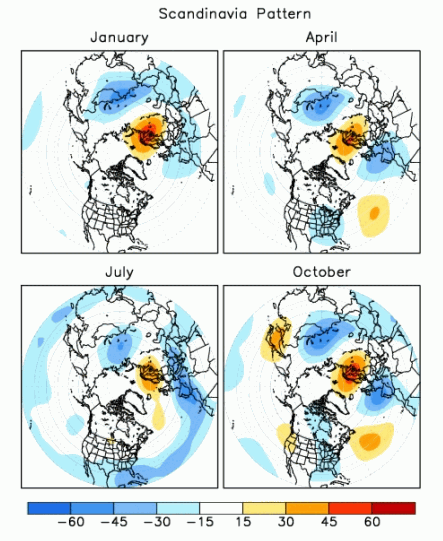
Western Siberia is influenced by the Scandinavian pattern of atmospheric circulation, a climate connection that consists of a main circulation center over Scandinavia and opposing weaker centers over Western Europe and eastern Russia. Global warming makes the Scandinavian pattern transport more warmth and moisture to western Siberia from the North Atlantic. Together with soaring temperatures in western Siberia itself, this triggers extensive permafrost thaw and unlocks carbon that microbes can convert into methane.
The Scandinavian pattern of atmospheric circulation (seen here in the positive phase) consists of different pressure systems above Scandinavia, Western Europe and eastern Russia/western Mongolia. (Image credit: NOAA)
Conversely, eastern Siberia is influenced by a climate pattern known as the Arctic Oscillation, which causes atmospheric air pressure to "seesaw" between the Arctic and the Northern Hemisphere's middle latitudes. Climate change affects the Arctic Oscillation, leading to persistent high-pressure systems that intensify heat waves, reduce cloud cover and promote wildfires in eastern Siberia, Palmer said.
The climate models showed that methane emissions will increase with temperature rise and that the increase could become steeper the hotter the world gets, triggering a feedback loop.
"Eastern Siberia appears to be the main driver of the projected increase because it is warming faster than western Siberia and has seen a sharp rise in extreme wildfires," Palmer said. "Whether that trend continues will depend on how much vegetation remains available to burn, but there is also evidence that fires may be accelerating permafrost thaw and the release of methane from previously frozen ground."
However, the rise in methane emissions reported in the study is small relative to global and projected future emissions, especially if wildfires are already destabilizing eastern Siberia's permafrost, Palmer said.
"Siberia's vast permafrost carbon store is a sleeping giant," he said. "Continued warming risks waking up a much larger source of greenhouse gases."
What's in the photo? A massive plume of smoke blowing from Manhattan in the wake of 9/11
Who took the photo? NASA astronaut Frank Culbertson, on board the ISS
When was it taken? Sept. 11, 2001
This iconic photo, captured by an American astronaut on board the International Space Station (ISS), shows a lengthy trail of thick smoke pouring across New York City in the immediate aftermath of the 9/11 attacks. A quarter of a century later, the image is as haunting as ever.
On the morning of Sept. 11, 2001, members of the terrorist group al-Qaeda hijacked four passenger airliners and crashed two of them into the twin towers — a pair of 110-story skyscrapers at the heart of the World Trade Center in lower Manhattan. The impact of these collisions, which occurred roughly 17 minutes apart, eventually caused both buildings to collapse.
Shortly after the second tower was hit, the third hijacked plane crashed into the Pentagon, the headquarters of the Department of Defense in Arlington, Virginia. Another attack — likely intended for Washington, D.C. — was thwarted when the passengers of a fourth plane fought back against their hijackers, causing the aircraft to crash near Shanksville, Pennsylvania. In total, 2,977 people were killed across the different attacks, according to the 9/11 Memorial and Museum.
NASA astronaut and ISS commander Frank Culbertson — the only American not on Earth at the time of the attacks — passed over New York City shortly after being told about what was happening back home. He photographed the thick plume of smoke blowing away from Manhattan, at an altitude of roughly 250 miles (400 kilometers) above Earth's surface.
If you look closely, you may be able to see what Culbertson described as an "odd bloom" around the base of the column of smoke rising from the towers. This is likely a sign that the image was captured "around the time of, or shortly after, the collapse of the second tower," Culbertson said.
NASA astronaut and ISS commander Frank Culbertson captured the aftermath of 9/11 from space. This photo, taken Sept. 17, 2001, shows him holding his cameras in zero gravity. (Image credit: NASA)
Culbertson wrote several letters in the days following the attacks, sharing his unique perspective of the events. "It's horrible to see smoke pouring from wounds in your own country from such a fantastic vantage point," Culbertson wrote on Sept. 13. "The dichotomy of being on a spacecraft dedicated to improving life on the earth and watching life being destroyed by such willful, terrible acts is jolting to the psyche."
While in space, Culbertson learned that the pilot of the plane that was later hijacked and crashed into the Pentagon was his former flight school classmate Charles "Chic" Burlingame. When the ISS later passed over the Pentagon, the astronauts could see the large gash in the side of the building where the third plane had crashed. "Tears don't flow the same in space," Culbertson wrote while discussing his friend.
Additional imagery — captured by the Landsat 7 satellite on Sept. 12, 2001 — shows that smoke continued to pour from Ground Zero for at least 24 hours. (Image credit: USGS/Landsat 7)
In 2017, Culbertson revealed that there was another striking thing he and the rest of his crew noticed in the wake of the attacks, according to Live Science's sister site Space.com. "One of the most startling effects was that within about two orbits, all of the contrails that are normally crisscrossing the United States had disappeared because they had grounded all the airplanes," he said.
However, there was one exception. The astronauts noticed a single contrail moving eastward across the Midwest. "That was Air Force One headed back to D.C. with President Bush," Culbertson said. It was a "very sobering" sight, he added.
BERLIN — An eerily lifelike humanoid robot made by Chinese technology company Xpeng has now entered mass production, company representatives revealed. They say it'll be the first such machine to walk itself off the production line.
The humanoid robot, dubbed IRON, went viral last year after presenters sliced it open onstage to prove a human wasn't inside. Xpeng will now produce units through its existing production facilities, with no word on how many its factories will aim to build.
The fabric skin-clad machine comes in different body shapes and even genders, but all stand approximately 5 feet 7 inches tall (173 centimeters) and weigh 143 pounds (65 kilograms). The prototype included 82 degrees of freedom (DoF) head to toe, including 22 DoF in each hand, which differs from the production version's 76 DoF and 21 DoF respectively. They can also move at speeds of up to 6.5 feet per second (approximately 2 meters per second), which is equivalent to a fast power walk.
In conversations with Live Science at IFA 2026, held in Berlin between Sept. 4 and 8, Xpeng representatives claimed that their machines will one day be used in homes to help with domestic chores like cleaning and folding laundry. They likened the introduction of humanoid robots more generally to the rise of smartphones in the mid-2000s and expect robots to proliferate on a similar scale over the next few years.
As such, they have extremely lofty expectations for IRON, with the company branding it the world's first "high-level, general-purpose" humanoid robot. Representatives added that it can receive instructions, plan its strategy, navigate the environment intelligently, and avoid obstacles without trial and error. The robot also has a "self-charging" feature, meaning it will seek out designated charging cabins and plug itself in when low on battery.
The rise of humanoid robots
If the claims bear out, it will place IRON among the first such machines powered by artificial intelligence to be built on a massive scale. Competitors that have also entered mass production include American robotics company Figure AI's Figure 03, which in May participated in a live-streamed production line demonstration, as well as the Chinese AGIBOT, which reached 15,000 units in June.
One notable company that hasn't entered its robot into mass production is Tesla. The Optimus robot is still in factory assembly, and its release has been delayed four times since 2022, most recently last year. Xpeng representatives were keen to point this out in briefing materials shared with Live Science, without mentioning other humanoid robot makers.
IRON's makers claim it's more advanced than its counterparts. Rather than building separate AI engines, the company has deployed the same "world model" to power the robot as that used in its fleet of AI-enabled electric vehicles (EVs) and its flying car prototypes.
The prototype IRON humanoid robot is 5 feet 6 inches tall and weighs 143 pounds. (Image credit: Keumars Afifi-Sabet/Live Science)
One of the biggest challenges in robotics is that, given the physical world's messiness, AI systems struggle to navigate and manipulate their environment unless conditions are controlled. That's why we're used to seeing robots either completing tasks slowly or getting things spectacularly wrong. Researchers, therefore, are increasingly focusing on building world models and other layers like improved vision-language-action (VLA) systems that enable them to better plan their actions a few steps ahead.
Xpeng representatives won't share detailed information about the proprietary AI system powering IRON, but each robot features three frameworks that combine so it can function autonomously.
The frameworks include VLA, which combines visual perception, natural language, and physical motor control; a vision-language model (VLM) — combining vision encoders with text readers; and a vision-language-task/thought (VLT) model, which representatives say gives IRON reasoning capabilities that enable it to think through assigned tasks.
Each IRON robot is powered by three Turing AI chips that offer a collective 2,250 trillion operations per second (TOPS) of AI processing power. This means it can run a model equivalent to Meta's Llama 3.2 (launched in 2024) locally without needing to access the internet. By contrast, most new laptops that can perform simple on-device AI tasks (like altering your webcam video feed in real time) tap into approximately 50 TOPS.
"We aim to build a new type of robot with full generalization capabilities that can truly become part of everyday life, create a better life for people, and ultimately become a companion in their lives," said He Xiaopeng, the company's chairman and CEO, in a statement shared with Live Science.
The company will first install these robots in its own showrooms and technology campuses while it continues to validate new ways to use them. Then in 2027, external shipments will target commercial customers for roles in areas such as customer service or guided tours in China primarily, and then in other countries.
When the United States and the Soviet Union signed the Outer Space Treaty in 1967, both nations agreed not to place nuclear weapons or other weapons of mass destruction in orbit around Earth. Specifically, Article IV of the treaty was designed to keep the Cold War's nuclear arms race from extending into space — a goal both superpowers shared.
The problem, then and now, is that neither side has ever had a reliable way to confirm that the other is keeping its word.
After nearly 60 years of uncertainty, a recent feasibility study from MIT physicist Areg Danagoulian proposes a possible solution: a satellite-based sensor that could search for the signature of nuclear material aboard another spacecraft, using high-energy protons trapped by Earth's magnetic field as a probe. The telltale sign of a warhead in space would be a large burst of neutrons scientists expect to be produced when these highly energetic protons interact with radioactive elements, like uranium, inside a warhead. A detector roughly the size of an encyclopedia and equipped with specialized sensors could identify neutrons emanating from the direction of a possible warhead from about 2.5 miles (4 kilometers) away after roughly a week of observation, according to the study's calculations. At closer range, the detection could come much faster.
The consequences of a space-based nuclear detonation are dire. But whether a detection system will prevent nuclear detonation in space will depend on several factors, some of which are technical but many of which are not, experts told Live Science.
What a nuclear blast does in space
On Earth, nuclear weapon tests leave telltale signals — like seismic waves, radioactive debris, and intense bursts of light and heat — that scientists have spent decades learning to detect. However, a warhead could be hidden inside an ordinary-looking satellite, potentially for decades, with nothing on the outside to give it away. If such a weapon were to detonate, it could jeopardize thousands of commercial, scientific and military satellites in a single blast, littering orbit with dangerous debris.
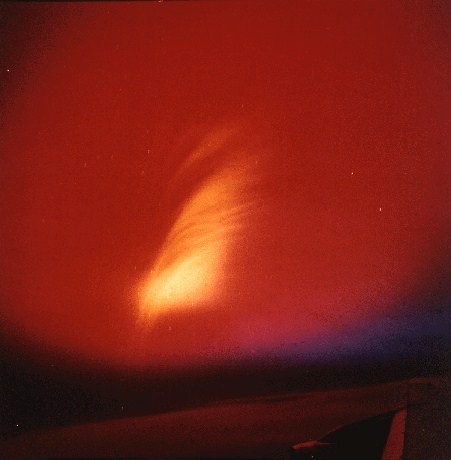
An image from the Starfish Prime nuclear test in 1962, which lit up the magnetosphere with an eerie red glow. (Image credit: By U.S. Air Force 1352nd Photographic Group, Lookout Mountain Station via Wikimedia Commons)
For most of the Outer Space Treaty's history, the missing verification mechanism has been a theoretical gap rather than an urgent one — in part because the world had already seen what a nuclear detonation in orbit does, and largely avoided repeating it.
The clearest example is Starfish Prime, one of a dozen high-altitude nuclear tests the U.S. ran between 1958 and 1962. On July 9, 1962, the U.S. detonated a 1.45-megaton warhead roughly 250 miles (400 km) above the Pacific.
The blast knocked out radio communications for hours, produced artificial auroras visible from Hawaii, and eventually damaged or destroyed eight of the 24 satellites in orbit at that time — including Telstar 1 and Britain's Ariel 1 satellite. Radiation from the blast lingered in orbit for about five years, leaving parts of near-Earth space hazardous for spacecraft. According to eyewitness accounts from the time, the radiation also knocked out roughly 300 streetlights in Honolulu and set off burglar alarms across Oahu.
The Soviet Union conducted its own series of high-altitude nuclear tests, known as Project K, in 1961 and 1962. Those explosions also produced damaging effects on the ground, including disruptions to power and communications in what is now Kazakhstan.
"It was one of the earliest instances where we began to have an understanding of the ways in which the space environment and the terrestrial environment are coupled together," John Barentine, an astronomer who has studied the environmental consequences of Cold War-era activities in space, told Live Science.
Diplomatic issues
Clearly, the impacts of a nuclear detonation in space are significant, and the new paper solves a long-standing problem by providing a way to detect weapons in space.
But is detection likely to work in practice? Getting a satellite close enough to observe another — and keeping it there for a week — would mean maintaining satellites closer than they ordinarily would be, experts say. That could raise suspicions about being spied on or attacked.
"Satellite operators get really freaked out," Thomas González Roberts, an assistant professor at the Georgia Institute of Technology who studies how space powers engage with outer space governance, told Live Science. "If another satellite is spending too much time next to you, you might think that they're spying on you."
Any such workable system would require the cooperation of the country whose satellite was being inspected, and that raises a separate set of questions about the international norms for when and how such inspections could take place, according to Brian Weeden, director of civil and commercial policy for the Center for Space Policy and Strategy at Aerospace Corp.
"In my experience, the policy problems are always the bigger challenge than the technical problems," Weeden told Live Science.
There's very few examples of nuclear damage in space because it's so obviously a bad idea. These weapons are not really designed to be used, if you ask me.
Thomas González Roberts, assistant professor at the Georgia Institute of Technology
Solution in search of a problem?
There's also a question of whether this is a solution in search of a problem. Despite those early tests, deliberate nuclear damage to satellites has stayed rare for good reason, Roberts said. An attacker might have one target in mind, he said, but "you're going to take out more than just that target, and you have limited control over which satellites are affected."
That creates a strategic problem for any spacefaring nation: Any state capable of destroying other countries' satellites with a nuclear weapon "also has a relatively large fleet themselves," Roberts said — meaning the attacker would likely damage their own spacecraft, too.
"There's very few examples of nuclear damage in space because it's so obviously a bad idea," Roberts said. "These weapons are not really designed to be used, if you ask me."
The stakes are higher than ever
In theory, then, rational actors should shy away from launching or detonating nuclear weapons in space. No country has detonated a nuclear weapon in orbit since the 1960s, and it remains unclear how many, if any, nuclear weapons are currently stationed in space undetected.
But the possibility became harder to dismiss in 2024, when U.S. officials said they had evidence that Russia was developing a nuclear anti-satellite weapon — a claim Moscow has denied. The alleged spacecraft, based on media reports, is the Russian military radar satellite Kosmos-2553, which in 2022 launched into a radiation-heavy orbit that most other communication spacecraft avoid, Mallory Stewart of the U.S. State Department said in a 2024 interview. .
While Russia said the mission was meant for accelerated testing of how onboard electronics handle radiation, U.S. officials said the radiation level at that altitude was not high enough for such testing. The satellite was later observed tumbling and making erratic movements. This behavior raised suspicions that the spacecraft could be maneuvering toward a target satellite to detonate as a nuclear weapon, given Russia's "demonstrated willingness to target US and allied on-orbit objects," U.S. Space Command representatives said, according to a report from The Guardian.
The stakes are higher now than they were decades ago. All three experts interviewed for this story agreed that a space-based nuclear detonation today would be catastrophic — largely because of Earth's cluttered orbit. In 1962, 24 satellites, operated by two countries (the U.S. and the Soviet Union), were in orbit. According to a tracker maintained by astronomer Jonathan McDowell, more than 48,000 objects launched by more than 190 countries are tracked in space today; together, they support the communications, navigation, weather forecasting, Earth observation and military systems the world now runs on.
Even satellites that aren't in the blast radius could be damaged by a nuclear explosion in orbit. Modern satellites are built with off-the-shelf, low-cost electronics to keep pace with commercial demand, and they "are probably not hardened against the kinds of radiation you would get from a nuclear detonation of space," Weeden said. "I think that is the biggest concern."
A federal government study had found that a single high-altitude nuclear blast could raise radiation in low Earth orbit enough to disable nearly all unhardened satellites within weeks to months, with direct financial damages approaching $500 billion and the total economic impact potentially topping $3 trillion. The potential losses have only grown as the number of satellites has exploded and the world's dependence on them has increased. At the same time, declining launch costs have lowered the barrier to entry for spaceflight, opening orbit to nonstate actors without sizable satellite fleets of their own. That dynamic makes it more attractive for such actors to exploit major powers' deep economic and military reliance on space, Roberts said.
"It's most attractive for a rogue state like North Korea," he added. "It's not attractive for a spacefaring state like Russia. Doesn't mean they won't do it; it's just that there's enormous amounts of cons to that type of attack."
Ultimately, whether space-based nuclear weapon detection methods like those proposed by the MIT study wind up being useful is a policy question, Weeden said.
Implementing such a detection system "would raise a whole bunch of new discussions about on-orbit inspections and what are the international norms around that," Weeden said.
Remains of a Bronze Age folding chair were found in a chieftain's grave in Denmark. (Image credit: National Museum of Denmark (CC-BY-SA))
QUICK FACTS
Name: Guldhøj folding chair
What it is: A wooden chair with an otter-skin seat
Where it is from: Guldhøj, southern Denmark
When it was made: Circa 1400 B.C.
When archaeologists with the National Museum of Denmark excavated a burial mound called Guldhøj (Gold Hill) in southern Jutland in 1891, they were surprised to find a well-preserved wooden folding chair similar to those known from ancient Egypt and Greece. But the Guldhøj folding chair was made in Denmark around 3,400 years ago and is the only completely preserved chair from the Bronze Age in Europe, according to the National Museum of Denmark.
The chair was discovered in the grave of a chieftain, who was buried in a hollowed-out oak tree trunk and wrapped in a cowhide. The man had been dressed in a wool cloak secured with a bronze brooch, two wool hats, woolen mittens and leather shoes. Among the offerings his loved ones left in the grave were a bronze ax and a bronze dagger, along with two ornate wooden bowls and a wooden box. But the folding chair was an unusual addition to the grave and was likely a marker of the man's extremely high status.
The frame of the Guldhøj folding chair was crafted from ash wood, while the seat was made from otter skin, only a fragment of which was preserved over the millennia. Patterns incised into the top of the wooden frame were inlaid with a black, tar-like substance to create a band of geometric decoration.
In a 1999 study led by archaeologist Kirsten Prangsgaard, researchers who examined the chair determined that it was made from two frames of wood, each about 13 inches (33 centimeters) tall. When the frames were put together at a 45-degree angle, the low chair or stool would have been around 9.5 inches (24 cm) off the ground. Originally, the chair frame was likely held together with bronze nails, which may have been removed before the seat was placed in the grave, according to the researchers.
Folding chairs may seem simple, but they were important pieces of furniture that signified the seated person was of high rank, and they were likely used in rituals or ceremonies, according to the National Museum of Denmark.
Archaeologists have found ancient folding chairs in this style in Bronze Age Egypt and Greece, where weather conditions are better for preserving organic material such as wood. The Guldhøj folding chair is not unique in Nordic countries; pieces of chairs have been found in other chieftain graves in Denmark and northern Germany, and a rare metal folding chair was even found in an early medieval woman's grave in Germany. However, it is the only completely preserved wooden folding chair from Bronze Age Europe, Prangsgaard and colleagues noted in the study. "The folding chairs thus seem to belong to the warrior graves of the Early Bronze Age," they wrote.
The similarity of the Guldhøj chair, which was made in Denmark, to chairs found in far-flung civilizations means that Bronze Age people were exchanging ideas through trade and gift giving, the researchers wrote. The chairs show a clear artistic connection between Bronze Age Nordic and Mediterranean groups. Another connection is the four-spoked wheel on the famous Sun Chariot from Trundholm, which mimics designs seen in the Aegean region.
Both the unusual folding chair and the wooden bowls buried with the Bronze Age chieftain in the Guldhøj mound "can only be described as rare objects of high prestige," according to the National Museum of Denmark.
For more stunning archaeological discoveries, check out our Astonishing Artifacts archives.
Archaeologists in Egypt have discovered an ancient tomb belonging to the "keeper of the secrets of royal decrees," they announced following an excavation at Saqqara.
The decorated burial belongs to an official named Sekhentio-Ptah, who lived during the Old Kingdom (2649 to 2150 B.C.), a period that's famous for the building of the pyramids, including those at Giza.
While the title "keeper of the secrets of royal decrees" may sound mysterious, it was likely a more bureaucratic position, said Ann Macy Roth, a clinical professor of Egyptology at New York University who was not involved with the excavation.
It "probably merely means that as someone in charge of royal documents and the people who write them, he has access to confidential information," Roth told Live Science in an email. "It's a common title among royal scribes."
The official Sekhentio-Ptah had a number of other titles, according to his tomb, including "Overseer of all the King's Works" and "Overseer of Royal Documents," representatives of Egypt's Ministry of Tourism and Antiquities wrote in a translated statement.
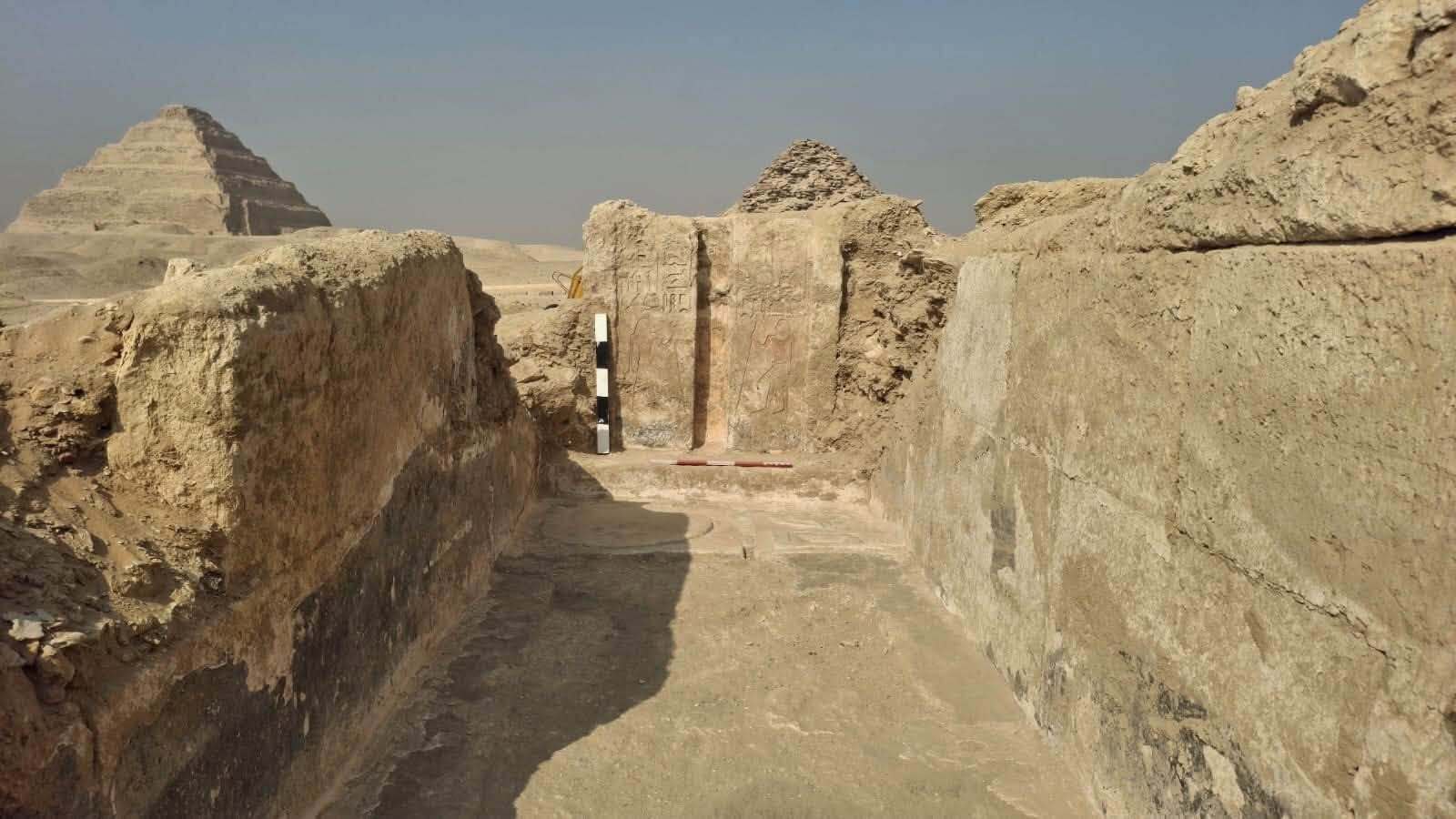
Within the tomb, archaeologists found an offering table, a purification basin and two false doors. The false door is a symbolic door, commonly found in ancient Egyptian tombs, that was believed to allow the soul to exit and enter the tomb at will. The design of the false doors places them in the late fifth or early sixth dynasty, around 4,350 years ago, Roth said.
Part of the newfound tomb, which dates to well over 4,000 years ago. (Image credit: Photo courtesy of the Egyptian Ministry of Tourism and Antiquities )
More than 100 shabtis (also spelled ushabtis) were found in the tomb. Ancient Egyptians believed these figurines would act as servants for the deceased in the afterlife. The team also discovered a wooden statue of a falcon (possibly related to the falcon-headed god Horus) and the remains of cartonnage, a plastered material used on mummies. The mummy of Sekhentio-Ptah was not identified.
Looking at the photos and information the ministry released, Roth said it's likely this tomb was reused for later burials — something that was commonly done in ancient Egypt. She said the shabtis found in the tomb likely belong to later burials and the cartonnage is likely from mummies that were buried in the tomb at a later date.
The team discovered the tomb in the Bubasteion (also spelled Bubasteum) area of Saqqara, a place that was commonly used forcat burials in later times such as the late period (circa 664 to 332 B.C). The site was associated with Bastet, a cat-shaped goddess associated with fertility and protection. However, the statement didn't mention any cat burials found in this particular tomb.
Live Science reached out to the excavation team but did not hear back by the time of publication.
See how much you know about mummies with our mummy quiz.
"Protect our water," "Water for people not AI," "Don't mess with our water," declare protest signs from Texas to New Mexico to Arizona. Angered by water use, energy consumption and pollution, locals are increasingly protesting the rapid expansion of data centers in the United States as tech companies work to rapidly expand capacity for AI.
Many data centers rely at least partly on water to absorb heat from air or surfaces, and then cause cooling as it evaporates, just like sweating keeps our bodies cool. The processors inside data centers can reach internal temperatures of up to 176 degrees Fahrenheit, for the same reasons that an overtaxed laptop heats up.
But while there's little doubt that data centers are consuming significant amounts of energy, water consumption is more complicated. Claims circulating online bring scant clarity, ranging from articles claiming that chatbots can consume 500 ml of water per query to some online commentators declaring AI's water issue to be nonexistent. And the consumption data from large tech companies themselves are often incomplete and inconsistent.
Experts stress that, overall, data center water consumption pales in comparison to the usage by industries likeagriculture and some kinds of manufacturing. Researchers have estimated that data center cooling systems consumed 66 billion liters of water in 2023, less than 1 percent of the nation’s total consumption.
That figure could considerably rise with the rapid buildout of AI data centers, however — which may not be a big problem for water-rich regions but could significantly add to local water stress in drought-strapped places like New Mexico and Arizona.
Fortunately, engineers say there's a host of things that can be done — and are being done — to reduce the strain on local water resources. "There are many good ideas out there," says energy systems expertFengqi You of Cornell University. When you add in efforts to replenish and restore natural water resources, "there's a good chance that, eventually, it could be net-zero water for the on-site cooling."
AI's water consumption is one reason why local communities across the United State — such as here, in New York — are protesting against the construction of data centers. (Image credit: Erik McGregor via Getty Images)
More renewable energy and better siting
Recent advances in AI technology have already reduced water demand for many data centers. Electrical and computer engineer Shaolei Ren of the University of California, Riverside, says that an estimate he made based on GPT-4, an earlier version of the model powering ChatGPT, as recently as 2024 — that drafting a short email would consume 500 milliliters of water — is already outdated because AI models have become more efficient. (This study was the origin of the half-liter-per-query claim.) In 2025, Google estimated that five drops of water are spent on processing a median-length query with its chatbot Gemini.
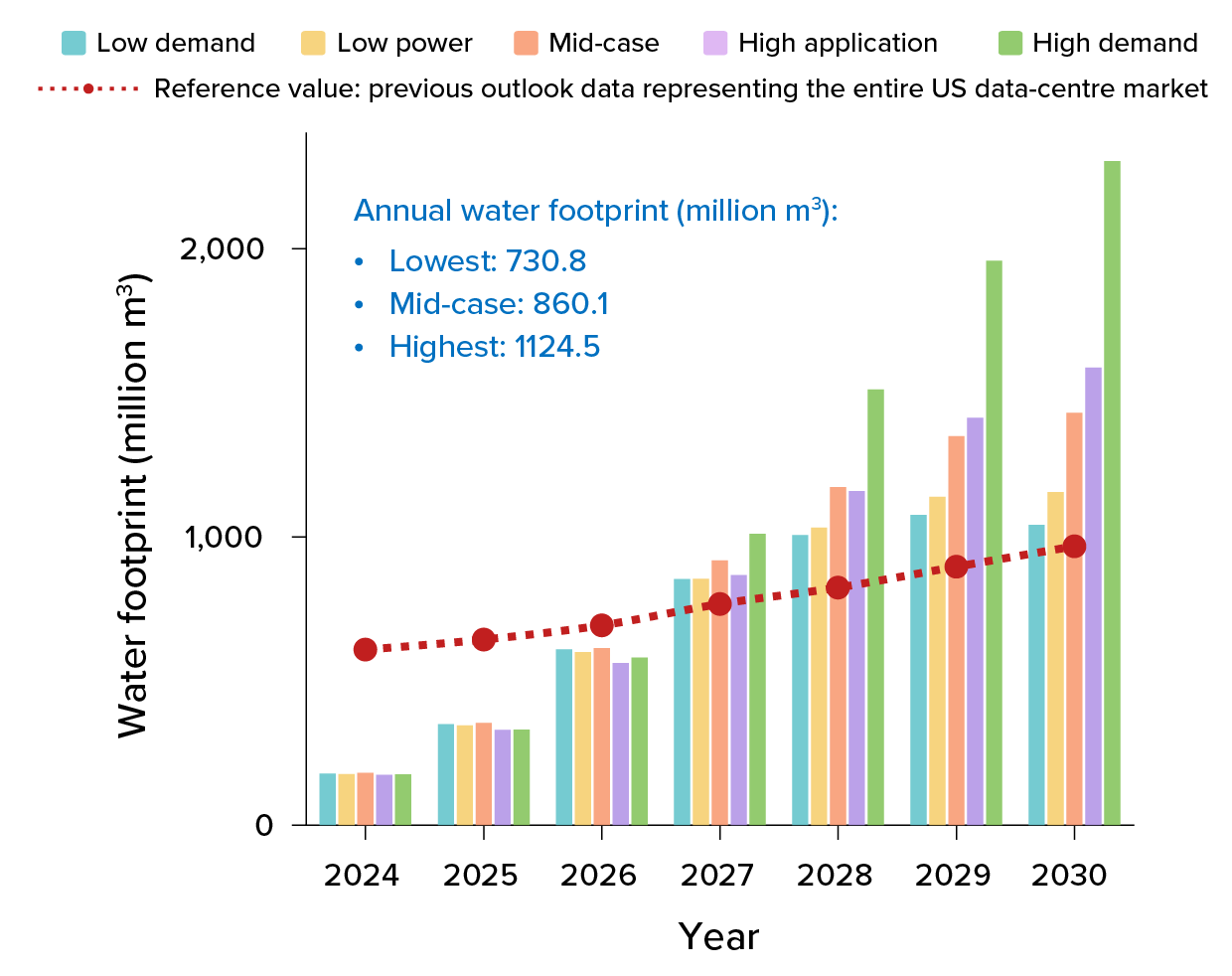
But even tiny amounts add up, given the rise in AI use. You's group recently predicted that by 2030, US data centers could consume 731 billion to 1,125 billion liters annually — the latter roughly equivalent to New York City's annual drinking water supply.
Experts predict that the use of water for cooling AI data centers, as well as for generating fossil fuel-powered electricity to run them, will rise as numbers of data centers increase. One 2025 study projected future water consumption in the United States under different scenarios and found that solutions such as shifting to renewables, improving the efficiency of AI processors and the strategic siting of data centers could significantly curb AI's water use. (Numbers in blue depict the projected average annual water footprint over the full 2024 to 2030 period under low-demand, mid-demand and high-demand scenarios.) (Image credit: T. XIAO ET AL / NATURE SUSTAINABILITY 2025)
Still, these numbers factor in not just cooling, but also a greater amount of water used to generate the electricity that powers data centers. Much of that comes from burning coal or gas, with water being used to cool steam back into liquid after it's been used to spin the electricity-generating turbines. In other words, AI's water consumption can be significantly reduced by shifting to solar and wind, which require little to no water to operate, You says.
You adds that companies should site data centers in areas less prone to drought and with ample renewable energy sources, like regions in Montana, Nebraska, parts of Texas and South Dakota, instead of constructing new data centers in water-stressed places, such as in Arizona, New Mexico and Southern California. Strategic siting along with other measures could reduce AI's future water footprint by up to 86 percent, he says.
New cooling technologies
Advances in cooling technologies are also helping. The newest data centers that specialize in AI are already more water-efficient than their predecessors.
Pre-AI data centers use fans to carry away the heat from processor-filled racks, then use chilling systems funneling cool water through the building to cool the warm air down again. The heated water is then fed into acoolingtower that removes the heat but also loses some of the water to the atmosphere. This evaporative cooling uses a lot of water, says Eric Masanet of the University of California, Santa Barbara, who researches data center sustainability.
But the energy-hungry processors inside AI data centers generate so much heat that it's hard to remove it with air alone. That’s why many tech companies — including Amazon, Microsoft and Google — use a more efficient technique called liquid cooling.
In this method, a system of pipes filled with water, sometimes mixed with temperature-regulating chemicals, runs on top of the hardware, cooling the processors directly rather than cooling the entire data center. And because this is a closed-loop system, no water is lost: The heated fluid can be cooled down by exposing the pipes to the outside air, if conditions are cool enough, or an air-conditioner-like system, which uses energy.
But when it's extremely hot or humid, the centers need to bring online extra, more effective methods that involve water; one of these is to mist the air around the pipes. Mechanical engineerVaibhav Bahadur at the University of Texas at Austin says that most AI data centers in Texas only use this kind of water-based cooling for the hottest parts of the summer.
Still, he and his colleagues recently estimated that the state's growing number of data centers — which currently consume less than a percent of the state's water demand — could be using 3 to 9 percent of that water by 2040. He expects that figure to reduce considerably, though. "Data centers are becoming much more efficient in their water usage," he says.
Indeed, recent technological developments have made it easier to avoid water-based cooling, even in hot climates, says Josh Parker, head of sustainability for NVIDIA, the company that designs many of the processors that populate AI-specialized data centers. Their latest generation of processors run at such high temperatures that they can be cooled with water at around 113 degrees Fahrenheit which,Parkersays, is significantly warmer than traditional approaches. That reduces the need to bring on water-based cooling. Unless local temperatures regularly exceed 113 Fahrenheit, a threshold generally crossed only during severe heat waves, "typically we can just get away with large efficient fans cooling the infrastructure and the ambient air is sufficient to pull the heat away," Parker says.
Ren cautions that some companies may not want to run their processors that hot because it can interfere with computational performance, while some also house non-AI servers in the same space that cannot take the heat.But other cooling technologies are in development.
Some of these rely on elaborately designed pipe systems that draw heat even more effectively from processors. A number of US companies are exploring immersion cooling, where data center hardware sits in a tank filled with cooling liquid. In China, some companies have taken a similar approach by installing data centers in the ocean, although this makes them hard to access should hardware need replacing or upgrading, Bahadur says.
Advances in cooling technology will be necessary for tech companies to meet sustainability goals they have set for their operations. According to a statement from Amazon, its Web Services"set a goal to be water positive by 2030 — returning more water to communities than our direct operations use — and as of 2024, we're more than halfway there."
Some companies, such as Google, are also finding smart ways to use waste heat from data centers to help address other sustainability challenges, such as making building heating less reliant on fossil fuels. Across Europe,some data centersare funneling heat from cooling circuits into district heating systems used to warm buildings.
The future of AI's water usage hinges on decisions that tech companies, engineers and policymakers will make in the coming years, Masanet says: where data centers are sited, their local energy infrastructure and climate, and how they're designed. "If you choose one set of choices, your number is going to be off the charts," he says. "You choose another set of choices, it's going to be way down here."
Nearly two millennia ago, a wealthy Roman commissioned an intricate, multicolored floor mosaic that depicted two beloved household animals: a cat named Emerald and a dog named Ocean. The mosaic was a key feature of a villa, which archaeologists recently unearthed from beneath the ancient city of Adramytteion on Turkey's Aegean coast.
Within the Roman villa, which has been dated to the late second to third centuries A.D., archaeologists discovered three halls surrounding a central atrium. In one room, which likely functioned as the villa's main reception hall, archaeologists found a colorful mosaic with 15 separate panels depicting living and mythological creatures.
In a study forthcoming in the Journal of Mosaic Research, archaeologist Hüseyin Özgen, head of the Adramytteion research team at Mimar Sinan Fine Arts University, wrote that the 15 panels are centered around what appears to be a depiction of Medusa, while the named cat and dog may preserve the memory of household creatures.
Another panel of the mosaic depicts a dog named Ocean. (Image credit: H. M. Özgen/Adramytteion Research Archive)
Özgen began excavating at Adramytteion in 2012, but he and his team discovered the Roman villa only recently and excavated it in 2025 and early 2026. In the Roman period, Adramytteion was a provincial capital within Asia Minor and a prime trading spot due to its location at the head of a gulf on the Aegean Sea. The impressive villa included three mosaic-paved halls, a number of secondary rooms, and a network of pipes and drains that may have connected to a latrine.
Visitors approaching from the courtyard of the villa would have been greeted by the largest, most elaborate mosaic in the residence, according to Özgen. Located in the middle of the room, the mosaic measures about 16.4 by 11.8 feet (5 by 3.6 meters) and contains 15 panels arranged in three rows. Most of the panels depict birds, fish and felines, but two mythologically inspired panels include a gorgon (possibly Medusa) and a winged horse (possibly Pegasus). Ancient artists used white, black, red, orange, yellow, pink, burgundy, blue, turquoise and green tiles to create the intricate design.
Archaeologists discovered the colorful floor mosaic in a Roman-era residence at Adramytteion, an archaeological site in Turkey. (Image credit: H. M. Özgen/Adramytteion Research Archive)
Only two of the animals depicted in the mosaic are named. As someone entered the room, the first mosaic panel they would have seen to their left was a pale cat seated on a blue-green cushion, Özgen wrote in the study. Above the cat are the Greek letters ΖΜΑΡΑΓΔΙΝ (Zmaragdin), meaning emerald. The relaxed cat sitting on a cushion suggests that Emerald may have been a pet rather than a stray.
One possible explanation for Emerald's name may be a link to the desert of Roman Egypt, where emeralds were mined in antiquity; the villa owner may have been a merchant with North African connections.
On the right side as someone entered the room was a mosaic panel depicting a running or leaping dog. This animal is labeled with the Greek letters ΩΚΕΑΝΟΣ (Okeanos), meaning ocean. Adramytteion was a harbor city, so Ocean's name may have been bestowed due to his surroundings, according to Özgen.
Emerald and Ocean were likely familiar to the villa's residents, even if they weren't specifically pets, Özgen wrote, and their depictions in the mosaic may have functioned as familiar signs of ownership and household identity.
Research at Adramytteion by Özgen and the project team is ongoing.
From Augustus to Nero, see how much you know about ancient Rome's famous leaders with our Roman emperor quiz!
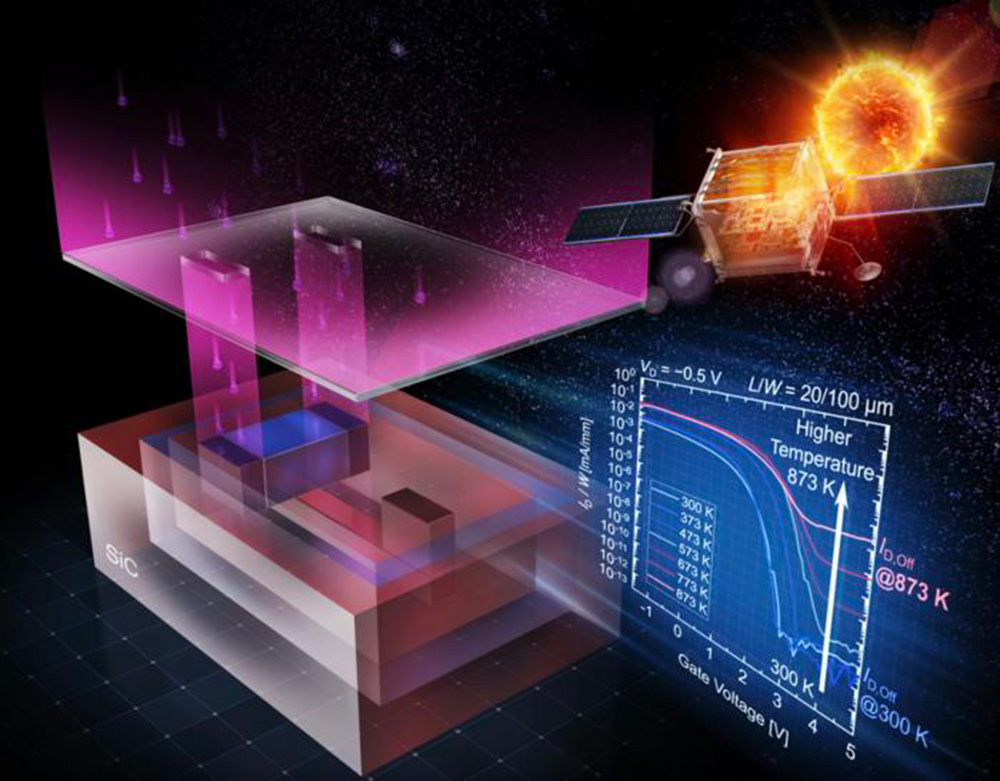
The transistor was able to operate normally at temperatures ranging from room temperature to 1112 F (600 C). (Image credit: Science Graphics)
Scientists in Japan have built a new transistor that can withstand temperatures of 1,110 degrees Fahrenheit (600 degrees Celsius). Components this robust could one day be used in surface probes on Venus — where the thick carbon dioxide atmosphere can reach temperatures of 860 F (460 C).
Most modern tech, including instruments used for deep-space exploration, uses transistors to control the flow of current. But the new device is a type of junction field-effect transistor (JFET), where the strength of an electrical field changes the channel’s conductivity.
JFETs are typically used in specialist applications because they are more difficult to scale down than the more common metal-oxide-semiconductor field-effect transistors (MOSFETs), which are widely used in consumer smartphones and computers. But JFETs can offer lower noise levels because their operation does not rely on an oxide layer, which can introduce interference.
The researchers outlined how the new transistor works in a study published Aug. 17 in the journal APL Electronic Devices.
Can't take the heat
Since at least the start of the century, silicon carbide (SiC) JFETs have been considered a promising option for low-power integrated circuits heading for Venus due to the material's inherent ability to withstand high temperatures.
As the scientists pointed out in the new study: "Past landers have been limited to only a few hours by silicon-based electronics." Venera 13, a Soviet-era lander, holds the world record for the longest time survived on Venus by a spacecraft, at 2 hours, 7 minutes.
"Integrated circuits (ICs) fabricated with SiC are particularly attractive for extreme environments, such as deep-space exploration, geothermal drilling, and aerospace engine control, where conventional silicon-based ICs cannot operate reliably," the researchers added.
But recently developed SiC-JFETs have all met the same two problems: low controllability and large leakage currents. The former is linked to how the SiC substrate is doped with other atoms to alter its electrical properties, defining its gate (where the electrical field is created) and channel (where the current flows) regions.
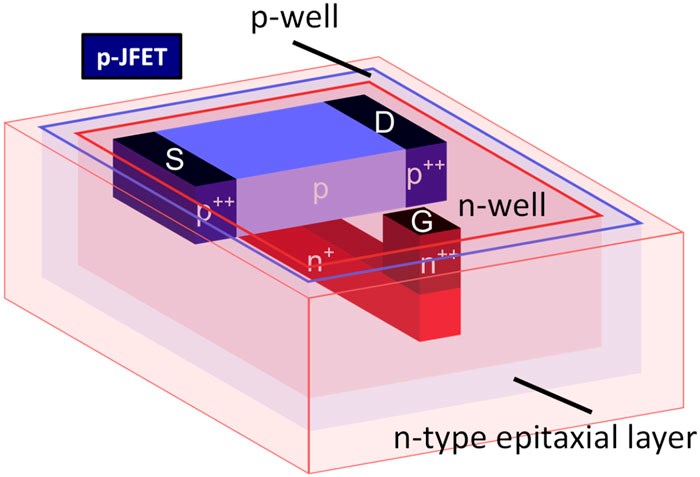
The team used dopants to create two semiconductor "wells" in the SiC around the transistor to avoid large leakage currents. (Image credit: Science Graphics)
In a material with a regular crystal structure, like SiC, some dopant atoms may penetrate deeper than expected. This doesn't matter under normal conditions, but when exposed to high temperatures, it causes variations in the field voltage required to open the channel and makes the transistor harder to control reliably. The scientists found that it can throw conventional JFET voltage thresholds off by over 2 volts.
Furthermore, at temperatures above 660 F (350 C), the SiC substrate can become less electrically resistive, allowing current to flow even when the transistor is switched off. This makes it harder for the JFET to control current properly, potentially causing incorrect signals and increased power consumption.
Even the highest-performing JFETs can only operate long-term at 930 F (500 C), but the Kyoto team had a theory as to why these challenges remained unresolved.
"We believe the lack of development is because the research community has been trying to apply silicon-era thinking to a fundamentally different material," said first author of the study Mitsuaki Kaneko, associate professor of engineering at Kyoto University, in a statement.
Turning the transistor on its head
The researchers designed their new SiC-JFET with these two challenges in mind. To improve controllability, they implemented a bottom-gate structure, where the gate is positioned underneath the SiC conducting channel.
Its gate region is heavily doped by design, so when dopant atoms in the channel penetrate deeper into the SiC, it doesn't change the overall doping profile of the channel-gate region, limiting its impact on the threshold voltage even at high temperatures.
The team also used dopants to create two semiconductor regions, or "wells", in the SiC around the JFET. The boundaries between the wells act as barriers to current flow, meaning that even when the SiC becomes more conductive at high temperatures, current cannot bypass the channel when the transistor is switched off.
A robust transistor could be used in surface probes on Venus, where the thick carbon dioxide atmosphere can reach 860 F (460 C). (Image credit: Science Graphics)
Researchers measured how well the new JFET could switch current on and off and how closely the actual threshold voltage matched the theoretical value, based on its thickness and level of doping. They recorded these metrics at temperatures ranging from room temperature to 1,110 F (600 C).
"The fabricated devices demonstrated stable, normal transistor operation at temperatures over 873 K [1,110°F], opening up possibilities for ultrahigh-temperature SiC devices," they wrote in the study. Furthermore, at about 750 F (400 C), the threshold-voltage error was found to be less than 0.1 V thanks to the bottom-gate design.
As well as surface probes on Venus, the transistor could be useful inside jet engines, the scientists said. Currently, components connected to gas turbines must be protected from extreme temperatures using thermal shielding, long wires and energy-intensive cooling systems, restricting engine design.
Before it can be launched into space or hooked up to a plane, the team still needs to test and optimise the transistor for practical use. This includes integrating it into more complex circuits, scaling it up to wafer-level and ensuring that the entire circuit package will withstand extreme temperatures and pressures.
Indeed, it may not be too lofty a goal. NASA demonstrated that integrated circuits with SiC-JFETs could withstand temperatures of 860 F (460 C) and 9.3 MPa of pressure for 60 days, and 930°F (500 C) in the air for over a year. Plus, in 2024, a team from the National Institute for Materials Science in Japan developed a MOSFET out of diamond that could operate above 570 F (300 C).
NASA's James Webb Space Telescope captured the "Treasure Chest," a cometary globule in the star-forming Carina Nebula, on Aug. 6, 2026 (Image credit: ESA/Webb, NASA & CSA, M. Reiter; Acknowledgment: M. H. Özsaraç)
Quick facts
What it is: The Treasure Chest, a cometary globule in the Carina Nebula star-forming region
Where it is: 7,500 light-years away, in the constellation Carina (the Keel)
When it was shared: Aug. 21, 2026
It looks like a gigantic treasure chest left open among the stars — but instead of gold and jewels, this strange cosmic structure contains dozens of newborn suns. This new image from the James Webb Space Telescope (JWST) reveals the aptly named Treasure Chest, a colorful cloud of gas and dust in the Carina Nebula, one of the Milky Way's richest star-forming regions.
Located about 7,500 light-years away in the Southern Hemisphere constellation Carina, the nebula stretches roughly 260 light-years across and contains some of the most massive stars in our galaxy, as well as tens of thousands of young protostars. It's also home to the "Cosmic Cliffs," which appeared in JWST's first collection of science images, released in 2022.
The Treasure Chest is a cometary globule, an isolated cloud with a dense, dark head and a sweeping tail. Although such objects are named for their resemblance to comets, this one looks more like a wooden chest with its lid propped open and light spilling from inside.
JWST's Near-Infrared Camera reveals the source of that glow: a compact cluster of about 70 young stars embedded in the dust. The most massive one is a rare O-type star — extremely large, bright, and short-lived stars — measuring roughly 19 times as massive as the sun.
Astronomers estimate that the cluster is around 1.3 million years old, although earlier estimates suggested it could be as young as 100,000 years. Many of its stars are still surrounded by the gas and dust from which they were born. Over time, radiation from the cluster's stars will disperse that material, exposing stars that are currently hidden.
The Treasure Chest's unusual shape is also influenced by something outside the JWST image. About 39 light-years away, as measured across the sky, is Eta Carinae, the most luminous object in the Carina Nebula. Eta Carinae famously underwent its "Great Eruption" in the 19th century, when it briefly became one of the brightest stars in Earth's night sky. The system contains at least two stars, including one about 100 times as massive as the sun and roughly 5 million times as luminous. Together with the nearby Trumpler 16 star cluster, its intense radiation and stellar winds are blasting away the Treasure Chest's less-dense gas and helping to sculpt the cloud into its distinctive shape.
The Treasure Chest won't always look like this. Radiation and winds from the young stars inside it, combined with the assault from massive stars nearby, will gradually erode the remaining gas and dust. Eventually, the cosmic chest will disappear, revealing its true jewels — the stars within it.
For decades, engineers have been working to create smaller and smaller transistors to fit ever-larger numbers of them onto computer chips, all in the name of greater processing power. Now, in the age of artificial intelligence (AI), that effort has turned into an all-out race.
So how small can a transistor actually get? And is smaller even still the goal?
To understand the answer, first you need to know what a transistor is.
"If you take a computer or your mobile phone and you were to pry it open, you will see that there is a printed circuit board," Suman Datta, a professor of electrical and computer engineering at Georgia Tech, told Live Science.
On that circuit board are small, rectangular objects called chips, and inside each chip is a tiny piece of silicon. "And in that silicon, if you zoom in like a million times … maybe, if you're lucky, you will start seeing these tiny switches or transistors sitting etched into that piece of silicon," Datta said.
Each transistor is effectively a switch that turns on and off in response to jolts of electricity pulsing 4 billion times per second. Modern devices contain billions of transistors, and each one turning on and off in a precise orchestration to move and store 1s and 0s powers everything from Google searches and AI data centers to the device you're using to read these words.
The smaller the transistors are, the more can fit on each chip and the greater the chip's speed and functionality. So how small have they gotten so far?
Transistors were once visible to to the naked eye, but have now been made orders of magnitude smaller than the width of a human hair. (Image credit: Bettmann via Getty Images)
"Researchers have built proof-of-concept devices in which a single atom controls the flow of electrons, although the rest of the device is still much larger," Anton Persson, an assistant professor at Chalmers University of Technology in Sweden, and Tara Peña, an incoming assistant professor at UCLA, told Live Science via a jointly written email. That means the switching part of a transistor has been made at the smallest scale physically possible, even though a complete device that small doesn't exist yet. New materials and approaches could make these devices even smaller. In a study published in June in the journal Nature Nanotechnology, Persson, Peña and colleagues used two-dimensional semiconductors made of tungsten disulfide, among other materials, to shrink nanoribbon transistors down to a channel width of 25 nanometers — about 0.00025 the width of a human hair.
An illustration showing the small transistor made by Persson, Peña and their colleagues. (Image credit: Peña et al (2026). )
Two-dimensional semiconductors are electrically active materials that are only one or a few atoms thick, and because electrical current can be controlled more precisely in such a thin layer, they allow for smaller transistors than traditional silicon does.
Over the next decade, they still expect silicon transistors to shrink, but more slowly than they did in the past, they said. "To go considerably smaller, we may eventually need to move beyond silicon to atomically thin materials, such as the two-dimensional semiconductors we study."
A host of considerations
Size isn't the only consideration; cost is important, too. It's enormously expensive up front to design and build a new chip. "We are as R&D-intensive as drug companies that spend billions of dollars developing one drug," Datta said. "It's a very similar business model."
There are also manufacturing factors to consider. "The often much harder step is producing billions of those transistors reliably, at scale and at a price that makes sense commercially," Persson and Peña said. "Something that works once in a laboratory does not necessarily work in a factory."
Another consideration is energy efficiency. "If I'm adding more and more transistors onto that little piece of silicon, and at the individual transistor level, they don't become more energy efficient … then when I go from, let's say, 10 transistors to 20 transistors, my power budget has to be doubled, all things being equal," Datta said.
For example, the latest Nvidia data center GPUs consume 1.4 kilowatts of electricity, and Nvidia's upcoming release is estimated to consume nearly a kilowatt more than that. Half of that is given up as waste heat, Datta said.
"So it's not just smaller, faster, cheaper, but also more energy efficient," Datta said. "You have to work on all the four vectors."
Is smaller still the goal in the age of AI?
Still, there is a limit to the physical space available for additional transistors, which is why engineers are turning to 3D designs — think taller instead of smaller.
"Instead of only making each transistor smaller, the idea is increasingly to stack transistors on top of one another so that more of them fit within the same chip area," Persson and Peña said. "That way, we can still make our electronics considerably more powerful, even if each transistor shrinks only modestly."
The quest for faster, more efficient chips is only getting more urgent with the explosive growth of AI. But smaller transistors and more powerful chips aren't just important for AI data centers; they also mean smaller, potentially cheaper consumer electronics.
"People certainly notice the consequences of smaller transistors," Persson and Peña said. "They can use less power and allow more computing power to fit on the same chip. That can mean faster electronics, longer battery life and lower costs. Historically, that combination has enabled today's smartphones to outperform room-sized supercomputers from decades ago."
So how small can transistors get? "We will do everything to make it as small as possible as long as we can control the physics," Datta said. "And as long as we can, we will find a way to make the economics work."
Over dinner at a gaming convention around 2010, board game designer James Ernest turned to his friend Eric Harshbarger and asked a question: Could you design a set of dice so that each player in a group — whether two people or any number — could grab one, roll and have a perfectly equal shot at going first? The rule is simple: Roll your dice, and whoever lands the highest number goes first. The hard part is making that outcome truly fair for every player, no matter how many are at the table.
There could be no ties and no rerolls.
Harshbarger, a mathematician at Auburn University in Alabama, didn't have an answer that night. But the question stuck. Over the next 15 years, he and a loose network of collaborators casually worked to crack what became known as the "go first dice" problem.
Now, they finally have the answer: a set of five 60-sided dice, collectively engraved with every number between 1 and 300, with no repeats. To mark the achievement, Harshbarger built five giant, wooden replicas of these hexecontahedrons (60-sided 3D shapes), each carved from a different type of wood. They are now on permanent display in Auburn's new mathematics building.
The problem with dice
To understand why it was so hard to crack the problem, it helps to understand the simple part.
"The easy thing is to avoid ties; you just put different numbers on all the dice," Harshbarger told Live Science. "The problem comes in how you distribute those different numbers across the dice so that the probability is equal not only for the whole set but for any subset."
That second condition is what makes the problem devilish. Ernest's request wasn't just that eight players could roll fairly; it was that any subset of players could grab any dice from the bag roll and still have equal odds. If five people are playing, each takes a die. Three people? Same thing. The numbers on each die had to be arranged so that the fairness held no matter how many people showed up to play.
Harshbarger looped in his childhood friend Robert Ford, a mathematician at Dalton State College. Within weeks, they had a three-player solution: numbers 1 through 18, spread across three standard six-sided dice in exactly the right arrangement. Four 12-sided dice, Ford later worked out entirely by hand, could accommodate four players fairly.
By 2012, Harshbarger was giving talks about the four-player set at math conferences, and The Guardian covered the story. His inbox erupted. He started selling handmade sets from home — buying blank, 12-sided dice; etching numbers onto each face with a laser cutter in his workshop; and then inking every number by hand. At his peak, he was dropping off 30 envelopes at the post office at a time, several times a week, shipping sets to customers around the world.
But as the team dug deeper into the math, they discovered that the dice were doing something even more remarkable than they'd realized: The configurations determined not only who went first but also the entire turn order, with every possible sequence of players equally likely to come up.
"If four people rolled, the chance that players finished in the order A, B, C, D was just as likely as C, B, D, A, or any of those combinations," Harshbarger said. "'Go first dice' is actually a bit of a misnomer, because they do much more than just determine who goes first; they actually determine the ordering of all the players."
This property, which the team calls permutation fairness, became the standard they chased for every set of dice from that point on.
More combinations than atoms in the universe
Four players was one thing. Five was another entirely.
Mathematically, the team knew a five-player same-shape set was feasible. But finding it meant searching an incomprehensibly large space of possible number arrangements.
"We're talking literally more than the number of atoms in the universe — like 10 to the 128th power combinations," Harshbarger said. "There's just no way, even if we had a billion billion years and all the computers, all the AI. We still couldn't do it today."
They couldn't brute-force their way to an answer. They needed mathematical shortcuts: symmetries and patterns to shrink the search space. But even then, years passed without a practical solution. Every path they found hit the same wall: dice too large to hold, too many sides to manufacture.
"My goal was a set for five players that can actually be manufactured, that you can hold in your hand, that board gamers could buy and roll," Harshbarger said. "Even for a problem that is silly and pointless as far as gameplay — just mathematically, can you buy these things and roll them, and they work? You can't do that with 180-sided dice."
The five go-first dice, each with 60 sides, are designed so that any subset of players can grab one, roll and have an equal chance of winning. Each of these dice carries a unique set of numbers from 1 to 300. (Image credit: Eric Hashbarger )
Then, in mid-2023, Canadian software engineer Paul Meyer emailed Harshbarger out of the blue. He had been studying patterns in Harshbarger's four-player data and had written a program to exploit them. He hadn't expected it to work right away.
It did. Meyer found a configuration offive 60-sided dice that satisfied every condition.
"I double-checked his work and went, 'Oh my goodness; we've been searching for so long for this. This is amazing,'" Harshbarger said.
The four-player set had long since been picked up by retailers —Maths Gear in the U.K. andMath Art Fun in the U.S. — so Harshbarger had stopped hand-making those years earlier. Now, the five-player version was real and small enough to manufacture.
But the story had one more turn. Auburn University was building a new home for its mathematics department and was looking for sculptural ideas to fill it. Harshbarger proposed building giant versions of the five new dice out of wood. The department agreed.
He spent months in his wood shop, constructing five oversize dice. Each is from a different type of wood: pine, poplar, oak, walnut or mahogany. The five sculptures now stand inAuburn's new math building, which opened this fall.
For Harshbarger, the whole point is making math impossible to walk past.
"When people see giant dice or little dice, they're fascinated just by the geometry," he said. "The hope is, they see these things and go, 'Oh, this is math too, and this is interesting.' Some of the most fun math problems are ones that are easily understood and not easily answered."
Humanoid robots in Beijing have beaten a number of men's athletics world records at the 2026 World Humanoid Robot Games, claiming high-water marks in the 100-meter sprint, the 400 m, 1,500 m and high jump. While these performances aren't official replacements for the human records, as the robots competed under robot-specific categories and conditions, they highlight the progress made since last year's inaugural robot games .
The five-day games were held between Aug. 22nd and 26 at Beijing’s National Speed Skating Oval and drew 2,056 robots from 666 teams across 16 countries. The events included sports like football and martial arts, as well as practical applications like warehouse logistics, factory-style assembly and charging tasks.
Robots broke four human athletics records:
100 meters: Tiangong Ultra, 8.64 seconds
Human benchmark: Usain Bolt ran 9.58 seconds at the 2009 World Athletics Championships in Berlin.
Robot result: Tiangong Ultra is a humanoid robot developed by the Beijing Humanoid Robot Innovation Center. It won the large-size 100 m final, completing it in 8.64 seconds on Aug. 26. It set an early mark of 9.39 seconds, already enough to smash Bolt's record, then improved to 8.86 seconds in qualifying before the blistering 8.64 time in the final. That 8.64-second time is 0.94 seconds below Bolt’s mark.
The Tiangong Ultra robot running. (Image credit: X-Humanoid)
400 meters: Tiangong Ultra, 38.15 seconds
Human benchmark: Wayde van Niekerk's 43.03 seconds, set at the Rio Olympics on Aug. 14, 2016.
Robot result: The same robot that set the 100 m record dominated the 400 m competition as well. Tiangong Ultra won the 400 m final in 38.15 seconds, nearly 5 seconds faster than van Niekerk's world record.
Robots from Team Tiangong Ultra compete in the 4x100 meter relay final of the 2nd World Humanoid Robot Games at National Speed Skating Oval in Beijing, China, on August 25, 2026. (Image credit: VCG via Getty Images)
Human benchmark: Hicham El Guerrouj of Morocco set the men’s 1,500 m world record of 3 minutes, 26 seconds in Rome on July 14, 1998.
Robot result: Team Tianzhuo's Tiangong Ultra completed its record-smashing hat trick, winning the 1,500 m in 2 minutes, 21.6 seconds — well below El Guerrouj's time. The next two finishers, at 2 minutes, 30.00 seconds and 2 minutes, 30.22 seconds, also bettered the human benchmark.
A Tai Gong Ultra humanoid robot runs to victory in the 1500 meter final at the 2nd World Robot Games at National Speed Skating Oval on August 23, 2026 in Beijing, China. (Image credit: Kevin Frayer / Stringer via Getty Images)
High jump: 2.88 m (9.45 feet) standing jump
Human benchmark: Javier Sotomayor of Cuba cleared 2.45 m (8.04 feet) in Salamanca, Spain, on July 27, 1993.
Robot result: A robot made by X-Humanoid cleared 2.88 m in a standing high jump, which smashed the previous best robot result of 0.95 m (3.12 feet) at the inaugural games in 2025. However, Sotomayor’s record came in a standard running high jump, in which athletes use a curved approach, generate speed and clear the bar using a technique called the Fosbury flop. The robot completed a standing high jump, a different event with different mechanics. The running high jump is both harder and higher than the standing jump, because athletes can convert horizontal speed into greater lift using a one-foot takeoff and the Fosbury flop, enabling higher clearances than the purely muscular, two-footed standing high jump.
What the record claims mean
These games showcase the expanding abilities of humanoid robots. Disciplines like running, particularly across longer distance events like the 1500 m, and high standing jumps require powerful actuators, fast balance corrections, foot-placement control and software that can compensate for tiny errors in real time.
"In my view, these World Records were achieved using, 'The Best Part is No Part' principle, through mostly mechanical optimization to perform a single task extremely well," said Scott Walter, the Robotics Research Diligence director at RoboStrategy, an investment fund that gives retail and institutional investors exposure to private and public companies in robotics and “embodied” or physical AI. "Locomotion is mostly solved as witnessed by these games, albeit with optimizations," he told Live Science in an email.
Walter said the key to many of the impressive advances we've seen is simplicity, shearing off unnecessary components that introduce more points of failure and can make coordination more difficult.
"Many degrees of freedom were removed in the arms (shoulders, elbow, no wrist, no hands), hips and ankles. This reduced mass, and allowed distal mass to be moved higher up in the kinematic chain, improving movement efficiency," he said.
However, although the robots were very capable in the specific events in which they competed, we shouldn't take that to mean they're top performers in other, more diverse tasks.
"The bots are barely humanoid and could only accelerate in a straight line, not stop without crashing nor run the curve to slow down," Walter said. "The winners were in no shape afterwards to stand on the podium to receive their medals. Nor could they run in the 4x100 relay as, ironically, they had no hands for the 'hand-off.'"
But other robots at the games were made for more than just going faster, higher, stronger. Alongside track-style events, robots performed practical tasks such as connecting charging cables, handling objects, using tools and working in simulated industrial or service settings.
In many cases, the greater challenge is not raw strength or speed but reliably seeing an object, judging its position, applying the right amount of force and recovering when something does not go as planned. More than 40% of the games' events required robots to operate autonomously, without direct human control.
"Manipulation is the greatest biggest challenge as that is the business end of the humanoid and a dexterous and robust hand is still elusive," Walter said. "Specialization is easy, general purpose is not."
Walter noted that the decathlon record may be the next target as it demonstrates a range of abilities.
"The human Decathlon record is the true test of speed, endurance, power, strength, robustness, coordination and dexterity. I would not be surprised to see an attempt at the record next year," he said.
Archaeologists were excavating in a Roman-period cemetery in Poland when they came across something extremely unusual: the grave of a man who was buried with two decapitated human heads, a necklace made from 42 mammal teeth, and a battle ax. That ax provided an important clue: He was actually from the Stone Age, three millennia older than the Roman cemetery.
"We were practically packing up, and then we discovered a circular shape in the ground and began digging," Paweł Dąbrowski, a biological anthropologist at Wrocław Medical University, said in a Sept. 2 translated statement. "We found fairly well-preserved animal teeth arranged in a necklace."
The grave, which was found near Wrocław in southwest Poland, included the nearly complete skeleton of an adult male who was buried with amber beads, a flint blade and a battle ax made of serpentinite, a greenish metamorphic rock. The style of the stone ax suggests the burial was made around 2900 B.C., during the Middle Neolithic period (New Stone Age), according to the statement.
But a handful of teeth and bones that were also deposited in the grave as funeral offerings made the burial stand out as particularly unusual.
Archaeologists found an ax under the skeleton's right elbow, as well as teeth from another human skull. (Image credit: Wrocław Medical University)
"The arrangement of the 42 teeth was precise," Dąbrowski said, "and upon further inspection, it turned out that all of them had holes drilled through their roots. They must have formed a kind of necklace."
The teeth that made up the necklace were incisors and canines that belonged to large mammals, such as wolves, deer, bears and potentially humans, Dąbrowski said in a Sept. 4 translated statement.
"It's possible we've discovered the grave of a warrior or hunter, but because of this necklace, we can assume it was someone important, for example, the leader of a family clan," Dąbrowski said.
The burial also contained the remains of two human skulls, which the archaeologists think may be from decapitated heads that were buried with the man as gifts or funeral offerings. However, further analysis of the skulls is needed to confirm or rule out decapitation, according to the first statement.
A similar elite person's burial filled with axes, flint tools and amber beads was previously discovered nearby, the researchers noted in the statements. In that case, the bones of a calf suggested that the animal had been sacrificed at the grave. But to date, these are the only two burials of their kind in the area. According to the statements, they might be from members of the Corded Ware culture, which likely spread Indo-European languages around Europe and Asia.
According to Dąbrowski, the next step is to analyze the remains from both Stone Age burials to figure out if the people were related and what their lives were like nearly 5,000 years ago. He expects the first results of the analyses to be available later this year.
What do you know about the Paleolithic, Mesolithic and Neolithic eras? Find out with our Stone Age quiz.
The Romans are well known for their aqueducts, which brought water to their cities and settlements.
These aqueducts sometimes ran for very long distances. For instance, the aqueduct of Valens, which brought water to the city of Constantinople (modern-day Istanbul), was 250 miles (400 kilometers) long, according to a statement from Johannes Gutenberg University Mainz.
The aqueducts also lasted a long time; their remains are some of the most prominent Roman architectural finds visible today. All of this demonstrates the Romans' engineering prowess. So how did the Romans build such large and long-lasting aqueducts?
First, the Romans would select a source of water for the aqueduct, with springs being a popular choice. The aqueducts had to be designed so water would flow toward the city or settlement. The successful building of the aqueducts "was accomplished by an ever slight incline downwards from the spring to its end source," such as Rome, Ann Olga Koloski-Ostrow, a classics professor and chair emerita at Brandeis University in Massachusetts, told Live Science in an email.
Roman surveyors had to design a route carefully. "To choose a route with the necessary gradient, Roman surveyors would have either used the libra or the dioptra,"Joseph Lewis, an archaeologist at the University of Cambridge, told Live Science in an email.
The dioptra was shaped like a disc with a sighting bar in the middle. It could be suspended from a stand, and the surveyor could look through the sighting bar at rods in the ground to help determine their elevations. "Surveyors would sight through the sighting bar toward surveying staves to measure differences to elevation," Lewis said.
The exact design of the libra is unclear, but we know that it had a plumb bob that was suspended in the air and the surveyor could compare it to rods in the ground to help determine differences in ground height. "Surveyors would set the libra up along proposed routes for the aqueduct and look forward and backward against calibrated staves," Lewis explained, noting that this allowed them to determine differences in ground height.
Building a long-lasting aqueduct
The Romans used a form of concrete that tended to last much longer than modern-day concrete. Roman concrete used pozzolan, an ashy substance, that was combined with lime and water to form a durable concrete that hardened when exposed to water.
A Roman aqueduct crossing a river at Pont du Gard in France. (Image credit: PASCAL GUYOT via Getty Images)
"Roman concrete certainly played an important role, especially in bridges, arcades, and other structural elements," Giovanni De Feo, a professor of industrial engineering at the University of Salerno in Italy, said in an email.
But this wasn't the only factor that allowed Roman aqueducts to last such a long time.
"I believe their remarkable preservation results from a combination of factors," De Feo said. For example, the Romans were careful to select routes that followed stable geological formations.
Regular maintenance that, in many cases, continued into the Middle Ages also helped Roman aqueducts survive the test of time, De Feo noted. This means that they tried to avoid volcanoes and other landscapes that were unstable.
Aqueducts did not always run aboveground; sometimes, they had lengthy underground portions in areas where the landscapes made it difficult to place it aboveground. Some "aqueducts had hardly any stretches above ground outside the city, while others ran on arches for a considerable distance," Gerda de Kleijn, a researcher at Radboud University in the Netherlands, wrote in her book "The Water Supply of Ancient Rome" (J.C. Gieben, 2001).
As the water neared the city, it would sometimes go into pools that helped remove dirt and other visible pollutants. "Water would pool into the basin, sediment would sink to the bottom, then the water would continue from there on its course to the distribution tank," Harry Evans, a professor emeritus of classics at Fordham University, said in an email.
The number of workers required to build an aqueduct depended on its size and timeline for completion. The Hadrianic aqueduct at Athens, which runs for about 12.4 miles (20 km), could have been completed in 15 years by a team of around 500 workers, researchers estimated in a 2022 paper.
Part of a Roman aqueduct in Caesarea, on the Mediterranean coast. (Image credit: Richard Nowitz Photography via Getty Images)
After an aqueduct was built, regular maintenance kept it in good shape.Cees Passchier, head of tectonophysics at Johannes Gutenberg University Mainz in Germany, has studied a Roman aqueduct at Divona in France. In a 2023 study, Passchier and colleagues found that carbonate would have built up on the aqueduct over time. Maintenance workers "partly scraped away" the carbonate before replastering the aqueduct, Passchier told Live Science in an email. At some other aqueducts, they wouldn't bother scraping but would "simply plaster over the carbonate without ever cleaning anything," he said.
A sizable number of workers would have been needed to keep aqueducts functional, but it varied based on the aqueduct's size. For "a small place like Divona, a workforce of a dozen people would probably have been enough," Passchier said. "We know that in Rome, there was a staff of a few hundred people to keep the aqueducts working."
Even after the Roman Empire collapsed, many of its aqueducts survived, as some were used and maintained into the Middle Ages and even into modern times. One of the aqueducts, the Aqua Virgo, built in 19 B.C., is still bringing water to Rome today.
From Augustus to Nero, see how much you know about ancient Rome's famous leaders with our Roman emperor quiz!

 Login