❌

Normal view

Which solar eclipse viewing method is right for you?

29 July 2026 at 12:00

The total solar eclipse on Aug. 12, 2026, will attract millions of viewers across northern Spain, western Iceland and eastern Greenland, while a deep partial eclipse will be visible across much of Europe, and a smaller partial eclipse will reach parts of northeastern North America.

If you're planning to watch, one question matters more than almost any other: how are you going to observe it safely?

The answer depends on where you are, your budget and what kind of experience you're after. Some people want to simply look up and enjoy the spectacle. Others want to study sunspots, photograph the eclipse or capture loved ones gazing at the eclipsed sun. Many away from the path will stay at home and livestream it. There is no correct way to watch a solar eclipse, but it's important to stay safe. Here are eight ways to safely view the Aug. 12, 2026, solar eclipse.

1. Eclipse glasses for viewing from land

four people watching an eclipse with solar glasses

Eclipse glasses are the easiest and safest way to view the partial phases. (Image credit: Getty Images)

If you're planning to watch any part of the eclipse with your own eyes, eclipse glasses should be your first purchase. Certified eclipse glasses that comply with the ISO 12312-2 standard block more than 99.999% of sunlight, making it safe to look directly at the sun during the partial phases.

Without them, even a brief glance at the uneclipsed or partially eclipsed sun can cause permanent eye damage. Through them, the sun appears as either a bright orange or a whitish disk against a black background. As the moon gradually moves across it, the changing crescent shape becomes immediately obvious. During the final minutes before totality, the solar crescent shrinks to an impossibly thin sliver.

For observers in Britain, Europe and North America outside the path of totality, eclipse glasses are arguably all you need. The entire eclipse remains partial, so the glasses stay on from beginning to end. Even if you're traveling to Iceland, Greenland or Spain for totality, eclipse glasses remain essential throughout the partial phases before and after totality, when the sun is still dangerously bright.

However, you should buy them early. Before every major eclipse, supplies tighten and some retailers sell out entirely. For reputable sellers, check out the American Astronomical Society's list of safe products. Recommended manufacturers include American Paper Optics, Rainbow Symphony and Thousand Oaks in the U.S. and Baader in Europe.

2. Handheld solar viewers for cruise ships

people using handheld solar viewers on a cruise ship

Solar eclipse viewers can be secured using a lanyard. (Image credit: Jamie Carter)

Many eclipse chasers prefer handheld solar viewers to eclipse glasses. These use the same safe solar-filter material and are made by the same manufacturers, but provide a larger viewing window. They typically hang around your neck on a lanyard, which makes them essential if you want to observe an eclipse from a cruise ship β€” it stops them from blowing into the sea. The actual view is almost identical to what you'll see through eclipse glasses.

3. Totality with the naked eye

an adult and two children looking at the total solar eclipse

If you are in the path of totality, you can look at the totally eclipsed sun with the naked eye. (Image credit: Getty Images)

If you're fortunate enough to observe from within the path of totality, there is one viewing method that rules all others during totality only β€” the naked eye. Although you must never look at the sun without eclipse glasses during the partial phases, during totality it's not only perfectly safe, but also the only sane thing to do.

During totality, you MUST take your eclipse glasses off to see the solar corona β€” one of nature's most extraordinary sights. The naked eye will also help you find bright planets around the eclipsed sun and the horizon glowing with twilight colors in every direction. If this is your first total solar eclipse, make a promise to yourself beforehand: spend at least some of totality doing nothing except looking up.

4. Solar binoculars

Binoculars widened to show interpupillary distance

Solar binoculars are an easy way to get a close-up of the partial eclipse. (Image credit: Jason Parnell-Brookes)

If observing the eclipsed sun through eclipse glasses and solar viewers leaves you unimpressed, you can upgrade your experience by opting for dedicated solar binoculars, which have permanently attached solar filters. They offer a significant jump in detail over eclipse glasses without introducing the complexity of a telescope. Sunspots become obvious, and you can more easily see them get covered by the advancing edge of the moon.

All kinds of magnifications are offered, but 10x42 is about the limit. Any more and they not only become hard to hold steady, but the eclipse then gets more difficult to find in the sky.

Since you can't use them during totality, solar binoculars are best seen as a good upgrade for observers outside the path of totality.

5. Regular binoculars

Jase Parnell-Brookes using binoculars

Solar filters can be added to any pair of binoculars for viewing the partial phases. (Image credit: Kimberley Lane)

Normal binoculars are arguably a better choice if you plan to be within the path of totality. This is what experienced eclipse watchers do, and with good reason β€” they simply add solar filters for the partial phases, then remove them during totality for a close-up of the solar corona.

For the partial phases, solar filters must completely cover the front objective lenses. Never place filters over the eyepieces and never rely on improvised materials such as sunglasses, smoked glass or photographic filters β€” you must use dedicated solar eclipse filters.

However, since objective lenses come in all shapes and sizes, it's often easier to make your own solar filters using Baader AstroSolar Film. Typically, users will make a solar filter for one lens and cap the other, removing both during totality.

Image-stabilized binoculars deserve special mention. Models from Canon and other manufacturers can provide remarkably steady views of the eclipse without requiring a tripod, making them particularly attractive for travel.

6. Telescopes

solar filter attached to a telescope

Telescopes can be used during the eclipse, as long as they are equipped with a solar filter for the partial phases. (Image credit: Getty Images)

The same applies to telescopes as applies to binoculars β€” you can buy a solar telescope with a permanently attached solar filter, or (a more popular method) put a solar filter on any telescope. However, there is another unusual option here β€” a dedicated hydrogen-alpha solar telescope, which reveals an entirely different side of the sun.

Rather than showing the photosphere, they isolate light emitted by hydrogen atoms in the chromosphere and show prominences arching above the solar limb as well as dark filaments across the disk. The downside is that hydrogen-alpha instruments are among the most specialized and expensive telescopes in amateur astronomy.

7. Smart telescopes

dwarf mini against some greenery

A smart telescope can take images automatically during the eclipse. (Image credit: Jamie Carter)

Few areas of amateur astronomy have changed as rapidly as smart telescopes. Devices such as the Unistellar Odyssey Pro, ZWO Seestar S30, DwarfLab Dwarf Mini and Celestron Origin have introduced a new generation of observers to astronomy by automating much of the traditional setup and operation.

For eclipse observing, the appeal is obvious. Once fitted with a solar filter, these systems can automatically track the sun, display images on a smartphone or tablet and save photographs with minimal fuss.

For eclipse travelers heading to Iceland, Greenland or Spain, smart telescopes can also reduce some of the stress associated with eclipse photography. Many users plan to have the telescope automatically capture the eclipse during the partial phases, then simply enjoy totality with their own eyes. Just don't spend the entire eclipse staring at a smartphone!

8. Livestreams

total solar eclipse livestream schedule

(Image credit: Time And Date)

What if you can't travel? Or if it's cloudy? The Aug. 12, 2026, eclipse will be streamed by observatories, astronomy organizations and media outlets around the world. A livestream can never replace standing beneath the moon's shadow, but it guarantees you'll see totality even if clouds intervene.

Confirmed live streams so far include the total solar eclipse by TimeAndDate and the European Space Agency, while partial solar eclipse images will come from the Royal Observatory in Greenwich, London, U.K. When cell signal allows, some eclipse observers keep a livestream running on a nearby phone while observing the real eclipse overhead, and/or livestream views from their own telescope on social media.

What's the best way to look at the eclipse?

The best viewing method for a solar eclipse depends entirely on what you want to get from it. Just remember that the purpose of the technology is to support the experience, not replace it β€” no instrument can replace the experience of seeing the solar corona with your own eyes if you're within the path of totality. Choose the viewing method that helps you do that β€” and spend as much time as possible simply looking up.

Catch an orange 'Buck Moon' rise tonight before a month of solar and lunar eclipses

29 July 2026 at 11:05

July’s full Buck Moon, the second full moon of summer in the Northern Hemisphere, will turn full on Wednesday (July 29). It will be the final full moon before a flurry of solar and lunar activity β€” notably, a total solar eclipse caused by the new moon on August 12, and a partial lunar eclipse during the following full moon on August 28.

Named for the new antlers that emerge from male deer during summer, July’s full moon is also known as the Thunder Moon and Hay Moon, according to Time and Date. The Anishinaabeg people call it Miin Giizis, or Berry Moon, according to the Center for Native American Studies.

The Buck Moon will be at its fullest at 10:37 a.m. EDT on Wednesday β€” however, it will also look bright and full on Tuesday and Thursday night. From North America, the best time to see it will be at moonrise in the southeast during dusk on Wednesday evening. The exact time of moonrise will depend on your location. A full moon looks most dramatic as it first appears above the eastern horizon shortly after sunset, with Rayleigh scattering making it loom orange β€” the same light-scattering phenomenon that makes the sky blue and sunsets red.

July's full moon is one of the lowest full moons of the year as seen from the Northern Hemisphere because it occurs relatively soon after the June solstice. A full moon always sits opposite the sun, so the path of July's full moon mirrors the sun's path in February.

You can easily enjoy the full moon with the naked eye, but a good backyard telescope or pair of stargazing binoculars can help you zoom in on famous structures, such as craters and Apollo landing sites. And if you want to take stunning photos of the moon, here’s everything you need to know.

Two weeks after theBuck Moon, the new moon will slide directly between Earth and the sun, causing a total solar eclipse. Observers along a narrow path of totality in eastern Greenland, western Iceland and northern Spain will see the moon block the sun for a few minutes, revealing the solar corona.

A deep partial solar eclipse will be visible across Europe, with a small partial solar eclipse observed over Canada and the northeastern U.S.. The largest eclipse in Canada will be 93% in northeastern Nunavut, while northeastern Maine in the U.S. will see 29% of the sun covered by the moon. Solar eclipse glasses must be worn at all times to safely view the partial phases.

The next full moon, the Sturgeon Moon, will rise on August 27 and be partially eclipsed by Earth overnight. More than 96% of the moon will pass into Earth's shadow as seen from Europe, Africa, North America and South America.

How much do you know about the moon? Test your lunar smarts with our moon quiz!

Diagnostic dilemma: Rare 'spinal stroke' struck an 8-year-old and temporarily paralyzed her

29 July 2026 at 11:00

The patient: An 8-year-old girl in the U.S.

The symptoms: The girl arrived at an emergency department after waking up with sudden, severe pain in her upper back. Within hours of the pain emerging, she developed rapidly worsening weakness in all four limbs, making it impossible for her to stand or walk.

She also reported painful tingling and loss of sensation in her hands, and doctors discovered that she had diminished reflexes and sensory changes beginning at her upper chest and moving down her body. In multiple instances at the hospital, she lost control of her bladder and bowels.

The combination of acute paralysis, severe back pain and incontinence suggested damage to the spinal cord, but the cause wasn't immediately clear, her doctors wrote in a report of the case.

What happened next: The medical team launched an extensive search for the underlying cause. An MRI of her neck and torso showed evidence of extensive inflammation or injury that stretched from her lower neck to the middle of her back. The scan also showed a small tear in one of the disks in her lower neck, with a small amount of disk material pushing outward.

However, the girl and her parents did not report any recent falls or injuries, and the MRI alone couldn't determine what had caused this apparent damage.

The girl's medical team then performed blood tests, a spinal fluid analysis and more imaging to look for signs of infections, autoimmune diseases or other inflammatory conditions that can trigger acute paralysis in children. These tests all came back negative.

While clinicians continued investigating, the girl was treated with intravenous steroids and underwent a procedure called plasmapheresis, during which blood is drawn from the patient into a machine which separates blood plasma (the liquid portion of blood) from blood cells and then returns the blood cells to the patient mixed with fresh plasma from donors. This process helps to filter out harmful antibodies and abnormal proteins that can be present in people with autoimmune or blood disorders.

Over the following days, the girl gradually regained her ability to feel, walk and control her bladder. However, repeat MRI scans showed worsening inflammation, which didn't seem to match the girl's improving condition.

A close up of a hospital overhang with glowing red letters spelling the word

The cause of the girl's symptoms was not immediately clear when she arrived at the emergency department. (Image credit: Douglas Sacha via Getty Images)

The diagnosis: Throughout her hospital stay, the medical team suspected a diagnosis of transverse myelitis, which is a rare neurological disorder that involves swelling in the spinal cord. However, as infectious and autoimmune causes became increasingly unlikely, the physicians changed their minds.

They instead concluded that the girl had experienced a spinal cord infarction, or essentially a stroke affecting the spinal cord. This blood-flow blockage was most likely caused by an exceptionally rare condition called fibrocartilaginous embolism (FCE).

In FCE, a small piece of jelly-like material from the soft center of an intervertebral disk breaks off, enters the bloodstream and blocks one of the arteries supplying the spinal cord. The resulting loss of blood flow can cause sudden paralysis, sensory loss and bowel and bladder dysfunction.

It's unknown exactly how many people experience FCE, as it's difficult to diagnose and frequently underreported. One literature review found only 30 suspected cases and 41 confirmed cases of FCE that had been documented in the U.S.

The case study notes that FCE is most common in children and young adults ages 10 to 20, and that rate also jumps up later in adulthood, around ages 40 to 60. It is slightly more common among female patients than male. While slightly younger than the most commonly affected demographic, the 8-year-old patient in this case otherwise fit this description.

FCE is difficult to diagnose because there is no definitive laboratory or imaging test for it. Instead, physicians must rule out more common causes of spinal cord injury while looking for imaging findings and clinical signs and symptoms that might fit the diagnosis of FCE.

The treatment: There isn't a specific treatment for FCE; instead, care focuses on managing the symptoms caused by the spinal stroke.

The patient was treated with corticosteroids to reduce inflammation, medications to manage pain and plasmapheresis. After a few weeks, and with extensive rehabilitation therapy, the girl regained nearly all of her strength and functional abilities. Her only lingering symptom was weakness in her hands.

What makes the case unique: The case study notes that FCE is often linked to minor trauma to the spine, such as that caused by heavy lifting or other activities that briefly increase pressure inside the spinal disks. In this case, however, the medical team was unable to identify a clear triggering event, and the girl was otherwise healthy and had no reported history of physical trauma. The girl simply woke up with symptoms, which made the diagnosis even more unexpected.

The case also highlights that, although FCE is rare and often carries a poor prognosis β€” as many patients experience long-term disability and some may even die from complications β€” meaningful recovery is also possible. The case report authors concluded that, with early recognition and supportive treatment, patients with FCE may achieve improved outcomes and a return to their normal activities.

For more intriguing medical cases, check out our Diagnostic Dilemma archives.

This article is for informational purposes only and is not meant to offer medical advice.

Kakadiya, J., Lakhani, D. A., Gaddamanugu, S., Goncalves, F. G., & Mullen, A. J. (2026). Presumed fibrocartilaginous embolism causing spinal cord infarct in 8-year-old female: A case report. Radiology Case Reports. https://doi.org/10.1016/j.radcr.2026.03.047

Can you guess the diagnosis in these strange medical cases? Find out with our diagnostic dilemma quiz!

America's gun violence epidemic, through the eyes of a Chicago trauma surgeon

29 July 2026 at 10:00

Gun violence is a uniquely American epidemic, according to Dr. Selwyn Rogers Jr., the founding director of the University of Chicago Medicine Trauma Center.

Rogers helped found the trauma center in 2018 on Chicago's South Side, which had lacked a local adult trauma center since 1991. For nearly 30 years, people injured on the South Side had to endure long ambulance rides to access care elsewhere in the city, and lives were lost as a result.

Since founding the new trauma center, Rogers has cared for many victims of gun violence. In a new book β€” "Healing the Gun Violence Epidemic: Ending Violence, Rebuilding Communities, and a Trauma Surgeon's Vision for Restoring Hope" (North Atlantic Books, 2026) β€” he tells their stories, along with those of advocates and organizations working to confront the underlying factors that drive gun violence in the first place. The book unpacks how we got here, and what we must do next, drawing on Rogers' experience as a witness to gun violence's toll.

Live Science spoke to Rogers about his work, new book and vision for how Americans should tackle this epidemic.

Nicoletta Lanese: In the book, you trace this trajectory of how we arrived here and what the future could look like, when it seems that strong gun legislation is unlikely. To put it plainly, what gives you hope for the future as a person who sees the impacts of gun violence daily?

Dr. Selwyn Rogers Jr.: I'll start off by saying, I'm pathologically optimistic. Otherwise I couldn't do what I do as a trauma surgeon, where I see some of the worst things.

What makes me hopeful, despite the current political headwinds, are people. When I see a mother who is grieving her son, who just died from gun violence, who says to me, "I have to keep going for my other kids." That gives me hope. When I see someone who acknowledges that they used to hurt others with a firearm, who now is passionate about prevention of other people getting hurt. That brings me hope. When I see the bugged out eyes of a five-year-old Black boy looking at me in my white coat, going, "Are you a doctor?" I say, yes, I am. That brings me hope.

There are all of these moments of human connection. If we just look for them, they're all around us. That brings me hope every time.

NL: The book draws on your experience as a trauma surgeon and also highlights societal factors driving gun violence. When did you begin thinking about treatment that goes beyond the operating room?

SR: I trained in Boston at the time of the crack epidemic in the early 1990s, and Boston, like many cities in the United States, had a fair bit of penetrating trauma. (We separate trauma into "blunt" and "penetrating": "blunt" meaning events where there's no penetration of the skin by a missile or a projectile, and "penetrating" where there is some projectile that violates the skin and causes internal damage.)

During that time, I was particularly struck that those who suffered penetrating trauma disproportionately look like me. I happen to be African-American, they happened to be mostly African-American or Hispanic. They happened to be mostly male. Something about that connected with me as I wanted to be part of helping to solve that problem over the course of my career.

That brought me to Vanderbilt and Meharry Medical College in Nashville, which is where I took my first job. I earned a Master's in Public Health at Vanderbilt School of Medicine, and as part of that experience, I had to do a practicum that involved real-life work trying to understand healthcare outcome differences across a two-mile difference in space: I was at Vanderbilt, a traditional academic medical center, and Meharry Medical College's county hospital, Nashville General Hospital.

Two people could have the same exact diagnosis and have very disparate outcomes, and trying to understand those differences and how you can make a difference in that space was very informative.

NL: How do you think about those social drivers of health in relation to trauma surgery?

SR: When I was in training early on, as well as when I was a junior faculty, it was really striking to me that there were some patients who would come back again and again after traumatic injury. Thinking about how we treat other conditions that are not trauma β€” for example, heart disease β€” if I had a heart attack, blockage of my coronary blood vessels supplying my heart, I would today get a stent and get antithrombotic, antiplatelet therapy to reopen my heart. But if at the same time it was discovered that I had high cholesterol, I was overweight, I had a sedentary lifestyle, I smoked, those risk factors would also be addressed as part of my holistic recovery.

For trauma, we don't treat it that way; for the most part, we treat it as an event. Something happened, and we will take care of you.

But we don't look at all the other factors that put you at risk in the first place. And because we often don't do that, when people leave the hospital, the four walls of the emergency department or the trauma center, their risk factors haven't changed. Why would we think that they're not going to be re-injured again? So bringing that framing has been a very fundamental part of my both professional journey and my academic journey.

NL: And those paired interests eventually brought you to your role in Chicago?

SR: In many ways, I've been preparing my entire career to be in Chicago. My current role combines both my technical interest in helping people using my skills and training as a surgeon, but also the social drivers of health and healthcare disparities.

All of those things culminated in a knock on the door where the chair of the Department of Surgery at University of Chicago, said, "Hey, we have an opportunity to open a brand-new adult trauma center on the South Side of Chicago." Before that call in 2016, I did not know that there was no adult trauma center on the South Side of Chicago since 1991.

I've been here nine years now, and I love the city of Chicago. I love what I do; I love the patients I take care of; I love the community. I can't imagine doing anything else.

NL: Can you clarify what services a trauma center offers, as opposed to an emergency room?

SR: The distinction is that the emergency room, emergency ward, emergency department is a place. It's a place where people who are the most severely ill go to seek care. Now, in our healthcare system, people also seek care in the emergency department because they don't know where else to go. They may not have a primary care doctor, they may not have health insurance, so the ED becomes a place where they go.

A close up of a hospital overhang with glowing red letters spelling the word

Trauma centers offer a comprehensive system of care that can't necessarily be delivered by an emergency room alone. (Image credit: Douglas Sacha via Getty Images)

A trauma center is not that. A trauma center is a system of care incorporating operating rooms, interventional radiology, social workers, anesthesiologists, trauma surgeons, orthopedic β€” basically a whole team of people that surround the individual and their injuries and try to restore them to health.

For traumatically injured patients, time is critical and minutes mean life or loss of function. Let's say you fell off your bicycle and you lacerated, or cut, your brachial artery, the artery that supplies your arm. If you don't go to a trauma center within a short period of time β€” minutes, maybe an hour max β€” you will likely die from that relatively straightforward injury.

The two things that trauma centers are very good at is stopping bleeding that will lead to death, and controlling complications of trauma. Those require a coordinated set of team members to do all those things in a short period of time.

In 1991, when there was no adult trauma center on the South Side, people who were injured on the South Side of Chicago would go to other adult trauma centers throughout the city. Chicago, as you know, is a pretty big city. You can drive for an hour and still be in Chicago. It's hard for me to calculate the number of lives lost [because of the time it took to reach a trauma center].

That's exactly what happened to a kid by the name of Damien Turner. He was an 18-year-old community activist advocating for rent control and other social issues on the South Side, and unfortunately, he was shot on August 15, 2010, literally four blocks from the University of Chicago. He was transported to Northwestern, where he arrived dead. His mother said that, "If the South Side had an adult trauma center, my son would still be alive."

You can debate whether or not that may be true, but it's hard to debate the reality that time matters if you're shot and actively bleeding to death. Because Damien Turner led a youth group called Fearless Leading by the Youth, in his honor, that organization mobilized around a simple slogan: Trauma center now.

This problem of gun violence in America is not unsolvable, it's not intractable.

NL: What do you think people often get wrong about gun violence in Chicago?

SR: Chicago has an outsized influence in this country, for better or for worse, right? It's in the middle of the Midwest. It has very high visibility as the third largest city. We've had mayors and governors and presidential candidates and presidents of the United States. All those things have put a lot of spotlight on Chicago.

With this framing that Chicago has all this violence, this is all a Democratic city problem β€” urban blight became synonymous with Chicago, which is far from the truth. One of the things that made me write the book is to dispel those myths. But also to bring the stories to change the narrative that this problem of gun violence in America is not unsolvable, it's not intractable.

If we bring a public health lens, we can solve this problem, just like we've solved so many others.

NL: What would it mean to bring a public health lens?

SR: Going back to 2005, when I was in training in Boston, I was very struck by people who came back over and over again, injured. So we developed a violence recovery program that was hospital-based. The number of these programs have grown over the past 20 years to basically embed people with lived experiences β€” some of whom have been shot themselves, some of whom have been justice-involved β€” as credible messengers to help connect people with services, provide psychological support, and change the arc or trajectory of people's lives.

That's what I would call secondary prevention. Something has already happened; how can we lower the risk? It's no different than someone who has an opiate addiction, and we make sure that they have access to naloxone so that they don't overdose and die. That's a public health risk mitigation strategy. Having a team of credible, trusted messengers to help transition that person from injured to recovered is something that every hospital should invest in.

Ideally, we would also invest in programs to prevent people from being injured in the first place. Those are harder because they're not constrained within the four walls of an emergency department or the many, many walls of a health system. They're, if you will, societal.

I think that there is an important opportunity for surgeons in particular, plus emergency medicine, physicians, nurses, and other healthcare providers, to bring voice to the voiceless. Oftentimes, people who are injured who come into our emergency departments, they don't have the agency that a physician or nurse or other healthcare provider has. How can we bring their voice to the forefront, often realizing that people who are the closest to the problem can often be the source of some of those solutions?

Our opportunity for primary prevention that I see is that we could approach gun violence not as a criminal problem, but as a public health one, for which we need to determine risk factors, protective factors, mitigation factors to lower people's risk.

NL: What do secondary prevention programs look like for the patients?

SR: There are probably 80 or so hospital-based violence intervention programs across the country with a blueprint that's been coordinated by a nonprofit called the Health Alliance for Violence Intervention. It hires individuals who are not necessarily social workers or pastoral care (though they can be), but often people with lived experience from the community that can relate to and can connect with the person because they've either been in the situation themselves, or they're from the neighborhood, from the community.

That's the first thing, to create that trusted relationship. The next thing that happens is you're getting out of the hospital. What's your life look like afterwards? If you were on the margin and living paycheck to paycheck, and now you're not working, now you can't pay your rent. Where's the next meal gonna come from?

Turns out there's a whole host of community-based organizations that are doing great secondary prevention work. Our violence recovery team can be the connector.

We could approach gun violence not as a criminal problem, but as a public health one.

It's not like we're creating new services; there is the Supplemental Nutrition Assistance Program, there is the Victims of Crime Act, which is a fund, but people don't know about it and don't know how to access it. A violence recovery team serves as a connective tissue or bridge to those services to get people access to things that they need to keep on progressing and recovering.

There are also a number of more established secondary prevention efforts. Oftentimes, street outreach organizations like Institute for Nonviolence Chicago have credibility to interrupt those cycles of violence. And there are others, like Cure Violence, that take people with lived experience, who are justice-involved, have spent time in prison or jail, and want to do something positive.

Those people are incredibly strong proponents; they don't want their son, their brother to be injured like they were injured. Those people can be important interrupters to the cycle of violence. They know many of the people in the community that are involved, and sometimes, it's literally a conversation to prevent a retaliatory shooting.

With that framing, you take folks who have been injured, shot themselves or [who have] shot others, and you wrap around a set of services to take them from the illegal economy into the legal economy. That might involve trauma-informed care, cognitive behavioral therapy, and skills development. I think those are all things that have evolved very intentionally in the city of Chicago over the past decade.

NL: We're currently seeing social support being weakened at the federal level. Do you see that as a place for cities to step up in new ways?

SR: In Chicago, I'll give a specific example for the community violence intervention ecosystem. The civic business community have put their money where their mouth is. They've put in $100 million over the past several years; that's new funding that wasn't there before.

Holistically, no matter what's going on at the federal, state, municipal, local level, at the end of the day, it is about the human connection, right? It's about what we do for the person next to us. It's what we do for our neighbor. If your neighbor is sick and shut in, do we actually show up for our neighbor and say, "Hey, can I bring you a cup of soup?" How much does that really cost?

You don't need the federal government to do that.

This interview has been condensed and edited lightly for clarity.

Healing the Gun Violence Epidemic by Selwyn O. Rogers Jr., Md Mph: 9798889842477 | Penguinrandomhouse.com: Books

"Healing the Gun Violence Epidemic"

"Healing the Gun Violence Epidemic" shares the stories of gun violence victims that Dr. Selwyn Rogers Jr. has met through his work as a trauma surgeon, as well as the lessons he's taken from bearing witness to that multifaceted trauma. Rogers explores underlying factors driving gun violence and shares insights into which policies have failed and which solutions have succeeded not just in his home of Chicago, but across the United States.

Science word of the day: Allele

29 July 2026 at 09:00

Science word of the day: Allele

Pronunciation: Ah-LEEL'

What it means: Genes contain the instructions for the various proteins that determine traits, such as eye color or blood type. An allele is a specific variant of a gene. Alleles come in pairs, one from each parent. Some are dominant, meaning that copy will override any instruction from the other allele in the pair, and some are recessive, meaning there have to be two copies of that particular allele for those instructions to translate into an observable feature. Of course, not all inheritance is as simple as dominant and recessive patterns, particularly for traits that arise from combinations of hundreds of genes.

How to use it in a sentence: We learned in grade school that alleles for brown eyes are dominant over alleles for blue eyes, leaving the kids with hazel eyes feeling lost and confused.

Can you crack our science word of the day puzzle, Chain Word?

Magnitude 6.8 earthquake traps shoppers as mall collapses in Japan —‬ here's why the seismic event was unusual

A powerful earthquake struck southwestern Japan Tuesday afternoon local time, collapsing part of a shopping mall, toppling a stone wall at the centuries-old Kumamoto Castle, and sending more than 150,000 people to evacuation shelters, the BBC reported.

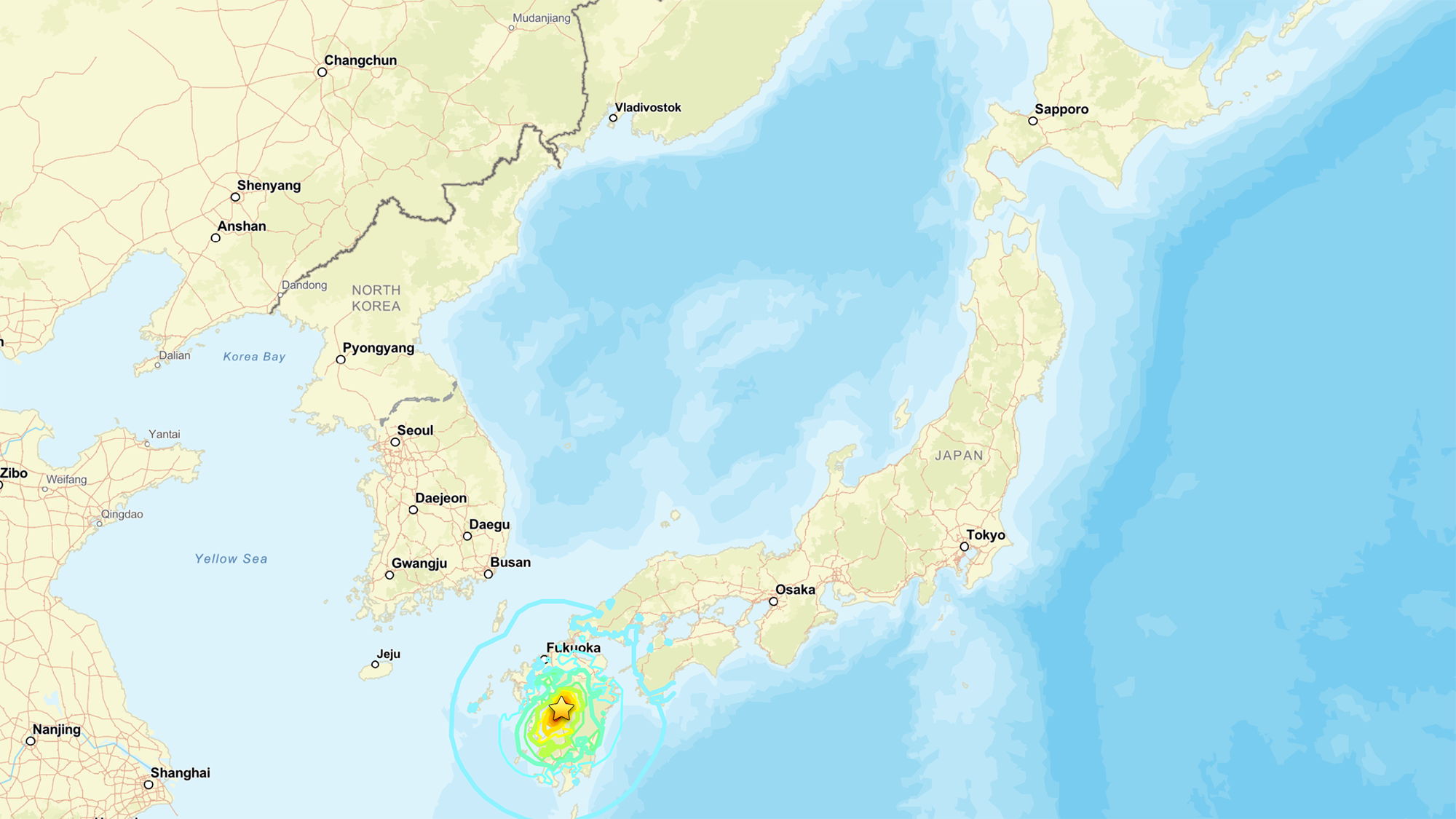
The quake, which the U.S. Geological Survey (USGS) measured as a magnitude 6.8, hit at 4:27 p.m. local time near Kumamoto, a city of more than 700,000 people located on the island of Kyushu in southern Japan.

Thousands of homes lost power, and roads buckled across the region. The second floor of a shopping center collapsed, trapping shoppers inside, according to the BBC report; some of these people were evacuated and later hospitalized. A brief tsunami warning was issued and lifted within an hour.

A map of Japan showing its various cities and provinces

A map showing the location of the July 2026 earthquake. (Image credit: National Tsunami Warning Center (ATWC), Pacific Tsunami Warning Center (PTWC), USGS National Earthquake Information Center, PDE)

The USGS measurement is different from the magnitude 7.1 reported by the Japan Meteorological Agency, "primarily because the agencies are reporting different magnitude types," the USGS reported. While Japan is looking at local magnitude, the USGS measured the moment magnitude, which is derived from the physical size of the fault rupture and gives the "most reliable estimate of earthquake size" for large earthquakes, since local-magnitude scales can lose accuracy once a rupture grows big enough, the USGS reported.

These measurements are helpful, as "different magnitude types capture different characteristics of earthquake source processes," the USGS noted. Local magnitude, for example, reflects how strongly the ground shook nearby, while moment magnitude reflects the total energy released across the fault.

Why this quake is scientifically interesting

Japan sits atop one of the most active plate boundaries on Earth, where the Philippine Sea Plate dives beneath the Eurasia Plate. That process, known as subduction, is responsible for the massive, tsunami-generating earthquakes that periodically strike offshore Japan, and it's been studied intensively for decades.

But Tuesday's earthquake didn't occur at the boundary itself. Instead, the rupture happened within the Eurasia Plate, more than 60 miles (100 kilometers) inland from where the plates meet, Jeffrey Park, a theoretical seismologist at Yale University, told Live Science. Roughly 90% of earthquakes happen at plate boundaries, where the constant grinding of two plates builds up stress until a fault gives way. Quakes that strike farther inside a plate β€” sometimes called intraplate earthquakes β€” are rarer and less understood, though scientists suspect that stress transmitted through the plate can reactivate old, dormant faults far from the boundary that produced it.

According to Park, the fault in Tuesday's earthquake moved in a way that suggests the plate tore horizontally as it was twisted by subduction occurring at an angle.

The USGS describes this event as shallow strike-slip faulting: the two sides of the fracture slid past each other horizontally, rather than one side thrusting up and over the other. This faulting style, combined with the shallow depth of just 6 miles (10 kilometers) down, points to the same type of rupture behind Kyushu’s deadly 2016 Kumamoto earthquake sequence.

That inland location is also why the quake didn't generate a damaging tsunami, despite the brief precautionary warning. Tsunamis are produced when a big event β€ͺ—‬ such as an earthquake, volcanic eruption or landslide β€ͺ—‬ displaces water; the force from that displacement then propagates as a wave.

Tuesday's rupture stayed entirely on land, so it never pushed the seafloor up the way offshore quakes do. That's why the tsunami risk stayed low, even with the brief precautionary warning. Still, an inland quake isn't automatically off the hook: if the shaking triggers a landslide that spills into the sea, that alone can generate a tsunami.

The depth mattered just as much as the location. The quake was shallow enough to concentrate its energy near the surface, which Park said explains the structural damage.

"Because it is shallow it will cause more structural damage than a similar-sized event that might occur deeper and offshore," he told Live Science in an email.

Earthquake country

Several earthquakes have already clustered in the area, and numerous aftershocks are expected over the coming days. Japan experiences roughly 1,500 earthquakes annually, making it one of the most seismically active countries on the planet β€” a byproduct of sitting at the junction of several tectonic plates.

To protect itself, Japan has spent decades β€” and learned from painful lessons from disasters like the 2011 Tohoku earthquake and tsunami β€” engineering a response system built for exactly this scenario.

Bullet trains are programmed to halt automatically the instant seismic sensors detect a major earthquake, a safeguard Park pointed to as a defining feature of the country's earthquake readiness. That automatic shutdown extends to other transit and utility systems, part of a broader early-warning network that alerts the public within seconds of a quake's detection, giving people crucial time to take cover before shaking arrives.

Japan's investment in its infrastructure may help to explain why, even after a magnitude 7 event near a city of 700,000, Japan's death toll and damage have historically been far lower than those from comparable quakes elsewhere in the world.

Search-and-rescue efforts are continuing in Kumamoto, with CNN reporting that between 20 and 30 employees remained unaccounted for at the Aeon Mall in Kashima Town, where the building’s second floor had collapsed. Firefighters were also working to reach the site and contain nearby fires.

A strange string of a dozen galaxies keeps surprising astronomers with its missing dark matter

28 July 2026 at 21:04

In a string of a dozen small galaxies hung in the sky like a row of cosmic fairy lights, astronomers have discovered a small, ghostly galaxy without any dark matter. The rare discovery offers additional evidence that violent galactic collisions can knock this invisible substance loose from visible matter.

Dark matter acts like cosmic glue, accumulating in "halos" in which galaxies form. It makes up about 85% of all the matter in the cosmos, meaning all the stars and other celestial objects we see account for a small fraction of the universe's mass. And as astronomer Vera Rubin observed, despite its invisible nature, dark matter seems essential to explain the apparent movement of stars around their galactic centers.

Yet in a study published June 16 in The Astrophysical Journal, astronomers report that a dwarf galaxy called DF9 may be devoid of dark matter, joining a couple of other apparently dark-matter-devoid dwarfs (DF2 and DF4) previously discovered in the same string of tiny, faint galaxies.

"The most surprising aspect is that this finding indicates that an entire trail of galaxies including DF2, DF4, and DF9 formed together in an extreme event producing galaxies not alike any we've ever seen before β€” the first of its kind," Michael Keim, an astrophysicist at Yale's Graduate School of Arts and Sciences and the study's first author, told Live Science via email. "As a result, they have a ghostly appearance, bright clusters of stars, and a lack of dark matter."

Following a trail of galactic crumbs

To study DF9, the researchers used the Keck Cosmic Web Imager at the W. M. Keck Observatory atop the dormant Mauna Kea volcano in Hawaii. The dwarf galaxy is situated within a long trail of a dozen similarly small, diffuse galaxies in the NGC 1052 field, nearly 70 light-years from Earth.

To calculate the mass of DF9, the researchers measured the motion of its stars by analyzing changes in their wavelengths. The analysis revealed that DF9 has a measly mass of approximately 100 million suns, which is consistent with its visible mass in stars. If it contained the expected amount of dark matter, it would be exponentially heavier, harboring a mass of more than 10 billion suns, the researchers said in a statement.

As revealed over the past decade, at least two of DF9’s nearby galactic siblings also appear to lack dark matter.

A gif showing two blobs together in deep space

A video showing the galactic collision that resulted in this string of dwarf galaxies. (Image credit: Video courtesy of W. M Keck Observatory / Adam Makarenko)

"If DF2, DF4, and DF9 were the only galaxies known, one would not conclude there is any need for dark matter," the researchers wrote in the paper. These three galaxies do not display a mass-based discrepancy based on their visible and invisible matter; their mass, determined by the gravitational motion of their stars, matches their mass as measured by the light emitted from these same stars.

But this is hardly typical among most observed galaxies, especially the tiniest ones. Counterintuitively, low-mass dwarf galaxies such as these often have the highest fraction of dark matter. Because they are not as massive, they have lower escape velocities, allowing supernovas and other "feedback mechanisms," like intense black hole winds, to eject their gas more easily. This mass expulsion typically results in dark matter halos around galaxies that are 100 times more massive than all of a dwarf galaxy's stars, the researchers said.

Dark matter deficiency is linked to a violent past

The team likened this lineup of dwarf galaxies to a miniature version of the Bullet Cluster, located nearly 4 billion light-years from Earth. The collision of two galaxy clusters that created the Bullet Cluster is considered the most energetic event known since the Big Bang, astronomers say, and the massive mashup is responsible for separating the system's gas from its dark matter.

This composite image shows the galaxy cluster 1E 0657-56, also known as the

The Bullet Cluster seen by the Chandra Telescope (Image credit: (X-ray: NASA/CXC/CfA/M.Markevitch et al.; Optical: NASA/STScI; Magellan/U.Arizona/D.Clowe et al.; Lensing Map: NASA/STScI; ESO WFI; Magellan/U.Arizona/D.Clowe et al.))

Violent galaxy mergers are widespread in space, suggesting such galaxies without dark matter also may be more common throughout the cosmos than once thought.

"The Bullet Dwarf event in which DF9 is thought to have formed is named after the famous Bullet Cluster wherein the gas of two entire clusters of galaxies was separated out in a similar manner as this 'Bullet Dwarf' collision, so indeed this can occur at much larger scales," Keim explained via email. "But collisions between giant clusters are far less frequent than collisions of individual galaxies."

Yet being able to glimpse DF9 and its linearly laid-out counterparts still required an element of fortune. "High-speed collisions are, nevertheless, somewhat rare," Keim added. "DF9 is 67 million light years away from Earth; based on cosmological simulations, we would expect just 7 or so similar collisions to have occurred within that distance."

Additionally, celestial bodies are always in flux, so finding galaxies devoid of dark matter is difficult for other reasons. For example, they may exist in dense regions, where they are harder to view through the obscuring dust, gas and starlight surrounding them. Or, they may merge with other galaxies that do have dark matter.

The strange separation between dark matter and visible matter in the galaxies of the NGC 1052 field warrants further study, the researchers said. Finding any leftover gas from the collision would provide the "smoking gun" evidence for the collisional origin of this faint string of galaxies.

The astronomers are conducting follow-ups with other observatories, including the new MOTHRA facility, the "world's largest all-lens telescope," which is under construction in Chile. With an array of 1,140 telephoto lenses, "its line mapping sensitivity on large scales β€” like that of the trail β€” will be at least an order of magnitude deeper than any other facility," Keim added.

Scientists may have found a clue to prevent muscles from aging, study hints

28 July 2026 at 20:30

Scientists may have found a way to rejuvenate key cells that help rebuild muscle in the body and thus preserve muscle into old age, they report in a new mouse study.

It is "really exciting stuff," Matthew Krause, a muscle physiologist at the University of Windsor in Ontario, said of the results. It could have clinical applications down the road if shown to work in humans, as well, added Krause, who was not involved in the research.

The body loses muscle with age and with chronic conditions that compromise people's mobility. To find a potential treatment for this muscle atrophy, the scientists behind the new study looked to "satellite cells." These stem cells are located around skeletal muscle fibers and play an important role in muscle regeneration.

Muscles incur microscopic damage with use, and this damage calls satellite cells into action. They proliferate to rebuild muscle fibers, by either merging into the torn muscle cells or forming new muscle cells. With age, satellite cells activate less efficiently and muscles become weak. But the new study, published July 24 in the journal Scientific Reports, suggests that it may be possible to rescue satellite cells from dormancy.

When muscles tear during exercise, a protein called hepatocyte growth factor (HGF) gets released. This is the signal that binds to receptors on satellite cells and activates them. Previously, studies from the same team showed that HGF works less well in old lab mice because its structure is chemically altered by a compound called peroxynitrite, and this makes it harder for HGF to plug into its receptor on satellite cells. This chemical alteration is known as nitration.

Peroxynitrite is produced through the reaction of unstable nitrogen and oxygen molecules, called radicals, said study co-author Ryuichi Tatsumi, a muscle physiologist at Kyushu University in Japan. These radicals are produced during normal metabolism, but their levels increase with age, he explained.

As a result, satellite cells cannot be activated efficiently to trigger muscle growth, even if the amount of HGF itself does not decline. Tatsumi and colleagues showed this in a previous study in rats.

A woman with gray curly hair lifts weights using a bicep curl

Regular physical activity can help older adults preserve muscle, but even so, muscular tissue tends to weaken with age. (Image credit: Maskot via Getty Images)

In the new study, the scientists tested two compounds to see if they could counter this effect in lab mice. They used an experimental setup in which mice couldn't use their muscles as normal, so they weakened; such muscle disuse is known to increase HGF nitration around muscle cells.

Both of the tested compounds are known to protect proteins from damage caused by highly reactive chemicals by intercepting the reaction before it can take place. In experiments, the team treated HGF with each compound before exposing it to peroxynitrite. They found that, compared with untreated HGF, HGF treated with either compound showed substantially lower levels of nitration. This preserved its ability to activate satellite cells grown in lab dishes.

At high concentrations, one of the compounds β€” lipoic acid trisulfide (LASSS) β€” not only prevented nitration but also markedly increased HGF's ability to plug into its receptor. That suggests LASSS may chemically modify HGF in a way that could boost its effects.

To see if these observations carried over to living animals, the researchers gave lab mice LASSS in their drinking water. Although these were young mice, they were prevented from bearing weight on their hind limbs for five days, so they experienced short-term muscle disuse. Compared with untreated animals, the mice given LASSS had substantially lower HGF nitration around their muscle cells.

It's "pretty remarkable" that providing LASSS by mouth was sufficient to produce this effect, Krause said. He noted, however, that the researchers did not measure muscle atrophy or try administering LASSS to old mice to see the effects on the muscle. Longer experiments would be needed to observe those changes, he told Live Science.

The compound could also be tested in other forms of muscle wasting, Krause suggested. For example, severe chronic diseases like cancer can cause cachexia, a wasting syndrome marked by dramatic weight and muscle loss.

In general, protein nitration has been linked to several age-related disorders, including Alzheimer's disease, in which nitrated proteins accumulate in the brain. Understanding how to protect proteins from this kind of chemical damage could have implications beyond muscle biology, Tatsumi said.

However, further studies are still needed to assess the effectiveness and safety of LASSS in older animals. Experiments involving aging animals are expensive and can take a lot of time, Tatsumi said, but he is optimistic that this understanding will help address a range of age-related disorders with this same underlying biology.

"That is our big wish," he told Live Science. "I think, in the near future, we can do that."

Killer whales sink another boat off the coast of Spain β€” why are they still doing this after 6 years?

A pod of killer whales has sunk another yacht off northwestern Spain, reinforcing a bizarre pattern of vessel encounters that has stretched on for more than six years along the Iberian coast.

In the incident, reported Friday (July 24), the whales destroyed the rudder of a 46-foot-long (14 meters) Swedish-flagged yacht off Galicia in northwestern Spain, forcing the two people aboard to send a mayday call. A Spanish coastguard vessel towed them to safety, Spain-based news outlet Sur in English reported.

The incident came after several other encounters in the same waters earlier that week, including one in which a pleasure craft called the Idem sank near Estaca de Bares, the northernmost point of the Iberian Peninsula. The ship sank after the killer whales, also known as orcas (Orcinus orca), destroyed its rudder. Both occupants were rescued.

That makes the Idem at least the eighth boat lost to these encounters since they began, according to groups that track the incidents. More than 700 interactions between orcas and vessels have been logged since 2020, ranging from a brief nudge to a multihour rudder-ramming session, according to the Atlantic Orca Working Group, the Spanish-Portuguese research collective that has coordinated data collection on the phenomenon from the start.

Researchers have identified roughly 15 individual killer whales involved in these incidents, out of an Iberian subpopulation of fewer than 50. The group is so small that the International Union for Conservation of Nature lists it as critically endangered, as it is dependent mainly on Atlantic bluefin tuna for its food.

The family-like cluster is thought to be led by a female known as White Gladis. That name comes from an early theory researchers themselves once floated: that White Gladis suffered some kind of traumatic run-in with a boat and that the encounter flipped a behavioral switch, with her being the first in the group to start ramming rudders.

Alfredo LΓ³pez Fernandez, a biologist with the Atlantic Orca Working Group, told Live Science in 2023 that this kind of defensive, trauma-driven origin was gaining traction among researchers at the time. But "defensive" isn't "vengeful" β€” and the idea has since curdled online into a punchier revenge story most scientists studying the population don't endorse.

So why do orcas go after the boats? Nobody knows for certain, but the leading explanation is simple: Orcas are some of the most social animals on the planet, and social animals pick up habits from one another the way trends spread through a friend group. Researchers describe the behavior as socially learned β€” young orcas appear to watch adults ram a rudder and then try it themselves, and the habit has spread through the group over time.

A 2022 study in the journal Marine Mammal Science found that the killer whales usually targeted sailing boats and often lost interest after striking the rudder and causing the boat to stop.

None of that makes the encounters any less disruptive for the people living through them. The standard guidance from authorities like the Maritime Safety and Rescue Society and the Atlantic Orca Working Group, refined over repeated encounters, is to cut the engine, drop the sails if possible, disengage the autopilot, and let go of the wheel entirely, giving the orcas nothing to push against. Boats that follow this protocol tend to sustain less damage than those that don’t.

Sailors are asked to report every encounter. Each one adds to the data scientists are using to try to solve a years-long mystery.

How to watch 'Jurassic Sharks' online – stream 'Shark Week' 2026 from anywhere

28 July 2026 at 16:00

We've all heard of the fearsome megalodon, the largest known shark to have ever lived, but how about its predecessors, contemporaries and successors? Shark Week premiere "Jurassic Sharks" uses CGI to flesh out the fossils of ancient cartilaginous fish, and Live Science is here with all the TV and streaming details.

How to watch "Jurassic Sharks" β€” Quick Guide

β–Ί Date: Tuesday, July 28 at 8 p.m. ET/PT

β–Ί TV: Discovery (US)

β–Ί US stream: YouTube TV / DirecTV / Hulu + Live TV / HBO Max

β–Ί Watch anywhere: Get 85% off Surfshark VPN

Using fossil records and "cutting-edge" visual effects, "Jurassic Sharks" will attempt to trace the ancestry of modern-day species back through millions of years, and build a picture of the prehistoric ocean, complete with superpredators that are both weird and awe-inspiring.

It's a must-watch for budding palaeontologists and animal fans alike.

How to watch "Jurassic Sharks" in the U.S.

"Jurassic Sharks" airs on Discovery at 8 p.m. ET/PT on Tuesday, July 28.

If you don't have the Discovery channel on cable, it's available on a streaming basis from several cable alternatives. Best of all, many of the services offer a free trial to new customers.

YouTube TV usually costs $82.99 per month but comes with a free trial and $15 off each of your first five months.

The DirecTV MyEntertainment genre pack costs $42.99 per month after a 5-day free trial, and Hulu + Live TV costs $89.99 per month after a 3-day free trial.

Alternatively, the HBO Max streaming service starts at $10.99 per month.

Can you watch "Jurassic Sharks" in the U.K.?

"Shark Week" programming typically airs on Discovery+ in the U.K. at a later date.

At the time of publication, plans for "Jurassic Sharks" and the other 2026 "Shark Week" specials are still firmly under wraps.

If you're currently in the U.K. for work or on vacation from the U.S., you can still catch "Jurassic Sharks" by using a VPN, such as Surfshark.

Watch "Jurassic Sharks" from anywhere

If you're traveling abroad you can access your usual streaming services from anywhere with a good VPN.

A VPN, or virtual private network, is a piece of internet security software that can alter your device's digital location, unlocking the geo-restrictions on most streaming platforms.

Our expert colleagues at TechRadar rate Surfshark as one of the best VPNs. Not only is it great for unblocking streaming services, it has top-level security features, a reasonable price tag and, right now, a big discount.

Save 85% off Surfshark VPN

Live Science x Surfshark Exclusive Shark Week Deal

Whether you're tuning into Discovery's Shark Week or diving deep into the web, privacy matters. Surfshark keeps your connection encrypted and your data out of sight – no matter what waters you're navigating.

Protect unlimited devices for just $2.39/mo + 4 Extra Months. Save 85%! Shark Week Special runs from July 26 to August 1, 2026.

πŸ₯‡ From $2.39 per month
βœ… Block ads, trackers, scams, and malware
🀝 30-day money-back guarantee
πŸ† 4 Extra monthsView Deal

We test and review VPN services in the context of legal recreational uses. For example: 1. Accessing a service from another country (subject to the terms and conditions of that service). 2. Protecting your online security and strengthening your online privacy when abroad. We do not support or condone the illegal or malicious use of VPN services. Consuming pirated content that is paid-for is neither endorsed nor approved by Future Publishing.

Introducing Live Science Pro β€” a new space to get all the science with none of the distractions

For over 20 years, Live Science has been committed to bringing you the latest breakthroughs and incredible discoveries with clarity, authority and good humor (when appropriate, of course). In that time, we've evolved through a modernized website design, a transition to more deeply reported stories, and the addition of engaging videos produced by a dedicated team.

Over the years, we have relied on advertising to support our team of journalists. However, the fast-changing economic landscape has pushed us to continue evolving so we can deliver quality science journalism. That is why I am proud to say we have launched Live Science Pro, a new space on Live Science that allows you to directly support our award-winning team of science journalists so we can continue writing best-in-class stories.

Right now, the world needs credible, rigorous science more than ever. Our mission is to responsibly communicate that science with the highest degree of accuracy, informing the scientific community and sparking the fascination of those who can't wait to learn about our world and the universe beyond. By joining Live Science Pro, your subscription supports this goal and allows us to produce high-quality journalism that is written and fact-checked by our experienced writers and editors, without ever seeing an advertisement on our articles. This means you get all the science, and none of the distractions.

While you can still read the latest science news for free, written to the same high standards as our Pro content, as a part of your paid membership, a Live Science Pro subscription gives you access to our Science Spotlight features, which take an in-depth look at the paradigm shifts and breakthroughs that will transform science in the coming years. Your subscription puts must-reads at your fingertips, including our insightful analyses, which give you crucial context for the biggest science headlines; and interviews and exclusive book excerpts, which provide a more personal look at the people driving progress. You also get access to our opinion pieces, which reveal how experts are thinking about the biggest issues in their fields.

Plus, you'll receive our exclusive, members-only weekly newsletter, which provides a curated look at the stories our writers and editors are most excited about and their take on what matters most in their areas of expertise.

To mark the launch of Live Science Pro, we're offering an introductory price of $3 for the first three months, or for an even better value, you can sign up for an annual subscription for just $30 for the first year. You can find more details on how to subscribe here: livescience.com/subscription

Right now, there are more voices and options than ever. We know you demand credibility and accuracy from your science reporting, and we thank you, again, for placing your trust in ours.

Alexander McNamara

Editor-in-Chief, Live Science

The ultimate packing list for Aug. 12, as a solar eclipse coincides with the Perseid meteors peak

28 July 2026 at 12:00

Aug. 12, 2026, promises to be a big day for anyone interested in the sky. By day, a solar eclipse will be visible across parts of North America and Europe. For most, it will be partial, but for those within the path of totality in eastern Greenland, western Iceland and northern Spain, the moon will completely block the sun.

Hours later, the sky show continues with the peak of the Perseid meteor shower on the night of Aug. 12-13. The shower occurs when Earth passes through debris left behind by Comet 109P/Swift-Tuttle, producing bright meteors and occasional fireballs. In 2026, the timing could hardly be better. The same new moon that makes the solar eclipse possible will also create moonless skies for meteor-watching, with observers under dark skies potentially seeing 30 to 50 "shooting stars" per hour.

All of that happens after the eclipse. As a bonus, Venus will blaze low in the west during twilight, the Milky Way will stretch overhead after dark and, in Iceland, there is even a slim possibility of an early-season aurora display. Many visitors will spend 12 hours or more outdoors, arriving long before first contact and remaining under the stars until after midnight. Here’s what to consider buying for this very special day and night beneath the sky.

Nothing belongs in your bag more than certified eclipse glasses. Whether you're in Spain's path of totality, watching a deep partial eclipse from the U.K. or viewing a smaller partial eclipse from North America, proper eye protection is essential during every partial phase of the eclipse. Even observers inside the path of totality will spend far longer watching the eclipse before and after totality than during it.

Eclipse glasses should comply with ISO 12312-2 and be bought from a reputable supplier. These Eclipser HD glasses from American Paper Optics are more comfortable and harder-wearing than regular cardboard products.

Read: Best solar eclipse glassesView Deal

Dedicated solar binoculars like the Celestron EclipSmart 10x42 are one of the best eclipse purchases you can make. They reveal sunspots, active regions and the changing shape of the partial eclipse in a way eclipse glasses simply cannot.

They're lightweight, require no set-up and provide a far more immersive view of the partial phases. However, it's important to practice with them before the eclipse because finding the sun is not as easy as many think. The EclipSmart porro solar binoculars also come in 12x50 and 20x50 versions.

Read: Celestron EclipSmart 10x42 solar binoculars reviewView Deal

Although solar binoculars are great for the partial phases, you can just make some regular optical binoculars safe by using Baader AstroSolar Safety Film OD 5.0 to make your own filters. However, if you’re heading to the path of totality, consider getting some image-stabilized binoculars to allow you a spectacular close-up of the solar corona.

These reference-level binoculars from Canon use motion sensors to detect hand shake and then shift actuators around the lenses to cancel it out. Other image-stabilized options include the Canon 12x36 IS, Canon 8x20 IS and Canon 15x50 IS.

Read: Canon 18x50 IS UD all-weather binoculars reviewView Deal

If you want to explore the world of solar observing during the eclipse and well beyond, consider investing in a hydrogen-alpha solar telescope. Isolating light emitted by hydrogen atoms in the chromosphere, they show you an entirely different view of the sun β€” from sunspots and dark filaments to prominences and, if you’re really lucky, a solar flare in action.

This 40mm aperture and 400mm focal length option from Lunt makes it thoroughly portable.

Read: Best telescopesView Deal

Solar eclipse glasses work well for individual viewing, but if you want a safe way to share an image of the partially eclipsed sun, consider a solar projector. The Solar Projector arrives flatpacked and is made entirely of stiff cardboard (which doesn’t heat up like metal or melt like plastic).

Once aimed at the sun using a designed-in quadrant to measure the sun’s declination, it uses its achromatic glass lens and convex mirrors to create a 55-75mm image of the sun on a small screen.

Read: Best solar viewing equipmentView Deal

A compact smart telescope is a wise choice for eclipse chasers who are after more than just a few smartphone snapshots. The DwarfLab Dwarf Mini is a tiny, app-controlled telescope whose included magnetic solar filter allows solar observing.

It can quickly locate the sun and capture images revealing sunspots during partial phases of a solar eclipse. If and when totality arrives, simply remove the solar filter. You'll need to add your own tripod.

Read: DwarfLab Dwarf Mini smart telescope reviewView Deal

A stargazing tent makes sense for anyone planning to watch the Perseids long after the eclipse. Sky View Tents use near-transparent mesh walls so you can lie in a sleeping bag and keep watching the sky, making them useful for meteor watching and the Milky Way.

The two-person Backpacker Stargazing Tent is roomy enough for lying back, quick to pitch and has an internal rainfly that can be deployed without getting up. At 5.6 pounds (2.6 kilograms), it’s better for car camping or short dark-sky hikes than long backpacking trips.View Deal

You'll likely arrive early to secure a good location. Then you'll spend hours watching the eclipse unfold before darkness finally arrives and the Perseids begin. A lightweight folding chair is therefore one of the most valuable things you can bring.

The Nemo Stargaze EVO-X is a suspended, gently rocking chair that reclines smoothly, with a padded headrest that makes long sessions under the stars far easier on the neck. It’s excellent for meteor-watching, reading and relaxed binocular use, with pockets for a phone or drink. However, it is bulky, heavy and body-size-dependent, so it’s better for car-based observing than for backpacking.View Deal

A sturdy travel tripod is essential if you want sharp eclipse photos, twilight shots of Venus or wide-field images of the Milky Way and Perseids.

The Peak Design Travel Tripod is unusually narrow when folded, quick to set up and stable enough for full-frame cameras, yet it also hides a smartphone mount in its center column, making it useful for both serious cameras and phones. Its compact ball head keeps the whole package sleek for travel, while the fast leg locks make set-up and takedown easy in the dark. However, it is expensive and not especially tall.View Deal

A fast wide-angle lens is the classic choice for photographing the Perseids and the Milky Way after the eclipse. The Sigma 14mm f/1.4 DG DN is a huge, heavy wide-angle lens for full-frame cameras that achieves f/1.4 aperture β€” the first such lens to do so.

That means shorter exposures, lower ISO settings and cleaner night-sky images which, with luck, will be stuffed with "shooting stars." It's sharp and well built, but it's expensive.

Read: Best lenses for astrophotographyView Deal

Colossal scars of 60 million-year-long continental collision streak across warped mountains in Pakistan β€” Earth from space

28 July 2026 at 11:38
QUICK FACTS

Where is it? Murgha Kibzai, Sulaiman Range, Pakistan [30.739354851, 69.50804296]

What's in the photo? Folded layers of rock left over from an ancient continental collision

Which satellite took the photo? NASA's Terra satellite

When was it taken? April 11, 2011

This striking satellite photo shows a multicolor "fan" of folded rocks sculpted by a longtime collision between two of Earth's tectonic plates.

The geological feature, known as an imbricate fan, is located around 3 miles (5 kilometers) east of the town of Murgha Kibzai in Pakistan's Balochistan province. The photographed section of folded rocks measures around 9 miles (15 km) across, but the fan stretches up to 55 miles (89 km) from end to end, well beyond the area in this image.

The dramatic structure sits at an altitude of around 5,000 feet (1,500 meters) in the Sulaiman Range, a series of mountains that covers around 2,500 square miles (6,500 square kilometers) of Pakistan and Afghanistan. ("Sulaiman" means "of Solomon," in reference to the biblical figure King Solomon, and the range's largest peak is Takht-e-Sulaiman, which translates to "Throne of Solomon.")

This is one of several unique features that emerged along the boundary between the Eurasian and Indian tectonic plates, which have been colliding for more than 60 million years. At one point during this tectonic tug-of-war, the two plates became somewhat intertwined, allowing the fan to take shape, according to NASA's Earth Observatory.

"As India moved northward, it began to rotate in a counter-clockwise direction, wrenching the northwestern part of the Indian plate backwards into part of the Eurasian plate," Earth Observatory representatives wrote. "The countervailing forces put the rocks of the Sulaiman Range in a unique compressional vice, causing many of its faults to curve and stretch in convoluted ways."

A wide-field image of the Sulaiman Range showing massive tectonic features spread out over a large area

The Sulaiman Range is full of unique geological features that were birthed by the collision between the Indian and Eurasian plates. (The imbricate fan is located on the far right of this wide-field image.) (Image credit: NASA/Terra)

The fan is made up of alternating layers of sandstone, which appear dark in the image, and limestone, which has a much lighter hue. These sedimentary rocks were formed by "thrust faults" that shot upward from the boundary between the Eurasian and Indian plates and became entangled as the boundary moved back and forth.

The satellite image is false-color, meaning it includes wavelengths of the electromagnetic spectrum that are not normally visible to humans. This helps to accentuate the differences between the two rock types, although they can also be easily distinguished with the naked eye. Pockets of vegetation appear in red throughout the image.

The photo is a small part of a larger, wide-field image (see above), which showcases several other intriguing geological features across the Sulaiman Range in false color.

Continental collision

The collision between the Eurasian and Indian plates became inevitable around 80 million years ago, when dinosaurs still ruled Earth, according to the Earth Observatory. At this point, the pair became locked on a collision course, with each plate moving more than 8 inches (20 centimeters) per year β€” around twice the speed of the fastest tectonic plates today.

Around 60 million years ago, the plates slowly slammed together. Normally, this would cause the smallest tectonic plate to sink below the other. However, the two plates' massive size meant neither receded. Instead, the continental crust along the boundary grew thicker, and the ground buckled, folded and pushed upward.

Satellite photo showing the warped shaped of the Sulaiman range

The Indian and Eurasian plates have been locked in a tectonic tug-of-war for more than 60 million years. Their collision birthed the Sulaiman Range, alongside the Karakoram and the Himalayas. (Image credit: Getty Images)

This process created not only the Sulaiman Range but also the Karakoram (a huge mountain range that spans the borders of China, India, Pakistan, Tajikistan and Afghanistan) and the Himalayas β€” the two tallest mountain ranges on Earth, according to the Earth Observatory.

This collision continued at full speed for around 30 million years, before eventually slowing down. However, the two plates are still technically colliding today, making the region a major earthquake hotspot.

See more Earth from space

A satellite photo showing a black blob of ancient lava surrounding a volcano in the middle of the Sahara desertShadowy tendrils of lava

A 2019 astronaut photo shows off ancient lava flows that once oozed down the jet-black slopes of the ToussidΓ© volcano in northwestern Chad. An intriguing volcanic "skull" also lurks in the aerial image.

An astronaut photo of two near-identical volcanoes standing side-by-side on Indonesia's Java Island.Volcanic 'Twin peaks'

A 2021 astronaut photo shows the surprising similarities between Mount Sundoro and Mount Sumbing, which lie at the heart of Java, Indonesia.

An astronaut photo of the massifConcentric rocky rings

A 2025 astronaut photo shows a massif made of concentric mountain ridges in the Libyan desert. The rocky walls contain ancient artworks and are occasionally used to contain herds of grazing cattle.

'World models' are the future of AI, but how do they work?

28 July 2026 at 09:52

In a few short years, artificial intelligence (AI) has transformed how we interact with computers and threatens to upend wide swathes of the job market. But large language models (LLMs) still struggle with the messy realities of the physical world. Researchers are betting that a new type of AI, called "world models," could fix that.

At a fundamental level, world models do exactly what the name suggests: They build a mathematical model of the world that can then be used to make predictions about how it will change in response to certain actions or changing conditions. The "world" in this context doesn't necessarily mean the entire physical reality. Instead, it refers to the environment the model operates within, which could be anything from a warehouse to a video game.

Exactly what counts as a world model and how best to build such a model remain topics of considerable debate among AI researchers. But world models would represent a significant advance over LLMs, which, despite their impressive capabilities, simply predict the most likely next word in a sequence.

The hope is that by developing a richer understanding of complex environments, world models could allow AI to finally break out of the chat interface, with potentially game-changing applications in areas like robotics, autonomous driving and scientific discovery.

"The idea has strong connections with the intuitive models in our human minds," said Yunzhu Li, an assistant professor of computer science at Columbia University. "We can imagine how the environment is going to change, how an object is going to move when you apply a specific action. And we basically want to also build this kind of model for any robots or any virtual agent so they can imagine the effects of their actions."

Building world models in your mind

While world models are the latest buzzword in Silicon Valley, the concept has deep roots. It first came to prominence in the 1950s, Manling Li, an assistant professor of computer science at Northwestern University, told Live Science. It arose when cognitive scientists attempted to describe the mental models people used to simulate their environments in their heads.

The concept is also deeply connected to, and often inspired by, control theory, Manling Li said. This is a branch of applied mathematics used to create models of physical systems so they can be predictably controlled. It powers everything from thermostats to aircraft autopilot systems.

However, the term "world models" today refers primarily to neural networks that learn models of their environment by training on data. The modern incarnation of the idea can be traced to a 2018 study titled "World Models," by scientist David Ha and deep learning pioneer JΓΌrgen Schmidhuber. Early models from Google, like PlaNet and Dreamer, were among the first to solve tasks by first making predictions about the outcome of different actions.

While the idea behind a world model is fairly intuitive, a more precise definition is any system capable of "action-conditioned future prediction," Yunzhu Li said. This essentially means the model can predict how a particular action will change the state of the world around it.

Making those predictions, Manling Li said, consists of two key tasks: state estimation and state transition. State estimation refers to the ability to perceive the current state of the environment and encode it into a format that the model can compute, while state transition means the ability to predict how a particular action will cause the environment to evolve.

The data that powers new realities

Deep-learning-based world models learn to do both tasks by training on vast quantities of data. But exactly what kind of data and how that data should be encoded and processed are design choices, with different groups taking a variety of approaches, Yunzhu Li said.

World models are trained primarily on video data, although they can also be trained on 3D data captured by light detection and ranging (lidar) or other depth sensors, audio data and even text that explains the relationships between elements in the environment. Crucially, Yunzhu Li said, this has to be paired with action data β€” things like robot joint angles, movement readings from an inertial sensor, or event text labels describing what action was taken.

A robot in a football jersey kicks a white ball as people behind watch.

Robots, including humanoids, will be increasingly reliant on strong world models in order to interact with the physical realm. (Image credit: China News Service via Getty Images)

Typically, this data is arranged into sequences of state-action pairs β€” essentially, recordings of what the world looked like and what action was applied at each step. The AI then uses this data to learn a statistical model of what impacts different actions have on its environment, which can be used to make predictions.

This data can be processed in different ways, Yunzhu Li said. One of the most popular approaches is to operate directly on raw pixel data, which represents the state of the world as a series of images and predicts how actions will change them. Another is to use the data to learn 3D geometric representations of the world that more explicitly encode spatial and physical relationships among objects in a scene.

The power of math-based abstractions

More recently, however, there's been growing interest in approaches that operate on a more abstract level. When a neural network learns from image data, it creates high-dimensional numerical representations of the real-world elements that make up the visual scene β€” known as embeddings β€” that exist in a mathematical space known as the model's "latent space."

In a pixel-based model, these abstract representations are reconstructed into pixels to make predictions about what will happen next. But it's also possible to do those simulations within the latent space by directly predicting the embedding of the environment's next state. This approach has been popularized by computer scientist Yann LeCun, Meta's former AI head and one of the "godfathers of deep learning," with his Joint-Embedding Predictive Architecture. He has raised more than $1 billion for a startup called AMI Labs, which plans to use the approach to build world models.

The key advantage of the approach is its efficiency, Yunzhu Li said. Pixel-based approaches have to reconstruct the entire image every time they make a prediction, even if only a small portion of the frame changes.

"As humans, when we're imagining the evolutions of the environment, we don't have to imagine the exact value of every pixel," he said. "That is why it makes a lot of sense to think about predicting over the latent space. It is easier to make sure you are only learning things that are task relevant and ignoring the things that are irrelevant to the task."

A man with gray hair and glasses speaks to an audience

Yann LeCun, the executive chairman of AMI Labs, has raised more than $1 billion to build world models. (Image credit: Bloomberg via Getty Images)

The flip side, however, is that it's much easier to understand what your model is doing if its predictions are in a visual format rather than abstract representations, Yunzhu Li added. "You have a better ability to debug your system by having something more explicit that is easily human interpretable," he said.

But questions about how best to represent data in a world model are secondary to the bigger issue of where to get that data in the first place, Manling Li said. LLM makers could simply scrape all the text from the internet for the initial foundational models, but high-quality, action-labeled video often has to be painstakingly curated. What's more, that data can be very sparse, she added, because only a small number of pixels in an image may change in response to an action.

"If I have a video camera recording what I am doing currently, it's generally just some very minor movement of my hand; the entire environment is not really changing," Manling Li said.

This is leading to considerable debate about the best architectures for world models. Almost every LLM today is based on the transformer architecture, which excels at rapidly ingesting huge amounts of data. But these models are tuned to dense language data where every word carries some meaning, and they are less suitable for sparse video data, Manling Li said. As a result, people are experimenting with a wide variety of model architectures and the field has yet to converge on a tried-and-true recipe.

The evolution of world models

One area of considerable controversy is whether video generation models, like OpenAI's Sora, count as world models. OpenAI representatives previously claimed it's a "world simulator" and suggested this type of model could be a promising path toward "general purpose simulators of the physical world." However, Yunzhu Li said that because these models are trained on raw video data without any action labels, they cannot be considered true world models.

"It is only conditioned on some initial language prompt and then predicts the entire video," he said. "So it cannot predict the counterfactual futures β€ͺ—‬ for example, what would have happened if you applied a different action?"

But there are also questions around whether the current approach to world modeling can truly achieve its goals. The vast majority of world models today are trained on big chunks of prepared data. In contrast, humans and animals build their mental models of the world through interaction with their environment, which provides continuous feedback that lets them refine their understanding.

A car with a camera on top drives down a busy road.

Driverless cars are one kind of AI-powered device that stand to gain from more sophisticated world models. (Image credit: Heather Diehl via Getty Images)

"In order to learn the most effective word models, it's highly likely we will also need the world model to make interactions with the environment and learn from those online interactions," Yunzhu Li said. That remains a stretch goal, however, as current neural network technology is incapable of this kind of continual learning. In addition, allowing a half-finished model to interact with the real world raises significant safety concerns, Yunzhu Li added.

Even a more modest world model could prove invaluable for a host of applications, though. Some of the most obvious include helping robots and autonomous vehicles navigate and plan how to complete tasks. But they could also act as a general-purpose simulator for a variety of applications, depending on the data they are trained on, Manling Li said. Such simulators could include more advanced physics engines for video games, digital twins of patients that could guide medical treatment, or even new ways to model physical phenomena like the climate.

Crucially, there is likely to be a broad diversity of world models. That's because the action data crucial to building a world model is fundamentally connected to a particular physical embodiment, such as a robotic arm, a human or a drone. In the short term, at least, this means world models will be adapted for specific applications, Yunzhu Li said, though many in the field have more ambitious long-term plans.

"People are working very hard and hope that with enough compute, with enough data, and with good enough algorithms, we will have this one unified world model that works across the board for many different applications," he said.

Science word of the day: Seamount

28 July 2026 at 09:00

Science word of the day: Seamount

Pronunciation: SEE'-mount

What it means: A seamount is an undersea mountain that rises at least 3,300 feet (1,000 meters) above the seafloor but does not come close to breaking the surface. According to the National Oceanic and Atmospheric Administration, there are at least 100,000 seamounts in the oceans, and less than 0.1% of them have been explored. Seamounts typically form from volcanic activity, and many host dramatic communities of sea life β€ͺ—‬ from coral, to sharks, to an assortment of weird jellyfish-looking things.

How to use it in a sentence: Every time marine biologists explore a seamount with their remotely operated vehicles, they seem to discover a new universe of strange and blobby deep-sea creatures.

Can you crack our science word of the day puzzle, Chain Word?

Ancient human relative cannibalized both adults and children in a cave in Spain 850,000 years ago, fossils reveal

Cut marks suggestive of cannibalism have been discovered on the fossils of an ancient human relative in a cave in Spain, new research finds. But many of the bones from the species, known as Homo antecessor, were from adults β€ͺ—‬ not just children, as previous discoveries had found β€ͺβ€” adding a new dimension to the cannibalism that was practiced in this area 850,000 years ago.

The two dozen bones and teeth were recently found in Gran Dolina cave, part of the Sierra de Atapuerca archaeological complex in northern Spain, according to a July 24 translated statement from the Catalan Institute of Human Paleoecology and Social Evolution (IPHES). Among the remains were fragments of a skull, spine, arm and leg bones, as well as three teeth from several members of the now-extinct H. antecessor, a relative of modern humans that lived in Europe between about 1.2 million and 770,000 years ago. Several of the bone fragments had cut marks from stone tools.

Over the past few decades, researchers have identified numerous cases of cannibalism at Gran Dolina, meaning H. antecessor is the oldest known human relative to eat its own group members for nutritional reasons. In a 2010 study, researchers noted that most of the evidence of cannibalism at Gran Dolina came from the bones of infants and juveniles, who would have been easier to capture and kill as the young, defenseless members of a rival group. But the newly excavated fossils have upended that assumption.

"The discovery of more adult individuals, some of whom also bear cut marks, demonstrates that cannibalism was not restricted to younger individuals," Palmira SaladiΓ©, a biological anthropologist at the IPHES who coordinated the work, said in the statement.

a human ulna bone lies in the orange colored dirt of a cave floor

The first-ever ulna (forearm bone) discovered from an adult Homo antecessor individual at Gran Dolina in Atapuerca, Spain. (Image credit: Maria D. GuillΓ©n / IPHES-CERCA)

The number of individuals found at Gran Dolina has now risen to at least 13, and about half of them are adults. "The increase in the number of individuals, and especially the addition of more adults, allows us to begin understanding this population from a much more complete perspective than ever before," Andreu OllΓ©, an archaeologist at the IPHES, said in the statement.

Excavation at Gran Dolina has also brought to light an assemblage of stone tools made from flint, quartzite and sandstone, along with animal bones from hyenas, beavers, deer, horses and rhinoceroses, according to the statement.

Evidence of cannibalism at the site is extensive. Stone tools found in the cave are consistent with the cut marks on the human bones, and the animal bones have revealed butchering techniques that were also used on humans. Some of the human bones also had human bite marks, SaladiΓ© told Live Science in 2025, which is the "most reliable evidence that the bodies found at the site were indeed consumed."

But while the practice of cannibalism at Gran Dolina has been confirmed, the reason for it is still unclear. Researchers hope the newly discovered adult bones may help them better understand the practice among H. antecessor groups.

"We have only just begun excavating this new area" at Gran Dolina, Marina Mosquera, an archaeologist at the IPHES, said in the statement, "and the first results already demonstrate its enormous scientific potential."

Further analyses on the bones are now underway to explore questions about age-related differences in cannibalism, the number and length of cannibalistic episodes, and the social organization of H. antecessor, according to the statement.

What do you know about early humans? Test your knowledge with our human origins quiz!

'Feynman and followers, you guys are off': Physicists disprove decades-old Richard Feynman theory on 'silly' sprinklers

27 July 2026 at 13:00

Richard Feynman was a serious physicist who loved to answer unserious questions. Can math tell you how to order the optimal lunch? Can a human track scents like a bloodhound can by smelling his own footprints? Now, researchers have picked up one of Feynman's most curious unanswered questions by looking at the physics of "silly" sprinklers.

A typical lawn sprinkler with an S-shaped nozzle spins in a given direction as it spews water from its two openings. But if you throw that sprinkler into a swimming pool and hook it up to a vacuum so it sucks water in instead of spraying it out, which way will it spin β€” the same direction as before, or the opposite?

Feynman posed that question as a Princeton graduate student in the 1940s. According to Feynman's telling, he rigged a glass sprinkler in his university's lab. It gave a brief "tremor," then barely moved even as he raised the pressure. He repeated the process until the glass shattered, leaving the answer ambiguous. Since then, decades of follow-up experiments have turned up every possible answer β€” the sprinkler spinning one way, spinning the other way, jittering back and forth, or not moving at all β€” depending on how carefully the tests were built.

In 2024, a team at New York University led by applied mathematician and experimental physicist Leif Ristroph took a first crack at the question, finding that the reverse sprinkler rotates opposite to a forward sprinkler. But that explanation was tested only on ordinary S-shaped sprinklers, and it hadn't yet been pitted directly against two other leading theories.

One, which traces back to Austrian physicist Ernst Mach, holds that the total angular momentum of the swirling water inside the sprinkler's arms must be balanced by an opposite spin of the sprinkler itself. The other, associated with Feynman himself, focuses on pressure and suction effects right at the outer nozzles.

So Ristroph's team asked, what if the sprinkler weren't shaped like a sprinkler at all? What if its arms spiraled, bent the wrong way or curled back on themselves?

In a new study published July 13 in the journal PNASs, the researchers built seven deliberately "silly" sprinklers with unusual arm geometries to pit the leading theories against each other. That includes one sprinkler with arms that spiraled several times to maximize the water's angular momentum, and another with a counter-bend at the nozzle.

A diagram of a series of swirls and sprinkler shapes

The sprinkler designs studied, with the observed rotation direction in the forward (red arrow) and reverse (blue) modes. (Image credit: NYU's Applied Mathematics Laboratory)

In the process, they tore down both ideas. If Mach were right, the spiral design should have spun dramatically differently. If Feynman were right, reversing the nozzle bend should have flipped the sprinkler's direction. Neither happened.

"We were forced to say, 'Feynman and followers, you guys are off,'" Ristroph told Live Science.

The spiral-armed sprinkler, meant to test Mach's theory, was just as unyielding. Even though the fluid inside carried substantially more angular momentum, "the solid barely cared," Ristroph said.

All three measurements across the seven designs pointed instead to the sprinkler's central hub, where the arms meet. There, incoming water collides and swirls, generating a flux of angular momentum inside the device that the solid structure pushes back against. The finding suggests that the reverse sprinkler is not much more than an inside-out version of a forward sprinkler governed by the same physics playing out at the opposite ends of the arms.

Ristroph emphasized that this result was made possible because of Jesse Smith, who just completed his physics doctorate at NYU while working on the project, along with a small team of Ristroph’s own students, and Ristroph's longtime collaborator Brennan Sprinkle, a computational fluid dynamics expert at the Colorado School of Mines whose surname is a coincidence.

Now, the team is building computer simulations to test whether the momentum-flux model holds up beyond the flow conditions already studied, and they hope to eventually derive it from fundamental fluid dynamics equations.

Ristroph said this "silly" problem does have real-world applications: Understanding how curved channels convert fluid flow into rotational force could inform the design of turbines and other devices that harvest energy from wind and water currents.

"If we can do something that would help with engineers designing devices to better make use of all the huge amounts of wind and water energy we have all around us," he said, "that would be, of course, a fantastic thing."

Military's testosterone screening program could lead to overtreatment and side effects, including impaired T production

27 July 2026 at 12:00

As recently as 2019, U.S. military health researchers had concerns about testosterone levels among the troops. Their worries were not that male service members didn't have enough of the hormone, as current Defense Secretary Pete Hegseth fears. Instead, experts worried about the troops' inappropriate use of testosterone replacement therapy (TRT), the practice of using injectables or gels to increase a person's circulating testosterone.

"Out of every 1,000 male service members, almost 3 are inappropriately receiving TRT," researchers wrote in a report published on Health.mil, the military's health system website. (That report is available on the Wayback Machine.)

This could lead to harmful side effects, the report authors noted.

"Those being inappropriately treated may experience adverse effects of the medication," including obstructive sleep apnea and edema, the report continued. TRT may worsen sleep apnea and cause swelling in the limbs from water retention. "These adverse effects have the potential to impact deployability and medical readiness."

In short, supplementing testosterone unnecessarily could reduce military readiness, rather than boost it, per the report authors. Now, in a reversal of these concerns, more service members might find themselves offered TRT in the wake of a new military policy announced July 15 by the Department of Defense. It states that all active-duty and reserve service members' testosterone levels will be tested annually starting at age 30.

It is unclear how the policy might affect female service members. Live Science contacted the Department of Defense, which declined to answer questions about the expected testing protocol or criteria for offering service members TRT.

Such an initiative goes well beyond what medical organizations recommend regarding hormone screening for men, experts told Live Science. And while the screening could catch some service members who actually need treatment, the policy might also lead to overtreatment and, in turn, unwanted side effects.

"One of my big, big concerns around this is, how are these tests going to be conducted?" said Luke Cox, a lecturer in sport and exercise science at Swansea University in the U.K. who studies performance-enhancing drugs, including steroidal hormones like testosterone.

Testosterone and military readiness

Testosterone has strong cultural connections with hypermasculinity. As the primary hormone responsible for the development of male sexual characteristics, it's been associated with concepts of strength, aggression and virility. Hegseth continued this pattern by tying the hormone to military readiness in a video announcing the policy change.

"[I]t's about restoring and optimizing your natural capabilities, projecting your longevity and ensuring you have the biological foundation required to sustain the fight," Hegseth said.

That rhetoric aligns with promises made in advertisements for TRT, which pitch testosterone as a tool to "attain that higher level of living," Cox told Live Science. The clinical trial data is more circumspect, however.

In men with genuinely low circulating testosterone levels β€” often defined as lower than 300 nanograms per deciliter (ng/dL) β€” TRT does have benefits. (This 300 ng/dL threshold isn't the universal definition for "low testosterone," as not everyone below that line has troubling symptoms. We'll unpack that later.)

Much of the clearest evidence of benefit is for sexual symptoms: In a large clinical trial, men with low testosterone saw increased sexual desire and sexual activity, such as masturbating or having sex, after TRT. For men whose levels are not low, additional supplementation hasn't been shown to have a clear benefit in the bedroom.

TRT has been shown to improve mood and reduce depressive symptoms in men with low testosterone, and in older men, it's also been shown to improve bone density. Boosting testosterone also boosts muscle mass in middle-aged and older men.

Illustration of dozens of human sperm.

One side effect of TRT is that it often dramatically lowers sperm count, because supplementing testosterone prompts the body to stop making it in the testes. (Image credit: SCIEPRO/SCIENCE PHOTO LIBRARY via Getty Images)

Most of this research has been done on men over age 40, because testosterone naturally declines with age. Low testosterone is rarer in younger men, although exact estimates of its prevalence vary. Estimates also vary among older age groups, but a large study called the European Male Ageing Study found that 0.1% of 40- to 49 year-olds had low testosterone, along with symptoms such as fatigue or low sexual desire. That number rose to 5.1% among those in their 70s.

In 2024, 42.8% of active-duty military members, including men and women, were 25 and younger. Only 8.3% were 41 or older. But the prevalence of low testosterone is generally on the rise, said Dr. Joshua Halpern, chief scientific officer and regional medical director at Posterity Health and a reproductive urologist at Northwestern University's Feinberg School of Medicine.

It will be very important for them and their physicians to understand the risks of treatment and the alternatives that may be more appropriate for preserving their fertility.

Dr. Joshua Halpern, Posterity Health and Northwestern University's Feinberg School of Medicine

Studies suggest that testosterone levels are lower, on average, in young men today than they were in the year 2000. Scientists have theorized that this trend may stem from increases in body mass index, as well as other factors, such as sedentary lifestyles, changing diets and exposure to environmental toxins, according to a 2020 article in Urology Times.

"While active service members are typically among the healthiest of men, and therefore at lower risk for testosterone deficiency, a significant proportion of service members could have a low testosterone number," Halpern told Live Science. "But that doesn't necessarily mean they should receive treatment."

Treating with testosterone

There is no universal testosterone level that is definitively "too low." The cutoff of 300 ng/dL is based on the point at which symptoms of low testosterone β€ͺ—‬ such as fatigue, low libido and poor mood β€ͺ—‬ tend to present themselves. However, some men have no problems associated with low or low-to-normal numbers.

Plus, testosterone doesn't act in isolation. In fact, some symptoms of "low T" in aging men may actually arise from low estrogen, which stems from these individuals' declining testosterone levels. That's because the male body converts a portion of its total testosterone into estrogen. The two hormones normally work together to regulate sexual desire and erectile function, while estrogen specifically regulates fat accumulation, studies suggest.

There is also a broad range of "normal," running from around 300 to 1,000 ng/dL. For that reason, the American Urological Association recommends testing only if a man is experiencing symptoms that point to low testosterone.

"Making a diagnosis of testosterone deficiency in the absence of signs and/or symptoms increases the likelihood of making a false diagnosis and reduces the potential benefit of testosterone therapy," the association's guidelines state.

Testosterone also has a complicated role in the body. It can affect mood, energy and bone health, but the hormone itself can also be affected by health conditions and lifestyle factors. Studies suggest that intense periods of physical training can temporarily suppress testosterone in military members. That finding tracks with civilian studies that have found that levels can shift dramatically based on people's recent sleep and exercise.

That's why doctors recommend two separate blood tests, both taken in the morning, before diagnosing low testosterone. This helps to ensure that a person's levels are consistently in a low range.

In some cases, it may be that the best treatment isn't TRT but rather an approach that addresses the underlying health conditions that are affecting testosterone levels. This might include assessing whether a patient has sleep apnea and treating it if they do, for example.

Meanwhile, pushing testosterone levels too high can lead to erythrocytosis, an overconcentration of red blood cells that can bring a risk of blood clots and stroke. What constitutes "too much" varies person to person. Due to some testosterone being converted into estrogen, too-high levels can also lead to unwanted side effects like breast growth in some men on TRT.

The other major side effect of TRT is that testosterone replacement shuts off the body's own production of testosterone in the testes. TRT only raises the level of testosterone circulating in the blood, not in the testes where sperm production takes place. Sensing the testosterone in the bloodstream, the brain suppresses its production in the testes, thus diminishing or stopping sperm production. This can cause infertility, and sperm production may take several years to recover after a person stops TRT.

"[F]or young service members who are found to have low testosterone, it will be very important for them and their physicians to understand the risks of treatment and the alternatives that may be more appropriate for preserving their fertility," Halpern said.

Meanwhile, a federal judge has questioned the treatment program. An ongoing lawsuit against the federal government's ban on transgender troops states that "the Armed Forces must adhere to high mental and physical health standards ... without the benefit of routine medical treatment or special provisions." The judge raised questions about how the TRT that will be offered to cis men differs from that which transgender men would use.

This article is for informational purposes only and is not meant to offer medical advice.

7 ways to photograph the 2026 total solar eclipse β€” from smartphone to telescope

27 July 2026 at 12:00

The total solar eclipse on Aug. 12, 2026, will bring thousands of photographers to a narrow path of totality through eastern Greenland, western Iceland and northern Spain. For many, it will be their first opportunity to witness totality, the brief period when the moon completely covers the sun and reveals its delicate corona, a wonder of nature that normally remains hidden by sunlight.

Some first-time eclipse chasers heading to the path of totality pack expensive gear they've never used before, hoping to capture expert-level images without any preparation. Others just take a smartphone. Guess who usually comes back with the best images? Practice and rehearsal β€” or simplicity β€” are key.

Remember, you should never look at the sun directly without specialist solar equipment (unless you are in totality), or you risk permanent damage to your sight.

Preparing for totality

Photographing a solar eclipse is unlike photographing anything else. Solar safety matters, exposure changes dramatically, and totality lasts only a few precious minutes. Despite that, memorable eclipse photographs can be taken with almost any camera. The best approach depends on your equipment, your experience and what kind of memory you want to bring home.

However, you don't need to stand in the path of totality to photograph some of the event. Across much of Europe, a deep partial eclipse will occur near sunset, with more than 90% of the sun obscured in many locations. In northeastern North America, observers will see a smaller partial eclipse during the afternoon. While neither experience matches the drama of totality, both offer opportunities for striking photography.

1. Take a souvenir shot through eclipse glasses

solar eclipse glasses held in front of a smartphone camera

A souvenir shot of the partial phase can be taken through eclipse glasses or solar viewers. (Image credit: Jamie Carter)

To watch any partial solar eclipse, you'll need a pair of eclipse glasses or solar viewers; the former you wear and the latter you look through. Either works well as a solar filter for a smartphone. Simply wrap some eclipse glasses around your phone's camera lens or hold a solar viewer in front, and you can take basic images of a partial eclipse.

The way to get more than just a rough souvenir shot is to put your smartphone on a tripod or purchase a Solar Snap, which not only provides a solar filter that attaches to your phone with Velcro but also includes an app that zooms in on the eclipse.

If you want pinpoint sharpness without having to spend too much or travel with much gear, get yourself a smart telescope like the ZWO SeeStar S30 Pro, DwarfLab Dwarf Mini or Vanois Vespera Pro.

2. Use a smartphone during totality

total solar eclipse over a coastal city

You can get a great image of totality using just a smartphone. (Image credit: Getty Images)

If you're traveling to Greenland, Iceland or Spain to see the total solar eclipse, take a simple smartphone photograph during totality. A smartphone cannot compete with a camera's zoom lens for close-up detail, but it's perfect for recording a wide view of the landscape you're in.

In Greenland and Iceland, the eclipsed sun will hang about 25 degrees above the western horizon, making it possible to include fjords, volcanic landscapes or distant mountains in the frame. In Spain, where totality occurs late in the day, the low altitude of the sun offers opportunities to photograph the eclipse above villages, church towers, castles and mountain ridges.

Before the eclipse, switch off auto-flash and enable RAW images if your phone offers them. Burst mode works well β€” as does filming the event in 4K from a tripod and extracting stills later.

3. Take a wide-angle shot during totality

total solar eclipse

A manual camera and a wide-angle lens work well during totality. (Image credit: Getty Images)

Many photographers using a manual mirrorless or DSLR camera become obsessed with the corona and forget that the eclipse affects the entire environment. The resulting images often feel disconnected from the actual experience. A well-composed landscape photograph can communicate the atmosphere of totality far more effectively.

The image above was shot by expert eclipse photographer Alan Dyer, author of How to Capture the Coming Solar Eclipses, in Teton Valley, Wyoming, during the Aug. 21, 2017, total solar eclipse. It was shot with a Canon 6D and a 14mm SP Rokinon lens at f/25 for 1/10 second at ISO 100. It's one shot from a 700-frame time-lapse and was taken just as totality began, moments after the diamond ring ended, and the dark shadow of the moon is approaching from the west.

4. Capture crescent suns

Shadows showing crescent suns photographed on a man's head

Shadows showing crescent suns can be imaged on people's faces during a partial solar eclipse. (Image credit: Jamie Carter)

When a partial solar eclipse reaches about 50% β€” something it will only do in extreme northeast Canada and Europe on Aug. 12, 2026 β€” it's possible to project crescent suns through anything with defined holes. It works really well through a colander or spaghetti spoon.

By projecting crescent suns onto the floor, the walls and people around you, unique portrait images of eclipse chasers can be created. Unlike photographs of the corona, which thousands of people will capture, photographs like this, which document the human experience of an eclipse, can be really special.

5. Take a close-up of the solar corona

solar corona during a total solar eclipse

A close-up of the solar corona is the aim of many eclipse chasers. (Image credit: Getty Images)

This is the classic eclipse photography setup and the one most commonly used by experienced eclipse chasers β€” though it demands some serious equipment, commitment and practice.

A camera fitted with a telephoto lens between 200mm and 600mm provides enough magnification to reveal detail in the corona while remaining portable enough for travel. At 400mm, the eclipsed sun fills a useful portion of the frame. At 600mm, the corona becomes significantly more prominent and fine detail begins to emerge. Lenses like the Canon RF 200-800mm f/6.3-9 IS USM, Sony FE 200-600mm f/5.6-6.3 G OSS and SIGMA 150-600mm f/5-6.3 DG DN OS Sport would be good options.

Focus carefully on the partially eclipsed sun through a solar filter, and leave the focus untouched thereafter. With a camera set to ISO 100 and f/5-f/8 aperture, exposure bracketing is essential because the corona spans an enormous range of brightness. Automated exposure sequences, or bracketing, allow photographers to capture multiple exposure levels to combine later, if desired.

It's always best to rehearse in advance; the excitement of totality very often leads to basic errors β€” the classic being leaving the solar filter on during totality.

6. Shoot a close-up sequence of the eclipse

Composite image of the phases of a solar eclipse against a black background. From left to right, the beginning to end of the process, with totality in the middle.

A composite view of various stages of a total solar eclipse. (Image credit: Getty Images)

If you want to shoot a sequence throughout the entire solar eclipse that shows all of the various stages, you need to be in position, ready to take images as soon as first contact occurs, and stay there until fourth contact.

Since the size of the sun won't be huge in your finished image, you don't need a huge telephoto lens. Instead, concentrate on imaging the partial eclipse at very specific times before and after totality, so that you can produce a mirror image on either side of an image of the solar corona.

7. Shoot a wide-angle sequence of the eclipse

solar eclipse sequence

A sequence of a total solar eclipse over Lac Brome, in the Eastern Townships of Quebec, Canada, on April 8, 2024. (Image credit: Getty Images)

A wide-angle eclipse sequence is a different kind of image, showing not just the changing shape of the sun, but the landscape. Start with a base exposure taken during totality, when the eclipsed sun sits in a darkened twilight sky, then layer in the partial phases at regular intervals from first contact to fourth contact.

The result can show the sun's path across the sky, the moon appearing to bite across it in the opposite direction, and even bright planets nearby. It's a powerful way to tell the whole story of an eclipse in one frame, especially if you include water, mountains, people or a dramatic horizon.

Dyer's image above is a single exposure taken with a Canon EOS Ra and a Canon RF15-35mm lens at ISO 125, f/2.8 and 1/6s. The partial phases were photographed every five minutes from start to finish of the eclipse.

Relief fragment with vanquished enemies: A 3,400-year-old depiction of an Egyptian pharaoh crushing western Asian soldiers under his royal chariot

QUICK FACTS

Name: Relief fragment with vanquished enemies

What it is: Painted sandstone

Where it is from: Luxor, Egypt

When it was made: Circa 1427 to 1400 B.C.

The ancient Egyptians sometimes reused crafted materials. This block, which features a battle scene, was likely created during the reign of Amenhotep II between 1427 and 1400 B.C., during the 18th dynasty. But when it was discovered, the block was being used as part of the foundation of the unfinished mortuary temple of Ramesses IV (who ruled from 1153 to 1147 B.C., during the 20th dynasty).

The painted sandstone slab was discovered in Luxor in 1912 by Egyptologist Herbert E. Winlock, who later became the director of the Metropolitan Museum of Art, which has the block in its collection. In his original publication describing the artifact, Winlock wrote that it featured a scene of an Egyptian pharaoh slaying his enemies with a bow and arrow. "The block may be taken as one of the best preserved specimens of the great imperial pictorial-relief yet discovered," he wrote.

The excellent preservation of the artifact and its vibrant colors was likely due to its reuse in Ramesses IV's temple foundations, Catharine Roehrig, the Met's curator emerita of Egyptian art, wrote in a 2008 explanation of the relief fragment.

Measuring roughly 24 by 45 inches (61 by 115 centimeters), the painted sandstone carving was likely part of a larger scene depicting an Egyptian pharaoh vanquishing an enemy army, according to Roehrig. The pharaoh's chariot and horses appear in the upper-right corner, while a rival soldier tries to avoid being trampled to death. Three of the enemies have been pierced by arrows.

The pointed beards and distinctive clothing suggest the enemies were ancient Syrians or possibly the Hyksos, a Semitic-speaking foreign dynasty that ruled Egypt from around 1640 to 1530 B.C., during the Second Intermediate Period, James P. Allen, former curator of Egyptian art at the Met, wrote in 2005. The battle scene may therefore reflect historical conflicts fought between dynasty 18 pharaohs like Amenhotep II and Asiatic rulers.

But the relief was unlikely to have been created as a commemoration of a specific historical battle. "Their primary purpose was to portray the pharaoh in his role as the victorious defender of Egypt," Roehrig wrote.

For more stunning archaeological discoveries, check out our Astonishing Artifacts archives.

Can you put together last week's Astonishing Artifact?

❌