Join us for an in-depth conversation with Xiaochuan Pan as he shares an expert perspective on the rapidly evolving landscape of advanced X-ray imaging—highlighting the breakthroughs shaping the field, what defines high-impact research, and how Physics in Medicine & Biology supports and amplifies this work. He will also explore what sets outstanding early-career research apart and offer practical strategies for increasing the visibility, reach, and long-term impact of your publications.
This session will also spotlight the research of Ronan Smith, winner of the 2025 PMB Early Career Award, who will reflect on his contributions to advanced X-ray imaging—including his award-winning paper—and how his work connects to wider developments in medical physics and imaging.
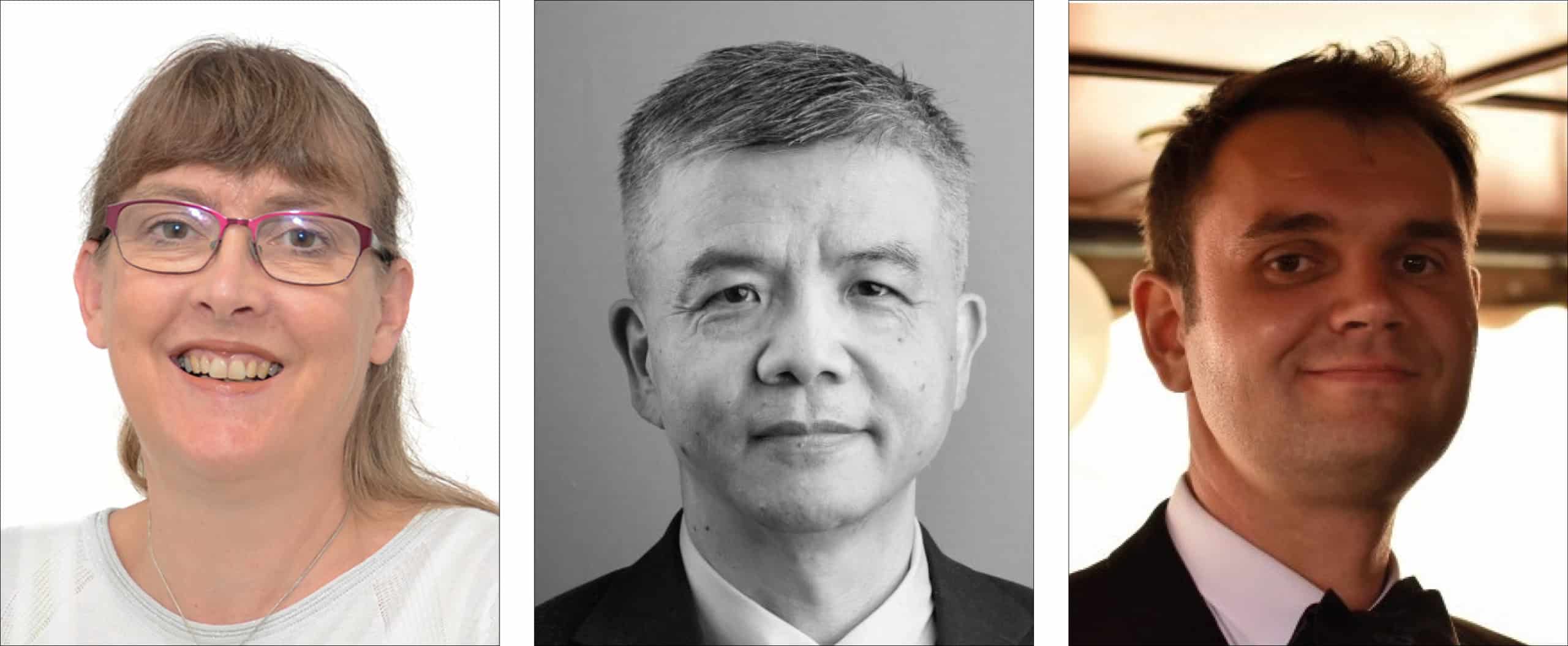
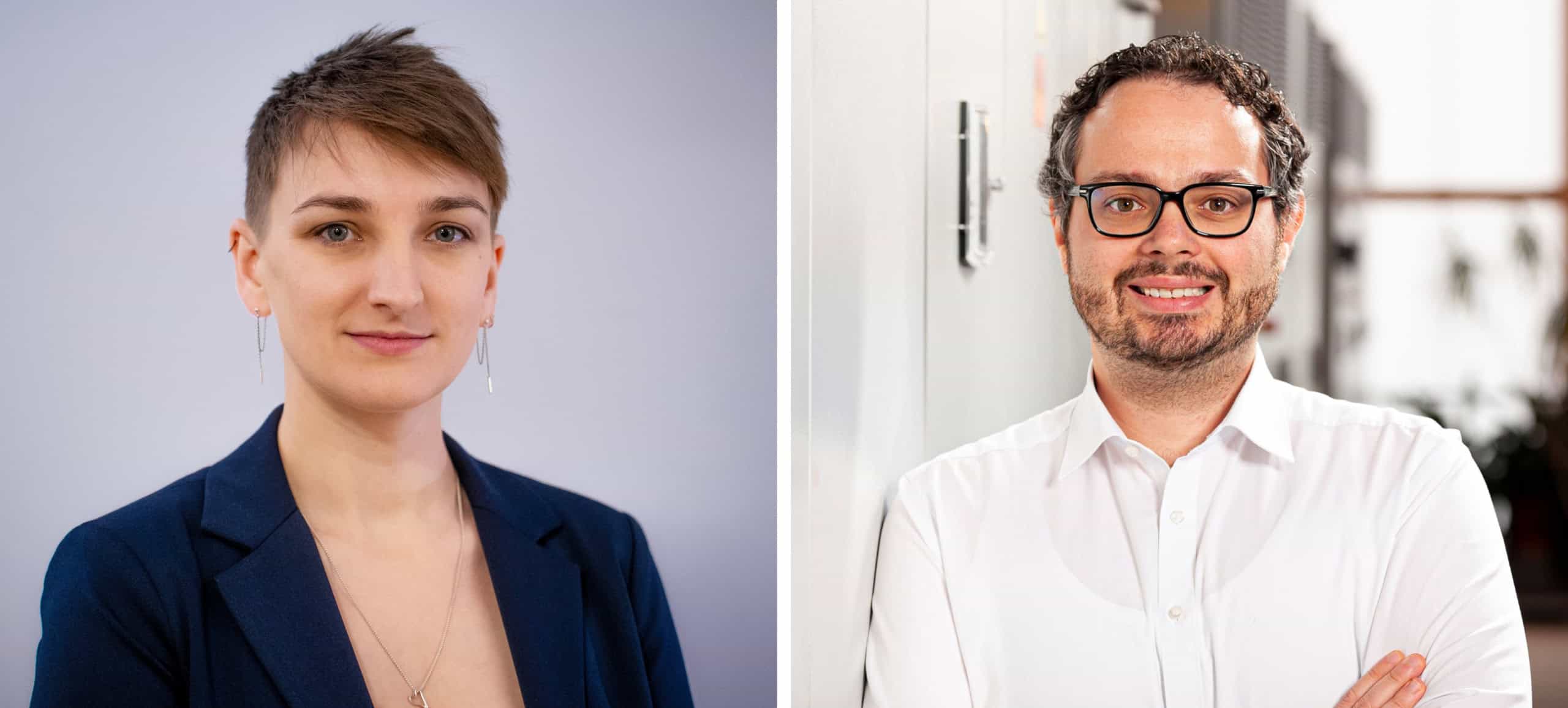
Left to right: Carol Clark, Xiaochuan Pan, Ronan Smith
Moderator
Carol Clark, Publisher,Physics in Medicine & Biology
Speakers
Xiaochuan Pan is Professor of Radiology, Radiation & Cellular Oncology, Committee in Medical Physics, the College, and the University of Chicago Medicine Comprehensive Cancer Center at The University of Chicago. His research centers on physics, algorithms, and engineering underpinning tomographic imaging and its biomedical and clinical applications. He has made pioneering, significant contributions to advanced theory and algorithms for conventional and spectral computed tomography (CT), positron emission tomography (PET), and single-photo-emission computed tomography (SPECT). He has contributed to algorithm development for digital breast tomosynthesis (DBT), digital lung tomosynthesis (DLT), magnetic resonance imaging (MRI), electron-paramagnetic resonance imaging (EPRI), phase-contrast CT, and photo-acoustic tomography (PAT). He has also developed strong translational imaging technological programs tailored to specific applications of biomedical and/or clinical significance. Xiaochuan is a Fellow of AAPM, AIMBE, IAMBE, IEEE, OSA, NAI, and SPIE.
Ronan Smith is a physicist interested in better ways of X-ray imaging. He completed his PhD at Southampton University (UK) in 2023, developing a technique called dark-field X-ray imaging, before moving to the warmer climate of Adelaide University in Australia as a grant-funded researcher in the School of Medicine. He focuses on developing and implementing imaging techniques for challenging and dynamic environments, such as the respiratory system. His current area of research is novel ways of analysing and understanding a new method for dynamic lung imaging called X-ray Velocimetry, with side projects looking at dark-field X-ray imaging.
About this journal
Physics in Medicine & Biology. The international journal of biomedical physics and engineering, published by IOP Publishing on behalf of the Institute of Physics and Engineering in Medicine (IPEM)
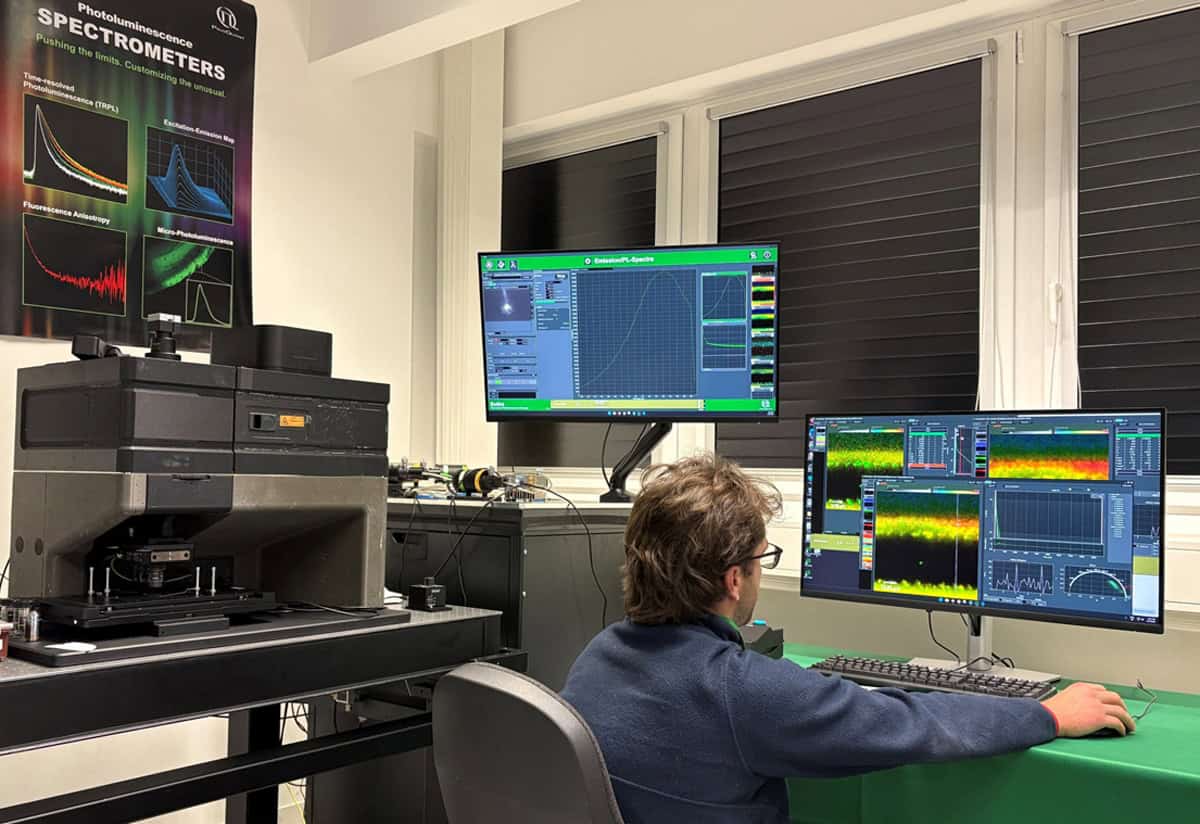
Maxim Simmonds measuring perovskite solar mini module samples with Solira. (Courtesy: PicoQuant)
When evaluating new materials for optoelectronic applications – perhaps promising solar panel materials like halide perovskites or semiconductor compounds for microLED displays – optical characterization is almost always the materials scientists’ first port of call. And up to now steady-state photoluminescence (PL) has been the de facto workhorse for this task.
This non-destructive and highly sensitive technique involves optically exciting a sample and recording the integrated intensity and wavelength of re-emitted photons. Through this, researchers gain a quick understanding into a material’s electronic structure, optical transitions and emission characteristics.
However, these spectra alone can be misleading. Materials with substantially different microscopic properties can generate similar steady-state PL results, masking the fundamental physical dynamics that govern the material’s performance in the real world. To gain deeper understanding of a given material, a more comprehensive and correlated approach is needed.
Blinding average
The core issue lies in the fact that steady-state PL provides a time-integrated view of the emission and depending on the measurement geometry, may also average over spatial variations. Steady-state PL records a static equilibrium in which charge carrier generation balances recombination. This means that, on its own, it does not directly reveal how these excited charge-carriers evolve and ultimately dictate how a device manipulates energy and light.
For example, although two semiconductor thin films may show identical steady-state emission, they can perform very differently in a real device. One film might have long carrier lifetimes consistent with low non-radiative losses – useful in solar cells, for example – while the other could suffer from high defect densities that are masked by strong light absorption or intense excitation light.
Conversely, weak emission does not necessarily mean poor material quality. Again using a layered solar cell as an example, dim luminescence often signals fast, beneficial charge extraction across an interface rather than harmful defect recombination (where structural imperfections convert charge-carrier energy into wasted heat). Because steady-state measurements only show an overall average, they cannot separate these competing mechanisms.
Resolving in time, space and spectrum
Time-resolved PL (TRPL) is a key technique in illuminating these hidden dynamics. Unlike steady-state PL, which continuously bathes a sample with light, TRPL uses a short laser pulse and measures how the photoluminescence intensity evolves afterwards. This can reveal carrier dynamics over timescales ranging from picoseconds to microseconds.
TRPL is particularly important in materials where local variations strongly influence device behaviour. For instance, it can expose the difference between regions that exhibit long-lived emission consistent with efficient radiative recombination, and those that exhibit fast decay caused by, for example, defect recombination.
Of course, steady-state PL averages over time and space, and therefore TRPL only solves part of the problem. Spatially resolved TRPL addresses the missing spatial dimension. Combining a high-precision, motorized XY stage with TRPL’s precise timing, spatially resolved TRPL forms a 2D map that directly correlates localized structural features – such as grain boundaries and defects – with variations in carrier kinetics across the surface.
Complementary to these techniques is time-resolved emission spectroscopy (TRES), which combines spectral selection with time-resolved detection to measure how emission dynamics vary across the spectrum. By recording wavelength-dependent decay behaviour, TRES reveals how different spectral contributions evolve following excitation.
In short, where TRPL reveals kinetics over time and spatially resolved TRPL locates variations in space, TRES adds a spectral dimension, showing how the emission spectrum evolves after excitation. This allows researchers to track changes in the distribution of photon energies over time to understand carrier evolution and gain insight into the mechanisms underlying material behaviour.
A correlative approach
Though powerful in isolation, reconciling insights across these different instruments is slow and prone to errors. There can be microscopic differences between samples or even within positions in a single sample that dramatically alter emission spectra. Moreover, moving a sample between separate instruments is fraught with difficulty, potentially damaging the sample or causing delays that lead to sample degradation.
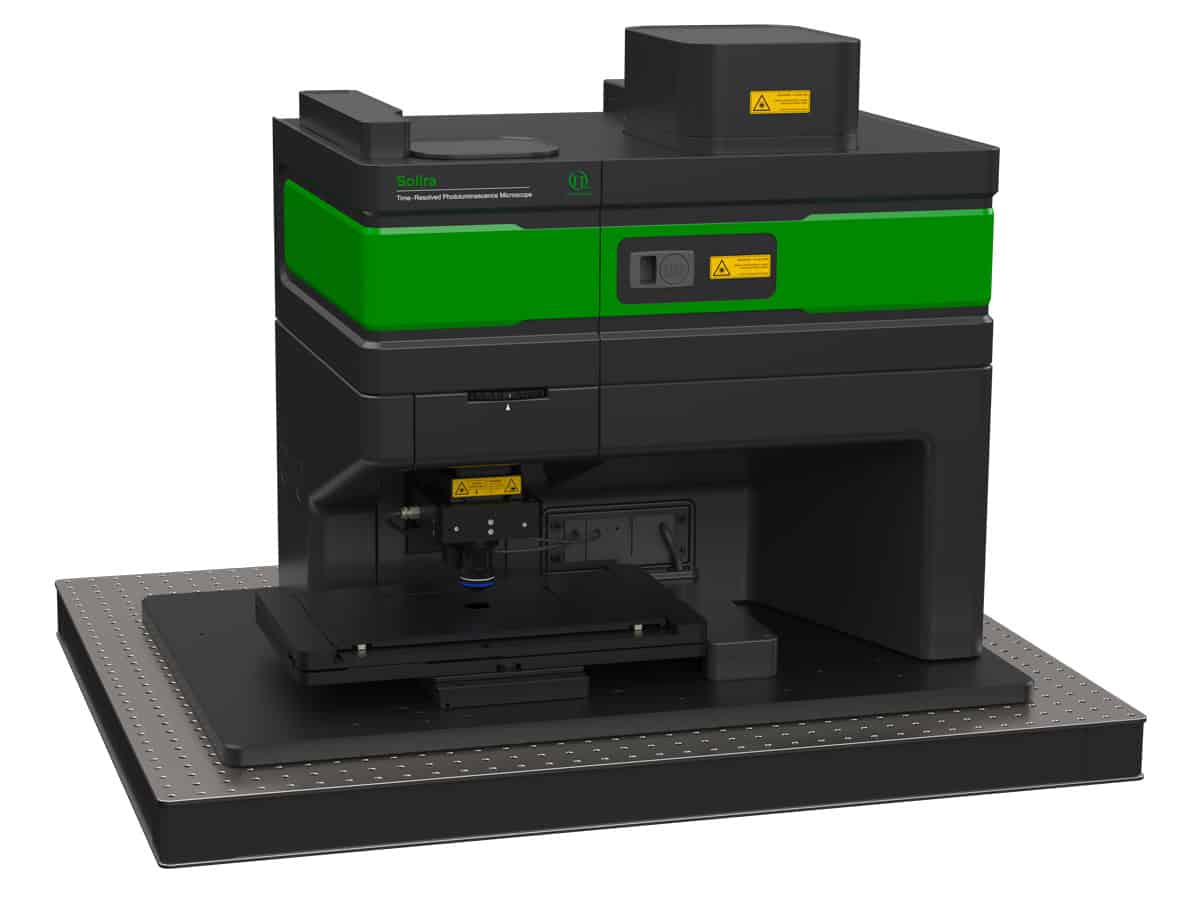
PicoQuant’s Solira, an all-in-one time-resolved photoluminescence microscope for flexible optical characterization of materials and optoelectronic devices. (Courtesy: PicoQuant)
More comprehensive and reliable physical insight comes when temporal, spatial and spectral factors are recorded correlatively on the exact same sample region. This need for correlation is the motivation behind PicoQuant’s Solira, an integrated workflow platform for steady-state PL, TRPL, spatially resolved TRPL and TRES (the latter when combined with the complementary FlexLambda Kit), as well as additional imaging techniques, such as hyperspectral imaging, required for different scientific questions.
Bringing these techniques together within one configurable microscope system means a materials scientist can gain a more informed interpretation of material behaviour. For instance, they can identify the relevant emission bands at selected points of interest with steady-state PL. They can then wield TRPL to measure the associated decay kinetics, before perhaps applying TRES to resolve how those kinetics vary across the emission spectrum.
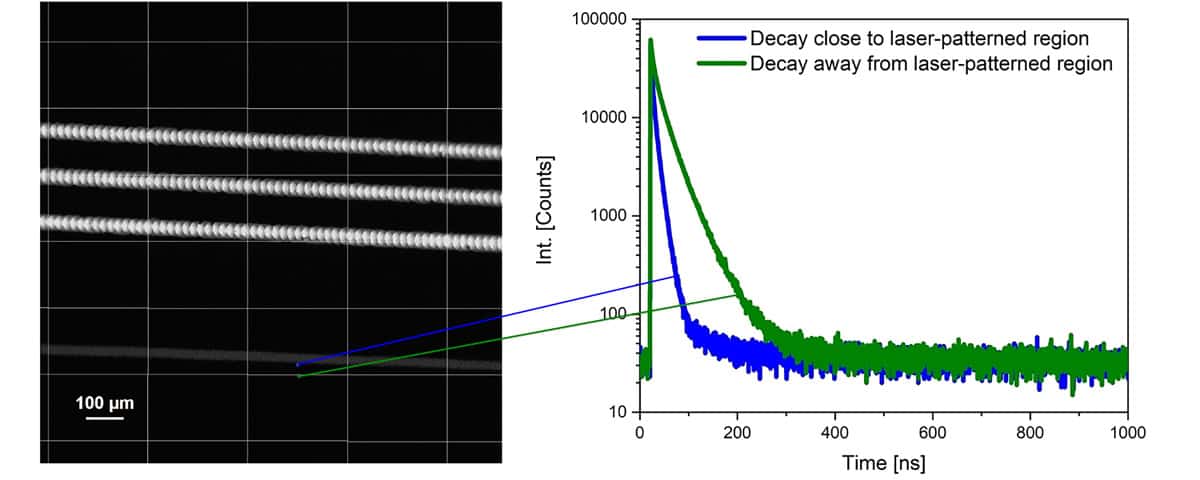
TRPL decay curves recorded at positions close to and away from a laser-patterned region of a perovskite solar mini module sample. The decay measured adjacent to the structured line exhibits faster PL decay dynamics compared to the unmodified region farther from the laser-patterned area. (Courtesy: PicoQuant)
Bright demonstration
The power of this correlated approach was demonstrated recently by Professor Eva Unger’s group at Helmholtz-Zentrum Berlin, Germany, with measurements carried out by Maxim Simmonds. Investigating perovskite solar mini-modules, the team worked with PicoQuant and used Solira to locate precise laser-patterned lines – microscopic scribes used to interconnect individual cells in a solar module – before verifying emission from the active layer. Localized TRPL measurements then revealed significantly faster decay dynamics next to these laser cuts compared to the pristine bulk material, indicating altered carrier recombination or diffusion near structured features.
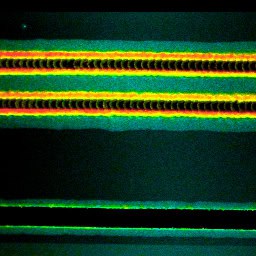
Spatially resolved TRPL image recorded from a sample of a perovskite solar mini module, showing photoluminescence lifetime differences between laser-patterned lines and bulk material. The structured regions remain photoluminescent, indicating that the laser process modifies local photophysical properties rather than completely removing the emissive material. (Courtesy: PicoQuant)
However, point measurements alone were not enough to discern whether the laser had fully removed the perovskite or merely modified it. Switching to spatially resolved TRPL imaging on Solira revealed that measurable photoluminescence persisted along the laser-patterned lines. This showed that laser structuring had altered local photophysical properties rather than eliminating the active layer – a conclusion only made possible by consistently mapping charge-carrier dynamics across temporal, spatial and spectral dimensions together on one setup.
As semiconductor materials and optoelectronic devices become more complex, optical characterization tools must keep pace. By unifying these tools within an integrated workflow platform such as Solira, materials scientists now have the means to paint a more complete picture of material characteristics and thereby unlock the next generation of innovative functional materials.
The best moment in my quantum-computing class often comes when something fails. A student writes a short quantum circuit – a program that tells qubits what operations to perform – then runs it on an ideal simulator and gets the clean answer theory predicts. Yet when the same circuit runs on real quantum hardware, unexpected results appear.
What once looked certain now becomes messy. The student may think the machine has failed but this is, in fact, when the real lesson begins. A run on a quantum processor is a physical experiment that produces a computational result.
Quantum education is expanding rapidly. A recent analysis of course catalogues from 1456 US institutions identified more than 8000 courses the titles or descriptions of w hich mentioned “quantum”. That growth is welcome, but it also carries a risk. Many students on such courses first meet quantum computing as a perfect cartoon: ideal qubits, flawless gates and clean probabilities.
Such idealization can be useful with computer simulators – ordinary software that imitates a quantum computer without real qubits. Simulators make excellent first classroom tools because they let students grasp three basic quantum ideas: superposition, where several outcomes remain possible before measurement; interference, where those possibilities strengthen or cancel one another; and entanglement, where two qubits become linked so measuring one helps predict the other.
Students should feel the shock of an imperfect result
Simulators also let students debug code and see the mathematics clearly. That matters in my classroom, because many students arrive with more confidence in Python than in quantum mechanics.
Useful as those abstractions are, they are not enough: students should learn not only the algorithm but also the machine that runs it. Real hardware exposes the gap between an ideal circuit and a physical device. A qubit is not a tiny coin showing heads and tails at once. It is a fragile physical system that gives different answers with varying probabilities when measured. Qubits lose information, gates make small mistakes, measurements misread states and nearby qubits can disturb one another.
The educational goal is to connect a quantum circuit to a real device – one in the lab, or one reached through the cloud. Yet that same circuit can behave differently after a recalibration, or after the device has “drifted”.
Students should see this as soon as possible. Teaching noise early shows students that quantum computing is an experimental science. If universities buy or rent quantum computers merely so that students can press “run”, they miss the best part of the lesson.
Intel inside
At Florida International University, this view shapes how I teach quantum computing. My students use Python, Qiskit, Jupyter notebooks, simulations and cloud quantum systems. My students have cloud access to an IonQ quantum computer that uses trapped-ion qubits, charged atoms confined by electromagnetic fields and manipulated with lasers. For now, our teaching uses cloud access to a quantum processing unit (QPU), raising a useful question: what does that access teach well, and what does it hide?
What cloud access teaches best is comparison. Students can run the same circuit on a simulator and a real QPU, then ask why the histograms – bar charts of measured output strings – differ. On platforms that expose device details, students can compare connectivity maps and calibration data such as coherence times, readout error rates and gate error rates.
Cloud systems, however, can still hide too much. A polished interface can make a QPU look like a web service rather than a delicate machine. Students may not see the lasers that control ions or atoms, the cryostat that cools a superconducting chip, the microwave electronics that drive gates, or the human work behind calibration, where engineers tune the machine to keep it reliable. Cloud access teaches students to submit and analyse circuits. Access to hardware, control settings and error data helps them understand how the processor operates.
Yet the educational value of any system depends less on qubit count than on what students can inspect, control and measure. A modest, accessible teaching platform – such as a photonic testbed that uses light to process information, a cryogenic set-up for testing devices at extremely low temperatures or a control-electronics lab that shows how signals drive qubits – can often teach more than a larger system that students cannot inspect.
Universities then should judge quantum-computing investments by learning outcomes, not headlines. Can students compare simulation and hardware? Can they test how a quantum computer changes over time by running the same circuit in the morning, afternoon and again the next day? Can they keep a notebook of circuits that worked in simulation but failed on hardware? Can they explain why one qubit pair works better than another? Can they connect algorithms to measurement, control, optics, microwaves, cryogenics and error reduction?
The experience has an emotional dimension too: a beautiful circuit on the whiteboard can become a difficult experiment on the chip. Students need to ask, “What algorithm did I write, and what physical experiment did the machine actually run?”
Students should feel the shock of an imperfect result, the frustration of a circuit that should have worked and the satisfaction of tracking down the physical cause. That experience turns quantum computing from a diagram into a craft.
A university quantum computer should be a teaching instrument that reveals the machine behind the calculation. Its purpose is to train people who can question claims, understand the hardware, and build the technology with sound judgement. The field needs graduates who understand the algorithm, the machine and the gap between them.
As wildfires and extreme heat events rage across the world, “apocalyptic” has become an increasingly common descriptor. These climate disasters are not unprecedented, however. New research suggests they may have been the main mechanisms behind the mass extinction event that killed the dinosaurs – and much other life on Earth – 66 million years ago.
Our modern understanding of this extinction dates back to 1980, when the father-and-son, physicist-and-geologist team of Luis and Walter Alvarez presented evidence that it was triggered by an asteroid strike. Subsequent work identified the Chicxulub crater in Mexico’s Yucatán Peninsula as the likely impact site, but debate has persisted – including over how a single asteroid could cause worldwide destruction.
In the latest work, Brandon and Alexandria Johnson, a husband-and-wife duo at Purdue University in the US, fit another piece into this puzzle. By combining Brandon’s research on impact cratering with Alexandria’s expertise on the behaviour of atmospheric particulates, they found that the asteroid impact sent up a near-impermeable layer of dust that smothered the entire planet. Their research, published in Journal of Geophysical Research: Biogeosciences, breathes new life into a theory that had fallen out of favour: that extreme heat and wildfires were the main killers on the day the asteroid hit.
The key to ignition
At some level, this dust layer likely produced a cooling effect, much as large volcanic eruptions do today. Indeed, a previous study showed that condensed droplets of rock known as spherules would have blocked the Sun’s radiation from entering the atmosphere.
At the Earth’s surface, however, the Johnsons think the dinosaurs had the opposite problem. The impact also sent a massive plume containing over 1000 km3 of vaporized material high into the atmosphere. When this material rained down as spherules, the dust cloud’s potential cooling effect was reversed.
“[The spherules] are essentially adding energy back to the atmosphere by travelling through it to the surface. That energy has to go somewhere,” Alexandria Johnson explains. “What we found is that this dust layer over the planet is essentially acting like a lid, and it’s keeping almost all the radiation that should try to find its way back out to space and reradiating it back down to the surface. So it’s enough to not only kill the dinosaurs but actually start widespread wildfires.”
Both researchers were surprised at just how opaque this dust layer was. By their reckoning, it trapped almost all radiation within the atmosphere, allowing a staggeringly tiny upwards transmittance of just 10-286.
“I asked [Brandon] to redo my calculation, I was like ‘make sure these numbers are right’, because this is absolutely nothing,” says Alexandria. “I expected more than what we got to be reradiated out, but the fact that it doesn’t just enhances the whole idea of the heat pulse killing things off in a very quick manner.”
Based on the Johnsons’ estimated heat fluxes, any creatures that couldn’t shelter or burrow – dinosaurs included – would have suffered temperature-induced deaths within an hour or two of the impact. The radiation was also more than enough to ignite lichens, grasses and pine needles, destroying vast amounts of plant life through wildfires.
Never-ending night
Anything that survived the heat then had to face the darkness. “You would have had darkness lasting for a long time which then can cause collapse of the food chain in the oceans and cause oceanic extinctions,” says Brandon Johnson. The dust particles were about as small as those in wildfire smoke, and they may have blocked out the Sun for as long as decades before settling into what we now see as the K-Pg boundary: a rock layer a few millimetres thick that contains high levels of iridium, identified by the Alvarezes as coming from an asteroid.
Although some previousworks suggested that the impact couldn’t have ejected enough material to trigger such large-scale effects, Brandon says his analysis of rock vaporization thresholds indicates that the plume’s mass was big enough to facilitate the transport of material across the planet’s atmosphere. Without this transport, he adds, the wreckage would have been more localized to the Chicxulub impact site.
Given the interdisciplinary nature of the field, Brandon thinks there are many ways this line of research could continue. Possibilities include investigating the geological record in more detail and combustion experiments to better understand the wildfires’ impacts. He himself is hoping to carry out 3D impact simulations which can more accurately incorporate the vaporization of rock. “Essentially, [we want] to see what happens to that vapour and see if it is going to expand and be deposited globally as we expect,” he says.
China has made astounding scientific progress over the past decade, with the country outperforming all others in the world according to a recent analysis by Nature. Based on data from 2025, its 2026 Research Leaders study puts China ahead of the US (in second), Germany (third) and the UK (fourth).
Across all disciplines, Nature reports that most (51) of the top 100 institutions in the world are in China, with only four in the UK. The picture is slightly different if you judge academic institutions based only on their work in the physical sciences, but China still has 30 of the top 100 institutions, with only seven from the UK.
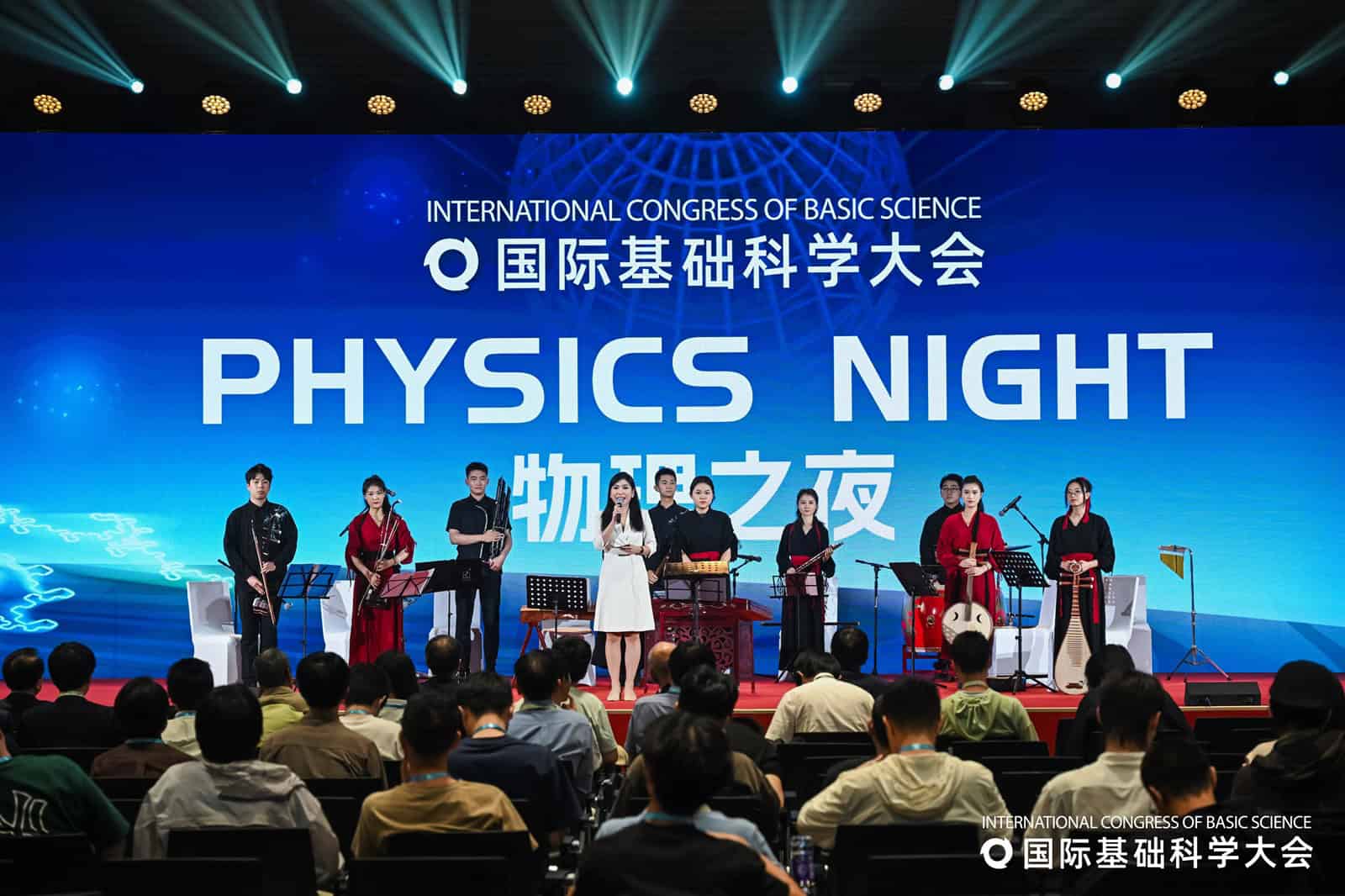
Professional physicists may not care much for such league tables but they do reveal just how far China has come in recent years. The country’s scientific strength was particularly evident at the fourth International Congress of Basic Science (ICBS) in Beijing, which I recently attended.
Founded in 2023 by the Fields-medal-winning mathematician Shing-Tung Yau, this year’s ICBS ran from 9-21 August at the Beijing Institute of Mathematical Sciences and Applications (BIMSA), of which Yau is president. Its international character is evident from the fact that a total of 50 of its 140 full-time researchers are from outside China.
Awards and honours
Over 800 participants from more than 30 countries attended the congress, which had the theme “Advancing science for humanity”, with my participation supported by the organisers. The programme was huge, featuring over 500 academic sessions covering topics from generative AI reasoning to quantum information.
Meanwhile, Frontiers of Science Awards were given to over 500 researchers from 20 countries who had done work of “excellent and of outstanding scholarly value” over the last 5-10 years in the three fields represented at the ICBS. Authors from many Chinese institutions were among the recipients, underscoring the growing international impact and vitality of China’s basic science research.
Youth focus Student nights wre held at the congress. (Courtesy: ICBS)
There were 20 plenary sessions, over 400 Frontiers of Science Awardee talks, plus events for entrepreneurs and school and university students. Especially engaging were the “nights of mathematics, physics and engineering”, enlivened by dance amd music performances by students. An exchange meeting was held too for research institutions in Beijing seeking to integrate basic science with frontier technologies
The closing ceremony saw the winners of this year’s ICBS Innovation Fellowships announced. They are all researchers under 50 who work full-time in China and have demonstrated potential in mathematics, physics, information sciences, and other fundamental and interdisciplinary fields. Each receives research funding and can work with a partner institution in China for an agreed period.
AI surges ahead
Artificial intelligence (AI) was one of the major themes of ICBS 2026. Fields medallist Martin Hairer from EPFL Lausanne, for example, said AI won’t end mathematics, but will transform how it’s carried out. It may speed up certain areas while others might fall away.
Caucher Birkar from Tsinghua University – another Fields medallist – pointed out that AI is highly capable in computation, searching for examples, and completing proofs of mathematical lemmas, but it remains difficult for AI to generate truly original ideas.
As for Robert Endre Tarjan, a Turing award laureate from Princeton University, he encouraged young researchers to be curious and commit themselves to long-term scientific exploration. Researchers, he said, can train AI to be a powerful tool for scientific discovery, but they must also develop their own ability to identify meaningful questions and establish independent judgment.
The last word was left to congress chair Shing-Tung Yau, who emphasised that while AI will enhance scientific research, the essence of scientific discovery will always depend on human creativity, imagination and independent thinking.
As audiences poured out of London’s Old Vic theatre on a crisp night in January, one theatregoer and their companion were overheard chatting about the second law of thermodynamics. “I wish I knew more about what they were discussing,” one remarked, referring to the characters in Tom Stoppard’s Arcadia. “It’s an unusual play,” the other responded.
Was this curiosity about thermodynamics a sign of confusion, that the production had failed to communicate its ideas clearly for a lay audience? Or had the evening in the theatre inspired a desire for these audience members to dig deeper and learn more about physics through the shared experience of watching a play?
Written in 1993, Arcadia is an early example of an ever-growing number of plays that have at their heart scientific ideas or scientists themselves. Newtonian determinism, chaos and iterated algorithms all crop up in Stoppard’s masterpiece, but Arcadia is a play about much more than just physics or mathematics.
With scenes alternating between a country house in the early 19th century and the present day, Arcadia is also a literary mystery about the poetry of Byron set against academic rivalry. Like all of Stoppard’s work, it’s an agile, clever and entertaining tour de force of ideas, led by characters who are just as concerned with traditional dramatic themes including love, jealousy and flawed ambition.
The Old Vic’s Arcadia was sufficiently popular with audiences that it received a transfer to London’s West End for an extended run in summer 2026. But it was not the only major revival of a classic “science play” in London this year, with Hampstead Theatre staging a new production of Michael Frayn’s Copenhagen.
Arguably no other play about physics has been as popular and successful as Copenhagen since it was first produced at the National Theatre in London 1998. It imagines what might have been discussed when Werner Heisenberg visited Niels Bohr at his home in the Danish capital during the Second World War. It also explores the implications of the meeting for the development of nuclear weapons.
Plays depicting physics or physicists fall into three main types. Some are straightforward biographical representations of physicists – from Lise Meitner to Stephen Hawking. Others focus on the process of “doing” physics. A third kind uses scientific concepts to structure the play itself. Copenhagen is perhaps unique in achieving all these feats at once.
Curtains up
The representation of scientists on stage is not a new phenomenon. The ambitious alchemist and natural philosopher Doctor Faustus, who sold his soul to the devil in Christopher Marlowe’s 16th-century play of the same name, is one early example of a learned character who could be considered a scientist seeking worldly knowledge at a cost.
Strange encounter The Devil and Doctor Faustus Meet is an 1825 illustration of the play Doctor Faustus by Christopher Marlowe, which was one of the earliest stage shows to feature scientific ideas. (Source: Wellcome Collection)
Later, in 1823, there was a highly popular stage adaption of Mary Shelley’s novel Frankenstein. Performed at the English Opera House in London, Presumption; or, the Fate of Frankenstein by Richard Brinsley Peake was what first brought Shelley’s book to public prominence, reigniting suspicions of the motivations of scientists as a potential force for good or evil.
While Frankenstein led the way in the genre of science fiction, which I will not cover here, the notion of the “physics play”, where physics or physicists feature deeply, can be more readily traced to the 20th century. Bertolt Brecht’s A Life of Galileo, written in 1938, is perhaps one of the first clear examples to represent the life and work of a real scientist on stage.
First performed in German in Zurich in 1943, ALife of Galileo presents the audience with an account of a scientist whose life is well documented in the historical record. It depicts scenes from Galileo’s life including his prosecution for heresy by the church for promoting the heliocentric universe.
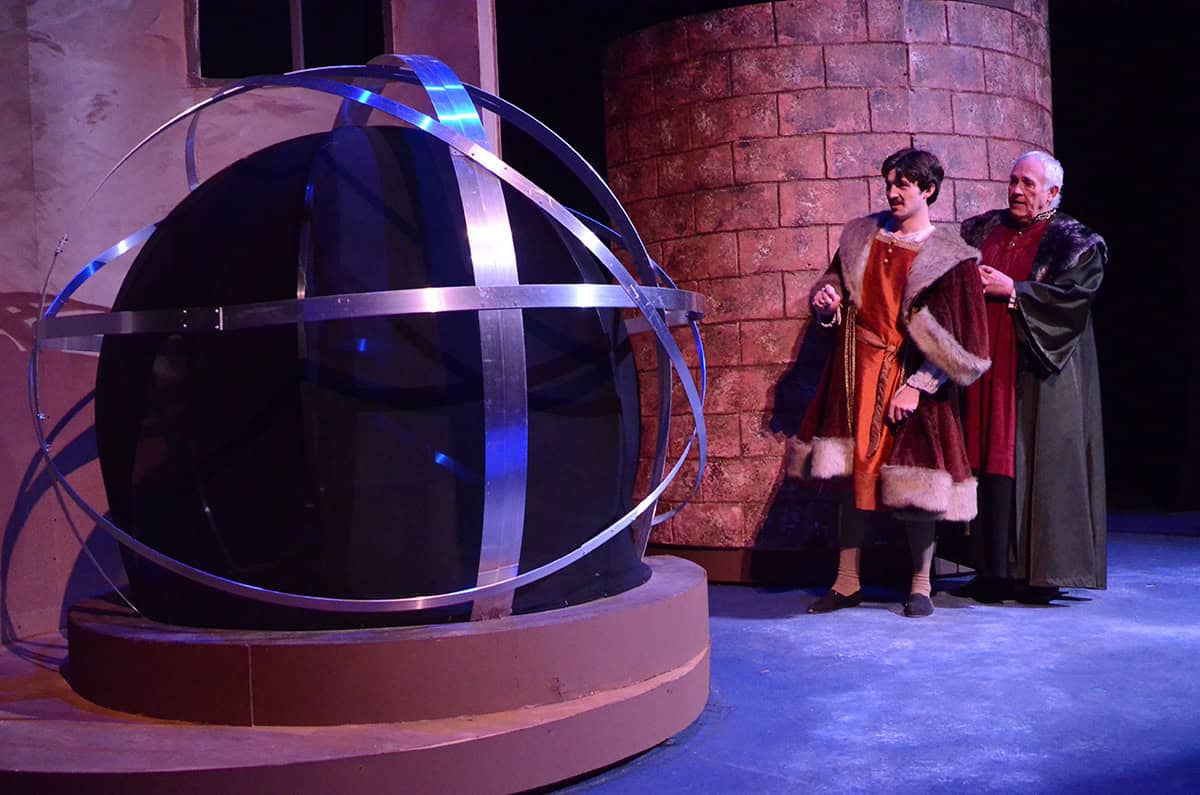
Astronomy in action Dava Sobel’s play And the Sun Stood Still was produced in 2014 by Boulder Ensemble Theatre Company, starring Benjamin Bonenfant (left) as mathematician Georg Rheticus and Jim Hunt (right) as Nicolaus Copernicus. (Photograph by Michael Ensminger. Used with permission)
Since then we’ve seen plenty of other plays about real-life physicists. Also dealing with the heliocentric solar system is acclaimed science writer Dava Sobel’s short 2011 play And the Sun Stood Still (first published in her book A More Perfect Heaven). It concerns an episode in the life of Nicolaus Copernicus, depicting his discussions with mathematician Georg Rheticus when he visited Poland in 1539.
The period of scientific advancement that followed in the 17th century is represented in a number of plays depicting the life of Isaac Newton. A notable example is Craig Baxter’s Let Newton Be!, a verbatim play based on Newton’s own words that was written to celebrate the University of Cambridge’s 800th anniversary in 2009.
It was performed by Menagerie Theatre Company for the first time in 2009 at Trinity College, Cambridge, where Newton had once been a fellow. Three actors simultaneously portray Newton at different points in his life, from boyhood to establishment figure, continually interacting with each other on stage. Baxter aims to give a less conventional perspective on Newton’s life than the usual image of a scientist beneath an apple tree.
Historical heroes Left: Let Newton Be! by Craig Baxter was toured from 2009 to 2011 by Menagerie Theatre Company with a cast that included David Meyer as Isaac Newton in later life. (Courtesy: Menagerie Theatre Company/Jaimie Gramston). Right: Siobhán Nicholas’ play Hanging Hooke, toured by Take the Space from 2008 onwards, starred Chris Barnes as Newton’s scientific rival Robert Hooke. (Photographer Ken Goodson, copyright Take the Space Theatre Company Ltd)
Newton’s contemporary and arch enemy Robert Hooke was also memorably represented by the actor Chris Barnes in Siobhán Nicholas’ 2008 one-man play Hanging Hooke. It was toured by Take the Space theatre company, which Barnes co-founded, to venues across the UK, including a performance at the Royal Society itself.
In a follow-up to Hanging Hooke, Take the Space also represented the contributions to astronomy of Caroline Herschel in the 18th and 19th centuries. Her work, which is arguably less well known than that of her brother William Herschel, appeared in STELLA: a Story of Women, Their Men and Astronomy, also written by Nicholas.
Centre stage
Some episodes in the history of physics are more thoroughly documented then others, lending rich source material for drama. Such is the case in Katherine Moar’s play Farm Hall about the German physicists who were famously held captive in a country house in Cambridgeshire, UK, at the end of the Second World War.
The play features six characters, all of them real scientists, including Heisenberg, Kurt Diebner and the pioneering radiochemist Otto Hahn. Their words were secretly recorded by their British military captors in 1945 in an attempt to find out how close, if at all, the German scientists were to developing a nuclear bomb.
Ethical matter Physicists’ involvement in nuclear weapons has been a rich source of material on the stage, including this 2023 production of Farm Hall by Katherine Moar, at the Jermyn Street Theatre in London. It included Archie Backhouse (left) as Erich Bagge, Forbes Masson (centre) as Otto Hahn and Alan Cox (right) as Werner Heisenberg, who were among six German physicists held captive by the British military after the Second World War to uncover their role, if any, in Germany’s attempt to build nuclear weapons. (Photograph by Alex Brenner. Used with permission)
Moar’s play is one of several that use the Farm Hall transcripts as the basis of a play text, another being Operation Epsilon by US playwright Alan Brody. Originally written in 2013, it received its British premier at the Southwark Playhouse in London in 2023, and examines the ethics of those involved in nuclear weapons programmes.
That theme was also tackled in Christopher Nolan’s blockbuster movie Oppenheimer, which was one of the biggest film successes of recent years. However, J Robert Oppenheimer has been represented on stage too, not least in Tom Morton-Smith’s 2015 play Oppenheimer, in which key figures in the Manhattan nuclear-bomb project were re-enacted in a large-scale production at the Royal Shakespeare Company (RSC). Morton-Smith’s play aimed to capture the scale and scope of a so-called Shakespearean “history play”, with a significant but flawed character at its heart, although this is arguably a tough feat to achieve.
Dramatis personae
In each of the examples above, the physicists portrayed are real people, whose names and work will be familiar from textbooks and the historical record. Other physicists to have been the subject of plays include Jocelyn Bell Burnell, Ludwig Boltzman and Wolfgang Pauli, while Nicole Kidman played DNA-structure pioneer Rosalind Franklin in Anna Ziegler’s Photograph 51.
Physicists as fictional characters and the act of doing physics are also increasingly being represented on stage, with collaboration in big-science projects becoming central
However, physicists as fictional characters and the act of doing physics are also increasingly being represented on stage, with collaboration in big-science projects becoming central. Especially fruitful as source material have been activities at CERN and particularly the Large Hadron Collider (LHC), which gained growing public awareness during the hunt for the Higgs boson in the first two decades of the 21st century.
Playwright Lucy Kirkwood had already published a play with nuclear scientists as characters in The Children in 2016 (currently playing at Lyric Hammersmith). But it was her play Mosquitoes, produced at the National Theatre in 2017, that centred on scientific themes. Many scenes are set at the LHC and its central character, Alice, is a research physicist based in Geneva who has a complex relationship with her sister, Jenny.
Colliding characters Mosquitoes by Lucy Kirkwood, performed at the National Theatre in 2017, starred Olivia Williams (right) as a physicist working at CERN, and Olivia Colman (left) as her sister. (Courtesy: Brinkhoff & Mogenburg)
The play’s depiction of the two sisters centralizes the process of collaboration that is key to large-scale science research. Olivia Colman and Olivia Williams played the main characters in Mosquitoes in the National Theatre production, which benefited from some funding from the Institute of Physics, which publishes Physics World.
On a smaller scale to Mosquitoes, but also set in the periphery of CERN, is Morton-Smith’s one act play The Earthworks. Set on the eve of the switch on of the LHC, it features two strangers – a journalist and a physicist – who meet in a hotel bar in Geneva and talk about their loves and fears.
The anticipation and magnitude of the imminent new experiment gives the two characters cause to reevaluate their own lives and relationships. Although not widely produced, The Earthworks is an engaging short drama that again normalizes the process of big science in the wider cultural context through theatre.
Structured text
Featuring a physicist as a main character is also key to Constellations by Nick Payne, a playwright who has often included scientific ideas in his work. First performed in 2012 at the Royal Court Theatre, it features a physicist and beekeeper who meet at a picnic and begin a series of scenes replayed over and over again.
Unlike straightforward biographical-style plays, Constellations is a great example of a play that uses a scientific principle as a metaphorical device to help shape the play itself. Its structure is essentially inspired by the “multiverse” interpretation of physics, which implies there may be a potentially infinite number of copies of ourselves in different worlds.
The many iterations of similar scenes in Constellations make it a challenging production for actors – although not necessarily for audiences, provided the acting is good. And having only two characters on stage proved handy during the COVID-19 pandemic, when strict social-distancing rules meant it was helpful to have such a small cast.
In fact, when Constellations was revived in 2021 at the Vaudeville Theatre in London, different pairs of celebrity actors were used in different performances. Pairings included Peter Capaldi with Zoë Wanamaker, and Omari Douglas with Russell Tovey.
Two’s company Constellations by Nick Payne is a two-hander with multiverse themes. In 2021 it was produced at the Vaudeville Theatre with several different casts. Clockwise from top left: Chris O’Dowd and Anna Maxwell Martin; Peter Capaldi and Zoë Wanamaker; Omari Douglas and Russell Tovey; Sheila Atim and Ivanno Jeremiah. (Photographs by Marc Brenner. Used with permission)
“I loved staging Constellations,” says the theatre director Michael Longhurst, who originally worked with Payne on the play. “When a writer does that work to understand the science for us lay audience members and then puts them into a human context in a dramatic setting, then I think there is a real gift.”
Incorporating physics into the structure of a play has also been tackled more than once by Tom Stoppard, who died last year. In Hapgood, his attempt at a spy thriller, quantum physics plays a role in structuring the play by experimenting with quantum uncertainty as a plot device. First performed in 1988, the complexity of the plot proved confusing for audiences and, although revived subsequently, it was one of Stoppard’s less successful plays.
The bewildering twists and turns of Hapgood are in strong contrast to Arcadia, which has proved a far more popular science-themed play from the great playwright. It toys with ideas of determinism and iterated algorithms in a rich drama.
Like many Stoppard plays, audiences appreciate the playfulness of ideas but can at times feel alienated by the complexity of the discourse. Nonetheless, Arcadia is a hugely significant play when it comes to science in theatre and its recent success at the Old Vic and subsequent West End transfer over 33 years later is evidence of its endurance.
It’s worth noting, however, the existence of several plays that appear to have a strong physics connection – but in fact have very little at all. Notable examples include Friedrich Dürrenmatt’s 1962 play The Physicists (which was more of a satire) and Simon Stephens’ 2015 play Heisenberg: the Uncertainty Principle. Stephens was perhaps capitalizing on a growing public awareness of “uncertainty”.
Copenhagen: the definitive physics play
Conversely, you could be forgiven for thinking that a play called Copenhagen would be largely about the Danish city. But Frayn’s drama is one of the most significant examples of a play about and featuring physicists. With just three actors on stage and minimal set or plot, it is perhaps a surprise that Copenhagen could capture the attention of theatre goers for over two hours.
However, the text is a richly researched and thought-provoking drama that successfully achieves several things at once. First, it is a faithful account of the lives and work of Bohr and Heisenberg, insofar as we can know these two Nobel-prize-winning physicists, provoking historically meaningful questions.
Second, it gives an audience a sense of the excitement, frustration and invigoration of the act of doing science through the reminiscences and insights of its characters reflecting on the heyday of the development of quantum theory.
Stars of the stage Michael Frayn’s Copenhagen, which is perhaps the archetypal physics play, was revived in 2026 at Hampstead Theatre. It starred Richard Schiff (left) as Niels Bohr, Damion Molony (centre) as Werner Heisenberg and Alex Kingston as Margrethe Bohr. (Photograph by Marc Brenner. Used with permission)
Third, it successfully embeds concepts of uncertainty and complementarity within the text and structure of the play itself – in a way that other writers have fallen short of achieving. Copenhagen perhaps stands out among all other plays that deal with physics as achieving all three of these things at once, accounting for some of its enduring appeal, not least to physicists.
In a conversation with Physics World earlier this year, Frayn admitted that physicists hadn’t held back in pointing out mistakes. “Some of the physicists who have seen Copenhagen have taken the trouble to write to me and to point out errors I had made in the science, in spite of all my efforts,” he says. “I have as a result made a number of corrections in succeeding productions over the years. I am very grateful to them.”
Copenhagen tackles the historical and moral dimensions of nuclear weapons in a way that is as relevant today as when it was written
The care with which Frayn researched and adapted Copenhagen enables it to tackle the historical and moral dimensions of the development of nuclear weapons in a way that has made it as relevant today as when it was written. The production at Hampstead Theatre in spring 2026 was the latest in a long line of revivals of the play around the world since its first critical and popular success in 1998. In addition to Howard Davies’ 2002 film version, Emma Harding adapted Copenhagen for radio in 2013, featuring Simon Russell Beale, Benedict Cumberbatch and Greta Scacchi.
Curtains down
So were the Old Vic theatregoers wandering down the street after seeing Arcadia enthused or confused by their encounter with thermodynamics in the theatre? Should we celebrate or be sceptical of plays that put physics at their core? There is arguably no reason why physics should have a place in theatre any more or less than any other aspect of human endeavour.
However, as the importance of science becomes more embedded as an essential part of our culture in general, the role for physics in the theatre continues to grow. Current writers such as Moar and Kirkwood will continue to build on the achievements of the old guard such as Frayn and Stoppard, whether that be representing the history of physics, portraying physicists as characters or using science within the structure of a play.
In the rarest of cases all three can be achieved at once and it is intriguing to wonder how long it will be until another play comes along to match the might of Copenhagen as the definitive physics play.
What do you think? What makes a good physics play and what’s your favourite production? Let us know by e-mailing pwld@ioppublishing.org
Whether it’s cosmology, quantum mechanics or particle theory, most of us go into physics because we’re fascinated by the universe and its mysteries – and not because of the career options it might lead to. In fact, by the time you’re at university, you’re so snowed under with lectures, labs, coursework and tutorials – not to mention having fun – that there’s almost no time to think about what to do after graduating.
It doesn’t help either that most university staff are only familiar with careers in research, and so aren’t the best career mentors for physics students exploring the many options outside academia. That’s why Physics World has published countless careers articles over the years looking at what physicists do after they graduate – not just in research but also in industry, finance, teaching, IT and engineering. Each year we also gather many of these into our annual Physics World Careersguide – which includes a directory of employers seeking physics graduates.
But when the time comes to look for a job or plan your next steps, you won’t want to plough through every guide we’ve published. So to help you through the maze of options, this article brings together all our tips, information and help in one place. In today’s tough job market, a physics degree is an absolutely fantastic thing to have, giving you a deep technical knowledge and an ability to think rigorously. But before even starting to apply for jobs or courses, you first need to sit down and think hard about what it is that makes you happy and fulfilled in life.
Stop and think
As Crystal Bailey from the American Physical Society advised in a 2025 Physics World Live discussion “Not sure what to do with your physics degree? Our expert panel give their careers advice”, first ask yourself what it is you want for your career and your life. Do you prefer theoretical questions or practical problems? Do you like working alone or with people? Do you want a good work–life balance, a flexible schedule or just to make pots of money? “You need to understand what will be a good match for you,” she advises.
We suggest you do this kind of self-reflection long before you expect to graduate – don’t leave it to the last minute when you’re short of time. It also helps to make an audit of all the “soft skills” you have as a physicist, of which there are 16 different kinds. From being able to manage your time, knowing how to communicate or sort out conflict, these attributes are just as important to employers as your technical prowess.
Think for a minute Before even starting to apply for jobs, first reflect on what it is you want from life. (Courtesy: iStock/Layla Bird)
The “hard” skills you gained while studying – such as knowing how to solve a differential equation or line up mirrors on an optics bench – are easy to provide evidence for, from the modules you took, or the lab work you did. But the other more nuanced and practical skills – such as presenting in front of your peers, writing reports or keeping to deadlines – are just as crucial.
While you’re still at university, it also helps to take advantage of the huge amount of talented people you’re surrounded by – or as Katie Perry, a physicist who works at the Daphne Jackson Trust, once put it, “network like crazy”. Scientific meetings, talks and conferences are a great place to do this, where our tip is to devise an “elevator pitch” – a short and pithy statement of who you are. If someone asks you about yourself, you can then confidently reel off a few well-considered words.
Networking doesn’t necessarily come easy so if you find it awkward, you just need to get out there and practise. As science communicator Claire Malone believes, networking doesn’t have to be scary and something that only super confident people excel at. Learn to ask questions, be a good listener, take an interest in other people – and remember to ask for their business card so you can contact them later.
And our final piece of advice before even brushing up your CV or creating a LinkedIn page is to get a sense of the current job market for physics. It always goes through ups and downs, with the rise of artificial intelligence (AI) causing huge uncertainty right now. But overall there are some constant characteristics to the physics jobs market, as you can find out in a 2023 Institute of Physics report, which is packed with information about the UK physics jobs market by size, location and salary.
From reflection to action
So now you’ve done all that self-reflection, analysed the job market, audited your soft skills, and had a go at networking, it’s time to start applying for things to do after you graduate.
A number of you might be considering a PhD and, if so, we have some specific advice just for you (see “The PhD pathway” box below). But more than half of today’s graduates move into the private sector and pursue industry careers instead. If that’s your target, plan ahead by spending a summer interning at a company and try to find the right mentor for you. It’s also a good idea to do some extracurricular activities beyond your core academic aims, which will help you develop a range of transferable skills that can help you switch into a different area beyond physics.
The PhD pathway
(Courtesy: iStock/elenabs)
For graduates who choose to remain in academia, and have found a PhD position, resilience and critical thinking are key skills to have. While it can be exciting and fulfilling to do your own research for the first time, completing a PhD is challenging. Most people have tough moments during a PhD, but people don’t often share their difficulties and it’s easy to think you’re the only one struggling.
Once you have completed all your research and gathered your data, the final step is to write your thesis – which can be a particularly stressful task, so its important to find different ways to motivate yourself and complete that final hurdle. Even if you don’t stay in academia, a PhD will teach you a lot about how to get ahead under your own steam and complete a major piece of work on your own.
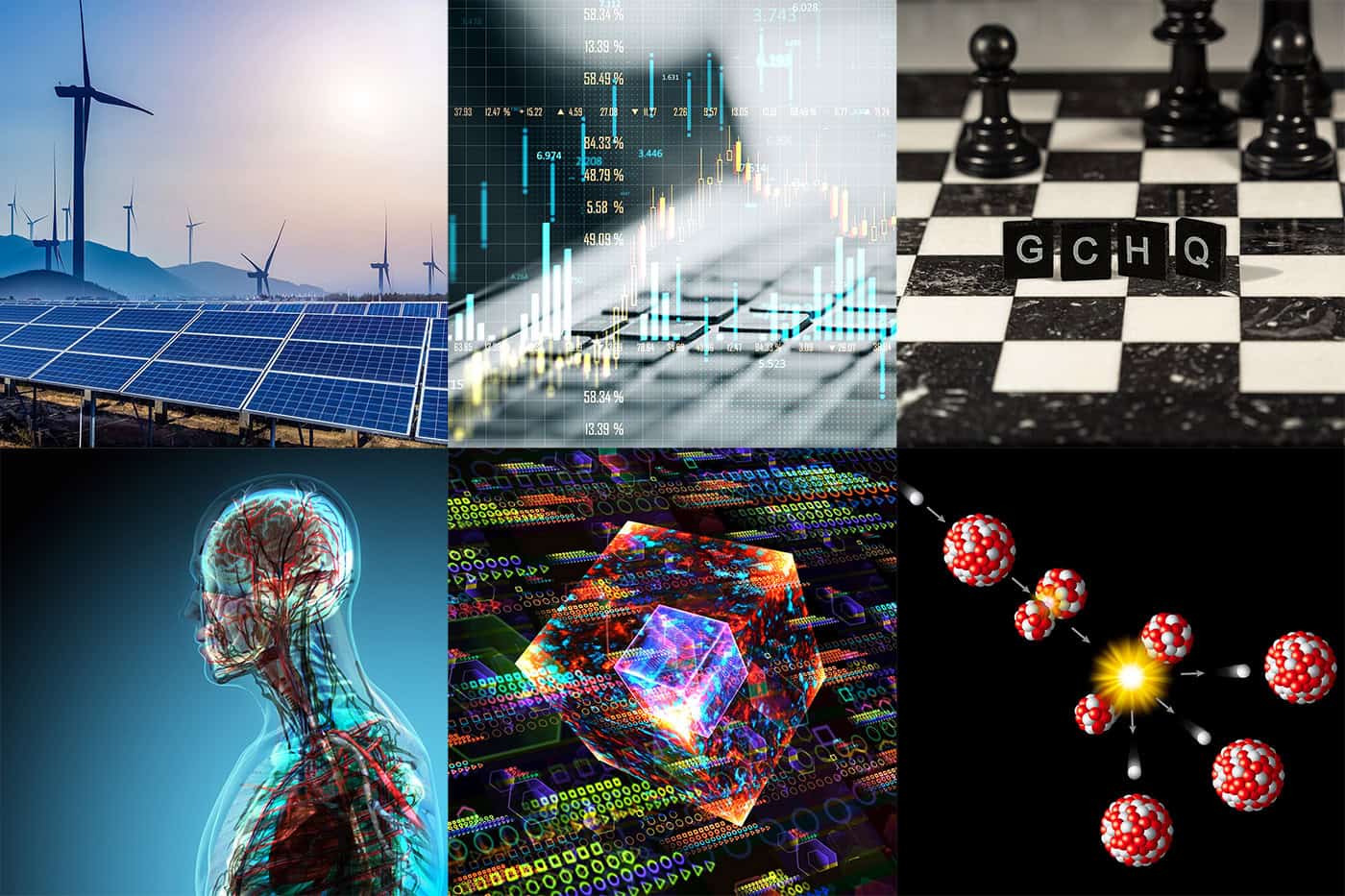
Take your pick From medical physics to green energy, and everything in between; your physics degree offers you many options. (Top row: Shutterstock/hrui; iStock/peshkov; Shutterstock/shaneinsweden. Bottom row: Shutterstock/Yevhen Vitte; iStock/chayanan; iStock/Peter Hermes Furian)
Green energy and sustainability: Physics graduates are ideally placed to tackle the world’s environmental challenges, with their technical knowledge and problem-solving skills. You can find out more about the physicists who are doing their bit to build a greener, more sustainable future in the field of decarbonizing energy sources.
Quantitative finance: With strong mathematical and analytic skills, physicists are a great fit for the financial world, and are often in high demand in quantitative finance in particular. Meet five physicists who pivoted to a career in finance, and explore what physics skills they use day to day.
Intelligence and cyber security: If a challenging but rewarding career is what you are looking for, you may want to consider a role in security. Here you can find out more about the careers of two leaders from GCHQ – the UK’s intelligence, security and cyber agency – with a background in physics.
Medical physics: Medical physicists have a wide variety of roles across academia and industry. From clinical research and medical imaging to computational simulations and testing new scanners, many job options for medical physicists around the world are included here.
Nuclear energy: With the push away from fossil fuels, there is a shortage of skills in the nuclear power sector. Here we speak to six physicists working across the nuclear energy industry – from design and construction, to safety and waste and beyond – highlighting how a background in physics can open many doors in this expanding sector.
The overall picture for all of you graduating with a degree in physics is positive. Physicists all over the world are keen to help solve some of humanity’s biggest challenges and help further our understanding of the universe at large. We hope that all of the resources above – alongside the annual Physics World Careers guide, the Physics World Jobs Hub and the Physics World LinkedIn page – will give you the headstart you need in planning your path and building a fulfilling career.
You can sign up to our bi-monthly careers newsletter from your account area on Physics World. Just click on My Alerts and tick the box to start receiving it
Packed with physics This photo montage of the 12 August 2026 solar eclipse as seen from the Isle of Wight, UK, holds a surprising amount of science. (Courtesy: Sean Ryan)
The UK’s hot, dry summer provided widespread clear skies for the solar eclipse that took place on Wednesday 12 August 2026. It was not a total eclipse – you had to be in northern Spain for that – but Britain still enjoyed a partial eclipse between around 6 p.m. and 8 p.m. BST, depending on location.
With typically more than 90% of the Sun’s disc covered – and with the event occurring after many people had finished work – the circumstances were ideal for a rare, immersive mass-engagement with physics.
Many people had got hold of eclipse glasses in advance or searched through kitchen cupboards for a colander to produce shadow patterns
Widespread public-awareness raising by professional and amateur astronomical societies had led to a strong build-up to the event in mainstream and social media. As a result, much of the public was aware the eclipse was coming, and many people had got hold of eclipse glasses in advance or, failing that, searched through kitchen cupboards for a colander to produce shadow patterns.
Here in the UK, friends and families gathered on west-facing hills, parks and village greens that evening with folding chairs, smartphones, cameras, telescopes and colanders, to enjoy the spectacle over a picnic tea. In built-up areas of towns and cities, many sought out west-facing windows of homes and offices.
I’m an old-school visual observer and recorded the eclipse sequence using 20-year-old equipment
While the eclipse on the UK mainland was deepest in Cornwall, I took my chances on the Isle of Wight, just off the coast of southern England.
Amateur astrophotography has been revolutionized over the last few years thanks to specialized high-sensitivity astronomical CMOS cameras, but I’m an old-school visual observer and recorded the eclipse sequence using 20-year-old equipment.
The montage presented here contains 36 frames spanning the entire eclipse sequence and packs in a wealth of physics. Besides the obvious relative motion of the Earth, Moon and Sun, three sunspot groups are visible, approximately delineating the solar equator; the camera was aligned with the sunspot groups and the equatorial mount maintained this orientation.
The Moon’s sharp-edged silhouette is a reminder that it has no atmosphere, whereas the Sun is brighter in the centre than the edge. Known as “limb-darkening”, it arises because of the temperature gradient of the tenuous solar photosphere – and is a reminder that the perceived edge of the Sun is merely a wavelength-dependent opacity transition.
While we often describe the Sun as yellow, the transmission profile with the OD5 solar filter that I used here gives it a slightly silvery-blue tinge. But as the Sun sank lower in the sky during the evening, wavelength-dependent extinction and scattering reddened the light, so the silvery disc progressively turns distinctly yellow and then orange.
Along with the colour change, the solar disc takes on an oblate form in the final row of frames due to differential atmospheric refraction close to the horizon. Terrestrial clouds close to the local horizon are seen in the final frame.
For many people viewing an eclipse for the first time, talk of intersecting orbital planes is perhaps already too much physics for one evening, but for those who wish to look a little deeper, more questions – and more physics – pop up the closer you look. What have you spotted in the montage that I haven’t?
The technical stuff
I took these images using a portable 90 mm diameter Maksutov-Cassegrain telescope (a Meade ETX-90) on an equatorial mount with a battery-powered drive, a full-aperture glass OD5 solar filter, and a 25 mm focal-length eyepiece paired in eyepiece-projection mode with a 5 megapixel Sony Cyber-shot CCD digital camera.
The camera was set for manual operation: minimum ISO (100), minimum aperture (f/5.6), fixed focus (achieved at f/2.8), and manually adjusted exposure time (1/400 – 1/13 s). Image processing was minimal, conducted using ImageJ software, which is widely used in biomedical imaging.
Shadowing of the sensor by dust on the lens surfaces was partially corrected by dividing through by a normalized clear-sky exposure. Frames were cropped manually and re-scaled in intensity to compensate for increasing atmospheric absorption as the Sun sank towards the horizon, and for changes of exposure duration.
For particle physicists, bigger has always been better. The first working cyclotron, which was built by Ernest Lawrence in California in 1931, was little more than 35 cm in circumference and accelerated protons to 80 keV. Compare that with CERN’s Large Hadron Collider (LHC), which is more than 27 km long and has been creating protons with energies of 7 TeV per beam – some eight orders of magnitude higher.
Only recently, though, have the burgeoning energy requirements of ever-larger accelerator facilities become a cause for concern. It was not until 2020 that CERN published its first-ever environmental report, which outlined to the public how the lab was reducing its energy consumption. Thanks to innovations in cryogenics, for example, CERN reported that the “data per joule” doubled between the LHC’s first and second experimental runs.
All good and well. Yet while their core mission of fundamental scientific discovery remains paramount, it’s clear that – if nothing changes – the environmental impact of new and upgraded accelerator complexes will track in tandem with the size, energy footprint and resource consumption of these large-scale research facilities.
The numbers are eye-watering. Particle-accelerator research centres currently consume hundreds of gigawatt-hours (GWh) of electricity per year – roughly the energy budget of a mid-sized European city. CERN’s unique array of accelerators, detectors, computers and technical infrastructure, for example, together account for about 95% of the lab’s total electricity use of 1290 GWh in 2024, with the LHC alone soaking up 695 GWh.
What if bigger isn’t better?
It’s not a good look given the climate crisis – and only made worse with oil and gas prices soaring after the effective closure of the Strait of Hormuz. Fortunately, the accelerator-science community is ramping up efforts to make its core technologies and facilities more sustainable. The aim is not only to cut the energy and resources that accelerators use, but also to understand – and, more importantly, minimize – their “whole-lifetime” environmental impact.
In fact, with CERN bringing the upgraded High Luminosity LHC online by 2030, mulling over a 91 km-circumference Future Circular Collider, and China eyeing up a 100 km collider of its own, now is a good time to embed environmental impact-reduction techniques into accelerator designs from the start.
That, at least, is the hope of a group of accelerator scientists and sustainability experts from the UK, Switzerland and Germany, who in June published a “living document” that puts environmental sustainability front-and-centre in the planning, construction, operation and decommissioning of large-scale accelerator facilities (EPJ Research Infrastructures10 12).
“We’re seeing a surge in interest from colleagues across the accelerator community, all of them eager to incorporate environmental sustainability into their work and to share lessons learned,” says Hannah Wakeling, lead author of the report. An accelerator physicist in the John Adams Institute at the University of Oxford, UK, Wakeling’s own research involves measuring the carbon footprint of particle accelerators, their use of raw materials and even their wider impact on biodiversity.
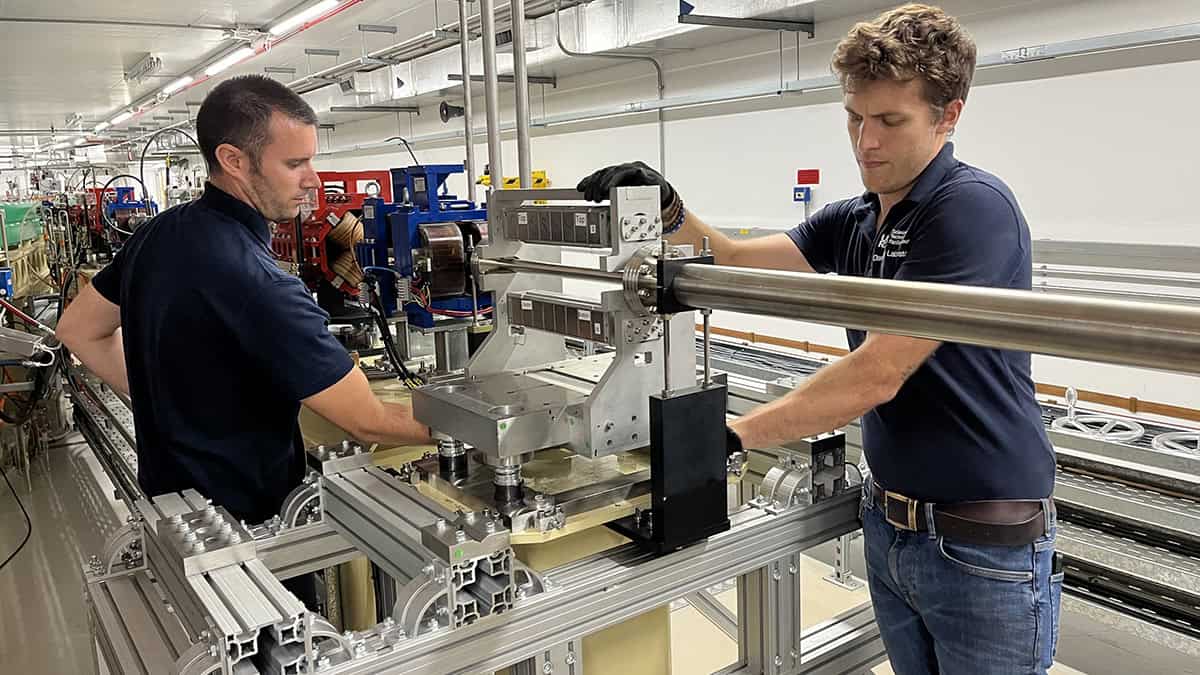
Permanent waves The UK’s Zero Power Tuneable Optics (ZEPTO) project is developing tuneable permanent magnets for accelerator facilities as an energy-efficient alternative to resistive electromagnets. Here engineers are installing a ZEPTO magnet on the booster-to-storage-ring transfer line at the Diamond Light Source synchrotron facility in Oxfordshire. (Courtesy: Science and Technology Facilities Council)
Trouble is, measuring and improving the environmental sustainability of accelerator facilities is not easy. Labs often don’t have enough funding, staff or time for such initiatives. Sustainability recommendations are either too generic or cannot be applied to accelerator science and technology. There’s also uncertainty about how to incorporate environmental sustainability into day-to-day operations.
We hope that the guidelines will help accelerator facilities make informed decisions that balance scientific progress with environmental responsibility
Hannah Wakeling, University of Oxford
Inspired by various initiatives in big science (see “Sustainable acceleration”, below), Wakeling and colleagues’ open-access resource has 110 practical sustainability recommendations for anyone building, planning or running accelerator facilities. It includes advice on procuring resources responsibly and reducing environmental impact through, for example, tunnelling, shielding, component design, waste management and green computing. There are also recommendations on skills, knowledge transfer and culture change, the latter being what the authors think will have most impact.
“Looking at accelerator programmes through the lens of sustainability gives us an opportunity to do things differently,” notes Wakeling. “We hope that the updated version of our high-level guidelines [v1.0 was published in 2025] will help accelerator facilities make informed decisions that balance scientific progress with environmental responsibility.”
Towards accelerator 2.0
In general, the biggest opportunity to make accelerators more sustainable is when they are still being designed and conceived. “At these crucial stages,” says Wakeling, “environmental impact assessments should be employed to highlight the areas of highest potential for impact reductions and more sustainable designs.”
What’s more, argues Wakeling, any decision to build or upgrade an accelerator shouldn’t depend just on its cost or scientific output but on how environmentally sustainable it will be too. That, in turn, means prioritizing R&D funding for enabling technologies that can make the most difference and co-ordinating efforts between large-scale facilities to avoid scientific duplication and to minimize the consumption of resources.
One relevant effort is a pan-European consortium called Research Facility 2.0 (RF 2.0), which is aiming to develop accelerator facilities that can run entirely on renewable energy – in effect, almost independently of the public power grid. A three-year, €5.6m initiative funded by the European Union’s Horizon programme and the Swiss State Secretariat for Education, Research and Innovation, RF 2.0 includes major accelerator labs like CERN, DESY and HZB (both in Germany), ALBA (Spain) and MAX IV (Sweden) plus the Karlsruhe Institute of Technology (KIT) and four high-tech SMEs.
Large-scale research infrastructures are a public good but they are inflexible and found wanting when it comes to environmental sustainability
Giovanni De Carne, director of KIT’s Institute for Technical Physics
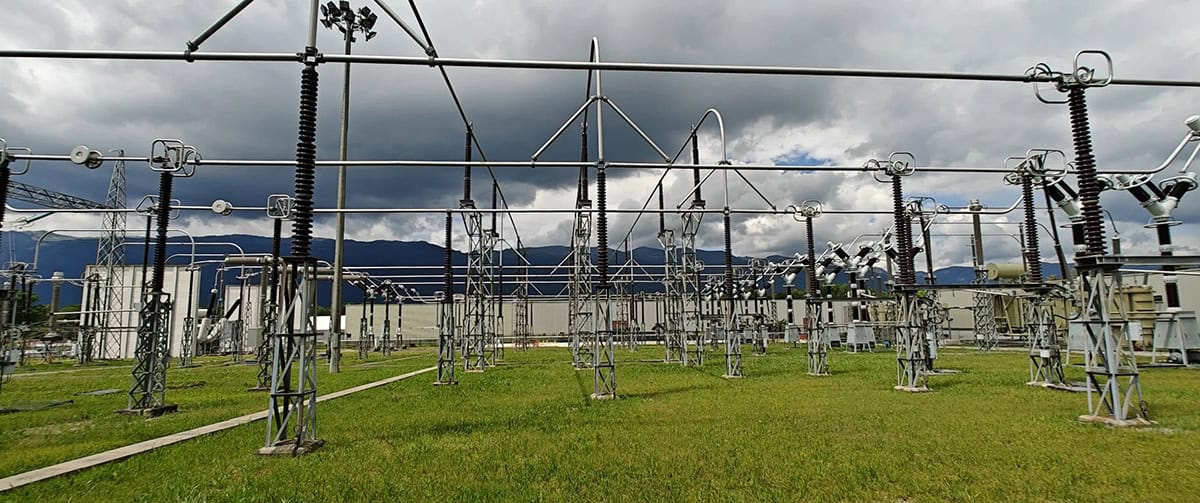
They’ve got the power RF 2.0 engineers from CERN and industry partner Zaphiro have installed 24 phasor measurement units to monitor disturbances in the Large Hadron Collider’s power network, including the BE1 400 kV switchyard (above), the main energy gateway to CERN. The demonstrator project aims to enhance the network’s resilience and energy-efficiency. (Courtesy: Nikolaos Sapountzoglu/CERN)
“The second problem is practical, but also philosophical,” De Carne adds. “Large-scale research infrastructures are a public good – driving scientific and societal impact – but they are inflexible and found wanting when it comes to environmental sustainability, consuming large amounts of raw materials during construction and regular operations.”
RF 2.0’s goal is therefore to analyse the many ways accelerators use energy – from components and systems to experiments and engineering – and to develop and test novel platform technologies in real-world settings. One notable RF 2.0 demonstrator project, for example, led to a redesign of permanent magnets that steer and focus beams at the MAX IV synchrotron, reducing energy use and heat losses by up to 40%.
Another involved retrofitting solid-state amplifiers with energy-efficient “active parameterization” controllers to enhance particle acceleration at the ALBA synchrotron; it yielded 18% energy savings in one year versus prior technologies. A parallel R&D track has also led to sustainable high-performance computing initiatives such as a summer energy-saving programme at DESY’s data centre, reducing the power draw during the hottest parts of the day.
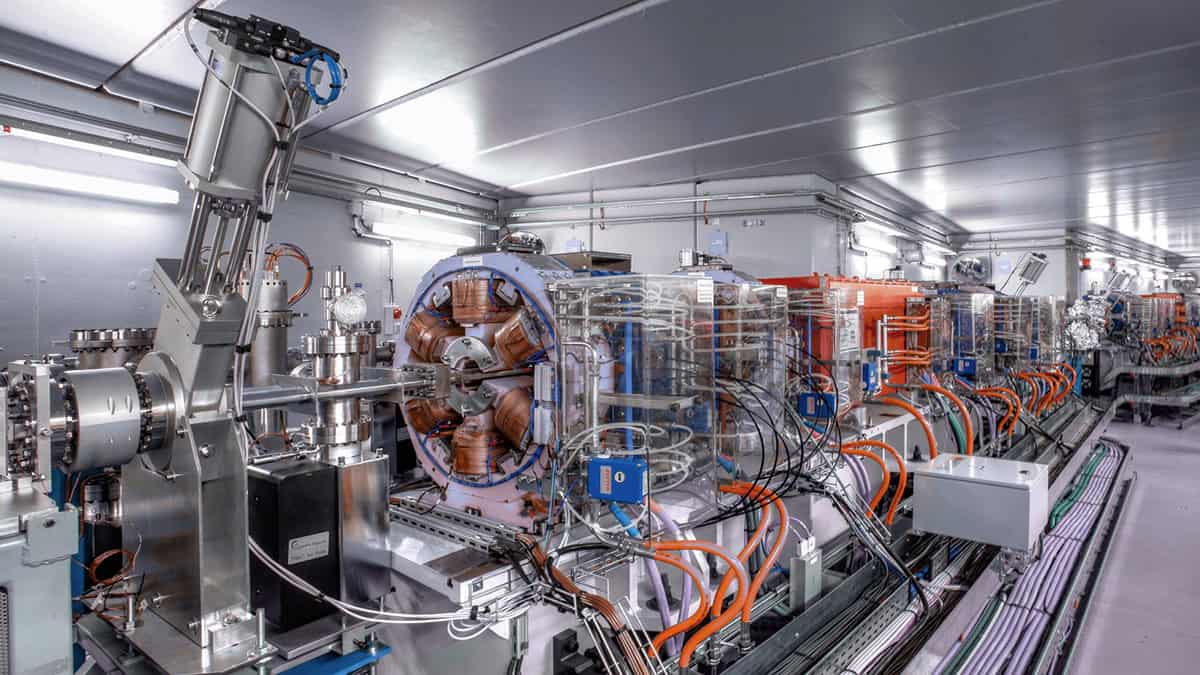
Permanent attraction RF 2.0 partners have been exploring the long-term environmental and operational benefits of using permanent magnets (rather than electromagnets) in accelerator systems, including a demonstrator project in the storage ring of Spain’s ALBA synchrotron light source. Here the actual electromagnets are shown along with the electrical and cooling connections that won’t be needed with a permanent magnet solution. (Courtesy: ALBA)
Meanwhile at CERN, an RF 2.0 team has installed 24 phasor measurement units (PMUs) at the lab. These smart grid devices, which record the magnitude and timing of voltage/current fluctuations, are able to monitor harmonics, voltage sags and grid disturbances within the LHC’s power network.
By recording phenomena that would otherwise go unnoticed with traditional metering systems, the PMUs help engineers to implement counter-measures to make the accelerator grid more robust. In the first year of operation, the devices recorded 135 voltage sags and rapid voltage-change events, with 18 of these adversely impacting operation of the accelerator complex – mainly affecting magnets and radio-frequency (RF) acceleration schemes.
“RF 2.0 cannot work in one single direction – a multidisciplinary approach is key,” says De Carne. “We are bringing together physicists, engineers and technologists who, under normal circumstances, rarely talk to each other. The project provides a forum for them to connect and share insights on common problems but from their own unique perspective. It’s been a real game-changer.”
The RF 2.0 programme finishes at the end of 2026, after which De Carne hopes to secure follow-on EU funding for RF 2.0 to merge with another pan-European project called Innovate for Sustainable Accelerator Systems (iSAS). The two projects look like a neat fit, with iSAS consisting of 11 academic labs and six companies seeking to make superconducting RF cavities – a workhorse accelerator technology – more energy-efficient.
Sustainable acceleration
The following sustainability initiatives are a useful starting point for scientists and engineers who want to evaluate and lower the environmental impact of accelerator projects at an institutional, project or individual level.
Sustainable HECAP+ is a group of researchers in high-energy physics, cosmology, astroparticle physics and beyond who are promoting environmentally sustainable practices in areas such as computing, energy, mobility, research infrastructure, resources and waste.
The ICFA Panel on Sustainable Accelerators and Colliders is promoting “energy-efficient and sustainable accelerator concepts, technologies and strategies…and the use of accelerators for the development of carbon-neutral energy sources”.
Flexibility in RIs for global CArbon Neutrality (FlexRICAN) is a pan-European academic-industry consortium evaluating how research facilities can enhance energy flexibility for the European electrical grid and contribute to local heating networks through waste heat recovery.
ErUM Data Hub is a German initiative helping 20,000 scientists exploring “the universe and matter” to make data management, software and digital tools more environmentally sustainable.
Disruptive thinking, sustainable outcomes
Along another coordinate, there’s also top-down pressure for a more sustainable approach to future accelerators from the European Strategy Group for Particle Physics (ESG), which guides the future of the field in Europe. “Energy consumption and emissions must be minimized when realizing and operating facilities and projects,” is the ESG’s unequivocal message in the 2026 update to its third strategy paper. “The design of new particle physics infrastructures should be as sustainable as possible, balancing important sustainability aspects with cost and physics performance.”
The ESG argues that R&D funding should be allocated to platform technologies with the most potential to yield energy savings. These include systems that convert grid power to RF more efficiently for particle acceleration, with some studies suggesting it could be possible to quadruple the efficiency with which RF systems convert electrical power into radiant power. Other promising technologies include thin-film superconducting RF cavities operating at higher cryogenic temperatures (around 4.2 K or higher versus 2 K for bulk niobium cavities).
Also important are novel permanent and high-temperature superconducting magnets that minimize heat losses. “Comparing the carbon footprints of electromagnet and permanent-magnet quadrupoles,” says Wakeling in Oxford, “the higher manufacturing impact of a permanent magnet can, in certain cases, be offset by its lower operational impact in as little as one year. Worth noting as well that this conclusion only considers carbon and doesn’t compare other environmental impacts.”
Another sustainability pathway is the use of AI and machine-learning to optimize the efficiency of accelerator experiments – for example, by focusing on intersecting parameters tuned to improve equipment reliability, lifetime and resource consumption. In parallel, AI could cut the huge computational needs of particle physics by requiring fewer “events” to be stored and lowering computing time.
Longer term, researchers are prioritizing disruptive accelerator concepts that could slash the size, cost and carbon footprint of next-generation facilities. One example is the energy-recovery linac, in which superconducting RF cavities decelerate a “used” particle beam and recycle the kinetic energy to accelerate new particles to higher energies. Another is plasma-wakefield acceleration, which uses laser- or particle-beam-driven intense “plasma waves” as the accelerating medium, yielding electric fields up to 1000 times greater than in classical accelerators.
Innovate and accelerate Hannah Wakeling (left) from the University of Oxford is one physicist seeking to make accelerator programmes more sustainable. Giovanni De Carne (right), director of the Institute for Technical Physics at KIT in Germany, runs the European RF 2.0 programme, which aims to develop accelerator facilities that can run entirely on renewable energy. (Courtesy: John Adams Institute and KIT)
The best of all worlds
Notwithstanding all this technology innovation, so many factors influence accelerator design that the “best” decision in terms of its environmental benefits can’t always be made. “In the end,” says Wakeling, “this is all a balancing act: we want accelerator facilities to be cutting-edge in terms of their scientific output, but we also want them to be cutting-edge when it comes to environmental sustainability.”
As for next steps, Wakeling and co-authors now plan to assess the anticipated impact of their 110 recommendations – whether high, medium or low – and the potential difficulty of putting them into practice (by referencing technology-readiness level, for example). Work is also underway to incorporate more quantitative analyses, including target figures for selected recommendations based on case studies from the accelerator community.
Equally, when assessing an accelerator’s emissions over its whole life-cycle, Wakeling thinks there is much to learn from the space-science community, which has developed the Open-source Rocket and Constellation Lifecycle Emissions (ORACLE) GitHub repository. This initiative seeks to cut the carbon footprint of the space industry – especially large constellations of satellites – by allowing researchers to share code and data.
“We applaud efforts like ORACLE and wish to encourage and promote similar programmes within fields applicable to accelerator science,” says Wakeling. But it’s clear that significant research is still required to tackle the complex environmental challenges in accelerator science, with Wakeling and colleagues aiming to update their living document as new information and technologies become available.
“We invite contributions from colleagues within the accelerator community,” Wakeling concludes, “to ensure this resource remains relevant, comprehensive and impactful.”
As the world of quantum computing grows and researchers work towards scaling up quantum systems, energy consumption is becoming a major concern. Beyond the small scale and high level of control in a laboratory environment, the lasers that power quantum systems result in a large energy cost that may act as a bottleneck for the integration of quantum technology.
Publishing their findings in Optica, researchers have demonstrated that sunlight can be used to generate pairs of entangled photons, providing a more energy efficient alternative to laser-pumped systems. This collaborative project combined theoretical research led by Robert Boyd at the University of Ottawa with technology developed by Hanieh Fattahi’s research group at the Max Plank Institute for the Science of Light in Erlangen, Germany.
Overcoming assumptions
Optical quantum computers use pairs of entangled photons as qubits, with the nonlinear optical processes used to produce them typically relying on lasers. This is largely due to two assumptions: firstly, that high optical coherence is required, meaning that the light waves maintain a steady phase relationship; and secondly, that lasers are the only way to achieve the necessary optical power density for these methods.
Sunlight, while naturally abundant, is largely incoherent and is difficult to collect in concentrations comparable to that of lasers. As such, this natural reservoir of optical input has been largely overlooked as a direct resource for nonlinear optical processes.
The researchers behind this latest study are challenging these assumptions with a new system that uses sunlight to fuel a process called spontaneous parametric down-conversion (SPDC). In this process, a pump beam – usually a laser but replaced here with solar light – interacts with a nonlinear crystal, splitting individual photons into entangled pairs.
To harness the plentiful yet highly dispersed sunlight, Fattahi’s team had to develop a device that focuses sunlight down to a point approximately 2 mm wide, to be coupled to a fibre as thin as a human hair. To achieve this, they used a Fresnel lens and spectral filter to collect sunlight, and a glass cone-shaped concentrator to funnel the light to a point, where it is coupled to the fibre. The fibre then directs the sunlight into the nonlinear crystal to induce SPDC.
Fattahi described the “significant practical challenges” involved with implementing such a system. Along with having to continuously track the Sun, the outdoor nature of the experiment left it vulnerable to both environmental effects and background light. Eventually compensated for by enclosing the system in a tent, the background light was initially offset by students beginning measurements at around 3 a.m. to make the most of the natural darkness.
Overcoming both theoretical and practical concerns, the system was able to successfully produce entangled photons. The states produced violate Bell’s inequality (as the photon correlations cannot be modelled classically) with an S value of 2.54, where S = 2 is the threshold for indication of quantum behaviour, and a 94% fidelity to the target entangled Bell state.
Significantly, when normalized in terms of the spectral bandwidth of the pump, sunlight-powered SPDC demonstrates a photon pair generation rate comparable to that of the laser-pumped process. This method eliminates the need for electrical-to-optical energy conversion, providing a viable path towards increasing energy efficiency.
The future of photon production
The development of quantum technology is vital for the future of secure communication, ultraprecise sensing and high-performance computation. Taking steps to develop a sunlight-driven method of photon pair production will potentially allow scaling of this technology without the major energy cost.
Minimizing energy consumption and system complexity would be a huge benefit for systems operating in demanding conditions, such as polar deserts. This research is particularly striking when considering space-based quantum technology. Sun-synchronous orbits could allow near constant access to a naturally occurring, reliable pump-source.
Fattahi and her team intend to develop a field-deployable version of this system, with a focus on greater integration which should “significantly improve mechanical stability, efficiency and overall practicality”. There is also potential to expand the portion of the solar spectrum used in this experiment. Fattahi described the “exciting possibility” of using different spectral regions to drive multichannel entangled-photon generation, increasing efficiency and capacity.
Research into new, energy-efficient photon production has the potential to remove a major barrier for the integration of quantum technologies and contribute to a brighter future for quantum computing.
Molecularly imprinted polymers (MIPs) are synthetic receptors that can recognize target analytes through tailored binding sites, offering a stable, cost-effective and versatile alternative to natural bioreceptors. In electrochemical sensing, MIPs have attracted growing interest because they can provide high selectivity while enabling rapid, portable and low-cost detection.
This webinar will introduce the fundamentals of molecular imprinting, including binding site design, polymerization strategies, template removal and immobilization on electrode surfaces. It will then compare molecularly imprinted non-conducting polymers (MINPs) and molecularly imprinted conducting polymers (MICPs), focusing on their differences in conductivity, binding-site accessibility, reproducibility, sensitivity and selectivity. Recent advances in MIP-based electrochemical sensors will be discussed across representative applications, along with current limitations and design strategies to improve sensor performance.
The webinar will conclude with perspectives on how conducting polymers, nanomaterials and optimized molecular recognition can guide the development of next-generation selective and sensitive electrochemical sensors.
Wonhyeong Kim
Wonhyeong Kim is a postdoctoral research associate in the department of materials science and engineering at the University of Arizona. He received his PhD in materials engineering from Auburn University, where his research focused on molecularly imprinted polymers, conducting polymers and electrochemical sensors for selective chemical and biomarker detection. His work has resulted in multiple publications in leading journals and he was the recipient of the 2025 ECS Sensor Division Student Research Award for his contributions to molecularly imprinted polymer-based electrochemical sensors. His research interests include molecular imprinting, conducting polymers, electrochemical sensors and functional materials for selective chemical sensing, with recent work expanding into advanced polymeric materials and nanomaterials for environmental applications.
Multinational missions Ariane 6 is the latest rocket in a long history of launchers – demonstrating the power of multinational co-operation for more than five decades. More than 3000 staff are working at ESA to implement space missions for exploring the universe, protecting our planet or serving our daily life. (Courtesy: ESA)
The European Space Agency (ESA) is globally recognized for its iconic space missions that push the boundaries of science and technology, whether it’s a rendezvous with a comet, landing a probe on Saturn’s giant moon Titan or mapping the stars of the Milky Way in unprecedented detail. But ESA does so much more than these headline-grabbing scientific and exploratory endeavours.
“Space is no longer solely a playground for curious minds,” says Eric Wille, ESA Head of the Opto-Electronics Section. “It’s really important for our everyday life too.” In fact, modern society relies on space technologies.
Project management The ESA Optical Ground Station in Tenerife is used to develop laser technologies for high-speed data links or quantum communication. The laser beam projects a guide star to control an adaptive optics system that improves the beam quality of the optical communication link. It is one of several ESA laboratories managed by Eric Wille and the opto-electronics section for testing optical systems for space. (Courtesy: ESA)
Satellite-based environmental monitoring, weather forecasting and global navigation are obvious examples, but there are many other important applications. For instance, the global financial system could not function without atomic clocks aboard satellites time-stamping millions of stock trades and digital payments every second. Similarly, when natural disasters strike, satellite networks become essential lifelines: mapping floods, tracking wildfires and helping with the co-ordination of emergency response efforts on the ground.
Fulfilling all of these roles and ESA’s bold space ambitions – from seeking answers to big questions about the universe to watching over our precious planet – requires a highly dedicated, technically proficient and multi-skilled workforce made up of scientists, engineers and various other professionals.
Diverse and challenging work
When Wille joined ESA as an optical systems engineer in 2009 after completing his PhD in experimental quantum optics, it was the sheer diversity of challenging work that attracted him. “Working in an international space agency, you’re partly a researcher, partly a project manager, partly also someone with ambassadorial skills,” he says. “That mixture is really something which I found at that time very attractive and I still like today, very much.”
Charlotte Pachot also craved a technically challenging role after her master in optics. She found it at Thales Alenia Space in France as a space engineer working on optical instruments. But after a few years, her interactions with ESA staff through joint projects convinced her to join the Agency as an optical engineer. She is now Lead Payload Engineer for the Laser Interferometer Space Antenna (LISA) mission, intended for launch in 2035, which will be the first gravitational wave detector in space.
Both Wille and Pachot have found that the technically challenging work at ESA is particularly satisfying because it has real-world impact. The first 10 years of Wille’s ESA career were largely spent on Athena (Advanced Telescope for High ENergy Astrophysics; now renamed NewAthena), a powerful X-ray observatory set to launch in the late 2030s that will provide fresh eyes on a wide range of hot and energetic processes in the universe.
Charlotte Pachot is overseeing the LISA optical bench assembly. Next to her is a model of LISA Pathfinder that tested critical technologies in space in 2016. (Courtesy: ESA)
In this role, Wille and the ESA team collaborated with an industrial consortium led by Dutch measuring instrument supplier cosine to develop a completely new type of optics, called silicon pore optics. Using techniques perfected by the semiconductor industry, cosine bonded and stacked many silicon plates on top of each other. By shaping the plates, a lightweight mirror to focus X-rays was created; in fact, 10 times lighter than the ones flying on current X-ray missions XMM-Newton and the Chandra X-ray Observatory.
Like Athena, LISA will also provide fresh eyes on cosmic events, but through the unique prism of gravitational waves. This will be achieved through a completely new approach involving a triangle of three satellites spaced 2.5 million kilometres apart.
Understandably, LISA calls for a unique optical bench, which Pachot is managing from design to manufacturing and testing. She sees her role as being like that of a conductor of an orchestra: a lot of her time is spent co-ordinating team members and partners, while also helping to solve technical, budget and schedule problems. For Pachot, tackling these daily friction points is part and parcel of working on real-world big science. “The instruments are very complex technically, very challenging, but they are also real pieces of hardware as part of a real project,” she says.
International community
As Wille and Pachot’s stories show, ESA selects talent from different career stages. The Agency offers several programmes that support students, graduates and experienced professionals in finding the right role for their profile and interests.
Device testing Lasers are used in many different space applications. Igniting launchers, high-speed optical communication, LIDARs for atmospheric measurements or for measuring gravity waves with LISA. The opto-electronics laboratory at ESTEC is frequently used to characterize the lifetime and performance of high-power diode lasers.(Courtesy: ESA)
For example, university students can benefit from ESA Academy sponsorship, such as participating in hands-on projects or training sessions. They can also join ESA as interns. Graduates can apply to ESA’s Graduate Trainee Programmes where they can gain experience on actual ESA projects and develop technical and professional skills. And for those currently in industry with less than three years’ experience, the Junior Professional Programme allows them to join ESA as staff members for four years and benefit from tailored learning and development opportunities to prepare them for a long-term position.
Whichever pathway they take, once new recruits get started in their first role, an excellent employment package – including competitive salary and pension scheme, hybrid working and flexible hours, and professional development training opportunities – comes as standard.
Eric Wille inspecting a new X-ray mirror using stacked silicon plates. The mirror was assembled using an automated stacking robot partially visible in the foreground. (Courtesy: ESA)
What sets ESA apart is the multicultural work environment. Team members might come from any of ESA’s 23 Member States and nine further Cooperating States and Associate Members. And recruits can be based in more than nine locations in seven countries (France, Germany, the Netherlands, Italy, Belgium, Spain and the UK). This makes for a melting pot of cultures.
“There’s a very lively expat community,” says Wille. “At the European Space Research and Technology Centre (ESTEC) and other big sites, it’s like a small Europe.” This cultural diversity is of course intentional. “The problems we have to solve require teamwork,” says Pachot. “And this is made easier at ESA because we all see problems in a different way depending on our culture.”
Working life at ESA
Want to learn more about working at ESA? Take a look at life at ESA and what ESA offers. Quickly find out which programme could be the best fit for you by following the pathways to ESA on this flowchart.
Modern computation ranks among the great technical achievements of the 20th and 21st centuries and touches nearly every area of human activity. Today digital computing uses billions of transistors etched onto semiconducting silicon chips to work as tiny switches that represent binary 0 or 1. The technology underlies personal phones and laptop computers, and extends to supercomputers that perform nearly one quintillion operations per second (1018 floating point operations per second, or FLOPS) and manipulate up to 100 petabytes of data.
Supercomputers can simulate otherwise intractable problems in science, from climate and weather patterns to protein folding and even black-hole interactions. However, further progress in scientific and general computation is approaching saturation because of fundamental limits, while the explosion in artificial intelligence (AI) based on large language models (LLMs) is clearly showing where computation needs to be improved. Physics is essential for this effort.
Nearing the physical limits
Back in 1965, Intel co-founder Gordon Moore famously predicted that the number of transistors we could fit onto a silicon chip would increase exponentially. He later forecasted that the number would double roughly every two years. Moore’s law has held for decades, albeit at a lower rate since the mid-2010s. More transistors meant increased computing power per chip, as well as faster computing.
That’s because smaller transistors switched between binary states more quickly, and higher transistor densities reduced the distance signals had to travel. These factors made it possible to increase “clock speed” – the frequency at which a computer’s central processing unit (CPU) synchronizes its internal operations – which helps determine computational speed. That frequency grew from tens to hundreds of megahertz in the 1970s–1990s until it reached gigahertz levels.
But by the early 2000s, the increase in clock speed with density of transistors no longer held. Transistors that switched more frequently used more power, generating heat beyond what could easily be dissipated. Essentially, clock frequencies have stagnated at 3–5 GHz.
Within this limitation, the strategy for faster computing has been to design chips for parallel processing. Modern CPUs contain “cores”, which are separate processing units on a chip that independently read and execute instructions. In a CPU with four cores, each operates at the clock rate of 5 GHz, say; but since they operate in parallel, the throughput can approach a fourfold increase.
Another, more specialized form of parallel processing was introduced in graphics processing units (GPUs). While a CPU typically has between four and 32 powerful cores that have been optimized for flexibility in carrying out different tasks, a GPU has hundreds to thousands of simpler cores, designed to deal with many data elements for such tasks as rendering images or multiplying large matrices.
GPUs have become essential for supercomputers, but they also face limits. Trouble is, not all computational tasks can be broken into parallel operations, while adding more transistors to a chip still requires more power and generates yet more heat.
Large scales and rising costs
Supercomputer-level capabilities, however, are needed to support the rising use of LLMs such as ChatGPT, which are trained on huge data-sets and can create content based on natural language. Other LLMs followed, and by 2025 up to a billion individuals, corporations and governments were using AIs globally. This enormous scale of usage is highly demanding of computational and electrical power.
LLMs need two kinds of computation. First there is training computation, which analyses massive amounts of text from books, articles and websites containing trillions of tokens – words or parts of words. The training’s aim is for the model to learn statistical patterns in a given language, and estimate the probabilities for the next token in a given sequence.
Training the largest LLMs can take up to 100,000 GPUs using tens to hundreds of megawatts, comparable to the biggest supercomputers. A few dozen of these centralized installations are estimated to be operating around the world, concentrated in the US and China.
The second type of computation is inference, where an already trained model responds to user prompts. Inference processing needs less computational and electrical power, but runs continuously to serve users. It must also respond with little latency, the time delay between request and response, so inference infrastructure is geographically distributed, not centralized.
Of about 12,000 general data centres operating globally, hundreds to a few thousand now support a large AI cluster for inference, with the number rapidly growing. With this scale of continuous operation, inference is expected to dominate long-term AI energy use.
By 2030, global data centres, driven largely by AI, are expected to consume some 1000 TWh per year, corresponding to an average load of roughly 100 GW. This is a few percent of global electricity use and the resulting waste heat must be removed, requiring millions of gallons of water for some facilities. This heat discharge, along with the necessary additional electricity generation, will have a significant impact on the environment.
That’s provoked reactions to AI infrastructure, both from communities objecting to local data centres and governments concerned about national power grids. Scaling today’s relatively few specialized supercomputers to many large AI centres around the world carries significant costs, not to mention AI’s uncertain societal impact. As AI stretches resources, researchers are keen to rethink the very nature of computation.
Building a better bit
The use of electronic circuits to carry out binary logic, which defines modern computation, was mathematically formalized by the US mathematician Claude Shannon. In 1937 he showed that on/off electrical switches, arranged in what we now call a “logic gate” (based on the true/false logic George Boole invented in the 19th century), can carry out arithmetic as well as logical decision-making.
This approach has been embodied in computers, first using electromechanical relays, then vacuum tubes, followed by discrete transistors, and finally CMOS (complementary metal-oxide-semiconductors) integrated circuits. Each succeeding generation has slashed the energy required for a single binary switching event – for example, from nanojoules for an older discrete transistor to femtojoules for a transistor in a modern CMOS chip.
But this gain has been far outstripped by the rapidly growing volume of computation. Despite improved energy efficiency, our increasingly computerized world demands more electrical energy. Fortunately, there are other, more efficient ways to encode binary information using physical systems that support two stable states: the horizontal or vertical polarization of a photon; the up or down orientation of the spin magnetic moment of an electron; or persistent superconducting currents circulating in opposite directions.
Each approach has its own advantages and drawbacks. Photon-based computing offers high speed and reduced resistive heating; but it is difficult to store photons. Superconducting currents offer high speed, and require low energy per operation. But the energy cost for cryogenic cooling at 4 kelvin, hundreds of watts per one watt of heat removed, diminishes or wipes out the energy advantage.
“Spintronics” technology, however, has been the most successful of the three. Its basic device is the magnetic tunnel junction (MTJ), where a thin insulating barrier separates a “reference” and a “free” magnetic layer. The device’s electrical resistance depends on whether the magnetizations of the layers are parallel or antiparallel.
Universal memory Magnetoresistive random-access memory (MRAM) stores data in magnetic domains. Its main benefit is that it can retain data even when the power is turned off. (Courtesy: Shutterstock/luchschenF)
MTJs exist in hard disk drives and can also serve as read-write units in a magnetoresistive random-access memory (MRAM). To read, a small current is passed through the MTJ, and the resulting voltage shows the state of the bit. To write, a larger current is applied. The fixed layer polarizes the spin of the electrons, which carry angular momentum as they tunnel into the free layer.
This flips that layer’s magnetization, switching the magnetic bit, whose state survives even without power. That’s a key advantage of MRAMs compared to volatile CMOS RAMs, which require power and lose their stored data without it. MRAMs are not yet competitive with CMOS RAMs, but are already used in automotive, aerospace and other applications where their non-volatile nature is essential to reduce power needs and maintain their data under extreme conditions.
Along with this benefit, new possibilities for spintronics are emerging. In 2024 Nuh Gedik at the Massachussetts Institute of Technology (MIT) and colleagues reported that they had rapidly induced magnetism in iron phosphorus trisulfide with light (Nature636 609). FePS₃ is an antiferromagnet where atomic spins in opposite directions result in little or no net magnetic field. The researchers found that picosecond pulses of terahertz light produced magnetic states that persisted for milliseconds – far longer than any other reported light-induced magnetism (see box below).
Metastable magnetization
(Courtesy: Ilyas, B, Luo, T, von Hoegen, A et al. “Terahertz field-induced metastable magnetization near criticality in FePS3” Nature636 609 (2024) Springer Nature)
Shown here is the experimental set-up that an international team of physicists use to produce a long-lasting, light-driven magnetic state in a material such as iron phosphorus trisulfide (FePS3), which becomes antiferromagnetic when cooled below about 118 K. They used an intense terahertz-frequency (THz) pulse (orange) to drive low-energy collective excitations, which induce transient changes in optical properties that can be probed with an 800 nm probe pulse (red). Fe2+ ions form a hexagonal lattice and their spins arrange ferromagnetically along the zig-zag chain (a-axis) and antiferromagnetically between the adjacent chains (the structure in the circle). The magnetic coupling between the layers is antiferromagnetic together with a small interlayer shear distortion along the a-axis. The THz pulses put the material in a metastable magnetic state that lasts for more than 2.5 milliseconds even after the light source is switched off.
Earlier this year, researchers at Beijing Normal University in China found that light-induced magnetic transitions consume little energy (ACS Nano20 9051). If magnetic bits become competitive with electrical ones – activated by light or otherwise – they would unite working memory and long-term storage in one computational stage rather than two as we now have. Magnetic bits could also play a role in a bigger change in computer structure.
Bringing it all together
A novel form of computer architecture could also remove a famous bottleneck in computing that dates back to the influential 1945 proposal by the mathematician John von Neumann for a general computational design. He suggested using separate processing and memory (first put forth in 1837 by Charles Babbage for his mechanical “Analytical Engine”) but added the idea of the stored program.
By holding the instructions for computer operations in memory along with data, a computer program makes computation more flexible but has one big drawback. Data and instructions have to shuttle between processor and memory along the same channel, reducing computing throughput and using more energy than processing – the “von Neumann bottleneck”.
Novel computing: liquids, soft solids and deuterium
Financial flows London School of Economics economist AWH (Bill) Phillips with his eponymous machine, also known as the MONIAC analog computer, that modelled economic theory with water flows. (No known copyright restrictions, LSE Library archive)
At the heart of modern computing technology are ultra-pure silicon wafers. These nearly perfect regular crystalline solids form the substrates for integrated circuits, making it all the more surprising that less ordered materials – such as liquids and soft solids – have their own history in computation.
In 1949, for example, the UK-built Monetary National Income Analogue Computer (MONIAC) simulated the flow of money within a national economy using coloured water moving through transparent tubes under gravity. Water levels representing economic conditions were set by pumps and valves. As the water negotiated the system, it dynamically illustrated how parameters such as tax rate affect an entire economy, eventually settling into equilibrium.
Another liquid – mercury – also appeared in the early days of electronic computing. The first commercial unit in the US, UNIVAC I (1951), stored nine kilobytes of data as sound pulses continually recirculating in tubes filled with liquid mercury acting as delay lines. The units, which were bulky and heavy, provided serial rather than random access because the pulses travelled in sequence. Timing was crucial, and the mercury was held at a constant 40 °C to keep the speed of sound stable. Another early computer, EDVAC, also stored data in liquid mercury.
Since the 2000s researchers have shown that tiny droplets of oil, moving through small channels filled with water, can implement binary logic. If a droplet blocks a channel, a second droplet arriving behind it is diverted into another channel, representing a “decision”. Proper design can emulate the Boolean logic that underlies conventional computing. With channels only 100–200 µm across, microfluidic logic could route and process small samples, providing a lab on a chip for chemical analysis, biological research or medical diagnostics.
Yet another liquid – one more exotic than mercury – and a soft solid were apparently at least considered for computation in the same era as UNIVAC 1. According to Iain Dey and Douglas Buck’s 2017 biography The Cryotron Files: the Strange Death of a Pioneering Cold War Computer Scientist, the MIT scientist Dudley Buck once worked on a data storage system using magnetic pulses in liquid deuterium held at cryogenic temperature. In that Cold War era, US government money was available for any research that might help America and the authors describe how some of it also went on studies into a soft, wobbly foodstuff, lemon Jell-O as well as the viscous semi-liquid hair preparation Wildroot Creme Oil, which might also support sound waves in a memory unit. None of this Cold War research panned out, although at least the Jell-O experiments could treat the entire lab team to dessert.
One solution is to carry out processing and memory functions in the same physical element, potentially using a new type of electric circuit element originally proposed in 1971 by the US electrical engineer and computer scientist Leon Chua. Its resistance depends on the accumulated charge and, since charge is the time integral of current, therefore carries a memory of the device’s past electrical activity.
Chua dubbed his new element a memory resistor or “memristor” – and the concept can be used when a read-write MTJ holds a memory of past electrical activity as a magnetic bit. In 2026 Shahar Kvatinsky at the Israel Institute of Technology and colleagues showed that small MRAMs formed from MTJs can perform logical operations inside memory (Adv. Electron. Mater.12 e00348).
In principle, therefore, this could also provide arithmetic processing inside memory, thereby removing the von Neumann bottleneck. The non-volatile memory would also save energy relative to CMOS memory. Problems remain though, such as reducing noise and producing large-scale MRAMs – but the ability to merge memory and computation within MRAMs has been established at small scales.
Certain material structures can also play a dual function. The wonder-material graphene – a 2D hexagonal lattice of carbon atoms – is electrically conductive when a voltage is applied in its plane, driving the electrons. If the graphene sheet is also placed between proton-conducting electrolytes, a second voltage applied across the sandwich produces a proton current (a flow of positive charge) perpendicular to the plane.
In 2024 Marcelo Lozada-Hidalgo at the University of Manchester and colleagues found that certain values of electron density in this structure make the graphene an insulator (Nature 630 619), producing a reversible change from conducting to insulating that forms a non-volatile two-state memory. Their set-up allowed the researchers to perform logic and memory operations in a single device for the first time.
As graphene, MRAMs, and other approaches are under study for in-memory computing, another method emulates a natural process – and is perhaps the biggest departure from conventional computing.
Dual purpose
(Courtesy: M Lozada-Hidalgo, Nature630 619. CC BY 4.0)
(a) Graphene is well known to be a good electrical conductor, but in 2024 an international team of researchers used the 2D substance to make a new electrically-controlled switching device that supports both memory and logic functions. The device exploits graphene’s ability to conduct protons as well as electrons. The team showed that placing a sheet of it between proton-conducting electrolytes also produces a proton current perpendicular to the plane, with the proton and electron transport allowing independent control of field and charge density. Shown here are the top and bottom voltages and the direction of electron and proton flow. (b) Map of in-plane electronic conductance, σe, as a function of electric field E and charge density n. The left and bottom axes show that these variables are controlled by the difference and sum of the top and bottom electron voltages, respectively). (c) Map of proton transport current, I, as a function of E and n.
Copying biology
In the 1980s, Carver Mead – a Caltech physicist and engineer who had been instrumental in developing integrated circuits and deeply understood the physics of computing – made a radical proposal. Instead of building computers around centralized digital logic, we should instead design them to imitate the strategies that make the human brain highly efficient. He coined the term “neuromorphic” computing for this approach and is widely considered its founder.
Using specific biological and biophysical features, the brain performs its cognitive and sensory tasks at the modest power of 20 watts. Its 86 billion neurons do not constantly use energy, but act sparsely in response to events, firing brief electrical spikes at definite timings and rates. A system like this can be expected to save energy compared to a conventional computer, which steadily consumes energy at the CPU clock rate.
Also, there is no von Neumann bottleneck in the brain. Information is stored as changes in synapses: the ~1014–1015 connections among neurons that control signal flow. As a spike arrives, a synapse immediately applies its stored information. The modified signal is passed on to neurons that repeat the cycle. Storage and processing occur together within this closely linked 3D network, which also operates in a massively parallel manner.
Mead had envisioned an analogue neuromorphic design, but in practice the biological features are expressed digitally to match CMOS technology. For example, in 2017 Intel introduced its Loihi chip with event-driven spiking and closely connected computation and memory. A later model was reported in 2025 (arXiv:2503.18002) that trebled the throughput for matrix multiplication – the main computationally-intensive operation needed to train an LLM – with half the energy a standard GPU chip uses.
Similarly, in 2014 IBM built and tested a chip that emulated spiking behaviour, while a later version, dubbed NorthPole, does not use spiking. In 2025, meanwhile, IBM researchers reported that 288 linked NorthPole chips could carry out AI inference on certain sizes of language models at favourable speeds and power usage.
Chip off the old block Intel’s Loihi 2 chip is an example of a neuromorphic chip, based on how the human brain functions. With linked computation and memory, it can carry out AI inferencing considerably faster than standard chips, making it more energy efficient. (Courtesy: Walden Kirsch/Intel Corporation)
The future of computing and AI
Most of the novel approaches are in the proof-of-principle or pre-commercial phase and may never reach wide use, for both economic and engineering reasons. The investment in CMOS technology and the associated computer architecture is enormous. Any overall change would be a massive undertaking. Although a neuromorphic chip might be more efficient, it would require huge investment to be formally adopted by today’s markets and chip-making industry.
Even so, there are valuable lessons to be learned from the research into novel approaches – such as better integration of memory and computation. There is also a consensus that hybrid solutions can yield immediate benefits. An accelerator unit, such as a bank of neuromorphic chips, integrated with CMOS technology, could increase speed and decrease power use for the critical matrix multiplication stage. Upgrades like these can be included as new supercomputers and AI centres are being built, improving general and AI computation and reducing their energy costs.
We should also think of the problem from the other end: yes, we can now produce a form of AI based on LLMs. But this is ultimately a brute-force approach that demands a great deal of time, money and resources. It should continue to be refined, but there should also be space for bold ideas that may lead to better and more sustainable forms of AI, and of the computation it requires.

 Login