Born and raised in Egypt, Mary Bishai studied physics at the University of Colorado, Boulder, US, before doing a master’s and PhD, also in physics, at Purdue University. After a postdoc at Fermilab, she joined Brookhaven National Laboratory in 2004, where she is now a distinguished scientist. Bishai served as co-spokesperson for the Deep Underground Neutrino Experiment (DUNE) from 2023 to 2025 and, over the years, has collaborated on many other leading particle-physics projects, including MicroBooNE, the Daya Bay neutrino experiment, the Main Injector Neutrino Oscillation Search, the CDF experiment at Fermilab, and the CLEO experiment at Cornell University. In 2026 she was elected fellow of the American Association for the Advancement of Science.
What skills do you use every day in your job?
I enjoy brainstorming. If I am having a mental block or get stuck in a technical or personal interaction issue, I walk down the hall to chat with a colleague about their work – even if it isn’t related to my own problem. This serves two purposes. First, it helps ameliorate the feelings of loneliness and frustration to discuss your challenges with others. Second, a surefire cure for any mental block is to divert your attention to a different topic. Another essential skill is to try to play devil’s advocate with myself and colleagues. My team finds this infuriating sometimes, but it’s vital – you need to be your toughest critic.
What do you like best and least about your job?
For a self-professed nerd like me, doing big science is heaven. I get to geek out on a broad set of technical and scientific challenges and work with lots of really cool experts from a variety of disciplines. Recently, for example, as part of DUNE, I’ve been looking at designs for the infrastructure that houses the Long Baseline Neutrino Facility. Located at Fermilab near Chicago, it will send the world’s most powerful beam of neutrinos to a detector in an underground lab 1300 km away in South Dakota.
In any given week, I might find myself discussing the mechanical engineering of detectors or learning about the civil engineering required for large-scale facilities. I might be discovering fascinating details about the hydrogeology of the Fermilab site, exploring the design of focusing magnets, or studying the results of simulations of high-energy particle interactions in materials.
I could also find myself in a meeting of the artificial intelligence (AI) expert team, learning new AI approaches, such as improving the search for neutrinos from supernovae using our detectors. Wandering the hallways, I might bump into a colleague from Brookhaven’s chemistry division and get chatting about new detector materials. I also work with theorists on new ideas for physics at DUNE.
I’m happiest trying to connect the dots between physics goals and technical and engineering disciplines, coming up with multidisciplinary design solutions to realize these massive science projects
I trained as an experimental particle physicist, but I’m happiest trying to connect the dots between physics goals and technical and engineering disciplines, coming up with multidisciplinary design solutions to realize these massive science projects. Best of all is when I ask a question in an area I’m not an expert in – say civil engineering – and someone replies: “Hmm, we hadn’t thought about that.”
My least favourite part of the job is that it can be very challenging to deal with large international collaborations of scientists and engineers over the very long time scales of large-scale projects. You need a lot of emotional resilience, stamina and patience to keep going for the decades it takes to get these large-scale projects to fruition. Burn out and despondency are downsides; keeping yourself and your team going is very difficult.
What do you know today that you wish you knew when you were starting out in your career?
Always be honest to the science. If it looks like something you put a lot of effort into is a dead end, drop it; don’t wait until someone tells you to stop. There will be a lot of dead ends before you find the right direction. When an approach fails, it means you have a new intellectual challenge – and that’s the fun part. Don’t be afraid to challenge established dogma and groupthink, even if it means difficult discussions with your colleagues no matter how senior. And most importantly, don’t keep pushing when you are burning out. It’s okay to step back and slow down for a while.
Deane explains EPSRC’s role in funding research in physics and other sciences in the UK. She talks about the long-term strategy behind changes in funding priorities that were announced earlier this year. She also explains how EPSRC is supporting students and highlights the importance of quantum technologies and artificial intelligence to the future of the UK.
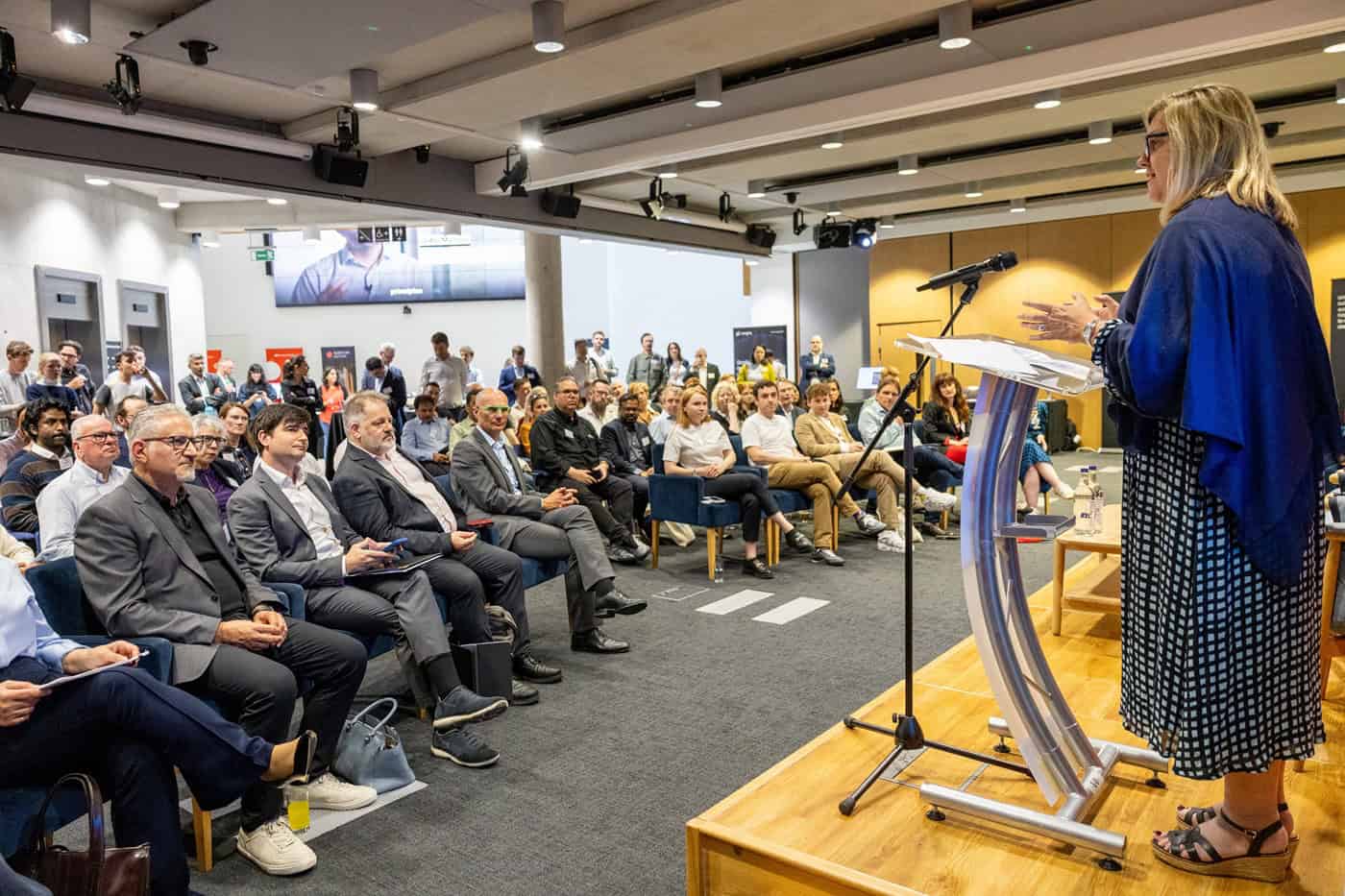
Capital connections Janet Coyle from London and Partners addressing delegates at a meeting at the Institute of Physics to mark the first anniversary of the London Quantum Cluster. (Courtesy: Carmen Vilano)
“There are two types of people when it comes to quantum,” joked Howard Dawber, deputy mayor of London for business and growth at a meeting at the Institute of Physics last night to celebrate the first anniversary of the London Quantum Cluster.
“There are those who understand quantum mechanics. There are those who don’t. And there are those who are in superposition of understanding and not understanding until they are observed.”
It was a light-hearted remark that matched the mood of what was essentially an evening of boosterism for quantum technology in London ahead of London Tech Week next week.
As chair of London and Partners – the growth agency for London – Dawber told the gathering of more than 100 “quantum influencers” that the organization was “100% behind the London Quantum Cluster”.
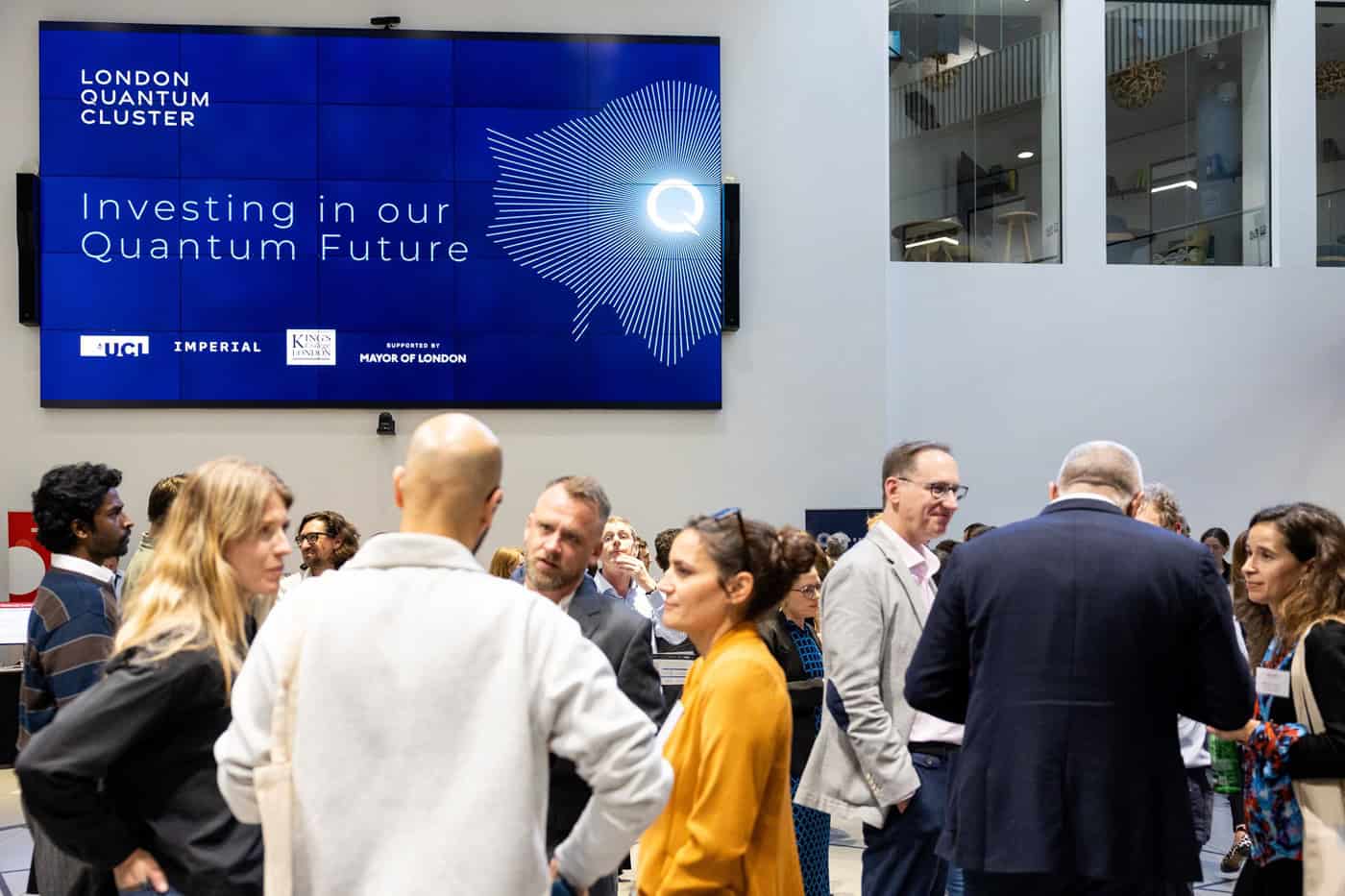
Founded in 2025 by University College London, King’s College London and Imperial College London, with support from the Mayor of London and the UK government, the cluster seeks to establish the capital as a powerhouse of quantum tech.
Georgia Siora from Warwick Economics and Development presented data to show that London is already doing well in the sector, being home to more than 160 quantum companies, with seven of the top 10 UK quantum firms based in the city. Small- and medium-sized quantum firms in the capital, she added, contribute an estimated £153m annually to the economy.
Happy anniversary The London Quantum Cluster is now one year old. (Courtesy: Carmen Vilano)
“Quantum and deep tech are at the heart of the capital’s 10-year growth plan,” added Janet Coyle, managing director of London and Partners.
Geraint Rees, vice-provost for research, innovation and global engagement at UCL, said his aim was “to make London the best place on the planet for serious quantum companies”. He pointed to UCL spin-out Quantum Motion, which has just won $160m of venture-capital funding, as an example of the kind of firm making a name in the city.
The evening ended with a panel debate chaired by Jess Wade from Imperial College London, featuring Maria Maragkou from Nu Quantum as well as Richard Murray, founder of ORCA Computing, who drew a distinction between universities being all about expanding the frontiers of knowledge, whereas for start-ups “the aim is to win”.
Also on the panel was physicist Alejandro Montblanch – head of quantum communication and networking at banking group HSBC – who made it clear that what he wanted to know was: “How can your quantum company help HSBC make more money?”
A welcome note of caution came from London-based venture-capital investor Eloisa Angeles, who pointed out that while the UK has a good track record of government-funded research, the UK is weak at “follow through”, with the government not focused on procurement and not having the end customer of the research in sight.
From heatwaves to extreme rainfall, the impact of climate change is rapidly becoming a reality in our daily lives and a danger to our planet. But physicists are in a great position to help, with physics-based research bringing about practical, real-world solutions, whether it’s more efficient solar cells, better climate models, or novel materials for capturing carbon dioxide from the atmosphere.
There are huge economic and commercial benefits from such work too. A 2023 report from the Institute of Physics (IOP), entitled Physics Powering the Green Economy, estimates there are almost 1800 companies in the UK and Ireland taking green technologies to market with a combined turnover of £750bn.
Last year a follow-up IOP Impact report entitled Unleashing Physics to Power the UK Energy Sector identified the most promising physics technologies for transforming the UK’s energy system. These fall into three main areas: energy generation (nuclear power, photovoltaics), storage (batteries) and transmission (high-temperature superconductors).
The clean-energy revolution will not be easy, however. As the IOP report points out, the UK has a strong research base, good international collaborations, and a growing pipeline of spin-out and early-stage companies. But the country doesn’t invest enough in technology scale-up facilities, faces critical skill shortages, and isn’t great at recycling either.
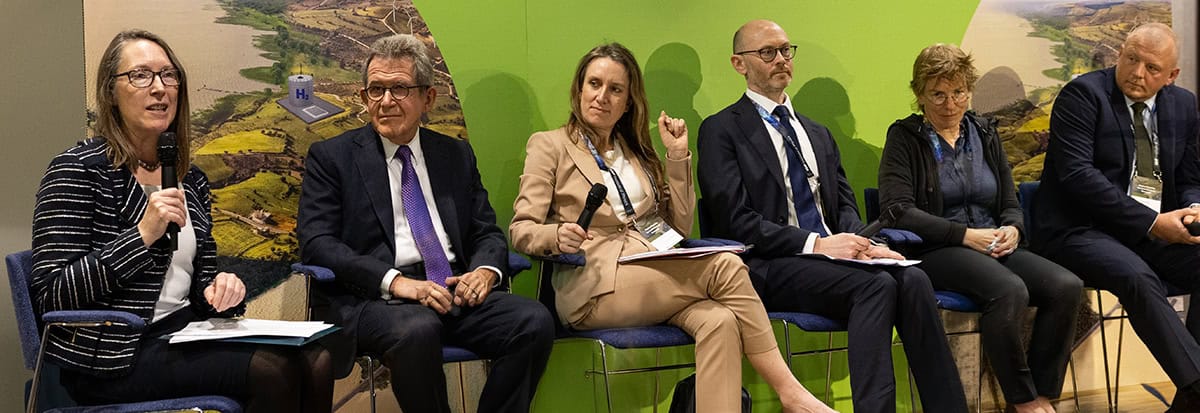
To discuss how physicists are supporting the green economy – and what more they can do – a panel debate was recently held at the IOP in central London. Attended by Prince Edward, the Duke of Edinburgh, as well as about 100 business leaders, policy chiefs, senior physicists, and IOP and IOP Publishing staff, it was chaired by Tara Shears, the IOP’s vice-president for science and innovation.
The panel featured ex-BP boss John Browne, who now works in green energy, Emily Nurse from the UK’s Climate Change Committee, former Sizewell C energy-strategy director David Cole, solar-cell physicist Jenny Nelson from Imperial College, and Nellie Technologies founder Stephen Milburn. The following is an edited extract of the discussion.
Physicists for a greener future
Green game-changers Tara Shears (far left) chairing the panel debate at the Institute of Physics in London on how physics can support the green economy. It featured (from left to right) John Browne, Emily Nurse, David Cole, Jenny Nelson and Stephen Milburn. (Courtesy: Carmen Valino)
John Browne is chair of BeyondNetZero, a climate-growth equity venture firm. He was group chief executive of energy giant BP from 1995–2007, having joined the firm in 1966 after studying natural sciences.
Emily Nurse, who was originally an experimental particle physicist, is the director of net zero at the UK’s Climate Change Committee, which advises the UK government on reducing emissions and adapting to the impacts of climate change.
David Cole, an engineer by training, was at the time of the discussion director of energy strategy at the Sizewell C nuclear-power plant, which is being built in Suffolk in the UK. When complete, it is expected to meet up to 7% of the UK’s total electricity demand. He is now executive president, consulting, at energy firm Wood.
Stephen Milburn is a physicist who is founder and chief executive of the firm Nellie Technologies in South Wales. It removes carbon dioxide form the atmosphere using biomass, which can then be used as animal feed or construction material.
What role are physicists currently playing in our quest for a greener economy?
John Browne: I made a wonderful decision 60 years ago, when I was 18, which was to read physics. After graduating, I became an engineer, but over the last 30 years physics has come back in to my life as I’ve found myself doing something very important – trying to get to net zero. Physics, you see, touches absolutely everything.
All that I’ve ever done – whether it’s renewable energy or “old energy” [fossil fuels] in my old life – starts with physics. Whether you’re involved in chemistry, biology, electronics or engineering, it could not exist without a much deeper understanding of physics. We have to make sure everybody knows that – but I don’t think people currently do. They tend to think engineering is the only enabler for commercialization, but physics is there.
Emily Nurse: I started out as a particle physicist working at CERN on the Large Hadron Collider but for the last four years, I’ve been involved in climate policy and now work with the UK’s Climate Change Committee. We are the UK government’s official advisers on its climate targets – and assessing progress towards meeting those targets. As we celebrate global decarbonization to date, we need to remember it’s all underpinned by physics.
Take the rise of solar power for example, which has been the fastest growing source of global electricity generation for the last 20 years in a row. Solar installations in 2024 were double those in 2022. Along with wind, solar has led to a reduction in electricity from fossil fuels. We’re seeing the costs of solar plummeting and they just keep falling further.
In the UK, solar power has been growing more slowly, but it’s starting to pick up and is going to be a really important part of the electricity mix. We’ve also got a lot of wind here in the UK – it’s a very windy island after all. I would also like to give a shout out to heat pumps: as a physicist, how can you not love their efficiency?
David Cole: I am an engineer, not a physicist, but I’ve spent my career in lots of different sectors and been fascinated with the role that energy plays in creating a better society. What’s really interesting at Sizewell C is the ownership structure, which involves both state and private investment. It’s the first time private investment has been used for a new nuclear build in the UK.
I hope it leads to a virtuous circle, in which the more plants we build, the more we can reap from that investment
David Cole
Getting this hybrid financial structure over the line was not trivial – it took a lot of effort – but I think it will drive great performance. We’re also trying to use as much UK content in the plants as possible, whether that’s materials, skills or technology. I hope it leads to a virtuous circle, in which the more plants we build, the more we can reap from that investment. Sizewell C will, in other words, bring down energy costs, which is fundamental to economic growth.
Jenny Nelson: I have been active in research into solar photovoltaic (PV) materials and devices for over 30 years and we should celebrate how much has happened in the field during that time. In the last 10 years, we have seen capacity increase globally by more than a factor of 10, we’ve seen the efficiency of solar cells increase, and we’ve seen the cost come down almost by a factor of eight, all of which is remarkable.
Those innovations are firmly rooted in physics – whether it’s changes in device structure… or of the optical properties of materials
Jenny Nelson
The cheapest form of electricity globally, in other words, is now from solar PV, which was not the case 30 years ago. These developments have come partly from economies of scale and partly from technological innovations that have now fed through into production. Those innovations are firmly rooted in physics – whether it’s changes in device structure due to our understanding of semiconductor physics or new developments in the optical properties of materials.
The next generation of PV cells, which are likely to be silicon-based tandem devices, will also depend on scientific breakthroughs and innovations.
Stephen Milburn: I’m chief executive of Nellie Technologies, which is based in South Wales on the site of a former chemical-weapons storage facility. We’re using biomass waste for removing atmospheric carbon dioxide, and if you visit us, you’ll see all kinds of activity: in one corner there’s chemistry, in another engineering and in the next there’s biology and biochemistry. But physics is at the heart of the technology. Physicists are a bit arrogant when we say we think we can do everything, but the fact is we probably can.
But we should also celebrate the work that has gone on to create a market in which carbon-emission credits can be bought and sold. Trading carbon credits has been a bit of a dark activity over the last 10 years, with double counting and bad things happening purely by firms wishing to make a profit. However, the market does have the power to regulate itself – in fact the alignment we’re starting to see between the UK and the EU will help greatly.
Challenging times Technologies to store, generate or transmit energy are rooted in physics. (Courtesy: iStock/Galeanu Mihai)
What are the biggest growth opportunities for the green-economy sector?
John Browne: First, we can do much more with what we’ve already got – for example we could increase our offshore wind or rethink whether we should go back into onshore wind. Second, we can improve what we’re doing – for instance, by increasing the efficiency of solar panels to their theoretical maximum, which would make rooftop solar economically attractive. Third, there are new opportunities, such as metallic organic frameworks and nuclear fusion.
What we do here in the UK needs to move the needle globally, which means thinking about how to scale and finance it properly
John Browne
However, the UK needs to avoid doing things that others are doing much better. The race for the best battery in the world is, for example, probably going to be won elsewhere. What we do here in the UK needs to move the needle globally, which means thinking about how to scale and finance it properly. The UK shouldn’t end up as a secondary player.
Emily Nurse: The UK has made a lot of progress in our quest to reach net zero by 2050. Since 1990, for example, we’ve halved our carbon emissions, mainly by decarbonizing electricity – phasing out coal, reducing gas generation, while significantly increasing wind, solar and other renewables. Electricity generation now accounts for only around 7% of UK emissions, which are dominated by transport (cars and vans) and heating (oil and gas boilers).
Reducing emissions still further will predominantly come from moving to electric technologies, including electric vehicles and heat pumps, and by further decarbonizing the electricity supply. There will be a backbone of wind and solar, but to ensure a secure supply, we’ll need nuclear, carbon capture and storage, hydrogen and batteries. We’ll have to reduce emissions from agriculture and land use too.
A report from the Confederation of British Industry (CBI) last year estimated that the net-zero economy grew by 10% in 2024, which is three times faster than the rest of the UK. But we’ll need more innovations to continue to bring costs down – and we’ll also need to provide incentives to boost the take-up of electric technologies. If we do that, there’ll be an overall saving to the UK economy in about 15 years’ time, our analysis suggests. There are huge opportunities for green growth to come from this investment.
David Cole: I agree that for the UK to be competitive, the cost of energy has to come down – not just for domestic customers but businesses too. In fact, there are two main opportunities First, we have to adopt a “whole-systems” approach. If we’re building a power station, for example, can we use every bit to its maximum potential?
Let’s say I’m running a direct air-capture plant operating at 25–30 ºC – can I use the waste flow from my coolant system to encourage new industries? Can it support nearby hydrogen generation plants or companies making, say, synthetic aviation fuel? Those questions involve thinking about physics and engineering as well as materials science, which is also super important.
Whichever way you look at it, we’re talking about building a lot of hardware, which involves materials. How much energy per unit mass are they using? Can we recycle those materials? What can we do with the waste products? Ultimately, what is really important is energy security: where does your energy come from, who made it and what impact does it have on the environment?
Jenny Nelson: The net-zero economy is growing significantly faster than the rest of the economy and I think that will continue. But decarbonizing the power sector only addresses part of the problem and we’re going to see a big transition across the rest of industry, agriculture and elsewhere that will generate a wide range of opportunities and stimulate the economy too. I’m not just talking about rolling out more renewables, but about integration – bringing together the generation and storage of energy, ensuring that we are managing demands and have the right infrastructure.
As for my area of photovoltaics, we’ve seen great ideas and technologies come out of the UK that are very likely going to be developed outside the UK because the manufacturing capacity isn’t here. Nevertheless, those ideas and innovations can still benefit the country through licensing, partial manufacturing and new technology.
One thing to remember about solar power is it’s distributed. You can have solar generation without being connected to the grid. That not only opens some markets for certain applications where you want to generate electricity locally, but it also provides a route to energy security through back-up generation, towards which solar power will be an important part.
Stephen Milburn: Having a strong green-technology manufacturing base is a huge opportunity for the UK. My company is based in South Wales, where we have lots of highly skilled people who used to work in traditional industries but now don’t have many places to go. Yes, there’s a fantastic semiconductor industry here, but when it comes to deploying green technology we cannot outsource that responsibility to other parts of the world.
Green tech needs to be deployed in the UK’s industrial heartlands… if we don’t nurture jobs and skills here there’s a real risk they will be gone forever
Stephen Milburn
Green tech needs to be deployed in the UK’s industrial heartlands to take advantage of the skills we already have, but which we are at risk of losing. In fact, if we don’t nurture those jobs and skills here there’s a real risk they will be gone forever. Having a strong green-technology manufacturing base is a huge opportunity for the UK.
Deep thinkers Combining analytical minds with great problem-solving skills, physicists are well placed to tackle the challenges of climate change. (Courtesy: iStock/MTStock Studio)
What needs to happen so that these opportunities can be put into practice?
Stephen Milburn: Many science graduates leave university equipped with solid academic rigour and a great scientific understanding, but they often lack practical green-technology skills. This summer my company is therefore hoping to launch a climate apprenticeship programme, which will allow graduates to pick up those skills. We need to build green-tech skills in the real economy, in particular those that will deal with climate change.
Jenny Nelson: The UK must do more to support its own innovations. We need better regulations to avoid unnecessary bottlenecks. We need to invest in infrastructure like the grid. We should completely avoid subsidizing fossil fuels and instead divert any subsidies into alternative economies. Finally, we need to train and educate people, showing the public the potential of green technology so that they become part of the transition, for example by generating their own electricity.
David Cole: We need to integrate our policies on industry, energy, land use and AI so that we can invest in them all as growth areas. In particular, I’d like to see a long-term nuclear programme in which we build a fleet of new reactors all of the same design, which will drive down costs by letting us replicate a particular technology. It’s also vital that we get a high proportion of UK content and technology into these reactors, which will lead to a virtuous circle, with money coming back into the economy that we can re-invest in industrial and academic partnerships.
Emily Nurse: What’s vital is consistency in policies; we need certainty. In the UK, we are fortunate to have world-leading climate legislation in the form of the 2008 Climate Change Act, which does not just make it a legal requirement to reach net zero by 2050 but also gives us targets along the way. It means we know what we need to do in both the medium- and long-term, which gives certainty to investors, businesses, innovators and consumers.
What’s really important is communication – supporting communities through the transition and making sure they realize the benefits
Emily Nurse
So the first thing we need to do is keep the Climate Change Act. Then, of course, we’ve got to address barriers to delivery, including having the right incentives to electrify the economy. And what’s really important is communication – supporting communities through the transition and making sure they realize the benefits, not just in terms of reducing carbon production but of having cleaner, better and more efficient technologies too.
John Browne: First, we must never stop investing in people who can discover things and translate them into real commercial products. Second, we need to understand how to scale things, which means focusing on the winners and getting rid of things that are “nice to have” but aren’t going anywhere. That’s not easy because you have to push people to say, “You’ve done great work, but you’ll have to stop”.
What’s more, to scale new technology, people have to learn what it takes. When I’m in the US, I often speak to chief executives who can explain their technology to the financier who’s supporting it, whereas here in the UK that often doesn’t happen.
Third, we need to maintain confidence in what we’re doing. I often talk to people who think that it’ll be really expensive to get to net zero, but in fact estimates suggest that each household would only have to spend an average of about £150 a year to get there. So it’ll be less than the cost of a TV licence to get to net zero.
Of course the investment needed will be “lumpy” – it’s not as simple as just levying a fee – but the point about governments is that they can smooth things out. That is what they have done in the past and it’s what they should continue to do.
For more information about the IOP’s work on the green economy, click here. You can also keep up to date with the all latest research in the field through IOP Publishing’s series of open-access Environmental Research Journals at this link.

 Login