❌

Normal view

Original Sony PlayStation 2 security chip ‘broken wide open’ after 26 years — chemical decapping and four years of reverse engineering unlocks MechaCon secrets

16 September 2026 at 11:30

The ‘magic security chip’ inside the original PlayStation 2 has been successfully reverse-engineered and dumped. Canadian retro hardware and software enthusiast DiscoStarslayer was the manic mind behind the cracking open of the CXP102064 MechaCon chip, which arrived inside the ‘PS2 Fat’ from 1999. It took “four years of effort” to reach this stage, but this milestone should be a boon to hardware preservation, repair, and emulation projects.

After 4 years of effort, I'm happy to announce that one of the final secrets of the PS2 has been broken wide open!It's been a long process of decapping, optical dumping, and now at last a software solution.Thank you Libby for finding the exploit from our dirty optical dumps! pic.twitter.com/VrsCH8I35CSeptember 13, 2026

The Mechacon got its name from its primary duty of controlling the PS2’s optical and flash drive mechanics. It also played a significant part in Sony’s game optical disc security, supporting “Magic Gate [memory card] and KELF file [executable] decryption among other things,” notes the PSDev Wiki. Unlocking the secret workings of such chips can be important to those involved in video game preservation. So, many people will appreciate DiscoStarslayer’s work in reverse engineering and dumping one of the PS2’s last remaining secrets.

As per the social media post, the arduous task of breaking the MechaCon’s security took four years. Some of the reverse engineering tricks utilized by DiscoStarslayer include chemically decapping the CXP102064 to expose the die, then using microscopes and optical dumping skills to analyze the silicon chip circuitry. In this case, a lucky break during the hacking apparently uncovered an exploit that provided a method whereby the chip’s data could be extracted through software.

With this achievement unlocked, the game/hardware preservation and programming communities can look forward to improved emulation and homebrew developments. It should also open up possibilities for replacing the aging optical drives in PS2 consoles.

Beyond the confines of PS2 Fat consoles, some social media commenters noted that the MechaCon was also used in a handful of arcade machines from the era. Specifically, the Namco System 246 and System 256, as well as the Konami Python 1, which used modified PS2 hardware, used the MechaCon firmware to authenticate security and allow the execution of encrypted game data.

Minecraft Legacy gets rewritten in C++ for PS2 and Wii ports — code is tuned so it works well even on the PS2’s meager 32MB of RAM

15 September 2026 at 11:30

Games optimization specialist OptiProjects (AKA OptiJeugos) has released a new port of Minecraft Legacy for the Sony PlayStation 2 and Nintendo Wii consoles. The project is based on the Minecraft Java 1.2.5 source code, rewritten in C++, and using a recreated legacy console interface (machine translation). Even on the quarter-century-old PS2 with its cramped 32MB of RAM, the OptiCraft Heritage Edition runs at 15-30 fps. Check out the video demo embedded below.

TERMINADO!!! FINALMENTE NUEVO PORT DE ""MINECRAFT LEGACY"" a PS2 y WII!!Es un PORT de JAVA 1.2.5 a C++ con la interfaz de Legacy recreada, corriendo nativamente en la PS2 y Wii.Probado en hardware real! La wii soporta online con servidores de JAVA en esa version! https://t.co/x3pQw8XvBJ pic.twitter.com/nZNc0QehGySeptember 14, 2026

Minecraft is one of the best-selling games of all time, with sales above $400 million according to an Entertainment Weekly report earlier this year. Meanwhile, the PS2 is the best-selling home console in history, with 160 million units shifted worldwide. When Minecraft first launched, the PS2 had already been kicking around for close to a decade and was rapidly reaching retirement age. Thus the Minecraft PS2 game release was never a thing (it did launch on PS3 in 2013-14). Similarly, the Wii got overlooked by Minecraft's publishers, with the Wii U only getting the game in late 2014.

Windows PC (Java Edition 1.2.5)

PS2 (OptiCraft Heritage)

Wii (OptiCraft Heritage)

Engine / Language

Java

C++ (native port)

C++ (native port)

Hardware / RAM

Min. ~2GB recommended for era

32MB system RAM

~88MB available RAM

Chunks / draw distance

Scalable, (usually 8–16+ chunks)

2 chunks

4 chunks

Performance

Often 60+ FPS on period PCs

15–30 FPS

15–60 FPS

Controls

Keyboard + mouse

DualShock 2

Wii Remote / Classic Controller

Interface

Original 1.2.5 UI

Recreated Legacy interface

Recreated Legacy interface

Ponder over the features and performance comparison table we have nailed together, above. You can see how tightly the PS2 version is constrained by its hardware limitations. In comparison the Wii version is significantly more comfortable. Moreover, the Wii version has experimental online gaming functionality.

Minecraft Legacy for the Sony PlayStation 2 and Nintendo Wii
OptiProjects
Minecraft Legacy for the Sony PlayStation 2 and Nintendo Wii
OptiProjects

If you are interested in enjoying some retro Minecrafting on your old PS2 or Wii, or emulators for either system head on over to the official OptiProjects page linked top for your downloads. Those aiming to play on original hardware will need to be able to load .ELF files from USB (on PS2), or access the game via SD card and the Homebrew Channel (on Wii). To my knowledge that means your PS2 or Wii must be soft or hard modded to play homebrew code.

Need for Speed Underground 2 now runs directly on Nintendo Switch — other Classic Windows titles playable thanks to custom firmware boot

14 September 2026 at 14:36

Retro gaming fans who own Nintendo Switch consoles now have several classic Windows titles they can now enjoy. A video shared on Twitter/X shows the well-loved Need for Speed Underground 2 running pretty smoothly on Nintendo’s hybrid device. Meanwhile, a forum about Wine-NX says that Quake III and OpenTTD are also playable, with WarCraft III nearly ready, too. It's early days for this 'experimental' software, but things look very promising.

Windows x86 games are now running directly on Nintendo Switch homebrewNeed for Speed Underground 2 on capture 😀 pic.twitter.com/SD0sugV4DsSeptember 13, 2026

In the embedded video you can see NFSU2 runs rather well on Nintendo’s hardware. Older PC games are perhaps a good fit for what many consider to be the rather anemic specs of the Switch. A status panel shows CPU and GPU usage. According to the forum post “Races run at roughly 20–45 fps at default detail with the CPU overclocked.”

Other games that Wine-NX can handle well at this time include OpenTTD (Transport Tycoon Deluxe), which runs at up to 60 fps. Quake III Arena is also capable of running at around 37 fps at 1,280 x 720 pixels, according to the source. The last PC game mentioned as being compatible, almost, is WarCraft III, and specifically this work in progress has working “menus, campaigns, and now cutscenes.”

The Wine-NX forum page linked to helpfully explains what exactly this is, and how it works. In brief, Wine-NX is a port of Wine 11 to the Switch’s native Horizon OS. It comes as a homebrew package in the NRO format Horizon expects games to be in, but that allows it to run Windows programs and games with Box64's ARM64 dynarec translating the x86 code. Graphics are handled through Mesa 20.1's nouveau driver. It supports audio and touchscreen, and the Switch controllers can also handle mouse / keyboard duties – as well as doubling as an Xbox 360 controller.

You can’t use any Nintendo Switch to load Wine-NX and Windows PC games. You’ll need to have a console that can boost custom firmware, and run homebrew NROs. That means an older unpatched Switch or one with a hardware mod.

Meta Quest user vibe-codes 3D object throwing to 3D printer — ‘I've never felt more like Tony Stark’ says the software engineer

14 September 2026 at 12:17

A software engineer and creative tinkerer has shown off a futuristic Meta Quest plus 3D printer workflow in a video shared on social media. Hank on X demonstrates modeling a 3D object on his computer, which he then picks up and throws to his 3D printing system across the room. “I've never felt more like Tony Stark,” joked the tech enthusiast.

I've never felt more like Tony Stark than I do now. Using my Meta Quest, I can just throw 3D models at my 3D printers to have them start printing it😂 pic.twitter.com/xNTe4KAVM2September 13, 2026

Let’s look more closely at the hardware in use before talking about the integration in play. The demonstration video clearly shows that Hank has a Bambu Lab P2S 3D printer with an AMS 2 multi-material system on top. We reviewed the Bambu Lab P2S with AMS2 last October, and gave it a pretty glowing 4.5/5 review score thanks to lots of features and factors in its favor. Hank has integrated this 3D printer with his Meta Quest 3 headset. We last reviewed one of these HMDs back in December 2024 when we tested the Quest 3S, and it was also a 4.5/5 star winner.

So, these two great pieces of hardware don’t usually work together, but that didn’t deter Hank. Not much anyway. Later in the tweet thread, Hank reveals that “The Bambu Lab printers have an API that you can use to control them locally! [So I] Spun up a quick web server on my PC that glued everything together! (Android app -> PC -> 3D printer).”

Of course, other Bambu Lab 3D printer users with Meta Quest headsets were interested in following in Hank’s footsteps. The software engineer said that the integration was finessed with the help of OpenAI’s GPT-6 Astra model (so, yes, it’s vibe coded), but wasn’t available on GitHub as yet. However, our 3D printing-in-VR hero indicated that they would be happy to share the code online if there was enough interest (and after a bit of code polishing).

We've entered the golden era of gaming. I had GPT-6 Astra reverse engineer Super Smash Bros Melee to work on my Meta Quest 3 with VR controls. I'll post my first real battle in the replies https://t.co/vDHsPTPOmM pic.twitter.com/abJvxHU5KfSeptember 9, 2026

Hank’s tweets are full of interesting projects mixing VR and vibe coding. In another noteworthy post (embedded above), he shows he used Astra to get the recently released Super Smash Bros Melee decompilation to work on the Meta Quest 3 with VR controls.

Dumpster diver builds home lab Proxmox server from weekly landfill runs for SSDs, HDDs, GPUs, and even RAM — weekly e-waste raids net multi-drive Proxmox server and Asus ROG laptop

14 September 2026 at 11:00

A tech enthusiast says that they managed to put together a home lab-worthy Proxmox server using PC parts scavenged from the nearby county landfill. Furthermore, Tsuto told fellow Redditors that they now routinely raid the dump’s separate electronics recycling area once a week. We can’t blame them; their gallery of liberated hardware includes plenty of valuable trinkets like SSDs, HDDs, GPUs, even RAM, complete laptops, and more.

The county landfill has a separate bin for electronics and I’ve taken to raiding it once a week to scavenge for parts for my labs.
 from r/homelab

‘It’s wild what people throw away these days,’ says the successful tech scavenger. Tsuto seems to admit that many of the bits and pieces are “on the older end,” but even folks paying cold, hard cash at retail in 2026 are competing for components like RTX 3060s, AM4 motherboards/CPUs, and DDR4. That’s how hard the components shortage is hitting folks.

Tsuto also seems rather pleased with an Asus ROG laptop found at the landfill site. “The Asus ROG laptop just needed a $25 battery off Amazon and still has decent enough specs for casual gaming for my son,” they comment. Pixel peeping Tsuto’s gallery indicates that this portable gaming laptop packs an Intel Core i7-4710HQ (4C/8T) supported by 16GB of RAM, and allied with a GeForce GTX 860M 2GB GPU. It will be playing less demanding titles such as Stumble Guys, we see.

In a follow-up post, the Redditor explains that one of their home lab projects that has been built from the dumpster finds includes a Proxmox server. It’s a dusty-looking machine (it’s a shame Tsuto hasn’t found an air duster yet?), but it is ample for their needs. The ‘new’ Proxmox machine is said to pack in “Two mirrored 256GB SSDs for the OS, one extra 1TB SSD for fast storage, and three 2TB HDDs in RAID1 for ZFS storage.”

Despite the lavish tech finds from this landfill, Tsuto says they actually bought some key components off Amazon to finalize the system – a Core i7-7700 and 64GB of RAM. We hope the RAM wasn’t bought in recent months, with the prices as they are.

Where I live, you might as well rob a bank as try and swipe electronics from the local council recycling centers. There’s security and cameras around these trash = treasure hoards, which can be particularly appealing to folks who appreciate retro computing.

Bernie Sanders proposes 20 year prison sentence for AI devs who plow ahead with Artificial Superintelligence plans — penalty on par with illegally developing rogue nuclear weapons

13 September 2026 at 15:10

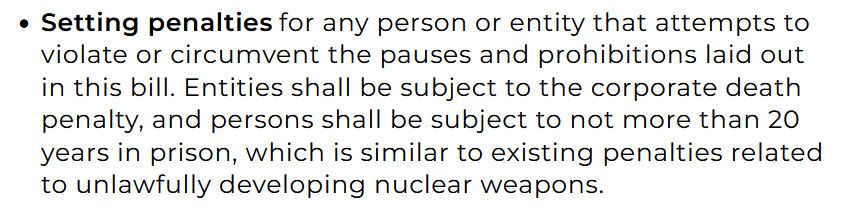
Senators Bernie Sanders and Greg Cezar have announced their Ban Artificial Superintelligence Act. Seeking to pause advanced AI development, the legislation’s stick is pretty severe. Penalties facing entities/developers who violate the pauses and prohibitions in the bill could face up to 20 years in prison. That’s a sentence on a par with someone found guilty of designing a rogue nuclear weapon.

Ban Artificial Superintelligence Act wording on penalties

(Image credit: Ban Artificial Superintelligence Act)

The news is suddenly filled with grave concerns about AI becoming too powerful. It could even threaten the future of humanity. Moreover, it might surprise casual observers that AI industry leaders like Sam Altman, Dario Amodei, and Elon Musk appear to agree. With this threat on the horizon, politicians are keen to introduce legislation to protect the citizens they serve.

According to USA Today, the Sanders bill “is the most extreme AI-related legislation to date.” It likely faces strong opposition in Congress, particularly among enterprise-supporting Democrats and Trump-aligned Republicans. However, with recent statements from industry leaders seemingly harmonizing with calls to slow down AI development and in favor of greater oversight/regulation, we could see politicians agree on something for a change.

Back to the Ban Artificial Superintelligence and Temporarily Pause Advanced AI Development bill and its specific wording, we note that it is advised that the government set up a new cabinet-level federal agency "to safeguard the public from the dangers of artificial intelligence, including by enforcing a prohibition on artificial superintelligence." As well as setting harsh penalties in the U.S., it is proposed that work be done to "ban superintelligence around the world" via international agreements, allied coordination, and so on.

Full speed ahead, or hit the brakes?

There remain plenty of interesting arguments on both sides of the AI progress divide. It is difficult to argue that the U.S. shouldn’t keep going as fast as it can, as a matter of national security, for example. On the other hand, the whole of humanity being wiped from the face of the Earth by opening Pandora’s AI box of tricks makes geopolitical concerns seem like minor grumbles.

We’ve seen some other theories about why the AI barons are suddenly in favor of regulation. Some critics say they may be running out of road, unable to balance private investments with credible paths to profitability. Thus, they now want to move away from a commercially funded model to a government-funded ‘Manhattan Project II,’ with their terrifyingly powerful AI being guarded by the state.

❌