❌

Normal view

Discovery of a Featureless Tidal Disruption Event at z ∼ 1 with the Wide Field Survey Telescope

31 July 2026 at 17:00
Jiazheng Zhu et al 2026 ApJL 1004 L10
Discovered just 6 billion years after the Big Bang, AT2025wet is the highest-redshift non-jetted tidal disruption event known, allowing researchers to probe the missing-energy puzzle.

The post Discovery of a Featureless Tidal Disruption Event at <em>z</em> ∼ 1 with the Wide Field Survey Telescope appeared first on AAS Nova.

Spying on a Split Comet

31 July 2026 at 17:00

240P

Traversing through the solar system, a comet split in two, and a recent study used six months of observations to investigate when and why.

A Split Comet

Orbit map

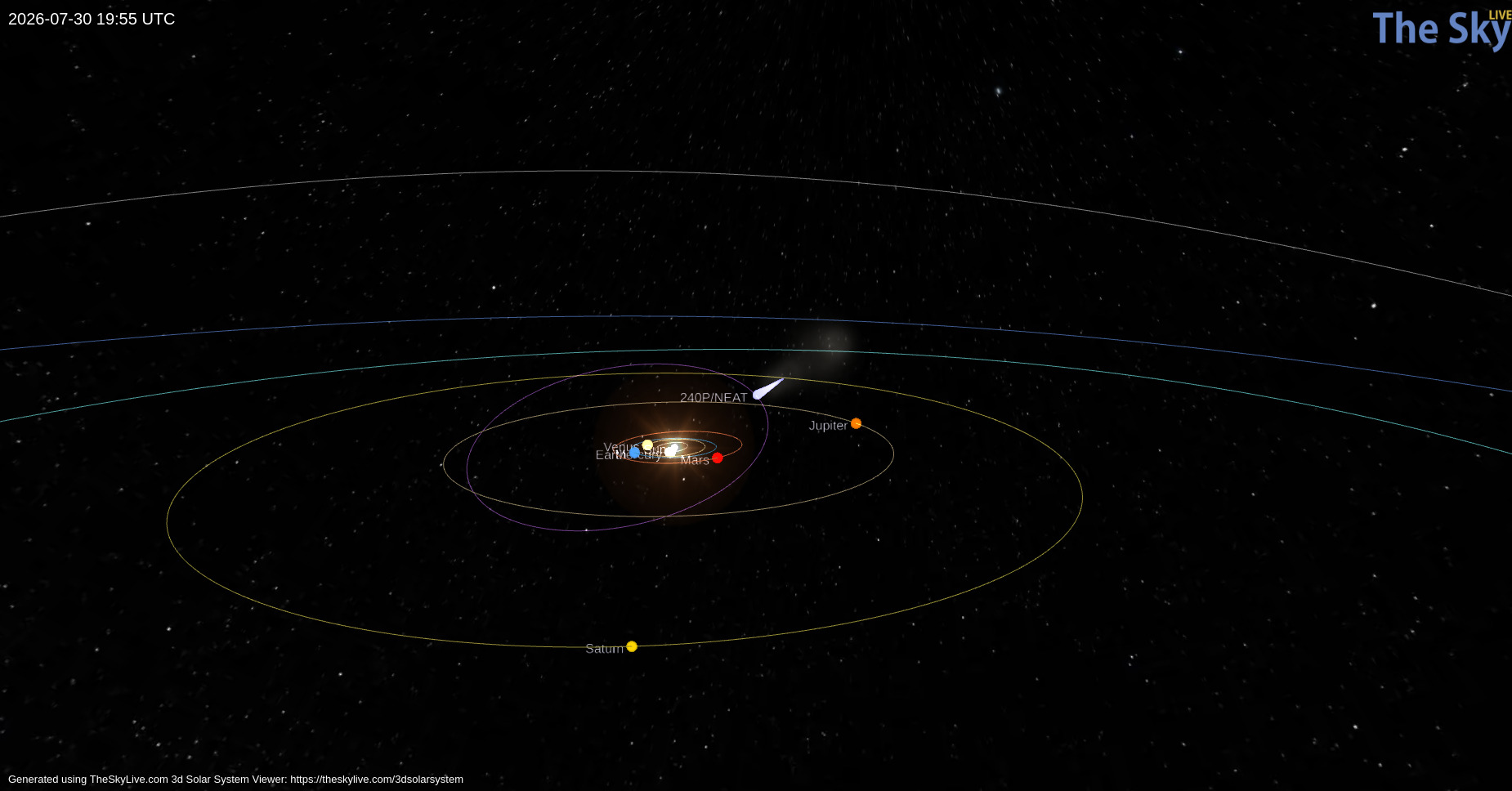
Orbital path of 240P/NEAT (purple) and the position of the comet on 30 July 2026 (light blue teardrop). Click to enlarge. [TheSkyLive]

While we often think of comets as icy remnants of the solar system’s formation that populate the Kuiper Belt and Oort Cloud, some comets make their homes closer to the Sun. One such class, known as Jupiter-family comets, traveled from the Kuiper Belt to short orbital periods (less than 20 years) whose paths through the solar system are shaped by Jupiter’s gravity. Discovered in 2002, 240P/NEAT is a Jupiter-family comet that loops between Jupiter and Mars on a 7.6-year orbit. Making close approaches to Jupiter, 240P experiences frequent, strong interactions with the gas giant that can alter the comet’s orbit and cause sudden bursts in brightness as ice and dust are heated and outgassed from the comet’s surface.

Most recently, 240P swept closest to Jupiter in July 2007, shifting the comet’s perihelion distance (closest approach to the Sun) from 2.5 to 2.1 au, and several long-lived bursts in brightness in 2018/2019 could have been spurred by this orbital shift. Excitingly, a fainter comoving object, 240P-B, was first reported in June 2025 as the comet headed toward perihelion — at some point recently, 240P had split in two!

Over the last century, numerous split comets have been recorded, but detailed physical studies of these objects are rare. With growing evidence suggesting splitting and disintegration are the primary mechanisms of comet destruction, understanding the properties and cause of 240P’s split is imperative.

Observing 240P

With 240P on the move to perihelion, David Jewitt (University of California, Los Angeles) and collaborators monitored the comet from October 2025 to April 2026 to establish the likely cause of its split. Employing the Alhambra Faint Object Spectrograph and Camera on the 2.56-meter Nordic Optical Telescope, the authors obtained detailed imaging of the comet from two months before to four months after perihelion to characterize both components.

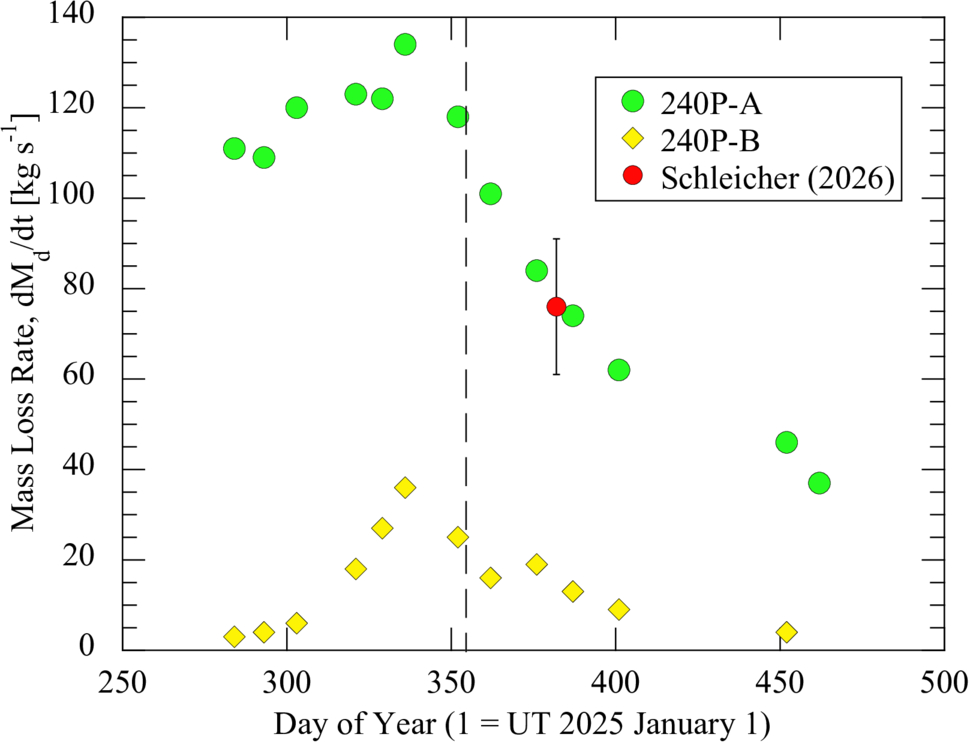
Tracking both photometric and morphological changes across their observations, the authors estimated the dust-loss rates, physical sizes, and separation speed of 240P-A and 240P-B. The brighter component, 240P-A, has an estimated radius between 400 and 600 meters and a dust-loss rate almost four times higher than 240P-B. Because 240P-B is fainter, its radius is harder to constrain observationally. From its lower dust-loss rate and lower brightness, the authors estimated a radius around 300 meters (and no smaller than 50). Based on how the separation of the two comet pieces changes over time, the authors determined that the split of 240P occurred at least three years before their observations.

dust mass-loss

Dust mass-loss rates for 240P-A (green circles) and 240P-B (yellow diamonds) over the course of the observations. Both components peak shortly before perihelion (dashed vertical line). Click to enlarge. [Jewitt et al 2026]

Source of the Split

How exactly did this fragmented comet get this way? The authors considered a number of comet-splitting mechanisms: tidal forces, asteroid impact, pressure buildup below the comet’s surface, thermal stresses, and rotational instability. Given the comet’s orbit, it has not had close enough encounters with the Sun or other planets for tidal forces to be the culprit, and it traverses well above the asteroid belt, avoiding collisions. Pressure buildup and thermal stresses can fracture comets, but both are unlikely to launch such a large fragment as seen in this system.

This leaves rotational instability as the likely source of 240P’s split. Outgassing torques lead to rotational instability, especially in subkilometer comets like 240P, and 240P has exhibited recent outgassing. In addition, the separation speed between the 240P components is comparable to the escape speed of the primary comet, which is expected for rotational breakup. To confirm this hypothesis, future observations measuring the rotation period of 240P are necessary, but this study adds to the small number of split-comet observations that aid in understanding comet destruction.

Citation

“Investigation of Split Comet 240P/NEAT,” David Jewitt et al AJ 172 113. doi:10.3847/1538-3881/ae83ac

The post Spying on a Split Comet appeared first on AAS Nova.

Disk Lifetime Distribution as a Function of the Mass of Host Star

30 July 2026 at 17:00
Susanne Pfalzner et al 2026 ApJ 1003 119
The disks around young high-mass stars survive for roughly 3.72 million years, and those around low-mass stars survive for 7.20 million years, though the distributions for both populations are quite broad.

The post Disk Lifetime Distribution as a Function of the Mass of Host Star appeared first on AAS Nova.

Monthly Roundup: The Fourth Catalog of Gravitational Wave Events from LIGO, Virgo, and KAGRA

29 July 2026 at 17:00

Illustration of gravitational waves emanating from a pair of black holes approaching a merger

A recent Focus Issue of the Astrophysical Journal Letters describes the fourth version of the catalog of gravitational wave events (GWTC-4.0) from the Laser Interferometer Gravitational Wave Observatory (LIGO), the Virgo interferometer, and the Kamioka Gravitational Wave Detector (KAGRA).

This catalog contains transient gravitational wave events recorded through January 2024, during the observatories’ fourth observing run, which concluded in November 2025. GWTC-4.0 displays the results of significant improvements to our suite of gravitational wave detectors, including higher-powered lasers and reduced quantum noise. A fifth catalog of gravitational wave events was released in Spring 2026, with the accompanying scientific articles being submitted to the Astrophysical Journal and the Astrophysical Journal Letters.

This Monthly Roundup consists of short descriptions of each of the currently published research articles in the LIGO–Virgo–KAGRA Gravitational Wave Transient Catalog (GWTC): Release 4 Focus Issue. Each snippet links to the corresponding research article, and the Focus Issue landing page is linked at the bottom of this post. Be sure to revisit the landing page to catch new articles as they’re published!

Introducing GWTC-4.0

timeline of gravitational wave observatories' observing runs

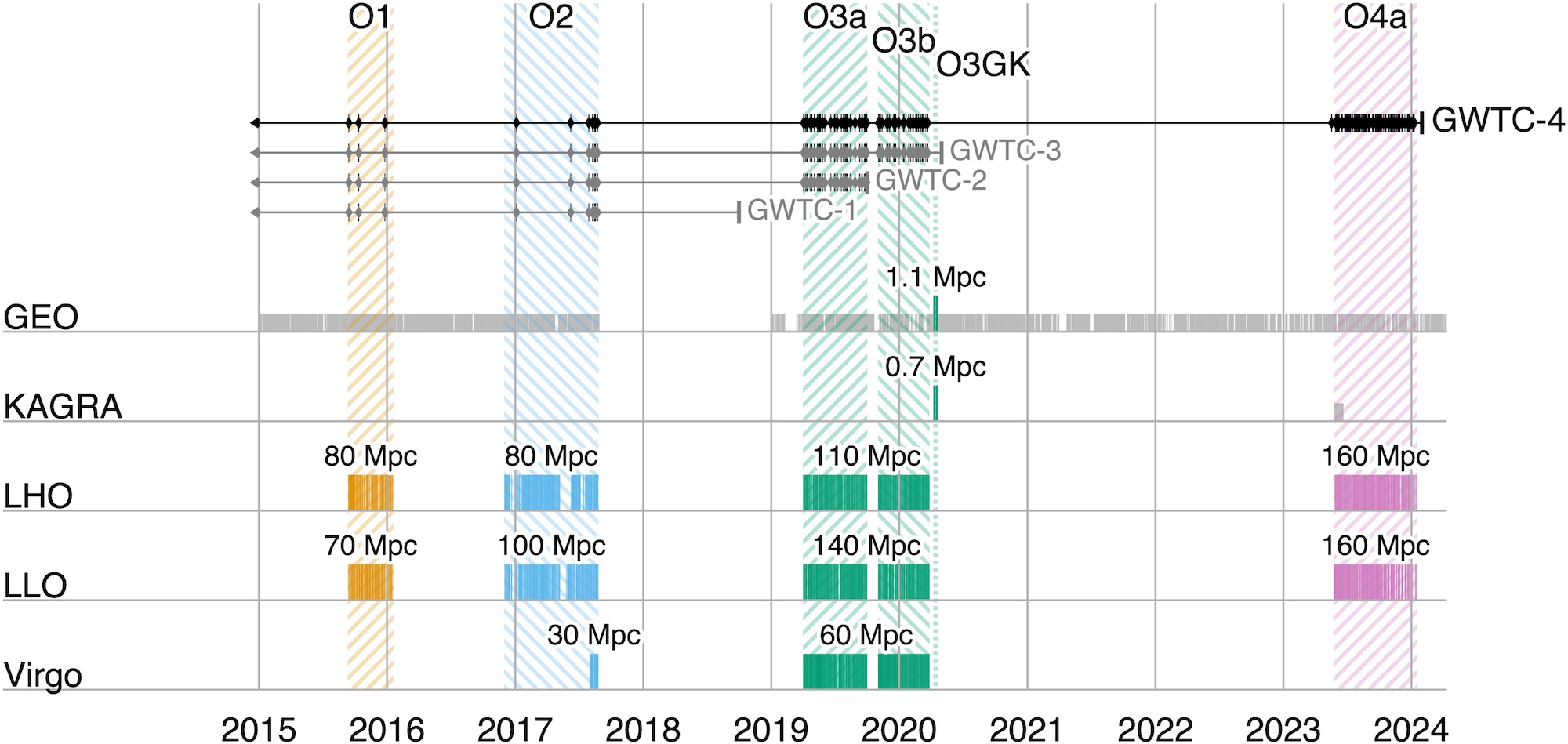
A timeline showing observing runs between 2015 and 2024. Click to enlarge. [LVK Collaboration 2025]

First up, the collaboration orients the reader to many important aspects of the catalog and the articles contained in the Focus Issue. This article describes how four detectors, each with two arms 3–4 kilometers long, monitor gravitational waves from Hanford, Washington; Livingston, Louisiana; Santo Stefano a Macerata, Italy; and Hida, Japan. These detectors work in concert, ready to receive signals from the universe during coordinated observing runs separated by periods of downtime for construction and commissioning. During these pauses, a smaller instrument, the German–British GEO600 gravitational wave detector, has kept an ear out for signals and will continue to do so until the end of 2026.

After these detectors record subtle spacetime squiggles from compact objects colliding millions to billions of light-years away, the collaboration converts the raw signals into the data contained in catalogs like GWTC-4.0. This process involves modeling the gravitational wave signals, filtering them to identify candidate transients, and pinpointing the most significant events.

After collecting and cleaning the signals, the collaboration undertakes a critical step: making their data accessible to researchers and the public. The data are available through the Gravitational Wave Open Science Center, and the Focus Issue article on open data describes how to navigate the online portal, how the datasets archived online are structured, and how the data were calibrated.

Science Results

This fourth version of the gravitational wave transient catalog greatly expands the sample of gravitational wave transients recorded by detectors across the globe. Including events from previous catalogs, GWTC-4.0 brings us to 218 events for which the probability of the source being astrophysical in nature is more than 50% and for which there is little chance of the signal being an instrumental artifact. This represents a more than 100% increase in the number of recorded gravitational wave events fulfilling this criterion, broadening our understanding of colliding compact object pairs. This release also includes some superlative signals, such as the most massive black hole binary with a low false-alarm rate and the highest signal-to-noise ratio for a gravitational wave event thus far.

Detected in November 2023 by both LIGO Hanford and LIGO Livingston, GW231123 is in many ways an exceptional gravitational wave transient. The total mass of the merging components appears to be between 190 and 265 solar masses, and the false-alarm rate for this signal is less than one per year. This makes it the most massive merger event with such a low false-alarm probability. The two components also appear to have high spins, which complicates the interpretation of the signal with existing models. A binary black hole merger in which one or more components lies within the pair-instability mass gap is the likeliest explanation for this signal, but the authors also present alternative scenarios, such as a core-collapse supernova or a gravitationally lensed gravitational wave signal.

GW230814 gravitational wave signal

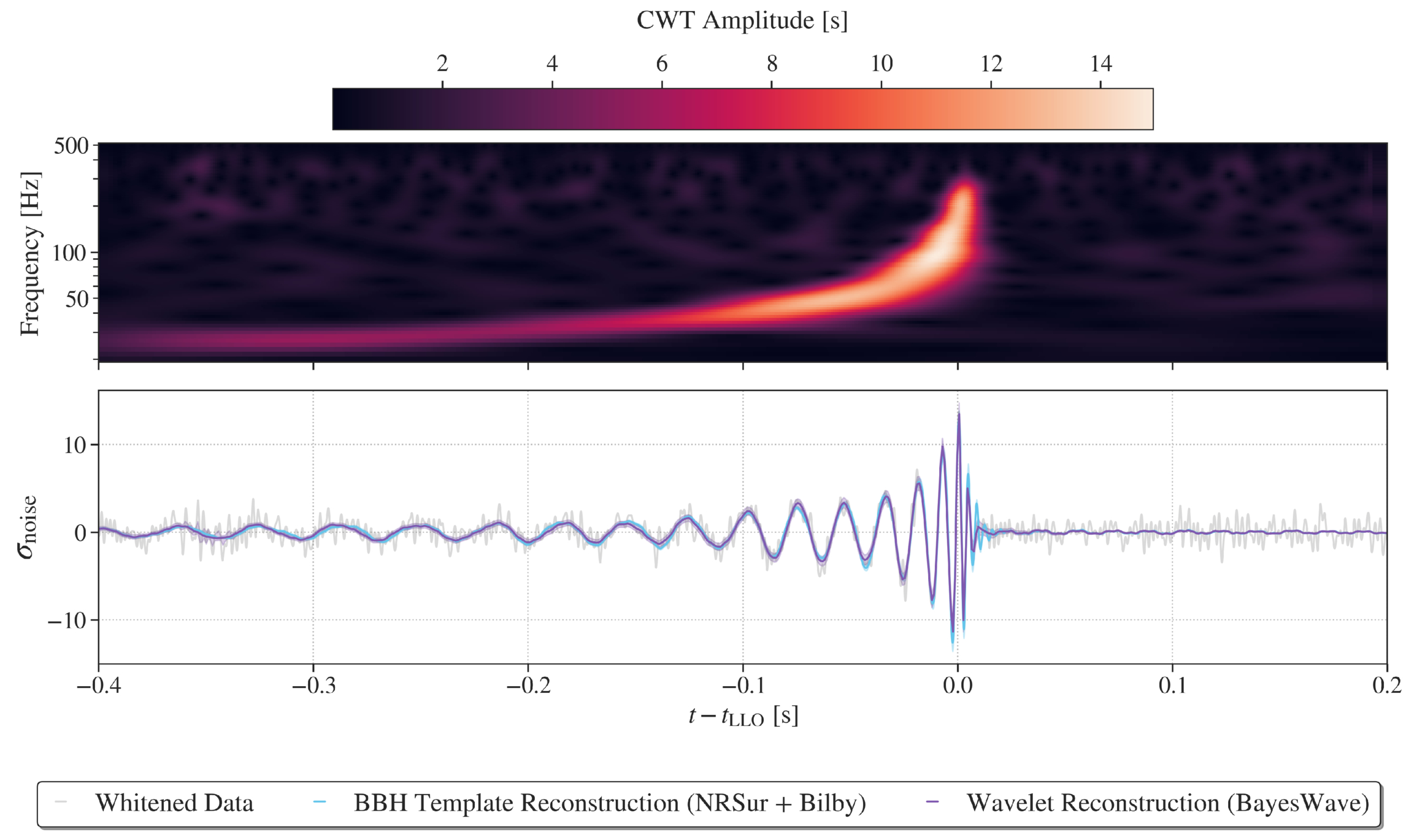
Representations of the GW230814 gravitational wave signal. Click to enlarge. [LVK Collaboration 2026]

GW230814, which was detected only by LIGO Livingston, is the loudest signal in the catalog. This signal is consistent with the collision of two black holes, each of roughly 30 solar masses. During the analysis of this signal, the team discovered potential deviations from the predictions of general relativity in the ringdown phase, when the remnant black hole settles into its final shape. Without a detection from another facility to corroborate this finding, it’s difficult to pinpoint the cause of the deviation, but the team could not rule out statistical noise fluctuations as the source.
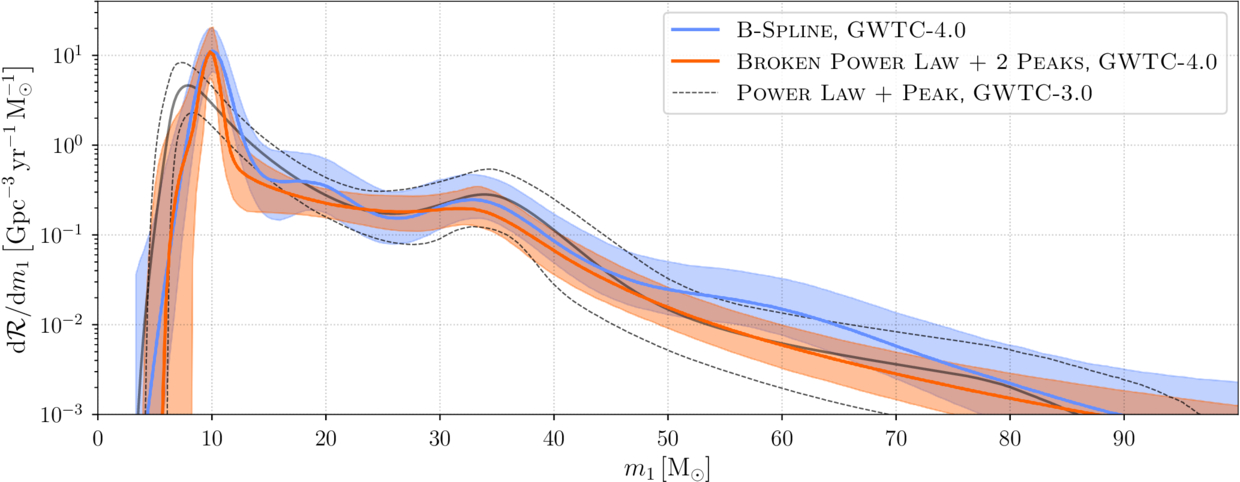
Plot of the differential merger rate

Plot of the differential merger rate as a function of the mass of the more massive of the two merger components. This shows overdensities at 10, 35, and possibly 20 solar masses. Click to enlarge. [LVK Collaboration 2026]

Surveying merging black holes and neutron stars on the population level, the team analyzed 158 gravitational wave signals from the current catalog. This analysis supported findings from previous transient catalogs, including multiple overdensities in the distribution of merging black hole masses, broadly distributed neutron star masses, and an increase in the merger rate with redshift. The new data strengthened certain previously identified trends, such as an increase in the width of the effective spin distribution with redshift, and weakened others.

The full list of articles in the GWTC-4.0 Focus Issue can be found here.

Citation

“GWTC-4.0: An Introduction to Version 4.0 of the Gravitational-Wave Transient Catalog,” A. G. Abac et al 2025 ApJL 995 L18. doi:10.3847/2041-8213/ae0c06

“GWTC-4.0: Methods for Identifying and Characterizing Gravitational-Wave Transients,” A. G. Abac et al 2026 ApJL 1004 L21. doi:10.3847/2041-8213/ae447b

“Open Data from LIGO, Virgo, and KAGRA Through the First Part of the Fourth Observing Run,” A. G. Abac et al 2026 ApJ 1004 232. doi:10.3847/1538-4357/ae211e

“GWTC-4.0: Updating the Gravitational-Wave Transient Catalog with Observations from the First Part of the Fourth LIGO–Virgo–KAGRA Observing Run,” A. G. Abac et al 2026 ApJL 1004 L22. doi:10.3847/2041-8213/ae2c74

“GW231123: A Binary Black Hole Merger with Total Mass 190–265 M⊙,” A. G. Abac et al 2025 ApJL993 L25. doi:10.3847/2041-8213/ae0c9c

“GW230814: Investigation of a Loud Gravitational-Wave Signal Observed with a Single Detector,” A. G. Abac et al 2026 ApJL 1004 L23. doi:10.3847/2041-8213/ae2ad3

“GWTC-4.0: Population Properties of Merging Compact Binaries,” A. G. Abac et al 2026 ApJL 1005 L51. doi:10.3847/2041-8213/ae771e

The post Monthly Roundup: The Fourth Catalog of Gravitational Wave Events from LIGO, Virgo, and KAGRA appeared first on AAS Nova.

A Natural ≳100× Telescope: Discovery of the Strongly Lensed Type II SN 2025mkn at z = 1.37

29 July 2026 at 17:00
Cameron Lemon et al 2026 ApJL 1003 L47
Researchers have discovered a supernova that occurred when the universe was roughly 5 billion years old; if the supernova’s luminosity is similar to that of nearby events, it must have been magnified by a factor of 250.

The post A Natural ≳100× Telescope: Discovery of the Strongly Lensed Type II SN 2025mkn at <em>z</em> = 1.37 appeared first on AAS Nova.

Magnetic Activity in X-Ray Stars from eROSITA: Insights from the TESS and LAMOST Surveys

28 July 2026 at 17:00
Lulu Xu et al 2026 ApJS 284 54
Of 7,229 flares from 1,430 stars, most came from stars with temperatures below 4000K and rotation periods shorter than 4 days; most flares lasted less than 2 hours.

The post Magnetic Activity in X-Ray Stars from eROSITA: Insights from the TESS and LAMOST Surveys appeared first on AAS Nova.

The “Rhythm” of the Interstellar Medium

28 July 2026 at 17:00

Messier 17

Editor’s Note: Astrobites is a graduate-student-run organization that digests astrophysical literature for undergraduate students. As part of the partnership between the AAS and astrobites, we occasionally repost astrobites content here at AAS Nova. We hope you enjoy this post from astrobites; the original can be viewed at astrobites.org.

Title: The Rhythm of the ISM: Tracing the Timescales of Gas Evolution and Star Formation Across Galactic Environments
Authors: Zuzanna Kocjan and Vadim A. Semenov
First Author’s Institution: University of Maryland
Status: Published in ApJ

The Connection Between Gas and Star Formation in Galaxies

Stars are born in the interstellar medium (ISM) when cold, dense clouds of gas become unstable and collapse under gravity. Despite their plentiful reservoirs of gas, galaxies convert only a small fraction of this material into stars, making star formation a surprisingly inefficient process. A key factor behind this inefficiency is stellar feedback: radiation, stellar winds, and supernova explosions from young stars can inject energy and momentum into the surrounding gas, heating, stirring, and dispersing it. In this way, stellar feedback shapes future star formation across scales ranging from individual regions in the ISM to whole galaxies.

An important tool astronomers use to study star formation is the Kennicutt–Schmidt relation, which links the amount of gas in a galaxy to the rate at which stars form. More specifically, it relates the gas surface density, Σgas, to the star formation rate surface density, ΣSFR. (For more on this relation, see this Astrobites article on a classic research article.) However, this law is underpinned by a crucial ingredient: timescales. In particular, the pace of star formation depends both on how quickly galactic gas is cycled into star-forming material and on how rapidly those regions convert gas into stars once they form. Today’s article investigates the physical origin of star-formation scaling relations behind the Kennicutt–Schmidt law by building on a simple theoretical framework for the ISM.

Consider a Kettle of Boiling Water…

In a given region of a galaxy, the ISM consists of gas in either an actively star-forming state or an inert, non-star-forming state, depending on whether it is dense and unstable enough to collapse (as illustrated in Figure 1). The transition of non-star-forming gas into the star-forming state occurs on the supply timescale, τ+. Conversely, the dispersal of star-forming gas back into a non-star-forming state is characterized by the removal timescale, τ–. As a helpful analogy, the authors compare this process to water boiling in a kettle: the ISM is continuously “boiling,” with gas moving between active and inactive states. Meanwhile, the total gas reservoir gradually decreases, analogous to water slowly evaporating as the kettle boils. The gas depletion time, τ*, therefore represents the timescale over which the available gas would be exhausted by star formation.

Schematic of the gas cycling framework

Figure 1: Schematic of the gas cycling framework used in the authors’ theoretical model for how gas is converted into stars, which takes into account a supply, removal, and depletion timescale. [Adapted from Kocjan and Semenov 2026]

Building on this picture of gas cycling, the authors turn to simulated galaxies, where the motion and evolution of the gas can be followed directly. By tracking how gas flows through the ISM in the simulations, they derive the three characteristic timescales above — τ+, τ–, and τ* — that describe how gas is supplied to, removed from, and ultimately consumed by star formation. The goal is to connect the small-scale physics of the ISM to the large-scale star formation efficiencies and scaling relations observed across galaxies.

The Timescales of the Interstellar Medium

To explore how gas and star formation are connected across different galactic environments, the authors analyze three simulated systems: a dwarf galaxy, a Milky Way–like galaxy, and a gas-rich starburst galaxy, as shown in Figure 2. Despite spanning very different physical regimes, the galaxies exhibit remarkably similar trends in the fraction of gas actively forming stars as a function of Σgas​. This suggests that the amount of star-forming gas is governed primarily by local interstellar conditions, since regions with higher gas surface densities tend to contain denser, more strongly self-gravitating gas.

galaxy simulations and star-forming gas fraction

Figure 2: Using simulations (left to right) of an isolated intermediate-mass dwarf galaxy, Milky Way–like galaxy, and gas-rich galaxy, the authors measure the star-forming gas fraction versus the gas surface density (right). [Adapted from Kocjan and Semenov 2026]

To further understand this trend, this study then applies the authors’ theoretical framework to determine the timescales of ISM gas cycling on the scales of individual star-forming regions. These include the timescales for the formation, dispersal, and local depletion of star-forming gas as described above: τ+, τ−, and τ∗, which also exhibit strong correlations with the gas surface density (see Figure 3). Specifically, the timescale for supplying gas into the star-forming state is linked to the rate at which turbulence redistributes material through the galactic disk. The depletion timescale, over which star-forming gas is turned into stars, decreases at higher Σgas​, since denser regions more efficiently collapse and form stars. By contrast, the removal timescale is comparatively short, reflecting how quickly feedback and changes in local equilibrium can disrupt star-forming clouds. In this way, the “boiling kettle” framework is able to capture the major processes driving small-scale gas evolution.
Scaling relations between the supply, depletion, and removal times

Figure 3: Scaling relations between the supply (left), depletion (middle), and removal (right) times in kiloparsec-scale regions of the simulated galaxies (shown in different colors). Based on the measurements from the simulations, the authors introduce a parameterized model for the gas cycling framework, as defined in the equations. [Adapted from Kocjan and Semenov 2026]

The cycling of gas through different phases of the ISM offers a useful framework for understanding how galaxies form stars. In the relatively well-ordered systems studied here, this balance can be described in simple terms; however, it is likely to become more complex in extreme environments where additional physical processes — such as those operating in the early stages of galaxy formation — play a significant role. Even so, these results highlight how key galactic properties can emerge naturally from the interplay between galaxy-scale dynamics, ISM turbulence, and the state of star-forming gas.

Original astrobite edited by Jayde Willingham.

About the author, Shalini Kurinchi-Vendhan:

After studying astrophysics and literature at Caltech, I moved onto a Fulbright Fellowship in Heidelberg, Germany. I’m passionate about using computer simulations to explore supermassive black holes and galaxy evolution — but I also love poetry and traveling.

The post The “Rhythm” of the Interstellar Medium appeared first on AAS Nova.

First-Generation Stars Provide Better Fit than a Black Hole for Early-Universe Gas Clump

27 July 2026 at 17:00

Star formation in the early universe.

An unusual clump of gas 450 million years after the Big Bang may contain stars hailing from the universe’s elusive first generation of stars. New research examines an alternative explanation involving an accreting black hole.

Meet Hebe

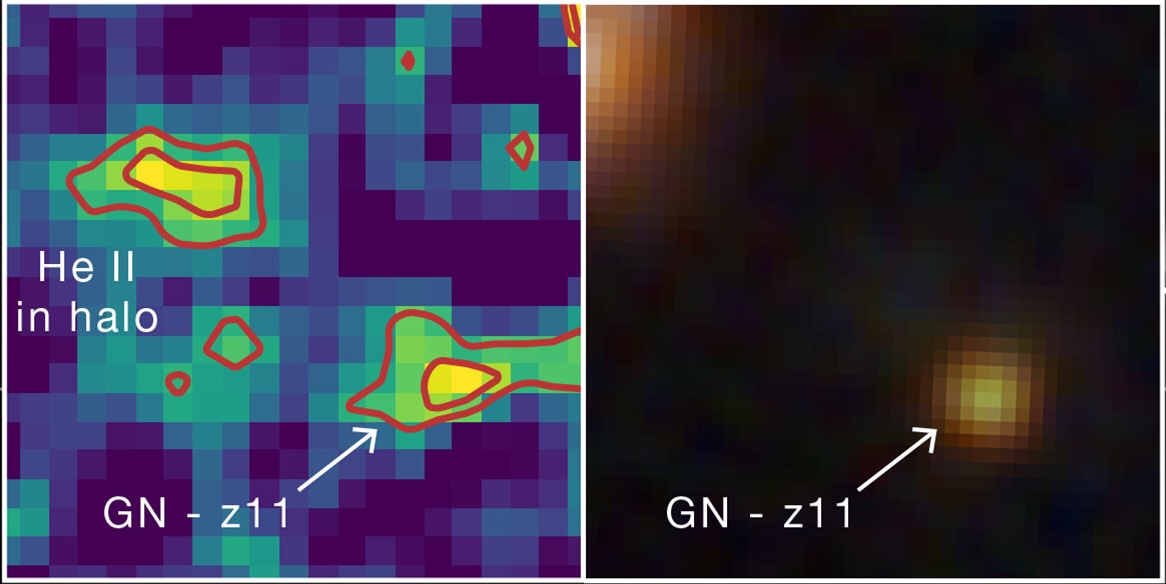
Hebe and GN-z11

Hebe is visible in the image on the left as a prominent blob of helium emission up and to the left from GN-z11, a luminous galaxy hosting an accreting supermassive black hole. On the right is an infrared image of the same region, in which Hebe is not visible. Click to enlarge. [Adapted from NASA, ESA, CSA, Ralf Crawford (STScI)]

Initially spotted in 2024, an early-universe gas clump nicknamed Hebe has now been identified as a possible hiding place of Population III (Pop III) stars — the universe’s first generation of stars. Pop III stars are thought to be massive and chemically pristine, containing only hydrogen, helium, and a whisper of lithium. This exciting hypothesis was prompted by the detection of recombination lines from helium, which could be ionized by the high-energy radiation of the first stars.

Before the community settles on this exciting explanation, however, the hypothesis must withstand all the tests astronomers can throw at it. In a recent research article, Junehyoung Jeon, Tae Bong Jeong, and Saiyang Zhang (The University of Texas at Austin) along with Volker Bromm (The University of Texas at Austin) attempted to explain Hebe’s properties in another way.

Considering Alternatives

Hebe glows with distinctive helium emission that requires a source of high-energy radiation. This radiation could be provided by a cluster of Pop III stars, but it could also, in theory, arise from an accreting supermassive black hole embedded within the gas clump.

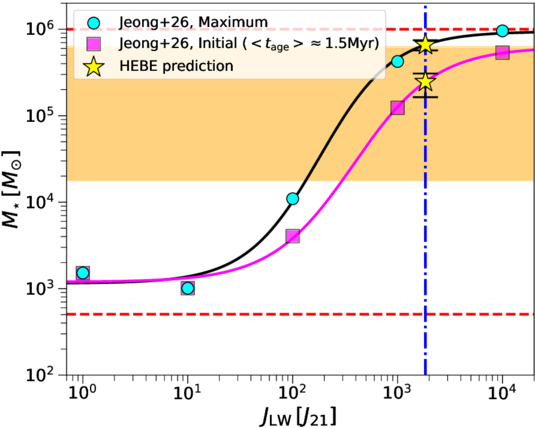
predicted Pop III star mass in Hebe

Predicted total mass of Hebe’s Pop III stars as a function of the Lyman–Werner flux from the nearby galaxy GN-z11. Click to enlarge. [Jeon et al. 2026]

The authors used models to explore both possibilities. For the first scenario, in which the telltale helium emission is driven by a cluster of Pop III stars, the team calculated the maximum possible mass of the cluster, which sets how much high-energy radiation is produced. The cluster mass is moderated by high-energy radiation from another source: GN-z11, a starburst galaxy situated about 10,000 light-years from Hebe. For the second scenario, the team modeled the spectral energy distribution arising from a supermassive black hole — either a direct-collapse black hole or a primordial black hole — accreting pristine gas from the surrounding cloud.

Still a Leading Explanation

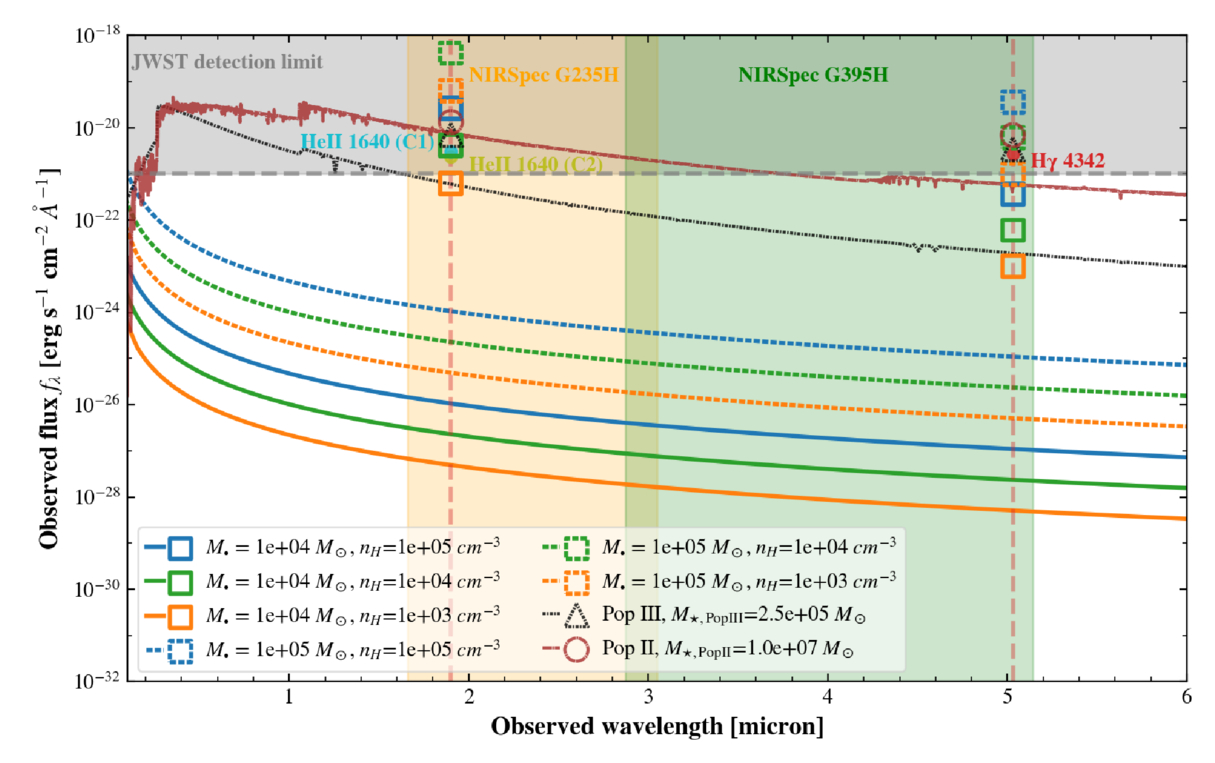
While the black hole scenario could, with reasonable black hole masses, gas densities, and accretion rates, reproduce individual flux measurements drawn from JWST observations, this hypothesis struggled to simultaneously match multiple measurements. The Pop III star cluster scenario, with a cluster mass of a few hundred thousand solar masses, provided the best fit to the JWST data.

modeled spectral energy distributions for Hebe based on the black hole or Pop III star hypotheses

Modeled spectral energy distributions (lines) and predicted line flux densities (open symbols) for the accreting black hole, Pop III star, and Pop II (second-generation) star hypotheses. The observed JWST line fluxes are shown as filled circles. Click to enlarge. [Jeon et al. 2026]

As a final test, the team introduced a third possibility involving a population of second-generation stars, which are more chemically enriched than Pop III stars. While this model fit well, the number of stars necessary to match the data — roughly 10 million — would produce a stellar continuum detectable (but so far not seen) by JWST.

While a cluster of Pop III stars is still the leading explanation for Hebe’s properties, the team noted that the Pop III star and black hole hypotheses aren’t mutually exclusive; Hebe could very well harbor a primordial black hole and a smattering of Pop III stars. Regardless of what powers its characteristic helium emission, Hebe offers an enticing glimpse into the early universe, and more work is needed to understand this intriguing object.

Citation

“What Is Powering the Enigmatic He II Emitter Hebe: The First Stars or Black Holes?” Junehyoung Jeon et al 2026 ApJ 1006 27. doi:10.3847/1538-4357/ae7bea

The post First-Generation Stars Provide Better Fit than a Black Hole for Early-Universe Gas Clump appeared first on AAS Nova.

Trends in the Population of Binary Black Holes Following the Fourth Gravitational-Wave Transient Catalog: A Data-Driven Analysis

27 July 2026 at 17:00
Nir Guttman et al 2026 ApJ 996 144
An analysis of the fourth gravitational wave catalog supports the existence of a gap at 45 solar masses in the secondary black hole mass distribution, among other findings.

The post Trends in the Population of Binary Black Holes Following the Fourth Gravitational-Wave Transient Catalog: A Data-Driven Analysis appeared first on AAS Nova.

An Enhanced Formation Channel for Galactic Dual-Line Gravitational-Wave Sources: von Zeipel–Lidov–Kozai Effect in Triples Involving Sgr A*

24 July 2026 at 17:00
Wen-Fan Feng et al 2026 ApJL 1003 L35
According to calculations, in a 4-year period researchers may detect of order one compact binary system in which the binary’s inspiral and the spin of its neutron star component both produce gravitational waves.

The post An Enhanced Formation Channel for Galactic Dual-Line Gravitational-Wave Sources: von Zeipel–Lidov–Kozai Effect in Triples Involving Sgr A* appeared first on AAS Nova.

Noble Gases Along for the Ride

24 July 2026 at 17:00

A rendering of an orange and grey planet against a dark background.

What can some neon trapped in a chunk of rock tell us about Earth’s formation and the protosolar nebula? Quite a lot, as detailed in a recent study in The Planetary Science Journal.

Noble Mysteries

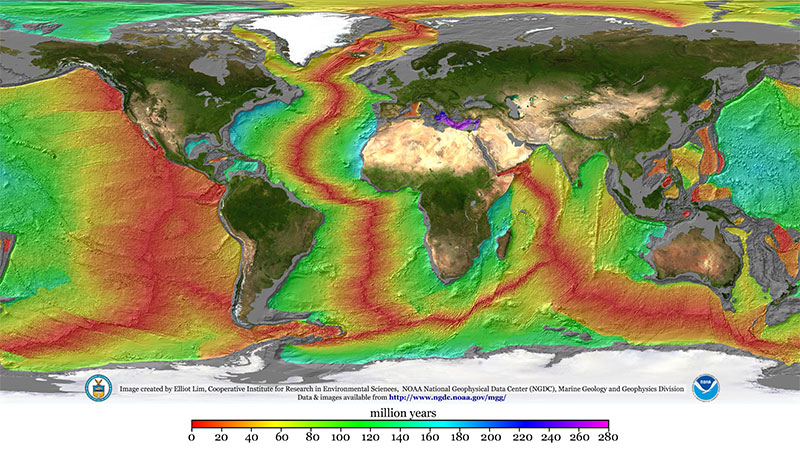
By analyzing rocks pulled from mid-ocean ridges, geologists have concluded that there are tiny amounts of noble gases in the deep interior of Earth. That’s a strange statement upon reflection: how did these gases, which are famously apathetic to essentially all other elements, end up embedded within rocks thousands of kilometers underground? Since their passivity rules out the potential of a chemical reaction that formed them in place, they must have been in the mantle since the very beginning of Earth’s history.

A map of Earth with the continents shown normally but the sea colored according to age.

A map illustrating the age of the seafloor. Mid-ocean ridges stand out clearly in red. By sampling material from these ridges, planetary scientists can infer the composition of Earth’s deep interior. Click to enlarge. [Mr. Elliot Lim, CIRES and NOAA/NCEI]

There are a few scenarios for how this could have happened. Though it’s possible that these inert species were delivered to the early Earth encapsulated within primitive meteorites or in solids contaminated by ions from the solar wind, at least some fraction of these elements likely came directly from the gaseous nebula that surrounded the earliest protoplanets.

That last option is especially exciting to present-day planetary scientists interested in constraining Earth’s formation history because it requires some very specific conditions. Since light noble gases like neon don’t dissolve well in seawater, they must have dissolved into a magma ocean — meaning the nebula was still around when Earth was large enough to have a molten surface. That already restricts us to a very specific time in the solar system’s history, but it doesn’t say much about the specific size of the proto-Earth other than “big,” and it doesn’t say much about the state of the nebula other than “it existed.” Recently, Vincent Savignac and Eve Lee (University of California, San Diego; McGill University) successfully refined these constraints to pin down information about both the early Earth and the nebula that surrounded it.

Infant Earths

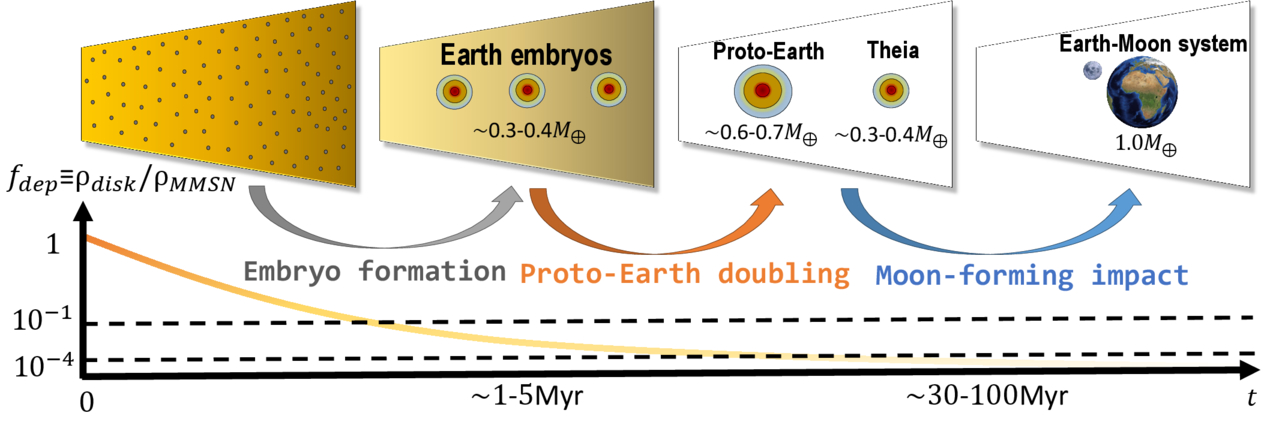
Savignac and Lee began by growing a grid of infant Earths on their computers via models of gas accretion and atmosphere–magma interactions. Each simulation started with a different proto-Earth mass and nebular density, and each one yielded a different amount of neon in Earth’s deep interior. Excitingly, only a small handful of the scenarios tested ended up with values similar to those observed.

A cartoon of small cores surrounded by gaseous envelopes eventually merging into the Earth.

A schematic of Earth’s formation via embryo formation (when the noble gases enter the mantle) followed by mergers. Click to enlarge. [Savignac & Lee 2026]

On the mass axis, the team found a narrow range of acceptable conditions. If a proto-Earth was less than about 20% of Earth’s present-day mass, it couldn’t accrete much gas. This let it cool rapidly, freezing the magma ocean and shutting down neon dissolution before too much could be trapped inside. On the other hand, if a proto-Earth was more than about 40% of Earth’s present-day mass, it would accrete too much gas, stay molten for too long, and be left with too much neon. On the density axis, the researchers found that when the nebula accreted on to the proto-Earth, it must have been fairly depleted compared to its initial density. This implies that the whole process happened at the end of the nebula’s life, just before it was completely blown away by the proto-Sun.

Savignac and Lee demonstrated that these constraints are robust against the later stages of Earth’s evolution. In its later years, Earth either suffered or benefited from a giant impact, depending on your feelings about the Moon, but the researchers showed that this event doesn’t pose a problem for their models. Overall, this study builds a delightful link between rocks from our deep oceans and the particulars of Earth’s formation, demonstrating the unique power of planetary science to tie together different scientific fields.

Citation

“Constructing the Earth’s Formation History Using Deep Mantle Noble Gas Reservoirs,” Vincent Savignac and Eve J. Lee 2026 Planet Sci. J. 7 135. doi:10.3847/PSJ/ae64f7

The post Noble Gases Along for the Ride appeared first on AAS Nova.

Trajectory-Agnostic Asteroid Detection in TESS with Deep Learning

23 July 2026 at 17:00
Brian P. Powell et al 2026 AJ 172 14
Unlike traditional “shift and stack” algorithms, a newly developed asteroid-detection method requires no assumptions on speed or direction; this method can be applied to upcoming time-domain surveys.

The post Trajectory-Agnostic Asteroid Detection in TESS with Deep Learning appeared first on AAS Nova.

Researchers Spot Hydrocarbons Surprisingly Close to a Quasar Pair

22 July 2026 at 17:00

J0749+2255

Researchers have detected molecules containing rings and chains of carbon atoms in the vicinity of a rare pair of quasars. The trends in the distribution of these molecules are unexpected, suggesting that more work is needed to understand the conditions surrounding active supermassive black holes.

Infrared Eyes on Molecules in Space

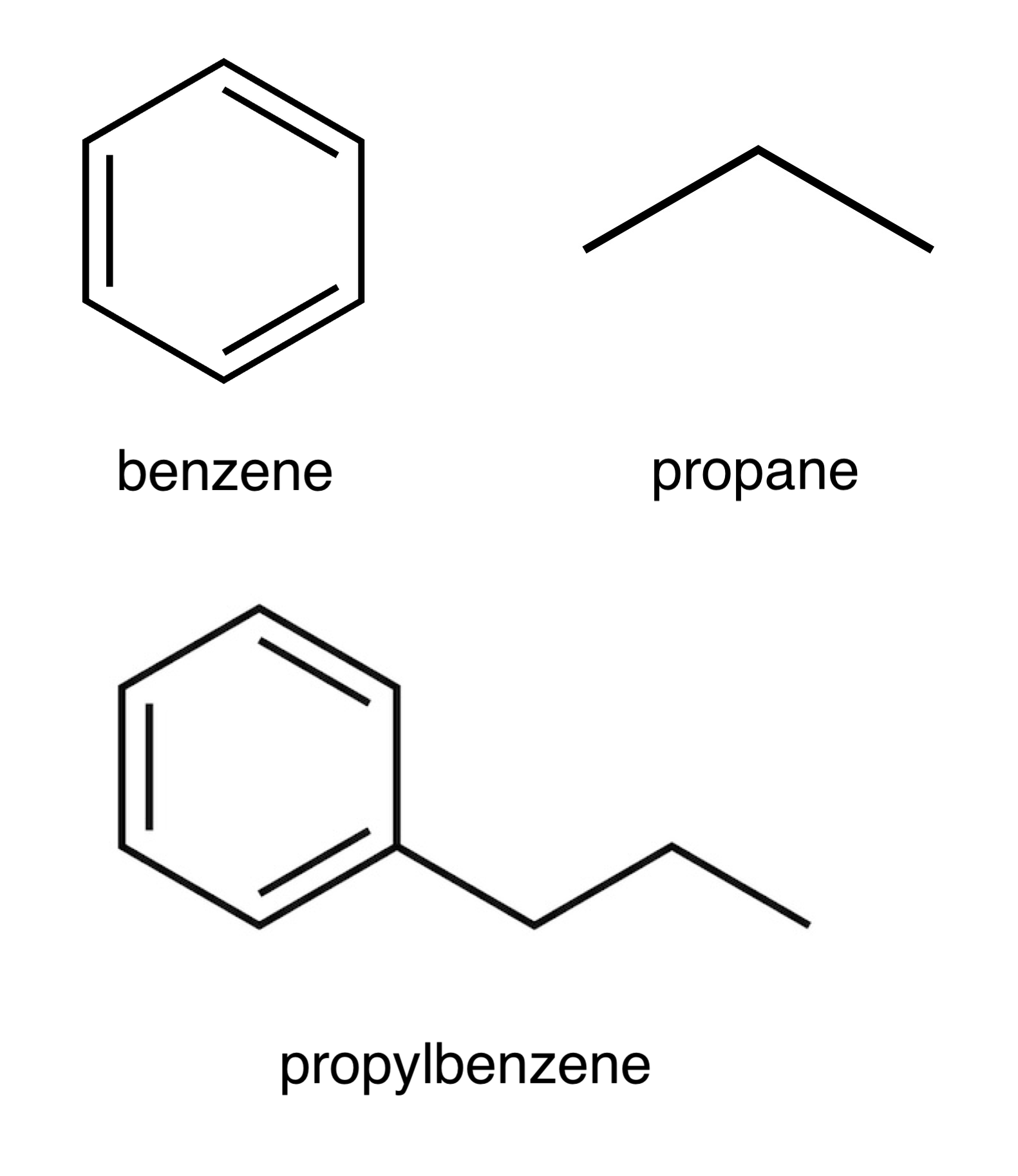
skeletal formulae of aromatic and aliphatic molecules

Examples of aromatic and aliphatic hydrocarbons. Benzene (top left) is the simplest aromatic molecule. Propane (top right) is a simple aliphatic molecule. Propylbenzene (bottom) is an aromatic molecule with an aliphatic chain branching off of it. In these “skeletal” formulae, there is a carbon atom at each vertex, and the remaining atoms (not depicted) are all hydrogens. Single lines indicate single chemical bonds, and double lines indicate double bonds. [Wikipedia; Public Domain]

Across the universe, atoms are combining to form molecules, and our ability to study molecules in distant realms has never been better. JWST is particularly attuned to emissions from molecules engaged in a kind of chemical yoga, stretching their bonds and flexing the angles between their atoms.

JWST’s sensitive infrared eyes have allowed researchers to study the distribution, creation, and destruction of both aromatic (containing one or more rings of carbon atoms in which certain electrons spread out within the ring) and aliphatic (containing chains of carbon atoms) hydrocarbons. These molecules have been spotted in a wide array of environments, and now, astronomers are finding them in more distant and more extreme environments than ever before.

Distant Discovery

SDSS J074922.96+225511.7, or J0749+2255 for short, is a quasar pair seen 3 billion years after the Big Bang. The two feasting supermassive black holes are roughly 12,000 light-years apart, giving researchers a glimpse into the late stages of a galaxy merger and a harsh environment in which to study the survival and destruction of molecules.

Researchers studying J0749+2255 with JWST have previously reported the detection of a 3.3-μm emission feature from aromatic molecules. Now, C. E. Mentzer (University of Missouri), Aigen Li (University of Missouri), and Xuejuan Yang (Xiangtan University) have analyzed JWST spectra of J0749+2255 and found not just widespread aromatic emission at a rest-frame wavelength of 3.3 μm, but also aliphatic emission at 3.4 μm, which they attribute to carbon chains branching off from the aromatic molecules. This likely makes J0749+2255 the most distant galaxy in which both aromatic and aliphatic emission has been detected.

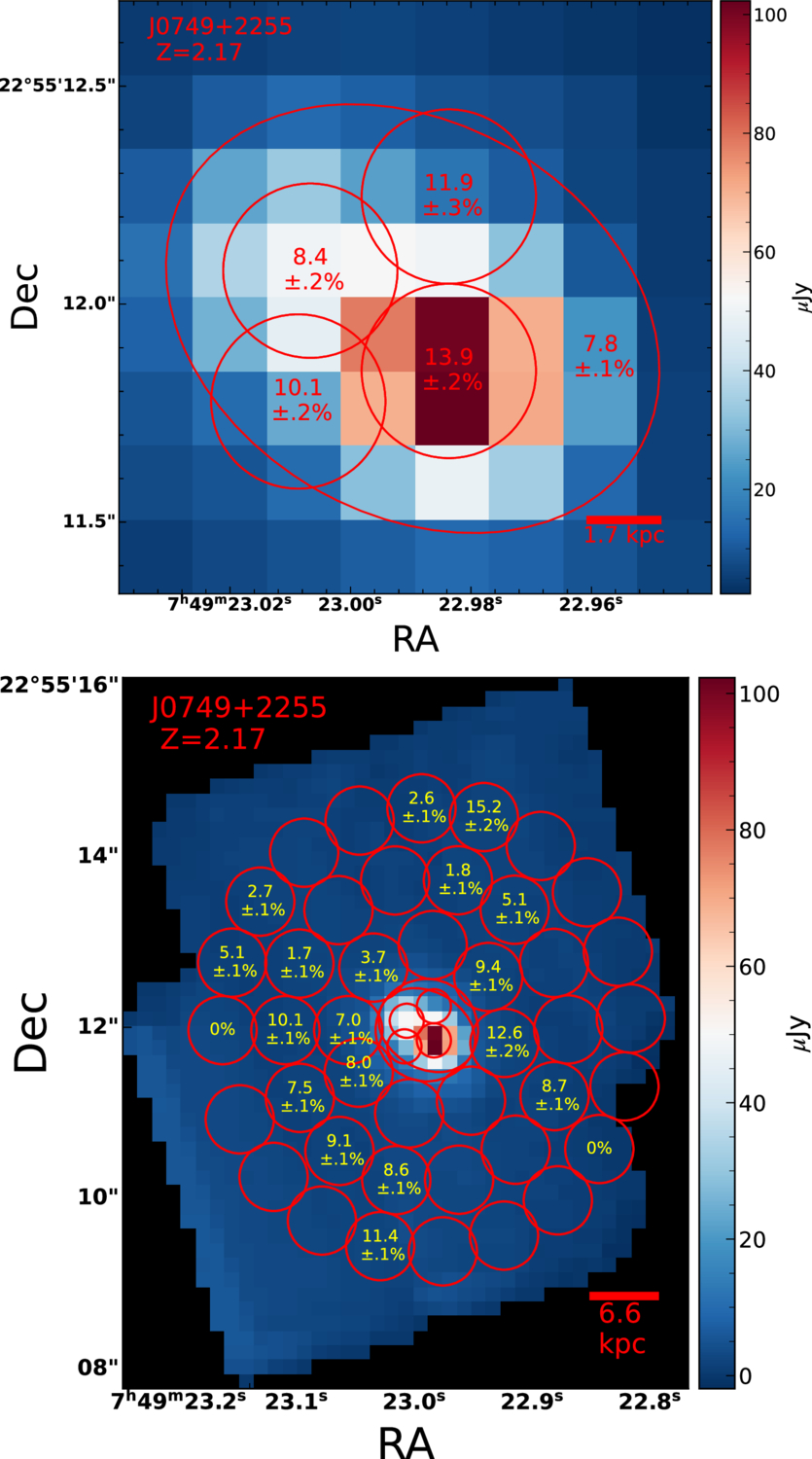
analysis results showing the aliphatic fraction across the quasars and the surrounding region

Aliphatic fractions in the bright central region surrounding the two quasars (top) and in the outer regions (bottom). [Mentzer et al. 2026]

Unexpected Trends

Mentzer, Li, and Yang subdivided the observations into 47 regions and measured the strength of the 3.3- and 3.4-μm features in each region. This analysis found strong aromatic emission nearest the quasars and showed that the fraction of carbon atoms bound up in aliphatic chains is highest close to the quasars.

Both of these findings are unexpected: the harsh radiation environment near the two active black holes is thought to break apart chains of carbon atoms attached to aromatic rings (which should decrease the 3.4-μm emission) and possibly destroy small aromatic molecules (which should decrease the 3.3-μm emission) — yet both of these features are strongest near the quasar cores where the radiation should be most capable of molecular destruction.

The authors speculated that the analysis regions centered on the quasars are large enough that they contain gas that hasn’t been pummeled by the quasars’ intense radiation and outflows, leaving molecules intact and able to produce the observed emission. However, this doesn’t explain the trend of stronger 3.3- and 3.4-μm emission closer to the quasars — necessitating further research into the emitting behavior of aromatic and aliphatic molecules under the extreme conditions of a dual quasar’s neighborhood.

Citation

“Widespread Detection of Aromatic and Aliphatic Emission in the Dual Quasar J0749+2255 at Cosmic Noon,” C. E. Mentzer et al 2026 ApJL 1005 L38. doi:10.3847/2041-8213/ae7e86

The post Researchers Spot Hydrocarbons Surprisingly Close to a Quasar Pair appeared first on AAS Nova.

Turbulence-Coupled Electrodynamics of the Martian Year 34 Global Dust Storm on Mars

22 July 2026 at 17:00
Chali Idosa Uga et al 2026 Planet. Sci. J. 7 126
Researchers show that the global martian dust storm in Mars year 34 warmed the lower atmosphere and led to greater electrical charging and stronger electric fields compared to a dust-free atmosphere.

The post Turbulence-Coupled Electrodynamics of the Martian Year 34 Global Dust Storm on Mars appeared first on AAS Nova.

What if Mars Were a Stranger (Thing)?

21 July 2026 at 17:00

Mars from Mars Global Surveyor

Editor’s Note: Astrobites is a graduate-student-run organization that digests astrophysical literature for undergraduate students. As part of the partnership between the AAS and astrobites, we occasionally repost astrobites content here at AAS Nova. We hope you enjoy this post from astrobites; the original can be viewed at astrobites.org.

Title: Mars as an Exoplanet: Lessons from a Planet at the Edge of Habitability
Authors: Stephen R. Kane et al.
First Author’s Institution: University of California, Riverside
Status: Published in PSJ

Mars in the Upside Down

If you’re a fan of Stranger Things like me, you’ll know of the Upside Down: a mirror world similar to our own, but with very different rules. Imagine Mars in the Upside Down, where it is no longer our next-door neighbor but a planet hundreds of light-years away. An astronomer on this Upside Down Earth would be looking at a distant speck with a transit signal barely distinguishable from noise. In this world, Mars would no longer be familiar but completely foreign, with unknown properties. Kane et al. suggest that treating Mars as if it were a stranger is a useful way to think about exoplanet science today.

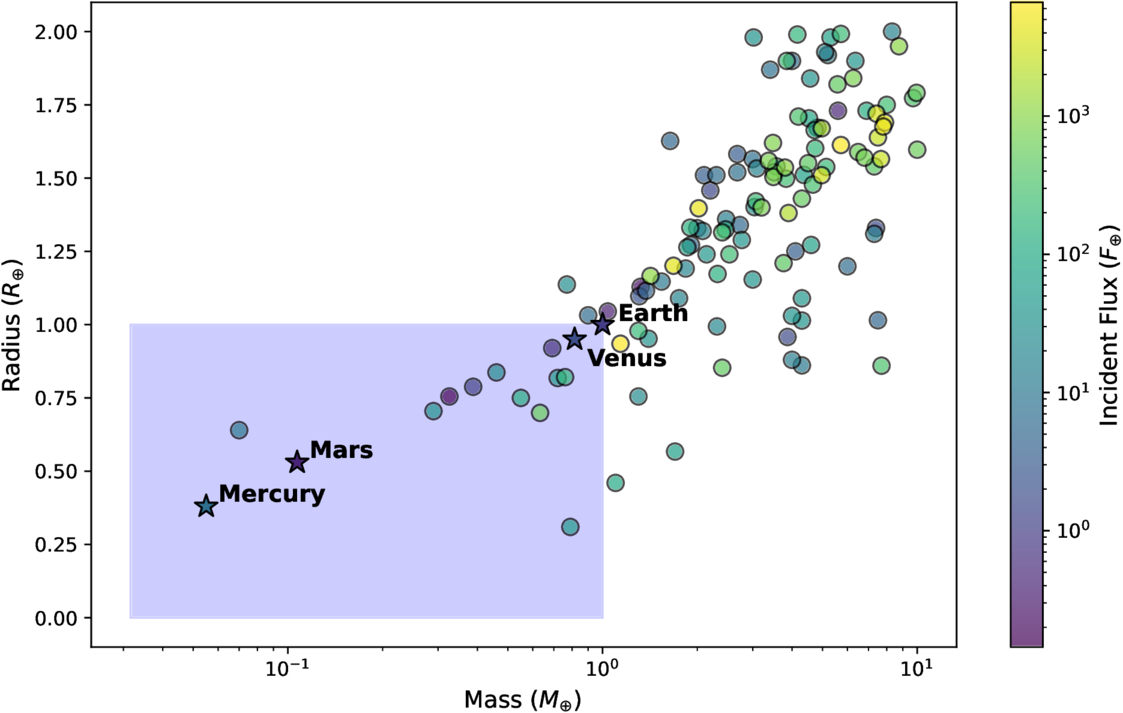
JWST is hunting for atmospheres on small rocky planets around other stars. However, only a select few Mars-like exoplanets have been discovered (Figure 1). This is because sub-Earth planets are small and hard to detect, testing the bounds of current technology. The ones that have been discovered, such as TRAPPIST-1h and Kepler-138b, were detected due to favorable geometry. They happen to orbit very close to a low-mass star or sit in resonant multi-planet systems, which amplify the signal we are looking for. True Mars analogs with low flux and moderate orbital periods remain out of reach. This is precisely what makes Mars itself so important scientifically — it is the only planet of this type we can study up close.

Plot of planetary radius versus planet mass, with symbols colored by incident stellar flux.

Figure 1: A plot of confirmed exoplanets by mass and radius. Most confirmed exoplanets are larger and more massive than Earth. Mars-like planets (dots in the blue box) are rare in confirmed exoplanet detections. [Kane et al. 2026]

Getting to Know Mars, Getting to Know All About Mars

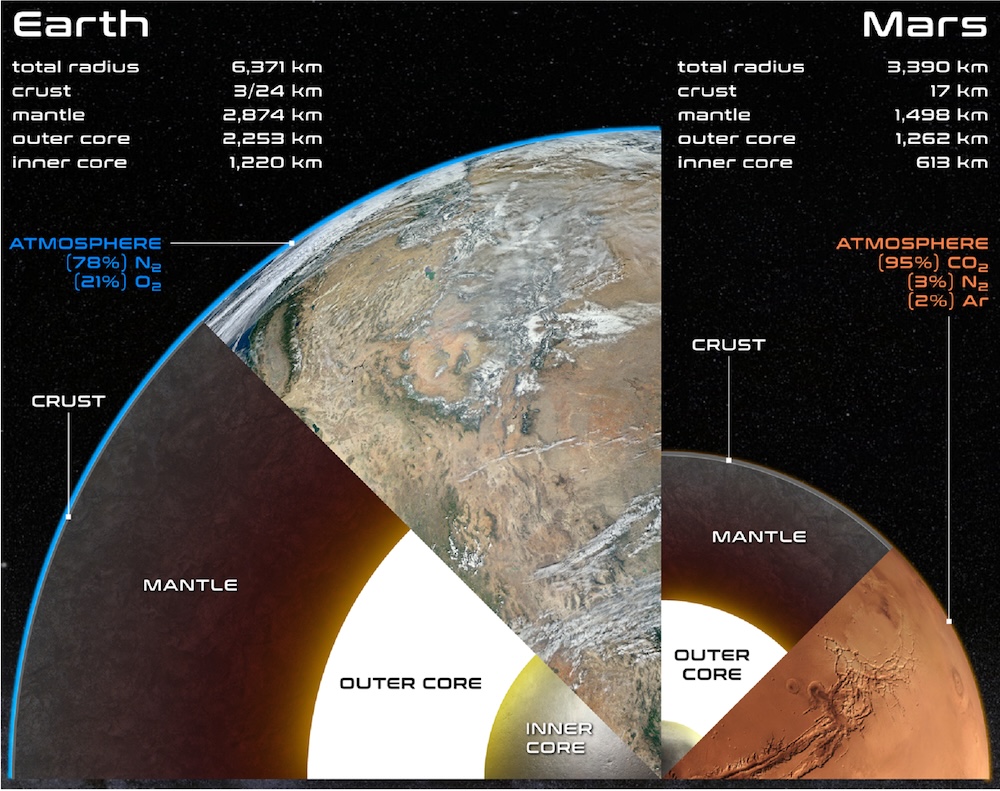
We know a lot about Mars in comparison to other planets thanks to rovers (such as Curiosity and Perseverance), atmospheric orbiters (such as Mars Atmosphere and Volatile EvolutioN and the Mars Orbiter Mission), and other science missions (Figure 2). We know it once had water features with neutral pH and favorable chemistry for life from sedimentary evidence at the Gale and Jezero craters. We know its atmosphere is 95% CO2 with a surface pressure less than 1% of Earth’s. We know it once had an active magnetic dynamo, but the dynamo died out about 4 billion years ago, leading to solar wind steadily stripping away Mars’s atmosphere over time.

Diagram showing Earth and Mars to scale

Figure 2: Earth and Mars to scale, showing their internal structures and atmospheres. Despite being neighbors, Mars is dramatically smaller with a thin CO2 atmosphere, similar to the planets JWST is struggling to characterize. [Kane et al. 2026]

But in the Upside Down, we would know none of this since Mars would be so distant. With current technology, this Upside Down Mars would be essentially undetectable using transit signals, radial velocity measurements, and spectrographs.

Beyond Our Backyard

JWST is currently studying the small rocky TRAPPIST-1 planets and is finding little evidence of atmospheres. The authors of today’s article explore the idea that these exoplanets are similar to Mars and perhaps are undergoing processes that strip away their atmospheres and create optimal conditions for life only for short durations. Using Mars as a blueprint, the authors show how we can better understand exoplanet processes, including volatile delivery and loss, photochemistry, climate evolution, obliquity forcing, planetary architecture, and intrinsic magnetism. For example, measurements of noble gases directly fingerprint Mars’s atmospheric escape process, and the authors argue these give us a calibration framework for interpreting future exoplanet spectra.

The upcoming Nancy Grace Roman Space Telescope’s microlensing survey will start revealing how common true Mars analogs actually are throughout the galaxy, while the future Habitable Worlds Observatory will attempt direct imaging of nearby candidates with unprecedented precision. Together, these missions will tell us whether Mars-like outcomes (brief habitability, catastrophic atmospheric loss, barren surfaces, etc.) are the default fate for small rocky planets. Interpreting that data will require the exact framework this article builds: one grounded in the only Mars analog we can study in detail.

Original astrobite edited by Sandy Chiu.

About the author, Ben Sherwin:

I am a physics PhD student and a National Science Foundation Graduate Research Fellow at Stanford University, working with Josh Frieman. I am interested in theoretical and observational cosmology, specifically in cross-correlations between the cosmic microwave background and tracers of large-scale structure.

The post What if Mars Were a Stranger (Thing)? appeared first on AAS Nova.

Nonthermal X-Ray Emission Associated with Supra-Arcade Downflows in the Late Decay Phase of a Solar Flare

21 July 2026 at 17:00
Hanya Pan et al 2026 ApJ 1001 89
Researchers show a connection between non-thermal hard X-ray emission and a tadpole-shaped downflow, strengthening the association between these flows and magnetic reconnection.

The post Nonthermal X-Ray Emission Associated with Supra-Arcade Downflows in the Late Decay Phase of a Solar Flare appeared first on AAS Nova.

Postperihelion Optical Low-Resolution Spectroscopy of Interstellar Comet 3I/ATLAS

20 July 2026 at 17:00
Hideyo Kawakita et al 2026 ApJL 1000 L60
Spectra of 3I/ATLAS as it retreated from its encounter with the Sun show that the comet’s mixing ratios of CN, C3, and C2 with respect to water are similar to those of solar system comets, while NH2 is depleted.

The post Postperihelion Optical Low-Resolution Spectroscopy of Interstellar Comet 3I/ATLAS appeared first on AAS Nova.

Featured Image: A Rare Pair of Galaxies Lacking Dark Matter

20 July 2026 at 17:00

This image, which combines a background view from the Dark Energy Camera Legacy Survey with two inset images from the Very Large Telescope, shows an unusual pair of galaxies in the Fornax Cluster. The galaxies FCC 224 and FCC 240 are under scrutiny because they may have formed via a high-velocity collision between dwarf galaxies — the so-called “bullet-dwarf” model. Using new spectroscopy from the Very Large Telescope, Maria Luísa Buzzo (Yale University) and collaborators analyzed the ages and kinematics of the galaxies’ stars as well as the unusually bright globular clusters swirling around each galaxy. These data suggest that both galaxies are deficient in dark matter, and their stellar populations and globular clusters are all roughly 10 billion years old. The lack of dark matter and the uniform stellar ages are both consistent with the bullet-dwarf model, in which the collision strips away dark matter and ignites a burst of star formation. Since this type of collision can create more than two remnants, the team suggests searching along the trajectory defined by FCC 224 and FCC 240 for more fragments from the collision, some of which may contain the galaxies’ lost dark matter. To learn more about these galaxies and what they might mean for the bullet-dwarf mechanism, be sure to check out the full research article linked below.

Citation

“Dark-Matter-Deficient Twins: FCC 224 and FCC 240 as Possible Analogs of NGC 1052-DF2 and DF4,” Maria Luísa Buzzo et al 2026 ApJ 1005 15. doi:10.3847/1538-4357/ae7349

The post Featured Image: A Rare Pair of Galaxies Lacking Dark Matter appeared first on AAS Nova.

Dating the Dawn of the Milky Way Disk

17 July 2026 at 18:56

Messier 64

The iconic disks of spiral galaxies are well known across the local universe and now far beyond. A recent study looks at the Milky Way to determine when its own disk emerged.

Spinning into Spirals

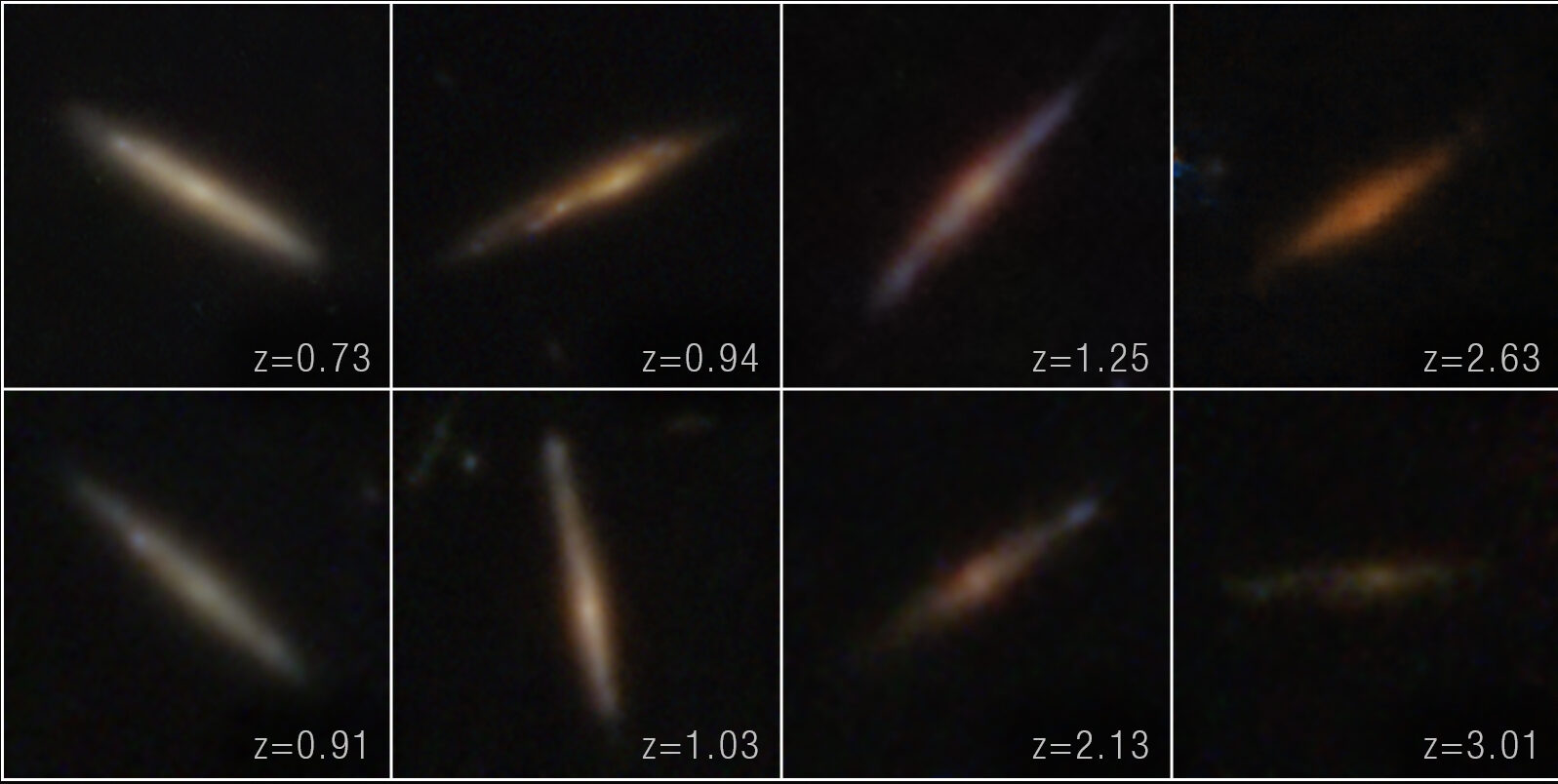
The Milky Way, a grand spiral galaxy with stars and gas rotating in a disk, did not always look this way. Galaxies begin as chaotic clumps of gas and stars inside a knot of dark matter, and at some point in time, spiral galaxies must transform into the flat rotating disks we observe them as today. Recent JWST observations have uncovered disk galaxies emerging much earlier in the universe than previously thought, shifting our understanding of how quickly spiral galaxies come together and settle into disks. While we cannot study the detailed assembly history of these very distant galaxies, we can dissect galaxies in the local universe to build a better timeline of galaxy evolution.

disk galaxies

JWST images of distant edge-on galaxy disks [NASA, ESA, CSA, STScI, Takafumi Tsukui (ANU)]

Looking as close to home as possible, astronomers have used the kinematics and chemical makeup of stars in our own Milky Way to trace the moment when the galaxy started to host a rotating stellar disk. This period, known as the “spin-up,” marks when the bulk kinematic signature of the galaxy transitioned from one dominated by random motions to one dominated by a rotating disk.

Stars hold on to the kinematic and chemical information they are born with, so stars of different ages and metallicities across the galaxy should trace the development of the disk. Because stellar ages have been difficult to constrain observationally, studies of galactic spin-up have typically relied on readily available metallicity measurements as a proxy for age; however, metallicity is not a clear-cut age indicator, making it difficult to truly distinguish different stellar populations across the Milky Way’s disk. Luckily, new major surveys have recently provided stellar databases adding the stellar age measurements necessary to pin down when the Milky Way spun up.

Dawn of the Galactic Disk

Plots showing stellar age and rotational velocity versus metallicity, [Fe/H].

Plots showing stellar age and rotational velocity (Vϕ) versus metallicity, [Fe/H]. The metallicity range where the age–[Fe/H] relation stalls coincides with the point when the Vϕ–[Fe/H] relation rapidly increases, indicating the age of the spin-up in the Milky Way. Click to enlarge. [Modified from Feltzing et al 2026]

Sofia Feltzing (Lund Observatory) and collaborators used a catalog of over 300,000 subgiant stars from the Large Sky Area Multi-Object Fiber Spectroscopic Telescope with metallicities, kinematics, and crucial stellar ages to determine when the Milky Way began to host a stellar disk. After making quality cuts to ensure they included only the most robustly measured stars, the authors divided the sample into two distinct stellar populations that settled into the Milky Way’s disk differently: older stars with a high abundance of α elements (like oxygen, magnesium, and silicon) relative to iron and younger stars with low α-element abundances.

With these star samples, Feltzing and team analyzed how both stellar rotational velocity and age varied with metallicity to determine when the Milky Way spun up. They found that high-α stars clearly move from having random motions to being rotationally supported over a short range of metallicities about 12.5 billion years ago, while the low-α stars seem to begin in a rotating disk and stay there. When varying their selection criteria and looking at the full sample, the authors determined that the Milky Way spin-up happened between 12.1 to 12.5 billion years ago — the first time Milky Way spin-up has been age-dated in this way.

These results imply a rapid chemical evolution and change in kinematic properties as stars went from randomly orbiting to rotating in an ordered disk in the Milky Way. The authors suggest that future studies should focus on lower-metallicity stars to better disentangle stars in the disk from stars in the halo, which will lead to a more precise determination of the Milky Way’s spin-up. Upcoming large-scale surveys will make this possible and allow astronomers to build a better picture of galaxy formation in the early universe.

Citation

“Dawn of the Milky Way Disk: Determination of When a Rotationally Supported Disk Appears and Dating the Spin-up of the Disk,” Sofia Feltzing et al 2026 ApJL 1004 L28. doi:10.3847/2041-8213/ae6f14

The post Dating the Dawn of the Milky Way Disk appeared first on AAS Nova.

Quantifying the Impact of Starspot-Crossing Events on Retrieved Parameters from Transit Lightcurves

17 July 2026 at 17:00
Catriona A. Murray and Zachory Berta-Thompson 2026 AJ 171 344
An analysis of synthetic starspot-crossing events suggests that while starspot longitudes are tightly constrained in high signal-to-noise data, other properties are more loosely determined.

The post Quantifying the Impact of Starspot-Crossing Events on Retrieved Parameters from Transit Lightcurves appeared first on AAS Nova.

❌