❌

Normal view

Episode 182: Human Factors: Designing Systems with People in Mind – Part 1 of 2

16 September 2026 at 13:33

Cynthia Null: The knowledge of how human cognition systems work and how they’re evolved has led to a lot of misconceptions and oversimplifications in human performance. And miscalibration of how humans contribute to the system and system performance can be problematic. And so, it’s important that you actually understand how humans do what they do, so you can actually support their work. 

Host Andres Almeida: That’s Dr. Cynthia Null, talking about a scientific discipline important to mission success. It’s called human factors, and it’s about how people interact with the systems they design, build, and operate. As the NASA Technical Fellow for Human Factors, Dr. Null provides technical leadership and expertise on how human capabilities and performance are considered across the agency. Let’s dive in on this episode of Small Steps, Giant Leaps. 

[Intro music] 

Welcome to Small Steps, Giant Leaps, the podcast from NASA’s Academy of Program/Project & Engineering Leadership, or APPEL. I’m your host, Andres Almeida. I’m talking with Dr. Cynthia Null, who’s joining us from NASA’s Ames Research Center in Silicon Valley. 

Hi, Cynthia, thanks for joining us. 

Cynthia Null: Well, great to be here.

Host: Can you tell us a bit more about your role and what you do at NASA? 

Null: Yes, I’m the technical fellow for human factors at the NASA Engineering and Safety Center. The NASA Engineering and Safety Center was formed after the Columbia accident to create a ready team that’s independent of programs and projects and has deep expertise. 

And what we deliver is robust understanding of risk and possible risk mitigations for mission safety and success for any project or program mission across all of NASA. 

There are 21 different disciplines that have a Technical Fellow. And my job as a Technical Fellow, is to have insight into how human factors is used or not used across all missions, not just human spaceflight, but aeronautics, science missions, technology developments, whatever. 

Now, we don’t get involved in everything because we, we’re a limited size group, and we’re in workplaces where we can influence risk and mission success. So, part of my job is just general insight. 

Because what comes to the NESC are questions or issues or concerns that approach might be wrong, if a question comes in that might have human factors needs, then I would find someone with the right expertise to be on that team. 

Sometimes, the questions are just generally human factors questions at which point I would lead the team, but sometimes it’s a, it’s a software development project. But there’s [a] piece of it that human factors would have some influence in. 

Or, for example, we’ve looked at parachutes, and part of the problems with parachutes are actually just making them, not just designing them. And so, the making them, of course, is all done by hand. And so, we might do a human factors investigation of the processes and procedures, and those kind of things related to manufacturing, for example. 

Host: You’re talking about parachutes for spacecraft landing on other worlds, yeah? 

Null: Yes, spacecraft. Well, or landing back here. Orion comes down on a spacecraft. Dragon comes down on a chute. Or, yeah, it could be chutes for Mars or some other place we’ve landed, and so you want those things to work. They usually have some sort of redundancy, but not always. 

It’s really critical that you have all aspects of it, so you can go through all your materials and sizing and all that other kind of stuff, but if there’s a problem with manufacturing, then that could be change your risk posture. Then it wouldn’t come up in your analysis, but it could come up in flight. So, that would be a place where we could help. 

And we might just decide that actually it’s a brilliant process, and they’re doing everything they can to control it, or we might have recommendations. 

Host: Can you give a straightforward explanation of what human factors entails? 

Null: I’ll try! 

[Laughter] 

So, to start with, human factors is a scientific discipline. It’s based on the understanding of human capability as well as the interactions amidst humans and all other elements of the system and mission. 

So, work our discipline is based on actually started with the understanding of human sensory systems and the development of quantitative methods to describe them. 

This work was actually done by some very famous physicists in the 19th century, people you’ve probably heard of or studied. Hermann von Holtz [and] Ernst Mach are two of those people who actually not only did amazing discoveries related to physics, but also developed methodologies to understand eyes, ears. They discovered the vestibular system, which helps with balance. Those techniques that they developed to do quantitative descriptions are still used today, and they’ve been modified to deal with perception, not just sensation, and also how we think. 

So, human factors enhances mission safety, efficiency, success, and all those kind of things by developing requirements, tools, processes, and procedures to make the humans in the system successful. 

The knowledge of how human cognition systems work and how they’re evolved has led to a lot of misconceptions and oversimplifications in human performance. And miscalibration of how humans contribute to the system and system performance can be problematic. And so, it’s important that you actually understand how humans do what they do, so you can actually support their work. 

Host: Is it important for human factors to be considered early in mission development? Is that something that you feel strongly about? 

Null: Very strongly. So, the thing is, when you’re, when you’re conceiving a mission, you’re also conceiving what humans will do and what they won’t do. And so, you can early on decide that you’re going to have a fully autonomous mission, and you can, and you can design it without the considering having human crew. And whether it’s crew on the ground or crew in space, that’s a decision you can make. 

But when you then can’t actually make everything work without real-time human decision-making, then you sort of have to step back and start all over again to figure out what their roles are really going to be. 

So, defining the human role and understanding what that role is and what you need to support that role is really critical. 

Host: Was human factors, as a discipline, shaped by lessons learned? 

Null: Well, yeah, it might look like that, but people were doing human factors and doing proactive human factors starting as early as World War II. 

So, one of the big problems in World War II, and it may have been problems before that, but I guess probably with communication systems and all these other kind of things, maybe it was less apparent. But a big problem for, for in World War II was just keeping planes in the air, keeping them and repairing them when they came back, and so maintenance became a huge issue. 

And one of the problems with maintenance can be: Have you actually designed for maintainability? So, if you can’t access the part of the engine you need to repair, then you have to actually take the engine off. If you have to take the engine off, okay, that plane is going to be in the repair area much longer than if you can repair it in place. And so, access becomes a very, very important thing. 

So, in the very, just after World War II, the field of human factors hadn’t been named yet, but people who had been involved in solving problems in World War II for the military came from major universities on the East Coast: Harvard, Penn, probably Yale, a few others, and those people were then contracted to the government to develop guidance on how to do designs for future mission systems. And right in those design books, right in the lectures about those designs, they started with, “We need to design for the mission from the beginning.”

So, the first book that was a guidance book on how to write human factors, the first chapter is called “The System.” The first bullet, it just says you have you, all of our contractors as well as the – this is written this, is written in the early ‘50s – all of our contractors, as well as all of our in-house designers, believe that you have to do designs starting at the system level. 

So, the notion of systems engineering is written, is the first paragraph in this human factors book. And paragraph 1.1 is entitled “The Human in the System” and how you have to work on designing for all the roles the human is going to have in the system, which could be engineer, like design engineer. It could be manufacturing. It could be maintenance. It could be operations. It could be the crew member, right? It could be anyone, right?

And all of those people are valuable assets to the mission, and they all need to be counted for. And you have to make sure that they have the information they need, the tools that they need, and that they have everything else that they need, like access, for example. And so, all of those things were actually talked about from the beginning in human factors.

Now, that doesn’t necessarily mean that’s the role we had in every system design once we said that’s what we needed. But it has been the mantra of human factors from the beginning that you actually had to think about the design, and that when we weren’t patching stuff that people forgot about that we were actually actively working on design. 

And in the early ’50s, people were asking questions, all sorts of questions at all sorts of different levels about how you should do human factors. So, one of the simple, simple questions is, if you need somebody to respond to something really quickly, like hit the off button, or hit the escape button, or something like that. And the question was, how big does the button have to be so you can find it and hit it quickly? 

And what they decided was that there was a tradeoff between speed and accuracy, and there was also a tradeoff between size and distance. So, if the button was far away, it had to be much bigger because you’re just sort of trying to hit it with your hand. And so, if it’s small, then you can’t get to it. 


And so, there’s actually a law called Fitts’s Law, named after a military human factors person from the, this is early ‘50s, where he actually described an equation: If the button’s close, like on your armrest, then it doesn’t have to be very big. But if it’s going to be out in front of you on the on the front displays on say an airplane or wherever, then it has to be big enough that you can just jam your hand in some direction and you won’t miss it. 

Now, we also said, “But if you don’t put a cover on it, they could accidentally bump into it.” And so, the other thing we said is, “Important things like aborts should have a cover on them so you don’t elbow into them accidentally because you don’t really want to do that unless it’s intended.” So, what you have to be going for if it’s far away, [it] has to be big, but it also has to be protected from just being bumped into accidentally.  

Host: You just made me think of an everyday example. I go to a gym where there’s a treadmill that has an emergency stop button in the center. And I’m moving my arms and I frequently hit it. It’s a large red button. I frequently hit it and I stop. 

Null: Exactly. So, what we would do in safety critical systems is we would put a cover on that. Or we might have, you know, you have to hit it twice, or you have to do something so that it takes two actions instead of one. 

But yes, I’ve been on those treadmills, and I do realize that it, yeah, it’s easy to hit them off. But it’s also good to have that there because if you are actually falling, you really do want that off instead of being thrown to the back. 

[Laughter] 

And usually in a gym, those treadmills, the rows between them are not that far. You could hit your head on the one behind you if you’re not careful. So, it’s good that it’s there, but you’re right. If it’s too easy to hit, that’s a problem. And so, those are actually how human factors thinks about everything, okay? And so, so that’s the, that’s sort of the problem. 

But people then say, “Oh, I can think like a human factors person. I’m a human.” So, there are lots of misconceptions about how humans actually work. 

Host: I bet there are. What are some?

Null: Well, so, one of them is that humans are maybe sort of bad at sort of probability or understanding risk or making decisions that are involved like that. 

And so, a long time ago, people interested in this topic actually did some research, and their subjects were either novices or actually experts in the field, and one of the studies was done with medical decision-making. 

And they gave a scenario, and half of the people got a scenario that was about a particular treatment for a disease, and it described this treatment, and then it said the survival rate was 90 percent. 

For another treatment, they described this treatment (entirely different treatment) and they described it in terms of its mortality rate, as opposed to its survival rate. And they said its mortality rate was 10 percent. And so, they asked both novices and doctors, “Would you prefer treatment A or treatment B?” Now, notice that 90% survival and 10% mortality are actually the same risk.  

Host: Right.

Null: But almost everyone picked the survival, and this was seen as being emotional, sort of, tagging, right? That you were having emotional response instead of a perceptual response.  

So, some people who actually know a little bit more about how the brain works decided to redo the experiment, and the only thing they changed was how they represented the survival rate and the mortality rate. And in the new experiment, they said that nine out of 10 people would survive in the first, and one out of 10 people would die in the second. 

And the bias towards survive, the survival metric went away, so that it wasn’t actually in the main, the emotional tagging. It was actually that humans are actually better at frequency than probability. So, let’s just think about this. 

I have a favorite meal that I like to have on Sundays at my house, and it’s fresh fish. And you don’t want to buy that several days in advance. And so, when I’m running errands on Sunday, I try to drive by a grocery store or a place where I’ve been before that I think the fish might be good, and buy some fish on my way home. So, it’s been, it’s been properly chilled until I get it to my kitchen and then I can cook it.  

So, over time, I’ve noticed that there are stores when I go into I often don’t have fish, so maybe once I’ve gotten fish there, and another place I’ve gotten fish, like, five or six times in a row. It appears that people think that way, as opposed to saying, “Oh, the probability I get fish from this market is…” and so that since we live our lives more like on frequency basis and not on, on collecting all the data and running a probability theory, it might be more natural for us to understand things presented in the way that we run our lives (in frequency, as opposed to changing into probability). 

Now, that doesn’t mean you can’t get people to be sophisticated about both the same representation of the facts. But if you’re just asking for a quick response or you’re doing a quick analysis, it may be actually better to present data as frequency data than as probabilistic data because that’s sort of a capability we have that we’ve had probably since the Serengeti. 

[Laughter] 

Because knowing where predators were or food was (one to avoid and one to find) would have been very, very important, and you probably weren’t thinking of it as a risk probability, but more of an experience that would be that way. And so, I think that gives you a little bit of an example of how it’s completely counterintuitive to expect that someone would interpret 90% and nine out of 10 as different, right? 

But actually, it takes less training to get people to do it without with, with having it as a frequency than it would be having it as a probability. And so, if you’re trying to have safe, reliable, quick, resilient performance, then it’s important to match human capability. And we always don’t understand what our capability is. 

Host: Right.

That’s the end of part 1 of our interview with Cynthia Null, NASA Technical Fellow for Human Factors. Stay tuned for part 2 of where Cynthia will detail more of the myths and misconceptions of how the human brain works.

For a transcript and to hear all other episodes, visit nasa.gov/podcasts. While you’re there, check out our other podcasts like Houston, We Have a Podcast, Curious Universe, and Universo curioso de la NASA. As always, thanks for listening.

Outro: Three. Two. One. This is an official NASA podcast.

The post Episode 182: Human Factors: Designing Systems with People in Mind – Part 1 of 2 appeared first on NASA Science.

APOD: 2026 September 16 – Webb’s View of M64

16 September 2026 at 05:05

APOD

Astronomy Picture of the Day

Discover the cosmos! Each day a different image or photograph of our fascinating universe is featured, along with a brief explanation written by a professional astronomer.

Hubble and JWST image of M64. A massive spiral galaxy glows with a yellow core, surrounded by arms full of orange-brown dust and pink and blue patches of star formation. Framed by a haze of dark dust, the galaxy shines against black space dotted with a few stars.Hubble image of M64. A massive spiral galaxy glows with a yellow core, surrounded by arms full of dark dust and pink and blue patches of star formation. Framed by a haze of dark dust, the galaxy shines against black space dotted with a few stars.

Webb's View of M64

Explanation: Sometimes where Hubble finds darkness, Webb sees light. An example is today’s composite images of Messier 64 (M64), a nearby spiral galaxy of many names. The dark band of dust partially blocking its bright core earned it the moniker “the Black Eye Galaxy.” Webb’s Mid-InfraRed Instrument (MIRI) sees that dust, shown in red, as it absorbs and re-emits light from surrounding newborn stars. These young stars are embedded in pink star-forming regions in the Hubble-only image. M64’s inner and outer gas regions counter-rotate, creating regions of increased star formation where the two gas “currents” meet and compress. A merger between M64 and a smaller galaxy was likely the cause of the opposing motion of the outer gas. Spiral galaxies were once thought to have peaceful histories. M64 was key evidence that spiral galaxies, including the Milky Way, can and do experience mergers. Webb’s view of M64 will tell astronomers about the structure, motion, and composition of the galaxy’s dust and add context to the galaxy’s merger history and evolution.

APOD’s main NASA site is moving: From apod.nasa.gov to science.nasa.gov/apod
Tomorrow’s picture: treasure

Date: September 16, 2026
Credit: NASA, CSA, ESA, F. Belfiore (ESO), J. Lee (STScI), A. Leroy (OSU), and D. Thilker (JHU); Processing: G. Kober (NASA/Catholic University)
Authors & editors: Keighley Rockcliffe, Robert Nemiroff, Jerry Bonnell, Cecilia Chirenti
A service of: ASD at NASA / GSFC,
NASA Science Activation & Michigan Tech. U.

The post APOD: 2026 September 16 – Webb’s View of M64 appeared first on NASA Science.
Purple Haze Aurora

16 September 2026 at 05:01
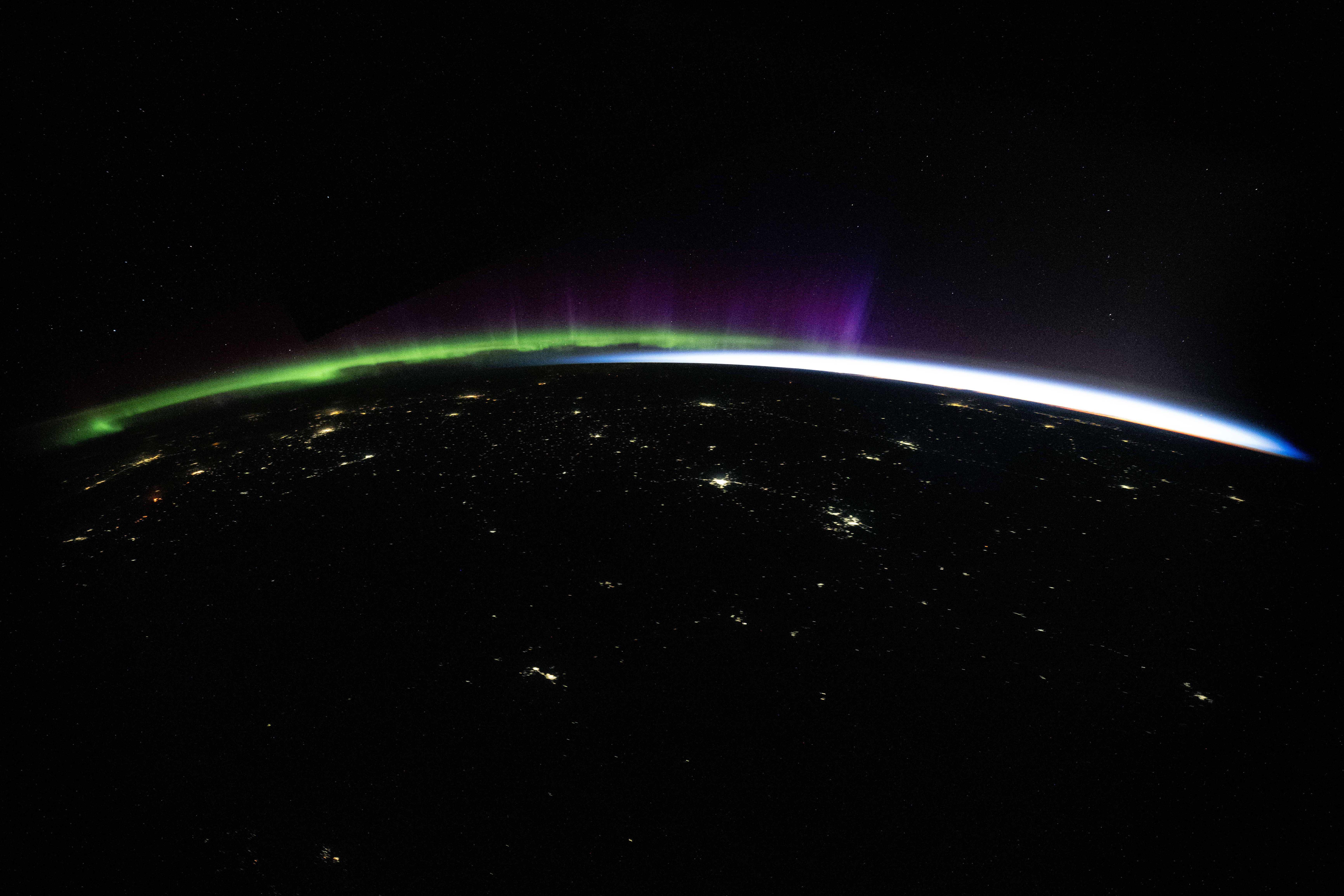
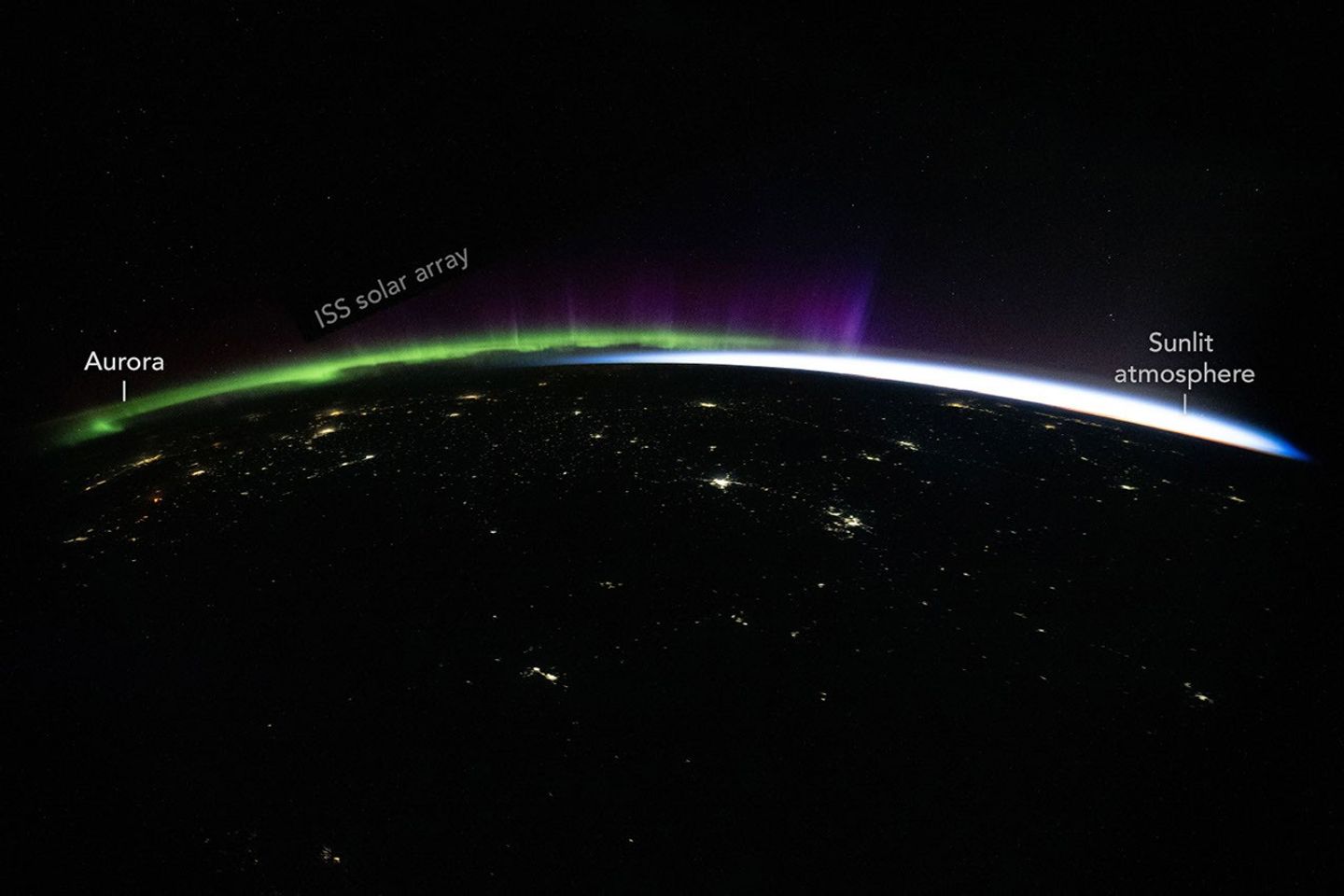
Green and purple aurora and white airglow arc above Earth’s limb and the scattered city lights of Central Asia in a nighttime photo taken from the International Space Station.

One of the inspirations for Jimi Hendrix’s iconic 1967 hit “Purple Haze” is said to be the sci-fi novel Night of Light, about a distant planet in a binary star system. Every seven years, the story goes, the stars bathe the planet in a bizarre purple radiance with the power to rearrange physical reality in profound and unexpected ways. The atmosphere’s purple glow, for instance, turned some people into trees and brought statues to life.

It’s perhaps fitting, then, for an astronaut on the International Space Station to invoke the iconic song after witnessing the aurora illuminate Earth’s atmosphere with ethereal greens, reds, and purples. Hendrix would have “rejoiced” at the “brilliant purple,” NASA astronaut Jessica Meir posted on September 8. It “makes me want to kiss the sky,” she added in a nod to the lyrics of the Hendrix song.

The photograph above is one of many that the astronauts took on September 7, 2026, as they orbited an atmosphere quivering with color. The station was at an altitude of 255 miles (411 kilometers) and above Kyrgyzstan when the photo was taken. Stacking several of the photos also yielded a long-exposure series in which the aurora’s green glow mingles with star trails, moonlight, passing satellites, and city lights in a dazzling jumble of illumination.

Aurora is the Latin word for “dawn” and also the name of the Roman goddess of the dawn. Its use in reference to the atmospheric phenomenon likely comes from Europeans living far from the Arctic Circle, who would have experienced the aurora as a faint red glow to the north, resembling the reddish glow in the east at dawn.

The colorful phenomenon typically starts when the Sun sends charged particles toward Earth through solar flares, coronal mass ejections (CMEs), or an active solar wind. These particles interact with the magnetosphere—the invisible, comet-shaped bubble of magnetic field lines surrounding the planet—compressing and changing the configuration of the magnetic field. In the process, some particles within the field are drawn into Earth’s upper atmosphere, where they excite nitrogen and oxygen atoms and molecules, causing them to release photons.

The aurora Meir photographed occurred amid a disturbance associated with a high-speed stream of solar wind from a coronal hole and the lingering effects of multiple coronal mass ejections, according to updates from NOAA’s Space Weather Prediction Center. These solar wind disturbances interacted with Earth’s magnetosphere, causing minor (G1) geomagnetic storms.

The colors of auroras are influenced by the type of gas involved and the altitude at which they occur in the atmosphere. Oxygen excited to different energy levels can produce green and red. Green occurs roughly between 60 and 120 miles (100 and 200 kilometers) altitude, and red occurs above 120 miles (200 kilometers). Excited nitrogen gas, from about 60 to 120 miles (100 to 200 kilometers), glows blue or pink depending on the type and energy of the particles it interacts with. Sometimes, the light emitted by gases can appear to mix, making the auroras seem purple, pink, or even white.

While auroras can occur any time of the year, astronauts are especially likely to enjoy the light shows in the spring and fall, around the equinoxes. That’s because the geometry of Earth’s magnetic field relative to the solar wind makes it especially favorable for transferring solar-wind energy into the magnetosphere, a phenomenon known as the Russell-McPherron effect.

This isn’t the only example of Jimi Hendrix’s music making an impression beyond Earth. A selection of Hendrix’s music touched down on the Moon in 2024 with the Odysseus lander. Another Hendrix song, “Voodoo Chile,” made the list of wake-up songs for STS-110, according to a report from NASA’s History Division.

Astronaut photograph ISS075-E-88592 was acquired on September 7, 2026, with a Nikon Z9 digital camera using a focal length of 15 millimeters. It is provided by the ISS Crew Earth Observations Facility and the Earth Science and Remote Sensing Unit at NASA Johnson Space Center. The image was taken by a member of the Expedition 75 crew. The image has been cropped and enhanced to improve contrast, and lens artifacts have been removed. The International Space Station Program supports the laboratory as part of the ISS National Lab to help astronauts take pictures of Earth that will be of the greatest value to scientists and the public, and to make those images freely available on the internet. Additional images taken by astronauts and cosmonauts can be viewed at the NASA/JSC Gateway to Astronaut Photography of Earth. Story by Adam Voiland.

Downloads

Green and purple aurora and white airglow arc above Earth’s limb and the scattered city lights of Central Asia in a nighttime photo taken from the International Space Station.

September 7, 2026

JPEG (6.20 MB)

References & Resources

You may also be interested in:

Stay up-to-date with the latest content from NASA as we explore the universe and discover more about our home planet.

A Moonlit Earth as Seen From Artemis II
4 min read

An astronaut’s photo, taken en route to the Moon, reveals our planet and its place in space in a novel…

Article
Great Balls of Fire
4 min read

An astronaut on the International Space Station was surprised to photograph a shower of light streaking through the darkness while…

Article
The World Cup From 250 Miles Up
4 min read

Over the years, astronauts aboard the International Space Station have photographed several of the cities hosting the 2026 FIFA World…

Article

The post Purple Haze Aurora appeared first on NASA Science.

NASA Ames Stars of the Month: September 2026

16 September 2026 at 00:46
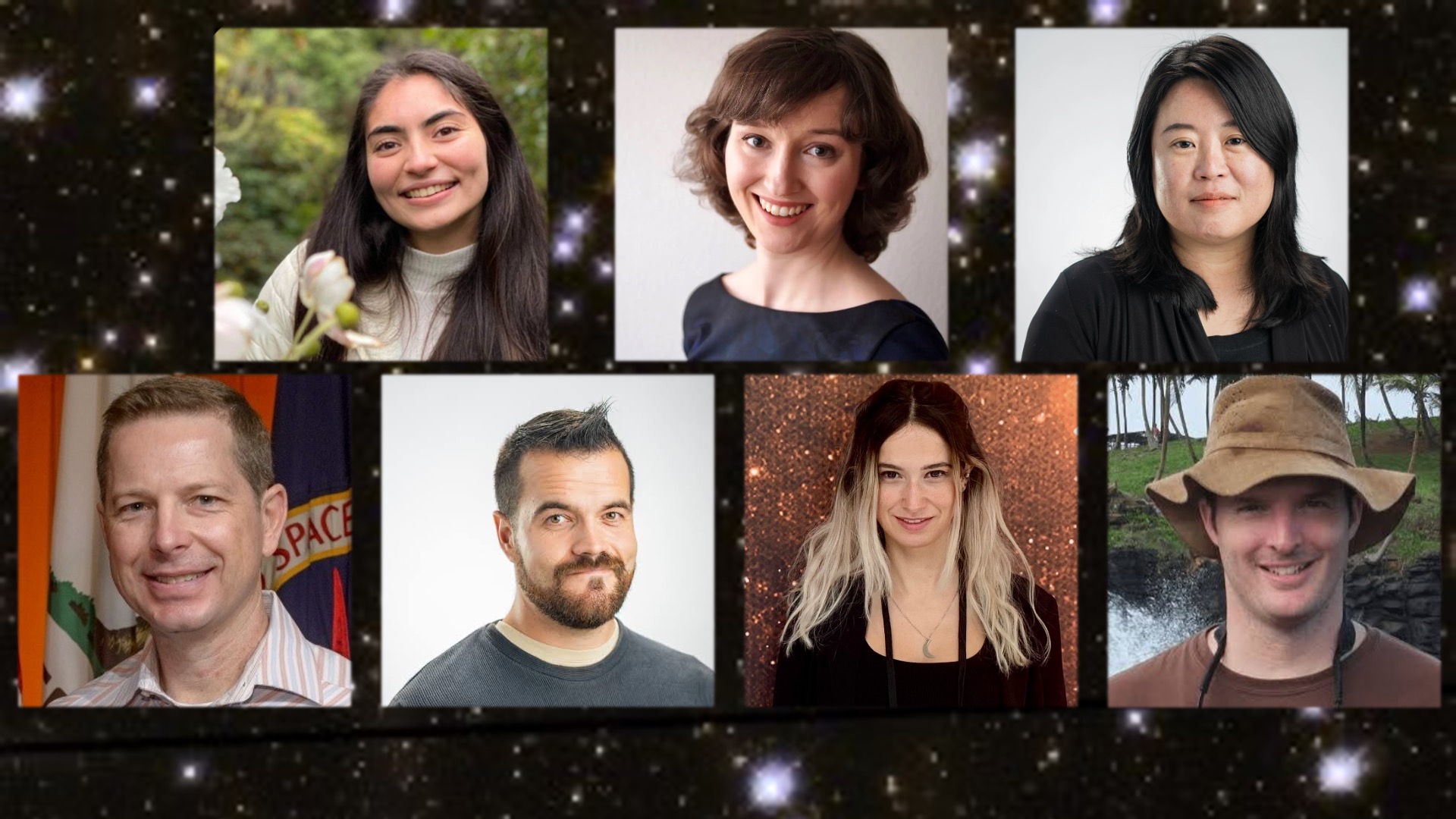
NASA Ames science stars of the month for September 20206. Pictured left to right is Steve Ormsby, Aphrodite Kostakis, Alejando Borlaff, Sarah Nickerson, Martina Caussi, Keiko Nomura, and Stephen Broccardo.

The NASA Ames Science Directorate recognizes the outstanding contributions of (pictured left to right) Steve Ormsby, Aphrodite Kostakis, Alejando Borlaff, Sarah Nickerson, Martina Caussi, Keiko Nomura, and Stephen Broccardo. Their commitment to the NASA mission represents the entrepreneurial spirit, technical expertise, and collaborative disposition needed to explore this world and beyond.

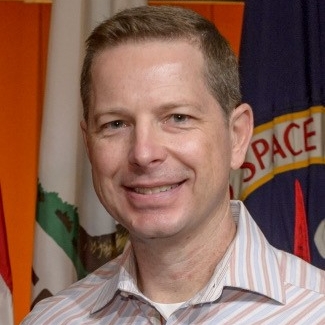
A portrait shot of Steve Ormsby in front of a NASA flag.

Space Biosciences Star: Steve Ormsby 

Steve Ormsby is a project engineer for the Space Biosciences Division with Amentum in the Center Operations Directorate. He is recognized for his perseverance, dedication and initiative in overseeing the safety of division facilities and infrastructure maintenance, as well as exceptional diligence as a property custodian.

Portrait photo of Aphrodite Kostakis

Space Biosciences Star: Aphrodite Kostakis

Aphrodite Kostakis is the Facility Service Manager with Amentum for building N239 in the Space Biosciences Division. She is acknowledged for her exemplary work ethic in maintaining building safety, preparing for and leading VPP inspections with diligence and attention, and suggesting infrastructure improvements and ensuring they get implemented for everyone’s benefit. 

lejandro Serrano Borlaff speaks to media during the Artemis II splashdown event at Chabot Space & Science Center in Oakland, California.

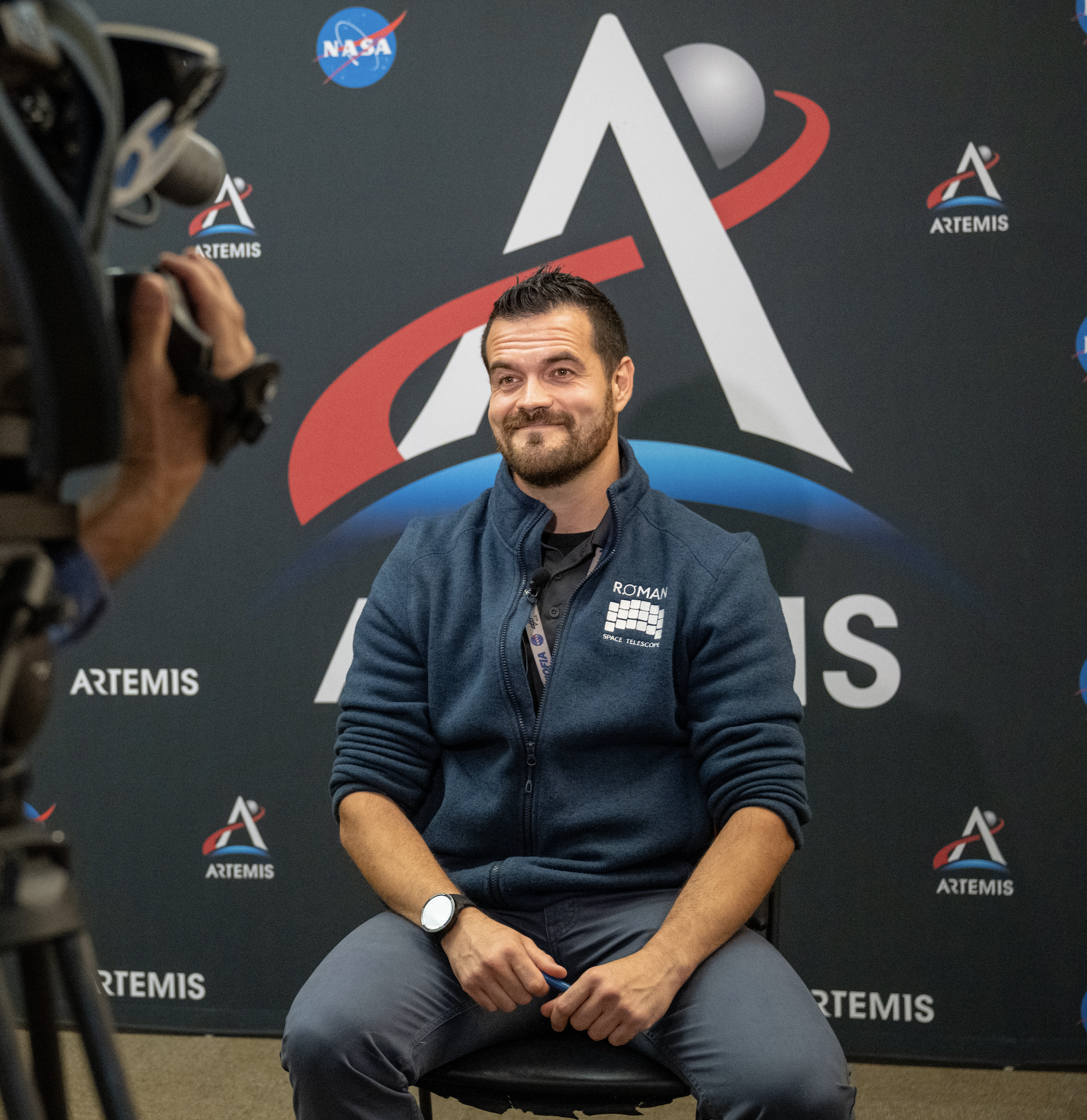
Astrophysics Star: Alejandro Borlaff

Alejandro (Alex) Borlaff, a research scientist in the Astrophysics Division with the Bay Area Environmental Research Institute, is recognized for his leadership in pioneering and developing image reduction pipelines for the Hubble Space Telescope (HST) and the Roman Space Telescope’s Wide Field Instrument (WFI). These algorithms significantly advance the detection of ultra-low surface brightness features through rigorous modeling of background contamination, including scattered and zodiacal light, better maximizing the science derived from NASA flagship astrophysics missions. 

Portrait photo of Sarah Nickerson

Astrophysics Star: Sarah Nickerson

Sarah Nickerson, a research scientist in the Astrophysics Division with the Bay Area Environmental Research Institute, is recognized for exceptional work on the analysis and curation of data taken from the EXES instrument on NASA’s Stratospheric Observatory for Infrared Astronomy (SOFIA) observatory. This provides high-level data products  to the global astrophysics community for continued discovery and synergy with other NASA missions.

Portrait photo of Martina Caussi

Planetary Science and Exobiology Star: Martina Caussi

Martina Caussi is a NASA Postdoctoral Program Fellow in the Planetary Science and Exobiology Division. Martina is recognized for her outstanding work using finite element simulations to determine that topographic relaxation has played a significant role in shaping Tegid, an unusually shaped impact crater on Europa. This work represents valuable precursory science in anticipation of the Europa Clipper mission, which will refine our understanding of this ocean world.

Portrait of Keiko Nomura in a black shirt.

Earth Science Star: Keiko Nomura

Keiko Nomura is a research scientist for the NASA Earth Exchange (NEX) in the Earth Science Division with the Bay Area Environmental Research Institute. She is acknowledged for timely efforts in leadership, stakeholder engagement, coordination with NASA HQ management, and team building for the recently funded NEX-GeoAI project. This project is now being recognized as a key step forward to establishing NASA as the ground-truthing agency for federal and private sector GeoAI modeling activities for decision making.

Earth Science Star: Stephen Broccardo

Stephen Broccardo is a research scientist in the Earth Science Division with the Bay Area Environmental Research Institute. He is recognized for exceptional initiative and technical leadership in sustaining and advancing Ames’ atmospheric remote-sensing capabilities. Stephen has maintained critical observational capabilities  and developed thoughtful technical milestones for future satellite-validation and science activities.

The post NASA Ames Stars of the Month: September 2026 appeared first on NASA Science.
NASA’s New X-59 Test Pilot Gets Behind Controls for Ground Test

16 September 2026 at 00:37
A man seated inside an aircraft cockpit adjusts a helmet, with the open canopy above him.
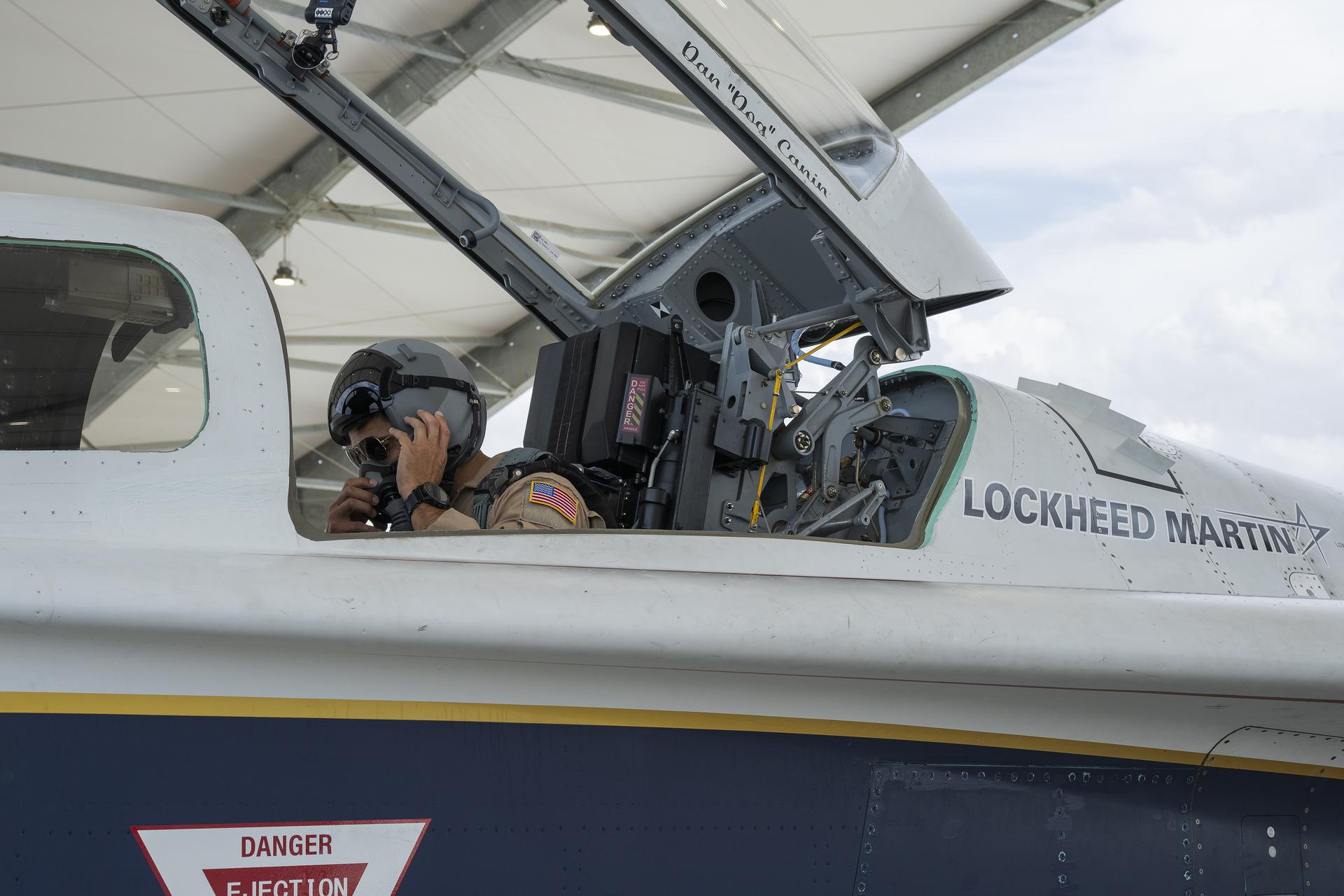
Mike Lippert, one of NASA’s X‑59 test pilots, sits in the cockpit of the agency’s X‑59 quiet supersonic research aircraft for the first time during an engine run at NASA’s Armstrong Flight Research Center in Edwards, California, on Thursday, Aug. 27, 2026. Lippert is the third X‑59 pilot supporting NASA’s Quesst mission, which will demonstrate quiet supersonic flight over U.S. communities and gather public feedback on the aircraft’s quieter sonic “thump.”
NASA/Carla Escamilla

This summer, NASA test pilot Mike Lippert powered up the X‑59 cockpit for the first time, running the aircraft’s engines on the ground during a key step in his months of preparation and training to fly the experimental aircraft. 

“Getting into the cockpit of the X‑59 felt very comfortable,” said Lippert, the newest X-59 test pilot for NASA’s Quesst mission. “The whole team has done a tremendous job of making sure I am trained and prepared.”

Lippert’s first powered interaction with the aircraft demonstrated how mentorship works in NASA’s test pilot community. The X‑59’s two established pilots, Nils Larson and Jim “Clue” Less, guided him throughout the test. Larson monitored Lippert’s coordination with the control room, while Less answered questions and provided coaching. 

Their feedback, along with insights from experienced engineers, turned the startup sequence into a detailed training exercise to strengthen Lippert’s understanding of the X‑59’s systems and the pace of test operations. 

The X-59 is a revolutionary design, shaped to create a quiet thump instead of a sonic boom when flying faster than the speed of sound. The test pilots’ experience and skill will allow NASA to safely test the aircraft, then eventually fly it over U.S. communities to gather data on how the public perceives the sounds it makes. 

The engine run also introduced Lippert to the X‑59’s maintenance crew. As the test progressed, Lippert saw how the cockpit and control room work together during critical operations. Watching the real-time rhythm, he said, provided a better understanding of how NASA’s flight test teams align to ensure safety and precision. 

Lippert credited the test team’s operating practices and leadership for helping him prepare for flight. He spent extensive time in the X-59’s high-fidelity simulator — designed to match the aircraft’s cockpit — for training, aircraft familiarization, and mission rehearsal. The simulation team’s members are absolute experts on the aircraft and have been key contributors to his training and the program as a whole, Lippert said. 

Lippert said he felt energized after powering on the aircraft’s systems for the first time, adding the milestone left him feeling ready for upcoming test flights. The X-59 will continue to progress through envelope expansion and test its performance under various flight conditions. In the coming months, it will advance toward acoustic validation flight tests to study the sonic thumps it is designed to make.

Learn more about the Quesst mission on NASA’s site.  

The post NASA’s New X-59 Test Pilot Gets Behind Controls for Ground Test appeared first on NASA Science.
NASA Field-Tests AI Fleet Capability for Science, Exploration

15 September 2026 at 21:43

NASA scientists and industry partners recently field-tested an artificial intelligence application that could make future solar system exploration missions more efficient, return more science data, and allow for faster scientific discoveries.

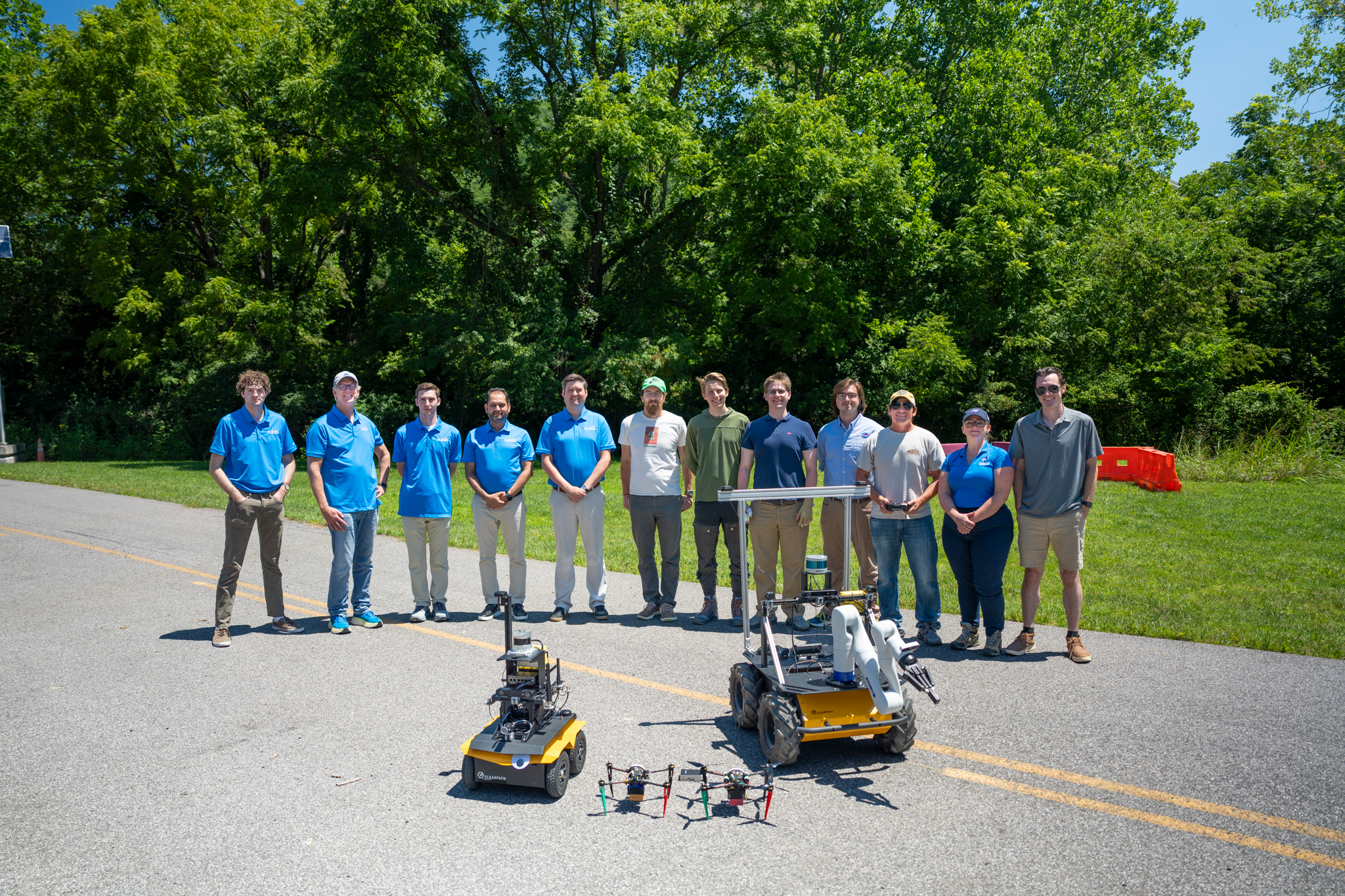
Team photo of twelve people standing on a road with trees behind them. In the foreground are four robots: two rovers and two drones.
Members of the ASTRA (Adaptive Sensing Technology for Responsive Autonomy) team with the fleet of robots they field-tested in July 2026. Left to right: Stephen Scarano, Karl Wunderlich, Zach Logan, Mohammad Goli, and James O’Hara of Noblis; James Marshall, Connor Firth, Leyton McKinney, Connor Williams, Steven Hard, Bethany Theiling, and Michael Monaghan of NASA’s Goddard Space Flight Center in Greenbelt, Maryland.
Noblis/Sean Sullivan

This summer at the Virginia Tech Transportation Institute in Blacksburg, Virginia, a fleet of three robots worked together, and researchers assessed the fleet’s ability to act like an independent science team. To begin each test, a drone was assigned to choose an area of interest based on initial science goals provided by human experts. Then, the fleet’s programming weighed risks against potential science payoffs and calculated which robotic team member was best suited to investigate. As the fleet carried out its plan, it continually checked for environmental hazards, reassessed its strategy to adapt to new information, and reported back to its human managers, NASA’s Adaptive Sensing Technology for Responsive Autonomy (ASTRA) team.

Three robotic explorers in a grassy field: a drone parked between two rovers. The larger rover has a multi-jointed arm extending from it.
The ASTRA + Noblis fleet. The drone (center) uses environmental and scientific sensors to scout the area, identify places of interest, and collect data from overhead. The rover on the left uses lidar to map its surroundings in detail, help the fleet navigate obstacles, and gather context for scientific samples. The rover on the right uses a robotic arm to collect samples.
NASA/Bethany Theiling

The project’s ultimate goal is to provide a trustworthy extension of the human science team in situations where humans are too far away to give real-time instructions, like on uncrewed missions to the outer planets of our solar system, or where the risk to human explorers is unacceptably high, like in areas of the Moon and Mars that are difficult for astronauts to explore.

One of the questions the field test was designed to answer: Once the fleet has started working on a science objective, will it change tasks autonomously based on new information? In the testing, the fleet showed it could focus on its original objectives and follow up on new possibilities. When the lead drone found an additional area of interest in the course of its work, it didn’t abandon its current task, but it did pause to process the opportunity and pull in another robotic asset to investigate the new question.

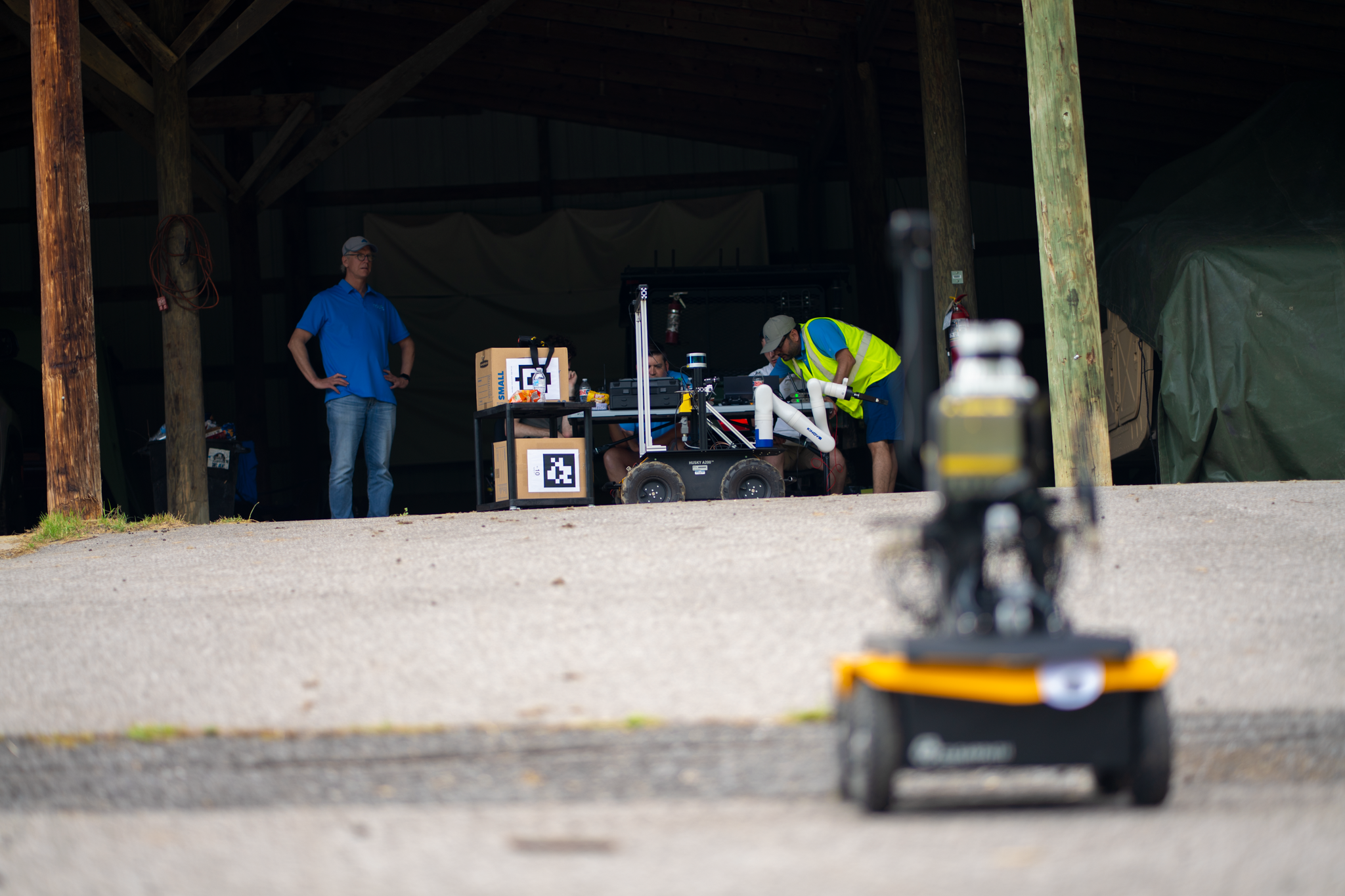
A small robot on the move across pavement. In the background, people observe its progress and work on another robot.
Mohammad Goli, Zach Logan, and James O’Hara test communications on the sampling rover as Karl Wunderlich observes rover actions during a July 2026 field test in Blacksburg, Virginia. Noblis provided the robotic fleet’s ground capability (two rovers shown here).
Noblis/Sean Sullivan

Crucially, the fleet’s decision-making programs handled both objective and subjective information. What robotic assets are available? How far away are they, and how fast can each one move? How much does the science team want the knowledge that can be gained by mapping this area or by taking a sample of that material? Would the humans want to learn from a newly spotted point of interest more than they’d want the fleet to focus on its original task? How risky is each job for the robot attempting it, and is the danger acceptable to the mission planners?

“We want to find a way for missions to do things that they could never do before because they didn’t have a decision-maker on board that can weigh all these criteria at the same time,” says Bethany Theiling, ASTRA principal investigator and field lead, of NASA’s Goddard Space Flight Center in Greenbelt, Maryland.

This ability to consider subjective criteria alongside simple facts, then deliver decisions that satisfy the people behind the project, is what the ASTRA team is working to develop. The mission team will consider the robotic fleet to be successful if it can correctly act without direct instructions based on its physical capabilities and on the team’s priorities and risk assessments.

Theiling led the testing campaign in collaboration with Noblis, Aurora Engineering, and the University of Tulsa.

Similar Landscapes, Different Worlds

About Planetary Analogs

Our planet isn't the only place with ice, volcanoes, impact craters, quakes, and erosion. Studying extreme environments on Earth helps us to understand other worlds better, too.

Learn More
A researcher in a clean suit kneels in the desert, collecting samples.
NASA scientist Mary Beth Wilhelm collects soil samples from Chile’s Atacama Desert. Studying ancient life in the driest places on Earth helps us to understand conditions on Mars.
NASA

The post NASA Field-Tests AI Fleet Capability for Science, Exploration appeared first on NASA Science.
AI/ML STIG Lecture Series, 21 Sept 2026

15 September 2026 at 21:20

AI/ML STIG Lecture Series

Artificial Intelligence & Machine Learning Science and Technology Interest Group

AI/ML STIG about AI/ML STIG Lecture Series

Location

Virtual

dates

21 September 2026
4:00pm ET

Community

AI/ML STIG

Type

Lecture

Hands-On Session I: Agentic Coding and Research Tools

Speaker

Christopher Stubbs, Harvard University

Meeting Connection

Join the Lecture

News Straight to Your Inbox

Subscribe to your community email news list

We will never share your email address.

Privacy Policy

Sign Up
Angled from the upper left corner to the lower right corner is a cone-shaped orange-red cloud known as Herbig-Haro 49/50. This feature takes up about three-fourths of the length of this angle. The upper left end of this feature has a translucent, rounded end. The conical feature widens slightly from the rounded end at the upper right down to the lower right. Along the cone there are additional rounded edges, like edges of a wave, and intricate foamy-like details, as well as a clearer view of the black background of space. In the upper left, overlapping with the rounded end of Herbig-Haro 49/50, is a background spiral galaxy with a concentrated blue center that fades outward to blend with red spiral arms. The background of space is speckled with some white stars and smaller, more numerous, fainter white galaxies throughout.

The post AI/ML STIG Lecture Series, 21 Sept 2026 appeared first on NASA Science.

Cosmic Origins Community Meeting, 22 Sept 2026

15 September 2026 at 21:20

Cosmic Origins Community Meeting

Location

Virtual

Dates

22 September 2026
12:00pm – 1:00pm ET

Community

Cosmic Origins

Type

Meeting

Post-Ad ASTRA Community Science Workshop Update

Hosted by the COPAG Leadership

This community meeting aims to provide you with an overview and explanation of the processes and plans for mission concepts submitted to the Ad ASTRA workshop. The meeting will include a description of how the NASA Astrophysics Division will use the information gathered at the workshop. Additionally, this meeting aims to collect feedback and questions that the COPAG community may have regarding the process and plans that further mission concept selections. 

Please use this form to submit any comments, questions, or feedback for the COPAG community meeting: https://forms.gle/puBBTk1mo34WiGwP7 

Meeting Connection

Join the Meeting

News Straight to Your Inbox

Subscribe to your community email news list

We will never share your email address.

Privacy Policy

Sign Up
Angled from the upper left corner to the lower right corner is a cone-shaped orange-red cloud known as Herbig-Haro 49/50. This feature takes up about three-fourths of the length of this angle. The upper left end of this feature has a translucent, rounded end. The conical feature widens slightly from the rounded end at the upper right down to the lower right. Along the cone there are additional rounded edges, like edges of a wave, and intricate foamy-like details, as well as a clearer view of the black background of space. In the upper left, overlapping with the rounded end of Herbig-Haro 49/50, is a background spiral galaxy with a concentrated blue center that fades outward to blend with red spiral arms. The background of space is speckled with some white stars and smaller, more numerous, fainter white galaxies throughout.

The post Cosmic Origins Community Meeting, 22 Sept 2026 appeared first on NASA Science.
AGN SIG Spotlight Series, 22 Sept 2026

15 September 2026 at 21:20

AGN SIG Spotlight Series

Active Galactic Nuclei Science Interest Group

Our Spotlight Series highlights recent advances in AGN science, with a strong emphasis on participation from early-career researchers, and includes plenty of time for community discussion following the presentations. 

AGN SIG about AGN SIG Spotlight Series

Location

Virtual

Dates

22 September 2026
1:00pm ET / 10:00am PT

Community

AGN SIG

Type

Seminar

Unveiling the Role of Multi-Phase AGN Outflows with MIRACLE

Speaker

Dr. Matteo Ceci (Università di Firenze)

Abstract

Galaxy evolution is tightly connected to Active Galactic Nuclei (AGN) through feedback processes in which gas accretion onto the supermassive black hole drives powerful multiphase outflows. Detailed studies in the local Universe are crucial to resolve the physical scales and gas phases involved, enabling a comprehensive view of AGN-host interactions. I will present first results from the MIRACLE (Mid-IR Activity of Circumnuclear Line Emission) program, combining JWST/MIRI, MUSE, and ALMA observations of seven nearby Seyfert galaxies. Thanks to JWST’s spatial resolution (50-150 pc), we probe atomic and molecular gas in the circumnuclear regions and assess the impact of AGN activity on their host galaxies. Focusing on NGC 1365, we trace the ionized outflow up to kiloparsec scales and constrain its energetics and effects on star formation (SF). By combining mid-IR diagnostics with advanced photoionization and kinematic models, we reproduce ~60 optical and mid-IR emission lines, disentangling AGN- and SF-driven components and providing robust estimates of gas density, ionization, extinction, and outflow mass. We show that classical methods commonly adopted in the literature can underestimate outflow masses by up to an order of magnitude.

Disk Reflection as the Origin of the X-ray Polarization of NGC 4151 with IXPE

Speaker

Dr. Elias Kammoun (California Institute of Technology) 

Abstract

The geometry of the X-ray emitting region around accreting supermassive black holes remains poorly constrained, but X-ray polarimetry now offers a new and direct perspective on it. I will present a spectro-polarimetric study of the nearby type-1 AGN NGC 4151, combining two long IXPE observations from 2022 and 2024 with simultaneous XMM-Newton and NuSTAR spectroscopy. IXPE reveals a polarization degree of 6–7% above 4 keV aligned with the radio jet, plus a distinct low-energy component at a different angle, providing evidence for at least two polarized components in the 2–8 keV band. While earlier work read the hard X-ray signal as a radially extended, slab-like corona, I will test an alternative: that the polarization is instead dominated by relativistic reflection from an accretion disk illuminated by a compact, lamp-post corona. Fitting the IXPE Stokes spectra with recently developed models, we find the data favor a low coronal height and a wide torus opening angle, with disk reflection supplying ~20% of the 2–8 keV flux. The same configuration reproduces the full 0.4–79 keV spectrum, showing that disk reprocessing by a compact corona can account for both the polarization and the broadband spectral properties of NGC 4151.

Seminar Connection

Zoom Registration, you will receive connection details by email after registration: 

https://alaska.zoom.us/meeting/register/V1okit8uSk2ql97gegbdzg

News Straight to Your Inbox

Subscribe to your community email news list

We will never share your email address.

Privacy Policy

Sign Up
Angled from the upper left corner to the lower right corner is a cone-shaped orange-red cloud known as Herbig-Haro 49/50. This feature takes up about three-fourths of the length of this angle. The upper left end of this feature has a translucent, rounded end. The conical feature widens slightly from the rounded end at the upper right down to the lower right. Along the cone there are additional rounded edges, like edges of a wave, and intricate foamy-like details, as well as a clearer view of the black background of space. In the upper left, overlapping with the rounded end of Herbig-Haro 49/50, is a background spiral galaxy with a concentrated blue center that fades outward to blend with red spiral arms. The background of space is speckled with some white stars and smaller, more numerous, fainter white galaxies throughout.

The post AGN SIG Spotlight Series, 22 Sept 2026 appeared first on NASA Science.

DGCE SIG Seminar, 24 Sept 2026

15 September 2026 at 21:20

DGCE SIG Seminar

Diffuse Gas in Cosmic Ecosystems Science Interest Group

DGCE SIG about DGCE SIG Seminar

Location

Virtual

Dates

24 September 2026
4:00pm ET / 1:00pm PT

Community

DGCE SIG

Type

Seminar

How the Faint Radio Sky is Changing Our Understanding of Star Formation and Galactic Outflows

Speaker

Allison Matthews (Carnegie Observatories)

Abstract

In the last decade, with the commissioning of high sensitivity radio telescopes, we have opened a new window into the faint radio sky. These novel facilities probe fundamental physical processes that regulate star formation and characterize star formation in normal galaxies like our Milky Way over nearly all cosmic time. Deep observations from MeerKAT and LOFAR have revealed that prior observations may have missed half the star formation at all cosmic times. This discrepancy has critical implications across astrophysics: estimates of gravitational wave events, the frequency of astrophysical transients, and the chemical evolution of galaxies. These same high-sensitivity radio facilities are simultaneously placing critical constraints on the physical drivers of galactic winds that we believe regulate star formation across all of cosmic time. In this talk, I will present these findings and outline programs with next generation radio facilities that will improve our observational constraints on the rate and regulation of star formation across cosmic time.

Seminar Connection

Join the Seminar

News Straight to Your Inbox

Subscribe to your community email news list

We will never share your email address.

Privacy Policy

Sign Up
Angled from the upper left corner to the lower right corner is a cone-shaped orange-red cloud known as Herbig-Haro 49/50. This feature takes up about three-fourths of the length of this angle. The upper left end of this feature has a translucent, rounded end. The conical feature widens slightly from the rounded end at the upper right down to the lower right. Along the cone there are additional rounded edges, like edges of a wave, and intricate foamy-like details, as well as a clearer view of the black background of space. In the upper left, overlapping with the rounded end of Herbig-Haro 49/50, is a background spiral galaxy with a concentrated blue center that fades outward to blend with red spiral arms. The background of space is speckled with some white stars and smaller, more numerous, fainter white galaxies throughout.

The post DGCE SIG Seminar, 24 Sept 2026 appeared first on NASA Science.

APOD: 2026 September 11 – M83: The Southern Pinwheel

11 September 2026 at 05:05

APOD

Astronomy Picture of the Day

Discover the cosmos! Each day a different image or photograph of our fascinating universe is featured, along with a brief explanation written by a professional astronomer.

A spiral galaxy is shown in front of a dark field of stars.

M83: The Southern Pinwheel

Explanation: Beautiful and bright spiral galaxy M83 lies some twelve million light-years away, near the southeastern tip of the very long constellation Hydra. Prominent spiral arms traced by dark dust lanes and blue star clusters lend this galaxy its popular name, the Southern Pinwheel. Still, reddish star forming regions that dot this cosmic pinwheel’s spiral arms have suggested another nickname, the Thousand-Ruby Galaxy. A mere 40,000 light-years across, smaller than the Milky Way, M83 is a member of a group of galaxies that includes active galaxy Centaurus A. In fact, the core of M83 itself is bright at x-ray energies, showing a high concentration of neutron stars and black holes left from an intense burst of star formation. This sharp, groundbased telescopic view also features foreground Milky Way stars and distant background galaxies.

APOD’s main NASA site is moving: From apod.nasa.gov to science.nasa.gov/apod
Tomorrow’s picture: lunar sun catcher

Date September 11, 2026
Credit & Copyright Aldo Zanetti
Authors & editors: Jerry Bonnell, Robert Nemiroff, Cecilia Chirenti, Keighley Rockcliffe
A service of: ASD at NASA / GSFC,
NASA Science Activation & Michigan Tech. U.

The post APOD: 2026 September 11 – M83: The Southern Pinwheel appeared first on NASA Science.

Monterrey Amid Mountains

11 September 2026 at 05:01
The light-colored urban development of Monterrey, Mexico, fills most of the top half of the photo, and green parallel mountain ridges arc across the bottom of the frame.
August 26, 2026

The curving, parallel mountain ridges of the Sierra Madre Oriental are an eye-catching feature of northeastern Mexico’s landscape. The spot where these folds nestle up against Mexico’s second-largest metropolitan area captured the attention of an astronaut aboard the International Space Station, who took this photo on August 26, 2026.

Monterrey, the capital of the state of Nuevo León, is an industrial hub supporting heavy industries such as ironworks and steelworks, as well as manufacturing facilities for goods ranging from textiles to processed foods to glass and plastics. The metropolitan area is home to 5.3 million people, according to the 2020 census. And while the city has seen overall population growth since 1990, the number of people living within 5 kilometers (3 miles) of the city center has declined, researchers have found—a trajectory shared with many of Mexico’s metropolitan areas.

In Monterrey’s case, urban expansion runs up against some unforgiving terrain. Along the city’s southern edge, layers of limestone, deposited in the late Mesozoic era and then folded between about 80 and 50 million years ago, form the Sierra Madre Oriental. Over millions of years, weaker rock layers have eroded away, leaving behind the distinct ridgelines that bound Monterrey today.

The Río Santa Catarina carves through the mountains and onto the semiarid floodplain where the city lies. Because of the dry environment, the river carries little to no water for much of the time. But its channel is crucial for collecting runoff from summer rains and serves as an important natural area for plant and animal life within the city.

The river runs through Monterrey’s urban core and between several island-like protrusions of folded rock. One of these is the Sierra Las Mitras, a state nature reserve established in 2000. The mountain ridge rises approximately 1,500 meters (4,900 feet) over the city and provides a haven for wildlife. As conditions become cooler and wetter with higher elevations, vegetation turns from cacti and thorny shrubs on lower rocky slopes to oak and pine forests higher on the ridge. Cerro de la Silla (Mount Silla or Saddle Hill) is another prominent feature of the landscape, contrasting with the built environment.

Near the city’s border with the Sierra Madre Oriental sits Universidad de Monterrey, a host venue for the NASA Space Apps Challenge. This annual hackathon will take place in November 2026 in person and virtually at sites around the world. Participating teams use NASA and partner agency data to tackle challenges in fields such as software development, astrophysics, space exploration, and agriculture.

Astronaut photograph ISS075-E-70481 was acquired on August 26, 2026, with a Nikon Z9 digital camera using a focal length of 400 millimeters. It is provided by the ISS Crew Earth Observations Facility and the Earth Science and Remote Sensing Unit at NASA Johnson Space Center. The image was taken by a member of the Expedition 75 crew. The image has been cropped and enhanced to improve contrast, and lens artifacts have been removed. The International Space Station Program supports the laboratory as part of the ISS National Lab to help astronauts take pictures of Earth that will be of the greatest value to scientists and the public, and to make those images freely available on the internet. Additional images taken by astronauts and cosmonauts can be viewed at the NASA/JSC Gateway to Astronaut Photography of Earth. Story by Lindsey Doermann.

Downloads

The light-colored urban development of Monterrey, Mexico, fills most of the top half of the photo, and green parallel mountain ridges arc across the bottom of the frame.

August 26, 2026

JPEG (14.83 MB)

References & Resources

You may also be interested in:

Stay up-to-date with the latest content from NASA as we explore the universe and discover more about our home planet.

Great Balls of Fire
4 min read

An astronaut on the International Space Station was surprised to photograph a shower of light streaking through the darkness while…

Article
The World Cup From 250 Miles Up
4 min read

Over the years, astronauts aboard the International Space Station have photographed several of the cities hosting the 2026 FIFA World…

Article
Shaping the Emerald City
4 min read

The hills and basins of Seattle, Washington, have been sculpted by glaciers and modified by humans.

Article

The post Monterrey Amid Mountains appeared first on NASA Science.
Integrated Demand Management (IDM)

11 September 2026 at 00:38

Integrated Demand Management (IDM)

AOL researchers recently led development of the Integrated Demand Management concept for operational integration of two of the FAA’s NextGen decision support systems to improve capacity-constrained arrival operations in the National Airspace System (NAS). The AOL’s HITL simulation platform was used to engage stakeholders in the development and evaluation of new methods and procedures for using Traffic Flow Management System (TFMS) initiatives to strategically precondition traffic for the more tactical Time-Based Flow Management (TBFM) system (FAA TBFM overview video). This preconditioning was shown in a series of realistic HITLs to improve the efficiency and predictability of TBFM operations and provide airline operators more control over individual flight outcomes when weather- or traffic-related congestion affected operations.

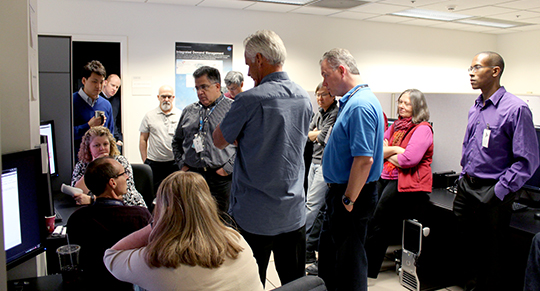
Air Traffic Controllers taking part in an Integrated Demand Management (IDM) research simulation in the Airspace Operations Laboratory (AOL) at NASA Ames Research Center.
Credit – NASA

Why IDM?

FMS and TBFM represent two powerful NextGen automation systems used to address demand/capacity imbalances in the NAS. Recent enhancements to TBFM that extend its geographic and temporal range have introduced some overlap with TFMS functionality, raising the question of which system to use in some situations. TFMS features such as its collaborative decision making framework and new Collaborative Trajectory Options Program (CTOP) (FAA CTOP overview video) and Trajectory Option Set (TOS) capabilities, however, are absent from TBFM. Integrated Demand Management (IDM) proposes that often the best solution can be found by leveraging the complementary features of both systems, developing coordinated strategic (TFMS) + tactical (TBFM) flow management interventions as needed.

IDM Concept

IDM uses a strategic Traffic Management Initiative (TMI), such as CTOP, to adjust the rate and/or geographic distribution across arrival flows of the traffic inbound to a high-demand, TBFM-managed airport. This TFMS intervention preconditions the traffic before it reaches the TBFM planning horizon. This results in a more workable problem for TBFM, which can then tactically fine-tune the demand to deliver a well-managed, orderly feed to the destination airport. Coordinated use of these two flow management capabilities is intended to improve system performance in terms of:

  • Equity of ground delay assignment, avoiding excessive ground delay for TBFM-scheduled departures, without penalizing longer flights;
  • Throughput, by distributing traffic to maximize use of available capacity;
  • Predictability for operators, providing advance notice about the impact on individual flights;
  • Increased flexibility, by supporting operator mitigation strategies such as slot swapping and trajectory options;
  • Efficiency of flight operations, by improving access to user-preferred routes, using ground delay more effectively, and reducing airborne delay.
Traffic Flow Management System (TFMS) Deployment Team and representatives from MITRE Corp and MIT Lincoln Labs participate in IDM demonstration in the AOL
Credit – NASA

Research Products

The AOL’s IDM research was a stakeholder-centered, laboratory-based development process that provided the following products to the FAA.

  • An IDM Concept and Procedures document and IDM Concept Overview slides that describe its context of use and the operational procedures for planning, coordination and execution of IDM operations in today’s NAS.
  • A description of CTOP User Interface Enhancements that were developed in the course of IDM HITL evaluations and demonstrations. While some of these were designed to support IDM-specific tasks, most were improvements that stakeholders found valuable for CTOP in general.
  • A description of the IDM Flow Balancing Algorithm (FBA). The FBA was an algorithm that traffic managers could use to support design of an IDM CTOP that improved the distribution of inbound traffic across multiple arrival flows.
  • An IDM Annotated Bibliography that provided an overview of the research publications conducted or supported by NASA under IDM, including links to all of the NASA-produced publications.

The post Integrated Demand Management (IDM) appeared first on NASA Science.
High Density Vertiplex

11 September 2026 at 00:17

High Density Vertiplex

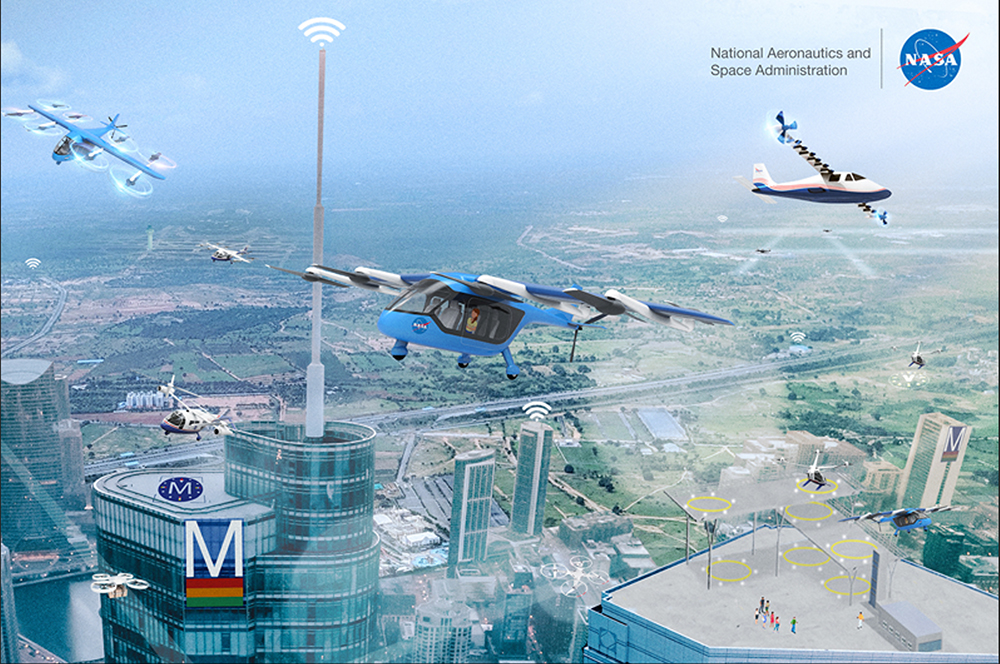
The High Density Vertiplex (HDV) subproject is responsible for the development and evaluation of a reference automation architecture that addresses scalable and efficient aircraft operations, flight and airspace management procedures, and vertiport operations in high density vertiplex environments.

HDV is a sub-project of the Advanced Air Mobility (AAM) project under the Integrated Aviation Systems Program (IASP).

What is a Vertiplex?

A Vertiplex is a geographic area that includes multiple vertiports whose arrival and departure operations are highly interdependent.

Artists conception of High Density Vertiplex (HDV) operations in an urban environment.
Credit – NASA

Purpose and Research Approach

The purpose of this research is to design concepts, procedures, and technologies focused on Urban Air Mobility (UAM) operations in a vertiplex environment. The HDV approach will be to gradually build-up complexity in the operational environment through a series of tests. Testing will be performed subscale using small Unmanned Aerial Systems (sUAS) as surrogates for UAM aircraft. Testing cycles will start out fully simulated, then culminate in live flight tests with small UAS at Langley Research Center. Results from each testing cycle will be used to support subsequent risk assessments. The overall goal is to create a representative UAM system to mitigate risk for future research and development.

Concepts Being Explored

Aircraft-airspace-vertiport automation technology must be integrated and matured to support three main use cases: (1) automated landing, (2) automated merging and spacing, and (3) automated contingency decision making.

NASA researchers participating in a High Density Vertiplex (HDV) study in the Airspace Operations Laboratory (AOL).
Credit – NASA

Role of the AOL in HDV

During simulations and flights tests, the Airspace Operations Laboratory (AOL) and the Autonomous Vehicle Applications Laboratory (AVAL) will serve as the base of operations for Airspace Systems Integration (ASI), which integrates systems and software from Unmanned Aerial Systems (UAS) Traffic Management (UTM) to support HDV concepts. Some of the outcomes of this work include prototype airspace management automation technology and human factors evaluation. Joining the AOL in the HDV flight testing efforts are the Autonomous Vehicle Applications Laboratory (AVAL) from the NASA Ames’ Human Systems Integration Division, and the Air Traffic Operations Laboratory (ATOL) from Langley Research Center.

The post High Density Vertiplex appeared first on NASA Science.

Exoplanet Technologies at NASA Ames

10 September 2026 at 23:42

Exoplanet Technologies at Ames

The Exoplanet Technology group in the Astrophysics Division at NASA Ames is dedicated to advancing direct imaging technologies, including the ultimate goal of imaging Earth-like exoplanets and searching them for signs of life.

Exoplanet Technologies Group TeaM

Rus Belekov, a man holding up a device to his eye, wearing gloves and a hairnet.

Rus Belekov

Senior Optical Scientist

Dan Sirbu

Dan Sirbu

AstroPIC Principal Investigator

Kevin Fogarty

Research Scientist

Eduardo Bendek

Eduardo Bendek

Senior Optical Scientist

Kevin Sims

Project Manager

Instrument development

Technology enabling exoplanet imaging in binary stars systems.

NASA Ames leads and supports the hardware working group for the Roman Coronagraph Participation Program, which enables international teams to develop capabilities beyond the instrument’s baseline modes

Contributions to the Roman Space Telescope

Instrument development

Laboratory Research

State of the art test beds, vacuum chambers, and labs.

These facilities enable researchers to validate new instruments, algorithms, and wavefront-control techniques before they are deployed on space missions.

Ames Coronagraph Experiment Laboratory

Laboratory Research

Theory and Observation

A deeper characterization of exoplanets and their host stars.

Combining theoretical research and observations to support NASA missions and enhance their scientific return. Developing models and analysis techniques to interpret observations from missions such as Kepler, TESS, Hubble, and Webb.

Mission contributions

Theory and Observation

Small Mission Concepts

Mission ideation and maturation

Developing innovative small mission concepts, such as ACESat, to demonstrate new technologies and explore compelling exoplanet science opportunities. These concepts help mature mission architectures and technologies while providing a pathway to address high-priority science goals with cost-effective, focused missions.

Small Mission Concepts

The post Exoplanet Technologies at NASA Ames appeared first on NASA Science.

Functional Allocation

10 September 2026 at 23:09

Functional Allocation

In conjunction with NASA Langley Research Center, NASA’s Airspace Operations Lab explored issues and ideas for allocating separation assurance functions to meet the future air transportation needs. A separation assurance system primarily performs the functions necessary to ensure that aircraft remain safely separated from other traffic. Such a system is also simultaneously concerned with the avoidance of severe weather, the conformance of flights to a variety of operational constraints, and the overall expeditious flow of traffic from origin to destination.

In the current system, air traffic services provide these functions. However even with the current level of operations, this can result in excessive controller workload, limited capacity and, often, inefficient operations. With an expected increase in traffic, these weaknesses can be exacerbated. New automation in the air, on the ground and/or the cloud, and powerful new communication technologies have enabled different ways to allocate trajectory management and separation assurance functions.

NASA’s functional allocation research successfully identified the strengths and weakness of different allocations of separation assurance functions amongst the wide variety of agents participating in the air traffic operation. This research helped provide a roadmap to ensure that fundamental research is pointed towards an efficient final state. The future system has helped handle growing travel in a safe, efficient, and sustainable manner.

The post Functional Allocation appeared first on NASA Science.

NASA Invites Media to Djibouti Artemis Accords Signing Ceremony

10 September 2026 at 22:11
NASA insignia.
Credit: NASA

The Republic of Djibouti will sign the Artemis Accords during a ceremony at 11 a.m. EDT, Monday, Sept. 14, at NASA Headquarters in Washington, becoming the 72nd country signatory.

NASA Deputy Administrator Matt Anderson will host Ambassador of Djibouti to the United States Mohamed Siad Douale for the ceremony, together with U.S. State Department Assistant Secretary for African Affairs Frank Garcia.

This event is in person only. Media interested in attending must RSVP no later than 8 a.m. on Sept. 14 to: hq-media@mail.nasa.gov. NASA’s media accreditation policy is online.

In 2020, during the first Trump Administration, the United States, led by NASA and the State Department, joined with seven other founding nations to establish the Artemis Accords, responding to the growing interest in lunar activities by both governments and private companies.

The accords introduced the first set of practical principles aimed at enhancing the safety, transparency, and coordination of civil space exploration on the Moon, Mars, and beyond.

Learn more about the Artemis Accords at:

https://www.nasa.gov/artemis-accords

-end-

Camille Gallo / Elizabeth Shaw
Headquarters, Washington
202-358-1600
camille.m.gallo@nasa.gov / elizabeth.a.shaw@nasa.gov

Share

Details

Last Updated
Sep 10, 2026
Editor
Jessica Taveau

The post NASA Invites Media to Djibouti Artemis Accords Signing Ceremony appeared first on NASA Science.

NASA Answers President’s Call to Establish United States Space Academy

10 September 2026 at 21:26
President Donald Trump presents an executive order establishing the United States Space Academy during an event to award the Congressional Space Medal of Honor to the Artemis II crew as Michael Kratsios, director of the Office of Science and Technology Policy, left; Kevin Hassett, director of the National Economic Council, third from left; and NASA Administrator Jared Isaacman, right, applaud, Friday, Aug. 28, 2026, at NASA’s Johnson Space Center in Houston.
Credit: NASA/John Kraus

Less than two weeks after an Executive Order was signed to create the first United States Space Academy, NASA-led work is in full swing to make the academy a reality and shape the future of America’s aerospace workforce and leadership.

NASA Administrator Jared Isaacman chaired the first Presidential Commission on the United States Space Academy meeting on Sept. 9. Following that meeting, NASA published a Request for Information Thursday seeking input from governors or their designees interested in hosting and sponsoring the up-and-coming academy in their state.

“Our first Commission meeting made clear how much talent and commitment we have behind President Trump’s vision for the U.S. Space Academy,” said NASA Administrator Jared Isaacman. “I’m grateful to our partners across government for getting right to work. Now, with the RFI underway, states across the country have an opportunity to help us shape a legacy institution built for America’s future in space.”

Isaacman and Deputy Administrator Matt Anderson welcomed key commission members from multiple agencies and organizations to NASA Headquarters in Washington for a collaborative Commission discussion. Participants included U.S. Secretary of War Pete Hegseth, Director of the National Economic Council Kevin Hassett, Secretary of the United States Air Force Troy Meink, and U.S. Chief Technology Officer Ethan Klein, representing Director of Office and Technology Policy Michael Kratsios, along with representatives from the U.S. Office of Management and Budget, the National Security Council, and the White House.

During the meeting, commission members began working through the structure and priorities of the proposed U.S. Space Academy, including its governance, curriculum, service commitments, partnerships, and implementation.

“The location of the U.S. Space Academy is foundational to its success,” said Anderson. “We’re asking states to bring their strongest vision — the infrastructure, the partnerships, and the community that can compete with the elite options this caliber of student will have and match the boundless ambition of our future space leaders.”

The commission’s 120-day mandate to develop recommendations for President Trump on how to establish the academy and build the technical talent and leadership pipeline needed to support America’s long-term goals in space began when the President signed the Executive Order on Aug. 28.

Responses to the RFI will help inform the commission’s path forward to selecting a location for the institution and are due by 6 p.m. EDT on Monday, Oct. 26. An ambitious timeline is outlined in the request, calling for a groundbreaking no later than 2027, temporarily hosting the first 300 students in 2028, and a permanent location in operation by 2031.

Each state is allowed one submission to the Announcement via its governor’s designee. In addition to details about resources available to support the academy, input sought on the potential campus includes:

  • Location information
  • Site readiness
  • Environmental and regulatory considerations
  • Proximity and supporting ecosystems

A fact sheet on the U.S. Space Academy is available on The White House website.

-end-

George Alderman / Cheryl Warner
Headquarters, Washington
202-358-1600
george.a.alderman@nasa.gov / cheryl.m.warner@nasa.gov

Share

Details

Last Updated
Sep 10, 2026

Related Terms

The post NASA Answers President’s Call to Establish United States Space Academy appeared first on NASA Science.

NASA’s Life-Saving Technology Where Cell Signals Can’t Go

10 September 2026 at 21:12
3 Min Read

NASA’s Life-Saving Technology Where Cell Signals Can’t Go

A group of people on a boat, several of them are wearing shirts with text reading
Rescued after more than four hours in the water, Easton Barrett (center, red shorts) and his friend were picked up by the U.S. Coast Guard thanks to a personal locator beacon (PLB). The devise sends a distress signal to satellites that are relayed back to Earth, launching a rescue operation.
Credits: Easton Barrett

Memorial Day weekend 2024 started with a blue sky and a mild three- to four-foot chop in the water off the Gulf Coast of Mississippi — a perfect day for a fishing competition. A team of five was about 40 miles offshore checking their sonar, and 30 seconds later the boat was gone. They were in the water struggling to pull on life jackets and grab the coolers as they bobbed up. When a boat sinks, survivors can be virtually invisible amid the vast expanse of water.

When their fishing trip went wrong, Easton Barrett had the only mobile phone and no cell service. He recorded a brief farewell, planning to put his phone in a cooler in hopes someone would find it.

Another team member activated a personal locator beacon (PLB) that had been stowed at the last minute, which sent a distress signal to the Search and Rescue Satellite-Aided Tracking (SARSAT) technology carried by multiple satellites in Earth orbit. In the SARSAT system, developed partly by NASA, an emergency signal containing the transmitter’s location is directed to the nearest available ground station.

A bearded man stands holding three bright green devices in front of a bag, each has the logo for ACR on it.
406 megahertz is the wavelength dedicated for PLB distress signals. On the annual 406 Day, Easton Barrett posts videos and messages on his social media accounts to help raise awareness about essential survival gear.
Credit: ACR

A mission control center then alerts rescue coordination centers to mobilize search and rescue crews. For Barrett and his crew, that was a Florida Coast Guard boat.

“Ever since, I have tried to teach others about safety on the water and in the outdoors by using a PLB,” said Barrett. “If that will save one life, it’s worth the effort.”

A beacon like the one that saved his crew, a registered ResQLink PLB developed by ACR Electronics Inc. of Fort Lauderdale, Florida, also notifies the device owner’s emergency contact, indicating a distress call was activated. All emergency beacons must meet the same requirements to ensure they work when needed. Every rugged, buoyant, handheld devices have a five- to 10-year battery life.

SARSAT began operations in 1982, becoming an international collaboration in 1985. The flight and ground technologies used globally were originally developed at NASA’s Goddard Space Flight Center in Greenbelt, Maryland. Now there are 62 satellites in the program and 45 nations contributing services, from operating ground stations to providing rescue crews. More than 63,000 lives have been saved.

A close up picture of a green ACR PLB atop a bag in a forest setting
Turning on a ResQLink View PLB from ACR Electronics will automatically “ping” orbiting satellites that send location and GPS information to the nearest search and rescue station. Whether on land or water, the appropriate resources will be dispatched to help anyone in distress anywhere in the world.
Credit: ACR

SARSAT by the Numbers

The Search and Rescue Satellite-Aided Tracking system developed over several decades by NASA and other government agencies saves lives on land or at sea.

  • 1982 — the start of U.S. operations
  • 1985 — the start of international operations
  • 62 operational satellites
  • 45 nations contributing services
  • 63,000+ lives saved

One rescue in 2024 demonstrates how it all comes together.

  • 40 miles off the Mississippi Gulf Coast
  • 5-person team participating in a fishing competition 
  • 30 seconds for a boat to sink
  • 200 pounds of bait dumped to make a cooler buoyant
  • 3 close encounters with wildlife, likely sharks and eels
  • 4 hours in the water
  • 1 personal locator beacon
  • 1 Coast Guard rescue boat
  • 5 lives saved

“If it has anything to do with NASA, it’s got to be awesome.”

EASTOn Barrett

EASTOn Barrett

ACR Customer

About the Author

Margo Pierce

Science Writer

The post NASA’s Life-Saving Technology Where Cell Signals Can’t Go appeared first on NASA Science.

❌