❌

Normal view

NASA Field-Tests AI Fleet Capability for Science, Exploration

15 September 2026 at 21:43

NASA scientists and industry partners recently field-tested an artificial intelligence application that could make future solar system exploration missions more efficient, return more science data, and allow for faster scientific discoveries.
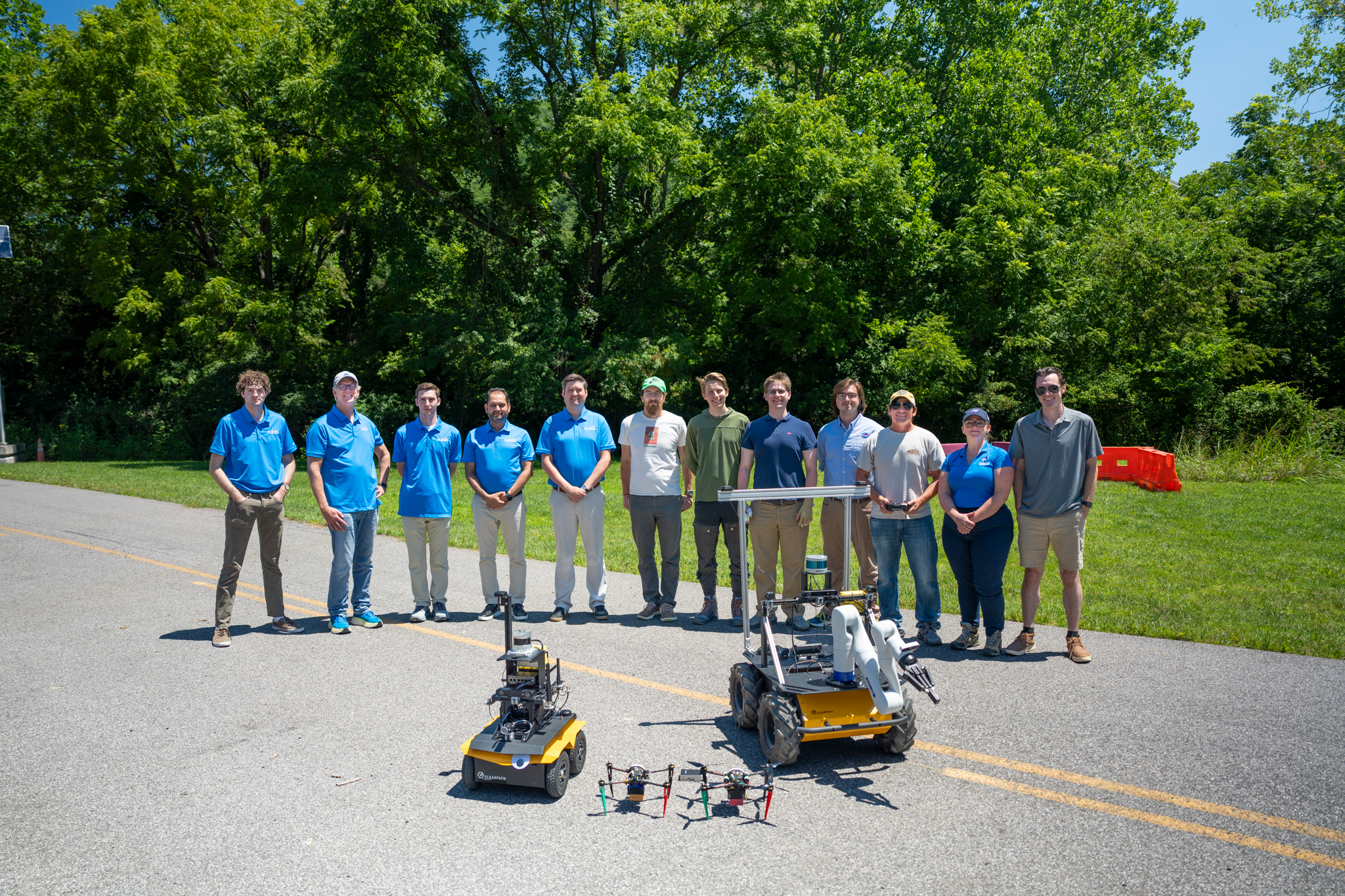
Team photo of twelve people standing on a road with trees behind them. In the foreground are four robots: two rovers and two drones.
Members of the ASTRA (Adaptive Sensing Technology for Responsive Autonomy) team with the fleet of robots they field-tested in July 2026. Left to right: Stephen Scarano, Karl Wunderlich, Zach Logan, Mohammad Goli, and James O’Hara of Noblis; James Marshall, Connor Firth, Leyton McKinney, Connor Williams, Steven Hard, Bethany Theiling, and Michael Monaghan of NASA’s Goddard Space Flight Center in Greenbelt, Maryland.
Noblis/Sean Sullivan

This summer at the Virginia Tech Transportation Institute in Blacksburg, Virginia, a fleet of three robots worked together, and researchers assessed the fleet’s ability to act like an independent science team. To begin each test, a drone was assigned to choose an area of interest based on initial science goals provided by human experts. Then, the fleet’s programming weighed risks against potential science payoffs and calculated which robotic team member was best suited to investigate. As the fleet carried out its plan, it continually checked for environmental hazards, reassessed its strategy to adapt to new information, and reported back to its human managers, NASA’s Adaptive Sensing Technology for Responsive Autonomy (ASTRA) team.

Three robotic explorers in a grassy field: a drone parked between two rovers. The larger rover has a multi-jointed arm extending from it.
The ASTRA + Noblis fleet. The drone (center) uses environmental and scientific sensors to scout the area, identify places of interest, and collect data from overhead. The rover on the left uses lidar to map its surroundings in detail, help the fleet navigate obstacles, and gather context for scientific samples. The rover on the right uses a robotic arm to collect samples.
NASA/Bethany Theiling

The project’s ultimate goal is to provide a trustworthy extension of the human science team in situations where humans are too far away to give real-time instructions, like on uncrewed missions to the outer planets of our solar system, or where the risk to human explorers is unacceptably high, like in areas of the Moon and Mars that are difficult for astronauts to explore.

One of the questions the field test was designed to answer: Once the fleet has started working on a science objective, will it change tasks autonomously based on new information? In the testing, the fleet showed it could focus on its original objectives and follow up on new possibilities. When the lead drone found an additional area of interest in the course of its work, it didn’t abandon its current task, but it did pause to process the opportunity and pull in another robotic asset to investigate the new question.
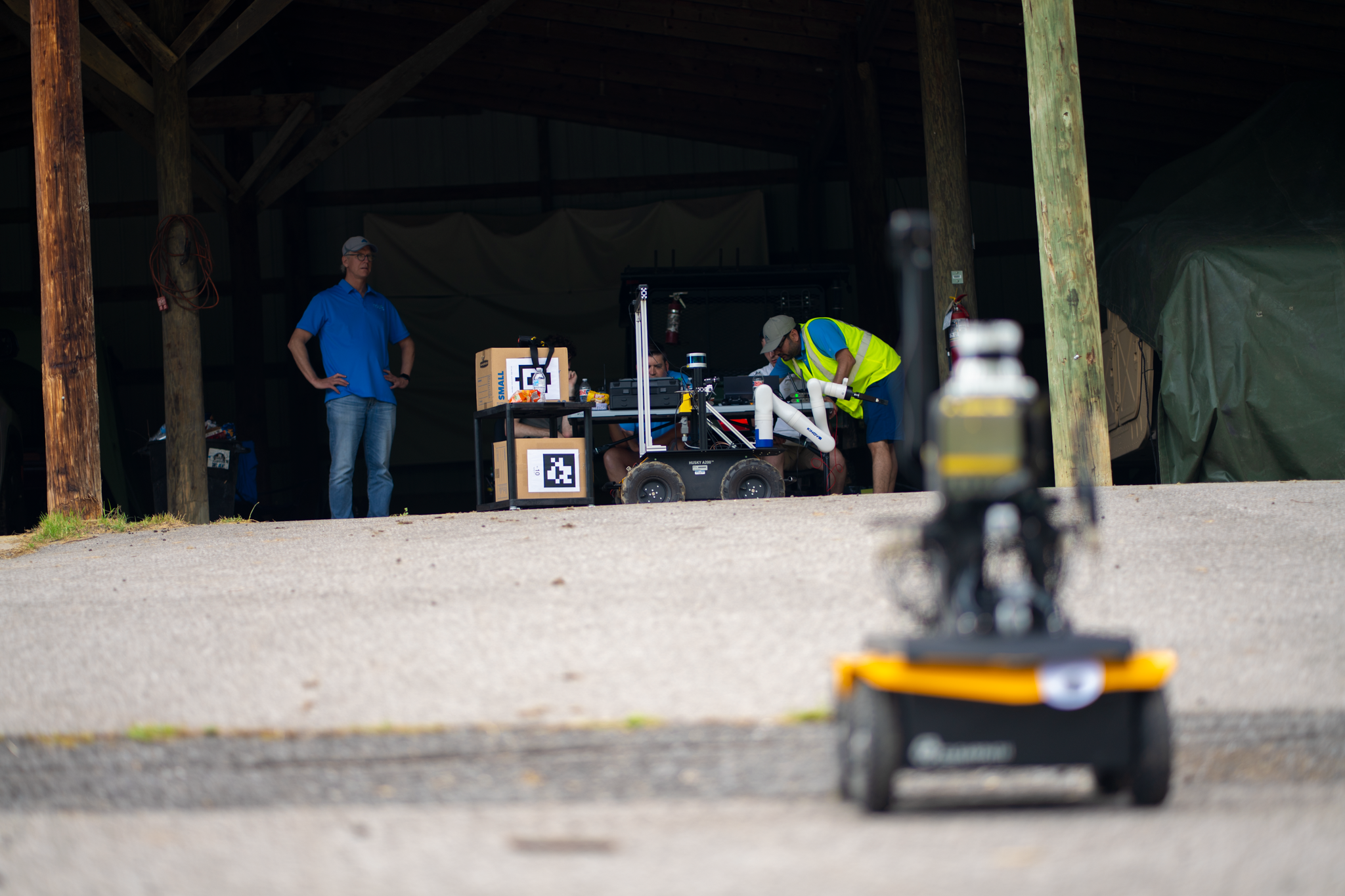
A small robot on the move across pavement. In the background, people observe its progress and work on another robot.
Mohammad Goli, Zach Logan, and James O’Hara test communications on the sampling rover as Karl Wunderlich observes rover actions during a July 2026 field test in Blacksburg, Virginia. Noblis provided the robotic fleet’s ground capability (two rovers shown here).
Noblis/Sean Sullivan

Crucially, the fleet’s decision-making programs handled both objective and subjective information. What robotic assets are available? How far away are they, and how fast can each one move? How much does the science team want the knowledge that can be gained by mapping this area or by taking a sample of that material? Would the humans want to learn from a newly spotted point of interest more than they’d want the fleet to focus on its original task? How risky is each job for the robot attempting it, and is the danger acceptable to the mission planners?

“We want to find a way for missions to do things that they could never do before because they didn’t have a decision-maker on board that can weigh all these criteria at the same time,” says Bethany Theiling, ASTRA principal investigator and field lead, of NASA’s Goddard Space Flight Center in Greenbelt, Maryland.

This ability to consider subjective criteria alongside simple facts, then deliver decisions that satisfy the people behind the project, is what the ASTRA team is working to develop. The mission team will consider the robotic fleet to be successful if it can correctly act without direct instructions based on its physical capabilities and on the team’s priorities and risk assessments.

Theiling led the testing campaign in collaboration with Noblis, Aurora Engineering, and the University of Tulsa.

Similar Landscapes, Different Worlds

About Planetary Analogs

Our planet isn't the only place with ice, volcanoes, impact craters, quakes, and erosion. Studying extreme environments on Earth helps us to understand other worlds better, too.

Learn More
A researcher in a clean suit kneels in the desert, collecting samples.
NASA scientist Mary Beth Wilhelm collects soil samples from Chile’s Atacama Desert. Studying ancient life in the driest places on Earth helps us to understand conditions on Mars.
NASA

The post NASA Field-Tests AI Fleet Capability for Science, Exploration appeared first on NASA Science.

Playing the Moon Game 

24 June 2026 at 05:01
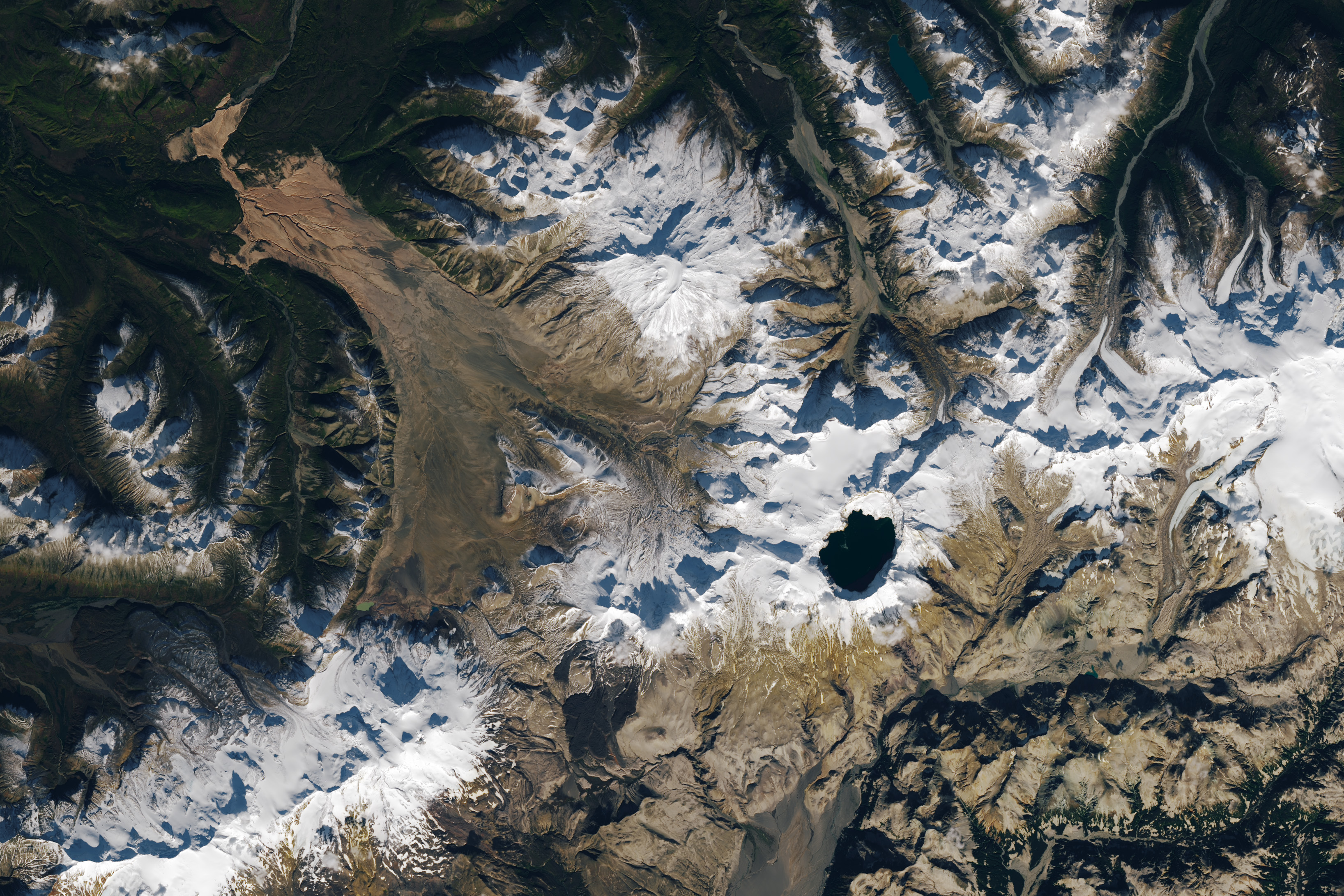
A satellite image shows part of Alaska’s Katmai National Park. A chain of snowy mountain peaks stretches from the bottom left corner to the right side of the image. The Valley of Ten Thousand Smokes is a long, tan-colored feature runs toward the northwest in the upper-left.
September 29, 2025

In preparing to visit the Moon’s surface, soon-to-be lunar explorers in NASA’s Apollo program first ventured into a variety of unfamiliar landscapes on Earth. A couple of these trips, in the summers of 1965 and 1966, took astronauts to Alaska’s remote Katmai National Park for simulations of field geology in Moon-like environments.

In one exercise, which they called “playing the Moon game,” pairs of astronauts were placed at unfamiliar field sites and asked to pretend as if they were on the Moon. By the account of William Phinney, Apollo’s science training coordinator, they were tasked with collecting representative geologic samples and practicing how to communicate their observations to scientists.

A detailed satellite image centers on the Valley of Ten Thousand Smokes in Alaska. The tan-colored feature runs southeast-to-northwest. Snowy peaks appear on the right side of the image, and green, forested valleys fill the left side.
September 29, 2025

The Alaskan setting for the Moon game was an unusual volcanic landscape called the Valley of Ten Thousand Smokes. The valley is full of debris deposited by the 1912 eruption of Novarupta—the largest volcanic event on Earth in the 20th century.

The images above, acquired on September 29, 2025, with the OLI (Operational Land Imager) on Landsat 9, show the massive ash flow deposited by Novarupta. The layer measures up to 660 feet (200 meters) thick and was emplaced at a searing 1,380 degrees Fahrenheit (750 degrees Celsius). 

The Valley of Ten Thousand Smokes, shown in the 1917 photo below, is so named because of the abundance of fumaroles—gas and steam-emitting vents—that filled the valley for a decade after the eruption. A few hundred persisted more than 10 years, with some lasting until the 1990s.

Three people stand in the foreground of this black-and-white photo, silhouetted by steam coming from a fumarole. A dark, barren landscape dotted with plumes of rising steam extends into the background.
1917

Scientists initially suspected that the monster eruption occurred at Mount Katmai, a neighboring volcano with a large caldera located 6 miles (10 kilometers) east of Novarupta’s dome. However, they later determined that the eruption actually occurred at Novarupta—whose name means “new eruption”—after stealing magma from beneath Katmai. As the magma chamber emptied, Katmai collapsed, forming the 2.5-mile-wide (4-kilometer-wide) caldera present today.

The volcanic landscape in the Valley of Ten Thousand Smokes is far fresher than the ancient lava flows that formed the Moon’s volcanic features. But for the Apollo astronauts, it offered an “excellent opportunity to view volcanic materials and landforms in nearly pristine condition,” Phinney wrote. They studied evidence of fumaroles and examined vertical sections of the deposits where streams had eroded deep gorges.

This photo shows a broad valley filled with tan-colored volcanic material in the foreground and snowy mountains in the background. The ashy volcanic deposits create a mostly flat valley floor, except where steep-sided chasms formed by erosion run through it.
June 9, 1991

Researchers continue to visit this Alaskan wilderness in search of clues that could help decipher the geology of the Moon and Mars. In 2024, the Goddard Instrument Field Team (GIFT) trekked to the Valley of Ten Thousand Smokes to study its icy volcanic landscape. Like the valley, Mars contains glaciers and ice sheets layered with dust and ash, a dynamic and difficult-to-interpret environment.

Advancing lunar science, the GIFT team also collected samples from rock formations comparable to the Moon’s Gruithuisen Domes. These mysterious features are made of hardened lava with a different composition than the surrounding rock. With more to learn about our nearest celestial neighbor, the spirit of the Moon game lives on in the 21st century.

NASA Earth Observatory images by Lauren Dauphin, using Landsat data from the U.S. Geological Survey. Photos from National Geographic Society Katmai expeditions photographs, Archives and Special Collections, Consortium Library, University of Alaska Anchorage, and from the U.S. Geological Survey Volcano Hazards Program. Story by Lindsey Doermann. 

Downloads

A satellite image shows part of Alaska’s Katmai National Park. A chain of snowy mountain peaks stretches from the bottom left corner to the right side of the image. The Valley of Ten Thousand Smokes is a long, tan-colored feature runs toward the northwest in the upper-left.

September 29, 2025

JPEG (2.64 MB)

References & Resources

You may also be interested in:

Stay up-to-date with the latest content from NASA as we explore the universe and discover more about our home planet.

Scoria Cones on Earth and Mars

7 min read

The hill-shaped features are a sign of explosive volcanic activity—a rarity on the Red Planet.

Article

A Volcanic Medley Near Mammoth Lakes 

4 min read

A massive, old caldera and more recently formed craters shape the landscape in the eastern Sierra Nevada.

Article

A Full Moon Checkup

3 min read

Once a month during the full Moon, Landsat 9 turns from Earth to image the lunar surface, helping keep the…

Article

Playing the Moon Game 

24 June 2026 at 05:01
A satellite image shows part of Alaska’s Katmai National Park. A chain of snowy mountain peaks stretches from the bottom left corner to the right side of the image. The Valley of Ten Thousand Smokes is a long, tan-colored feature runs toward the northwest in the upper-left.
September 29, 2025

In preparing to visit the Moon’s surface, soon-to-be lunar explorers in NASA’s Apollo program first ventured into a variety of unfamiliar landscapes on Earth. A couple of these trips, in the summers of 1965 and 1966, took astronauts to Alaska’s remote Katmai National Park for simulations of field geology in Moon-like environments.

In one exercise, which they called “playing the Moon game,” pairs of astronauts were placed at unfamiliar field sites and asked to pretend as if they were on the Moon. By the account of William Phinney, Apollo’s science training coordinator, they were tasked with collecting representative geologic samples and practicing how to communicate their observations to scientists.

A detailed satellite image centers on the Valley of Ten Thousand Smokes in Alaska. The tan-colored feature runs southeast-to-northwest. Snowy peaks appear on the right side of the image, and green, forested valleys fill the left side.
September 29, 2025

The Alaskan setting for the Moon game was an unusual volcanic landscape called the Valley of Ten Thousand Smokes. The valley is full of debris deposited by the 1912 eruption of Novarupta—the largest volcanic event on Earth in the 20th century.

The images above, acquired on September 29, 2025, with the OLI (Operational Land Imager) on Landsat 9, show the massive ash flow deposited by Novarupta. The layer measures up to 660 feet (200 meters) thick and was emplaced at a searing 1,380 degrees Fahrenheit (750 degrees Celsius). 

The Valley of Ten Thousand Smokes, shown in the 1917 photo below, is so named because of the abundance of fumaroles—gas and steam-emitting vents—that filled the valley for a decade after the eruption. A few hundred persisted more than 10 years, with some lasting until the 1990s.

Three people stand in the foreground of this black-and-white photo, silhouetted by steam coming from a fumarole. A dark, barren landscape dotted with plumes of rising steam extends into the background.
1917

Scientists initially suspected that the monster eruption occurred at Mount Katmai, a neighboring volcano with a large caldera located 6 miles (10 kilometers) east of Novarupta’s dome. However, they later determined that the eruption actually occurred at Novarupta—whose name means “new eruption”—after stealing magma from beneath Katmai. As the magma chamber emptied, Katmai collapsed, forming the 2.5-mile-wide (4-kilometer-wide) caldera present today.

The volcanic landscape in the Valley of Ten Thousand Smokes is far fresher than the ancient lava flows that formed the Moon’s volcanic features. But for the Apollo astronauts, it offered an “excellent opportunity to view volcanic materials and landforms in nearly pristine condition,” Phinney wrote. They studied evidence of fumaroles and examined vertical sections of the deposits where streams had eroded deep gorges.

This photo shows a broad valley filled with tan-colored volcanic material in the foreground and snowy mountains in the background. The ashy volcanic deposits create a mostly flat valley floor, except where steep-sided chasms formed by erosion run through it.
June 9, 1991

Researchers continue to visit this Alaskan wilderness in search of clues that could help decipher the geology of the Moon and Mars. In 2024, the Goddard Instrument Field Team (GIFT) trekked to the Valley of Ten Thousand Smokes to study its icy volcanic landscape. Like the valley, Mars contains glaciers and ice sheets layered with dust and ash, a dynamic and difficult-to-interpret environment.

Advancing lunar science, the GIFT team also collected samples from rock formations comparable to the Moon’s Gruithuisen Domes. These mysterious features are made of hardened lava with a different composition than the surrounding rock. With more to learn about our nearest celestial neighbor, the spirit of the Moon game lives on in the 21st century.

NASA Earth Observatory images by Lauren Dauphin, using Landsat data from the U.S. Geological Survey. Photos from National Geographic Society Katmai expeditions photographs, Archives and Special Collections, Consortium Library, University of Alaska Anchorage, and from the U.S. Geological Survey Volcano Hazards Program. Story by Lindsey Doermann. 

Downloads

A satellite image shows part of Alaska’s Katmai National Park. A chain of snowy mountain peaks stretches from the bottom left corner to the right side of the image. The Valley of Ten Thousand Smokes is a long, tan-colored feature runs toward the northwest in the upper-left.

September 29, 2025

JPEG (2.64 MB)

References & Resources

You may also be interested in:

Stay up-to-date with the latest content from NASA as we explore the universe and discover more about our home planet.

Scoria Cones on Earth and Mars
7 min read

The hill-shaped features are a sign of explosive volcanic activity—a rarity on the Red Planet.

Article
A Volcanic Medley Near Mammoth Lakes 
4 min read

A massive, old caldera and more recently formed craters shape the landscape in the eastern Sierra Nevada.

Article
Restless Kīlauea Launches Lava and Ash
3 min read

Episode 43 of the Hawaiian volcano’s current eruption was marked by high lava fountains and widespread ash dispersal.

Article

The post Playing the Moon Game  appeared first on NASA Science.

❌