Defense tech is red hot right now. Anduril and Mach Industries just doubled and quadrupled their valuations, respectively, and the U.S. government is proposing a 40% increase in defense budget. A wave of new startups is chasing those government contracts, but according to Ross Fubini, the venture investor who wrote Anduril’s first check, most of them will get lost in the Valley of Death between prototype contract […]
Jensen Huang, chief executive officer of Nvidia Corp. | Bloomberg via Getty Images
Just in case you were wondering, Nvidia's RTX Spark isn't supposed to be a one-off. The company is not just flirting with becoming the fifth high-profile vendor of consumer laptop chips to see if people bite. At Computex 2026 in Taipei, Nvidia CEO Jensen Huang confirmed at least two additional generations of RTX Spark are already planned. The eventual goal, he said, is to build Star Trek-like computers and and Star Wars-like droids you can order around with your voice.
"I want to talk to my laptop! I want R2-D2!" he told analysts and investors at Computex, revealing that he started working with Microsoft CEO Satya Nadella "about three years …
Some people rarely lose things. Wallets are always exactly where they’re supposed to be, keys never go missing, and remotes never slip between the couch cushions. And then there’s the rest of us — the folks who can’t ever seem to find the thing that was right there a few seconds ago. For us, Bluetooth trackers can help.
Bluetooth trackers have been around for a long time, and they all generally work the same way. You attach the tracker to an object (a key ring, tote, in your wallet, etc), pair it with your phone, and then, if you lose said object, you can go into an app and ring the tracker. These days, Bluetooth trackers can do a lot more. Some have ultra-wideband chips that enable precision tracking, so you can find exactly where in a room your item is without having to sound an alarm. Most trackers tap into large networks — like Apple’s Find My and Google’s Find Hub — making it easier to locate lost items outside the home. Many will notify you if they detect you’ve left the device behind or come with QR codes that link to your contact information so people can easily return lost items.
These features are incredibly handy but also have the potential for misuse. For example, when Apple launched the AirTag, it seems the company hadn’t anticipated they might be used to track people or stolen items — but that’s exactly what happened. It’s since beefed upits anti-stalking features, and companies like Tile have also followed suit. Apple and Google have launched a standard that enables unwanted tracking alerts across both Android and iOS devices, and major players like Tile, Samsung, and Chipolo have supported the initiative. Still, it’s worth making yourself aware of each tracker’s approach to safety when deciding the best option for you.
As consummate Losers of Things, we have tested a fair share of Bluetooth trackers on wallets, keys, and luggage. Here’s what we’d recommend if you, too, have a hard time finding things.
The best tracker for iPhone users
Apple AirTag (second-gen)
Apple’s latest AirTags features an upgraded ultra-wideband chip for more precise location tracking, a noticeably louder speaker, and an expanded Bluetooth range.
If you’re an iPhone owner, Apple’s second-gen AirTag offers a level of precision that rival trackers simply cannot match. The updated model leverages the company’s latest ultra wideband (UWB) chip for its nifty Precision Finding feature, which, in turn, can lead you to your lost item with an on-screen arrow in the Find My app. Plus, because AirTags can tap into Apple’s vast Find My network, a lost tracker can anonymously ping its location to Apple’s iCloud servers whenever it’s near another Apple device, extending its range beyond Bluetooth’s limitations.
That level of precision proved incredibly useful during testing. Apple’s newest coin-shaped tracker consistently guided us to our misplaced items, including a spare mailroom key hidden in a closet. None of the other Bluetooth trackers we tested — including those from Tile and other third-party, Find My-compatible offerings — worked quite as well. The extended range on the latest AirTags also makes it much easier to reliably locate items in multi-story homes, while a series of iOS updates has made it possible to share a temporary map with a host of airlines (including Delta and United), which can help if your luggage should ever go missing.
There are downsides, though. Although their replaceable CR2032 battery helps you save money in the long run, AirTags aren’t truly $29 for most people, since you’ll likely want to buy a separate holder to attach one to your keys or luggage. They’ve also faced criticism for being misused for unwanted tracking purposes (you can read our original testing in full here). That being said, Apple is aware of the issue and has since improved unwanted tracking alerts by shortening the time before you’re notified an unknown AirTag is in your vicinity, making chimes louder, and creating a separate app that lets Android users scan for unknown AirTags.
The Tile Pro is the company’s loudest Bluetooth tracker and has the widest range at 500 feet. It also has a user-replaceable battery, unlike other Tiles.
More trackers these days offer support for both Google’s and Apple’s Find My networks, but Tile’s trackers remain our top recommendation for both Android users and those in mixed iOS / Android households. What’s more, Tile currently offers four form factors to suit different needs: the card-shaped Tile Slim ($29.99), the square-ish Tile ($24.99), the self-adhesive Tile Sticker ($24.99), and the Tile Pro ($34.99). The keyfob-shaped Tile Pro is our personal favorite; it’s larger than the Tile, offers the longest Bluetooth range at 500 feet, and has the loudest ring. Of the four, it’s also the only one that has a replaceable one-year CR2032 battery.
Initially, the network lagged behind Apple’s, but it’s catching up. After several weeks of testing Find Hub-compatible trackers — specifically the Chipolo Pop, Pebblebee Clip 5, and Motorola’s Moto Tag — in 2025, we found the network had improved significantly, especially in busy areas. Still, it’s clear Google prioritized privacy over precision.
Google is making some progress, though. In 2024, it also rolled out satellite connectivity to Pixel 9 phones and newer devices, followed by UWB support for more precise tracking with Moto Tags and other compatible phones and trackers. More recently, the company added support for an iPhone-like feature that lets you share tracker locations with a growing number of airlines. So far, the list doesn’t include any US-based carriers, but it does include Lufthansa, Air India, China Airlines, Saudia, and more.
All Tile trackers work similarly to AirTags. Like Apple’s, Tile’s platform-agnostic trackers can tap into a larger network — in this case, the Tile Network and Amazon Sidewalk, neither of which is as expansive as Apple’s or Google’s. However, when we tested Google’s Find Hub-compatible trackers, including the Chipolo Pop and Moto Tag, we found that Tile still did better at tracking items outside the home. The biggest downside is that Tile trackers lack ultra-wideband support, which means they can’t guide you to a nearby item using distance and directional cues like an AirTag. The company didannounce a tracker that supports UWB in 2021, but it’s yet to ship, likely because Apple is effectively blocking UWB compatibility for third parties in iOS and Tile’s priorities shifted after it was acquired by Life360.
That being said, Tile trackers do have an edge over AirTags when it comes to recovering stolen items and safety features. That’s largely due to Tile’s anti-theft feature, which makes trackers invisible to tracking detection if your item is stolen. Using it requires identity verification and carries strict penalties, including a $1 million fine for misuse. Tile also offers a “Scan and Secure” tool for detecting unknown Tile devices nearby, though potential victims still have to proactively scan their surroundings.
To round things out, Tile users can manage their trackers directly within the Life360 app and send SOS alerts to emergency contacts with the push of a button (or several). New Tile users are also eligible for up to $100 in reimbursement for lost items and free replacements for damaged trackers, as well as access to 30 days of location history and unlimited sharing within their first year. After that, Tile owners will have to pay the $29.99 annual premium subscription fee to continue enjoying those perks, though every Tile user gets two days of location history for free.
The best AirTag and Tile alternative
Pebblebee Clip 5
The Pebblebee Clip 5 supports Apple’s Find My and Google’s Find Hub networks, but also has a 500-foot Bluetooth range, LEDs that flash to help you locate it, and a rechargeable battery that lasts up to 12 months on a single charge.
If you’re looking for an AirTag or Tile alternative, the $34.99 Pebblebee Clip 5 is an excellent choice. It’s one of a growing number of trackers that support both Apple’s Find My and Google’s Find Hub networks, which is a major improvement over its predecessor. Setup is seamless for iOS and Android users, but because Pebblebee’s app doesn’t handle tracking, features like geofencing and safe locations depend on which network you choose. Apple’s Find My, for instance, supports “left behind” alerts and safe locations; Google’s Find Hub still lacks an equivalent.
The thing we like best about the Pebblebee Clip 5 is its rechargeable battery. It can last up to a year on a single charge, though you may get longer than that depending on your usage. It features a USB-C port, and Pebblebee advertises a Bluetooth range of up to 500 feet. Additionally, the Clip 5 features a blinking LED strip that’s noticeably brighter than prior models and a significantly louder ringtone, making lost items easier to find, even in dark or noisy environments.
You can still use Pebblebee’s app to set voice tags, ask Amazon Alexa or Google Assistant for help, or double-tap the tracker to ring your phone. While the Clip 5 is larger than an AirTag, it also includes a snap-on key ring, so you don’t need to pay for an extra accessory just to attach it to your belongings. It’s also rated IP66 for dust and water resistance, making it slightly more durable than earlier Pebblebee trackers.
The best AirTag alternative for wallets
Pebblebee Card 5
The Pebblebee Card 5 has a rechargeable battery that lasts up to 18 months and supports wireless charging. It works with Apple’s Find My and Google’s Find Hub, but you can also use the Pebblebee app for voice tagging.
You could try stuffing an AirTag into a bifold wallet and hope it stays put — or opt for a Find My–compatible alternative that’s actually designed for wallets, like the $34.99 Pebblebee Card 5. It plays nicely with both Apple’s Find My and Google’s Find Hub networks, giving you cross-platform flexibility and the benefits of each, all with a super loud ringtone. It doesn’t offer precision tracking because it lacks UWB, but it makes up for it with said ringtones. It also supports unwanted tracking alerts as part of the Find My network.
The Card 5 stands out for its sleek design and wireless charging support. At just 1.8mm thick, it’s one of the thinnest trackers you can buy and measures about the size of a credit card, meaning you can easily slip it into an overstuffed wallet packed to the brim with receipts, gift cards, and cash. The same can’t always be said of Tile’s wallet tracker, which is nearly twice as thick. What’s more, the Card 5 lasts up to 18 months on a single charge and supports wireless charging, so you don’t have to worry about replacing any batteries.
Unsurprisingly, the Card 5 shares many of the same strengths as the Pebblebee Clip 5, including support for the Pebblebee app and voice tagging. You also get a range of up to 500 feet, an IP66 rating for dust and water resistance, and a built-in button you can press to help locate your phone.
The $29 Chipolo Pop offers a similar form factor to Apple’s AirTag in a lighter, more colorful package with a hole for a keychain or lanyard, a louder beep, and compatibility with both Apple’s Find My and Google’s Find Hub networks (though only one at a time). You can even use the Pop as a remote camera shutter and press the built-in button twice to find your lost phone. Unlike Chipolo’s other trackers, it boasts a wider 300-foot Bluetooth range, a more robust IP55 rating for water and dust resistance, and includes a user-replaceable battery that can last up to a year.
In our testing, tracking was accurate on both Apple’s and Google’s networks in most cases, Google’s struggled to track items outside of the home as reliably as the Tile. And without UWB, the Pop couldn’t match the AirTag’s pinpoint precision. Still, the Chipolo app provides Android users with reliable out-of-range alerts and left-behind notifications — something Pebblebee and Moto Tag’s trackers lack —which, in our experience, trigger even faster than the Tile.
If you’re willing to spend an extra $10, the $39 Chipolo Loop is very similar to the Chipolo Pop, with many of the same strengths and weaknesses. However, it charges via USB-C and includes a built-in silicone ring that’s easy to attach to keys, bags, and other items. You also get a more durable IP67 rating and an extra 100 feet of Bluetooth range — up to 400 feet total. Just note you’ll have to supply your own USB-C cable.
If you’re a Samsung Galaxy phone user, the $29.99 Samsung SmartTag2 gets you UWB tracking and can tap into the Galaxy Find network, which operates similarly to Apple’s Find My network. It’s a great AirTag alternative, but it isn’t our overall pick for Android because it’s limited to Samsung Galaxy users. That said, the latest SmartTag2 includes an improved Compass View, longer battery life, and a better app experience. It also has a newer, oblong design with a larger key ring than the original SmartTag.
Motorola’s $29.99 Moto Tag is the first tracker on Google’s Find Hub network to offer ultra wideband for locating lost items on phones equipped with a UWB chip, which is a feature Google enabled via a firmware update after releasing the device. Like Apple’s AirTag, it can guide you directly to your missing item via directional cues in the Find Hub app. It worked well in our testing, though Apple’s AirTag was occasionally more precise when tracking objects farther away or through walls. The Moto Tag was also less effective than Tile’s trackers at locating items outside of the home.
Still, if you want a tracker to find things around the house, the Moto Tag is a solid pick. It also fits most AirTag accessories, carries an IP67 rating for dust and water resistance, and uses a replaceable CR2032 battery that lasts up to a year. It can ring your misplaced phone, too, and doubles as a remote shutter for Motorola phones. Just know that Motorola recently announced the Moto Tag 2, which can last more than 500 days on a user-replaceable CR2032 coin cell battery and offers improved dust and water resistance. The company hasn’t specified an exact US release date (yet).
The rechargeable Chipolo Card is also a good, thin tracker for wallets. Priced at $39, it works with either Apple’s Find My or Google’s Find Hub network and carries an IP67 rating for dust and water resistance. It supports Qi wireless charging, unlike the Chipolo Loop, and features a slim design that slips neatly into your wallet. It also offers a 400-foot Bluetooth range — a bit less than the Pebblebee Card 5 — and lasts about six months per charge. Overall, it’s a solid choice if you want something simple, even if it lacks the QR code found on some competing trackers.
Eufy’s rechargeable $34.99 SmartTrack Card E30 is another good option for wallets, one that can also tap into Apple’s Find My network like the aforementioned Pebblebee Card 5. On the back, there’s also a QR code — similar to the ones Tile uses — that helps good Samaritans return your item to you. Like the Pebblebee’s newest offerings, you can also share it with multiple people if you set it up via the Eufy Security app.
The bummer here is that the E30 doesn’t work with Android and lacks UWB. However, the upcoming Eufy SmartTrack Card E40 will add support for Google’s Find Hub network while continuing to support Apple’s aforementioned Find My feature. It can also recharge via any Qi-compatible wireless charger and features a louder, 100dB alarm.
Update, June 3rd: Adjusted pricing and availability, and updated references to the Tile Mate to reflect its new name, Tile.
A pioneering technology capable of converting lignin, one of the world's most abundant organic compounds, into vanillin and biodegradable materials has been unveiled by the University of Alicante (UA), in collaboration with the Polytechnic University of Valencia (UPV). The study, published in Nature Communications, offers a sustainable method for repurposing plant waste and identifies viable alternatives to the fossil fuels that currently drive the chemical industry.
Compact power banks have gotten a lot faster in the past year — and it’s not just their USB-C charging speeds that have received a boost. The newest Qi2.2-certified models can wirelessly charge an iPhone 16 or later at up to 25W. Combine that with their ability to magnetically snap on via MagSafe, and you’ve got yourself an essential add-on that’s easy to take on the go.
Qi2 is a magnetic wireless charging standard that’s based on Apple’s MagSafe tech, so almost all modern iPhones support it. While the latest iPhones offer the fastest charging rates, older models (dating back to the iPhone 12) support 15W Qi2 charging speeds, which is still suitably quick. (The iPhone 17E also maxes out at 15W, and the 16E doesn’t have wireless charging at all.)
On the other hand, Android phones are a mixed bag, with very few models supporting Qi2, let alone Qi2.2. Google’s Pixel 10, 10 Pro, and 10 Pro Fold support Qi2 charging at up to 15W; the 10 Pro XL supports Qi 2.2 at up to 25W. Samsung’s Galaxy 26 lineup is “Qi2 Ready,” which means they can use Qi2 chargers at up to 15W if they have a magnet case. And that’s pretty much it.
We know you want the best, whichever phone you have. Some of you may be willing to pay a lot for it, while others may simply want the best possible model for the least amount of money. Of the seven we tested — which vary in features, design, and charging speed — we landed on two picks that should satisfy most people’s needs.
The Qi2.2 battery with the fastest wireless charging speeds
Dimensions: 2.6 x 4 x 0.6 inches, 196 grams / Wireless charging speed: Qi2.2 25W, Qi2 15W / Wired charging speed: Advertised as 45W, but a bit slower / Passthrough charging: Yes / Ports: One USB-C port / Built-in cable: Yes, non-removable / Advertised battery capacity: 10,000mAh, 36Wh
The Baseus PicoGo AM52 is about as no-frills as power banks come, both in design and features. The all-black battery pack has a sleek aluminum case, with soft-touch silicone on the magnetic side to prevent it from scratching your phone while charging. It can charge devices via Qi2.2 and USB-C simultaneously, but using both requires you to press the power button (and there’s a steep speed penalty as it splits the power).
The AM52 consistently offered the fastest wireless charging speeds of any power bank I tested, and it’s often the most affordable of the bunch. It wirelessly charged an iPhone 17 Pro Max to 65 percent in one hour and the Pixel 10 Pro XL to 50 percent, which is on par with the slightly pricier Sharge Icemag 3. The Iniu SnapGo Air slightly outperformed the AM52 in some wireless tests, but lagged behind in others. Baseus’s model lacks a built-in display — meaning you can’t see the remaining charge — but two of the four LED indicators were still full after an hour of wireless charging, indicating it still had some juice left.
I tested the version with a built-in USB-C cable, which usually retails for $64 at Amazon if you’re a Prime member ($4 more than the cordless version). Sometimes, it drops to $40 or so with a coupon, and in terms of wired charging speeds, it was also among the fastest of the seven batteries I tested. It charged both the iPhone and Pixel to about 90 percent capacity within an hour, though it’s not necessarily hard to find a battery that supports fast wired charging.
The Baseus AM52 advertises a top speed of 45W via USB-C, though it didn’t reach those speeds with any of the devices I tested. It topped out at about 38W while connected to the iPhone 17 Pro Max and 33W while attached to the Pixel 10 Pro XL, both of which advertise higher wired speeds (the Iniu SnapGo Air topped out at 39W). The Baseus also topped out at 39.1W while plugged into my M2 MacBook Air, which isn’t far from its advertised rating, while the Iniu reached 43W. In other words, get the Iniu if you value fast wired speeds and the Baseus if you want fast wireless charging.
The other Qi2.2 batteries I tested
Sharge’s Icemag 3 (39.1Wh) is the coolest battery of the seven that I tested, and it delivers great wireless and wired charging speeds (25W and 30W, respectively). No issues here, but it usually costs a fair amount more than the Baseus or Iniu model.
Iniu’s SnapGo Air (39.2Wh) came close to being our top pick thanks to its fast wired charging, relatively low price, and LED display that shows remaining charge. But its wireless charging performance was inconsistent.
The Qi2 battery with the most power for the least money
I wasn’t expecting one of the best-performing batteries to be the least expensive model I called in. The iWalk PowerHybrid is a 15W Qi2 charger that’s bulkier than our top pick, and honestly, pretty cheap-looking. But I can’t argue with its charging speeds, or the fact that it’s commonly available for about $35 — half the typical cost of the Baseus AM52. The PowerHybrid also includes a USB-C cable fashioned into a lanyard; however, this one is fully detachable, unlike Baseus’s.
The iWalk charged the iPhone 17 Pro Max to 55 percent in an hour via Qi2 wireless charging. It performed similarly to our Qi2.2 pick while charging the Pixel 10 Pro XL, too, delivering 46 percent of the phone’s total charge in an hour (with 59 percent of the power bank’s battery remaining). Yes, that’s slower than the AM52, but ask yourself: Is a 10 percent speed boost worth nearly twice the price? No judgment if your answer is yes, but those shaking their heads are my kind of people.
The PowerHybrid’s wired charging speeds were in line with other models I tested, allowing me to take the iPhone 17 Pro Max and the Pixel 10 Pro XL to 90 percent and 85 percent in an hour, respectively. It also didn’t have any issues reaching its peak 30W charging speeds across multiple devices, which, again, was the case with the AM52.
The iWalk battery has a pretty big quirk, however: It doesn’t automatically turn on when you place a device on its magnetic surface. For Qi2 charging to work, its display (which shows the remaining charge) must be illuminated, which requires you to either press the power button or charge something via its USB-C port. It’s not a big deal, but it might be annoying to some.
The other Qi2 batteries I tested
The Anker MagGo Power Bank (38.5Wh) is hefty and deluxe, with a durable kickstand and a slick display that shows remaining charge and time to charge. But it’s slow considering its high $90 price, managing 15W Qi2 and 27W USB-C charging.
No other battery I tested looks as quirky and futuristic as Aulumu’s M10 (36Wh). It supports Apple Watch charging, plus USB-C charging and Qi2 15W speeds, but it’s costly at $90 and delivers inconsistent wireless charging speeds.
Statik’s SmartCharge Gen 2 (38.5Wh) delivers what a lot of people are likely looking for: a power bank that can plug directly into an outlet, with two built-in USB-C cables, a few ports, not to mention Apple Watch charging. It’s cool and not terribly expensive at $70, but it’s very slow to charge devices.
Photography by Cameron Faulkner / The Verge
A note on efficiency and capacity
Battery packs are convenient, but slower and less efficient than wired power adapters. All the batteries I tested claim 10,000mAh capacity. Milli-Ampere-hours, unlike Watt-hours, depend on battery voltage, so they can be misleading. For example, the Anker MagGo 10K battery I tested is advertised as having 10,000mAh capacity at 3.85V, or 38.5Wh total energy. The Baseus battery I tested is advertised as having 10,000mAh capacity. Fine print on its label reveals that its actual rating is 5,000mAh at 7.2V, or 36Wh. That doesn’t mean it can deliver only half the energy of the Anker; it’s actually only a little bit less. The Watt-hours are what to look for. And none of that has anything to do with the output voltage from the Qi2 charger, anyway.
Wireless charging is also much less efficient than wired. Qi2 is the least bad, but still loses about a quarter of the battery’s energy compared to charging over USB-C. If you want to squeeze the most charge out of your battery, it’s wired all the way. And finally, claimed charging speeds are typically measured in ideal lab conditions; in my tests, charging speeds were rarely as fast as advertised.
Plex is adding new social features to the platform.
As of today, users can make and share "personalized lists on Plex of any movie, show or episode," the company said in an announcement. Later this year, users will be able to import lists from other streaming services and react to other people's lists.
This month, Plex will also launch a community forum that will allow people to "post and comment directly on any movie, show, season, or episode." Later this year, Plex will introduce "Match Scores" based on a viewer's history and past ratings to predict how much they'll like a show or movie, Plex said.
Amazon's updated search bar will now show you AI-generated images of products as you describe them. For now, the in-app feature only surfaces AI images of clothing and home goods, allowing you to tap on the image that best matches what you're looking for and search for similar-looking items.
In a blog post, Amazon positions the feature as a way to help you search for items if you can't remember the name of a specific texture or style, like describing a "shirt with a draped collar" if you can't think of "cowl neck." The feature seems like it might come in handy in these kinds of scenarios, but it doesn't really add much if you're just searc …
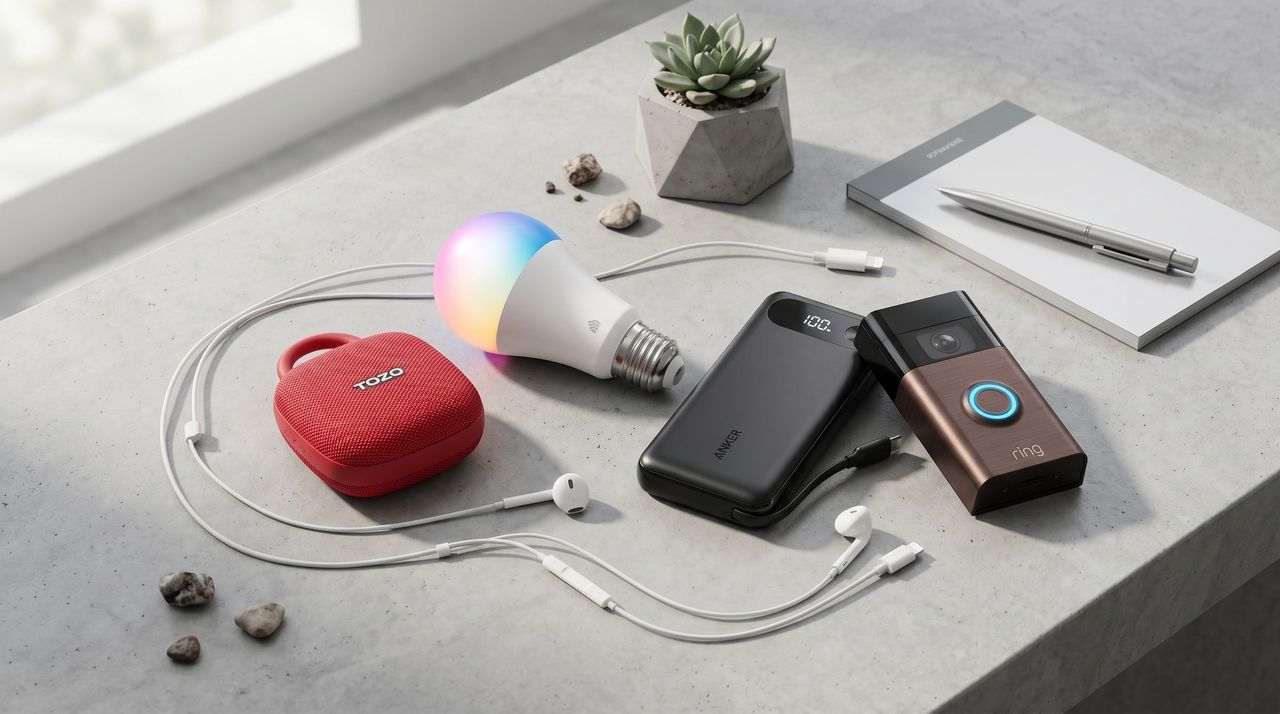
Amazon's early Prime Day sale includes some of my favorite cheap tech gadgets that you'll actually use, and I'm rounding up the 15 best with prices starting at just $9.99.
A closer look at cancer cells with extra chromosomes uncovered surprising traits linked to faster-growing, more dangerous tumors, pointing to potential new indicators of disease severity. Cancer cells are notorious for breaking the rules of biology. One of the most dramatic violations occurs when a cell suddenly doubles its entire genetic library, creating a chromosome-packed [...]

 Login
Login