Reading view

Why Elites Build Bunkers | Preparing for Earth’s Next Extinction Event

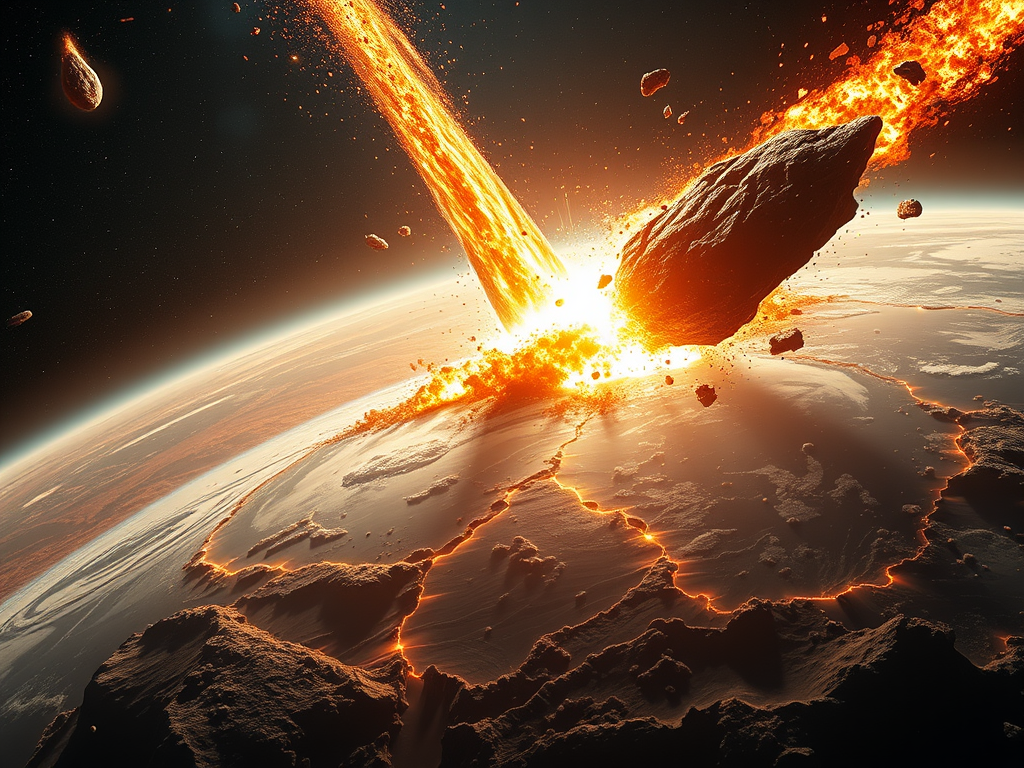
Many elites are constructing underground bunkers in anticipation of a coming global catastrophe, possibly including thermonuclear war or an asteroid impact. Notable figures like Mark Zuckerberg and Elon Musk are involved, raising conspiracy theories about a coming Earth extinction event. What is it that they fear? Final judgment from God?

  •  
  •  

Asteroid Impact Craters May Have Helped Create Early Habitats for Oxygen-Producing Life


Scientists studying an ancient asteroid crater on the Korean Peninsula have uncovered rock formations that may offer clues to the rise of atmospheric oxygen on Earth.

Researchers from the Korea Institute of Geoscience and Mineral Resources (KIGAM) discovered stromatolites inside the Hapcheon impact crater, the only confirmed asteroid impact site in South Korea. Similar stromatolite fossils represent some of the oldest known evidence of life on Earth.

Their findings were published in Communications Earth & Environment, and the discovery suggests that asteroid impacts, often linked to mass extinctions, may also have supported the development of early oxygen-producing life.

The Importance of Stromatolites

Stromatolites are layered rocks made by microorganisms, such as cyanobacteria, which produce oxygen through photosynthesis. Fossilized stromatolites are at least 3.5 billion years old and are some of the earliest evidence of life on Earth.

Scientists think these microbes were central to the Great Oxidation Event, which occurred about 2.4 billion years ago and led to a lasting increase in atmospheric oxygen levels. Learning where and how early stromatolites lived could help explain how Earth became habitable.

The KIGAM team discovered several stromatolites in the northwestern part of the Hapcheon crater, each measuring about 10 to 20 centimeters across. This is the first time that these types of formations have been found at this location.

Life from the Crater

The team suggests that the stromatolites developed in a hydrothermal lake that formed after the asteroid impact. The impact generated enough heat to melt surrounding rock and keep the water warm and rich in minerals for an extended period. These conditions would have supported the growth of early microbial communities.

Geochemical analysis supports this explanation. The stromatolites contain material from both the asteroid and local rock, in addition to signs of changes caused by heat and water. The inner layers show the most evidence of hydrothermal activity, suggesting they formed when the lake was hottest and continued to grow as it cooled. The combination of heat, minerals, and chemical energy found in hydrothermal environments is favorable for microbial life.

Radiocarbon dating of charcoal in the impact breccia shows that the Hapcheon impact occurred about 42,300 years ago. This is much more recent than the geological events usually linked to early life. The researchers frame the crater as a local example of a post-impact environment that was likely common during Earth’s early history.

“This is the first comprehensive evidence suggesting that stromatolites could form in hydrothermal lakes created by asteroid impacts,” said lead author of the study Dr. Jaesoo Lim. “Such environments may have provided favorable conditions for early microbial ecosystems.”

Oxygen Oases Before Atmospheric Oxygen

The implications may extend far beyond a single crater. During Earth’s early history, asteroid impacts occurred far more frequently. If each impact produced a warm, mineral-rich lake where oxygen-producing microbes could flourish, then these craters may have served as isolated ‘oxygen oases’ long before the atmosphere as a whole became oxygen-rich.

The researchers suggest these localized pockets of biological activity could have contributed to the gradual buildup that eventually triggered the Great Oxidation Event.

Implications for Martian Life

This new research builds on a 2021 study in Gondwana Research, where KIGAM scientists first confirmed that the Hapcheon crater was formed by an impact. This new study adds a biological perspective, linking the physical effects of the asteroid impact to the development of life.

The research may also apply to life on Mars. The early Martian environment contained water-filled impact craters similar to those on ancient Earth. The researchers suggest that Martian craters could be good places to search for signs of past microbial life. This study now provides a model for what this type of evidence might look like.

Austin Burgess is a writer and researcher with a background in sales, marketing, and data analytics. He holds an MBA, a Bachelor of Science in Business Administration, and a data analytics certification. His work focuses on breaking scientific developments, with an emphasis on emerging biology, cognitive neuroscience, and archaeological discoveries.

  •  

Did Dante’s ‘Inferno’ Predict Impact Physics Hundreds of Years Before Its Invention?


Dante Alighieri’s Inferno turns out to be an excellent model of impact physics, with Satan taking the role of an extinction-causing asteroid, according to new work out of Marshall University.

The nine layers of hell depicted in the classic Dante’s Inferno bear a striking resemblance to the rings created by shockwaves in the K-Pg event, which killed most of the non-avian dinosaurs, according to a recent presentation by Marshal University English Professor Timothy Burbery at the European Geosciences Union General Assembly 2026, held in Vienna, Austria.

Professor Burbery argues that Dante Alighieri applied the limited medieval knowledge of physics to present a surprisingly accurate picture of Lucifer’s fall as a physical body slamming into Earth, creating Hell.

Dante’s Inferno

Written in 1341 by the medieval poet Dante Alighieri, Inferno is the first portion of his longer work, The Divine Comedy. A fictionalized version of Dante himself stars in the story, guided through the layers of hell by the ancient Roman poet Virgil. Originally written in Italian, the work is considered a masterpiece of literature and presents an allegory for recognizing sin.

Yet instead of the classical reading of Satan’s fall as a purely spiritual fall from grace, Professor Burbery argues that an alternative reading of the text as describing the physical effects of a massive object crashing to Earth has remained unappreciated for almost seven centuries.

He applied modern meteoritic research to the medieval text, revealing correlations with real-world impact events, which Dante modeled with surprising accuracy, given that extinction-causing impacts were an unknown concept at the time. He compares the fall to a high-velocity object impacting the Southern Hemisphere, driving all the way through to the Earth’s center. There, at the bottom of the crater, Satan founded Hell, with the mountain of Purgatory forming from the displaced earth.

A Real World Impact Crater

The 110-mile-wide Chicxulub crater, located under Mexico’s Yucatán Peninsula, is generally accepted by scientists as the impact site of a six-mile-wide asteroid that killed the dinosaurs 66 million years ago. Professor Burbery says the description of the creation of Hell bears remarkable similarities to that of the ancient cataclysm, not well known until a scientific paper was published in 1980. The chain reaction that made Earth unlivable for many species in the wake of the K-Pg asteroid’s arrival resembles the creation of Hell.

However, that isn’t the only modern cognate Professor Burbery finds in the Inferno, noting that Satan’s form is also reminiscent of the oblong shape of the interstellar comet Oumuamua, discovered in 2017. Additionally, the Hoba meteorite in Namibia, the largest known intact meteorite, shares certain similarities with Lucifer’s arrival in dramatic, yet intact, physical form.

Dante’s Inferno and the Cosmos

From these observations, Professor Burbery argues that instead of viewing Dante’s hell only through the lens of symbolic sin, it also corresponds to a fresh meaning found in the cosmos. Multi-ringed impact basins discovered not only on our planet but also on the Moon and Venus bear strong similarities to the layers of hell. He goes on to say that the way Satan’s fall reflects terminal velocity and crustal breach anticipates non-Euclidean geometry, not suggested until the 19th century.

Finally, as more research work is invested in planetary defense, such as NASA’s DART mission in 2022, which successfully altered the course of an asteroid, Professor Burbery sees Dante’s influence here as well. Most prior mythologizations of the heavens depicted it as perfect and unchanging, yet Dante depicted it as physically dangerous prior to the discovery of meteors.

Professor Burbery concludes that reexamining this geophysical myth deepens scientific understanding of meteoritics, revealing new ways of framing what we know, as well as how continued scientific research defies the expectations of our ancestors’ mythological understanding of the cosmos.

Meteoritics and Dante’s Inferno: Examining Satan’s Fall as an Impact Event” was presented at the EGU General Assembly 2026, Vienna, Austria, May 3-8, 2026.

Ryan Whalen covers science and technology for The Debrief. He holds an MA in History and a Master of Library and Information Science with a certificate in Data Science. He can be contacted at ryan@thedebrief.org, and follow him on Twitter @mdntwvlf.

  •  

Global Summit on Cutting-Edge Functional Materials and Technologies (ICAFMT)

In an era increasingly defined by the confluence of materials science innovation and data-driven methodologies, the International Conference on Advanced Functional Materials and Technologies (ICAFMT) stands as a pivotal forum. Set to convene in Dongguan, China, from October 23 to 25, 2026, this event promises to be a landmark gathering for scholars, researchers, and industry leaders aiming to shape the future of materials science. The conference will explore the latest strides in functional materials, encompassing fields from energy storage and advanced computational techniques to biomaterials and metallic alloys.

ICAFMT 2026 brings together an outstanding cadre of thought leaders and institutional representatives from around the globe. Chaired by Weihua Wang of the Dongguan Institute of Materials Science and Technology, alongside other eminent figures such as Jinkui Zhao, Gian-Marco Rignanese, and Torsten Brezesinski, the meeting reflects a uniquely international and interdisciplinary spirit. The organizing committee, drawn from prestigious universities and research institutions including Peking University, The University of Hong Kong, and École Polytechnique de Louvain, underscores the global collaboration permeating the event.

The conference program distinguishes itself through a suite of parallel sessions, each dedicated to cutting-edge research and emerging technologies. One crucial session focuses on electronic and information-processing materials, an arena witnessing revolutionary advances as the world pivots toward smarter, faster computing systems. Here, researchers will delve into novel semiconductors, quantum materials, and nanoscale architectures that redefine information handling and storage at the atomic scale.

Energy storage and conversion, critical for sustainable development, constitute another core theme. With surging global demand for efficient and durable batteries, supercapacitors, and beyond-lithium chemistries, ICAFMT will enable lively discussions on advanced materials facilitating higher energy densities, faster charge rates, and longer lifespans. Experts like Torsten Brezesinski, known for his pioneering work in electrode materials, are expected to lead discourse on engineering design at both the nano- and microscale to optimize performance.

Biomaterials research, an inherently interdisciplinary domain, also features prominently. Advances here promise transformative impacts on healthcare, ranging from regenerative medicine scaffolds to biocompatible implants and drug delivery systems. The conference’s emphasis on biomaterials reflects the growing integration of biology with materials science, leveraging molecular engineering, additive manufacturing, and computational modeling to enhance functional efficacy.

Metals and alloys remain foundational to modern technologies, and the session on high-performance metallic materials addresses the relentless pursuit of materials that combine strength, ductility, corrosion resistance, and lightweight properties. Discussions will cover alloy composition design, processing techniques such as severe plastic deformation, and characterization methods that uncover microstructural dynamics influencing macroscopic behavior.

One of the most avant-garde aspects of ICAFMT 2026 is its spotlight on AI-driven materials discovery and computational materials science. Harnessing machine learning algorithms, high-throughput simulations, and big data analytics, researchers aim to accelerate the design and optimization of materials with tailored properties. This session symbolizes the transformative role of artificial intelligence in shifting material development cycles from years or decades to mere months, heralding an era of rapid innovation.

The conference also dedicates attention to advanced characterization and measurement techniques, vital for resolving materials’ complex structures and properties. Techniques ranging from synchrotron-based X-ray spectroscopy to atomic force microscopy and in situ electron microscopy will be examined, reflecting the trend toward multimodal, high-resolution analyses that integrate experimental and theoretical insights for comprehensive understanding.

The agenda of ICAFMT 2026 is thoughtfully constructed, beginning with a registration and welcome reception on October 23, followed by plenary talks and multiple parallel sessions on the 24th and 25th of October. This structure promotes deep engagement, knowledge exchange, and networking across thematic areas while maintaining flexibility for participants to choose sessions aligned with their expertise and interests.

Early career researchers and students are notably encouraged to participate, benefitting from discounted registration fees and opportunities to present their work on an international stage. This strategic inclusion aims to cultivate the next generation of materials scientists who will navigate and contribute to the rapidly evolving landscape of functional materials and advanced technologies.

Held at the Dongguan Institute of Materials Science and Technology, a hub recognized for its innovative research, the venue provides state-of-the-art facilities tailored to accommodate the technological demands and collaborative spirit of the conference. The locale in Dongguan, Guangdong Province, also offers an enriching cultural and industrial milieu conducive to idea exchange and partnerships.

With registration open ahead of key deadlines such as the abstract submission closing on September 15, 2026, ICAFMT invites researchers worldwide to contribute their latest findings and perspectives. The combination of rigorous scientific discourse and strategic networking at this conference is poised to accelerate breakthroughs across various domains of materials science, from fundamental research to practical applications in energy, electronics, biomedical sectors, and beyond.

The dynamic integration of AI and computational approaches featured at ICAFMT underscores a paradigm shift in how materials challenges are addressed, enabling researchers to traverse vast chemical spaces and simulate complex behaviors with unprecedented speed and accuracy. These advances promise to underpin future innovations in sustainable technologies, quantum devices, and novel biomaterials, paving the way for scientific and technological revolutions.

As the materials science community anticipates this event, the International Conference on Advanced Functional Materials and Technologies offers a unique platform to converge expertise, spark interdisciplinary collaborations, and unveil next-generation materials destined to transform industries and society at large. It is a seminal event not only reflecting current trends but also proactively shaping the trajectory of materials research and development on a global scale.

Subject of Research: Advanced Functional Materials and Technologies
Article Title: International Conference on Advanced Functional Materials and Technologies (ICAFMT) to Illuminate Future Innovations in Materials Science
News Publication Date: Not specified
Web References: https://icafmt.aiforsci.net/
Image Credits: Materials Futures AI for Science

Keywords

Materials Science, Functional Materials, Advanced Technologies, AI in Materials Discovery, Biomaterials, Energy Storage, Metallic Alloys, Computational Materials Science, Characterization Techniques, International Conference

  •  
❌