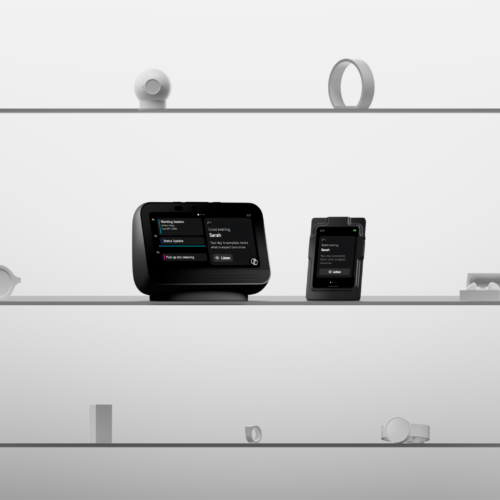
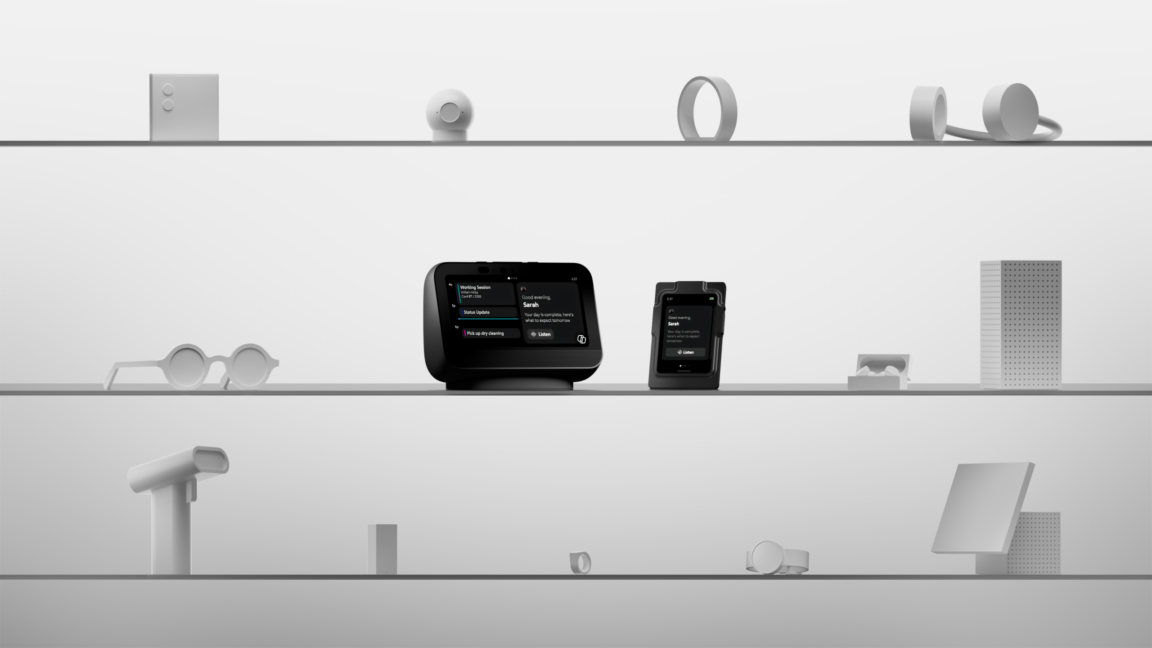
Microsoft has been deeply committed to the growth of generative AI technology in recent years through its now-fragmented partnership with OpenAI. At Build 2026, the company remains all-in on AI, and it's looking toward the future with a new software platform. The new Android-based OS is called Project Solara, and Microsoft says Solara is designed to run agents instead of apps.
Project Solara is not something you'll have to worry about killing your apps anytime soon. It's limited to a few pieces of concept hardware and software that are awaiting the magical agents of the future. The vision is for Solara to run on myriad specialized devices with interfaces generated on the spot, and it's all powered by the explosive intelligence of models that Microsoft and others insist will soon exist.
According to Microsoft, Solara is a chip-to-cloud platform intended to free agents from reliance on single interfaces. Much of Microsoft's messaging around AI is speculative and self-serving, but the company rightly points out that new computing form factors have always required specialization, and that process is complex and expensive. The shift to mobile computing, for example, tripped Microsoft up multiple times as it fell behind on app availability, security, and long-term support.
The new MSI Claw with Intel Arc G3 Extreme. | Photo by Sean Hollister / The Verge
Intel couldn't catch a break. Layoffs. Shakedowns. Crashing CPUs torpedoing its reputation, sending desktop gamers fleeing to AMD. Apple and Qualcomm pushing Intel out of multiple flagship laptops. A gaming graphics card going MIA. But its Panther Lake laptop chip, the first on its all-important 18A process, turned out excellent - and a handheld version might make Intel the leader in portable gaming chips.
On Monday, I spent two hours with an MSI Claw 8 EX AI Plus handheld atop Intel's new Arc G3 Extreme. I walked away thinking that next-gen handhelds have finally arrived. The true leap in performance and battery life we've been waiting for …
Microsoft just kicked off Build 2026 with a keynote from CEO Satya Nadella and other company leaders. As expected, it was filled with announcements, ranging from new Surface hardware to an always-on personal assistant and updates across Microsoft's in-house AI models.
If you didn't watch the event live, you can catch up on all the latest news in the roundup below.
Researchers at a Scottish university have demonstrated a 100kW fully superconducting aviation motor that could help pave the way for an electric aircraft.
President Donald Trump signed an executive order Tuesday creating a "voluntary framework" for AI companies to share their frontier models with the federal government before they're released "to promote secure innovation and strengthen the cybersecurity of critical infrastructure."
The order says the US AI industry has succeeded in part "because we refuse to stifle this innovation with overly burdensome regulation," but that it also recognizes new AI capabilities come with security risks. Accordingly, it directs several federal agencies to come up with a framework to "assess the advanced cyber capabilities of AI models" before they're releas …
Microsoft’s new Majorana 2 quantum chip. | Image: Microsoft
Microsoft claimed last year that it had made a key breakthrough in quantum computing with Majorana 1, the company's first quantum processor. While physicists were immediately skeptical of Microsoft's claims, the software giant is announcing Majorana 2 today, the next generation of its topological quantum chip.
Majorana 2 contains qubits, a unit of information in quantum computing much like the binary bits that computers use today, that are 1,000 times more reliable, according to Microsoft. It's a milestone that helps make quantum computing more reliable, thanks to the use of a new material stack and some help from Microsoft Discovery's agen …
Microsoft announced a bunch of new in-house AI models at Build 2026, including a new "flagship" model: MAI-Thinking-1. It's an ambitious step into model development for Microsoft, which introduced its initial in-house models last year - before then, it had relied on OpenAI's models. The two companies recently renegotiated their deal to loosen ties.
According to Microsoft, MAI-Thinking-1 is a "medium-sized model" that "matches leading models" on "key" software engineering benchmarks. Microsoft says the company "trained it from the ground up on clean data, without distillation from third-party models."
We're expecting Android 17 to begin rolling out later this month, but first, Google has a batch of updates for the wider Android device ecosystem. As usual, some of the new features are limited to specific devices, and others require using Google's apps. But if you don't mind the latter, you can get automated protection from the growing threat of deepfake phone scams.
According to Google, "impersonation fraud" is one of the most common types of financial scams. The FTC tracked almost $3 billion in losses from such scams during 2024, and the improvements in AI voice cloning tools more recently are making the schemes easier to pull off. The voice models are becoming so capable that it can be difficult to identify a fake caller even when an AI is imitating someone you talk to every day.
Google's solution is an expansion of the system it debuted last month for verified financial calls. Now, a similar feature will work with anyone in your contacts. Many of the most effective deepfake scams involve spoofing a contact's number, which makes the call look more legitimate when your phone lights up. Victims of these scams are then greeted by an accurate re-creation of the person's voice spinning a yarn that involves an urgent need for cash.
We're expecting Android 17 to begin rolling out later this month, but first, Google has a batch of updates for the wider Android device ecosystem. As usual, some of the new features are limited to specific devices, and others require using Google's apps. But if you don't mind the latter, you can get automated protection from the growing threat of deepfake phone scams.
According to Google, "impersonation fraud" is one of the most common types of financial scams. The FTC tracked almost $3 billion in losses from such scams during 2024, and the improvements in AI voice cloning tools more recently are making the schemes easier to pull off. The voice models are becoming so capable that it can be difficult to identify a fake caller even when an AI is imitating someone you talk to every day.
Google's solution is an expansion of the system it debuted last month for verified financial calls. Now, a similar feature will work with anyone in your contacts. Many of the most effective deepfake scams involve spoofing a contact's number, which makes the call look more legitimate when your phone lights up. Victims of these scams are then greeted by an accurate re-creation of the person's voice spinning a yarn that involves an urgent need for cash.
We're expecting Android 17 to begin rolling out later this month, but first, Google has a batch of updates for the wider Android device ecosystem. As usual, some of the new features are limited to specific devices, and others require using Google's apps. But if you don't mind the latter, you can get automated protection from the growing threat of deepfake phone scams.
According to Google, "impersonation fraud" is one of the most common types of financial scams. The FTC tracked almost $3 billion in losses from such scams during 2024, and the improvements in AI voice cloning tools more recently are making the schemes easier to pull off. The voice models are becoming so capable that it can be difficult to identify a fake caller even when an AI is imitating someone you talk to every day.
Google's solution is an expansion of the system it debuted last month for verified financial calls. Now, a similar feature will work with anyone in your contacts. Many of the most effective deepfake scams involve spoofing a contact's number, which makes the call look more legitimate when your phone lights up. Victims of these scams are then greeted by an accurate re-creation of the person's voice spinning a yarn that involves an urgent need for cash.
We're expecting Android 17 to begin rolling out later this month, but first, Google has a batch of updates for the wider Android device ecosystem. As usual, some of the new features are limited to specific devices, and others require using Google's apps. But if you don't mind the latter, you can get automated protection from the growing threat of deepfake phone scams.
According to Google, "impersonation fraud" is one of the most common types of financial scams. The FTC tracked almost $3 billion in losses from such scams during 2024, and the improvements in AI voice cloning tools more recently are making the schemes easier to pull off. The voice models are becoming so capable that it can be difficult to identify a fake caller even when an AI is imitating someone you talk to every day.
Google's solution is an expansion of the system it debuted last month for verified financial calls. Now, a similar feature will work with anyone in your contacts. Many of the most effective deepfake scams involve spoofing a contact's number, which makes the call look more legitimate when your phone lights up. Victims of these scams are then greeted by an accurate re-creation of the person's voice spinning a yarn that involves an urgent need for cash.
Much like Google, Microsoft is launching its own version of OpenClaw. Microsoft Scout is an always-on assistant that integrates into Microsoft 365 apps like Outlook, OneDrive, and Microsoft Teams, allowing businesses to assign a virtual assistant to employees to help with organizing calendars, expense reporting, email drafts, and much more.
Unlike Copilot that lives inside Microsoft 365 apps, Microsoft Scout can see and do a lot more. "This is a personal assistant, it's the first real personal assistant we've offered customers," explains Omar Shahine, corporate vice president of Microsoft Scout, in an interview with The Verge. "I think it's …
Google is launching a new feature for its Phone app that aims to protect you from AI impersonation scams. Now, when you receive a call from a scammer that appears to be coming from the same number as one of your contacts, Phone by Google will flag the call as suspicious so you can hang up.
This is what a Switch 2 looks like with a glossy glass protector attached to its screen. | Image: Cameron Faulkner/The Verge
A glass screen protector is one of a few essential accessories that I strongly recommend to every Switch 2 owner. In fact, it should be a priority to stick one onto the console’s screen as soon as possible to avoid accidental scratches.
To test the candidates below, I installed and removed Switch 2 screen protectors on my console at an alarming rate, more than any sane person should, and here are the most important takeaways:
Do not buy a flimsy plastic screen protector. They are a waste of money and won’t protect your Switch 2 enough.
It’s impossible to tell different brands’ protectors apart once they’re on your screen; product packaging and the installation process are the biggest differences (as well as the key factors that increase cost).
Some protectors are glossy and some are anti-reflective, each with its own tradeoffs. For my money, glossy is the way to go. The matte finish looks good, but it reduces the screen’s vivid quality and its viewing angles.
Of the options below, it’s easiest to recommend amFilm’s three-pack of glossy screen protectors. Not only is the pack affordable ($9.99 from Amazon), but the tray also allows for perfect alignment of the glass protector for easy, bubble-free installation. I’ve used this company’s screen protectors on various gadgets for years, and I particularly like its glossy option over the matte finish, since it lets the Switch 2’s screen fully shine through.
amFilm three-pack of glossy screen protectors
My go-to screen protector brand for years has been amFilm. Three glossy tempered glass sheets come in the box, and the tools make installation fairly simple. JSAUX’s model is just as good based on my testing, and just as affordable.
In keeping up with some brands that offer faster installations, amFilm offers a two-pack of glossy protectors that includes a “OneTouch” tray. Remove the protector’s bottom film, attach the tray to your device, and then press gently on the protector until it’s fully applied.
Dbrand Prism 2.0 two-pack of glossy screen protectors
Dbrand’s Prism 2.0 includes two glass protectors for the Switch 2, each nestled into plastic cases that fit perfectly around the edges of the console (with the Joy-Con 2 removed). $34.99 is expensive for two protectors, but if simplicity and elegant packaging trump value, then this is a good option.
Genki Aegis Shield two-pack of glossy screen protectors
Genki offers a cheaper alternative to Dbrand with the Aegis Shield. It includes two protectors, and the installation process is nearly identical: just align the plastic frame with the console, pull the tab, and run your finger across the exposed section of the frame. Spigen makes a similar product that costs $24.99 for a two-pack.
Let’s start with one of the most affordable options if you want to go the matte-textured route. AmFilm sells a two-pack of protectors at Amazon for $8.99. The set includes a plastic frame that serves as a guide to align the protector just right. JSAUX makes a similar product that’s the same price.
amFilm OneTouch two-pack of matte screen protectors
AmFilm also sells a two-pack with a OneTouch frame for easier installation. Again, keep in mind that opting for matte over glossy will reduce glare, but at the cost of viewing angles as well as the full vivid quality of the Switch 2’s screen. That’ll be an acceptable tradeoff for some, but not all people.
Microsoft just announced "Project Solara," a new OS designed for gadgets that run AI agents, at Build 2026. The company is calling it "a new platform built from the ground up to power agent-driven experiences." It's built on Android, not Windows.
Microsoft demonstrated two concept Project Solara devices at Build today: Desk concept and badge concept. The desk concept is an Amazon Echo Show-like device that unlocks with facial recognition and provides access to AI agents.
The badge concept is a wearable, the type of badge you'd typically use to access a work building. It has a camera and a fingerprint scanner, which can wake an AI agent wi …
Researchers at the Indian Institute of Technology Gandhinagar (IITGN) have developed an adaptive charging strategy for lithium-ion batteries that could help electric vehicles (EVs) charge efficiently while reducing a major cause of battery degradation known as lithium plating. Published in the Journal of Energy Storage, the study introduces a self-adjusting charging framework that dynamically protects batteries from internal degradation while optimizing charging efficiency and time across varying temperature and health conditions.

 Login
Login