 Login
Login
9 Incredible Stargazing Events Happening This June and the Exact Times You Need to Look Up
 June brings planetary alignments, meteors, the Milky Way in full view and summer’s first full moon.
  June brings planetary alignments, meteors, the Milky Way in full view and summer’s first full moon.
For just an hour in late 2019, a cosmic mystery revealed itself to astronomers in an unprecedented way: by bending the light of a star as it passed between Earth and a distant galaxy.
The odd event unfolded on the evening of December 18, 2019, as a star in the Large Magellanic Cloud suddenly—and only for a short time—appeared to become brighter. But what could cause an ordinary star to randomly illuminate in this way, becoming a cosmic beacon for only an hour?
Astronomers considered a few possibilities, the most likely being that some kind of object—and one possessing a significant amount of mass—passed in front of the star, warping its light toward Earth through gravitational microlensing.
Now, the curious object that captured the star’s light for an hour in 2019 has been given a name: Phoebe. Unraveling the mystery as to what it actually was constitutes an intriguing question for astronomers, one which has now been tackled in a recent paper.
One of the most fascinating phenomena in modern astrophysics is an effect predicted by Einstein, where gravity itself can act like a lens. The result can often produce beautiful and mysterious cosmic features, which include what astronomers call “Einstein rings” as light from a distant object is warped around a nearer, extremely massive object, taking on a circular or ring-like shape.
A similar effect, known as an “Einstein cross,” produced the even more unusual appearance of multiple objects surrounding a nearer, massive source of lensing.
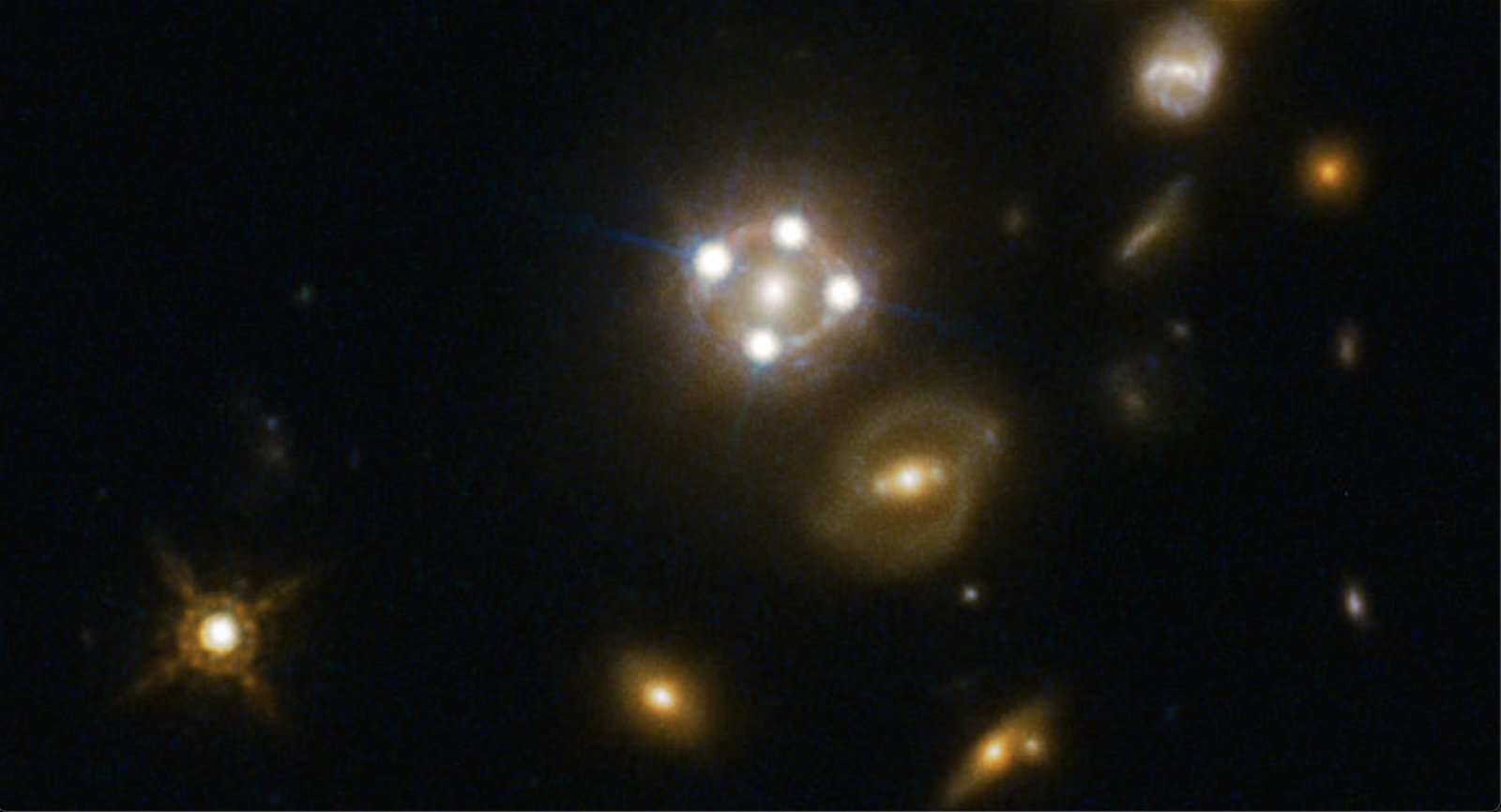
Under most conditions, these objects remain static and can be observed indefinitely. However, in 2019, something very different happened. The light from the star observed in the Large Magellanic Cloud was apparently only subjected to lensing for a short amount of time, meaning that whatever the massive “Phoebe” object was that caused the effect had been in transit.
The discovery was revealed as astronomers from Swinburne University in Melbourne spotted Phoebe in the data for a high cadence survey being conducted of the satellite galaxy in question. Now, in a new paper, they propose three possibilities for the mystery object.
One involves a free-floating planet somewhere within the Milky Way, something astronomers also occasionally call “rogue planets.” These cosmic loners come to exist when a planet is ejected from its host system, leaving them to drift through space as lonely planetary wanderers.
Another possibility the team proposes is that the same thing could be going on within the Large Magellanic Cloud itself: a rogue planet originating from that galaxy might have passed in front of the star. If this were ever confirmed, it would mark a notable first, as it would confirm the only extragalactic microlensing planet ever observed by astronomers.
However, a third possibility involves something more unusual: the presence of a primordial black hole, whose origins could go all the way back to the moments immediately after the Big Bang.
A major clue to solving the mystery involves the fact that the event took place over just one hour. Given the short duration, it seems most likely that the object was relatively small and therefore able to complete its transit in a short amount of time.
Such a short duration presents challenges for astronomers, since it rests at the threshold of detectability, although the team was able to extract enough information that they could calculate the rough mass of the object, which they believe to have been roughly four times the mass of the moon.
So whatever the object was, it was probably also too small to have been a planet, and also far too small for a normal black hole—the kind produced as a result of stellar collapse—to qualify.
The same couldn’t be said for a primordial black hole, however. Based on additional calculations, the team was also able to demonstrate that Phoebe most likely represents a dark matter object, by around five orders of magnitude greater than other possibilities they looked at.
Overall, this reveals that Phoebe could potentially be one of the oldest objects astronomers have ever spotted, since if its identity as a primordial black hole holds, that would mean its origins go all the way back to the genesis of our universe as we know it.
So based on the team’s work, a star’s mysterious brightening for just one hour in late 2019 might have been even more than an unusual astronomical one-off event: it may have offered us a glimpse at one of the oldest objects in the universe.
The team’s paper, “AMPM II. A Lunar-Mass Primordial Black Hole Microlensing Candidate in the Milky Way Halo,” appeared on the preprint server arXiv.org on May 19, 2026.
Micah Hanks is the Editor-in-Chief and Co-Founder of The Debrief. A longtime reporter on science, defense, and technology with a focus on space and astronomy, he can be reached at micah@thedebrief.org. Follow him on X @MicahHanks, and at micahhanks.com.
A Breathhh é uma extensão para o browser com ferramentas para quem se preocupa com o bem-estar e, além de sugerir pausas ao longo do dia, conta com exercícios práticos de respiração e alongamentos, bem como ferramentas de produtividade.
The post Passa horas no computador? Breathhh ajuda a fazer pausas para respirar e alongar ao longo do dia appeared first on Tek Notícias.
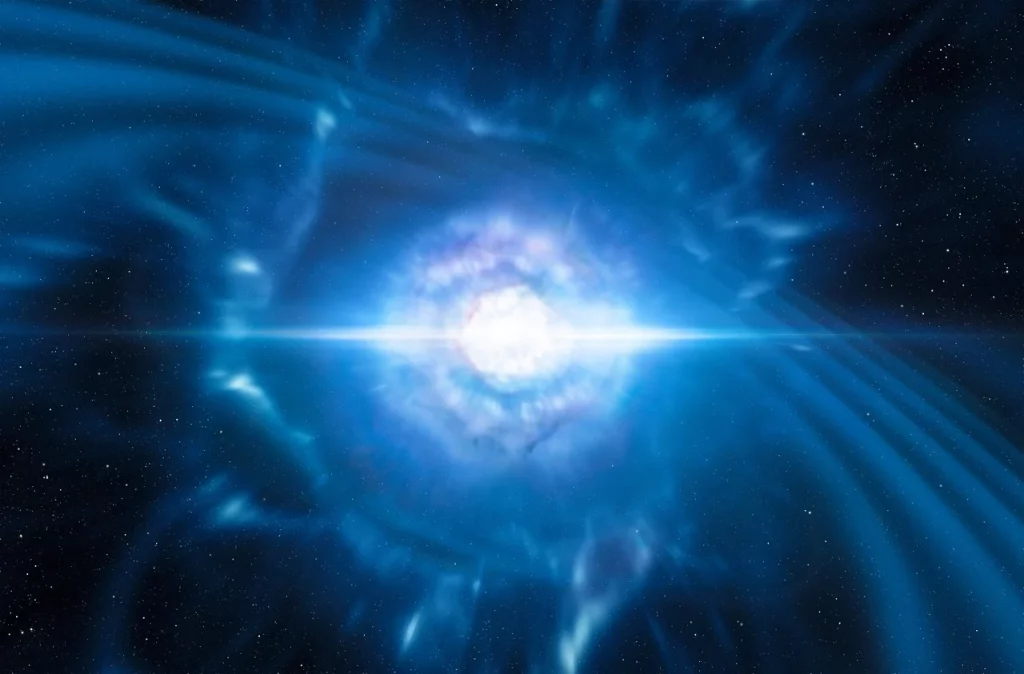
The physics of neutron stars are almost too fantastic to believe. Something the weight of two Suns compacted to a sphere the size of a city. Each teaspoon of its material would weigh billions of tons. If you’ve done any reading on the topic, you’ve heard these facts before. But despite the intense interest these […]
The post How heavy can a neutron star get appeared first on Knowridge Science Report.
June brings planetary alignments, meteors, the Milky Way in full view and summer’s first full moon.
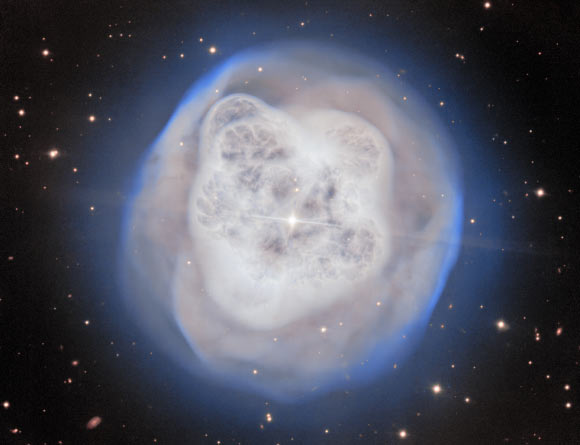
A stunning new image from the 8.1-m Gemini North telescope, located on the summit of Maunakea in Hawai’i, reveals the Crystal Ball Nebula in unprecedented detail: a lumpy, glowing sphere of gas sculpted by a pair of stars.
The post Gemini North Telescope Peers into Crystal Ball Nebula appeared first on Sci.News: Breaking Science News.
The Star Wars series depicted alien heroes fighting against evildoers and their planet-destroying superweapons “a long time ago in a galaxy far, far away.” But what do scientists really know about alien planets in distant galaxies beyond our own? These worlds, known as extragalactic exoplanets, are expected to exist, assuming the Milky Way is no different from other galaxies. However, we have yet to find them since other galaxies are still too far, far away for modern exoplanet-observing techniques.
Recently, a team of astronomers analyzed a stream of over 700,000 stars that the Milky Way likely absorbed from the dissolving Sagittarius dwarf galaxy. These stars are very distant, so the team investigated whether any of them host large, close-orbiting exoplanets called hot Jupiters, which are relatively easy to find.
They established a set of 3 criteria to narrow down their list of stars. First, each star should appear bright enough when observed by the Transiting Exoplanet Survey Satellite, or TESS, to ensure high-precision results from the team’s data processing software. Second, each star must have more than a 50% likelihood that it originated from the Sagittarius dwarf galaxy, based on motion and position measurements from the Gaia mission. Finally, each star should have a radius of less than twice the Sun’s, as it’s easier to find planets around smaller stars. They used these criteria to limit their candidate list to around 20,000 stars.
After selecting their candidate stars, the team analyzed publicly available TESS catalog data using the software packages eleanor and TESS-Gaia Light Curve, or TGLC. These tools allowed them to plot each star’s brightness over time, in graphs called light curves. Then, the astronomers looked for periodic brightness dips in these light curves as evidence that an exoplanet passed in front of the star. From this, they excluded several thousand additional stars with too much light interference from their surroundings, reducing their final sample size to just over 15,000 stars.
To find hot Jupiters, the team looked for brightness dips at intervals of 14 hours to 10 days, which is the typical orbital period range for hot Jupiters. Then, they used geometry to derive each exoplanet’s radius from the fraction of the starlight it blocked. They excluded candidates with dips corresponding to objects with radii at least twice that of Jupiter’s, as these are likely caused by orbiting companion stars rather than exoplanets.
Among all the stars they surveyed, the team’s strongest candidate to host a hot Jupiter was a star labeled TIC 92223525. They calculated that this star could host an exoplanet with a radius 1.76 times the size of Jupiter’s and an orbital period of 7.2 days. However, when they reviewed this star’s light curve, they found that it was likely contaminated by its neighbor, TIC 92223526. The regular brightness dips from this system of orbiting stars mimicked that of an exoplanet, creating a false positive for TIC 92223525 that was difficult to detect during initial screening. As a result, the team ultimately excluded this candidate, leaving them with no confirmed exoplanets.
The researchers drew several conclusions from their inability to find hot Jupiters in their sample of stars from the Sagittarius dwarf stream. They estimated that if more than 1% of these stars hosted hot Jupiters, it would have been highly unlikely not to detect one in a sample of over 15,000 stars. This places an upper limit of about 1% on the occurrence rate of hot Jupiters. If this estimate is accurate, then even an ideal exoplanet search team would need to examine over 11,000 stars to find an extragalactic hot Jupiter. Accounting for more realistic levels of scientific uncertainty, a future team would likely need to study at least 80,000 stars to find one.
Although this survey of the Sagittarius dwarf stream yielded null results, the team suggested that future researchers continue searching it and other star streams from different galaxies. Scientists have identified over 20 such streams in the Milky Way. Researchers studying these streams could find the first extragalactic exoplanet or provide evidence that other galaxies produce fewer hot Jupiters than our own. But let’s hope none of them find the first extragalactic Death Star!
The post Searching for planets in a galaxy far away appeared first on Sciworthy.
