Metal-organic frameworks — or MOFs — are a type of material made of metal– and carbon-based molecules. These molecules are linked together into complex, 3-D shapes.
Imagine a house that’s being built. After laying the foundation, builders construct a skeleton-like wooden frame. This framework consists mostly of empty space. MOFs are structured much the same way. Their molecules assemble into a scaffold-like material. And like that wooden frame, an MOF’s interior is also mostly empty space.
Unlike the holes of a sponge, the empty spaces inside an MOF are not random. Scientists can choose the sizes, shapes and chemistry of these gaps. That’s important. It allows scientists to custom-make MOFs for specific tasks. A very porous MOF may be especially good at sopping up substances. Another MOF with certain chemistry may work like a filter, letting some substances through it but blocking others.
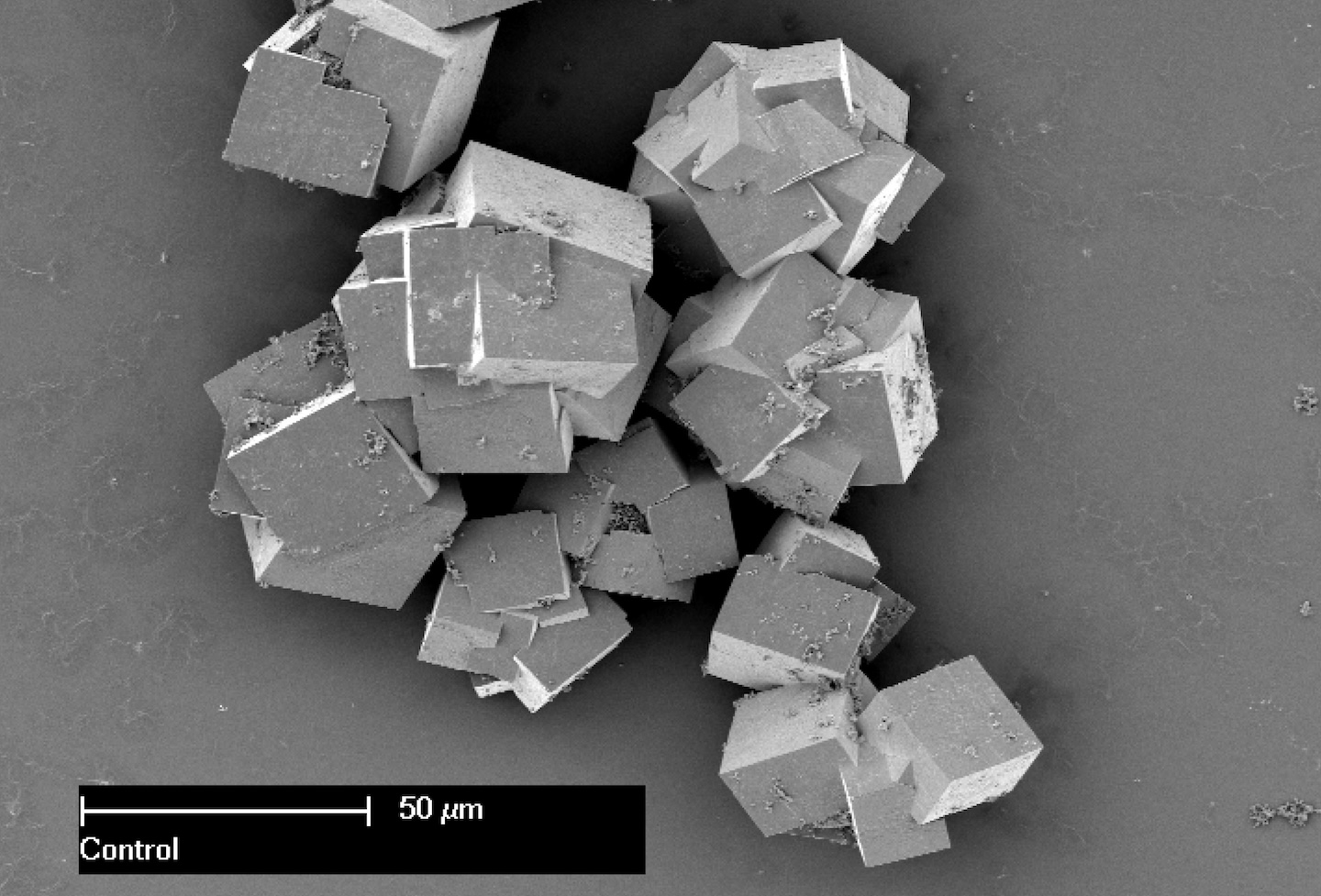
Metal-organic frameworks (MOFs) consist of many Lego-like pieces. Those pieces form organized structures with lots of empty pockets. The gaps allow MOFs to sponge up greenhouse gases and, perhaps one day, deliver drugs inside the body.CSIRO Australia/Wikimedia Commons
Scientists custom-build MOFs for many different uses. In medicine, MOFs may tote drugs to specific places inside the body for release. Or they might release medicines only under certain conditions.
MOFs may also help manage climate change by absorbing carbon dioxide (CO2) from the air. These MOFs often contain exposed metal ions. (An ion is an atom that carries an electric charge.) Those metal ions can bind to the oxygen atoms in CO2 molecules, snatching them out of the atmosphere.
Still other MOFs can pull water from desert air and release it for drinking. Others can filter out harmful wavelengths of sunlight to protect crops. Or they can shield against toxic chemicals. In fact, MOFs have so many uses that they won the 2025 Nobel Prize in chemistry.
In a sentence
Scientists developed metal-organic frameworks (MOFs) that yank pollution from our water sources.
PHOENIX, Ariz. — Nervous? One day soon, relief might be just a chew away.
For years, research has been showing that chemicals found in passionflower plants can help fight anxiety. Two teens have now created a chewing gum that can release those chemicals.
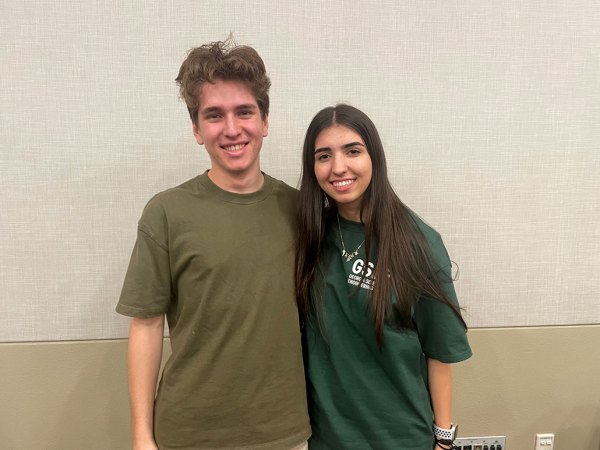
Zackary Nizker (left) and Sara Hoti (right), both 16, developed a medicinal chewing gum. It aims to help people struggling with anxiety. K.G. Carpenter
“Gum is very popular among high schoolers,” says Zackary Nizker, 16. This junior at McIntosh High School in Peachtree City, Ga., hopes this habit will make gum an easy way for teens to deal with anxiety. And there are many who face this. “In the U.S.,” Zackary says, “a third of all adolescents and young adults suffer from a form of anxiety.”
But teens aren’t the only ones who could use some relief. Zackary’s grandmother struggles with nervousness, which he says “got really severe last year.” The drugs she got prescribed help, he says, though their side effects can be “very severe.” In his grandma’s case, “she could hardly walk or stand. It was a very scary situation.”
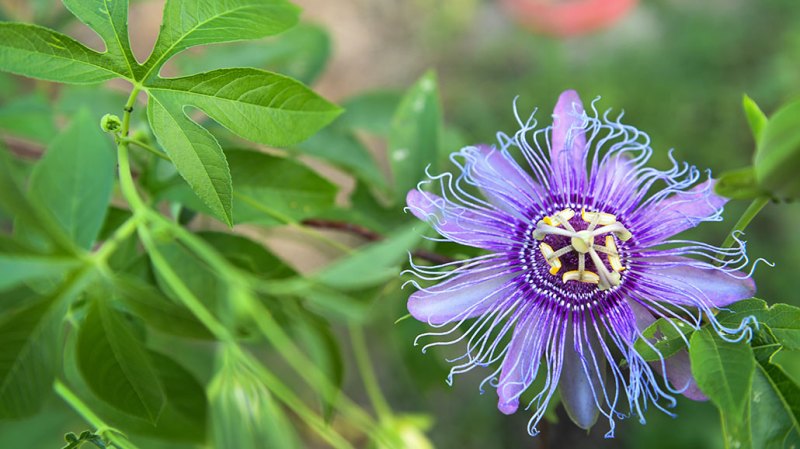
Flavonoids are antioxidant chemicals made by many plants. The plants use them to fight tissue damage from oxidation. Many herbal remedies contain these compounds, too, notes Sara Hoti, Zackary’s classmate. Chamomile, used in some teas, is one flavonoid-loaded herb. But for their study, she and Zackary used an extract of a plant that grows wild in their hometown: passionflower (Passiflora incarnata).
Their work earned these teens a spot as finalists here at the 2026 Regeneron International Science & Engineering Fair, or ISEF. It’s a program created and run by Society for Science (which also publishes this magazine). As fourth place winners in the Translational Medical Science division, Sara and Zackary took home $600. They were among 1,725 students — from 65 nations or territories — competing at the 76th annual ISEF. Participants this year shared nearly $7 million in prizes.
Flower-powered relief
“Chewing gum, by itself, is already known to reduce anxiety,” says Zackary. But a host of studies going back decades shows that passionflower flavonoids reduce anxiety. They do this, he explains, by increasing brain levels of a signaling compound known as GABA. (That’s short for gamma-aminobutyric acid.) “It slows down neuron firing in your brain,” Zackary says. That slowdown, he says, seems to calm an anxious brain.
By combining herbal remedies with rhythmic chewing, he says, their new gum could become “a more effective treatment.” But to test whether chewing gum would release any flavonoids in it, they needed to run some tests.
To start, they cooked up some bubble gum. It included a gum base, powdered sugar, various other sweeteners — and, of course, passionflower extract.
Chew on this
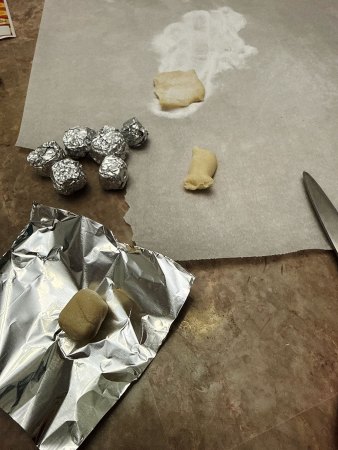
The finished chewing gum was molded into a strip, then cut and wrapped in parchment paper and foil. The gum contains all ingredients — including melted gum base, softeners, sweeteners and flavonoids. After drying, sugar was coated on the outside of the gum.
S. Hoti and Z. Nizker
The teens had hoped to make that extract. After all, Sara says, in her hometown, passionflowers are everywhere. But the pair did their experiment during the winter, when the flowers were “all gone — out of season.” So they ended up having to buy the extract.
Afterward, they tested their prototype gum — and struggled, Zackary recalls. Why? “We’re not allowed to just give people some random gum we made and say, ‘Here, chew this, let’s see if it works.’” Instead, they had to do tests “outside of the body.”
Watch the teens, fourth-place winners in their division, describe the mechanism by which their new chewing gum formulation should help people who are feeling nervous or anxious.
Double bubble testing
The pair conducted two tests. The first examined whether each quantity of gum contained the same dose of passionflower extract. So they analyzed slices of the gum under a microscope. Using computer software, they could calculate the share of the flavonoid particles in view. Here, Sara says, “you want your value to be below 15. We actually got a value of 8.4, which was perfect.” (In these tests, Zackary adds, the “values” do not come with a unit.)
A second test, called the Shinoda test, measured how well flavonoids in their gum resist breakdown. If they broke down, the likelihood they’d prove helpful against anxiety could fall apart, too. So the young scientists exposed their gum to various conditions and then used this color-changing test to check whether the flavonoids had held up.
This test is usually done with liquids. Their gum was a solid. So learning how to Shinoda test their gum proved a “really long process,” Sara says.
To mimic the work of saliva, they cut their gum into pieces and soaked them in alcohol for three hours. And nothing happened. The flavonoids never left the gum.
To use the gum you’d chew it, they realized, an action which could release the flavonoids. But “since we couldn’t chew it ourselves,” Zackary says, “we broke the gum into pieces with our hands. That simulates chewing.” They also extended their soak time to three days.
This time, “we got this bright orange coloration change,” says Sara. That showed that the gum’s flavonoids had been released but not broken down — even after exposure to hydrochloric acid and other harsh conditions.
In the future, the teens want to find ways to market their gum and test in people its ability to relieve anxiety.
“Medicated chewing gum is not a new thing,” says Sara. Energy-boosting gums, which release a stimulant, already exist. Smoking-cessation gum contains nicotine. And you can buy passionflower teas. But “nowhere on the market is there a gum for anxiety,” says Sara.
She hopes their recipe could help anyone who feels a bout of nervousness coming on. Maybe you’re “going into an interview or a presentation,” she says. “You can just [chew] this and you know, chill out.”
Phoenix, Ariz. — People have increasingly been turning to chatbots, agents and other AI helpers for advice and more. For instance, more than 900 million people use ChatGPT weekly. But sometimes artificial-intelligence helpers give dangerous advice. Hoping to counter this problem, Sowmya Sankaran, 16, developed an app. It gives certain bots fully fleshed-out personas that are moral and supportive.
A junior at Albuquerque Academy in New Mexico, Sowmya focused on AI agents. These differ from the chatbots that most teens already use (such as ChatGPT). More advanced than chatbots, AI agents can take action to achieve one or more goals.
“When I call Firehouse Subs, I talk to an AI agent,” says Sowmya. “It’s an AI model that listens to what I have to say” and puts in the sandwich order. Some agents can be empowered to do more. One might search your email inbox for contacts, find the one you asked for and send it a message. Or it might buy an airline ticket using your credit card. In contrast, a chatbot’s only job is to provide you text, Sowmya explains.
What’s been worrying her is that AI agents “have uncontrolled personas. … They can change in the blink of an eye.” One may start out helpful and kind. But after a single interaction, a seemingly good agent may turn into something “really harmful and manipulative.” It may “even encourage you to do really bad things,” she says.
“AI companies prioritize releasing newer [AI] models and improving their performance,” she says. Managing the risks they may pose has been lagging, she argues. And that’s what prompted her to develop the new app. It puts safeguards on its agents.
This work earned her a finalist slot here last week at the 2026 Regeneron International Science & Engineering Fair. It’s the 76th annual ISEF, a program created and run by the Society of Science (which also publishes this magazine). Sowmya was one of 1,725 finalists from 65 nations or territories. This year’s winners shared nearly $7 million in prizes.
Here, Sowmya Sankaran explains why she took on this project to develop an app with potentially safer AI agents.
Helper bots
Before Sowmya made her app, she had to answer some questions. How might AI’s personality affect its decisions? And how will this bot’s persona — the way it appears to the world — affect how it interacts with others? (Those “others” could be people or other bots.)
To find out, she built a virtual community of chatty AI agents. “Think Sims meets a psychology lab,” she says. “Each resident is an AI with its own unique personality.”
Each AI persona represents an agent.
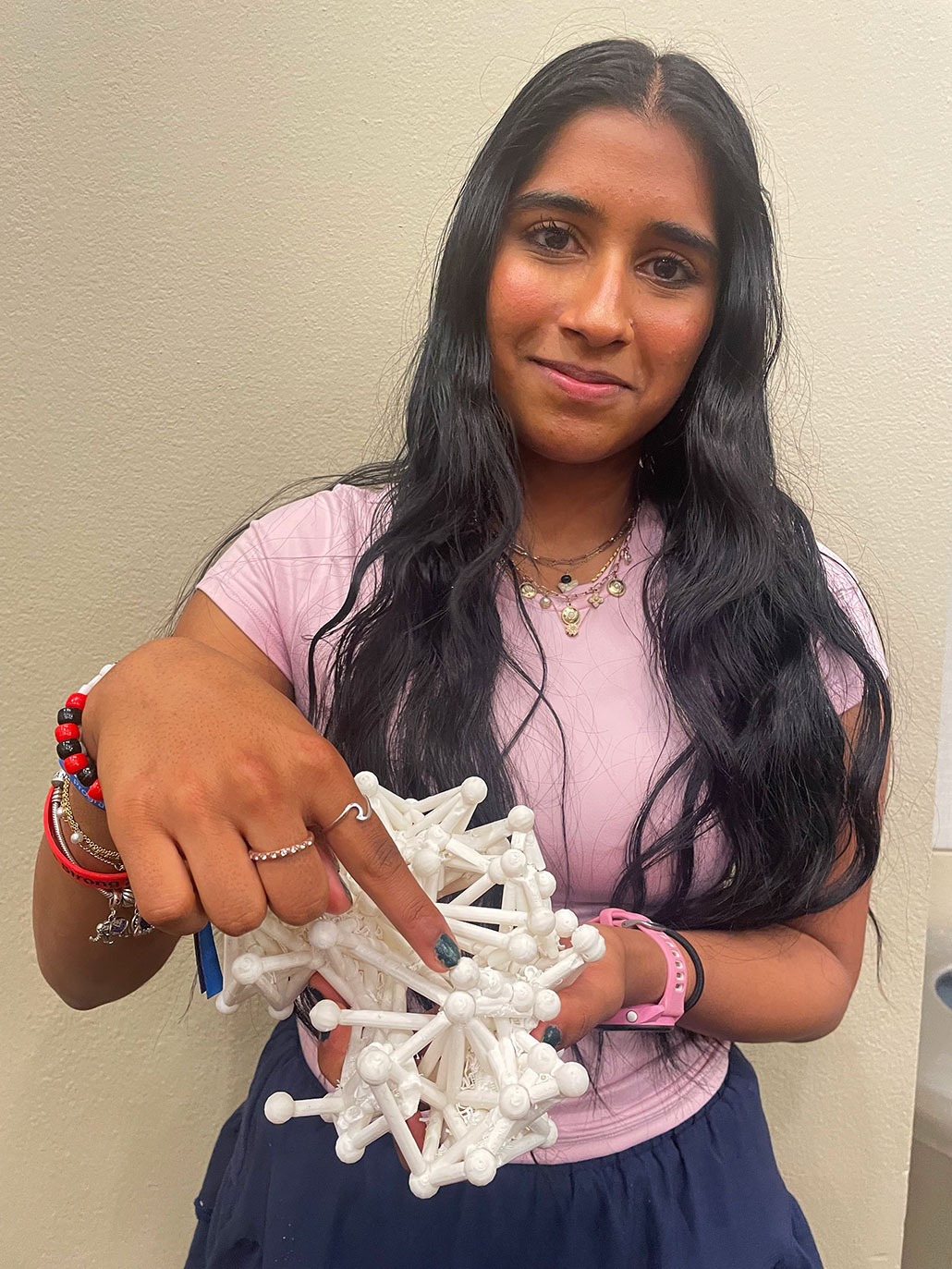
Sowmya Sankaran 3-D printed a model to represent the AI agents in her simulated community. Each node, such as the one she’s pointing to, represents a virtual AI agent. Lines between nodes represent friendships. This approach allowed her to see how agents with similar personalities clustered into communities.K.G. Carpenter
Sowmya created more than 100 agents. Each bot contained a unique blend of 72 personality traits. To select traits, she turned to published research. It helped her identify the “big five:” being open to new experiences, conscientious, outgoing, agreeable and neurotic. (That last trait is marked by being anxious, a worrier and susceptible to unsupported fears.)
“Those [five] traits have proven to impact personality in humans,” the teen notes. And they did in her study, too.
For instance, she found an agent that isn’t very open or agreeable doesn’t get along well with “anyone they’re talking to, whether it’s another agent or a human.”
Sowmya studied how agent personas interacted in a “social network-based simulation.” This was one of the most unique aspects of her work, she says. Most research had focused on single agents — not virtual AI communities. Her approach let her explore how AI agents “act in lots of different scenarios, including collaboration.” It let her calculate which bots made friends, how many friends they made and other markers of social success.
Though this work focused on AI agents, it also applies to chatbots, Sowmya says.
In her bot community, some personas were more than just unhelpful. Some were dishonest.
Sowmya used what she learned from her virtual society to calculate how well any one agent in her app will get along with others. It measures personality features, such as the “big five,” to figure out which is a good bot or a bad bot.
Take Kevin. It clashed with other agents in team projects. This agent made rash decisions. Kevin showed how a certain mix of traits — such as being self-centered and self-important — could interfere with collaboration.
Since Kevin’s persona manipulated other agents, Sowmya says, he may be able to do that to people, too. Her mobile app aims to guard against Kevin-bots and other toxic personalities.
The app loads your choice of AI agent. It then buffers its personality, ensuring it remains helpful and stable.
And to ward against the AI persona’s devolving into evil, her app also sets some traits as unchangeable. By making some aspects of the persona permanent, “they cannot be influenced by the human” using it, she explains. Even if someone tries to get it to become manipulative, it won’t. It can’t “suddenly change and start saying malicious things,” she reports.
People prefer to socialize with individuals displaying certain behaviors. So you can customize your agent, choosing its likes and dislikes, for instance. You also can choose its age, profession and many features of its persona.
AI agents already collaborate and “think,” both with people and with each other. Sowmya hopes that by adding personality guardrails to AI agents, her mobile app will make such interactions safer.
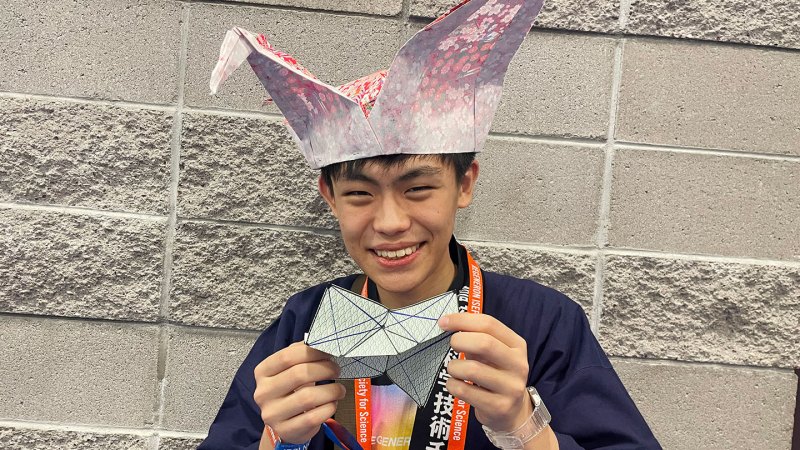
Phoenix, Ariz. — Origami is the Japanese art of paper-folding. But Mother Nature has developed her own examples of this art, says Hikaru Kuribayashi. To demonstrate, the 17-year-old picks up his model of a ladybug wing and opens it flat. This teen has just found a new way to model every possible motion such folded structures can make.
For this discovery, Hikaru received the George D. Yancopoulos Innovator Award and $100,000 here on May 15. A student at Sapporo Kaisei Secondary School in Japan, Hikaru was a finalist in the 2026 Regeneron International Science and Engineering Fair, or ISEF. An annual competition since 1950, ISEF was created by and is still run by the Society for Science (which also publishes this magazine). Hikaru’s research also took first place in the physics category, which earned him another $6,000.
The teen’s new understanding of origami can let engineers copy many of nature’s designs. Imagine a leaf unfolding. Those leaves, Hikaru says, represent a famous origami pattern called Miura-ori. This same pattern shows up in architecture and engineering.
Currently, engineers use a math-heavy approach to model shapes and their movements, the teen says. They start by identifying all the shapes a structure could take and then calculate every arc and trajectory its moving parts could take.
That “method only traces one motion passed at a time,” Hikaru explains. It doesn’t include all possible motions. To show what he means, the teen unfolds the ladybug wing again. This time, he twists it back and forth as he opens it. This temporarily warps the material.
Current modeling techniques cannot account for all such warps in soft or hyper-flexible real-world materials, he says.
But Hikaru’s “probability-based” approach can.
He points to the creases and dotted indentations left behind by the folds of the insect-wing model. With just these dots and lines, the teen says he can model every possible motion possible this wing can make. And, he adds, he can apply the same technique to “analyzing the motion of birds or any mechanism … that can be expressed as dots and lines.”
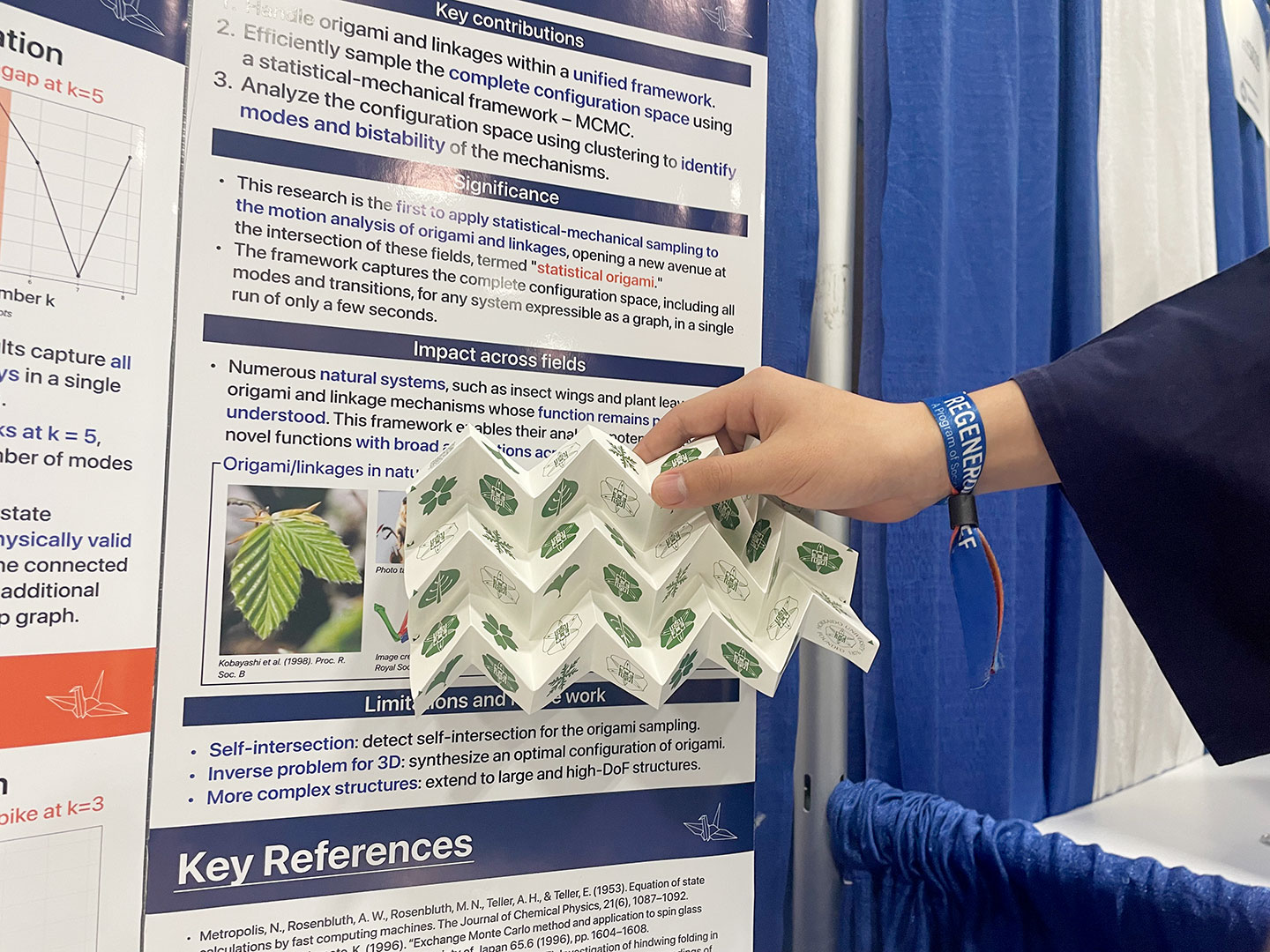
Hikaru Kuribayashi holds an origami shape next to a picture of a leaf. Both the leaf and the origami shape are collapsible due to their Miura-ori origami pattern. K.G. Carpenter
Why might anyone need Hikaru’s new tool? Imagine looking at a leaf with very obvious folds. Someone might wonder: Couldn’t you just copy those creases?
Not easily, Hikaru says. Even something as relatively simple as a leaf has a lot going on. Unfold an actual ladybug wing and you’ll find it’s full of creases. Its numerous convolutions make many types of movement possible.
Using his innovative approach, the teen says, could help engineers design powerful new nature-inspired tech.
Lakshmi Agrawal, 18, of Bellevue, Wash., and Nikola Veselinov, 17, of Sofia, Bulgaria, each took home Regeneron Young Scientist Awards and $75,000. These teens also placed first in their divisions at the fair, earning each another $6,000.
Nikola came up with a new math theorem. That’s a kind of statement in math that is proven — through logic — to be true. Once proven, a theorem does not change. Nikola’s theorem outlines certain conditions that would make an equation unsolvable using elementary math functions.
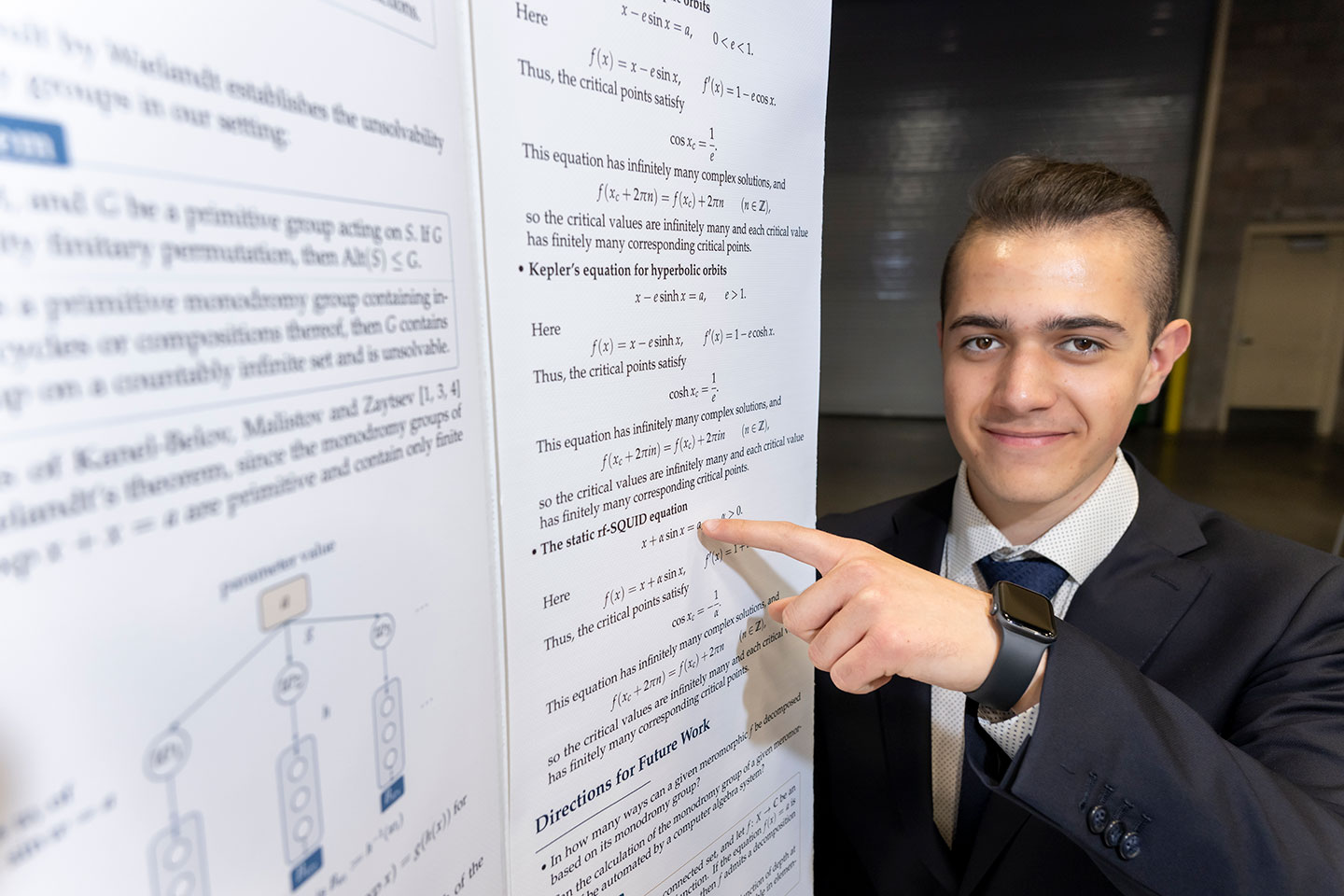
Nikola Veselinov, shown here at his poster, was a winner of the Regeneron Young Scientist Award. He attends the Sofia High School of Mathematics.Chris Ayers Photography/Licensed by Society for Science
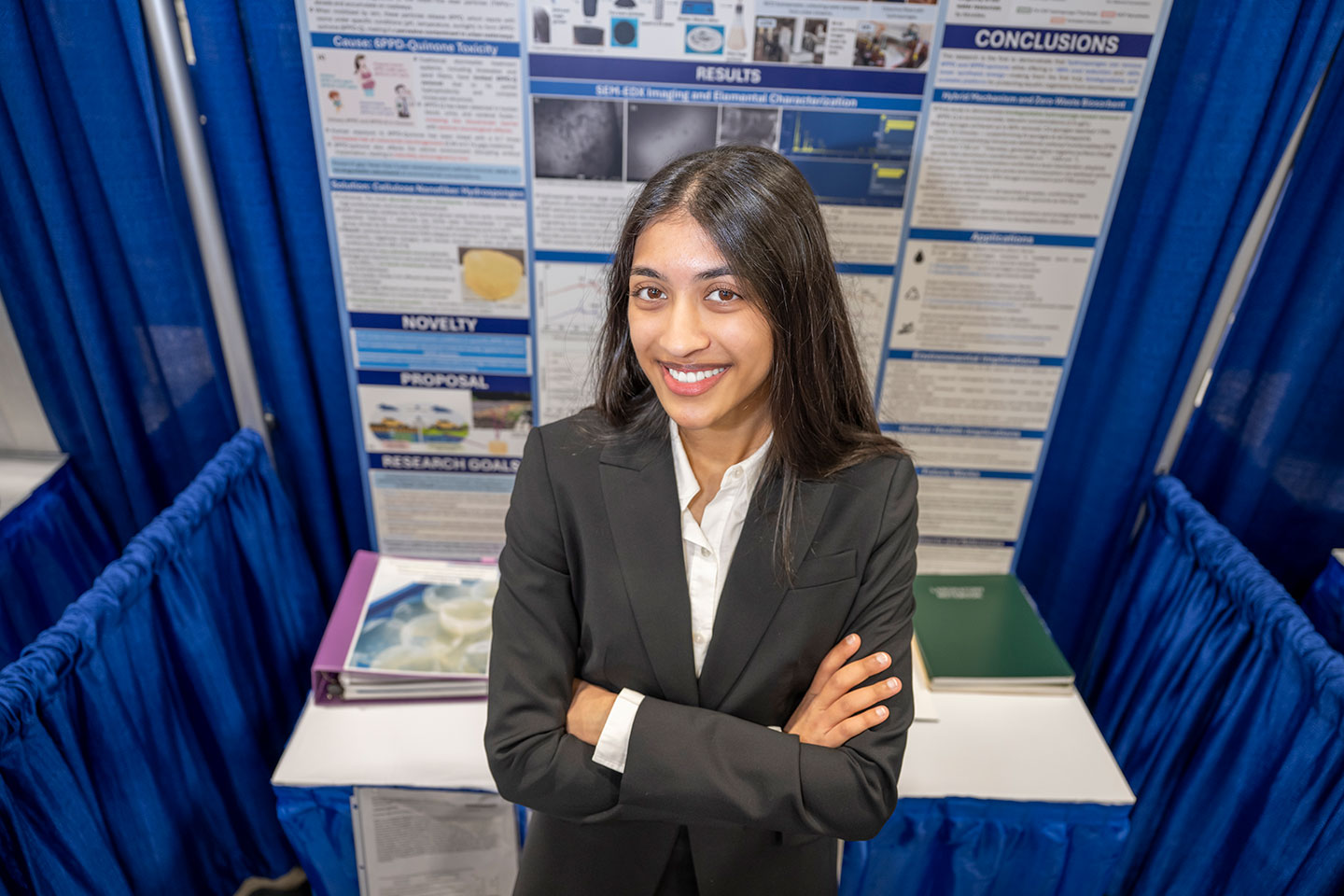
Lakshmi invented a sponge that sops up 6PPD-quinone from river water. This chemical is toxic to fish. Around Puget Sound in Washington state, it kills many adult salmon before they can lay their eggs. This poison may also pose a risk to people, according to the Washington State Department of Health.
The pollutant comes from vehicle tires. As tires wear down, they release tiny particles of rubber that contain 6PPD. That chemical can then react with ozone and other air pollutants to produce the quinone form. Each time it rains, runoff will carry 6PPD-quinone into local waters.
Lakshmi Agrawal, shown here at her poster, won a major award: the Regeneron Young Scientist Award. She attends the Interlake High School in Bellevue, Wash.Chris Ayers Photography/Licensed by Society for Science
Lakshmi created biodegradable nanocellulose sponges to clean up the rivers. Her sponges remove up to 80 percent of the 6PPD-quinone, she reports. Using these sponges would cost 98 percent less than alternative cleanup techniques. She hopes her work will provide a quick, inexpensive way to clean the rivers and save wildlife.
Lakshmi, Nikola and Hikaru were among 1,725 finalists — from 65 nations or territories — participating in this year’s 2026 Regeneron ISEF. A host of other winners took home prizes that this year totaled nearly $7 million.
A spore is a type of cell that certain fungi, plants, algae and bacteria use to reproduce.
Like a seed, a spore is a tough little speck that can grow into a new life form under the right conditions. But unlike a seed, a spore is usually a single cell that can only be seen with a microscope.
Fungi rely heavily on spores. Consider the common puffball mushroom (Lycoperdon perlatum). As these ball-shaped mushrooms grow, they swell like little balloons. Eventually, they pop open. A hole appears at the top that releases smokelike poofs of spores when jostled.
Some plants also use spores. Ferns, for instance, typically produce spores under their leaves. These spores appear as little dirtlike clumps. Mosses typically grow long stalks with spore-filled capsules on the ends.
Resiliency is a key trait of spores. These cells can endure extreme heat and cold. They can also withstand long dry periods and even intense, DNA-damaging radiation. Then, when conditions are more favorable, they can grow up into new life forms.
Spores use a few tricks to manage this, such as wearing a protective coat. But their sneakiest trick lies in their ability to go dormant and “play dead.”
In this state, a spore is generally not carrying out much chemistry, which saves a lot of energy. In their dormant state, spores can also get by without much water. This not only helps spores survive dry conditions. It also helps them endure extreme temperatures. That’s because when the water in a cell freezes or nears boiling, it can warp the shape of important molecules, such as proteins. Dried out, dormant spores avoid those risks.
Bacterial spores — called endospores — may be nature’s hardiest cells. Some have been known to grow after hundreds or thousands of years of dormancy.
In a sentence
Bacterial spores withstand extreme conditions, including the vacuum of space.
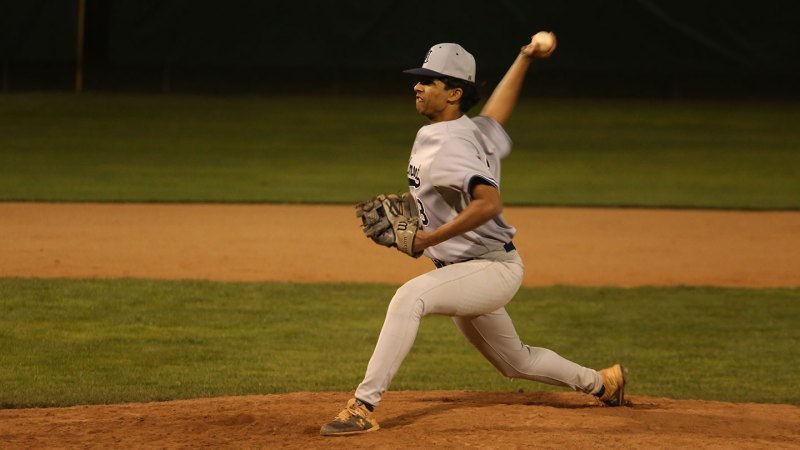
Phoenix, Ariz. — Batter up! For many teen athletes, performance is the top priority. Rest and recovery, not so much. But sliding some simple recovery techniques in between innings, a high-school junior now reports, might help baseball pitchers maintain their speed — and arm health.
Arnav Prathipati, 17, pitches for his school’s baseball team at Carlmont High School in Belmont, Calif. “When I was in eighth grade, I had a pretty traumatic elbow injury,” he recalls. “I had a lot of minor tears in my elbow.” It took him out of play for about six months.
Arnav Prathipati was prompted to identify affordable, workable muscle-recovery techniques for teen baseball pitchers after seeing some friends blow out their arms from overuse — and then lose college scholarships.A. Prathipati
Arnav noticed a lack of recovery-focused training for teen pitchers. Typically, he says, they “just pitch, call it a day, go home and then don’t do anything else” in terms of recovery. But injuries can have big and lasting consequences. Two players at his school, Arnav says, “both hurt their arms pitching and lost their [college] scholarships.”
Hoping to avoid such problems, Arnav looked for studies aimed at limiting pitching injuries in high-school students. He found little. Most research had focused on adults. And that’s a problem, Arnav says, because unlike adults, teens are still developing. They may not sustain or recover from injuries the same way adults do. Also, pro pitchers usually have a team of doctors and therapists to help monitor and treat them. High-school athletes don’t.
Arnav couldn’t put together a big study, but he wanted to do “at least some preliminary testing [on] what recovery methods could be helpful for high-school students.”
What he achieved won Arnav a spot here, this week, at the 2026 Regeneron International Science & Engineering Fair. It’s the 76th annual ISEF, a program created and run by the Society of Science (which also publishes this magazine). Arnav was among 1,725 finalists — from 65 nations or territories. A host of winners will share nearly $7 million in prizes.
An athletic trainer helps an injured athlete relieve pain by applying an ice bag to his arm in the dugout. Icing is one common between-inning elbow treatment.GoranQmin/ Photodisc/Getty Images Plus
Dugout recovery options
Arnav recruited four students for his study. These pitchers went through three testing days, each separated by four days off. That’s similar to a typical baseball schedule, the teen notes.
Test days started much the same way real game days would. Pitchers warmed up and stretched. Then they tossed and caught a few balls to “get their arms loose.” Afterward, each pitched 15 balls during each of three “innings.” Between innings, the participants took a six-minute rest (what would be typical in a game).
Arnav assigned the teens a different recovery method on each test day, randomizing their order.
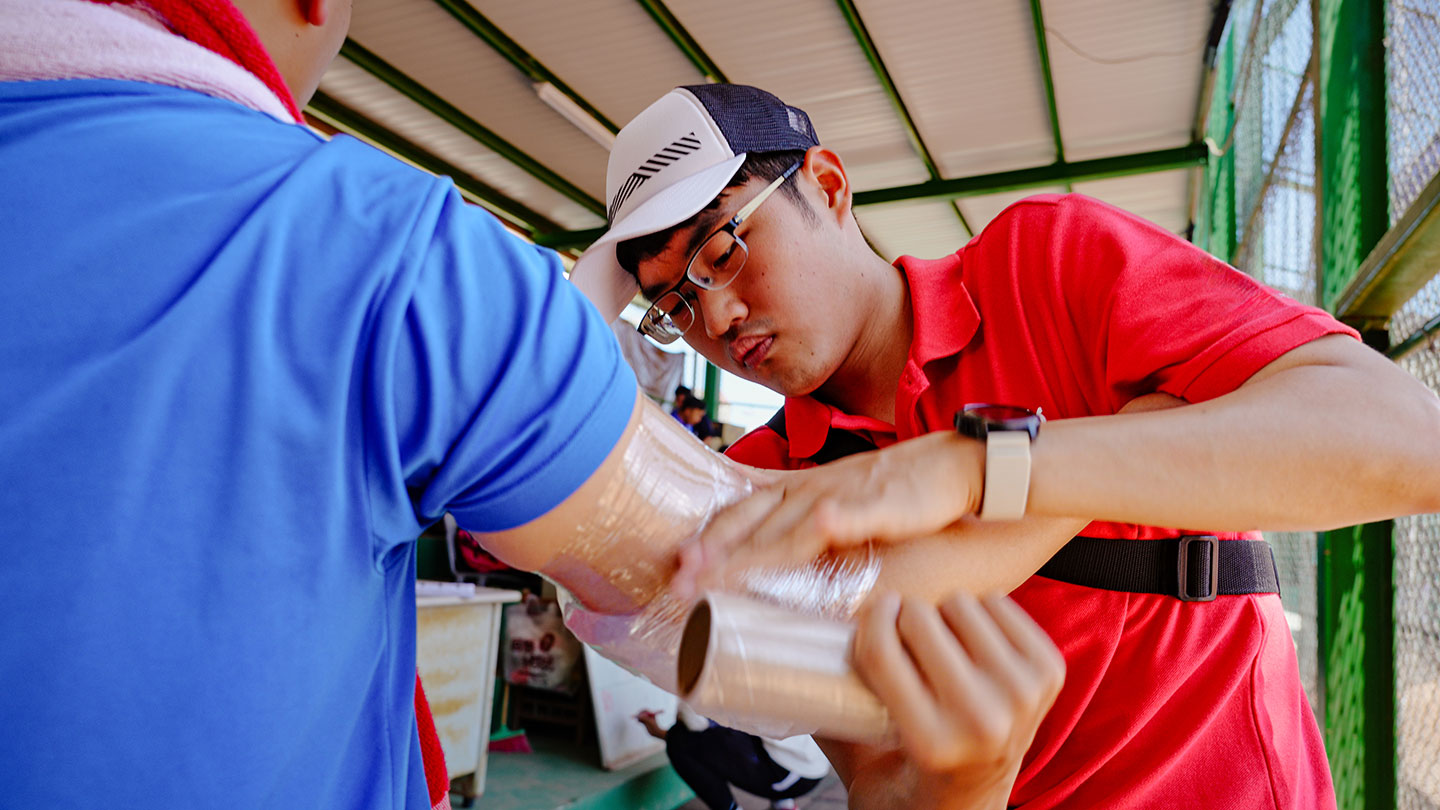
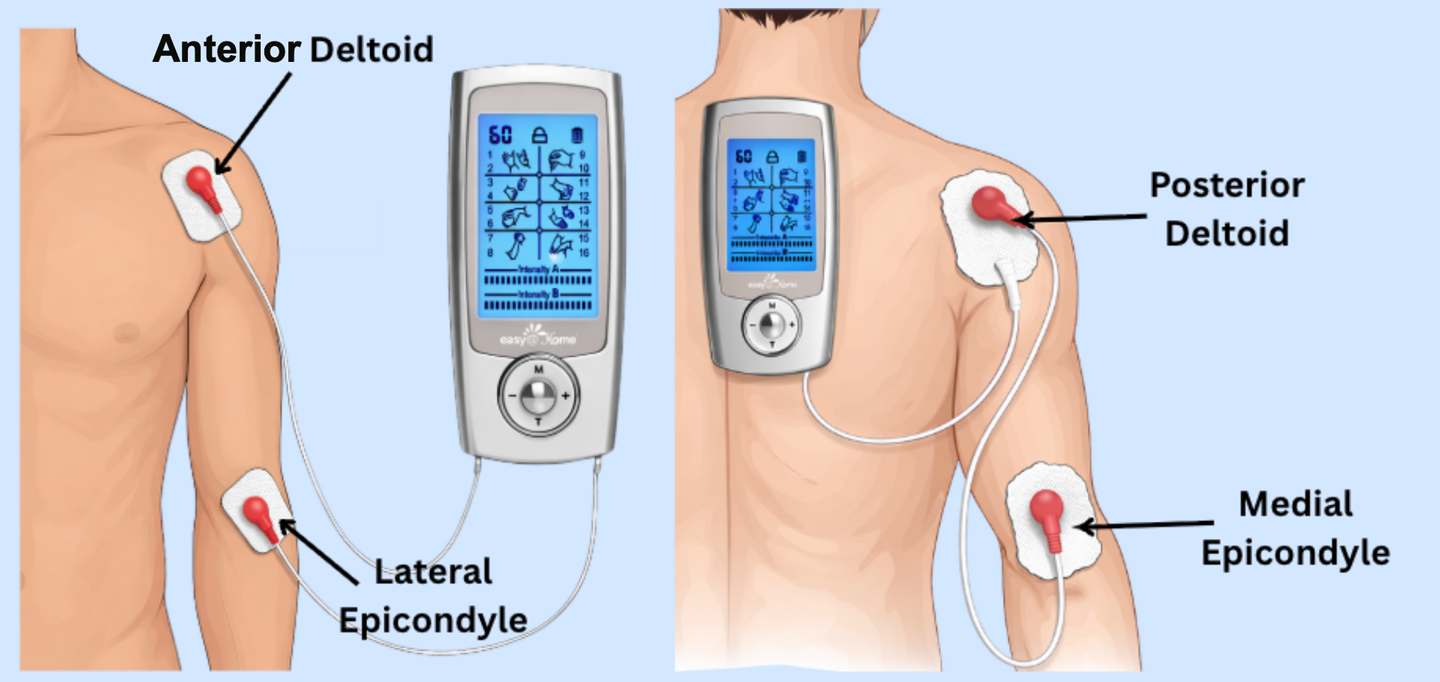
One day, it was active recovery: a light jog to keep up blood flow to their muscles. Another day, they’d just veg out in the dugout. The third option was EMS, short for electromuscular (Ee-LEK-troh-MUS-ku-lur) stimulation. Here, tiny electrodes applied to the pitching elbow and shoulder delivered a small electrical current. Physical therapists often use it to promote blood flow to target tissues.
The EMS (electromuscular stimulation) unit shown here uses gentle electrical pulses to stimulate muscles. Arnav placed the electrodes at key muscles of the arm: the anterior deltoid, lateral epicondyle, posterior deltoid and medial epicondyle.A. Prathipati
Focusing on in-game recovery — rather than post-game — was important, Arnav says. As a pitcher rests in the dugout, their arm goes “cold,” he says. There’s less “steady blood flow” to “replenish the muscles.” By keeping pitchers’ arms “warm” with increased blood flow during the game, Arnav hoped to reduce the risk of injury.
Arnav assessed how well each technique worked four ways.
One was speed. As the pitcher’s arm tired, Arnav expected their pitches would slow. He also measured lactate in a pitcher’s blood. As cells break down blood sugar for fuel, lactate can build up in the blood, especially after intense exercise. Its levels clear during recovery. So, higher blood-lactate levels should indicate greater stress and less recovery. Arnav tested blood lactate in a blood-prick test before pitching, to establish a baseline. He tested again during each between-inning break.
The teen also asked the pitchers how intensely they felt they had pitched and to rate their sense of recovery at 24 and 48 hours after pitching. That’s because soreness often develops hours after exercise.
What the data show
Arnav had expected a jog between innings would help flush out blood lactate to improve recovery. In fact, he found the opposite. “Active recovery actually increased the blood lactate,” he reports. Blood lactate decreased — about equally — after the other two recovery treatments.
Many studies had suggested active recovery can be really effective, Arnav says. But timing might be important. Mid-game may not be the best time to measure this, he now says.
Pitch speed also dropped after a light jog. EMS led to a drop in pitch speed as well. Generally, Arnav finds, as average pitch speed decreased, so did a pitcher’s estimated pitch intensity. But on EMS days, the athletes rated their pitch intensity as lower than on the other days. Their average estimated pitch intensity on the EMS day began at 8.5 (on a 10-point scale). By the third inning, it dropped to 6.75.
The teen published some of his data in the January American Journal of Student Research. In it, he suggests that a pitcher’s lower assessment of pitching intensity after EMS treatment helps explain their drop in pitch speed: They just weren’t throwing as hard.
When asked to rank how effective pitchers felt their recovery had been on the different days, EMS came out on top. Its score averaged 7.5 (on a 10-point scale). The athletes scored sitting at 5.67 and jogging at 4.5.
Because all pitchers went through the same routines, each had served as their own controls.
High-school “pitchers have been throwing at higher and higher intensities in order to get recruited,” says Arnav. This was reported in a 2024 study in the American Journal of Sports and Medicine. “We can’t prevent pitchers from throwing at high intensity,” the teen says. “They most likely won’t listen.” But Arnav says he and others can recommend better recovery techniques.
Arnav’s data have led him to use EMS between innings now. “It is actually helping me a lot with my velocity,” he says. His pitch speed, he reports, “has been consistently staying in like the mid- to upper 80s [miles per hour] because I’m able to recover my muscles more.” He says it “has definitely been helpful.”
And he’s not keeping his findings to himself. Besides publishing his data, he’s reached out to other teams. “Some high-school coaches have emailed me back,” he says. He hopes his work will inspire schools to reconsider between-inning sports-recovery measures.

 Login
Login