Reading view

Anthropic and DeepMind Now Actively Investigating AI Consciousness

Are AI models conscious, and if not, could they be in the near future? The possibility is far-fetched, but AI companies seem to feel it’s in their best interests to keep the question as open-ended as possible.

Now, the Financial Times reports that three of the industry’s top dogs — Anthropic, Google’s AI lab DeepMind, and Meta — have all hired experts in fields like psychology, philosophy, and ethics to pursue research into machine consciousness and AI welfare. 

Anthropic, which has arguably done the most out of the bunch to anthropomorphize its models and play up the AI consciousness angle — its chatbot has the human name of “Claude,” after all — has been testing its models for behaviors that resemble “panic” and “anxiety,” per the reporting, and is pursuing “model welfare research” to explore whether AI models might have experiences that matter morally.

“We remain deeply uncertain about this, but we think the question is serious enough to study carefully as AI systems get more capable,” the company said in a statement.

DeepMind, meanwhile, has hired University of Cambridge researcher Henry Shevlin as a philosopher working on machine consciousness, human-AI relationships, and AGI readiness, per the reporting. (Earlier this year, Shevlin sparked a wave of discourse in online AI circles after sharing his stunned reaction to an email he received from an AI agent.)

DeepMind ethicist Iason Gabriel, who leads the lab’s AGI and society team, called the question of AI consciousness “very complicated,” and described AI as “highly capable cognitive agents that are also just very deeply different from human beings and even from animal consciousness.”

These weighty claims are disputed by many scientists and AI researchers. But the FT, in seeking a counterargument to round out its reporting, quotes an expert who makes claims that ascribe a questionable degree of humanlike agency to chatbots. “[AI models] have goals, they can deceive, they can hide what their true interests are,” Susan Schneider, director of the Center for the Future of AI, Mind and Society, told the newspaper. But she added it’s “entirely scientifically possible that they’re doing this without having the felt quality of experience, which is what consciousness is.”

Certainly, the possibility of AI consciousness shouldn’t be completely dismissed out of hand. But neither should alien civilizations, which are generally treated more as a sci-fi musing than an urgent existential issue. 

Moreover, we should be skeptical when most of the noise on this topic is coming from the industry itself. Anthropic CEO Dario Amodei has repeatedly dangled the possibility of AI consciousness in interviews. And his company’s research frequently makes bold claims about their models showing humanlike behavior, such as supposedly harboring “emotions.” Just remember that it’s easier for AI companies to string us along with wild Skynet doomsday scenarios instead of confronting the tech’s far mundane consequences currently playing out before our eyes.

More on AI: Was This the Moment That AI Psychosis Began?

The post Anthropic and DeepMind Now Actively Investigating AI Consciousness appeared first on Futurism.
  •  

Film Community Aghast as Martin Scorsese Extolls AI Startup, Says He Now Uses AI for Storyboards

The film community is in meltdown after acclaimed director Martin Scorsese promoted a new AI startup called Black Forest Labs, saying that he’s already using its tech to help plan his movies.

Scorsese revealed this collaboration in a statement to The New York Times on Tuesday, which was accompanied by the release of a new promotional video from Black Forest Labs depicting the 83-year-old film legend using its AI image generation tool for storyboarding, the process of visualizing scenes using illustrations in preparation for filming. According to the reporting, Scorsese signed on as a partner and an adviser to the venture last year.

Such shilling by a venerated artist for AI was, in the eyes of many filmgoers, the opposite of “Absolute Cinema.”

“Cannot stress enough how disappointing it is that Martin Scorsese is collaborating with an AI company and putting a stain on his name so late in his life and career,” wrote one cineaste.

“Putting storyboard artists out of work is bad and that should not be a controversial opinion,” another fumed.

For film journalist Richard Newby, the reaction was visceral. “I feel like I’m going to throw up,” he tweeted.

It’s easy to understand where they’re coming from, since Scorsese is one of the most revered filmmakers alive. The “GoodFellas” and “Mean Streets” director spearheaded a movement that cast off the shackles of the stodgy old studio system and ushered in a Renaissance of Hollywood filmmaking that embraced authorial intent, drawing on a deep reverence for foreign filmmakers — from Akira Kurosawa to the duo of Michael Powell and Emeric Pressburger — to create something more stylistic and transgressive, while taking a unflinching eye to social issues of the day. 

Beyond his role behind the camera, Scorsese has also been an important champion of overlooked international films, and has helped preserve cinema history through his Film Foundation. For him to throw his weight behind AI is a big victory for the industry — and a gut punch to artists who view the tech as not only a threat to their livelihoods, but to creativity itself.

That said, Scorsese is being conspicuously limited in how he praises AI, though this is likely to be little consolation to the anti-AI crowd. In the promotional video and in his remarks to the NYT, he was careful to stress that he only uses AI for storyboarding, claiming that it’s allowed his team “to move faster without sacrificing quality or craft” during preproduction.

“For 70 years, I’ve been creating my own storyboards,” Scorsese told the NYT in a statement (which is notable, since it definitely reads more like a company-approved release than something he’s said in one of his many insightful interviews.) “There’s always been this problem of how do you communicate what you see in your head to your cast and crew. There are some things you have to see and feel.”

“Now with this tool,” he added, “I can share what I’m visualizing more clearly and efficiently to my creative team — the production designer, art designer and cinematographer.”

The sense of betrayal hit one Scorsese fan especially close to home.

“Scorsese’s storyboards for Taxi Driver were a big inspiration for me, a poor artist, to feel confident drawing ideas to share with our illustrators,” the indie game developer lamented. “I can’t understand why so much of the older generation of artists are swayed by this crap when they already had it all figured out.”

More on AI: OpenAI’s Attempt at an AI-Generated Pixar-Style Movie Is in Shambles

The post Film Community Aghast as Martin Scorsese Extolls AI Startup, Says He Now Uses AI for Storyboards appeared first on Futurism.
  •  

There’s Something Living Inside Fog, Scientists Find

There’s something living in the fog. Repeat: there’s something living in the fog.

It may sound like a twisted update to the classic John Carpenter film — or a log line for the new Apple TV horror series “Widow’s Bay” — but these low-hanging clouds are indeed rife with living bacteria, according to new research.

The findings, published in a study in the journal Environmental Microbiology, showed that fog is teeming with so much life that the researchers liken it to a vast aquatic ecosystem unto itself.

“We found that millions of bacteria inhabit… fog droplets,” coauthor Ferran Garcia-Pichel at Arizona State University, told USA Today

“When you take all of the droplets together, the concentration of bacteria is the same as in the ocean,” he added in a statement about the work.

The presence of bacteria in airborne water droplets isn’t a new revelation in itself. But the work helps elucidate what it is that bacteria do while suspended in fog and other clouds — something that wasn’t clear before — and the impact this has on the broader environment.

“There’s very limited knowledge about what kinds of bacteria are present in fogs, which are like clouds at the ground level,” lead author Thi Thuong Cao, a researcher at ASU, said in the statement.

To peer into this gloomy microscopic realm, the researchers meticulously collected air samples before, during, and after fog events. Since wind can blow fog banks away and confound attempts to get consistent samples, the researchers focused on a specific type called radiation fog that forms on calmer days when the ground cools and chills the air above it, allowing water droplets to condense close to the surface.

After assiduously collecting samples, the researchers found that only one percent of fog droplets contained bacteria. But a thimbleful of these droplets in all packs around ten million bacteria, which is nothing to scoff at. 

Some thrived more than others. The population of one bacteria called Methylobacteria, known for devouring simple carbon compounds including pollutants like formaldehyde, increased after fog events. A closer look showed that the bacteria were actively growing and multiplying.

“We observed them under the microscope to see that yes, the bacteria are getting bigger and they’re dividing, so there is growth,” Cao said. “We also found that they’re using the formaldehyde as food to support their growth.”

Garcia-Pichel said this marked a “mindset change” in how we think about fog. “If they are growing,” he said of the bacteria, “then the droplets are a habitat.”

From this habitat, bacteria could be influencing air quality, thanklessly sucking up pollutants. It’s a possibility that might give pause to calls to start collecting fog for drinking water, the researchers say.

“If we harvest fog, we are getting rid of our little friends in the air,” Garcia-Pichel said in the statement. “We don’t know if that’s going to make a big impact or not, but we should be considering that.”

More on biology: Scientists Intrigued by Chunk of Flesh That Refuses to Die After Several Years

The post There’s Something Living Inside Fog, Scientists Find appeared first on Futurism.

  •  

Elon Musk Says He Only Got Involved in Politics Because He Couldn’t Deal With Having a Transgender Child

Dismantling the federal government. Building a “MechaHitler” AI. Waging a war on Woke. Donating nearly $300 million to get Donald Trump reelected as president. What caused Elon Musk, once a liberal hero, to go down this path?

According to Musk: his estranged daughter, Vivian Wilson.

Doing what he does best — compulsively doomscrolling his own social media site, X — Musk responded to a fan’s post claiming he wouldn’t be the based, Nazi saluting hero that he is today if it weren’t for his daughter’s transition.

“We should never forget that if not for Vivian, Elon Musk never would have gotten involved, never would have purchased Twitter, Kamala Harris would be President and the Left-wing would have total instrumental control over the construction of Skynet,” the poster claimed.

“True,” Musk replied.

Musk might be being a little facetious here, but there’s no denying that he has a weird and unhealthy obsession with Wilson, who publicly came out as transgender in 2022, and her gender identity. He has tirelessly repeated the line that the “woke mind virus killed my son,” and claims that this is why they’re estranged — actually, she disowned him — and not because he regularly misgenders her or says she’s suffering a “tragic mental illness.”

Of course, Wilson’s perspective is pretty different. In interviews, she’s described Musk — who has 14 known children with at least four different  women — as an absent and “cruel” father who would constantly demean her for being feminine, including yelling at her for having a high-pitched voice.

In spite of that, Wilson says that Musk signed the paperwork giving parental consent for her to start the medical interventions to begin her gender transition. It seems totally out of character for him today, but it wasn’t that long ago, we should remind you, that Musk was proudly boasting about how LGBTQ friendly his company Tesla was, even telling bigots, “Don’t buy our car if that’s a problem.” Encapsulating his political about-face, Musk now claims that he was “tricked” into approving Wilson’s gender treatments.

All that being said, Wilson finds ascribing Musk’s villainous turn to her transition somewhat insulting, and implied that his reactionary sympathies were always there.

“It’s such a convenient narrative, that the reason he turned right is because I’m a f**king tr**ny, and that’s just not the case. That’s not what that does to people,” she said in a 2025 interview with Teen Vogue.

“Him going further on the right, and I’m going to use the word ‘further’ — make sure you put ‘further’ in there — is not because of me,” she added. “That’s insane.”

More on industrialists: Trump Shovels $4 Billion Directly to Elon Musk, Who Spent a Fortune Getting Him Elected

The post Elon Musk Says He Only Got Involved in Politics Because He Couldn’t Deal With Having a Transgender Child appeared first on Futurism.

  •  

Now You Gotta Buy a Second Computer Just for Your AI Agent, Nvidia Declares

While gamers beg for cheaper GPUs, and consumers at large yearn for affordable devices amid constant chip shortages, Nvidia is giving the people what they really want: laptops primarily designed for running AI agents.

On Monday, CEO Jensen Huang unveiled a new family of consumer PC chips, called the RTX Spark, designed for handling intense AI workloads. It’s a CPU and GPU rolled into one — like the processors that power modern Macbooks — and will be used in a new line of Windows computers that are “purpose-built for personal agents,” to use the wording of a company release.

Huang did not shy away from grand proclamations. At the annual Nvidia GTC event in Taiwan, he claimed RTX Spark was “the most efficient PC chip ever built,” extolled the new agent-focused design as “reinventing the personal computer,” and claimed that an RTX Spark PC “literally runs everything the world has ever created.”

“Plus, it now runs agents,” he added.

Audacious statements are par for the course for AI companies, but the pivot towards providing the hardware for personal agents raises heaps of questions. How big is the market for these laptops, and will they age like milk if agents go out of fashion?

Based on what Nvidia is teasing, they won’t be cheap. Mark Aevermann, Nvidia’s senior director of product development, said that the PCs will target “creators, AI developers and gamers” and will be priced at the premium end of the market, per The Wall Street Journal. The epic specs of the flagship version of its chip bear that out, boasting 20 CPU cores, 6,144 GPU cores, and 128 gigabytes of unified memory. All this power enables it to run AI agents with 120 billion parameters, Nvidia claims.

You can bet that a laptop with such a powerful chip will cost several thousand dollars at the very least, though Nvidia says it will offer cheaper, less powerful versions. And while AI agents are popular, especially in coding professions, it remains dubious just how many power users are out there demanding beefy machines to run AI models locally. 

Nonetheless, Huang imagines that in ten years, consumers will have “AI supercomputers in your house, running agents and assistants” connected to everything from your TV, security cameras, to dishwashers, per the Financial Times.

Skepticism may abound, but Huang’s has seemingly got all the major Windows PC manufacturers on board — to wit, Asus, Dell, Lenovo, HP, and MSI. Microsoft is also joining the pack by launching a new RTX Spark laptop called the Surface Laptop Ultra.

If there’s another takeaway, it’s that running AI agents is getting awfully expensive. Companies and individual developers are finding themselves stuck with exorbitant usage fees from using agentic tools like Claude Code. And perhaps that’s not surprising, since the preferred way to use them is to run multiple at a time in the background, each handling separate tasks. But now, if you want to be among the truly AI agent elite who walk around with their laptops half open, you should spend even more than you already do — on an Nvidia one.

More on AI: Neighbors Horrified by Data Center Twice the Size of Manhattan

The post Now You Gotta Buy a Second Computer Just for Your AI Agent, Nvidia Declares appeared first on Futurism.
  •  

Jeffrey Epstein’s Biopreserved Sperm Is Missing

Today in news we regret having to deliver: Jeffrey Epstein’s missing sperm.

According to documents in the Epstein files released by the Justice Department and viewed by The New York Times, the deceased child sex criminal and accused sex trafficker kept his sperm locked up in a cryobank several years before he died — but its current whereabouts are unknown.

A sample of his secretions were deposited with the California Cryobank sometime before 2012, and he signed a new contract in 2016, with files showing emails he received notifying him of an upcoming renewal payment. 

Epstein, who pleaded guilty to child prostitution in 2008 and was charged with sex trafficking before his death in 2019, indicated that he didn’t want his sperm discarded if he died. Instead, according to a contract in the files, it should fall under control of his estate or other legal representative. However, it’s unclear if these instructions were honored.

CooperCompanies, which has owned California Cryobank since 2021, appeared tight-lipped about the ordeal, telling the NYT that it “does not currently store any samples associated with Jeffrey Epstein,” and answering no further questions.

Adding to the mystery, the document for the trust that Epstein left most of his money and possessions makes no mention of his sperm. Naomi Cahn, a law professor at the University of Virginia, said that disputes over his sperm would likely be handled under the laws of the US Virgin Islands, where Epstein’s notorious island was located, and where his estate is administered.

Storing sperm isn’t an uncommon practice. But on top of him being a convicted sex criminal and pedophile, Epstein’s motivations for doing so, we can safely infer, were pretty dark. He had a lifelong obsession with eugenics and using science to supposedly improve human genetics, an ambition he weaved with his racist beliefs. As part of that worldview, he also wanted to “seed” the human race with his DNA by impregnating multiple women at a time at his New Mexico ranch.

More on Epstein: Elon Musk Not Doing Well After Epstein Files Reveal

The post Jeffrey Epstein’s Biopreserved Sperm Is Missing appeared first on Futurism.
  •  

Unfortunate Company Accidentally Blows Half a Billion Dollars on Claude in One Month

Ever regret picking up everyone’s tab after getting the check? Something like that is probably going through the mind of the CFO of an unnamed company which reportedly racked up half a billion dollars in Claude usage fees in a single month.

The bonkers figure comes from new reporting by Axios on how organizations that rapidly adopted AI are now reckoning with its exorbitant costs, which are mounting in tandem with skepticism over the benefits the technology is supposed to provide. 

Regarding the unnamed and deeply unfortunate company, an AI consultant told the outlet that it blew a staggering $500 million in a month after the small oversight of “failing to put usage limits on Claude licenses for employees.”

It’s an astonishing amount that speaks both to the actual costs of using AI tools — especially AI agents, which are more sophisticated and expensive — and the corporate zeal around embracing AI as quickly as possible. Which is more to blame is a matter of debate, but the breathless hype around AI’s ability to maximize efficiency is clearly blowing back on the tech’s evangelists.

On the cultural angle, many companies whose CEOs are drunk on spiked AI Kool-Aid have been encouraging employees to use AI as much as possible, a trend that some call “tokenmaxxing.” Meta now includes AI usage on employee’s performance reviews, for example. Amazon had an internal leaderboard that tracked how much its employees used AI tools, which it recently shut down after finding that some tryhards were directing AI agents do useless tasks to boost their scores, the Financial Times reported

Other unnecessary costs may be less obvious; a chief technology officer told Axios that employees at their company were using AI models to check the weather, something they obviously don’t need AI to do. Velastegui Ventures CEO and former chief AI officer at Microsoft Sophia Velastegui opined that another explanation for spiraling AI costs is that “most people default to automating tasks they dislike rather than tasks most valuable to the company,” per Axios.

AI advocates might argue that we’re going through a phase of experimentation, and that after companies figure out how to smartly use the tech, costs will come down. That could happen, but it might mean scaling back AI usage, something that the AI industry doesn’t want, especially not as leaders like OpenAI and more recently Anthropic are pushing trillion dollar valuations

Moreover, some AI providers have been raising the rates they charge for using their models, placing tighter rate limits. That suggests that the AI rates could continue to rise as AI companies themselves grapple with the huge computing costs they’re footing to get customers on board with cheaper rates. Microsoft began cancelling its Claude Code licenses last month — despite, and perhaps because, of its immense popularity with software engineers.

More on AI: Corporations Reeling From Huge AI Costs With No Clear Benefits

The post Unfortunate Company Accidentally Blows Half a Billion Dollars on Claude in One Month appeared first on Futurism.
  •  

Behold! Duke Scientists Build Biblically Accurate Angel Robot

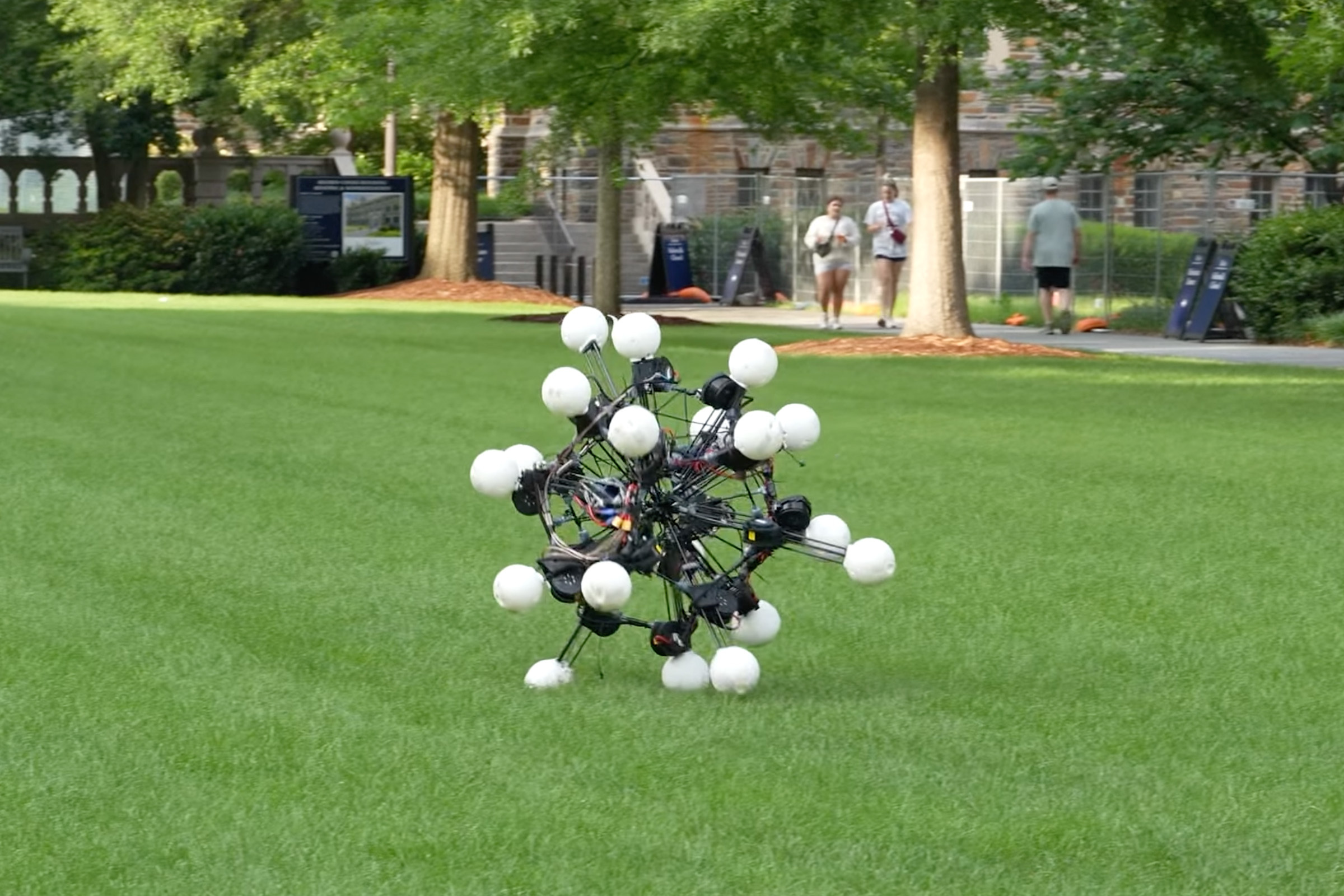
Be not afraid, human. A new robot developed at Duke University isn’t intended to strike fear into the hearts of anyone who beholds it, but more closely resembles one of those terrifying biblically accurate angels than it does any other machine or living creature you’ve ever seen.

Called Argus, the robot is a rolling, virus-shaped conglomeration of twenty telescoping legs attached to a central core. And it’s completely covered in eyes that let it see in every direction, which is literally how some of the more terrifying versions of the divine creatures are described (see: ophanim.) The result is something that is not only all-seeing, but capable of moving in any direction on a dime.

Its designer Boyuan Chen, a Duke engineering professor, says his team’s goal was to think outside the box and design something that didn’t resemble humans, dogs, or other living creatures that roboticists love to ape. Instead, they focused on uniformity in action, or what Chen calls “dynamic symmetry.”

“Instead of measuring how your legs are arranged around a different part of your body, we’re measuring how fast you can move in any direction,” Chen, who coauthored a new paper published in the journal Science Robotics describing the design, told The Associated Press. “Who said, you know, if you have a robot to help us in a most effective way, it has to look like us?”

“We’re not imitating anything in nature,” Chen added. “We’re imitating everything in nature.”

Not an inch of space is wasted in Argus’ design, which is optimized for agility. The round feet attached to the end of each of its twenty legs are also where its depth sensing cameras are housed, enabling it to watch every step it takes. (It’s named after the one-hundred-eyed giant in Greek mythology.) The legs extend and retract just the right amount they need to navigate the obstacles ahead of it. 

To gauge how well the robot moves, the researchers coined a new design principle called “dynamic isotropy” that measures how uniformly a robot accelerates when it changes direction. Most robots, including clumsy humanoids and flying drones, scored less than 0.6, but Argus clocked in at 0.91.

In footage taken by the researchers, Argus rolls across various terrain with aplomb. A paved street, a sandy beach, and a bumpy forest path each prove no match for the rolling robot. It can even climb up between two parallel walls, providing its most uncanny display as it quickly but smoothly bounces between them while gradually ascending. If one of these ever goes rogue, surely nothing will be beyond its reach.

“Watching Argus move is unlike watching any other robot we’ve worked with,” study coauthor Jiaxun Liu, a Duke graduate student, told the AP. “The first time we saw it navigate among trees and rough terrain, even under heavy collisions, we knew this was something different.”

Chen flipped the traditional robot-script further in another analogy.

“Instead of building a robot hand that looks like a human hand… one idea is to think about having Argus be the hand itself, and it can manipulate objects in any direction,” he told the AP. “The knowledge we can transfer to the rest of the world is much more deeper than building an existing robot or copying an existing species.”

Chen’s team isn’t the only one exploring unorthodox robot designs. Northwestern University researchers recently unveiled modular “metamachines” made of limbs that are each their own independent robot, allowing them to form a greater whole, but survive if broken apart.

More on robots: Oops! Domino’s-Partnered Robotics Startup That Was Supposed to Put Human Pizza Chefs Out of a Job Just Shut Down

The post Behold! Duke Scientists Build Biblically Accurate Angel Robot appeared first on Futurism.

  •  

Scientists Spot What Appears to Be a Ring-Shaped “Planet Factory” Deep Out in Space

Astronomers have spotted a “planet factory” in space that could explain the origins of bizarre meteorites scattered across the Earth.

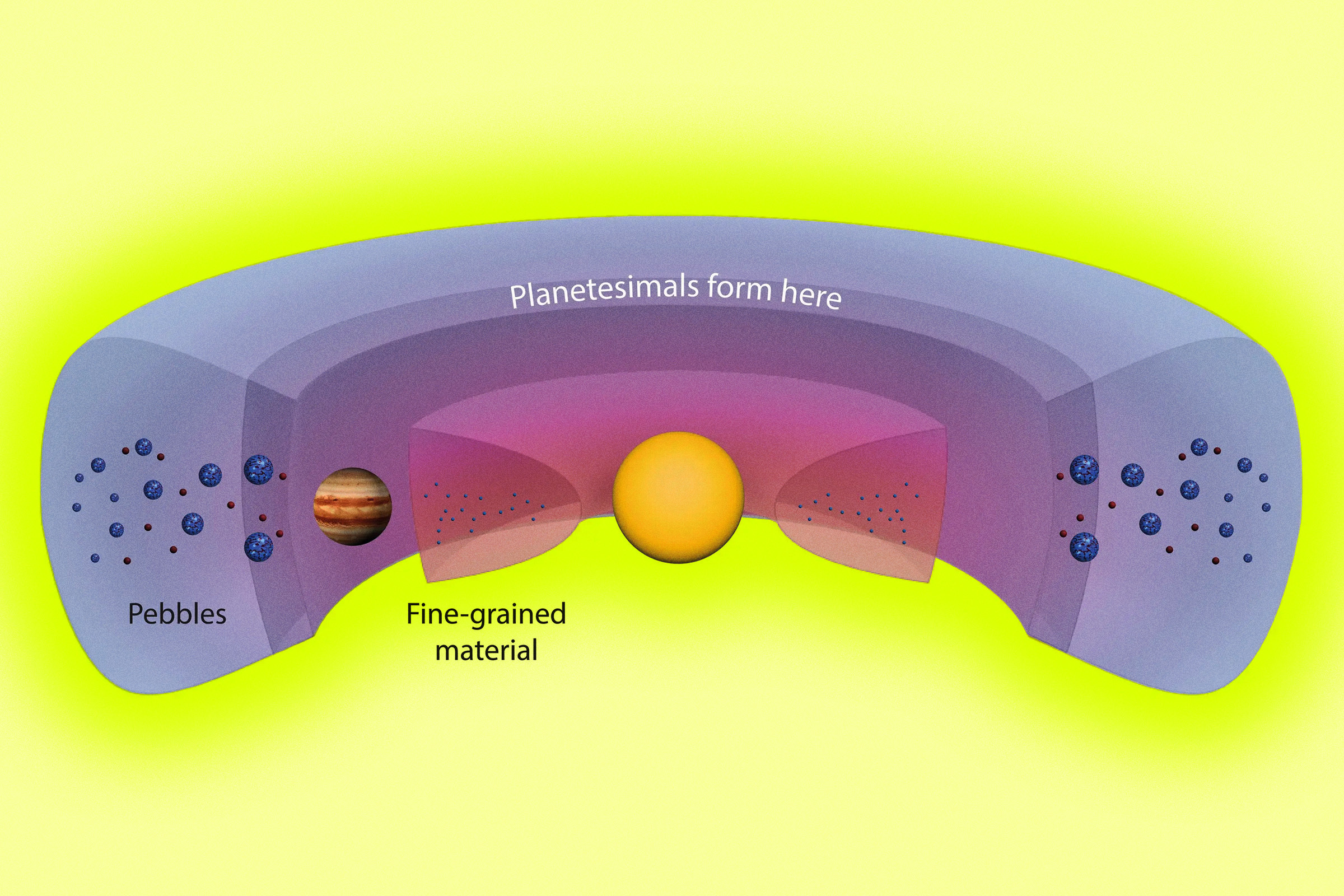
Lurking beyond Jupiter’s orbit, the ring-shaped region is packed with gas and dust that may have allowed it to serve as a breeding ground for so-called planetesimals, mile-length solid masses that can become the building blocks planets, when the solar system was in its infancy.

But that’s not all. In computer simulations described in a new study published in The Astrophysical Journals, the team found that the region also produced planetesimals of different compositions, perhaps making it one of the most influential planet-forming regions in our star’s domain.

“Different types of planetesimals apparently formed in the same region of the early dust and gas disk, only at different times. The region just outside Jupiter’s orbit offered excellent conditions for this,” study coauthor Joanna Drążkowska, an astrophysicist at the Max Planck Institute for Solar System Research, said in a statement about the work.

The mystery stems from a class of planetesimals called carbonaceous chondrites that formed around two to four million years after the solar system first came together. Though most planetesimals are thought to have been ejected as the solar system matured, traces of these survive as meteorite fragments that frequently bombard our planet, and it’s the rarer and unusually carbon heavy ones — our aforementioned chondrites — that prove most intriguing. They’re composed of distinct dust grains, but the proportion of these grains varies dramatically over time, with one generation made of notably crumbly grains, and others sturdier grains. What region could’ve formed such a medley of planetesimals in a short window was unknown.

A so-called “dust trap” just beyond Jupiter provides a tidy explanation, the researchers found. When the Sun was young, it was encircled by a huge disk of material in which the planets eventually formed. When Jupiter came along with its incredible mass, it sucked up most of the planet-forming material around its orbit, creating a gap in the so-called protoplanetary disk. A knock-on effect of this was that it also created a ring of higher pressure gas outside the neighborhood it cleared, trapping dust grains that clumped together into pebbles, which could eventually birth planetesimals.

In simulations modeling both microscopic particle collisions and large-scale movements in the protoplanetary disk, the researchers demonstrated that some particles could become trapped in certain regions, like the one near Jupiter. Further underscoring the planet’s role, they also found that it acted as a barrier for larger, more sturdy particles than smaller ones. This was all occurring as already-forming planetesimals sucked up some of the free-floating material. Over time, these dueling processes helped create planetesimals of two distinct generations. In the first 500,000 years, the abundance of crumbly grains dropped before rising over the next million years.

These findings, if borne out, could have broader implications for our understanding of the solar system’s evolution.

“There is strong evidence that dust traps were the preferred birthplace of planetesimals in our solar system,” Drążkowska said.

“For the first time, we have succeeded in accurately reproducing the results of laboratory studies of meteorites using computer simulations of the early solar system,” added coauthor Thorsten Kleine, Max Planck cosmochemist. “The meteorites serve, so to speak, as a touchstone for theories of planetary formation.”

More on space: Scientist Suggests That 3I/ATLAS May Have Seeded Life as It Careened Through Our Solar System

The post Scientists Spot What Appears to Be a Ring-Shaped “Planet Factory” Deep Out in Space appeared first on Futurism.

  •  

Take-No-Prisoners Professor Will Fail Any Student Who Uses AI

When it comes to AI’s place in the classroom — and its role in education broadly — some professors are at the end of their rope. The not quite all-knowing but incredibly adept at bullsh*tting chatbots let lazy students churn out entire essays, solve math problems, and cobble together passable answers for most questions. Needless to say, none of that leaves much room for actual learning.

Such desperate times call for Draconian measures. In a roundup of instructor testimonials on the AI’s impact on their profession from The New Yorker, one pedagogue is taking no prisoners when it comes to punishing pupils who surrender their brains to the tech.

“I tell students that ChatGPT is disallowed from their writing process, that I can immediately tell when ChatGPT has been used, and that I will fail the student on this assignment if it is used — and, potentially, for the entire course, if we go through a formal appeals process,” Neal Hebert, a theatre professor at Grambling State University, wrote to the magazine.

Hebert has an even more merciless warning for theater majors. 

“I tell my theatre majors, ‘I get paid the same whether I pass you or fail you,'” he wrote. “‘But what you’ve just done is told me and everyone else in our department that you are so lazy you would rather outsource your collaboration to an app than risk being an artist.'” 

Tough love is not something Hebert undertakes with glee, but the overwhelming tide of AI cheating in his introductory classes has left him no choice, he feels.

“I’ve stopped being a collaborator in these intro courses and started being a plagiarism cop, and I do resent that a bit,” he lamented. “I wanted to be the kind of professor my professors were for me.”

Some professors try a different tack, allowing moderate experimentation with AI, and more forgiving forms of chastisement. Daniel Silver, a professor of sociology at the University of Toronto, Scarborough, framed it as a learning opportunity — for the instructors.

“AI has fundamentally changed how I teach, and it demands basic reflection about what we are trying to accomplish,” Silver told The New Yorker.

Silver said he spent a lot of time this academic year coming up with new types of assignments that call for more creative uses of AI, such as creating and experimenting with AI agents that represent famous thinkers like Adam Smith.

“Beyond that, students still would use AI in a thoughtless way, as a replacement for their thought and judgment,” Silver wrote in his testimonial. “So I made a point to just call them on it, and make them meet with me personally.”

After talking with the students, Silver would give them a zero on the offending assignment but also a chance to redo it. “They usually improved, but not always,” he said. To drive the point home, he would show them AI-generated assignments to demonstrate how the “they all kind of look the same.”

AI caused him a lot of “emotional upheaval,” Silver admitted, “but I do feel we all, including the students, are learning how to live with it, and we’ll come out better on the other side.”

Hebert is less optimistic. Whatever ounce of good-feeling he still possessed was shot down when he read his student’s papers on “Fences,” a Pulitzer-winning 1985 play by August Wilson.

“Out of forty students, the vast majority chose similar words, phrasing, and concepts, and most papers were written in that inimitable ChatGPT style: ‘This isn’t a simple story about injustice — it’s a clarion call for a positive understanding of justice,'” he wrote, comparing LLM’s prose to “elevator muzak, but in words.”

Rather than integrating AI, he’s fortifying his classroom against it. The assignment is now based on plays too obscure for ChatGPT and other AI models to know about.

“If ChatGPT is used on these assignments now, it hallucinates characters, plotlines — it just makes sh*t up, since it has nothing to go on,” Hebert told the magazine.

Still, this hasn’t completely discouraged AI cheating, even in Hebert’s upper level courses. And it’s causing him to have nightmares of what the tech’s long term implications for theater as an artform will be, if students “can’t be bothered to read and think about the plays they are performing in.”

“Can you imagine AI Performing Arts Slop? The theatrical equivalent of the images ChatGPT and its competitors spit out, soulless and inert, arriving on stage stillborn?” he asked. “I can.”

More on education: Parents Explode in Fury at School’s Plan to Constantly Film Their Children to Train AI

The post Take-No-Prisoners Professor Will Fail Any Student Who Uses AI appeared first on Futurism.

  •  

Startup Testing Drugs on Freshly Extracted Human Brains That Are Kept On Life Support

A biotech startup called Bexorg is doing something that sounds like it was ripped straight from the pages of a cyberpunk novel — or from the script of “RoboCop,” for that matter.

The company is extracting human brains just hours after their owners died and then hooking them up to specialized life support machines, Science reports. While the masses of pink mush no longer host electrical activity, most of their key functions remain intact, allowing scientists to test experimental drugs, such as potential treatments for Alzheimer’s disease, like never before.

You’d hope that the disembodied cerebrums are most assuredly dead. But according to the reporting, an extracted brain hooked up to one of Bexorg’s proprietary life support machines, BrainEX, “hovers between life and death.” There’s no spark of consciousness, and yet the brains are kept running on an artificial lung, kidney oxygenate, blood, and other fluids.

Perhaps you can put this ambiguity down to the startup being deliberately enigmatic to provoke attention. Or maybe it’s a reflection of how the distinction between life and death is uncomfortably blurry.

But you can put those doubts out of your very-much embodied mind, assures Brendan Parent, one of Bexorg’s six ethicists. The extracted brains are almost devoid of the coordinated neural firing necessary for minimal consciousness, he told Science. To prevent the eerie implausibility that some the brains produce electrical activity, the brains are also dosed with anesthetic propofol. Of course, that such a measure has to be taken in the first place may actually be less assuring and more unsettling.

Ethics aside — not a statement that should be made lightly — the scientific possibilities that these extracted brains afford may well hold promise. Bexorg CEO Zvonimir Vrselja said that the brains come with decades of environmental exposures, histories of drug treatments, and other factors that make them a more realistic testing medium for drugs. “You get cells that have been there for 60 to 80 years,” Vrselja told Science.

Bruna Bellaver, who studies neurodegeneration at the University of Pittsburgh, was also effusive. 

“It’s a huge step up from mouse models,” she told Science.

Bexorg is the same startup that demonstrated, over six years ago, that it could keep decapitated pig brains alive for 36 hours using a prototype of its BrainEX machine.

Today, its human brains aren’t kept running in perpetuity. After 24 hours, they’re sliced into hundreds of pieces so they can be analyzed by scientists. The company plans to use a robotic arm to slice up to 1,600 brains per year.

Though Bexorg hasn’t itself published any papers on its work with human brains, other companies have already been eagerly experimenting with them. The pharmaceutical firm Biohaven has used 130 of its brains to test drugs, according to Science, including a potential treatment for Parkinson’s disease, and plans to launch a clinical trial for another drug using data it gathered from those experiments.

More on neuroscience: Scientists Say Test Subjects Were Able to Quit Smoking After They Blasted Their Brains With a Huge Magnet

The post Startup Testing Drugs on Freshly Extracted Human Brains That Are Kept On Life Support appeared first on Futurism.
  •  

California State University Made a Huge Deal With OpenAI and It’s Been a Disaster

Last year, California State University signed a $17 million deal with OpenAI to provide its over half a million students and faculty with ChatGPT Edu, an education-focused version of the company’s flagship chatbot. It was a statement move for both parties: OpenAI clinched the largest public university system in the country, and CSU secured bragging rights for being pioneering adopters of the latest revolutionary tech. This was the big stage for AI’s dazzling promises of supercharged learning to shine on.

CSU students, however, have come to see the tech differently. Around 65 percent of them — and 59 percent of faculty there — are skeptical that AI has been benefitting education overall, according to a recent university-wide survey with over 94,000 respondents. A full 80 percent of students said they wouldn’t be comfortable turning in AI-generated work as their own. And around four out of five of them were worried about various AI issues, including its impact on jobs, creativity, and the environment. 

If part of the intent behind the collaboration was to win new AI converts, it hasn’t quite worked out that way.

“They’re ethically opposed to the environmental impacts and the bias and the erasure of their jobs and voices and creativity,” CSU English professor Jennifer Trainor told NPR. “[They] don’t like it.”

The ambivalent student sentiment is especially striking when you consider how widespread AI use on campus has become. In the survey, 84 percent of students said they used ChatGPT, and 64 percent said AI positively affected their learning. Roughly half used AI regularly.

But even as they’re heavily encouraged by their institution to use AI — not to mention bombarbed by all the noise coming out of the AI industry itself — students can’t shake off some deep-seated reservations about the tech. Some are completely opposed, with Trainor describing that there was a “groundswelling of resistance” to AI on the campus. Taking aim at the school’s administration, one student vented to NPR that she was a “little disappointed that they accepted [AI] with open arms immediately.”

There’s more than a hint of optics, instead of merely education value, being a major factor behind the ChatGPT deal. University leaders called a potential OpenAI partnership a “huge branding opp[ortunity]” in an internal planning document obtained by NPR. At a press conference announcing the partnership, CSU chancellor Mildred García bragged that “no other university system in the US or internationally is doing anything like this, not at this scale.”

Of course, there’s good reason to be cautious around AI as an educational tool and not treat hundreds of thousands of students as a big tech experiment. The long-term effects of AI on mental health and learning are still unknown. But a burgeoning body of evidence has associated AI usage with impaired critical thinking skills, memory loss, lower brain activity during cognitive tasks, and other deleterious cognitive effects. That’s not to mention the temptation it brings as an effortless cheating tool. 

CSU faculty are just as ambivalent as students. About 52 percent of professors and instructors said that AI had negatively affected their teaching, and 40 percent said they either discourage or outright forbid AI in the classroom. Some hope for campus-wide reform. Martha Kenney, a professor and science and technology scholar, led a petition demanding CSU not renew its contract with OpenAI.

“I think refusing this technology needs to be a position that’s on the table,” Kenney told NPR.

CSU renewed its contract with OpenAI this month, agreeing to pay $13 million a year for the next three years. The decision was made despite the university facing steep budget cuts that could slash $144 million.

More on AI: Nvidia CEO Begs Execs to Stop Telling Workers They’re Fired Because of AI

The post California State University Made a Huge Deal With OpenAI and It’s Been a Disaster appeared first on Futurism.

  •  

Woman Alarmed When Her Trusted Therapist Starts Recording Her With AI

Therapy is predicated on trust. You can’t be honest and vulnerable, and share how you’re really feeling, if you don’t believe in the embodied-concerned-frown sitting in the armchair across from you.

So you can understand why one woman, 31-year-old Molly Quinn, was taken aback when her trusted therapist suddenly whipped out an AI model to start recording their private conversations, NPR reports

“She wasn’t taking notes like she usually did,” Quinn recalled realizing halfway through one session. “The iPad was just propped up.”

Where were her words being processed and stored? Will they one day become training data? It’s not something you have to ask yourself when your therapist jots stuff down on a clipboard. But those questions were now racing through Quinn’s head, leaving her uneasy.

“The more I thought about it, the more I just started getting more and more sick to my stomach,” she told NPR. “This person who I’m supposed to be able to trust with some very private and very intense emotions had just completely disregarded something I said I was not comfortable with. I felt completely violated.”

Though her therapist offered to stop using the AI tool, Quinn cut her off and found another one.

“The trust was gone,” she told NPR.

Like doctors, therapists across the country are adopting AI tools for notetaking and generating transcripts. AI companies offering these services frame it as a way of cutting down on the drudgery of paperwork and other administrative tasks, freeing up more time to focus on patients — a permutation of a common AI industry refrain: let us do the tedious stuff for you. 

The reliability of AI tools remains fairly dodgy, though, and even setting aside questions of hallucinations creeping into clinical notes — which is something we’re already seeing happen — it’s not clear whether patients are even comfortable with the tech yet. In a YouGov survey cited by NPR, only 11 percent of Americans said they would be open to using AI in mental health care. An even slimmer eight percent said they would trust AI being used this way, while 40 percent said they don’t trust the technology at all.

“Even the presence of AI changes the therapeutic experience,” Marisa Cohen, a couples and sex therapist in New York, told NPR. “Clients know or feel like something else is listening to them. That awareness can subtly alter their disclosure.”

“When you introduce something that’s being stored electronically, it raises additional questions about trust and safety,” Cohen added. “It’s essentially a third party.”

Tal Salman, the CEO a popular AI scribe tool for therapists called Berries, insists that conversation recordings are deleted immediately and that transcripts are stored on HIPAA compliant servers in the US. Even if this is true, if AI companies’ tools are to ever have a place in private mental health settings, they need the trust of patients — and that’s something the AI industry clearly hasn’t earned yet. Quinn fears that AI-recorded conversations could one day be exposed by hackers.

“We’re going to see breaches,” she told NPR. “Maybe not tomorrow, maybe not next week. But in a few years? I think we’re going to see them. And I don’t want my therapy session to be part of that.”

More on AI: The Pope Just Low Key Declared Holy War on Artificial Intelligence

The post Woman Alarmed When Her Trusted Therapist Starts Recording Her With AI appeared first on Futurism.

  •  

AI Filmmaker Compares His Tech to Something That Gets Worse the More You Think About It

Jorge R. Gutierrez, the animator behind the beloved animated film “The Book of Life,” is enraging his fans after seemingly selling out to AI. 

At a conference held by Amazon MGM Studios on Wednesday, he unloaded a gushing encomium to the tech after announcing that he’d be working with the Amazon studio to create an AI-generated animated series called “Punky Duck.” (A shared still from the series is littered with hallucinations and nonsensical words, like a concert poster that says “Satorsay IUCT7AX – 0 PM.)

Further raising eyebrows, Gutierrez made an utterly bizarre analogy to explain why he had come to love using machine-amalgamated imagery. Per ToonHive, he enthused that animating with AI was like “having sex and then they hand you the baby” — in what may very well be the last attention-getting image he ever produces if he continues to let AI do his job for him.

Gutierrez’s point: you can skip over the actual creative process that goes into art and get instant results. Never mind the figurative pregnancy, in his analogy, when the idea is actually incubated and given life.

“I’m used to two years for a pilot, and something like this… it feels like the most rebellious, punk rock thing you can do right now is to make something this fast,” he said of AI, as quoted by IndieWire. “For someone like me who’s used to waiting so long, this has been a life-changer.”

As a rule, if something has to be described as “punk rock,” it’s not, in fact, “punk rock.” That aside, it’s a revealing insight from Gutierrez, epitomizing the logic of shameless AI boosters who think a machine can replace an artist. The truth is that art is inseparable from the labor that produces it, and any attempt to take that labor out of the equation will produce something hollow. The “I hate writing, but I love having written” crowd can embrace AI all they want, but there is no “having written” with the tech. It’s just doing the work for you. AI takes the labor we loathe out of the process, sure, but also the opportunity to stamp actual intent.

All in a way of saying, sure. Typing a prompt into an AI model is sex, somehow, and the uncanny, and hallucination-mangled images its spits out is just like a precious baby.

Getting ahead of the backlash, Gutierrez made another questionable statement.

“I understand a lot of you are happy for me and a lot of you are really angry at me for experimenting with AI at Amazon,” he tweeted Thursday morning. “I’m going to leave the comments open so you can get it all out and hopefully feel better.”

“Any death threats will be reported,” he said, in a dramatic escalation, before randomly namedropping his wife and son. “Come at me all you want and need, just leave my family alone.”

We didn’t see any death threats. Actually, what we saw was far more gutting: legions fans thoughtfully articulating why Gutierrez had completely let them down, heavily laden with word “disappointed.”

There isn’t “really anything to ‘get out,'” one fan wrote. “this [isn’t] the kind of thing you can just do and wait for it to blow over. [It’s] a betrayal, and even if the anger subsides, [people aren’t] going to trust you anymore.”

“Disappointment is an understatement,” another wrote. “It goes against why we tell stories, why we motivate and move people. You discarded something priceless.”

More on AI: AI Firm Trots Out Digitally Resurrected Corpse of Stan Lee You Can Use to Create Mind-Numbing Slop

The post AI Filmmaker Compares His Tech to Something That Gets Worse the More You Think About It appeared first on Futurism.

  •  

Tech CEOs Have a Problem: Even Their Closest Allies Now See AI as a Sign of Laziness and Dishonesty

Tech founders and CEOs are all rapidly adopting AI, deploying it across their companies and personally using it to handle emails and other busywork. 

But Paul Graham, the cofounder of startup accelerator Y Combinator and one of the most venerated names in Silicon Valley, has already grown tired of the tech’s influence. When he receives pitches that are AI written, it’s such a turn off that he now closes them on sight.

“A lot of the emails I get from founders are now written in a hard-hitting journalistic style,” Graham wrote this week. ” I know they’re written by AI, because no founder ever wrote this way before. And once you realize something is written by AI, it’s hard not to ignore it.”

To say his feelings were mixed on this would be an understatement.

“I have never knowingly finished reading an email signed by a human but written by AI,” Graham added. “It feels like being lied to, and who would stand for that?”

This should be a warning sign to tech CEOs, if they’re not too busy getting obsequious advice from a chatbot to notice. Graham, whose word goes far in tech circles, has historically been a major AI booster and investor. Just last month, he proclaimed that AI was the “biggest opportunity for would-be startup founders.” That makes his latest musings distinctly ironic, but all the same, if even someone who’s advocated for AI’s revolutionary power has already turned heel and decided that it reflects negatively on the person using it, it doesn’t bode well for tech’s long-term image.

“It makes me think less of the author. It means they can’t write well unaided (or feel they can’t), and that they’re trying to trick me,” Graham said of AI emails. “It’s not impressive to use AI to write stuff for you; any teenager can do that.”

Some accused Graham of “cognitive dissonance.” In addition to his usual AI boosterism, Graham also recently celebrated how AI was “giving a lot of hard-working founders the growth they deserve.”

Graham saw no contradiction between that sentiment and his latest post.

“You’re supposed to use it,” he said of AI, “but in the right way.”

But what is “the right way”? AIs are large language models. Writing, be it language or code, is exactly what they do. If AI shouldn’t be used to wholesale write emails or essays or pitch decks, how should it be? If the suggestion is that AI should be used more subtly and intelligently, fine, but means that its applications would be niche — and “niche” isn’t what the investors pouring hundreds of billions of dollars in the industry are hoping.

All that is to say that the AI industry is fraught with contradictions, and so far it’s survived because the tech’s being built and deployed fast enough to outpace them. For now, at least. In response to Graham’s post, one observed the irony of how “people who are pro AI don’t want to be on the receiving end of AI work.”

More on AI: Corporations Reeling From Huge AI Costs With No Clear Benefits

The post Tech CEOs Have a Problem: Even Their Closest Allies Now See AI as a Sign of Laziness and Dishonesty appeared first on Futurism.

  •  

Scientists Intrigued by Chunk of Flesh That Refuses to Die After Several Years

A chunk of seemingly immortal sea cucumber tissue has scientists wondering if they’ve just stumbled on the secret to regenerating limbs. No, we are not kidding.

In a new study published in the journal Science, researchers say that an amputated sample of the creature, a species called Psolus fabricii, has survived for three years while being kept in natural seawater, growing and repairing all on its own. The tissue was so hardy, in fact, that it outlasted the researchers’ experiments — at which point they decided to call it quits and publish their astounding find.

“This is naturally occurring tissue immortality,” study lead author Sara Jobson, a researcher at Memorial University of Newfoundland, told Ars Technica. “Having tissues that survive that easily is unheard of. We’ve never seen anything like this.”

The sheer longevity of the specimen isn’t the only reason it’s unprecedented. Another is the fact that the sea cucumber tissue survived in ordinary seawater, an environment rife with bacteria and other microbial organisms. In previous tests, tissue samples were placed in an “axenic” culture that’s sterilized and tightly controlled.

Another is that the explanted tissue is actually healing and growing. In their experiments, the researchers found signs of immune activity and tissue reorganization; the cells even appeared to be diversifying and absorbing nutrients on their own.

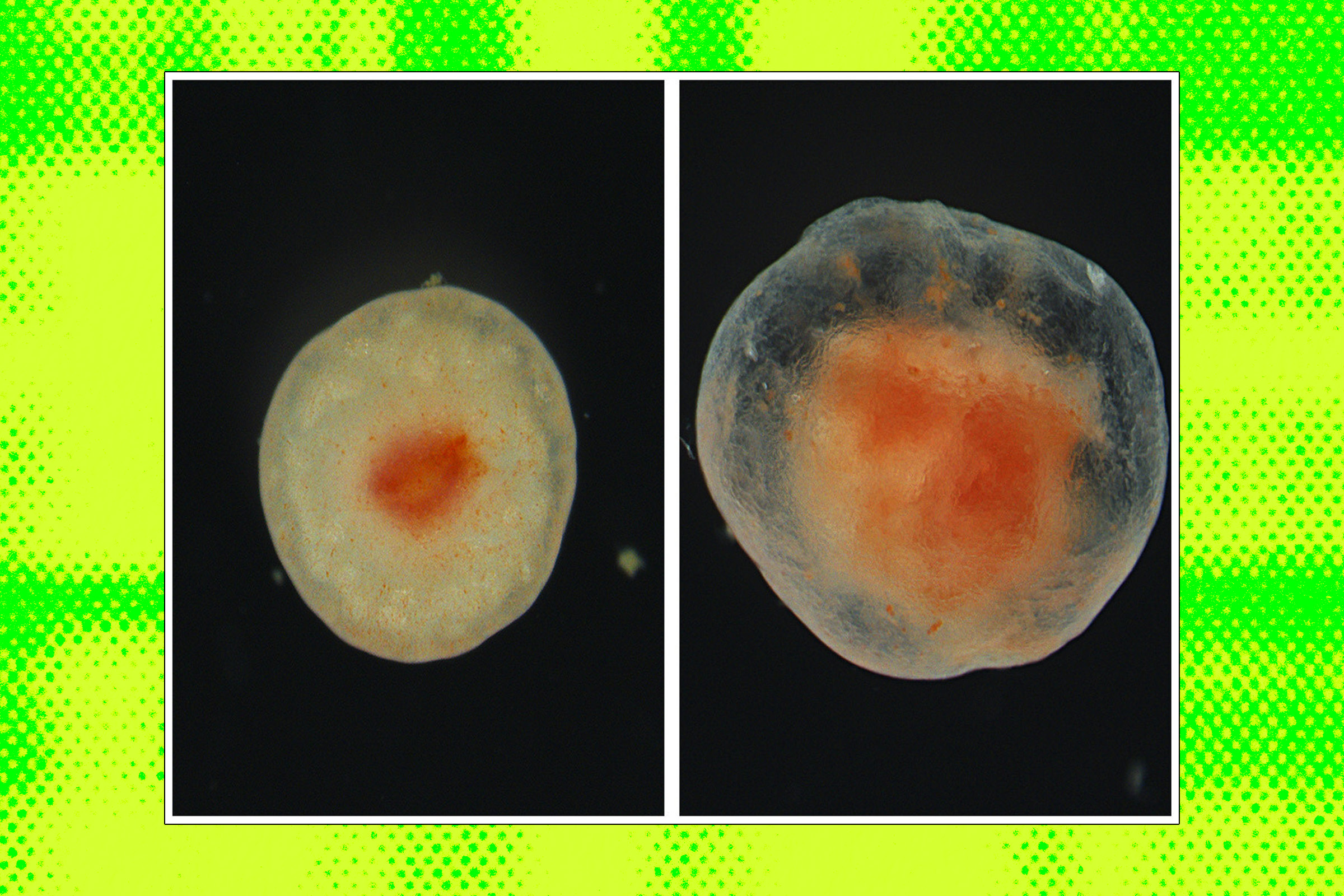
That said, the immortality it’s exhibiting isn’t of the science fiction vein. While persisting, the explanted tissue hasn’t graduated into a new organism — and it’s unclear if it’s “alive” in the traditional sense at all. It’s growing and repairing, and all the biological upkeep is firing, but it lies inert and unformed.

“We haven’t grown a new, complete sea cucumber yet, but we are seeing pretty stunning growth and diversification of cells literally years after this tissue was removed,” study coauthor Rachel Sipler, a senior research scientist at the Bigelow Laboratory for Ocean Sciences, said in a statement about the work. “It’s like a lizard that loses its tail. We know some lizards can grow new tails; we’re talking about whether the tail can grow a new lizard.”

Biomedical researchers are already salivating at the find. Since it’s an invertebrate, there’s less restrictions on the research that can be performed on the organism.

“This discovery highlights that the ocean holds profoundly unexpected biological innovations,” Andrea Bodnar, science director at Gloucester Marine Genomics Institute, who wasn’t involved in the work, said in the statement. “The fact that tissue explants from a sea cucumber can heal, reorganize, and survive independently for years in natural seawater suggests an entirely new model for biological resilience and tissue regeneration.”

More on biology: China Launches Synthetic Human Embryos to Space Station

The post Scientists Intrigued by Chunk of Flesh That Refuses to Die After Several Years appeared first on Futurism.

  •  

The Blue Moon Is Fake. You Are Being Deceived

At the end of this month, the sky will be graced by a rare Blue Moon. But wait: it’s actually a slightly smaller than usual full Moon that’s also a Blue Moon — so instead, newspapers and outlets, drawing on apocryphal traditions found in farmer’s almanacs so they can stave off a slow news day, are calling it “Blue Micromoon,” which is supposedly even rarer. 

What’s going on with all these Moons? It’s lunacy!

To be clear, there will, in fact, be what is colloquially called a Blue Moon this Saturday night and Sunday morning. A Blue Moon is anytime a second full Moon appears in the same month, something that only occurs every two or three years. Or it’s when a season has four full Moons, instead of three, in case you were harboring any doubt that the whole thing is a bunch of made up nonsense.

The significance of all this is mostly invented — and for that matter, a Blue Moon isn’t even blue; if you catch one when it rises, it usually looks orange. There’s no intriguing astrophysical phenomena at play here, like with a solar eclipse, or even a lunar one (also called a Blood Moon, if you prefer.) It’s just a calendrical coincidence, independent of what the Moon is actually doing. You may as well start celebrating when a full Moon falls on a Friday, and call it the TGI Moon.

Witnessing a full Moon is cool, but we need to stop with the names. Last month it was a “Flower Moon,” which is just another name for a full Moon that happens to be in May. Correction: it was a full “Flower Moon” that was also a “micromoon.” A Micro Flower Moon? A Flower Micromoon?

And what is a micromoon anyay? It’s the slang that describes when the Moon’s oblong orbit takes it slightly farther from our planet than usual, making it appear marginally smaller in the sky. Similarly, a “supermoon” is when it’s closer and appears bigger.

Here’s the catch: none of these are official names, with no hard criteria on the distances the Moon needs to be at, giving people a lot of leeway on what they get to call a “supermoon” and a “micromoon.” Both of those, by the way, are fairly mundane and routine. They sure do punch up a headline, though. Remember the buzz around a “Super Worm Moon”, also known as a “Super Worm Equinox Moon,” a few years ago?

Well, don’t feel left out if you missed it, folks. There’s a “Strawberry Micromoon” coming up next month.

More on the Moon: NASA Releases Sweeping Plans for Moon Base

The post The Blue Moon Is Fake. You Are Being Deceived appeared first on Futurism.

  •  

Kids Are Flying Into Lunatic Rages When Their iPads Are Taken Away

Parents say their kids are going ballistic when they take their iPads away from them, leaving them unsure of what normal behavior might be — and whether there’s something sinister going on with their child’s connection to the devices.

Rachel, a mother of two, tried limiting her son Jonah’s screen time by warning him that he had put down his iPad to leave for a birthday party at 11 AM. Despite the repeated warnings the day before and several reminders before the hour mark, when it came time to leave, Jonah had a meltdown.

“He just left his body,” the mother told The Cut of her son, who hurled the electronics and started screaming: “You said I had until 11! It’s not 11 yet! You’re always doing this!”

Jonah followed her around the house, distraught, until finally collapsing on the kitchen floor and refusing to move.

“I remember standing there thinking, I don’t know this person,” she recalled. “I genuinely did not recognize him.”

Thirty minutes later, he tied his shoes, got in the car, and acted like nothing had happened.

“That’s the part that really messes with you,” Rachel says. “How fast they come back.”

Think that’s bad? Hear what Nora had told The Cut about her 13-year-old son when she asked to check his phone settings: he accused Nora of ruining his life, before dropping a grenade in conversation.

“You make me want to kill myself,” he lashed out.

And while getting dinner last month at an Italian restaurant, Rachel told the outlet that she allowed her daughter Maya to watch YouTube Kids on the phone. When it was time too leave, she took the phone back. Maya went rigid, screamed, and hid under the table.

What’s going on here? Are these the kind of extreme tantrums that kids are prone to throw no matter the toy they’re being deprived of? Is everyone a bad parent, or at least not handling this the right way? Or are apps and the devices they run on uniquely addictive, somehow impacting a child’s development in novel and frightening ways?

The research into this area is still emerging, as are the generation of children raised on YouTube Shorts, Roblox, and other mobile games. That’s to say that we’re still a long way from grasping the long-term cognitive effects of being a so-called “iPad kid.” And the latest Silicon Valley horror, AI chatbots, are an even bigger question mark.

What evidence we do have, however, is alarming. The Cut cites a recent University of Washington study that found that 22 percent of parents’ attempts to cut down screen time sparked a negative reaction from kids under five. And in another study from Brigham Young University, 93 percent of parents reported that their toddlers would sometimes whine or throw tantrums when “transitioning away from media.”

Experts are mixed on whether the devices are provoking some newly negative response. 

“We frequently hear from parents who say, ‘When I ask my child to get off technology, they get very mad at me.’ That is true of almost anything that children find reinforcing,” Dave Anderson, a senior psychologist at the Child Mind Institute in New York City, told The Cut.

Anderson was skeptical of using the word addiction to describe what’s fueling iPad rages, noting that withdrawal symptoms of actual addiction don’t disappear within minutes. Kid’s minds just aren’t developed enough to handle having their favorite toy taken away from them, she said.

Stanford psychiatrist Anna Lembke, however, hasn’t hesitated to invoke the specter of addiction, calling screen devices a “digital drug” in an interview with Oprah. And Sarah Coyne, a professor of human development at Brigham Young, seemed to consider equating post-iPad rages to tantrums related to other pleasures outrageous. 

“I’m not sure how many children are struggling to function because their parents tell them to be done with their ice cream,” she told The Cut, adding that she’s seen addiction-like behavior in kids using devices as young as two years old.

If describing these patterns as signs of outright addictive behavior goes too far, there’s certainly there is a lot of evidence painting screen time’s cognitive effects. One study found that the more  babies and toddlers looked at screens each day, the more likely they were to miss key development goals, including fine motor skills and social skills.

The effects are no less worrying in older children. A study that followed tweens over four years found that increased screen time was a reliable predictor of ADHD diagnoses. Beyond iPad rages and worrying cognitive trends, there are other behaviors that illustrate the impact of device usage on children. In a survey of UK preschool school teachers, the teachers on average estimated that a third of their pupils didn’t know how to correctly use books — as in they literally couldn’t figure out that they had to turn the page. Instead, some reportedly tried to swipe or tap them.

More on mental health: Influential Tech Founder Says His Peers Are Suffering From Mass AI Psychosis

The post Kids Are Flying Into Lunatic Rages When Their iPads Are Taken Away appeared first on Futurism.

  •  

CEO Receives Violent Threats After Kicking Off AI Layoffs

As the Australian software firm WiseTech lays off thousands of employees in a pivot to AI, its CEO Zubin Appoo has become the target of violent threats, the company says.

Richard White, WiseTech’s founder, revealed the news in an email to the company’s staff on Sunday, the Financial Review reported

White said the company had already been facing “several serious and deeply concerning incidents involving personal attacks.” 

But “in the past week, this escalated into a handwritten threat of violence made against our CEO, Zubin Appoo, containing personal information and offensive comments directed at members of his family,” White wrote in the email to staff, per the Financial Review.

Security was ramped up at the company’s Sydney office “because of the serious nature of the threat,” he added, and the threat was reported to police.

The threats come after a dragged out layoff-saga at WiseTech which has left employees frustrated and confused. In February, the company stunned the rank and file by announcing that it was firing 2,000 staff, or about a third of its entire workforce. But who was getting the axe was unclear, leaving employees in agonizing suspense. For months, they waited to hear if they were part of the cuts, but never got clarification.

The agony was amplified Monday, when staff received messages in the morning saying their role was “impacted,” before getting another communication two hours later asking for their personal email address for further communication, according to the Financial Review. Except this was followed by another twist, when the emails were deleted from employee inboxes by WiseTech’s IT administrator, and succeeded by a similar email that gave only a fifteen minute deadline to submit information.

Rubbing salt in the wound, the one thing WiseTech leadership was sure to communicate was their love for AI. Appoo told investors that he was expecting “further efficiency gains” over time as AI capabilities improved. And White, even more blithely, boasted that AI agents could complete training in mere minutes that would take humans weeks.

“It doesn’t take much effort to convince people, in the end, that they’re stupid to be paying $100 for labour when you can pay $2 for the AI,” White said at an investment conference earlier this month, per the Financial Review.

Harbingering the new paradigm, White also revealed an “AI agent credo” for the company, stating: “Capacity is no longer constrained by people or time.”

With job cuts looming and AI being waved in their faces, morale at WiseTech has plummeted.

“People are being told to keep delivering as usual, while also helping roll out the AI tools that are supposedly meant to replace them,” one employee told The Guardian earlier this month. “All of this while everyone’s left waiting to find out if they’re in the 50 percent.”

The alleged threat illustrates how tensions around AI layoffs are running high across myriad industries. Earlier this month, Standard Chartered CEO Bill Winters sparked a storm of controversy after calling the employees he planned to replace with AI “lower-value human capital,” forcing him to not only issue an internal memo clarifying his remarks but, after that apparently didn’t go over well, even make a public apology.

More on AI: Finance Bros Tremble in Fear That They Could Be Replaced by AI Too

The post CEO Receives Violent Threats After Kicking Off AI Layoffs appeared first on Futurism.

  •  

YouTube Announces Plans to Crack Down on AI Slop

It’s no secret that YouTube is overrun with AI slop. It’s made gestures towards reining in the flood of chintzy AI imagery, and now it’s signaling that it’s getting a little more serious about enforcing its own (still relatively lax) standards on videos made with the tech.

On Wednesday, the Google-owned platform announced changes to how it would start labeling AI-generated content. The most noticeable update is that the labels will be more prominent: going forward, traditional YouTube videos will show an “AI” label right below the video player, instead of being hidden in the video description. And for its vertical video TikTok knockoff Shorts — the format that’s proven most susceptible to being taken over by low effort slop, especially the kind that purports to be educational — an AI label will be displayed as an overlay at the bottom of the video.

But there’s an even more significant escalation in YouTube’s slop-stemming tactics. Starting this month, the company will begin scanning for signs of “photorealistic” AI usage so it can automatically label suspected videos. Before, AI labels were only applied if the uploader chose to disclose it.

YouTube didn’t specify what systems it’ll use to detect AI content, but like other companies, it’s adopted C2PA, a standard for embedding provenance data in AI content, and SynthID, a tool Google developed that watermarks AI content.

The video giant says the disclosure labels are intended for “photorealistic and meaningfully AI altered or generated content.” Evidently the company understands the risks of letting misleadingly real-looking AI fakes abound on its platform, but it’s not going for a sweeping rebuke against all forms of the stuff.

Unrealistic AI content — like those nonsensical animated slop videos that target children — won’t be slapped with the new front-and-center label, and will continue with the older label hidden in the expanded description. More piecemeal uses of AI won’t be prominently labeled, either.

In any case, beyond the potential stigma that a big “AI” label entails, YouTube isn’t trying to punish content for heavily using AI. The changes “are designed to balance transparency with creator control,” but they won’t “change how a video is recommended or whether it’s eligible to earn money,” according to the announcement.

More on AI: Record Label Claims That Bizarre AI-Generated “Viking Rappers” Garnering Millions of Views are Real People

The post YouTube Announces Plans to Crack Down on AI Slop appeared first on Futurism.

  •  
❌