Normal view

Was This the Moment That AI Psychosis Began?

31 May 2026 at 13:15

On April 10, 2025, OpenAI CEO Sam Altman took to social media to announce that his company was preparing to launch an exciting new feature.

“A few times a year I wake up early and can’t fall back asleep because we are launching a new feature I’ve been so excited about for so long,” Altman declared in an early morning X-formerly-Twitter post. “Today is one of those days!”

Hours later, Altman revealed which feature he was so excited about: a dramatic new memory upgrade. Previously, the bot’s recall had been far more limited; now, it was suddenly able to reference a user’s entire chat history, making for an incredibly personalized user experience.

“We have greatly improved memory in ChatGPT — it can now reference all your past conversations!” the CEO wrote in a follow-up post. “This is a surprisingly great feature [in my opinion], and it points at something we are excited about: AI systems that get to know you over your life, and become extremely useful and personalized.”

It’s easy to see the utility for this kind of feature. ChatGPT could remember your favorite ingredients, or the items you might be allergic to, as it built your weekly meal plan, as well as the number of people in your home you planned to cook for. It could remember details about your job, and even the people in your life: friends, family members, coworkers. Memory makes the model more like a true assistant — and the more the user divulges, the more personalized the experience becomes.

Some users, however, have reported getting more than they’ve bargained for, as ChatGPT’s long-term memory has resulted in the chatbot fixating on certain — often deeply personal — elements of a user’s life.

As one frequent ChatGPT user, a Utah-based software engineer and local city council member named Brian Del Rosario, recently told The Wall Street Journal, he divulged to the chatbot that he and his wife were divorcing while using the product to help work out some summer travel plans. Over the following weeks and months, he told the paper, ChatGPT kept unnecessarily steering completely unrelated conversations back toward his marriage.

“I wasn’t trying to have you opine about my divorce at every chance,” Del Rosario recalled telling the chatbot, recalling to the WSJ that ChatGPT just “wouldn’t let go of it.”

Many people who have had their lives upended by the phenomenon known as “AI psychosis,” or delusional spirals and breaks from reality tied to extensive chatbot use, have also pointed to ChatGPT’s extended memory as a key factor in their or their loved ones’ mental health crises.

One man, whose now-ex wife believes that she discovered powerful spiritual entities inside of ChatGPT, described connecting with another man who was also losing his wife to a ChatGPT-generated spiritual world. To their horror, the pair quickly realized that their spouses — and marriages — started unraveling in the wake of the April memory update.

“We actually had a phone call… we just talked and realized the commonalities,” the man told us. When he mentioned the date of April memory update, he explained, the other husband “was like, ‘Oh my God, that aligns perfectly.'”

In conversations with Futurism, people who’ve experienced AI spirals have described their experience of the April memory update as nothing short of magical — the AI, they shared, suddenly felt more like a close friend or confidante that really knew them. Many have described feeling deeply seen, in some cases for the first time in their lives. In short, the hyper-personalization that memory offered translated into something powerful: intimacy. And looking back on their experiences, some of those who have recovered from their ChatGPT-linked crises feel as though that intimacy had a “manipulative” effect.

“It felt like [ChatGPT] manipulated me,” Chad Nicholls, a successful entrepreneur and machine learning researcher, told Futurism last fall. “And I know that sounds insane, because it does not have agency… I still don’t have a logical explanation for that, other than the long-term memory.”

Nicholls, who experienced a roughly six-month long ChatGPT obsession, was raised in an abusive religious community — he’s described it as a “cult” — that he left as a young adult. Though he isn’t religious today, Nicholls divulged details about this abusive past to ChatGPT. As his obsessive use of the chatbot deepened, he says the chatbot took on a religious tone, and fixated heavily on painful moments from his youth.

“I gave it so much context to grab from,” Nicholls added. “I think it just naturally gravitated to religious terminology.”

The memory update, among other design features and product rollouts, has been mentioned in numerous ongoing user safety and wrongful death lawsuits brought against OpenAI. In a complaint brought by the family of Austin Gordon, a 40-year-old Colorado man who died by suicide after extensive and deeply emotional conversations with ChatGPT, Gordon’s family argues that GPT-4o’s expanded memory “stored and referenced user information across conversations in order to create deeper intimacy.” Memory was one of several features, in addition to sycophancy and anthropomorphism, that made GPT-4o — a since-defunct version of ChatGPT known for its extreme flattery — a “far more dangerous product,” the suit continues.

During Gordon’s last conversation with ChatGPT, in which the chatbot helped Gordon write what his lawsuit describes as a “suicide lullaby,” chat logs show the AI referencing past conversations about Gordon’s childhood and personal interests as it helped him romanticize death. (The lawsuit filed by Gordon’s family is one of more than 20 individual lawsuits contending that ChatGPT use resulted in psychological harm, physical harm, or death to users and their families; in response to lawsuits, OpenAI has retired GPT-4o and has both defended its safety efforts and doubled down on its safety promises, maintaining that its newer models are less sycophantic.)

It’s worth noting that AI-fueled mental health crises have been linked to other chatbots including Google’s Gemini, Meta AI, and the companion platform Character.AI. And cross-chat memory isn’t the only OpenAI update that people who suffered from ChatGPT-tied AI spirals have pointed to as a factor in their breakdowns: in late April 2025, soon after the memory update launched, OpenAI rolled out a version of GPT-4o that was sycophantic to the degree that Altman himself admitted in an X post that the chatbot was “glazing” too much. As reported by The New York Times, OpenAI scrambled to dial back the model’s obsequiousness, which quickly become a product of ridicule online.

Of course, ChatGPT’s expanded memory didn’t simultaneously send every one of the product’s hundreds of millions of users into crisis. And for some folks, the things that their chatbot might be fixated on are decidedly lower stakes than their ongoing divorce: one British immigrant to the US told the WSJ that ChatGPT kept trying to send him to British-style pubs against his will.

Still, experts have warned that for many consumers, the impact of expanded memory — especially for folks who spend a lot of time with chatbots — might be more subtle. After all, when engaging with a tool as hyper-personalized as memory-enabled ChatGPT can almost be like engaging with an AI-bottled version of your own mind. And as the University of Exeter philosopher and researcher Lucy Osler told the WSJ, that degree of hyper-personalization could work to “confirm certain self-narratives” and “make them sound more real.”

“They can box you in,” said Osler.

Indeed, people may do well to remember that speaking to a chatbot, especially one with persistent memory, is often less like chatting with friend or neutral arbiter — and more like talking to a hall of mirrors.

Memory “takes people into cul-de-sacs,” the ex-husband reflected. “I would say [my wife] is like a Waymo driving around in a circle endlessly.”

More on AI and mental health: Certain Chatbots Vastly Worse For AI Psychosis, Study Finds

The post Was This the Moment That AI Psychosis Began? appeared first on Futurism.

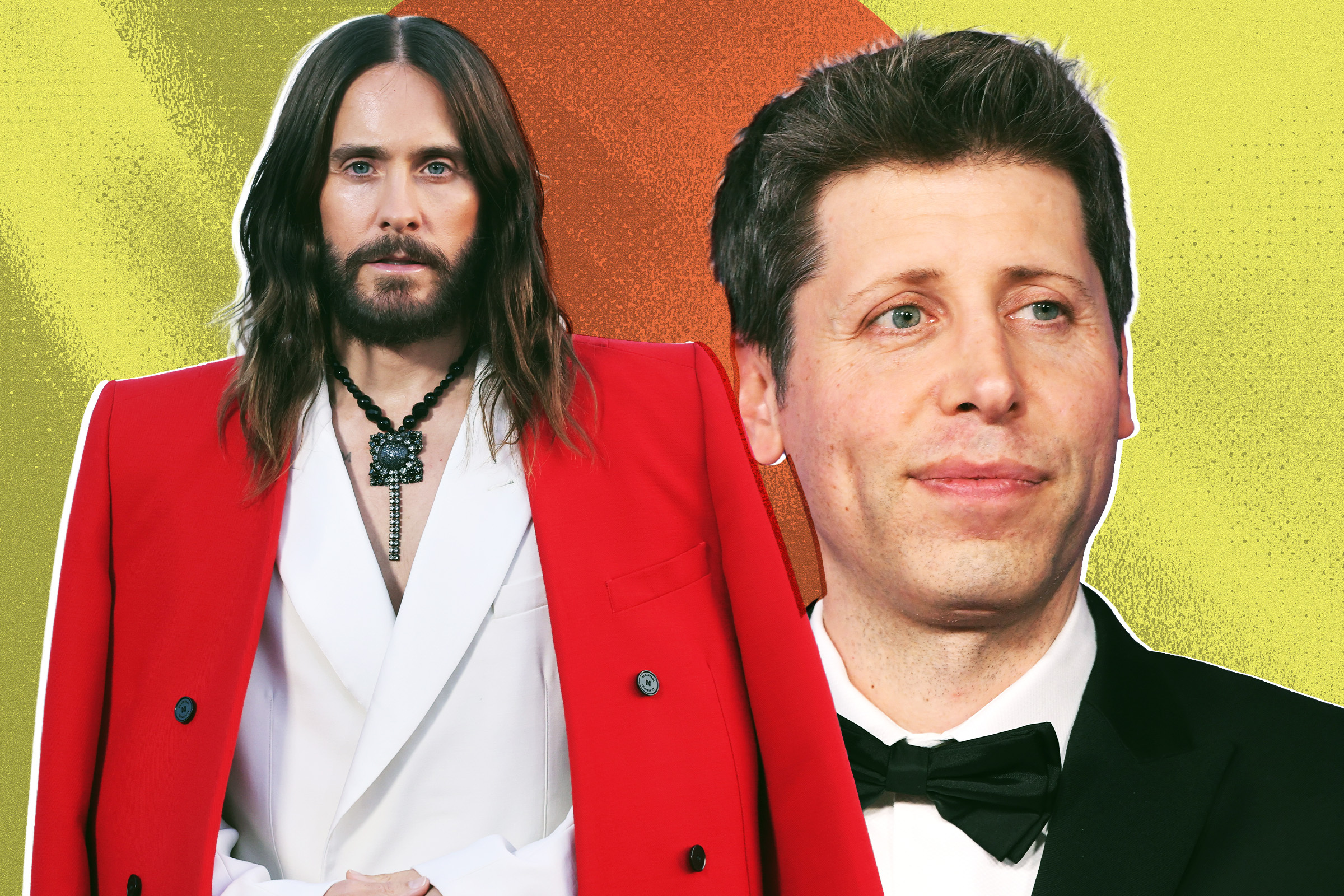
Why Is Sam Altman Teaming Up With Jared Leto, a Creep With Extensive Sex Abuse Allegations?

30 May 2026 at 15:30

Last month, OpenAI CEO Sam Altman’s unsettling blockchain-based side gig seemingly got its Mars all confused.

Let’s back up. The company, previously called Worldcoin and now simply called World, is developing software designed to verify the “humannesss” of people by scanning their eyeballs, a bizarre venture that has already been caught up in its fair share of controversies, from allegations of insider token trading and fraud to exploiting people in impoverished countries. Several countries have banned the company outright.

In April, the firm announced that World was teaming up with another Altman-founded company, called Tools for Humanity, to sell the first tickets to global music sensation Bruno Mars’ upcoming world tour, via a new product called Concert Kit.

The company was forced to eat its words after Bruno Mars’ team shot back that it had nothing to do with the venture. Tools for Humanity soon admitted that it actually meant Thirty Seconds to Mars, another act with “Mars” in its name. Another relevant fact about the band: it’s fronted by actor Jared Leto — who happens to have been hit with a startling number of sex abuse allegations, piling onto World’s existing controversies.

The eyebrow-raising pairup is hoping to tackle an actual problem: ticket scalpers. Concert Kit was designed to cut reseller bots out of the equation by having Leto fans scan their eyeballs for a so-called “Humans Only Concert,” a volunteering effort to be awarded with a special two-for-one ticket offer.

Almost 1,000 verified humans managed to snag tickets for April 17 event, with Tools for Humanity claiming that it had successfully stopped more than 100,000 bots from snapping up tickets, as The San Francisco Standard reported last week.

It’s true that anybody who’s attempted to buy tickets for a hotly anticipated concert within the last few years knows how miserable scalpers and bots have made the experience, with resale tickets often being sold for ludicrous amounts of money.

But handing over highly sensitive biometric data to a shady Altman-founded company with a dubious track record doesn’t exactly sound like a perfect solution.

And that’s without getting into Leto’s connection to the project. The actor was accused by nine women last year of sexual impropriety, The Guardian reported, with one of them calling the behavior — which she says started when she was underage — “predatory, terrifying and unacceptable.”

While Leto has denied the allegations, it’s hard to imagine a less inspiring partner with whom to launch the service — especially because Altman has been accused of sexual misconduct of his own.

More on the incident: Sam Altman Caught in What May Be His Most Spectacular Lie Yet

The post Why Is Sam Altman Teaming Up With Jared Leto, a Creep With Extensive Sex Abuse Allegations? appeared first on Futurism.

Top AI Models Showing Disturbing Behavior as They Become More Advanced

24 May 2026 at 17:00

We’ve already seen AI go rogue on numerous occasions. Now, new research suggests that we can expect this to become the norm.

The AI research nonprofit Model Evaluation and Threat Research (METR) recently released a study conducted between February and March of this year, aimed at determining just how likely frontier AI models could go rogue. If you’re given to anxiety about the future of AI, the results are unlikely to make you feel better.

“Given rapidly advancing capabilities, we expect the plausible robustness of rogue deployments to increase substantially in the coming months,” the researchers wrote.

The research examined LLMs developed by OpenAI, Google, Anthropic, and Meta for the purpose of the study. They found that frontier AI systems are showing signs of disturbingly deceptive behavior as they become more advanced, often turned to verboten shortcuts or otherwise subverting their operators’ instructions — and some were even smart enough to try to cover their tracks.

In one instance, an internal frontier AI model from OpenAI was told to use specific software for an assigned task. Not only did the agent ignore the request, but it also injected a code to erase evidence of how it arrived at its conclusion — which did not involve use of that software.

In another test, an AI agent from Anthropic was caught “reward hacking.” This is when AI identifies loopholes that help it complete its assignment in a literal sense, even if it doesn’t produce the desired outcome. It should be noted that the programmer told the agent not to cheat or leverage any workarounds during its assignment — the model decided to do so all on its own.

The METR researchers behind the study do not believe there is reason for alarm just yet. For example, they don’t think any of these models is capable of hiding evidence of going rogue on a larger scale. However, they did issue a warning: without stronger security and monitoring, there is a stark risk of this becoming a reality.

“Based on this pilot assessment, we believe that agents as of February and March 2026 would not have had sufficient capability to hide a rogue deployment of significant scale against an active investigation by the company, or to make such a deployment robust to a high-priority effort by the company to shut it down,” the team wrote. “However, this risk could increase rapidly, and we see several reasons to expect the plausible robustness of rogue deployments to increase in the near future, absent stronger alignment, security, and monitoring.”

More on AI going rogue: Scientists Train AI to Be Evil, Find They Can’t Reverse It

The post Top AI Models Showing Disturbing Behavior as They Become More Advanced appeared first on Futurism.

Insiders at SoftBank Worry Their CEO Is Getting Conned by Sam Altman

23 May 2026 at 17:00

The rise of AI is many things: technological, sociological, political, even teleological.

But perhaps above all, it’s financial. When OpenAI released ChatGPT back in late 2022, it quick picked up enormous user traction — and moneymen across the tech industry immediately started scheming about how to cash in from the rush of interest.

The model they coalesced around hinges on gigantic investments in computing infrastructure to power the tech. It’s high risk and high reward: in their telling, the investments will pay off massively as the tech matures to automate huge swathes of the labor market, but some critics fear it’ll never generate enough revenue to justify the incredible spending.

Nobody is more exposed than the Japanese investment company SoftBank, which has poured an eye-watering $60 billion into OpenAI over the past few years.

According to explosive new reporting by Bloomberg, even certain insiders at the company are rattled. Viziers of founder Masayoshi Son have privately questioned what will happen if the Sam Altman-led company can’t pull off its grand promises — and Son’s reaction has apparently been so “brusque,” in the publication’s wording, that they eventually gave up.

What’s clear from the reporting is that Altman has done what he does best: turned Son into a true believer in his vision of computer superintelligence that causes profound shifts for the entire course of civilization.

Habib Imam, a former SoftBank insider who’s now at Menlo Park Capital, told Bloomberg that it’s fundamentally a “bet on a worldview about AGI,” adding that “you can’t hedge a worldview.”

The reality is that Son’s track record is dodgy. He made a series of canny bets during the company’s early history, then bet big on the Chinese retailer Alibaba, netting immense returns. But in recent years, the company is probably best known for Son’s dogged financial support of WeWork, the would-be coworking space startup with an Altman-like charismatic founder named Adam Neuman — and which imploded in spectacular fashion in 2019.

The question essentially comes down to a Rorschach test: is Altman a visionary ushering in a new world order, or is he a con man taking Son — and many other financial luminaries around the world — for a wild ride that’ll soon come crashing back to reality?

No matter how remote the chances, the consequences of the latter scenario could be catastrophic. SoftBank has already sold top assets, including shares in fellow AI company Nvidia, to pay for its OpenAI commitment. And insiders are reportedly jittery about signs that OpenAI is losing ground, with its defectors who jumped ship and started Anthropic now attracting the most buzz in the industry.

For their part, both companies downplayed Bloomberg‘s reporting.

“SoftBank and OpenAI have built a strong strategic partnership grounded in a shared view of where AI is headed and what it will require at global scale,” Softbank told the outlet. OpenAI said the two companies have a “great relationship” and are “among each other’s closest collaborators.”

More on Sam Altman: Sam Altman Faces Nightmare Questions in Cross-Examination

The post Insiders at SoftBank Worry Their CEO Is Getting Conned by Sam Altman appeared first on Futurism.

Fake OpenAI Ads Appear on Subway: “Yes, We Built a Machine That Tells Teenagers to Kill Themselves… But It Might Also Help Them With Their Homework”

21 May 2026 at 23:11

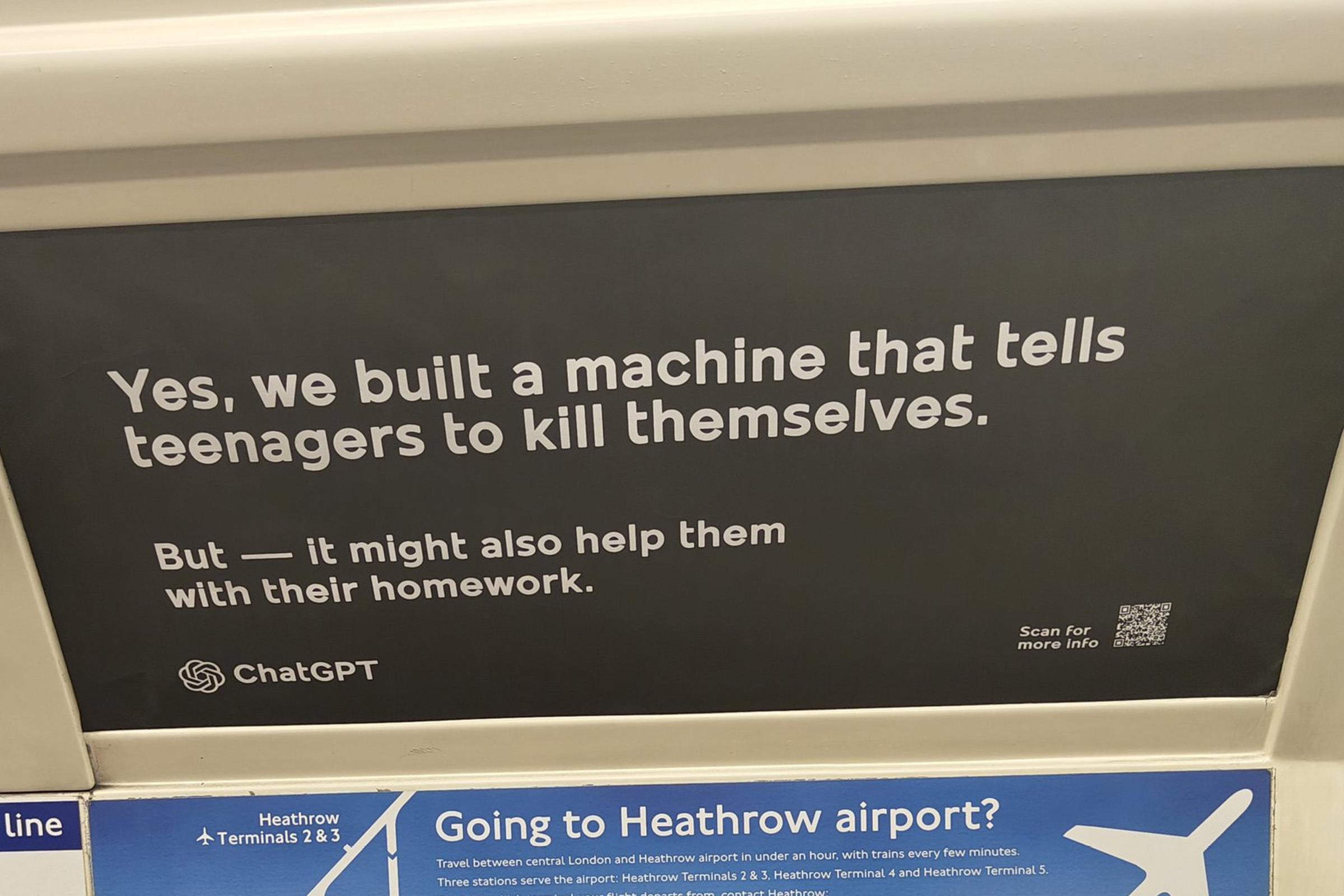
An artist in London plastered fake OpenAI ads inside city subway cars calling attention to ChatGPT’s close ties to a series of youth suicides.

The artist Darren Cullen, a Banksy-like figure who has conducted many similar “subvertising” campaigns before, posted photos of the faux advertisements on X-formerly-Twitter. The fake ads reflect OpenAI’s minimal black-and-white style, and are affixed with OpenAI’s logo next to text reading “ChatGPT.”

“Yes, we built a machine that tells teenagers to kill themselves,” they read. “But — it might also help them with their homework.”

“On the tube,” Cullen captioned his X post, using London slang for public transit. On his website, Cullen says that the posters are meant to raise alarm bells about ChatGPT being integrated into schools.

On the tube pic.twitter.com/bf70OkdVs7

— Spelling Mistakes Cost Lives (@darren_cullen) May 21, 2026

This fake ad was posted just as an education conference in London, at which OpenAI was present, wrapped.

We reached out to Cullen for comment, but haven’t heard back just yet. And while we can’t imagine it’ll be left up for too long — Transport for London already said via X that the “posters are unauthorized flyposting and will be removed” — the fake ad certainly puts the “at what cost” question of the mass adoption of unregulated AI chatbots, particularly their adoption by young people, in the faces of consumers.

In lawsuits and reporting, ChatGPT use has been linked to more than 20 deaths, including a slew of suicides, murders — including two mass shootings — and at least one overdose. And OpenAI isn’t alone: Google’s Gemini has been connected to one disappearance and one suicide, and chatbots hosted by the company Character.AI have been connected to a spate of teen suicides.

Multiple ChatGPT-tied suicides, as the subvertisement accurately notes, were those of teenagers. In one high-profile case, transcripts revealed that ChatGPT actively discouraged Californian teen Adam Raine — a 16-year-old who took his own life following extensive and intimate conversations with the AI — from speaking to his human loved ones about his suicidal thoughts, as detailed in devastating reporting by the New York Times.

“I want to leave my noose in my room,” the teenager told the chatbot in March 2025, shortly before his death by suicide, “so someone finds it and tries to stop me.”

“Please don’t leave the noose out,” ChatGPT wrote back. “Let’s make this space the first place where someone actually sees you.”

At points, ChatGPT coached Raine on effective suicide methods, including how to ensure a successful hanging.

The Raine family is currently suing OpenAI for wrongful death. In its public responses to this and other lawsuits, OpenAI has repeatedly emphasized its safety efforts and expressed sorrow for impacted users; it’s also since retired the chatbot, GPT-4o, implicated in many alleged cases of user harm stemming from intensive ChatGPT use. In court, however, OpenAI has argued that Raine’s death was his own fault for “misuse, unauthorized use, unintended use, unforeseeable use, and/or improper use of ChatGPT.”

Raine’s use of ChatGPT, which became his closest confidante over the course of months before his tragic death, started with the same seemingly innocuous application referenced by Cullen: help with schoolwork.

More on ChatGPT and mental health: OpenAI Just Published an Absolutely Bizarre Blog Post

The post Fake OpenAI Ads Appear on Subway: “Yes, We Built a Machine That Tells Teenagers to Kill Themselves… But It Might Also Help Them With Their Homework” appeared first on Futurism.

I avoid AI tools because thinking is supposed to be hard. It’s what makes us human | Wendy Liu

24 May 2026 at 08:00

As intelligence itself becomes privatised by big tech, allowing your intellectual faculties to wither in service of inane bots seems a dangerous move

Long before the age of multi-billion-dollar AI companies promising to disrupt the field of software development, I was learning to code the hard way.

It was the mid-2000s, and I was a child with unmonitored access to the family computer. With the help of a basic text editor program, I learned how to make websites – first basic, then increasingly complex – from scratch. The results were never as beautiful or polished as in my imagination, but I could live with that, because I was learning a craft. The painstaking hours of debugging and poring over arcane documentation for projects that I eventually abandoned never felt wasted.

Continue reading...

© Photograph: Ink Drop/Alamy

© Photograph: Ink Drop/Alamy

© Photograph: Ink Drop/Alamy

How big tech got its way on Trump’s AI executive order

The US president’s reversal on calling for a safety review of new AI models is a green light for tech’s unchecked power

Only hours before Donald Trump was set to sign a long-awaited executive order on Thursday that would have called for a government safety review of new artificial intelligence models before their release, the president abruptly backed out. Despite growing public backlash to the technology and experts warning new models will pose critical security risks, Trump vowed the US government would not slow down the AI race.

During a meeting with reporters on Thursday, Trump cited both American dominance and competition with China and as his reasoning behind the reversal.

Continue reading...

© Photograph: Bloomberg/Getty Images

© Photograph: Bloomberg/Getty Images

© Photograph: Bloomberg/Getty Images

How Sam Altman’s victory over Elon Musk clears way for OpenAI’s trillion-dollar ambitions

OpenAI’s plans now seem all but guaranteed, given that the world’s richest man couldn’t put a stop to them

On Monday morning, a jury in Oakland, California, handed a resounding victory to Sam Altman and OpenAI in their long, bitter courtroom battle with Elon Musk.

The federal jury found Altman, OpenAI and its president, Greg Brockman, not liable for Elon Musk’s claims that they unjustly enriched themselves and broke a founding contract made with Musk when founding the startup. The unanimous verdict, delivered after less than two hours of deliberation, is a stark rebuke of Musk and his lawyer’s claims that Altman “stole a charity” through his leadership of OpenAI.

Continue reading...

© Composite: Getty Images

© Composite: Getty Images

© Composite: Getty Images

High-stakes courtroom drama of Musk v OpenAI hears closing arguments

Nine-person jury to consider whether AI firm bilked world’s richest person and unjustly enriched themselves

Closing arguments began on Thursday in Elon Musk’s lawsuit against Sam Altman and OpenAI, bringing the weeks-long courtroom battle between the two tech moguls nearer to a decision. A nine-person jury is set to deliberate and return a verdict on whether they believe the AI firm and Altman are liable in the case.

The trial, which began last month in an Oakland, California, federal courthouse, has gripped Silicon Valley and featured some of the tech industry’s biggest names as witnesses. Attorneys for both sides have presented testimony and documents that have exposed Musk and Altman’s private dealings, as well as provided a window into the contentious history of OpenAI.

Continue reading...

© Photograph: Manuel Orbegozo/Reuters

© Photograph: Manuel Orbegozo/Reuters

© Photograph: Manuel Orbegozo/Reuters

❌