Normal view

Alien Life on the Exoplanet K2-18b is Already Disputed by Scientists

29 May 2025 at 23:13
Recent claims of potential biosignatures on the exoplanet K2-18b have been challenged by researchers at the University of Chicago. Their analysis suggests that the detection of dimethyl sulfide may be inconclusive due to overlapping signals from non-biological molecules, emphasizing the limitations of current detection technology and urging caution against premature conclusions.

FIRST VISIBLE LIGHT IMAGES OF VENUS’ SURFACE FROM SPACE CAPTURED BY PARKER SOLAR PROBE

29 January 2023 at 19:58

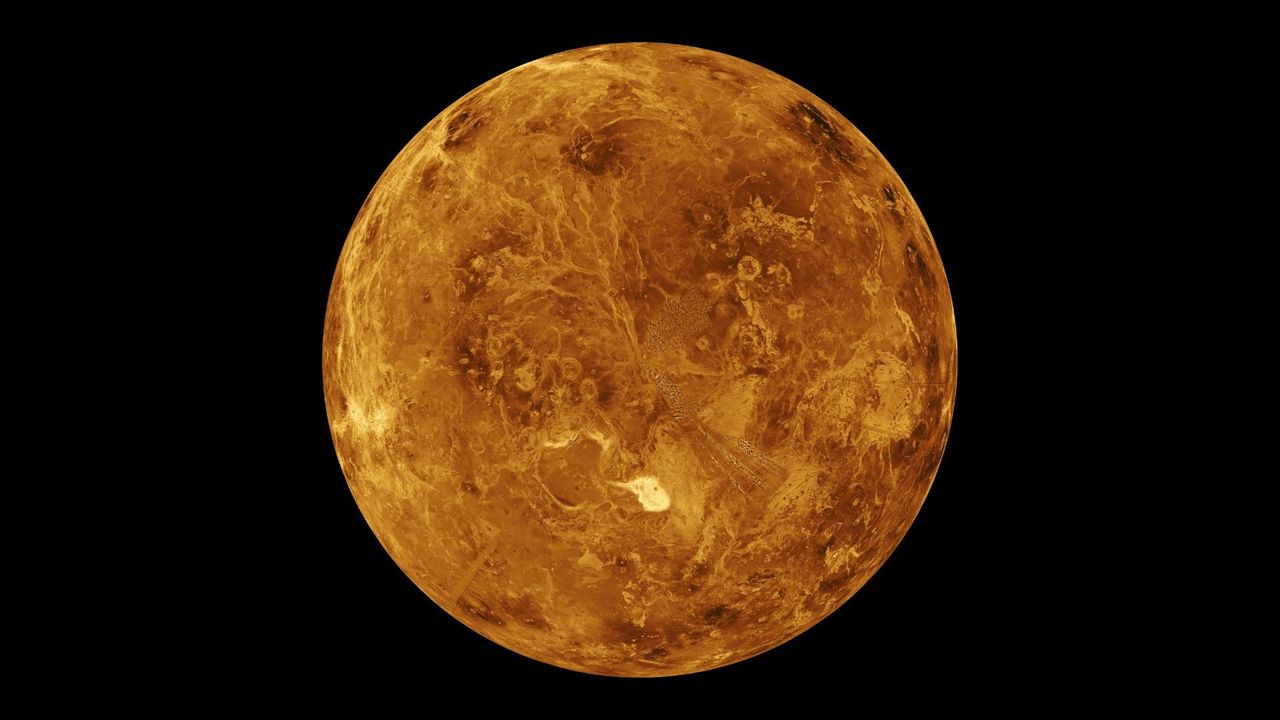
NASA’s Parker Solar Probe captured the first visible light images of Venus from space. The images, taken during two recent flybys, show a faint glow from the surface, revealing features like continents, plains, and plateaus. The images could help scientists learn about Venus’s geology and mineral make-up and understand why it became inhospitable while Earth […]

The post FIRST VISIBLE LIGHT IMAGES OF VENUS’ SURFACE FROM SPACE CAPTURED BY PARKER SOLAR PROBE appeared first on Science Bulletin.

'I would never have guessed it': Unexpected effect is squeezing Mars' atmosphere like toothpaste, experts say

29 May 2026 at 15:48
Researchers have uncovered an unexpected phenomenon, dubbed the Zwan-Wolf effect, squeezing plasma "like toothpaste" in Mars' upper atmosphere. This effect, which also happens on Earth, was thought to be impossible on the Red Planet.

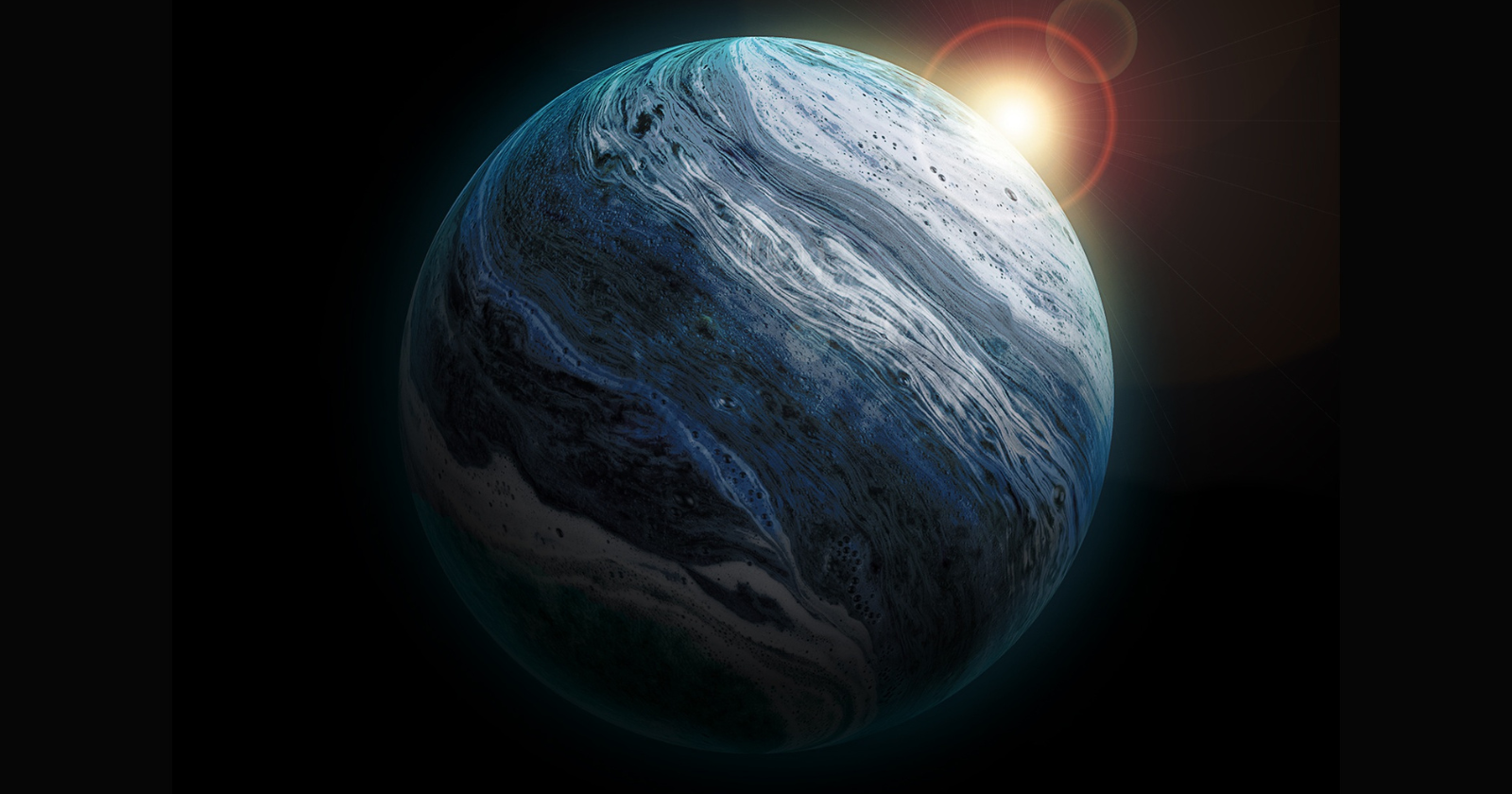
There is a planet 63 light-years from Earth where the rain is made of molten glass, the winds blow at 7,000 kilometres per hour, the daytime temperature is over 1,000 degrees Celsius, and the planet itself, viewed from space, is the same deep blue as Earth.

The planet’s name is HD 189733b. It is one of the closest extrasolar planets to Earth that can be studied in detail, and one of the most thoroughly characterised exoplanets in the astronomical literature. Its star, HD 189733, sits in the constellation Vulpecula, the Little Fox, north of the celestial equator. The star itself is faintly visible to a small telescope from any dark backyard in the northern hemisphere on a clear summer night. The planet is not. The planet has never been directly photographed and probably never will be by any current generation of telescope.

Everything that is known about it has been deduced from the way its star’s light changes as the planet passes in front of, alongside, and behind it. The deductions, after twenty years of accumulated work, describe one of the most hostile environments in the catalogued universe.

It was discovered on 5 October 2005 by François Bouchy and colleagues at the Haute-Provence Observatory in southern France, using the Doppler-spectroscopy method to detect the small gravitational tug of the planet on its host star. The planet is approximately the mass and size of Jupiter. It sits roughly 4.6 million kilometres from its star, which is about one-thirtieth of the distance between the Sun and Mercury. It completes one orbit every 2.2 Earth days. At that distance, it is tidally locked. The same hemisphere faces the star at all times.

On the side facing the star, it is approximately 1,000 degrees Celsius.

What it would be like to be there

The astronomers who have studied HD 189733b in detail describe an atmosphere that has no analogue in the solar system. The temperature differential between the planet’s permanently lit day side and its permanently dark night side, measured by NASA’s Spitzer Space Telescope in 2007, is approximately 260 degrees Celsius. That differential drives atmospheric winds at speeds that, in the upper atmosphere on the day side, reach approximately 7,000 kilometres per hour. As the European Space Agency set out in its 2013 announcement of the planet’s confirmed colour, the wind speeds are roughly seven times the speed of sound. On Earth, by comparison, the strongest sustained surface winds ever recorded reached approximately 410 kilometres per hour during a tropical cyclone. HD 189733b’s winds are approximately seventeen times faster.

The atmosphere is composed primarily of hydrogen and helium, like Jupiter’s, but it also contains a high concentration of silicate particles. Silicates are the family of minerals that make up most of the Earth’s crust, including sand, quartz, and the basaltic rocks that form ocean floors. On HD 189733b, at atmospheric temperatures exceeding 1,000 degrees Celsius, silicate particles condense in the atmosphere from gaseous form into small molten droplets of glass.

The droplets do not fall straight down. They are driven sideways by the 7,000 km/h winds, at velocities at which a single droplet impacting a surface would carry the energy of a small artillery shell. The planet, on the side facing its star, is therefore experiencing continuous horizontal precipitation of molten glass at hurricane speeds, at temperatures that would melt aluminium.

The rain is the weather. There is no break in it.

How they figured out it was blue

The visual colour of an exoplanet 63 light-years away cannot be observed in the conventional sense. The planet is far too faint and far too close to its star to be photographed directly. The team that established HD 189733b’s true colour, led by Tom Evans at the University of Oxford, used a technique called secondary eclipse spectroscopy. Their paper, published in Astrophysical Journal Letters on 1 August 2013, describes the method in detail.

The Hubble Space Telescope’s Space Telescope Imaging Spectrograph observed the HD 189733 system continuously through several full orbital cycles of the planet. During each orbit, the planet passes behind the star from the telescope’s perspective. In the moments before and after the planet disappears behind the star, the telescope is receiving light from both the star and the planet. In the moments when the planet is hidden, the telescope is receiving light from the star alone. By subtracting the second measurement from the first, the team could isolate the light reflected by the planet alone.

The drop in brightness as the planet vanished behind its star was measurable specifically in the blue part of the spectrum, between 290 and 450 nanometres. The drop in the red and near-infrared was much smaller. The published interpretation is that the planet reflects blue light at approximately three to four times the rate it reflects red light, which makes it, in the visual range, a deep cobalt blue.

If a human observer could be positioned in space within the HD 189733 system, at a safe distance, the planet would appear to them as a small, deep blue point of light, almost indistinguishable in colour from the way the Earth appears to astronauts looking back from the International Space Station.

The mechanism that produces the blue colour, however, is completely different.

What the blue actually is

Earth appears blue from space for two reasons. The most obvious is the reflection of light from the oceans, which cover approximately 71 per cent of the planet’s surface. The second, less commonly understood, is Rayleigh scattering in the atmosphere. Short-wavelength light, including blue, scatters more efficiently off the molecules of nitrogen and oxygen in the air than long-wavelength light does. This is why the sky is blue. The same effect contributes to the planet’s blue appearance from orbit.

HD 189733b has no oceans and probably no liquid water of any kind. The temperatures are too high for water to exist as a liquid anywhere in the atmosphere. The blue colour comes entirely from the silicate particles. The droplets of molten glass suspended and condensing in the atmosphere scatter blue light preferentially, in much the same way that nitrogen and oxygen molecules in Earth’s atmosphere scatter blue light. The mechanism is a different kind of Rayleigh-like scattering, off particles that are themselves molten and being driven sideways by hurricane-speed winds, but the optical outcome is similar.

HD 189733b is, by the resemblance of one colour to another, a kind of cosmic mimicry. A planet that looks, from sixty-three light-years away, like Earth. A planet that, on inspection, has nothing in common with Earth except the wavelength of the light it reflects.

Why it matters

HD 189733b belongs to a class of exoplanets called hot Jupiters: gas giants similar in mass and composition to Jupiter, orbiting their stars at distances much closer than Mercury orbits the Sun. The first hot Jupiter was discovered in 1995. Since then, several hundred have been confirmed in the published exoplanet catalogue maintained by NASA’s Exoplanet Exploration Program. They are, on the data so far, surprisingly common in the galaxy. They are also, on the same data, completely absent from our own solar system.

The reasons hot Jupiters form, and the processes that drive them inward to such close orbits around their stars, are still subjects of active investigation. HD 189733b, because of its relative closeness to Earth and its bright host star, has become one of the most-studied hot Jupiters in the astronomical literature. The 2013 confirmation of its blue colour was the first time the visible-light colour of any exoplanet had been measured directly. The same observational programme, and follow-ups using the James Webb Space Telescope, have detected water vapour, carbon dioxide, methane, and atmospheric haze in the planet’s upper layers, building up a picture of an atmosphere chemically rich and physically violent at scales no observation of a solar-system planet has matched.

The exoplanet has, in the years since its discovery, been informally referred to in the astronomical literature as the planet where it rains glass. The wind speeds, the temperatures, and the silicate atmospheric chemistry are now well established. The geological details — whether the molten glass droplets reach the planet’s deeper layers as glass or evaporate back into vapour, whether the planet has a coherent solid core or whether its interior is a continuous fluid down to whatever pressure ultimately produces metallic hydrogen — remain open questions.

What 63 light-years actually means

The light that the Hubble Space Telescope captured in 2013 had been travelling toward Earth since approximately 1950. The light Hubble might capture from HD 189733b today began its journey toward us during the early 1960s. The planet itself, in real time, is doing whatever it has continued to do for the four billion years it has existed. The astronomers who study it are studying its past.

If a human civilisation around HD 189733 were, at this moment, observing Earth through the same kind of telescope Hubble represents, they would be looking at images of Earth as it was in 1962. They would be receiving the light Earth was reflecting during the Cuban Missile Crisis, the early Mercury space programme, and the year before the death of John F. Kennedy.

Earth, from sixty-three light-years away, also looks like a deep blue dot.

The difference is that ours, on closer inspection, has oceans.

The post There is a planet 63 light-years from Earth where the rain is made of molten glass, the winds blow at 7,000 kilometres per hour, the daytime temperature is over 1,000 degrees Celsius, and the planet itself, viewed from space, is the same deep blue as Earth. appeared first on Space Daily.

Is Earth’s water why intelligent life evolved here?

1 June 2026 at 12:00

Earth has many unique features for a planet, such as a magnetic field, a large moon, and plate tectonics. It’s also the only planet we know of that harbors life. These facts form the basis of the Rare Earth hypothesis, which posits that we haven’t found aliens because other planets in the Galaxy probably don’t have all the right conditions for life. 

Another characteristic of Earth is that about 30% of its surface is land and about 70% is ocean. Recently, Columbia University Assistant Professor David Kipping investigated whether the proportion of Earth’s surface covered by dry land versus ocean, or its land fraction, is another reason Earth is habitable not only for simple single-celled organisms, but also for intelligent species like humans. 

To test this hypothesis, Kipping created 4 statistical models of planets with different land fractions that intelligent aliens could potentially evolve on. First, he created an equation to describe the likelihood that a planet in its star’s habitable zone has a particular land fraction, known as a probability distribution. Kipping weighted this probability distribution toward the extreme ends, making it more likely that a planet would be covered by a single huge landmass or a single vast ocean than by a mix of both, as on Earth. 

Kipping then incorporated this land fraction probability distribution into his statistical models to calculate the probability that a random planet will have that land fraction and host intelligent life. The 4 scenarios Kipping tested were: 1) that intelligent life is more likely to emerge on land-dominated planets, 2) that it’s more likely to emerge on ocean-dominated planets, 3) that it’s more likely to emerge on planets with roughly equal amounts of land and ocean, and 4) that its emergence is independent of a planet’s land fraction. 

As a first step in determining the kinds of planets intelligent aliens would tend to emerge on, Kipping used each model to predict the probability that intelligent life would emerge on a planet with the same land fraction as Earth. He then compared these probabilities by calculating the ratios between each value. Because Earth is the only known planet with intelligent life, a model that predicted a greater probability for humanity’s existence on Earth would be more likely to reflect reality.

Kipping considered it strong evidence that a given model was more realistic than another if the ratio between 2 of them was greater than 10, meaning one model was 10 times more likely to predict the existence of Earth and humanity. Kipping found that no comparison of any 2 models passed this threshold. However, the models assuming that intelligent life prefers ocean-dominated planets or planets with a land-ocean balance were 2.5 and 3 times more likely to predict the existence of humanity than the model assuming that intelligent life prefers land-dominated planets. Additionally, the model assuming that intelligent life prefers a land-ocean balance was always more likely to predict humanity than any other model, though marginally. 

Kipping also addressed whether finding more planets with intelligent life would affect which model was deemed most realistic, for example, if scientists discovered conclusive evidence of life on Mars in its distant past. Here, Kipping identified 2 complications. First, it’s uncertain how much of Mars’s surface was once covered by water – some estimate it had a land fraction as high as 81%, while others estimate it was as low as 25%. Second, proving that Mars once had life would not prove it once had intelligent life.

Regardless, Kipping reran the models assuming that ancient Mars had a land fraction comparable to Earth’s. Adding this second data point produced ratios similar to those in the earlier Earth-only calculations, meaning it still didn’t make any single model 10 times more likely to predict the existence of humans and Martians, respectively. 

Kipping then took the 10-times threshold and reversed the calculations to find what conditions would exceed it. In doing so, he calculated that astronomers would need to find 14 other planets with intelligent life and known land fractions to robustly determine whether intelligent life is more likely to occur on desert planets, ocean planets, balanced planets, or without bias.

Kipping concluded that he can’t yet definitively state whether there is something special about Earth’s land fraction when it comes to producing intelligent species. However, Earth’s existence would suggest that intelligent life is unlikely to favor extreme desert planets, so the Milky Way probably isn’t filled with Tatooines and Jakkus. And while his analysis doesn’t debunk the Rare Earth hypothesis, it does undermine the argument that Earth’s ocean size explains why Earth is rare. 

The post Is Earth’s water why intelligent life evolved here? appeared first on Sciworthy.

Earth May Be Seeding Venus With Life, According to New Research

30 May 2026 at 22:39
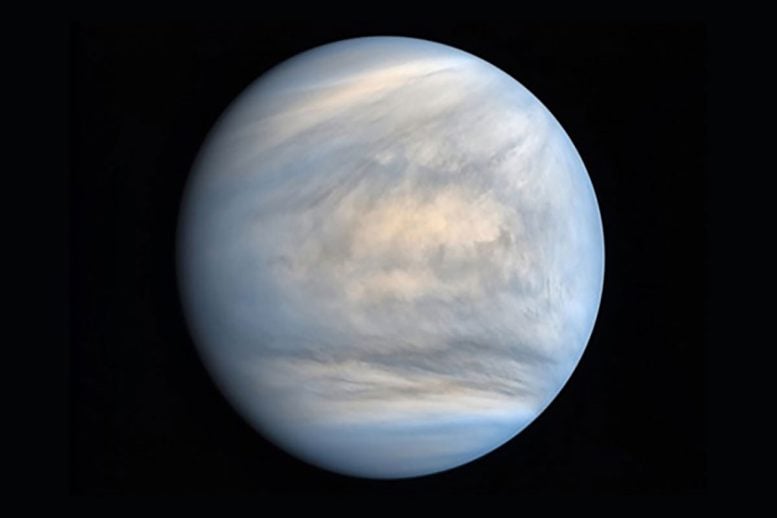
Venus Cloud Layers in UltravioletModels suggest that impact-ejected material from Earth could reach Venus’ clouds and potentially survive there briefly. Panspermia is the idea that life, or the ingredients needed for life, can move through space on asteroids, comets, and other objects. If life’s building blocks appear on one planet, a powerful impact could blast material from its surface [...]

'I would never have guessed it': Unexpected effect is squeezing Mars' atmosphere like toothpaste, experts say

29 May 2026 at 15:48
Researchers have uncovered an unexpected phenomenon, dubbed the Zwan-Wolf effect, squeezing plasma "like toothpaste" in Mars' upper atmosphere. This effect, which also happens on Earth, was thought to be impossible on the Red Planet.

Characterizing galaxies at “cosmic noon”

18 May 2026 at 12:00

The universe is around 14 billion years old, but scientists theorize that no stars formed for the first several hundred million years, during an era known as the cosmic dark ages. They refer to the first billion years or so after this, when stars formed, as the cosmic dawn. At that time, the very oldest galaxies first assembled from collections of gas and plasma. 

As these galaxies assembled and more material became available, the number of stars formed each year increased. Around 2 to 3 billion years after the Big Bang, galaxies grew faster than they ever would, producing stars at the highest rate in the universe’s history. This era is called cosmic noon.

Researchers from the Netherlands recently investigated 3 distant galaxies whose light began its journey to Earth during cosmic noon. They selected targets from a set of ancient star-forming galaxies identified in the ALMA – Archival Large Program to Advance Kinematic Analysis or ALMA-ALPAKA project. Of these, they chose to study 3 galaxies labeled ID1, ID3, and ID13.

They combined 2 different types of data to produce a detailed description of these galaxies. First, they collected data from an enormous telescope comprising 66 antennas in Chile, known as the Atacama Large Millimeter/submillimeter Array or ALMA. They used ALMA to detect radio-wave emissions from carbon monoxide and elemental carbon in these galaxies. The researchers stated that studying these chemicals in distant galaxies could reveal how their free-floating gas clouds move. They also used publicly available data from JWST’s Near Infrared Camera, or NIRCam, to determine how much light the galaxies’ stars emitted. By analyzing cosmic noon galaxies in multiple different ways, the team aimed to measure their masses and the relative contributions of regular matter and dark matter.

They used a computer program developed by other astronomers to interpret the JWST data as a series of maps showing the distribution of stars across each galaxy. They used this light-emission data to estimate the total mass of all the stars in these galaxies. Then they developed an original computer program to map the distribution of gas through each galaxy using the ALMA data. The team used these maps to create plots, known as rotation curves, which show how fast particles orbit each galaxy’s center as a function of their distance from it. 

The astronomers used these rotation curves to estimate the amount of dark matter in each galaxy. They explained that this method works because dark matter is totally invisible, but it still exerts a gravitational pull. Its gravitational pull causes visible material like stars and gas closer to the edges of these galaxies to move faster than they would in galaxies without dark matter. 

The team found that these galaxies had between 39 and 80 billion times the mass of our sun, or solar masses, in stars. They had between 4 billion and nearly 16 billion solar masses worth of free-floating gas. And they had from 1 trillion to 31 trillion solar masses of dark matter.

However, when the team compared the light-emission data with the rotation curves, they found a discrepancy. Typically, dark matter resides in a shell or halo surrounding a galaxy, meaning it should mostly affect material near the galaxy’s outer edge. Since astronomers don’t usually have to account for dark matter near a galaxy’s center, they can calculate the total mass of center material based on the amount of gas and stars they see there. But near the centers of these galaxies, the team found that the masses they derived from the light emissions were less than what they calculated from the rotation curves. 

They proposed multiple potential explanations for this discrepancy. First, they suggested that the halo shape might not be a good model for the dark matter distribution in all galaxies, meaning that cosmic noon galaxies could contain dark matter near their centers. Second, they suggested that stars could be packed tightly in the center of these galaxies, blocking each other’s light emissions. Third, they suggested that galaxy ID1 could have a supermassive black hole as big as 1.5% its total stellar mass at its center.

The team concluded that they now have a detailed picture of the mass distribution in these cosmic noon galaxies, but the reason for their center mass discrepancies remains elusive. They suggested that a complex relationship exists between the dark matter halos and the rest of the material within these galaxies. They indicated that future astronomers could adapt their methods to study the distribution of material in other distant galaxies studied by ALMA-ALPAKA and forthcoming galactic surveys.

The post Characterizing galaxies at “cosmic noon” appeared first on Sciworthy.

Searching for planets in a galaxy far away

4 May 2026 at 12:00

The Star Wars series depicted alien heroes fighting against evildoers and their planet-destroying superweapons “a long time ago in a galaxy far, far away.” But what do scientists really know about alien planets in distant galaxies beyond our own? These worlds, known as extragalactic exoplanets, are expected to exist, assuming the Milky Way is no different from other galaxies. However, we have yet to find them since other galaxies are still too far, far away for modern exoplanet-observing techniques.

Recently, a team of astronomers analyzed a stream of over 700,000 stars that the Milky Way likely absorbed from the dissolving Sagittarius dwarf galaxy. These stars are very distant, so the team investigated whether any of them host large, close-orbiting exoplanets called hot Jupiters, which are relatively easy to find.  

They established a set of 3 criteria to narrow down their list of stars. First, each star should appear bright enough when observed by the Transiting Exoplanet Survey Satellite, or TESS, to ensure high-precision results from the team’s data processing software. Second, each star must have more than a 50% likelihood that it originated from the Sagittarius dwarf galaxy, based on motion and position measurements from the Gaia mission. Finally, each star should have a radius of less than twice the Sun’s, as it’s easier to find planets around smaller stars. They used these criteria to limit their candidate list to around 20,000 stars.

After selecting their candidate stars, the team analyzed publicly available TESS catalog data using the software packages eleanor and TESS-Gaia Light Curve, or TGLC. These tools allowed them to plot each star’s brightness over time, in graphs called light curves. Then, the astronomers looked for periodic brightness dips in these light curves as evidence that an exoplanet passed in front of the star. From this, they excluded several thousand additional stars with too much light interference from their surroundings, reducing their final sample size to just over 15,000 stars.

To find hot Jupiters, the team looked for brightness dips at intervals of 14 hours to 10 days, which is the typical orbital period range for hot Jupiters. Then, they used geometry to derive each exoplanet’s radius from the fraction of the starlight it blocked. They excluded candidates with dips corresponding to objects with radii at least twice that of Jupiter’s, as these are likely caused by orbiting companion stars rather than exoplanets.

Among all the stars they surveyed, the team’s strongest candidate to host a hot Jupiter was a star labeled TIC 92223525. They calculated that this star could host an exoplanet with a radius 1.76 times the size of Jupiter’s and an orbital period of 7.2 days. However, when they reviewed this star’s light curve, they found that it was likely contaminated by its neighbor, TIC 92223526. The regular brightness dips from this system of orbiting stars mimicked that of an exoplanet, creating a false positive for TIC 92223525 that was difficult to detect during initial screening. As a result, the team ultimately excluded this candidate, leaving them with no confirmed exoplanets.

The researchers drew several conclusions from their inability to find hot Jupiters in their sample of stars from the Sagittarius dwarf stream. They estimated that if more than 1% of these stars hosted hot Jupiters, it would have been highly unlikely not to detect one in a sample of over 15,000 stars. This places an upper limit of about 1% on the occurrence rate of hot Jupiters. If this estimate is accurate, then even an ideal exoplanet search team would need to examine over 11,000 stars to find an extragalactic hot Jupiter. Accounting for more realistic levels of scientific uncertainty, a future team would likely need to study at least 80,000 stars to find one. 

Although this survey of the Sagittarius dwarf stream yielded null results, the team suggested that future researchers continue searching it and other star streams from different galaxies. Scientists have identified over 20 such streams in the Milky Way. Researchers studying these streams could find the first extragalactic exoplanet or provide evidence that other galaxies produce fewer hot Jupiters than our own. But let’s hope none of them find the first extragalactic Death Star!

The post Searching for planets in a galaxy far away appeared first on Sciworthy.

❌