It’s a regrettable reality that there is never enough time to cover all the interesting scientific stories we come across. So every month, we highlight a handful of the best stories that nearly slipped through the cracks. May's list includes the discovery of a possible prehistoric mining site in the Pyrenees; a new species of tiny blue octopus; why cats seem to prefer silver vine to catnip; and why political polarization might behave like a phase transition, among other noteworthy stories.
Prehistoric mining in the Pyrenees
Credit:
IPHES-CERCA
High in the eastern Pyrenees is a prehistoric cave, excavated between 2021 and 2023. Based on analysis of artifacts uncovered at the site, a team of Spanish archaeologists believes this may have served as an ancient copper smelting spot, with far more frequent occupation by humans than previously thought. The researchers described these preliminary findings in a paper published in the journal Frontiers in Environmental Archaeology.
It’s a regrettable reality that there is never enough time to cover all the interesting scientific stories we come across. So every month, we highlight a handful of the best stories that nearly slipped through the cracks. May's list includes the discovery of a possible prehistoric mining site in the Pyrenees; a new species of tiny blue octopus; why cats seem to prefer silver vine to catnip; and why political polarization might behave like a phase transition, among other noteworthy stories.
Prehistoric mining in the Pyrenees
Credit:
IPHES-CERCA
High in the eastern Pyrenees is a prehistoric cave, excavated between 2021 and 2023. Based on analysis of artifacts uncovered at the site, a team of Spanish archaeologists believes this may have served as an ancient copper smelting spot, with far more frequent occupation by humans than previously thought. The researchers described these preliminary findings in a paper published in the journal Frontiers in Environmental Archaeology.
It’s a regrettable reality that there is never enough time to cover all the interesting scientific stories we come across. So every month, we highlight a handful of the best stories that nearly slipped through the cracks. May's list includes the discovery of a possible prehistoric mining site in the Pyrenees; a new species of tiny blue octopus; why cats seem to prefer silver vine to catnip; and why political polarization might behave like a phase transition, among other noteworthy stories.
Prehistoric mining in the Pyrenees
Credit:
IPHES-CERCA
High in the eastern Pyrenees is a prehistoric cave, excavated between 2021 and 2023. Based on analysis of artifacts uncovered at the site, a team of Spanish archaeologists believes this may have served as an ancient copper smelting spot, with far more frequent occupation by humans than previously thought. The researchers described these preliminary findings in a paper published in the journal Frontiers in Environmental Archaeology.
For the past three decades, a team of archaeologists have been uncovering some of the field's most recent monumental discoveries, relying on gut instinct, persistent hard work, and cutting-edge methods and technologies.
For the past three decades, a team of archaeologists have been uncovering some of the field's most recent monumental discoveries, relying on gut instinct, persistent hard work, and cutting-edge methods and technologies.
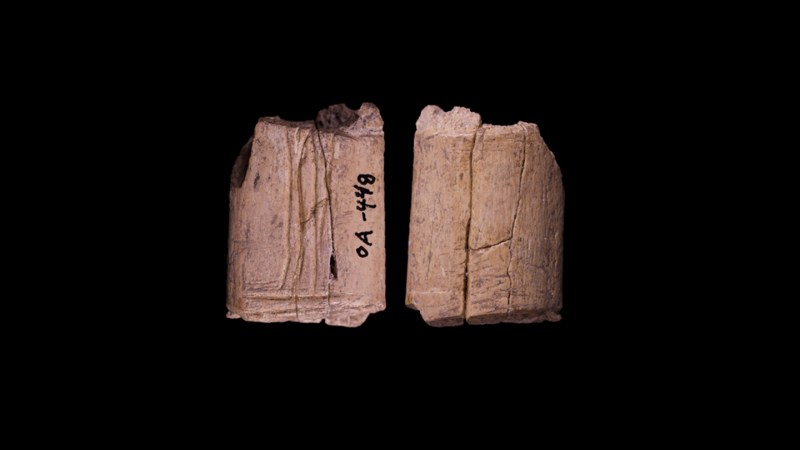
Ancient cultures across the globe have been playing games of chance — using dice — far, far longer than historians had ever realized, a new study finds. Researchers turned up these gaming pieces from as far back as 12,000 years ago. That makes them the oldest known dice.
These came from western North America. Until their discovery, the oldest known dice were from Mesopotamia, an ancient region in what is now Iraq. The oldest of those were only about 5,500 years old.
Many Native American cultures have a rich history of dice games and still play them today.
Such games could have helped foster social connection, says archaeologist Robert Weiner, who was not part of the new study. If you meet strangers, “how are you going to interact?” he asks. Dice games could have offered one way for strangers to bond. Weiner works at Dartmouth College in Hanover, N.H.
But until now, the roots of early American dice games had been fuzzy. Robert Madden hoped to track down those origins. In the April 2 American Antiquity, he describes the search for the earliest dice in what is now the mainland United States.
Dice defined
Madden, too, is an archaeologist. He works at Colorado State University in Fort Collins. He started his search by sifting through records of Native American artifacts. He was scouting for objects that might be dice.
He set rules for sorting out possible dice. Most Native American dice are two-sided with at least one side marked. So that’s what Madden looked for. He rejected objects with holes. These might have been part of jewelry. Any die candidates also had to be small enough to fit in one’s hand.
In all, 565 objects met all those criteria. An additional 94 objects were probably dice but would need more details to be sure.
The items came from 57 archaeological sites across 12 U.S. states in the Great Plains and American West. Most of the promising objects were 450 to 2,000 years old. About 31 were 2,000 to 8,000 years old. And at least 14 artifacts dated as far back as 12,000 years ago. Those oldest ones came from Wyoming, Colorado and New Mexico.
Holding deep history
Madden then traveled to examine the oldest of these artifacts in person. He found some objects that had not yet been described or linked to gaming.
“It was amazing to hold these pieces of deep history in my hand,” Madden says. In-person inspections confirmed to him that these ancient objects were in fact dice. Each was made of bone, worn smooth by use and time. Lines had been carefully etched on one side. Some had faint traces of red pigment to mark the different sides.
Especially notable: They looked much like more modern Native American dice.
“If you took dice from 2,000 years ago and the prehistoric ones and put them in a bag and shook it up, it would be really hard to tell the difference between them,” Madden says. “They look very similar.”
Weiner agrees. “I don’t think there’s a compelling alternative explanation for many of these objects,” he says.
The new study likely understates the true diversity, in space and time, of dice in Native American cultures. After colonial contact, settlers documented 18 tribes in the eastern U.S. that played dice games. Yet Madden’s search turned up no dice from there. Future research should explore that region, he says.
Finding the oldest dice also pushes back when people first seem to have been experimenting with the concept of probability. It highlights Native American contributions to early intellectual developments, Madden says. That Native Americans used dice to generate randomness this long ago, he says, “is a very exciting connection to make.”
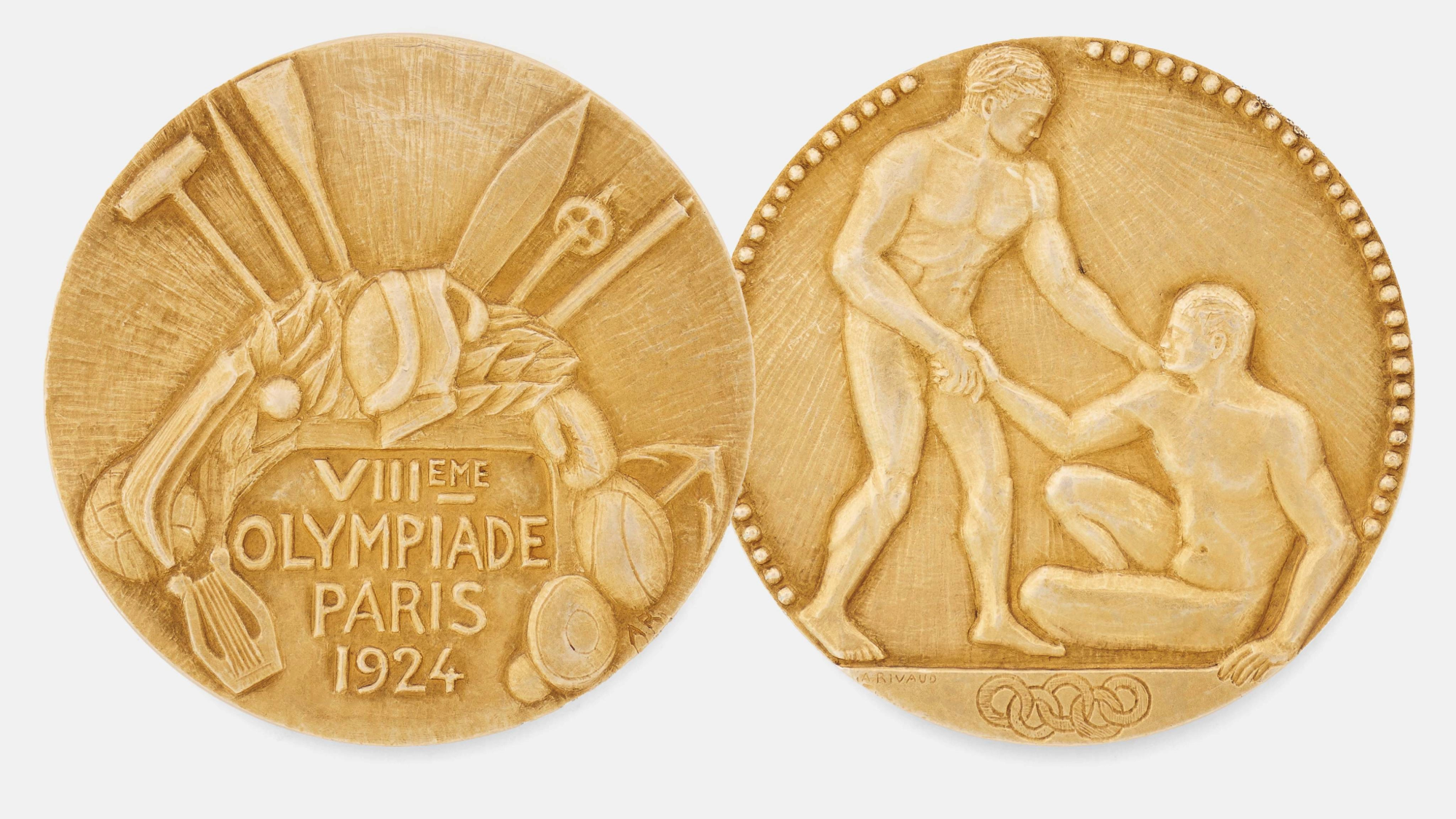
The harp on this side of the medal represents the Cultural Olympiad, an artistic and cultural program that ran alongside the athletic competition. Image: Nate D. Sanders Auctions.
The 1924 Paris Games were a hallmark of Olympics and sports history. More than 3,000 athletes from 44 countries competed in the first Olympics to include a Closing Ceremony. American swimmer Johnny Weissmuller won three gold medals and later went on to play Tarzan in 12 films. Swiss tennis player Richard Norris Williams won gold, after surviving the sinking of the RMS Titanic in 1912. He almost lost both his legs after jumping into the freezing water, but made a full recovery. The Paris Games were also featured in the award-winning film Chariots of Fire.
The 1924 Paris Games were also the first to officially feature the iconic five-ring Olympic symbol. The rings were designed by Baron Pierre de Coubertin, the founder of the modern Olympics and symbolize five continents and athletic unity.
This symbol of sportsmanship set the standard for future medals. Image: Nate D. Sanders Auctions.
The medals were designed by sculptor André Rivaud. The obverse side shows a winning athlete reaching out to help a fallen competitor, an image of sportsmanship that set the standard for future Olympic medal design. The five Olympic rings are beneath this scene. The reverse side features sports equipment alongside a harp, a nod to the Cultural Olympiad. This artistic and cultural program ran alongside the athletic competition to explore the links between art and sport and the values they both share.
The medal is about 2 inches in diameter and weighs 2.7 ounces. It is listed as “near fine condition,” is made from gold-plated gilt silver and has the “2ARGENT” stamp on the rim as a mark of authenticity. Only 304 gold medals were originally produced, making them one of the rarest and most coveted pieces of Olympic history in existence. The auction will take place on May 28 with a minimum bid of $14,000.
Only 780 days to go until the 2028 Summer Olympic Games in Los Angeles, California.
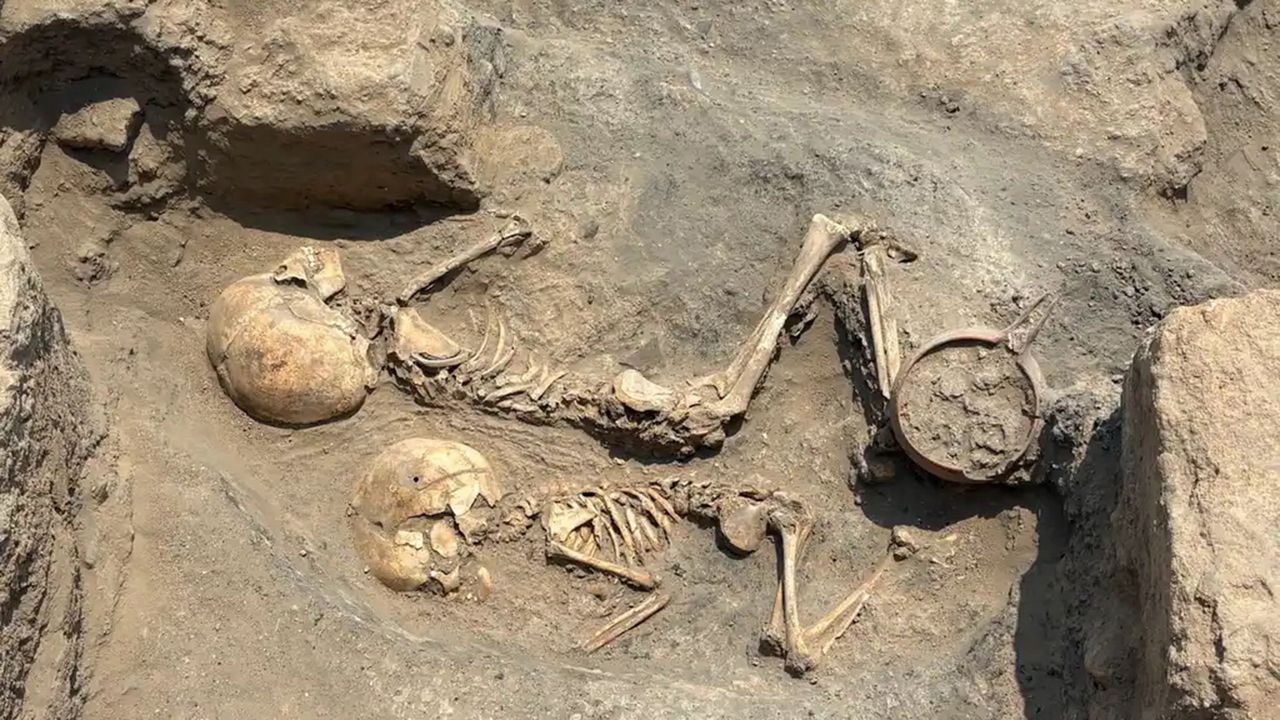
In honor of the 700th-anniversary founding of the Royal Monastery of Santa Maria Pedralbes in Barcelona, scientists opened eight 14th-century graves and studied the 25 people found inside, including a queen.
Despite their occupations of Britain, the Romans and Vikings didn't leave much of a genetic mark on Britons. The Anglo-Saxons, though, were a different story.
How was iron produced 2,000 years ago in Senegal? A recent study at the Didé West 1 archaeological site, in the Falémé Valley in eastern Senegal, sheds light on an ancient iron production technique.
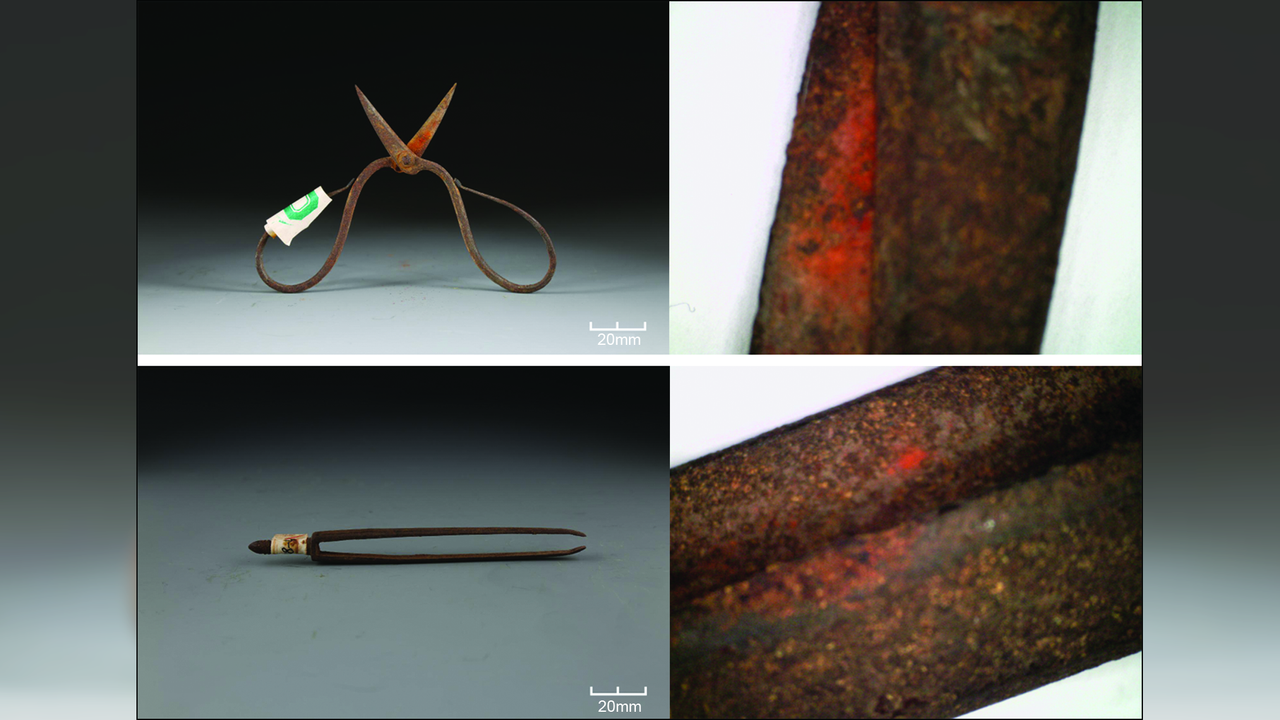
Ancient Egyptians are often depicted wearing black eyeliner, known as kohl, which was stored in small containers. While kohl containers are typically found throughout Egypt and Sudan (Nubia), their presence beyond these areas is limited to only a handful of examples.

 Login
Login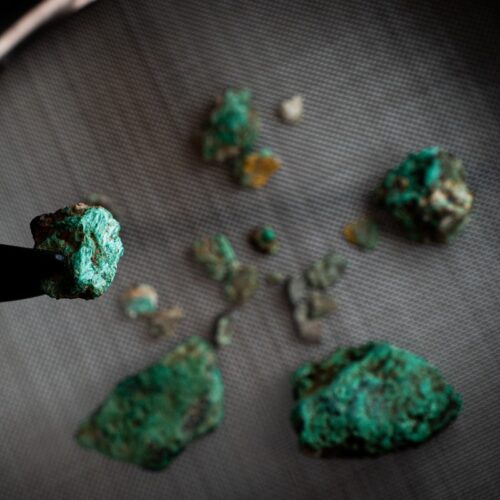

 Credit:
IPHES-CERCA
Credit:
IPHES-CERCA