The babies were part of a vaccine trial for a respiratory virus in the 1960s and died shortly after. Their families said they had been unaware of the trial until recently.
The teenagers of 1950s America helped create a completely new youth culture, one shaped by economic prosperity, growing independence, and a rapidly changing postwar society. Captured in a memorable series of photographs by photographer Nina Leen, these young Americans appeared confident, stylish, and eager to embrace the opportunities surrounding them. In June 1954, LIFE magazine […]
Faces frozen in time stare out from fragile glass negatives that survived more than a century in silence. Some appear nervous, others defiant or exhausted, each one carrying a story that was nearly forgotten forever. Taken in the small Northern California town of Marysville during the early 1900s, these haunting mugshots offer an unusually personal […]
As part of a growing anti-tech movement, startup dumb.co is pushing flip phones as a way for young people to find ‘social and spiritual freedom’
“They aren’t as dumb as they look,” our facilitator said, referring to the dark gray flip phone in his hand. He just as easily could have been talking about us, the 28 New York residents before him who had signed up to use the device for the entire month of March. He explained that the relic was loaded with WhatsApp, iMessage, Google Maps, Uber, Microsoft 2FA – nothing like my seventh-grade flip phone.
We each had paid $75 to participate in Month Offline, or MO, a program that challenged us to swear off our smartphones entirely. Another $25 went to dumb.co, the company behind MO, for the so-called dumbphones we would use as we navigated daily life.
Britain in the 1960s liked to think of itself as a country moving forward. The postwar recovery was well underway, consumer culture was beginning to bloom, and cities across the country were being promoted as symbols of a new, modern age. Behind that image, in the back streets of Manchester, families were living in conditions […]
New York City, through much of the 20th century, was a place where power operated in the shadows. The Five Families ruled entire neighborhoods, names like Lucky Luciano, Bugsy Siegel, Meyer Lansky, and Frank Costello commanded fear and respect in equal measure, and the city’s underworld hummed along with the quiet efficiency of a criminal […]
Fashion in early 1970s San Francisco reflected a city in the middle of cultural change. The streets became a stage for personal expression, where young women mixed vintage pieces, handmade garments, and bold new trends into looks that felt effortless and individual. Away from the polished pages of fashion magazines, candid street photography captured a […]
There is something striking about looking at a photograph of a teenager from the 1970s. The confidence, the color, the sheer audacity of what they chose to wear speaks louder than any fashion editorial ever could. These were not curated outfits assembled for a camera. They were real kids, in real hallways and real streets, […]
Before a woman could step onto a plane as a stewardess, she had to clear a set of requirements that bore no resemblance to anything related to aviation. No safety certification, no navigation knowledge, no emergency training. The checklist that determined her eligibility was built entirely around her physical appearance, the sound of her voice, […]
Almost 1400 people, including two Nobel laureates, have signed an open letter condemning the US/Israeli attacks on Iranian academicinstitutions. The signatories call on the international community to “protect scientific infrastructure, defend academic life, and uphold the principle that knowledge-serving institutions must never be treated as expendable in war”.
The letter, which is addressed to the United Nations secretary-general, the director-general of UNESCO, the UN High Commissioner for Human Rights and “the governments of all parties to the conflict”, was instigated by the theoretical condensed-matter physicist Alireza Qaiumzadeh and colleagues from the Norwegian University of Science and Technology.
The signatories, which include May-Britt Moser and Edvard Moser who shared the 2014 Nobel Prize in Physiology or Medicine, express their “grave concern” over the attacks that they say have “damaged laboratories, universities, hospitals, and other scientific institutions”.
Organizations that have been attacked include Isfahan University of Technology, Iran University of Science and Technology and the Pasteur Institute of Iran and Sharif University of Technology. During the 12-day war between Israel and Iran in June 2025, Israel’s Weizmann Institute of Science and Ben Gurion University were also hit.
“Scientific and educational institutions are civilian spaces essential to public health, knowledge, and human survival,” the letter states. “Their destruction endangers researchers, students, medical personnel, and the broader public, while causing lasting harm to science and society.”
Qaiumzadeh says that many of the Iranian research institutions that have been destroyed were built over decades under sanctions. “My colleagues in Iran are deeply disheartened to see that what they achieved under such difficult conditions has been reduced to rubble,” he says.
Due to the ongoing war, which began on 28 February, many schools, universities and research centres – in which more than 60% of Iranian students in STEM subjects are women – are now closed, with courses forced online under limited internet access.
Particle physicist John Ellis from King’s College London, who is among those who signed the letter, says that he counts many Iranian, Gulf State and Israeli physicists among his colleagues and friends and says he has visited some of the institutions that have been attacked.
“I deplore any and all military attacks on universities, and indeed other educational institutions,” adds Ellis. “I can only hope that this open letter and the publicity it receives may help convince the belligerents to refrain from such attacks.”
The letter now calls on all parties in the war to “immediately” end attacks on civilian scientific and educational sites. “Science is not a military target,” the letter states. “Universities and laboratories must not become battlefields.”
It also calls on international bodies to “document [the] damage”, “protect affected scholars and students” and “support independent investigations into violations of international humanitarian law”.
Qaiumzadeh told Physics World that he finds it “particularly troubling” the scientific bodies, such as academies and international scientific organizations, have remained largely silent during the conflict.
“They must understand that undermining academic institutions will only worsen the situation for those who believe in gradual, constructive change within Iran’s complex society,” he says.
Physicists who go into politics are a rare breed. Most famously there was Angela Merkel, who was chancellor of Germany for 16 years. Climate physicist Claudia Sheinbaum Pardo was elected Mexican president in a landslide win in 2024. Alok Sharma, meanwhile, was business secretary in the UK government and president of the COP-26 climate summit.
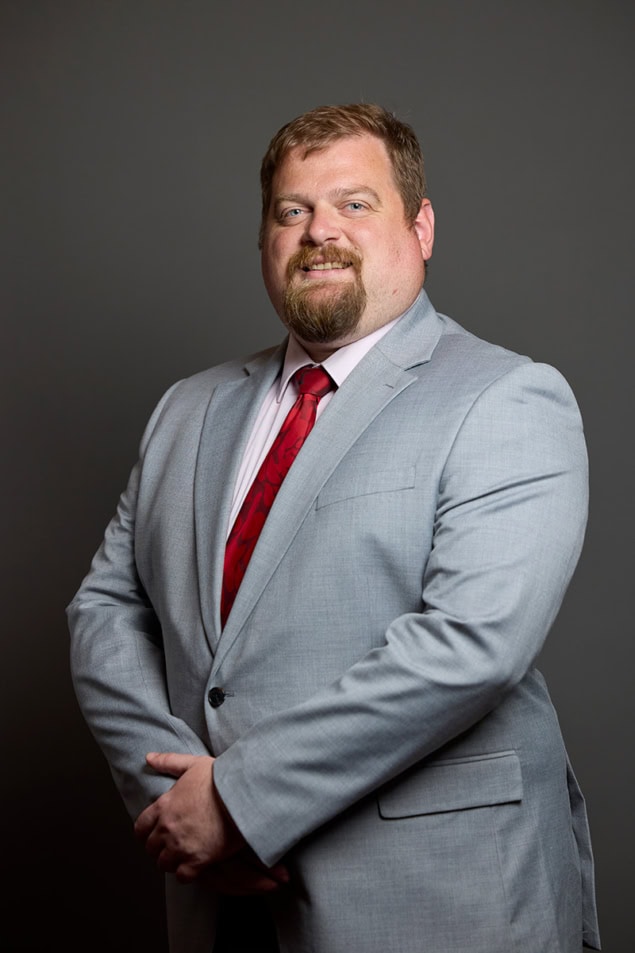
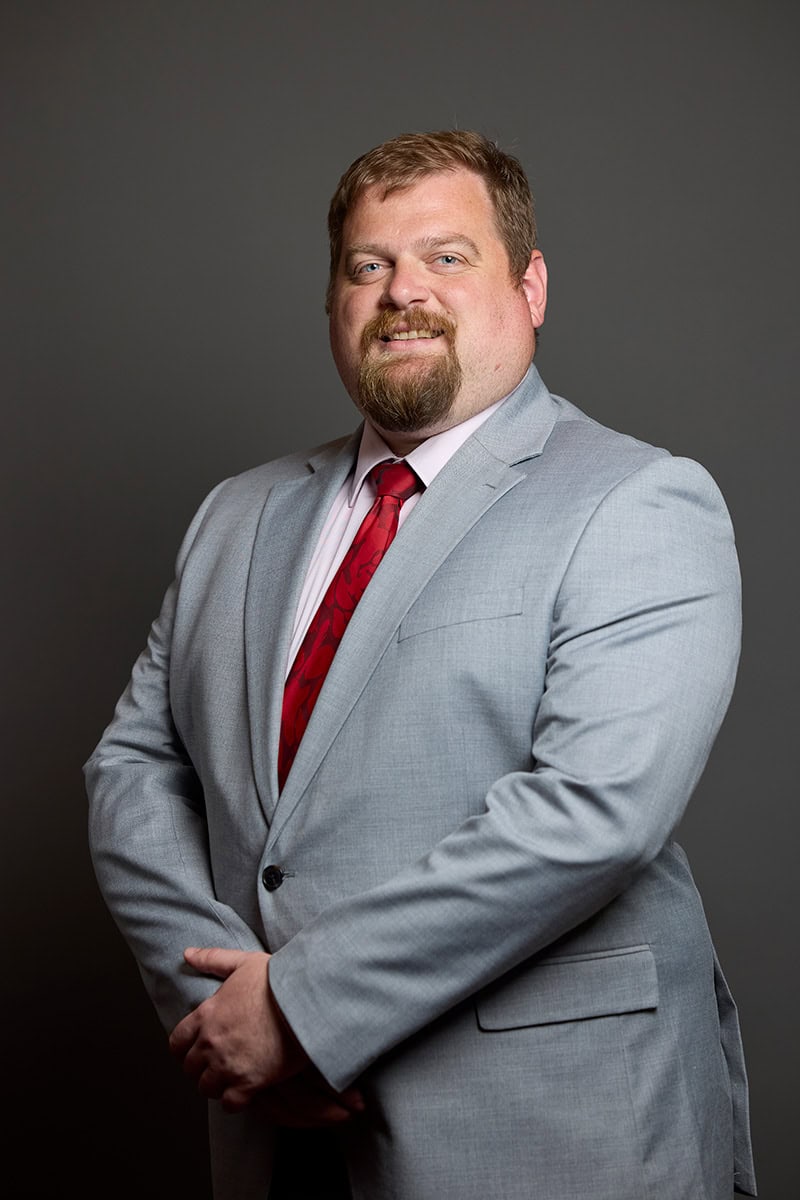
But Dave Robertson is even more unusual. Having originally studied physics at the University of Liverpool in the UK, he worked as a physics teacher in Birmingham for almost a decade. After spells in the trade-union movement and local politics, Robertson has been the Labour Member of Parliament (MP) for Lichfield, Burntwood and the Villages since 2024.
He’s not the only physicist currently serving as an MP. Others include Layla Moran – another former physics teacher – who’s been Liberal Democrat MP for Oxford West and Abingdon since 2017. There’s also shadow home secretary Chris Philp, who’s been Conservative MP for Croydon South since 2015.
But Robertson is the only physics-teacher-turned-MP in the current Labour government, which came to power at the 2024 general election. It won a 174-seat landslide majority, though Robertson’s own victory was wafer-thin. He squeaked home by just 810 votes over his Conservative rival Michael Fabricant, who had been Lichfield’s MP for more than 25 years.
In an interview with Physics World, Robertson admits he had little idea of what the job of MP would involve (see box). Describing the British parliament as “a truly bonkers and bizarre workplace”, he divides his time between Lichfield and London. “I try to do four days in my constituency a week and four days in parliament. That doesn’t add up, but if can split my Mondays, I can just about make it work.”
Dave Robertson MP: what happened after I got elected
Dave Robertson recalls the immediate aftermath of his victory in the UK general election on Thursday 4 July 2024.
When you win an election, they give you this envelope. I was expecting a proper, thick A4 envelope, but all they gave me was a single sheet of A4 paper folded in half. It was 4.30 in the morning, I’d had no sleep and I’d been on my feet since 7 a.m. or something stupid. And I thought “I’m not opening this now. I’m going to take it home.”
When I opened it in the morning, it basically said “Congratulations, phone this number.” So I rang and someone said “Oh, when are you coming down to parliament?” And my reaction was “I thought you’d tell me that!” In the end, I went down on the Sunday after the election and I remember walking into Westminster Hall for the first time with the person who was showing me round and she said, “So when was the last time you were in parliament?”
As I put my hand on the door, I had to admit I’d never been in the building before: it was literally the first time I’d ever been there. And it’s nothing like I expected. It is a truly bonkers and truly bizarre workplace. It’s unique and so different to everything else. That comes with its frustrations, but it is also an absolute privilege to be involved – and long may it continue.
Into the classroom
Brought up in Lichfield, Robertson began his physics degree at Liverpool in 2004. Saying he “loved every second” of his time there, Robertson particularly enjoyed nuclear physics. But it was a science-communication course, which Robertson admits he only took because he thought it would be easy marks, that made him realize how much he liked taking complicated concepts and explaining them to non-experts.
After graduating in 2007 and taking a year off, Robertson returned to the Midlands to do a teacher-training degree at the University of Birmingham. The course was largely practical, with Robertson spending most of his time getting hands-on teaching experience at various schools in Birmingham, including one – Great Barr School – that he ended up working at.
Roberston spent seven years as a physics teacher at Great Barr, which was then one of the largest secondary schools in the UK. With about 2500 pupils, it had as many as 16 classes in each year group, from age 11 to 16. Great Barr was also able to offer physics to 17 and 18 year olds who stayed on to do A-levels. “We’d always have one physics group or occasionally two in year 12.”
Rather than just focusing on the syllabus, Robertson would try to make his lessons “loud and engaging” to emphasize the excitement and sheer bizarreness of physics. Claiming he has good control of his voice, Robertson says he would also “put on accents and do silly voices” to keep pupils entertained.
He particularly enjoyed teaching a course called “Science in the news”, where pupils would look into the impact of a particular topic in the syllabus on the wider world. “That was wonderful,” Robertson recalls. “It was effectively a literature review, which let us teach a lot of the skills that we want to see kids developing when they’re learning sciences. It was fascinating.”
Not all pupils enjoyed physics. “For some kids, physics wasn’t their thing – it’s not what drove them,” he says. But he regarded it as “an absolute privilege” to teach students who were engaged with the subject, especially those who went on to study physics at university. One ex-pupil even contacted Robertson after he became an MP to say she’d just passed her PhD. “She’d dropped a note into her thesis thanking Mr Robertson for being an inspiring physics teacher.”
Political moves
Robertson’s time at Great Barr came to an end in 2016 when the school was making job cuts and he accepted voluntary redundancy. After doing supply teaching for about a year, he got wind of a post at the NASUWT teachers’ trade union, which he’d been school rep for at Great Barr. “It was one of those jobs I’d have regretted if I didn’t apply for it,” he says.
It was while working for the NASUWT that Robertson got involved in local politics. He joined the Labour Party and in 2019 was elected to Lichfield District Council, which was then run by the Conservative Party. He also stood in that year’s UK general election, but was beaten by Michael Fabricant, losing by more than 23,000 votes. “I don’t talk about that result,” Robertson jokes.
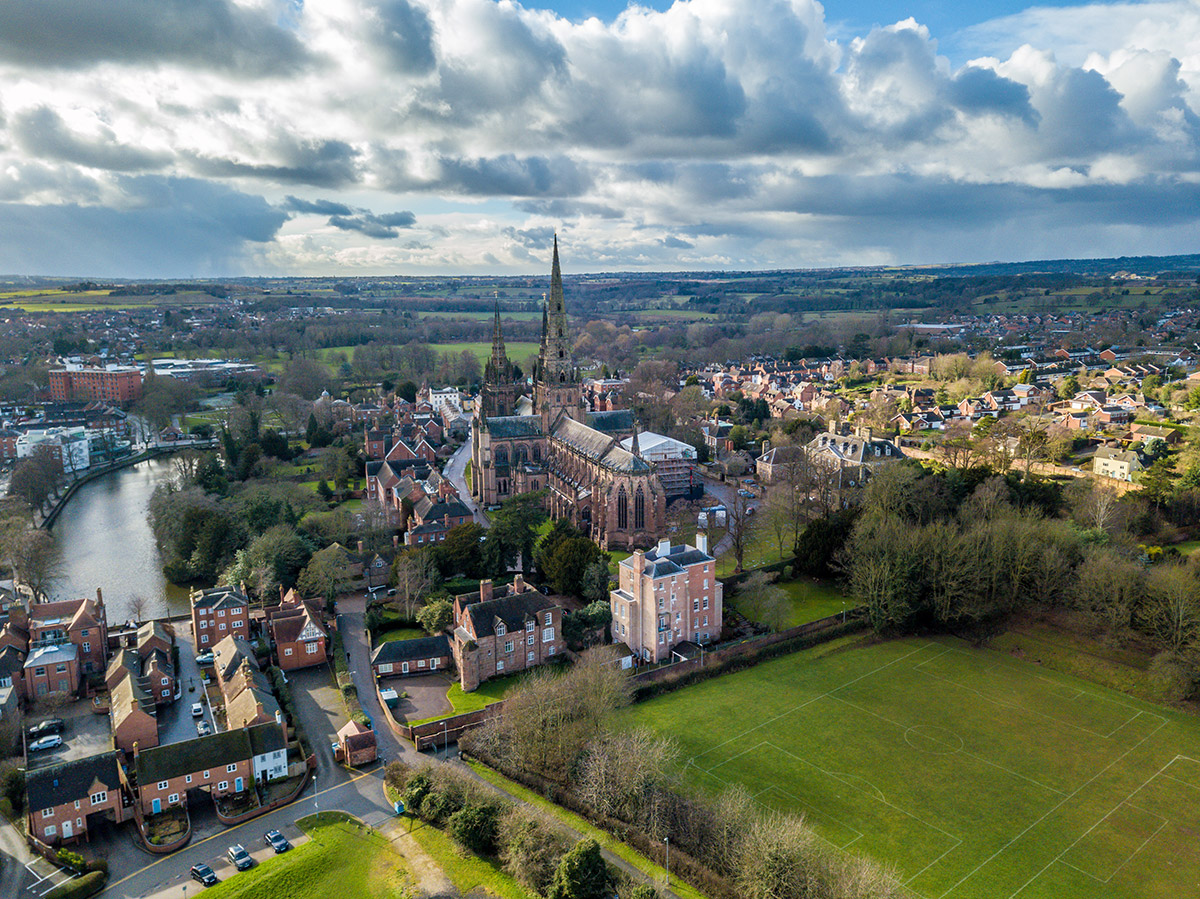
Heart of the country Dave Robertson was elected as Labour Member of Parliament for the Staffordshire seat of Lichfield, Burntwood and the Villages at the 2024 UK general election, beating the sitting Conservative MP Michael Fabricant by just 810 votes. The former physics teacher serves a semi-rural constituency centred on the cathedral city of Lichfield (pictured). Lying about 30 km north of Birmingham, the constituency also includes farmland, villages and the town of Burntwood. (Courtesy: iStock/Nicholas E Jones)
Robertson is now one of more than 400 Labour MPs and spends most of his time on local Lichfield matters. “My number one focus is very much what’s going on in my constituency, and that will always be the case,” he says. “But I’m very fortunate to be one of a very small number of parliamentarians who’ve got a science background, let alone a physics background.”
That interest saw Robertson host an exhibition in the Houses of Parliament, organized by the Institute of Physics (IOP), in June 2025 to support the International Year of Quantum Science and Technology (IYQ). “Every MP and member of the Lords would have been able to walk past and see that it was the IYQ,” he says. The exhibition was, for him, a great opportunity “to show decision-makers that the UK is one of the world leaders in quantum”.
That month Robertson also hosted a hands-on display of quantum technology for MPs and members of the House of Lords, again organized by the IOP. At the end of 2025 he sponsored another parliamentary reception, this time for physics-based companies that had won IOP Business Awards. “The event was absolutely wonderful,” says Robertson. “Seeing some of the cutting-edge science from companies on show was astonishing.”
Robertson’s focus on science extends to his membership of various cross-party parliamentary groups, including ones about nuclear energy and space. He is also chair of a new group he has set up devoted to quantum science and technology. As a backbench MP, Robertson cannot dictate or implement policy, but he says such groups “can help build up a critical mass of interest in parliament to drive an agenda forwards”.
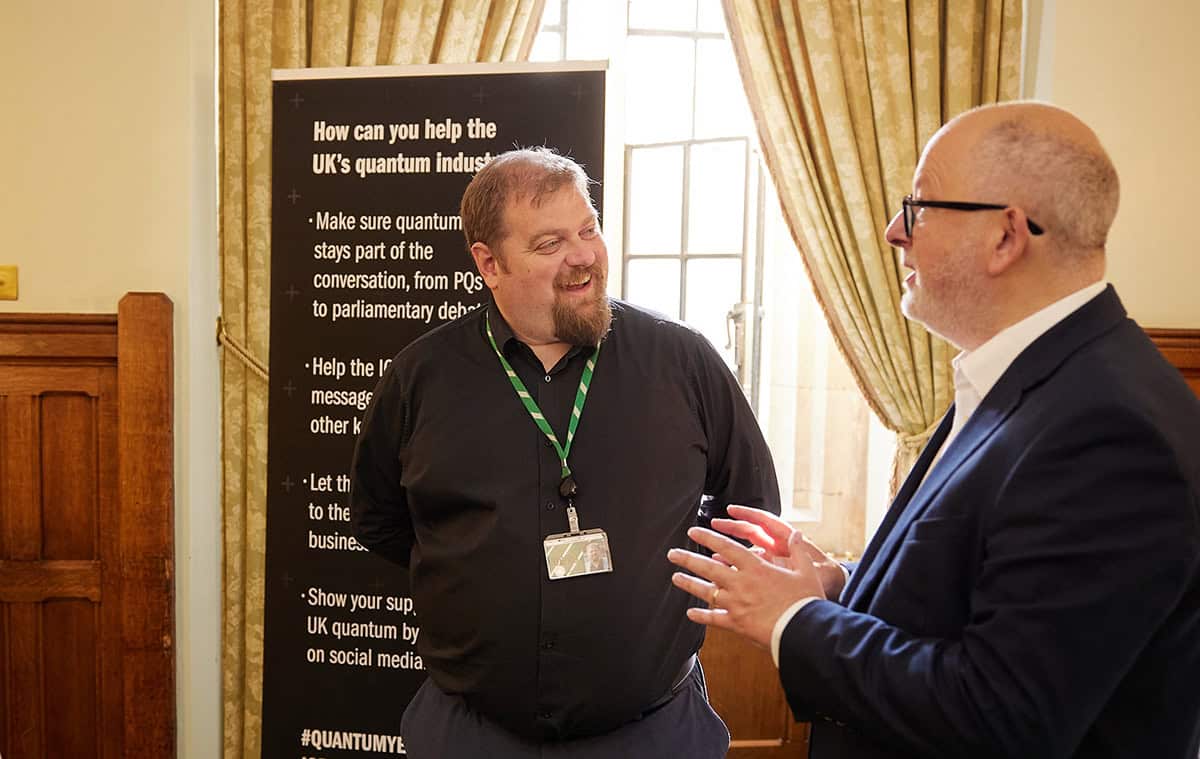
Spreading the word Dave Robertson (left) at an Institute of Physics event that he sponsored at the Palace of Westminster in June 2025 to inform parliamentarians, including fellow MP Steve Yemm (right), of the commercial applications of quantum science. The event formed part of the International Year of Quantum Science and Technology. (Courtesy: Barry Willis Photography)
With his background in teaching, Robertson is also keen to highlight the UK-wide shortage of physics teachers. While at Great Barr School – now rebranded as Fortis Academy – he was lucky. “I remember having a physics group meeting,” he says, “where there were six of us around the table and thinking ‘This is more [physics teachers] than most cities have’.”
As a 2025 IOP report pointed out, a quarter of state schools in England have no specialist physics teachers. In fact, more than half of physics lessons for 14–16 year olds are taught by teachers who never studied a physics-related subject beyond the age of 18. Despite some improvement, only 31% of the government’s target number of physics teachers have been recruited, while 44% of new physics teachers quit within five years.
It’s the responsibility of me and other MPs with a scientific background to spark an interest in physics
Dave Robertson MP
Robertson admits that getting the lack of physics teachers on the radar is an uphill battle. “There are 650 MPs but have they all thought about the importance of getting more physics teachers in the classroom? Probably not, if I’m honest. That’s why it’s the responsibility of me and other MPs with a scientific background to spark an interest in physics and unearth the next Paul Dirac or Isaac Newton.”
Robertson would also like to get on the influential science innovation and technology select committee to spread the message about the importance of physics. But he is wary of spending too much time in parliament with other MPs with a scientific background. “It’s more helpful if all of us have tentacles that spread out into other groups and parties and sections of parliament.”
Spreading the message
For the wider physics community, Robertson believes that physicists need to speak out more strongly about how they can tackle many of the world’s problems, notably climate change. “It’s the biggest issue at the moment and a lot of the solutions are going to come from physics,” he says. “Getting more physicists engaged with decision-makers will not only be good for the future of the economy but ultimately for the future of the planet.”
As for Robertson’s own future, he knows that a career in politics is precarious. Voters rarely hold politicians in high regard and will often boot them out on a whim. It’s therefore hard for any MP to have a predictable career path or plan too far ahead. Robertson himself admits to having “no big aspirations” to be a cabinet minister, which is perhaps just as well given that his majority at the last election was so thin.
With the next general election not due to take place until 2029, Robertson is for now focusing squarely on his role as a backbench constituency MP. “The job I have is just about the most wonderful in the world,” he says. “I want to keep doing it because there’s some wonderful things I can do for my community, whether it’s physics, quantum or football.” But if Robertson did get kicked out, at least he can go back into the classroom.
“Rumour has it, we could do with a few more physics teachers.”
Many-body physics is the study of large ensembles of interacting particles and their collective behaviour. These systems are notoriously difficult to simulate, yet they underpin phenomena such as superconductivity and superfluidity. Thus, they are of great interest to understand. As a many-body physicist myself, I arrived at my first American Physical Society (APS) meeting with a different curiosity: understanding what the largest physics conference in the world was all about.
Last week, I joined a crowd of 14,000 scientists convening in Denver, Colorado for the annual Global Physics Summit, hosted by the APS.
On Sunday morning, the day before the conference, I walked alone through the streets of downtown Denver. Silence filled the frigid air. A light flurry of snow covered the empty streets in white. It seemed that the city was still asleep.
But Denver was abruptly awakened on Monday morning, as I found myself well-accompanied by the crowd collectively moving towards the Colorado Convention Center for an 8 a.m. start. Inside, the conference was humming with its own emergent dynamics, with lines forming around coffee stations and people bustling to find their way to wherever they were going.
Throughout the day, I was faced with the repeated indecision of choosing between over 80 simultaneous sessions. Some sessions housed APS’s infamous blitz talks with speakers racing to pack as many graphs and equations into their allotted 10 min. Having barely enough time to write down the takeaways, I tried, often in vain, to fill my memory as quickly as possible.
Other sessions featured longer talks on hot topics in physics. By evening, my mind was swimming with notions of scalable quantum computing and physics funding issues and public engagement opportunities and the infiltration of AI slop into every corner of the scientific process. These sessions offered me a necessary reminder that science is not performed in a vacuum. With that said, the purely technical sessions on ultracold atomic gases served as a necessary reprieve for me that day.
Ultracold atoms, cooled to only a fraction of a degree above absolute zero, provide physicists with a clean and controllable platform for studying quantum many-body physics. At its heart, this physics is governed by interparticle correlations.
Seeing single atoms A fluorescence image taken under a quantum gas microscope. Each dot is one atom (Courtesy: Candice Chua)
During my PhD, we measured two-body correlations and observed bosons spatially bunching together—unlike their antisocial fermionic counterparts. While the stereotypical physicist may be notoriously antisocial, the APS lanyard seemed to overturn that reputation.
Over dinner one evening, I requested a table for one. Only a moment later, I was joined by a physicist I’d never met before, and the evening unfolded behind pleasant chatter of 2D materials and the lack of vegetables in our travel diets.
Two tables down sat a professor whose work I admired. I’ll admit that I embarrassingly (or, more favourably, courageously) walked to the washroom so that I could pass by his table and say hello. I had met him once last year, but he didn’t remember me. So, I kept talking until he agreed that he remembered, and that it was nice to run into each other again. Whether true or not, I accepted it as a win. Without an APS lanyard, I probably would have avoided that conversation.
Single-atom resolution
On Thursday, a session titled “Novel imaging and quantum sensing technologies” caught my eye since I work with a quantum gas microscope. The microscope is a high-magnification imaging system that affords us the resolution of individual atoms. The microscopic information is far richer than what is obtained by a bulk imaging technique such as absorption.
Similarly, at the conference, I found the greatest value in individual conversations. Conversing with employees at the career fair, though exhausting, was far more effective than listening to panels on how to plan for careers that I couldn’t decide if I wanted.
By the end of the week, I started to recognize people I had already met over the few days prior. I saw every reunion or simple “Oh! Hi” as miraculous rather than a given, based on the size of the conference. People shared with me their personal journeys navigating the hardships and uncertainties of today’s world, others about the trade-offs and uncertainties in their experimental results. Some of the most fulfilling and deeply human conversations were the spontaneous ones that arose outside the doors of sessions that we had meant to be in.
When Friday rolled around, the city emptied as quickly as it had filled. For me, I retreated into the sunny Boulder mountains, mulling over the lingering resolution of singular people whose shared words and ideas were now intertwined with my own. Ignoring my fear of getting lost, I followed my instincts deeper into the dry heat of the afternoon, one step at a time.

 Login
Login