Technology • Audio Engineering • Digital Entertainment The Sound Factor: Why Certain Casino Games Feel More Intense than Others Modern casino games use advanced sound engineering, frequency mapping, dynamic audio systems, and low-latency synchronization to create immersive digital experiences that feel emotionally intense and highly responsive. May 12, 2026 • 6 min read Sound design, […]
There is a reason so many online casino games reach backward before they move forward. For all the talk around speed, interface design, and mobile play, a huge part of the experience still comes down to atmosphere. Before a player notices mechanics, bonus features, or payout structures, they notice the world the game is trying […]
Tongits remains one of the most competitive and skillful card games, particularly popular among Filipino players. This game, rooted in strategy, memory, and decision-making, has extended its reach into the world of digital platforms like Tongits Go APK and GameZone (also referred to as GZone). These platforms allow players to improve their gameplay, sharpen their […]
Forty years ago, the future seemed just around the corner—and the vehicle that was going to take us there was NASA's Space Shuttle. Originally envisioned as part of a larger integrated space transportation system, the shuttle was billed as a fully reusable vehicle, totally unlike the one-and-done capsules of the fading Apollo era, capable of making monthly (and perhaps even weekly) ferry flights to low Earth orbit.
The loss of Challenger in January 1986—carrying educator Christa McAuliffe, who would have been the first private citizen in space—put the kibosh on all of that. The shuttle, while fantastically advanced, would never be the vehicle to help humankind slip all of our surly bonds, so to speak. Even operating at its most frantic peak in 1985 just before Challenger's loss, the shuttle hardware managed a maximum of nine flights in one calendar year; for most of the 1990s, it performed at five or six flights per year. Civilians in space—to say nothing of Big Bird—would have to wait.
Forty years ago, the future seemed just around the corner—and the vehicle that was going to take us there was NASA's Space Shuttle. Originally envisioned as part of a larger integrated space transportation system, the shuttle was billed as a fully reusable vehicle, totally unlike the one-and-done capsules of the fading Apollo era, capable of making monthly (and perhaps even weekly) ferry flights to low Earth orbit.
The loss of Challenger in January 1986—carrying educator Christa McAuliffe, who would have been the first private citizen in space—put the kibosh on all of that. The shuttle, while fantastically advanced, would never be the vehicle to help humankind slip all of our surly bonds, so to speak. Even operating at its most frantic peak in 1985 just before Challenger's loss, the shuttle hardware managed a maximum of nine flights in one calendar year; for most of the 1990s, it performed at five or six flights per year. Civilians in space—to say nothing of Big Bird—would have to wait.
Forty years ago, the future seemed just around the corner—and the vehicle that was going to take us there was NASA's Space Shuttle. Originally envisioned as part of a larger integrated space transportation system, the shuttle was billed as a fully reusable vehicle, totally unlike the one-and-done capsules of the fading Apollo era, capable of making monthly (and perhaps even weekly) ferry flights to low Earth orbit.
The loss of Challenger in January 1986—carrying educator Christa McAuliffe, who would have been the first private citizen in space—put the kibosh on all of that. The shuttle, while fantastically advanced, would never be the vehicle to help humankind slip all of our surly bonds, so to speak. Even operating at its most frantic peak in 1985 just before Challenger's loss, the shuttle hardware managed a maximum of nine flights in one calendar year; for most of the 1990s, it performed at five or six flights per year. Civilians in space—to say nothing of Big Bird—would have to wait.
Loryn Brantz created The Good Advice Cupcake for BuzzFeed years ago. The company licensed the character for a new Amazon series—made with AI—without her consent.
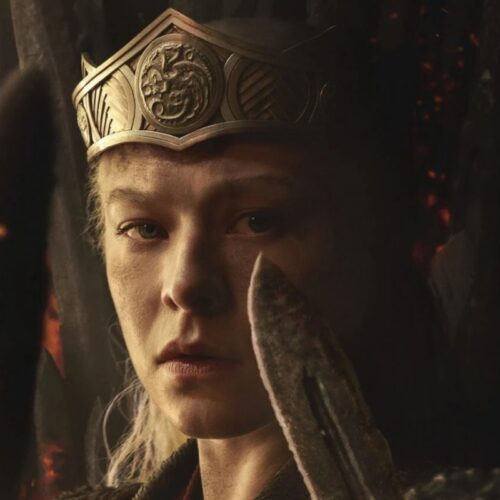
Some viewers were disappointed that the second season of House of the Dragon ended not with a bang, but a whimper. But the big battle sequence that season 2 set up will open season 3 with a bang, judging by the latest trailer, which has all the dragons, fire, and blood Westeros is known for.
(Spoilers for first two seasons below.)
As previously reported, the series is set nearly 200 years before the events of Game of Thrones, when dragons were still a fixture of Westeros, and chronicles the beginning of the end of House Targaryen’s reign. The primary source material is Fire and Blood, a fictional history of the Targaryen kings written by George R.R. Martin. As book readers know, those events culminated in a civil war and the extinction of the dragons—at least until Daenerys Targaryen came along.
Some viewers were disappointed that the second season of House of the Dragon ended not with a bang, but a whimper. But the big battle sequence that season 2 set up will open season 3 with a bang, judging by the latest trailer, which has all the dragons, fire, and blood Westeros is known for.
(Spoilers for first two seasons below.)
As previously reported, the series is set nearly 200 years before the events of Game of Thrones, when dragons were still a fixture of Westeros, and chronicles the beginning of the end of House Targaryen’s reign. The primary source material is Fire and Blood, a fictional history of the Targaryen kings written by George R.R. Martin. As book readers know, those events culminated in a civil war and the extinction of the dragons—at least until Daenerys Targaryen came along.
CONCEPCIÓN DE SOLUTECA, Honduras — In the 1970s, the Honduran government granted a piece of land in the mountains of Concepción de Soluteca to Roberto González’s parents. They duly grabbed a chainsaw and a machete to clear the forest. On the 12 hectares (30 acres) they received as part of a land reform, they planted corn, beans and bananas, the basic staple foods. It was a hard life up in the mountains, allowing the farmers and their families to just survive. There wasn’t much public infrastructure, and most children had to help with farmwork early on. This included González, who only attended elementary school for three years. When González inherited the land 20 years later, coffee cultivation was just taking off. Middlemen promised the farmers good money for the export crop, and the banks provided loans for cultivation. At first, this worked well, González, now 39, remembers. Coffee helped the farmers to generate income and improve living conditions. But it didn’t last long. They grew coffee much the same way they did other crops, without adequate soil or shade management. When harvests dwindled, they expanded their area, cutting the last standing forests and damaging water sources. Around 2012, they faced an outbreak of coffee rust, a fungal disease. It was a complete disaster: many farmers were thrown into poverty and forced to migrate. “We destroyed the foundations of our livelihoods, but it was out of ignorance; we just didn’t know better,” González tells Mongabay. Under the EUDR, coffee farmers step…This article was originally published on Mongabay
Speaking at Amazon’s AI on the Lot event, the Rogue One film-maker Gareth Edwards said ‘it’ll do anything you ask’ and ‘it’s going to be better than CGI’
Jurassic World Rebirth and Rogue One director Gareth Edwards has enthusiastically endorsed the use of generative AI in film-making, saying “it is a fucking genius at helping you” and “it’s going to be better than CGI”.
Edwards was speaking at AI on the Lot, an event in Culver City, California, organised by Amazon, and in remarks reported by the Hollywood Reporter said: “I can’t see a reason why you wouldn’t become interested in this stuff as a film-maker. It’s so clearly a tool that might be up there with the camera. It’s going to be better than CGI.”
When Ben Elton didn’t distract from the pain of moving my body, I found the perfect solution – the interactive smartphone game Zombies, Run!
At 56, I am running my first marathon, an old, fat, bald dad surrounded by millennials in body-hugging Lycra and smiles that look AI-generated. But I am ahead of them. For they are only competing for positions and personal bests, and I am being chased by zombies.
The black dog of depression hit me around the time of my last birthday. I didn’t feel I had achieved anything of note for an eternity. I used to work out but, for years, work kept getting in the way. I decided to kill two circling, carcass-sniffing vultures with one stone and run my first marathon.
Infinity Ward’s new game in the storied shooter genre embraces change with a potentially controversial real-world setting
There was a time when Call of Duty (CoD) regularly courted controversy. In 2009, Modern Warfare 2’s infamous “No Russian” mission saw players (optionally) shooting screaming civilians in a Moscow airport. In 2022’s entry, a drone strike mission that drew chilling parallels to the real-world US assassination of Iranian general Qassem Suleimani two years earlier was featured. The series has not always been straightforwardly palatable.
In recent years, however, the world’s most popular shooter game has largely swapped grit for melodrama, following the misadventures of a troop of larger than life elite soldiers. For 2026’s Modern Warfare 4, however, Activision’s shooter series and its developer Infinity Ward are back in tabloid-baiting territory.
I draw the old way – with my hand. Doing it with AI would not make me more creative, it would drain the colour out of my existence
Last week I went to a gig by myself for the first time. I sat myself down in my single seat, possibly the youngest person in the room and one of thousands excited to see Split Enz. I loved it – I felt joy and heartache as the lyrics spoke of human experiences, really lived. I happily realised that I did not have to wonder whether Split Enz had used AI in their work (as I so often do nowadays) as these bangers were created long before it was even dreamed of.
As a visual artist and writer myself, when I see AI generated images, music or words presented as “art”, I see red. It’s boring, it’s theft, it’s soulless, sterile and it’s killing the planet through energy and water-guzzling datacentres. Someone suggested AI “visual art” should be called “Computer Rendered Artificial Pictures” (CRAP).
A gentle daily puzzle is quietly becoming the most joyful part of my morning routine and reminds me that not every win needs to be epic
There’s been some pretty big news in the last couple of weeks in video game world: the long-running space shooter Destiny 2 is winding up after almost nine years, PlayStation appears to have decided to stop releasing its flagship single-player games on PC, and Microsoft wants us to look like we’re shouting every time we type XBOX. But the biggest news for me is that I have found my new favourite word game. I am going to be so bold as to call it the new Wordle.
Ribbit is one of the varied suite of daily games on Puzzmo, an online puzzle platform. It launched at the beginning of January, but I only recently discovered it because I have been unwell, bored, and spending too much time on my phone. Puzzmo’s daily hits include a satisfying shape-arranging game, variations on chess that make me feel extremely stupid, and pleasing word games, which are my favourites. Circuits has you making connections between the beginnings and ends of phrases (eg “stone cold > cold medicine > medicine cabinet”) as fast as you can. Bongo gives you a bunch of letter tiles and asks you to arrange them for a maximum score.
Debut from 20-year-old director examines memory, reality and fear after Chiwetel Ejiofor accesses an infinite series of hidden rooms that all feel creepily askew
All the lonely people … where do they all belong? YouTuber Kane Parsons makes his feature directing debut with this icily brilliant and genuinely disturbing conceptual horror film based on his web series, and scripted by Will Soodik. There is something here of J-horror, the V/H/S found footage franchise, Dan Erickson’s Severance and Nathan Fielder’s The Rehearsal. It’s about people walled up in their own memories, imprisoned in endlessly remembered scenes from their past, or miserably perceived versions of their present existences in which they have become caricatures of themselves, gargoyle stars of their paralysed inner world of failure. Or perhaps the action of the film is not metaphorical in this or any other sense, and the “backrooms” of the title simply exist.
Chiwetel Ejiofor and Renate Reinsve give barnstormingly good performances as Clark and Mary; it is the early 90s and Clark is a failed architect, separated from his wife, and an alcoholic who to make ends meet self-hatingly manages a drearily and eerily vast discount furniture store, called Cap’n Clark’s Ottoman Empire. He does dumb TV ads dressed as a pirate while uneasily aware he should be a sultan to make the “Ottoman empire” pun work. He goes to see a therapist, Mary, a sad, gentle person who markets her own self-help audio tapes and is haunted by childhood memories of her abusive mother.

 Login
Login