
 Login
Login
Attosecond interferometry meets quantum optics
Experimental attosecond science is built around the ability to generate and control light flashes lasting billionths of a billionth of a second. Such extreme pulses can be created through high harmonic generation (HHG), where an intense laser field drives electrons out of atoms or solids and then forces them back, releasing bursts of extreme ultraviolet radiation. Techniques like this have transformed our ability to observe electron motion on its natural timescale.
To extract information from such ultrafast processes, physicists often rely on attosecond interferometry. By combining a strong laser field with a weaker second colour, different electron trajectories are made to interfere, imprinting timing and phase information onto the emitted harmonics. Over recent years, these schemes have become standard tools for attosecond metrology and spectroscopy.
In a recent paper published in Reports on Progress in Physics, Javier Rivera Dean et al, revisited this idea from a quantum optical perspective. Treating both the driving fields and the emitted harmonics as quantum rather than classical objects, they analysed how attosecond interferometric control influences the photon statistics, correlations and phase space structure of the generated light. Their calculations show that even when harmonic radiation appears classical in its average properties, its underlying quantum state can carry rich and measurable structure.
The study also explores how interferometric phase control can be repurposed as a practical probe of quantum optical features in spectral regions where standard techniques, such as homodyne detection, are unavailable. This represents a new approach for measuring phase-space distributions through tomographic reconstruction: attosecond quantum tomography.
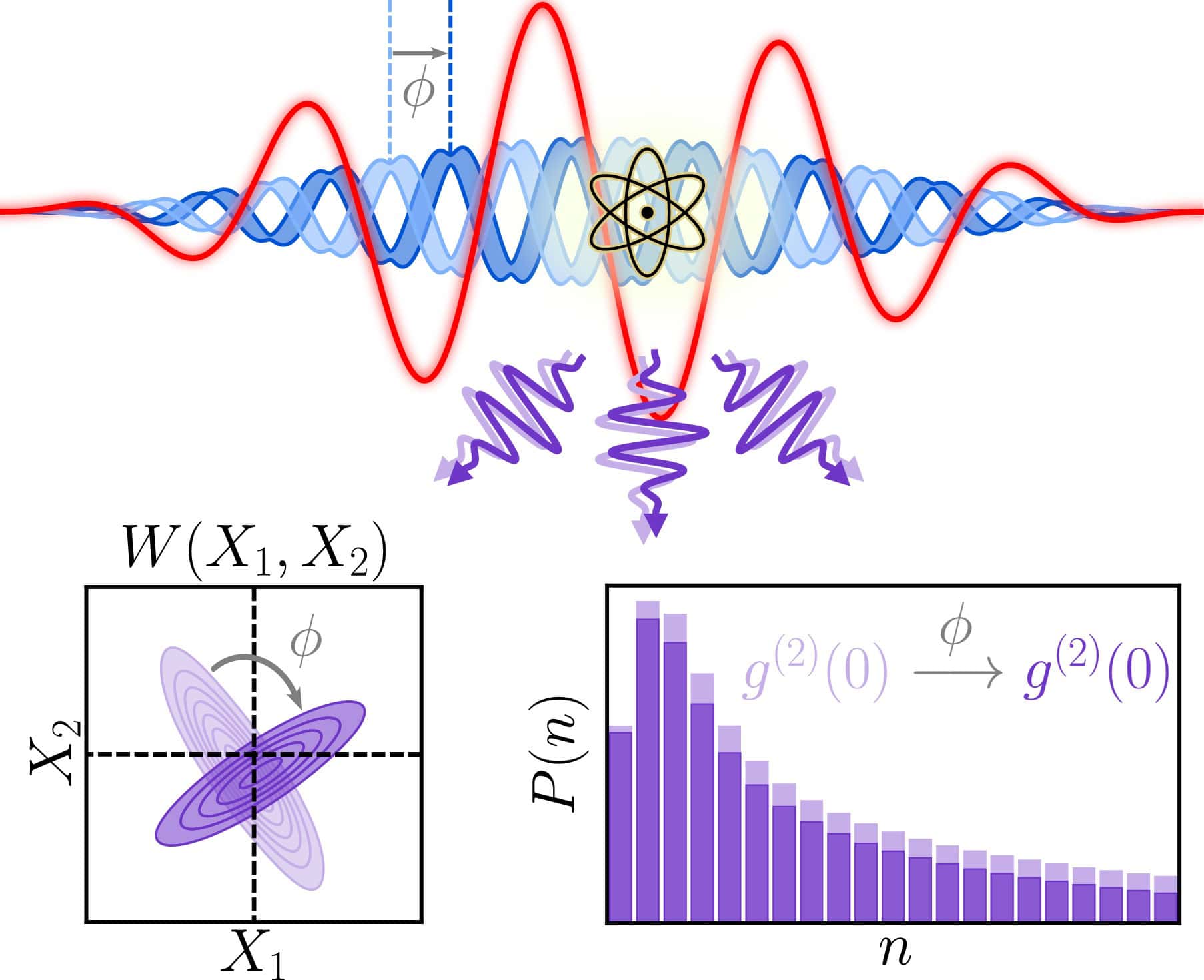
By combining quantum optics with common attosecond techniques, the work shows how ultrafast science is increasingly becoming a platform not just for watching electrons move, but also for studying light itself at the shortest timescales accessible in the laboratory.
Read the full article
Attosecond quantum optical interferometry – IOPscience
J. Rivera-Dean et al 2026 Rep. Prog. Phys. 89 047901
Do you want to learn more about this topic?
The physics of attosecond light pulses – IOPscience by P. Agostini and L. F. DiMauro (2004)
The post Attosecond interferometry meets quantum optics appeared first on Physics World.
