Normal view

How to model a net‑zero system across timescales

27 May 2026 at 08:51

A successful clean‑energy transition depends on understanding how to balance variable renewable power with the growing electricity demands of transport, heating, and industry. A key challenge is capturing how renewable energy sources like wind and solar fluctuate hour by hour, but this variability also creates new opportunities to align supply with increasingly flexible forms of demand, such as electric vehicles, heat pumps, and other electrified services. Alongside these short‑term dynamics, it is equally important to determine the long‑term infrastructure needed to support a fully decarbonised energy system.

In this research, two powerful models (REMIND and PyPSAEur) are linked and allowed to exchange information repeatedly to determine both what infrastructure should be built and how it would operate each hour of the year. REMIND is a global energy and climate model that looks decades ahead, analysing investments, technology choices, and pathways to netzero. PyPSAEur is a detailed model of the European electricity system that simulates realtime grid behaviour. By combining a model that excels at longterm planning with one that captures hourly power system dynamics, the researchers create a much more realistic tool for answering these complex questions. 

They then test this approach on a Germany case study under two conditions: one with demandside flexibility (where electricity use can shift to cheaper hours, such as smartcharging electric vehicles) and one without flexibility. Their findings show that a fully renewable energy system is technically and economically achievable, that flexible systems perform far better than inflexible ones, and that even with flexibility, electricity prices can vary significantly between sectors, creating political challenges around fair pricing. Both scenarios of the German case study reach net-zero emissions by 2045.

This research gives policymakers a clearer way to design reliable, affordable, fully renewable energy systems by showing how to integrate renewables, manage electrification, use flexibility to reduce costs, understand sectoral price differences, and build markets. 

“Models used to inform climate policy have always faced a fundamental trade-off: they either capture the long-term perspective needed for investment decisions, or the hourly detail needed for power system planning, but not both. Our coupling of REMIND and PyPSA-Eur is a first step towards resolving this trade-off for an increasingly electric future energy system.” – Dr Adrian Odenweller, Potsdam Institute for Climate Impact Research

Read the full article

REMIND-PyPSA-Eur: integrating power system flexibility into sector-coupled energy transition pathways

Adrian Odenweller et al 2026 Prog. Energy 8 025001

Do you want to learn more about this topic?

The role of grid-forming inverters in enabling high penetration of renewable energy in power systems: standards, ancillary services, current deployment, and future perspectives Ali Q Al-Shetwi et al. (2026)

The post How to model a net‑zero system across timescales appeared first on Physics World.
The hidden mechanics behind earthquakes

27 May 2026 at 08:08

Earthquakes occur when tectonic plates rub against each other, become temporarily stuck, and then suddenly release accumulated stress as they slip. Although earthquakes have been studied for decades, the microscopic mechanics that cause faults to stick, slip, and generate friction are still not fully understood. 

In this research, scientists use a granite-on-granite system to investigate these processes. Granite is common in continental crust and mechanically similar to many fault rocks, making it a strong laboratory analogue. The researchers used three complementary approaches. First, they performed controlled experiments measuring friction, wear, and surface roughness as two granite surfaces slid past each other, including tests with water, different temperatures, and different sliding speeds. Second, they ran molecular dynamics simulations of a silica (amorphous SiO₂) tip sliding on quartz (crystalline SiO₂), the dominant mineral in granite, to observe how atomic bonds break, phases transform, heat builds up, and friction emerges. Third, they applied theoretical models of contact mechanics (how surfaces actually touch through tiny asperities) and flash heating (how much local heating occurs and whether it weakens the material). 

Traditionally, earthquake models assume that friction comes from mechanical processes such as asperity interlocking (high points locking together), plowing (hard grains digging into the opposite surface), and gouge grinding (crushed particles resisting motion). However, this study shows the opposite of what those models predict: more wear leads to less friction, and less wear leads to more friction. Instead of friction coming from grains digging or grinding, it arises from tiny asperities that plastically flatten, coldweld together, and resist sliding because their welded atomic bonds must be broken. This represents a major shift in how fault friction is understood. 

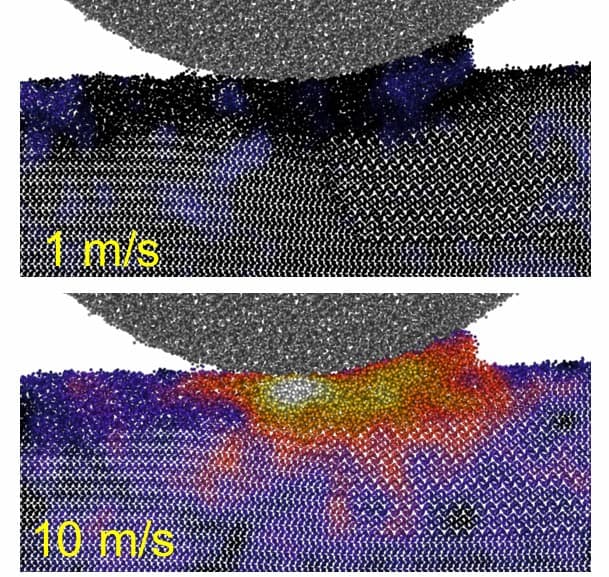
Rigid tip sliding over quartz at two velocities
Rigid tip sliding over quartz at two velocities.
Brighter colours indicate higher temperatures. (Courtesy: Bo Persson/ Chinese Academy of Sciences)

The study also finds that friction is largely insensitive to temperature, sliding speed, and hold time, suggesting that classic rate-state friction laws may not scale to real faults. The simulations identify three main energy dissipation mechanisms which are bond breaking, plastic deformation, and stressinduced phase changes. This shows that flash heating at laboratory speeds is too small to weaken quartz, whereas earthquake level slip speeds would generate much stronger thermal weakening. They also reveal that certain quartz polymorphs can form purely from stress, meaning their presence in natural faults does not necessarily indicate high temperatures. 

Taken together, these results suggest that fault friction is dominated by adhesive bonding at asperities rather than mechanical grinding, and that tectonic motion may be governed more by creepslip than classic stickslip behaviour. 

Read the full article

Granite sliding on granite: friction, wear rates, surface topography, and the scale-dependence of rate–state effects

Sergey V Sukhomlinov et al 2026 Rep. Prog. Phys. 89 038301

Do you want to learn more about this topic?

The physics of earthquakes by Hiroo Kanamori and Emily E Brodsky (2004)

The post The hidden mechanics behind earthquakes appeared first on Physics World.

Solar at the centre of Nigeria’s future

26 May 2026 at 08:37

Nigeria is Africa’s most populous country and one of its largest economies, which puts enormous pressure on its electricity system. At the same time, the country has committed to reaching net‑zero emissions between 2050 and 2070. Today, Nigeria’s power sector is underpowered, unreliable for many citizens, and heavily dependent on fossil fuels and diesel generators, which are costly and polluting.

This study explores pathways for Nigeria to reach net‑zero emissions by 2050, 2060, and 2070, focusing on which technologies would be required. Across all scenarios, solar power becomes the backbone of the system, providing 37–55% of electricity by 2050 and remaining central in the two longer term scenarios. Nuclear power also plays a major role when allowed, but faces barriers such as high upfront costs, regulatory capacity, and public safety concerns. If nuclear is excluded, Nigeria must rely even more on solar and on gas with carbon capture and storage (gas-CCS).

Although transitioning to net‑zero requires significant upfront investment, the study finds that a clean electricity system is cheaper overall than continuing with fossil fuels, and earlier transitions do not significantly increase total costs.

The authors conclude that Nigeria should build a balanced clean‑energy mix (solar, hydro, nuclear, gas‑CCS), rapidly scale up solar deployment, strengthen institutions, mobilise international and private financing, and coordinate regionally to ensure a reliable, affordable, and achievable transition.

“Nigeria’s electricity transition is not only a climate challenge; it is also a development and reliability challenge. Our analysis shows that solar power will be central to any net-zero pathway, but achieving an affordable and dependable electricity system will require a diversified mix of clean technologies, stronger institutions, and sustained investment in the grid and supporting infrastructure.” – Dr Michael Dioha, Clean Air Task Force

Read the full article

Technology options and optimal pathways to a net-zero electricity system in Nigeria across different timelines

Michael O Dioha et al 2026 Prog. Energy 8 014001

Do you want to learn more about this topic?

The zero-emissions cost of energy: a policy concept Colin Beal and Carey King (2021)

The post Solar at the centre of Nigeria’s future appeared first on Physics World.

Ferroelectric band gaps are not what we thought

13 May 2026 at 09:06

Ferroelectric materials have a permanent electric dipole, an internal separation of the centres of positive and negative ionic lattices, that can be flipped by applying an electric field. They also undergo a structural change at a material dependent temperature. known as the Curie temperature, above which this dipole behaviour disappears. Despite having permanent dipoles, ferroelectrics are insulating materials. These properties make them valuable in technologies such as sensors, actuators, and memory devices. 

In this work, the researchers study the band gaps of ferroelectric materials to better enable their use in energy conversion, catalysis, and optoelectronic devices, where understanding light absorption and electron behaviour is essential. Traditionally, the band gap in ferroelectrics has been treated as a single number. However, ferroelectrics are not conventional semiconductors. They contain localized charges, polarons, internal dipoles, and structural disorder. These features give rise to three distinct band gaps, not one. 

There is the intrinsic fundamental band gap, defined as the ground state difference between the fully occupied valence band and the completely empty conduction band. The smaller optical gap is associated with light induced transitions involving bound electron-hole pairs (excitons), and the even smaller transport gap associated with electrical conduction via localised electronic carriers. 

In this study, the authors determine the fundamental, optical, and transport gaps using Xray photoelectron spectroscopy, optical spectroscopy, and electrical conductivity measurements, respectively, for NBT6BT and NaNbO₃. The fundamental gap values are further supported by DFT calculations. Because these three gaps differ by about 1 eV or more, different experiments have actually been probing different gaps all along, meaning past optical and electrical results were often compared incorrectly, leading to widespread misinterpretation. The conclusion establishes that ferroelectrics possess three fundamentally different energy gaps, explains why they differ, provides a framework for measuring them, confirms their values theoretically, and highlights why this distinction is crucial for designing future energy and electronic technologies. 

Do you want to learn more about this topic?

Prospects and applications near ferroelectric quantum phase transitions: a key issues review by P ChandraG G LonzarichS E Rowley and J F Scott (2017)

The post Ferroelectric band gaps are not what we thought appeared first on Physics World.

How polarons travel through TiO₂

6 May 2026 at 10:47

Complex oxide materials form a large family of compounds with highly tuneable electronic properties, making them important for electronics, magnetic devices, and energy technologies. In many of these materials, electrons interact strongly with lattice vibrations and form polarons, quasiparticles consisting of an electron plus the surrounding lattice distortion. Polarons play a key role in determining how materials conduct electricity, but they are difficult to study because theoretical modelling requires advanced methods to describe strong electron-lattice interactions characteristic of polarons, and experiments must be performed on ultraclean samples to reveal intrinsic behaviour.

In this work, the researchers combine experimental and theoretical approaches to study polarons in TiO₂, a material that is ideal for this purpose because it has a simple crystal structure, well‑known phonon modes, well‑characterised defects, and strong, reproducible electron-phonon coupling. They use a state of the art simulation method called first‑principles electron‑phonon diagrammatic Monte Carlo (FEP‑DMC), which accurately predicts polaron formation and transport. The calculations predict a room temperature mobility of around 45 cm² V⁻¹ s⁻¹ and a characteristic temperature scaling of μ ∝ T⁻¹·⁹, while also revealing microscopic details of polaron structure, phonon cloud distribution, and lattice distortion that experiments alone cannot access.

Lead researchers Marco Bernardi (left) from California Institute of Technology and Bharat Jalan (right) from University of Minnesota
Lead researchers Marco Bernardi (left) from California Institute of Technology and Bharat Jalan (right) from University of Minnesota (Courtesy: Bernardi/California Institute of Technology and Jalan/ Minnesota)

The team then grew ultrahigh‑quality TiO₂ thin films with controlled oxygen vacancies using hybrid molecular beam epitaxy, achieving record high electron mobility in excellent agreement with the theoretical predictions. Microscopy and spectroscopy measurements show that oxygen vacancies act as intrinsic n‑type dopants and strongly influence low‑temperature transport, including in‑plane resistance anisotropy and signatures of the Kondo effect.

Together, these results provide the most detailed picture to date of how large polarons move in TiO₂ and demonstrate that the theoretical method is a reliable predictive tool for polaronic materials. This unified framework will help guide the design and engineering of improved electronic and energy materials in the future.

Do you want to learn more about this topic?

Review Phonons and thermal transport in graphene and graphene-based materials by Denis L Nika and Alexander A Balandin (2017)

The post How polarons travel through TiO₂ appeared first on Physics World.

When Fermi arcs flip, the current flips

6 May 2026 at 10:45

Weyl semimetals are quantum materials in which electrons behave as if they are massless, moving with a linear energy-momentum relationship similar to photons. These materials also host Weyl fermions with a built‑in chirality, meaning their spin and momentum are locked in either a left‑ or right‑handed configuration.

A distinctive feature of Weyl semimetals is the presence of Fermi arcs which are surface electronic states that connect projections of bulk Weyl nodes. Because these arcs inherit the chirality of the underlying Weyl fermions, their motion is directionally biased and highly sensitive to the surface environment. This makes them promising for surface‑state engineering in topological devices.

The researchers show that the surface of the Weyl semimetal Co₃Sn₂S₂ can generate a strong, tunable second‑order nonreciprocal electrical response, which depends sensitively on the surface termination and can be further controlled by adjusting the surface potential. Crucially, when the Fermi arcs undergo a Fermi arc Lifshitz transition, a change in how the arcs connect across the surface Brillouin zone, the nonlinear current reverses sign. This sign flip arises from the chiral nature of electron velocities on the arcs.

The work demonstrates that measuring nonreciprocal transport provides a direct and experimentally accessible fingerprint of Fermi arc topology, offering a practical route to track and control surface states in Weyl semimetals without relying on complex surface‑sensitive probes.

Read the full article

Nonlinear transport fingerprints of tunable Fermi-arc connectivity in magnetic Weyl semimetal Co3Sn2S2

K X Jia et al 2026 Rep. Prog. Phys. 89 020503

Do you want to learn more about this topic?

Recent progress on correlated electron systems with strong spin–orbit coupling by Robert SchafferEric Kin-Ho LeeBohm-Jung Yang and Yong Baek Kim (2016)

The post When Fermi arcs flip, the current flips appeared first on Physics World.

Strain engineered single crystal silver films

29 April 2026 at 08:52

It is straightforward to produce polycrystalline metal films on wafers but producing singlecrystal metal films is far more challenging. Because single crystals have no grain boundaries (the joints between differently oriented crystal regions in polycrystalline materials), they offer much better electrical performance: higher conductivity, lower resistive losses, improved highfrequency behaviour (important for highspeed communication and 5G), and reduced noise for quantum technologies. As a result, methods for reliably producing singlecrystal films are highly sought after. 

Singlecrystal silver and copper films are particularly valuable. Silver is an exceptional conductor of both electricity and light, while copper provides excellent thermal management and reduces resistive heating. However, growing silver on copper is notoriously difficult because the two materials have a large lattice mismatch (13%), which normally introduces strain, defects, dislocations, and rough, lowquality films. This makes conventional epitaxy essentially impossible. 

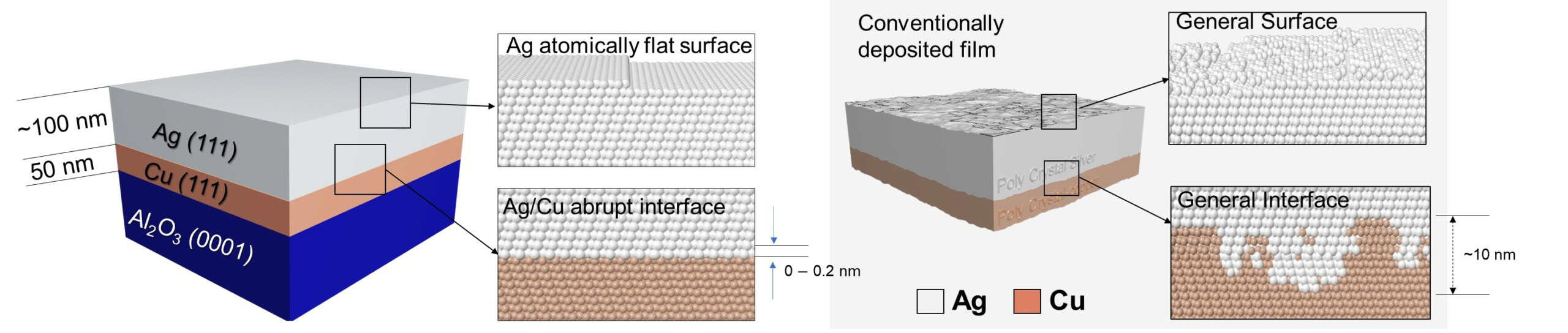
Schematics of a heteroepitaxial Ag film on a Cu buffer layer/Al2O3 substrate (left) and a rough surface and thick (or mixed) interface of a conventionally deposited Ag thin film (right)
Schematics of a heteroepitaxial Ag film on a Cu buffer layer/Al2O3 substrate (left) and a rough surface and thick (or mixed) interface of a conventionally deposited Ag thin film (right), from figure 1 in article (Courtesy: Su Jae Kim et al 2026 Rep. Prog. Phys. 89 028002)

In this work, the researchers overcame this barrier using Atomic Sputtering Epitaxy, which allows precise atomic deposition, combined with postannealing to reduce twin boundaries. They discovered that the mismatch strain is absorbed entirely within the first atomic layer of silver. This occurs because the atoms at the interface shift sideways in a periodic, controlled pattern that releases the strain. This represents a new form of heteroepitaxy in which two materials with different lattice periodicities can still grow together seamlessly. 

They demonstrated waferscale, defectfree singlecrystal silver films on copper despite the huge lattice mismatch, enabling ultrahigh quality metal films for advanced optical and electronic technologies. This approach opens the door to new heteroepitaxial systems and provides a route to producing silver films with exceptional optical and electronic performance. 

“What we find most notable is that a 13% lattice mismatch, which would normally prevent clean heteroepitaxy, is absorbed almost entirely within the first monoatomic Ag layer at the Ag/Cu interface, allowing the film above to grow as if on its own native lattice and yielding wafer-scale, grain-boundary-free films with atomically flat surfaces. We hope this concept of a strain-absorbing monolayer interface can be extended to other dissimilar metal pairs.” – Professor Young-Min Kim, Sungkyunkwan University

Read the full article

Homoepitaxy-like heteroepitaxy via monolayer interface achieves grain-boundary-free ultraflat silver thin films

Su Jae Kim et al 2026 Rep. Prog. Phys. 89 028002

Do you want to learn more about this topic?

Si/Ge nanostructures by Karl Brunner (2001)

The post Strain engineered single crystal silver films appeared first on Physics World.

A new standard for p‑wave scattering theory

29 April 2026 at 08:51

Physicists study ultracold lithium6 because it is a fermionic isotope of lithium: its nucleus contains three protons and three neutrons, giving it a halfinteger total spin. This makes lithium6 behave like other fundamental fermions such as electrons, protons, and neutrons, in contrast to lithium7, which has an integer spin and is a boson. According to the Pauli exclusion principle, fermions cannot occupy the same quantum state, so lithium6 provides a clean, controllable system for exploring how fermionic particles behave. It is also relatively easy to cool to ultracold temperatures, and its interactions can be tuned very precisely using magnetic fields. At these temperatures, atomic motion slows dramatically, allowing quantum mechanical effects to become directly observable. 

In this work, the researchers studied threebody recombination processes, where three atoms collide and two of them form a molecule while the third atom carries away the excess energy. The escaping atom has information about how the three atoms interacted. By tuning the interactions with a magnetic field using a Feshbach resonance, the researchers were able to access a pwave resonance (where atoms collide with orbital angular momentum) rather than the more common swave (headon collisions). Pwave interactions are especially important because they are linked to exotic quantum systems such as topological superfluidity and strongly correlated fermionic phases. 

The researchers developed a highly stable technique to measure how often atoms are lost due to threebody recombination for different orbital orientations of the collision. This highprecision method allowed them to distinguish the orbital components, measure how the recombination rate changes with temperature and magnetic field and extract microscopic parameters that characterize pwave interactions. This work establishes a precise benchmark for pwave scattering theory, introduces a powerful method for probing directiondependent interactions, and lays the groundwork for exploring complex quantum phenomena such as anisotropic pairing, fewbody universality, and topological superfluidity relevant to future quantum technologies.  

Read the full article

Orbital-resolved three-body recombination across a p-wave Feshbach resonance in ultracold 6Li

Shaokun Liu et al 2026 Rep. Prog. Phys. 89 020502

Do you want to learn more about this topic?

Single atom detection in ultracold quantum gases: a review of current progress by Herwig Ott (2016)

The post A new standard for p‑wave scattering theory appeared first on Physics World.

Long range attraction between like charged particles

22 April 2026 at 08:49

A fundamental theory in electrostatics is that two particles with the same charge will repel and two particles with opposite charge will attract. This idea is built into most models that describe how particles behave in liquids. Yet over the past several decades, experiments have revealed that like charged particles can attract each other in solution, forming clusters that standard theories cannot explain. 

In this work, researchers explore this unusual phenomenon and find that the attraction between likecharged particles is strong, longranged, and sensitive to the particles’ surface chemistry and size. Using optical imaging, they directly observed how pairs of charged microscopic spheres interact in different liquids with high precision. They tested particles with various surface coatings, including DNA and lipid bilayers, the same material that forms cell membranes. 

Conventional electrostatic models treat the solvent as a uniform medium with a single dielectric constant, but real solvents (such as water) have structure, form hydrogen bond networks, orient themselves around charged surfaces, and can exhibit longrange correlations. This research suggests that the way water molecules organise around charged surfaces creates an additional attractive force, known as the electrosolvation force. DNA coated and lipid coated particles show especially longrange attraction, indicating that the interaction depends not only on the solvent but also on the chemical and structural properties of the particle surface. 

Overall, this work shows that like charged particles can attract each other over unexpectedly long distances, something current theories say should not happen, revealing a missing piece in our understanding of electrostatic forces in liquids. These insights could reshape models of biological self-organisation and help explain how molecules such as DNA, RNA, and membranes naturally cluster and form structures inside cells. 

We are really excited about this emerging discovery and the possibility that what has been uncovered so far on interactions in fluids may be just the tip of the iceberg…” – Professor Madhavi Krishnan, University of Oxford

Read the full article

Direct measurement of the attractive electrosolvation force between a pair of colloidal particles

Sida Wang et al 2026 Rep. Prog. Phys. 89 028101

Do you want to learn more about this topic?

Assembly of colloidal particles in solution by Kun Zhao and Thomas G Mason (2018)

The post Long range attraction between like charged particles appeared first on Physics World.
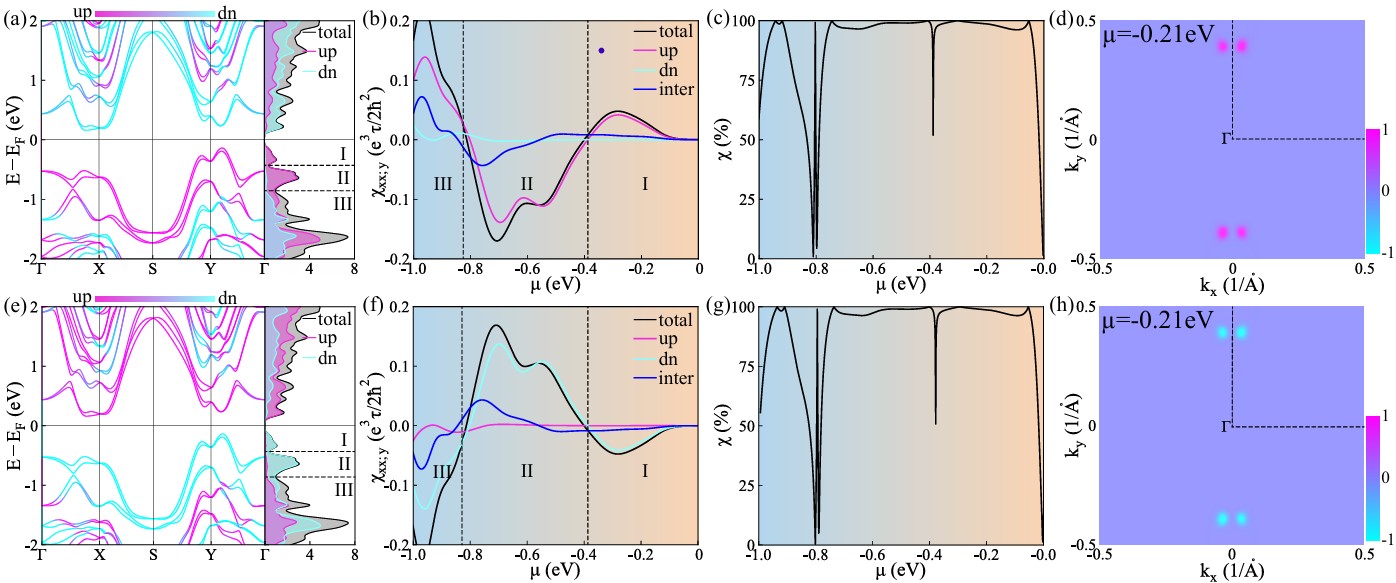
Hidden polarization unlocks non-volatile Hall switching

22 April 2026 at 08:48

The Hall effect is a voltage that appears across a material when a current flows through it in the presence of an external magnetic field. The nonlinear Hall effect, however, can occur without a magnetic field if the material’s internal structure is asymmetric. It typically appears under an AC or oscillating electric field, and the resulting Hall voltage scales with the square of the input current, making it a nonlinear response. Researchers are interested in this effect because it could enable new types of sensors, low‑power logic elements, and electrically switchable quantum devices. But so far, the nonlinear Hall effect has been difficult to control in a reliable, switchable way. In this work, the scientists demonstrate a new method to control the second‑order nonlinear Hall effect using a gate electric field. They show that certain bilayer materials can switch the effect on and off when a gate field is applied, functioning much like a transistor. The switching is non-volatile, binary (ON/OFF), and does not require magnetism.

The researchers focus on bilayer SnSe and SnTe, well known ferroelectric and thermoelectric materials. Although these bilayers appear symmetric overall, each layer carries a hidden internal polarization. This hidden polarization is tied to a layer‑locked hidden Berry curvature dipole, the quantum property responsible for generating the nonlinear Hall effect. Under a gate field, the hidden polarization behaves like a pseudospin, and the gate field acts as a pseudospin Zeeman field, selecting the preferred orientation of this polarization. Reversing the direction of the gate field flips the pseudospin orientation and therefore switches the nonlinear Hall response.

Layer-resolved band dispersions and projected density of states
Layer-resolved band dispersions and projected density of states, from figure 3 in article (Courtesy: Xiaoliang Xiao et al 2026 Rep. Prog. Phys. 89 020501)

By screening 80 possible bilayer symmetry groups, the authors identify 18 that can host this switchable effect, establishing a universal design principle for creating electrically switchable nonlinear Hall devices. This approach combines symmetry analysis, effective modelling, and first‑principles calculations, and it opens the door to future nonlinear quantum electronics. The same design principle can also be extended to other gate‑field-controllable nonlinear transport and optical phenomena, including the circular photogalvanic effect, the nonlinear Nernst effect, and second‑harmonic generation.

Read the full article

A universal design principle for switchable control of the second-order nonlinear Hall effect

Xiaoliang Xiao et al 2026 Rep. Prog. Phys. 89 020501

Do you want to learn more about this topic?

Recent advances in the spin Hall effect of light by Xiaohui LingXinxing ZhouKun HuangYachao LiuCheng-Wei QiuHailu Luo and Shuangchun Wen (2017)

The post Hidden polarization unlocks non-volatile Hall switching appeared first on Physics World.

Ferroelectric devices push reservoir computing forward

15 April 2026 at 11:01

Reservoir computing is a computational approach well suited to time‑dependent tasks such as speech recognition, because it relies on internal dynamics, nonlinear responses, and short‑term memory of recent inputs. However, most hardware implementations consume too much power and lack the rich dynamics needed for complex problems. In this study, the researchers introduce a new reservoir‑computing device made by connecting a ferroelectric capacitor (FC) in series with a linear capacitor (LC). This FC-LC device naturally provides the two essential ingredients of a reservoir: nonlinearity, through polarization switching and back‑switching in the ferroelectric layer, and fading memory, through slow charge accumulation and relaxation.

The device offers several advantages over existing reservoir hardware. It operates at extremely low power, produces a direct voltage output without extra circuitry, and has widely tuneable time constants, allowing it to respond quickly or slowly depending on the task. It also supports bidirectional operation, which increases the richness of its internal states and improves performance on classification tasks. By combining FC-LC devices with different time constants, the researchers create a hybrid reservoir with even greater computational capacity.

The system performs exceptionally well on a range of benchmarks, including heartbeat anomaly detection, waveform classification, multimodal digit recognition, and prediction of chaotic time‑series data. Because the device can be fabricated using established semiconductor processes and can be extended to widely used ferroelectric materials such as hafnium oxide, it is well positioned for large‑scale integration and future commercial reservoir‑computing hardware. This work lays the foundation for scalable, energy‑efficient reservoir systems that could enable fast, on‑chip processing in next‑generation electronics.

Do you want to learn more about this topic?

Many-body localization in the age of classical computing by Piotr SierantMaciej LewensteinAntonello ScardicchioLev Vidmar and Jakub Zakrzewski (2025)

The post Ferroelectric devices push reservoir computing forward appeared first on Physics World.

A new explanation for negative thermal expansion

8 April 2026 at 09:42

Most materials expand when heated because increased atomic vibrations push atoms slightly farther apart. However, some unusual materials, such as α‑Cu₂V₂O₇, instead shrink when heated, a phenomenon known as negative thermal expansion. Although this behaviour had been observed before, its underlying mechanism was not well understood. In this study, the researchers examined α‑Cu₂V₂O₇ from 5 K to 800 K using neutron diffraction, synchrotron X‑ray diffraction, Raman spectroscopy, and first‑principles calculations. They found that the material exhibits three distinct thermal‑expansion regimes: almost no expansion below 35 K, strong negative thermal expansion between 35 K and 550 K, and normal positive expansion above 550 K.

The origin of this behaviour lies in how copper atoms move within distorted CuO₆ like octahedra. At the lowest temperatures, a quantum effect called the second‑order Jahn-Teller effect pushes the copper atoms off‑centre, but this motion is partly suppressed by the onset of antiferromagnetic ordering, which stabilises the structure and produces near‑zero thermal expansion. As the temperature increases, the second‑order Jahn-Teller effect weakens, allowing the copper atoms to shift back toward the centre of their octahedra, but in opposite directions along different structural chains. This anti‑off‑centering motion compresses the Cu-Cu zigzag chains and also reduces the spacing between neighbouring chains, pulling the structure inward and producing the observed negative thermal expansion.

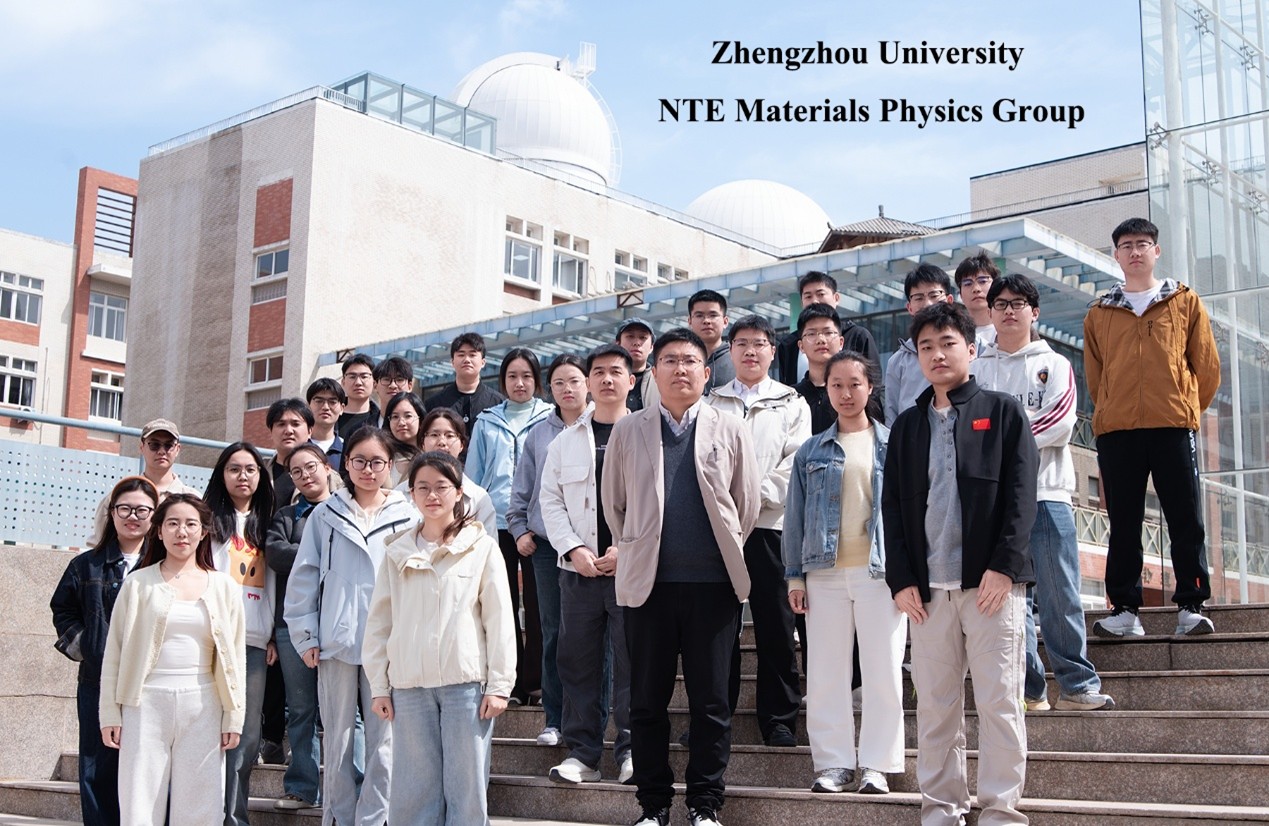
The Negative Thermal Expansion Materials Physics Group at Zhengzhou University
The Negative Thermal Expansion Materials Physics Group at Zhengzhou University was established by Professor Qilong Gao in 2023. The team conducts in-depth characterization and mechanistic investigations by leveraging major large-scale scientific facilities, including SPring-8, ESRF APS, SSRF, ELETTRA, and CSNS. (Courtesy: Gao/Zhengzhou University)

The researchers also found that the copper atoms have unusually large vibrational freedom along one axis, which helps enable this motion. Raman spectroscopy revealed an anomalous broadening of a low‑frequency vibrational mode, providing evidence for electron-phonon coupling that further supports the proposed mechanism. Together, these effects explain the unusual thermal behaviour of α‑Cu₂V₂O₇ and offer valuable insight for designing materials with controlled thermal expansion, which is important for precision engineering, electronics, and composite materials that must remain dimensionally stable across temperature changes. Meanwhile, this mechanism, centered on the Jahn–Teller effect, can be extended to a wide range of transition metal oxide systems, providing a universal theoretical foundation for systematically explaining the anomalous thermal expansion behavior of such materials.

Read the full article

Jahn–Teller distortions induced strong negative thermal expansion in α-Cu2V2O7

Xiangkai Hao et al 2026 Rep. Prog. Phys. 89 018005

Do you want to learn more about this topic?

Negative thermal expansion and associated anomalous physical properties: review of the lattice dynamics theoretical foundation by Martin T Dove and Hong Fang (2016)

The post A new explanation for negative thermal expansion appeared first on Physics World.

How topological surfaces strengthen magnetism

8 April 2026 at 09:41

In this work the researchers explore what happens when a topological insulator is placed next to a two‑dimensional ferromagnetic insulator. Experiments have shown that this arrangement dramatically increases the ordering temperature of the ferromagnet. The theoretical study demonstrates that the surface electrons of the topological insulator mediate interactions between the magnetic moments in the neighbouring ferromagnetic material, strengthening its overall magnetism.

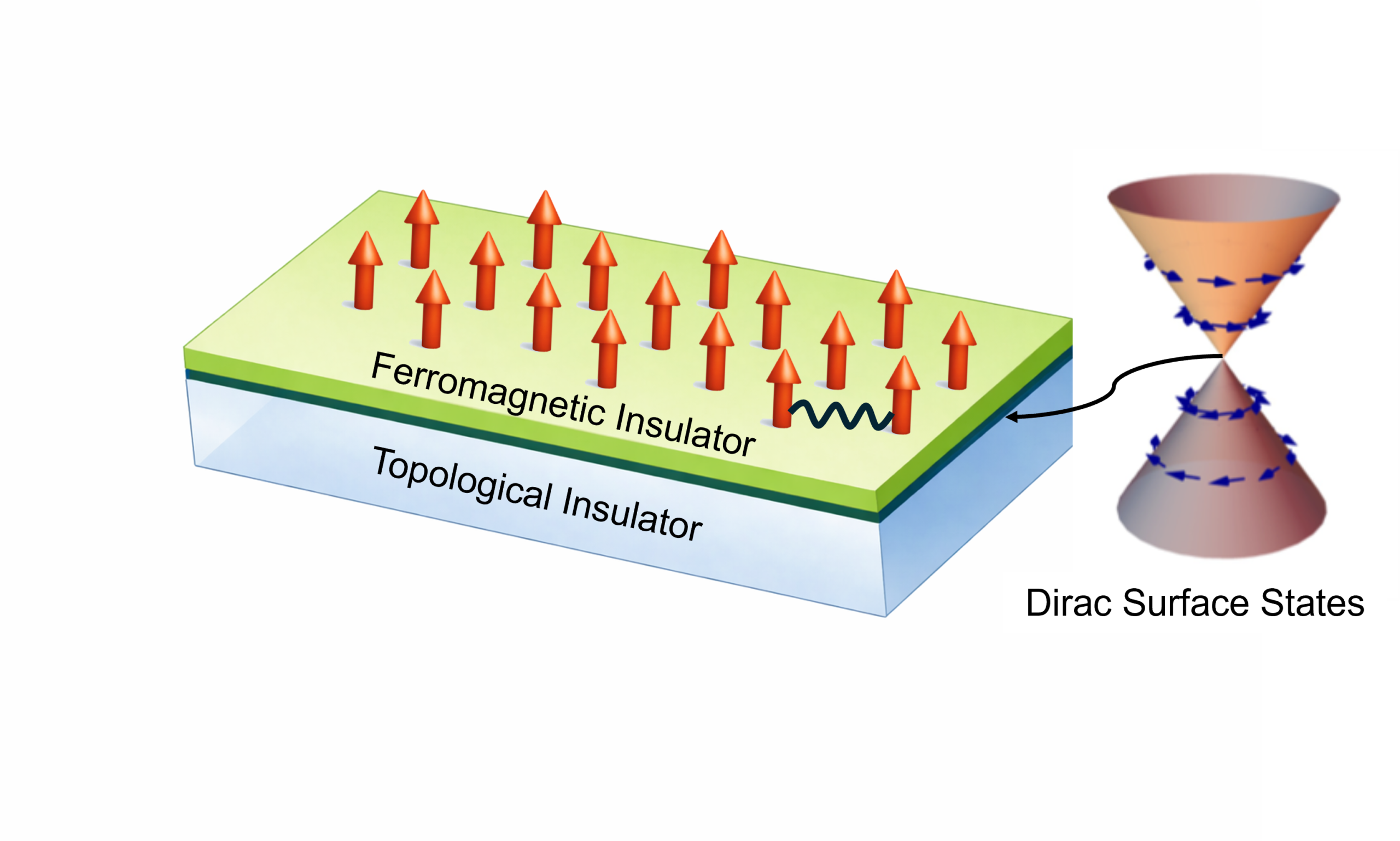
There are two main ways electrons in a nearby material can act as messengers between magnetic moments. The first is the well‑known Ruderman-Kittel-Kasuya-Yosida interaction, which arises in a metal from electrons at the Fermi level that produce long‑range, oscillatory coupling, typically in a regime when magnetic moments are sparse. The is the often overlooked Bloembergen-Rowland interaction, which in fact turns out to dominate in this system. This mechanism comes from virtual transitions between the valence and conduction bands of the topological insulator surface states and leads to strong, short‑ranged ferromagnetic interactions between the dense magnetic moments.

Schematic showing the Bloembergen-Rowland interaction (clack wavy line) between the local moments of a ferromagnetic insulator that is mediated by the Dirac surface states of a proximate topological insulator.
Schematic showing the Bloembergen-Rowland interaction (clack wavy line) between the local moments of a ferromagnetic insulator that is mediated by the Dirac surface states of a proximate topological insulator (Courtesy: Randeria/The Ohio State University)

Identifying the Bloembergen-Rowland interaction is significant because it naturally enhances ferromagnetism: it is strong, it does not oscillate, and it keeps the magnetic moments aligned. Due to the spin-momentum locking of the topological insulator’s surface states, this interaction also has a built‑in anisotropy that favours out‑of‑plane magnetic alignment. The researchers show that the increase in the magnetic ordering temperature is directly proportional to the Van Vleck susceptibility of the topological insulator’s surface electrons.

The study also examines how hybridisation between the top and bottom surfaces of a thin topological‑insulator film modifies the mediated interaction and affects the magnetic ordering temperature. This analysis helps explain recent experimental results in heterostructures made from chromium telluride and bismuth-antimony telluride. Overall, the work clarifies how topological surface states influence magnetism in these layered systems and provides a foundation for designing improved devices in spintronics, magnonics, and quantum technologies.

Read the full article

Enhancement of Curie temperature in ferromagnetic insulator-topological insulator heterostructures

Murod Mirzhalilov et al 2026 Rep. Prog. Phys. 89 018004

Do you want to learn more about this topic?

Characteristics and controllability of vortices in ferromagnetics, ferroelectrics, and multiferroics by Yue Zheng and W J Chen (2017)

The post How topological surfaces strengthen magnetism appeared first on Physics World.

❌