Login
Login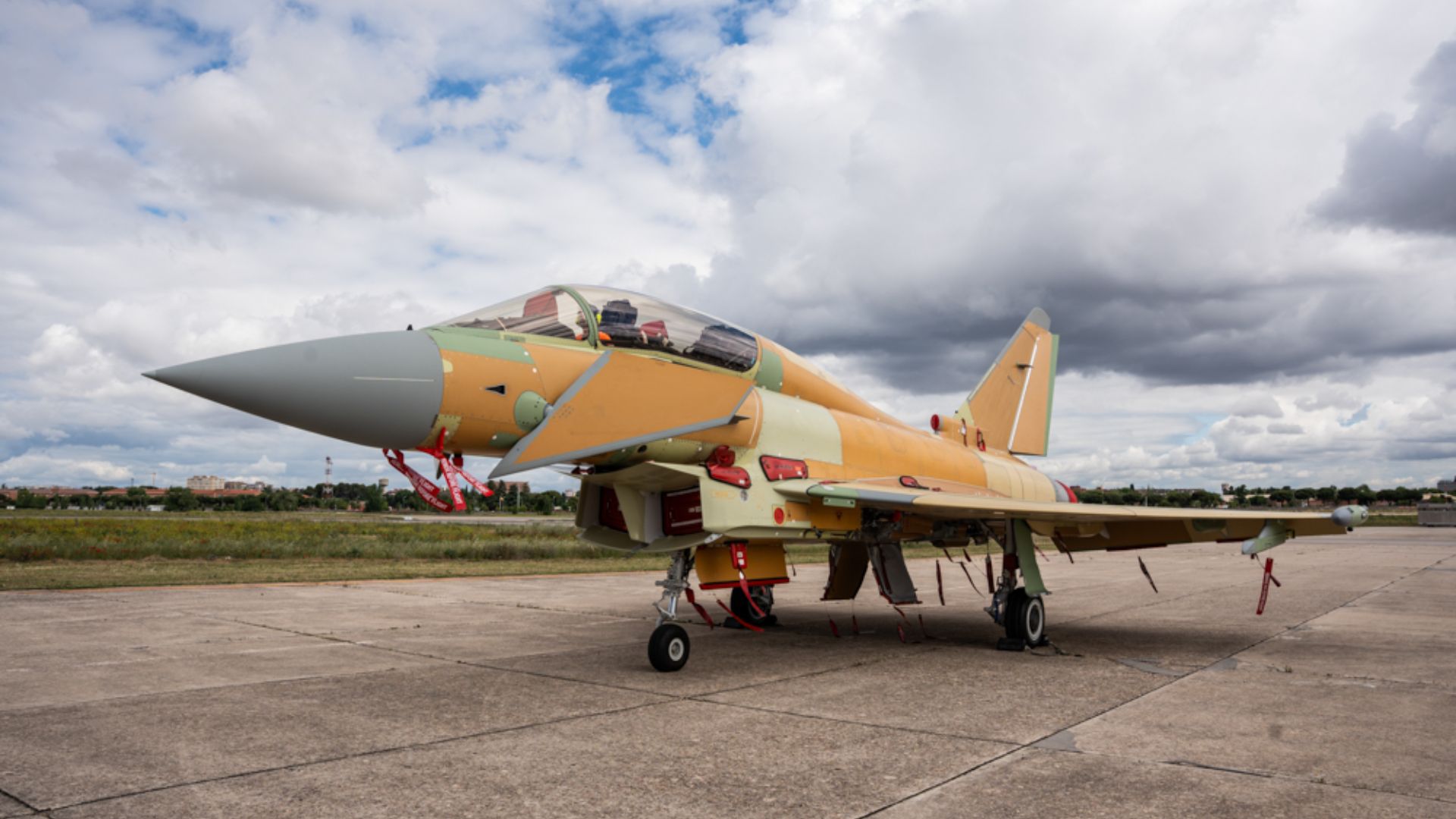

Next-gen Eurofighter jet boasts 1,550 mph top speed and advanced AESA radar

Spain has made significant progress in updating its air combat fleet. The first Eurofighter from the Halcon I program has left Airbus’ facility in Getafe, near Madrid. Airbus Defense and Space said on Monday that the jet is ready for engine testing and its first flight, bringing the Spanish Air Force closer to using its most advanced Eurofighter Typhoon yet.
This rollout marks the first jet from a 20-aircraft order Spain signed in June 2022. It is also the first Tranche 4 Eurofighter for Spain. Deliveries are set to start in 2026, but the Spanish Air Force Chief of Staff, General Francisco Braco Carbó, said the first three jets should join the fleet this year. The aircraft is capable of reaching a top speed of Mach 2.0, equivalent to roughly 1,550 mph (2,495 km/h).
Since 2003, Airbus’ Getafe site, about 9 miles (15 kilometers) south of Madrid, has built, tested, and delivered every Eurofighter for Spain.
New radar and missile systems boost combat capability
The Halcon I jets bring in new technology not seen on Spain’s earlier Eurofighters. The main upgrade is the E-Scan radar, an Active Electronically Scanned Array (AESA) system that replaces the older, mechanically rotating radar.
Unlike older radars, the AESA system uses many transmit-receive modules to electronically steer the radar beam, with no moving parts. This lets the fighter track several targets at once, quickly switch between air and ground missions, and lowers the chance of being detected by enemy electronic warfare.
The radar can also conduct electronic attacks against enemy sensors, giving the aircraft roles beyond traditional fighter missions.
Spain’s new jets will carry the Meteor missile, a ramjet-powered air-to-air weapon with a range of over 62 miles (100 kilometers). This missile can engage targets much farther away than the older AMRAAM used on previous Eurofighters. The jets will also have the Brimstone III precision missile for ground attacks.
— Airbus Defence (@AirbusDefence) June 1, 2026
The 20 HALCON aircraft will be equipped with E-Scan (Electronically Scanned) radar, with… pic.twitter.com/dOdwK0UEiA
Replacing aging Hornets in a strategic region
The Halcon I jets will replace Spain’s aging F-18 Hornets at Gando Air Base in the Canary Islands. The islands are about 62 miles (100 kilometers) from northwest Africa and are one of NATO’s most important spots in the eastern Atlantic.
Jets at Gando monitor the airspace around the Canary Islands, guard the approaches to the Strait of Gibraltar, and watch over important Atlantic sea routes. Their location also puts them close to possible security issues from North Africa.
With the current Hornets nearing retirement, Spain’s military chose the new Eurofighters to keep strong air defense and quick response in the region.
Spain expands its long-term Eurofighter investment
Madrid has boosted its commitment to the Eurofighter program beyond the first Halcon I order. In December 2024, Spain signed a second deal for 25 more jets under the Halcon II program.
With both orders, Spain has bought 45 Eurofighters since 2022. When all are delivered, the Spanish Air Force should have a fleet of 115 Eurofighters.
Halcon II jets will have the same advanced E-Scan radar, Meteor missile support, and better connectivity as the Halcon I aircraft. Both types will keep replacing F-18s in Spain’s Eurofighter units.
The Tranche 4 version also brings better cockpit displays, improved electronic warfare, and works with both current and future Eurofighter weapons. It is powered by two Eurojet EJ200 engines, each making about 20,230 pounds (90 kilonewtons) of thrust with afterburner.
These engines give the Typhoon a key advantage: supercruise. The jet can fly at supersonic speeds without afterburners, saving fuel and extending its range. Few modern fighters have this feature, and the old F-18s cannot match it.