
 Login
Login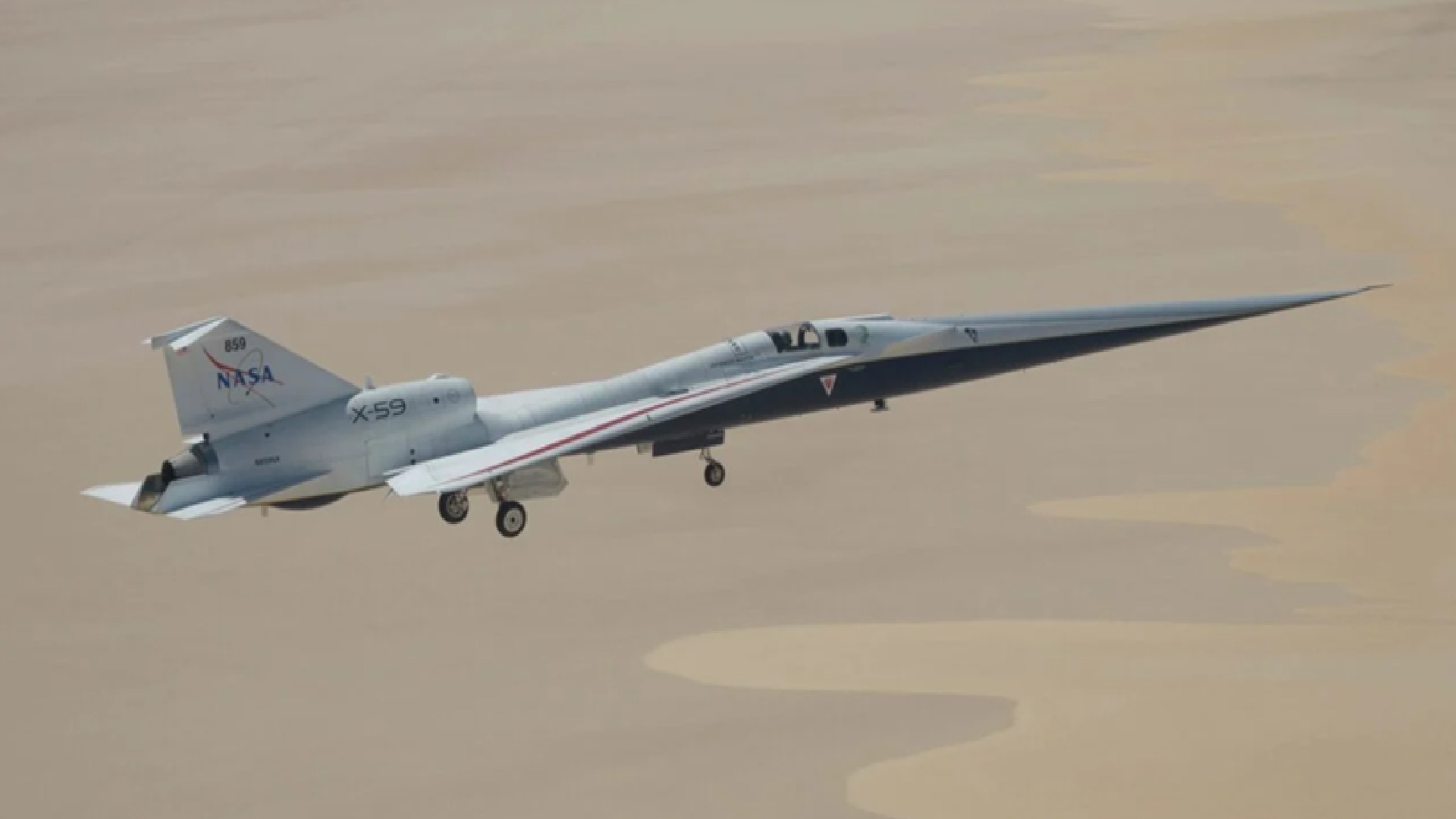

NASA approves Lockheed Martin X-59 for maiden supersonic test flight phase

NASA’s X-59 experimental aircraft, developed under the agency’s Quesst mission in partnership with Lockheed Martin Skunk Works, is preparing for its most demanding test phase to date: flying over populated communities to measure how residents perceive its sonic signature on the ground.
The results are intended to give regulators concrete data on whether current rules banning overland supersonic commercial flight in the United States should be revised.
Built around acoustics, not speed
The X-59 is not a speed demonstrator. Its design objective is acoustic shaping — specifically, suppressing the conventional sonic boom into what engineers describe as a “sonic thump,” a quieter pressure wave that the aircraft’s geometry is engineered to produce.
The airframe is roughly 99 feet long with a needle-like nose section that accounts for about a third of its total length. That elongated forebody distributes the pressure gradients that normally coalesce into a sharp N-wave shockwave, the defining cause of the loud double-boom heard on the ground during supersonic flight.
The aircraft is designed to cruise at approximately Mach 1.4 at 55,000 feet, generating a ground-level noise signature targeting around 75 Perceived Level decibels (PLdB) — roughly equivalent to the sound of a car door closing, according to NASA’s published mission parameters. For reference, a conventional supersonic aircraft produces a boom in the range of 105 to 110 PLdB.
How the test profile changes
Flight envelope expansion at Edwards Air Force Base was the first hurdle. Pilots had to validate structural performance, engine behavior, and handling qualities before the program could progress to acoustic validation — measuring actual boom signatures using microphones and ground sensors beneath the flight path. That phase established the baseline acoustic data from controlled conditions.
The community overflight phase introduces a fundamentally different variable: human perception. NASA will conduct flights over select U.S. cities, collecting responses from residents through surveys.
The agency is looking not just for decibel readings but for psychoacoustic data — how disruptive or acceptable people find the sound in a real residential context, factoring in background noise, time of day, and subjective annoyance thresholds.
This methodology draws on earlier NASA work with the F-18 at reduced-boom conditions, but the X-59 is the first purpose-built low-boom demonstrator to undergo this protocol at scale.
Regulatory stakes behind flight data
The Federal Aviation Administration prohibits civil supersonic flight over land in the United States under rules that have remained largely unchanged since the early 1970s. Those regulations were written in direct response to community complaints during supersonic transport trials, before any engineering framework existed for low-boom design.
NASA’s position is that the X-59 data set, once compiled and submitted, could give the FAA the empirical basis to draft new noise-based standards rather than a blanket speed prohibition.
That process will take time. Even if the community overflights yield favorable responses, rulemaking at the FAA involves public comment periods, technical review, and coordination with international bodies such as ICAO, whose standards govern transoceanic routes.
Commercial operators including Boom Supersonic are watching the outcome closely, since any regulatory shift would directly affect the viability of overland routes for next-generation supersonic transports.
Technical risks in overflight phase
Community overflights carry logistical complexity that controlled test range flights do not. Atmospheric variability — wind gradients, temperature inversions, and humidity — can refract shockwaves in ways that alter the ground-level signature even when the aircraft performs nominally.
NASA’s acoustic modeling accounts for these factors, but real-world dispersion can produce outlier measurements that complicate the statistical picture regulators need.
