Normal view

Received yesterday — 3 June 2026 Interesting Engineering

Scientists reshuffle atoms to create record catalyst for green hydrogen production

Researchers in the UK have identified a way to speed up the production of green hydrogen after discovering that atoms can mix, split apart and reorganize during the same experiment.

The discovery led to the creation of a record-breaking catalyst for electrochemical water splitting, the process used to produce hydrogen from water. It is reportedly one of the most effective catalysts yet reported for hydrogen generation.

Led by Jesum Alves Fernandes, PhD, a professor at the University of Nottingham’s School of Chemistry, the team created nanoscale particles containing a few dozen platinum and nickel atoms. They then recorded unusual atomic changes in direct space and in real time.

As the metals separated from one another, they maintained an atomically defined interface. The team observed that the structure is highly active for electrochemical water splitting, leading to efficient hydrogen production.

A new hydrogen route

The project brought together researchers from the University of Nottingham, the University of Birmingham, Diamond Light Source, and Ulm University in Germany. “What makes this discovery exciting is that we can reversibly tune the structure of the particle while directly observing the process at the atomic scale,” Fernandes pointed out.

To form the nanoparticles, the team turned to advanced electron microscopy. The platinum and nickel atoms were initially evenly mixed and formed a conventional alloy. Within seconds, though, the two metals began separating while maintaining a shared atomic boundary.

The observation contradicted the normal tendency of mixed materials to remain blended. It suggested that the nanoparticles could dynamically reorganize under specific conditions.

Time-resolved electron microscopy video showing platinum–nickel nanoclusters transforming into a platinum–nickel oxide structure.
Credit: University of Nottingham

“This was an astonishing observation, as it appeared to go against conventional thermodynamic behaviors,” Emerson Kohlrausch, PhD, a researcher who led the experimental work at the University of Nottingham, said.

The separation process happens when atoms interact with a beam of high-energy electrons in microscopy experiments. The electron beams transfer energy to the atoms and cause them to move and occupy new positions within the particle.

“It is important to create conditions under which we can track positions of every atom,” Ute Kaiser, PhD, a professor at Ulm University, emphasized. “To achieve this, we employed the thinnest possible material to support the nanoparticles, the graphene sheet, and carefully controlled electron beam energy and flux.”

A hydrogen breakthrough

When nickel split from the platinum, it reacted with the surrounding oxygen and generated nickel oxide (NiO). “This results in nanoparticles made of two halves – platinum metal and nickel oxide, separated by an atomically defined interface,” Andrei Khlobystov, PhD, a nanomaterials professor at the university, added.

According to the researchers, this interface is the key to the material’s exceptional catalytic performance. They saw that a similar separation process occurs naturally during electrochemical water splitting. Platinum and nickel oxide each contribute different functions to the reaction, and their close atomic contact enables them to work together more efficiently.

Meanwhile, the resulting catalyst delivered hydrogen production rates that place it among the most effective materials reported for electrochemical water splitting. “This opens a new strategy for designing adaptive catalysts for a wide range of applications,” Fernandes said in a press release.

The process is also reversible. By changing experimental conditions, the separated materials can recombine into an alloy and then split multiple times again. This led the team to compare the particles to living systems. “This inspired us to harness their dynamics for catalysis,” Kohlrausch concluded.

Apart from hydrogen production, the new discovery could influence the design of catalysts. These could boost efficient energy conversion, chemical manufacturing, and sustainable industrial applications.

The study has been published in the journal Advanced Materials.
💾

Scientists in the UK have reshuffled platinum and nickel atoms to create a record-breaking catalyst for green hydrogen production.

Liquid metal hydrogel stretches 900% and powers batteries at temperatures of −4°F

Scientists in South Korea have unveiled an ultra-stretchable hydrogen electrolyte that can expand up to 900 percent of its original size while staying fully functional at subzero temperatures.

The study came from Sungkyunkwan University’s (SKKU) Department of Chemical Engineering. Led by Sungjune Park, PhD, a professor and soft electronics expert, the team used liquid metal particles to create a new hydrogel electrolyte.

The new material can stretch up to nine times its original length without losing its electrochemical performance. It also remains functional at temperatures as low as -4 degrees Fahrenheit (-20 degrees Celsius).

According to the researchers, it could reportedly help power wearable electronics and flexible energy storage devices in harsh climates. “For practical applications, it is essential to ensure long-term stability and reproducibility in large-area manufacturing processes,” the research group pointed out.

A new flexible hydrogel

The growth of wearable and bio-integrated electronics has increased the need for flexible energy storage systems that can withstand bending, stretching, and harsh environmental conditions without losing performance.

Meanwhile, even though conventional hydrogel electrolytes are flexible and boast high ionic conductivity, they often lack mechanical strength. In addition, they also freeze at low temperatures, which limits their practical use.

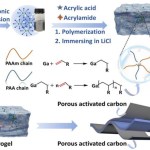
Тo address the challenge, the SKKU team decided to build a hydrogel electrolyte. The researchers used liquid metal particles (LMPs) as initiators for polymerization, the chemical process used to form the hydrogel network.

Schematic illustration of the fabrication process and device structure of the liquid metal-based hydrogel electrolyte.
Credit: Zhang, Q., Bhuyan, P., Nguyen, Q.T. et al.

The particles combine liquid-like adaptability and metallic properties. This makes them highly versatile for applications like flexible electronics, drug delivery, and soft robotics.

The team then used ultrasonication, a technique that uses high-frequency sound waves to agitate and process materials, and broke the bulk liquid metal into fine particles. These, in turn, initiated the polymerization of acrylamide and acrylic acid to form the hydrogel. The method works without heat, UV light, or other external stimuli, which makes manufacturing easier.

Liquid metal solution

At the same time, the researchers also incorporated stearyl methacrylate (SMA), a hydrophobic material that forms physical crosslinks between polymer chains. These reversible connections can break under stress to absorb energy and then reform once the stress is removed.

This gave the hydrogel exceptional durability and stretchability. Tests revealed it could stretch up to nine times its original length before breaking. It corresponded to an elongation at break of approximately 900 percent.

The researchers then soaked the hydrogel in a lithium chloride solution. This step suppressed hydrogen bonding between water molecules, prevented freezing, and preserved its flexibility.

Consequently, the electrolyte maintained both ionic conductivity and mechanical performance at temperatures of -4 degrees Fahrenheit, unlike traditional hydrogel systems. Moreover, energy storage devices built using the materials retained 98 percent of their performance after 45,000 charge-discharge cycles.

Park highlighted the innovation’s significance. “This work introduces a new design strategy for hydrogel electrolytes based on liquid metal and provides a viable platform for next-generation wearable electronics and flexible energy storage systems operating under extreme conditions,” he concluded in a press release.

The study has been published in the journal Nano-Micro Letters.

💾

Researchers in South Korea have created a liquid metal hydrogel electrolyte that stretches 900 percent and lasts 45,000 charge cycles.
Received — 2 June 2026 Interesting Engineering

Japan-US team builds world’s first silicon spintronic chip for smart computers

Scientists in Japan and the US have made a big achievement in smart computing after developing the first silicon-based spintronic probabilistic bit in the world, or p-bit.

The device was designed by a joint research team from Japan’s Tohoku University and the US National Institute of Standards and Technology (NIST). It is the world’s first spintronic p-bit fabricated on a silicon chip with conventional semiconductor manufacturing processes.

The researchers announced that they had experimentally verified the operation of the p-bit, the base unit of probabilistic computing. Probabilistic computing is a field of computer science and AI that focuses on the study and implementation of probabilistic algorithms, models, and methods for computation.

“The achievement provides a pathway toward large-scale spintronic p-computers for applications such as AI and machine learning,” the researchers pointed out.

Smarter AI hardware

Conventional computers process data using bits that exist in one of two states: 0 or 1. This binary system forms the foundation of modern technologies, including smartphones, supercomputers, data centers, AI, and virtually every digital device in use today. However, it struggles with searching through enormous numbers of possible solutions.

In contrast, probabilistic computers use p-bits, which are electronic elements that fluctuate randomly between 0 and 1. They utilize physical randomness, to explore many possible states and make them attractive for tasks involving AI, machine learning and optimization.

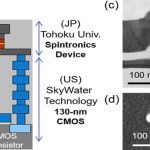
Schematic cross-sectional structure of the spintronic p-bit.
Credit: Shunsuke Fukami, William A. Borders et al.

Spintronics, a technology that processes and stores information by manipulating the intrinsic quantum spin of an electron, has meanwhile emerged as one of the most promising technologies for building p-computers. Spintronic devices exploit the magnetic properties of electrons.

“Among several candidate technologies, spintronics is considered especially promising because nanoscale magnetic devices can naturally generate probabilistic behavior through magnetic fluctuations,” the researchers stressed.

Built on a silicon chip

The study was led by Ju-Young Yoon, PhD, a researcher at Tohoku University’s lab for nanoelectronics and spintronics. The team integrated spintronic devices right onto a silicon chip by combining semiconductor and spintronics manufacturing techniques in both Japan and the US.

To fabricate transistors and lower interconnect layers, the team used the 130-nm (130-nanometer) CMOS process provided by SkyWater Technology, a Minnesota-based semiconductor firm. They then integrated superparamagnetic nanodevices and upper electrodes using spintronic device fabrication facilities at the university.

The resulting chip successfully demonstrated the two key characteristics required for p-bit operation. First, the team observed stochastic fluctuations in the output voltage over time, and confirmed that the device could naturally switch between different states.

They also proved that the average output could be controlled through an applied input voltage, allowing the probabilistic behavior to be tuned. The scientists said this is the first experimental demonstration of a spintronic p-bit monolithically integrated on a silicon chip using semiconductor integrated circuit processes.

The findings could enable larger spintronic p-computers. “By further advancing device and circuit technologies and increasing the number of integrated p-bits, the researchers expect spintronic p-computers to move closer to large-scale practical implementation,” the university concluded in a press release.

The study has been published in the journal IEEE Electron Device Letters.

💾

Scientists in Japan and the US have paved the way for smart computers by integrating a spintronic p-bit on a silicon chip for the first time.

US opens first national lab production line for safer grid-scale batteries

The US has recently launched a new battery production line, which is expected to help researchers develop safer and cheaper energy storage technologies for the electric grid.

The new line is housed at the Grid Storage Launchpad (GSL), a 93,000-square-foot research facility. It is run by the Department of Energy’s (DOE) Pacific Northwest National Laboratory (PNNL) in Richland, Washington State.

According to PNNL, the newly commissioned production line features a total of 16 pieces of equipment inside a 1,400-square-foot laboratory. It is reportedly the first prismatic battery cell production line at a US national laboratory.

Researchers at PNNL pointed out that it will allow them to manufacture, test, and validate advanced battery designs at an industrially relevant scale. “This helps our researchers bridge the gap between science and industry,” Adam Jivelekas, GSL operations manager, said.

A new grid storage hub

The line will produce prismatic battery cells. These are rectangular and larger than cylindrical cells, and shaped like a nine-volt battery (9V). As a result, they contain more energy per cell. Developed with a heavier metal casing, they are less prone to overheating, which makes them increasingly popular for storing energy on the electric grid.

Mark Weller, PhD, a PNNL materials scientist and the principal investigator of the project, explained that metal transfers heat more efficiently than most materials. This allows these batteries to cool more easily. “If you have better heat transport, if the cells are more mechanically uniform, if they’re packed more efficiently, all those things can translate to not just higher safety, but lower cost,” he added.

In addition, their rectangular shape means they can be stacked neatly together. This reduces wasted space compared to cylindrical alternatives. Efficient packing helps boost energy density at the pack level.

As per Jivelekas, the facility will help speed up the transition from battery research to production. “We can help external researchers or industry partners test and validate their prismatic cell designs,” he pointed out.

Start of operations

PNNL noted that the facility is located inside a specialized dry laboratory, where humidity levels are kept lower than those found in some of the driest places on the planet. Maintaining these conditions is critical, as trace levels of moisture can degrade the sensitive battery components.

The facility wrapped up testing earlier this year. The scientists are now preparing validation projects intended to demonstrate its capabilities. Well emphasized that the real test is proving it can be used to consistently manufacture high-quality prismatic cells.

“Making a coin cell takes a few milligrams of material; making a prismatic cell takes at least a kilogram,” he elaborated in a press release. “When you scale up like that, you can’t assume that a chemistry that worked well in a coin cell will work just as well in a prismatic cell.”

To demonstrate the approach, the research team will produce and evaluate two promising battery chemistries to use in prismatic cells. These include sodium-ion and lithium-iron-phosphate (LFP).

Following production, the researchers will submit these two prismatic cell types to a number of tests to evaluate their performance and safety. “With this capability, we can do the research and development and pilot-scale testing that is difficult for companies to justify and help facilitate a smoother handoff to get advanced battery concepts to market,” Weller concluded.

💾

A new battery production line in the US will test and validate advanced prismatic cells for future grid energy storage systems.
❌