Chimpanzees are known to use rudimentary tools when foraging for food. According to a new paper in the journal Frontiers in Psychology, this learned behavior is passed down from adults to offspring through social learning. Specifically, adult chimps deliberately model the behavior, then turn their tools over to the youngsters so they can mimic the same motions.
"Receiving food and tools from experienced individuals, which we call food or tool transfer, may help chimpanzees learn to use technology to extract foods that are difficult to access,” said co-author Andreu Sánchez-Megías, a graduate student at the University of Barcelona and the Jane Goodall Institute Spain in Senegal. “Tool transfers thus appear to be a form of teaching, together with observation and supervised practice. It appears that mothers are the main models and teachers for young chimpanzees in this manner.”
As we have previously reported, tool use was once thought to be one of the defining features of humans, although Charles Darwin observed chimpanzees using stones to crack nuts in 1871. In 1960, the late primatologist Jane Goodall observed a chimp named David Greybeard bend a twig, strip off the leaves, and use it to spoon termites out of a nest and into his mouth. When he learned of the behavior, Goodall's mentor, Louis Leakey, famously observed, “Now we must redefine ‘tool,’ redefine ‘man,’ or accept chimpanzees as humans.” Since then, chimps have been observed making sponges out of leaves to soak up liquids, shaping sticks to collect algae, and sharpening rudimentary spears for hunting.
Longtemps considérées comme de charmantes anecdotes, les interactions sociales entre primates et autres animaux semblent en réalité largement répandues. L’étude de ce primatologue rassemble 427 cas, allant du jeu au toilettage et aux soins, dont certains évoquent de véritables liens affectifs...
Lipid nanoparticles (LNPs) have become one of the most important delivery technologies in modern medicine, helping transport messenger RNA into cells for vaccines, protein replacement therapies and experimental treatments. Yet a formulation that performs well in mice can behave very differently in humans. This species gap makes nonhuman primate studies an important step in drug development, but conventional methods for comparing multiple nanoparticles often require euthanasia and extensive tissue collection. A new study reports a way to measure the functional activity of several LNPs in the same animal using only a small blood sample.
Published in Nature Biotechnology, the work introduces a non-invasive nanoparticle barcoding platform called snapCodes. The method is designed to determine which LNP formulation successfully delivers its mRNA cargo and prompts cells to produce the encoded protein. Rather than relying on tissue harvesting, the researchers identify delivery events through DNA barcodes that can be recovered from serum and analyzed by sequencing. The approach could allow scientists to compare many candidate nanoparticles in a single nonhuman primate while reducing both animal use and the logistical burden of downstream analysis.
The central challenge addressed by the study is that nanoparticle delivery is not adequately described by measuring where an LNP travels. An LNP may reach an organ or circulate in the bloodstream without releasing its mRNA in a form that cells can translate. The new system instead records functional mRNA delivery. Each nanoparticle is associated with a distinctive DNA sequence, and the mRNA cargo is engineered to encode a fusion protein containing nanoluciferase and a SNAP-tag. Nanoluciferase is a compact enzyme that produces light in the presence of its substrate, while the SNAP-tag is a protein module capable of forming a covalent bond with specific chemical groups.
For the barcode to become a permanent molecular record of delivery, the researchers modified the DNA tags with benzylguanine. When a cell receives an mRNA molecule encoding the nanoluciferase–SNAP-tag fusion, the resulting protein can react with a benzylguanine-bearing snapCode. This creates a stable DNA–protein complex. The complexes are then exported from cells into the circulation, where they can be isolated from a small serum sample. Sequencing the recovered DNA reveals which barcoded LNPs produced the fusion protein and therefore achieved functional mRNA delivery.
The design turns transient protein expression into a measurable signal that can be collected without sacrificing the animal. This is particularly valuable in studies involving nonhuman primates, where tissue-based nanoparticle profiling can require euthanasia and can limit the number of formulations tested in each subject. A blood-based assay also makes it possible to monitor delivery over time, potentially showing how the activity of a formulation changes after dosing. The study used just 30 microliters of serum, a volume small enough to support repeated sampling and longitudinal measurements.
Before comparing nanoparticle performance, the researchers validated the molecular components of the system, including the activity of the snapCode chemistry and the ability of the fusion protein to participate in the intended covalent reaction. These steps were necessary to establish that the barcode signal reflected genuine expression of the delivered mRNA rather than nonspecific interactions. Once the platform had been characterized, the team used it to evaluate multiple chemically distinct LNPs in living animals.
The investigators intravenously administered six snapCoded LNP formulations to mice and nonhuman primates. Each formulation carried its own molecular identity, allowing all six candidates to be assessed in parallel. Serum collected after administration was analyzed for the DNA–fusion protein complexes, and sequencing was used to quantify the relative delivery activity associated with each barcode. By testing the same barcoded set across species, the researchers could directly examine whether patterns observed in mice were reproduced in nonhuman primates.
Such cross-species comparisons are crucial because LNP composition strongly influences biological behavior. Changes in ionizable lipids, helper lipids, cholesterol, polyethylene glycol-lipid components or particle structure can affect stability, organ distribution, cellular uptake and endosomal escape. These properties may differ substantially between rodents and primates because of differences in blood proteins, immune responses, tissue physiology and cellular trafficking. A method that measures expression from several formulations in the same animal may therefore reveal species-specific delivery patterns more efficiently than traditional one-formulation-per-animal experiments.
The snapCode strategy does not replace every form of nanoparticle analysis. It reports successful expression of a particular engineered mRNA and depends on the recovery and sequencing of the associated molecular complexes. It does not, by itself, provide a complete map of tissue distribution, long-term safety or therapeutic efficacy. Nevertheless, it adds a functional layer to LNP evaluation: scientists can ask not only where particles go, but which particles actually release mRNA that cells translate. In early development, that distinction can help prioritize candidates before more resource-intensive studies begin.
By combining multiplexed dosing with low-volume serum sampling, the researchers aim to make nonhuman primate testing more informative while using fewer animals. The platform could be adapted for screening delivery systems designed for different organs or therapeutic proteins, provided that the encoded reporter and barcode chemistry remain compatible with the intended experiment. As mRNA medicines expand beyond vaccines into gene editing, immunotherapy and protein replacement, tools that connect nanoparticle chemistry to real biological output may become increasingly important. Non-invasive barcoding offers a way to track those differences in living subjects and could help narrow the path from promising LNP design to clinically relevant drug candidate.
Subject of Research: A non-invasive method for comparing functional mRNA delivery by multiple lipid nanoparticles in mice and nonhuman primates using serum-based DNA barcodes.
Article Title: Non-invasive nanoparticle barcoding in nonhuman primates
Article References: Jang, B., Zenhausern, R., Lian, L. et al. Non-invasive nanoparticle barcoding in nonhuman primates. Nat Biotechnol (2026). https://doi.org/10.1038/s41587-026-03262-6
Monkeys use some of the same basic mental strategies as people do to perceive abstract relationships between shapes, a new study suggests.
The findings challenge the idea that humans crossed a sharp evolutionary divide when they learned to recognize geometric properties like symmetry, parallel lines and right angles, the researchers say.
"While humans do come up with geometric descriptions that are more abstract than what nonhumans can do, there's still some overlap, some similarity in the kinds of geometric intuitions you see in humans and those of non-primates," study co-author Jessica Cantlon, a professor of developmental neuroscience and psychology at Carnegie Mellon University, told Live Science. "So there's a thread of continuity that runs through geometric reasoning between humans and nonhumans."
The research, published July 20 in the journal PNAS, adds to a long-standing scientific debate over whether humans possess entirely unique forms of abstract thought or unusually sophisticated versions of abilities found elsewhere in the animal kingdom.
"For decades, cognitive scientists have searched for the 'special ingredient' that distinguishes human intelligence from that of other animals," Elizabeth Brannon, a professor of psychology at the University of Pennsylvania who was not involved in the research, told Live Science in an email. "This study provides compelling evidence that, at least for geometric reasoning, the difference between humans and other primates is more quantitative than qualitative."
In other words, the study suggested that baboons and macaques don't lack the ability to reason about geometry. Instead, they just aren't as proficient at it as humans, meaning that humans didn't evolve a new unique skill in understanding geometry.
A geometric matching game
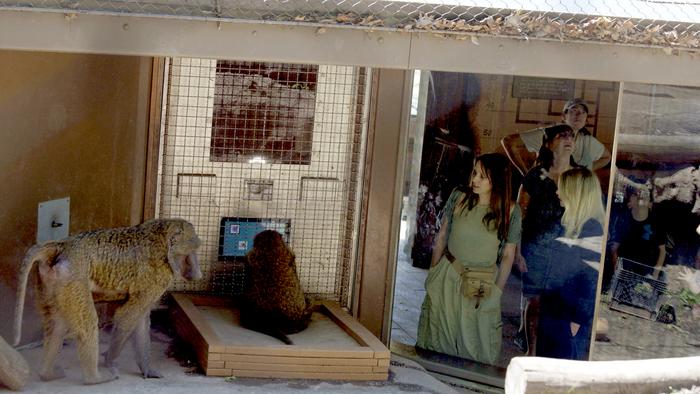
The researchers tested eight adult monkeys: four rhesus macaques (Macaca mulatta) and four olive baboons (Papio anubis). The olive baboons participated through the Primate Portal, a touch-screen system installed at Seneca Park Zoo in Rochester, New York. One baboon, Kalamata, was especially enthusiastic.
"Every day he came to the touch screen," Jialin Li, a doctoral student at Carnegie Mellon University and first author of the study, told Live Science. "He just sat there and worked for two hours, three hours straight, completing thousands of trials. That's just amazing."
The macaques participated separately at Carnegie Mellon University, having prior experience with matching tests in other experiments.
The researchers then compared the animals' performance with that of 58 U.S. preschoolers ages 3 to 6, and 79 adults from the Tsimané, an Indigenous farmer-forager society in Bolivia whose members received little formal education. A separate experiment in the larger project involving rotating shapes also included 21 U.S. adults.
In all of the study's cohorts, the participants played a game known as a match-to-sample task.
"[The participants] see a sample shape first," Li said. "For example, it's a square. Then they need to tap the square to make sure that they are looking at it. When they tap it, there will be two shape choices that come up: one on the left and one on the right. They need to choose which shape matches with the sample shape."
The researchers made the choice shapes half the area of the sample shape, thus preventing the participants from solving the task by simply matching overall size or pixel count. In another version of the test, they rotated the choice shapes, thereby forcing the participants to identify the underlying form despite its changed orientation.
Two olive baboons participated in the Primate Portal experiments at the Seneca Park Zoo in Rochester, New York. (Image credit: Rochester Institute of Technology)
Correct answers earned the monkeys fruit-flavored cereal pellets, preschoolers collected stickers that could later be exchanged for prizes, and adults received verbal feedback. Incorrect answers triggered a "bonk" sound and a short timeout from the game.
Despite their limited formal education, the adult group had little trouble with the game, but the monkeys and the children had to put considerable thought into their choices.
"We often think that this matching task will be super easy for humans," Li said. "But actually, young kids were struggling in completing the task in telling the shapes apart, which makes them more similar to monkeys."
Ultimately, the children and monkeys could find the matches, Cantlon said, but only after taking a long time to think about the problem.
The researchers then used computer models to investigate which visual properties best predicted participants' decisions. One model represented simple details, such as edges and lines. Another represented more complex information about a shape's overall form. A third encoded discrete geometric properties, such as equal sides, equal angles, symmetry and parallelism — an approach the researchers described as "symbolic."
According to Cantlon and Li, the term "symbolic" does not mean the monkeys were mentally applying rules such as "a square has four equal sides." Much of the apparent symbolic effect could be explained by the ability to recognize a shape regardless of its orientation, known as rotation invariance.
If abstract geometry depended on a uniquely human symbolic system, only the human participants would have shown evidence of using that thought process. Instead, both monkeys and humans appeared to rely on a mixture of complex visual information and symbolic-like features. Adult humans generally performed the best, followed by preschoolers and monkeys, but their results overlapped. This finding suggests that the differences were quantitative, meaning humans are simply better at the same underlying kind of geometric reasoning rather than possessing an entirely unique ability., Monkeys relied roughly three times more strongly on the symbolic model when the shapes were rotated than when they remained upright.
Brandon said one of the study's most intriguing findings is that what looks like uniquely human symbolic reasoning for understanding geometry may actually grow out of flexible, abstract ways of representing information that are shared by humans and other primates.
Ancient roots of geometry
The results do not mean that monkeys understand formal mathematics, Brannon cautioned. "Human mathematical reasoning extends far beyond recognizing geometric regularities — it includes language, formal proof, recursive reasoning and cultural transmission."
Rather, this study provides evidence that some of the building blocks of mathematical thought have deeper evolutionary roots than previously recognized, she said.
Giorgio Vallortigara, a professor of neuroscience at the University of Trento in Italy who was not involved in the study, agrees with Brannon and her colleagues' conclusions.
Vallortigara explained in an email to Live Science that previous studies have often focused on how animals understand the geometry of their surroundings, such as navigating spaces. What makes these findings different is that they show animals can also reason about the geometric properties of individual objects.
Comparing species can help scientists trace the origins of geometry before language or arbitrary symbols became involved, Vallortigara said. It may also reveal whether similar abilities depend on mechanisms inherited from a common ancestor or evolved independently in animals with different nervous systems.
Li and Cantlon are now breaking down shapes into components such as angles, side lengths and numbers of sides to identify which properties are the hardest for monkeys and humans to understand. Cantlon described the follow-up as "a deconstructed geometry task."
The research could also help educators understand the geometric intuitions children bring into the classroom, Cantlon said, allowing lessons to build upon those abilities rather than treating geometry as something learned entirely from scratch.
"Evolution rarely invents entirely new mechanisms from scratch," Brannon said. "More often, it refines, recombines and extends existing ones."
What do you know about chimpanzees and great apes? Test your smarts with our primate quiz!
Scientists have identified a new species of monkey that has orange lips and makes unique roars and snorting sounds. The distinctive monkey lives in a remote region of the Democratic Republic of the Congo (DRC).
It is only the fifth new monkey species to be identified in Africa in the past 75 years, and there might be more unknown monkey species in the region, scientists behind a new study suggested. Researchers named the newly identified species of monkey Colobus congoensis,after the region, and it is known by the common name "likweli" in the local Kilanga language.
"This is remarkable because it's not very common these days to find a new, never-before-documented primate species, let alone a relatively large species of monkey," said Joshua Linder, an anthropologist and president and co-founder of the The Forest Collective, a nonprofit that aims to conserve and restore tropical rainforests.
In 2008, conservationists in the dense rainforests ofLomami National Park, within the Congo Basin in the DRC, photographed an unidentified monkey, but it was partially obscured. Then, in 2018 a similar-looking animal was captured on camera, prompting study co-authorJunior Amboko, a Lomami National Park researcher and a Florida Atlantic University anthropologist, to set out to find the mysterious monkey.
To see what was already known, Amboko and his colleagues showed the pictures to people from 52 villages around the park.
"These people really know the fauna and flora in the forest," Amboko told Live Science. "In only eight villages, people knew the monkey — and these were hunters, who know the economic value of animals or how much food each animal can provide, but even they didn't know much."
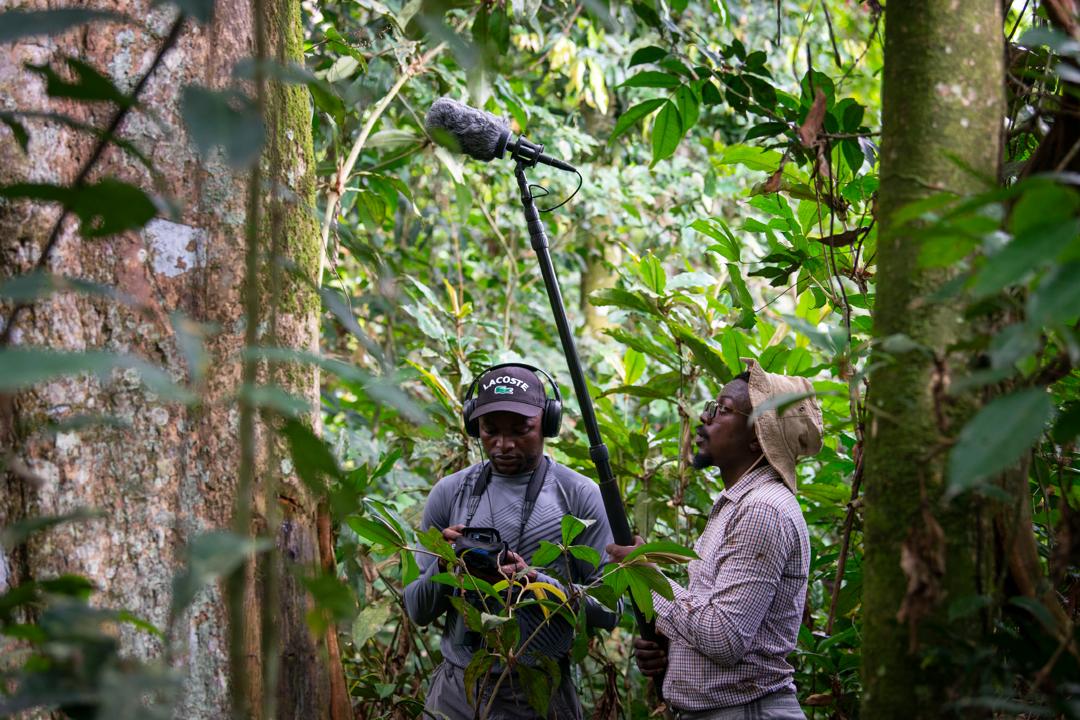
The researchers worked in the Lomami National Park, within the Congo Basin in the Democratic Republic of Congo. (Image credit: Daniel Rosengren, Frankfurt Zoological Society )
Hunters of the Balanga ethnic group called the monkey "likweli," although the meaning of this name isn't known. Some in the Mituku local communities called the species "kasaba nkoni," which Amboko said means "the branch shaker." This refers to the way colobus monkeys leap from branch to branch, Amboko said.
In their searches between 2018 and 2022, the researchers recorded 114 sightings of the species across an estimated range of about 660 square miles (1,700 square kilometers) naturally isolated between the Lomami and Lualaba rivers. They reported their findings July 15 in the journal PLOS One.
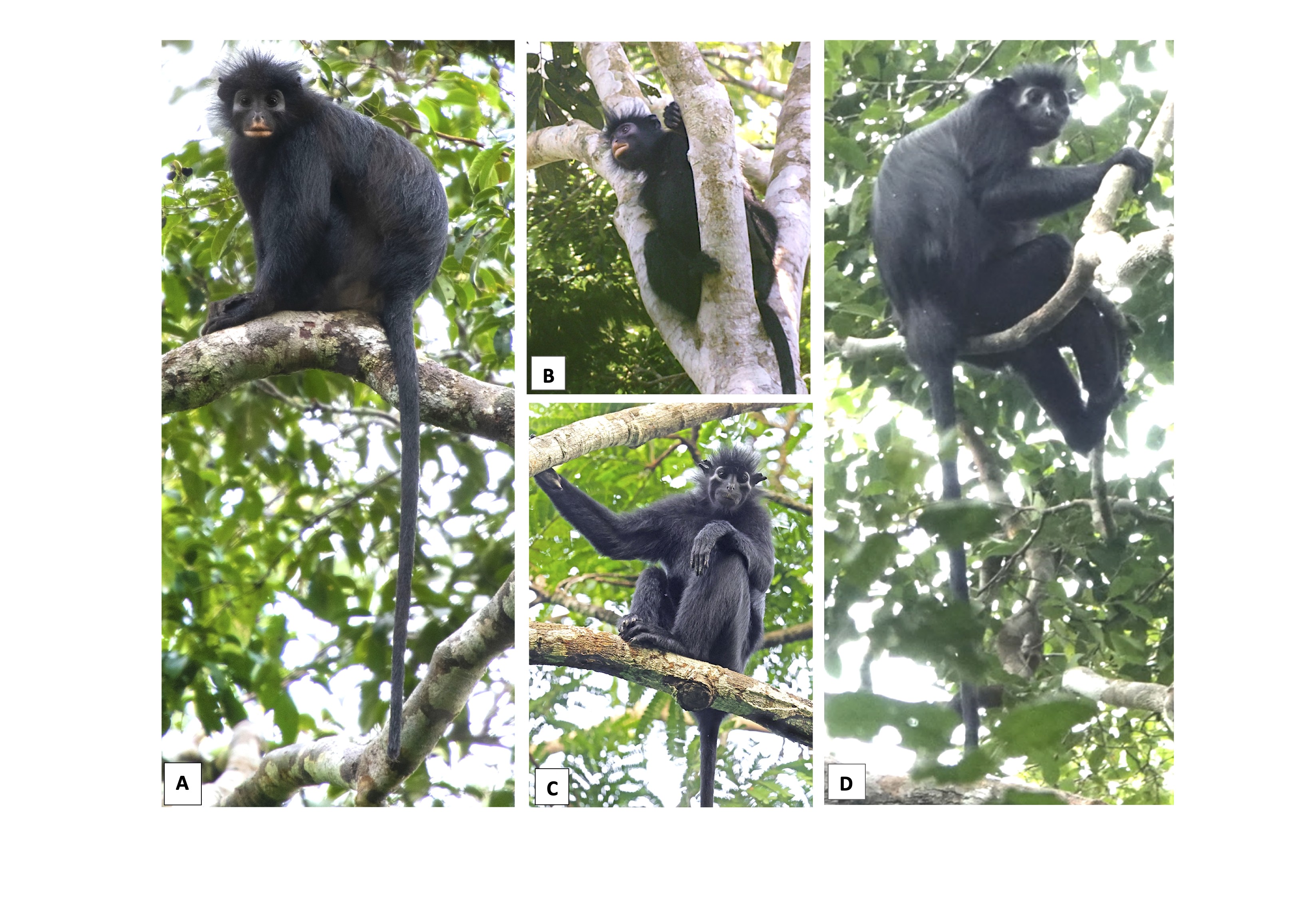
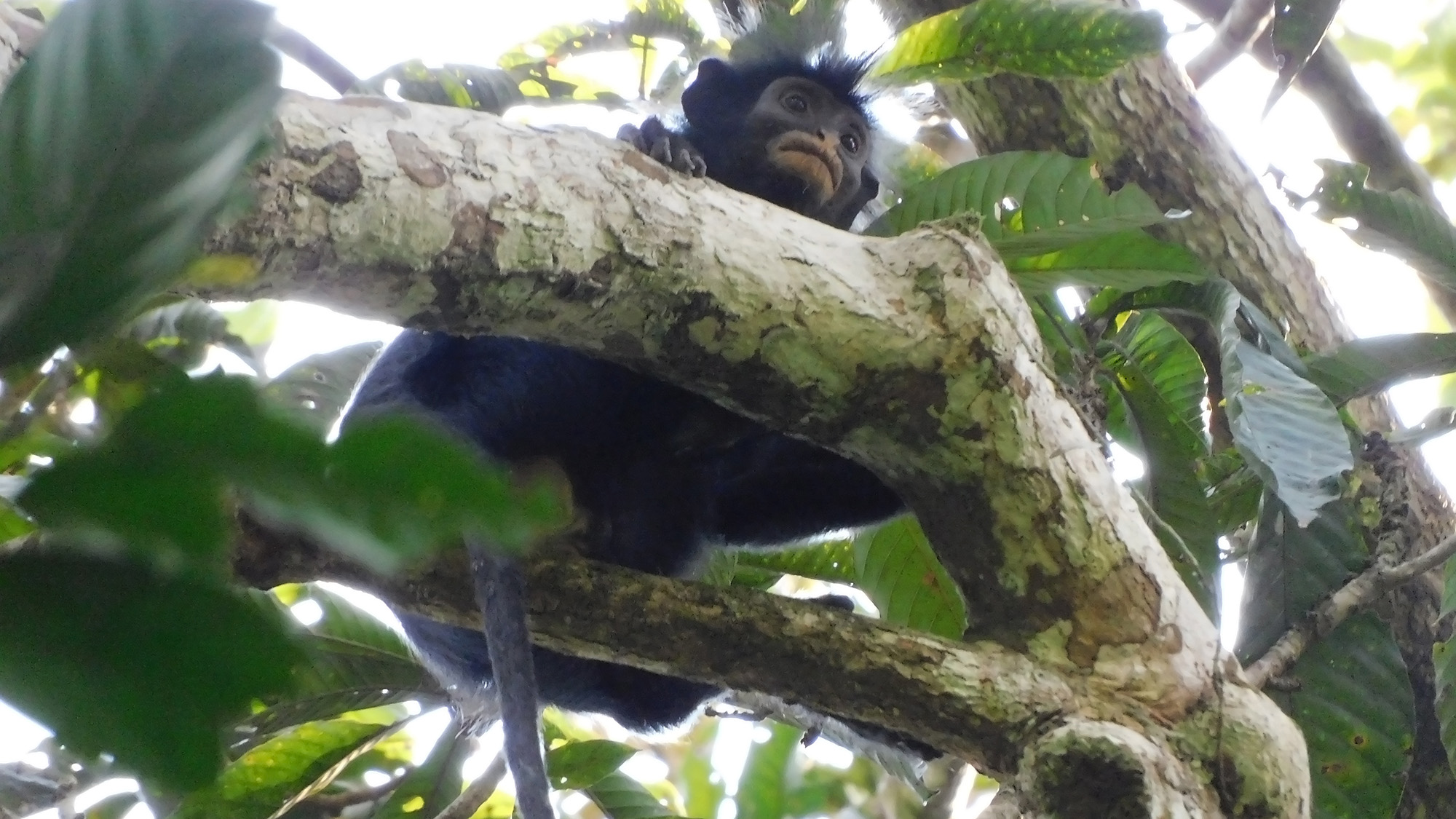
The monkeys, seen hanging out in groups of between one and 20 individuals, are mainly glossy black, but they have a conspicuous orange patch around the mouth and nose. Bare gray skin on their cheekbones makes it look as if they're wearing masks. They also have a patch of white fur around the anus.
"We're going with the face and the rump as the two distinctive traits," said study co-author Kate Detwiler, an anthropologist at Florida Atlantic University. "If you see the face, you see this unique bare skin that's orange cream. And then if you're coming from behind, you see this white patch."
DNA analysis confirmed C. congoensis was a previously unknown species. (Image credit: Daniel Rosengren, Frankfurt Zoological Society )
The monkeys, which weigh about 15 pounds (7 kilograms), also make deep, loud roars, punctuated by distinctive snorts. These unique vocalizations distinguish them from other colobus monkeys, Detwiler told Live Science.
By taking samples, and sequencing DNA, from monkeys killed by hunters and destined for the illegal bushmeat trade, and comparing the results with what’s in museum collections and datasets of genetics, skulls, teeth and pelts for other colobus monkeys, the team confirmed that C. congoensis was a previously unknown species.
"My lab got the tissue sample and did the genetics, and we were shocked by how divergent the key area of the mitochondrial genome was from other colobus monkeys," Detwiler said.
Researchers think the new species diverged up to 5.78 million years ago. (Image credit: Daniel Rosengren, Frankfurt Zoological Society )
The monkeys live in the same forest as the Angola colobus (Colobus angolensis), but their closest relatives are black colobus monkeys(Colobus satanas), which live around 750 miles (1,200 kilometers) to the west, in Cameroon, Gabon and Bioko Island.
"The fact that the results show that the closest living relative to this new species is the black colobus located 1200 km away in West Africa is equally remarkable," Linder, who was not involved in the new study, told Live Science via email.
Detwiler estimates that these close relatives diverged between 5.78 million and 3.44 million years ago — the longest known split between species within the Colobus genus. "The discovery is reshaping our understanding of African monkey evolution," she said.
Given the small geographic range, rare sightings and increasing habitat loss, the researchers recommend that C. congoensis be classified as endangered on theIUCN Red List.
The discovery also emphasizes the importance of Lomami National Park, where another previously undescribed monkey, the lesula (Cercopithecus lomamiensis), wasreported in 2012 by a team that included Detwiler.
The Congolian rainforest ranging across this part of Africa is the world's second-largest tropical forest, after the Amazon, and about 60% of it is in the DRC. "It is a paradise for biodiversity," Amboko said, adding that there might be more undescribed primate species there. "If we are able to discover two big new primate species, who knows how many other new mammals, fish, reptiles or plants there could be?"
What do you know about chimpanzees and great apes? Test your smarts with our primate quiz!
Wild chimpanzees in Uganda split into two separate communities and later engaged in deadly attacks against each other. Researchers believe the conflict shows how social relationships alone can fuel polarization and violence. The world’s largest known community of wild chimpanzees has permanently divided into two separate groups. Researchers from the University of Texas at Austin [...]

 Login