❌

Normal view

Photojournalist Steve Winter on his iconic Hollywood puma image, the illegal tiger trade and having a black panther knock on his door

For decades, photojournalist Steve Winter has traveled across the world capturing incredible images of big cats as part of his work for National Geographic. Yet he didn't photograph an animal professionally until he was 34.

"If anybody had said, 'You're going to work with big cats for 25 years of your career,' I would have said 'No, I don't know anything about big cats,'" he told Live Science. "But I learned from scientists and local people," he added. "That was very, very important β€” that's what, to me, was the biggest change in my life."

Together with his wife, author and environmental journalist Sharon Guynup, Winter has helped change laws around big cats in the U.S.; revealed the horrors of the Tiger Temple in Bangkok, resulting in its closure; and took an iconic photograph of the cougar P-22 beneath the Hollywood sign, which eventually led to the creation of the world's largest highway wildlife corridor over Highway 101 in California.

In their new book, "Big Cats" (National Geographic Books, 2026), Winter and Guynup provide a retrospective of their careers, looking at the fragility of these predators, the conservation work helping to save them, and the challenges they still face. Live Science spoke with Winter about his career, the changes he's seen, and why he's hopeful for the future.

Steve Winter headshot

Steve Winter has won numerous international awards, including BBC Wildlife Photographer of the Year and BBC Wildlife Photojournalist of the Year. He lectures internationally on photography and conservation issues and has been interviewed on CBS Nightly News, 60 Minutes, NPR, BBC and CNN. He contributes regularly to National Geographic magazine, for which he can spend months working on a single story. He’s camped for weeks in steamy jungles, vast grasslands, and at 15,000 feet in the Himalayas to capture cats’ stunning beauty and secret behaviors. (Image credit: Steve Winter)

Hannah Osborne: You've traveled all over the world and seen so many things. Is there one photograph that really sticks out for you, one that you come back to and think about?

Steve Winter: I always look at the images that have had an impact at the time. That makes a huge difference to me, because in the end, I know that in taking this [photograph], not only did I succeed beyond my wildest expectations, but it's making a difference in the world. Right now, I have just been putting remote cameras up on what will be the world's largest wildlife overpass, and that was started by my Hollywood cougar picture of P-22, Puma 22, under the Hollywood sign. [Editor's note: The common names cougar, puma and mountain lion all refer to the same species, Puma concolor.]

That changed so much in Los Angeles. I've never seen a city be transformed in their love for the fact that they have a mountain lion in a park in the city. What came of that was [people] thinking, "Hey, maybe we should connect these areas where these animals are living." [Editor's note: The Wallis Annenberg Wildlife Crossing over the 10-lane Highway 101 that was inspired by the cougar P-22 is due to open Dec. 2.]

To think about that is pretty amazing, so right now, P-22 and the Hollywood cougar is my go-to image.

He became a celebrity in the land of celebrities; people loved him. There's a P-22 day; schools are using urban wildlife in their curriculum. The LA Natural History Museum has a permanent exhibit, and what is right in the center of it? The Hollywood cougar picture.

HO: How did the P-22 photograph come about?

SW: As wildlife photographers, we will often go to these meetings where people are gathering to save elephants, to save this, to save that. So I went to meet the scientists that worked with these cats in the largest urban park in the United States. I asked Jeff Sikich, a biologist for the National Park Service, "[Do] you have a lot of trails in that park? Do you have any that the cats walk on where you could see the lights of LA in the background?" He kept saying no.

When you're working with camera traps, it's very important to visualize the picture in your mind that you're after [when] you visit a spot. I just said, "Well, Jeff, you know what would really tell the story of urban wildlife is if we had a mountain lion under the Hollywood sign." He looked at me like I'm crazy, and said, "There's no mountain lions in Griffith Park." I said, "If anything changes, let me know."

Eight months later, I got a text. They had a trail camp set up to census bobcats [Lynx rufus] in the park, and there was P-22.

a cougar in a tree looking down

A cougar that biologists had chased into a tree so they could collar it to monitor its movements via GPS. (Image credit: Steve Winter)

With camera traps, you don't need to sit, and I learned that from the beginning. For the second story I did, it was photographing a quetzal, which is a sacred bird of the Maya and the Aztecs. I knew nothing about birds, either. It's got a meter-long [3 feet] tail. I was enamored by the fact that it had a historical background β€” they used quetzal feathers as a form of currency; they were sacred birds.

I loved all that, but working on that story in a cloud forest in Guatemala on top of a mountain all by myself, every morning I'd come down and set my camera up on the tripod [near the bird's nest], and then take it away at the end of the day. I'd walk back, and all of a sudden, the hair on the back of my head would stand up and on my arm, and I'd get this tingling feeling and it's like, what's going on? I'd turn around. You can't see anything in a rainforest or a cloud forest because the proliferation of life is everywhere. One night when I'm reading my book in the one room shack that I was staying in my bunk bed, all I hear is the stairs creaking. Then I hear the floorboards creaking. Then I hear scratching, and then sniffing, outside the door.

I grabbed the walkie-talkie to call Juan Carlos, the naturalist that I was working with. He would find the quetzal nests for me. I asked him, in Spanish, "Juan Carlos, what is this?"

And he said, "Oh, Steve, don't worry; it's just a black panther [Panthera onca]." I've been there five weeks, and I said, "Well, how come it took you so long to tell me there was a black jaguar here?" And he said, "We didn't want to worry you."

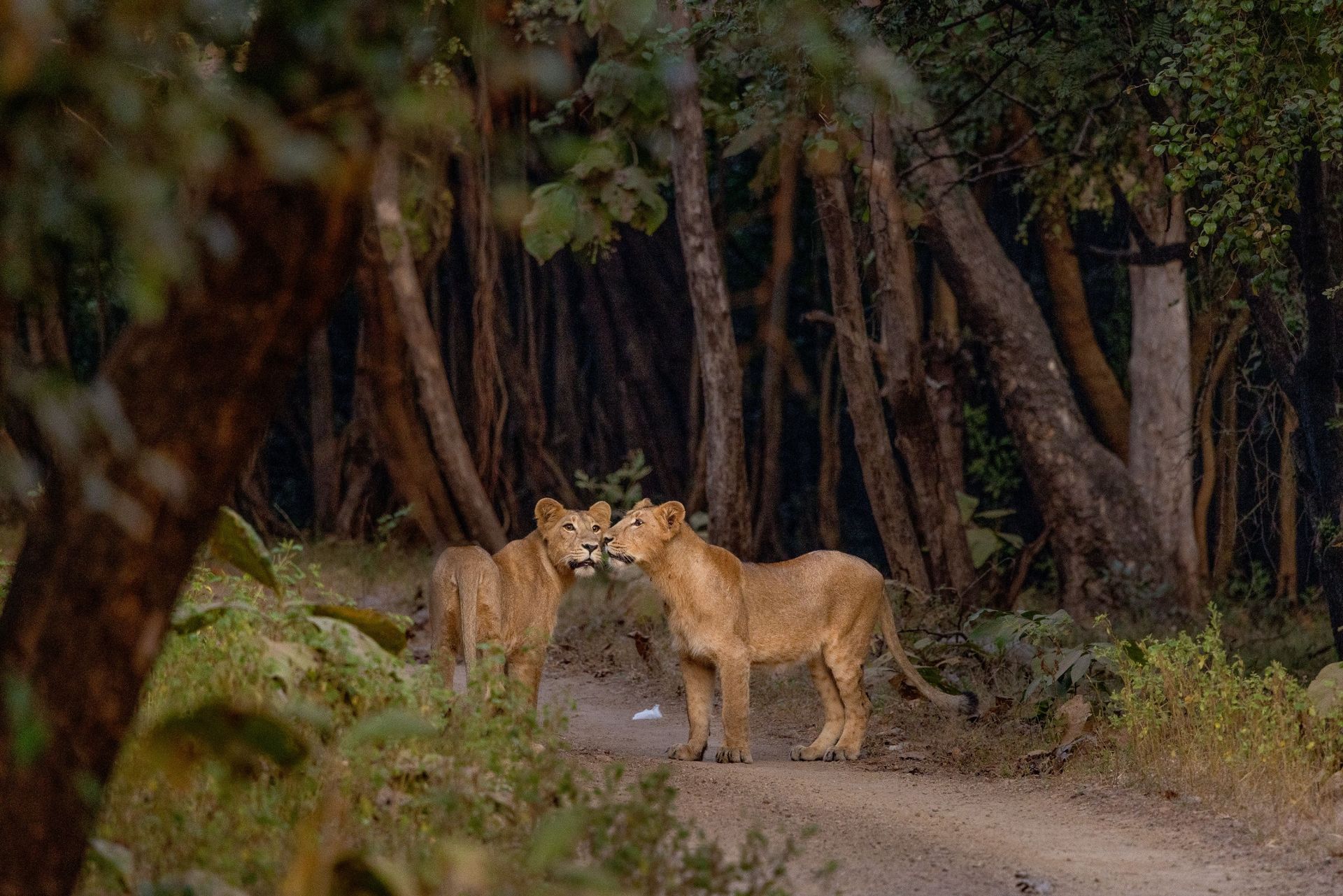
two lions standing on a track with trees and foliage on either side

Two Asiatic lionesses greeting each other with a nose-to-nose touch. (Image credit: Steve Winter)

HO: Throughout the book, you look at topics like poaching, captive tigers in the Tiger Temple in Thailand, and the way they're kept in the U.S. for entertainment. And a lot of these things are still going on. How do you cope with seeing that side of their lives?

SW: When I was first working on tigers, I was in Thailand. I was wanting to work in Thailand and Sumatra because they were the two subspecies that experts said may go extinct. I was working with the most incredible group of scientists I've probably ever worked with. They were trying to save the Indo-Chinese tiger [Panthera tigris corbetti] in Thailand.

But close by was this place called the Thai Tiger Temple. And I said, "Hey, guys; I'd like to go there." And they said, "No, Steve; don't go. These are bad people, and we think they're involved in the black-market trade of tiger parts and tigers to Laos and then into China."

That's a good reason for me to go if you don't want me to go. The first thing I saw was this huge sign that said "conservation." This was a Buddhist monastery. For some reason, the abbot had been given a tiger cub about 10 years before, and he fell in love with tigers. So they started a tiger tourism operation that brought in at least $3 million a year.

I could see something was fishy right away, because by then, I'd learned a lot about these cats. They kept saying that they always had 150 tigers. But you could pet tiger cubs for Instagram selfies or bottle-feed them 365 days a year. If you're breeding tigers, what are you going to have? More tigers. Something was happening to them, because the death rate wouldn't take over the birth rate when you're speed-breeding cubs, which is what they were doing. A female has cubs; they take them away immediately so she'll be ready to have another litter. You can only use the cubs for three months because after that, they're too big to pet.

They had all these tourist things where you could get a selfie with a head of a tiger in your lap. I was saying, "Why are these tigers acting so sleepy?" They're taking this giant head of a tiger and putting it in somebody's lap that's sitting on the concrete. You would think that if you put the head of a tiger in your lap, you're going to end up with your head in their mouth.

[Editor's note: Winter and Guynup worked together on an investigation into the Tiger Temple in 2016, which eventually led to it being exposed for its abuse and connections with the illegal wildlife trade. Shortly after, the Tiger Temple was shut to the public.]

Sharon did the investigation, and I already had pictures. But we went to do a video and go visit the temple again … By the time we got done, the TV stations in Bangkok had taken the video and showed it all over on the nightly news. We kept working on this, and Sharon wrote four more stories. And after the last one, the Thai government was inundated with people calling for the prime minister to shut it down. They went in with the army and the police, and what they found was horrific. They went to the freezer. There were tigers hanging on meat hooks, cubs in jars, with a little Thai flag on them. They shut it down.

three tigers, with two in a big metal tub, in a grassy landscape

Three tigers that were rescued from Joe Exotic's Oklahoma zoo cooling down at the Wild Animal Sanctuary in Colorado. (Image credit: Steve Winter)

Stopping this is really important. After that, we did a story on tigers in the U.S., which was very difficult psychologically. It was one thing to see them in Thailand, but we had always heard that there were more tigers in the United States than there are in the wild, and people would go, "What are you talking about? We don't have tigers here."

Sharon and I … we found a lot of the same speed-breeding cubs at these roadside zoos, whether it was Doc Antle's Myrtle Beach that was $500 a day, or some dumpy little place on the road down south where you can give them $10 to look at a tiger. They were everywhere.

After that story came out, the National Geographic Society gave a copy of this 30-page story that we had done for the magazine to every member of Congress. We got this text on 20th December, 2022, that President Biden had signed the Big Cat Public Safety Act, which outlawed all that. We were part of getting this law passed, which was incredible.

HO: What are some of the biggest changes in conservation you've seen over your career?

SW: Conservation was changing a lot in the '90s and 2000s. Alan Rabinowitz [a zoologist who served as the president, CEO and chief scientist at Panthera Corp., a nonprofit conservation organization devoted to protecting wild cats] had this idea after he had a lot of scientists in Central and South America give him data on where they were working and where jaguars were. When he took it away and just showed the locations, he goes, this is a corridor, a natural corridor, because now we're talking a lot about connectivity and how roads get in the way. It's like animals are in prison because they can't cross these big freeways or even small ones. Find out where animals are, their migrating paths, and put in an overpass or an underpass or something.

leopard cub in a rocky landscape

A Cape leopard cub in the Cederberg Wilderness Area in South Africa. (Image credit: Steve Winter)

All this was happening, all this new science, new conservation. That was all spearheaded by the work of [biologist and conservationist] George Schaller, who became a friend of ours. What a life that we've had β€” and are having. We're still working on the connectivity part right now.

HO: Are you hopeful for the big cats in LA?

SW: Oh, definitely. The ones that live in the Santa Monica National Recreation Area will be able to cross the 101 and then go all the way to San Jose. They could actually then hug the top of a certain mountain and get close to San Francisco, which is incredible to think about now. It's a huge metropolitan area, so you're leaving one, going to another. But there's so much land in between, and they can cross safely.

HO: What made you specialize in big cats in the first place, and what's the draw that keeps you coming back?

SW: Big cats are so charismatic and, to me, mystical. And they're an umbrella species, so if you save the largest predator, which is usually a big cat in any landscape, you save everything underneath it.

I was just taken over by these animals. National Geographic had never done a jaguar story before. I found out really quick why: You can't see them. I tried to use remote cameras, camera traps, but they're really smart. They'll go around them, so they don't have the flash going off or they don't like the sound or the smell of meat on these waterproof boxes and the cords and all that.

I just fell in love with big cats, and what a life to be able to work with every one of them. The only one that was on my list that I haven't done is the Amur tiger, Siberian tiger [Panthera tigris altaica]. When I was ready to photograph them with the scientists that had been monitoring them for over a decade, [the tigers] got canine distemper and about 60% died.

Big cats really bounce back when you give them protection, and there was protection given after you lose this many. All the study tigers that had the GPS collars on, the ones they could monitor, died. But the population bounced back, and there's more now than there were before.

I won't get to photograph Amur tigers. And the reason is, there's people β€” locals β€” who are working on it, and they're doing an incredible job. I've got a book here that has all the cats that I've worked on. The impact these stories have had, and the change that's come about, is what really makes me proud.

This interview has been condensed and edited lightly for clarity.

Help us improve Live Science Pro: We're always trying to make our content better. Leave us feedback about Pro here.

Big Cats

National Geographic
Big Cats

National Geographic photographer Steve Winter has spent his career photographing big cats around the world, from the graceful jaguars of Brazil’s Pantanal to the elusive Himalayan snow leopard. His photographs astound; his stories, even more so. In Big Cats, Winter and environmental journalist Sharon Guynup share experiences behind the lens.

In chapters on every key speciesβ€”cougar, jaguar, leopard, snow leopard, tiger, and lionβ€”readers will witness the power of Winter’s work, including uplifting stories of how his photographs have made a difference and powered important conservation efforts on behalf of these mighty creatures.

Big dogs age faster at an epigenetic level, new study finds

8 October 2026 at 22:59

Great Danes and mastiffs rarely live more than a decade, while Chihuahuas can live twice as long. Exactly why big dogs die younger than small ones do has been unclear β€” but new findings may help to solve that mystery.

The research, published Thursday (Oct. 8) in the journal Science, looked at a chemical code written on top of dogs' DNA. This code, called the methylome, consists of chemical tags called methyl groups, which bind to DNA's building blocks.

Proteins constantly access DNA, loading up the information written in its code and taking that data away to be turned into new proteins for the cell. But these methyl groups can act as tiny roadblocks that stop that process in its tracks.

These groups are one type of "epigenetic marker," which collectively help to control gene activity, and their arrangement on DNA changes predictably as animals age, study co-author Blaise Mariner, a bioinformatician at Arizona State University, told Live Science. Across many studies and species, including humans, scientists have used this data to build epigenetic clocks that track animals' biological ages.

Dogs happen to be a great species for studying aging. Their owners devotedly track what they eat, how they live, and how their health changes over time. So Mariner and his colleagues built epigenetic clocks using DNA in blood samples taken from 894 dogs enrolled in the long-term Dog Aging Project based at the University of Washington.

These samples revealed how the dogs' immune cells aged. These cells patrol the whole body, so "they're a really good measure of systemic aging," study co-author Noah Snyder-Mackler, a genomicist at Arizona State University, told Live Science.

The team found that changes in DNA methylation closely tracked biological aging, in that the dogs with older-than-expected epigenetic ages had a higher risk of death from any cause. Once they looked at how different sizes of dogs aged, clear differences emerged.

"Using our biomarker, this epigenetic clock, big dogs were aging a little bit faster per year of life than small dogs," Snyder-Mackler said.

A key epigenetic change linked to larger body size was the loss of methyl groups at stretches of DNA called transposable elements. Also called "jumping genes," these elements can potentially move around the genome, but the methyl groups help stop them from doing so. But when that methylation is lost, the jumping genes can become too active and end up damaging other genes and causing inflammation, a key process that ramps up with age.

In short, the new data suggests that out-of-control jumping genes may contribute to big dogs' faster aging.

An illustration of blue double-helix strands of DNA

Researchers created epigenetic clocks based on data from 894 dogs. (Image credit: Josh Hawley via Getty Images)

In aging dogs, the team found that some regions of the genome with few chemical tags became more methylated, while other areas that had been choked with methyl groups gradually lost them. Additionally, at least in terms of their epigenetics, dogs' immune cells appear to become more similar to one another as they age. Mariner said this "loss of cell identity" is a key hypothesis for what happens to the body as it ages.

Immune cells are carefully specialized for different roles, such as preventing cancer or killing viruses. As these cells become more similar to one another, they become less able to fulfill their specialized roles, studies suggest.

Humans have bred big dogs for size, and Snyder-Mackler said this push for large body size may have come at a cost.

"Their bodies have to make this trade-off between really rapid growth and maintenance of that," he said, "versus investment in the immune system and integrity of the organism." For now, that idea is a hypothesis, though, as the current study doesn't directly address why big dogs' epigenetic aging has come to be this way.

Now, the team wants to build more informative clocks as the Dog Aging Project recruits more pooches to follow for longer periods. Snyder-Mackler said the team's data currently explains only part of how dogs' epigenetic ages vary. "What we really want to know is, what explains the rest of that variation?" he said.

The team was keen to build predictive models that might help dog owners anticipate their pets' age-related health concerns, Snyder-Mackler added.

What we learn about dogs from these studies may help us understand human aging, too. That's partly because dogs get some of the same diseases we do, but it's chiefly because they share humans' living spaces and environments.

"We're going to start looking, at the molecular level, [at] how these environmental exposures or experiences impact health and aging in dogs, which is going to be directly translatable to humans who are living in those same exact environments," Snyder-Mackler said.

"Most people love dogs," he added. "That means we can get a lot of really good data on them."

Why do cats lick each other?

13 September 2026 at 10:00

In a multicat household, it's common to see one cat licking another. When some people see this behavior, known as allogrooming ("allo" means "another individual"), they assume it's a sign of friendship.

But is that really the case? Are there hidden, more complex reasons for why cats lick each other?

While research into allogrooming is ongoing, scientists have suggested different explanations for why cats lick each other, including some social reasons and some more practical ones.

Social bonding or social tension?

The historical view, based on observations of free-roaming-cat colonies, was that allogrooming is a sign of affection and helps cats create and maintain bonds with other cats in their social group, perhaps by creating a shared group smell.

But a 1998 study of 25 cats living together in an indoor-outdoor enclosure poked holes in this theory. The study found that aggressive behavior showed up in about 35% of allogrooming sessions, which suggested that allogrooming might not be about friendship. Instead, the authors proposed, it may help to defuse a tense situation in a confined space, where an actual fight would be too risky.

Sign up for our newsletter

The words 'Life Little Mysteries' over a blue background

Sign up for our weekly Life's Little Mysteries newsletter to get the latest mysteries before they appear online.

To investigate, Morgane Van Belle, a cat behavior scientist at Ghent University in Belgium, and her colleagues analyzed videos of allogrooming from 53 two-cat homes. They concluded that allogrooming may have different social functions, depending on the situation.

The team noticed that the cats sometimes licked each other while huddling together and copying one another's body postures. In these moments, allogrooming probably helps strengthen social bonds, the researchers proposed. Most licking was directed toward the ears; this may help cats relax because the skin there is rich in sensory nerve endings, Van Belle said. Allogrooming produces a relaxing effect in other animals too. For example, it lowers the heart rate in horses and triggers the release of feel-good hormones in monkeys.

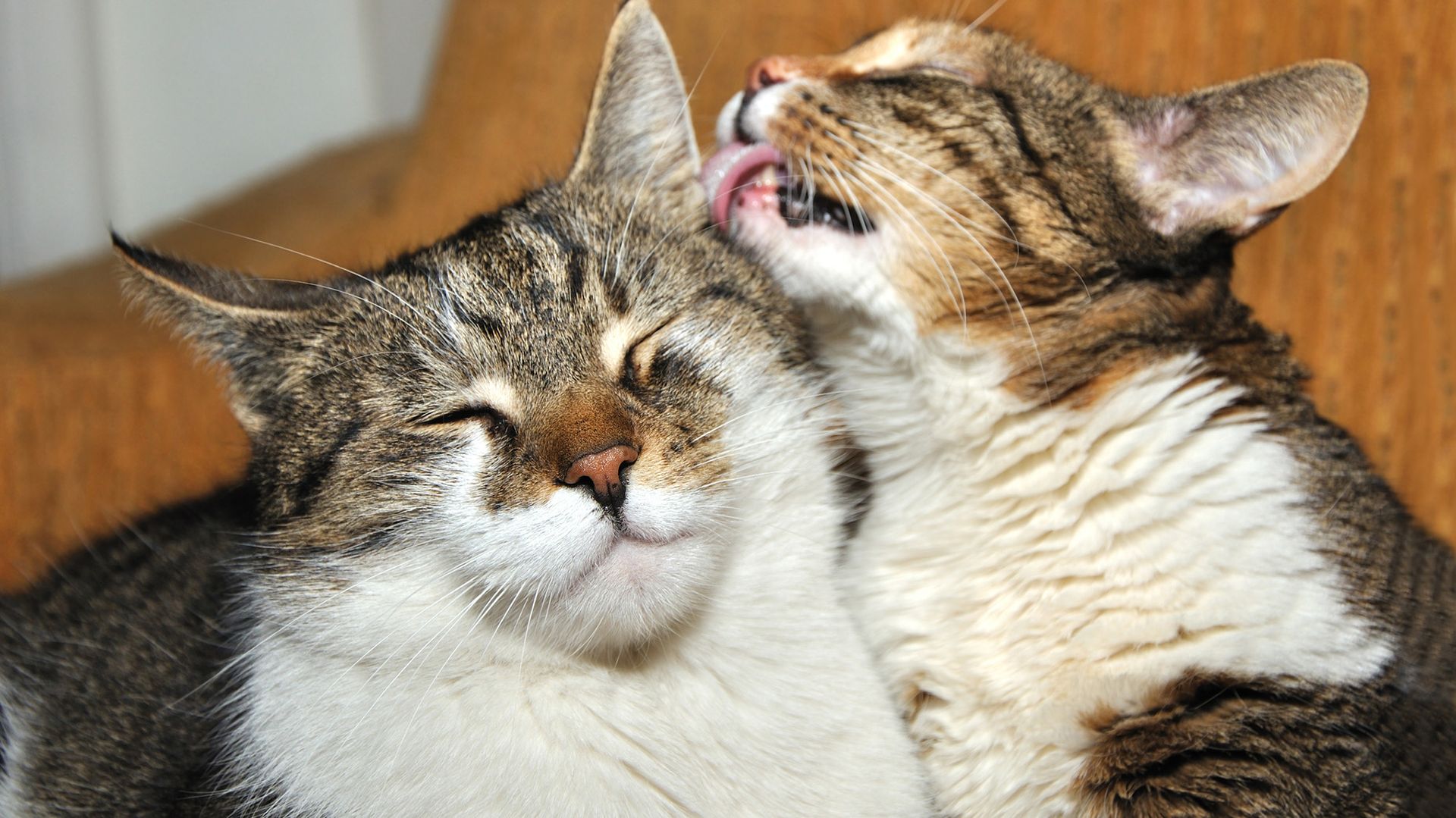
One brown-and-white cat licks another brown-and-white cat's ear.

Cats often lick the head and neck, especially the ears, of other cats. Ear-licking may help cats relax because the skin there is rich in sensory nerve endings. (Image credit: Madzia71 via Getty Images)

They also noted that allogrooming sometimes led to friendly wrestling, in which the cats grabbed each other with their front legs and tumbled around. This suggests that allogrooming may serve as a signal to start play.

In other situations, however, the researchers noticed that allogrooming was followed by behaviors linked to conflict, such as turning the ears backward, pawing, and biting. In these cases, one cat would stand or lean over the other, and both cats showed subtle signs of stress like lip licking, head shaking or self-scratching.

Based on these observations, Van Belle's team think that allogrooming may be an "appeasement signal" in fraught moments that could lead to conflict or injury, for example, when one cat wants to take over a sleeping spot already occupied by another. They think it possible that the licking helps to calm things down and keeps a spat from turning into a real fight. Similar behavior has been seen in meerkats, where subordinate individuals groom dominant ones to placate them.

Yet because this licking often targets the neck β€” the same area cats bite during fights β€” it also may signal a subtle aggressive threat, the researchers suggested.

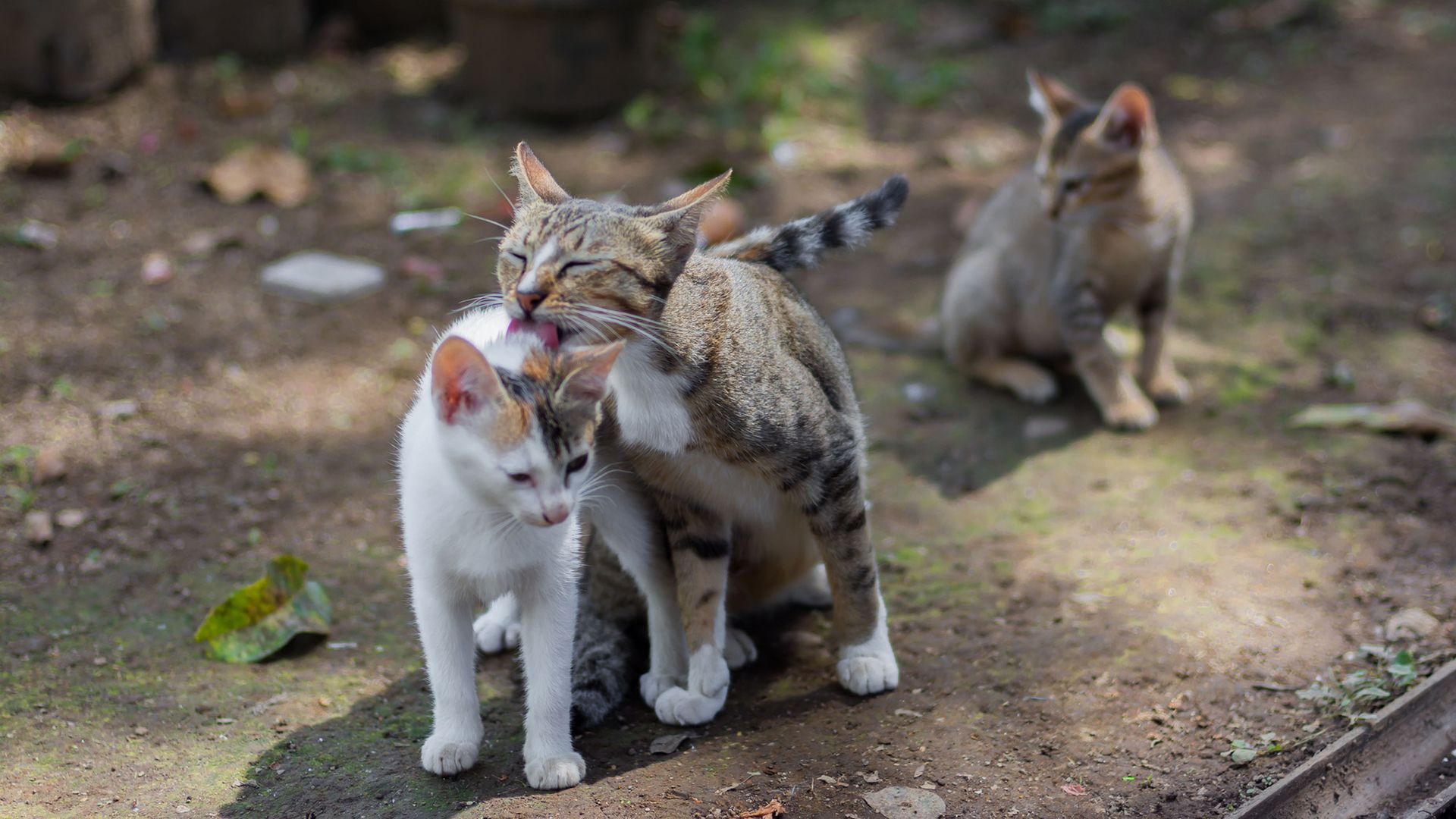
Three kittens who are outside are close together and licking each other.

It's possible that feral cats may have a different allogrooming pattern than pet cats do. (Image credit: Kriswanto Ginting via Getty Images)

Hygiene and grooming

Van Belle and her colleagues think that, beyond sending social signals, allogrooming may help with hygiene. After all, it's often aimed at the head and neck β€ͺ—‬ the areas that are "least accessible for the cat itself during grooming," Van Belle said. Allogrooming is thought to have a hygienic function in other species too. For example, ants achieve colony-level hygiene by grooming heavily infected individuals more, and primates concentrate their grooming on body parts the recipient can't easily reach. When it comes to cats, however, more research is needed. Van Belle's study did not measure parasites, infections or skin cleanliness to see whether such grooming actually reduces dirt or bugs.

Dr. Terry Curtis, a veterinary behaviorist who has studied how often allogrooming happens, also thinks cats might groom each other for hygiene reasons. She wonders whether feral cats, who likely carry more fleas than house cats, might have a different allogrooming pattern.

The explanations proposed by Van Belle and colleagues are reasonable but not definitive, Curtis said. Because so many factors can shape a cat's behavior, she's skeptical that researchers will ever be able to say with real confidence exactly why one cat grooms another.

After working as a veterinary behaviorist for 25 years, Curtis has concluded it is often impossible to understand what's going on in a cat's mind.

"Congratulations, you got a cat," she said. "Let the mystery begin.”

How much of a cat fan are you? Find out by taking our cat quiz!

'Like a jail door slamming': Male sperm whales' mysterious rhythmic clanging is the loudest communication sound of any animal

11 August 2026 at 16:09

Sperm whales make the loudest communication sound of any animal on Earth, researchers find β€” but they aren't sure why.

In a new study, researchers investigated the mysterious, low-frequency clangs made by male sperm whales and found that they were louder than any known sperm whale communication signal, with the potential to be heard by other whales around 43 miles (70 kilometers) away.

They are very loud and metallic sounds that almost sound "like a jail door slamming," which is "why they are also called clangs," study first author Simone Videsen and co-author Peter Teglberg Madsen, biologists at the Center for Active Sensing with Sound at Aarhus University in Denmark, told Live Science in an email. "You feel small as a human when you hear them, as they are clearly made by something bigger than you," they said.

Sperm whales (Physeter macrocephalus) are the largest toothed predators, growing up to around 59 feet (18 meters) long. They dive deep into the ocean to hunt giant squid (Architeuthis dux) and other prey that dwell as low as 1.9 miles (3 km) below the ocean surface.

The distinctive clangs, first reported in the 1980s, are the loudest communication signal that sperm whales make, although they can produce even louder echolocation clicks to locate prey during hunts. The clangs are unusual because they are made only by males and represent an extreme form of communication that scientists still can't fully explain.

In the latest study, the researchers used hydrophones (underwater microphones) off the Seychelles to measure the sound level of the clangs. They also studied the rhythm of the signals in recordings collected in other locations, including off Sri Lanka, Norway and Scotland.

The recordings revealed that the whales kept up a slow, low-frequency rhythm, unlike the short, rhythmic clicks that both males and females make for typical social communication or the clicks used in echolocation. In fact, the rhythm was so slow that males left a gap of 5 to 10 seconds between each clang. That might not sound that impressive β€ͺ—‬ but as far as we know, whales can't count to 10, so they are using another means to keep up this rhythm. According to the study, the whales might be relying on the echoes of the clangs bouncing off the seafloor.

Sperm whales can produce these record-breaking acoustics thanks to their ginormous noses β€” the largest of any animal β€” that dominate their massive heads, which make up about one-third of their body length. To make the clangs, male whales use their "phonic lips" β€ͺ—‬ structures in their noses that snap together.

"They make [these noises] by forcing pressurized air through so-called phonic lips in their giant sound producing nose," Videsen and Madsen said.

The researchers proposed a few possible explanations for why the whales might be making the long-range clangs. For example, the males might be using the sounds to attract mates or scare off other males.

However, the communication may exist for another, unknown reason. In future studies, the researchers hope to learn more about this mysterious form of communication by playing recordings of the clangs underwater and seeing how nearby sperm whales respond.

'They would come in with a chord change': Composer Jim Nollman has collaborated with turkeys, kangaroo rats and whales. Now he's dropping 'Orcas' Greatest Hits.'

Throughout his career as a composer, Jim Nollman has worked with unorthodox partners to create music. Instead of collaborating solely with human musicians, the artist has expanded his cast to include animal bandmates, and they've been making melodies together for more than 50 years.

Nollman's new album, "Orcas' Greatest Hits," will be released Aug. 14 by the music label Smithsonian Folkways Recordings. As the title suggests, the album is a collection of songs centered around orca (Orcinus orca) vocalizations.

Nollman now lives in Friday Harbor, Washington, but he recorded these sounds off the coast of British Columbia between 1985 and 2002, using underwater microphones called hydrophones. The vocalizations weren't random calls that Nollman overheard; rather, he prompted the orcas to "sing" by broadcasting his and fellow musicians' music into the water via underwater speakers. The artists kept the volume at a reasonable level to protect the orcas and performed after dark to avoid motorboat sounds.

However, orcas weren't Nollman's first animal bandmates. Fresh out of Tufts University in the 1970s, he made music with various animals, including turkeys, wolves and dolphins. To learn more, we spoke with Nollman about his career, including several years he spent consulting with the U.S. Navy, and the extraordinary interactions he's had with whales and other creatures.

Sascha Pare: How did you first start making music with animals?

Jim Nollman: In my latter year at university, I got involved in the theater, doing all the music for all their plays. I soon got into John Cage [an American composer known for his innovative approaches to sound] β€ͺ—‬ first in Boston, and then in the San Francisco Bay Area when I moved there. I got to know some of the avant-garde music people, especially in Berkeley, because there was a big movement there [centered around California's KPFA Radio].

I'd been in Mexico, playing flute, and the turkeys next door would always gobble on a certain high note and at a certain volume. I said [to an editor at KPFA], "Why don't you send me to a turkey farm? I'd like to do a Thanksgiving Day piece." He gave me a sound man and a Nagra tape recorder. I remember vividly, because having a Nagra after just getting out of college was a big deal for me. I was into technology. [Editor's note: Nagra is a Swiss brand of portable audio recorders.]

The turkey farm had 300 turkeys, and I immediately learned from the owner that it's really only the males that gobble. He kept the males and the females separate, so he put me into the fenced-in area where the males were. I started singing, and I could control them. The turkeys closest to me would start, and the gobble would go out to the edge of the 300 birds. And then it would come back, and then they would all stop. I was singing "Froggie Went A-Courtin'," which is an old American folk song [originally from Scotland] about animals. I sang 30 or 40 verses of this song and controlled the turkeys.

Jim Nollman playing guitar with orcas from the bow of a boat.

Jim Nollman's new album, "Orcas' Greatest Hits," will be released Aug. 14. (Image credit: Jim O'Donnell)

I was around 24 years old, and I had a hit. I knew I wanted to be a musician, but I had some major flaws to be a performer, because I didn't like being the center of attention. I'm kind of an introvert. That's a loser if you're trying to be a singer-songwriter. I loved writing tunes and playing them, but not in front of a big audience. This [recording tunes in nature with animals] was a way to get into music.

After the turkeys, I wondered if I should try making music with animals again. I tried it with kangaroo rats [Dipodomys deserti], which build these burrows like Trinidad steel drums. Kangaroo rats only come out at night, and they thump to each other in their burrow systems, which are tuned β€” it seemed to me, anyway, that each place in the burrow had a different tone β€” and they communicate with one another.

Then, I went to a wolf preserve. I realized that the wolves did two or three howl sessions in the morning around dawn and two or three at night. The wolves wouldn't play with me if I was out of their key. If I played a flat note, they would stop and basically tell me, "We don't mind if you're playing in our pack, but you've got to do it right." That was a big lesson for me, and that's how I got into it.

SP: Your new album features orcas. Did you always have a sweet spot for orcas, or is there another animal you preferred working with?

JN: No, I don't have a sweet spot for orcas. I recorded orcas for 15 years, and I had lots of recordings, most of which I never really listened to, because I didn't know what to do with them. At some point, I decided that "I can't do anything more with the orcas, and I don't like going to whale conferences and being this authority," because it wasn't about that for me.

[After years of recording orcas], I started going to the Arctic β€ͺ—‬ because I wanted to go to the Arctic and because beluga whales [Delphinapterus leucas] were there, and they seemed like the opposites of orcas. The orcas were very much in tight families traveling together and making very simple calls that had deep meaning. To have their echolocation against a speaker at midnight could be like being in a war zone. It was so loud; we had speakers blow out sometimes.

The beluga whales were the antithesis of that. It seemed like they all were talking at the same time, and they all seemed to know what everybody else was saying. This is my speculation. They used sound as their family anchor, and I had no idea if they all understood each other talking. But it was very much more animated than what the orcas were doing. I would say 50% of the orca calls were just two notes; they were D to C, and back to D. And they would do that all day long, some of them. Beluga whales sometimes sounded like belly laughs. They made the weirdest sounds, and I loved it.

I went everywhere in the Arctic. I started out in the first year going to Nome [Alaska] in the Bering Strait, and then I went east to the Mackenzie River delta in northern Canada on the Beaufort Sea. Then, I went to Baffin Island in the Canadian High Arctic. In every place I went, limited beluga populations were crashing. At some point, I realized this was a complete loser. I pretty much gave it up until I met some people from Finland who said, "You should try it in Russia." The Soviet Union had recently crashed, and they were opening up all the places where they had their gulags [forced labor camps] and their nuclear fleet. The Solovetsky Islands were loaded with beluga whales that hadn't seen people in 70 years. I went there, and I had a great time with the beluga whales.

The wolves wouldn't play with me if I was out of their key.

Jim Nollman, musical composer and sound artist

SP: What is your favorite memory of working with orcas or beluga whales?

JN: Six or eight years ago, somebody brought me and a bunch of other artists up to Hudson Bay [in Canada], basically to emulate what I'd done for so many years [artistic residencies to experiment with whale sounds]. I was the mentor for everybody. I liked that role. We were confronted with beluga whales, and I said, "I don't really want to play the guitar or the mandolin with the beluga whales, because I've tried that all over the Arctic and I've never had much success. I'm going to put my head in the water and blow bubbles."

The beluga whale came up, and it wrapped its mouth around my face. It did the same thing to the woman who was blowing bubbles on the other side of the kayak we were on. That was maybe the most fun thing I ever did with cetaceans. I wasn't worried at all. I've had the same thing happen with giraffes. I was in Texas at this game farm, and this giraffe came and licked my whole face with its giant tongue. It was really quite wonderful.

SP: The oldest recordings in the new album are 40 years old, and you said you hadn't listened to all of them before making the album. What was it like hearing them after all these years?

JN: I had 65 hours of tapes, and I listened to them over three or four months. Ninety percent of it was rubbish; it was just repetitive, and the whales would get into their D-to-C-to-D call routine. I wanted something where there was a groove, or some kind of magic going on that was inexplicable.

I started choosing some sequences. I thought it was only a certain level of connection that we'd created, but a couple of the things that I listened to when I was in that process blew me away. The one where I was playing James Brown riffs into the water β€ͺ—‬ that was very strong for me. I'd never heard that before. I was discovering new stuff by giving it a close listen.

There's one where I was being filmed by National Geographic, and it was just me and a guy on a big boat cruising the waters. I started playing a country blues bottleneck on the guitar. [Editor's note: A bottleneck in country blues is a guitar-playing technique where a hard object is placed on a finger and glided along the strings.] The whales only did this a couple of times, but they would come in with a chord change. Say I'm playing in a key of D; they would come up and play the G in perfect time. I was impressed by that.

SP: Did you ever play the recordings of you and the orcas back to the orcas?

JN: No, because the recording can't answer the whales. I was trying to make a telephone connection, so it has to be two things talking to each other. To play a recording would be like me saying, "Let's stop this interview now, and I'm going to put on something of me giving an interview to somebody I spoke to yesterday." You wouldn't like that, and I don't think the whales would have liked that either if I did it to them. It had to be direct. I had many people who were very ardent or passionate about singing or reciting poetry β€” one guy wanted to sing Jewish death prayers to the whales. But the whales didn't come.

A man playing a guitar with headphones in, on a boat in on the ocean.

Nollman recorded orcas off the coast of British Columbia between 1985 and 2002. (Image credit: Jim Nollman)

SP: Is part of why you've been so successful at making music with animals that they particularly like you?

JN: Some animals like me. I definitely got through to the orcas. I could tell that, because I had an interim of eight years between doing it with the big communities [of artists] and going out alone with the orcas. They were the same orcas, and they definitely knew who I was the first time I put sound in the water again. That's when that country blues episode happened. We were all much more relaxed with each other. The second time was great. It was also a tragedy, because the whales had lost their residence to the loss of salmon [in the northeast Pacific Ocean], and they were way out of their range.

SP: Your work with orcas and other whales landed you a job with the U.S. Navy in 2011. How did that happen, and what was your role?

JN: I was doing underwater concerts in the 1990s. I was invited to Kodiak Island, which is a large island off the coast of southern Alaska. They wanted me to do an underwater concert. At the time of this festival, in which I was performing, the U.S. Navy was sending ballistic missiles from Southern California to the waters off Kodiak Island for testing. This was destroying the halibut [Hippoglossus stenolepis] fishery on Kodiak Island, because the fishermen couldn't go into this area, suddenly.

The Navy sent a guy who was part of this ballistic missile thing but also had a PR background. He said, "Can I speak before your concert?" I said, "You can speak about whatever you want, but you've got to get in the water. That's the payment you have to give me: Get in the water and hear all this music that I've created."

He was blown away. I had a fan. He took me out for dinner and asked me if I had any ideas about solving this great scandal that was enveloping the Navy at the time, which was the killing of mostly beaked whales during mid-frequency sonar exercises, mostly in the Bahamas, in this hole in the ocean that's there. Nobody had a solution, so he wanted me to be on the team. I said, "Sure, I'll be on the team." It was like somebody asking me to play for the New York Yankees or something β€” completely odd, but I thought, "OK, I'll try that."

He called me back two years later, saying, "We have our money, and we want you to come to the Groton submarine base [in Connecticut], where we'll have our first meeting with submarine captains, Ph.D. sonar engineers and a few whale biologists." That went on for seven years. I took the job seriously. I told them that I thought we could solve it in five minutes. I said, "All you need to do is take care. If you see whales in the vicinity, don't exercise on that day." This sounds so totally obvious, but the fact was that he [the PR man] was contending with a Navy establishment that believed that the Navy could do anything to save the American people from being bombed or wrecked. They didn't see whales as anything but collateral damage.

SP: Do you have a favorite song on the new album?

JN: I like "The Three Jimmies." I never knew that James Brown's guitar player was named Jimmy Nolen β€” I mean, that's really outrageous. So, it's the three Jimmies, right? I really like the music, and I like the piano player [Jonathan Churcher], who plays one note every three or four bars. The response of the whales is also brilliant, I think. There's one part where the whale starts to echolocate, which is the way they see the world; it's their perceptional tool. The whale starts clicking in time with the beat that I'm playing on the guitar. That only happened once in 65 hours of recordings, and I thought that was pretty unusual.

SP: What's next for you after "Orcas' Greatest Hits"?

JN: I'm composing new music, and I'm hoping I'm at least breaking even [with the new album] so that they [Smithsonian Folkways Recordings] can do the next one, which is called the "Cowbird Variations." The cowbirds are basically the bottom voice, maybe the part that's played by bass in pop music. Everything else is other birds and insects called treehoppers. It has this very primitive sound to it.

I love doing this music with cowbirds, because cowbirds have a horrible reputation. They lay their eggs in other birds' nests, and when the eggs hatch, the baby cowbirds knock all the birds in the nest out and kill them. Then, the parents β€” juncos, where I live β€” end up raising the cowbirds. These birds have a terrible reputation, but they make one of the strangest sounds in nature β€” so that's why I chose them.

This interview has been condensed and edited lightly for clarity.

'It's incredibly rare to see a moment like this in the ocean': Camera drone captures moment humpback whale gives birth off Australian coast

A camera drone operator captured footage of a humpback whale giving birth off the north coast of New South Wales in what is thought to be a world first.

Alexander Forrest, a commercial drone pilot for the Organisation for the Rescue and Research of Cetaceans in Australia (ORRCA), was conducting aerial observations of migrating humpback whales (Megaptera novaeangliae) on July 28. ORRCA is a nonprofit organization focused on the rescue, conservation and welfare of marine mammals.

During the survey, Forrest noticed a whale swimming slightly behind her pod and going unusually slowly. Then, he saw her give birth.

"It's incredibly rare to see a moment like this in the ocean. It's a very rarely documented encounter," Forrest told Live Science. "It's the first drone video as far as we know of a full humpback whale live birth. It gives critical inside moments in the first moments of a calf's life, and also discovers the behaviour of a new humpback whale mother and her freshly newborn calf."

An ORRCA spokesperson said that this is only the fourth time the phenomenon of a humpback whale giving birth had been filmed, in general. Scientists also have footage of other whale births, including a gray whale (Eschrichtius robustus) birth filmed off the coast of California and a sperm whale (Physeter macrocephalus) recorded giving birth in the Caribbean.

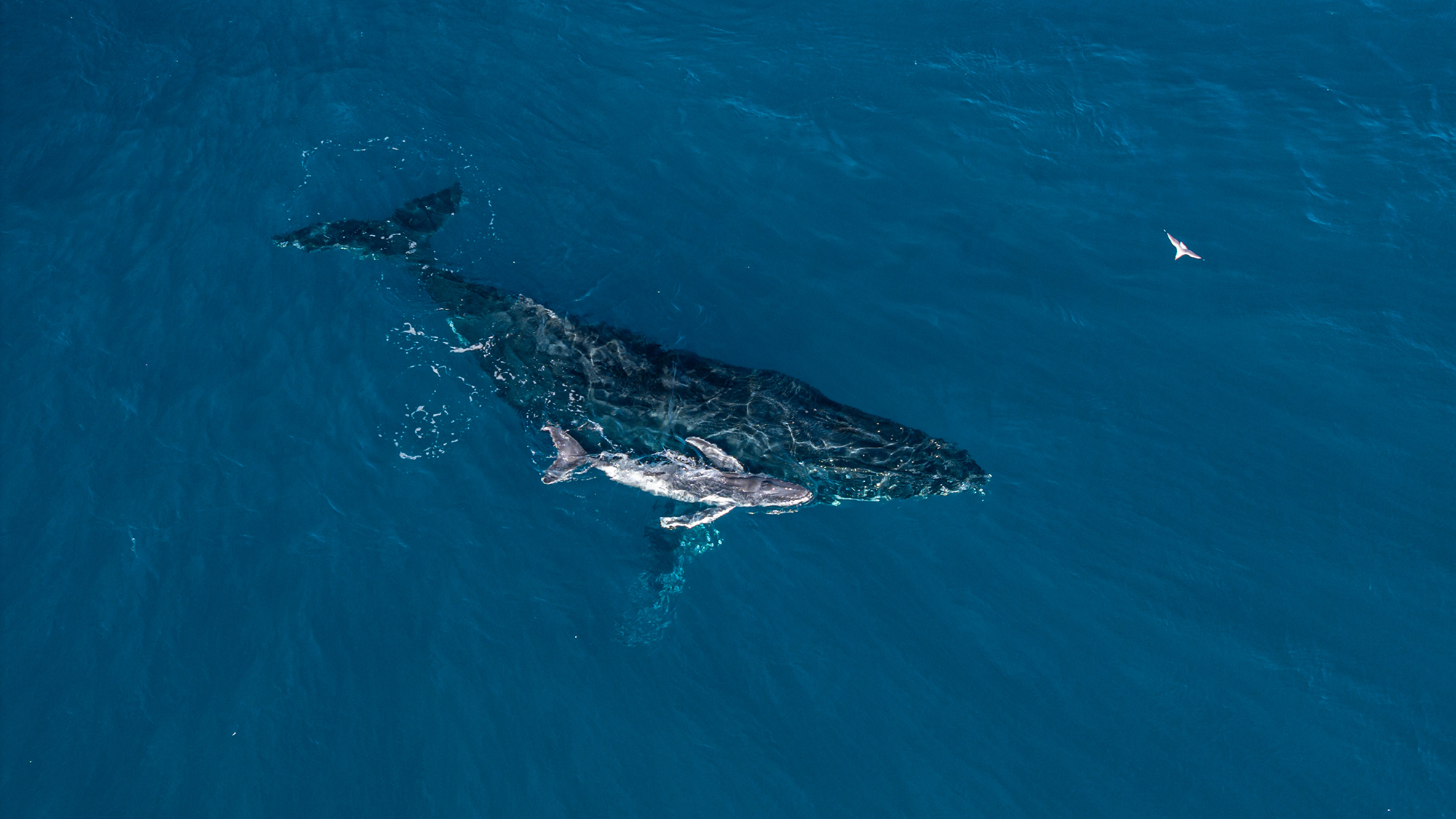
Large whales swim in the blue ocean

The expectant humpback whale mother swam behind her pod, eventually giving birth by herself. (Image credit: Alexander Forrest/ORRCA (@forrestfov))

The drone video shows the newborn whale surface from blood-reddened water for its first breath. The mother then turns back to reunite with it. The scene was filmed around 0.4 miles (700 meters) from the shore at Kingscliff in northeastern New South Wales.

The birth is "a symbol of one of the strongest conservation efforts in history, returning humpback whales from near extinction to nearly 50,000 on the New South Wales coast," Forrest said. Gathering data on this humpback whale population is critical to "discovering more about where they birth, what happens when they birth, and what those early moments look like."

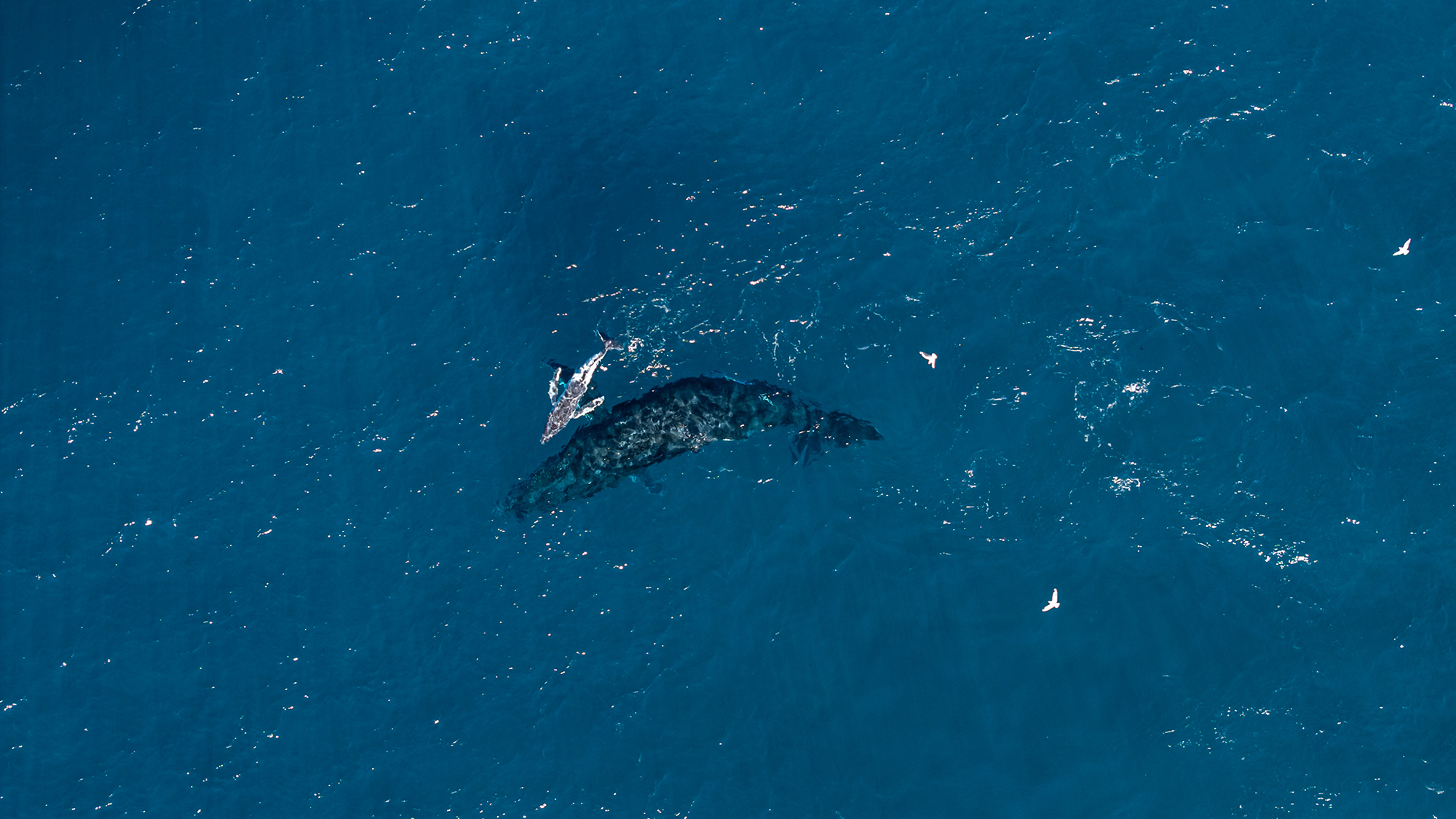
Large whales swim in the blue ocean

Humpback whale calves stay with their mothers for their first 11 months. (Image credit: Alexander Forrest/ORRCA (@forrestfov))

The footage will now be analyzed so that a report on the observation can be peer-reviewed and published in a scientific journal. Notably, the mother whale was trailing behind her pod when she gave birth, a detail biologists will compare with observations of other birthing whales that were accompanied by members of their pod. For instance, the 2023 drone footage of the sperm whale giving birth showed that she had 10 adult females near her that formed a protective circle and took turns lifting the calf up so it could breathe at the water's surface.

Throughout their first weeks, calves stay close to their mothers and learn critical behaviors, such as breathing at the surface.

"Humpback whales seem to have an incredible maternal bond with their offspring," Forrest said. "There is an 11-month period where this calf will be raised and feeding on very nutrient-rich milk until it is a yearling and can fend for itself."

A newborn humpback whale calf weighs 1 to 1.5 tons (900 to 1,360 kilograms) and measures roughly 10 to 16 feet (3 to 5 meters) in length. While feeding on its mother's milk, the calf will gain 100 pounds (45 kg) a day and develop the strength and food storage it needs for its first migration. Humpback whales undertake one of the longest migrations of any mammal, travelling up to 5,000 miles (8,000 kilometers) each way between the cold waters of the poles to warm tropical breeding grounds.

Why do cats have 'leg whiskers'?

1 August 2026 at 10:00

Cats are known for the whiskers on their faces. However, if you look closely, you can see that they also have whiskers on their legs. So why do cats have leg whiskers?

To answer why they're useful, it's important to understand what whiskers are. Technically known as vibrissae, whiskers are specialized hairs that are stiffer and several times thicker than other hairs. Although whiskers themselves do not contain nerves, their bases are rooted in specialized receptacles loaded with nerve endings, making whiskers very sensitive.

"Facial whiskers are as sensitive as human fingertips," Robyn Grant, a sensory biologist at Manchester Metropolitan University in the U.K., told Live Science.

Sign up for our newsletter

Life's Little Mysteries logo with a question mark in a magnifying glass

(Image credit: Marilyn Perkins / Future)

Sign up for our weekly Life's Little Mysteries newsletter to get the latest mysteries before they appear online

A cat's whiskers around the nose, which are also known as the mystacial vibrissae, are the longest whiskers they have, according to the veterinary reference book "The Feline Patient" (Wiley, 2025). Although there is variation among cats, on average there are 12 mystacial whiskers set in four rows on each side of the muzzle.

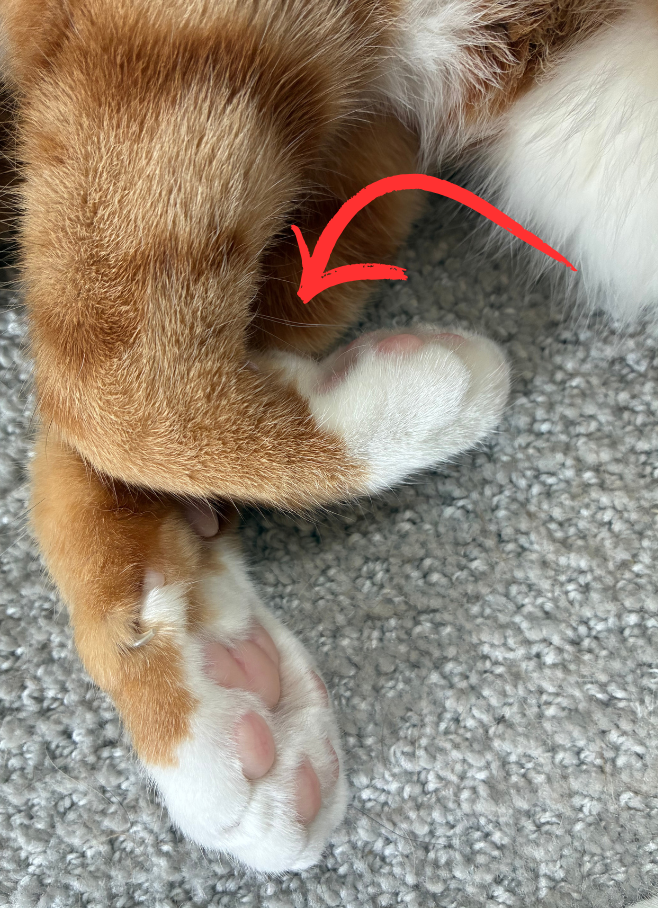
A close up of an orange cat's legs with an arrow

Cat leg whiskers, scientifically known as carpal vibrissae, are attached to their forelegs. (Image credit: Future)

Facial whiskers help cats hunt when light is limited or when their vision is poor. Although cats are good at seeing distant objects, "cats can't really focus on anything less than 10 inches (25 centimeters) from their eyes, so they use their whiskers to figure out where things are," Jonathan Losos, an evolutionary biologist at Washington University in St. Louis and author of "The Cat's Meow: How Cats Evolved from the Savanna to Your Sofa" (Viking, 2023), told Live Science.

In addition, cats have a tuft of whiskers known as superciliary vibrissae above each eye. These whiskers help protect the cat's vision by triggering a blink when stimulated by anything that might fly into their eye, according to The Feline Patient.

Cats also have chin whiskers (mandibular vibrissae) and whiskers on each side of the head, between the ear and chin (genal vibrissae). These also help cats stay aware of the space around them.

Leg whiskers

Cats also possess a tuft of four to six whiskers on the back of each front leg, each about 0.8 to 1.2 inches (2 to 3 centimeters) long. These are known as carpal vibrissae.

"Carpal refers to the bones that, in humans, are in our wrists," Losos said. "Carpal whiskers are attached to cat forelegs near the carpal bones." However, in cats, the carpal bones are not located in the same place as the human wrist. Rather, they "are further up the leg, because cats essentially walk on their toes and not their palms," he explained.

Cats are not the only animals with carpal whiskers. "Most carnivores have them, and many rodents do, as do lemurs and armadillos," Losos said. "Dogs don't have them, but other canine species do. Rabbits don't have them either, nor do ungulates β€” that is, hooved animals, such as horses and cattle."

The species that have carpal whiskers "tend to be the ones that either grasp things with their forelimbs or climb up trees," Losos said. "The idea is that if it's hard for the animals to see what they're grasping, carpal whiskers can help supplement their vision. Perhaps cats have them and dogs don't because cats can move their forearms laterally from side to side and put their palms together to grab things, whereas dogs can't."

It remains uncertain what role carpal whiskers play in cats, but they likely "guide locomotion β€” that is, safe forepaw placement β€” especially during complex locomotion, such as climbing," Grant said. "They might guide prey handling too."

How much of a cat fan are you? Find out by taking our cat quiz!

What colors were prehistoric mammals?

30 July 2026 at 12:00

The spots on a leopard, the stripes on a zebra, and the mask on a raccoon are all types of coloration in mammal fur, referred to as pelage. Scientists have struggled for a long time to understand how these colorations evolved. A team of researchers recently discovered how to reconstruct the colors of ancient mammal fur using cell structures that contain the chemical pigment melanin, known as melanosomes. They hope to use this understanding of ancient mammal pelage to determine how they lived and what their environments were like.

To decipher the color of ancient mammal fur, the researchers constructed a statistical computer model to predict their fur colors based on the shape of their melanosomes. First, they needed to understand how the shapes of melanosomes control fur color in modern mammals. To measure the length and width of the modern melanosomes, the scientists used a beam of electrons like a flashlight to map them in great detail, a technique called scanning electron microscopy.

They measured the length and width of 2,615 melanosomes from the fur of 116 different living mammal species, including a Red Panda, a German Shepard, and one or more species of most types in the mammalian classification. Then they recorded the wavelengths of light reflected off each melanosome using a microspectrophotometer. These wavelengths represented the exact color of hair from each melanosome they measured. This means they now had a quantitative measurement of the color of each hair to compare with its corresponding melanosome length and width.

When they examined their data, the researchers found that spherical melanosomes produced brighter fur colors, like reds and oranges, while elongated melanosomes produced darker fur colors, like browns and grays. The researchers plotted the microspectrophotometric measurements for each melanosome as a graph showing how much light it absorbed across each possible wavelength, creating reflectance curves. Based on these data, the researchers used computer software to create a statistical model that could predict reflectance curves, and therefore color, from melanosome shape alone.

Once the researchers created a model, they needed to find fossilized mammal melanosomes to predict their fur color. Mammal fossils are rare, and pieces of cells are only preserved in the most immaculate fossil deposits. In fact, these researchers only found 6 fossils of this caliber, from Mesozoic rocks deposited around 250 million years ago, soon after mammals evolved.Β 

The fossils came from 2 world-renowned deposits in Northeastern China, the Yanliao and Jehol biotas. They selected 5 previously studied fossils from these locations, including 1 specimen of Megaconus mammaliaformis, 1 specimen of Vilevolodon diplomylos, 2 specimens from the group Docodonta, and 1 specimen from the group Eutheria. All of these animals were small, rodent-like mammals. The researchers also discovered a new species of tree-dwelling mammal, Arboroharamiya fuscus.

The scientists used scanning electron microscopy to measure a total of 2,159 fossilized melanosomes to refine their color predictions. The fossilized melanosomes were all slightly elongated spheres and had far fewer differences in shape than in modern mammals. The researchers used their model to predict reflectance curves based on the shapes of the fossil melanosomes to determine the ancient mammals’ colors. They found that all the extinct mammals they examined likely had dark brown fur without any color patterns.

Based on these findings, the researchers suggested that most, if not all, early mammals were nocturnal, like many dark-colored mammals today. They suggested that this nocturnal lifestyle probably helped them survive the meteorite impact that wiped out the dinosaurs 100 million years later. While dinosaurs were unable to survive in the post-impact wasteland, these smaller, dark-colored mammals were more resilient and thrived in the aftermath. As mammals filled the ecological roles left by the dinosaurs, they evolved new color patterns, some based solely on camouflage, and others on new factors, like sexual selection and visual communication.

The researchers concluded that their model can predict fossilized mammal colors and help determine how these ancient animals lived. Notably, their data suggest that mammals likely stayed small and nocturnal throughout the Mesozoic until the dinosaurs were gone. Future researchers could use similar methods to uncover exactly how mammals evolved the colors we see today. For example, studying mammals closer to the impact event could reveal if it took a long time to develop diverse fur patterns, or if they began before the dinosaurs’ demise. Ultimately, similar studies could help determine whether the extinction of dinosaurs was necessary for the rise of mammals.

The post What colors were prehistoric mammals? appeared first on Sciworthy.

Monkeys have a basic intuition for geometry, study suggests

29 July 2026 at 17:43

Monkeys use some of the same basic mental strategies as people do to perceive abstract relationships between shapes, a new study suggests.

The findings challenge the idea that humans crossed a sharp evolutionary divide when they learned to recognize geometric properties like symmetry, parallel lines and right angles, the researchers say.

"While humans do come up with geometric descriptions that are more abstract than what nonhumans can do, there's still some overlap, some similarity in the kinds of geometric intuitions you see in humans and those of non-primates," study co-author Jessica Cantlon, a professor of developmental neuroscience and psychology at Carnegie Mellon University, told Live Science. "So there's a thread of continuity that runs through geometric reasoning between humans and nonhumans."

The research, published July 20 in the journal PNAS, adds to a long-standing scientific debate over whether humans possess entirely unique forms of abstract thought or unusually sophisticated versions of abilities found elsewhere in the animal kingdom.

"For decades, cognitive scientists have searched for the 'special ingredient' that distinguishes human intelligence from that of other animals," Elizabeth Brannon, a professor of psychology at the University of Pennsylvania who was not involved in the research, told Live Science in an email. "This study provides compelling evidence that, at least for geometric reasoning, the difference between humans and other primates is more quantitative than qualitative."

In other words, the study suggested that baboons and macaques don't lack the ability to reason about geometry. Instead, they just aren't as proficient at it as humans, meaning that humans didn't evolve a new unique skill in understanding geometry.

A geometric matching game

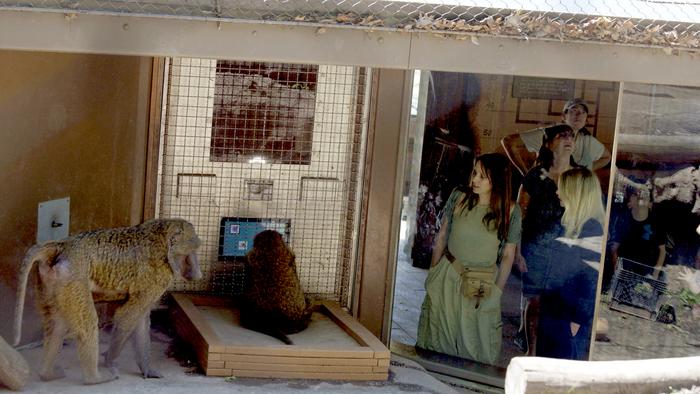
The researchers tested eight adult monkeys: four rhesus macaques (Macaca mulatta) and four olive baboons (Papio anubis). The olive baboons participated through the Primate Portal, a touch-screen system installed at Seneca Park Zoo in Rochester, New York. One baboon, Kalamata, was especially enthusiastic.

"Every day he came to the touch screen," Jialin Li, a doctoral student at Carnegie Mellon University and first author of the study, told Live Science. "He just sat there and worked for two hours, three hours straight, completing thousands of trials. That's just amazing."

The macaques participated separately at Carnegie Mellon University, having prior experience with matching tests in other experiments.

The researchers then compared the animals' performance with that of 58 U.S. preschoolers ages 3 to 6, and 79 adults from the TsimanΓ©, an Indigenous farmer-forager society in Bolivia whose members received little formal education. A separate experiment in the larger project involving rotating shapes also included 21 U.S. adults.

In all of the study's cohorts, the participants played a game known as a match-to-sample task.

"[The participants] see a sample shape first," Li said. "For example, it's a square. Then they need to tap the square to make sure that they are looking at it. When they tap it, there will be two shape choices that come up: one on the left and one on the right. They need to choose which shape matches with the sample shape."

The researchers made the choice shapes half the area of the sample shape, thus preventing the participants from solving the task by simply matching overall size or pixel count. In another version of the test, they rotated the choice shapes, thereby forcing the participants to identify the underlying form despite its changed orientation.

Two monkeys are seen in an enclosure with people nearby

Two olive baboons participated in the Primate Portal experiments at the Seneca Park Zoo in Rochester, New York. (Image credit: Rochester Institute of Technology)

Correct answers earned the monkeys fruit-flavored cereal pellets, preschoolers collected stickers that could later be exchanged for prizes, and adults received verbal feedback. Incorrect answers triggered a "bonk" sound and a short timeout from the game.

Despite their limited formal education, the adult group had little trouble with the game, but the monkeys and the children had to put considerable thought into their choices.

"We often think that this matching task will be super easy for humans," Li said. "But actually, young kids were struggling in completing the task in telling the shapes apart, which makes them more similar to monkeys."

Ultimately, the children and monkeys could find the matches, Cantlon said, but only after taking a long time to think about the problem.

The researchers then used computer models to investigate which visual properties best predicted participants' decisions. One model represented simple details, such as edges and lines. Another represented more complex information about a shape's overall form. A third encoded discrete geometric properties, such as equal sides, equal angles, symmetry and parallelism β€” an approach the researchers described as "symbolic."

According to Cantlon and Li, the term "symbolic" does not mean the monkeys were mentally applying rules such as "a square has four equal sides." Much of the apparent symbolic effect could be explained by the ability to recognize a shape regardless of its orientation, known as rotation invariance.

If abstract geometry depended on a uniquely human symbolic system, only the human participants would have shown evidence of using that thought process. Instead, both monkeys and humans appeared to rely on a mixture of complex visual information and symbolic-like features. Adult humans generally performed the best, followed by preschoolers and monkeys, but their results overlapped. This finding suggests that the differences were quantitative, meaning humans are simply better at the same underlying kind of geometric reasoning rather than possessing an entirely unique ability., Monkeys relied roughly three times more strongly on the symbolic model when the shapes were rotated than when they remained upright.

Brandon said one of the study's most intriguing findings is that what looks like uniquely human symbolic reasoning for understanding geometry may actually grow out of flexible, abstract ways of representing information that are shared by humans and other primates.

Ancient roots of geometry

The results do not mean that monkeys understand formal mathematics, Brannon cautioned. "Human mathematical reasoning extends far beyond recognizing geometric regularities β€” it includes language, formal proof, recursive reasoning and cultural transmission."

Rather, this study provides evidence that some of the building blocks of mathematical thought have deeper evolutionary roots than previously recognized, she said.

Giorgio Vallortigara, a professor of neuroscience at the University of Trento in Italy who was not involved in the study, agrees with Brannon and her colleagues' conclusions.

Vallortigara explained in an email to Live Science that previous studies have often focused on how animals understand the geometry of their surroundings, such as navigating spaces. What makes these findings different is that they show animals can also reason about the geometric properties of individual objects.

Comparing species can help scientists trace the origins of geometry before language or arbitrary symbols became involved, Vallortigara said. It may also reveal whether similar abilities depend on mechanisms inherited from a common ancestor or evolved independently in animals with different nervous systems.

Li and Cantlon are now breaking down shapes into components such as angles, side lengths and numbers of sides to identify which properties are the hardest for monkeys and humans to understand. Cantlon described the follow-up as "a deconstructed geometry task."

The research could also help educators understand the geometric intuitions children bring into the classroom, Cantlon said, allowing lessons to build upon those abilities rather than treating geometry as something learned entirely from scratch.

"Evolution rarely invents entirely new mechanisms from scratch," Brannon said. "More often, it refines, recombines and extends existing ones."

What do you know about chimpanzees and great apes? Test your smarts with our primate quiz!

Killer whales sink another boat off the coast of Spain β€” why are they still doing this after 6 years?

A pod of killer whales has sunk another yacht off northwestern Spain, reinforcing a bizarre pattern of vessel encounters that has stretched on for more than six years along the Iberian coast.

In the incident, reported Friday (July 24), the whales destroyed the rudder of a 46-foot-long (14 meters) Swedish-flagged yacht off Galicia in northwestern Spain, forcing the two people aboard to send a mayday call. A Spanish coastguard vessel towed them to safety, Spain-based news outlet Sur in English reported.

The incident came after several other encounters in the same waters earlier that week, including one in which a pleasure craft called the Idem sank near Estaca de Bares, the northernmost point of the Iberian Peninsula. The ship sank after the killer whales, also known as orcas (Orcinus orca), destroyed its rudder. Both occupants were rescued.

That makes the Idem at least the eighth boat lost to these encounters since they began, according to groups that track the incidents. More than 700 interactions between orcas and vessels have been logged since 2020, ranging from a brief nudge to a multihour rudder-ramming session, according to the Atlantic Orca Working Group, the Spanish-Portuguese research collective that has coordinated data collection on the phenomenon from the start.

Researchers have identified roughly 15 individual killer whales involved in these incidents, out of an Iberian subpopulation of fewer than 50. The group is so small that the International Union for Conservation of Nature lists it as critically endangered, as it is dependent mainly on Atlantic bluefin tuna for its food.

The family-like cluster is thought to be led by a female known as White Gladis. That name comes from an early theory researchers themselves once floated: that White Gladis suffered some kind of traumatic run-in with a boat and that the encounter flipped a behavioral switch, with her being the first in the group to start ramming rudders.

Alfredo LΓ³pez Fernandez, a biologist with the Atlantic Orca Working Group, told Live Science in 2023 that this kind of defensive, trauma-driven origin was gaining traction among researchers at the time. But "defensive" isn't "vengeful" β€” and the idea has since curdled online into a punchier revenge story most scientists studying the population don't endorse.

So why do orcas go after the boats? Nobody knows for certain, but the leading explanation is simple: Orcas are some of the most social animals on the planet, and social animals pick up habits from one another the way trends spread through a friend group. Researchers describe the behavior as socially learned β€” young orcas appear to watch adults ram a rudder and then try it themselves, and the habit has spread through the group over time.

A 2022 study in the journal Marine Mammal Science found that the killer whales usually targeted sailing boats and often lost interest after striking the rudder and causing the boat to stop.

None of that makes the encounters any less disruptive for the people living through them. The standard guidance from authorities like the Maritime Safety and Rescue Society and the Atlantic Orca Working Group, refined over repeated encounters, is to cut the engine, drop the sails if possible, disengage the autopilot, and let go of the wheel entirely, giving the orcas nothing to push against. Boats that follow this protocol tend to sustain less damage than those that don’t.

Sailors are asked to report every encounter. Each one adds to the data scientists are using to try to solve a years-long mystery.

'We're trying this out of frustration': Marmots star in OnlyFans account as researchers desperately look for ways to raise funds amid US budget cuts

A team of UCLA scientists has resorted to posting content on OnlyFans to raise money for research amid huge federal funding cuts to U.S. science. But the videos aren't of themselves, they're exclusive recordings of marmots.

"I spend a lot of time waiting for marmots to do things and had the idea one slow morning," Daniel Blumstein, a professor of ecology and evolutionary biology at UCLA, who leads the project, told Live Science in an email. "When I came back with this idea, one of my graduate students immediately said we MUST do this! So here we are!"

Researchers at the Rocky Mountain Biological Laboratory (RMBL) have been studying yellow-bellied marmots (Marmota flaviventer) at a field station in the Rocky Mountains near Crested Butte, Colorado, since 1962. "The RMBL marmot study is the second oldest continuous study of individually marked mammals in the world," Blumstein said. "We have up to 65 years of data on population dynamics, social and anti-predator behavior and ask a lot of questions about how animals respond to a changing environment."

Yellow-bellied marmots are one of 15 marmot species, a group of cat-size ground squirrels that can be found throughout the Northern Hemisphere. This particular species is widely distributed throughout the Rocky Mountains and several mountain ranges in California. The species live in social groups and are active during the day, which makes them a great subject for long-term behavioral studies.

"Long-term research like ours is both very valuable to understand how and why things change over time, and our project has been very productive," Blumstein said.

However, collecting data over such long periods comes with a significant price tag. And with federal funding cuts draining research budgets across the country, Blumstein and his team have had to look for other methods to raise money for their research. Enter OnlyMarms.

On June 17, the RMBL Marmot Project announced on Instagram that "the state of funding is so bad we are turning to OnlyFans, or as we like to call it 'OnlyMarms'."

Two marmots on a rock

With federal funding cuts draining research budgets across the country, Blumstein and his team have had to look for other methods to raise money for their research. (Image credit: Daniel T. Blumstein, Professor Department of Ecology & Evolutionary Biology Institute of the Environment & Sustainability UCLA)

OnlyFans is a subscription platform that allows users to pay creators to see exclusive photos and videos. The platform has become popular with adult-only content creators, but it hosts others too, including musicians, athletes and celebrities β€” and now marmots.

"We’re trying this out of frustration with an extremely challenging funding environment," Blumstein said. "If we’re lucky, it can help raise money for supplies and some expenses. But unless we are very lucky, it won’t replace the federal funding that has driven discovery in the US since the 1950s."

However, for anyone hoping for spicy marmot content, you might be a bit disappointed. "[It's] almost all G-rated content of marmots playing, being cute, digging, bringing plants to their burrows…normal routine stuff for marmots," Blumstein said. "The occasional scuffle makes it PG rated."

Emily Renkey, who also works on the project, said the team hopes to add videos of marmot pups soon.

"Our 'Onlymarms' page has gotten a bit of engagement since we started it a bit over a month back," Renkey told Live Science. "We've gotten 735 page visits and have 44 fans."

But how much has OnlyMarms actually been able to raise? "Not much," Blumstein said. "We’re letting folks have free subscriptions and ask for tips. They [OnlyFans] take 20% and I have to pay taxes on the balance."

Even so, the team is hopeful that the page is helping to increase public engagement and interest in the project. "Overall I think this can be an amazing way to teach people more about animal social behavior, which can sometimes be hard to observe," Renkey said. "Even we are learning more about marmots through these up close glimpses the game cameras provide."

While it is difficult to get signed consent from the marmots to use this content online, Blumstein said that the funds raised would be used to help protect the creatures in a rapidly changing world. "We are using these funds to help continue the study which provides valuable information about them and how they’re responding to climate change," he said.

The OnlyFans account is just one way the team has tried to share its research with new audiences. "We work hard to translate our research findings to the public," Blumstein said. "Our lab’s running a Fat Marmot Week contest this summer. We're hoping this will let people learn more about these fascinating alpine critters!"

'It was unlike anything I'd witnessed before': Orcas seen headbutting a sunfish so hard that it exploded

23 July 2026 at 05:00

One of the ocean's most intelligent and aggressive predators has once again surprised scientists with a curious new behavior. In the Gulf of California, researchers witnessed orcas working together to smash dead sunfish into bits β€” a suspected food processing technique that makes it easier for younger whales to feed on the enormous bony fish that weigh up to 4,400 pounds (2,000 kilograms).

In two separate encounters, one orca gripped a sharp-tail sunfish (Masturus lanceolatus) while another orca charged toward the fish. The first whale released the carcass just before impact, allowing its companion to slam into the fish at high speed and scatter fragments of fish flesh throughout the water.

"It was unlike anything I'd witnessed before," Kathryn Ayres, a scientist at the conservation nonprofit Beneath the Waves told Live Science in an email. "As a scientist, moments like this are incredibly exciting because you realize you're observing something that may never have been documented in detail before β€” as you can tell in the video!"

Ayres and her colleagues dubbed the behavior "ram-to-fragment." Their observations, published July 23 in the journal Frontiers in Ethology, suggest the killer whales were not trying to kill the sunfish, which were already dead and appeared to have been disembowelled. Instead, the orcas may have been breaking down the bulky carcasses so members of the group, particularly younger animals, could feed more easily.

Hunting in action

The first encounter Ayres observed took place in July 2024 near an offshore seamount off Baja California Sur, Mexico. An adult female orca held a sharp-tail sunfish by its tail-like clavus, or rudder, while an adult male orca accelerated toward it, belly-up. The female released the fish an instant before the male struck.

The collision produced a loud noise and caused the sunfish's tissue to disintegrate. In the video, Ayres' shock is evident as she can be heard exclaiming, "Oh my god!"

A juvenile orca then swam into the cloud of suspended flesh and ate the smaller pieces, while the adults fed on what remained of the main carcass.

A second encounter, which the researchers credited diver HΓ©ctor Franz for filming in September 2025, followed much of the same sequence. One adult orca stabilized the sunfish, another rammed it and a calf later pulled tissue from the broken carcass.

Ayres had previously watched orcas hunt ocean sunfish (Mola mola), but this was different.

"I had also seen orcas ram their prey previously, but I had never witnessed an impact powerful enough to completely fragment the tissue like this," Ayres said. "That was what made this observation so remarkable."

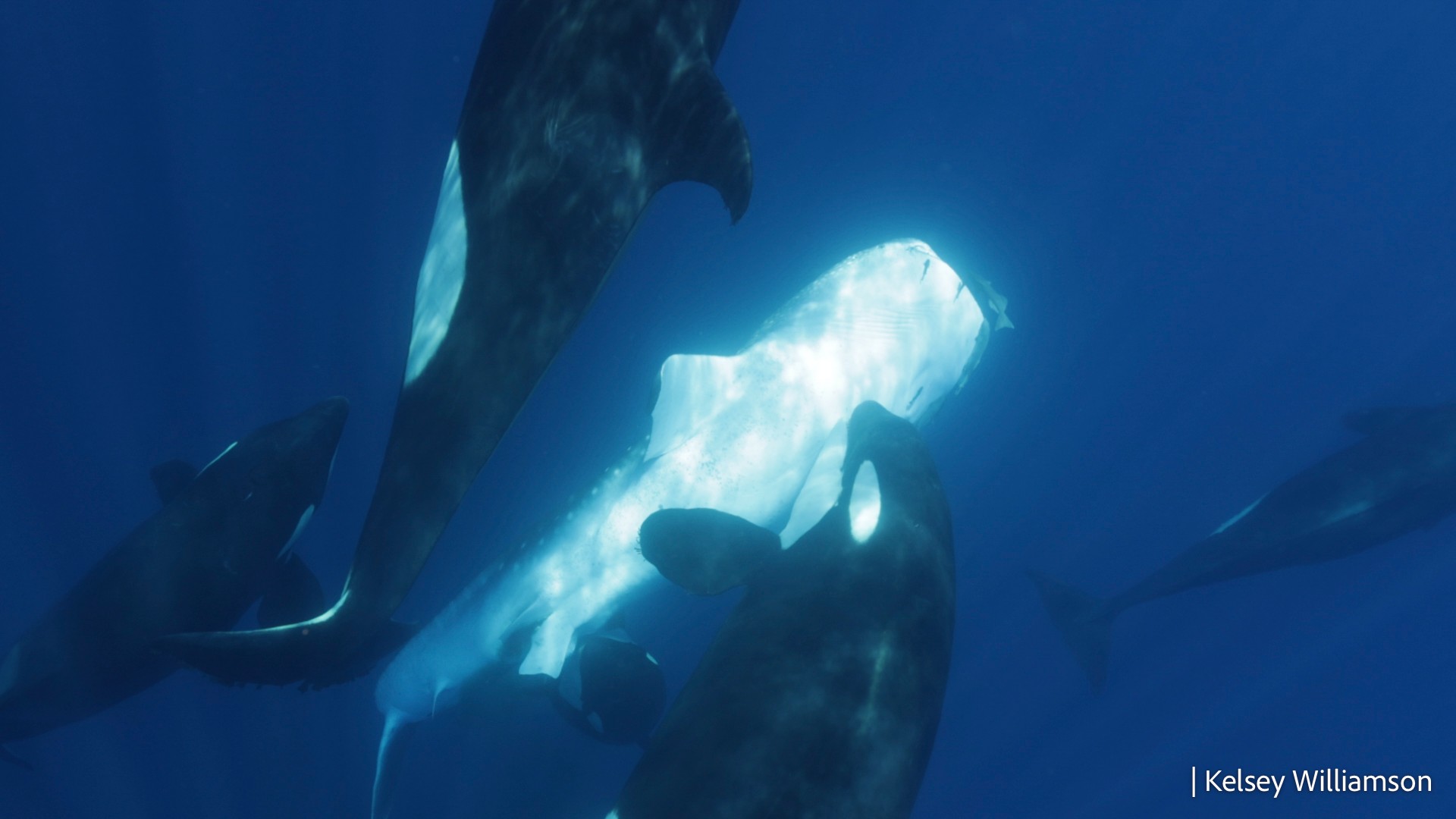
The maneuver resembled coordinated attacks Ayres and her team had previously documented, in which orcas confronted whale sharks (Rhincodon typus) β€” the largest living fish β€” in the Gulf of California. In those hunts, some orcas took turns ramming it.

An orca hits the under side of a small whale shark, which has been flipped upside down for easier predation

Previous footage from diver Kelsey Williamson shows orcas flipping a whale shark upside down to have an easier time preying on it. (Image credit: Kelsey Williamson)

Why make fish confetti?

Ramming is not a new killer whale hunting technique, said Matt Hansen, a postdoctoral researcher at the Leibniz Institute of Freshwater Ecology and Inland Fisheries who was not involved in the study. However, the hold-and-release sequences and shattering of carcasses may be new, Hansen told Live Science in an email.

The researchers proposed several possible explanations for the behavior. The predominant assumption is that the adults were processing food for younger whales. Orcas frequently tear apart prey and share portions with calves and juveniles, and in both newly described encounters, young killer whales were present.

But two observations are not enough to show that the adults were deliberately feeding or teaching the youngsters, Heather Hill, a professor and chair of psychology at St. Mary's University in Texas who was not involved in the research, told Live Science in an email.

"Whether or not it represents parental investment, observational learning, or distribution of resources remains circumstantial in my opinion," she said.

The researchers also suggested that the behavior could have been playful. Orcas are highly intelligent and social, and they sometimes manipulate, toss or strike prey without immediately eating it. However, Hill said that the two encounters appeared more practical than playful.

"If it was for fun, I would have expected multiple attempts made with variations in speed, point of contact, force of impact, and initiators because the point of playing is to try different things and not destroy the toy too soon," she said. "Since it appears that these events were 'one and done' so to speak, probably less playful and more functional β€” to eat the fish and maybe to model a foraging technique and possibly to share resources with the younger animal."

The study authors also raise a more speculative possibility that dispersing the sunfish's microbe-rich skin and gelatinous tissue could somehow affect the surrounding water or expose the orcas to potentially beneficial microbes. But what that benefit might be is unclear.

"I don't see how dispersing the skin into the water column would have a different effect from eating it," Hansen said. "Unless the authors are suggesting [the orcas] are using it like a lotion on their own skin? Who knows, the world is weird and wonderful."

Orca quiz: Will you sink or swim?

Mice on 'godforsaken' frozen volcanoes eat toxic plants to survive conditions 'not remotely compatible with long-term human survival'

22 July 2026 at 18:54

Scientists have discovered how mice survive at extreme altitudes on the tips of icy dormant volcanoes in the Andes.

The area where the mice call home extends more than 1 mile (1.6 kilometers) above the world's highest human settlement. The air is thin, temperatures are blisteringly cold, and a desert ecosystem ensures water and vegetation are extremely scarce.

"As a mountain climber standing on the summit of these peaks, the idea that there could be animals living in these barren godforsaken environments is just really mind-boggling," Jay Storz, a professor of biological sciences at the University of Nebraska–Lincoln, told Live Science.

In 2020, Storz led a team of mountaineering scientists who recorded Andean leaf-eared mice (Phyllotis vaccarum) at a record-breaking altitude of 22,110 feet (6,739 meters). The mice were living on the summit of Llullaillaco, the world's highest historically active β€” now dormant β€” volcano, located on the border between Argentina and Chile.

Now, in a new study published July 9 in the journal Science, Storz and his colleagues have revealed the biological mechanisms behind the mice's extreme survival. It turns out that the species has evolved a variety of adaptations to survive at such high altitudes, including the ability to eat plants that would normally be toxic.

Before the discovery of the high-altitude mice, researchers had assumed that mammals could only survive up to around 18,000 feet (5,500 m) above sea level. But these hardy animals smashed that record, while also thriving at lower altitudes.

"One of the really notable things about this particular species is that it has such a broad elevational range, from sea level along the desert coastline of northern Chile, all the way up to the summits of some of the highest peaks in the Andes," Storz said.

To better understand these remarkable mice, the researchers studied members of the species at low, middle and high altitudes between 2020 and 2023. The work mixed mountain climbing and animal surveying techniques, with Storz and his team ascending the mountains and setting traps to catch and record the mice.

Storz said that a well-acclimatized mountain climber can tolerate these high elevations for a very short period, but that the conditions are "not remotely compatible with long-term human survival."

The expeditions can be dangerous even for experienced climbers: one of Storz's colleagues was evacuated during a separate expedition in Peru after they developed high-altitude pulmonary edema β€” a life-threatening form of altitude sickness that causes fluid to build up in a climber's lungs.

A photo of Storz and two of his colleagues on the summit of Hualca Hualca in the Central Andes.

Storz surveyed the mice with other experienced mountain climbers. Here he is pictured with Mario PΓ©rez Mamani and Franz Checca on the summit of Hualca Hualca in Peru. (Image credit: Jay Storz)

The researchers sent some of their specimens to labs in Chile for further analysis. This included putting the mice into small chambers and measuring how they adapted to extreme cold and oxygen deprivation. The team also sequenced the Andean leaf-eared mouse genome, which revealed a variety of local adaptations to different altitudes. For example, the mice living at high elevations were better at maintaining their body heat and oxygen levels than those taken from lower altitudes, according to a statement released by the University of Nebraska-Lincoln.

Another change in the high-altitude mice's genes enabled them to digest food and detoxify plants that would otherwise be harmful to them, according to a statement released by McMaster University in Canada. This special adaptation helps the mice get enough food on the sparsely vegetated volcanoes.

The researchers also revealed that the high-altitude mice were much more active in the daytime, perhaps due to a lack of predators and warmer temperatures during those hours. However, despite local adaptations, the mice were still extremely similar genetically across their elevation range. All of the mouse populations overlapped, which prevented high-altitude individuals from becoming isolated or especially distinct from their low-altitude kin.

Not all of the mice survived the researchers' study. To fully understand the biology of the mice, researchers needed to euthanize them and study their tissues. They also wanted to preserve "voucher" specimens to act as permanent representatives of the species in museums, which researchers can keep returning to for further study. According to the study, the team collected 167 of these voucher specimens.

Storz noted that it's very valuable to have a biological record of specimens archived in museum collections for future generations. He added that their work was not having any impact on the viability of the mice populations, and that the animals were killed humanely, although he did not disclose any details.

"King of the mountains"

Study co-author Graham Scott, a professor of biology at McMaster University in Canada, said that the take-home message of the new research was how life can overcome such extreme environments, and not just survive but thrive. In this case, the mice did this by developing solutions for the cold, oxygen deprivation and food scarcity.

"It just shows the complex ways that evolution has made these animals the king of the mountains," Scott said.

Enduring harsh conditions high in the Andes likely comes with some benefits. Scott said that competition is probably the biggest reason for the mice living at such high elevations. The mice are also pretty much left to their own devices, and thus likely have less to fear from predators.

But this begs the question: Are there any animals living higher than the mice?

"Birds are always a bit hard to nail down because, of course, they can fly and there's certainly records of birds flying at higher elevations than that," Scott said. "But we think this is probably the highest-dwelling animal."

Queen Odor Mediates Reproductive Suppression in Eusocial Mammals

16 July 2026 at 13:26

Naked mole-rats have long puzzled biologists with their striking eusocial structure, where most adults remain reproductively suppressed while a queen controls the colony’s future. Now, a new study identifies a chemical β€œqueen odour” that links social status to endocrine control, revealing a mammalian analogue to insect queen pheromones.

The molecule, termed IPM, is enriched by the queen and acts as the key mediator of reproductive suppression in non-breeding females. When IPM is present, circulating prolactin rises while progesterone is suppressed, locking the colony into a stable reproductive hierarchy characterized by reduced conflict and maintained group cohesion.

Crucially, the team connects this behavioural outcome to the brain. Using multiple approachesβ€”including non-invasive functional ultrasound imaging (fUSI)β€”they show that IPM provokes strong activation of olfactory neurons and central neural circuits. This provides a neural substrate for how a chemical cue can trigger colony-wide physiological change, rather than relying on social learning or passive association.

The experiments also clarify sensory routing. Ablating olfaction abolishes aggression initiation and lowers prolactin levels, directly tying IPM detection to reproductive suppression. While the findings are consistent with sensing through the main olfactory epithelium, the authors note that the vomeronasal system may still contribute.

Queen removal normally destabilizes colonies, leading to aggression, reproductive competition, prolactin decline, and, in extreme cases, mortality. Yet when IPM is added to queenless bedding, the colony remains stable for months. During this period, fecal progesterone metabolite levels stay low, indicating sustained ovarian quiescence alongside elevated prolactin.

The study also addresses a longstanding paradox: transferring soiled bedding and urine from parent colonies fails to maintain suppression in isolated individuals. The authors propose that IPM’s chemistry helps explain this discrepancy. As a long-chain fatty acid ester with low volatility, IPM may persist within the colony environment but fail to travel effectively over distance or survive transfer pathways that preferentially carry other chemicals.

Comparative work extends beyond naked mole-rats. IPM is detected in breeding females of four additional Fukomys species. Although reproductive suppression mechanisms may differ across species, the presence of a similar queen-linked odorant suggests convergent chemical strategies for managing reproductive skew in eusocial mammals.

Overall, the research reframes reproduction control as a chemosensory-to-endocrine pathway: IPM activates olfactory–hypothalamic signalling, elevating prolactin and inhibiting GnRH release. This β€œsocial hormone” model offers a new principle for social evolutionβ€”chemical cues can synchronize behaviour and physiology at the scale of an entire mammal colony.

Subject of Research: Reproductive suppression and social hierarchy in eusocial mammals (naked mole-rats and related Fukomys species)

Article Title: A queen odour mediates reproductive suppression in a eusocial mammal

Article References:

Khallaf, M.A., Hart, D.W., Luo, W. et al. A queen odour mediates reproductive suppression in a eusocial mammal.
Nature (2026). https://doi.org/10.1038/s41586-026-10772-5

Image Credits: AI Generated

DOI: https://doi.org/10.1038/s41586-026-10772-5

Keywords: IPM; queen odour; reproductive suppression; prolactin; GnRH; olfaction; eusociality; functional ultrasound imaging; Fukomys

Orange-lipped monkey that roars and snorts deep in Congo rainforest is new species to science

15 July 2026 at 19:00

Scientists have identified a new species of monkey that has orange lips and makes unique roars and snorting sounds. The distinctive monkey lives in a remote region of the Democratic Republic of the Congo (DRC).

It is only the fifth new monkey species to be identified in Africa in the past 75 years, and there might be more unknown monkey species in the region, scientists behind a new study suggested. Researchers named the newly identified species of monkey Colobus congoensis, after the region, and it is known by the common name "likΒ­weli" in the local Kilanga language.

"This is remarkable because it's not very common these days to find a new, never-before-documented primate species, let alone a relatively large species of monkey," said Joshua Linder, an anthropologist and president and co-founder of the The Forest Collective, a nonprofit that aims to conserve and restore tropical rainforests.

In 2008, conservationists in the dense rainforests of Lomami National Park, within the Congo Basin in the DRC, photographed an unidentified monkey, but it was partially obscured. Then, in 2018 a similar-looking animal was captured on camera, prompting study co-author Junior Amboko, a Lomami National Park researcher and a Florida Atlantic University anthropologist, to set out to find the mysterious monkey.

To see what was already known, Amboko and his colleagues showed the pictures to people from 52 villages around the park.

"These people really know the fauna and flora in the forest," Amboko told Live Science. "In only eight villages, people knew the monkey β€ͺ—‬ and these were hunters, who know the economic value of animals or how much food each animal can provide, but even they didn't know much."

Two men wearing long sleeves and hats stand in the middle of a dense jungle.

The researchers worked in the Lomami National Park, within the Congo Basin in the Democratic Republic of Congo. (Image credit: Daniel Rosengren, Frankfurt Zoological Society Β )

Hunters of the Balanga ethnic group called the monkey "likweli," although the meaning of this name isn't known. Some in the Mituku local communities called the species "kasaba nkoni," which Amboko said means "the branch shaker." This refers to the way colobus monkeys leap from branch to branch, Amboko said.

In their searches between 2018 and 2022, the researchers recorded 114 sightings of the species across an estimated range of about 660 square miles (1,700 square kilometers) naturally isolated between the Lomami and Lualaba rivers. They reported their findings July 15 in the journal PLOS One.

The monkeys, seen hanging out in groups of between one and 20 individuals, are mainly glossy black, but they have a conspicuous orange patch around the mouth and nose. Bare gray skin on their cheekbones makes it look as if they're wearing masks. They also have a patch of white fur around the anus.

"We're going with the face and the rump as the two distinctive traits," said study co-author Kate Detwiler, an anthropologist at Florida Atlantic University. "If you see the face, you see this unique bare skin that's orange cream. And then if you're coming from behind, you see this white patch."

Images of three black monkeys in trees.

DNA analysis confirmed C. congoensis was a previously unknown species. (Image credit: Daniel Rosengren, Frankfurt Zoological Society Β )

The monkeys, which weigh about 15 pounds (7 kilograms), also make deep, loud roars, punctuated by distinctive snorts. These unique‬ vocalizations distinguish them from other colobus monkeys, Detwiler told Live Science.

By taking samples, and sequencing DNA, from monkeys killed by hunters and destined for the illegal bushmeat trade, and comparing the results with what’s in museum collections and datasets of genetics, skulls, teeth and pelts for other colobus monkeys, the team confirmed that C. congoensis was a previously unknown species.

"My lab got the tissue sample and did the genetics, and we were shocked by how divergent the key area of the mitochondrial genome was from other colobus monkeys," Detwiler said.

A close up of an orange-lipped monkey in a tree

Researchers think the new species diverged up to 5.78 million years ago. (Image credit: Daniel Rosengren, Frankfurt Zoological Society Β )

The monkeys live in the same forest as the Angola colobus (Colobus angolensis), but their closest relatives are black colobus monkeys (Colobus satanas), which live around 750 miles (1,200 kilometers) to the west, in Cameroon, Gabon and Bioko Island.

"The fact that the results show that the closest living relative to this new species is the black colobus located 1200 km away in West Africa is equally remarkable," Linder, who was not involved in the new study, told Live Science via email.

Detwiler estimates that these close relatives diverged between 5.78 million and 3.44 million years ago β€ͺ—‬ the longest known split between species within the Colobus genus. "The discovery is reshaping our understanding of African monkey evolution," she said.

Given the small geographic range, rare sightings and increasing habitat loss, the researchers recommend that C. congoensis be classified as endangered on the IUCN Red List.

The discovery also emphasizes the importance of Lomami National Park, where another previously undescribed monkey, the lesula (Cercopithecus lomamiensis), was reported in 2012 by a team that included Detwiler.

The Congolian rainforest ranging across this part of Africa is the world's second-largest tropical forest, after the Amazon, and about 60% of it is in the DRC. "It is a paradise for biodiversity," Amboko said, adding that there might be more undescribed primate species there. "If we are able to discover two big new primate species, who knows how many other new mammals, fish, reptiles or plants there could be?"

What do you know about chimpanzees and great apes? Test your smarts with our primate quiz!

Scientists are deep-freezing koala eggs and sperm to protect the species from extinction

Scientists in Australia are deep-freezing koala eggs and sperm as a "genetic backup" to save the wild population from future extinction.

The backup could be used to create healthy koala embryos through artificial insemination and in vitro fertilization (IVF), the researchers said in a statement. When koalas (Phascolarctos cinereus) die, unique traits and diverse genes that may help them adapt to changing environments are lost, but the new project offers a way to store this valuable material, the team said.

"Losing genetic diversity can weaken future generations and decreases the ability of the species to adapt to challenges," Andres Gambini, a reproductive biologist at the University of Queensland who is involved in the project, said in the statement. "This project will create a safe and systematic way to rescue and preserve koala spermatozoa and eggs to support future conservation programs."

Australia is facing a paradox with its koalas. In some regions of Queensland and New South Wales, koala populations have crashed by as much as 80% since the late 1990s due to deforestation, bushfires, drought and disease. This prompted the Australian government to change koalas' conservation status in their eastern range from "vulnerable" to "endangered" in 2022.

Meanwhile, in parts of southern Australia, koalas are overabundant. However, the places where koalas are currently thriving may not be able to support a booming population much longer, because the animals are overbrowsing and killing the trees they need to survive, recent research suggests.

To protect against koalas' decline, the scientists will freeze koala reproductive cells in liquid nitrogen (LN2), which has a boiling point of minus 321 degrees Fahrenheit (minus 196 degrees Celsius). This method would enable the team to cryopreserve the cells for several decades until they are needed, said Vincent Lynch, an evolutionary developmental biologist and associate professor of biological sciences at the University at Buffalo in New York.

Every year, many koalas are admitted to wildlife hospitals because of illness or injury and sadly, not all of them survive.

Andres Gambini, reproductive biologist at the University of Queensland

"I've successfully woken cells up that were frozen in LN2 a couple of decades ago," Lynch, who is not involved in the koala project, told Live Science in an email.

The sperm and eggs will be supplied by wildlife hospitals that will harvest sex cells from dead koalas or koalas that can no longer breed due to disease or trauma, according to the statement.

"Every year, many koalas are admitted to wildlife hospitals because of illness or injury and sadly, not all of them survive," Gambini said.

The researchers will then test the cells for Chlamydia pecorum, a highly contagious and deadly form of chlamydia. In koalas, this infection causes painful urinary tract infections, gastrointestinal issues, and conjunctivitis, which can lead to blindness. It can also cause infertility in females. C. pecorum is one of the main contributors to koalas' decline in recent years, with infertility driving a sharp reduction in the number of koala joeys being born. In the worst-affected populations, situated mostly in Queensland and New South Wales, almost 90% of koalas are infected with chlamydia.

If the reproductive cells contain C. pecorum, "we have the technology now to remove the infection from the samples," Steve Johnston, an associate professor of animal reproduction and captive husbandry at the University of Queensland who works on the koala project, said in the statement.

Two scientists posing with a liquid nitrogen storage cannister in a laboratory.

Andres Gambini and doctoral student Patricio Dandy Palacios, who participated in the project, want to preserve koala sex cells in liquid nitrogen. (Image credit: The University of Queensland)

In 1998, Johnston was part of a research team at the University of Queensland that created the world's first koala joey born through artificial insemination. The new project also builds on a 2025 study, led by Gambini, that produced the first-ever IVF kangaroo embryos. (These did not result in live births; at the time, the scientists said that would take another decade.)

It's unclear how many sperm and egg cells the researchers plan on freezing, and it's hard to say how many cells they would need to ensure the survival of healthy koala populations, as the number of cells required is probably increasing with time, Lynch said. As koala populations shrink, genetic material is being lost at an accelerating pace, so the team will have to get more samples as time goes on to obtain the same amount of diversity.

The project does not replace more traditional conservation approaches β€” such as habitat protection, disease management and population monitoring β€” but researchers cannot afford to wait until populations are smaller and genetic diversity is harder to recover, Gambini said.

Although conservationists are concerned about the fast rate of koalas' decline, "there is a chance" that scientists can save the species through cryopreservation, Lynch said.

"I support multipronged approaches like this," he said. "By preserving the environment with traditional conservation we allow re-introductions because the species have somewhere to live."

'Weirdos of the sperm whale world' appear to be evolving 2 different dialects, audio recordings suggest

24 June 2026 at 15:01

An isolated population of sperm whales in the Mediterranean Sea are splitting into two distinct groups with different dialects, a new study reveals. This shift has likely been happening for thousands of years, as two groups split from an initial single population.

The findings, published Tuesday (June 23) in the journal Proceedings of the Royal Society B: Biological Sciences, are providing a rare insight into the process of different dialects emerging among non-human species.

The sperm whales (Physeter macrocephalus) live in small social units of females and young, and they associate with other groups in the same area. They use social vocalizations called codas β€ͺ—‬ shortpatterns of clicks β€ͺ—‬ to communicate. The particular codas they use identify them as being part of the same cultural group.

Taylor Hersh, a researcher in the School of Biological Sciences at the University of Bristol in the U.K. and first author of the research, and her colleagues have analyzed codas recorded over almost 20 years in the Mediterranean, where there is a unique population of a few thousand sperm whales, to see if they all use the same dialect.

Sperm whales entered the Mediterranean via the Strait of Gibraltar about 20,000 years ago, and they have spread throughout the area. The whales rarely leave the sea β€ͺ—‬ even males, which normally migrate. Other sperm whales don't seem to enter often, either, so the Mediterranean ones are effectively isolated from other populations and are considered an endangered subpopulation.

"The sperm whales in the Mediterranean are really cool," Hersh told Live Science. "I've always thought of them as the weirdos of the sperm whale world in that they don't leave through the Strait of Gibraltar even though they could. They are unique, and for a long time, they were also thought to be acoustically unique."

The thinking was that all the sperm whales in the Mediterranean belonged to the same clan, identified by their use of a single coda 90% of the time. This coda consists of three clicks and then a pause before the fourth and final click β€ͺ—‬ a pattern called the three-plus-one type.

But the analysis by Hersh's team of 5,291 codas recorded between 2003 and 2021 revealed that sperm whales living in the eastern Mediterranean around the Hellenic Trench, off Greece, have a slightly different dialect from that used by animals in the western basin around Spain's Balearic Islands.

The eastern whales produce a distinct form of the three-plus-one coda. "It's a very similar pattern of clicks, but it's much, much faster," Hersh said.

four sperm whales in the sea

Researchers found distinct dialects between the two populations, with the eastern population producing slower codas. (Image credit: AsociaciΓ³n Tursiops)

In some recordings, whales in the eastern Mediterranean produced the slower coda, showing they were familiar with both dialects.

"The western sperm whales religiously stick to their dialect, but there were four instances of eastern whales using the western dialect," Hersh said. "The question of why is still an open one. Their dialect seems to be a lot more diverse than we expected. They do occasionally make those slow three-plus-one codas, but they make a lot of other coda types, too."

Hersh hopes further recordings alongside records that tie individual whales to sounds and events might help elucidate why the whales switch between dialects.

"It's exciting to see this study showing different populations behaving closely, but also differently," said GaΕ‘per BeguΕ‘, linguistics lead at Project CETI, a nonprofit organization that aims to translate the communication of sperm whales.

The study paints a picture of sperm whales progressively occupying the Mediterranean from west to east, with the dialect of one group gradually changing. "The groups in the east clearly remember the western dialect because they have these 'throwback' days," Hersh said.

It's still a mystery how and why these dialects evolved.

"Every speech is a dialect; the question is how did they arise and why?" said BeguΕ‘, who wasn't involved in the new study. He said the historical change in habitat does help to show which dialect came first. "In the Mediterranean, maybe they're forming different groups, so that's why they're trying to distinguish themselves," he told Live Science, giving the parallel of young people who distinguish themselves from previous generations by coming up with new slang.

"It's possible that these two groups with repertoires that are very similar but still distinctive could represent a sort of midway phase,” Ellen Jacobs, a marine biologist at Aarhus University in Denmark who wasn't involved in the research, told Live Science via email.

"Changes in the rhythm might be a very feasible and meaningful way for coda signals to start to diverge," she said, like the way the English words "How do you do?" got mashed together until they morphed into "howdy."

The timescale on which a sperm whale dialect develops is uncertain, but it's likely a slow process, according to Hersh. "It's probably happening on the scale of hundreds and thousands of years, because sperm whales can live into their 60s and 70s. And this study is looking over 19 years of data, and that's just a snapshot of one animal's life," Hersh said.

This means the eastern whale dialect was conceivably emerging in the Mediterranean Sea as famous human civilizations were speaking different languages on the surrounding lands, including when the ancient Greeks and Romans were rising and then falling.

"Maybe if we could leave them for another 10,000 years, we would come back to find the completely separated dialects of clans," Jacobs said.

Koalas Nearly Vanished 100,000 Years Ago – Long Before Humans Arrived

22 June 2026 at 00:19
Cute Koala Close UpKoalas survived a climate-driven population crash 100,000 years ago, and new genomic research is helping scientists better protect the species today. A major genomic study has transformed scientists’ understanding of koala (Phascolarctos cinereus) evolution, showing that the species underwent a dramatic population decline about 100,000 years ago, long before humans reached Australia. Researchers found that [...]

Outdoor cats can be exposed to dangerous germs β€” here's how to protect you and your pets, according to more than 400 studies

20 June 2026 at 15:00

Pets form an important part of many people's lives, providing meaningful companionship. However, our pets can sometimes also be a source of unwelcome pathogens and diseases, particularly if they frequently roam outdoors.

We are ecologists and a veterinarian who study wildlife health and the movement of pathogens among wildlife, domestic animals and people. If you let your cat outdoors, or if outdoor cats visit your yard, our recent findings may be relevant.

Zoonotic pathogens are organisms that can infect both animals and humans. From a pathogen's perspective, humans are just another animal host. Wildlife is often emphasized as a source of emerging disease for humans because there are vastly more wild animal species than domestic animal species.

However, even if a pathogen is capable of infecting people, it needs a way to reach us. Humans share more zoonotic pathogens with domestic animals than with wildlife, because domestic animals live close to us. Pathogens benefit even further if they can infect a companion animal.

In our newly published research, we compiled data from more than 400 studies to investigate how a cat's lifestyle, whether they're mostly indoors, outdoor-roaming or feral, affects that cat's likelihood of carrying pathogens that can infect people.

Across this compilation, there were nearly 100 pathogens detected in cats that are considered zoonotic and capable of infecting humans. Familiar examples are rabies, Toxoplasma gondii, roundworms and Salmonella.

Our research

We found that outdoor-roaming pet cats had three to five times the odds of carrying a zoonotic pathogen compared with indoor-only cats. More surprisingly, cats allowed to roam outdoors had similar odds of carrying at least one zoonotic pathogen as feral cats. Outdoor-owned cats carried fewer types of pathogens than feral cats, but the same pathogens that infect feral cats can also infect owned cats.

These risks become a large-scale problem because pet cats that roam freely interact closely with people, wildlife and other domestic animals. Across the studies we reviewed, about 60 per cent of owned cats had unsupervised outdoor access; in some regions, that rate exceeded 90 per cent.

Roaming cats hunt, interact with wildlife or other domestic animals, and move through environments contaminated with pathogens and toxins. Research suggests that cat owners may underestimate hunting by around 80 per cent, meaning that many prey captures and animal contacts go unnoticed.

These interactions are not uncommon and not limited to so-called pest species. Single-country estimates of wildlife killed by cats run into the billions, with more than 2,000 wildlife species documented as prey for domestic cats.

A gray and black striped cat sits on some broken tree trunks and looks at the camera.

Cats hunt animals that can carry zoonotic pathogens, including rodents, birds and bats, many of which would otherwise have little direct contact with people. (Image credit: Anton Darius)

Cats hunt animals that can carry zoonotic pathogens, including rodents, birds and bats, many of which would otherwise have little direct contact with people. Owned cats might bring home rodents carrying viruses, and there are documented cases of cats bringing rabies-positive bats into homes. A cat returning home with prey can therefore create a pathway by which pathogens circulating in wildlife populations reach people.

In addition, it is not only owners who are at risk. Outdoor cats defecate in gardens, parks, playgrounds and other shared spaces, potentially leading to high contamination rates. One study estimated that outdoor cats deposited more than 60 tonnes [60 tons] of feces per 10,000 households each year.

Depending on the parasite, feces can contain hundreds to hundreds of thousands of parasite eggs that can persist in soil or water for months to years, which can infect people or other animals that come in contact with those eggs.

What cat owners can do

The most straightforward intervention is also the most economical and humane: prevent unsupervised roaming. That does not mean denying cats access to the outdoors. It can mean building "catios" or enclosures, leash walks, supervised time outside or other forms of contained outdoor access.

House cats, as well as cheetahs, cougars and lynxes, can purr but can't roar, while other cats, such as lions, tigers and jaguars, can roar but can't purr.

Using systems like "catios" or leash walks can help minimize pathogens for cats. (Image credit: Carlos G. Lopez)

Veterinary care still matters. Treating existing parasitic infections and vaccinating against diseases like rabies are essential precautions, even for indoor cats. Since neither vaccines nor anti-parasitic treatment cover the full spectrum of wildlife-associated pathogens, managing exposure remains the more comprehensive protective approach.

The free-roaming debate is often framed as a false choice: either cats roam freely, or they are deprived of a natural life. That framing is misleading and inconsistent with how we manage other companion animals.

We do not assume dogs need unrestricted access to roads, neighbors' yards or to hunt wildlife to have good welfare. Indoor cats and cats with supervised outdoor access can live healthy, enriched and longer lives.

Policies and strategies that address how and where owned cats roam outdoors can help safeguard biodiversity, feline and wildlife welfare and public health. That is the central insight of One Health, that the same choices that protect ecosystems can also protect the animals and people who share them.

This article was co-authored by David Lapen, who works for and receives research funding from Agriculture and Agri-Food Canada.

This edited article is republished from The Conversation under a Creative Commons license. Read the original article.

How much of a cat fan are you? Find out by taking our cat quiz!

Watch bison herd defend a newborn calf from wolf attack in a primeval Polish forest

A camera trap in an ancient Polish forest has captured extremely rare and unexpected footage of wolves attacking a bison herd made up of adults, youngsters and a newborn calf, a new study shows.

The event took place on Sept. 15, 2025. Five wolves (Canis lupus) enter the camera frame, closely followed by three bison cows and the newborn calf. In the footage, the cows chase after the wolves, leaving the calf alone and exposed. The wolves then surround the calf, bite its neck and try to drag it away, but two cows come to its rescue. The wolves return and seize the calf a second time in the background of the video β€” however, this time the entire bison herd comes to its defense to end the attack.

The clip is from the Bialowieza Primeval Forest, the oldest and best-preserved temperate lowland forest in Europe, which hosts the world's biggest population of European bison (Bison bonasus). The forest covers 350,600 acres (141,900 hectares) on the border between Poland and Belarus. There are more than 870 bison on the Polish side, according to the new study, while the Belarussian side has roughly 730 bison.

Also known as "the king of the forest," the European bison is typically considered a non-prey species, meaning it has no predators except humans. But the footage calls this into question.

Still images from a video of wolves attacking a bison herd in Poland.

These still images from the video show (a) the wolves grabbing the newborn calf for the first time; (b) the wolves seizing the newborn calf for the second time; and (c) the bison herd forming a protective circle around the newborn calf after both attacks. (Image credit: Wijnands & Borowik, 2026. (CC BY 4.0). Mammal Research Institute, Polish Academy of Sciences.)

"To our knowledge, we present the first video-recorded evidence of wolves attacking a European bison herd in the BiaΕ‚owieΕΌa Primaeval Forest," researchers wrote in the study, published May 29 in the journal Ecology and Evolution. "Although the video did not capture a direct kill, it suggests that other attacks on European bison could potentially be successful."

Historical documents show that wolf attacks on European bison used to be more common, with about 8 kills recorded annually in the Bialowieza Primeval Forest between 1840 and 1849. The forest was a popular hunting ground for monarchs from the 14th century onward, explaining why such detailed records exist.

European bison went extinct in the wild in 1919, but they were reintroduced in the Bialowieza Primeval Forest in 1952. The first confirmed bison kill since then dates to the mid 1990s, and after that, it seems as though wolves stuck to a diet of roe deer (Capreolus capreolus), red deer (Cervus elaphus) and wild boar (Sus scrofa), likely because these are much easier prey than bison, the researchers wrote in the study.

But now, "our observation demonstrated that the European bison is in fact a potential prey for wolves," they wrote. "This raises questions about why predation attempts are so rare, whether the bison can still be described as a non-prey species, and what this could mean for conservation and management of the species."

An intriguing trend in the Bialowieza Primeval Forest is that wolf packs are growing in size, possibly thanks to a late 1980s hunting ban. This shift could increase wolf predation on bison in the future, because bigger packs can handle bigger prey.

"If predation on European bison, specifically young animals, occurs more frequently than previously assumed, wolves could play a small but potentially important role in the natural regulation of bison numbers," the researchers wrote in the study. "In turn, such regulation could possibly lead to mitigation of human-bison conflicts."

❌