Mike Clayville, the former Amazon Web Services enterprise sales chief who played a key role in expanding its business with Fortune 500 firms before departing for Stripe six years ago, is back in the fold.
Clayville recently rejoined Amazon as a vice president under Peter DeSantis, a senior ...
Salesforce said Tuesday it has agreed to buy customer engagement platform Braze for about $5.66 billion including debt.
Braze, which was founded in 2011 and went public a decade later, is a longtime competitor of Salesforce’s Marketing Cloud product, which businesses use to communicate with ...
Meta Platforms’ chief global affairs officer, Joel Kaplan, is set to leave the company next year, a Meta spokesperson said, after more than 15 years at the company in which he helped strengthen ties with Republicans including the Trump administration.
Compute Labs, a startup founded on the vision of bringing more capital to the market for graphics processing units, has started a matchmaking service for companies looking to buy the chips and lenders willing to lend against them.
The move comes as a range of financial firms and startups are ...
OpenAI is bound to get a reality check soon, if it hasn’t already, on how difficult it is to “pace” AI technology, let alone getting all the frontier AI developers to agree on how to do so together.
CEO Sam Altman last week walked employees through three proposals the industry has discussed for how to safely develop AI, we reported yesterday. Those options included plans for developing an international organization akin to the International Atomic Energy Agency; merging the frontier labs into a single entity that would develop, test and distribute models; or a scenario, however far-fetched, in which one lab races ahead of the others and literally crushes their GPUs, ending their ability to catch up.
It goes without saying that each of those options has major issues. But we’ll say it anyway.
No mês passado, falamos sobre o Hybrid Compute, uma ferramenta do app da Perplexity que permite dividir uma tarefa entre um modelo de ponta baseado na nuvem e um LLM 1Large language models, ou grandes modelos de linguagem. executado no Mac.
Hoje, a companhia de inteligência artificial anunciou uma outra novidade nessa linha: um modo totalmente local que elimina qualquer dependência do Computer de modelos na nuvem e possibilita sessões de trabalho 100% offline.
Perplexity Computer can now run fully local on your Mac.
Work with your native Mac apps and local files, and run tasks without sending sensitive data to the cloud. The model and the agent both run on your Mac.
Quando ativado, esse modo processa localmente, no seu computador, tanto o modelo de IA quanto o agente, o que inclui tarefas como planejamento, raciocínio e processamento de arquivos (que só são enviados para a nuvem com a devida permissão, caso o usuário opte por isso).
Caso o usuário conceda os acessos necessários, o Perplexity Computer pode trabalhar com arquivos locais e apps suportados no Mac, como o Notas (Notes), o Mensagens (Messages), o Mail e o Numbers.
Segundo a Perplexity, esse novo modo está disponível para assinantes dos planos Pro, Max e Enterprise, os quais podem baixar e configurar os modelos Qwen 3.6 e PPLX Pro. Para isso, porém, é necessário ter um Mac com Apple Silicon e pelo menos 36GB de memória unificada.
Lançado em 2022 e disponível em mercados selecionados, o Self Service Repair permite que consumidores adquiram peças genuínas de dispositivos da Maçã e as ferramentas adequadas para realizar manutenções por conta própria, além de oferecer manuais de reparo.
No caso dos iPhones supracitados, agora é possível comprar itens como vidro traseiro, bateria, alto-falante inferior, alto-falante superior, câmera traseira, câmera frontal, tela, carcaça, placa lógica, microfone principal, bandeja do cartão, Taptic Engine e outros componentes.
No caso da nova geração do Mac Studio, é possível comprar peças como portas Thunderbolt e USB-C, ventoinhas, alto-falante, módulo de SSD, placa lógica e fonte de energia.
Como assinalado pelo 9to5Mac, o Mac mini tem uma lista mais enxuta de peças disponíveis do que os demais, mas ainda é possível encontrar componentes como ventoinhas, alto-falantes, placas lógicas e fontes de energia.
Ao que tudo indica, os preços dessas peças ficaram, em grande parte, inalterados em relação aos das gerações anteriores. Um módulo de câmera para os iPhones, por exemplo, segue saindo por US$250 — valor que cai para US$189,24 caso você devolva o original.
Já é possível adquirir essas peças nas lojas do Self Service Repair nos Estados Unidos, no Canadá e na Europa.
iPhone 18 Pro Max
Cores: bordô, glacial, prateado e preto Armazenamento: 256GB, 512GB, 1TB ou 2TB
NOTA DE TRANSPARÊNCIA: O MacMagazine recebe uma pequena comissão sobre vendas concluídas por meio de links deste post, mas você, como consumidor, não paga nada a mais pelos produtos/serviços ao usar os nossos links de afiliado.
Em uma petição protocolada em nome da Taction (e reportada pela Reuters), a empresa argumentou que o valor da decisão contempla apenas as vendas realizadas pela Apple entre 2021 e março de 2026, e pediu um valor adicional pelas vendas posteriores a esse período.
Além disso, os advogados da Taction pediram a concessão de juros anteriores ao julgamento com base na taxa legal prevista na legislação da Califórnia (cerca de 7% ao ano, o que pode somar algumas centenas de milhões de dólares à indenização), pois, de acordo com a Taction, “o valor da indenização determinada pelo júri não é motivo para negar o pagamento de juros”.
Iniciado em 2021, o processo movido pela Taction alegava que a tecnologia Taptic Engine (presente nos iPhones e Apple Watches) infringia as patentes da empresa, e que a Apple se apossou das invenções da empresa sem autorização ou negociação prévia.
Além de solicitar a anulação do veredito do júri, a Apple afirmou que pretende recorrer da decisão.
Um tópico aberto recentemente no fórum de suporte da Withings indica que a empresa adotou uma estratégia no mínimo questionável no que se refere à sincronização automática de dados obtidos por seus dispositivos com o aplicativo Saúde (Health), da Apple.
Desde o dia 13 deste mês, qualquer nova conta da Withings precisa de uma assinatura do serviço Withings+ (que custa nada menos que R$50/mês ou R$500/ano) para realizar essa sincronização — algo que foi confirmado ao usuário pelo time de suporte da empresa.
“Qualquer conta criada depois de 13 de outubro precisará de uma assinatura do Withings+ para exportar dados”, disse o suporte da empresa, que justificou a mudança alegando “motivos de segurança” e a existência de um conector de inteligência artificial.
Como bem observado pelo usuário que fez a reclamação, sincronizar dados com o app Saúde é algo que acontece localmente no dispositivo com uma chamada básica de API 1Application programming interface, ou interface de programação de aplicações. e não requer qualquer custo com servidores ou conectores de IA para a empresa responsável.
Embora os usuários ainda possam exportar manualmente seus dados em um arquivo CSV, convenhamos que isso não é nada prático para quem está chegando agora ao ecossistema da Withings — a contrapartida é ser obrigado a pagar bem caro por algo que pode ser implementado de maneira simples.
A empresa afirma estar combatendo um método que ela classificou como “resolução de identidade”, em que empresas de publicidade de terceiros capturam o endereço de email dos usuários em sites quando eles fazem login ou assinam uma newsletter.
Esse endereço pode ser usado para montar um perfil e direcionar anúncios online — uma evolução do rastreamento por cookies, cujo uso por terceiros já é bloqueado pelo Safari há seis anos.
Com o lançamento recente dos novos sistemas, a Apple passou a bloquear, no nível do domínio, as solicitações de rede destinadas à infraestrutura dessas companhias — o que impede o envio do endereço de email dos usuários aos servidores delas.
De acordo com o Business Insider, essa abordagem da Maçã vem agitando o mercado porque pode dificultar bastante o trabalho de anunciantes que dependem desses identificadores para segmentar campanhas e medir resultados.
Com isso, os anunciantes terão menor capacidade de alcançar públicos específicos na web e medir a eficácia de suas campanhas. Em consequência, os anunciantes poderão migrar para plataformas como Google e Meta, que já possuem perfis detalhados de seus usuários.
Conforme informamos ontem, a Apple liberou as Release Candidates das versões 27.2 dos seus sistemas operacionais, incluindo algumas reformulações visuais e novidades.
Vamos conferir o que chegou para os sistemas da Maçã?
iOS/iPadOS 27.2
No caso da RC do iOS 27.2, há uma série de pistas sobre implementações de recursos futuros, além de integrações com outros sistemas: é o caso da adição do código de configuração do som surround com quatro HomePods e a nova Apple TV 4K (quarta geração):
iOS 27.2 RC adds setup code for surround sound with 4 HomePods and Apple TV 4K (4th gen).
A RC do iOS 27.2 adiciona o código de configuração para o som surround com quatro HomePods e a Apple TV 4K (quarta geração).
O código já estava incluído no runtime do simulador do iPhone Duo 27.2.
Um indício deixado no sistema para um recurso futuro é a não contabilização de conversas silenciadas na contagem das notificações de mensagens não lidas no app Mensagens (Messages):
iOS 27.2 RC indicates that Apple is working on a feature to exclude muted chats from the unread count in the Messages app
Às vésperas da chegada do HomePod mini 2, o software dos alto-falantes inteligentes da Apple ganhou algumas novidades que se aplicam aos demais modelos compatíveis com a atualização (para ser mais exato, o HomePod mini de primeira geração e o HomePod de segunda geração), como o Sound Glow (que exibe luzes ambientes no topo do alto-falante de acordo com o som que está sendo reproduzido) e o bloqueio dos controles de toque:
Sound Glow will work on HomePod mini 1, HomePod mini 2 and HomePod (2nd generation)!
In HomePod Software 27.2 RC, the LightShowCapability check is “productType > 1,” so only the original HomePod is unsupported. https://t.co/KwMrrAx7rf
Todos os modelos de HomePod suportarão a configuração de Controles de Bloqueio, de acordo com o RC do software do HomePod 27.2.
Você deve ver a configuração no app Casa após atualizar tanto o HomePod quanto o iPhone.
O leaker pdfu [@itspdfu] confirmou ainda que o Party Mode (“Modo Festa” em tradução direta) é um modo de renderização “difuso” secundário para som surround, o que significa que, para aproveitá-lo, será necessário ter uma Apple TV 4K de quarta geração:
audioOS 27.2 confirms that Whole Room Audio (Party Mode) is a secondary “diffuse” rendering mode for surround sound, so you’ll need the new Apple TV 4K.
The feature has an interesting implementation: it gives diagonally opposite HomePods the same L/R stereo role.
O audioOS 27.2 confirma que o Whole Room Audio (Party Mode) é um modo de renderização “difuso” secundário para som surround, então você precisará da nova Apple TV 4K.
O recurso tem uma implementação interessante: ele atribui o mesmo papel estéreo L/R aos HomePods diagonalmente opostos.
Esquerdo frontal → Estéreo da esquerda Direita frontal → Estéreo da direita Esquerda traseira → Estéreo da direita Direita traseira → Estéreo da esquerda
Então, se você virar as costas para a TV, ainda terá o posicionamento correto de L/R. Você também recebe ambos os canais L/R se estiver de lado.
tvOS 27.2
Ainda sobre o som surround com HomePods na Apple TV, será possível ajustar o modo dos alto-falantes, o ganho de surround e o funcionamento do som estéreo:
You’ll get new audio controls when you set up four HomePods with the new Apple TV.
Speaker Mode: Surround Sound or Whole Room Audio.
Specifically for Surround Sound: • Spatialize Stereo: Control whether to play a spatially processed mix for video and music. As reported in… pic.twitter.com/KDzUeu3VpU
Você terá novos controles de áudio quando configurar quatro HomePods com o novo Apple TV.
Modo Alto-falante: Som Surround ou Whole Room Audio.
Especificamente para Som Surround: • Spatialize Stereo: Controle se deve reproduzir uma mixagem processada espacialmente para vídeo e música. Como relatado em setembro, quando desativado, o estéreo normal é reproduzido nos alto-falantes frontais, enquanto os alto-falantes traseiros recebem uma mixagem vazia. Padrão: Ativado para Vídeo e Música. • Nível Surround: Ajuste o par traseiro em relação aos frontais. Suporta de −8 dB a +8 dB, em etapas de 0,5 dB. Padrão: Normal (0 dB).
Não há opções de áudio para o Whole Room Audio, pois ele usa canais estéreo para ambos os pares de alto-falantes. Os canais são atribuídos diagonalmente: esquerda traseira e frontal compartilham o canal esquerdo, enquanto direita traseira e frontal compartilham o canal direito.
A nova versão do sistema também permite a exibição aleatória de protetores de tela personalizados com Memórias, Apresentações de Slides ou Retratos:
tvOS 27.2 allows you to shuffle through available Screen Savers throughout the day.
You can also set up Memories & Slideshows or Portraits screen savers on iPhone or iPad without sharing your whole library.
O tvOS 27.2 permite que você embaralhe os Protetores de Tela disponíveis ao longo do dia. Você também pode configurar Memórias e Apresentações de Slides ou protetores de tela de Retratos no iPhone ou iPad sem compartilhar toda a sua biblioteca. Os recursos foram anunciados no comunicado de imprensa da Apple TV 4K.
Bastante coisa, né?
iPhone 18 Pro Max
Cores: bordô, glacial, prateado e preto Armazenamento: 256GB, 512GB, 1TB ou 2TB
NOTA DE TRANSPARÊNCIA: O MacMagazine recebe uma pequena comissão sobre vendas concluídas por meio de links deste post, mas você, como consumidor, não paga nada a mais pelos produtos/serviços ao usar os nossos links de afiliado.
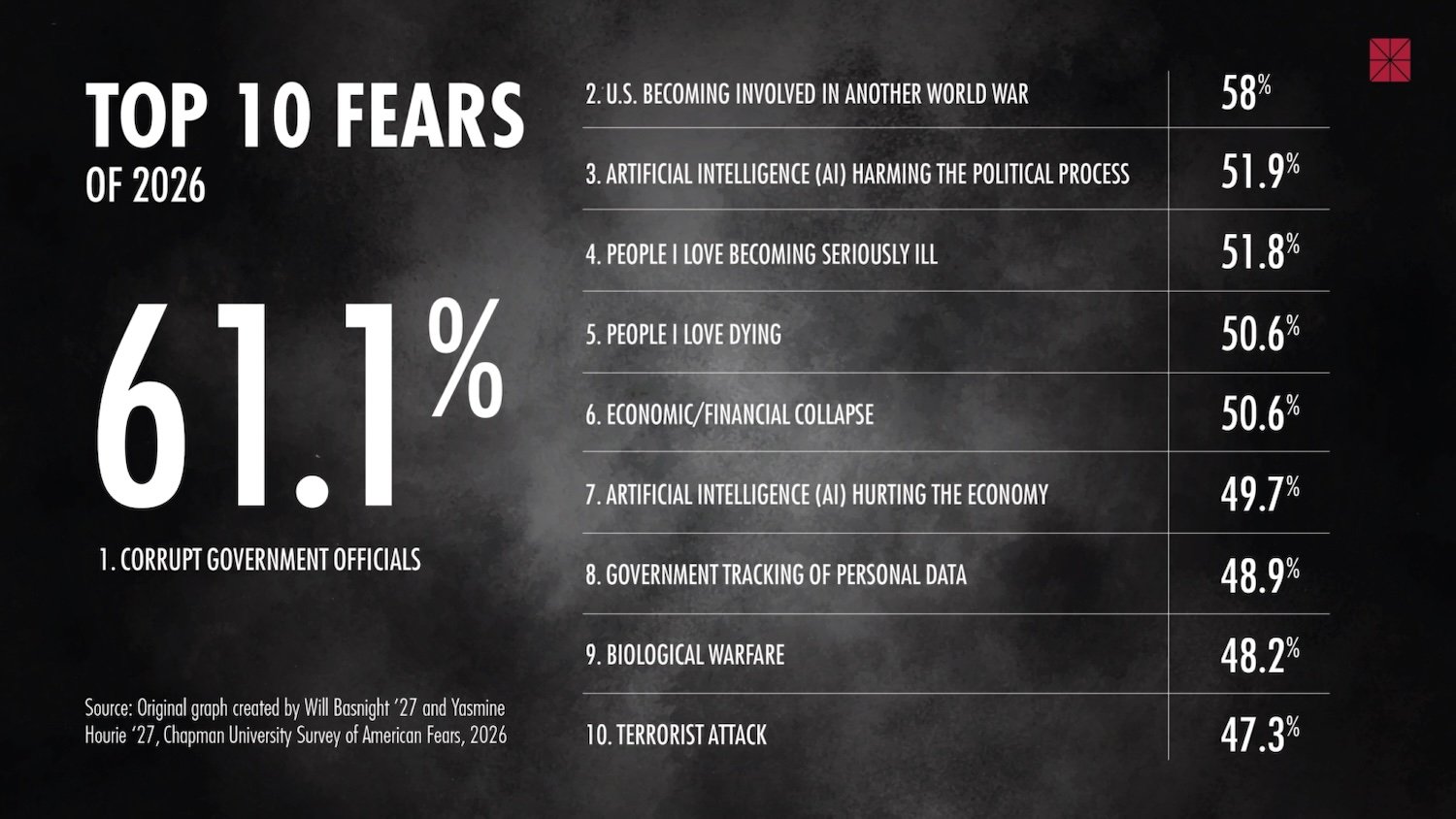
First conducted in 2014, the recurring questionnaire tracks yearly anxiety trends that often range from everyday concerns to existential terrors. This year, 61.1 percent of over 1,200 respondents once again cited “corrupt government officials” as their biggest fear—the same subject was last year’s number one entrant as well as its 11th year on the list. After that, it’s the fear of another world war (51.9 percent). However, “AI harming the political process” wasn’t too far behind for third place at 51.9 percent. The technocentric worry is now essentially tied with the fear of loved ones becoming gravely ill (51.8 percent).
Government corruption is once again at the top of the list. Credit: Chapman University
That said, the survey’s own plus or minus 3.79 percentage point margin of error complicates the results a bit. Taking the margin of error into consideration, it’s a tossup when trying to definitively rank the list’s third through tenth fears. Regardless, about 49.7 percent survey takers are also anxious about AI negatively impacting the economy—a double dose of AI-centric woes for the first time in the survey’s history. It’s also the first year researchers at Chapman University in California included questions about AI, but they made it clear it likely won’t be the last.
“As artificial intelligence becomes more integrated into everyday life, understanding these fears will be increasingly important,” said Chapman University sociologist and survey creator Christopher Bader. “We expect concerns about AI to remain a significant part of the national conversation in the years ahead.”
It’s understandable why AI currently vexes so many people. The blanket term now encompasses everything from photorealistic fake images, to dubious search engine chatbots, to nebulous doomsday warnings. Despite these worries, the AI industry’s biggest threats arguably remain the rampant spread of misinformation, coupled with a lack of meaningful regulations or oversight.
But no matter your top technological fear, survey organizers still believe the annual report highlights a very relatable human emotion.
“What I’m seeing more and more over time is that our fear about our loved ones is going to always be there, no matter what’s going on in the world,” said sociologist Ashley Kranjac, director of Chapman University’s Earl Babbie Research Center.
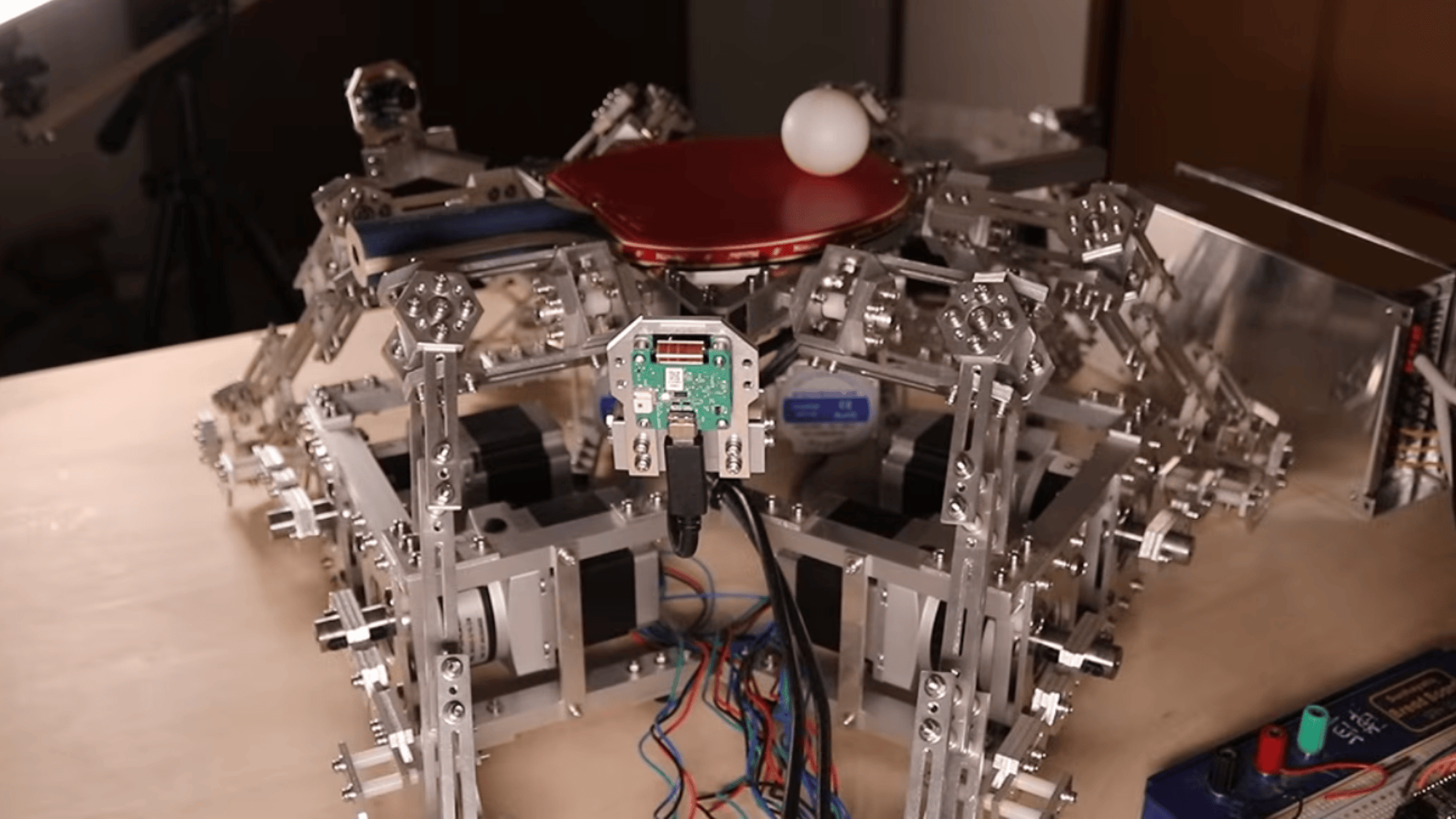
In a world where tech leaders are racing to build autonomous machines that can do almost anything, one hobbyist is going the complete opposite route: an over-engineered robot that does exactly one thing and one thing only.
T-Kuhn’s Hexa-Bouncer only bounces a ping-pong ball, but looks like it’s capable of far more. The six-armed, metal machine was first designed in a simulated environment and then brought to life with a CNC milling machine. Custom-built joints let it rise, fall, and tilt, and even bob up and down while tracing a circle. A pair of cameras, set 120 degrees apart, track the ball’s position and send that data to a computer over USB. The computer then builds a 3D picture of the scene, then calculates when the paddle should strike the ball and at what angle. All of this happens in a fraction of a second.
Hexa-Bouncer keeps balls in the air remarkably well. In a video, Kuhn holds a ping-pong ball above his creation, and the machine moves up and down in sync with his hand. When he drops the ball, the robot immediately reacts, striking it back into the air and keeping it aloft bounce after bounce, all the while making small adjustments. After a few more bounces, the device eases off its swing and the ball starts bouncing lower and lower. It’s unclear exactly how long Hexa-Bouncer can keep the ball in the air, it never misses—at least in the video posted online..
Kuhn describes his ball juggler as the latest in a series of, “useless but mildly interesting ball bouncing machines.” Prior to this, he released his Octo-Bouncer, a similar design that keeps a ping-pong ball bouncing in the air using a four-sided flat plate. Some might say all this over-engineered ball bouncing is unnecessary, but Kuhn would disagree. For him, solving the design puzzle is a journey in itself.
“Building a thing like this is like bashing your way through a jungle,” he said. “It’s an adventure. You’re not completely sure if you can make it through or not, and that’s exactly why you do it.”
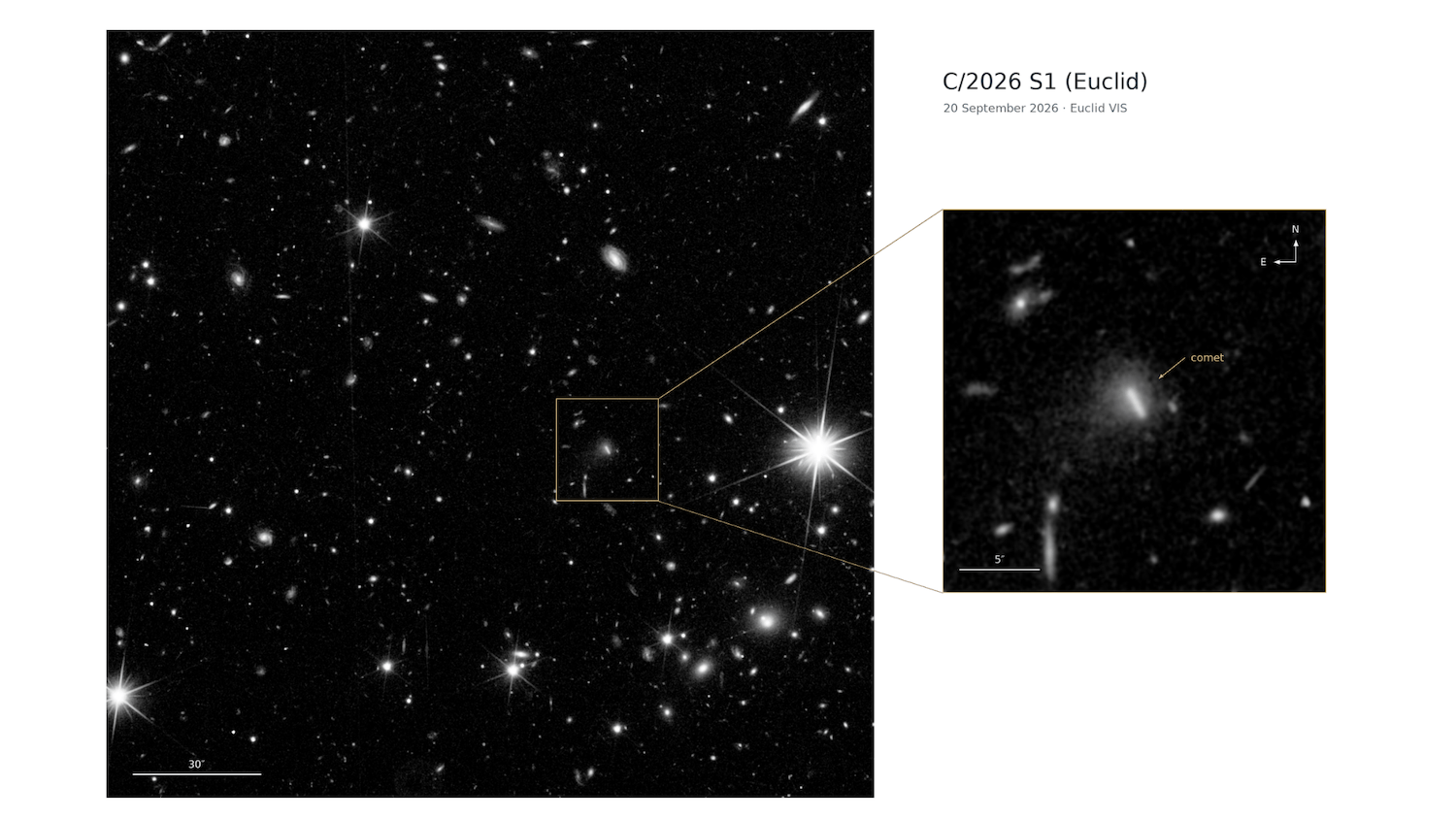
Launched in 2023, the European Space Agency’s (ESA) Euclid space telescope observes some of the most distant regions of the visible universe for signs of dark matter and dark energy. But even while focused on the “big picture,” Euclid’s onboard equipment is surprising astronomers by capturing tiny photobombers like errant comets.
Its recent portraits of one specific dusty space rock are especially impressive, however. Euclid spotted a never-before-seen comet sailing through space more than 807.7 million miles from Earth. The telescope isn’t designed to automatically flag an image interloper. Instead, the bright blemish seen in multiple images was spotted by a moving object detection program designed by Mikko Pöntinen, an astronomer at the University of Helsinki in Finland.
“I was excited to see my software flag a ‘streak’ smeared across several images—the result of a fast-moving object,” said Pöntinen. “Further inspection revealed that it had a fuzzy cloud around it, indicative of an active object like a comet that is shedding dust and gas.”
Pöntinen quickly relayed his findings to the International Astronomical Union’s Minor Planet Center (MPC), which then passed the news along to researchers around the world. On October 8, the MPC confirmed the newly discovered comet, which is now classified C/2026 S1 (Euclid).
C/2026 S1 was seen from five different fields of view over multiple days in the Euclid Deep Field North region of the telescope’s scans. Astronomers now know the comet’s trajectory isn’t located on the same horizontal plane as the planets. Instead, its path is technically taking it over the solar system along a multi-thousand-year orbit.
Euclid’s discovery is particularly striking because the telescope’s six-year mission is specifically mapped to avoid areas of the sky that are laden with comets and asteroids.
“Very few comets are expected to be discovered by Euclid, so it was a happy coincidence,” added Euclid archive scientist Bruno Altieri.
At the narrowest point of the Karmsundet, the channel that separates the island of Karmøy from the mainland on Norway’s west coast, five stones stand upright on a hillside. Some are more than five metres (16 ft) tall. They were raised inside a cairn, a mound of piled stones, laid out in the shape of […]
En el punto más estrecho del Karmsundet, el canal que separa la isla de Karmøy del continente en la costa occidental de Noruega, se alzan cinco piedras hincadas en vertical, algunas de más de cinco metros de altura. Se levantaron dentro de un túmulo de piedras con forma de estrella de tres brazos, y bajo […]
With Alaska’s fat bears done packing on their winter weight and spooky season in full swing, it’s time to turn our collective animal-loving attention to a smaller mammal—bats. The Bureau of Land Management’s (BOEM) annual Bat Beauty Contest returns on October 24 and promises “plenty of batty puns.”
Beginning Saturday, October 24, BOEM will post photos of the competitors to their Facebook and Instagram accounts and ask you to vote for the best-looking one. All of the competing bats are part of wild populations that live on land managed by the public agency and are photographed by wildlife technicians. The winner will be announced (appropriately) on Saturday, October 31.
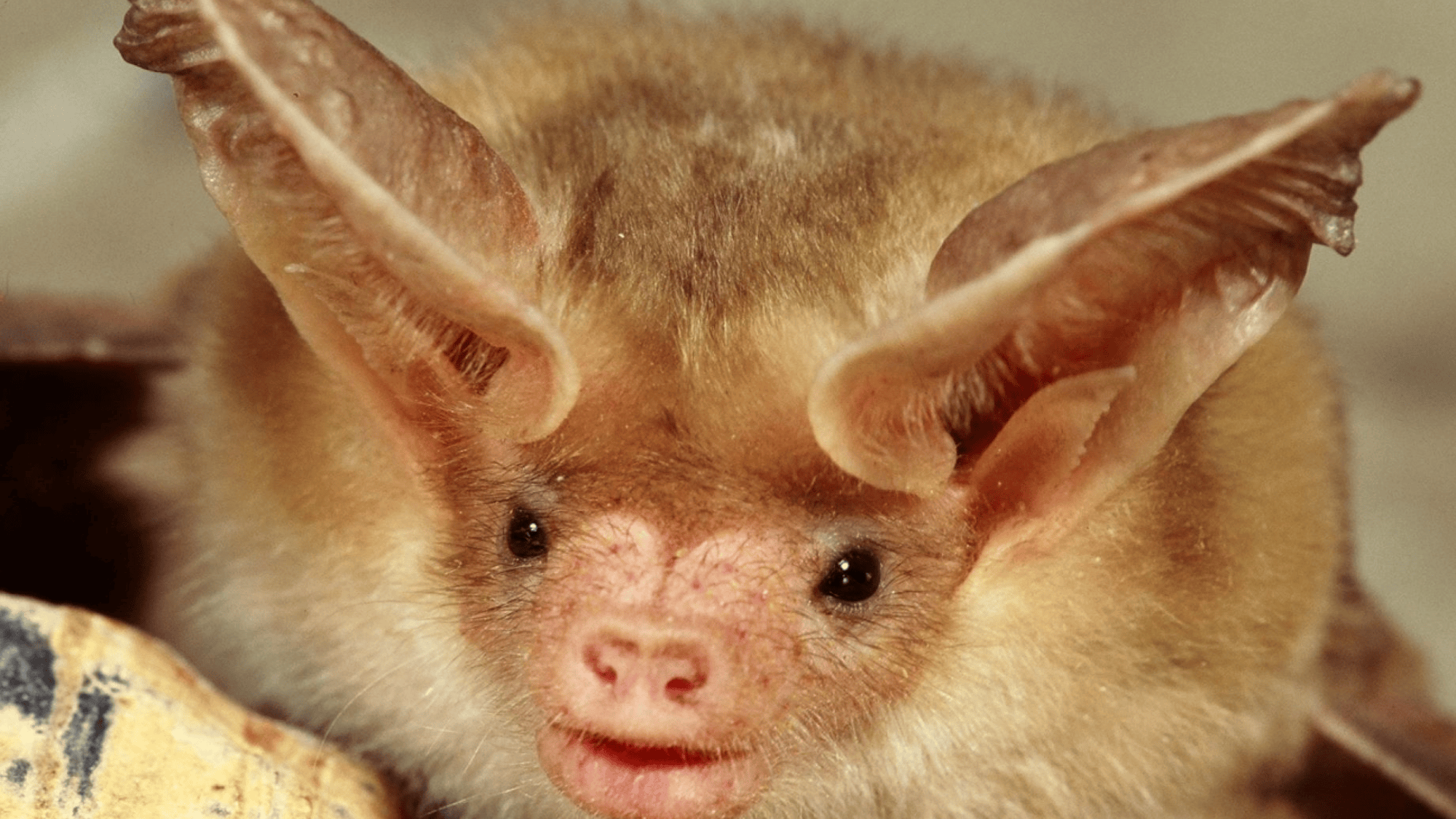
The bats in this competition are known for their squishy faces and clever names. In 2024, a hoary bat (Lasiurus cinereus) from Oregon named Hoary Potter took the crown. Other contestants included a long-eared myotis (Myotis evotis) named Honey Bunches of MyOtis, a myotis bat (Myotis myotis) named Robert Battinson, and western small-footed bats (Myotis ciliolabrum) named Batt Damon and Batlor Swift. The contest was not held in 2025 due to the 43-day-long federal government shutdown.
A hoary bat at Isle Royale National Park in Michigan. Image: NPS Photo/Bat Conservation International.
The contest is not all bat puns and a way to keep the spirit of Fat Bear Week alive. It falls during Bat Week (October 24-31). Bat Week raises awareness about the Earth’s only flying mammal. More than just a Halloween symbol, bats play a critical ecological role as plant pollinators and through eating insects that can threaten crops and forests around the world. According to Bat Week, one bat can eat up to its body weight in insects every night. Only three species of bats eat animal blood, with two specializing in bird blood. Female lesser long-nosed bats even make tequila possible. Every spring, they migrate from south-central Mexico up to the southwestern United States, following “nectar corridors” of columnar cacti and agave plants. They pollinate agave plants, which are then used to make tequila and mezcal. When they feed on cactus fruits and nectar, they may also help disperse cacti seeds. Other bats eat pollen, nectar, or fruit.
Bats are increasingly threatened due to habitat loss, light pollution, and diseases like white-nose syndrome. This fungal disease infects the skin of the muzzle, ears, and wings of hibernating bats. In about 20 years, it has killed millions of bats across North America and affects about half of the species on the continent. Bats also are often misunderstood as carriers of diseases such as rabies.
The planet is home to over 1,400 species of bats, and they make up almost 20 percent of all mammal species. Bats also can be found almost everywhere on Earth, even in desert and polar regions. To look up which bat species live near you, you can use Bat Week’s state bat database.

 Login