❌

Reading view

Uma foi de passagem, a outra já lá estava e duas sondas acabaram a fotografar o mesmo lugar de Marte

A mesma paisagem marciana pode parecer diferente consoante a câmara, a distância e o ângulo de observação. Uma rara experiência envolvendo duas sondas permitiu a comparação e pode ajudar a garantir que uma delas está pronta para a longa viagem que tem pela frente.

The post Uma foi de passagem, a outra já lá estava e duas sondas acabaram a fotografar o mesmo lugar de Marte appeared first on Tek Notícias.
  •  

Space Weather May Warp Martian Weather during Dust Storms, Planetary Scientists Suggest

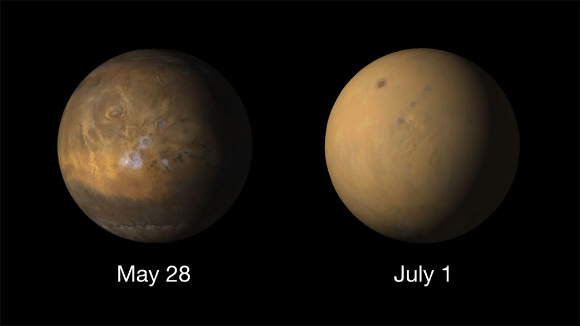
These images from Mars Color Imager (MARCI) aboard NASA’s Mars Reconnaissance Orbiter (MRO) show Mars before (left) and during (right) the June 2018 dust storm. Image credit: NASA / JPL-Caltech / University of Arizona.

Planetary researchers have found the first evidence that bursts of energetic particles from the Sun could warm the lower atmosphere of Mars during massive dust storms, hinting at an unexpected link between space weather and Martian climate.

The post Space Weather May Warp Martian Weather during Dust Storms, Planetary Scientists Suggest appeared first on Sci.News: Breaking Science News.

  •  

Our Milky Way Galaxy Likely Underwent Disk Flip after Ancient Galactic Collision: Study

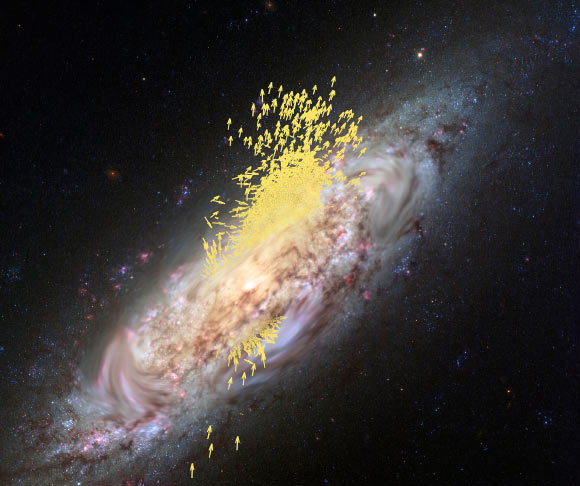
Using supercomputer simulations of galaxies like the Milky Way, Batrakov et al. found that galaxies with slowly rotating stellar haloes are more likely to have experienced a major ‘disk flip,’ where our Galaxy’s disk changed its orientation by more than 90 degrees. Image credit: Batrakov et al.

A head-on collision with another galaxy billions of years ago may have dramatically reoriented the Milky Way’s disk, according to new supercomputer simulations that reveal how violent mergers can leave spiral galaxies looking surprisingly normal today.

The post Our Milky Way Galaxy Likely Underwent Disk Flip after Ancient Galactic Collision: Study appeared first on Sci.News: Breaking Science News.

  •  

Astronomers Find Omega Centauri’s First Stellar-Mass Black Hole

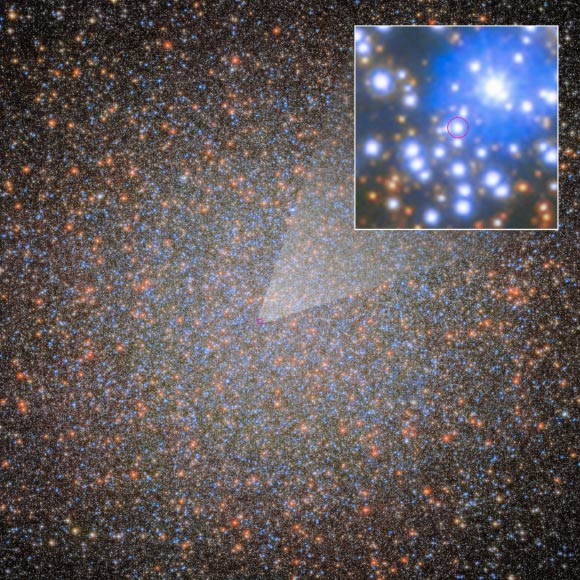
Whitaker et al. found Omega Centauri’s first stellar-mass black hole, which has a visible star companion that is shown in greater detail. Image credit: ESA / NASA / Maximilian Häberle, MPIA / Joseph DePasquale, STScI.

After decades of searching, astronomers have pinpointed the first of an estimated 10,000 stellar-mass black holes thought to lurk in Omega Centauri, the most massive stellar system in the Milky Way found so far, with a stellar mass of 3.6 million solar masses.

The post Astronomers Find Omega Centauri’s First Stellar-Mass Black Hole appeared first on Sci.News: Breaking Science News.

  •  
❌