❌

Reading view

NASA’s HiRISE Captures Perseverance Rover Completing a Marathon on Mars

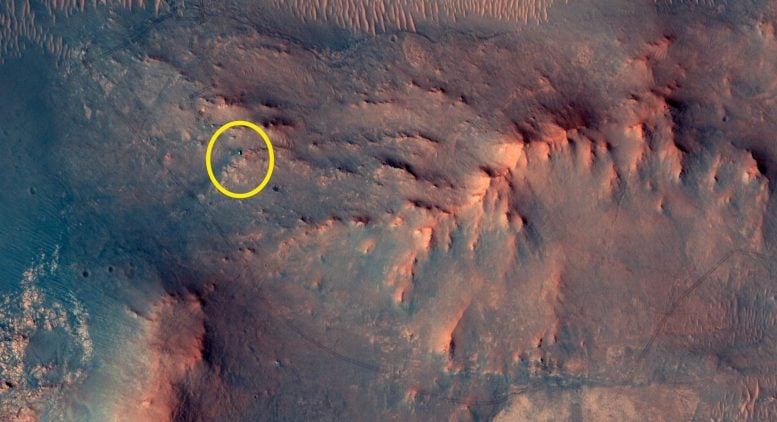
NASA HiRISE Captures Perseverance Rover Mars Milestone AnnotatedA new NASA orbital image captures Perseverance after completing a marathon across the surface of Mars. NASA’s Perseverance rover has completed the equivalent of a full marathon on Mars, reaching 26.2 miles (42.195 kilometers) after five years and four months of driving across the Red Planet. The milestone came on the 1,890th Martian day, or [...]
  •  

Odd “Polygons” on Mars, a Rendezvous with Space Objects, and a Deep Earth Mystery

polygon structures Curiosity rover
(Image Credit: NASA/JPL-Caltech/MSSS)

This week in stories we’re covering at The Debrief… Japan’s Hayabusa2 spacecraft just completed its flyby of the mysterious asteroid Torifune over the weekend, in a celestial rendezvous that nearly coincided with the Chinese Tianwen-2 mission’s successful capturing of new images of Earth’s “quasi-moon”. Equally intriguing are the unusual “polygon” structures NASA’s Curiosity rover just spotted and photographed on the Martian surface; what are they, and what caused them? And finally, bringing things back down to Earth a bit, scientists have revealed new details about an odd “reversal” that occurred deep within the Earth’s molten core, and what new findings suggest that could mean.

In addition to these stories, here’s a look at more of the stories we’re following right now at The Debrief…

  •  

NASA’s Curiosity Rover is Investigating Unusual Polygon Structures That Look Like a “Giant Martian Honeycomb”

An unusual discovery on the Red Planet has revealed an odd-looking series of polygon-shaped structures, documented in new images obtained by NASA’s Curiosity Rover.

The curious features were discovered after Curiosity was dispatched to an area of interest on the Martian terrain initially identified from orbital imagery obtained by the Mars Reconnaissance Orbiter (MRO).

Upon its arrival at the area, which the satellite imagery had conveyed as appearing light in coloration and apparently smooth-surfaced, Curiosity discovered something vastly different.

Curiosity Uncovers a Martian Honeycomb

Writing at NASA’s Curiosity blog, Senior Research Scientist William Farrand of the Space Science Institute described the area in question as being “covered with polygonal structures like the top of a giant Martian honeycomb.”

polygon structures Curiosity rover
Above: Unusual polygon-shaped structures discovered in the unit currently under exploration by NASA’s Curiosity rover (Image Credit: NASA/JPL-Caltech/MSSS)

Polygonal structures are a frequent occurrence in nature, as evidenced by the Curiosity team’s likening them to a “honeycomb” in appearance. Similar polygon-shaped features are often seen in geology, such as the famous Giant’s Causeway on Northern Ireland’s Antrim Coast, which consists of close to 40,000 interlocking basalt columns that bear a similar appearance to the features recently discovered on Mars by Curiosity.

This is also not the first time such features have been observed by Curiosity. Last May, NASA revealed similar discoveries of structural features resembling honeycomb or “waffle” patterns.

As Curiosity proceeded into the unusual area, imagery provided by the rover revealed additional polygonal features, albeit in a more eroded condition than the features it initially spotted.

“Littered about this unit are pebble to cobble-sized dark-toned rocks,” Farrand wrote, adding that among the unresolved questions researchers with the Curiosity team have “is whether these are bits of Mars that ‘floated’ down from higher in the stratigraphy, were ejected from distant impacts outside of Gale crater, or are meteorites from beyond Mars altogether.”

Clues Pointing to Meteorites?

A potential clue arises from the presence of nickel Curiosity detected in some of the darker stones. This may be significant, since nickel is generally rare in Martian rocks.

The same can’t be said for meteorites, though, which often contain an abundance of nickel and other metals. On Earth, meteors that flash in vivid shades of green as they collide with Earth’s atmosphere do so when nickel and magnesium are present within these space rocks.

It remains unclear whether all the darker-colored stones discovered by Curiosity are possible fragments from a meteorite or if their appearance is due to other factors that remain undetermined.

“Further investigations should help in answering this question,” Farrand added.

Ongoing Research by Curiosity

On Monday, June 29, 2026, Curiosity continued its investigations of these unusual features with its APXS and MAHLI instruments, with further plans to conduct additional viewing of an area the Curiosity team has dubbed the Miraflores butte, which features a small knob-like prominence.

Miraflores knob
Recent imagery obtained by Curiosity of the knob at Miraflores butte (Image Credit: NASA/JPL-Caltech/MSSS)

Additional viewing was planned for the nearby Cordillera mesa as well, although much of the rover’s work has remained focused on the unique polygon-shaped structures.

“After driving further towards the upper boundary of the light-toned, polygon-covered unit, the three-sol Friday plan included APXS and MAHLI measurements of another polygon ridge and one of the dark-toned cobbles,” Farrand’s update at the Curiosity blog noted.

This particular cobble, which the Curiosity team has dubbed “Cortadera,” was studied using the rover’s ChemCam instrument, which was also used in observations of the aforementioned features, and others in the nearby Martian terrain.

In the days ahead, Curiosity is expected to traverse another area where dark-colored materials are present based on previous orbital reconnaissance, which may provide additional clues about their origins, and the intriguing features in the area where the rover’s current investigations are focused.

Additional details can be found at NASA’s Curiosity blog.

Micah Hanks is the Editor-in-Chief and Co-Founder of The Debrief. A longtime reporter on science, defense, and technology with a focus on space and astronomy, he can be reached at micah@thedebrief.org. Follow him on X @MicahHanks, and at micahhanks.com.

  •  

Look What NASA’s Mars Reconnaissance Orbiter Just Spotted Lurking in the Red Planet’s Arbot Hills

A tiny green dot appearing in an image taken by NASA’s Mars Reconnaissance Orbiter (MRO) captures a historic tale of Red Planet exploration by one of its first Earthling visitors.

That visitor—a robotic rover named Perseverance—has been conducting investigations on Mars since February 18, 2021, and the new aerial images reveal its current location in an area that mission specialists have dubbed “Arbot.”

While Perseverance’s latest appearance reveals little more than a greenish spec on the planet’s rust-colored surface, also visible in the new images are the long path its formidable tires have left in the Martian soil as the robotic explorer has trekked west of its initial landing site.

The new images, captured on June 13, 2026, were taken just one day before Perseverance broke the previous distance record held by a robotic explorer on Mars: NASA’s Opportunity rover.

However, Perseverance completed this phase of its journey in record time compared to its predecessor, which took more than 11 years to traverse a similar distance. Perseverance, by contrast, covered the same distance in less than half that time, with just five years and four months of travel now behind it.

Perseverance Mars Reconnaissance Orbiter
In the image above, NASA’s Perseverance Rover appears in the center of the image as a small, greyish-green reflective spot. Also visible are the impressions left by its all-terrain tires, revealing the robotic rover’s long path over the last several years of Martian exploration (Image Credit: Credits: NASA/JPL-Caltech/University of Arizona)

The images were made possible by the MROs’ High-Resolution Imaging Science Experiment (HiRISE) camera, which also captured surface features in the Arbot area that include ridges and windswept areas along Mars’ rugged exterior.

Built and operated by the University of Arizona, HiRISE captures images with resolutions as fine as about 25 centimeters (10 inches) per pixel, allowing researchers to distinguish features roughly the size of a kitchen table from orbit. The camera has returned hundreds of thousands of detailed images since the MRO arrived at Mars two decades ago, contributing to a growing data set that has transformed scientists’ understanding of the Red Planet.

Documenting everything from active dust avalanches and shifting dunes to fresh impact craters, the unprecedented resolution its imagery provides has made HiRISE one of the most powerful planetary imaging instruments ever deployed.

Last year, the MRO’s HiRISE camera also successfully captured images of the interstellar comet 3I/ATLAS as it made its way past Mars during its trip through our Solar System. Although the HiRISE images weren’t the clearest images of the interstellar visitor obtained during its visit, they did help demonstrate just how formidable NASA’s MRO and its suite of instruments are.

Additional details about Perseverance and its mission can be found at NASA’s official web page, and information about the MRO can be found here.

Micah Hanks is the Editor-in-Chief and Co-Founder of The Debrief. A longtime reporter on science, defense, and technology with a focus on space and astronomy, he can be reached at micah@thedebrief.org. Follow him on X @MicahHanks, and at micahhanks.com.

  •  

NASA’s Perseverance Rover Finds Complex Carbon at Ancient Martian Site Rich in Potential Biosignatures

Evidence for possible life on Mars in the ancient past continues to build, thanks to a recent discovery by NASA’s Perseverance rover that identified complex carbon in two mudstones.

As detailed in a recent paper published in Science Advances, Perseverance collected samples in the Jezero crater, a location that has continued to yield possible biosignatures of life on Mars in the ancient past.

In the same region, scientists reported potential evidence of microbial activity on ancient Mars, adding to a growing list of circumstantial evidence for one of the most intriguing possibilities in modern space exploration: the prospect that Earth may not have been the only planet in our Solar System that has held the potential to host life.

A Prime Location for Life on Mars

Among the study’s most significant findings is that complex macromolecular carbon was discovered alongside other potential biosignatures. Jezero Crater, a 28-mile-wide impact basin on the Martian surface, once contained flowing water roughly 3.5 billion years ago, making it one of the most promising locations in the search for ancient life. Water is essential to all known life on Earth, serving as a universal solvent and playing a critical role in biological processes.

“Jezero Crater was selected as a landing site due, in part, to its past evidence of aqueous activity and potential to preserve organic material,” co-lead author Kyle Uckert, a research scientist at NASA’s Jet Propulsion Laboratory, told The Debrief. “The Perseverance Rover’s exploration of Jezero Crater helps us understand the past habitability of Mars.”

Perseverance targeted a distinctive geological feature known as the Bright Angel outcrop, where the samples were collected. The outcrop consists of mudstones deposited in the dry bed of an ancient river that once flowed into Jezero Crater. Comparable sedimentary deposits on Earth are often associated with environments capable of preserving evidence of microbial life.

Analyzing Samples

Determining the origin of the organic carbon preserved within these Martian rocks is key to understanding whether the Red Planet ever supported life.

Using its onboard Raman spectrometer, Perseverance mapped the distribution of the rocks’ organic matter. One sample contained organic carbon within a primary silicate-dominated matrix, while another preserved carbon within secondary carbonate and sulfate minerals.

Notably, the carbon appears to have remained remarkably well preserved despite billions of years of exposure to the harsh Martian environment. Researchers suggest its limited weathering may indicate that the material is resistant to radiation and oxidation—possibly because it is mixed with iron-rich regolith or protected by clay minerals—or that it was only recently exposed at the surface through erosion.

The researchers are quick to point out that their findings do not determine whether the carbon originated through biological or non-biological processes. Nevertheless, the discovery adds another intriguing piece of evidence to the ongoing search for ancient life on Mars.

“Macromolecular carbon may be delivered to Mars via meteorites, or may have formed through hydrothermal geologic processes,” Uckert said.

Continuing to Explore Life on Mars

According to the researchers, determining the true origin of the carbon will ultimately require returning Martian samples to Earth, where they can be examined using far more sophisticated laboratory instruments than those carried aboard Perseverance.

“Further constraining the origin, distribution, and alteration history of the MMC observed in the Neretva Vallis mudstones requires high-resolution and high-sensitivity analyses in terrestrial laboratories, which can be facilitated by the return of the Cheyava Falls rock core, ‘Sapphire Canyon’ to Earth,” explained co-lead author Ashley Murphy, a postdoctoral research scientist at the Planetary Science Institute.

“The Perseverance Rover science payload is not designed to determine whether martian organic molecules were created by biologic or geologic processes, and our study is unable to make this distinction,” Uckert added.

The researchers say that future sample-return missions, combined with advanced laboratory analyses on Earth, may finally help resolve one of planetary science’s most enduring questions.

“The Perseverance Rover collects samples of scientifically compelling martian rocks for potential return to Earth,” Uckert concludes.“Using high-resolution terrestrial instruments to analyze these rock samples, particularly the Sapphire Canyon core collected on the Cheyava Falls rock, may provide more compelling evidence for a biologic or abiotic origin of this organic matter.”

The paper, “Spatially Distributed Complex Organic Matter Detected in an Ancient River Valley in Jezero Crater, Mars,” appeared in Science Advances on June 24, 2026.

Ryan Whalen covers science and technology for The Debrief. He holds an MA in History and a Master of Library and Information Science with a certificate in Data Science. He can be contacted at ryan@thedebrief.org, and follow him on Twitter @mdntwvlf.

  •  
❌