
❌

Reading view

Human-Dog Bond is Ancient, Universal and Strikingly the Same Everywhere: Study

Testing situation and hunters with their dogs -- examples from each of the four non-WEIRD societies: (a) pointing test in Mongolia, (b) unsolvable problem test in Vanuatu, (c) showing test in Mongolia, (d) Vanuatu, (e) Mongolia, (f) Madagascar, (g) Peru. Image credit: BrΓ€uer et al., doi: 10.1038/s41598-026-57657-1.

New research spanning five continents and vastly different cultures -- from the steppes of Mongolia to the rainforests of the Pacific -- shows that hunting dogs and their owners cooperate, communicate and rely on each other in nearly identical ways, suggesting the relationship was forged in deep evolutionary time, perhaps 30,000 years ago.

The post Human-Dog Bond is Ancient, Universal and Strikingly the Same Everywhere: Study appeared first on Sci.News: Breaking Science News.

  •  

Domestic Cats Age Like Humans, New Study Shows

Lauren Scott & Brittany Florkiewicz show that cat facial signals correspond to different social functions, which have likely been influenced by domestication. Image credit: Sci.News / Makieni777 / Rise-a-mui / Alexas_Fotos / Dorothe / Vaclav Zavada / Artem Makarov / Daga Roszkowska / Birgit / Pasi Mammela.

Domestic cats (Felis catus) develop the same patterns of brain shrinkage and neurological decline as aging humans, and scientists think that makes them an ideal window into dementia and aging.

The post Domestic Cats Age Like Humans, New Study Shows appeared first on Sci.News: Breaking Science News.

  •  

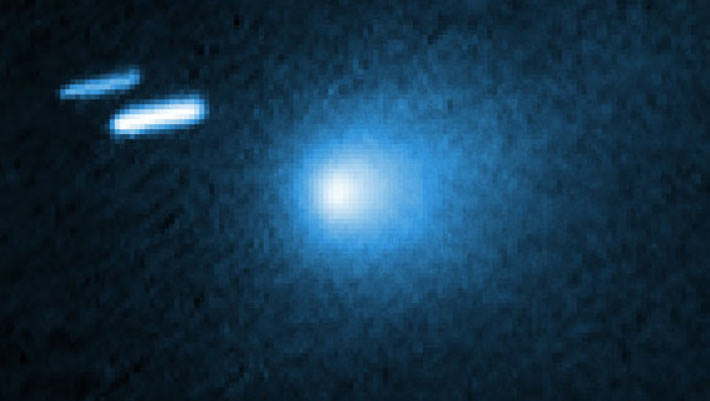
Interstellar Comet 3I/ATLAS Formed Up To 12 Billion Years Ago, New Observations Suggest

Hubble captured this image of 3I/ATLAS on July 21, 2025, when the comet was 446 million km (277 million miles) from Earth. Image credit: NASA / ESA / David Jewitt, UCLA / Joseph DePasquale, STScI.

The interstellar comet 3I/ATLAS carries a chemical fingerprint unlike anything in our Solar System, and it may have formed 10 to 12 billion years ago, before our Sun even existed, according to two papers published in the journal Nature.

The post Interstellar Comet 3I/ATLAS Formed Up To 12 Billion Years Ago, New Observations Suggest appeared first on Sci.News: Breaking Science News.
  •  

Secret to Heliconius Butterflies’ Longevity May Be Hidden in Pollen

Heliconius hecale. Image credit: Robert Lawton / CC BY-SA 2.5.

Entomologists have compiled decades of data from butterfly houses, wild field studies, and lab experiments to build the most comprehensive picture yet of how long Heliconius butterflies live and how slowly they age.

The post Secret to Heliconius Butterflies’ Longevity May Be Hidden in Pollen appeared first on Sci.News: Breaking Science News.

  •  

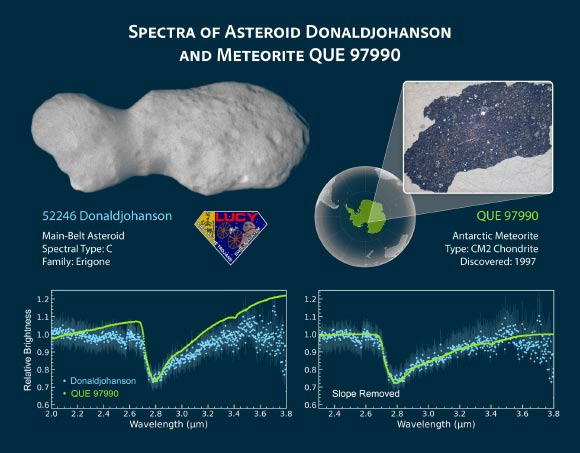
Asteroid Donaldjohanson is Wobbly, Peanut-Shaped Object with Watery Past, Scientists Say

The asteroid Donaldjohanson is composed of two heavily cratered lobes, connected by a smoother neck, with overall dimensions 8.8 km by 4.4 km by 3.1 km. Image credit: NASA / Goddard / SwRI / Dan Gallagher.

The main-belt asteroid Donaldjohanson, a heavily cratered fragment born from a catastrophic breakup 155 million years ago, appears to wobble through space while preserving clues to the migration of water-rich worlds in the early Solar System, according to a new analysis of images and data from NASA’s Lucy spacecraft.

The post Asteroid Donaldjohanson is Wobbly, Peanut-Shaped Object with Watery Past, Scientists Say appeared first on Sci.News: Breaking Science News.

  •  

Webb Sees Jupiter-Size Exoplanet Being Roasted by Its Star

An artist’s impression of the hot-Jupiter exoplanet HD 80606b. Image credit: NASA / ESA / CSA / Joseph Olmsted, STScI.

HD 80606b has one of the most extreme orbits of any known exoplanet and the NASA/ESA/CSA James Webb Space Telescope just caught it getting flash-fried as it whipped past its star.

The post Webb Sees Jupiter-Size Exoplanet Being Roasted by Its Star appeared first on Sci.News: Breaking Science News.

  •  
❌