❌

Reading view

A Dark Matter Origin for Little Red Dots

illustration of the Milky Way's dark matter halo

New research suggests that the mysterious “little red dots” spotted in the early universe could be supermassive black holes birthed in the collapse of dark matter halos.

Another Theory for Little Red Dots

little red dots

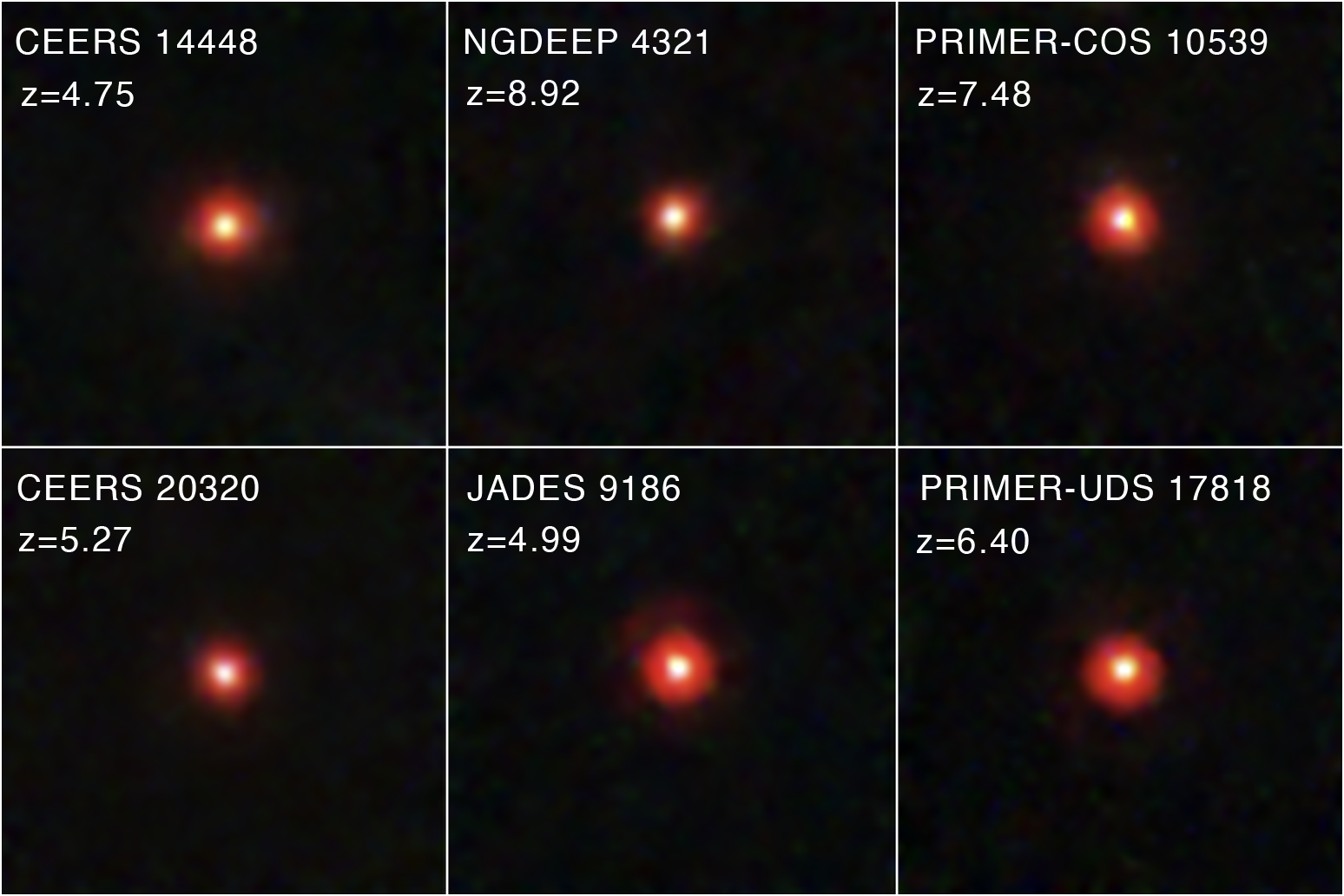
JWST images of six very distant galaxies dubbed “little red dots.” [NASA, ESA, CSA, STScI, Dale Kocevski (Colby College)]

Many theories exist for the origins of little red dots: compact, reddish objects spotted mainly in the first billion years after the Big Bang. The leading theory states that that little red dots are growing black holes encased in dense gas. The black holes at the centers of these little red dots appear to be tens or even hundreds of millions of times the mass of the Sun, raising questions about how they grew so massive so quickly. One possibility is that they started out quite massive, arising from black holes born from the collapse of massive gas clouds in the early universe.

A recent research article explores that theory, with a twist: that the black holes at the heart of little red dots were born not out of regular, baryonic matter, but out of dark matter.

A Dark (Matter) Past

In the early days of the universe, tiny fluctuations in the density of dark matter began to grow, eventually collapsing into vast spheroidal structures called dark matter halos. In the leading theory of cosmology, ΛCDM, dark matter interacts with itself and normal matter only through gravity. This leads to the creation of stable dark matter halos that act as the invisible scaffolding within which the first stars and galaxies grow.

In today’s article, Fangzhou Jiang (Peking University) and collaborators investigated the evolution of halos containing self-interacting dark matter. Particles of self-interacting dark matter, as the name suggests, can interact with one another through collisions and exchange heat. This small adjustment, sometimes invoked in alternatives to ΛCDM to explain the properties of dwarf galaxies, can lead to the collapse of dark matter halos into black holes.

Seeding Black Holes

Jiang and coauthors examined whether this process could explain the observed population of little red dots. First, the team examined whether the timescales are feasible: is it possible for dark matter to assemble itself into massive halos and collapse into black holes, all within the first billion years of the universe?

The answer appears to be yes — in this framework, dark matter halos with masses between 106.5 and 108.5 solar masses were able to form black holes between 104.5 and 106.5 solar masses by a redshift of z = 8.5, when the universe was just 600 million years old.

plot comparing observed and modeled black hole populations

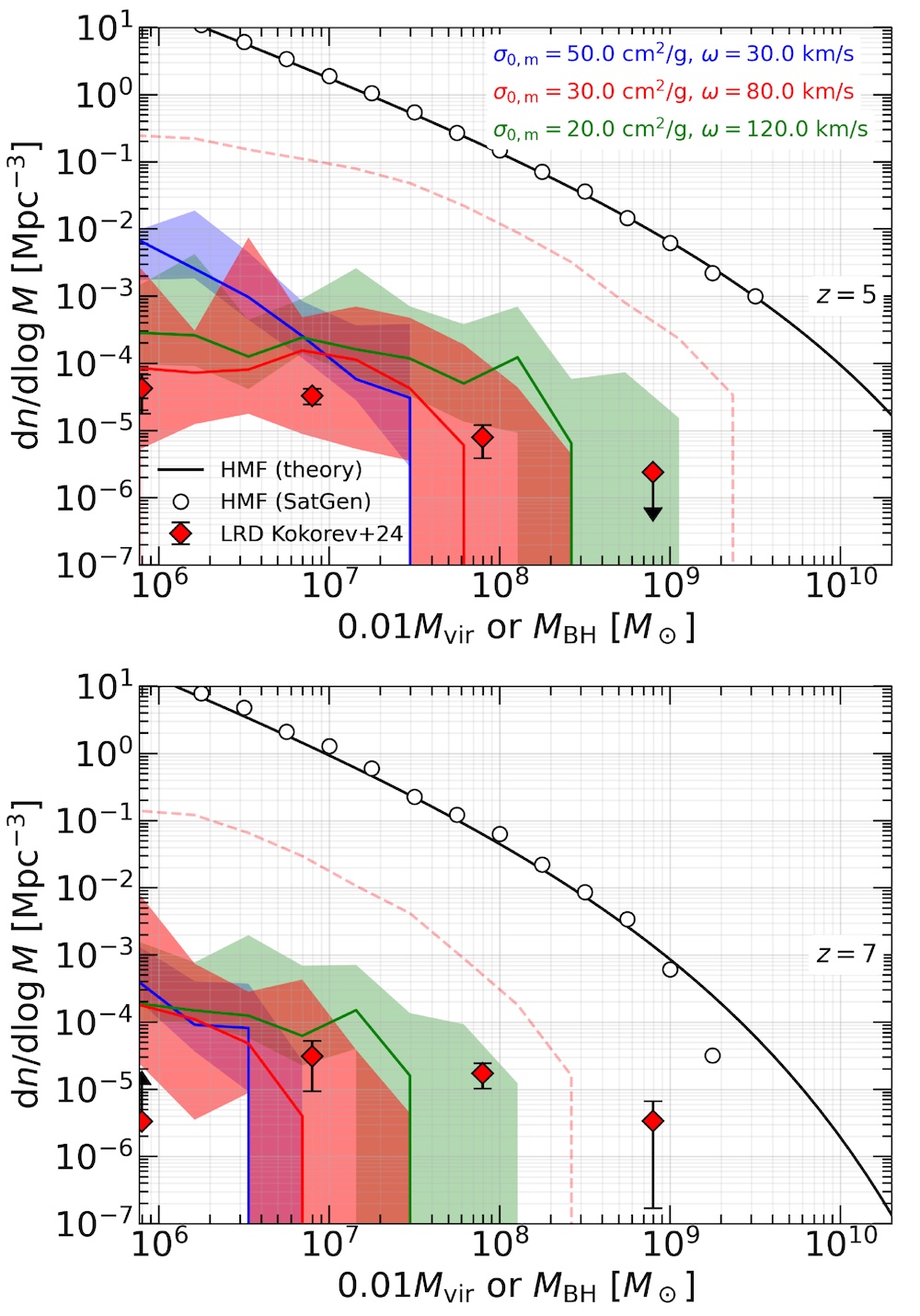
Comparison of the inferred black hole population in little red dots (red diamonds) to models of black holes formed in dark matter halo collapse (shaded areas) at two redshifts. The red area shows the fiducial model, while the blue and green areas show the effects of changing the dark matter self-interaction cross-section. The dashed red lines show an extreme case in which the presence of baryons accelerates halo collapse. Click to enlarge. [Jiang et al. 2026]

Jiang’s team then performed semianalytic modeling to explore how these “seed” black holes grow and evolve through accretion and mergers. This analysis generated a distribution of black hole masses consistent with what has been observed in little red dots. The team cautioned that their results are sensitive to the interaction cross-section of the dark matter particles, as well as various other parameters like the black hole accretion duty cycle. Their modeling also assumes that the halo collapse takes place before any baryonic matter collects within it. Intriguingly, the authors found that the presence of baryons accelerates the collapse of the dark matter halo, speeding the seeding process.

To close, Jiang and collaborators noted that this process is not mutually exclusive with other black hole seeding mechanisms, and as studies of self-interacting dark matter continue, its ability to create black holes in the early universe should be examined further.

Citation

“Formation of the Little Red Dots from the Core Collapse of Self-Interacting Dark Matter Halos,” Fangzhou Jiang et al 2026 ApJL 996 L19. doi:10.3847/2041-8213/ae247a

The post A Dark Matter Origin for Little Red Dots appeared first on AAS Nova.

  •  

Finding Galaxies in the Dark: Using Globular Clusters to Identify Ultra-Diffuse Galaxies

While classic spiral and elliptical galaxies shine brightly, another class of galaxy flies under the radar. A recent study uses a new technique to search for galaxies so faint they are nearly completely dark.

Ultra-Diffuse Galaxies

Hard to see and harder to understand, ultra-diffuse galaxies are a galaxy class with extremely low surface brightness. With low luminosities but large physical extents, these galaxies appear as barely visible smudges, making them difficult to detect. Historically, astronomers have searched for ultra-diffuse galaxies using methods that search for diffuse stellar light; however, this method only catches those bright enough to spot — if even darker galaxies exist, they will not be found this way. Is there another way to discover these elusive galaxies?

Recent studies have shown that ultra-diffuse galaxies tend to have more globular clusters on average than typical galaxies. While this raises questions surrounding their formation and evolution, the abundance of globular clusters provides another way to search for ultra-diffuse galaxies. In general, globular clusters do not clump together in space unless there is additional mass, like dark matter, pulling them together. Thus, searching for overdensities of globular clusters could reveal a hidden population of ultra-diffuse galaxies.

Candidate Confirmation

Discovered as an overdensity of three globular clusters, Candidate Dark Galaxy-2 (CDG-2) was found in data from a Hubble Space Telescope (HST) program aimed at imaging the Perseus galaxy cluster. With an updated globular cluster catalog and improved statistical method for detecting overdensities, Dayi (David) Li (University of Toronto) and collaborators perform a follow-up search and analysis to confirm CDG-2 as a galaxy. Their method searches for clustering of globular clusters that do not appear to belong to any bright galaxy and are unlikely to be randomly grouped so closely in the intergalactic medium.

CDG-2

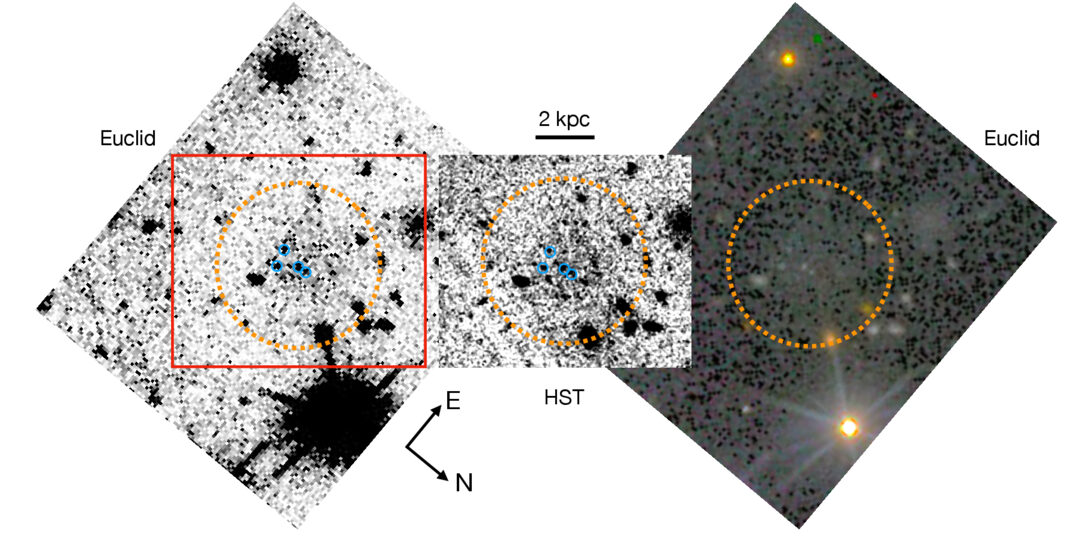
Euclid images of CDG-2 showing the four identified globular clusters (blue circles) and the faint diffuse emission (orange circles) associated with the galaxy. Click to enlarge. [Modified from Li et al 2025]

From their analysis, the authors find an additional globular cluster that belongs to CDG-2, making the object even more statistically likely to be a galaxy as opposed to four randomly clumped globular clusters. Further pointing to CDG-2’s galactic nature, two stacked HST images reveal a very faint light surrounding these globular clusters. To confirm that this diffuse emission is truly associated with CDG-2, the authors use data from Euclid, a space telescope that is optimized for detecting diffuse structures. The Euclid data confirm a low-surface-brightness fuzzy emission that coincides with the emission seen with HST and corresponds to the location of the four globular clusters — strong evidence that CDG-2 is indeed a galaxy.

Globular Cluster and Dark Matter Dominated

plot

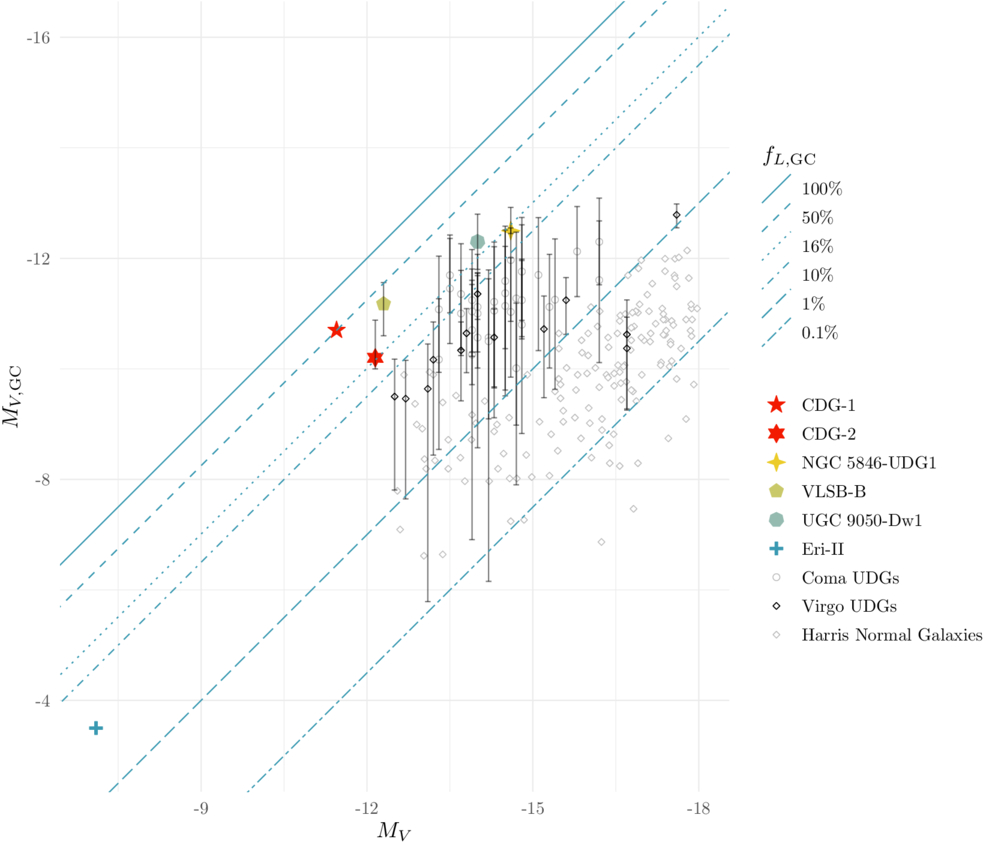
Plot showing globular cluster total luminosity versus total galaxy luminosity for multiple galaxies. CDG-2 falls along the line corresponding to 16% of the total galaxy light coming from globular clusters. Click to enlarge. [Li et al 2025]

Further analysis of CDG-2 reveals that at least ~16.6% of its total light is contained within its globular clusters. However, if CDG-2 follows the typical distribution of globular clusters in galaxies and some are still undetected, this fraction could be as high as 33%, which would make CDG-2 have the highest globular cluster-to-stellar mass ratio of any galaxy to date. With additional analysis of the mass contained within the observed globular clusters, the authors estimate that CDG-2 is highly dark-matter dominated with 99.94%–99.98% of its total mass contained within dark matter. The dark-matter fraction could be even higher if CDG-2 contains more undetected globular clusters. Future observations of CDG-2 with deeper imaging and spectroscopy will more confidently determine the galaxy’s extreme and unique structure.

Through this study, the authors have confirmed the first galaxy ever detected solely through its globular cluster population. This technique opens a promising avenue to discovering more galaxies hiding out in the dark.

Citation

“Candidate Dark Galaxy-2: Validation and Analysis of an Almost Dark Galaxy in the Perseus Cluster,” Dayi (David) Li et al 2025 ApJL 986 L18. doi:10.3847/2041-8213/adddab

The post Finding Galaxies in the Dark: Using Globular Clusters to Identify Ultra-Diffuse Galaxies appeared first on AAS Nova.

  •  

NCIS JWST: Analyzing the Aftermath of the Bullet Cluster’s Collision

multi-wavelength image of the Bullet Cluster

Editor’s Note: Astrobites is a graduate-student-run organization that digests astrophysical literature for undergraduate students. As part of the partnership between the AAS and astrobites, we occasionally repost astrobites content here at AAS Nova. We hope you enjoy this post from astrobites; the original can be viewed at astrobites.org.

Title: A High-Caliber View of the Bullet Cluster Through JWST Strong and Weak Lensing Analyses
Authors: Sangjun Cha et al.
First Author’s Institution: Yonsei University
Status: Published in ApJL

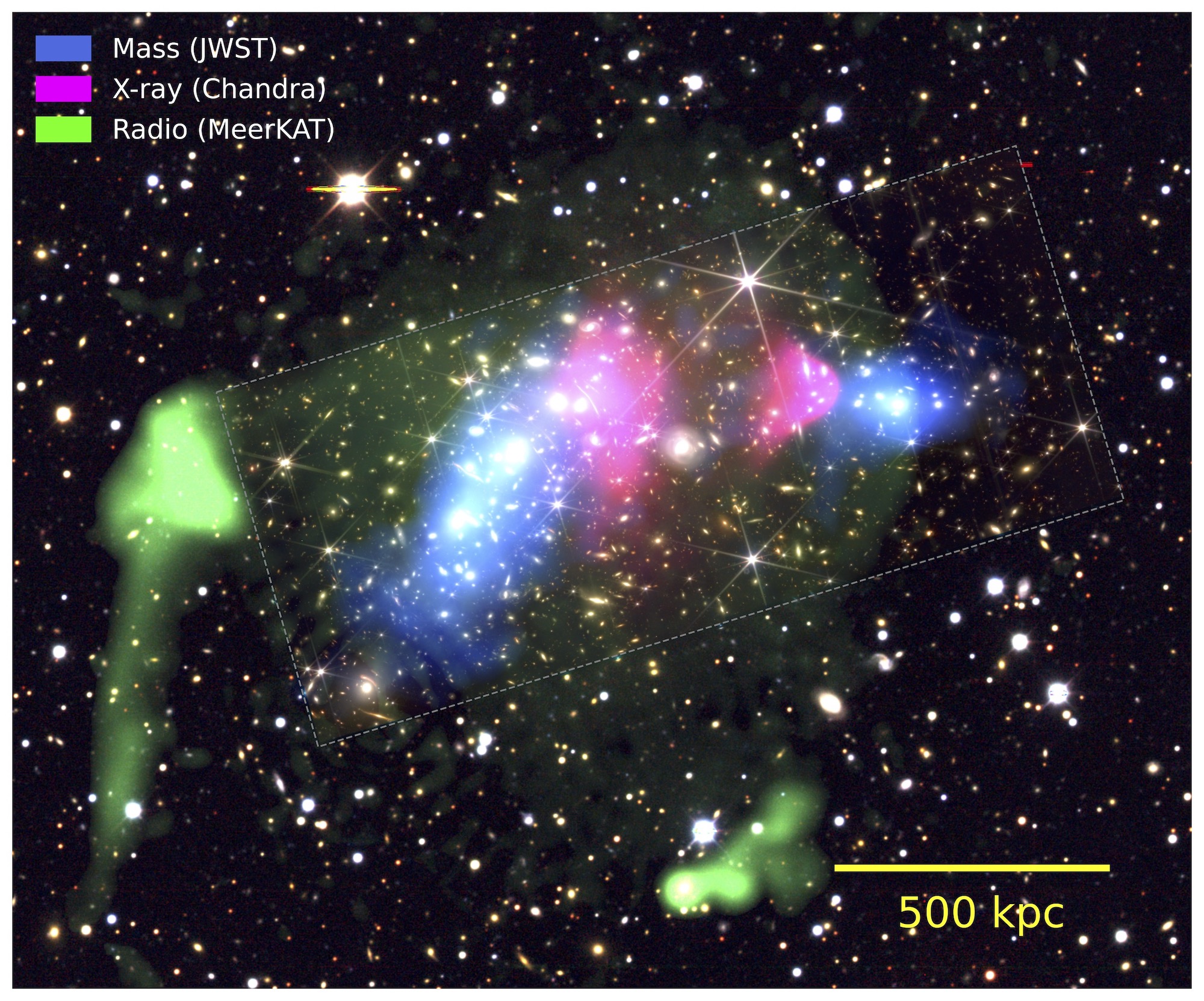
Despite the extreme depth and resolution of JWST observations, there’s still no smoking gun to be found in the hunt for dark matter. Yet, the extremely high-velocity collision in today’s article might aid in the search for what this mysterious material is made of. The target of today’s article is the Bullet Cluster (Figure 1). Despite its name, the Bullet Cluster is not one, but actually two massive clusters of galaxies gravitationally interacting with one another. Due to the high speed with which the smaller “bullet” subcluster collided and passed through the larger one, a strong bow shock caused the gas in the system to compress and heat to millions of degrees. Typically, this alone would make this system interesting to astronomers, but the real kicker here is that this collision was powerful enough to separate the dark matter from the normal, luminous matter. This has made the Bullet Cluster an important testing ground for theories on the nature of dark matter and is exactly what the authors of today’s article attempt to use it for.
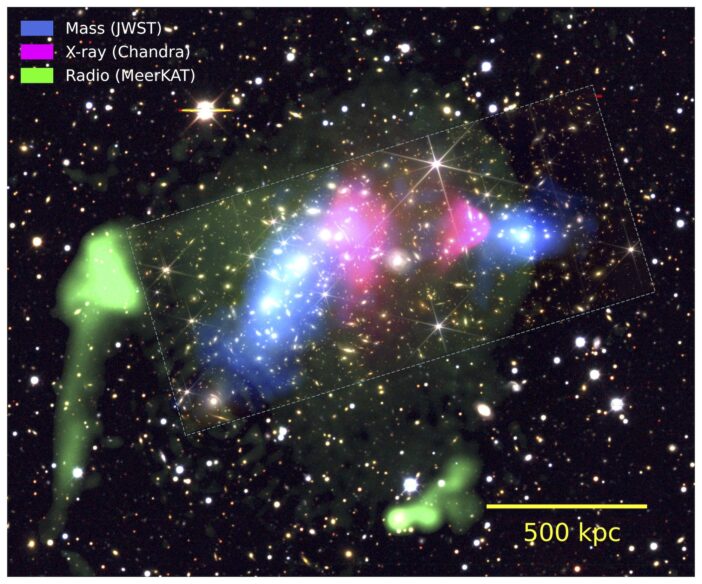
multi-wavelength view of the Bullet Cluster

Figure 1: The Bullet Cluster, colour coded based on the strong and weak lensing–based mass reconstruction (blue/JWST), X-ray intensity (pink/Chandra), and radio intensity (green/MeerKAT) using three different telescopes. The dashed rectangle indicates JWST’s smaller field of view compared to Chandra and MeerKAT. [Cha et al., in press]

Mapping Hidden Mass

The authors used JWST imaging of the majority of the Bullet Cluster system to obtain high-resolution, multi-wavelength data. They then identified over 146 areas in the image subject to strong lensing, which is when the light from a background galaxy is bent around mass in the foreground Bullet Cluster system, since that mass distorts spacetime. They also obtained a weak lensing model for the image through statistical analysis, since the effects of weak lensing, while similar, are much more subtle than strong lensing. They then created a mass map for the system by feeding their strong lensing and weak lensing model into a reconstruction algorithm. Essentially, this algorithm creates the most likely distribution of mass, both dark matter and normal matter, that would re-create all the lensing that they observed.

What’s special about the algorithm that they used here is that it does not assume that light traces mass. In general, this assumption is correct, so other algorithms use it to get the most accurate mass estimate. But the authors here wanted to confirm that even in extreme environments like the Bullet Cluster that this is still the case, so they sent their algorithm in “blind.”

Comparing How the Light Traces the Dark

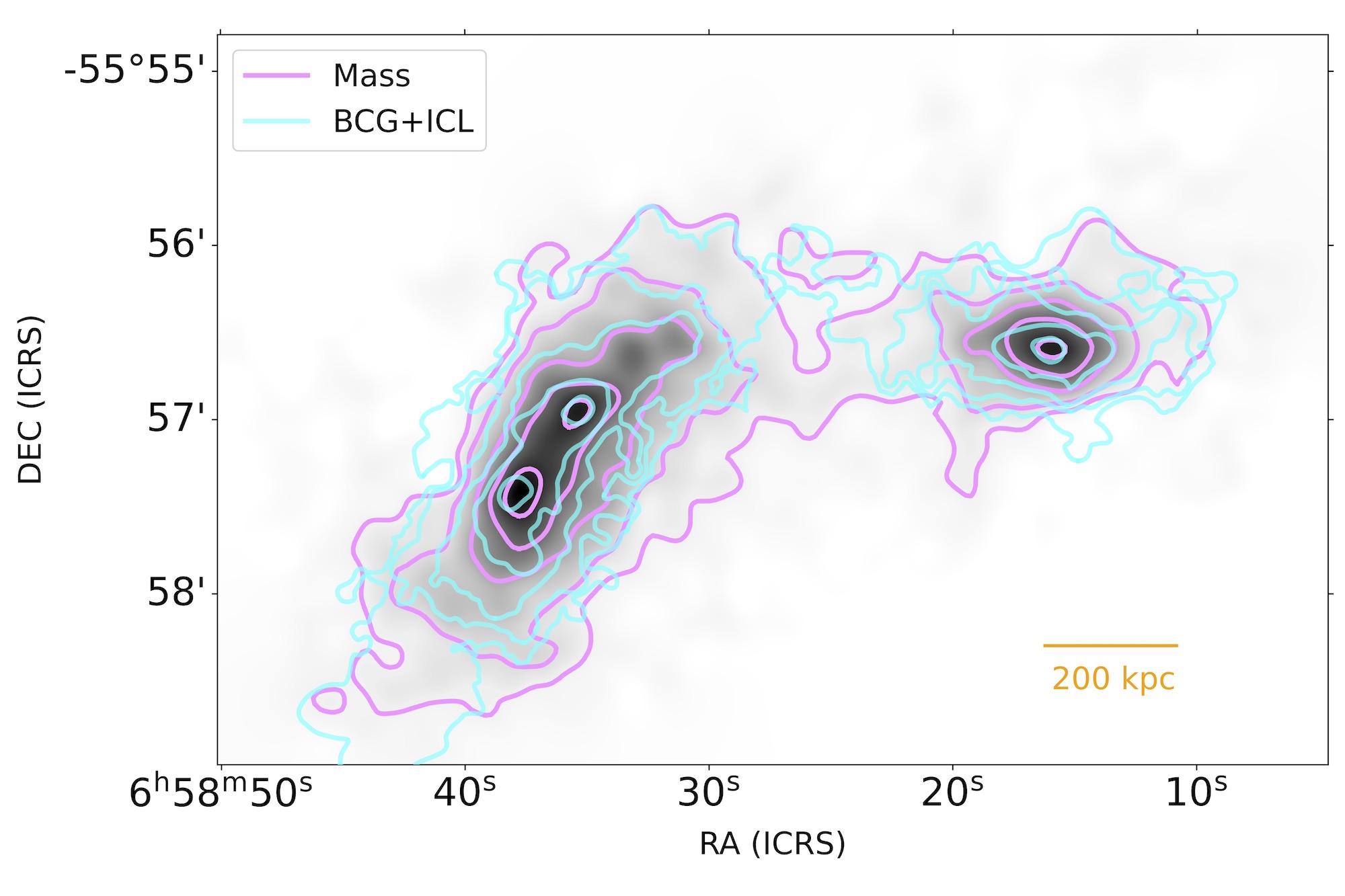
Once they had their mass map, which is dominated mostly by the dark matter in the system, they could compare it to the optical light between the system’s galaxies, referred to as the intracluster light (ICL). They used a statistical test called the modified Hausdorff distance to determine how similar the distribution of ICL and dark matter were to each other. They found that, despite the extreme gravitational interactions going on in the Bullet Cluster, the ICL still does an excellent job overall of tracing the system’s mass (see Figure 2).
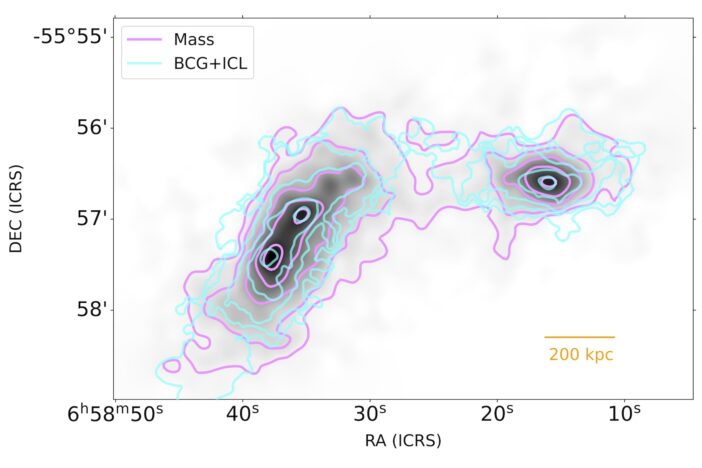
comparison of dark matter mass map and distribution of light

Figure 2: Comparison of the dark matter mass map from the strong and weak lensing data (pink) and the distribution of light from the ICL and the most massive galaxy, also known as the brightest cluster galaxy (BCG), combined (blue). Note how the bottom-most centroid’s dark matter and ICL contours are offset from one another. [Cha et al., in press]

Next, they compared their mass map to the distributions of hot plasma, as observed in X-ray wavelengths with Chandra, and of hydrogen gas, as observed in radio wavelengths with MeerKAT (see Figure 1). They found that the dark matter was offset from both of these distributions, which was already known about this system. However, their measurement of these mass offsets indicated that it is unlikely that the Bullet Cluster was formed from a merger between just two galaxy clusters. The authors suggest that the Bullet Cluster’s formation is much more complicated than previously thought, but they aren’t able to give any guesses about the initial conditions.

What a Massive Cluster Tells Us About a Tiny Particle

Finally, the authors were able to use their mass map to put some constraints on one of the theories of dark matter: self-interacting dark matter. If dark matter particles interact with each other, then they have a cross section that can be calculated. Here, the authors calculate it from the offset between the position of the most massive galaxy in the Bullet Cluster and the position of the highest density of dark matter, which is about 60,000 light-years (see Figure 2). They were able to determine that the upper limit of this cross section is 0.5 cm2/g. This is the tightest constraint on self-interacting dark matter’s cross section to date, but we still have that pesky “per gram” in our units since we don’t know the mass of a dark matter particle (but this is being studied!).

This cross section is near the lower limit of what is thought to be a reasonable range for self-interacting dark matter theories (about 0.5–2 cm2/g), but it certainly doesn’t rule anything out. For further context, when dividing by mass, the cross section of a hydrogen atom is about 1.7×107 cm2/g, which is much bigger, but we would expect that when comparing an atom to a potential subatomic dark matter particle.

Altogether, the authors of this article were able to use both the precision of JWST and the impartiality of their mass-reconstruction algorithm to learn new things about both the structure of the Bullet Cluster and the nature of dark matter. Although there are still some open questions that will need to be answered, this study certainly is not just a shot in the dark!

Original astrobite edited by Maggie Verrico.

About the author, Veronika Dornan:

Veronika is a final-year PhD candidate at McMaster University. Her research is in observations of extragalactic globular star clusters and what they can tell us about galaxy evolution and dark matter distribution in the universe.

The post NCIS JWST: Analyzing the Aftermath of the Bullet Cluster’s Collision appeared first on AAS Nova.

  •  

From Gas to Cluster: Simulating Star Formation in the Early Universe

globular cluster

JWST observations have begun uncovering some of the oldest star clusters in the universe, but their formation mechanisms are still uncertain. A recent study uses high-resolution simulations to understand early star formation and how local globular clusters may have originated. 

Supersonically Induced Gas Objects

Our leading cosmological model of the universe suggests that stars and galaxies coalesce within dark matter halos, eventually forming the larger structures we see today. However, some of the oldest astronomical objects in the universe — massive collections of stars called globular clusters — contain little to no dark matter, making their formation mechanisms somewhat mysterious. How do large clusters with thousands of stars form outside of dark matter halos?

supersonically induced gas objects

Visualizations of the gas density in the simulated star-forming regions in this study. Click to enlarge. [Lake et al 2025]

Recent studies have suggested that as the dark matter and baryons (i.e., normal matter) in the early universe began to clump together and form slightly denser areas, the pristine gas and dark matter began to move relative to one another. Baryons, still tightly coupled to photons, did not have the same freedom to collect in dense regions that the dark matter did, creating supersonic (about five times the speed of sound) relative motions that separated gas clumps and early dark matter halos. These separate, dark-matter-free gas clumps formed baryon-enriched structures known as supersonically induced gas objects.

Over the past decade, simulations and theory have shown that supersonically induced gas objects can form star clusters, which may be the origin story of many of the local globular clusters seen today. However, these simulations have been limited by their resolution. Unable to resolve individual star formation and not including key aspects like feedback, these simulations have left open questions about these dark-matter-free objects.  

High-Resolution Simulations

Seeking to more deeply understand supersonically induced gas objects, William Lake (University of California, Los Angeles; Dartmouth College) and collaborators perform high-resolution simulations that include detailed physics and can track the formation of individual stars. The simulations varied the metallicity and presence of protostellar jets, properties that are both known to impact the star formation process in gas clouds.

imf

Mass distribution for the stars formed in the simulated supersonically induced gas objects. The simulated clusters form more high-mass stars than what is seen in local star-forming regions. Click to enlarge. [Lake et al 2025]

From the simulations, the authors find that star formation occurs naturally in these early systems. Both feedback from jets and the metallicity of the gas affect star-formation outcomes — jets tend to have a minor impact on the star formation efficiency in low-metallicity clouds, but disruption from the jets can cause low-mass stars to form in metal-enriched systems. However, in general, the authors conclude that supersonically induced gas clouds tend to form higher-mass stars than local star clusters, which agrees with what is expected for the universe’s first stellar population. 

Given that these objects likely form very high-mass stars, these primordial star clusters will have extremely high stellar mass surface densities and brightnesses compared to what is observed locally. With such enhanced brightness, these objects may be bright enough for JWST to observe them. Further high-redshift observations of star clusters will allow for further constraints on the formation of the universe’s first stars and will yield more information about the possible origins of the globular clusters we see in the local universe.

Citation

“The Stellar Initial Mass Function of Early Dark Matter–Free Gas Objects,” William Lake et al 2025 ApJL 985 L6. doi:10.3847/2041-8213/add347

The post From Gas to Cluster: Simulating Star Formation in the Early Universe appeared first on AAS Nova.

  •  

A Long, Hard Look at (Potentially) Nothing to See

cloud-9 neutral hydrogen contour map

Editor’s Note: Astrobites is a graduate-student-run organization that digests astrophysical literature for undergraduate students. As part of the partnership between the AAS and astrobites, we occasionally repost astrobites content here at AAS Nova. We hope you enjoy this post from astrobites; the original can be viewed at astrobites.org.

Title: Examining the Nature of the Starless Dark Matter Halo Candidate Cloud-9 with Very Large Array Observations
Authors: Alejandro Benítez-Llambay et al.
First Author’s Institution: University of Milano-Bicocca
Status: Published in ApJ

Astronomy, in many ways, is the study of light — in every wavelength that exists — coming at us from light-years away. But most of the mass in our universe is made of dark matter, a material that neither emits nor reflects any light. So, how exactly are we supposed to find this dark matter? Well, the dominant theory of what our universe is made of, Lambda cold dark matter (ΛCDM), predicts that this dark matter can form small halos — regions of gravitationally bound matter — that host reservoirs of cold gas but no stars. While we cannot directly observe dark matter, this cold gas can reflect light at radio wavelengths. Finding these dark halos, referred to as reionization-limited neutral atomic hydrogen clouds (RELHICs), is therefore rather important to confirm ΛCDM. The authors of this article are attempting to do just that by taking a close look at Cloud-9, a potential RELHIC.

How to “See” in the Dark

Cloud-9 was first discovered in 2023 when a team of astronomers noticed an excess of neutral hydrogen (HI) gas with no bright stars around it, near the spiral galaxy Messier 94 (M94). This discovery was made with the Five-hundred-meter Aperture Spherical radio Telescope (FAST), which doesn’t have the best resolution. For reference, this article found Cloud-9’s diameter to be roughly 3 arcminutes in the sky, while FAST’s resolution is 2.9 arcminutes. So, the authors of this article decided to look at Cloud-9 again, this time with the Very Large Array (VLA), an array of radio telescopes that can pick out more of the structure of this system.

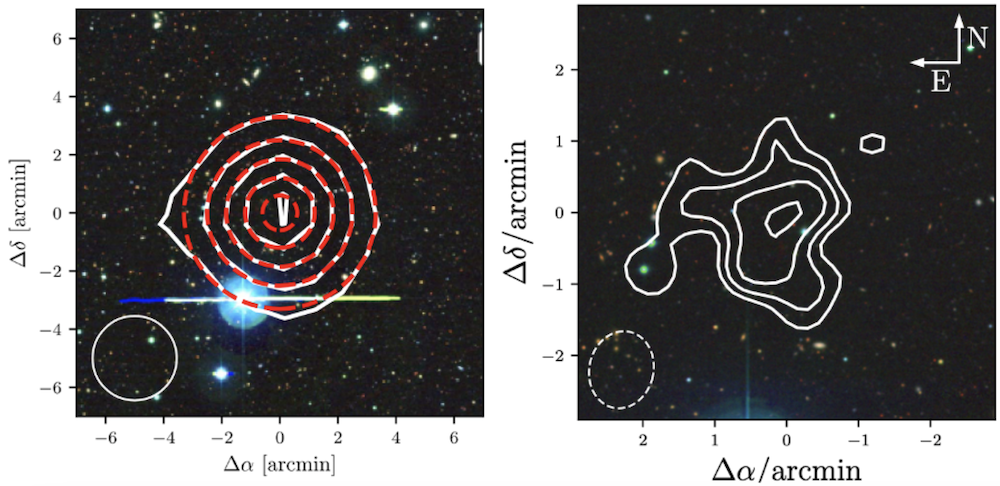
With this upgraded resolution, the authors were able to get a clearer picture of the shape of Cloud-9 and compare it to the previous study (see Figure 1). They found that Cloud-9 was slightly smaller and much more lopsided than previously thought. This funky shape is likely due to gravitational interactions with the larger nearby galaxy M94, causing the gas in Cloud-9 to squish and stretch.

neutral hydrogen density contours for Cloud-9

Figure 1: Left: The HI gas column density from the previous FAST observations. [Benítez-Llambay & Navarro 2023] Right: The HI gas column density from the VLA observation in this article. [Benítez-Llambay et al. 2024] Corner circles represent the resolution of each telescope and the x and y axes are the position on the sky. Note the scale of the axes in each plot; the right plot is a zoomed-in version of the left.

RELHIC or Just RELHIC-tively Dim?

To determine if Cloud-9 really is a RELHIC, the authors needed to compare its HI radial density profile to the profiles of simulated RELHICs. Density profiles are a good tool to use here since although we don’t fully understand what dark matter is, we do know how it will affect things around it gravitationally. If the only matter hosted by Cloud-9 is HI gas and dark matter, then that gas will have a specific distribution that we can observe. If other baryonic matter is hosted by Cloud-9 that we just aren’t picking up right now, it will affect that density profile.

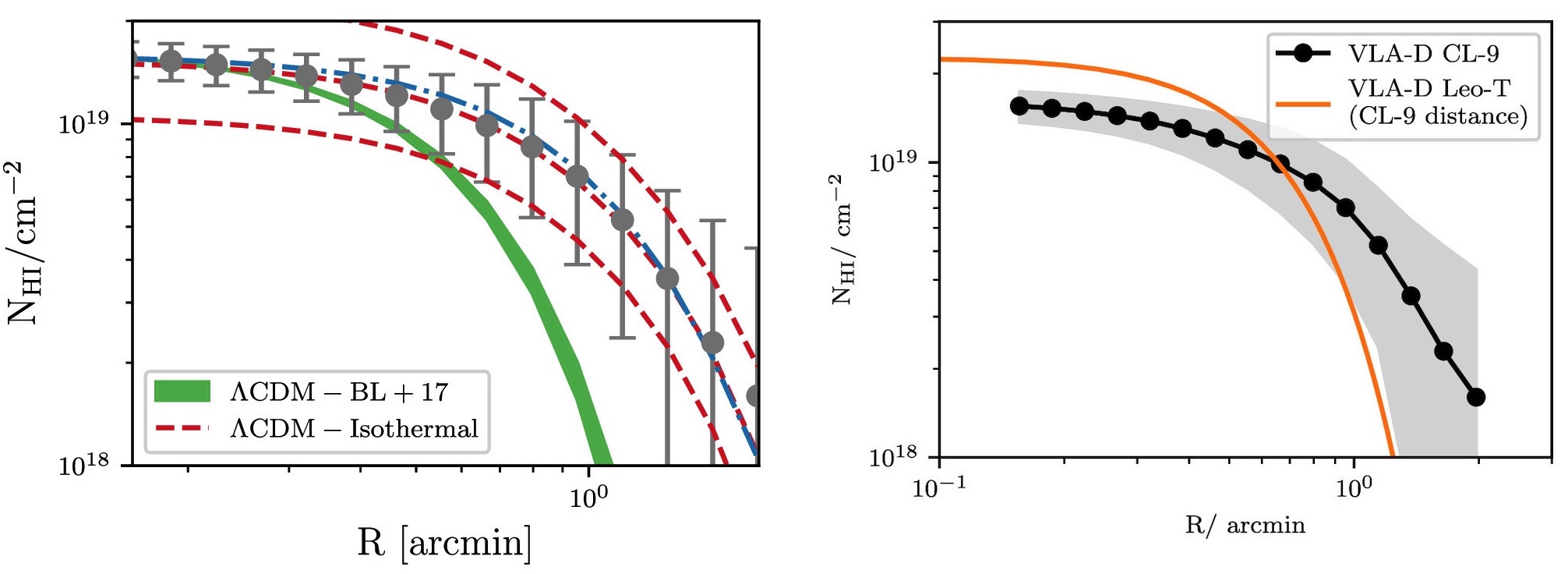
The authors found that for a detailed, general simulation the profiles did not match well, specifically in the outer regions. But when they compared it to a sphere of gas with a constant, specific temperature, they were able to get the fits to line up (see Figure 2). However, the authors point out that these simulations are isolated, meaning there is no big galaxy next to them affecting their shape, unlike Cloud-9.

observed and modeled neutral hydrogen density

Figure 2: Left: Comparison of Cloud-9’s HI profile (grey dots) to a general simulated RELHIC’s profile (green line) and a simulated RELHIC at a specific temperature (red line). Right: Comparison of Cloud-9’s profile (black dots) to Leo T’s profile (orange line). Although the positions are shifted, the slopes of the profiles match. [Benítez-Llambay et al. 2024]

The authors also tried to test another explanation for Cloud-9’s apparent lack of stars: the stars are there but just too dim for us to see right now. The Milky Way sits near many ultra-faint dwarf galaxies, which are small and have quite dim stellar populations. We’ve only just developed telescopes in the last few years that can take in enough light to see these galaxies, and we might not be able to detect stars in an ultra-faint dwarf galaxy as far away from us as Cloud-9. The authors compare the HI density profile of Cloud-9 to that of Leo T, a nearby ultra-faint dwarf galaxy. They find that these profiles match up better than for the general RELHIC simulations, particularly in the innermost regions of Cloud-9 and Leo T.

What Are the Next Steps?

The authors conclude that, as of right now, they can’t definitively say whether Cloud-9 is or is not a RELHIC, but there are a few things astronomers can do to clear things up. First, theorists can re-run the RELHIC simulations with halos that have been affected by gravity like Cloud-9. This will allow them to better compare their observations to the simulations.

Second, observers can image Cloud-9 with an optical telescope that is powerful enough to detect any stars that could be there. They suggest the Hubble Space Telescope since it would be able to detect the brightest handful of stars in the potential dim population. JWST would be an even better choice, with its even deeper imaging capabilities, but it is very difficult to get observing time on it. (JWST recently received the most proposals in one year for any telescope ever!)

We will likely have to wait a bit for a definitive answer on the nature of Cloud-9, but either way the authors are excited by this gas cloud. Either it is the first starless dark matter halo, a confirmation of one of the predictions of ΛCDM, or it is the most distant ultra-faint dwarf galaxy ever detected! Although Cloud-9 is not much to look at right now, you should still definitely keep your eye on it.

Original astrobite edited by Maggie Verrico and Cole Meldorf.

About the author, Veronika Dornan:

Veronika is a final-year PhD candidate at McMaster University. Her research is in observations of extragalactic globular star clusters and what they can tell us about galaxy evolution and dark matter distribution in the universe.

The post A Long, Hard Look at (Potentially) Nothing to See appeared first on AAS Nova.

  •  
❌