❌

Reading view

Jupiter Accelerates Electrons to Near-Light Speed, Offering Clues to Cosmic Ray Origins
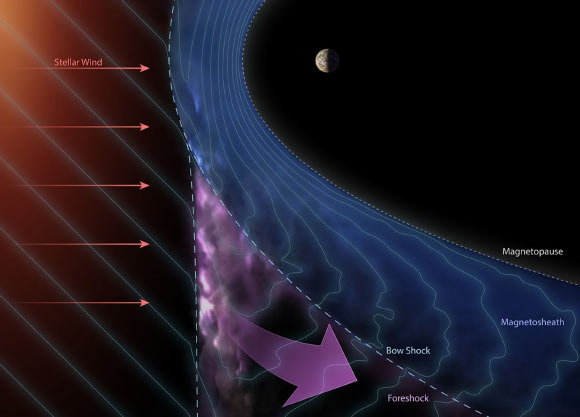
As planets and stars travel through the streams of charged particles flowing across space, their magnetic fields act like obstacles; incoming particles are slowed and deflected, forming a boundary called the bow shock; just ahead of this boundary lies the foreshock, a variable region where magnetic conditions can accelerate some particles to nearly the speed of light. Image credit: Ben C. Smith, Johns Hopkins Applied Physics Laboratory.

The giant planet’s bow shock isn’t just deflecting the solar wind, it’s acting as a powerful particle accelerator, firing electrons to relativistic energies of at least 1 MeV, according to a new analysis of data from NASA’s Juno spacecraft.

The post Jupiter Accelerates Electrons to Near-Light Speed, Offering Clues to Cosmic Ray Origins appeared first on Sci.News: Breaking Science News.

  •  

NASA Captures Typhoon Jangmi’s Massive Eye in Stunning Nighttime Image

Typhoon Jangmi May 30Typhoon Jangmi dazzled from space with a giant swirling eye while drenching parts of Japan with heavy rain. From late May into early June 2026, Typhoon Jangmi slowly tracked north-northwest across the Philippine Sea on a path toward southern Japan. Although the storm moved at a relatively slow pace, it spread intense rainfall across a [...]
  •  

Super Typhoon Sinlaku Was So Powerful It Made the Sky Ripple With Gravity Waves

Super Typhoon Sinlaku Atmospheric Gravity WavesA rapidly intensifying super typhoon sent giant atmospheric ripples skyward, revealing a hidden connection between extreme weather and near-space. In April 2026, Super Typhoon Sinlaku swept across the North Pacific, bringing torrential rain and flooding to parts of the Mariana Islands. The storm intensified into a “violent typhoon,” the highest category used by the Japan [...]
  •  

ISS crew back to normal after emergency shelter order

NASA has told crew aboard the International Space Station (ISS) to resume normal operations, ending a roughly two-hour period in which five astronauts sheltered inside a docked SpaceX capsule. The shelter order came Friday morning as a precautionary measure to protect crew while Russian cosmonauts attempted a fix on the Zvezda service module’s transfer tunnelContinue reading "ISS crew back to normal after emergency shelter order"

The post ISS crew back to normal after emergency shelter order appeared first on Astronomy Magazine.

  •  

How NASA plans to build a Moon Base

NASA announced new contracts for the rovers and landers that will lay the groundwork for the agency’s proposed $30-billion Moon Base — some of which they plan to launch as soon as this fall — during a May 26 press conference. The announcement offered the most detailed look yet into the Moon Base plan NASAContinue reading "How NASA plans to build a Moon Base"

The post How NASA plans to build a Moon Base appeared first on Astronomy Magazine.

  •  

Webb Weighs Most Distant Inactive Black Hole Ever Found

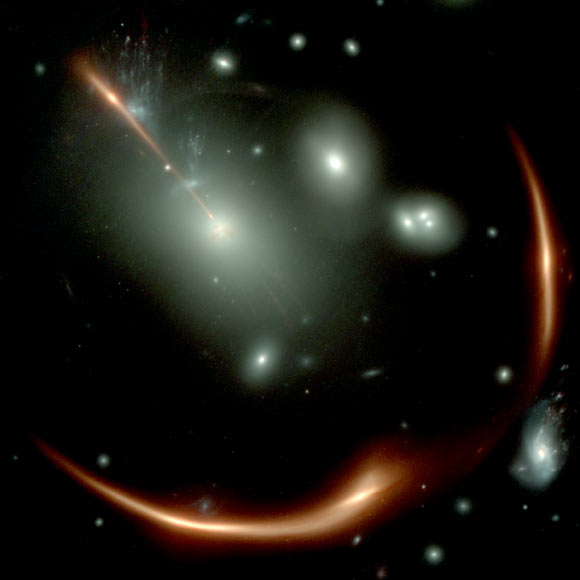
This Webb image shows the highly distorted red galaxy MRG-M0138 seen through a foreground cluster of galaxies (white sources). Image credit: NASA / ESA / CSA / Webb.

A supermassive black hole 6 billion times the mass of the Sun lurks in MRG-M0138, a gravitationally lensed quiescent galaxy seen when the Universe was just 3 billion years old, according to an analysis of data collected by the NIRSpec Integral Field Spectrograph onboard the NASA/ESA/CSA James Webb Space Telescope.

The post Webb Weighs Most Distant Inactive Black Hole Ever Found appeared first on Sci.News: Breaking Science News.

  •  

Alarme na Estação Espacial ultrapassado: NASA cancela evacuação de astronautas devido a fuga de oxigénio

Os quatro astronautas da missão Crew-12 foram instruídos pela NASA a vestir os fatos espaciais e a refugiarem-se na cápsula Dragon, enquanto cosmonautas russos tentam uma reparação mais extensa no módulo Zvezda.

The post Alarme na Estação Espacial ultrapassado: NASA cancela evacuação de astronautas devido a fuga de oxigénio appeared first on Tek Notícias.

  •  

Let’s build the moon base, but not lose sight of Mars

Illustration representing NASA's moon-to-Mars ambitions. Credit: NASA

These are heady days for NASA and the space industry. The Artemis 2 crew flew around the moon, traveling farther into space than any humans previously had; NASA announced an […]

The post Let’s build the moon base, but not lose sight of Mars appeared first on SpaceNews.

  •  

Don’t Miss: Venus Is About To Disappear Behind the Moon

Venus Moon Occultation 2023A disappearing Venus, a planet parade, and the start of summer make June a must-see month for skywatchers. June brings several notable skywatching events, including a close meeting between Venus and Jupiter, a rare occasion when the Moon moves in front of Venus, the arrival of astronomical summer, and the return of favorite deep-sky sights. [...]
  •  
❌