Cysteine is one of the main building blocks that cells use to make proteins. But this amino acid is a double-edged sword—too much cysteine is toxic to the cell. Cells therefore keep free cysteine levels to a minimum, converting most of the amino acid into the antioxidant glutathione.
There has still been no reckoning for the five long months it took for the authorities to warn the public about myocarditis from Covid vaccines, nor for falsely claiming it was only "mild" when they did, says Dr Ros Jones.
Vanderbilt University's Golnaz Arastoopour Irgens, assistant professor of human-centered learning technologies at Peabody College of Education and Human Development, partnered with Sarah K. Burriss (Ph.D. '23, Peabody's Department of Teaching and Learning), assistant professor of the practice at the College of Connected Computing, to rethink how kids should learn about artificial intelligence.
Meet Hilary Cremin: the Cambridge Professor of Education (yes, the one who appointed Jason Arday) who wants to abolish all secondary schools because they're "fascist", among other mad ideas, says Dr Nicholas Tate.
First-year university students in Northampton are being asked to complete a race equality course as part of their induction, with requirements to write about "white privilege" and how to "improve anti-racist practice".
Artificial intelligence is rapidly becoming part of how people learn, solve problems and construct knowledge. Yet whether AI strengthens human intelligence or encourages excessive dependence remains an open question.
What factors influence students' decisions about whether they will continue to use ChatGPT for learning in the future? This was the question addressed by a new study from ELTE's Faculty of Informatics, which used an interpretable machine learning framework to identify the factors that most strongly influence the use of generative artificial intelligence in higher education.
Alors que l’Europe travaille dans une logique de décarbonation à faire émerger une économie de l’hydrogène à l’échelle continentale, son développement reposera autant sur sa production que sur les infrastructures nécessaires pour relier les bassins de production aux bassins de consommation.
Scientists have discovered a crater on the moon that's bigger than the Roman Colosseum and is the result of a powerful impact two years ago that initially went undetected.
Scientists have discovered a crater on the moon that's bigger than the Roman Colosseum and is the result of a powerful impact two years ago that initially went undetected.
Un purificateur d'air domestique pour faire baisser la tension artérielle : l'idée peut sembler surprenante. Pourtant, une étude publiée en août 2025 dans le Journal of the American College of Cardiology apporte des preuves sérieuses : 3 mmHg de moins sur la pression systolique. C'est modeste,...
Artificial intelligence is rapidly becoming part of how people learn, solve problems and construct knowledge. Yet whether AI strengthens human intelligence or encourages excessive dependence remains an open question.
Encore trop peu connue, la choline est un nutriment essentiel au bon fonctionnement de l’organisme, et ce, dès la vie in utero. Indispensable au développement du cerveau, elle joue aussi un rôle clé dans la mémoire, l’humeur ou encore la santé du foie. Pourtant, la majorité de la population n’en...
C'est vrai que les solstices et équinoxes tombent forcément le 21 du mois ?On sait qu'ils ont lieu aux alentours de cette date, alors pour aller plus vite on parle toujours du 21 comme référence. Mais est-ce ces évènements saisonniers sont vraiment toujours placés ce jour-là dans notre...
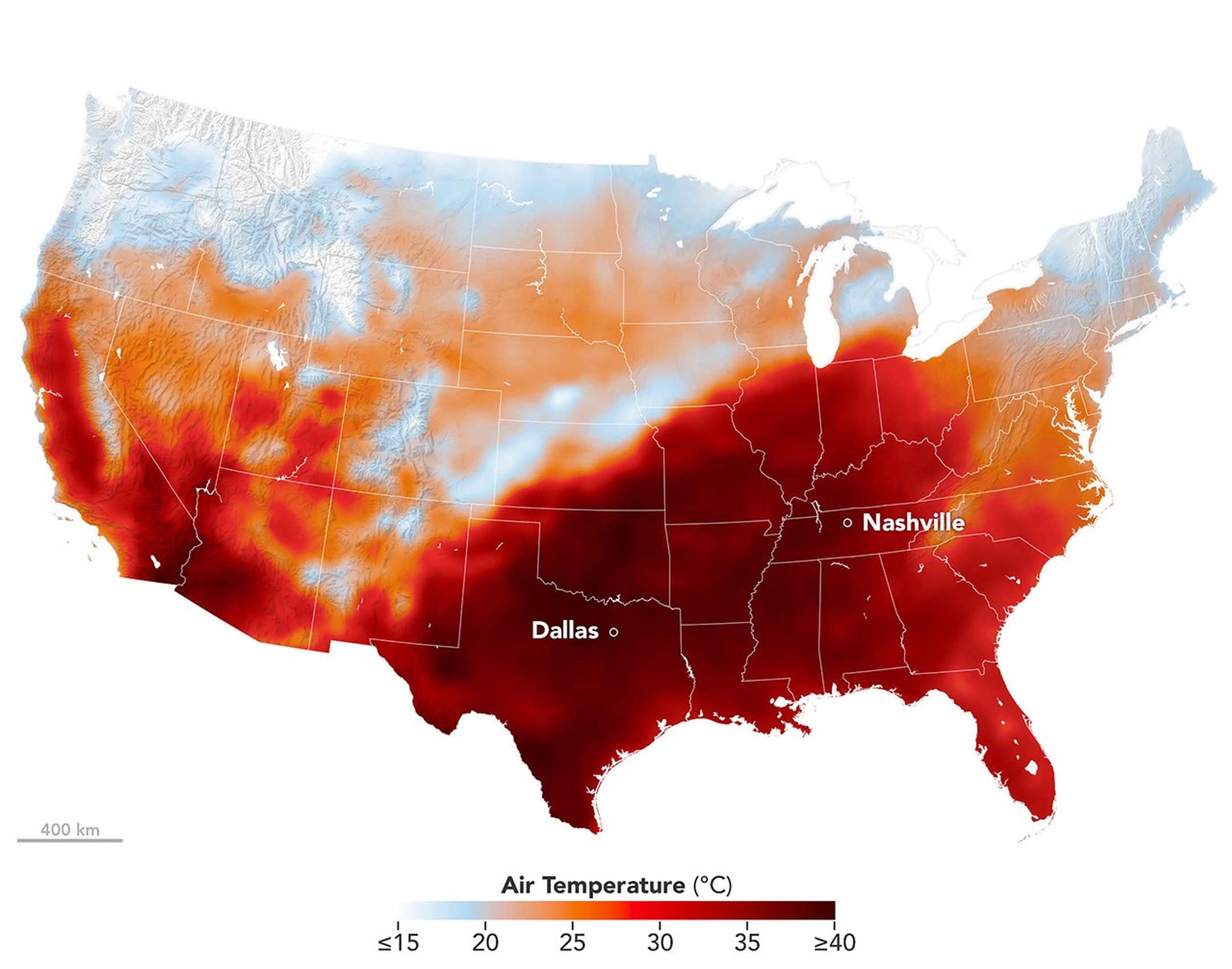
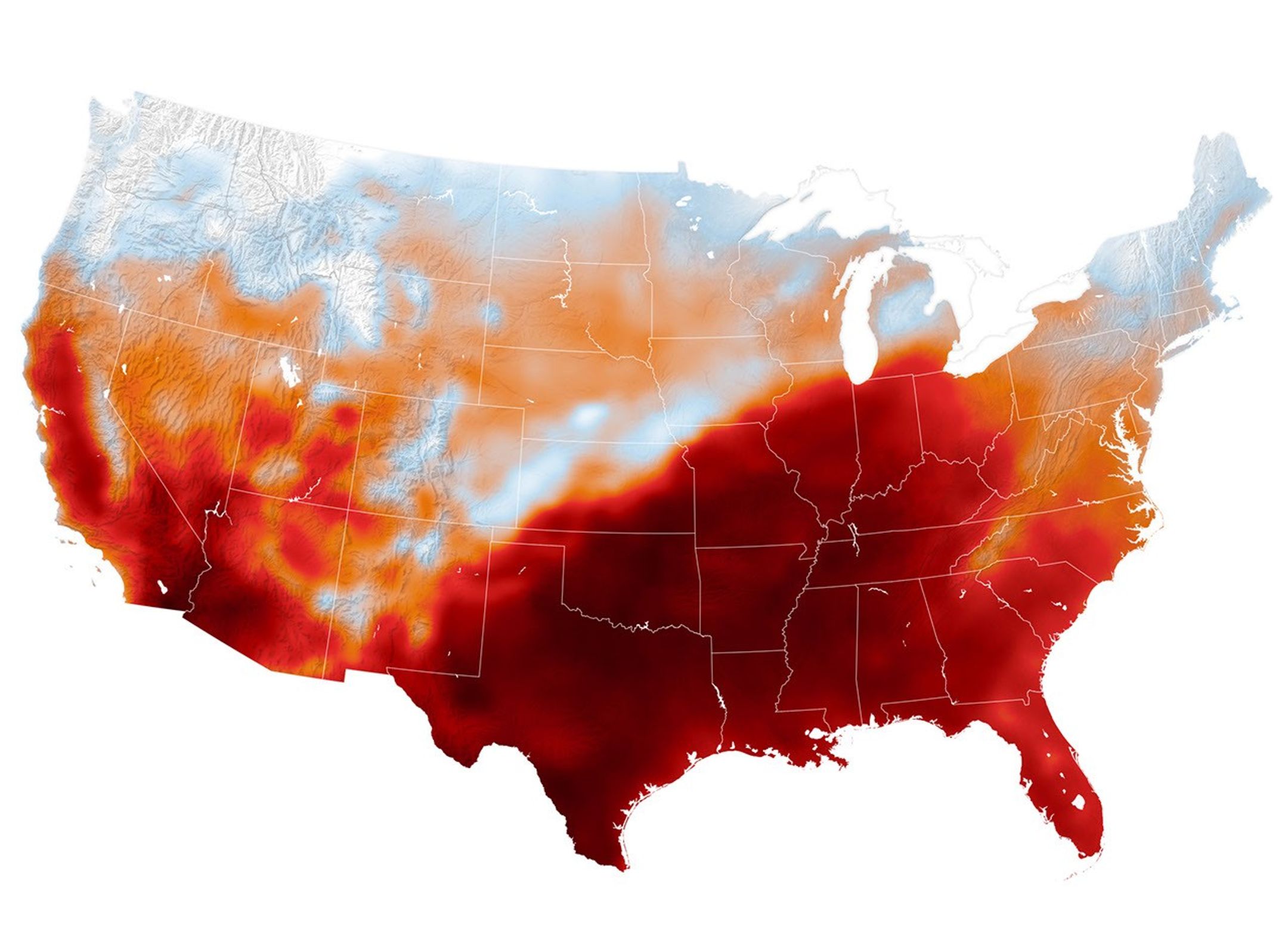
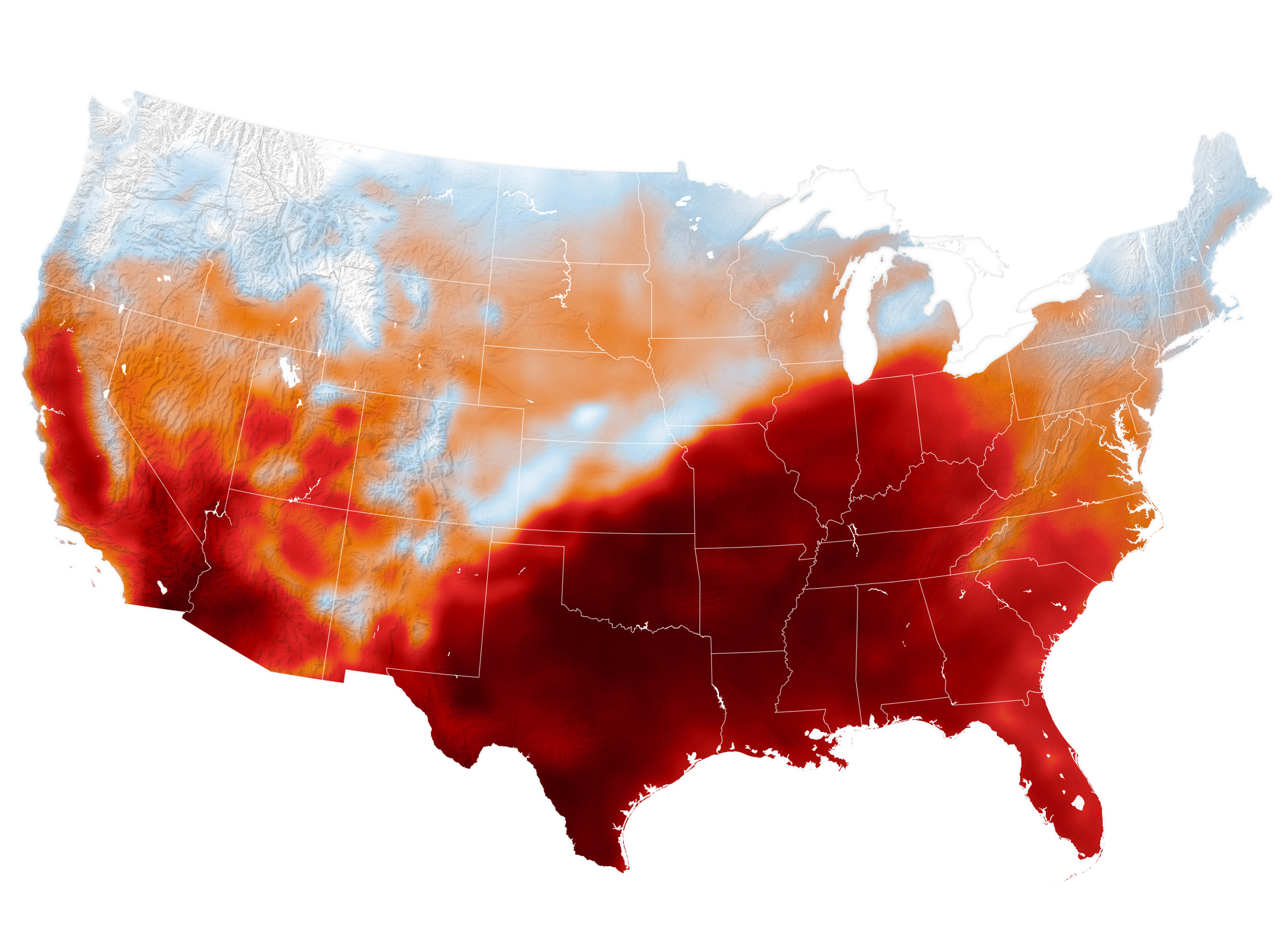
An area of high pressure over the south-central U.S. produced unseasonable and, in some places, record-breaking warmth on September 15, 2026, as shown in this map of modeled air temperatures from GEOS (Goddard Earth Observing System).
NASA Earth Observatory/Michala Garrison
While the calendar indicated that astronomical summer was winding down, a swath of the south-central United States was sweltering under a heat dome in mid-September 2026.
This map shows air temperatures in the contiguous U.S. on September 15, 2026, at 4 p.m. Central Time (21:00 Universal Time), modeled at 2 meters (6.5 feet) above the ground. It was produced by combining satellite observations with temperatures predicted by a version of the GEOS (Goddard Earth Observing System) model, which uses mathematical equations to represent physical processes in the atmosphere. The darkest reds indicate areas where temperatures approached or exceeded 40 degrees Celsius (104 degrees Fahrenheit).
More than 41 million people in the U.S.—about 12 percent of the population—were under a National Weather Service extreme heat advisory, extreme heat watch, or extreme heat warning on September 15. The high temperatures spanned large portions of several states, such as Texas, Oklahoma, Arkansas, Missouri, and Tennessee. Meteorologists warned that high humidity, limited cloud cover, and light winds could make temperatures feel higher than thermometer readings and increase the risk of heat-related illnesses.
Several locations set new daily high temperature records on September 15. These included Dallas, Texas, at 101ºF (38ºC), Memphis, Tennessee, at 99ºF (37ºC), and Nashville, Tennessee, at 100ºF (38ºC). The cities were all at least 12ºF warmer than normal that day, with Nashville breaking its daily-high record from 1927. The day before, Nashville also set a record-high minimum temperature of 75ºF (24ºC).
A weather phenomenon meteorologists call a heat dome was responsible for driving temperatures up across the region. A heat dome develops when an area of high pressure in the upper atmosphere pushes hot air toward the surface and traps it there. Heat domes put the brakes on convection and suppress clouds and precipitation. This allows sunlight to reach Earth’s surface relatively unhindered and further elevate air temperatures.
The stretch of unseasonable temperatures follows the warmest June through August in the contiguous United States in a 132-year record, according to NOAA. The three-month period in 2026 was 0.4ºF warmer than the previous records, set in 1936 and 2021.
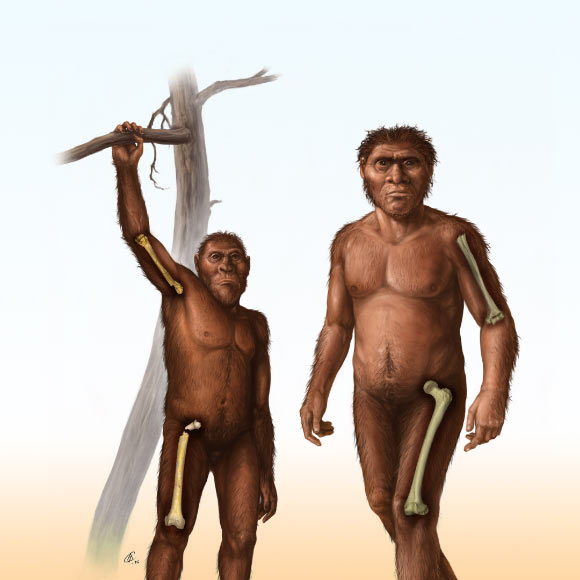
New research led by University of the Witwatersrand and University of Southern California paleoanthropologists sheds more light on one of the most debated transitions in human evolution: when our ancestors stopped regularly climbing trees and committed fully to walking on two legs.
Tenzing shifts one of mountaineering’s most famous stories toward the Himalayan climber whose name has long shared a place in history with Edmund Hillary. Apple Original Films has released the trailer for the upcoming adventure drama, with Genden Phuntsok playing Tenzing Norgay and Tom Hiddleston portraying Hillary during the 1953 expedition that reached the summit of Mount Everest.
Directed by Jennifer Peedom, the film reaches select theaters on October 9 before streaming globally on Apple TV on October 16. The cast also includes Willem Dafoe, Caitríona Balfe, Thinley Lhamo, and Tenzin Dalha.
Rather than presenting the expedition simply as a survival story about reaching the world’s highest point, the film approaches the ascent through Tenzing’s position within the British-led team, his relationship with the mountain, and the social divisions surrounding the expedition.
That perspective gives the familiar Everest story a different dramatic center.
Tenzing puts the Himalayan climber at the front of the story
Tenzing Norgay and Edmund Hillary reached the summit of Everest on May 29, 1953, during an expedition led by Colonel John Hunt. Their ascent became one of the defining achievements in mountaineering history, but the new film is explicitly structured around Tenzing rather than treating the two climbers as interchangeable figures.
Phuntsok plays Tenzing as an experienced Himalayan climber who has already spent years pursuing the possibility of reaching the summit. The story follows his attempt to secure a meaningful place on the climbing team instead of being viewed primarily as someone there to support Western expedition members.
Hiddleston’s Hillary enters that story as another outsider within the expedition hierarchy. Apple describes the relationship between the two men as one built gradually through mutual respect and trust as the dangers and pressures of the ascent increase.
Dafoe plays Hunt, the expedition leader, while Balfe portrays expedition secretary Jill Henderson, who becomes an ally to Tenzing. Thinley Lhamo plays Dawa, Tenzing’s wife, whose support forms another part of the film’s emotional foundation.
The Apple TV listing also identifies Johnny Flynn as George Mallory and Tenzin Dalha as a younger Tenzing.
The 125-minute film therefore has room to explore more than the final climb itself. Its central conflict begins before Tenzing and Hillary ever approach the summit.
Image Credit: Apple Inc.
The Everest story looks beyond conquest
One of the distinctions emphasized in Apple’s description of Tenzing is the different meaning the mountain holds for its characters.
The film contrasts the Western climbers’ view of Everest as something to be conquered with Tenzing’s reverence for Chomolungma as the sacred mother goddess.
That contrast gives director Jennifer Peedom a way to examine the expedition through competing cultural perspectives rather than framing the mountain solely as an obstacle.
The trailer also points toward tensions involving class, hierarchy, nationality, and the legacy of empire. Tenzing must establish that he belongs among the expedition’s climbers instead of accepting a supporting position defined by others.
Historical accounts from the Royal Geographical Society record that Hillary and Tenzing left their final camp on the morning of May 29, 1953, using supplemental oxygen. They reached the summit at approximately 11:30 a.m. after negotiating the steep section of rock and ice that became known as the Hillary Step.
The achievement has been recounted in books, documentaries, photographs, and films for decades. Tenzing approaches the material by asking how the same expedition looks when the Himalayan climber occupies the center of the frame.
Peedom shares story credit with Luke Davies, who wrote the screenplay.
The project is a natural fit for Peedom, whose filmmaking career has repeatedly engaged with mountains, extreme environments, and the people drawn to them. Here, however, the physical scale of Everest serves a character story built as much around identity and recognition as technical climbing.
Genden Phuntsok leads an established ensemble
Casting Tenzing Norgay was particularly consequential because the film surrounds its lead with several internationally recognizable performers.
Hiddleston arrives as Hillary with a career spanning major franchise work and dramatic television. Dafoe brings a more imposing presence to Hunt, while Balfe plays Henderson as one of the figures willing to challenge the assumptions surrounding Tenzing’s role.
Phuntsok nevertheless remains the narrative anchor.
Apple’s synopsis describes the climber’s journey as both a lifelong ambition and a spiritual calling. That gives the performance two demands: convincing audiences of Tenzing’s physical capability at extreme altitude while conveying why reaching Chomolungma carries meaning beyond becoming part of the first confirmed ascent of Everest.
Lhamo’s Dawa is also positioned as more than background to the expedition. Apple specifically identifies her encouragement as part of what drives Tenzing toward the opportunity, adding a personal relationship to a story otherwise dominated by expedition politics and physical risk.
Behind the camera, Davies joins Peedom as a producer. Desray Armstrong also produces, alongside Liz Watts, Iain Canning, and Emile Sherman of See-Saw Films.
See-Saw has an established relationship with Davies, whose previous screenwriting credits for the company include Lion. Norbu Tenzing, Simon Gillis, and David Michôd serve as executive producers.
Image Credit: Apple Inc.
Tenzing gets a theatrical window before Apple TV
Apple is giving Tenzing a short theatrical run before bringing the film to its streaming service.
Select theaters will begin showing the movie on October 9, with the global Apple TV premiere following one week later on October 16. The Apple TV listing categorizes the film as a drama and adventure title and gives it a PG rating in the U.S. for thematic elements, language, smoking, and some peril.
The release continues Apple Original Films’ practice of using theatrical distribution selectively before making features available to subscribers.
For Tenzing, the cinema component has an obvious creative advantage. A film built around Everest, dangerous climbing conditions, and the physical scale of the Himalayas has material suited to a large screen, even as its narrative emphasis remains on the people inside that landscape.
The trailer arrives with less than a month remaining before the theatrical debut, giving Apple a relatively concentrated promotional window.
It also introduces Phuntsok to a much wider international audience alongside performers including Hiddleston, Dafoe, and Balfe without letting the better-known names displace the person identified in the title.
Tenzing will begin its theatrical run on October 9, followed by its Apple TV release on October 16. Its 1953 destination is already known; the new question is how the film reconstructs the journey by placing Tenzing Norgay’s perspective, relationships, and understanding of Chomolungma at the center of the ascent.

 Login