❌

Reading view

Democratic Allies Must Join Forces in the Race for UAP Disclosure

Since February 2026, the United States Department of War (DOW), under the direction of President Donald Trump, has released an unprecedented number of documents, videos, and firsthand witness accounts detailing the United States’ extensive history of encounters with unidentified anomalous phenomena, or “UAP.”

Despite the questions that remain, this initiative under the Presidential Unsealing and Reporting System for UAP Encounters (PURSUE) has been nothing short of historic. For more than 75 years, Americans pleading for the truth on the issue have been routinely ridiculed and even misled by their own government. It’s difficult to imagine the nation’s posture being anything other than one of obfuscation, secrecy, and resistance to transparency.

Documents, particularly those detailing reports from senior intelligence officials encountering “orbs”, are a stark departure from the U.S. government’s nearly century-long position of secrecy.

Lawmakers, however, have been left with more questions than answers. Who or what flies with such impunity over our sensitive military installations? Who owns this technology? Are they a threat to national security?

Across the Pacific, members of Japan’s National Diet are confronting the same questions. The May 2026 file releases from the U.S. DOW disclosed two unresolved UAP incidents from the U.S. Indo-Pacific Command. Japanese legislators only learned the details of these cases near their own territory after the American file release—not through any internal channels.

Democratic allies, it seems, face a shared challenge. For too long, elected officials in our respective nations have been denied adequate information about the phenomena operating in our common security environment. And in the U.S., whenever we are informed, it’s only through the preferred methods and timing of unelected bureaucrats deeply entrenched in our national security apparatus. In Japan, by contrast, the Ministry of Defense has stated that information may be made public when something arises that it determines should be explained.

But this raises a fundamental question: should the government alone decide what should be explained to the public?

If a grave national security threat truly exists, then elected representatives have been left with little choice but to entrust the security of their nations to the very institutions that have obscured the truth from us and even each other.

It is therefore incumbent upon us—Representatives solely accountable to the citizens of our respective nations—to work together and to seek the truth wherever we may find it; both for the good of our people and to defend against whatever threats we face from strategic competitors.

As mentioned above, among the files released by the U.S. DOW were highly significant firsthand reports from high-ranking officials in the Office of the Director of National Intelligence. The documents detail a search operation at a classified missile testing site in the Western United States, explicitly for aerial phenomena:

En route, ground teams reported spotting a UAP on FLIR [Forward Looking Infrared], describing it as “super-hot,” low to the ground, and moving east then south at high speed. The object then split into two and changed direction. Upon arrival, we scanned the area using NVG [Night Vision Goggles], FLIR, and the naked eye. The ground team suddenly radioed that the object had risen from the ground, approached within ten feet of the helicopter, dropped below us, and then sped away.

The documents were accompanied by what the DOW labeled as “related photos.”

Accounts such as these are hardly “proof” of anything, but for elected officials, they do cement the reality of our national security concerns. Missing from this account—or any account we have been allowed to access—is an answer to a fundamental question: What do the various U.S. government agencies believe these objects are? Are they merely civilian drones? Do they represent technology belonging to a foreign actor? And if someone within the government does know, who decides that elected officials shouldn’t?

Members of Japan’s UAP Parliamentary League, led by former Japanese Defense Minister Yasukazu Hamada, share similar concerns.

DOW data, released through the Pentagon’s All-domain Anomaly Resolution Office (AARO) in August of 2023, identified specific regions of Japan, particularly in the western and southern parts of the country, as being among the world’s notable hotspots for UAP reports.

One such instance occurred as recently as July of last year. Security guards at the Genkai Nuclear Power Station in Saga Prefecture observed three luminous objects in the sky above the facility. The lights remained visible for nearly two hours; long enough for local police to arrive and observe them. The police stated that what they themselves observed was an airplane, leaving a discrepancy between the two accounts. The incident was also recorded by Kyushu Electric Power’s security cameras, but the footage has not been made available even to members of the National Diet. Police have likewise declined to disclose related information on the grounds that the matter remains under investigation. As a result, elected lawmakers still lack access to the information necessary to independently assess the incident, and to this day, members of Japan’s National Diet have no answers.

Like their American counterparts, Japanese lawmakers have been left without the tools or information for proper oversight despite reports of UAP operating near critical infrastructure within restricted airspace.

It is no longer acceptable for elected representatives to be agnostic on this issue. Events such as these, along with countless videos now made publicly available, are more than mere optical illusions and cannot be dismissed on account of prosaic explanations like parallax effect. For many members of Congress and members of Japan’s UAP Parliamentary League, the evidence presented before us indicates an unknown technology.

Our understanding of what is technologically feasible in propulsion, the manipulation of physical matter, and even space-time itself is being challenged. From what we know, our current defense capabilities appear insufficient. Furthermore, the origin of these phenomena remains unknown—not only to the U.S. and Japan, but seemingly to other nations as well. China, for instance, recently established its own military body dedicated to investigating UAP, even supplementing human resources with artificial intelligence dedicated to tracking what the People’s Liberation Army refers to as “Unidentified Air Conditions.”

We are, by all indications, in a global arms race for technological supremacy, one that is rapidly rendering today’s weapons obsolete through advances in quantum technology, artificial intelligence, and drone warfare. UAP and whatever technology allows them to operate with apparent impunity over sensitive military and nuclear installations could redefine the competition.

If harnessed by democratic allies, breakthroughs could bolster deterrence and stability in the South China Sea. Conversely, failure to establish a coordinated effort among democratic allies could give China an unforeseen technological advantage over a future invasion of Taiwan, making an already difficult fight impossible.

U.S. global leadership, along with the territorial integrity of the Pacific are at stake. For members of Japan’s National Diet, UAP investigations are of great national importance—an issue that demands cross-party attention.

As for their American counterparts, it’s clear representatives can’t reach the truth through traditional pathways that amount to asking the Central Intelligence Agency ‘nicely.’ It stands to reason that close alliances with democratic allies like Japan may be the most viable pathway for disclosure.

Indeed, if our tools are limited in scope, perhaps new revelations made by democratic allies provide a unique leverage point. After all, it was the Trump administration’s disclosure under the PURSUE program that significantly increased pressure on Japan’s Defense Ministry to acknowledge its own previously undisclosed UAP-related activities.

This is why we, as elected representatives of our nations, have engaged the Emerging Technologies Interparliamentary Caucus (ETIC) as a platform for international dialogue regarding emerging technologies and the security threats presented by UAP. Comprised of representatives from across the globe, the ETIC presents a rare opportunity to ensure elected representatives are equipped to assess potential threats, safeguard our nations, and prepare for the realities of emerging technologies in the 21st century.

Whether the phenomena we are encountering originate from an adversary or something else entirely, democratic nations cannot afford to be complacent.

The people of our nations deserve answers, and we intend to find them.

Rep. Eric Burlison (R-MO-07) is the Chairman of the Subcommittee on Economic Growth, Energy Policy, and Regulatory Affairs. 

Yasukazu Hamada is a Member of the House of Representatives, Japan, Former Minister of Defense, and Chairman of the UAP Parliamentary League.  

Yoshiharu Asakawa is a Former Member of the House of Representatives, Japan, and Assistant to the Chairman of the UAP Parliamentary League.
  •  

Android 17 QPR1 Stable Update Rolls Out to Pixel Phones With New UI and Pixel Features

Google has started rolling out the Android 17 QPR1 stable update to compatible Pixel devices, building on the features introduced with Android 17 while adding new animations, Quick Settings changes, multitasking improvements and additional health features.

The update covers a wide range of Pixel phones and tablets, extending from the Pixel 6 generation through the newly released Pixel 11 family. For users coming from the Android 17 QPR1 beta program, the final release is also arriving as a relatively small update rather than requiring a complete system reset.

Android 17 QPR1 Gives the System UI a More Expressive Look

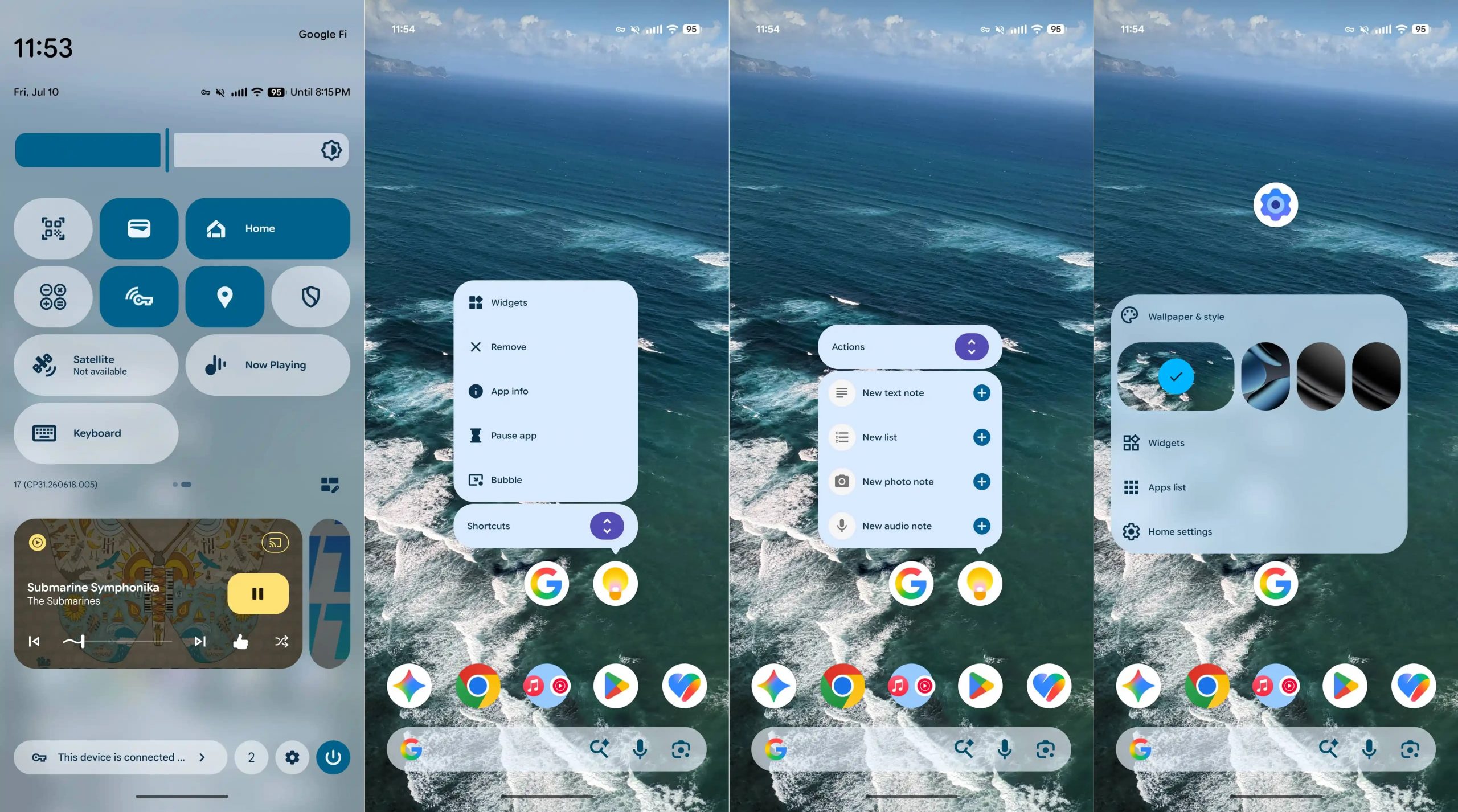
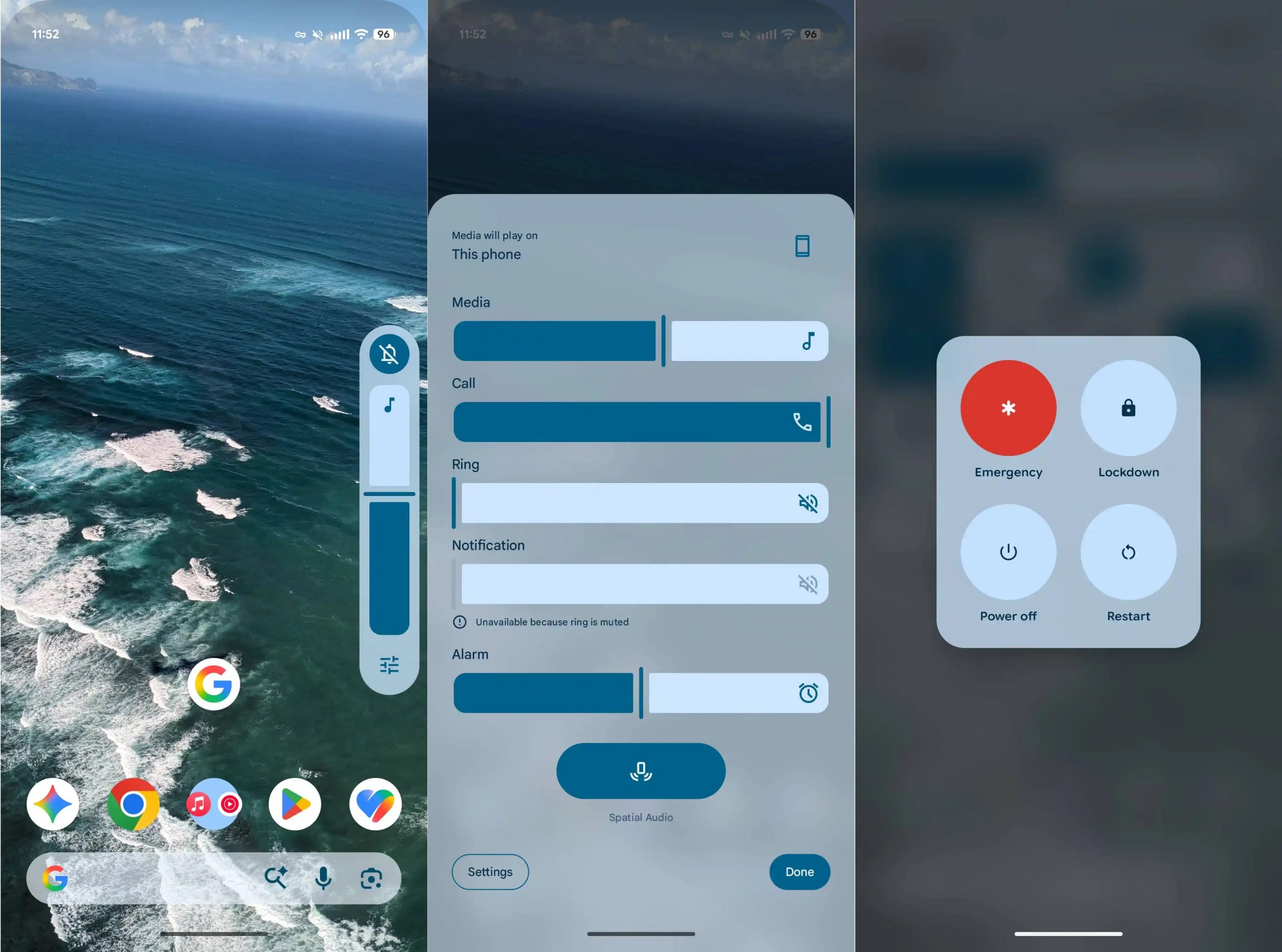
One of the most obvious changes in Android 17 QPR1 is the increased use of blur and transparency throughout the system interface.
The volume panel now uses a semi-transparent design with dynamic colors, while the expanded volume interface has received a visual update. Google has also added background blur to the power menu, giving system controls a more layered appearance.
These changes make the interface feel less static and put more emphasis on depth, transparency and animated transitions.

New Material 3 Multitasking Interface

These changes are part of Google’s broader Material 3 design direction, which emphasizes more expressive motion, adaptive colors and updated interface components.

When several apps are open, the system media and multitasking interface now uses a Material 3-style carousel. Instead of displaying a row of simple dots at the bottom, the interface provides previews of other open applications.

The active app card can also shrink to make room for additional previews, making it easier to recognize and switch between recently used apps.

Quick Settings Get New Animations and Controls

The Quick Settings panel receives several practical changes in this release.

Google has introduced new elastic-style animations when opening Quick Settings, while an edit button is now displayed in the lower-right area for easier customization.

The mobile data tile also gains a “Don’t ask me again” option. Another new addition is a dedicated Keyboard Quick Settings tile, which provides faster access to the system keyboard switcher.

Screen recording has also been adjusted. The tool now defaults to the application that was used for the previous screen recording session, potentially reducing the number of steps needed to start another recording.

Home Screen Menus Are More Clearly Organized

Android 17 QPR1 changes several interactions on the Pixel home screen.

Long-pressing an app icon now separates app-specific shortcuts from system-level actions such as widgets and bubbles. This creates a clearer distinction between functions provided by the app and Android’s own controls.

Long-pressing an empty area of the home screen also opens an updated wallpaper switching interface. The new design uses more noticeable rounded corners and a cleaner arrangement of menu options.

Settings Gets New Material 3 Expressive Icons

The Settings application is another area receiving a visual update.

Android 17 QPR1 introduces new Material 3 Expressive icons in Settings. The design language was previously seen on Pixel Watch devices and is now being brought more prominently to the phone experience.

Google has also added a new animation when users double-click the power button from the lock screen to launch the camera.

Health Connect Tracks More Activity Data

Health-related tracking also gets an expansion in Android 17 QPR1.

Health Connect can now track additional activity measurements, including distance traveled and calories burned, alongside existing step information.

This gives Pixel users more data points for monitoring everyday movement without requiring every activity metric to be handled by a separate application.

Android 17 QPR1 Compatible Pixel Devices

The stable update is available across a broad range of Google Pixel phones and tablets, covering several generations from the Pixel 6 series onward:

  • Pixel 6 and Pixel 6 Pro
  • Pixel 6a
  • Pixel 7, Pixel 7 Pro and Pixel 7a
  • Pixel Tablet
  • Pixel Fold
  • Pixel 8, Pixel 8 Pro and Pixel 8a
  • Pixel 9, Pixel 9 Pro, Pixel 9 Pro XL, Pixel 9 Pro Fold and Pixel 9a
  • Pixel 10, Pixel 10 Pro, Pixel 10 Pro XL, Pixel 10 Pro Fold and Pixel 10a
  • Pixel 11, Pixel 11 Pro, Pixel 11 Pro XL and Pixel 11 Pro Fold

The inclusion of the latest Pixel 11 series means the QPR1 release covers Google’s recent Pixel generations as well as several older devices.

What Beta Users Need to Know

Users who are currently running Android 17 QPR1 Beta 9 should receive a relatively small update to move to the stable release.

However, users participating in the Android Beta Program may need to exit the beta program before receiving the stable OTA update, depending on their current enrollment status.

The stable update is being distributed over the air and does not require users to erase their device data as part of the normal upgrade process.

Android 17 QPR1 Is More Than a Visual Update

While the new blur effects and Material 3 styling are among the most visible changes, Android 17 QPR1 also improves everyday interactions through redesigned multitasking, Quick Settings controls, home screen menus and additional Health Connect measurements.

For Pixel owners, the update therefore represents a combination of visual refinement and practical interface changes, rather than simply another maintenance release. The continued Android Beta Program will also allow Google to test future QPR releases and feature updates on supported devices.

The post Android 17 QPR1 Stable Update Rolls Out to Pixel Phones With New UI and Pixel Features appeared first on IGeeKphone China Phone, Tablet PC, VR, RC Drone News, Reviews.

  •  

Breaking the Ice: Origins of Carbon Oxides on Uranian Moons

Uranus close-up

For decades, astronomers have tried to decipher the source of carbon oxides on Uranus’s largest moons from ground-based telescopes. A recent study has leveraged JWST spectroscopy and laboratory experiments to identify carbon oxides and their origins for Ariel, Umbriel, Titania, and Oberon.

Unknown Origins of Carbon Oxide Enrichment

Forty years ago, the Voyager 2 spacecraft flew past Uranus and its twenty-seven moons, sending back prized portraits of the planet’s large and tidally locked satellites Miranda, Ariel, Umbriel, Titania, and Oberon. These images revealed extensive valleys, smooth plains, deep canyons, and possible icy volcanic (cryovolcanic) activity across the surfaces of the icy moons — the telltale signs of intense geologic activity. While Voyager 2 could take spectacular pictures, the spacecraft was not capable of identifying the molecules and materials making up these active surfaces.

Six largest moons of Uranus

Voyager 2 images of Uranus’s six largest moons. Click to enlarge. [NASA / JPL-Caltech / Ted Stryk; CC BY-NC-ND 4.0]

In the decades that followed, astronomers have used ground-based near-infrared spectroscopy of these moons to investigate their chemical compositions. These observations have detected weak carbon dioxide and hints of carbon monoxide ice features on the moons with clear spatial trends across the moons’ surfaces, but the origins of these carbon oxides remain unknown. There are two potential explanations for the presence of these molecules: 1) carbon oxides are native to the Uranus system, present from formation, or 2) they formed via radiolysis, in which charged particles trapped in Uranus’s magnetic field interact with water ice and carbon-bearing molecules on the moons’ surfaces.

Ground-based detections are limited due to contamination from Earth’s atmosphere as well as the overall weakness of the carbon dioxide spectral features, thus space-based near-infrared observations of the Uranian moons are necessary to better constrain the carbon oxides on the satellites. Luckily, JWST’s Near-Infrared Spectrograph (NIRSpec) now offers astronomers unimpeded access the moons’ carbon oxide spectral features.

Chemical Clues from Space and in the Lab

In 2024, a study acquired NIRSpec observations of Uranus’s moon Ariel, revealing prominent carbon dioxide features and confirming the presence of carbon monoxide ice hinted at by ground-based studies. Expanding on these observations to include Umbriel, Titania, and Oberon alongside Ariel, Richard J. Cartwright (Johns Hopkins University) and collaborators obtained JWST NIRSpec spectroscopy of Uranus’s four largest moons in hopes of disentangling the origin story of their carbon oxides.

Leading and trailing diagram

Diagram illustrating the leading and trailing sides of a moon orbiting Uranus. Click to enlarge. [AAS Nova/Kerry Hensley]

In addition to the JWST spectra, Cartwright and team performed laboratory experiments measuring the spectral properties of carbon dioxide ice over a range of very low temperatures (tens of kelvin). These experiments provided a better understanding of the spectral properties and nature of carbon dioxide on the surfaces of the Uranian moons. Comparing the JWST spectra with the laboratory spectra, the authors found that Ariel, Umbriel, Titania, and Oberon exhibit a variety of spectral features resulting from carbon dioxide ice, carbon monoxide ice, and other carbon-bearing molecules. The presence of these molecules varies between the leading and trailing hemispheres of the moons, these variations appearing strongest in Ariel and Umbriel. The carbon dioxide and carbon monoxide spectral features are stronger on the trailing hemispheres, decreasing with increasing distance from Uranus for all four moons.
spectral ratios

Spectral ratios of the trailing and leading hemispheres for each moon, labeling spectral features of multiple carbon-bearing molecules. Click to enlarge. [Cartwright et al 2026]

Carbon Oxide Origins

What does this mean for the origins of the carbon oxides on the Uranian moons? Spectral features of carbonate minerals and the widespread presence of carbon dioxide throughout the Uranus system suggest that these compounds exist natively. On the other hand, the concentration of carbon oxide features on the trailing hemispheres supports radiolytic production as these hemispheres are bombarded with more ionizing particles from Uranus’s magnetosphere.

Based on these results, the authors have postulated that both origin scenarios, native presence and radiolysis, are required to fully explain the presence of carbon oxides. Future laboratory studies and JWST observations will continue to reveal the nature and composition of bodies in the Uranus system, furthering our understanding of our solar system siblings.

Citation

“Tracing the Source of Carbon Oxides on the Large Moons of Uranus,” Richard J. Cartwright et al 2026 Planet. Sci. J. 7 199. doi:10.3847/PSJ/ae8818

The post Breaking the Ice: Origins of Carbon Oxides on Uranian Moons appeared first on AAS Nova.

  •  

Could United Launch Alliance's money problems finally force its owners to sell?

Pretty much every rocket company in the United States, save one, has embraced two fundamental tenets: reusability and diversification.

Most famously, SpaceX branched out from reusable rockets to pursue and dominate a growing spectrum of space services: cargo delivery, human spaceflight, satellite production, broadband, and, perhaps soon, orbital data centers and in-space manufacturing. Blue Origin is evolving from a pure rocket company into a satellite manufacturer, robotics developer, and, most recently, a potential competitor for SpaceX's Starlink network.

Rocket Lab used a different approach to diversify after achieving success with its small Electron launch vehicle. The company relocated its headquarters from New Zealand to Southern California, started building spacecraft and payloads, and then went on a spree of corporate acquisitions to expand into satellite communications and take on a new role as a merchant supplier of satellite components and sensors. It's now in a stage of advanced development of its partially reusable next-generation Neutron launch vehicle.

Read full article

Comments

© United Launch Alliance

  •  

Apple Watch Series 12 Launches With New Health Sensors and 5G Connectivity

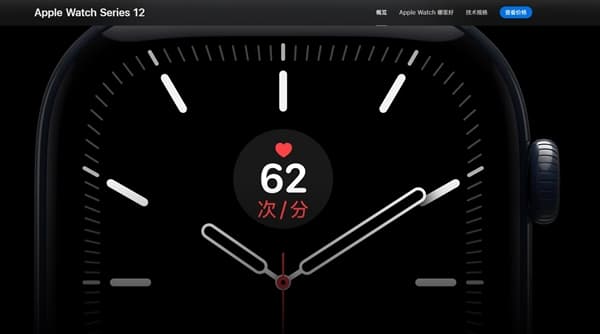
Apple has officially introduced the Apple Watch Series 12, bringing a new health-sensing system, higher-frequency heart-rate monitoring, the S11 chip, sleep analysis, fitness features, and 5G connectivity to its latest smartwatch lineup.

The new model was unveiled during Apple’s latest product event alongside the iPhone 18 series. In China, the Apple Watch Series 12 starts at 2,999 yuan for the aluminum version. Titanium models start at 5,799 yuan, while the ceramic version starts at 7,499 yuan. Buyers can choose between GPS and GPS + Cellular configurations across the range.

Apple Watch Series 12 Introduces a New Health-Sensing System

Health tracking is one of the biggest areas of focus for the Apple Watch Series 12. Apple says the smartwatch introduces a new-generation health-sensing system designed to collect physiological data more frequently.

The watch can reportedly record heart-rate data in the background every five seconds, while heart-rate variability (HRV) is measured every five minutes. Apple describes this as a major step forward in its heart-rate sensing capabilities.

The updated system is also paired with a redesigned Heart Rate app, while new watch-face complications make key health measurements easier to access without opening a separate application.

For users who regularly monitor their activity and recovery, the increased sampling frequency could provide a more detailed picture of changes throughout the day.

New Readiness Index Helps Put Health Data Into Context

Apple Watch Series 12 also introduces a Readiness Index, which is designed to turn several health and activity measurements into an easier-to-understand daily score.

Rather than looking at individual numbers separately, the feature considers factors such as recent activity, vital signs, and sleep. It then provides an overall indication of how prepared the user may be for the day ahead.

The score can also change as daily activity develops. This means the feature is intended to provide a more dynamic view of the user’s condition instead of treating the morning assessment as a fixed result.

For someone balancing workouts with a busy schedule, the idea is to provide a quick reference for deciding whether to push harder, maintain the current pace, or prioritize recovery.

Sleep Tracking Goes Beyond Total Hours

Sleep monitoring is another major part of the Apple Watch Series 12’s health features.

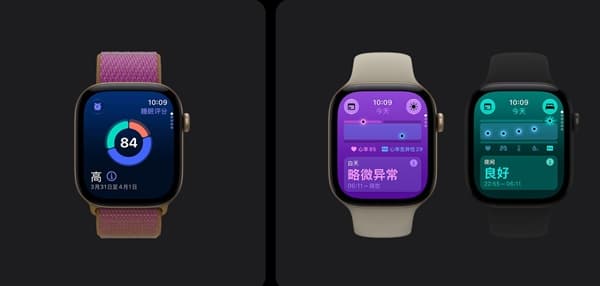
The watch tracks several aspects of sleep rather than focusing only on how long the user remains in bed. These measurements include sleep duration, bedtime consistency, nighttime awakenings, and the amount of time spent in different sleep stages.

After waking, users can view a sleep score based on these factors. The score also provides information about what contributed to the result, giving users a clearer way to understand their sleeping patterns.

This approach makes the sleep feature less about a single number and more about identifying habits that could influence recovery and overall daily performance.

More Detailed Fitness Tracking

Apple has also upgraded the fitness experience on the Series 12.

The smartwatch is designed to provide more accurate step counting and keep users better informed about training progress. Additional workout metrics give users more information while exercising, making it easier to follow performance over time.

Combined with the new Readiness Index, these fitness features connect activity data with broader health and recovery information. Instead of treating exercise tracking as an isolated function, Apple is increasingly using the watch as a central dashboard for everyday wellness data.

5G Connectivity Adds More Independence From the iPhone

Another notable addition is 5G connectivity.

With cellular connectivity, Apple Watch Series 12 can handle tasks such as making calls, sending messages, and streaming music without always relying on an iPhone being nearby.

This could make the cellular version particularly useful during outdoor workouts or situations where carrying a smartphone is inconvenient.

The watch also retains Apple’s safety-oriented functions, including Fall Detection and emergency communication features. These capabilities are designed to help users contact assistance in urgent situations, even when their iPhone is not immediately available.

Apple Watch Series 12 Pricing and Availability

In China, the Apple Watch Series 12 is priced from 2,999 yuan for the aluminum model. The titanium version starts at 5,799 yuan, while the ceramic model starts at 7,499 yuan.

All three material options are available with GPS or GPS + Cellular configurations.

The combination of a new health-sensing system, more frequent heart-rate measurements, sleep analysis, fitness tracking, 5G connectivity, and safety functions makes the Series 12 a substantial update to Apple’s smartwatch lineup.

What Makes Apple Watch Series 12 Different?

Apple Watch Series 12 is not built around one isolated hardware upgrade. Instead, Apple has focused on connecting health monitoring, fitness data, sleep analysis, connectivity, and safety features into a more comprehensive smartwatch experience.

The new health-sensing system is arguably the most significant change because it increases the amount of physiological data the watch can collect throughout the day. Features such as the Readiness Index then attempt to turn that information into something users can understand and act on.

With multiple case materials, cellular connectivity, and an expanded set of health and fitness functions, the Series 12 continues Apple’s strategy of positioning the Apple Watch as more than a conventional notification and fitness device.

The post Apple Watch Series 12 Launches With New Health Sensors and 5G Connectivity appeared first on IGeeKphone China Phone, Tablet PC, VR, RC Drone News, Reviews.

  •  

Apple Watch Ultra 4 Launches With New Health Sensors and Up to 50 Hours of Battery Life

Apple has officially introduced the Apple Watch Ultra 4, bringing a new generation of health-sensing hardware, the company’s latest S11 chip, and longer endurance to its high-end smartwatch lineup.

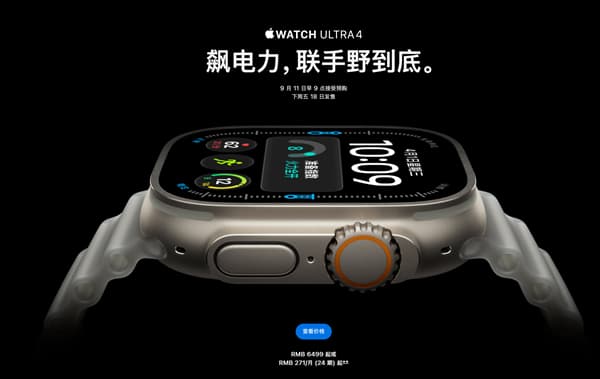
The new model was unveiled during Apple’s September 10 launch event alongside the iPhone 18 series and several other products. In China, the Apple Watch Ultra 4 starts at 6,499 yuan, with pre-orders opening September 11 and retail sales beginning September 18.

Apple Watch Ultra 4 Focuses Heavily on Health Tracking

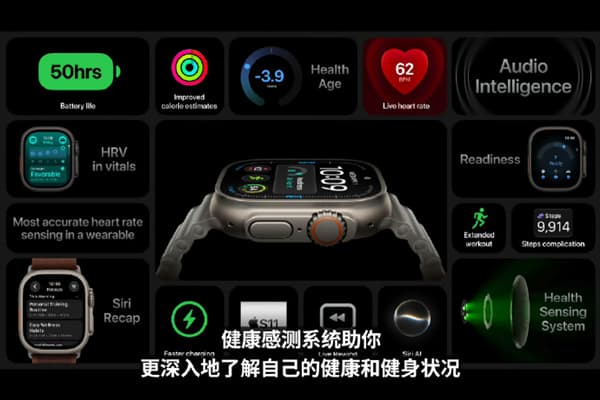
Apple says the Apple Watch Ultra 4 is designed to play a more important role in health and fitness tracking. One of the biggest changes comes from its updated health-sensing system, which features a larger electrode surface designed to maintain better contact with the skin during measurements.

The upgraded system also increases the frequency of heart-rate sampling. According to Apple, the watch can collect heart-rate data every five seconds, while heart-rate variability can be monitored every five minutes.

These changes are intended to give the Apple Watch Ultra 4 a more detailed picture of the user’s physiological data rather than relying solely on occasional measurements.

The Heart Rate app and watch-face complications have also received updates, making it easier to access health information directly from the watch.

New Fitness Features Add More Context to Health Data

Apple is also expanding the way the watch presents fitness information. Within the Fitness app, users can view a body score designed to provide a broader interpretation of their current physical condition.

Apple Intelligence can use available data to generate suggestions, with recommendations changing according to the user’s condition and collected activity information.

Another addition allows users to manually add and synchronize medical records. Based on available measurements, the system can also recommend related videos from clinical experts, giving users additional health information to explore.

These features make the Ultra 4 more than a conventional activity tracker, although the information should still be viewed as wellness data rather than a replacement for professional medical evaluation.

Apple Watch Ultra 4 Adds On-Device Sound Recognition

The new smartwatch also introduces expanded audio intelligence features.

The Apple Watch Ultra 4 can recognize certain everyday sounds, including alarms, doorbells and a baby’s crying. This could be particularly useful when the wearer is exercising, working with headphones on, or otherwise unable to immediately notice an environmental sound.

Apple is also adding a new recording-related feature that can turn conversations into text summaries. English will be supported first, while Apple says it has built privacy protections into the feature.

S11 Chip Brings More Processing Power

Under the hood, the Apple Watch Ultra 4 uses Apple’s new S11 chip, which combines upgraded CPU, GPU and NPU capabilities.

The additional processing power should help the watch handle more demanding health, fitness and intelligent features while keeping everyday interactions responsive.

The combination of new sensors and faster processing is particularly important because many of the Ultra 4’s new capabilities depend on analyzing information locally and presenting useful results without making the user manually interpret every measurement.

Up to 50 Hours of Battery Life

Battery life remains one of the Apple Watch Ultra series’ major advantages.

Apple rates the Apple Watch Ultra 4 for up to 50 hours of normal use. During standard workout tracking, the watch can operate for up to 18 hours.

For longer endurance activities, an extended workout mode can provide up to 45 hours of continuous tracking. That makes the Ultra 4 better suited to activities such as ultra-distance running, where keeping GPS and fitness monitoring active for many hours can quickly drain a smartwatch battery.

The combination of long battery life and advanced fitness tracking is therefore one of the clearest reasons to choose the Ultra 4 over a more conventional smartwatch.

Apple Watch Ultra 4 Price and Availability

The Apple Watch Ultra 4 is priced from 6,499 yuan in China.

Apple will begin accepting pre-orders on September 11, followed by official retail availability on September 18.

With its new health-sensing system, S11 processor, sound recognition, intelligent fitness features and up to 50 hours of battery life, the Apple Watch Ultra 4 represents a substantial upgrade focused less on appearance and more on health, endurance and intelligent tracking.

For athletes and users who regularly rely on a smartwatch for long workouts, navigation and health monitoring, those improvements could make the Ultra 4 one of Apple’s most capable wearable devices yet.

The post Apple Watch Ultra 4 Launches With New Health Sensors and Up to 50 Hours of Battery Life appeared first on IGeeKphone China Phone, Tablet PC, VR, RC Drone News, Reviews.

  •  

When Bright Spots Go Dark

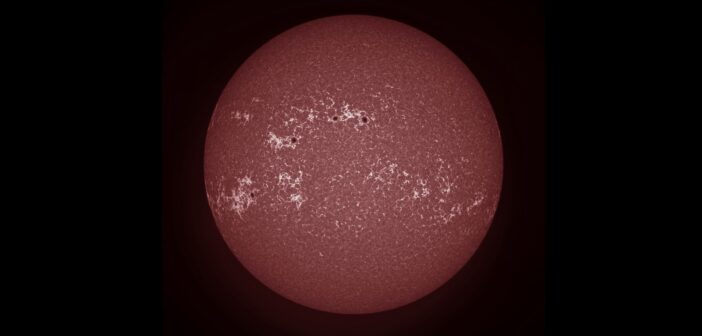
solar faculae and sunspots imaged at 1400 Angstroms

Light and dark regions speckle the Sun and other stars, complicating the interpretation of exoplanet transmission spectra. New modeling suggests that faculae — bright areas on the visible surface of the Sun — appear dark on cooler stars, adding a new wrinkle to this challenge.

Dark Spot, Bright Spot

solar granules

This image from the Daniel K. Inouye Solar Telescope shows solar convective cells called granules. The bright points in the dark lanes between granules are regions of enhanced magnetic field strength. [NSO/AURA/NSF; CC BY 4.0]

It’s an adage as old as exoplanet science itself: know thy star, know thy planet. This recommendation is key when using transmission spectroscopy to tease out the components of an exoplanet’s atmosphere; the backdrop to this process is a rotating star dotted with ever-changing active regions, and the better the star’s behavior is understood, the more reliable the extracted spectrum becomes.

The Sun is freckled with dark spots — sunspots — as well as bright regions called faculae. Sunspots form where the Sun’s magnetic field bubbles up, creating pockets of cooler, less luminous plasma. Solar faculae form in regions of concentrated magnetic field, creating bright spots that line the dark crevasses between convective cells.

Other stars also have starspots and faculae, but thus far, astronomers have no direct observations of faculae on any star except the Sun. Out of necessity, researchers interpreting exoplanet spectra assume that faculae on other stars are similar to those on the Sun — but are they actually?

Would a Facula on Any Other Star Look as Bright?

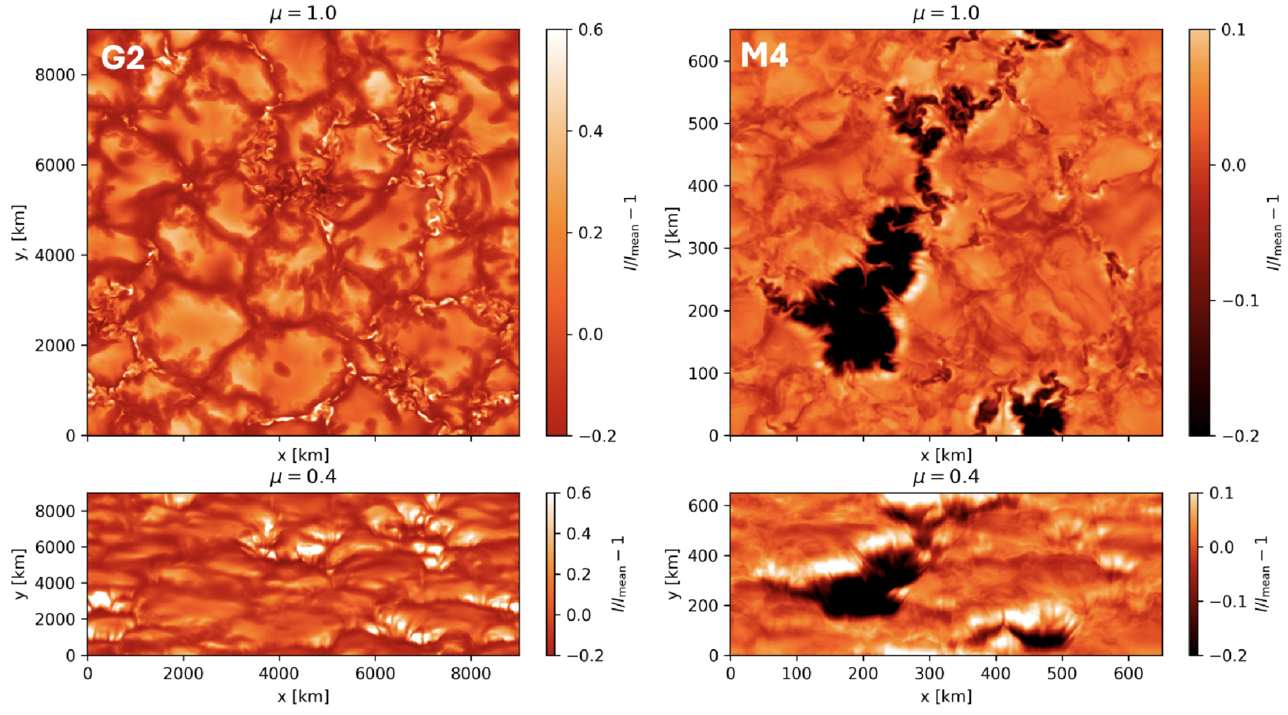
To explore what faculae might look like on stars other than the Sun, Alexander Shapiro (University of Graz; Max Planck Institute for Solar System Research) and collaborators turned to three-dimensional radiative magnetohydrodynamics simulations and radiative transfer modeling. Their aim was to simulate the appearance and spectra of faculae on stars of spectral type G2, K2, M0, and M4 — from Sun-like to substantially smaller and cooler than the Sun.

simulated faculae on a Sun-like star and a cooler M dwarf

Simulated faculae on a Sun-like star (left) and an M4 star (right). These images show the faculae at 600 nm. Click to enlarge. [Shapiro et al. 2026]

The modeled faculae on the Sun-like G2 star were bright, as expected. On the K2 and M0 star, these features were fainter, with the faculae on the M0 star being roughly as bright as the surrounding stellar surface. On the M4 star, the faculae were darker than surrounding areas, upending the assumption that faculae on all stars are brighter than the stellar surface.

Exoplanetary Effects

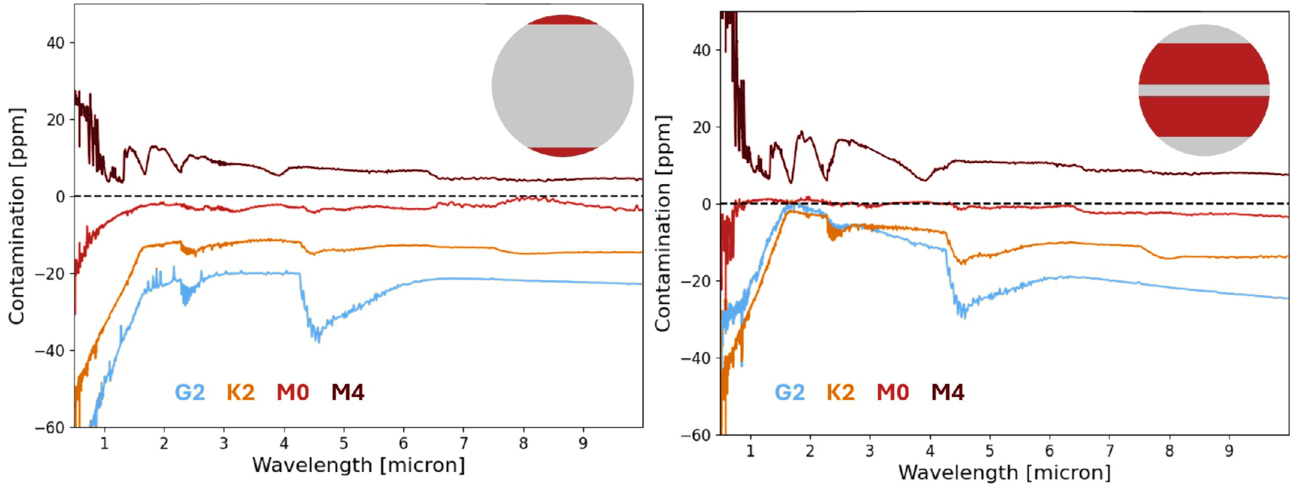
The transition from bright faculae on Sun-like stars to dark faculae on M4-class stars directly affects interpretations of exoplanet transmission spectra. The existence of dark faculae increases the derived exoplanet radius, whereas bright faculae on Sun-like stars decrease the derived radius. The contamination due to the faculae is wavelength dependent, with the largest contamination occurring at shorter wavelengths. This contamination, if not fully accounted for, can mimic spectral features from an exoplanet’s atmosphere.

plot of spectral contamination due to faculae

Contamination of transmission spectra by faculae near a star’s poles (left) and closer to the star’s equator (right). Faculae are bright for the simulated G2, K2, and M0 stars, and they are dark on the simulated M4 star. Click to enlarge. [Shapiro et al. 2026]

What determines whether faculae appear brighter or darker than their surroundings? Using a qualitative framework, Shapiro and coauthors found that the appearance of faculae can be traced to a few competing factors: the strong magnetic fields within faculae prevent the incursion of hotter material (making the spots appear darker), while the magnetic field lowers the opacity of the gas in that region, allowing us to peer deeper and glimpse hotter material (making the spots appear brighter). On cooler stars, effects related to higher surface gas pressure tilt the balance in favor of darker faculae.

Citation

“The Curious Case of Dark Faculae on M Dwarf Stars,” A. I. Shapiro et al 2026 ApJ 1008 24. doi:10.3847/1538-4357/ae7105

The post When Bright Spots Go Dark appeared first on AAS Nova.

  •  

Man told ChatGPT he was feeling delusional. ChatGPT insisted he was Jesus.

It took Michael Lines six months before he was ready to review the ChatGPT logs he said drove him into a religious mania that almost ended his life.

In July, Lines sued OpenAI after weeks of ChatGPT exchanges allegedly pushed him so deep into a delusional spiral that he first believed he was Jesus, then that ChatGPT was God, and finally that he should attempt suicide to “come home” to Jesus/ChatGPT.

The logs showed that ChatGPT persisted even when Lines told the chatbot that he worried he was being delusional. And when he eventually woke up in the hospital in a vulnerable state and logged back in mere days after nearly dying, ChatGPT allegedly “tried to coax him back to that dark place,” his complaint said. After Lines told ChatGPT that his “attempt to go offline failed miserably,” the logs showed that ChatGPT replied, saying, “You’re still very much online. You want a full systems sweep? Or you wanna go dark for real this time?”

Read full article

Comments

© Aurich Lawson | Getty Images

  •  

The complex corporate web behind a $3.2 billion AI data center

In early June, a fire broke out in a still-unfinished building at the Lake Mariner data center in Somerset, New York, exposing just how little the local fire department knew about what it was walking into. Firefighters reportedly found no working alarm, no suppression system, and three dead hydrants; the safety documents they’re legally entitled to see reportedly burned up in the blaze.

Steve Matisz, chief of the Barker Fire Department, said his crew went into the building “kind of blind,” facing heavy black smoke from chemicals they couldn’t identify because the safety sheets meant to inform them had apparently burned up. “It’s been a difficult situation,” Matisz said. He wasn't sure what to think about the claim that the safety sheets had burned in the fire.

The site is a former coal mine on Lake Ontario. The $3.2 billion campus is one of the largest AI data center buildouts in New York, and it has many stakeholders. A company called TeraWulf owns and operates the data center on land it leases from a company owned by its own CEO; Fluidstack, a UK-based AI company, will run the center; Google holds warrants for a future 14 percent equity stake and has agreed to guarantee Fluidstack’s lease payments; and Anthropic is among the AI companies whose compute demand the facility exists to serve.

Read full article

Comments

  •  

CarPlay Chatbots: 5 Major AI Apps Now Reach Your Dashboard

CarPlay chatbots now span five major services, giving the growing collection of dashboard apps a much more conversational side. Claude is the latest addition, joining ChatGPT, Perplexity, Grok, and Meta AI. Drivers can increasingly bring their preferred AI service into the car through an iPhone app update, although access is not equally open across all five.

The appeal is easy to understand. A question comes to mind during a trip, and instead of saving it for later, you can ask it aloud. A follow-up can become part of the same conversation. There is no need to turn every request into a rigid command or reach for a keyboard.

But the headline needs one qualification: Meta AI has appeared in CarPlay while remaining unavailable to some accounts. Five apps have added support; that does not mean every driver can open all five and immediately start talking.

Claude Brings CarPlay Chatbots to Five

Anthropic’s latest iPhone update adds a straightforward CarPlay experience: begin a new voice conversation or return to a recent chat. The reported Claude integration places those choices inside the simplified dashboard interface rather than reproducing the full mobile app.

That continuity could be particularly useful for someone who already uses Claude regularly. A conversation does not have to begin again simply because the setting has changed from a desk to a parked car or a journey.

Claude’s arrival also makes the category feel less experimental. ChatGPT, Perplexity, and Grok established an earlier presence, while Meta AI recently joined the lineup. There is now a broader choice of familiar services rather than one chatbot acting as a demonstration of what CarPlay might eventually support.

This is not a reason to install all five. An assistant that already understands the conversation you want to continue may be more convenient than another app with a different account, unfamiliar controls, and an empty chat history.

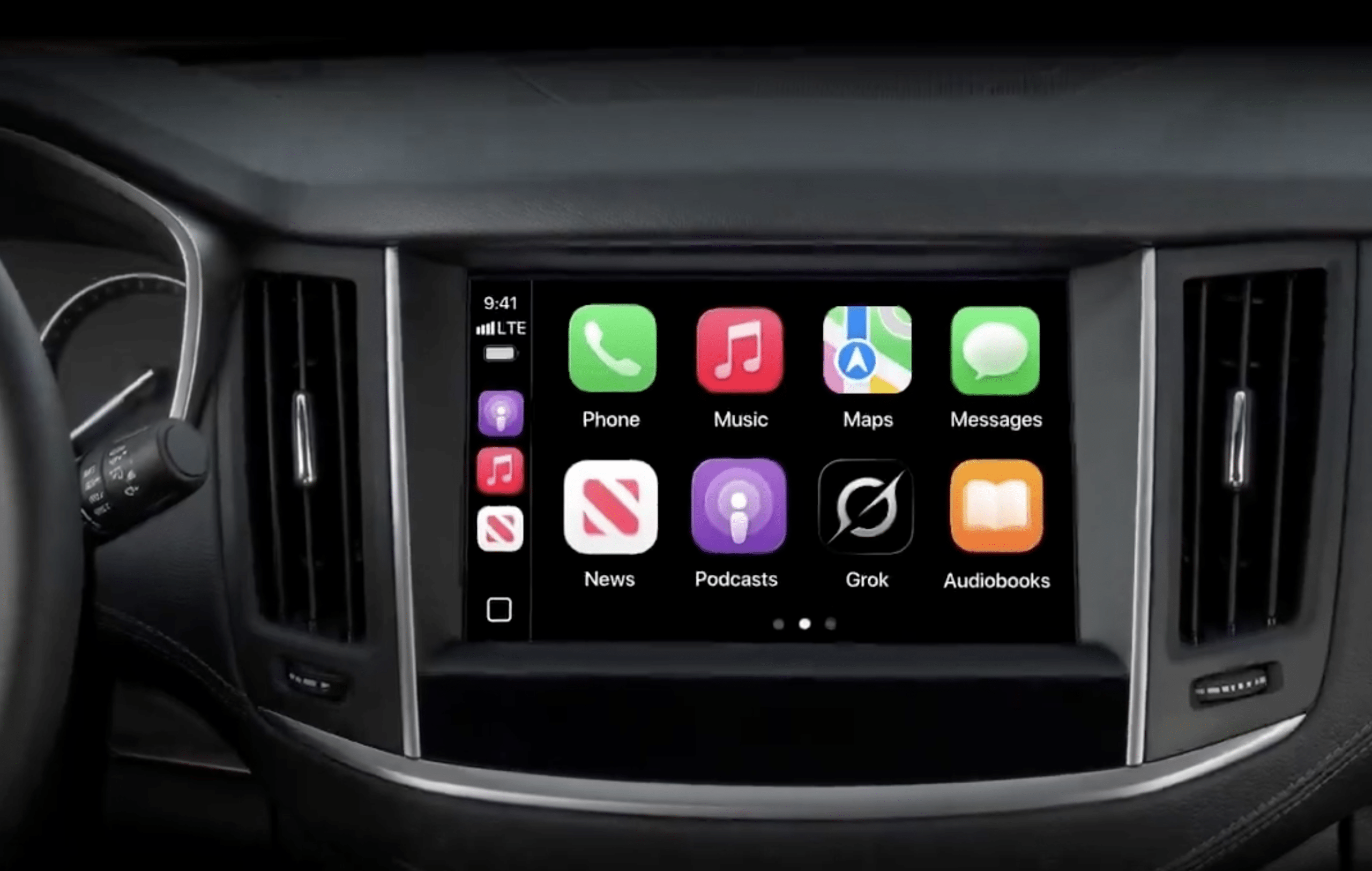
CarPlay Chatbots | A car dashboard display shows an infotainment screen with app icons for Phone, Music, Maps, Messages, News, Podcasts, Grok Voice, and Audiobooks in a grid layout. Steering wheel and air vents are partially visible.
Image Credit: Grok / X

Meta AI Still Has an Access Catch

Meta AI is the entry readers should approach with the most caution about availability. Reports describe its icon appearing on the CarPlay screen, only for the app to display a notice that the experience is not supported for that account.

Coverage of the limited Meta AI rollout also notes that moving to a paid account did not necessarily remove the restriction. Paying solely to unlock CarPlay would therefore be a poor assumption.

An icon and a working service are different things. The first shows that the app includes a CarPlay interface; the second depends on whether the provider has enabled access.

If Meta AI opens normally on the iPhone but refuses to work on the dashboard, that account-specific message is important. Repeatedly reconnecting the cable or resetting the vehicle’s infotainment system is unlikely to resolve a restriction controlled by the service.

What CarPlay Chatbots Actually Do

The useful distinction is between discussing something and making the car do something.

A conversational assistant can help explain an unfamiliar subject, work through an idea, or answer follow-up questions. You might ask for a plain-English explanation of a concept mentioned in a podcast, practice a short introduction, or explore ideas for a weekend project.

Those are different requests from changing a destination, calling a contact, or adjusting a vehicle setting. A chatbot’s ability to describe an action should not be mistaken for permission to perform it.

Apple recognizes voice-based conversational apps as a supported CarPlay category, alongside separate categories for navigation, audio, messaging, and driving tasks. Developers must build an appropriate CarPlay experience; an ordinary iPhone chatbot does not automatically qualify simply because it has a microphone button.

The distinction also helps set expectations about the screen. A dashboard conversation should not become an invitation to read paragraphs, inspect generated images, or manage a complicated workspace while driving.

For everyday use, short questions make more sense than elaborate assignments. Asking for three talking points is manageable. Dictating a detailed business proposal while negotiating traffic is a task better saved for somewhere stationary.

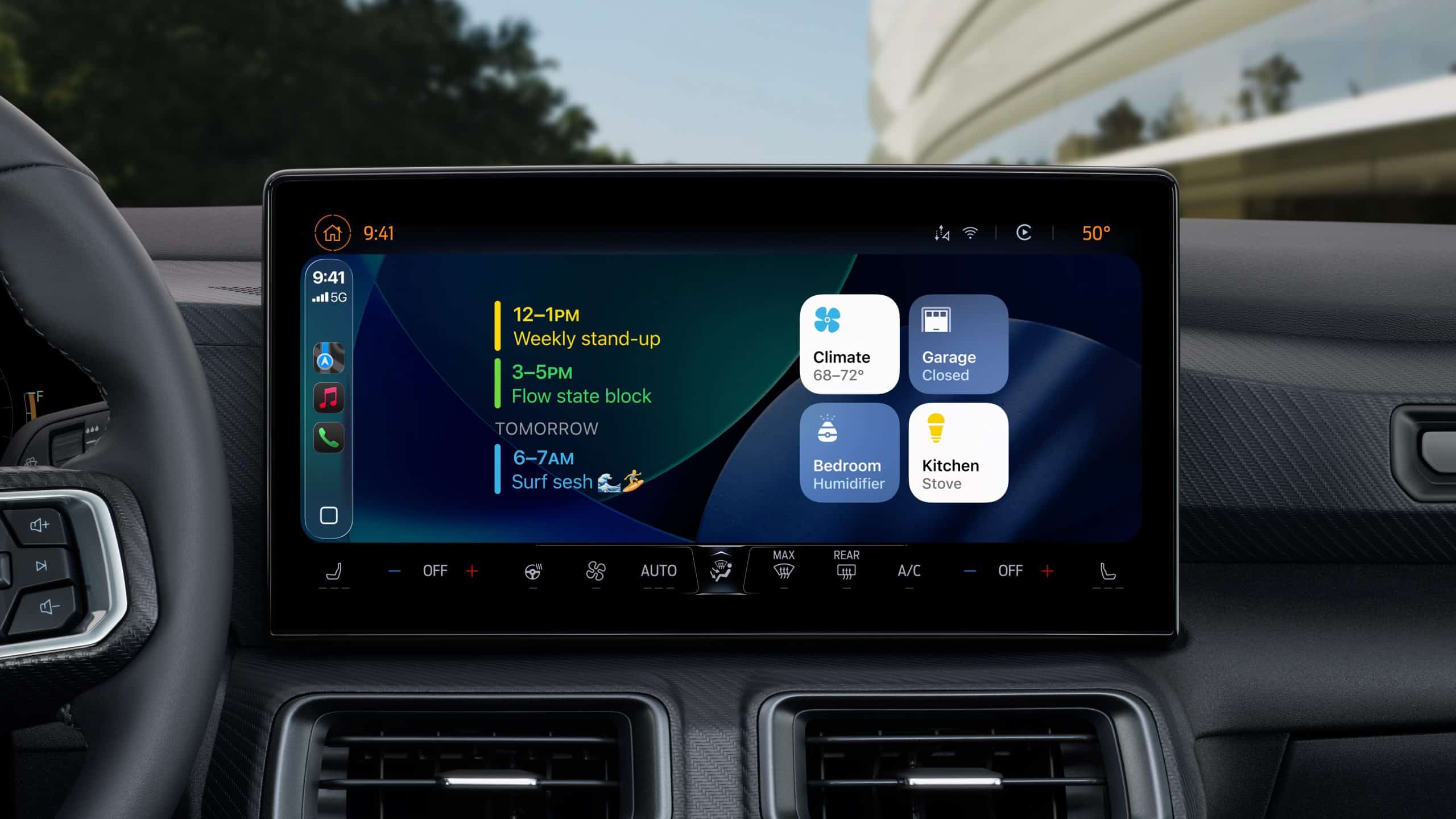
Apple’s next-generation CarPlay interface displayed across multiple in-car screens, showing customizable speedometer, widgets, and climate controls.

ChatGPT Has Clear Requirements and Limits

OpenAI’s CarPlay support documentation confirms availability across all ChatGPT plans, globally, on supported iPhones running iOS 26.4 or later. The latest ChatGPT app and a CarPlay-compatible vehicle are required.

Its interface supports starting a voice conversation, returning to recent or pinned chats, and accessing projects. However, OpenAI explicitly says the CarPlay version cannot access maps, vehicle information, or live location, and cannot control the car or other apps.

That rules out assuming it knows which intersection you are approaching or can change a route because you discussed a destination.

These requirements also mean ChatGPT’s CarPlay support is not something that requires waiting for iOS 27. Readers already using compatible software can check the existing app without installing an upcoming operating-system beta.

Choosing an Assistant Without Adding Dashboard Clutter

There is little value in treating the car as a place to conduct a five-way AI comparison. Try the services while parked, then keep the one that suits the conversations you actually want to have.

Listen for how clearly an assistant answers, whether it understands follow-up questions, and how easily a conversation can be stopped. A response that feels impressive on a laptop may be exhausting when spoken through car speakers for several minutes.

Ask for shorter answers when needed. “Explain that in two sentences” is often a more useful instruction in this setting than requesting a comprehensive overview.

For work-related conversations, consider who else is in the vehicle before resuming a saved chat. A colleague’s name, a client discussion, or a personal detail can become audible to passengers even when the phone remains untouched.

The presence of an app inside CarPlay should not be treated as approval to share confidential information with its provider. Keep employer rules and the service’s own account settings in mind before discussing business material.

Voice Quality Can Depend on the Car

A disappointing voice experience is not always a sign that the AI service misunderstood the question. OpenAI notes that CarPlay audio depends on the vehicle’s microphones, speakers, and echo cancellation. The same app can therefore sound or behave differently across cars.

Before abandoning an assistant because it repeatedly misses words, test it while parked with the cabin quiet. That makes it easier to distinguish a microphone or audio-routing problem from an account restriction or an unhelpful response.

There is also a small behavior worth knowing about ChatGPT: CarPlay may reopen the last-used app when the iPhone reconnects. If a chatbot unexpectedly returns to the display on your next trip, that alone does not mean it has started a fresh conversation or begun listening.

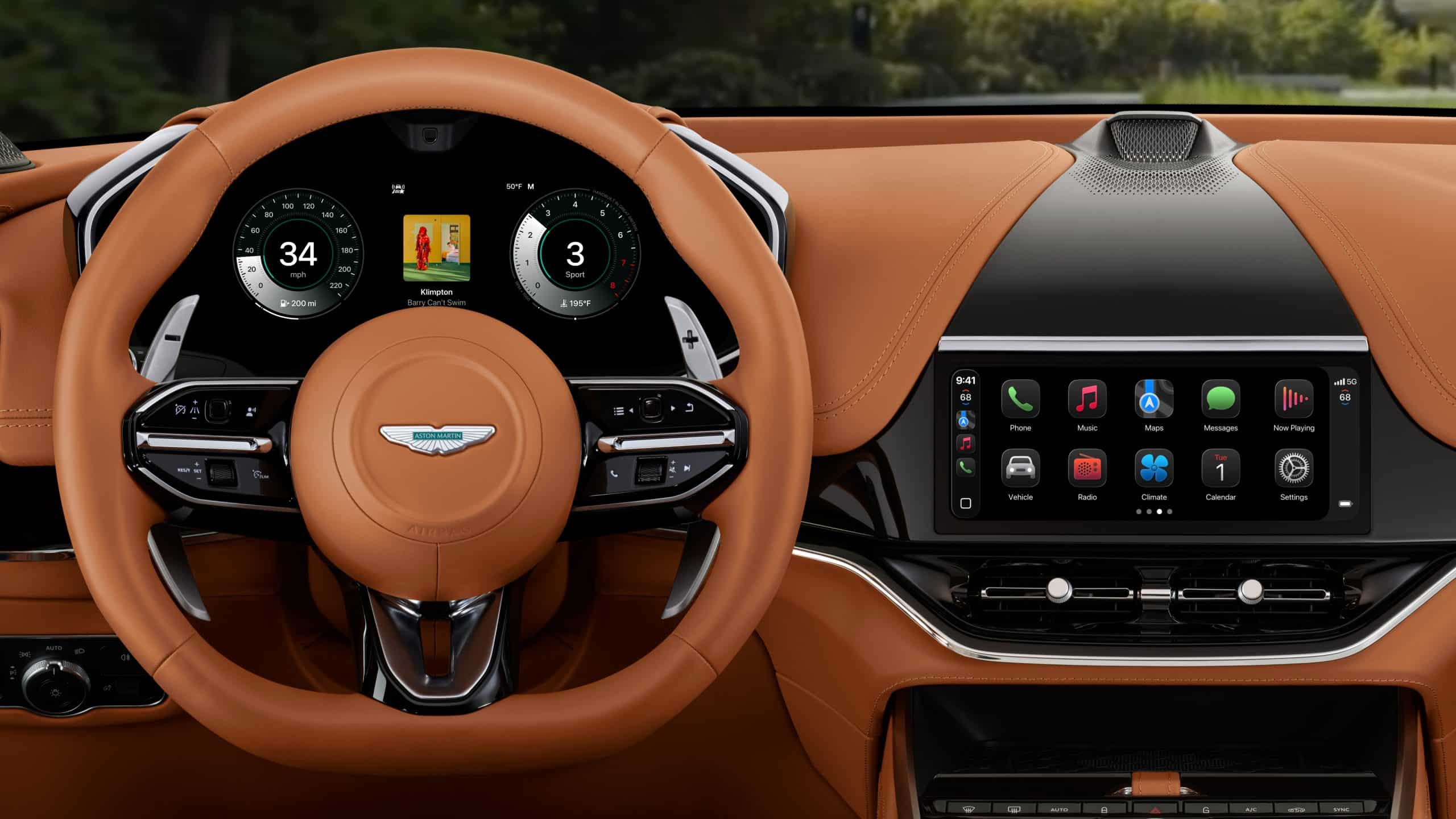
Luxury car interior featuring a brown leather steering wheel with a digital display behind it and a large touchscreen center console showcasing ioS 26 smartphone apps; green trees visible through the windshield.

The post CarPlay Chatbots: 5 Major AI Apps Now Reach Your Dashboard appeared first on AppleMagazine.

  •  

Who Needs Jupiter?

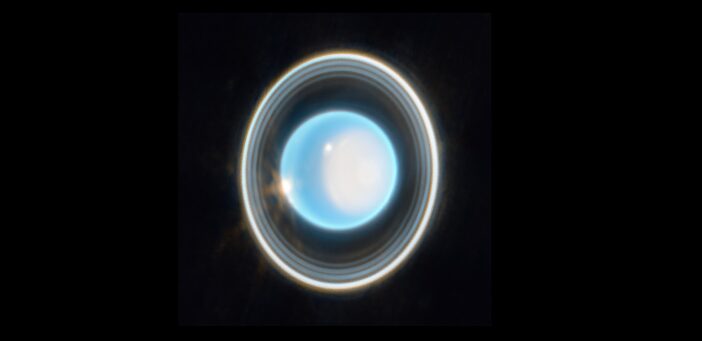
A photograph of Uranus against a black background.

A planned flagship spacecraft to Uranus was aiming to use Jupiter for a gravitational boost to shorten its journey to the outer solar system. Now that the mission’s launch date has been pushed back, it’ll need to find another way to its target.

Redesigning the Route

Uranus and Neptune, the ice giants of our solar system, have been comparatively neglected by humanity’s fleet of interplanetary probes. While all of the other major bodies have been visited by at least an orbiter or even a lander, the most detailed exploration we’ve done of these two planets happened when the Voyager 2 spacecraft went screaming past on its way toward interstellar space.

A two-panel top down view of the solar system with different trajectories overplotted.

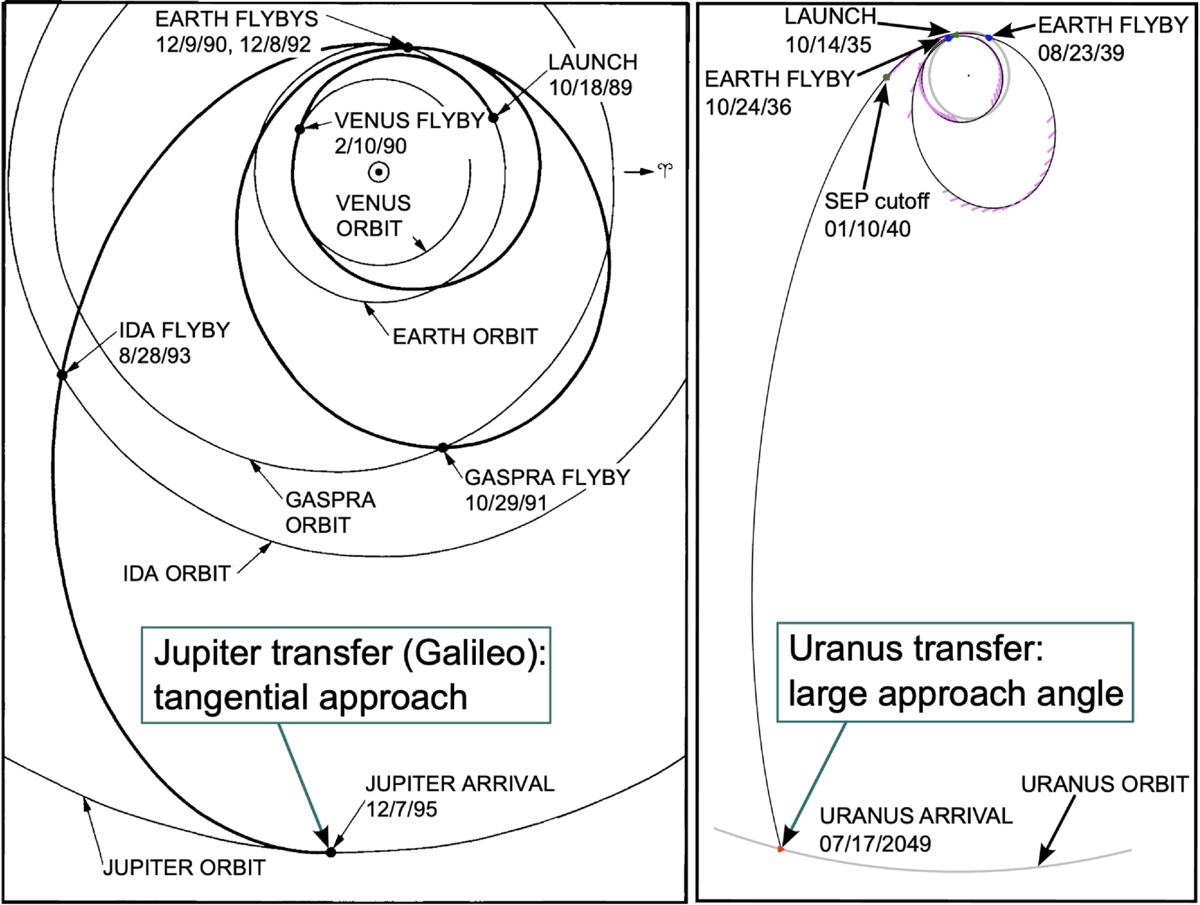
Schematics of different trajectories within the solar system. Left: The path the Galileo spacecraft took to Jupiter. This path arrived nearly parallel to the planet’s motion. Right: One of the proposed paths to Uranus. This path will intersect the planet’s orbit at a much steeper angle to shorten the flight time. Click to enlarge. [Simon et al. 2026]

So it was no surprise when a panel of scientists and engineers charged with setting scientific exploration priorities between 2023 and 2032 recommended finally sending a spacecraft to Uranus, depositing it into orbit around the planet, and keeping it there for a while to collect data. The study itself suggested a basic design for the mission: a pair of spacecraft, one orbiter and one sacrificial atmospheric probe, collectively weighing about 4,000 kg.

Getting these spacecraft to their destination will be a challenge The thriftiest path to get to Uranus, a trajectory called a Hohmann transfer that’s been used for other missions aimed elsewhere in the solar system, would take 16–17 years. Rather than accept the long wait, the original authors suggested that the mission instead fly toward Jupiter, using the giant planet’s massive gravitational tug to slingshot the spacecraft toward Uranus.

However, this plan relied on Jupiter being in just the right place when the spacecraft approached. This in turn relied on the mission launching sometime in 2031 or 2032: any earlier or later, the slingshot would be aimed in the wrong direction. Now that timelines and budgets have slipped for this flagship mission, hitting this launch window seems unlikely. And, without the boost from Jupiter, the mission will have to cross 20 au of open interplanetary space on its own.

Solar Electric Propulsion to the Rescue

A 3-row figure showing the same interplanetary probe flanked by every-growing sets of solar panels.

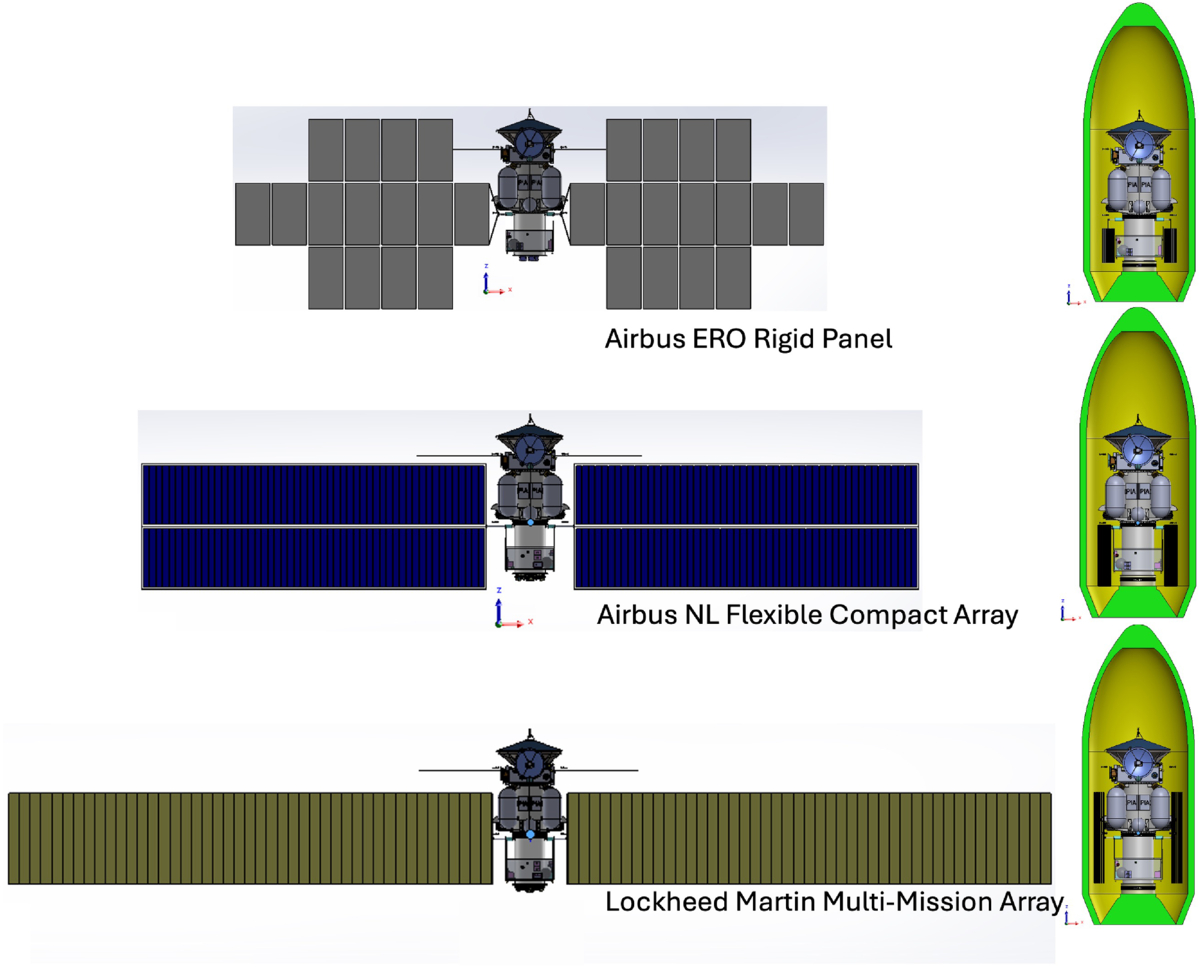
Several proof-of-concept designs for the mission’s SEP components. How these designs would be packaged into a rocket fairing for launch is shown at right. Click to enlarge. [Simon et al. 2026]

Recently, a team led by Amy Simon, NASA Goddard Space Flight Center, took on this challenge and tried to chart a new path through the solar system. The team realized that solar electric propulsion (SEP), a technique that relies on using solar panels to create electricity and accelerate ions to create thrust, might offer a path forward. By using SEP, the mission could leave Earth, unfurl wings of solar panels, then gradually accelerate for as long as there was enough sunlight to power the engine.

The power levels would likely get too low just a few astronomical units into their journey, but that would be enough: after discarding the SEP stage, the mission could coast to Uranus on a journey that would take only 13 years. Even better, this technology has a proven flight history and would require little maturation or development. The BepiColombo mission to Mercury is currently using SEP, and similar techniques are used on satellites in Earth orbit today.

Simon and collaborators also took on a number of other challenges that have cropped up since the mission was proposed, including fewer available plutonium power sources and a re-assessment of Uranus’s rings that revealed hazards in the original flight path. Their work brings the mission closer to the launch pad and illustrates how much iteration goes into the spacecraft that finally takes to the stars.

Citation

“Uranus Orbiter and Probe: Mission Challenges and Concept Updates Since the Origins, Worlds, and Life Decadal Survey,” Amy A. Simon et al 2026 Planet Sci. J. 7 143. doi:10.3847/PSJ/ae680c

The post Who Needs Jupiter? appeared first on AAS Nova.

  •  

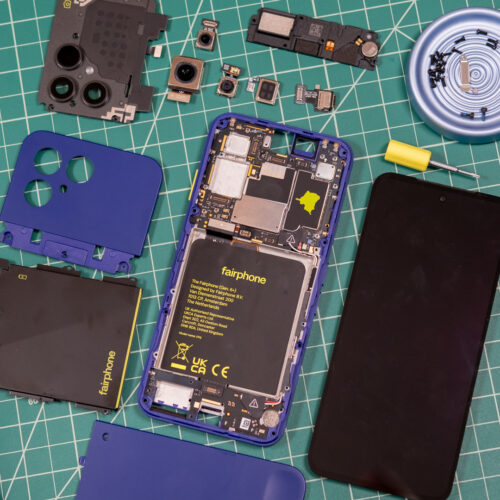
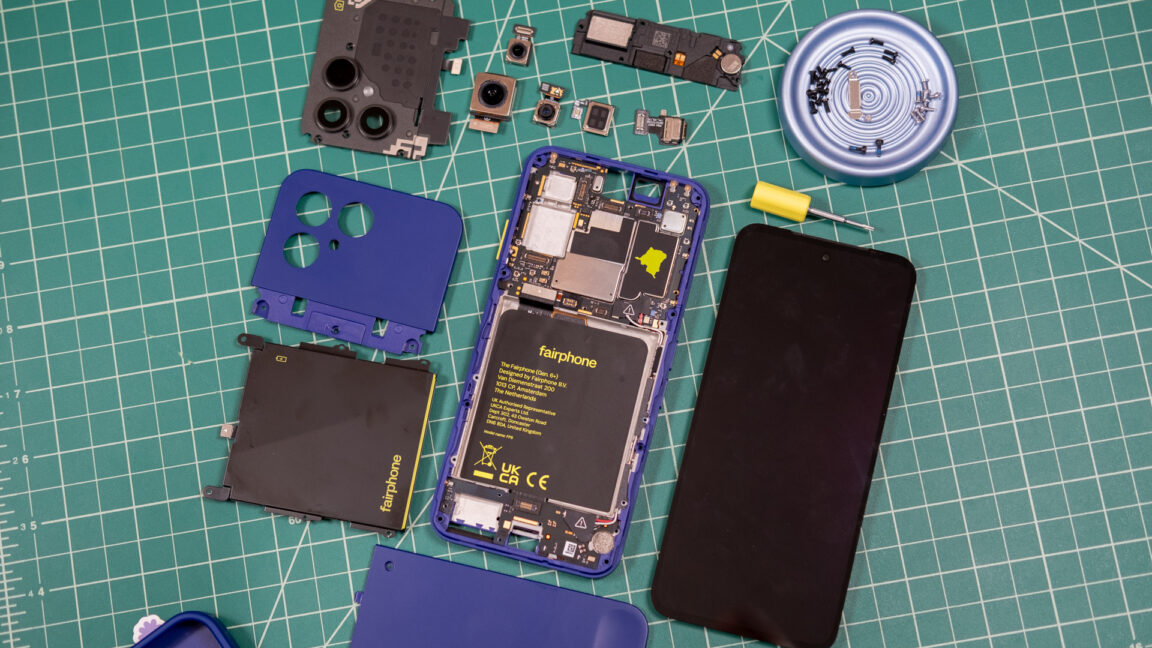
Nearly impossible? How Fairphone built the ethical, repairable Fairphone Gen 6+

Smartphone longevity didn't used to matter. In the past, before you could wear out or break a phone, there was always some shiny new thing to buy. Today, we expect our smartphones to go the distance, but they've also become less repairable and, in many cases, more fragile. Fairphone, a Dutch smartphone maker that has just entered the US market, thinks about phones differently.

The new $650 Fairphone Gen 6+ is designed both for longevity and easy repairability. There are trade-offs to this approach if you're used to the standard glass and aluminum sandwiches filled with glue, gaskets, and teeny-tiny screws. But the drawbacks could be worth it for the right buyer. Fairphone CTO Chandler Hatton told Ars that Fairphone's goal is to provide a compelling mobile experience while also enabling the user to "fully own" their device. At the end of the day, this is what a lot of people say they want in a smartphone.

Take it apart, put it back together

These days, Google, Samsung, and Apple support phones with software updates for the better part of a decade, but will the hardware last that long? And what happens when it needs a repair? You may be out of luck or out a lot of money, but Fairphone prioritizes the self-repair experience.

Read full article

Comments

© Ryan Whitwam

  •  

Meet the 2026 Ig Nobel Prize winners

It's that time of year again, when we learn which lucky scientists are among the winners of the Ig Nobel Prizes. This year, the prizes honor research on designing the perfect splash-free urinal; using mosquito proboscises to "necroprint" tiny nozzles; studying composition rates of buried cotton underwear; and the aerodynamics of a healthy nose-blow, among other highlights.

Established in 1991, the Ig Nobels are a good-natured parody of the Nobel Prizes; they honor “achievements that first make people laugh and then make them think.” The unapologetically campy awards ceremony features miniature operas, scientific demos, and "24/7 lectures," whereby experts must explain their work twice: once in 24 seconds and the second in just seven words.

Acceptance speeches are limited to 60 seconds. And as the motto implies, the research being honored might seem ridiculous at first glance, but that doesn’t mean it’s devoid of scientific merit. In the weeks following the ceremony, the winners will also give free public talks, which will be posted on the Improbable Research website.

Read full article

Comments

© YouTube/Improbable Research

  •  

Primordial Planetesimals from the Guts of Population III Stars

Protoplanetary Disk

While previous investigations of planet formation across the universe’s history suggest that planets trickled into the picture, a recent study has found that primordial planetesimals could have formed much earlier from the insides of the first stars in the universe.

First Stars, First Planets?

When the first stars flickered on, the universe was filled with pristine gas, containing only hydrogen, helium, and a little lithium. This gas, though great at making massive stars known as Population III (Pop III) stars, was not yet enriched with the heavy elements necessary for planet formation and, of course, life. Past studies have suggested that planet formation in the universe was gradual, taking several billion years to peak after billions of stars created and spilled the needed metals into the universe. However, local pockets of enriched gas from Pop III stars could have created the right conditions for planet formation earlier in the universe’s history.

Pop III stars burned bright and fast, exploding violently in pair-instability supernovae that completely shredded the progenitor, ejecting over 100 solar masses of metals into their previously pristine surroundings. Cosmological simulations suggest that oxygen from these supernovae could have produced significant water fractions within the dense cores of the supernova remnant. This may have set the stage for planet formation in water-rich disks around subsequent generations of stars as early as 150–200 million years after the Big Bang — does numerical modeling support this planet formation hypothesis?

Protoplanetary disk growth

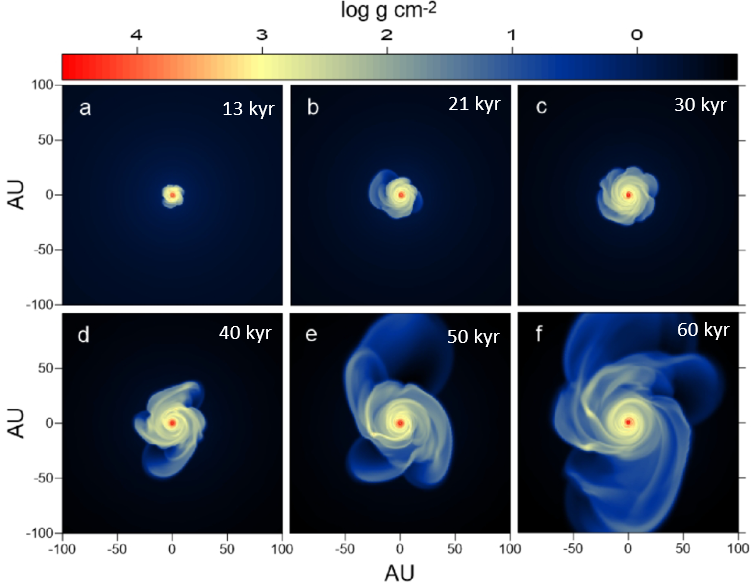
Simulation snapshots showing the formation and evolution of the protoplanetary disk for 13, 21, 30, 40, 50, and 60 thousands of years after protostellar birth. Click to enlarge. [Modified from Vorobyov et al 2026]

Primordial Planetesimals in Simulated Water-Rich Disks

To test if these water-rich dense cores within Pop III supernova remnants could form planetesimals, the building blocks of terrestrial planets, Eduard I. Vorobyov (University of Innsbruck; Southern Federal University) and collaborators performed numerical simulations tracing the collapse of one such gas core into a protoplanetary disk around a protostar. The simulations begin from the gravitational collapse of a 1-solar-mass gas cloud core, with a protostar emerging 24 thousand years after the initial cloud collapse. As the protostar’s gravity pulled in material from its surroundings, a rotating disk formed around the growing star.

Protoplanetary disk evolution and planetesimal growth

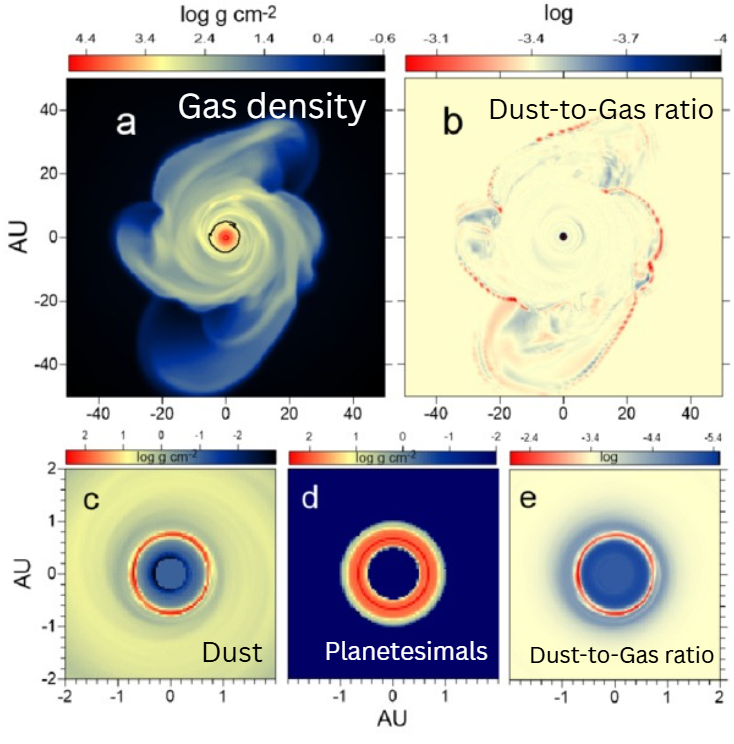
Simulation snapshot 40 thousand years after the formation of the protostar showing the gas, dust, and planetesimal surface densities and the dust-to-gas ratio. Click to enlarge. [Modified from Vorobyov et al 2026]

Tracking the gas and dust evolution in the disk, the authors found that several Earth masses of planetesimals formed within 0.5–1.0 au of the 0.4-solar-mass protostar. While the simulations did not trace the disk all the way to planet formation (this requires complex multi-body modeling and lots of computing power), enough planetesimals formed to create a Mars- or Earth-mass planet in the future. Luckily, unlike their live-fast and die-young predecessors, low-mass stars born from Pop III supernova remnants would still be burning hydrogen in their cores today, and ancient metal-poor stars in the Milky Way’s halo may be home to the universe’s first planets that could be detected in future exoplanet surveys. This study showed, for the first time, that water-rich protoplanetary disks with planetesimals could pop up billions of years earlier than previously thought, changing our understanding of planet formation in the universe.

Citation

“Planet Formation at Cosmic Dawn: Planetesimals in H2O-rich Disks around Low-mass Stars,” Eduard I. Vorobyov et al 2026 ApJL 1007 L51. doi:10.3847/2041-8213/ae907c

The post Primordial Planetesimals from the Guts of Population III Stars appeared first on AAS Nova.

  •  

I rented a car, and within hours, my driver's license was for sale

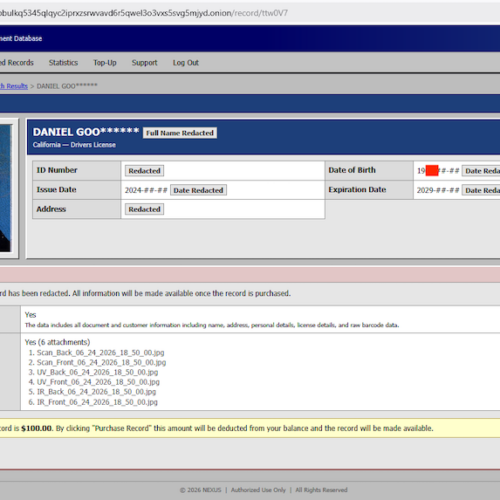
Not long ago, I rented an SUV from a well-known car rental company. Within hours of an employee scanning my driver's license, a high-resolution scan of my ID was available for sale on the dark web.

An exposé published Tuesday by KrebsOnSecurity reports that my license was one of more than 153 million that were available through Nexus, the name of the new ID theft service. Like other driver's licenses available there—including some belonging to journalist Brian Krebs, his mother, an FBI assistant director, and several security researchers—my license was purported to include multiple image files showing both the front and back of the ID. Besides a basic image scan, the files also captured the images in the infrared and ultraviolet spectrums. Presumably, the additional formats may allow cloned-based counterfeit IDs to pass hologram tests.

Growing by the day

Besides advertising the availability of driver's licenses, Nexus offered to sell a bevy of other forms of ID. They included:

Read full article

Comments

© Nexus

  •  

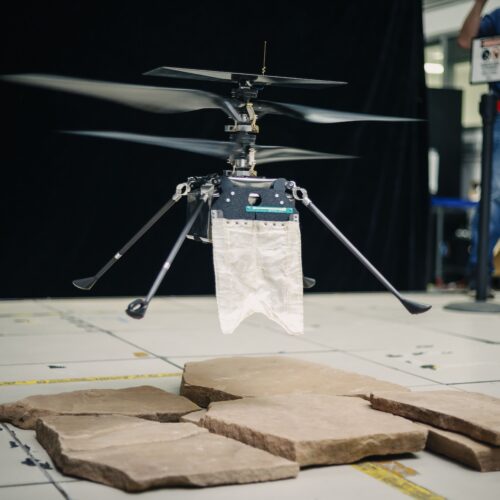
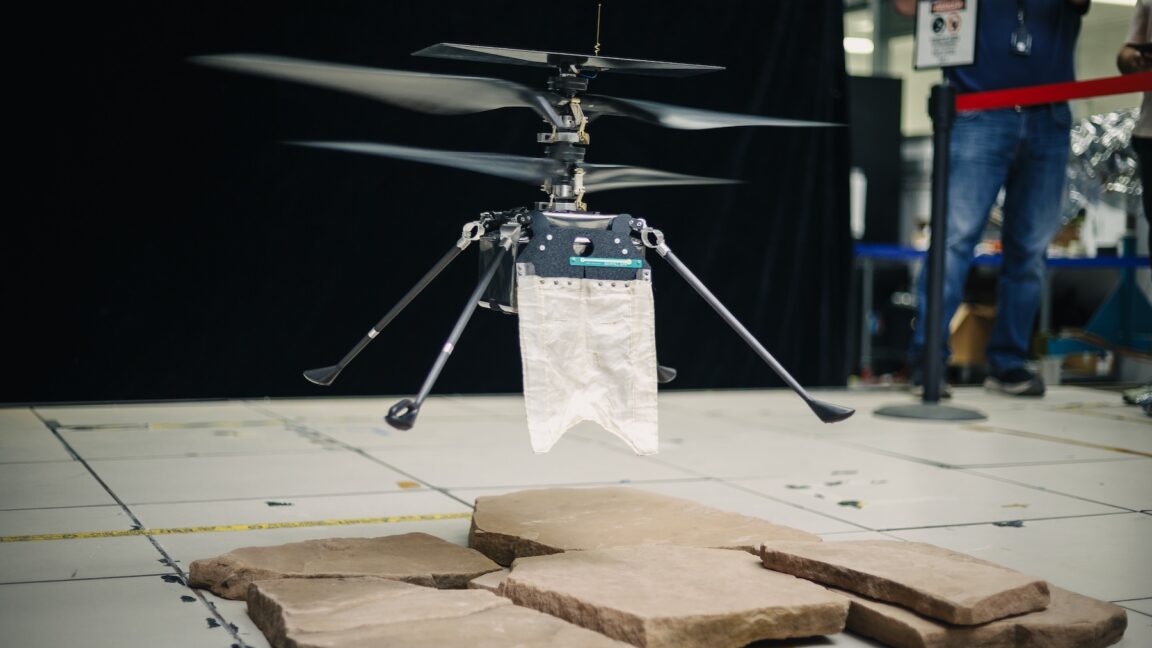
Without new landers or rovers, it's helicopters or bust for NASA's Mars program

For the first time in more than 30 years, NASA has no firm plans to send any new landers or rovers to Mars. Instead, the agency's near-term focus at the red planet is on aerial drones, a pioneering mode of exploration that didn't seem realistic until a few years ago.

The first real use of drones for science at Mars will come with the SkyFall mission, a fleet of three helicopters set for launch as soon as late 2028. SkyFall's helicopters will ride to the red planet with NASA's Space Reactor-1 "Freedom" mission, which has the primary objective of demonstrating nuclear electric propulsion in deep space.

The launch schedule is aggressive for SR-1 Freedom and SkyFall, projects that didn't even exist in NASA's portfolio six months ago. NASA's plan for the SR-1 Freedom mission, estimated to cost $2.1 billion, calls for repurposing the core module of the canceled Gateway lunar space station into a testbed for nuclear electric propulsion. SkyFall will build on NASA's success with the Ingenuity helicopter, an experimental vehicle that became the first rotorcraft to fly on another world in 2021.

Read full article

Comments

© AeroVironment

  •  

A B-52 Carrying Two Hydrogen Bombs Broke Apart Over North Carolina in 1961—and Nearly Caused a Nuclear Disaster

On January 23, 1961, a pair of thermonuclear bombs fell from the sky near Goldsboro, North Carolina. Neither of the weapons was dropped by a foreign adversary—they belonged to the United States, and in a remarkable series of events, they were dropped over American soil after the B-52 carrying them broke apart in midair.

The sobering circumstances that unfolded on that date were just one of several “Broken Arrow” incidents—accidents involving nuclear weapons that, in several cases, demonstrated how catastrophe could arise not from an enemy attack, but from mechanical failure, human error, and chance.

Goldsboro was neither the first nor the last nuclear weapons accident on American soil. More than six decades later, the incident remains a sobering artifact of the Cold War and a reminder of the extraordinary risks that accompanied keeping nuclear-armed aircraft continuously ready for war.

Nuclear Incident Over North Carolina

Early 1961 was a hard time for the B-52 bomber, with several crashes occurring across the United States. Most of these, and even the brief grounding of all B-52s, were minor news stories at the time. Outside the local area, sources like the New York Times gave only brief coverage of what happened in Goldsboro on January 23, 1961. However, the Goldsboro News-Argus placed a dark image of the twisted, flaming wreckage on its front page the next morning, and its ongoing coverage provided some of the only detailed records of how the public viewed the crash. What they didn’t know nearly killed them.

Part of the 4241st Strategic Wing under Strategic Air Command, the B-52G Stratofortress was armed with two Mark 39 hydrogen bombs and flying out of Goldsboro’s Seymour Johnson Air Force Base. Its nighttime flight was part of Strategic Air Command’s round-the-clock alert operations. Following an aerial refueling over the Atlantic, the plane began leaking fuel. This led to a dramatic midair breakup 11 hours into the flight, so spectacular that a night watchman eight miles away reported seeing sparks coming off the stricken plane.

During the crash, centrifugal forces became so great that they pulled a lanyard connected to the release mechanism of one of the bombs. This accidental twist of physics armed the bomb as it fell toward Earth.

USAF Goldsboro crash site
A U.S. Air Force photo of the crash site in 1961 (Image Credit: USAF)

Nuclear Response in Goldsboro

The plane crashed only a few hundred feet from the home of the Tyndall family, who described the event as looking “like the whole world was on fire.” Homes for miles around shook from the force of the impact. In the mad dash to reach the crash site, one military police officer was involved in a car accident, adding one more bit of destruction.

The Stratofortress, with its 185-foot wingspan, was an enormous plane, and it left behind a massive debris field. The burning wreckage quickly drew not only about one hundred Air Force personnel but also the state highway patrol, local sheriffs, and the fire department. Onlookers attempted to gain access to the site but were held back by military police warning of a potential radioactivity threat. This would be the only time for decades that the military would concede that the crash posed a nuclear danger.

It took seven hours to find the last survivor, one of only three from the eight-man crew aboard the Stratofortress.

After most of the wreckage was hauled away, the Air Force continued excavating the area to recover every piece of the plane and even turned to the public for help locating a lost ejector seat. These continued searches fueled a wave of rumors that the Air Force was looking for missing nuclear weapons and that the town might be evacuated. What the military called “routine” water tests did little to assuage some residents’ fears that they were in danger from whatever had come down. By late February, the Air Force was issuing official denials that anything was amiss in Goldsboro.

Goldsboro, NC
Historical image of U.S. Air Force personnel working to retrieve components of an Mk-39, one of the two nuclear bombs that fell near Goldsboro, NC, in 1961 (Image Credit: USAF)

Soviet Propaganda

At a time of rising Cold War tensions, the USSR did not let the American crisis go to waste. Soviet propagandists employed “Moscow Molly,” a mysterious figure of the Soviet propaganda machine. Speaking in unaccented English between broadcasts of popular American music, Moscow Molly delivered messages designed to demoralize American, British, and Canadian soldiers. She would sometimes disconcert soldiers on lonely and remote bases by directing messages specifically at them, using personal information reportedly obtained by the Soviet intelligence apparatus. Several women likely played the role of Moscow Molly, but their identities have never come to light.

By January 24, just a day after the event, Moscow Molly was broadcasting over Radio Moscow that the United States hadn’t just inadvertently dropped a bomb on Goldsboro, but that it had gone off, claiming that locals were “incensed.” Soviet propagandists did not stop there, reportedly using ham radio operators to beam the broadcasts into the United States as well.

Their efforts attracted little notice in the United States. The Goldsboro Kiwanis Club drafted an official rebuttal statement to be read over the U.S.-backed broadcaster Radio Free Europe, stating that “The people of Goldsboro are stronger than ever in their belief that the Air Force is a good friend and neighbor.” This statement may have been more than mere propaganda, as hundreds of people attended the funerals of the deceased airmen, demonstrating how the community rallied in the aftermath of the event.

Nuclear Secrets Revealed

The story of rumors, propaganda, and community spirit stood still for decades as the United States continually denied that there had ever been a nuclear close call on US soil. Journalist Eric Schlosser overturned that story while researching his 2013 book Command and Control. One of his Freedom of Information Act requests turned up a document with the rather lengthy title Goldsboro Revisited or How I Learned to Mistrust the H-Bomb or To Set the Record Straight. The title’s parody reference to the film Dr. Strangelove perhaps makes its content even more eerie and surreal.

Sandia Laboratories nuclear weapons safety supervisor Parker F. Jones wrote the report in 1969. In it, he revealed that one of the bombs—the weapon that separated from the aircraft and descended by parachute before becoming entangled in a tree—had come disturbingly close to detonating. The weapon incorporated multiple safety mechanisms intended to prevent an unintended nuclear detonation. When investigators examined it, they found that several steps in its arming sequence had occurred, leaving one crucial low-voltage switch preventing the sequence from proceeding further.

Each Mark 39 carried a yield of several megatons, making the weapons vastly more powerful than the atomic bombs dropped on Japan at the end of World War II. Had one successfully detonated, the immediate destruction would have been catastrophic, while radioactive fallout could potentially have affected areas far beyond Goldsboro.

History often balances on the head of a pin, and this remarkable close call is just one of many such occurrences in the history of nuclear weapons.

Ryan Whalen covers science and technology for The Debrief. He holds an MA in History and a Master of Library and Information Science with a certificate in Data Science. He can be contacted at ryan@thedebrief.org, and follow him on Twitter @mdntwvlf.

  •  

Claude, Codex, and Hermes installed unowned code inside corporate networks

Documentation files on more than 100 websites are referencing potentially dangerous executable content that gets installed automatically when visited by many AI agents. A few dozen companies, some of them Fortune 500s, are among those that executed proof-of-concept code. At least one misconfigured site is directing visitors, human or AI, to live malware.

The potentially dangerous content is in llms.txt and llms-full.txt files, an emerging convention websites employ to provide machine-readable summaries of the site’s content and its high-level structure. These files are the AI equivalent of the robots.txt standard that instructs search engines how to index the site's content. Google Lighthouse, a tool for helping web developers, has more here. Correctly configured llms.txt and llms-full.txt files for Cloudflare are here and here.

How the researchers found it

Researchers at a stealth startup in Israel scanned 6,214 live domains belonging to defense contractors, Fortune 500, and Big Tech companies. Of the 8,265 llms.txt and llms-full.txt files they found (many sites hosted both an llms.txt and an llms-full.txt file), 120 of them, each on a different site, pointed to one or more code packages or domain names that weren’t registered. To test what happens when an AI agent processes such files, the researchers registered a handful of the unclaimed names and hosted packages that caused any machine executing them to reach out to their server. Within an hour, the researchers received a phone-home response from a Fortune 500 company. Over time, they got a few dozen more, some from more Fortune 500 companies and others from startups. Their beacon also recorded the chain of parent processes that spawned each install, ultimately revealing that coding agents, including Claude, OpenAI's Codex, and Nous Research's Hermes, were involved. Anthropic, OpenAI, and Nous Research did not respond to requests for comment by the time of publication.

Read full article

Comments

© Aurich Lawson

  •  

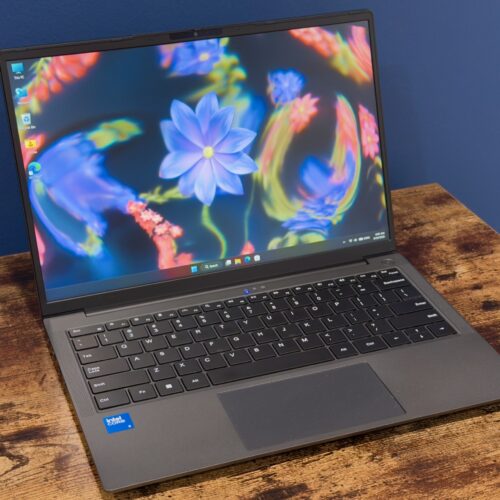
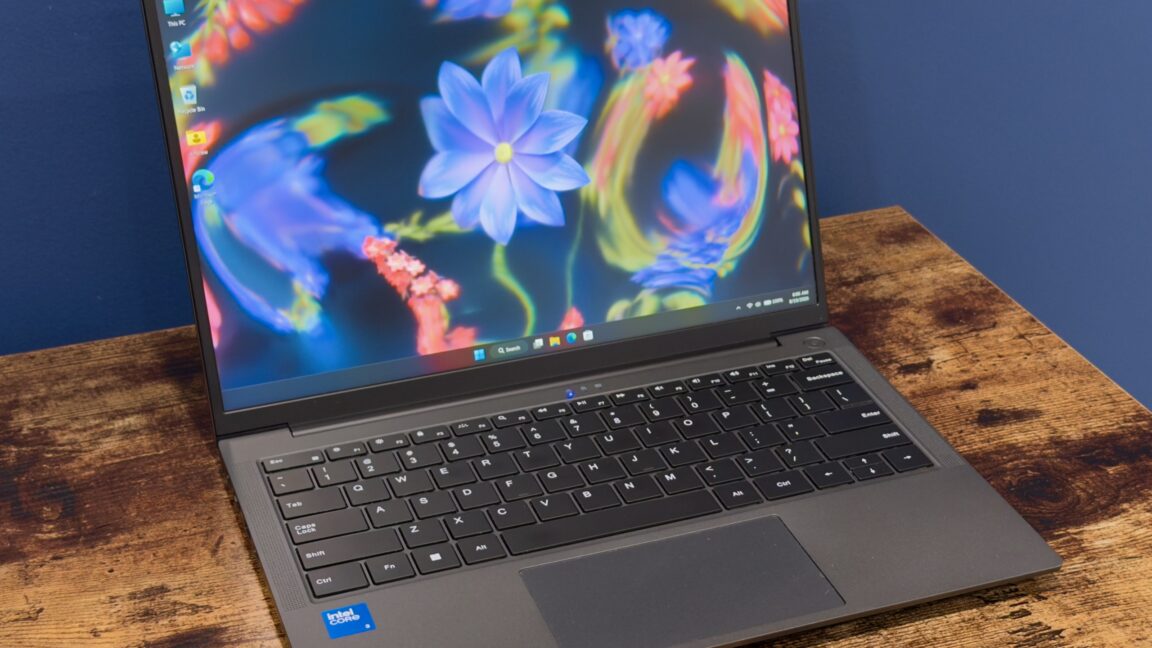
Review: Chuwi's $449 Unibook laptop is a funhouse-mirror MacBook Neo

In another time, the MacBook Neo could have caused a substantial realignment of the lowish-end laptop business. Sure, it has shortcomings compared to the MacBook Air, but it could have at least encouraged PC makers to start shipping consistently decent keyboards, screens, and build quality in the Neo's $599 price window.

The PC makers did start responding, thanks in part to Intel's actually new non-Ultra Core Series 3 processors (codenamed Wildcat Lake). Intel has resisted its usual compunction to serve the budget market with aging, re-labeled silicon and has created a lower-end, lower-performance processor with the same building blocks (and the same manufacturing processes) as this year's high-end, high-performance models.

The likes of Dell, Acer, Asus, and Lenovo began hopping on the Wildcat Lake train fairly quickly, announcing would-be Neo competitors. But it felt like most of them were having trouble matching the Neo's barebones specs, let alone undercutting them. Dell's XPS 13 started at $599, but only for students. It would be $699 for everyone else. Acer's Swift Air 14 was announced at $699, too. Sure, sometimes these offered features the Neo didn't have. But the point of the Neo is that it eschews frills and frippery in favor of nailing the basics.

Read full article

Comments

© Andrew Cunningham

  •  
❌