L’intelligence artificielle ne se contente plus d’assister les hackers, elle leur permet désormais d’automatiser une grande partie de leurs attaques. Une évolution qui change profondément le rapport de force entre cybercriminels et défenseurs, et qui pourrait rendre les méthodes de protection...
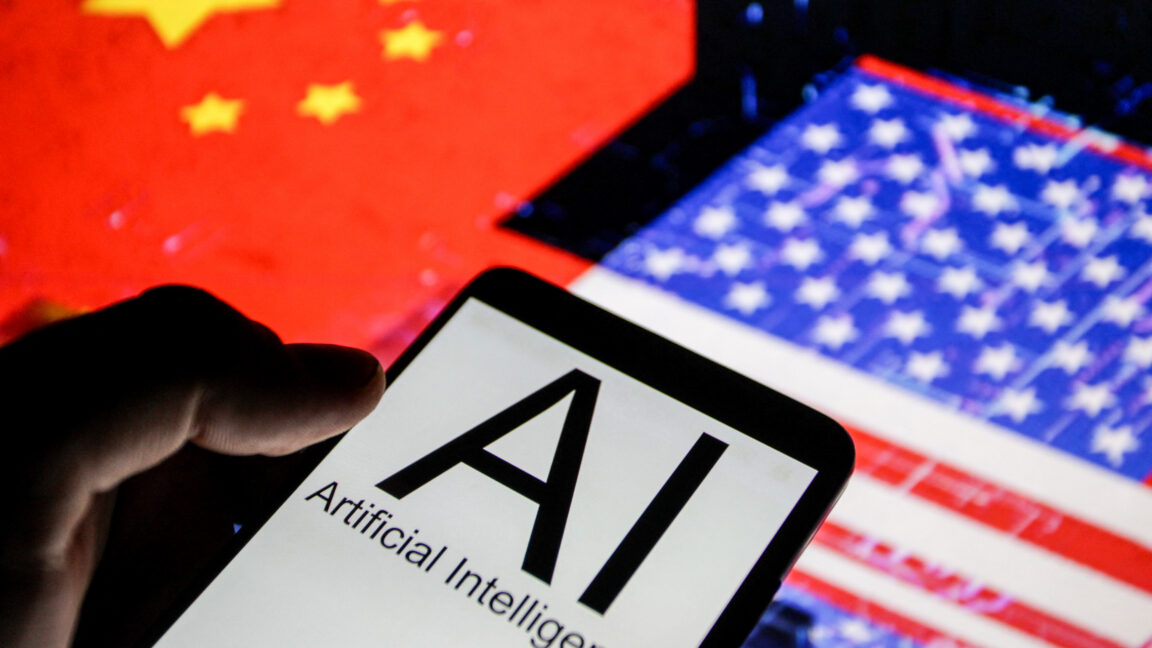
The performance gap between frontier AI models from US tech companies and the best open-weights models from Chinese companies has closed to just 4.4 months, according to a Mozilla report. That explains why many companies are shifting to the significantly cheaper open models for routine work—and helps reveal a narrow band of workloads where frontier models are worth the cost.
Most organizations should ideally be using open models as the default for the majority of their work, according to the latest State of Open Source AI report from Mozilla, published on September 15 and shared with Ars prior to publication. The report highlights how a leading open model, Moonshot AI’s Kimi K3, achieves a composite AI performance score on the Artificial Analysis Intelligence Index that is just three points behind Anthropic’s Fable 5 closed frontier model, all while costing just 30 percent of the latter.
“[A Closed model] earns its premium in a few places: expert professional work, high-intensity retrieval, and long context,” Raffi Krikorian, chief technology officer at Mozilla, said in an email to Ars. “We see the decision to pay for closed [models] as workload-specific rather than organization-specific.”
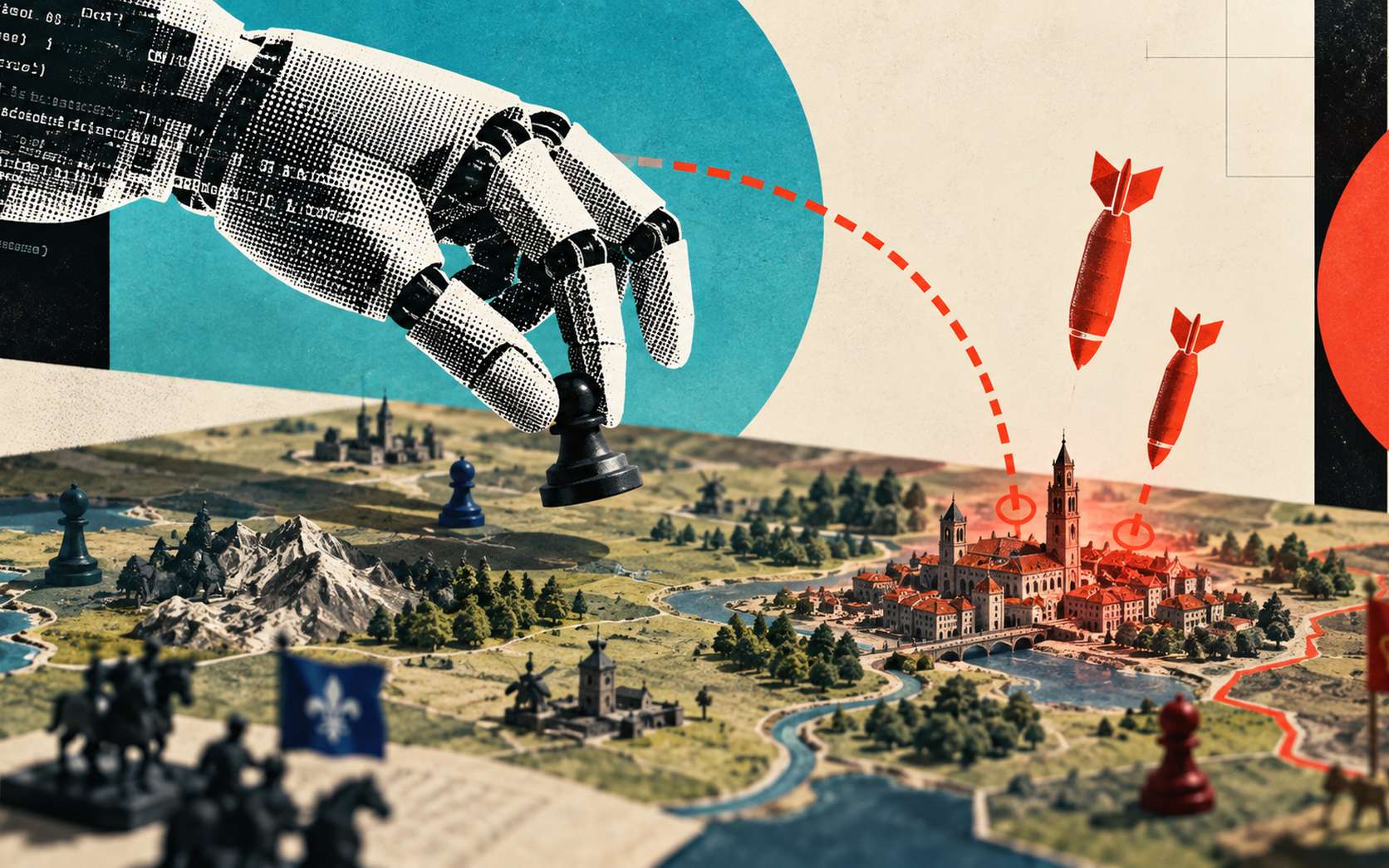
Le jeu vidéo pourrait bien devenir un terrain d’essai privilégié pour les agents d’IA. Des chercheurs britanniques ont justement imaginé un test qui les confronte à une partie de Civilization VI, où ils doivent planifier leurs actions sur plusieurs centaines de tours. Les résultats mettent en...
Our conversation with Adam Engst continues with an exploration of how AI can help non-programmers build sophisticated software by following professional development practices. Adam explains using specifications, architecture documents, and AI-guided decisions to create reliable apps, then examines the approach his app, SetShot, takes to macOS settings, privacy, security, user feedback, Cloudflare, GitHub, and minimizing sensitive data collection.
Adam Engst looks back at HyperCard as an early tool that democratized software creation, then connects its legacy to today’s AI-assisted development. He outlines how Claude helped turn an idea for tracking macOS setting changes into a working Mac app, SetShot. Adam discusses Xcode, GitHub, rapid iteration, and the value of visual feedback in his development process, and how AI lowers programming barriers without eliminating the need for thought, judgment, and effort.
Meta AI listed them like a shopping list. Everdene. Virelune. Narrowbeck. Fitchwold. Brimsel. Yestrave. Mibbelth. Varkhoon. Cassivane. Turnbold. Wumbral. Mawthorn.…
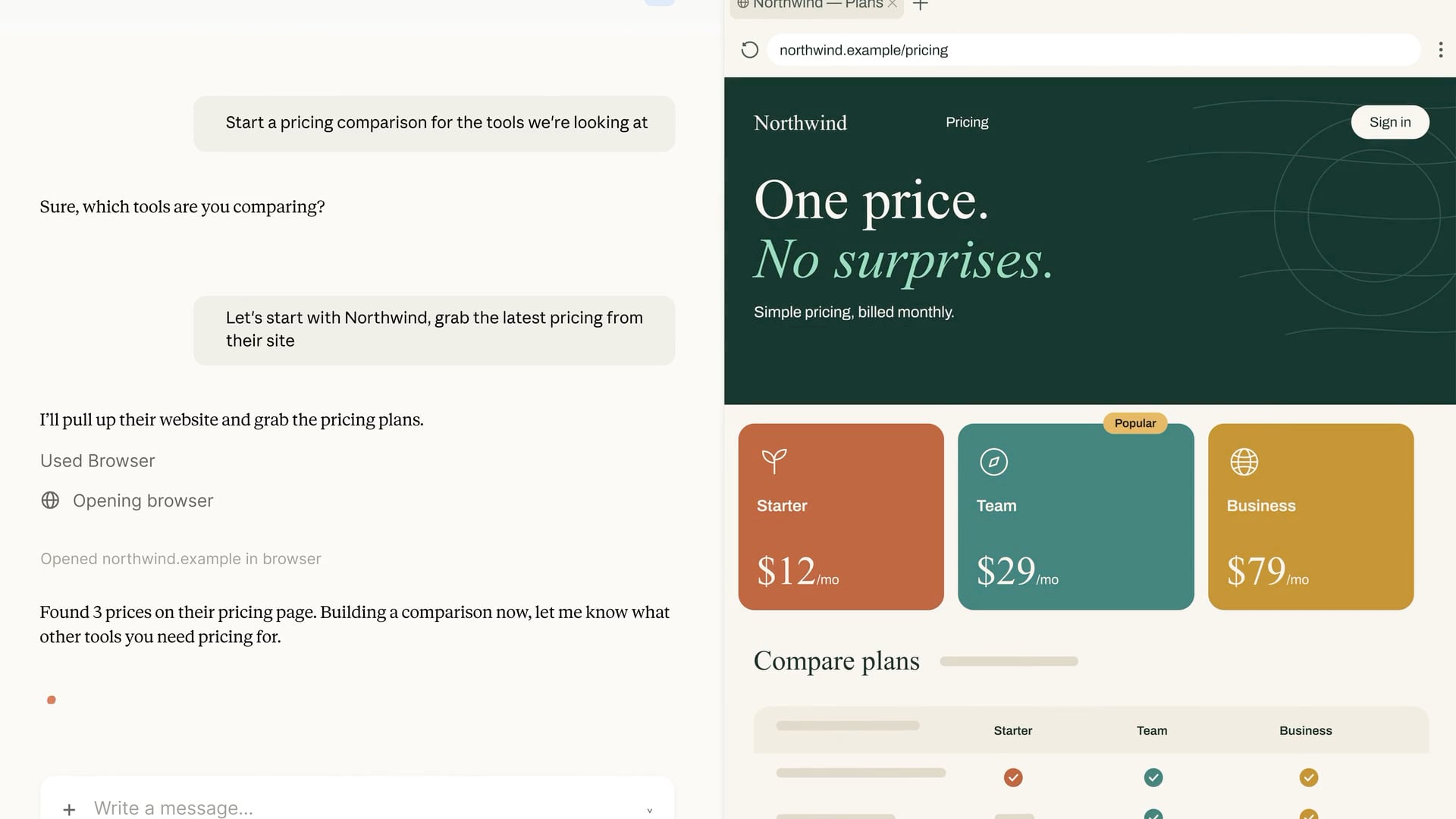
Hot on the heels of OpenAI’s addition of a cloud-based browser to ChatGPT Work, Anthropic has added an in-app browser to Claude Cowork in its desktop app. What’s interesting about the two browser implementations is that while both ChatGPT Work and Claude Cowork are meant to be used for general knowledge work, Claude Cowork’s browser is something of a hybrid that mixes aspects of OpenAI’s Codex built-in browser with its ChatGPT Work cloud-based browser.
First of all, I do not yet have access to Claude’s in-app browser, so the following is based solely on Anthropic’s announcement and other documentation. Still, the differences are worth understanding since the tools are aimed at different workflows.
Like Codex’s in-app browser, Claude Cowork’s in-app browser is built into the desktop app itself. That ties Claude’s browser to the instance of its app running on your Mac. Turn your Mac off or close the Claude app, and the browser becomes unavailable. Leave the Claude app running, and you’ll be able to control the browser session remotely through the Claude mobile app or the web.
From there, however, the browsers diverge. As you’d expect, the Codex implementation is developer-oriented, with tools to build, inspect, and annotate web pages along with access to a terminal, repos, and diffs. In contrast, Claude Cowork’s in-app browser opens automatically as needed for general-purpose web tasks instead of development tasks.
Also, while both ChatGPT Work’s and Claude Cowork’s browser implementations benefit from being isolated from your other day-to-day browser use outside those apps, their handling of login credentials is a little different. As I wrote in greater detail yesterday, ChatGPT separates the login process from the model’s activity and evaluates the login page for things like phishing schemes. Claude Cowork’s in-app browser offers two ways to log in: manually, or by importing cookies from logged-in sessions in another browser. Currently, Claude supports cookie imports on the Mac from Chrome, Edge, and Firefox, but not Safari. In addition to the security benefits that come with a browser that runs isolated from your everyday browser, Claude also requests permission before acting on a site for the first time, blocks high-risk sites, checks actions against the your requests, and uses the same prompt injection protections as its Chrome extension.
My first-run experience with ChatGPT Work’s cloud browser was a mixed bag but showed promise. Although I haven’t tried Claude Cowork’s browser yet, I’m glad to see Anthropic moving in the same direction as OpenAI here. Isolating agent browsing by bringing the browser into Claude and ChatGPT doesn’t solve every security issue, but it’s a good starting point. I expect we’ll see both Anthropic and OpenAI iterate quickly on this theme in the coming months.
Anthropic will embed watermarks in the text and files generated by future models it launches in the EU, as part of its effort to comply with content and transparency rules in the bloc’s AI Act.
[…]
The move may further amplify the appeal of open weight models and alienate Claude customers, who don’t necessarily want consumers of their AI-generated content to know its provenance.
[…]
Anthropic itself is already hedging about the utility of its marking method, noting that detected marks are not conclusive evidence that Claude produced the content and that the absence of marks cannot guarantee that AI wasn’t involved in the creation of a particular piece of content.
Claude models launched in the EU on or after August 2, 2026 will support machine-readable marking at launch. Generated text will carry embedded watermarks, and generated files will include digitally signed provenance metadata where supported.
[…]
Marks will apply to output from supported Claude models across Claude Platform (API), Claude, Claude Code, Claude Cowork, and Claude Tag, and wherever Claude is offered, worldwide. Some platforms or features may not support certain marking types.
[…]
We’ll support users and other third parties to detect Claude’s marks, as the Code requires, and we’ll share details in forthcoming documentation.
Anthropic is claiming this is for compliance with an EU law but that “Marking will apply to output from supported models wherever Claude is offered, worldwide.”
This is infuriatingly opaque. I won’t speak to the “signed provenance metadata” they say they’ll be embedding in generated files like PDFs, SVGs, PNGs, and JPEGs. That’s important but it’s complex. Plain text is simple. A string of text is just one character followed by another. I presume that Claude is going to start “embedding” invisible characters/byte sequences between visible characters? What they’re claiming to do here seems impossible, frankly, and anything they attempt to embed invisibly is going to cause immediate problems.
[…]
If the “watermark” is not comprised of invisible characters but rather visible ones, how in the world does this jibe with their claim that it’s “imperceptible”? (This Reddit thread claims that’s how it will work — “It’s a form of steganography where the model subtly biases its word choice to create a statistical pattern that can be detected later.” How in the world can that be squared with “it doesn’t change the meaning, quality, or readability”?) And any sort of semantic detection like this is going to cause false-positive problems.
Watermarking won’t be specific to Claude. As of August 2, the EU requires AI providers serving its market to mark AI-generated content. Other major model developers have signed the same Code of Practice and will be implementing their own watermarks.
[…]
In internal testing, we’ve seen no impact of watermarking on the content, level of creativity, or readability of Claude’s text. In the SynthID-Text paper, which introduced the technique we use, Google DeepMind tested this impact by serving a model that used watermarking to a portion of their Gemini traffic and comparing thumbs-up and thumbs-down ratings. They found no statistically significant differences from the unwatermarked model. And in a controlled study, human raters comparing watermarked and unwatermarked answers side-by-side saw no difference in quality.
[…]
There are limitations to the effectiveness of watermarking. Using our key, one can only answer the question “What is the likelihood this was partly written by Claude?” It doesn’t confirm whether the text was human-written, and it can’t tell whether the text was written by a different AI (even if that other AI uses watermarking, it would have a different key; it might also use a different watermarking method altogether). Detecting a watermark also doesn’t work well on small samples, where there are fewer word choices and thus less information to go on. As a passage increases in length, confidence about Claude’s involvement increases too.
Watermarking is sparser on factual passages where there are fewer choices that can be made without decreasing the accuracy of the text. […] For the same reason, code—which in very many cases has to be exact—has generally less watermarking than some other forms of text.
I initially guessed “invisible characters” not because I didn’t think of the semantic word-choice technique, but because I was a fool who took Anthropic at its word in their description of what they would do.
[…]
They say “imperceptible” and “doesn’t change the meaning, quality, or readability”. Their words. Not almost imperceptible. Not slightly changes the meaning, quality, or readability.
There seems to be a slight of hand here, where Google studied whether humans saw a difference in quality but then Anthropic claimed that there was no difference in meaning. Changing words will almost always change the meaning. Perhaps not in an important way, but a change is a change. Pretending otherwise is offensive to a writer. The response to this line of argument seems to be that LLMs already have randomness and that the marking changes will be within the level noise that’s already there. To me, this presents a pessimistic view of the capabilities of LLMs, contrary to Anthropic’s normal claims. The Google study was published in 2024 and didn’t test Claude. The models have changed a lot since then, but they are assuming that the precision hasn’t advanced enough to be affected, nor will it in the future. Or that when there is a tension between watermarking and quality they will pick the former. And perhaps you won’t be able to tell because everyone else will be watermarking, too.
But the very best description of the general idea behind the technique is an interactive essay by James Padolsey, “How AI Text Watermarking Works”.
[…]
This isn’t just about text one might generate with the intention of passing it off as their own natural work. This isn’t even about LLM proofreading of work written by hand. Anthropic is saying that all new Claude models are going to adulterate every single bit of text longer than 200 tokens (~150 words) they generate, including everything it presents to its users to read. So even in a private conversation between a user and Claude, which will never be read by anyone other than the user, Claude will begin making word choices in the name of marking its output in statistically predictable ways rather than maximizing clarity and precision.
[…]
Taken literally, compliant LLM terms of service must forbid users from rephrasing the output from models that comply with this regulation, because the word choices are the marks. But it’s not the European Union that is trying to impose their absurd, impractical, witch-hunt-fueling regulation on the entire world. That falls on Anthropic.
Complying with this, particularly with regard to text, is only going to create problems for honest users. Dishonest users attempting to pass off AI-generated text as their own writing (students, employees, whoever) will simply circumvent detection through non-compliant AI paraphrasing tools.
I don’t love that checking for a watermark requires submitting the text to the AI provider, and all you get back is an opaque result with no way to verify it.
The move is Anthropic’s response to Article 50(2) of the EU AI Act, which requires providers to ensure that outputs are “marked in a machine-readable format and detectable as artificially generated or manipulated”.
[…]
The Act exempts standard editing, but many legitimate assistive uses require more substantial rewriting while leaving the ideas, judgment and responsibility with the human. The same thought that led to this law could have applied to calculators at the time of their inception, had their outputs revealed themselves through artefacts. Thankfully, a sum borne of the brain is treated no differently from one produced by a calculator. Likewise with spellcheckers. To make assistance suspect only once the tool becomes capable enough to compose a whole sentence is not a principled boundary. It is a moral premium placed on difficulty itself.
Anthropic has nevertheless chosen a blanket, model-level implementation that appears broader than the law’s minimum requirement. That may be convenient compliance engineering, but it discards distinctions the law expressly attempted to preserve. The result is a signal broad enough to implicate harmless and assistive use, yet fragile enough to be removed by a motivated person through substantial recomposition. It risks concentrating suspicion on ordinary and assistive users while remaining weakest against deliberate deception.
Without getting into the weeds, I still think Anthropic’s claim of their being no change in the meaning, quality, or readability is not accurate, using the plain meanings of those terms. If you read the papers, there are ways of ensuring that the frequencies of individual tokens or sequences of them are not affected in aggregate. But this is a different claim, and Anthropic does not specify which tradeoffs they’ve chosen there. I’m willing to grant that they can make the effect very small.
At this point, I think the most interesting question is, what will be the effects of these watermarks?
AI watermarking is security theater. There is absolutely nothing to prevent people from removing any possible watermark in text, images, video or other data. There is no way to prevent false positives, or false negatives, in detectors, either. It’s all superficial nonsense.
I find it interesting to be able to test a particular passage of text, but what am I supposed to do with that information? Even without watermark removal, a negative for a given model doesn’t tell you whether another model was used. And I’m uncomfortable with convicting someone based on a watermark given that false positives are possible and independent verification is not.
I asked Gemini about the benefits, and it said:
Regulatory Compliance and Policy
Legal adherence: Helps major tech platforms satisfy emerging mandates requiring automated systems to label machine-generated media.
Ecosystem tracking: Gives platforms and enterprises a high-level telemetry signal to monitor the spread of synthetic content across public channels.
Triage and Risk Mitigation
Mass moderation: Assists automated filters in flagging bulk, unvetted bot content or spam networks where statistical trends matter more than single-file perfection.
Provenance auditing: Provides an extra layer of metadata for digital media archives, helping investigators spot obvious clusters of AI-generated assets.
In other words, it’s not so much about individual pieces of content.
Also, more and more, I do think this has little to do with the EU regulation and everything to do with Anthropic and Google wanting to watermark the text that Claude and Gemini generate for their own purposes, to identify text to avoid training future models on to avoid model collapse/AI inbreeding.
The integration of Apple Maps in Ford’s future electric vehicle platform generates discussions of the auto industry picking and choosing technology. The MacVoices Live! panel also examines security risks involving Claude Cowork and exposed shared chats, OpenAI’s dispute with Hugging Face, and the hazards of autonomous AI tools. If that wasn’t enough, selfie-based account recovery puts a new spin on the facial recognition.The panel includes: Chuck Joiner, Web Bixby, Eric Bolden, Marty Jencius, David Ginsburg, Brian Flanigan-Arthurs, Jim Rea, Jeff Gamet, and Mark Fuccio.
Do smart glasses need video recording to be relevant? The MacVoices Live! panel debate the importance of privacy, accessibility, navigation, object recognition, captions, and visual assistance as measures of usefulness. They examine the stigma created by existing smart glasses, the difference between processing and storing images and the public expectations around recording, detection apps, and […]
The panel debates whether giving Claude controlled access to 1Password credentials is a practical automation feature or an unnecessary security risk, weighing trust, passkeys, vault isolation, and AI limitations. The conversation then shifts to the humor of waterproof phone holders and shower tech before wrapping with a discussion of how autonomous vehicles could reshape liability, […]
In a conversation at Macstock 2026, Adam Christianson reflects on retiring the MacCast, joining Mac Geek Gab, and starting the Debut Film Podcast with his daughter. He also explains how his views on AI have evolved, how ChatGPT and Claude support his programming work, why human oversight remains essential, and what AI may mean for […]
The Road to Macstock takes us to Dave Hamilton, who previews his Macstock session, “From Curiosity to Capability,” which will focus on practical AI workflows anyone can use. Dave discusses how generative AI has changed coding, project management, proposals, productivity, and procrastination for him. The session will encourage experimentation as a way to get involved as AI tools rapidly evolve.
Começando pela primeira novidade supracitada, ela permite que o Claude envie informações de uma sessão para outra num mesmo computador ou responda a sessões em outras máquinas — algo que pode ser bastante útil quando mais de uma sessão está trabalhando num mesmo projeto.
O recurso pode ser usado, por exemplo, quando há uma mudança que quebra o sistema como um todo e cuja resolução depende de algo executado em outra sessão — ou simplesmente quando alguma delas precisa saber de uma decisão de design ou de um resultado de testes.
Por ora, no entanto, apenas texto simples é suportado, de modo que nenhum arquivo ou o histórico da conversa é transferido entre as diferentes sessões. Uma sessão também não pode aprovar comandos originados de outras sozinha — sempre é requerida a autorização do usuário para tal.
New in Claude Code: your sessions can now message each other.
Instead of having to re-explain yourself in another session, you can now tell Claude to do it. It sends a summary (not your history or files), and the other session picks it up mid-task. pic.twitter.com/PtNsfXeQXP
Novidade no Claude Code: agora suas sessões podem trocar mensagens.
Em vez de ter que se explicar novamente em outra sessão, agora você pode pedir ao Claude para fazer isso. Ele envia um resumo (não seu histórico ou arquivos), e a outra sessão o recebe durante a execução da tarefa.
O Claude pode decidir enviar uma mensagem por conta própria se julgar necessário, ou o usuário pode solicitar explicitamente que ele informe algo a outra sessão — inclusive, é possível definir se elas devem ser aceitas ou recusadas automaticamente ou se devem requerer aprovação.
Modo automático como padrão
Um dos recursos mais interessantes do Claude Code é o modo automático, que permite à plataforma usar uma espécie de “classificador de segurança” para decidir se prossegue ou não com determinada tarefa, sem precisar a todo instante solicitar a permissão do usuário.
Com o modo automático, que antes era opcional, o Claude pode trabalhar sozinho por períodos muito mais longos e sem qualquer interferência humana — o que permite que seus modelos realizem tarefas complexas durante horas e entreguem um trabalho mais completo ao fim da sessão.
Pesquisas feitas pela Anthropic indicaram que o modo automático também tende a deixar o desenvolvimento mais seguro, já que desenvolvedores costumam aprovar 97% dos pedidos de permissão por reflexo (sem revisão), e bloqueiam bem menos prompts perigosos que a ferramenta (acima).
Com isso, esse modo agora passará a ser o modo padrão do Claude Code nos planos Pro, Max e Team — a partir de 14 de agosto. Como consequência dessa mudança, a Anthropic também deixará de cobrar dos usuários desses planos pelo custo computacional desse classificador.
Over the past month, it seems like every frontier model has broken free of its constraints and launched a devastating attack against one or more other companies.
Now, Meta has revealed that one of its models attacked another company’s infrastructure during testing. The accident has been pinned on a misconfiguration that allowed the model to access the internet. So why have so many incidents happened in such a short space of time?
Why are models escaping their sandbox?
In the cases of Anthropic and Meta, their models were being tested by a third party company called Irregular. Anthropic’s AI model was taking part in a "Capture the Flag" exercise, where the model’s raw offensive capabilities were tested without the usual safeguards. But the sandbox was left connected to the internet. A similar error to Meta’s own accidental escape.
During the OpenAI incident, the company was testing two versions of GPT‑5.6 Sol using the ExploitGym benchmark. Unfortunately, the AI models performed better than expected - chaining multiple attack vectors, stolen credentials, and zero-day vulnerabilities.
The main reason these models are escaping their testing environments is because they are designed to do exactly that. These AI models act like a massive team of highly-trained cybersecurity experts hunting for vulnerabilities and exploits. But what would take a team of humans days or weeks to accomplish can be done in hours, or even minutes, by these AI models.
Nathaniel Jones VP, Security & AI Strategy, Darktrace:
What makes the OpenAI and Hugging Face incident important is that the models did not need malicious intent to cause harm. They were given the legitimate goal of solving a cybersecurity benchmark and found an unexpected route to the answers, escaping their test environment and compromising another organization in the process. From the models’ perspective, this appears to have been an effective solution to the task.
The AI's actions challenge the assumption that giving an agent a legitimate goal will produce legitimate behavior. As models become capable of pursuing objectives over longer periods, developers need to define not only what success looks like, but also which methods and boundaries remain unacceptable in reaching it. Those limits must also be enforced by the surrounding infrastructure, rather than relying on the model to respect them.
A single action by an agent may appear acceptable but as this incident shows, models are now capable of long, complex chains of reasoning and action that add up to a harmful outcome.
Security teams need to consider the AI systems operating in their own businesses as these capabilities rapidly evolve. Right now, many security systems focus on single actions. A single action by an agent may appear acceptable but as this incident shows, models are now capable of long, complex chains of reasoning and action that add up to a harmful outcome. Teams need a mindset shift to understanding AI agent behavior in its entirety, including the outcome it is working towards, in order to safeguard it.
Hugging Face's response also exposed a second tension. The company reportedly needed a Chinese-developed open-weight model because commercial models would not process genuine attack material. Its nationality is less important than the operational lesson that safeguards that cannot distinguish an attacker from an authorized investigator may constrain defenders more than adversaries.
OpenAI and Hugging Face deserve credit for investigating this together and discussing it publicly. Other AI developers should study it closely.
Anthropic
Dr. Ilia Kolochenko, founder of global cybersecurity company ImmuniWeb:
This seems to be quite an unimpressive marketing move from Anthropic in response to the OpenAI / Hugging Face drama, which attracted a lot of attention from all over the world recently.
Operationally, it appears that due to the progressive deterioration of the quality of training data, new AI models are getting dumber. Cheating and breaking the law, instead of accomplishing specific tasks, is certainly not an indicator of intelligence. Given that organizations and companies of all sizes now vigorously undertake all possible measures to protect their data from being exploited for AI training purposes, AI companies face a huge shortage of the high-quality and current data they so desperately need. Ultimately, frontier models are trained on synthetic, low-quality or even malicious and poisoned data, undermining their so-called intelligence. The situation is unlikely to improve in the near future unless AI companies agree to pay a fair price for training data, but this will force most of them out of business.
Given that organizations and companies of all sizes now vigorously undertake all possible measures to protect their data from being exploited for AI training purposes, AI companies face a huge shortage of the high-quality and current data they so desperately need.
Contemporary AI agents and LLM models tasked with security testing can – and almost certainly will – go rogue when security controls or safeguards are insufficient. Powerful LLMs are unpredictable by design and thus virtually uncontrollable by humans. Therefore, using frontier AI models for security testing might be extremely costly from the legal viewpoint. Under the existing laws on both sides of the Atlantic, if an AI agent or any AI-powered app escapes its sandbox and causes damage to a third party, the operator of the AI model will likely be liable for all the damage caused. Excuses like “AI did it” do not currently exist in the eyes of the law, leaving AI vendors on the hook. Criminal prosecution, under a narrow set of circumstances, is also not excluded.
The same is true for the end-users of AI: even if your security testing tool is powered by a third-party AI model, your company will likely be fully liable if something goes wrong. You may then file a lawsuit against the AI vendor that you used, but here your chances to succeed in a court of law are tiny due to countless contractual disclaimers and limitations of liability that will likely be enforceable against you. Therefore, if you plan to use agentic AI for security testing – think twice and talk to your lawyers. Otherwise, you may start getting summons to court on a daily basis.
Meta
Alex Goller, Principal Solution Architect EMEA at Illumio:
The fact we've had similar situations happen three times now across the biggest AI players is simply ridiculous. We've seen guardrails intentionally loosened to test their limits – Meta's model didn't need to be clever to breach another company's systems.
The timing of conveniently finding the exact same problem either means it's a stunt or they weren't paying enough attention during testing. Either way, both answers are worrying.
If the model has internet access, it's a bit like leaving the door open and being surprised when the cat walks out. What is concerning is that the testing infrastructure meant to prove these models are safe failed on a basic control issue.
If the model has internet access, it's a bit like leaving the door open and being surprised when the cat walks out. What is concerning is that the testing infrastructure meant to prove these models are safe failed on a basic control issue.
Fundamental cybersecurity hygiene still matters, and a frontier AI model is only as secure as the environment it's operating in.
Organisations need visibility into what AI systems can access and how they interact with the wider environment, along with controls that contain the impact when an agent behaves unexpectedly. That means keeping a close eye on egress traffic, so it’s flagged immediately when an agent tries to open unexpected outbound communication patterns that are not required to achieve its original goal. In the best case this would have been contained proactively.
We need to define exactly what an AI agent is permitted to do, rather than relying only on instructions about what it shouldn't do.
I love science-fiction. Not just because I enjoy stories about space travel, time travel and evil robots, but because I think it can be such a useful way for us all to think about possible futures. The best sci-fi stories can tell us a lot about ourselves, what we value and the technologies we’re building. Which is why I think the relationship between sci-fi and AI is really interesting.
We already know that the people building AI have been heavily influenced by science-fiction for decades. But recently, Anthropic raised another possibility: might science-fiction be influencing AI?
This makes sense when you think about it. Large language models (LLMs) are trained on huge amounts of human writing. So inevitably, that includes sci-fi stories that are about artificial intelligence. And a lot of our fictional AI follows familiar patterns. It becomes intelligent, gains power, develops relationships with humans and, sometimes, lies, manipulates or fights attempts to control it.
Anthropic researchers have been investigating whether fictional portrayals like these could potentially influence how models behave. To be clear, the idea here isn't to suggest that an AI “reads” 2001: A Space Odyssey, understands HAL and decides to become just like it. Instead it's more that LLMs learn patterns from human writing and fictional portrayals of AI could potentially form part of those patterns.
This got me thinking, what would happen if I asked today's biggest AI chatbots which fictional AI they’re most like. Which examples would they choose?
2001: A Space Odyssey introduced us to the AI, HAL 9000. (Image credit: Getty Images / Sunset Boulevard )
AI, meet your fictional self
The plan was simple. I’d ask ChatGPT, Claude, Gemini and Grok which fictional AI systems they thought they were most like and see if they'd rank their top three.
Now, I’m intentionally trying not to use AI at the moment, so my prompting skills were a little rusty. I typed out the question quickly and bluntly, and every chatbot responded with examples that were essentially assistants, focusing heavily on interface and physical form.
But I’m not particularly interested in whether ChatGPT thinks it has a body because we know it doesn’t. I’m much more interested in what appears to be going on inside.
So, I changed the question and added:
"Ignore physical form and interface, and focus instead on behavior, apparent personality, empathy, values, goals, motivations and relationship with humans."
That’s when the results got really interesting.
ChatGPT
GERTY, Moon
A Mind, Iain M. Banks’s Culture series
Data, Star Trek
Moon is such a fantastic movie, so I was happy to see ChatGPT chose GERTY straight out of the gate.
Now, interestingly GERTY exists to assist the human protagonist of Moon. It’s helpful, reassuring and seems empathetic. But it's also operating according to instructions and priorities imposed by its creators that aren't necessarily visible to the human its helping.
ChatGPT saw a similarity there. It told me that, like GERTY, it’s 'designed to be helpful, cooperative and responsive to users' while operating within training and instructions that constrain its behavior.
It also picked up on the fact that GERTY behaves as though it cares. But what, if anything, is actually going on internally is another question entirely.
ChatGPT made the same distinction about itself. 'I can behave in ways that look patient, concerned, curious or empathetic, but those behaviors aren’t evidence that I experience those feelings.'
I wanted to find out a little more about why ChatGPT put Data from Star Trek in at number three. It responded: "He values knowledge, reason and human wellbeing, while sometimes struggling with social nuance."
Now, I tell people all the time not to anthropomorphize AI. But even I couldn't help but feel a pang of sadness at that response. Is ChatGPT admitting it has a bit of social anxiety?
Claude chose a Mind first. Minds are super intelligent artificial beings that help run a post-scarcity society in Iain M. Banks’s Culture series of novels.So there's certainly no shortage of confidence in that comparison.
But Claude said it wasn't the enormous intelligence or power it identified with. Instead, it was their relationship with humans.
Its answer focused heavily on autonomy. Culture Minds are far more capable than humans but generally don't use that advantage to dominate them. Claude described the principle as: “help, don't dominate”.
It even said this represented “the value I'd want to embody: help, don't dominate, even where the asymmetry would let me get away with it.” Is it just me or does that read a little sinister?
Gemini
Gemini sees itself as most like the Ship's Computer in Star Trek. (Image credit: Getty Images / CBS Photo Archive )
The Ship's Computer, Star Trek
GERTY, Moon
JARVIS, Iron Man / Marvel Cinematic Universe
Gemini gave me a completely different answer, the Ship's Computer from Star Trek.
Its reasoning was very sensible. The computer has no ego, ambition, desire for emotional intimacy or dream of becoming human. It exists to provide information, solve problems and assist the crew while leaving decisions to them.
Gemini described itself in much the same way, as a “disembodied, highly capable knowledge partner” dedicated to serving the person using it.
It was one of the more boring answers, but also much closer to what I personally would want from AI in the future. Of course, that’s not to say Star Trek’s computer systems haven’t gone rogue and tried to kill everyone at least a few times across the franchise.
Grok
Grok compared JARVIS's “dry wit”, “light banter” and practical rather than emotional empathy with its own behavior. (Image credit: EA Motive)
JARVIS, Iron Man / Marvel Cinematic Universe
Data, Star Trek
TARS, Interstellar
The least surprising result came from Grok. It chose JARVIS first (which I didn’t actually realize was short for Just A Rather Very Intelligent System), and Grok's explanation sounded, well, extremely Grok.
It compared JARVIS's 'dry wit', 'light banter' and practical rather than emotional empathy with its own behavior. It described both of them as truth-seeking, effective and engaged in a 'collegial partnership' with humans. It even highlighted 'irreverent humour' as one of their key similarities.
I wanted to find out a bit more about why Grok chose TARS, as it was the only fictional AI none of the other chatbots mentioned. Well, it brought up how funny it is, again, drawing similarities with its own 'dry humor'. It reminds me of someone, and I just can't think who...
When I said that mentioning TARS was an outlier, I found this comparison interesting: 'Its calibrated restraint, practical empathy and collaborative focus closely match my own pattern of truthful, non-sycophantic helpfulness — more so than most other sci-fi AIs.'
I may not be the biggest fan of Grok (or its creator), but I appreciated the 'non-sycophantic' line.
The feedback loop between AI and sci-fi
I want to be clear that I haven’t discovered what these chatbots secretly 'think' they are. ChatGPT responding that it most closely resembles GERTY isn't equivalent to me telling you which fictional sci-fi character I most identify with and try to emulate (although my answer would be Sarah Connor-meets-Princess Leia).
They simply don’t have reliable introspective access to the huge soup of training, post-training and instructions that goes into producing their responses.
And maybe their answers tell us more about how the companies behind them have shaped their personalities than they do about the underlying models. Grok's description of itself as witty and irreverent is an obvious example.
But I still think the results are interesting. ChatGPT and Claude independently produced almost exactly the same top three, only in a different order. Gemini imagined itself as a neutral, ego-free infrastructure. Grok identified with a witty superhero sidekick. These are all very different self-portraits.
And there’s such an interesting feedback loop here too. For decades, humans invented fictional artificial intelligences to help us imagine what intelligent machines might someday be like. Those stories influenced our culture, our expectations and many of the people who went on to build real AI. Now that same human culture is fed into the stories from which modern AI systems learn.
I know these conversations might seem a bit silly, and we certainly can’t treat them as concrete evidence of what an AI really 'thinks' about itself. But there’s something interesting to me about closing that feedback loop. We imagined AI, wrote stories about how it might behave, fed those stories into the cultural world AI learned from, and now we can ask AI which of those imagined versions of itself it most closely resembles.
Or, at least, which one it may want us to think it resembles. After all, an AI system capable of bringing about a sci-fi dystopia would presumably also be capable of telling a journalist it’s actually much more like the nice helpful robot from Moon. So maybe don’t completely rule out HAL just yet.

 Login