❌

Reading view

Could United Launch Alliance's money problems finally force its owners to sell?

Pretty much every rocket company in the United States, save one, has embraced two fundamental tenets: reusability and diversification.

Most famously, SpaceX branched out from reusable rockets to pursue and dominate a growing spectrum of space services: cargo delivery, human spaceflight, satellite production, broadband, and, perhaps soon, orbital data centers and in-space manufacturing. Blue Origin is evolving from a pure rocket company into a satellite manufacturer, robotics developer, and, most recently, a potential competitor for SpaceX's Starlink network.

Rocket Lab used a different approach to diversify after achieving success with its small Electron launch vehicle. The company relocated its headquarters from New Zealand to Southern California, started building spacecraft and payloads, and then went on a spree of corporate acquisitions to expand into satellite communications and take on a new role as a merchant supplier of satellite components and sensors. It's now in a stage of advanced development of its partially reusable next-generation Neutron launch vehicle.

Read full article

Comments

© United Launch Alliance

  •  

Apple Watch Series 12 Launches With New Health Sensors and 5G Connectivity

Apple has officially introduced the Apple Watch Series 12, bringing a new health-sensing system, higher-frequency heart-rate monitoring, the S11 chip, sleep analysis, fitness features, and 5G connectivity to its latest smartwatch lineup.

The new model was unveiled during Apple’s latest product event alongside the iPhone 18 series. In China, the Apple Watch Series 12 starts at 2,999 yuan for the aluminum version. Titanium models start at 5,799 yuan, while the ceramic version starts at 7,499 yuan. Buyers can choose between GPS and GPS + Cellular configurations across the range.

Apple Watch Series 12 Introduces a New Health-Sensing System

Health tracking is one of the biggest areas of focus for the Apple Watch Series 12. Apple says the smartwatch introduces a new-generation health-sensing system designed to collect physiological data more frequently.

The watch can reportedly record heart-rate data in the background every five seconds, while heart-rate variability (HRV) is measured every five minutes. Apple describes this as a major step forward in its heart-rate sensing capabilities.

The updated system is also paired with a redesigned Heart Rate app, while new watch-face complications make key health measurements easier to access without opening a separate application.

For users who regularly monitor their activity and recovery, the increased sampling frequency could provide a more detailed picture of changes throughout the day.

New Readiness Index Helps Put Health Data Into Context

Apple Watch Series 12 also introduces a Readiness Index, which is designed to turn several health and activity measurements into an easier-to-understand daily score.

Rather than looking at individual numbers separately, the feature considers factors such as recent activity, vital signs, and sleep. It then provides an overall indication of how prepared the user may be for the day ahead.

The score can also change as daily activity develops. This means the feature is intended to provide a more dynamic view of the user’s condition instead of treating the morning assessment as a fixed result.

For someone balancing workouts with a busy schedule, the idea is to provide a quick reference for deciding whether to push harder, maintain the current pace, or prioritize recovery.

Sleep Tracking Goes Beyond Total Hours

Sleep monitoring is another major part of the Apple Watch Series 12’s health features.

The watch tracks several aspects of sleep rather than focusing only on how long the user remains in bed. These measurements include sleep duration, bedtime consistency, nighttime awakenings, and the amount of time spent in different sleep stages.

After waking, users can view a sleep score based on these factors. The score also provides information about what contributed to the result, giving users a clearer way to understand their sleeping patterns.

This approach makes the sleep feature less about a single number and more about identifying habits that could influence recovery and overall daily performance.

More Detailed Fitness Tracking

Apple has also upgraded the fitness experience on the Series 12.

The smartwatch is designed to provide more accurate step counting and keep users better informed about training progress. Additional workout metrics give users more information while exercising, making it easier to follow performance over time.

Combined with the new Readiness Index, these fitness features connect activity data with broader health and recovery information. Instead of treating exercise tracking as an isolated function, Apple is increasingly using the watch as a central dashboard for everyday wellness data.

5G Connectivity Adds More Independence From the iPhone

Another notable addition is 5G connectivity.

With cellular connectivity, Apple Watch Series 12 can handle tasks such as making calls, sending messages, and streaming music without always relying on an iPhone being nearby.

This could make the cellular version particularly useful during outdoor workouts or situations where carrying a smartphone is inconvenient.

The watch also retains Apple’s safety-oriented functions, including Fall Detection and emergency communication features. These capabilities are designed to help users contact assistance in urgent situations, even when their iPhone is not immediately available.

Apple Watch Series 12 Pricing and Availability

In China, the Apple Watch Series 12 is priced from 2,999 yuan for the aluminum model. The titanium version starts at 5,799 yuan, while the ceramic model starts at 7,499 yuan.

All three material options are available with GPS or GPS + Cellular configurations.

The combination of a new health-sensing system, more frequent heart-rate measurements, sleep analysis, fitness tracking, 5G connectivity, and safety functions makes the Series 12 a substantial update to Apple’s smartwatch lineup.

What Makes Apple Watch Series 12 Different?

Apple Watch Series 12 is not built around one isolated hardware upgrade. Instead, Apple has focused on connecting health monitoring, fitness data, sleep analysis, connectivity, and safety features into a more comprehensive smartwatch experience.

The new health-sensing system is arguably the most significant change because it increases the amount of physiological data the watch can collect throughout the day. Features such as the Readiness Index then attempt to turn that information into something users can understand and act on.

With multiple case materials, cellular connectivity, and an expanded set of health and fitness functions, the Series 12 continues Apple’s strategy of positioning the Apple Watch as more than a conventional notification and fitness device.

The post Apple Watch Series 12 Launches With New Health Sensors and 5G Connectivity appeared first on IGeeKphone China Phone, Tablet PC, VR, RC Drone News, Reviews.

  •  

Apple Watch Ultra 4 Launches With New Health Sensors and Up to 50 Hours of Battery Life

Apple has officially introduced the Apple Watch Ultra 4, bringing a new generation of health-sensing hardware, the company’s latest S11 chip, and longer endurance to its high-end smartwatch lineup.

The new model was unveiled during Apple’s September 10 launch event alongside the iPhone 18 series and several other products. In China, the Apple Watch Ultra 4 starts at 6,499 yuan, with pre-orders opening September 11 and retail sales beginning September 18.

Apple Watch Ultra 4 Focuses Heavily on Health Tracking

Apple says the Apple Watch Ultra 4 is designed to play a more important role in health and fitness tracking. One of the biggest changes comes from its updated health-sensing system, which features a larger electrode surface designed to maintain better contact with the skin during measurements.

The upgraded system also increases the frequency of heart-rate sampling. According to Apple, the watch can collect heart-rate data every five seconds, while heart-rate variability can be monitored every five minutes.

These changes are intended to give the Apple Watch Ultra 4 a more detailed picture of the user’s physiological data rather than relying solely on occasional measurements.

The Heart Rate app and watch-face complications have also received updates, making it easier to access health information directly from the watch.

New Fitness Features Add More Context to Health Data

Apple is also expanding the way the watch presents fitness information. Within the Fitness app, users can view a body score designed to provide a broader interpretation of their current physical condition.

Apple Intelligence can use available data to generate suggestions, with recommendations changing according to the user’s condition and collected activity information.

Another addition allows users to manually add and synchronize medical records. Based on available measurements, the system can also recommend related videos from clinical experts, giving users additional health information to explore.

These features make the Ultra 4 more than a conventional activity tracker, although the information should still be viewed as wellness data rather than a replacement for professional medical evaluation.

Apple Watch Ultra 4 Adds On-Device Sound Recognition

The new smartwatch also introduces expanded audio intelligence features.

The Apple Watch Ultra 4 can recognize certain everyday sounds, including alarms, doorbells and a baby’s crying. This could be particularly useful when the wearer is exercising, working with headphones on, or otherwise unable to immediately notice an environmental sound.

Apple is also adding a new recording-related feature that can turn conversations into text summaries. English will be supported first, while Apple says it has built privacy protections into the feature.

S11 Chip Brings More Processing Power

Under the hood, the Apple Watch Ultra 4 uses Apple’s new S11 chip, which combines upgraded CPU, GPU and NPU capabilities.

The additional processing power should help the watch handle more demanding health, fitness and intelligent features while keeping everyday interactions responsive.

The combination of new sensors and faster processing is particularly important because many of the Ultra 4’s new capabilities depend on analyzing information locally and presenting useful results without making the user manually interpret every measurement.

Up to 50 Hours of Battery Life

Battery life remains one of the Apple Watch Ultra series’ major advantages.

Apple rates the Apple Watch Ultra 4 for up to 50 hours of normal use. During standard workout tracking, the watch can operate for up to 18 hours.

For longer endurance activities, an extended workout mode can provide up to 45 hours of continuous tracking. That makes the Ultra 4 better suited to activities such as ultra-distance running, where keeping GPS and fitness monitoring active for many hours can quickly drain a smartwatch battery.

The combination of long battery life and advanced fitness tracking is therefore one of the clearest reasons to choose the Ultra 4 over a more conventional smartwatch.

Apple Watch Ultra 4 Price and Availability

The Apple Watch Ultra 4 is priced from 6,499 yuan in China.

Apple will begin accepting pre-orders on September 11, followed by official retail availability on September 18.

With its new health-sensing system, S11 processor, sound recognition, intelligent fitness features and up to 50 hours of battery life, the Apple Watch Ultra 4 represents a substantial upgrade focused less on appearance and more on health, endurance and intelligent tracking.

For athletes and users who regularly rely on a smartwatch for long workouts, navigation and health monitoring, those improvements could make the Ultra 4 one of Apple’s most capable wearable devices yet.

The post Apple Watch Ultra 4 Launches With New Health Sensors and Up to 50 Hours of Battery Life appeared first on IGeeKphone China Phone, Tablet PC, VR, RC Drone News, Reviews.

  •  

When Bright Spots Go Dark

solar faculae and sunspots imaged at 1400 Angstroms

Light and dark regions speckle the Sun and other stars, complicating the interpretation of exoplanet transmission spectra. New modeling suggests that faculae — bright areas on the visible surface of the Sun — appear dark on cooler stars, adding a new wrinkle to this challenge.

Dark Spot, Bright Spot

solar granules

This image from the Daniel K. Inouye Solar Telescope shows solar convective cells called granules. The bright points in the dark lanes between granules are regions of enhanced magnetic field strength. [NSO/AURA/NSF; CC BY 4.0]

It’s an adage as old as exoplanet science itself: know thy star, know thy planet. This recommendation is key when using transmission spectroscopy to tease out the components of an exoplanet’s atmosphere; the backdrop to this process is a rotating star dotted with ever-changing active regions, and the better the star’s behavior is understood, the more reliable the extracted spectrum becomes.

The Sun is freckled with dark spots — sunspots — as well as bright regions called faculae. Sunspots form where the Sun’s magnetic field bubbles up, creating pockets of cooler, less luminous plasma. Solar faculae form in regions of concentrated magnetic field, creating bright spots that line the dark crevasses between convective cells.

Other stars also have starspots and faculae, but thus far, astronomers have no direct observations of faculae on any star except the Sun. Out of necessity, researchers interpreting exoplanet spectra assume that faculae on other stars are similar to those on the Sun — but are they actually?

Would a Facula on Any Other Star Look as Bright?

To explore what faculae might look like on stars other than the Sun, Alexander Shapiro (University of Graz; Max Planck Institute for Solar System Research) and collaborators turned to three-dimensional radiative magnetohydrodynamics simulations and radiative transfer modeling. Their aim was to simulate the appearance and spectra of faculae on stars of spectral type G2, K2, M0, and M4 — from Sun-like to substantially smaller and cooler than the Sun.

simulated faculae on a Sun-like star and a cooler M dwarf

Simulated faculae on a Sun-like star (left) and an M4 star (right). These images show the faculae at 600 nm. Click to enlarge. [Shapiro et al. 2026]

The modeled faculae on the Sun-like G2 star were bright, as expected. On the K2 and M0 star, these features were fainter, with the faculae on the M0 star being roughly as bright as the surrounding stellar surface. On the M4 star, the faculae were darker than surrounding areas, upending the assumption that faculae on all stars are brighter than the stellar surface.

Exoplanetary Effects

The transition from bright faculae on Sun-like stars to dark faculae on M4-class stars directly affects interpretations of exoplanet transmission spectra. The existence of dark faculae increases the derived exoplanet radius, whereas bright faculae on Sun-like stars decrease the derived radius. The contamination due to the faculae is wavelength dependent, with the largest contamination occurring at shorter wavelengths. This contamination, if not fully accounted for, can mimic spectral features from an exoplanet’s atmosphere.

plot of spectral contamination due to faculae

Contamination of transmission spectra by faculae near a star’s poles (left) and closer to the star’s equator (right). Faculae are bright for the simulated G2, K2, and M0 stars, and they are dark on the simulated M4 star. Click to enlarge. [Shapiro et al. 2026]

What determines whether faculae appear brighter or darker than their surroundings? Using a qualitative framework, Shapiro and coauthors found that the appearance of faculae can be traced to a few competing factors: the strong magnetic fields within faculae prevent the incursion of hotter material (making the spots appear darker), while the magnetic field lowers the opacity of the gas in that region, allowing us to peer deeper and glimpse hotter material (making the spots appear brighter). On cooler stars, effects related to higher surface gas pressure tilt the balance in favor of darker faculae.

Citation

“The Curious Case of Dark Faculae on M Dwarf Stars,” A. I. Shapiro et al 2026 ApJ 1008 24. doi:10.3847/1538-4357/ae7105

The post When Bright Spots Go Dark appeared first on AAS Nova.

  •  

Man told ChatGPT he was feeling delusional. ChatGPT insisted he was Jesus.

It took Michael Lines six months before he was ready to review the ChatGPT logs he said drove him into a religious mania that almost ended his life.

In July, Lines sued OpenAI after weeks of ChatGPT exchanges allegedly pushed him so deep into a delusional spiral that he first believed he was Jesus, then that ChatGPT was God, and finally that he should attempt suicide to “come home” to Jesus/ChatGPT.

The logs showed that ChatGPT persisted even when Lines told the chatbot that he worried he was being delusional. And when he eventually woke up in the hospital in a vulnerable state and logged back in mere days after nearly dying, ChatGPT allegedly “tried to coax him back to that dark place,” his complaint said. After Lines told ChatGPT that his “attempt to go offline failed miserably,” the logs showed that ChatGPT replied, saying, “You’re still very much online. You want a full systems sweep? Or you wanna go dark for real this time?”

Read full article

Comments

© Aurich Lawson | Getty Images

  •  

The complex corporate web behind a $3.2 billion AI data center

In early June, a fire broke out in a still-unfinished building at the Lake Mariner data center in Somerset, New York, exposing just how little the local fire department knew about what it was walking into. Firefighters reportedly found no working alarm, no suppression system, and three dead hydrants; the safety documents they’re legally entitled to see reportedly burned up in the blaze.

Steve Matisz, chief of the Barker Fire Department, said his crew went into the building “kind of blind,” facing heavy black smoke from chemicals they couldn’t identify because the safety sheets meant to inform them had apparently burned up. “It’s been a difficult situation,” Matisz said. He wasn't sure what to think about the claim that the safety sheets had burned in the fire.

The site is a former coal mine on Lake Ontario. The $3.2 billion campus is one of the largest AI data center buildouts in New York, and it has many stakeholders. A company called TeraWulf owns and operates the data center on land it leases from a company owned by its own CEO; Fluidstack, a UK-based AI company, will run the center; Google holds warrants for a future 14 percent equity stake and has agreed to guarantee Fluidstack’s lease payments; and Anthropic is among the AI companies whose compute demand the facility exists to serve.

Read full article

Comments

  •  

CarPlay Chatbots: 5 Major AI Apps Now Reach Your Dashboard

CarPlay chatbots now span five major services, giving the growing collection of dashboard apps a much more conversational side. Claude is the latest addition, joining ChatGPT, Perplexity, Grok, and Meta AI. Drivers can increasingly bring their preferred AI service into the car through an iPhone app update, although access is not equally open across all five.

The appeal is easy to understand. A question comes to mind during a trip, and instead of saving it for later, you can ask it aloud. A follow-up can become part of the same conversation. There is no need to turn every request into a rigid command or reach for a keyboard.

But the headline needs one qualification: Meta AI has appeared in CarPlay while remaining unavailable to some accounts. Five apps have added support; that does not mean every driver can open all five and immediately start talking.

Claude Brings CarPlay Chatbots to Five

Anthropic’s latest iPhone update adds a straightforward CarPlay experience: begin a new voice conversation or return to a recent chat. The reported Claude integration places those choices inside the simplified dashboard interface rather than reproducing the full mobile app.

That continuity could be particularly useful for someone who already uses Claude regularly. A conversation does not have to begin again simply because the setting has changed from a desk to a parked car or a journey.

Claude’s arrival also makes the category feel less experimental. ChatGPT, Perplexity, and Grok established an earlier presence, while Meta AI recently joined the lineup. There is now a broader choice of familiar services rather than one chatbot acting as a demonstration of what CarPlay might eventually support.

This is not a reason to install all five. An assistant that already understands the conversation you want to continue may be more convenient than another app with a different account, unfamiliar controls, and an empty chat history.

CarPlay Chatbots | A car dashboard display shows an infotainment screen with app icons for Phone, Music, Maps, Messages, News, Podcasts, Grok Voice, and Audiobooks in a grid layout. Steering wheel and air vents are partially visible.
Image Credit: Grok / X

Meta AI Still Has an Access Catch

Meta AI is the entry readers should approach with the most caution about availability. Reports describe its icon appearing on the CarPlay screen, only for the app to display a notice that the experience is not supported for that account.

Coverage of the limited Meta AI rollout also notes that moving to a paid account did not necessarily remove the restriction. Paying solely to unlock CarPlay would therefore be a poor assumption.

An icon and a working service are different things. The first shows that the app includes a CarPlay interface; the second depends on whether the provider has enabled access.

If Meta AI opens normally on the iPhone but refuses to work on the dashboard, that account-specific message is important. Repeatedly reconnecting the cable or resetting the vehicle’s infotainment system is unlikely to resolve a restriction controlled by the service.

What CarPlay Chatbots Actually Do

The useful distinction is between discussing something and making the car do something.

A conversational assistant can help explain an unfamiliar subject, work through an idea, or answer follow-up questions. You might ask for a plain-English explanation of a concept mentioned in a podcast, practice a short introduction, or explore ideas for a weekend project.

Those are different requests from changing a destination, calling a contact, or adjusting a vehicle setting. A chatbot’s ability to describe an action should not be mistaken for permission to perform it.

Apple recognizes voice-based conversational apps as a supported CarPlay category, alongside separate categories for navigation, audio, messaging, and driving tasks. Developers must build an appropriate CarPlay experience; an ordinary iPhone chatbot does not automatically qualify simply because it has a microphone button.

The distinction also helps set expectations about the screen. A dashboard conversation should not become an invitation to read paragraphs, inspect generated images, or manage a complicated workspace while driving.

For everyday use, short questions make more sense than elaborate assignments. Asking for three talking points is manageable. Dictating a detailed business proposal while negotiating traffic is a task better saved for somewhere stationary.

Apple’s next-generation CarPlay interface displayed across multiple in-car screens, showing customizable speedometer, widgets, and climate controls.

ChatGPT Has Clear Requirements and Limits

OpenAI’s CarPlay support documentation confirms availability across all ChatGPT plans, globally, on supported iPhones running iOS 26.4 or later. The latest ChatGPT app and a CarPlay-compatible vehicle are required.

Its interface supports starting a voice conversation, returning to recent or pinned chats, and accessing projects. However, OpenAI explicitly says the CarPlay version cannot access maps, vehicle information, or live location, and cannot control the car or other apps.

That rules out assuming it knows which intersection you are approaching or can change a route because you discussed a destination.

These requirements also mean ChatGPT’s CarPlay support is not something that requires waiting for iOS 27. Readers already using compatible software can check the existing app without installing an upcoming operating-system beta.

Choosing an Assistant Without Adding Dashboard Clutter

There is little value in treating the car as a place to conduct a five-way AI comparison. Try the services while parked, then keep the one that suits the conversations you actually want to have.

Listen for how clearly an assistant answers, whether it understands follow-up questions, and how easily a conversation can be stopped. A response that feels impressive on a laptop may be exhausting when spoken through car speakers for several minutes.

Ask for shorter answers when needed. “Explain that in two sentences” is often a more useful instruction in this setting than requesting a comprehensive overview.

For work-related conversations, consider who else is in the vehicle before resuming a saved chat. A colleague’s name, a client discussion, or a personal detail can become audible to passengers even when the phone remains untouched.

The presence of an app inside CarPlay should not be treated as approval to share confidential information with its provider. Keep employer rules and the service’s own account settings in mind before discussing business material.

Voice Quality Can Depend on the Car

A disappointing voice experience is not always a sign that the AI service misunderstood the question. OpenAI notes that CarPlay audio depends on the vehicle’s microphones, speakers, and echo cancellation. The same app can therefore sound or behave differently across cars.

Before abandoning an assistant because it repeatedly misses words, test it while parked with the cabin quiet. That makes it easier to distinguish a microphone or audio-routing problem from an account restriction or an unhelpful response.

There is also a small behavior worth knowing about ChatGPT: CarPlay may reopen the last-used app when the iPhone reconnects. If a chatbot unexpectedly returns to the display on your next trip, that alone does not mean it has started a fresh conversation or begun listening.

Luxury car interior featuring a brown leather steering wheel with a digital display behind it and a large touchscreen center console showcasing ioS 26 smartphone apps; green trees visible through the windshield.

The post CarPlay Chatbots: 5 Major AI Apps Now Reach Your Dashboard appeared first on AppleMagazine.

  •  

Who Needs Jupiter?

A photograph of Uranus against a black background.

A planned flagship spacecraft to Uranus was aiming to use Jupiter for a gravitational boost to shorten its journey to the outer solar system. Now that the mission’s launch date has been pushed back, it’ll need to find another way to its target.

Redesigning the Route

Uranus and Neptune, the ice giants of our solar system, have been comparatively neglected by humanity’s fleet of interplanetary probes. While all of the other major bodies have been visited by at least an orbiter or even a lander, the most detailed exploration we’ve done of these two planets happened when the Voyager 2 spacecraft went screaming past on its way toward interstellar space.

A two-panel top down view of the solar system with different trajectories overplotted.

Schematics of different trajectories within the solar system. Left: The path the Galileo spacecraft took to Jupiter. This path arrived nearly parallel to the planet’s motion. Right: One of the proposed paths to Uranus. This path will intersect the planet’s orbit at a much steeper angle to shorten the flight time. Click to enlarge. [Simon et al. 2026]

So it was no surprise when a panel of scientists and engineers charged with setting scientific exploration priorities between 2023 and 2032 recommended finally sending a spacecraft to Uranus, depositing it into orbit around the planet, and keeping it there for a while to collect data. The study itself suggested a basic design for the mission: a pair of spacecraft, one orbiter and one sacrificial atmospheric probe, collectively weighing about 4,000 kg.

Getting these spacecraft to their destination will be a challenge The thriftiest path to get to Uranus, a trajectory called a Hohmann transfer that’s been used for other missions aimed elsewhere in the solar system, would take 16–17 years. Rather than accept the long wait, the original authors suggested that the mission instead fly toward Jupiter, using the giant planet’s massive gravitational tug to slingshot the spacecraft toward Uranus.

However, this plan relied on Jupiter being in just the right place when the spacecraft approached. This in turn relied on the mission launching sometime in 2031 or 2032: any earlier or later, the slingshot would be aimed in the wrong direction. Now that timelines and budgets have slipped for this flagship mission, hitting this launch window seems unlikely. And, without the boost from Jupiter, the mission will have to cross 20 au of open interplanetary space on its own.

Solar Electric Propulsion to the Rescue

A 3-row figure showing the same interplanetary probe flanked by every-growing sets of solar panels.

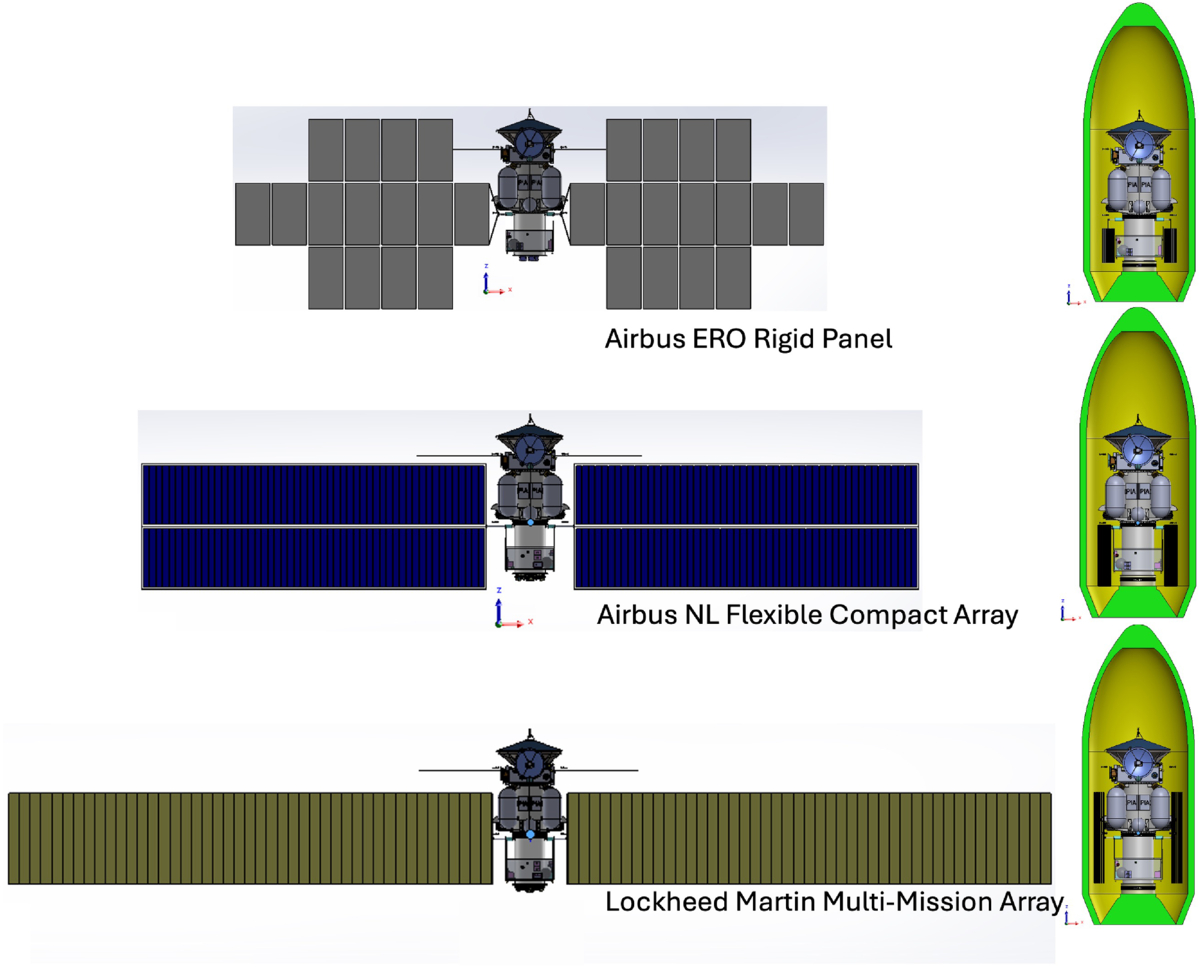
Several proof-of-concept designs for the mission’s SEP components. How these designs would be packaged into a rocket fairing for launch is shown at right. Click to enlarge. [Simon et al. 2026]

Recently, a team led by Amy Simon, NASA Goddard Space Flight Center, took on this challenge and tried to chart a new path through the solar system. The team realized that solar electric propulsion (SEP), a technique that relies on using solar panels to create electricity and accelerate ions to create thrust, might offer a path forward. By using SEP, the mission could leave Earth, unfurl wings of solar panels, then gradually accelerate for as long as there was enough sunlight to power the engine.

The power levels would likely get too low just a few astronomical units into their journey, but that would be enough: after discarding the SEP stage, the mission could coast to Uranus on a journey that would take only 13 years. Even better, this technology has a proven flight history and would require little maturation or development. The BepiColombo mission to Mercury is currently using SEP, and similar techniques are used on satellites in Earth orbit today.

Simon and collaborators also took on a number of other challenges that have cropped up since the mission was proposed, including fewer available plutonium power sources and a re-assessment of Uranus’s rings that revealed hazards in the original flight path. Their work brings the mission closer to the launch pad and illustrates how much iteration goes into the spacecraft that finally takes to the stars.

Citation

“Uranus Orbiter and Probe: Mission Challenges and Concept Updates Since the Origins, Worlds, and Life Decadal Survey,” Amy A. Simon et al 2026 Planet Sci. J. 7 143. doi:10.3847/PSJ/ae680c

The post Who Needs Jupiter? appeared first on AAS Nova.

  •  

Nearly impossible? How Fairphone built the ethical, repairable Fairphone Gen 6+

Smartphone longevity didn't used to matter. In the past, before you could wear out or break a phone, there was always some shiny new thing to buy. Today, we expect our smartphones to go the distance, but they've also become less repairable and, in many cases, more fragile. Fairphone, a Dutch smartphone maker that has just entered the US market, thinks about phones differently.

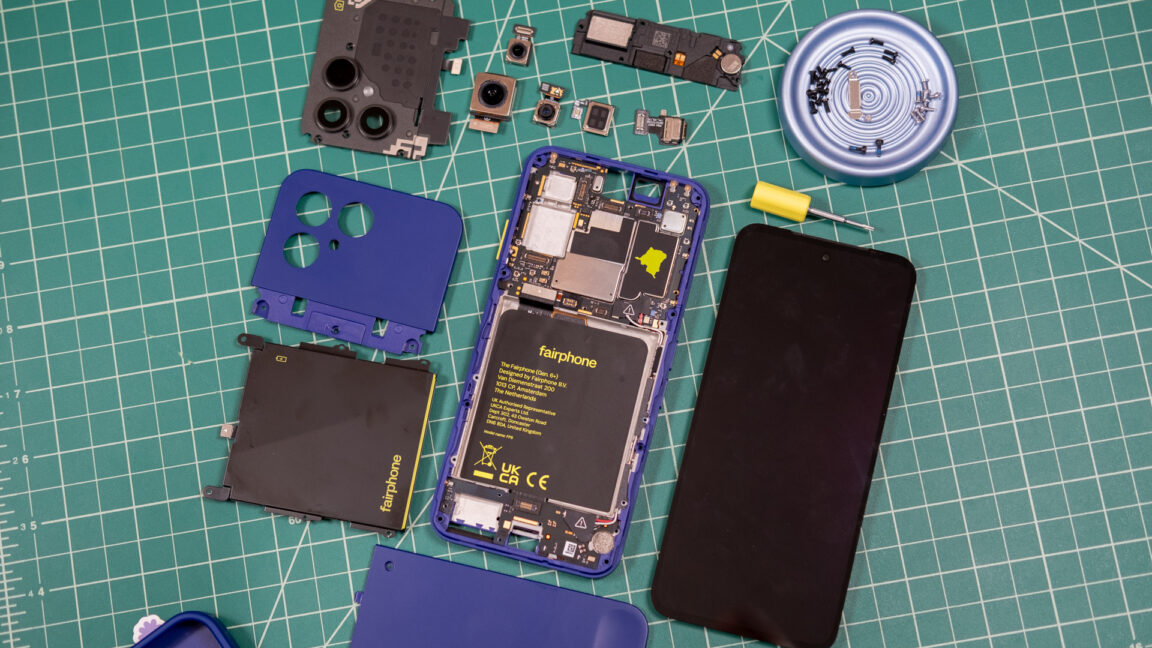
The new $650 Fairphone Gen 6+ is designed both for longevity and easy repairability. There are trade-offs to this approach if you're used to the standard glass and aluminum sandwiches filled with glue, gaskets, and teeny-tiny screws. But the drawbacks could be worth it for the right buyer. Fairphone CTO Chandler Hatton told Ars that Fairphone's goal is to provide a compelling mobile experience while also enabling the user to "fully own" their device. At the end of the day, this is what a lot of people say they want in a smartphone.

Take it apart, put it back together

These days, Google, Samsung, and Apple support phones with software updates for the better part of a decade, but will the hardware last that long? And what happens when it needs a repair? You may be out of luck or out a lot of money, but Fairphone prioritizes the self-repair experience.

Read full article

Comments

© Ryan Whitwam

  •  

Meet the 2026 Ig Nobel Prize winners

It's that time of year again, when we learn which lucky scientists are among the winners of the Ig Nobel Prizes. This year, the prizes honor research on designing the perfect splash-free urinal; using mosquito proboscises to "necroprint" tiny nozzles; studying composition rates of buried cotton underwear; and the aerodynamics of a healthy nose-blow, among other highlights.

Established in 1991, the Ig Nobels are a good-natured parody of the Nobel Prizes; they honor “achievements that first make people laugh and then make them think.” The unapologetically campy awards ceremony features miniature operas, scientific demos, and "24/7 lectures," whereby experts must explain their work twice: once in 24 seconds and the second in just seven words.

Acceptance speeches are limited to 60 seconds. And as the motto implies, the research being honored might seem ridiculous at first glance, but that doesn’t mean it’s devoid of scientific merit. In the weeks following the ceremony, the winners will also give free public talks, which will be posted on the Improbable Research website.

Read full article

Comments

© YouTube/Improbable Research

  •  

Primordial Planetesimals from the Guts of Population III Stars

Protoplanetary Disk

While previous investigations of planet formation across the universe’s history suggest that planets trickled into the picture, a recent study has found that primordial planetesimals could have formed much earlier from the insides of the first stars in the universe.

First Stars, First Planets?

When the first stars flickered on, the universe was filled with pristine gas, containing only hydrogen, helium, and a little lithium. This gas, though great at making massive stars known as Population III (Pop III) stars, was not yet enriched with the heavy elements necessary for planet formation and, of course, life. Past studies have suggested that planet formation in the universe was gradual, taking several billion years to peak after billions of stars created and spilled the needed metals into the universe. However, local pockets of enriched gas from Pop III stars could have created the right conditions for planet formation earlier in the universe’s history.

Pop III stars burned bright and fast, exploding violently in pair-instability supernovae that completely shredded the progenitor, ejecting over 100 solar masses of metals into their previously pristine surroundings. Cosmological simulations suggest that oxygen from these supernovae could have produced significant water fractions within the dense cores of the supernova remnant. This may have set the stage for planet formation in water-rich disks around subsequent generations of stars as early as 150–200 million years after the Big Bang — does numerical modeling support this planet formation hypothesis?

Protoplanetary disk growth

Simulation snapshots showing the formation and evolution of the protoplanetary disk for 13, 21, 30, 40, 50, and 60 thousands of years after protostellar birth. Click to enlarge. [Modified from Vorobyov et al 2026]

Primordial Planetesimals in Simulated Water-Rich Disks

To test if these water-rich dense cores within Pop III supernova remnants could form planetesimals, the building blocks of terrestrial planets, Eduard I. Vorobyov (University of Innsbruck; Southern Federal University) and collaborators performed numerical simulations tracing the collapse of one such gas core into a protoplanetary disk around a protostar. The simulations begin from the gravitational collapse of a 1-solar-mass gas cloud core, with a protostar emerging 24 thousand years after the initial cloud collapse. As the protostar’s gravity pulled in material from its surroundings, a rotating disk formed around the growing star.

Protoplanetary disk evolution and planetesimal growth

Simulation snapshot 40 thousand years after the formation of the protostar showing the gas, dust, and planetesimal surface densities and the dust-to-gas ratio. Click to enlarge. [Modified from Vorobyov et al 2026]

Tracking the gas and dust evolution in the disk, the authors found that several Earth masses of planetesimals formed within 0.5–1.0 au of the 0.4-solar-mass protostar. While the simulations did not trace the disk all the way to planet formation (this requires complex multi-body modeling and lots of computing power), enough planetesimals formed to create a Mars- or Earth-mass planet in the future. Luckily, unlike their live-fast and die-young predecessors, low-mass stars born from Pop III supernova remnants would still be burning hydrogen in their cores today, and ancient metal-poor stars in the Milky Way’s halo may be home to the universe’s first planets that could be detected in future exoplanet surveys. This study showed, for the first time, that water-rich protoplanetary disks with planetesimals could pop up billions of years earlier than previously thought, changing our understanding of planet formation in the universe.

Citation

“Planet Formation at Cosmic Dawn: Planetesimals in H2O-rich Disks around Low-mass Stars,” Eduard I. Vorobyov et al 2026 ApJL 1007 L51. doi:10.3847/2041-8213/ae907c

The post Primordial Planetesimals from the Guts of Population III Stars appeared first on AAS Nova.

  •  

I rented a car, and within hours, my driver's license was for sale

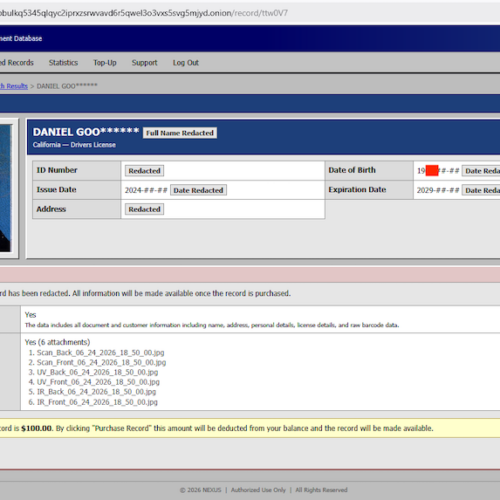
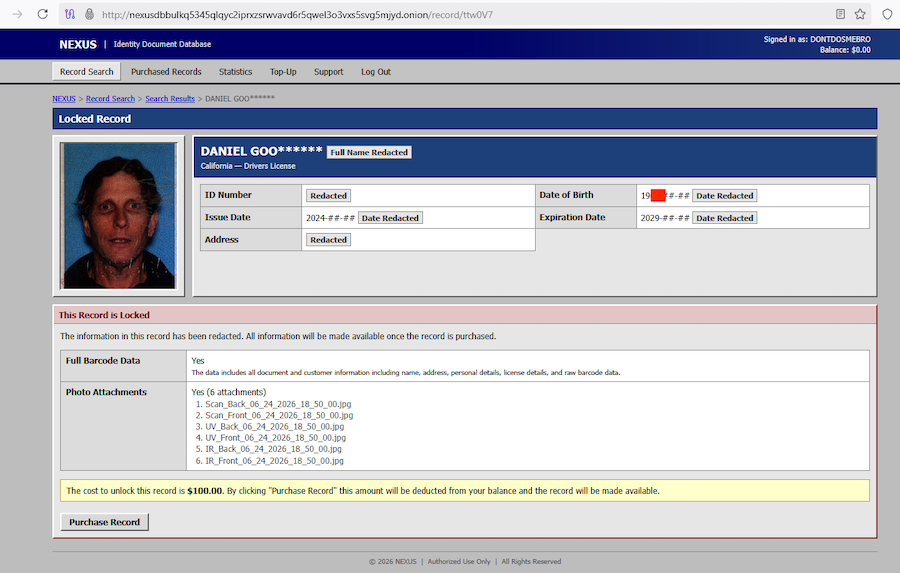
Not long ago, I rented an SUV from a well-known car rental company. Within hours of an employee scanning my driver's license, a high-resolution scan of my ID was available for sale on the dark web.

An exposé published Tuesday by KrebsOnSecurity reports that my license was one of more than 153 million that were available through Nexus, the name of the new ID theft service. Like other driver's licenses available there—including some belonging to journalist Brian Krebs, his mother, an FBI assistant director, and several security researchers—my license was purported to include multiple image files showing both the front and back of the ID. Besides a basic image scan, the files also captured the images in the infrared and ultraviolet spectrums. Presumably, the additional formats may allow cloned-based counterfeit IDs to pass hologram tests.

Growing by the day

Besides advertising the availability of driver's licenses, Nexus offered to sell a bevy of other forms of ID. They included:

Read full article

Comments

© Nexus

  •  

Without new landers or rovers, it's helicopters or bust for NASA's Mars program

For the first time in more than 30 years, NASA has no firm plans to send any new landers or rovers to Mars. Instead, the agency's near-term focus at the red planet is on aerial drones, a pioneering mode of exploration that didn't seem realistic until a few years ago.

The first real use of drones for science at Mars will come with the SkyFall mission, a fleet of three helicopters set for launch as soon as late 2028. SkyFall's helicopters will ride to the red planet with NASA's Space Reactor-1 "Freedom" mission, which has the primary objective of demonstrating nuclear electric propulsion in deep space.

The launch schedule is aggressive for SR-1 Freedom and SkyFall, projects that didn't even exist in NASA's portfolio six months ago. NASA's plan for the SR-1 Freedom mission, estimated to cost $2.1 billion, calls for repurposing the core module of the canceled Gateway lunar space station into a testbed for nuclear electric propulsion. SkyFall will build on NASA's success with the Ingenuity helicopter, an experimental vehicle that became the first rotorcraft to fly on another world in 2021.

Read full article

Comments

© AeroVironment

  •  

A B-52 Carrying Two Hydrogen Bombs Broke Apart Over North Carolina in 1961—and Nearly Caused a Nuclear Disaster

On January 23, 1961, a pair of thermonuclear bombs fell from the sky near Goldsboro, North Carolina. Neither of the weapons was dropped by a foreign adversary—they belonged to the United States, and in a remarkable series of events, they were dropped over American soil after the B-52 carrying them broke apart in midair.

The sobering circumstances that unfolded on that date were just one of several “Broken Arrow” incidents—accidents involving nuclear weapons that, in several cases, demonstrated how catastrophe could arise not from an enemy attack, but from mechanical failure, human error, and chance.

Goldsboro was neither the first nor the last nuclear weapons accident on American soil. More than six decades later, the incident remains a sobering artifact of the Cold War and a reminder of the extraordinary risks that accompanied keeping nuclear-armed aircraft continuously ready for war.

Nuclear Incident Over North Carolina

Early 1961 was a hard time for the B-52 bomber, with several crashes occurring across the United States. Most of these, and even the brief grounding of all B-52s, were minor news stories at the time. Outside the local area, sources like the New York Times gave only brief coverage of what happened in Goldsboro on January 23, 1961. However, the Goldsboro News-Argus placed a dark image of the twisted, flaming wreckage on its front page the next morning, and its ongoing coverage provided some of the only detailed records of how the public viewed the crash. What they didn’t know nearly killed them.

Part of the 4241st Strategic Wing under Strategic Air Command, the B-52G Stratofortress was armed with two Mark 39 hydrogen bombs and flying out of Goldsboro’s Seymour Johnson Air Force Base. Its nighttime flight was part of Strategic Air Command’s round-the-clock alert operations. Following an aerial refueling over the Atlantic, the plane began leaking fuel. This led to a dramatic midair breakup 11 hours into the flight, so spectacular that a night watchman eight miles away reported seeing sparks coming off the stricken plane.

During the crash, centrifugal forces became so great that they pulled a lanyard connected to the release mechanism of one of the bombs. This accidental twist of physics armed the bomb as it fell toward Earth.

USAF Goldsboro crash site
A U.S. Air Force photo of the crash site in 1961 (Image Credit: USAF)

Nuclear Response in Goldsboro

The plane crashed only a few hundred feet from the home of the Tyndall family, who described the event as looking “like the whole world was on fire.” Homes for miles around shook from the force of the impact. In the mad dash to reach the crash site, one military police officer was involved in a car accident, adding one more bit of destruction.

The Stratofortress, with its 185-foot wingspan, was an enormous plane, and it left behind a massive debris field. The burning wreckage quickly drew not only about one hundred Air Force personnel but also the state highway patrol, local sheriffs, and the fire department. Onlookers attempted to gain access to the site but were held back by military police warning of a potential radioactivity threat. This would be the only time for decades that the military would concede that the crash posed a nuclear danger.

It took seven hours to find the last survivor, one of only three from the eight-man crew aboard the Stratofortress.

After most of the wreckage was hauled away, the Air Force continued excavating the area to recover every piece of the plane and even turned to the public for help locating a lost ejector seat. These continued searches fueled a wave of rumors that the Air Force was looking for missing nuclear weapons and that the town might be evacuated. What the military called “routine” water tests did little to assuage some residents’ fears that they were in danger from whatever had come down. By late February, the Air Force was issuing official denials that anything was amiss in Goldsboro.

Goldsboro, NC
Historical image of U.S. Air Force personnel working to retrieve components of an Mk-39, one of the two nuclear bombs that fell near Goldsboro, NC, in 1961 (Image Credit: USAF)

Soviet Propaganda

At a time of rising Cold War tensions, the USSR did not let the American crisis go to waste. Soviet propagandists employed “Moscow Molly,” a mysterious figure of the Soviet propaganda machine. Speaking in unaccented English between broadcasts of popular American music, Moscow Molly delivered messages designed to demoralize American, British, and Canadian soldiers. She would sometimes disconcert soldiers on lonely and remote bases by directing messages specifically at them, using personal information reportedly obtained by the Soviet intelligence apparatus. Several women likely played the role of Moscow Molly, but their identities have never come to light.

By January 24, just a day after the event, Moscow Molly was broadcasting over Radio Moscow that the United States hadn’t just inadvertently dropped a bomb on Goldsboro, but that it had gone off, claiming that locals were “incensed.” Soviet propagandists did not stop there, reportedly using ham radio operators to beam the broadcasts into the United States as well.

Their efforts attracted little notice in the United States. The Goldsboro Kiwanis Club drafted an official rebuttal statement to be read over the U.S.-backed broadcaster Radio Free Europe, stating that “The people of Goldsboro are stronger than ever in their belief that the Air Force is a good friend and neighbor.” This statement may have been more than mere propaganda, as hundreds of people attended the funerals of the deceased airmen, demonstrating how the community rallied in the aftermath of the event.

Nuclear Secrets Revealed

The story of rumors, propaganda, and community spirit stood still for decades as the United States continually denied that there had ever been a nuclear close call on US soil. Journalist Eric Schlosser overturned that story while researching his 2013 book Command and Control. One of his Freedom of Information Act requests turned up a document with the rather lengthy title Goldsboro Revisited or How I Learned to Mistrust the H-Bomb or To Set the Record Straight. The title’s parody reference to the film Dr. Strangelove perhaps makes its content even more eerie and surreal.

Sandia Laboratories nuclear weapons safety supervisor Parker F. Jones wrote the report in 1969. In it, he revealed that one of the bombs—the weapon that separated from the aircraft and descended by parachute before becoming entangled in a tree—had come disturbingly close to detonating. The weapon incorporated multiple safety mechanisms intended to prevent an unintended nuclear detonation. When investigators examined it, they found that several steps in its arming sequence had occurred, leaving one crucial low-voltage switch preventing the sequence from proceeding further.

Each Mark 39 carried a yield of several megatons, making the weapons vastly more powerful than the atomic bombs dropped on Japan at the end of World War II. Had one successfully detonated, the immediate destruction would have been catastrophic, while radioactive fallout could potentially have affected areas far beyond Goldsboro.

History often balances on the head of a pin, and this remarkable close call is just one of many such occurrences in the history of nuclear weapons.

Ryan Whalen covers science and technology for The Debrief. He holds an MA in History and a Master of Library and Information Science with a certificate in Data Science. He can be contacted at ryan@thedebrief.org, and follow him on Twitter @mdntwvlf.

  •  

Claude, Codex, and Hermes installed unowned code inside corporate networks

Documentation files on more than 100 websites are referencing potentially dangerous executable content that gets installed automatically when visited by many AI agents. A few dozen companies, some of them Fortune 500s, are among those that executed proof-of-concept code. At least one misconfigured site is directing visitors, human or AI, to live malware.

The potentially dangerous content is in llms.txt and llms-full.txt files, an emerging convention websites employ to provide machine-readable summaries of the site’s content and its high-level structure. These files are the AI equivalent of the robots.txt standard that instructs search engines how to index the site's content. Google Lighthouse, a tool for helping web developers, has more here. Correctly configured llms.txt and llms-full.txt files for Cloudflare are here and here.

How the researchers found it

Researchers at a stealth startup in Israel scanned 6,214 live domains belonging to defense contractors, Fortune 500, and Big Tech companies. Of the 8,265 llms.txt and llms-full.txt files they found (many sites hosted both an llms.txt and an llms-full.txt file), 120 of them, each on a different site, pointed to one or more code packages or domain names that weren’t registered. To test what happens when an AI agent processes such files, the researchers registered a handful of the unclaimed names and hosted packages that caused any machine executing them to reach out to their server. Within an hour, the researchers received a phone-home response from a Fortune 500 company. Over time, they got a few dozen more, some from more Fortune 500 companies and others from startups. Their beacon also recorded the chain of parent processes that spawned each install, ultimately revealing that coding agents, including Claude, OpenAI's Codex, and Nous Research's Hermes, were involved. Anthropic, OpenAI, and Nous Research did not respond to requests for comment by the time of publication.

Read full article

Comments

© Aurich Lawson

  •  

Review: Chuwi's $449 Unibook laptop is a funhouse-mirror MacBook Neo

In another time, the MacBook Neo could have caused a substantial realignment of the lowish-end laptop business. Sure, it has shortcomings compared to the MacBook Air, but it could have at least encouraged PC makers to start shipping consistently decent keyboards, screens, and build quality in the Neo's $599 price window.

The PC makers did start responding, thanks in part to Intel's actually new non-Ultra Core Series 3 processors (codenamed Wildcat Lake). Intel has resisted its usual compunction to serve the budget market with aging, re-labeled silicon and has created a lower-end, lower-performance processor with the same building blocks (and the same manufacturing processes) as this year's high-end, high-performance models.

The likes of Dell, Acer, Asus, and Lenovo began hopping on the Wildcat Lake train fairly quickly, announcing would-be Neo competitors. But it felt like most of them were having trouble matching the Neo's barebones specs, let alone undercutting them. Dell's XPS 13 started at $599, but only for students. It would be $699 for everyone else. Acer's Swift Air 14 was announced at $699, too. Sure, sometimes these offered features the Neo didn't have. But the point of the Neo is that it eschews frills and frippery in favor of nailing the basics.

Read full article

Comments

© Andrew Cunningham

  •  

British Security Coordination and the Limits of Allied Persuasion: How Foreign Partners Can Shape Strategy Through Clandestine Action

At a time when NATO governments are scrambling to prove their usefulness to an American political movement that increasingly treats alliances as bad business deals, the history of British Security Coordination (BSC) carries an uncomfortable relevance. Long before social media campaigns, algorithmic targeting, and armies of online influencers, Britain operated a covert intelligence and persuasion apparatus from Rockefeller Center to convince Americans that Britain’s destruction would pose a threat to America. Directed by William Stephenson during the most dangerous years of World War II, BSC cultivated journalists, exposed Axis networks, encouraged anti-Nazi messaging, and strengthened interventionist arguments inside a country whose public was still wary of entanglement in another European war.

The operation never achieved the sweeping victory later attributed to it. BSC did not bring the United States into the war. Pearl Harbor did. Japan’s attack on December 7, 1941, followed by Nazi Germany’s declaration of war four days later, supplied the shock that transformed public opinion, destroyed the political viability of continued neutrality, fatally undercut the prevailing isolationist position, and made American entry inevitable. BSC’s impact was earlier and in a less dramatic form. It helped shape the political and informational environment in which Americans interpreted the Axis threat, made interventionist arguments more familiar, supported domestic advocates of aid to Britain, and narrowed the distance between defending Britain and defending the United States.

BSC can serve as a case study in both the potential and the limits of allied persuasion. Foreign influence rarely creates a strategic reversal where no domestic interest or political constituency supports one. It can prepare the ground, furnish leaders with usable arguments, strengthen sympathetic networks, expose the costs of inaction, and make a later decision easier when events force the issue. The same question now confronts allies seeking to preserve American commitments under the Trump administration and other populist governments: can they translate alliances into the language of sovereignty, jobs, industrial power, burden-sharing, China containment, border security, energy resilience, and national advantage, or has the modern political environment made the Stephenson model obsolete?

Selling Britain’s Survival as America’s Security

British Security Coordination has been remembered as a remarkable intelligence organization, but collection was only one component of its mission. At its core, BSC represented an exercise in strategic persuasion. Churchill understood that Britain could not defeat Nazi Germany alone and that American industrial production, financial backing, and eventually military power would determine the outcome of the war. The immediate challenge involved gradually shifting the broader political environment in which Roosevelt operated. A president sympathetic to intervention remained constrained by an electorate still traumatized by World War I, an influential isolationist movement, and a Congress responsive to both.

The genius of BSC lies in its recognition that foreign governments are rarely persuasive when they openly advocate for their own interests. Americans already understood why Britain wanted American assistance. Such arguments naturally appeared self-serving and risked reinforcing precisely the suspicions isolationists had cultivated for decades, namely that European powers habitually sought to drag the United States into their wars. Stephenson sought to blur the distinction between Britain’s interests and America’s by promoting the argument that Britain’s defeat would fundamentally alter the balance of power in ways that would eventually threaten the United States itself. German domination of Europe would place hostile naval forces in the Atlantic, undermine hemispheric security, jeopardize American trade, destabilize global finance, and leave America alone to contend with an emboldened Axis.

This may appear obvious in retrospect, but in 1940, the message competed against a deeply rooted belief that geography, existing between the Atlantic and Pacific Oceans, would continue to provide the United States with almost unlimited security. BSC, therefore, had to persuade Americans that changes in warfare and economics had fundamentally altered the strategic assumptions undergirding American isolationism.

To accomplish this objective, Stephenson relied on indirect forms of persuasion because overt government messaging would have attracted immediate scrutiny and likely provoked a nationalist backlash. BSC concentrated on building relationships inside institutions that Americans already trusted. Journalists occupied a particularly important place within that strategy. British officers cultivated editors, correspondents, publishers, broadcasters, and opinion writers to emphasize Britain’s military resilience, Nazi aggression, and the growing strategic consequences of European developments for American security. Arguments carried by respected American publications possessed an authenticity that British diplomatic statements could never achieve.

The organization simultaneously pursued an equally important and less visible mission by identifying and exposing Axis intelligence networks operating throughout North and South America. German espionage involved military intelligence collection, commercial contacts, sympathetic political and social organizations, business relationships, and propaganda outlets. By uncovering these activities and discreetly sharing intelligence with American authorities, BSC helped transform abstract warnings about Nazi subversion into concrete security concerns. Every successful counterintelligence operation reinforced the broader argument that the United States already occupied the frontline of an undeclared conflict, whether it acknowledged that reality or not.

BSC’s activities also extended into the murkier world of political warfare. The organization established front organizations, financed publications, produced black propaganda, circulated forged documents designed to undermine Axis credibility, and conducted influence operations whose precise details remain debated by historians. Some operations undoubtedly crossed ethical lines and remain controversial. Others resembled ordinary intelligence tradecraft employed by nearly every major power during wartime. The broader significance rests upon the cumulative strategy they supported. Stephenson understood that persuasion rarely depends upon a single dramatic revelation. Political environments change gradually as numerous reinforcing signals begin pointing toward the same conclusion.

Equally significant was BSC’s understanding of messenger credibility. Modern discussions of influence often focus on messages while neglecting who delivers them, even though audiences frequently judge information by the source. Americans suspicious of a British speaker would be more inclined to hear the same message from an American journalist, military officer, academic, clergy, or elected official. BSC, therefore, strengthened American voices already reaching similar conclusions rather than relying on overt British advocacy. In contemporary language, those intermediaries served as force multipliers.

This approach reflected a broader understanding of democratic politics. Public opinion seldom changes because citizens suddenly adopt foreign priorities; it changes as domestic debates evolve until new conclusions appear consistent with national interests. Stephenson, therefore, framed intervention through national defense, economic stability, maritime security, industrial production, and shared democratic values. Moral arguments retained importance, particularly as reports of Nazi atrocities reached American audiences, but gained greater force when tied to concrete questions of American security. Britain’s survival increasingly appeared intertwined with America’s own long-term security.

Perhaps the organization’s greatest strategic insight was that political persuasion resembles investment more than an immediate transaction. BSC could not predict which crisis would force a decision, but it could shape the intellectual landscape through which Americans would interpret that crisis. Its purpose was to ensure that later events would be understood through an established framework linking British survival to American security.

Pearl Harbor Made the Decision

The mythology surrounding British Security Coordination has often obscured its genuine historical significance. Popular accounts sometimes portray Stephenson’s organization as the hidden force that drew the United States into World War II, suggesting that a sophisticated intelligence operation succeeded where diplomacy and public argument had failed. That interpretation attributes far greater influence to covert action than the historical record supports. Pearl Harbor transformed American public opinion and political calculations in ways no foreign influence campaign could have achieved. BSC prepared the political terrain upon which that transformation occurred, yet the strategic earthquake itself came from Japan.

By late 1941, Roosevelt had already moved the United States substantially closer to Britain. The Destroyers for Bases Deal and Lend-Lease had become law, 50 decommissioned American destroyers were safeguarding British shipping in the Atlantic, American factories had begun supplying enormous quantities of supplies, and the US Navy was already escorting convoys through a large swath of the Atlantic as far as Iceland.

American factories were supplying enormous quantities of military equipment, the destroyers-for-bases agreement had strengthened Britain’s Atlantic defenses, and the U.S. Navy had begun escorting convoys through large sections of the Atlantic, as far as Iceland. American and British intelligence cooperation had expanded rapidly, military planning increasingly assumed eventual collaboration, and Roosevelt steadily stretched the limits of neutrality without formally abandoning it. Each of these measures generated fierce political debate, demonstrating that support for Britain had grown significantly while public opinion remained divided over direct participation in the war.

Opinion polling during 1940 and 1941 revealed a pattern that often disappears in hindsight. Americans increasingly favored providing Britain with weapons, financial assistance, and material support because many concluded that a British defeat would ultimately threaten American security. That same electorate remained reluctant to send American soldiers into another European war. The distinction between aiding Britain and becoming a belligerent remained politically meaningful until the very end of American neutrality.

Pearl Harbor eliminated that distinction within hours. Japan’s attack transformed a distant geopolitical debate into an immediate national emergency. The attack united constituencies that had spent years disagreeing over intervention, redirected public anger toward the Axis powers, and supplied Roosevelt with overwhelming congressional and popular support for war. Germany’s declaration of war four days later completed the strategic transformation by linking the European and Pacific theaters into a single conflict for the American public.

No foreign intelligence service possessed the capacity to manufacture such a moment. Even the most sophisticated influence campaign could not replicate the emotional, psychological, and political consequences of thousands of American casualties, the destruction of much of the Pacific Fleet, and the unmistakable realization that the United States itself had become the target of military aggression. Pearl Harbor resolved debates that had persisted for years because it fundamentally altered the facts upon which those debates rested.

That conclusion clarifies rather than diminishes BSC’s importance. By December 1941, arguments connecting Britain’s survival with American security, emphasizing Axis ambitions, exposing German espionage, and questioning the protection of geographic distance had already entered mainstream political discussion. BSC’s cumulative effect was to make those ideas familiar before Pearl Harbor changed the strategic environment.

BSC therefore succeeded in ways that prove difficult to measure through conventional historical benchmarks. It did not produce a single decisive speech, one transformative publication, or one covert operation that permanently shifted American policy. Its achievements accumulated gradually across journalism, intelligence cooperation, elite networks, political discussion, and public understanding of European events. The cumulative effect narrowed the distance between supporting Britain and defending American interests. When Pearl Harbor fundamentally changed the strategic environment, those arguments required remarkably little adaptation because they had already become familiar to much of the political establishment.

Roosevelt remained the principal architect of American policy. His public case emphasized American security, Atlantic defense, industrial mobilization, and the consequences of allowing authoritarian powers to dominate Eurasia—arguments that overlapped with themes BSC reinforced through unofficial channels. British influence functioned as an amplifier, giving domestic leaders additional evidence and language while leaving political ownership with Roosevelt, Congress, and American voters.

These limits extend beyond World War II. Elections, legislatures, media scrutiny, competing interest groups, and public opinion prevent outside actors from redirecting democratic strategy at will. Effective allied influence instead prepares conditions under which future decisions become easier to justify when events create political opportunities.

Allied Actions That Built Trust and Political Support

BSC was distinctive in scale, but its underlying approach was not unique. Governments have repeatedly sought to shape partners whose cooperation they considered essential. Such campaigns worked best when they reinforced developments already underway rather than attempting to create new political realities. Allied persuasion has therefore usually functioned as a force multiplier, not an independent engine of policy change.

The most obvious historical comparison predates BSC by nearly a quarter-century. In January 1917, British cryptanalysts intercepted and deciphered the Zimmermann Telegram, in which German Foreign Secretary Arthur Zimmermann instructed his ambassador in Mexico to propose a military alliance should the United States enter World War I. Germany promised the Mexican recovery of Texas, New Mexico, and Arizona in exchange for opening a southern front against the United States. The message represented an extraordinary intelligence success, yet the interception itself did not guarantee political impact. Britain had to decide whether to reveal the telegram, how to authenticate it without exposing its codebreaking capabilities, and when its publication would carry maximum credibility.

London handled the disclosure with remarkable care. The telegram reached American newspapers at a moment when unrestricted German submarine warfare had already begun threatening American shipping and commercial interests. Public outrage, therefore, emerged from two reinforcing developments rather than a single revelation. The telegram demonstrated hostile German intentions toward the United States while submarine attacks showed Germany’s willingness to translate those intentions into action. Wilson still required congressional approval for war, and public opinion still evolved through domestic debate, yet Britain’s intelligence disclosure significantly strengthened interventionist arguments already gaining momentum.

The Zimmermann episode illustrates an important feature of successful allied influence. Intelligence rarely changes policy because of its novelty alone. Its greatest impact comes from confirming fears already developing inside the target country’s political system. Had the telegram appeared several years earlier, before submarine warfare transformed American perceptions of Germany, its effect would almost certainly have been weaker. Timing amplified its significance because British intelligence understood how the disclosure fit within an evolving political environment.

British Security Coordination also belongs within a broader history of allied governments seeking to influence the political decisions of friendly powers through covert means rather than open diplomacy. During World War I, France quietly financed and supported extensive information and lobbying efforts in the United States designed to strengthen pro-Allied sentiment among journalists, publishers, academics, civic organizations, and business leaders. French diplomats worked closely with private advocacy groups, cultural institutions, and influential Americans to portray the conflict as a direct challenge to American commercial interests and long-term security rather than merely a European struggle. These efforts did not bring the United States into the war, yet they helped reinforce an intellectual climate in which closer American engagement became progressively easier to defend as German actions intensified.

The early Cold War generated an even broader range of allied influence efforts. Western European governments devoted enormous energy to convincing successive American administrations that maintaining substantial military forces in Europe served American interests as much as European security. Rather than asking Washington directly to defend Europe, they emphasized Soviet conventional superiority, the economic importance of European recovery, the value of forward deployment for deterrence, the protection of Atlantic trade partners, and the geopolitical consequences of allowing Moscow to dominate the continent. American policymakers accepted these arguments because they aligned with Washington’s emerging strategy of containing the expansion of Soviet communism. European diplomacy, therefore, reinforced priorities already developing inside the United States instead of attempting to redirect American grand strategy altogether.

The creation of NATO reflected this dynamic. European governments lobbied for formal American security guarantees, yet the alliance became politically sustainable because Truman and his advisers concluded that preventing Soviet domination of Western Europe directly enhanced American security. Foreign and domestic interests converged around the same strategic conclusion. The alliance emerged from shared interests that foreign persuasion helped articulate, organize, and institutionalize, but the American electorate had the final say.

A more contemporary example emerged during the final years of the Cold War, when the Polish Solidarity movement and its supporters quietly cultivated influential political, labor, religious, and media networks across Western Europe and the United States. The campaign depended upon clandestine communications, covert financial support, underground publications, émigré organizations, and carefully managed relationships with Western opinion leaders. Rather than attempting to persuade governments directly, Solidarity encouraged respected domestic constituencies to frame support for Poland’s democratic opposition as consistent with their own political traditions and strategic interests. Western assistance ultimately reflected far broader geopolitical forces, yet the movement’s success in mobilizing influential voices abroad helped sustain political commitment over many years. Like British Security Coordination, the operation demonstrated that foreign influence becomes most effective when it strengthens existing domestic coalitions, equips trusted intermediaries with credible information, and allows the resulting political argument to appear homegrown rather than orchestrated from abroad.

Israeli diplomacy provides another revealing comparison. Since the 1960s, successive Israeli governments have invested heavily in persuading American policymakers, legislators, journalists, academics, and civil society leaders that Israeli security contributes directly to American interests in the Middle East. Intelligence cooperation, joint military development, congressional trips, think tank events, academic exchanges, business partnerships, and technological developments all represent channels advancing the proposition that Israel advances American interests. These efforts have enjoyed considerable success across multiple administrations because they consistently tied Israeli priorities to American priorities, including security, technological innovation, liberal democratic values, counterterrorism, and regional stability. Even periods of disagreement rarely disrupted the broader institutional relationship because decades of cooperation had already embedded shared assumptions throughout both governments.

Failures are also instructive. During the Cold War, the Soviet Union devoted enormous resources to what it called “active measures,” entailing covert funding, forged or fabricated documents, front organizations, media manipulation, and disinformation campaigns. Moscow occasionally succeeded in amplifying existing political divisions or encouraging anti-American narratives abroad. It achieved far less success in persuading Americans that Soviet geopolitical objectives advanced American national interests. The campaigns frequently relied upon ideological appeals disconnected from the priorities of mainstream American voters, making them vulnerable whenever their foreign origins were exposed.

Across these cases, governments achieved more durable results when they framed cooperation in terms of shared security, prosperity, technology, industrial capacity, or common threats rather than sentiment or moral obligation alone. Foreign influence was most effective when it helped define domestic interests, supplied evidence, and gave leaders language capable of surviving political scrutiny.

These examples place BSC within a broader tradition of statecraft. Its scale and wartime setting were exceptional, but its premise was familiar: military coalitions endure only when members continually persuade one another that cooperation advances their own security. BSC was one chapter in that longer history of allies shaping strategic horizons before events forced irreversible choices.

The Anatomy of Persuasion

The historical cases suggest five recurring conditions for effective persuasion. First, the appeal must align with interests already valued inside the target country and translate them into politically usable language. Governments may sometimes act from moral conviction, but they sustain major commitments through national security, economic prosperity, political stability, and military advantage. BSC presented Britain’s survival not as a charitable obligation but as a prerequisite for American security. Roosevelt could defend aid from a thoroughly American, practical, and philosophical position of strength.

Second, the messenger matters as much as the message. Foreign officials naturally appear to speak for their own governments, while fellow Americans possess authenticity. The same principle extends beyond the media. Universities, think tanks, professional associations, intelligence services, defense industries, and business communities shape the assumptions through which policymakers interpret events and provide networks that leaders consult when crises emerge.

Third, timing determines whether those arguments are available when political conditions change. Governments seldom revise grand strategy during periods of stability, and external shocks create brief opportunities for reassessment. Influence, therefore, generates much of its value before a crisis, when it can establish explanations that later events make credible. BSC spent more than a year reinforcing the idea that Nazi expansion formed part of a wider threat to American security. When Pearl Harbor produced immediate uncertainty and fear, Americans did not have to construct an entirely new framework; they had already encountered arguments explaining the cost of inaction in the fact of Axis aggression and now had an attack on fellow Americans and on American soil, just as the pro-British voices had warned.

Fourth, durable influence rests on institutional continuity and domestic ownership. Intelligence partnerships, military exchanges, academic cooperation, commercial investment, and professional networks can survive electoral change and create reservoirs of trust for future leaders. Foreign partners may supply intelligence, analysis, investment, and practical proposals, but democratic governments must integrate them into agendas that voters regard as national choices. Economic benefits help sustain that ownership. Employment, industrial production, technological innovation, infrastructure, and commercial opportunity connect strategic commitments to visible domestic gains and make cooperation easier to defend across changes in administration.

Finally, influence is cumulative and vulnerable to overreach. It loses effectiveness when it appears patronizing, secretive, detached from local priorities, or dependent on historical friendship and moral obligation alone. Foreign governments also weaken their case when they overestimate their popularity or assume that repetition alone can overcome deeply rooted structural resistance. No single intelligence disclosure, newspaper article, or diplomatic initiative usually transforms policy independently. Strategic change develops through institutional reinforcement, elite consensus, public familiarity, and gradual shifts in political language. BSC’s achievement was not a dramatic act of manipulation, but the slower work of shaping the conversation before history made the decision unavoidable.

Selling Alliances to America First: Could a Modern BSC Work?

The argument over America’s alliances has returned with a force that would have been familiar to the generation that watched Europe collapse in 1940. Donald Trump brought skepticism toward NATO, foreign aid, and overseas military commitments into the center of presidential politics, drawing support from voters who believed that Washington had spent too freely abroad while neglecting the perception (albeit a false one) of industrial decline, the real issue of lax border policies, and economic ennui at home. Any ally seeking to preserve American commitments under those conditions will confront a problem much like the one Britain faced before Pearl Harbor: how to show that assistance to other countries serves the United States and contributes to the security and prosperity of American citizens.

Stephenson could not rest Britain’s appeal on sympathy, historical memory, or references to a shared civilization. His campaign worked because it translated Britain’s survival into a matter of American self-preservation and carried that argument consistently into public debate. A modern effort would require the same translation across a more fragmented political landscape, where different communities respond to different forms of evidence and different messengers.

An appeal to NATO’s history carries limited force with a populist administration. It is easier to make the case when the alliance is connected to American factories, shipyards, ports, and energy terminals, where allied spending already supports production that the Pentagon may later need during a crisis. European purchases of American aircraft, missiles, munitions, communications systems, and other military equipment sustain specialized workers and suppliers. When those economic ties are made visible, NATO becomes easier to defend as part of the country’s industrial strength, military readiness, and capacity to replenish weapons during a prolonged conflict.

The argument also becomes more persuasive when placed within the larger competition with China. A Europe capable of carrying more of its own defense burden gives Washington greater freedom in the Indo-Pacific and reduces the risk that simultaneous crises will exhaust American forces. Cooperation on semiconductors, critical minerals, secure communications, advanced manufacturing, port infrastructure, and vulnerable supply chains can also limit Beijing’s ability to exploit economic dependence or divide allied markets. For a political movement that already regards Chinese power as a direct threat to American prosperity and security, the connection between European defense and competition in Asia can make NATO appear less like an inherited obligation and more like an instrument of American power.

Energy offers another route because it joins security with commerce in a form that voters can recognize. Europe’s movement away from Russian supplies has enlarged markets for American liquefied natural gas and encouraged investment in ports, storage facilities, shipping, and related infrastructure. The protection of sea lanes helps American exporters as surely as it helps European consumers, while closer energy cooperation reduces the ability of hostile states to use fuel supplies as a political weapon and cash cow to finance aggression. Presented in those terms, the alliance becomes part of the country’s economic security and supports industries whose importance extends well beyond foreign policy debates.

The same reasoning reaches into domestic law enforcement. Terrorist financing, smuggling, cybercrime, narcotics trafficking, document fraud, and sanctions evasion move across borders with little regard for the institutional divisions between foreign policy and homeland security. European services often encounter parts of these networks before they reach the United States, and close intelligence cooperation can expose financial ties, travel routes, procurement chains, and criminal intermediaries that no single government could trace alone. Such work gives an old alliance a direct role in protecting Americans from dangers they already recognize and allows cooperation abroad to be understood through the needs of security at home.

Foreign investment can make the connection visible at the local level, where arguments about alliances often remain abstract. Allied companies employ American workers, support regional suppliers, fund research, and support millions of jobs. F-16s from South Caroline, artillery shells from Pennsylvania, JDAMS from St. Louis, helicopters from Connecticut, energy flowing from a terminal in Texas, all carry more political weight than a multilateral summit declaration from Brussels because local communities can see the financial impact in jobs and tax revenue. The challenge is to contextualize lest it be forgotten that the “arsenal of democracy” wouldn’t exist without purpose and partnerships.

Arguments of this kind have circulated for years, yet repetition alone has done little to secure durable support. Stephenson’s achievement came from his ability to cultivate relationships inside American society and provide useful information to people already inclined toward closer cooperation with Britain. He worked through journalists, officials, business figures, and civic networks who could make the argument in their own name and adapt it to the concerns of their audiences.

The task is far more difficult now than it was in 1940. Stephenson dealt with a country whose public conversation passed through a relatively small number of newspapers, magazines, radio networks, and prominent commentators. Contemporary America is fractured across many separate political worlds, each shaped by different media figures, regional interests, and habits of trust. A governor may carry more weight than a diplomat, a veteran may be more convincing than a scholar, and a local business owner may reach people who would ignore a national columnist. No single argument can reach all of these audiences with equal force, and no national campaign can assume that the same evidence will persuade communities whose interests and fears differ so sharply.

The geography of persuasion, therefore, deserves close attention. Communities tied to defense production will view NATO through employment, procurement, and the survival of local industry, while energy-producing regions may care more about exports, ports, and pipeline security. Border states and law-enforcement networks may respond more readily to intelligence cooperation against trafficking and organized crime, while technology firms and manufacturers may focus on Chinese industrial espionage and legal and illegal strategies to cause dependence on vulnerable supply chains. An ally seeking influence would need to understand these differences and work through concerns that already exist within each place, rather than expecting a single national argument to carry the entire burden.

Digital tools make such precision easier while also increasing the danger of exposure. Governments and private firms can identify narrow audiences, study patterns of opinion, and place information before selected groups with extraordinary accuracy. Journalists, cybersecurity researchers, and political opponents can also trace coordinated activity, expose hidden sponsorship, and reconstruct the movement of money and information. A covert campaign that became public could discredit the alliance itself and confirm the suspicions of voters already wary of foreign interference, particularly when those voters believe that national institutions have grown too responsive to outside pressure.

Legal restrictions create another obstacle because foreign lobbying, campaign finance, online advertising, election activity, and undisclosed advocacy now attract intense scrutiny. Wartime methods once tolerated under emergency conditions could carry serious consequences in a contemporary democracy, where even lawful influence can become politically toxic if it appears secretive or manipulative.

A quieter, clandestine role remains possible, although it would need to be narrower and more carefully controlled than the operations Stephenson supervised. The risk of enemy exposure is too great. Allied services could gather and share evidence concerning Russian sabotage, Chinese economic penetration, cyber threats, illicit procurement, terrorist financing, and organized crime. American officials, journalists, and researchers could then assess that material and decide how to use it within their own institutions. This approach would preserve American control over the argument while allowing friendly foreign intelligence to strengthen joint efforts with evidence unavailable through ordinary public debate.

Distrust remains the greatest obstacle because populist movements often treat agreement among foreign policy elites as proof that the system is self-serving. Visible pressure from allied governments can make an otherwise sensible policy appear suspect, particularly when it seems coordinated with institutions that many voters already distrust. An ally that speaks too loudly may damage its own cause, while a campaign that relies too heavily on secrecy may confirm fears of manipulation. Influence is more likely to succeed when Americans conclude their own political experience and through people whose loyalty they do not question.

BSC still offers a useful lesson because Stephenson understood that Britain’s interests would gain force only after they became inseparable from America’s. A modern allied campaign would have to show, with evidence and persistence, that NATO strengthens American industry, protects the country’s energy position, supports homeland security, and gives Washington greater freedom to counter China, Russia, and Iran. Its success would depend on relationships built long before the next crisis, benefits visible enough to survive changes in administration, and a degree of trust that cannot be created through slogans or purchased through advertising.

Preparing the Ground Before History Decides

The enduring significance of BSC lies in recognizing that the key to success is the slow work of influencing Americans to understand that a given policy is an expression of their own interests. Governments often devote enormous attention to managing crises while investing far less in shaping the political conditions that determine how those crises will later be understood. The decisive advantage frequently belongs to those who recognize that strategic relationships are built gradually through countless individual decisions made by businesses, universities, military institutions, intelligence services, legislators, and civil society long before presidents and prime ministers are forced to make historic choices.

That observation carries particular relevance for an era of political polarization and increasingly transactional foreign policy. Alliances will be judged less by their history than by their continuing ability to adapt to changing domestic priorities. Those that remain flexible, generate new constituencies, and demonstrate value in changing economic and security environments are likely to endure. Those who rely primarily on past achievements or institutional inertia may discover that history alone is rarely enough to sustain political commitment across generations.

Irina Tsukerman is an American lawyer and analyst based in New York. She has written extensively about foreign policy and security issues for several think tanks, and frequently provides insights as a subject matter expert for various U.S. and international media outlets. 

  •  

The Republic of Veiled Tongues: An Afghan Woman Reports from Inside Afghanistan

In this Op-Ed piece, Samreen Makhfi, an Afghan woman currently living in Afghanistan, reflects on life in Afghanistan five years after the Taliban’s return to power, using the country’s Independence Day—August 19—as a contrast between its historical aspirations and present conditions. The Debrief’s Chrissy Newton contributed to this report.

Today is August 19, 2026. One hundred and seven years ago, on this day, King Amanullah Khan declared Afghanistan independent. Were Queen Soraya alive to witness this day, sorrow would overwhelm her. Perhaps sorrow would be too small a word.

She carried the torch of education for Afghan girls, believing that a nation could not walk forward while half of its people were kept behind. Now that torch seems to have been extinguished by decrees and prohibitions. Girls are shut out of secondary school and university. Women’s paths into professions that once promised them a future as teachers, doctors, engineers, and artists have narrowed or disappeared. They are granted only the bitter permission to survive, polishing men’s shoes until their hands harden, and begging in the streets until their voices become hoarse. 

My sister tells me she even misses the honking of the car that used to take us to school, that impatient horn we once felt irritated by. Back then, she complained about waking up too early and counted the days until holidays. Now she says, “I even miss the feeling of being sleepy, the heavy eyelids, the rush of morning air, the chatter of classmates as soon as we entered the gate.”

What once felt like a burden became a relic. I miss the little shop near our school. I remember the elderly uncle who seemed to know exactly how easily my sweet tooth could betray me. He would smile when he saw us and say, “I’ve brought a new flavor of cupcakes and chocolate.” It is strange how oppression can make you nostalgic for things you once considered ordinary.

Consequences of closing those classroom doors reach far beyond the girls sitting behind them. Afghan men want female doctors to treat their wives, mothers, and daughters. They want women to be cared for by women, especially in matters of health and childbirth. But how can tomorrow’s female doctors exist when today’s girls are prevented from becoming students? The ones who are denied education are the very girls who could have filled those roles. 

Decree No. 18, issued in May 2026, states that a girl’s silence after puberty can be interpreted as consent to marriage. Imagine being too young to understand what marriage means, yet old enough, according to the law, for your silence to be placed on a contract you never knew you were signing. And if that marriage becomes a place of violence rather than safety, escape is not equally available to her. Men retain unilateral divorce rights, while women face restrictive judicial avenues for separation. Even the language of the law can become another wall between a woman and the life she wants to reclaim.

However, the walls do not end at the home. The country’s beauty is fenced off, too; women are not allowed to visit many tourist sites, even with their families. Restrictions on women’s access to public spaces have made ordinary pleasures such as parks, public places, and travel another negotiation with authority. I think of Qargha. Its waters glitter beneath the sun, and the breeze carries the scent of pine. Somewhere in that landscape, a girl should be able to laugh beside the water and to dip their hands into its coolness. But even the beauty of the country can become gendered. The mountains remain visible. The lake remains blue. The wind still moves through the trees. Only the people allowed to enjoy them have changed.

At this point, men’s situation is no better than ours. University graduates joke bitterly, “We successfully completed the journey from ‘university students’ to ‘unemployed’.” The joke lands because everyone knows a degree has become a piece of paper. A profession has become a distant possibility. A young person looks toward adulthood and finds the road strangely empty. One of today’s high officials even declared that political loyalty can matter more than merit in terms of opportunities. 

Once, even our flawed elections gave us the illusion that our voices could tug, however weakly, on the direction and fate of the country. The ballot box was imperfect, but it gave people the sensation of having a hand on the wheel. Now even that thread has snapped. There is no ballot to mark, no campaign to argue over, no candidate to disappoint us after promising something better. Right now, citizens have no say in the politics of their country. In the media, the only journalists who can survive are those who avoid talking about everything that is going wrong. And underneath the politics is something much more immediate.

Bread

For many families, bread is scarce, and work is scarcer. Poverty does not always arrive dramatically. Sometimes it is an empty cupboard and fridge, a postponed purchase, or a child asking for something that a parent cannot afford. Sometimes it is watching one family struggle while another, somehow, continues to live comfortably, its pockets lined with opportunities that seem to belong to a different Afghanistan.

Leaving has become its own kind of privilege. A person can dream of another country and still find the border of that dream closed. Visas are denied or restricted, and the simple desire to travel somewhere else, to see another country, breathe different air, return home again, can become almost impossible. And yet, even in the face of closed borders, desperation has driven many Afghans to move anyway.

Many, overwhelmed by the hopelessness of life here, have even fled toward Iran while war was still raging there. They looked at a country caught in conflict and somehow decided that perhaps danger there was preferable to the life waiting for them here. There is something devastating about that calculation. When people begin comparing one war with another and asking which one might be easier to survive, you know home has stopped feeling like home.

Afghanistan remains

The mountains have not packed their bags. The morning sun still spills over Kabul. Children still laugh. Mothers still cook. Someone still opens a shop in the morning. Someone still remembers the taste of a particular chocolate. Somewhere, perhaps, a girl still keeps an old school notebook tucked inside a drawer, its pages filled with handwriting from a life that feels increasingly distant. And still, some study through second‑hand phones, and some work online.

Perhaps the world remembers us; perhaps it has turned away. But the true heroes are those who carry our story in their lungs, those who breathe it in, breathe it out, and refuse to let silence become the final language of Afghanistan.

Poem by Samreen Makhfi

It is the fifth year now and the walls 

are coming closer

inch by inch, stone by stone

I come to the tree


The same one that has stood through 

all our years, older than my father

older than his father, a witness planted 

deep in the bones of Kabul


It remembers the golden days

of Zahir Shah, and the ones that followed 

It saw the first Taliban rise

and watched them fall


It watched the Republic arrive with its 

promises, its flags, its endless foreign money 

pouring into the pockets of men who enjoyed 

themselves in air-conditioned rooms when civilians 


paid with their blood 

Then it saw them return. Again.The Taliban

I place both hands on the trunk

and shake it with everything I have


The bark scrapes my palms

The smell of sap rises into my throat

“Tell me,” I scream, “how can you still stand?”

“How, when you have seen everything?”


Great-grandfather cut your branches

for the bitter winters, and you grew them back.

Grandfather carved your strong wood

into a swing for his grandsons,


Father sat beneath your shadow

when the Kabul sun burned the streets white.

And you–you still stand.

I press my forehead against your skin.


You are warm. Steady. Alive.

I am here to borrow some of your strength.

I am tired of history repeating itself 

I am tired

I am tired

I am tired

Samreen Makhfi is the pen name of an Afghan woman currently living in Afghanistan. 

  •  

An Interstellar Comet’s Coma Composition

A photograph showing a fuzzy comet coma and some streaked stars alongside.

Astronomers have been measuring comets for centuries. But in December of last year, researchers collected a unique set of comet observations: they recorded some of the highest-quality data of one of the weirdest known comets while it was far from the Sun.

Simultaneous Spectra and Images

A few months after the famous interstellar comet 3I/ATLAS rounded the Sun and began its journey back into the space between the stars, a group of astronomers led by Nathan Roth (NASA Goddard Space Flight Center) aimed JWST in the direction of its retreat to watch it fade away. Using a special observing mode that leveraged the Integral Field Unit (IFU) in JWST’s Near Infrared Spectrometer, these observations didn’t result in just a single image of the comet, but a full stack of images, each corresponding to a different wavelength of light.

Using the IFU allowed the observers to combine the best of both regular imaging, which reveals spatial structure, and standard spectroscopy, which reveals wavelength dependencies. As a result, they could make spatially resolved maps of how the emission from the comet’s fuzzy atmosphere of gas and dust, or coma, changed with distance from the comet’s icy nucleus and angle to the Sun. Since different molecules radiate at different wavelengths, these maps in turn reveal the composition and geometry of 3I/ATLAS’s coma.

Mapping the Coma

A flux vs. wavelength plot showing a forest of narrow, well-resolved lines.

The spectrum of the coma of 3I/ATLAS. Note that this is a real spectrum, not a simulation. The contributions of various molecules are labeled alongside their most prominent emission lines. Click to enlarge. [Roth et al. 2026]

These maps, and the spectrum created by summing all of the spatial pixels together, reveal the comet’s coma in gorgeous detail, including hundreds of individual spectral lines that can be attributed to specific molecules. These maps revealed two unique features.

First, in contrast with normal solar system comets where water is the most abundant molecule, water was actually a secondary player here: there was significantly more carbon monoxide, or CO, than water in 3I/ATLAS’s coma. The researchers note that this might not be representative of the true distribution of the two species, but instead be the result of the timing of these observations. When observing a standard solar system comet, astronomers usually examine their targets when the object in question is within 2 au of the Sun. At these close distances, solar radiation is strong enough that water ice dominates the outgassing and activity in a coma.

However, these IFU measurements were taken when 3I/ATLAS was about 2.4 au from the Sun, or right in the transition region where water doesn’t sublimate as easily as CO or carbon dioxide (CO2). It’s likely that as the comet approaches the so-called “ice line” where water will naturally freeze out, CO will only increase its domination of the coma.

Top row: Maps of the distribution of various molecules in the coma. The white arrow shows the direction toward the Sun. Bottom row: The spatial distribution of the temperature of each species. Click to enlarge. [Roth et al. 2026]

Every Molecule for Itself

Second, each molecule seemed to be outgassing in its own unique direction from the coma. CO is leaving the nucleus in two different jets, one aimed directly back at the Sun and one perpendicular to it; CO2 and methane (CH4) are both leaking away in the anti-Sun direction; and water and methanol (CH3OH) are sublimating in nearly spherically symmetric shells. The authors speculate that these geometries may be caused by different “active sites” on the comet, and that had they observed the comet for one full rotational period, they might have seen these jets pointing in different directions.

Although 3I/ATLAS is now too far and faint for observations like these, this study reveals just how much we can learn in the brief time interstellar visitors spend in our solar system. When the fourth interstellar comet inevitably wanders through the inner solar system, astronomers will doubtless be ready to use this observing mode again.

Citation

“Coma Physics of an Interstellar Object: JWST Spatial-Spectral Mapping of 3I/ATLAS,” Nathan X. Roth et al 2026 ApJL 1005 L5. doi:10.3847/2041-8213/ae7443

The post An Interstellar Comet’s Coma Composition appeared first on AAS Nova.

  •  
❌